
Reading Time: 35 Minutes
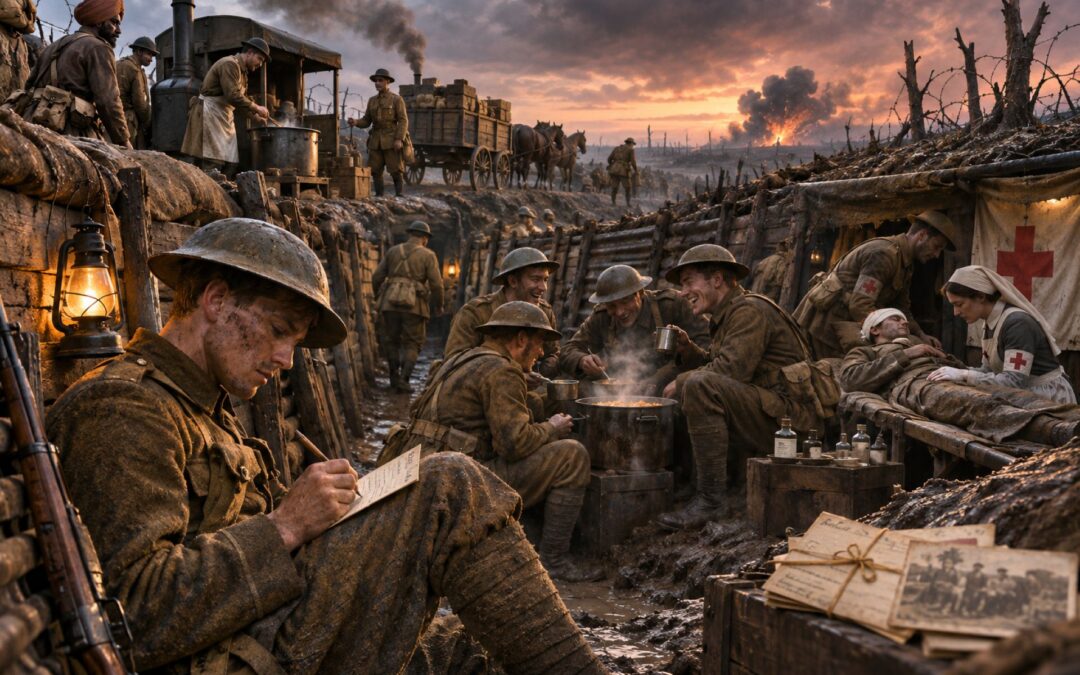
A soldier could spend an entire morning repairing a trench he might be ordered to abandon that afternoon. He could be hungry even when a kitchen had finished cooking his dinner, or receive a letter that had been chasing him across France for five months. If he was wounded, reaching a hospital might depend first on four exhausted men finding a way to carry a stretcher around a muddy corner. These were not distractions from the fighting. They were part of what made fighting, surviving and sometimes simply remaining in place possible.
The Western Front of the First World War is remembered through its great battles, shattered landscapes and enormous casualties. Yet between offensives, armies lived according to a relentless timetable of guard duty, trench repairs, food distribution, correspondence and medical care. Each familiar comfort depended on people and institutions stretching far beyond the firing line. To understand the soldiers’ experience, it helps to follow not just the infantryman but the meal he ate, the letter he opened and the route by which a wounded comrade might leave.
Most of the examples here concern British and British Empire forces in France and Belgium, especially in the middle and later years of the war. Conditions differed across armies, sectors and seasons. The recurring routines and illustrative journeys reveal how the system worked without pretending that every soldier endured the same day.
The Western Front: A Battlefield That Became a Place to Live
The First World War did not begin as a static contest between opposing trenches. In August 1914, German armies advanced through Belgium into France, while French and British forces fought, retreated and counterattacked. The German advance was checked at the Marne in September. A succession of attempts to outflank the enemy then pushed the fighting north until opposing armies occupied positions running toward the North Sea. By the end of the year, a broad system of connected defenses had emerged across the Western Front.
Men dug for immediate protection because remaining exposed to artillery, rifle fire and machine guns could be lethal. Temporary holes deepened into trenches, and trenches became organized positions that had to be defended for weeks or months. The ground was not uniformly level or wet: some sectors were relatively dry, while low-lying parts of Flanders became notoriously flooded. Nor was the front motionless throughout the war. Positions were attacked, captured, abandoned, rebuilt and extended, even where a large-scale map showed little change.
A front-line trench faced the enemy, but it was only one part of a defensive network. Support and reserve trenches stood farther back, linked by communication trenches through which men, messages, equipment and supplies could move with some protection. Bends called traverses restricted the distance along which an enemy could fire or a blast could travel. A raised fire step let men observe or shoot over the parapet; dugouts provided whatever shelter the local ground, resources and circumstances permitted.
In front of the line lay no man’s land, often marked by barbed wire, shell holes, damaged vegetation and the remains of earlier positions. Its width varied enormously. Crossing it by daylight could expose a person to observation and fire; crossing at night presented different hazards, including patrols, sudden flares and ground made treacherous by shelling. Trenches were designed to protect those inside them, not to make every movement easy. The bends that limited an enemy’s field of fire could impede a stretcher, while a flooded communication trench might stop the delivery of food.
The result was an unusual kind of home and workplace. Soldiers inhabited a defensive structure they also had to maintain, sharing confined space with weapons, tools, rations, waste, vermin and one another. Above all, they lived within an immense organization whose outer limits were almost invisible from the fire step. Much of what kept a man alive arrived through routes he rarely saw.
A Soldier’s Daily Routine: From Dawn Stand-To to Endless Work
A front-line day often began before the sun appeared. During the period known as stand-to, soldiers occupied their firing positions with rifles ready and watched the enemy line. Dawn was regarded as vulnerable: troops might have assembled in darkness, and the growing light could reveal preparations for an attack. An attack might never come. The expectation of one nevertheless demanded attention from men who had already been woken repeatedly during the night.
When stand-to ended, there could be inspections, breakfast and another round of work. Rifles needed cleaning; ammunition, equipment and defenses needed checking. Sentinels continued watching while others carried supplies, filled sandbags, repaired trench walls, cleared blocked passages or tried to rest. Much of this labor was repetitive because rain, foot traffic and shellfire could undo it almost as soon as it was finished. A safe position one morning could be unstable or impassable by evening.
Military instructions reveal how seriously commanders regarded such everyday work. Canadian trench standing orders, for instance, addressed sentry duty, patrols, sanitation and the care of weapons and equipment alongside preparations for combat. The Canadian War Museum’s account of trench routine shows why waiting did not mean idleness. Thousands of ordinary tasks made it possible for a unit to remain alert, protected and ready to fight.
A soldier might be sent to repair a fire step or replace sandbags supporting an exposed wall. Another would carry timber or work on drainage. Wooden duckboards helped people move over wet ground, but they could break, sink or require repositioning. Latrines had to be maintained, refuse managed and pathways kept clear. When a working party finished, someone still had to stand guard, keep a record or take over the watch of an exhausted comrade.
The rhythm was governed partly by visibility. Daylight might make an ordinary errand hazardous if a route lay within the enemy’s sight. Darkness provided cover for moving supplies, extending defenses and repairing wire, but also concealed the enemy. A soldier could thus spend a daylight interval waiting in a trench and much of the night performing work that would have been dangerous in the sun. The timetable rarely accommodated uninterrupted sleep.
A remarkable first-hand account survives in a letter written on 5 January 1917 by Hugh Andrew Skilling, a British serviceman writing from France to a former colleague. He described flooded positions, nights without shelter and labor interrupted by gas shells. Yet he also wrote about a new assignment in army photography, friendly Australian servicemen and an enjoyable Christmas. His different circumstances appeared within the same correspondence, illustrating how a man’s service might move between severe hardship and periods of relative security.
That contrast matters. Soldiers did not live continuously at the most exposed point of the battlefield, and an army was not staffed exclusively by infantrymen standing on fire steps. Men were transferred, rotated, reassigned, trained and employed in specialized duties. An infantryman might pass from a miserable trench to comparatively sheltered quarters, only to find that his supposed rest included marching, carrying equipment and another set of orders. The description of a typical day is useful because it identifies recurring tasks, not because it captures an unchanging experience.
What transformed these chores into wartime labor was the possibility of sudden violence. A man clearing mud could be struck by shellfire. A routine inspection could be interrupted by a gas alarm, and a watch that had seemed uneventful might end in an attack. On this front, the distinction between ordinary work and mortal danger was never secure. Keeping the trench usable was itself a military achievement.
Mud, Rats, Lice and the Physical Cost of Trench Life
The famous mud of the Western Front was more than an unpleasant background. In low-lying ground, rain, damaged drainage and shell holes allowed water to collect where soldiers needed to stand, walk and sleep. Trenches could flood above the ankles or knees; communication routes sometimes became unusable altogether. Pumps, duckboards and constant digging helped where conditions permitted, but the weather and artillery could overwhelm efforts to keep the ground passable.
Skilling described water above his knees and the difficulty of moving through flooded trenches. His letter is compelling precisely because it records a particular extreme experience. Elsewhere, officers or soldiers might occupy dry dugouts with flooring, beds or shelving. Captain Maurice Asprey, whose letters are discussed by the National Army Museum, described improvements to his accommodation. These accounts should remain side by side: neither the comfortable dugout nor the flooded trench tells the whole story.
Prolonged exposure to damp conditions could produce trench foot, a disabling injury associated with cold, wet feet and impaired circulation. Looking after feet was therefore more than a matter of personal comfort. Changing socks, drying boots and inspecting feet helped maintain a soldier’s ability to walk, carry loads and remain on duty. A unit might lose men to preventable injury even without taking part in a major engagement. Obtaining dry clothing and a place to wash was consequently a military concern as well as a personal one.
Body lice imposed another recurring burden. They lived in clothing, tormented men who could not wash regularly and transmitted trench fever, an illness that might incapacitate a soldier for an extended period. Men searched seams and shirts for the insects, while military authorities issued advice for controlling infestation. The existence of organized guidance about lice shows how an apparently minor irritation could become a problem affecting manpower and health across an army.
Rats also found shelter and food in crowded defensive positions. They disturbed men trying to sleep and got into stores that were difficult to protect. Asprey complained of rodents in his porridge oats and of animals waking him at night. Such memories are more useful than lurid claims that every trench was equally infested. They show how even moments without enemy action could be consumed by the work of keeping food safe and securing a little rest.
Sanitation was difficult wherever many people remained in confined quarters. Latrines had to be dug, cleaned and sited according to the ground available; rubbish and contaminated water required attention. Men were expected to maintain cleanliness in positions where water, dry surfaces and adequate shelter could be scarce. These problems were connected. Flooding impeded waste disposal, dirty clothing encouraged infestation, interrupted sleep weakened men already exposed to cold, and illness reduced the labor available to maintain the defenses.
Sleep itself was easily broken by shellfire, orders, sentry rotations, bad weather or the movement of others through a crowded position. Some men might lie down for hours without enjoying sustained rest. Exhaustion made familiar decisions harder and the smallest improvement valuable: a dry blanket, a repaired floor, washed clothing, a warm drink or a period out of immediate danger. Such comforts were not evidence that the front had become safe. They were reminders of what ordinary functioning required when almost every condition made it more difficult.
How the Army Supplied Food to the Western Front
A soldier could not live on courage, and the question of where his dinner came from reached far beyond the trench. Food might arrive through Channel ports before passing into military depots and onto trains. Railways delivered consignments toward railheads and advanced supply points; from there, lorries, horses and carts took them nearer to units. The final stage would require another form of work, but at this point the army was moving ingredients and ration stores, not a single cooked meal kept warm from Britain to the battlefield.
In June 1917, a photograph preserved by the National Army Museum shows rations being collected at the railhead at Écuires in France. A railhead was where railway transport handed supplies over to other carriers. Its usefulness depended on the transport system behind it and the personnel able to distribute what had arrived. Roads could be damaged, horses required feed and water, and lorries needed fuel and maintenance. The ration delivered to one soldier embodied many earlier journeys.
The Army Service Corps played an important role in organizing supplies and transport. Quartermaster personnel connected what the army had allocated with the strength and needs of individual units. A consignment had to reach the right destination and be divided correctly. William Kirk, in an oral-history account preserved by Imperial War Museums, recalled supplies moving from motor transport to horses before being apportioned among units. His memory shows how administrative numbers became practical decisions about loads and recipients.
Food available to British soldiers included bread, hard biscuits, tinned meat, fresh or preserved vegetables, jam and tea, although no particular meal necessarily contained every item. Bully beef, the familiar name for tinned corned beef, was valuable because it could be stored and transported. The National Army Museum’s history of army food illustrates how preserved rations, field cooking and improvised meals could coexist. Soldiers also obtained food through parcels, purchases or opportunities behind the line, so memories of what men ate differ substantially.
Turning supplies into an organized meal required people who knew how to cook for groups. The British Army had a military cooking manual before the war, with a 1910 edition reprinted in 1914. It explained how to supervise cooks, measure quantities, maintain utensils, organize fires and establish field kitchens. A sergeant cook could oversee the preparation and train men in the practical work. This was not the later Army Catering Corps, established during the Second World War; in 1917, military cooking was arranged through units and their cooks.
The manual expected groceries to be checked against diet sheets and the number of men to be fed. It recommended variety and described such dishes as stews combining meat, vegetables and seasoning. Those instructions expressed intended practice, not a promise that every front-line unit received an appetizing, changing menu. A cook could work only with the ingredients, fuel, water, vessels and time available. A well-written recipe could not make missing vegetables appear or repair a road cut by shellfire.
The supply system was global even when the evening meal looked thoroughly British. Railway workers, drivers, animal handlers, port laborers and workers from overseas helped sustain the lines of communication. The soldier holding a rifle might never meet the person unloading a consignment, but the success of that person’s work could determine what appeared in his mess tin. Feeding an army was a continuous logistical operation whose last, most difficult link had still to be completed.
From Field Kitchen to Front-Line Trench: The Journey of a Hot Meal
Imagine a British infantry unit holding a front-line trench in 1917. Its ingredients have reached the cooks, who prepare a substantial stew, bread and perhaps tea for the men on duty. The kitchen is not necessarily in the front trench. Placing a large cooking fire farther back could provide more working room and make preparation easier, but it introduced a final journey over damaged ground. The meal was ready for the cook before it was ready for the men who needed to eat it.
A military cooking manual treated the preparation of a large meal as a sequence of practical tasks. Meat and vegetables had to be divided, water collected, vessels arranged and fires tended. The size of a cooking group depended partly on what its kettles could hold. In a crowded field kitchen, the cook had to manage heat, capacity and timing rather than simply place an oversized pot over a roaring flame. Some recipes called for gentle cooking that could be spoiled by excessive heat. A shortage of dry fuel or a missing vessel could upset the whole schedule.
Water was needed not just for the stew but for drinks and cleaning. The manual considered field cooking positions built with trenches, turf and chimneys that directed heat around kettles; these were cooking arrangements, not the firing trenches occupied by infantry. It even advised cooks to carry dry kindling when moving between camps because wet conditions could make the next fire difficult to start. Such instructions show that tomorrow’s dinner might depend on something the cooks carefully saved today. When the food was prepared, equipment still needed washing and setting up for the next round.
Now the hot stew had to be moved. Large metal containers commonly called Dixies could hold cooked food or drinks. A container that performed perfectly beside a fire might be awkward on a narrow, uneven route. The complete weight included the vessel as well as its contents, and carriers had to keep the lid secure. A pot of liquid stew could not be tipped and swung around obstacles like a bundle of biscuits. Its heat began to escape long before it reached a soldier’s spoon.
Insulation could slow that loss, although it could not generate new warmth or eliminate delays. A striking surviving example is a British-made insulated carrier associated with the Australian 18th Battalion. The Australian War Memorial’s shell-damaged food container had double walls and straps that allowed it to be carried on a man’s back. Near Villers-Bretonneux on 8 July 1918, a German shell passed through it while food was being prepared near a cookhouse. The shell failed to explode, and the damaged carrier survived as evidence of both ingenuity and danger.
That object should not be mistaken for the standard equipment of every carrying party. Some men moved meals in ordinary metal vessels, and the availability of insulated equipment differed. The lesson is broader: supplying heat and preserving it were separate problems. Even a well-equipped kitchen could be shelled; even a protected carrier could lose warmth if the route became blocked. A hot dinner depended on decisions made after the cooks finished their own work.
Ration parties supplied the human labor that heavy transport could not complete. Soldiers collected assigned loads and carried them toward particular positions through communication trenches or other available routes. John Grover recalled ration transport arriving by horse-drawn wagon at a distribution point before smaller parties took supplies farther forward. Australian recollections also describe the carrying of tea and stew in Dixies, sometimes through shellfire and sometimes without a successful delivery. Different memories reflect different sectors, times and circumstances rather than a single universal standard.
Consider what a narrow trench meant for two men carrying a heavy container. One had to make room for the other at a bend, and both needed secure footing. A stumble could spill the meal, injure a carrier or leave a group waiting. Darkness made the party less visible to the enemy but also concealed holes, damaged duckboards and obstructions. Daylight offered easier navigation while increasing exposure where an enemy could observe the route. An unexpected bombardment could force a choice between waiting and attempting an even more dangerous passage.
The result could be a cold meal prepared perfectly well. A soldier’s disappointment with his dinner did not necessarily prove that the cook was incompetent or that no food had been issued. The problem might have arisen between the kitchen and the front, where a difficult route steadily consumed the heat the cook had produced. Quantity, warmth, hygiene and taste were different aspects of a meal; success in one did not guarantee success in the others.
Once the food arrived, someone still had to divide it fairly among the men. A large Dixie fed nobody until its contents had been portioned into individual mess tins. Some soldiers might still be on duty while others ate. Bread and tea could arrive at different times, and preserved meat could be eaten cold, heated or mixed into a dish. Small portable stoves made cooking near the front possible in some conditions, so there was no absolute rule that every mouthful had originated farther back.
If ordinary supplies failed, soldiers had an emergency iron ration intended for exceptional circumstances. It was not simply an extra meal to open whenever dinner looked unappealing. The ration parties had to return, vessels had to be cleaned and recovered, and kitchens needed equipment for the next preparation. The soldier’s brief moment with a warm mess tin was the end of one complicated journey and the beginning of the next day’s work.
Letters From Home: The Postal Network Behind the Trenches
A letter opened in a front-line position might contain a child’s news, a photograph, a request for advice or an apology for a delayed reply. To the recipient, those ordinary details could be precious because they preserved his place within a family or friendship from which war had physically removed him. He was still a son, husband, brother or colleague, even when the army controlled where he slept and what he did each day. Getting that page into his hands required a network almost as elaborate as the one that supplied his food.
A sender in Britain needed a usable military address, usually identifying the recipient’s unit rather than the exact patch of ground where he stood. That arrangement allowed correspondence to follow a moving army without requiring a family to know sensitive operational locations. The postal workers still had to connect a name and unit to the correct current formation. A battalion might be moved, a man transferred, or an item sent while its recipient was on an entirely different duty. A correct name could be necessary without being sufficient.
The Army Postal Service drew on the skills of Britain’s civilian post office, and its personnel served within the wider military organization. Frank Musgrave had joined the General Post Office in 1905, initially as a messenger boy and later as a postman. In 1915 he enlisted in the Royal Engineers postal section. He became one of the people moving other families’ messages while depending on letters from his own family. The postal worker in uniform was not outside the experience of separation he was helping others endure.
Much of the outgoing correspondence passed through the Home Depot at Regent’s Park in London. The Postal Museum’s First World War collections describe an operation that handled enormous volumes of wartime mail: approximately two billion letters and 114 million parcels. Individual messages were sorted into groups that could be sent toward the appropriate military routes. The work turned private addresses into transportation decisions, then repeated that operation at scale day after day.
Women formed a particularly important part of this postal workforce. By 1918, the Home Depot employed predominantly women, and wartime pressure had contributed to the suspension of a marriage bar that normally forced many female employees to leave their jobs after marrying. Workers sorted correspondence, handled damaged packaging and repaired parcels that had to survive repeated transfers. The restriction was restored after the war, revealing how emergency responsibility could coexist with a lasting reluctance to grant women equal employment freedom.
From Britain, a letter could pass through a Channel port to one of the British postal bases in France, including Le Havre, Boulogne or Calais. Railways, vehicles and carts then helped move mail toward army post offices and distribution points. Finally, local military arrangements placed the item in the hands of the person it was meant to reach. An expression such as ‘the letter arrived in the trenches’ concealed the sorting rooms, shipping, trains, transport workers and regimental distribution that made that last handover possible.
The family of Elizabeth Brown reveals how correspondence connected one fixed home to several moving soldiers. Her sons served in different units while letters returned to the same address in Eastbourne. A request for photographs of family members makes the exchange especially tangible. The recipient wanted not merely information but a face to look at. Correspondence could also contain instructions for the next letter or parcel, giving the exchange a rhythm in which one arrival prompted another response.
Musgrave’s own correspondence offers another example. He married Maud Mabel in January 1917, and the Postal Museum preserves 76 postcards he sent across their separation between 1917 and 1919. He acknowledged parcels, books, photographs, letters and newspaper cuttings. Each acknowledgement established that a particular thing Mabel had chosen and posted had reached him. The postcards were not isolated declarations of affection; they formed pieces of a continuing conversation, with surviving references to fuller letters that are not always preserved.
Parcels made affection materially useful. In December 1915, Robert Thorp told his father about waterproof socks and Christmas presents, including chocolates and mince pies, that had been sent to him. Socks mattered because a soldier’s feet faced damp and cold; food offered an immediate comfort to someone engaged in hard physical duty. Families supplemented military provision through choices shaped by what their relatives said they needed. Yet each parcel was another load that somebody had to sort, transport, protect and deliver.
Not every message was written on plain paper. Embroidered silk postcards, often made in France or Belgium and sold to servicemen, carried flowers, affectionate motifs or regimental imagery. Private Holly Christmas frequently sent postcards to his wife Adah alongside longer letters. The surviving affectionate messages complicate the stereotype that men of that generation rarely expressed tenderness openly. Repeated greetings can record the effort of sustaining a relationship just as clearly as a dramatic declaration.
The system worked impressively, but it could not guarantee that a recipient would have the time, paper or opportunity to reply. In November 1915, Jonathan George Simmons wrote from France while wet through and without dry clothing. Regimental Sergeant Major Arthur Harrington explained to his wife in September 1914 that his opportunities to write arose mainly while he was eating. A silence at home might therefore mean more than postal delay: the missing letter might not yet have been written.
Censorship, Missing Letters and the Emotional Cost of Separation
Sending a letter from a military position introduced a question that did not arise in ordinary family correspondence: who else might read it? British soldiers in the ranks generally had their freely written letters inspected by an officer within their unit. Censors looked for details that could be useful to an enemy, including operational information and locations. The writer’s personal concerns could thus pass through the hands of a superior with authority over his everyday life. The desire to keep secrets and the desire to speak privately were never entirely compatible.
A green envelope offered a limited alternative. A soldier could certify that its contents concerned private matters and avoid inspection by his own regimental officers, although the letter remained liable to examination at the base. The arrangement did not suspend military secrecy. It changed who was likely to read a personal message before dispatch, creating a measure of distance between a man’s family conversation and the officers he served under.
The field service postcard solved the problem by sharply restricting the message itself. Its statements were printed in advance, and the soldier crossed out those that did not apply. He could report that he was well, acknowledge a previous letter or promise to write when possible, then add his signature and date. Unauthorized additions could lead to the card being destroyed. For the postal and censorship systems, a fixed message was manageable; for an anxious family, the smallest permitted news could be immense.
One card preserved from the Gallipoli campaign included an authorized Christmas greeting, showing that even strict standardized messages could accommodate particular occasions. Elizabeth Brown received a field card from her son Archie in May 1916. Its surviving choices indicated that he was well, had received her letter and parcel, and intended to reply when he could. Those simple statements documented two completed journeys. Her news had reached him, and his answer had returned home.
The National Archives’ collection of letters from the trenches provides a more frustrating example. In January 1917, Hugh Skilling explained that a letter sent the preceding August had only just reached him. Its envelope had apparently been forwarded through a succession of regiments and officers before catching up with his assignment. We know about this journey from his reply, not from a fully recoverable record of every stop the envelope made. During part of his service, he had also been able to send little more than a field card.
These were two different causes of apparent silence. Incoming mail could be delayed because a man was difficult to locate; outgoing news could be restricted because he lacked the opportunity or permission to send a full letter. The sender at home might see only the absence of a reply. Meanwhile, the recipient’s circumstances could have changed completely by the time a message finally arrived. Skilling had moved into photographic work and was enjoying a period of companionship far removed from the flooded positions he also recalled.
A returned letter could cause still greater alarm. In July 1917, a letter Elizabeth Brown had sent to her son Harry came back marked ‘missing’ after fighting near Nieuport. The label described the army’s incomplete knowledge, not necessarily the man’s fate. Harry had been captured and was later transferred to a prisoner-of-war camp at Bayreuth, in Bavaria, after initially being held at Dülmen. His subsequent prisoner correspondence shows how an administrative mark and the actual experience of a serviceman could diverge. For a family, however, the returned envelope created an urgent search for news.
Prisoners of war faced a different communication route. Charlie Cole, a private in the Buffs captured in 1918, sent postcards to his wife Martha expressing his wish to return to his family. He died in captivity in September of that year, but Martha was still seeking his whereabouts the following January and learned of his death through the Red Cross. A card could prove that its writer had been alive at the moment he sent it. It could never guarantee what had happened since.
Distance magnified the uncertainty. A letter crossing the English Channel might sometimes arrive relatively quickly, while communication with families in Canada, Australia or New Zealand required much longer overseas journeys. Weather, transport interruptions and censorship introduced further variation. Men serving in the same area could have very different experiences of waiting for news, depending on where their loved ones lived and what routes their letters followed.
For Indian troops serving in France, communication was shaped by language, literacy and colonial power as well as distance. Men who could not write their own letters might dictate them to scribes; letters might then be translated, censored and excerpted for official reports. The British Library’s catalogue of Indian mail censorship records points to correspondence that survived partly because the colonial administration considered it useful to preserve. Historians must distinguish the soldiers’ own words from the categories and judgments officials imposed on them.
Censors sometimes treated these letters as evidence of morale, loyalty or supposedly distinctive characteristics of different communities. Such racialized assumptions are evidence of colonial thinking, not reliable descriptions of whole groups. The letters themselves reveal a range of worries, requests, loyalties, disappointments and advice to people at home, including occasions when men discouraged others from joining the war. A soldier’s written words could influence a decision made thousands of miles away even as officials tried to control what crossed those miles.
Surviving letters are also incomplete records. An individual could deliberately reassure relatives, describe hardship frankly or conceal what he thought would distress them. Collections contain the papers that someone preserved, not every message ever sent. Dates, censor marks, envelopes and references to missing correspondence help reconstruct an exchange, but they do not give an uninterrupted view into its writer’s mind. The emotional significance of a letter lies partly in what it made possible and partly in everything the person waiting could not know.
When a Soldier Was Wounded: First Aid and the Battle to Evacuate Him
Consider an illustrative British infantryman wounded by a shell fragment in the leg in 1917. He cannot walk without help, and the fighting continues nearby. Somewhere behind the line are medical staff, beds and equipment, but none can assist until somebody reaches him and begins moving him toward care. His journey should not be mistaken for a particular patient’s documented experience; it follows a series of routes and decisions known from military records and surviving medical equipment.
British soldiers carried a first field dressing among their equipment. Its sterile dressings offered an immediate response to bleeding or injury before a medical officer could examine the casualty. A nearby comrade might open the packet and try to cover the wound while staying aware of the danger around them. A man with a minor injury might be able to walk toward an aid post; someone who could not move depended on others. The distinction between walking wounded and stretcher cases shaped the whole evacuation process.
Regimental stretcher-bearers worked close to their battalions, with additional bearers and transport belonging to medical formations farther back. Their tasks included finding casualties, administering assistance and carrying those unable to walk. Being designated a medical worker did not make a man physically immune to shellfire. The Red Cross emblem marked a protected role under the laws of war, but it could not stop shrapnel or make a shattered path safe to cross.
The first few hundred yards might be the hardest. In the devastated ground around Passchendaele, rain and shelling created deep mud that impeded both men and stretchers. Teams sometimes worked with fewer carriers than intended, struggling to lift a casualty and maintain footing while exposed to danger. A pause to adjust a grip or recover balance could be essential. A road or rail route hundreds of miles long was useless until human beings had carried the wounded man to somewhere it could begin.
The design of a fighting trench introduced further obstacles. Traverses that protected soldiers from fire made its passages narrow and awkward for a long stretcher. The Science Museum preserves Colt’s stretcher designed for trench corners, an example of equipment adapted to this very problem. Its construction shows that medical evacuation depended not only on the courage of bearers but on attention to the geometry of the battlefield. A stretcher was part of the transport system and had to work where the patient actually lay.
The bearers also needed to know their route. Surviving maps used by stretcher-bearers around Messines identify paths and medical points through a landscape that could be disorienting even without heavy shellfire. Their destination was often the regimental aid post, which might occupy a dugout, damaged building or any workable shelter close enough to receive men from the line. There, a battalion medical officer and assistants assessed injuries, gave initial treatment and decided who required further evacuation.
An aid post was not a fully equipped hospital. Limited space, personnel and supplies restricted the treatment it could provide, especially during a major action when casualties arrived in large numbers. Staff had to determine which men could move, which needed immediate attention and who should be directed to the next medical station. The patient could be given care without yet being safe. His continued survival depended on whether the next handover was possible.
Beyond the battalion lay the field ambulance, a name that can mislead modern readers. It referred to a military medical unit rather than merely a motor vehicle. Its personnel operated advanced and main dressing stations, supplied stretcher-bearers and arranged movement farther back. Some casualties passed through several stations; others bypassed a particular stop when the organization of evacuation or their condition warranted it. Routes were flexible, not a sequence of compulsory rooms that every wounded person visited.
At each station, somebody had to take responsibility for the casualty the previous group had carried in. The original bearers could then return toward the firing line while another team examined, treated or transported the man. When the ground and roads permitted, horse-drawn or motor ambulances replaced the exhausting labor of carrying. The driver, vehicle mechanics and staff coordinating destinations became part of medical care because they determined whether a patient could reach the next treatment point. The journey was a series of practical handovers, not one uninterrupted rescue by a single heroic team.
From Casualty Clearing Station to Hospital: A Journey Through Military Medicine
For a wounded man reaching a casualty clearing station, the journey could pause for an essential reason: he needed treatment more urgently than he needed to travel farther. By the later years of the war, many clearing stations had grown into substantial medical facilities with operating theatres, places for resuscitation and wards capable of holding patients. Some possessed X-ray equipment. They were not simply places where stretchers waited to be loaded onto trains. They were important sites of surgery and decisions about whether a casualty could safely continue.
Medical staff assessed the severity of injuries and set priorities, a process often described as triage. The decision was difficult because the needs of a single patient had to be weighed against the flow of others arriving from the line. Moving a badly injured man too soon could worsen his condition; keeping every patient indefinitely would overwhelm the station. Some required urgent operations, some could be sent on to base hospitals, and men with relatively minor problems might recover sufficiently to return to duty. There was no single route that suited every wound.
Medical practice changed throughout the conflict. The Thomas splint, a device that supported an injured leg, predated the war but became more widely used in military treatment, particularly for serious fractures of the femur. Better immobilization could reduce damage during handling and transport. Improvements in blood transfusion and efforts to clean or manage contaminated wounds also altered what surgeons could achieve. Yet penicillin was not available to treat infected soldiers in this war. Better technique could improve the odds without making the battlefield’s injuries predictable or safe.
The history of the Royal Army Medical Corps places these developments inside a system of personnel, transport and repeated transfers. Each medical team depended on what its predecessors had done. Dressings, splints and careful handling could affect the patient’s condition before he ever reached a surgeon. Equally important were records carried with him. Field medical cards and hospital documents helped preserve information about identity, injury, treatment and movement between stations, especially when the patient was too exhausted or ill to give a clear account.
Once stable enough to travel, our illustrative infantryman might be moved to an ambulance train. Railway transport brought a different scale of possibility: many casualties could travel considerable distances while receiving care. Photographs of British ambulance train No. 15 in 1915 show wards with beds arranged in tiers, along with spaces for medical staff, linen, food preparation and even an operating theatre. Trains differed in their arrangements, but this example shows that a train was more than a carriage containing stretchers. It could function as a moving medical environment.
Nursing made the transitions between treatment and travel workable. Women serving in Queen Alexandra’s Imperial Military Nursing Service and the Territorial Force Nursing Service worked across hospitals, casualty clearing stations, ambulance trains and hospital ships. Orderlies, trained medical staff and volunteers performed other essential tasks. A nurse observing a deteriorating patient during a railway journey or an orderly preparing a place for the next arrival contributed to the continuity of care. Without such work, the capacity to transport people would not necessarily amount to an effective medical service.
At the railway destination, another team had to unload patients and move them by ambulance to a base hospital. Red Cross volunteers helped with stretchers, luggage and transfers. Hospital centres near ports such as Boulogne treated men away from the immediate front. Some patients recovered there or remained for additional operations. Others, if their condition allowed and their needs justified it, could continue to Britain by hospital ship. An official British film from 1916 presents an evacuation route through treatment stations, rail travel and a ship, although its orderly sequence should not be confused with every actual patient’s disrupted journey.
In Britain, military hospitals worked alongside civilian institutions, auxiliary hospitals and convalescent facilities, some housed in buildings adapted for wartime care. Arrival did not always mean recovery, and recovery did not necessarily mean a return home. Some soldiers eventually resumed military duties; others required prolonged treatment, rehabilitation or assistance in living with permanent disability. The medical service could provide a path from battlefield to bed, but it could not determine what the rest of a man’s life would be.
Families had their own information problem. Hospital admissions, transfers and the work of the British Red Cross inquiry service could help locate a missing or wounded relative. A man’s body might move along a route that his family could not see, while records slowly supplied clues to his whereabouts. Here the systems of medicine and correspondence met. What mattered to the wounded soldier was getting care; what mattered to the people waiting for him was also knowing where he had gone.
The People Beyond the Trenches Who Kept the Front Running
The Western Front is often pictured as a confrontation between infantrymen on opposite sides of no man’s land. But an infantryman holding his position depended on cooks, railway workers, mechanics, signallers, animal handlers, medical orderlies and postal staff whom he might never meet. Someone had to maintain a road, repair a telegraph cable, distribute fuel or move a train. Each task was less visible than a charge over the parapet, but failure could leave the front without food, ammunition, information or a route for casualties.
The British war effort drew people from across the empire and beyond. Indian soldiers served on the Western Front, with infantry units particularly prominent during 1914 and 1915. They did not simply become interchangeable British soldiers upon arrival. Language, clothing, religious observances and the preparation of appropriate meals affected daily arrangements. Muslim, Sikh and Hindu soldiers had differing requirements, and broad official categories concealed further individual variation. The surviving sketches of French interpreter and artist Paul Sarrut, for example, help recover named Indian and British servicemen rather than presenting colonial troops as an anonymous mass.
Labor formations also supplied the infrastructure behind the line. Chinese workers made important contributions to construction, repair, transport and related duties, while African and other overseas workers performed different kinds of support labor. Their working conditions, status and relationship to military authority were not uniform. The people supporting an imperial army did not all possess equal power, freedom or recognition. It is therefore inaccurate to treat the phrase ‘British war effort’ as if it described one homogeneous community pursuing identical interests.
Women worked as nurses and postal employees and in the wide range of civilian activities required to sustain wartime forces. The female workers sorting the mail at Regent’s Park and the nurses receiving a patient from an ambulance train illustrate parallel forms of responsibility. Both enabled a man at the front to remain connected with something beyond his immediate position, whether that connection was a letter or a chain of medical care. Their contributions could expand during the war even where legal or workplace restrictions later narrowed opportunities again.
Animals belong in the picture as well. Horses and mules helped move stores over ground where motor vehicles or railways could not complete the journey, and their needs created further demands for fodder, water, handlers and veterinary care. A ration shipment might require the feeding of the animals carrying it. Behind every apparently simple arrival stood other supply requirements, other bodies exposed to danger and other people responsible for keeping the system moving.
The soldier who finally opened a parcel, ate a meal or reached a hospital was encountering the final result of this combined labor. The networks did not always work, and they did not protect everyone equally. Understanding who performed the work makes the familiar battlefield image more accurate. The trench was a point where a much wider human system converged.
Nightfall, Patrols, Raids and the Danger That Never Disappeared
As evening approached, another stand-to commonly brought men back to readiness. Dusk, like dawn, was a moment when changing light could conceal preparations or expose movement. After dark, the trench did not simply become quiet. Working parties used the reduced visibility to move supplies, repair defenses, lay or mend wire, and sometimes carry out tasks beyond the front line. The same darkness also allowed the enemy to move unseen.
Patrols entered no man’s land to examine ground, investigate enemy positions or gather information. Raids went farther by entering an opposing trench, perhaps to capture prisoners or obtain documents. They could require elaborate planning, supporting fire and coordination between different groups. Commanders sometimes valued raids as a way to obtain intelligence, improve tactics or maintain aggression, while men assigned to undertake them might experience intense fear and resent the costs. The same operation looked different from headquarters and from the soldier preparing to cross the wire.
Routine duty remained dangerous without any major offensive. A sniper might watch a familiar opening, and artillery could strike a trench that had been quiet for hours. Men tried to stay below exposed edges and maintain protective cover, but even a careful soldier had limited control over where the next shell landed. Steel helmets were introduced as armies adapted their protection against fragments and other battlefield hazards. Such measures reduced certain risks; they did not abolish them.
Gas warfare complicated the demands on attention. The nature of the danger and the effectiveness of protective equipment changed as armies adopted different agents and improved respirators. Soldiers learned drills for putting on masks, while some chemical weapons threatened breathing and others injured eyes or skin. Wearing a respirator could make digging, carrying or finding a route more difficult. A gas alarm therefore interrupted both fighting and the everyday work required to hold a position.
Communication within the army was another fragile system. Field telephones linked positions and headquarters, but shellfire could damage their wires. Signallers repaired lines under difficult conditions, and other methods included visual signals, carrier pigeons and developing wireless equipment. When equipment failed, runners sometimes carried messages through dangerous ground. Headquarters might need information urgently at precisely the moment when a damaged cable prevented anyone from providing it. One person’s physical journey could restore contact between formations otherwise unable to see or hear one another.
The war also changed how attacks were prepared. Infantry increasingly used grenades and light machine guns, while artillery methods, engineering and coordination evolved through hard experience. The phrase combined arms describes different military branches operating together so that each supports the others. Making that cooperation effective required practice, communication and adaptation. A soldier trained in 1917 might carry different equipment and face different tactical expectations from a soldier who entered the war in 1914.
The front could therefore seem stationary in a newspaper account while changing constantly for the men occupying it. Work at night, raids, shelling, training and reliefs reshaped positions and routines. Danger was not limited to the famous battles remembered afterward. It inhabited the space between them, including the hours when a man was simply trying to bring back dinner or replace a damaged plank.
How Soldiers Endured: Humour, Comradeship, Discipline and Psychological Strain
Life in the line alternated between exhausting monotony and moments of terror. Soldiers looked for ways to retain a sense of themselves beyond their assigned duties. They read books and newspapers, played cards, wrote diaries, exchanged stories and cultivated friendships. These activities did not erase the danger around them. They gave people forms of attention, companionship and expression they could partly control when most of their time was governed by orders.
An unusual example appeared in 1916, when men of the 12th Sherwood Foresters used a printing press salvaged from the ruins of Ypres to produce The Wipers Times. The title played on the way British soldiers pronounced the city’s name. An officer and a sergeant with printing knowledge helped turn the equipment into a satirical newspaper that mocked inflated reporting and military absurdities. Its first issue appeared in February 1916. Producing it required skill, paper, time and collaboration, all in a place where every resource could be scarce.
A newspaper could circulate between men, be read aloud or provoke arguments and laughter. Satire offered a way to register frustration without abandoning the community of soldiers sharing the experience. It was not proof that the war was tolerable or that everyone found its humour comforting. It showed that men could remain critical and inventive even while operating within a strict military hierarchy. Creativity was another activity performed within the confines of wartime routine.
Religion and personal belief offered different kinds of support. Chaplains held services, spoke privately with soldiers and sometimes helped men compose letters. Others drew reassurance from ritual, luck, friendship or a degree of fatalism about events they could not control. No single belief system explains endurance. A person who enjoyed a joke one afternoon might be frightened, exhausted or deeply distressed the following night.
Time away from the front could bring better accommodation, chances to wash, sport, concerts, canteens or visits to friends. But a unit relieved from the firing line was not necessarily on holiday. Rear-area life included marching, training, carrying stores and other labor. The significance of rest lay partly in the contrast: a comparatively ordinary place to sleep or an opportunity to change clothes could make the return of strength possible. The schedule depended on military requirements, not simply on what each soldier needed to recover.
Comradeship and obligation helped many men continue, but they were not the entire explanation. Military authority regulated behavior through orders, inspections and punishment. Offenses could lead to fines, loss of rank, field punishment or imprisonment, while serious cases went before courts-martial. In extreme circumstances, men were executed under military law. Any account that attributes every act of endurance to willing patriotism or friendship leaves out this coercive aspect of service.
Shell shock was the contemporary label applied to a variety of wartime psychological and neurological disturbances. Soldiers might struggle with fear, disorientation, trembling, loss of function or inability to continue serving, although symptoms and diagnoses varied. Wartime medicine did not fully understand the causes, and treatment could be uneven or stigmatizing. It would be misleading to translate every historical reference to shell shock automatically into a modern psychiatric diagnosis. The language and institutions used to recognize the damage have changed considerably.
Surviving letters and memories also present an uneven view of morale. Some men wrote frankly about misery; others emphasized reassurance, hope or the pleasure of an unexpected comfort. Silence might reflect censorship, reluctance to distress family or the simple inability to find time to write. The record preserves soldiers who continued willingly, soldiers who struggled and soldiers disciplined by their own army. Their endurance was made of different mixtures of routine, loyalty, fear, belief, companionship and the practical need to complete the next task.
The Armistice and the Long Road Home
The Western Front changed again in 1918 as German offensives and subsequent Allied advances restored large-scale movement. The long war of maintaining fixed positions became part of the effort to push armies across ground that had seemed impossible to cross. The armistice took effect on 11 November 1918, stopping the fighting on the Western Front. It did not return every soldier immediately to his home, nor did it erase the consequences of years spent in uniform.
Men remained in Europe for occupation duties, administration and the gradual process of demobilization. Canadian soldiers, among others, waited months before most could leave; different formations faced different schedules. Frank Musgrave, whose postal work had helped maintain other people’s connections, remained in France after the fighting ended. Mabel sent him a Christmas postcard, and he returned to Britain in 1919 before resuming postal work. Their letters continued across the boundary between war and its aftermath.
For men returning with injuries or psychological distress, homecoming could mark the beginning of another demanding transition. Some resumed work or family life with relatively few visible obstacles, while others needed long-term treatment, support or adjustments to permanent disability. Public recognition of psychological injury, and the language used to describe it, continued to evolve over subsequent decades. The war’s daily costs could persist after the uniforms were put away.
The documents left behind carry their own limitations. A medical card records treatment and transfer without reproducing a patient’s private thoughts; an envelope shows where a message was sent without revealing everything the recipient felt on opening it. Photographs capture positions, objects and people from particular viewpoints. Read together, however, they allow us to recover a world of effort that casualty totals and campaign maps alone cannot explain.
A ration carrier could reach a trench with warm food only because a cook, quartermaster, driver and many others had completed their work. A letter could find its recipient after months of redirection because clerks and soldiers kept trying to identify where he served. A wounded man could reach a hospital because bearers, medical officers, nurses and transport workers repeatedly accepted responsibility for his next movement. Each small arrival depended on a much larger system, and each could fail.
For the men on the Western Front, surviving a day was rarely a matter of simply standing still until the next battle. It meant keeping watch, carrying burdens, finding food, protecting feet, writing home, repairing shelters and helping the person beside them. Their war was fought with weapons, but it was lived through the ordinary needs that no army could afford to ignore.
Last Updated on November 23, 2026 by Aseem Gupta