
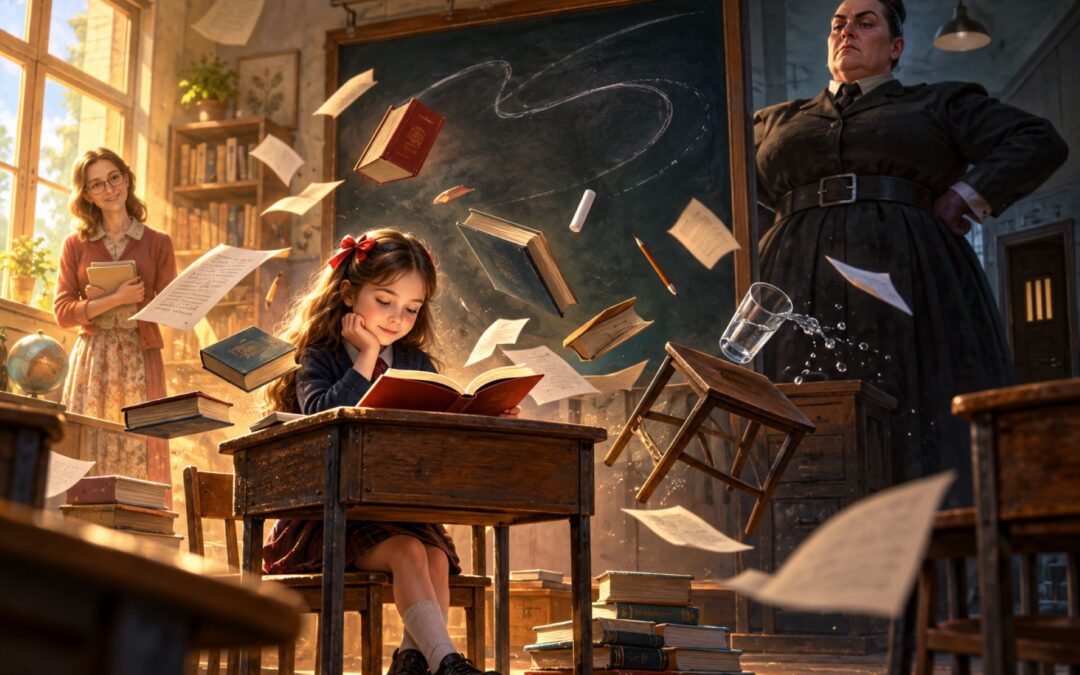
Roald Dahl’s Matilda is built around one of the simplest and most satisfying fantasies in children’s literature: what if the small child whom foolish adults underestimate is not merely smarter than they are, but eventually becomes powerful enough to defeat them? Yet the novel works because it develops that fantasy into something more substantial. Matilda Wormwood begins as an intellectually extraordinary girl trapped in a family that neither understands nor values her; by the end, she has found a teacher who recognises her, used her abilities to free that teacher from an abusive past, escaped her own neglectful parents, and entered a home in which her intelligence no longer has to function primarily as a weapon.
The novel was first published in London by Jonathan Cape in 1988, with Quentin Blake as illustrator, as confirmed by the original 1988 bibliographic record. This article follows the original, pre-2022 form of Dahl’s text. That distinction matters because current editions are not all textually identical: Penguin’s Roald Dahl Classic Collection explicitly reinstates the versions published before the revised 2022 Puffin editions.
Spoiler warning: This article explains the complete novel, including Matilda’s powers, Miss Honey’s history, Miss Trunchbull’s defeat, and the ending.
At its centre, Matilda is a story about recognition. Books allow Matilda to recognise that the narrow world of her family is not the whole world; Miss Honey becomes the first important adult to recognise what Matilda is capable of; and Matilda eventually recognises that Miss Honey, despite being an adult, is also living under the consequences of childhood abuse. Her supernatural power matters, but it arrives only after Dahl has established a more fundamental imbalance: Matilda possesses extraordinary mental ability while almost all the adults with practical authority over her misuse or ignore their power.

Matilda: Complete Plot Summary
The novel unfolds across twenty-one chapters, but its structure is clearer when understood as six connected phases. It begins as a domestic comedy of retaliation, grows into a school story about institutional tyranny, introduces telekinesis only after Matilda has exhausted ordinary forms of resistance, and finally joins her struggle to Miss Honey’s history so that Matilda’s power becomes useful for something larger than avenging herself.
A Brilliant Child in the Wrong Family
Dahl begins by attacking the conventional assumption that parents naturally consider their children wonderful. Some parents, he jokes, are excessively proud even when there is little objective reason for it. The Wormwoods represent the opposite extreme. Their daughter Matilda is genuinely extraordinary, but Mr and Mrs Wormwood treat her as an irritating inconvenience and regard their son Michael, who is much more ordinary, as the child who really matters.
Matilda’s abilities emerge long before she enters school. She teaches herself to read from the limited printed material available in the Wormwood household and soon wants more than newspapers and magazines can provide. Her mother spends her afternoons playing bingo, leaving Matilda at home, so the young girl begins walking alone to the village library. There she meets Mrs Phelps, the librarian, who initially assumes that such a small child will need help finding picture books.
Instead, Mrs Phelps discovers a reader with an extraordinary appetite. Matilda rapidly works through children’s books and asks for something more difficult, eventually entering the world of adult novels. Charles Dickens becomes particularly important, but what matters is the breadth of the experience. Through books, Matilda encounters lives, places, emotions, and moral situations utterly unlike the cramped culture of the Wormwood household.
Mrs Phelps responds in exactly the way Matilda’s parents do not. She does not turn Matilda into a spectacle or constantly announce how remarkable she is; she simply recognises the child’s ability, gives her access to books, and allows her to develop at her own pace. The relationship is quiet, but it establishes one of the novel’s central distinctions between good and bad adults: the best adults do not control Matilda’s intelligence. They make space for it.
Home remains a hostile environment. Mr Wormwood is a used-car dealer whose pride in his business is inseparable from his pride in deceiving people. He purchases poor-quality cars cheaply, disguises faults, alters signs of heavy use, and then sells the vehicles at inflated prices. Rather than being ashamed of fraud, he regards cheating customers as evidence of cleverness and intends Michael eventually to inherit the business.
Matilda immediately sees the moral distinction her father refuses to make. Mr Wormwood may be cunning, but cunning is not the same thing as intelligence, and profit obtained through deception is not proof of superiority. When Matilda points out that his methods are dishonest, he does not reconsider them. He becomes angry that a small girl has challenged him.
That pattern produces Matilda’s first campaign of retaliation. Because she cannot make her father behave rationally through argument, she discovers that elaborate practical jokes can temporarily rebalance the relationship. After one bout of bullying, she secretly puts powerful glue around the inside of his hat. Mr Wormwood puts it on without noticing and discovers that it has become attached to his head.
The joke works because it attacks something he values intensely: his dignity. He has to conduct his business while wearing the hat, sleep in it, and eventually allow his wife to cut it away along with parts of his hair. Matilda never openly claims responsibility, which gives her both revenge and protection. This becomes the pattern of her early resistance: she uses planning rather than force and creates punishments carefully matched to the vanity or cruelty of the adult involved.
The conflict escalates when Mr Wormwood finds Matilda reading The Red Pony by John Steinbeck. His hostility toward books is not passive indifference. He regards reading as an implicit rejection of the television-centred family culture he has chosen and cannot tolerate the idea that his daughter possesses interests outside his control. He damages the library book, which is especially cruel because the book does not belong to Matilda.
Matilda responds with another deception. She borrows a friend’s talking parrot and hides the bird where her parents can hear it but cannot see it. When a mysterious voice begins emerging inside the house, Mr and Mrs Wormwood first fear an intruder and then become convinced that the house may be haunted. Matilda understands that adults who dismiss her imagination can still be controlled through their own.
The prank frightens her parents enough to improve their behaviour temporarily, but the deeper conflict remains. Mr Wormwood later comes home boasting about a profitable day and uses his sales figures to test Michael’s arithmetic. Matilda calculates the result mentally with astonishing speed. Rather than taking this as evidence that his daughter possesses an exceptional mathematical mind, her father accuses her of cheating.
His reaction is revealing because he cannot explain how she could have cheated. The accusation exists simply because accepting Matilda’s achievement would require him to revise his beliefs about her, about himself, and about girls. His sexism makes that resistance explicit: he is more prepared to believe in impossible dishonesty than in his daughter’s intelligence.
Matilda retaliates again by tampering with Mr Wormwood’s hair product and replacing it with some of her mother’s powerful blonde dye. The transformation of his carefully maintained dark hair into an alarming new colour is another attack on vanity rather than physical safety. By this stage, the domestic episodes have established a comic rhythm in which Mr Wormwood asserts arbitrary adult power, Matilda cannot defeat him directly, and she therefore creates a hidden mechanism through which his own arrogance becomes the source of humiliation.
These episodes can look like loosely connected pranks, but they establish almost everything the school plot will later enlarge. Matilda understands injustice before she possesses power over it. She has learned that some adults cannot be persuaded by reason, that cleverness can compensate for physical weakness, and that authority is not automatically legitimate simply because an adult possesses it.
School, Miss Honey, and the Adults Who Refuse to See Matilda
When Matilda finally begins attending Crunchem Hall Primary School, the novel introduces the first adult who will fundamentally change her life. Miss Honey, Matilda’s teacher, is young, gentle, observant, and serious about teaching. Almost immediately, she realises that one of the pupils in her class is operating at an entirely different intellectual level from the others.
Miss Honey tests Matilda cautiously rather than assuming that one impressive answer proves everything. She tries increasingly difficult arithmetic, multiplication, vocabulary, and reading. Matilda continues answering correctly, often without displaying any pride about doing so. The contrast between ability and temperament matters: Dahl does not present Matilda as a child desperate to demonstrate superiority. She is accustomed to knowing things without receiving recognition for them.
For Miss Honey, the discovery is exhilarating and alarming. She understands that keeping Matilda on beginner-level work would waste the child’s ability, so she decides to approach the headmistress, Miss Trunchbull, about moving her into a more advanced class. This is the first time an adult actively attempts to change an institution for Matilda’s benefit.
Miss Trunchbull turns the meeting into a confrontation. She is physically enormous, aggressively authoritarian, and convinced that children are fundamentally disgusting. Where Miss Honey sees teaching as the cultivation of a child’s abilities, Trunchbull sees school as a mechanism for imposing obedience. She does not merely dislike individual misbehaviour; she seems offended by childhood itself.
Matilda is already disadvantaged before Miss Honey begins her argument. Mr Wormwood has recently sold Trunchbull one of his defective cars and has apparently tried to protect his business relationship by describing Matilda as a terrible child. Trunchbull is therefore prepared to believe the worst about a girl she barely knows. She even attributes an earlier act of school mischief to Matilda without evidence.
Miss Honey explains that Matilda can already perform work far beyond the level of the youngest class and should be moved upward. Trunchbull refuses. Her objection is partly personal prejudice and partly institutional rigidity: children of a given age belong in a particular class because that is where the system says they belong. Evidence about the actual child cannot compete with the headmistress’s certainty.
Miss Honey therefore creates a compromise within her own classroom. She gives Matilda more advanced books and exercises to work through independently while continuing to teach the rest of the class. It is an imperfect solution, but it is the first time Matilda’s formal education has been adjusted to what she genuinely needs.
Miss Honey does not stop there. Assuming that any parents would be delighted to learn that their child possesses exceptional ability, she visits the Wormwood home. What follows teaches her that Matilda’s neglect is not a misunderstanding that can be corrected through better communication.
The Wormwoods are watching television and regard Miss Honey’s arrival as an interruption. Mr Wormwood dismisses academic achievement, while Mrs Wormwood presents physical attractiveness, marriage, and conventional feminine success as more valuable than intellectual development. The conversation reveals that their hostility toward Matilda’s interests is not simply ignorance. They possess an alternative system of values and see no reason to change it.
Mrs Wormwood’s position is especially important because the novel does not merely give Matilda a sexist father. Her mother has internalised a model of femininity in which cultivating beauty and obtaining a husband are practical accomplishments, whereas prolonged education is unnecessary or even foolish. Matilda therefore receives no encouragement at home from either parent, though for somewhat different reasons.
Miss Honey leaves with a clearer understanding of Matilda’s position. The child is not simply underchallenged at school; she is growing up in a home where the things that matter most to her are treated as defects. Miss Honey cannot replace the family at this stage, but emotionally the novel has begun moving in that direction.
Crunchem Hall Under Miss Trunchbull
The full nature of Miss Trunchbull’s rule becomes visible through the other children. Matilda and her friend Lavender meet an older pupil named Hortensia, who has survived the school long enough to understand its unofficial laws. Through her, the younger girls learn that Trunchbull’s punishments are so extreme that Crunchem Hall operates almost like an occupied territory.
The most notorious punishment is the Chokey, a narrow cupboard designed to make confinement actively painful. Children can be shut inside when Trunchbull decides they deserve punishment, and the device transforms ordinary school discipline into something closer to torture. Hortensia also describes acts of rebellion she has carried out against Trunchbull and the retaliation that followed.
This information changes the scale of the conflict. Matilda’s battles with her father were private struggles inside one household, but the children of Crunchem Hall possess a collective culture of resistance. They exchange stories about successful tricks, admire courage, and accept punishment as a possible cost of refusing total submission.
Trunchbull’s physical treatment of Amanda Thripp provides immediate evidence that the stories are not exaggerations. Amanda arrives at school wearing her hair in pigtails, a style Trunchbull dislikes. The headmistress seizes her by those pigtails and, drawing on the athletic strength associated with her past as a competitive hammer thrower, swings the child around and launches her through the air.
The event is absurd enough to belong to a cartoon and frightening enough to reveal why the children are terrified. Dahl repeatedly works in this unstable zone. Trunchbull’s violence is deliberately too extravagant to be realistic, yet the emotional pattern underneath it—the adult who humiliates a child because nobody can effectively stop her—is recognisable.
That mixture reaches its most famous expression in Bruce Bogtrotter’s punishment. Trunchbull summons the boy before the assembled pupils and accuses him of stealing a piece of chocolate cake intended for her. Instead of imposing an ordinary punishment, she decides to destroy him through excess.
An enormous chocolate cake is brought out, and Bruce is ordered to eat the entire thing. Trunchbull expects the punishment to work through humiliation. Bruce will become sick, admit defeat, and provide a spectacle demonstrating that resistance to her authority inevitably ends in misery.
At first, the other children watch anxiously. Then something changes. As Bruce continues eating long after Trunchbull expects him to fail, his private punishment becomes a public contest between a child and the headmistress.
The pupils begin willing him onward. Every additional mouthful weakens the meaning Trunchbull intended to impose on the scene. She has all the institutional authority, but she cannot control how the audience interprets what it sees.
When Bruce finishes the cake, the result is effectively a victory. He has obeyed the literal command and thereby destroyed its punitive purpose. Trunchbull, furious that her performance has produced admiration rather than humiliation, smashes the serving platter over his head.
The scene is important beyond its grotesque humour because it demonstrates that Trunchbull’s power has limits before Matilda ever uses magic against her. Authority depends partly upon controlling the emotional response of the people being ruled. Once the children transform Bruce from victim into champion, Trunchbull can hurt him, but she cannot make the school interpret his experience in the way she wanted.
Lavender is inspired by this culture of resistance. Although she is Matilda’s friend, she is not merely a follower waiting for Matilda to act. Wanting her own contribution to the struggle, she catches a newt and secretly places it in the water jug used by Trunchbull during her weekly visit to Miss Honey’s classroom.
That weekly test reveals Trunchbull’s philosophy of education in concentrated form. She questions children not primarily to discover what they know but to create opportunities for intimidation. Incorrect answers become evidence of moral deficiency; physical strength and humiliation substitute for teaching; and Miss Honey’s gentler methods are treated as weakness.
Several children are targeted during the lesson. Trunchbull’s questions about spelling and multiplication become traps in which she can almost always redefine the situation to preserve her superiority. If a pupil struggles, the child is stupid; if someone answers unexpectedly well, she can simply refuse to accept the achievement.
The literary contrast becomes unusually explicit when Dickens enters the scene. Trunchbull invokes the brutal schoolmaster Wackford Squeers from Nicholas Nickleby approvingly rather than recognising him as a satirical monster. Matilda reveals that she has actually read the book, which only makes Trunchbull more suspicious of her.
This detail complicates any simple equation between reading and moral goodness. Matilda reads Dickens imaginatively and sympathetically, while Trunchbull can know the same literary reference and identify with the cruelty being condemned. The book repeatedly values literature, but it also suggests—perhaps unintentionally at first—that possessing a text and understanding it ethically are different things.
The confrontation also reconnects school with Matilda’s family. Trunchbull’s car, purchased from Mr Wormwood, has proved to be exactly the kind of fraudulent vehicle Matilda described. The two major tyrants in Matilda’s life are therefore linked through the dishonesty of one and the gullibility of the other.
Then Lavender’s plan begins to work. Trunchbull reaches for the water jug, unaware of what is inside it. The prank is about to produce the event that changes the novel completely.
Matilda Discovers Her Power
When Trunchbull pours the water and the newt appears, chaos follows. She reacts with disgust and rage, while the children struggle to control their amusement. Because Matilda has already become a target in Trunchbull’s mind, the headmistress decides that she must be responsible.
For Matilda, the accusation feels different from earlier conflicts. She has certainly played elaborate tricks on her parents and has deliberately deceived them. This time, however, she is being punished for an act she genuinely did not commit.
Her anger becomes unusually concentrated. She stares at the glass and experiences a strange physical and mental intensity, as though her attention has become capable of reaching beyond her body. The glass begins to move.
Matilda does not touch it. Under the pressure of her concentration, the glass tips and spills its remaining water and the newt onto Trunchbull. To everyone else, the event appears impossible.
Trunchbull assumes that somebody must have physically caused the glass to move and again focuses on Matilda. Yet the other children can truthfully insist that Matilda never left her place. The class becomes her witness, and Trunchbull cannot prove what she knows only in the broadest sense—that something connected to this child has defeated her.
After the headmistress departs, Matilda tells Miss Honey what she believes happened. Miss Honey is sympathetic, but the claim is so extraordinary that even this unusually receptive adult cannot simply accept it. Her hesitation matters because it distinguishes recognition from credulity. She believes Matilda is honest without immediately assuming that every interpretation Matilda offers must therefore be correct.
Matilda repeats the experiment. By concentrating deliberately, she manages to affect another glass without touching it. The second demonstration transforms a spontaneous event produced by rage into an ability that can potentially be understood, practised, and controlled.
The effort leaves Matilda exhausted. Her power is therefore not an unlimited magical gift that removes every obstacle. It requires concentration and initially consumes enormous mental energy.
Miss Honey responds with astonishment rather than fear. This becomes another decisive moment in their relationship. Many fictional adults confronted with a supernatural child would attempt to exploit, suppress, expose, or medically classify her. Miss Honey’s first instinct is to understand what has happened and protect Matilda while they think about it.
She invites Matilda to visit her home. The decision seems at first like a natural extension of their growing friendship, but the walk to Miss Honey’s cottage opens the final and most emotionally important movement of the novel.
Miss Honey’s Secret and Matilda’s Plan
Miss Honey lives far more poorly than Matilda expects. The journey takes them away from the ordinary comforts of the village toward a tiny cottage that initially resembles something out of a fairy tale. Its charm quickly gives way to evidence of genuine deprivation.
The cottage contains almost none of the things Matilda assumes an employed adult would naturally possess. Miss Honey has little furniture, minimal food, and a standard of living that is difficult to reconcile with the fact that she receives a teacher’s salary. Matilda begins asking questions.
Miss Honey is reluctant to explain. Her gentleness has sometimes looked like simple temperament, but the conversation reveals that fear has been trained into her over many years. She is a competent adult who can advocate for children, yet a particular personal authority still exerts power over her long after she has technically become independent.
Her story begins in childhood. Miss Honey’s mother died when she was very young, after which her maternal aunt came to help her father, Magnus Honey, care for her. The arrangement placed the aunt inside the household and gave her increasing power over the child.
Magnus later died in circumstances officially treated as suicide. Miss Honey has never been entirely comfortable with what happened, but as a child she possessed no power to investigate or contest the adult account. Her aunt became her guardian and took control of both her upbringing and the family property.
Life under that guardianship was brutal. Miss Honey was terrorised, overworked, and treated more like a servant than a child. The abuse was sufficiently comprehensive that obedience became part of her survival strategy.
Education might have given her an escape, but even that possibility was restricted. Miss Honey was prevented from following the path she would have chosen and instead entered teacher training. Once she began earning money, her aunt claimed most of the salary by insisting that Miss Honey owed repayment for the costs of her childhood.
The arrangement is absurd and exploitative, yet Miss Honey has been psychologically conditioned to experience resistance as nearly impossible. Eventually she finds the courage to leave the family house and rent the tiny cottage. The move gives her physical freedom but not financial independence because the aunt continues controlling most of her income.
Property intensifies the injustice. The house in which Miss Honey grew up should have belonged to her through her father, yet it remains under the aunt’s control. Documents supposedly justify the arrangement, but the entire history of Magnus’s death and the missing inheritance is surrounded by suspicion.
Matilda listens with the seriousness Miss Honey once gave her. Their relationship reverses in a productive way: the adult who recognised a powerless child is now revealing her own powerlessness to that child. Matilda does not interpret adulthood as proof that Miss Honey should automatically be capable of escaping trauma.
Then Miss Honey reveals the fact that reorganises the entire novel. Her aunt is Miss Trunchbull.
The headmistress who terrorises Crunchem Hall is therefore not merely an institutional villain who happens to employ Miss Honey. She is the same person who dominated Miss Honey’s childhood, took control of her father’s property, restricted her choices, and has continued profiting from the psychological fear established years earlier.
Matilda immediately begins thinking in practical terms. Rather than simply expressing outrage, she asks questions about the Honey household and, most importantly, about the names used within the family. Miss Honey’s father was Magnus, the aunt is Agatha, and Miss Honey herself is Jenny.
The questions initially seem strangely specific. Their purpose becomes clear only when Matilda returns home and begins training her telekinetic ability.
She uses one of her father’s cigars as a practice object and turns the extraordinary event in the classroom into something closer to a disciplined skill. She learns to move the cigar, raise it, hold it in the air, and guide it more deliberately. Practice gradually reduces the enormous effort required.
This short training period is crucial to Matilda’s character. Her supernatural ability does not replace the qualities that have defined her from the beginning. She approaches magic exactly as she approaches books and mathematics: through concentration, experimentation, patience, and learning.
Her motive has changed as well. The early pranks punished people for mistreating her. The plan she now develops is designed primarily to free Miss Honey.
The Third Miracle and a New Home
Matilda waits until Trunchbull once again visits Miss Honey’s classroom. She needs an audience, because the success of her plan depends not only on frightening Trunchbull but on producing an apparently supernatural event that cannot easily be explained away afterward.
The lesson begins with more intimidation. Trunchbull targets another child, Wilfred, and the familiar structure of arbitrary authority resumes. This gives Matilda the opportunity she needs.
Without visibly moving, she concentrates on a piece of chalk. It rises and begins writing on the blackboard.
The message appears to come from Magnus Honey, Miss Honey’s dead father. Because Matilda knows the private names Magnus, Agatha, and Jenny, the writing contains information that makes the impersonation psychologically convincing. The apparent ghost orders Agatha to restore Jenny’s house and money and leave her alone.
Matilda’s plan is not simply telekinetic force. She does not throw Trunchbull across the room or physically overpower her. Instead she uses knowledge, performance, fear, and the headmistress’s own guilty history.
For a woman who has spent the novel terrorising people weaker than herself, Trunchbull is suddenly confronted by a power she cannot intimidate. The children cannot be blamed for what the entire room has apparently witnessed, Miss Honey cannot plausibly be controlling the chalk, and the name of Magnus connects the impossible event to something private in Trunchbull’s past.
She collapses. The reaction of the surrounding adults is revealing: whatever formal respect her position once commanded disappears rapidly once fear of her begins to break. The institution was held together less by genuine loyalty than by intimidation.
Trunchbull then vanishes from the school and does not return. Her disappearance is followed by a cascade of corrections to the damage she caused. Documents connected with Magnus Honey’s estate appear, establishing Miss Honey’s right to the family house and her father’s money.
Miss Honey returns to the Red House. The woman who had been driven into poverty by childhood abuse regains both material security and a piece of the life taken from her. The restoration is deliberately fairy-tale-like: the wicked guardian disappears and the dispossessed heir recovers the home.
Crunchem Hall changes as well. A different head takes charge, and the rigid decision that had kept Matilda trapped in a beginner class is reversed. She is moved into the highest class, where the work finally becomes difficult enough to occupy her extraordinary mind.
Then another surprising change occurs. Matilda discovers that her telekinetic power has disappeared.
Miss Honey proposes an explanation. Before Matilda was given sufficiently demanding schoolwork, her mind may have possessed a kind of unused energy that found another outlet. Now that advanced study is consuming her intellectual capacity, the excess has vanished.
The novel never establishes this as science. It is Miss Honey’s theory inside a fantasy story. Symbolically, however, its meaning is clear: Matilda needed miraculous power most when the ordinary structures around her refused to provide an appropriate outlet for her abilities.
The final conflict arrives suddenly from home. Mr and Mrs Wormwood begin packing frantically because Mr Wormwood’s criminal dealings are catching up with him. The family intends to flee to Spain.
Matilda faces a choice that would once have seemed impossible. She does not want to leave with them. Her meaningful life is now connected to school and, above all, to Miss Honey.
She asks whether she can remain with her teacher. Miss Honey is willing, but the decision still requires the Wormwoods’ consent.
Their answer is almost shockingly casual. The parents who have spent the novel failing to recognise their daughter do not suddenly discover a hidden reservoir of love at the moment of separation. They allow her to stay, in part because they are preoccupied with escaping the consequences of Mr Wormwood’s crimes.
The emotional force of the ending therefore comes not from reconciliation with the Wormwoods but from abandoning the assumption that biological family must be redeemed before Matilda can be happy. She stays with Miss Honey. One child loses the parents who never really understood her and gains the adult who does; one adult who lost her childhood home and family gains both again in a new form.
Crunchem Hall, the Library, and the Meaning of Home
Matilda does not contain world-building in the conventional fantasy sense. There is no invented geography, mythology, or elaborate supernatural system. Instead, Dahl builds a small social world out of sharply contrasting spaces, and those spaces tell the reader who has power, what kind of power they possess, and whether Matilda is allowed to become herself within it.
The Wormwood house is materially comfortable but emotionally barren. It contains television, consumer goods, food, and the outward signs of ordinary family life, yet Matilda has almost no intellectual companionship there. Even the family name, “Wormwood,” carries an unpleasant flavour, while the house’s comforts cannot compensate for the fact that the people inside it repeatedly treat Matilda’s strongest qualities as defects.
The village library is the opposite. It offers Matilda almost none of the conventional forms of intimacy associated with home, but it gives her freedom, access, and respectful adult attention. Mrs Phelps does not attempt to replace Matilda’s parents; she simply makes knowledge available without humiliation. Åse Kristine Tveit’s study of the library and reading in Matilda usefully emphasises how information-seeking and reading allow Matilda to expand her world long before she possesses any supernatural power.
Crunchem Hall contains both possibilities at once. Miss Honey’s classroom can be a place of discovery, friendship, and challenge, while Trunchbull’s authority turns the larger institution into a culture of fear. The Chokey concentrates that system into one physical object: a space supposedly belonging to a school has been redesigned specifically to hurt children who displease the person in charge.
The children respond by creating an unofficial counterculture. Hortensia passes down stories of resistance; Lavender develops her own prank; Bruce Bogtrotter’s ordeal becomes a collective victory once the pupils begin cheering him. School therefore becomes a contested territory in which formal authority belongs to Trunchbull but emotional legitimacy increasingly belongs to the children and Miss Honey.
Miss Honey’s cottage is another deliberate contradiction. It looks like the cottage from a fairy story and contains genuine warmth because of the person living there, but Matilda quickly understands that its simplicity is not merely picturesque. Miss Honey lives there because abuse has dispossessed her.
The Red House reverses that dispossession. It represents inheritance, childhood memory, security, and the life Miss Honey should have had. When she regains it, the event matters not because a large house is inherently morally superior to a cottage, but because property stolen through coercion has been restored.
By the ending, “home” has therefore been separated from biology and material comfort. Matilda’s first house contains her parents but does not emotionally shelter her; Miss Honey’s first independent cottage shelters her emotionally but represents continuing financial exploitation; the restored Red House becomes meaningful only when the two characters can inhabit it as a freely chosen family.
Characters and Relationships
Dahl builds most of Matilda through unusually strong contrasts. Characters tend to recognise children or diminish them, use power responsibly or abuse it, value learning or despise it. The simplicity gives the novel enormous narrative clarity, but within that broad moral structure Matilda and Miss Honey develop enough complexity to prevent the story from becoming only a contest between clever children and stupid adults.
Matilda Wormwood
Matilda’s most obvious characteristic is intelligence, but intelligence alone does not explain why she works as a protagonist. A character who simply knows more than everyone else could easily become unbearable. Dahl avoids that problem by making Matilda curious rather than boastful and by placing her ability inside situations where knowledge does not automatically translate into power.
At home, Matilda knows that her father cheats customers but cannot stop him. She knows that destroying a library book is wrong but cannot compel him to respect it. She can perform arithmetic her father cannot imagine her understanding, yet he retains the authority to accuse her of dishonesty.
Her first significant form of agency is therefore mischief. The hat, parrot, and hair-dye episodes reveal creativity but also anger. Matilda is not an endlessly forgiving ideal child. When adults behave cruelly, she wants them to suffer consequences, and she is willing to engineer those consequences herself.
That retaliatory instinct gives the novel much of its pleasure while also creating one of its moral tensions. Matilda is usually right about the people she punishes, but being correct about another person’s wrongdoing does not automatically settle every question about revenge. Dahl manages the tension by making her targets so extravagantly unpleasant that the reader is strongly encouraged to enjoy their humiliation.
At school, other parts of Matilda’s personality become more visible. She forms a genuine friendship with Lavender and responds warmly to Miss Honey’s interest. She can accept recognition without becoming dependent upon constant praise, perhaps because books have already given her a private intellectual life that exists independently of adult approval.
Her response to Miss Honey’s story marks the most important stage in her development. Until then, most of Matilda’s strategic brilliance has been used for self-defence or revenge. Once she learns about Trunchbull’s control over Miss Honey, she decides to deploy the same qualities on behalf of somebody else.
The telekinetic power therefore does not create Matilda’s heroism. Her character is already established before it appears. What magic changes is the scale on which she can act.
Even then, she succeeds because she combines power with understanding. Simply moving objects would not necessarily defeat Trunchbull. Matilda listens carefully to Miss Honey’s history, notices the significance of private family names, practises until she can control the chalk, and constructs a performance tailored precisely to Trunchbull’s psychology.
Her greatest strength is thus not raw intelligence but the integration of several abilities: intellectual speed, emotional perception, patience, anger at injustice, and willingness to act. Her principal flaw—or at least the quality that keeps her from becoming a bland moral ideal—is her enjoyment of retaliation. She is compassionate, but she is not meek.
Matilda is also an intentionally exceptional child. Her mathematical ability, reading level, self-command, and telekinesis separate her from ordinary childhood. That raises a productive question about the novel’s message: does Dahl argue that all children deserve to be listened to, or does he make respect seem especially urgent because this particular child happens to be a genius?
The book gestures toward the broader answer through Lavender, Hortensia, Bruce, Nigel, Amanda, and the other pupils. None possesses Matilda’s extraordinary mind, yet Trunchbull’s treatment of them is still wrong. Matilda’s exceptional ability attracts Miss Honey’s attention, but the wider school story makes clear that children do not need to be prodigies to deserve dignity.
Miss Honey
Miss Honey is the novel’s moral centre because she demonstrates what legitimate adult authority looks like. She is still a teacher, sets work, assesses children, and occupies a position above them. Dahl therefore does not solve the problem of bad authority by imagining a world without authority; he contrasts domination with responsibility.
Her most important quality is attentiveness. She does not discover Matilda’s abilities because somebody provides her with a report. She notices what happens in her own classroom, tests her observations, and changes her judgement when evidence demands it.
That makes her nearly the inverse of Trunchbull. The headmistress begins with certainty and forces facts to fit it; Miss Honey begins with observation and allows what she sees to alter her understanding. When Matilda claims telekinesis, Miss Honey again avoids both extremes. She does not ridicule Matilda, but neither does she instantly treat an impossible claim as established fact. She asks for evidence.
Miss Honey’s gentleness, however, is not presented as simple perfection. Her history reveals how thoroughly Trunchbull has conditioned her through fear. She can stand before a classroom every day, care for children, and challenge the headmistress over Matilda’s education, yet she remains psychologically vulnerable when dealing with her aunt.
That contradiction is one of Dahl’s strongest pieces of characterisation. Abuse does not make Miss Honey incapable of functioning in every part of her life. Its effects are concentrated around the person and history through which the abuse was learned.
Her cottage makes that damage materially visible. She has succeeded in leaving Trunchbull’s house and building an independent professional identity, but the financial control continues. Physical escape has preceded psychological and economic liberation.
Matilda does not “fix” Miss Honey by telling her to become braver. Instead, the two characters contribute different things to one another’s freedom. Miss Honey identifies Matilda’s abilities and creates a space in which they can develop; Matilda uses those developed abilities to break the particular system Miss Honey has been unable to escape alone.
Their relationship is reciprocal without pretending to be equal in every respect. Miss Honey remains the nurturing adult Matilda needs, while Matilda becomes the disruptive force capable of changing Miss Honey’s circumstances. Each recognises something in the other that the surrounding adults have failed to see.
The ending therefore feels more substantial than a conventional adoption fantasy. Matilda is not merely rescued by a perfect substitute mother. Miss Honey and Matilda have already changed one another before they become a family.
Miss Trunchbull
Miss Trunchbull is among Dahl’s most memorable villains because she is constructed out of contradictions that are funny until they become frightening. She is the head of a school who hates children, an educator who admires a fictional abusive schoolmaster, and an adult whose enormous physical power is directed against people who have almost no ability to defend themselves.
Her size is central to the character. Dahl repeatedly emphasises the disparity between Trunchbull and the children, turning ordinary differences between adult and child bodies into something monstrous. She can lift, throw, drag, and terrify pupils, which makes institutional power feel literally physical.
Yet her authority is not based on strength alone. She understands fear. The Chokey, public punishments, unpredictable accusations, and impossible classroom tests create an environment in which children can never be certain what behaviour will keep them safe.
She also benefits from implausibility. Her punishments are so outrageous that the children understand adults outside the school might struggle to believe them. Dahl turns exaggeration into part of the mechanism of power: the more extraordinary Trunchbull behaves, the more unreal a truthful report could sound.
Her cruelty has another distinctive feature: she treats children not as immature human beings but as a contaminating category. She appears offended by their smallness, habits, appearance, and mere presence. This makes her less psychologically realistic than Miss Honey or Matilda, but it makes her perfectly suited to the emotional logic of childhood, where a terrifying adult can seem not merely unkind but gigantic and almost mythological.
The novel also allows her occasional intelligence. Trunchbull can manipulate, intimidate, and impose order; she is not simply foolish. Her weakness is the belief that power settles truth. Because she can usually punish disagreement, she has little reason to distinguish being obeyed from being correct.
The chalk scene finally exploits that weakness. Matilda does not beat Trunchbull through greater physical strength. She creates a form of authority the headmistress believes may be beyond her own.
The result is poetically appropriate. A woman who has trained everyone around her to live in fear is defeated through fear. Whether that counts as justice or merely successful revenge is one of the novel’s continuing moral questions.
Mr and Mrs Wormwood
Mr Wormwood is smaller in scale than Trunchbull but establishes the moral world she later enlarges. He values money, appearance, masculine status, and the feeling of being clever. His fraud is important because it demonstrates that the novel does not treat intelligence as automatically virtuous.
Mr Wormwood is inventive enough to deceive customers and manipulate the condition of cars. What he lacks is Matilda’s combination of intelligence and moral perception. He mistakes the ability to exploit ignorance for proof of superiority.
His sexism sharpens his hostility toward Matilda. Michael is the son he imagines inheriting the business even though Matilda is clearly the more capable child. When she demonstrates extraordinary arithmetic, Mr Wormwood finds the achievement almost threatening because accepting it would undermine both his assumptions about girls and his belief that he is the smartest person in the family.
Mrs Wormwood represents a different value system. She is less interested in business domination than in entertainment, beauty, social life, and a conventional vision of feminine success. Her dismissal of education is therefore tied to the idea that a girl can achieve more through attractiveness and marriage than through books.
The novel clearly wants readers to reject this philosophy, and Matilda’s life gives them every reason to do so. Yet the portrayal of the Wormwoods also raises a legitimate critical problem. Their badness is repeatedly connected not only to neglect and dishonesty but to cultural taste: television, bingo, flashy appearance, used-car dealing, and indifference to prestigious books.
Clémentine Beauvais’s influential essay on giftedness and class in Matilda argues that the novel’s celebration of Matilda can conceal a broader class-based contempt toward the socioeconomic world represented by her family. This does not excuse the Wormwoods’ abuse or Mr Wormwood’s fraud, but it helps separate two claims that the narration often blends together: they are morally bad parents, and they also possess tastes Dahl presents as vulgar.
That distinction matters because bad parenting does not logically follow from watching television, playing bingo, wearing flashy clothes, or failing to appreciate Dickens. The book is strongest when it condemns the Wormwoods for what they do to Matilda and weaker when cultural preference itself begins to function as evidence of moral inferiority.
Even so, Dahl gives Mrs Wormwood occasional moments that prevent her from becoming entirely interchangeable with her husband. She can recognise practical realities he misses and is not always motivated by exactly the same vanity. The differences are small, but they make the household more interesting than a pair of identical villains.
Lavender, Hortensia, Bruce, and the Children of Crunchem Hall
The secondary children matter because they prevent Matilda from becoming a story in which one genius is the only child worthy of attention. Lavender, Hortensia, Bruce, Amanda, Nigel, Rupert, Eric, Wilfred, and their classmates collectively demonstrate the variety of ways children respond to oppressive authority.
Lavender is especially important because she develops an independent act of resistance. She admires Matilda, but the newt prank is her own idea. Her courage helps create the conditions in which Matilda discovers her power, making an apparently comic side plot indispensable to the novel’s central transformation.
Hortensia functions as the keeper of institutional memory. Her stories teach Matilda and Lavender what Trunchbull is capable of, but they also teach them that resistance has existed before they arrived. The school has traditions of oppression and counter-traditions of rebellion.
Bruce Bogtrotter becomes a hero almost accidentally. He does not launch an ideological challenge to Trunchbull; he is trapped inside a punishment designed for him. His achievement consists in enduring it so completely that the meaning of the spectacle reverses.
The other children complete that victory by cheering him. Their response demonstrates something Matilda’s early household pranks could not: solidarity can redistribute power even when the official hierarchy remains unchanged.
This is why the school story needs so many secondary pupils. Matilda ultimately performs the decisive act, but she is not the only child who resists. Crunchem Hall contains an entire community learning that fear becomes less absolute when it is shared.
What Matilda Is Really About
No single theme fully explains Matilda. Reading is central, but the novel is not only an argument for books; resistance is central, but it is not simply an anti-authoritarian revenge fantasy; family is central, but the biological family is ultimately discarded rather than repaired. The book’s meaning emerges from the way these concerns overlap.
Reading, Learning, and the Right to Be Challenged
Reading is Matilda’s first form of freedom. Before she can alter anything about her external circumstances, books allow her to discover that the intellectual and emotional possibilities of life extend far beyond the Wormwood household.
That matters because neglect can make a family’s values appear universal. Matilda hears constantly that books are pointless, television is preferable, academic accomplishment has little value, and her intelligence is irritating. The library supplies evidence that other worlds exist.
Mrs Phelps makes that discovery possible without demanding that Matilda perform giftedness for her. She offers access. In a novel filled with adults who impose themselves on children, the librarian’s restraint is one of her greatest virtues.
Miss Honey later performs a similar function inside formal education. She does not give Matilda intelligence but identifies it accurately and provides material difficult enough to engage it. Education succeeds when it responds to the learner rather than forcing the learner into a category.
The ending makes this idea literal. Once Matilda enters an advanced class, her telekinetic ability disappears. Within the story, Miss Honey speculates that Matilda’s underused brain had surplus energy that previously found a physical outlet.
Taken symbolically, the explanation is one of Dahl’s clearest statements about education. Ability that is suppressed does not simply disappear. It seeks expression somewhere, and a system that refuses to challenge a child may transform potential into frustration, rebellion, or other unpredictable forms.
This does not mean the novel equates reading itself with goodness. Trunchbull’s reference to Nicholas Nickleby provides an important counterexample. She can recognise Dickens’s abusive schoolmaster Squeers and admire precisely the behaviour the novel condemns.
The more convincing principle is therefore not “people who read are good.” It is that reading can expand a person’s imaginative range when approached with curiosity, and education becomes valuable when it helps someone think rather than merely submit. Tveit’s analysis of Matilda’s information-seeking and library use is particularly useful here because it treats reading as an active way of making sense of the world rather than simply a virtuous hobby.
There is also a sharper claim underneath the celebration of books: children have a right to work that is genuinely appropriate to their abilities. Matilda does not merely want praise for being clever. She needs intellectual difficulty.
Trunchbull’s age-based refusal to move her is therefore a failure of education even before the headmistress’s cruelty is considered. The institution possesses evidence about an individual learner and chooses bureaucracy over responsiveness.
Children, Adults, and Abusive Authority
Matilda is sometimes described as anti-adult because so many of its adults are ridiculous or dangerous. That reading captures part of Dahl’s appeal but misses an important distinction. The novel is hostile to authority that treats its own power as proof of correctness, not to adulthood itself.
Mr Wormwood’s authority comes from parenthood. Trunchbull’s comes from institutional position. Both assume that the hierarchy allows them to define reality: Mr Wormwood can call honest criticism insolence, and Trunchbull can declare a child guilty simply because she has decided it must be so.
Their common failure is epistemic as much as moral. They do not merely behave badly; they refuse evidence that threatens their preferred understanding of the world. Matilda cannot be intelligent because Mr Wormwood has already classified her as foolish. She must be guilty because Trunchbull has already decided she is troublesome.
Miss Honey represents another model. She possesses real authority over children but treats authority as responsibility rather than entitlement. She watches, listens, tests, and revises.
Mrs Phelps is even less interventionist. She allows Matilda to choose increasingly difficult books and offers guidance without turning guidance into control. The novel therefore contains a spectrum of adult power rather than a simple child-versus-adult opposition.
The children’s vulnerability is nevertheless fundamental. They cannot simply leave school, fire Trunchbull, vote out the headmistress, or physically resist her. The comedy depends upon the real structural fact that children generally possess fewer legitimate routes for opposing adults who control them.
Dahl exaggerates that imbalance until it becomes grotesque. Trunchbull throws children, locks them in the Chokey, and creates absurd punishments, but the emotional core is recognisable: the terror of confronting an adult who can punish you and whose account of events will automatically carry more authority than yours.
Miss Honey shows another consequence of that imbalance because she has carried it into adulthood. Although Trunchbull no longer possesses lawful parental authority over her, years of domination have made resistance psychologically difficult. Childhood power relations can outlast childhood.
Matilda’s victory therefore has significance beyond fantasy fulfilment. She creates a situation in which Trunchbull can no longer rely on the ordinary hierarchy between adult testimony and child testimony. The moving chalk is visible to everybody.
Revenge, Resistance, and Justice
Dahl does not ask readers to endure injustice patiently while waiting for respectable institutions to correct it. Almost every major victory in Matilda comes from somebody refusing to remain passive.
That gives the novel tremendous energy. Matilda’s pranks are satisfying because Mr Wormwood cannot be persuaded through ordinary reasoning. Lavender’s newt is satisfying because Trunchbull has created a school in which conventional complaints have little effect. Bruce’s cake triumph is satisfying because he transforms punishment using the only freedom still available to him: the freedom to complete the task more successfully than the punisher expects.
Yet resistance and revenge are not identical. Matilda’s early tricks are retaliatory. She wants Mr Wormwood to experience discomfort because he has behaved badly toward her.
The chalk plan has a broader purpose. Trunchbull certainly suffers fear, but the goal is to stop ongoing exploitation of Miss Honey. Matilda’s method remains deceptive and punitive, yet the moral horizon has expanded.
The book often solves ethical difficulty by making villains spectacularly guilty. Readers are not encouraged to wonder whether Mr Wormwood’s hair deserves protection from humiliation after he has destroyed a library book, or whether Trunchbull deserves gentler treatment after abusing children for years. Dahl loads the scales so heavily that retaliation can function as uncomplicated pleasure.
For a child reader, that may be precisely the point. Children frequently encounter moral instruction telling them to be patient, obedient, forgiving, and respectful even when adults behave unfairly. Dahl temporarily reverses the burden.
The more interesting adult reading recognises both the emotional value and the limitation of this structure. Revenge can restore a feeling of agency without necessarily creating a general model of justice. Matilda’s actions work because the novel has carefully constructed exceptional circumstances in which institutions are ineffective and her targets are unmistakably abusive.
Bruce Bogtrotter’s victory offers a different model. He does not harm Trunchbull at all. He defeats the meaning of her punishment through endurance and collective support.
Miss Honey offers another. Her resistance begins through teaching, advocacy, and eventually leaving Trunchbull’s house. These approaches are less spectacular than Matilda’s pranks but broaden the novel’s account of what resistance can look like.
The story ultimately values successful opposition to abusive power more consistently than it specifies one morally pure method. Sometimes the tool is education, sometimes solidarity, sometimes escape, sometimes trickery, and finally supernatural intimidation.
Family, Neglect, and Chosen Belonging
The Wormwoods do not abuse Matilda in exactly the same way Trunchbull abuses Miss Honey, but their neglect shapes the entire novel. They provide basic material care while repeatedly refusing emotional and intellectual recognition.
Dahl never seriously prepares them for redemption. Mr Wormwood becomes more criminally compromised, not more reflective. Mrs Wormwood never develops into the secretly sympathetic parent who finally understands what she has lost.
That decision makes the ending unusually firm. Many children’s stories insist that family reconciliation is the highest possible resolution, even after severe conflict. Matilda allows the protagonist to conclude that another home is better.
Miss Honey’s history makes the final arrangement emotionally symmetrical. Both characters have experienced childhood under adults who failed in different ways. Both know what it means for a home to be controlled by somebody who should be protecting you.
Their relationship begins through education rather than sentimental destiny. Miss Honey notices Matilda because she teaches her. Matilda learns Miss Honey’s history because trust develops between them.
The eventual family therefore grows out of demonstrated care. Miss Honey has already behaved as a responsible adult toward Matilda before becoming her guardian, and Matilda has already acted out of love and loyalty toward Miss Honey before asking to live with her.
The Wormwoods’ easy consent is painful precisely because it confirms the absence of what Matilda hoped for least by that stage. There is no final scene in which they suddenly appreciate her genius and beg forgiveness. Their indifference makes separation possible.
The novel’s idea of chosen family is not that biology means nothing. Miss Honey’s grief over her father demonstrates the opposite. The point is that biological connection does not automatically produce the qualities that make a relationship worthy of being called family.
Home becomes the place where someone is recognised, protected, challenged appropriately, and wanted. By that definition, Matilda has to leave her original family in order to find one.
Class, Taste, and Gender
The novel’s moral contrasts become more uncomfortable when behaviour and cultural taste begin to overlap. The Wormwoods are not merely dishonest and neglectful. They watch television excessively, play bingo, care about flashy appearance, sell used cars, and lack enthusiasm for canonical literature.
By contrast, Matilda reads Dickens, Austen, Hemingway, and other respected authors; Miss Honey is educated, restrained, and associated with simplicity rather than conspicuous consumption. Dahl clearly wants readers to prefer one cultural world to the other.
The problem is that moral and aesthetic judgements become difficult to separate. Mr Wormwood’s fraud is objectively harmful; enjoying television is not. Mrs Wormwood’s neglect is harmful; playing bingo is not.
Beauvais’s class-based critique of Matilda argues that the charm of Matilda’s giftedness can make the novel’s hostility toward the petty-bourgeois world of the Wormwoods appear more natural than it actually is. The criticism does not require readers to defend the parents. It asks them to notice how strongly the narrative connects bad taste with bad character.
Tveit similarly observes that books and library culture operate not only as sources of empowerment but as markers of distinction. Matilda does not merely escape ignorance; she moves from one cultural identity toward another that the narrator explicitly values more highly.
Gender creates another tension. Mr Wormwood underestimates Matilda partly because she is a girl, while Mrs Wormwood offers her a model of womanhood centred on beauty and marriage. Matilda’s intellectual achievement directly contradicts both expectations.
Miss Honey provides an alternative adult woman: educated, professionally competent, caring, and uninterested in the kind of glamorous femininity Mrs Wormwood values. Yet she is also gentle, physically vulnerable, and initially unable to defeat Trunchbull without Matilda’s intervention.
Trunchbull complicates matters further. She possesses the physical strength, aggression, authority, and indifference to conventional femininity denied to the other women, but those qualities are coded as grotesque. The novel liberates Matilda from one set of expectations while remaining uneasy about adult women who occupy others.
Kristen Guest’s analysis of resistance and gendered social scripts in Matilda develops this tension by asking how far the novel’s resistant girl can escape the limited adult female roles surrounding her. Matilda is offered Mrs Wormwood, Miss Honey, and Miss Trunchbull as radically different possibilities, yet none provides an uncomplicated model of female adulthood.
These problems should not erase the novel’s obvious feminist force for many readers. A brilliant young girl defeats a father who assumes boys are superior, rejects a mother’s claim that appearance matters more than learning, and overthrows a powerful adult who tries to silence her. The point is not that Matilda secretly says the opposite of what it appears to say, but that its challenge to gender expectations exists alongside caricatures worth examining.
Symbols and Motifs
Books are the novel’s most obvious recurring objects, but their significance changes as Matilda develops. At first they are an escape from the Wormwood household. Later they become evidence of her exceptional ability, a source of connection with Miss Honey, and part of the explanation for why proper education eventually removes the need for supernatural power.
Television serves as the principal contrast. The Wormwoods gather around it collectively, while Matilda often reads alone. Dahl uses that distinction to oppose passive consumption and active imagination, though the symbolic contrast becomes less convincing whenever preference for television is treated as evidence of inferior character rather than simply a different form of entertainment.
The Chokey is the physical symbol of Trunchbull’s educational philosophy. A school should create space in which children develop, but Trunchbull literally creates a space designed to constrict and hurt them. It turns institutional authority into architecture.
Food operates more ambiguously. Miss Honey’s sparse meals reveal deprivation, while the enormous chocolate cake becomes an instrument of punishment. Yet Bruce transforms that same cake into a source of victory, demonstrating the novel’s recurring strategy of taking the weapon chosen by an oppressor and reversing its meaning.
Eyes and concentration accompany Matilda’s telekinesis. Her power is generated not through spells, objects, or inherited magical lore but through focused mental attention. The mechanism literalises a connection Dahl has been building from the first chapter between mind and agency.
Names are another source of power. “Wormwood,” “Honey,” “Trunchbull,” “Crunchem Hall,” and “the Chokey” belong to Dahl’s comic method of making language signal character before analysis is required. The private names Magnus, Agatha, and Jenny work differently: they become evidence. Matilda wins because she understands that knowledge known only within a family can make the impossible message believable.
Houses develop alongside the characters. The Wormwood house offers material comfort without belonging; Miss Honey’s cottage offers emotional warmth without material security; the Red House represents both the injustice of stolen inheritance and the possibility of restoration. By the end, it becomes a genuine home only because Matilda and Miss Honey can freely choose to share it.
Hair and appearance recur in more comic form. Mr Wormwood’s hat and dyed hair attack his vanity, while Mrs Wormwood’s beauty-centred worldview turns appearance into an explicit ideology. Amanda’s pigtails provoke Trunchbull because even a child’s harmless self-presentation becomes something she believes authority should control.
Finally, physical size runs through nearly every major conflict. Adults are bigger than children; Trunchbull is bigger than almost everyone. The novel repeatedly acknowledges that physical difference before constructing forms of power that can defeat it: imagination, solidarity, knowledge, and eventually telekinesis.
How Roald Dahl Tells the Story
The narrator of Matilda is not invisible. Dahl speaks to the reader through an intrusive, opinionated narrative voice that jokes, exaggerates, condemns, and occasionally pauses the story to make broad pronouncements about parents, children, books, or behaviour. This creates immediate intimacy because the narrator often seems to be conspiring with the child reader against foolish adult conventions.
That alliance is essential to the book’s emotional design. Matilda may be disbelieved by the adults around her, but the narration believes her from the beginning. Readers therefore experience the story from a position of privileged understanding: they know Mr Wormwood is a fraud before institutions punish him, know Trunchbull is monstrous even when she possesses official authority, and know Matilda’s ability is real even when adults refuse to acknowledge it.
Dahl’s prose relies heavily on exaggeration. Characters are not merely unkind or foolish; their defining qualities expand until they become grotesque. Trunchbull becomes almost physically impossible, Mr Wormwood’s vanity invites spectacular humiliations, and punishments become theatrical performances.
Quentin Blake’s illustrations have become closely associated with this mode of characterisation, and the first-edition record identifies Blake as the book’s illustrator. The visual looseness and caricatural energy familiar from Dahl’s illustrated books fit a prose world in which bodies, gestures, hair, clothing, and facial expressions are repeatedly pushed toward comic extremes.
The insults are similarly exaggerated. Dahl delights in verbal invention, especially when Trunchbull addresses children, and the language is designed less to approximate realistic adult speech than to turn contempt into comic spectacle. Readers can fear the headmistress while also enjoying the absurd creativity of her rage.
The novel’s pacing depends upon escalation. The opening chapters could almost form a separate book of comic domestic revenge: Matilda is mistreated, plans a trick, and obtains temporary satisfaction. Those episodes teach readers how she thinks before the plot introduces a problem too large for Superglue or hair dye.
School enlarges everything. Mr Wormwood can dominate one household; Trunchbull dominates an institution. Matilda’s private tricks are replaced by a collective culture of child resistance, and the consequences become more serious because physical punishment is now explicit.
The supernatural element appears surprisingly late. This is one reason it works despite changing the apparent genre of the story. Readers have spent enough time watching Matilda solve problems through ordinary intelligence that telekinesis feels like an intensification of a familiar quality rather than an entirely new identity.
Dahl also delays giving Matilda full control. The first miracle erupts from anger, the second proves the power can be deliberately repeated, and the cigar practice converts it into a reliable skill. The three-stage sequence gives a simple magic system enough structure to support the climax.
More importantly, the magic becomes attached to Miss Honey’s history. Without that connection, the novel could have ended with Matilda simply using telekinesis to torment Trunchbull until she left. Instead, the private abuse story gives the power a specific task and turns the climax into a restoration of stolen identity and property.
The story consequently has a fairy-tale skeleton underneath its contemporary school setting. Matilda resembles the exceptional child mistreated by an unworthy family; Miss Honey resembles the dispossessed innocent living under a cruel guardian’s shadow; Trunchbull becomes the monstrous adult who controls both household and institution; the Red House functions like a stolen inheritance; and the ending restores the rightful home while creating a new family.
Dahl modernises the pattern through comedy. The heroine does not wait for a prince, inheritance lawyer, or benevolent authority to rescue her. She reads Dickens, performs arithmetic, uses household products for revenge, trains herself with a cigar, and stages a fake supernatural visitation.
The structure also repeatedly turns an oppressor’s preferred weapon back against them. Mr Wormwood’s vanity becomes the target of Matilda’s tricks. Trunchbull’s cake becomes Bruce’s triumph. Her culture of fear makes her vulnerable to the apparent ghost of Magnus.
This reversal produces much of the novel’s satisfaction. Dahl rarely destroys a villain through an unrelated force. He creates punishments that expose the weakness concealed inside the character’s apparent strength.
The simplicity of the moral landscape helps the pacing because the novel rarely pauses to decide whether Trunchbull might secretly have sympathetic reasons for abusing children. The cost is reduced psychological complexity, but the gain is tremendous narrative momentum. Readers always know where the conflict is and why it matters.
Even the sudden conveniences of the ending belong to this fairy-tale structure. The will appears, Trunchbull disappears, school improves, Mr Wormwood’s crimes force the family to flee, and Matilda can remain with Miss Honey. Realism would demand more legal and bureaucratic resistance; the story instead rewards the characters once the moral contest has been won.
The Ending and the Disappearance of Matilda’s Power
The ending resolves several different conflicts almost simultaneously. Trunchbull flees after the chalk episode, Miss Honey’s inheritance is restored, Crunchem Hall receives new leadership, Matilda enters a class appropriate to her ability, the Wormwoods leave England, and Matilda remains with Miss Honey. The speed is deliberate: once the tyrannical structure collapses, the novel rapidly rearranges the world around the people it considers deserving.
The literal resolution of Miss Honey’s story depends upon Trunchbull believing that Magnus has somehow returned. Matilda’s telekinesis provides the visible miracle, but the private names provide credibility. Without “Agatha,” “Jenny,” and the apparent voice of Magnus, moving chalk might simply be inexplicable; with them, the event becomes personal.
Trunchbull’s disappearance allows the missing legal order to reassert itself. Magnus Honey’s will emerges, Miss Honey receives the Red House and her father’s money, and the financial exploitation that kept her poor ends. The mechanism is convenient, but the narrative logic is clear: the property story exists to represent the larger theft of Miss Honey’s childhood, and restoring it externalises her liberation.
Matilda’s loss of telekinesis can initially seem disappointing. She has only recently mastered an extraordinary ability, and the story removes it almost as soon as she has completed the task for which it was needed.
Miss Honey’s theory provides an in-story explanation. Matilda’s mind had been so underused in the lowest class that enormous unused mental energy may have found expression through physical force. Once she is given advanced work, the energy is absorbed by ordinary intellectual effort.
Nothing about this explanation should be treated as scientific. Matilda is a fantasy, and Dahl does not provide a testable account of psychokinesis. The explanation works symbolically rather than empirically.
Throughout the book, Matilda’s environment has failed to make proper use of what exists inside her. Her parents do not recognise her; Trunchbull refuses to advance her; even Miss Honey initially lacks the institutional power to place her correctly. Telekinesis is the most extravagant possible expression of unused capacity breaking through the structures suppressing it.
Once Matilda is properly challenged, she no longer needs the miracle. This prevents the novel from ending as the origin story of a superhero. Her ultimate reward is ordinary in the best possible sense: difficult schoolwork, safety, affection, and a home.
The disappearance of the power also keeps Miss Honey central to the ending. If Matilda retained unlimited telekinesis, the balance of their relationship might change completely. The child would possess a force capable of solving almost any future conflict, while the teacher’s role would become less important.
Instead, the supernatural period closes as the family relationship begins. Matilda does not need to remain miraculous in order to deserve Miss Honey’s love.
The Wormwoods’ escape completes another side of the structure. Mr Wormwood has spent the novel treating fraud as cleverness, so the fact that criminal consequences finally force him to flee converts his own value system into his undoing. Matilda does not need one last revenge against him; his life has generated its own.
Their willingness to leave her behind is both convenient and emotionally brutal. Dahl does not offer a sentimental farewell because such a farewell would contradict the relationship he has spent the book establishing.
Matilda’s happiness therefore depends upon accepting that some relationships do not need to be repaired before they can be left. She chooses the person who has behaved like family over the people who possess the biological title.
Miss Honey undergoes the parallel transformation. She regains the home associated with the father who loved her and simultaneously creates a future family with a child she loves. The ending restores something lost without pretending the past itself can be recovered.
Critical Review: Why Matilda Endures—and Where It Is Uneasy
The fairest way to judge Matilda is not by asking whether its events are realistic. A five-year-old prodigy with telekinesis defeating a child-throwing headmistress is clearly not designed as social realism. The better questions are whether Dahl’s exaggeration produces emotional truth, whether the plot earns its wish fulfilment, whether the characters are memorable enough to support its simple moral structure, and whether the book’s less comfortable assumptions undermine its central achievement.
What the Novel Does Exceptionally Well
The novel’s first major success is the speed with which it establishes sympathy for Matilda without making her helpless. She is mistreated, but she is never defined solely through victimhood. Before any benevolent adult arrives to rescue her, she has taught herself to read, discovered the library, developed strong moral judgements, and invented ways to fight back.
That makes Miss Honey’s arrival more satisfying because recognition confirms something the reader and Matilda already know. The teacher does not create the protagonist’s value. She becomes important because she is the first adult with enough perception to acknowledge it.
The escalation of antagonists is equally effective. Mr Wormwood is intolerable but manageable through pranks. Trunchbull is more dangerous because she combines individual cruelty with institutional power.
Dahl therefore raises the stakes without abandoning the emotional pattern established at home. Matilda keeps confronting adults who confuse authority with superiority, but each stage demands a more ambitious response.
The Bruce Bogtrotter scene demonstrates how skilfully the novel can build suspense from an absurd premise. Eating cake should be pleasurable, yet Trunchbull converts abundance into punishment. Bruce then converts punishment back into triumph.
The emotional direction of the scene changes several times while the physical task remains exactly the same. That is excellent comic construction. The cake never changes; the meaning attached to eating it does.
Trunchbull herself is a remarkably effective children’s villain. She is too grotesque to be mistaken for an ordinary strict teacher, but her underlying behaviours—humiliation, arbitrary accusations, intimidation, contempt for weakness—are recognisable enough to generate real fear.
Dahl understands that a child’s emotional experience of adult power can feel exaggerated even when the events themselves are ordinary. Trunchbull externalises that feeling. She is what unfair authority feels like when translated into fantasy.
Miss Honey’s story deepens the novel at exactly the point where its school comedy might otherwise become repetitive. Her history reveals that Trunchbull’s cruelty does not vanish when a child grows older. Fear can become internalised, and financial or psychological control can persist beyond formal guardianship.
That development also gives Matilda a reason to act that transcends self-interest. Her final victory is more meaningful because she uses her power to liberate the adult who first used her own limited power to help Matilda.
The telekinesis is integrated surprisingly well given how late it appears. Dahl does not spend the opening half foreshadowing a magical destiny. Instead, he establishes the metaphorical power of Matilda’s mind before making mental power literal.
Her method of defeating Trunchbull is especially satisfying because it remains recognisably Matilda-like. She does not become a different kind of hero once she possesses magic. She studies, practises, gathers information, devises a trick, and executes it carefully.
The ending then refuses the obvious temptation to make supernatural power Matilda’s greatest reward. What she receives instead is a better education and a loving home.
That choice gives the novel more emotional intelligence than its broad caricatures might suggest. Matilda does not need to become more extraordinary. She needs circumstances in which being herself is finally enough.
What Has Aged Less Comfortably
The most significant problem is the class coding of Dahl’s moral universe. The Wormwoods deserve condemnation for neglect, dishonesty, sexism, and contempt toward their daughter, but the narration repeatedly places those moral failures beside markers of cultural vulgarity as though they naturally belong together.
Used-car dealing, bingo, television, gaudy appearance, and popular taste help signal that readers are supposed to dislike the family before behaviour alone has completed the case. As Beauvais argues in her analysis of class and giftedness, Matilda’s intellectual superiority can make the contempt directed toward the Wormwoods’ broader socioeconomic identity seem deserved.
This weakness does not make the book’s celebration of education meaningless. It does mean readers should distinguish a powerful argument for intellectual freedom from a less convincing hierarchy of cultural taste.
Gender is similarly complicated. Matilda’s success directly challenges her father’s belief that boys are naturally more capable and her mother’s insistence that beauty is more useful to a girl than education. For many readers, that remains one of the novel’s strongest liberating elements.
At the same time, the adult women surrounding Matilda fall into sharply coded roles. Mrs Wormwood embodies shallow conventional femininity; Miss Honey embodies gentleness and care; Trunchbull’s extreme physical power and rejection of feminine appearance are incorporated into her grotesqueness.
Guest’s critique of resistance and gendered roles is valuable because it does not require denying Matilda’s resistance. It asks what kinds of adult womanhood remain imaginable once the resistant little girl grows up. The novel is more radical about giving a girl intellectual and moral agency than it is about constructing a broad range of sympathetic adult female identities.
The violence can also feel different to contemporary adult readers than it does within Dahl’s comic register. Trunchbull throws children, drags and humiliates them, locks them in a torture-like cupboard, and smashes a platter over Bruce’s head. The unreality makes these events funny, but the underlying actions are still severe.
Dahl’s technique depends upon keeping the violence just far enough inside grotesque fantasy that readers can enjoy rebellion rather than dwell on trauma. That balance will not work equally well for everyone.
The punitive moral structure raises a related issue. Villains are humiliated because they deserve humiliation. The novel rarely imagines justice through due process, institutional reform, or reconciliation when revenge can provide a more entertaining answer.
For the kind of book Dahl is writing, this is largely a feature rather than an accidental failure. Matilda is a child-centred fantasy of resistance, not a manual for conflict resolution. Even so, adults presenting the book as an uncomplicated source of life lessons can flatten what makes it interesting.
The characterisation is also extremely binary. Trunchbull has virtually no redeeming qualities; Miss Honey has few serious moral flaws; the Wormwoods make almost no meaningful progress. Psychological realism is repeatedly sacrificed for force and clarity.
The same is true of the resolution. Miss Honey’s inheritance is restored with extraordinary convenience, Trunchbull disappears, school leadership changes, and the Wormwoods need to flee just when Matilda has found the adult with whom she wants to remain. Almost every external obstacle collapses within a short span.
A more realistic novel would need lawyers, custody questions, police procedures, institutional investigations, and much messier emotional consequences. Dahl’s novel does not merely omit those complications accidentally; it belongs to a tradition of comic fairy-tale justice in which defeating the monster permits the world to snap into a better shape.
Whether that satisfies a reader depends upon the standard being applied. As realism, the ending is implausible. As the culmination of the book’s moral and emotional architecture, it is exceptionally effective.
Lasting Value and the Readers It Best Serves
Matilda remains especially powerful for readers who have experienced the gap between what they know themselves to be and what authority figures assume about them. The fantasy of being finally recognised is at least as important as the fantasy of telekinesis.
It also respects children’s anger in a way many moralising stories do not. Dahl does not insist that Matilda become emotionally saintly before readers are permitted to support her. She can be furious, mischievous, and vindictive while still being recognisably kind.
That mixture broadens the appeal beyond children who resemble her intellectually. Few readers will calculate like Matilda or read adult novels at her age, but many understand the desire to be taken seriously by someone who has already decided what they are.
For adults reading the novel with children, some of its dated or uncomfortable elements can become opportunities rather than reasons for automatic rejection. The story invites useful questions about whether intelligence makes someone morally superior, when resistance becomes revenge, why Miss Honey remains afraid as an adult, whether popular culture deserves the contempt the narrator gives it, and how authority earns legitimacy.
Its cultural durability is difficult to separate from the strength of that central story. The Royal Shakespeare Company reports that Matilda the Musical has been performed in 100 cities worldwide, an unusually visible afterlife for a children’s novel first published in 1988. The adaptations alter Dahl’s material in different ways, but their success demonstrates how portable the underlying conflict remains.
The readers least likely to enjoy the novel are those who want subtle antagonists, restrained humour, realistic educational institutions, or a morally cautious treatment of retaliation. Dahl offers almost the opposite. He writes in thick lines and strong contrasts.
For readers willing to enter that mode, the exaggeration is part of the pleasure. Children are allowed to see adults as ridiculous, villains are allowed to be monsters, and the humiliations endured by the powerless are eventually reversed with equally extravagant force.
Is Matilda Still Worth Reading?
Yes. Matilda remains one of Roald Dahl’s most complete novels because its famous ingredients—the brilliant child, monstrous headmistress, chocolate cake, practical jokes, and telekinesis—are ultimately organised around a coherent emotional problem. Matilda possesses enormous ability, but ability cannot by itself give her the things she most needs: recognition, appropriate challenge, safety, and love.
The book’s greatest achievement is the way those needs gradually become connected. Reading allows Matilda to imagine beyond her family; Miss Honey recognises what reading and independent learning have developed; Trunchbull demonstrates how institutions can suppress children even more effectively than families; telekinesis gives Matilda temporary power against that suppression; and the ending replaces supernatural power with the ordinary conditions in which she can finally thrive.
Its limitations are real. Dahl’s contempt for the Wormwoods often spills from justified condemnation of their behaviour into class-coded contempt for their tastes. His women occupy roles that reward more scrutiny than the book itself gives them. Violence becomes comedy, revenge frequently substitutes for justice, and the conclusion resolves practical problems with fairy-tale speed.
None of those issues requires pretending that the central story has stopped working. In fact, reading Matilda critically can make its strengths clearer because the novel is most convincing when it focuses on power rather than social superiority. Mr Wormwood is wrong not because he likes television but because he humiliates his daughter and cheats people; Trunchbull is wrong not because she is physically imposing but because she uses strength to terrorise the weak; Miss Honey is good not because she possesses refined tastes but because she pays attention, changes her judgement when evidence requires it, and treats children as people.
Matilda herself remains memorable because Dahl does not ask her simply to endure until a benevolent adult rescues her. She reads, argues, retaliates, experiments, helps a friend, practises a difficult skill, and eventually makes a decision about where she wants to live. Yet the novel is wise enough not to end by declaring that total self-sufficiency is the ideal.
What Matilda finally gains is dependence of the healthy kind: a trustworthy adult on whom she can rely, just as Miss Honey gains someone she can love and protect. The magic disappears once it has completed its purpose, leaving behind something less spectacular and more important. Matilda ends the novel not as a superhero, but as a child who has finally found a teacher, an education, and a home.
Last Updated on October 5, 2026 by Aseem Gupta