
Reading Time: 25 Minutes
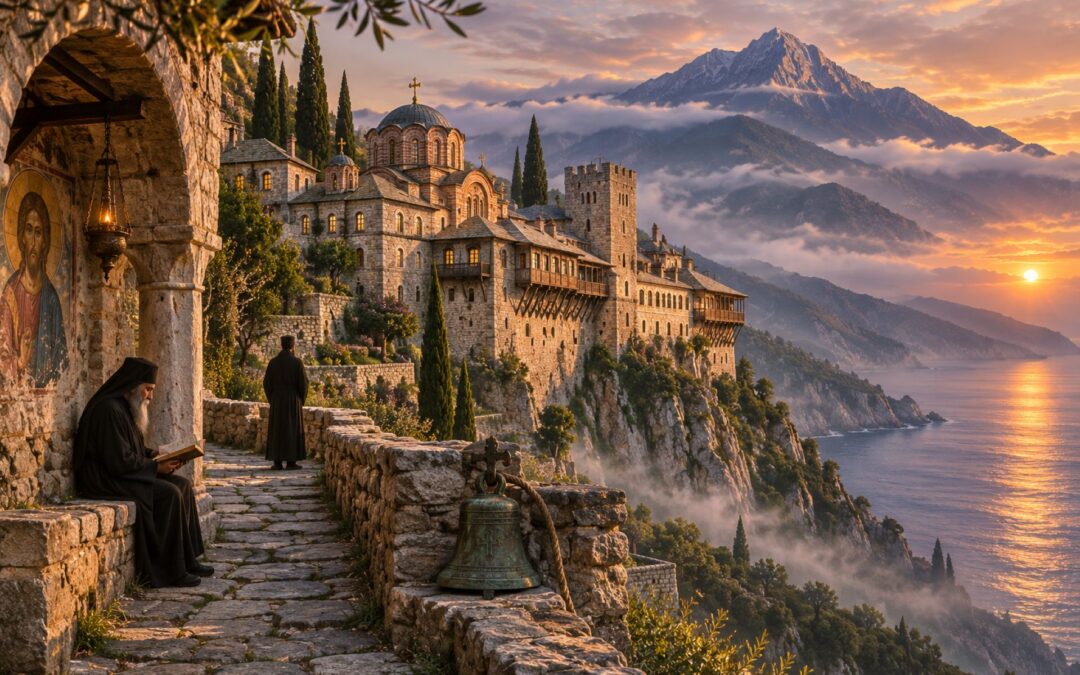
On a narrow peninsula in northern Greece, the ordinary rules of modern life begin to loosen their grip. Bells and wooden signals summon men to prayer long before dawn. Monasteries rise from cliffs above the Aegean Sea, and paths lead through forests to isolated cells where hermits have spent decades seeking solitude. A visitor may have crossed only a short stretch of water, yet the rhythm of the place feels separated from the surrounding country by centuries.
This is Mount Athos, known to Orthodox Christians as the Holy Mountain. It belongs to Greece, but its twenty monasteries govern much of their internal life through institutions inherited from the Byzantine world. The monks use a religious calendar thirteen days behind the civil one, preserve priceless manuscripts, and maintain traditions that predate the modern Greek state. Entry requires special permission, and women are prohibited from setting foot on the peninsula.
Mount Athos is therefore more complicated than an exceptionally beautiful collection of monasteries. It is a living religious community, a protected historical landscape and a peculiar constitutional arrangement, all occupying the same territory. Its history includes imperial generosity, pirate raids, political bargains and bitter disputes between monks. Understanding it means looking beyond the silence to the choices that have allowed an ancient institution to survive in an increasingly different world.
What Is Mount Athos and Who Governs It?
Mount Athos occupies the easternmost of the three long peninsulas extending from Halkidiki into the Aegean Sea. The mountain that gives the territory its name rises above 2,000 metres, dominating a landscape of wooded hills, steep slopes, rocky coves and extraordinarily exposed coastal settlements. The monastic territory covers roughly 335 square kilometres, depending on the geographical definition used. UNESCO’s protected World Heritage property is approximately 330 square kilometres, rather than the 400 square kilometres sometimes quoted in popular accounts.
The territory is commonly called a monastic republic, but that expression should not be confused with the legal status of an independent country such as Vatican City. Mount Athos forms part of Greece, and Greek sovereignty is explicit in the constitution. Its exceptional feature is self-administration: a substantial degree of authority over communal religious affairs, internal institutions and daily rules, exercised under special historical and constitutional protections. The Greek state remains responsible for matters such as public order and the implementation of national law.
Article 105 of the Greek Constitution recognises the Holy Mountain as a self-governed part of the Greek state and places it spiritually under the direct jurisdiction of the Ecumenical Patriarchate of Constantinople. That distinction matters. The patriarchate provides ecclesiastical oversight and spiritual authority; it is not the sovereign government of a separate Athonite nation. Nor does Athos possess unlimited power to disregard Greek legislation merely because its traditions are old.
The peninsula’s administrative centre is Karyes, a small settlement rather than a conventional national capital. Representatives from the twenty sovereign monasteries form the Holy Community, which handles shared concerns. Other bodies, including a rotating executive administration, perform specified functions within this established framework. Individual monasteries retain their own internal government under an abbot and monastic rules, creating a layered system that is more complex than the picture of twenty monks simply sitting in a parliament.
The monasteries are central to the entire arrangement. Great Lavra, Vatopedi, Iviron, Hilandar, Dionysiou, Simonopetra and the others are not interchangeable buildings scattered across a scenic reserve. They are historic communities with different foundations, languages, artistic traditions and possessions. Some have strong connections to Greek Orthodox life; others preserve Serbian, Russian or Bulgarian religious heritage. The peninsula’s international importance grew precisely because it became a shared spiritual centre for Orthodox Christians far beyond Greece.
The UNESCO World Heritage designation recognises both the religious landscape and the remarkable artistic legacy of the monasteries. Architecture, mosaics, frescoes, manuscripts and icon painting have influenced Orthodox culture over a huge geographical area. The designation also makes clear that Athos is not merely a place whose importance ended with the Middle Ages. Worship, community organisation and conservation remain intertwined with the surviving buildings and collections.
The population fluctuates, but monks number in the thousands rather than the tens of thousands. They live in large monasteries, smaller dependent communities, sketes, cells and isolated hermitages. Almost every visible feature of this settlement pattern reflects the same underlying aim: organising a landscape around prayer, discipline and distance from ordinary worldly demands. That is what makes Mount Athos simultaneously a geographical place and an institution with rules of its own.
How Mount Athos Became the Holy Mountain
The origins of Athonite monasticism are less tidy than the story of a single emperor founding a sanctuary. Christian ascetics and hermits were drawn to the peninsula by its remoteness, and monastic settlement became increasingly visible in the early medieval period. Traditions place holy men there even earlier, but the surviving documentation becomes firmer from the ninth century. The community emerged over generations before it acquired the elaborate buildings and legal privileges associated with the Holy Mountain today.
For a hermit, seclusion was not simply an escape from society. In the Christian ascetic tradition, withdrawal could become a disciplined effort to confront distraction, temptation and dependence on material comforts. The goal was spiritual attention, sustained through prayer, fasting, work and obedience. A remote mountain with difficult access offered practical conditions for a religious ideal that was hard to achieve in crowded towns.
As monastic settlement increased, Byzantine emperors began defining its privileges. A familiar but incorrect account assigns an expulsion of shepherds to Emperor Basil I in 855, a date before his reign began. The relevant imperial interventions belong instead to the later ninth century, especially the 880s and provisions associated with 885. These measures helped establish the principle that the peninsula should be protected for monastic life rather than treated as ordinary land available to everyone.
The decisive institutional transformation came with Athanasius the Athonite. Supported by the emperor Nikephoros II Phokas, with whom he had personal ties, Athanasius established Great Lavra in 963. The monastery introduced a more organised communal model on a large scale. Instead of every ascetic maintaining a separate existence, monks could pray, eat and work together under a shared rule, with responsibilities distributed across the community.
That arrangement was not universally welcomed. Some older hermits feared that substantial buildings, collective wealth and elaborate organisation would undermine the simplicity of their way of life. The tension between communal monasteries and stricter solitary asceticism was therefore present near the beginning, not something invented by modernity. Athos ultimately accommodated both forms, and they continue to coexist across the peninsula.
Imperial patronage helped transform Great Lavra into a model for other foundations. Grants of land, money and privileges supported construction, agriculture and the copying of books. A major charter in 972, traditionally associated with Emperor John I Tzimiskes, helped regularise the community’s administration and the relationship among its inhabitants. Byzantine rulers did not simply abandon the peninsula to religious solitude; they actively shaped the rules that made its independence of everyday secular life possible.
Over the following centuries, large monasteries appeared along the coast and in sheltered valleys. Their walls enclosed churches, refectories, libraries, storerooms, workshops and rooms for pilgrims. The increasing scale of their operations required labour, food production, legal arrangements and links with patrons elsewhere. What visitors now see as a timeless medieval landscape was built through many generations of political support, engineering and institutional adaptation.
Orthodoxy also spread the mountain’s reputation far beyond Greek-speaking territories. Monks from the Balkans and eastern Europe arrived, while rulers and aristocrats financed communities associated with their peoples. Serbian Hilandar and other foundations became centres of liturgy, literacy and cultural exchange. Athos was never simply an isolated Greek village with unusual residents; it belonged to a wider network through which religious practice and artistic forms crossed borders.
The ideal of retreat and the practical reality of international influence developed together. The monks sought distance from worldly ambition, yet emperors and kings competed to support them. They valued austerity, yet their monasteries accumulated valuable land and treasures. These apparent contradictions became enduring features of Athonite history, and they help explain both its survival and the controversies that followed.
Surviving Crusaders, Catalans and Ottoman Rule
Monastic walls offered protection, but they also advertised wealth. Donations from imperial families and other patrons filled churches with valuable objects and helped monasteries acquire land. Their settlements stood on routes used by merchants, soldiers and raiders crossing the Aegean. A remote peninsula was therefore not an inaccessible refuge, particularly when attackers approached from the sea.
Over the medieval centuries, monasteries faced raids and violence from pirates and competing military forces. Crusading armies and Latin powers disrupted Byzantine territories, while mercenary campaigns introduced new dangers. Coastal communities strengthened towers, gates and fortifications, building monasteries that sometimes resemble citadels perched above the water. Their defensive character was not merely picturesque architecture; it arose from a long experience of vulnerability.
Among the most destructive episodes was the campaign of the Catalan Company, a force of mercenaries active in the eastern Mediterranean during the early fourteenth century. After relations with the Byzantine authorities collapsed, the company’s attacks devastated parts of the region. Monasteries on Athos suffered in the years around 1307, and the memory of the violence endured far longer than the immediate military conflict.
One enduring story claims that Catalans remained unwelcome on Mount Athos for seven centuries. The tale includes a Catalan musician reportedly turned away during the 1990s because of his nationality. Such anecdotes reflect the strength of the remembered grievance, although they should not be mistaken for evidence of an uninterrupted formal legal prohibition against every Catalan visitor. The centuries-long reconciliation story is better understood as a powerful example of how an institution can preserve historical memory.
In the early twenty-first century, efforts were made to repair the relationship. The musician became involved in an initiative under which Catalan authorities contributed roughly a quarter of a million euros towards restoration work. A gesture of cultural reconciliation answered, in symbolic form, damage inflicted by medieval mercenaries. The encounter connected contemporary politics, medieval grievances and the practical need to conserve centuries-old buildings.
The Ottoman conquest of Constantinople in 1453 marked a far greater political change than any individual raid. Yet the Holy Mountain did not suddenly disappear when Byzantine imperial rule ended. Athonite representatives had sought workable arrangements with Ottoman rulers, and the monasteries retained a measure of communal autonomy in exchange for acknowledging the new political order and fulfilling fiscal obligations. The sultans had reasons to preserve productive religious institutions and recognised communities rather than dismantle every one of them.
Ottoman rule was neither effortless nor uniformly benevolent. Monasteries encountered taxation, debt, changing privileges and periods of hardship, and they sometimes relied on donations from Orthodox rulers outside the empire. Monks continued to produce religious texts, maintain sacred objects and cultivate connections with the wider Orthodox world. The survival of the institution depended less on an unchanging guarantee of freedom than on repeated negotiation under changing circumstances.
The peninsula’s relationship to modern Greece emerged during the Balkan Wars. Greek forces took control in 1912 as Ottoman authority receded from much of the region, and Mount Athos subsequently became part of the Greek state with its distinct arrangements preserved. Its special place was eventually entrenched constitutionally, rather than inherited unchanged from an independent medieval republic. Modern Greek sovereignty and monastic self-administration developed as parts of the same settlement.
Seen across these transitions, Athonite endurance looks less like complete separation from politics than a capacity to bargain with whichever power dominated its surroundings. Byzantine emperors granted privileges, Ottoman rulers recognised a religious establishment, and Greek constitutional law protected a historical exception. The monks preserved their spiritual objectives, but doing so repeatedly required engagement with the world from which they hoped to withdraw.
Mount Athos During the Second World War
When Germany invaded Greece on 6 April 1941, Mount Athos faced a dilemma familiar from earlier centuries in a much more dangerous form. The monks had built their existence around separation from political conflict, but the peninsula lay within a country being conquered by an army notorious for its brutality. Religious traditions and historic privileges offered no guarantee that occupying forces would leave monasteries and their inhabitants untouched.
Representatives of the Athonite community sought protection from the new power. A petition addressed to Adolf Hitler proposed placing the Holy Mountain under his personal protection, invoking the language of patronage once used in dealings with emperors and other rulers. The episode is uncomfortable because it involved a Nazi dictator, yet the monks’ immediate concern was also recognisable from their earlier history: preventing soldiers from plundering or occupying places dedicated to worship.
Popular retellings sometimes say Hitler enthusiastically accepted the honorary title of protector and then sent a scholarly delegation to live with the monks. The historical record is more complicated. In a 2024 study, The Nazi Protectorate of Mount Athos: Between Illusion and Reality, Claudiu Boia examines the confused communications and concludes that the proposed formal protectorate was not accepted in the straightforward way later stories suggest. Some monks believed such protection existed, while German authorities approached the situation through their own strategic and ideological interests.
German personnel and researchers did visit the peninsula. The Third Reich’s fascination with historical manuscripts, religious institutions and the cultural past made scholarly-looking activity compatible with a ruthless occupation elsewhere. Accounts of monasteries displaying images of Hitler or monks offering prayers for him require attention to particular circumstances; they cannot establish that all Athonite communities shared a unified political allegiance. The island-like appearance of the peninsula should not tempt anyone to treat the thousands of monks as a single mind.
There was another, very different wartime story unfolding around the same shores. After the defeat of Allied forces in Greece, British Commonwealth soldiers sought ways to evade capture and reach safety. Some hid in villages or monasteries, relying on networks that offered food, clothing and transport despite the danger of reprisals. Mount Athos’s isolation could provide useful concealment, and its coastal routes created opportunities to escape towards Turkey.
Among the escape stories are those of Australian and New Zealand servicemen sheltered with help from Athonite monks. Accounts of the Anzacs who escaped Greece describe the ingenuity and uncertainty involved in moving through occupied territory and across the sea. One frequently repeated episode involves New Zealanders leaving disguised as monks and a promise to send £50 in thanks when the war ended. The colourful details should be attributed carefully rather than treated as the defining experience of every wartime escape.
The contrast reveals why the period resists a simple verdict. Some religious leaders pursued accommodation with the occupying regime in the hope of protecting monasteries. Other monks helped men who were escaping that regime. These actions could occur within the same broad religious landscape without being identical in motive or consequence. Neither a petition to Hitler nor the rescue of Allied soldiers explains the wartime behaviour of the entire Athonite community.
Mount Athos avoided much of the catastrophic physical destruction that befell other parts of Greece. That outcome helped safeguard libraries, churches and buildings, but it should not be presented as proof that a Nazi protectorate had been formally established or that all preservation was the product of one successful political bargain. The episode is better understood as a revealing moment when an ancient institution confronted a modern dictatorship and individual monks responded in sharply different ways.
A Day in the Life of a Mount Athos Monk
The most striking feature of monastic life is not a particular ritual but the way the entire day is organised around worship. On much of Mount Athos, the hours that other people devote to commuting, entertainment or ordinary socialising are claimed by prayer, communal duties and silence. Monasticism is not supposed to function as an extended spiritual holiday. It is an intentionally demanding way of living in which repetition and discipline are central rather than incidental.
Before dawn, the call to prayer may come from a semantron, a wooden board struck rhythmically with a mallet. The sound carries across courtyards and passages long before the landscape is fully illuminated. The image is memorable, but its purpose is practical: bringing the community together for the services that anchor its day. Church worship can begin at an hour that would still be considered the middle of the night outside the monasteries.
The services are elaborate and often lengthy. Psalms, hymns, readings, chants, incense and candlelight form a liturgical world that has developed over centuries. On important feast days, vigils may continue for many hours, sometimes through most of the night. The apparent stillness of the monasteries conceals demanding schedules requiring monks to stand, sing, listen and sustain attention even when tired.
Prayer also extends beyond the church. The Jesus Prayer, a short invocation repeatedly used in Orthodox contemplative practice, is closely associated with the tradition of hesychasm, or inner stillness. A monk’s work can be understood as part of that continuous discipline rather than a break from it. The aspiration is not simply to spend several hours praying and then return to an unrelated private life, but to make every responsibility compatible with religious attention.
Meals illustrate this communal structure. Monks often gather in a refectory for simple food, sometimes while a text is read aloud, rather than conversing over lunch. Fasting traditions shape what appears on the table. Vegetables, legumes, bread, olives and other local foods are staples, with fish, oil and wine permitted or restricted according to the day, monastery and liturgical season. Meat is normally absent from the monastic diet, but the impression of a single inflexible menu for every monk is misleading.
A strict routine does not mean that food arrives without effort. Gardens, orchards, olive groves, vineyards and kitchens require constant work. Some monks tend crops, others bake bread, maintain buildings, prepare rooms for visitors or manage supplies arriving by sea. Skilled crafts include woodworking, sewing, bookbinding and the production of religious objects. The highly visible beauty of the monasteries depends upon an unglamorous amount of cleaning, carrying, repairing and planning.
Icon painting occupies a special place because it combines craftsmanship with religious practice. In Orthodox Christianity, an icon is not merely a decorative portrait. It serves within the devotional life of believers, following an artistic language governed by conventions, symbols and theological meaning. Athonite workshops have helped preserve and transmit techniques and styles across generations. The same community that spends hours in prayer may also spend months restoring one painted image or carefully copying sacred text.
Visitors create another layer of responsibility. Monasteries accommodate pilgrims, provide food and explain rules while protecting their own patterns of worship. Hospitality is valued as a religious obligation, but it is not an invitation for guests to behave as though they have checked into a hotel. Pilgrims may share certain services and meals while being expected to observe quiet, modest dress and established local customs.
The monasteries need resources to operate, and their economic life is more extensive than the romantic picture of monks eating only what they grow. They receive donations and derive income from products such as olive oil, wine, incense, honey and religious items; some have used online shops to reach supporters beyond the peninsula. Historic landholdings and property interests beyond Athos have also attracted public scrutiny, particularly where valuable assets intersect with Greek political and financial affairs. Spiritual renunciation by individual monks does not imply that monastery institutions own nothing.
Not all monks perform the same work, nor do all monasteries follow identical schedules. Older residents, novices, priests, skilled craftspeople and those with administrative responsibilities contribute differently. Some days involve exceptional services or large pilgrim groups; others are dominated by ordinary tasks. What unites these varied lives is the belief that a structured retreat from outside distractions can create space for spiritual concentration.
There is hardship in that choice. Sleep is interrupted, personal freedom is deliberately limited, possessions are restricted, and obedience to communal authority may be difficult. Yet the attraction is equally real for those who enter willingly: a life with a clear purpose, long stretches of contemplation and a continuity of practice that few secular institutions can match. Silence on Mount Athos is not an absence of activity. It is something the monks work to create.
Hermits, Byzantine Time and Sacred Treasures
The great monasteries are the most recognisable face of Mount Athos, but they represent only part of its spiritual geography. Scattered across steep slopes are smaller settlements and individual cells, while the southern cliffs include some of the most inaccessible hermitages in the Orthodox world. Their occupants pursue the same broad religious purpose as communal monks, but with far fewer daily interactions. To reach some dwellings, a visitor must navigate narrow paths, ladders and difficult rock faces.
A hermit may live in a tiny building pressed against a cliff or in a cave adapted for human shelter. The walls can be bare stone, the furnishings minimal and the route to the nearest community hazardous. Accounts describe monks pulling supplies upwards in baskets or relying on ropes and ladders to move through terrain too severe for an ordinary doorway or road. Such arrangements are not an adventure sport: they are the physical consequence of taking seclusion to an extreme.
Solitude can last for decades, although stories of men spending seventy uninterrupted years without speaking should not be generalised to all hermits. A monk may exchange words with a spiritual adviser, receive food from another resident or make occasional journeys when circumstances require them. The point is the intentional narrowing of social contact, not a contest to achieve the largest number of completely silent years. Some hermits use agreed signals, including flags, to indicate when assistance is needed.
Mortality is present in a visible way throughout Athonite tradition. As burial space is limited, bones may eventually be transferred from graves to ossuaries, where skulls and other remains are carefully arranged. This can seem unsettling to outsiders, especially when a new monk encounters the remains of predecessors who lived in the same place. Within the monastic setting, remembering death is connected to humility, repentance and the belief that earthly life is temporary.
Even time itself is measured differently. Many Athonite communities maintain the Julian calendar for religious observances, putting their feast days thirteen days behind the Gregorian calendar used for everyday civil dates in Greece. A celebration listed for 5 July in monastic reckoning therefore falls on 18 July in the present Gregorian calendar. This is not literal time travel; it is the survival of a calendar convention that shaped religious life long before the modern civil standard became widespread.
Some communities also preserve a form of Byzantine timekeeping in which the hours are counted from sunset rather than from midnight. The clocks have to be adjusted as the length of daylight changes with the seasons. The method reflects a religious division of the day and helps explain why timetables on Athos may look unfamiliar to visitors accustomed to fixed clock times. The precise practice can differ among communities, and modern conventional time is also used where practical coordination requires it.
The libraries and treasuries supply a different kind of encounter with history. Monasteries preserve Byzantine and later manuscripts, charters, illuminated gospels, icons, textiles, liturgical vessels and objects associated with generations of benefactors. Ottoman-era documents also survive, revealing how the communities negotiated property, privileges and obligations after the Byzantine Empire’s disappearance. These collections are valuable not only because they are old, but because they connect religious practice with political, artistic and linguistic history.
Collections also record connections among monasteries that outsiders might regard as separate national enclaves. A document written in one language might preserve a donation from a ruler speaking another, while an icon travelled through networks of pilgrims and patrons before reaching its present home. Those objects reveal exchange and dependence beneath the apparent isolation.
Preserving them is difficult. Historic buildings are exposed to moisture, fire, erosion, earthquakes and the cost of maintaining remote sites; delicate documents require careful storage and specialist conservation. The celebrated architecture of Simonopetra, rising from a cliff face, illustrates the balance between extraordinary construction and perpetual vulnerability. Some conservation depends on grants, private donations and the expertise of people who do not live as monks themselves.
The result is a place where history is neither wholly locked inside glass cases nor untouched by modern interventions. A medieval manuscript may be examined using contemporary scholarship, while a crumbling wall is stabilised with modern engineering. The monk who follows an ancient calendar may also work with a computer or communicate with benefactors abroad. Athos’s continuity survives because its inhabitants preserve selected practices while adapting the material means needed to keep them alive.
How Pilgrims Enter Mount Athos
For all its isolation, Mount Athos is not closed to every outsider. Male pilgrims, including visitors who are not Orthodox Christians, can enter after obtaining permission. The essential document is the diamonitirion, a special permit administered for the Holy Mountain. It is separate from the ordinary passport and Greek immigration requirements that may apply to someone arriving from abroad. Permission to enter Greece is not, by itself, permission to travel to Athos.
The number of visitors is controlled. A commonly stated daily allowance is around one hundred Orthodox pilgrims and ten non-Orthodox visitors, although arrangements and quotas should be confirmed when planning a trip. Advance applications are essential, particularly around religious festivals and popular travel periods. The usual permit allows a stay of three nights, with extensions subject to separate arrangements rather than a presumed right to remain indefinitely.
Most visitors begin from Ouranoupoli, the mainland town near the monastic border, and travel by boat to the peninsula’s landing points, including Dafni. Ferries and smaller vessels connect different stretches of the coast, while internal transport and footpaths lead towards monasteries and Karyes. The journey reinforces the separation: admission is controlled before the traveller arrives, and access to particular communities still depends on their willingness and ability to receive a guest.
The physical journey can be demanding even after the paperwork is settled. Weather and sea conditions may interrupt boat services, and mountainous footpaths can require more endurance than their distance suggests. Pilgrims travelling between distant monasteries must allow for transport connections and the rhythm of the communities receiving them. A visit planned entirely around sightseeing risks missing what makes the place distinctive: the shared experience of walking, waiting, attending worship and accepting a schedule set by someone else. The sense of leaving ordinary life behind is therefore produced as much by practical limits as by the border itself.
Practical guidance from the Friends of Mount Athos pilgrims’ guide stresses that a permit and monastery accommodation are not identical arrangements. A visitor may need to contact monasteries in advance and respect the availability of guest places. The experience is closer to taking part briefly in a religious community than to booking a conventional holiday. Hospitality often includes a simple meal and a bed, but it also involves rules about behaviour and participation in monastic life.
Those rules are not decorative. Modest clothing, restrained photography, observance of silence in appropriate places and respect for religious services are expected. Guests may be able to attend prayers and observe communal routines, yet the monastery remains a home and a place of worship rather than a museum operated for their amusement. Some areas, objects or ceremonies are not accessible merely because someone holds a permit.
A significant distinction also separates visiting from becoming a monk. Men of different faiths may be admitted as pilgrims under the applicable arrangements, but monastic membership belongs to the Orthodox religious tradition and requires a lengthy process of spiritual discernment and acceptance. The peninsula’s special restrictions therefore concern several different questions: who may cross its boundary, who may stay temporarily, who may enter a particular monastery and who may dedicate a life to it.
The system reveals Athos’s central compromise. Pilgrims bring donations, connections and a continuing relationship with the wider Orthodox world. Too many visitors, however, would undermine the seclusion the monks are trying to maintain. Controlled access protects the community’s routine while permitting a limited number of outsiders to encounter it directly. The most consequential exclusion within that system remains the rule that applies not to particular beliefs or travel purposes, but to sex.
Why Women Are Banned from Mount Athos
The prohibition on women entering Mount Athos is known as the Avaton. It is among the peninsula’s most distinctive and contentious rules, and it extends beyond the ordinary principle that monks and nuns live in separate communities. A woman cannot simply obtain a visitor’s permit and spend a few nights observing the monasteries. The restriction applies to the territory itself, regardless of whether she wishes to attend a service, study historical objects or visit as a tourist.
The exclusion has medieval roots. It is conventionally associated with Byzantine regulations consolidated around the eleventh century, including an imperial measure in 1046. Athonite tradition links the mountain to the Virgin Mary, who is revered as its special protector and, in devotional language, its only female inhabitant. The monks also argue that excluding women helps protect the celibate and contemplative life they have undertaken. These are explanations of the rule from within the tradition, rather than evidence that women are inherently incapable of respecting monastic solitude.
Its scope is striking. Longstanding descriptions of Athonite custom extend restrictions to female domestic animals, though hens and cats are frequently cited as practical exceptions because they provide eggs and control rodents. Accounts of animal rules differ in detail and should not be converted into an absolute claim that no female creature can be present on the peninsula. The unusual provisions nevertheless show how thoroughly the idea of a male-only environment has shaped the community’s understanding of itself.
The ban has never produced a perfectly simple historical record. Byzantine scholar Alice-Mary Talbot’s study of women in Athonite archives demonstrates that women appeared in the peninsula’s documentary history in more varied ways than a blanket statement of uninterrupted absence suggests. Women could be benefactors, property holders or participants in events that affected the monasteries, even when official religious rules sought to keep them physically outside.
One celebrated case concerns the Serbian empress Jelena, who was associated with a refuge on Athos during the plague in the fourteenth century. She is said to have been carried rather than permitted to touch the soil, as though avoiding physical contact could preserve the prohibition in a literal sense. The story is memorable, but the detail about a litter should be treated cautiously; the historical significance lies in the reported exception and the attempts to reconcile it with religious custom. Other accounts suggest emergencies, upheaval and individual acts of defiance occasionally brought women onto the peninsula.
In the twentieth century, French writer Maryse Choisy claimed to have entered disguised as a man and later published Un mois chez les hommes, or A Month Among Men, drawing on that experience. Her narrative is part of the popular history of the rule, although it should not be accepted uncritically as a complete independent record of everything she claimed to witness. The account also illustrates something easy to miss when the discussion focuses exclusively on doctrine: for some women, being excluded made the mountain itself an object of curiosity and protest.
A related anecdote claims that a monk named Michalis Tolotos, supposedly raised on Athos after his mother died shortly after his birth, reached old age without ever seeing a woman. Versions place his death in 1938 and describe an exceptionally isolated life. The story has circulated widely, but its evidentiary foundation is weak; it is better presented as a reported curiosity than a verified biographical fact. The deeper point does not depend on whether one man truly had that experience. Monastic isolation can radically limit contact with the world beyond the community.
Modern criticism raises questions that a theological explanation alone cannot settle. Women who challenge the Avaton are not necessarily demanding admission as Orthodox monks. Many argue for the ability to visit religious monuments, historical collections and a portion of Greek territory on the same basis as male pilgrims. Excluding someone solely because she is female is therefore criticised as discrimination, even when the institution defending the rule understands it as central to a protected religious way of life.
The issue became especially visible through Greece’s relationship with European institutions. When Greece entered the European Communities in 1981, Athos’s special historical status was acknowledged in a joint declaration connected with accession. That recognition did not make the underlying tension disappear. In 2003, the European Parliament called for the exclusion of women to be reconsidered, reflecting broader commitments to equality and freedom of movement. The legal setting is more complicated than simply saying European law automatically cancels every religious exception.
Greek law has backed the territorial prohibition with criminal penalties. Reporting on the applicable legislation has described potential imprisonment of two to twelve months for unauthorised female entry, not the twelve-year sentence sometimes repeated in popular videos. Public discussion also involves the use of Greek and European funds for heritage conservation. Critics ask why women should help finance historic sites that they cannot visit, while defenders distinguish public protection of cultural heritage from a universal right of physical access to an active monastery.
There is no need to pretend that these positions are equally persuasive to everyone or that they address precisely the same question. For Athonite monks, Avaton is bound up with centuries of communal self-definition and religious freedom. For opponents, the issue is an enduring sex-based barrier imposed across an entire territory. Both the importance of the tradition to its adherents and the unequal treatment it creates are essential to understanding why the dispute continues.
The Esphigmenou Monastery Rebellion
A different struggle on Mount Athos has produced something even more surprising than arguments over visitor permits: rival monks, barricades, competing religious authorities and episodes of violence. Its centre is Esphigmenou, one of the peninsula’s twenty historic monasteries. The dispute concerns who may legitimately occupy and represent the monastery, but beneath that question lies a deep division over relations between Eastern Orthodoxy and other Christian churches.
Christianity’s eastern and western traditions separated through a long process commonly symbolised by the schism of 1054. Relations between the Orthodox Church and Rome remained complicated, with theological disagreements, historical grievances and competing claims to authority. The modern movement for greater dialogue and possible reconciliation is usually called ecumenism. Not all Orthodox Christians view those efforts in the same way, and Athonite monks have differed sharply in their responses.
A highly symbolic encounter took place in 1964, when Ecumenical Patriarch Athenagoras met Pope Paul VI in Jerusalem. Their meeting prepared the way for the mutual lifting of the historic excommunications in 1965, not a complete reunion of the churches. Many welcomed the gestures as steps towards healing an ancient breach. Other Orthodox believers saw them as compromising religious truth, especially if dialogue seemed to blur distinctions they considered fundamental.
Monks at Esphigmenou became prominent opponents of the patriarchate’s ecumenical approach. The monastery displayed the slogan Orthodoxy or Death, signalling uncompromising resistance to perceived doctrinal concessions. The dispute grew into a refusal by the resident brotherhood to recognise ecclesiastical authorities whose legitimacy it rejected. From their perspective, fidelity to Orthodoxy required resistance; from the patriarchate’s perspective, the refusal violated the order under which Athonite monasteries operated.
During 2002–03, ecclesiastical rulings and eviction efforts deepened the confrontation. Authorities eventually recognised another brotherhood as the monastery’s legitimate administration, while the dissenting group continued occupying the historic premises. Two communities therefore claimed a connection to the same institution, but they did not occupy an equal position under the decisions of the patriarchate, the Holy Community and Greek authorities. A dispute over theology had become a dispute over possession, governance and enforcement.
The most dramatic incidents cannot be collapsed into one date. The controversy and exclusion orders began in the early 2000s, but reports of petrol bombs directed during a confrontation belong to July 2013. Other incidents included physical altercations and accusations between rival groups. The sensational image of monks fighting with Molotov cocktails is real enough to demand explanation, yet the chronology matters: it did not all happen during a single 2002 eviction attempt.
Nor did the conflict end there. In May 2025, an incident involving the rival Esphigmenou factions left a monk requiring hospital treatment, reviving attention to the unresolved dispute. Associated Press reporting on the confrontation describes the continuing conflict between the recognised brotherhood and monks defying church and court orders. Allegations about responsibility must be distinguished from proven facts, particularly because the two sides describe their positions and encounters differently.
Esphigmenou exposes the limits of treating Mount Athos as a tranquil religious society united by one timeless understanding of faith. Its internal institutions depend on hierarchy and obedience, but individual communities can reject the authorities they are meant to accept. Religious withdrawal does not abolish disputes about power, identity or doctrine; it can sometimes make them more intense. The same peninsula that shelters solitary hermits has also been the setting for very public struggles over who speaks for Orthodox tradition.
The extraordinary quality of Mount Athos lies not in having escaped history but in preserving a way of life through history’s interruptions. Byzantine patronage, Ottoman accommodation, Greek constitutional protection and present-day conservation have all contributed to keeping its monasteries alive. The monks continue to seek spiritual stillness, but that stillness depends on institutions, property, rules and difficult choices that connect them to the outside world.
Its libraries and cliffside monasteries deserve admiration, just as its restrictions and internal conflicts deserve scrutiny. Both belong to the story. Behind the water crossings and guarded boundaries is neither a perfectly preserved medieval utopia nor a simple relic that modern society has forgotten to change. Mount Athos is a living community continually deciding what must remain untouched, what can adapt and how much separation from the world is possible when the world has never truly stopped reaching its shores.
Last Updated on November 26, 2026 by Aseem Gupta