
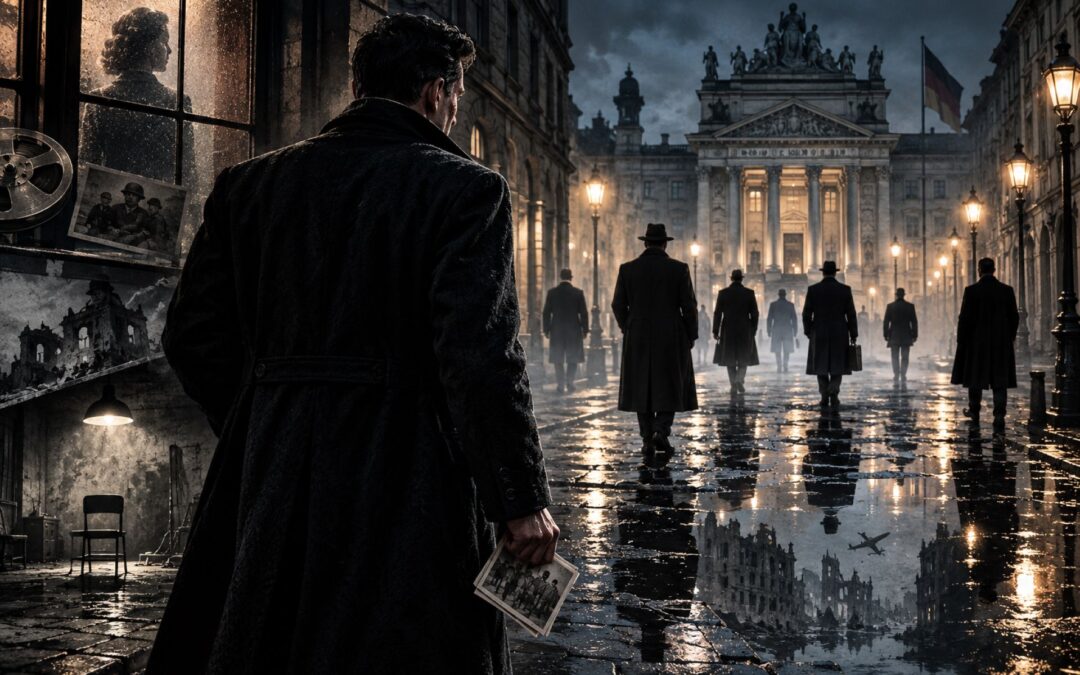
Mario Puzo’s Six Graves to Munich looks at first like one of the simplest stories a thriller can tell. A man has survived torture, betrayal, and an attempted execution. Ten years later, he has found the people responsible, and he intends to kill them one by one. Yet Puzo steadily makes that apparently clean revenge fantasy harder to sustain. The guilty men are not equally guilty, some have changed, one wants to die, and the governments that claim to represent law and justice prove willing to tolerate or facilitate killing whenever it suits their interests.
The novel was first published in 1967 under Puzo’s pseudonym Mario Cleri and later reissued under his own name; the Penguin Random House edition identifies it as an early pseudonymous Puzo novel. It is much shorter and more overtly pulpy than The Godfather, but it already shows Puzo’s interest in power, loyalty, violence, institutional hypocrisy, and the unstable boundary between crime and legitimate authority.
Spoiler warning: this article covers the entire novel, including the truth about Christine, the deaths of all Rogan’s targets, the final killing in Munich, and Michael Rogan’s own death.
What makes Six Graves to Munich worth examining is not simply whether Rogan gets revenge. He does. The more important question is what remains once he has succeeded, and whether revenge can still be called justice after the moral certainty behind it has been dismantled.

Six Graves to Munich: Complete Plot Summary
Puzo does not begin at the beginning. The novel opens with Michael Rogan already deep into his revenge campaign, then later reconstructs the war, Christine, the interrogation in Munich, and the years that turned him into the man capable of hunting his former torturers across Europe. That structure lets the reader first encounter Rogan as a killer and only afterward understand how he became one.
The complete story therefore depends on holding two timelines together: the wartime catastrophe that creates Rogan’s obsession and the postwar journey in which he tries to convert memory into punishment. As the number of surviving targets decreases, the apparent clarity of that mission decreases with it.
The Revenge Begins in Hamburg
Michael Rogan arrives in Hamburg looking for Karl Pfann, one of the seven men involved in his wartime torture. Puzo introduces Rogan not through explanation but through action: he enters the Roter Peter nightclub in St. Pauli, finds Pfann, confronts him with the past, and shoots him with a silenced pistol.
The murder immediately establishes that this is not the beginning of Rogan’s campaign. Another target has already died, and Rogan is moving through a list he has carried for years. The arithmetic matters because the revenge has become almost procedural. Each dead man reduces the remaining number, giving Rogan a structure around which to organize a life that otherwise never truly moved beyond 1945.
After killing Pfann, however, Rogan does not appear triumphant. He wanders through Hamburg exhausted, physically unstable, and emotionally depleted. He encounters Rosalie, a prostitute, and goes with her less because he wants sex than because he needs somewhere to rest.
Rosalie quickly discovers that the stranger she has taken in is far from ordinary. Rogan is scarred by a terrible head wound, and the metal plate implanted after the war has left him vulnerable to attacks and collapses. She also sees material connected to several men and understands that Pfann’s death is part of something larger.
Instead of withdrawing, Rosalie becomes curious and protective. She recognizes that Rogan is not simply a professional killer and that his violence belongs to a history he has not yet told her. Her willingness to remain with him creates the relationship that will accompany the rest of the novel and, eventually, provide the strongest alternative to the revenge itself.
How Michael Rogan Survived Munich
Rogan’s history begins long before the interrogation room. From childhood he possesses an almost unnatural capacity for memory, combined with exceptional intellectual ability. He becomes a brilliant student and develops especially strong mathematical gifts, but the same abilities that distinguish him also separate him from ordinary social life. His mind can retain enormous quantities of information with extraordinary accuracy.
That talent becomes strategically useful after the United States enters the Second World War. Instead of depending entirely on written codes or documents that could be captured, intelligence officers can use Rogan himself as a living repository. He can memorize material that would be dangerous to carry and reproduce it when necessary.
Eventually he is sent into occupied France. There he stays with the Charney family and falls in love with their daughter Christine. The relationship gives Rogan something almost completely absent from the rest of his life: uncomplicated emotional belonging. They marry, and Christine becomes pregnant.
The war destroys that stability. Rogan’s radio activity contributes to the exposure of the network in the period surrounding the Allied invasion, and German forces capture both him and Christine. The mistake becomes one of the private sources of guilt he carries afterward. Even before the torture begins, he can tell himself that his own actions helped bring catastrophe onto the woman he loves.
Rogan is taken to Munich, where seven men participate in his interrogation. They differ in nationality, personality, and degree of direct cruelty, but together they become fixed in his memory as the human machinery that destroyed his former life. The group includes Albert Moltke, Karl Pfann, Eric Freisling, Hans Freisling, Genco Bari, Wenta Pajerski, and Klaus von Osteen.
Physical torture is only part of the interrogation. The most important weapon is psychological. Rogan is made to hear Christine screaming, and he is led to believe that she is being tortured because of his refusal to cooperate. The sound attacks the very part of him that had always seemed most reliable: his memory. He hears something real, stores it perfectly, and then builds his understanding of what is happening on a false interpretation deliberately supplied by his captors.
Klaus von Osteen is especially important. He does not behave only as a brute. He alternates cruelty with apparent sympathy and gives Rogan reasons to believe that cooperation might save him and Christine. That mixture of brutality and kindness is more effective than simple violence because it creates hope.
Eventually Rogan breaks and reveals information. The confession is one of the central sources of his later shame. His captors then tell him that Christine is dead.
Rogan is apparently taken away to be released. Instead Eric Freisling shoots him through the head, and Rogan is left among bodies as though he too were dead.
Against extraordinary odds, he survives. American forces eventually find him, but survival does not amount to recovery. His head has been catastrophically damaged, his vision is impaired, and a metal plate becomes part of the body he must live with for the rest of his life. Alcohol temporarily becomes one way of enduring that life.
His perfect memory, which once made him valuable, now works against him. He cannot blur or soften the interrogation with time. The voices, sensations, betrayals, and imagined suffering of Christine remain available to him with terrible precision.
Rogan’s childhood friend and lawyer Philip Houke helps him rebuild. Over time Rogan regains enough control to function, and his intelligence eventually makes him extremely wealthy in the developing computer business. Money gives him independence, mobility, and access to private investigators, records, and the practical resources needed to turn memory into a long-term operation.
He studies war-crimes information and tracks the seven men from Munich. By the time the novel opens in Hamburg, one of them is already dead.
That man is Albert Moltke. Rogan finds him in Vienna, where Moltke has acquired a respectable postwar existence. Respectability does not deter Rogan. He confronts him and kills him, making Moltke the first completed step in the private accounting he has imagined for years.
Karl Pfann in Hamburg follows. By the time Rosalie meets Rogan, two men on the list are gone, and the remaining names are not abstractions. They are people Rogan believes he remembers perfectly.
The central problem, which the rest of the novel gradually reveals, is that perfect memory does not produce perfect understanding.
Berlin, Rosalie, and the Freisling Brothers
Rogan takes Rosalie with him to West Berlin. Their life there initially looks almost like an interruption of the thriller: hotels, restaurants, shopping, physical pleasure, and the novelty of companionship occupy space that could otherwise have been devoted to the next assassination. That pause is important because it shows that Rogan is still capable of wanting something besides revenge.
Berlin itself reinforces the contrast. Europe has been physically reconstructed, and Rogan can move through prosperous, lively places that barely resemble the ruins associated with his wartime memories. He alone seems unable to rebuild at the same speed as the cities around him.
The next targets are Eric and Hans Freisling. They are now involved in a business operation connected to a gas station, but their postwar activities also bring them into contact with restricted American technology and a wider espionage network. Rogan sees a practical way to get close to them.
The situation draws the attention of Arthur Bailey, an American intelligence officer connected to Rogan’s past. Bailey already knows more about Rogan’s activities than Rogan would prefer. He also knows that the Freislings may be useful to American intelligence because they could expose connections leading toward an East German spy network.
That creates the first direct collision between Rogan’s private justice and the priorities of the government for which he once worked. To Rogan, the brothers belong to Munich and therefore must die. To Bailey, their wartime guilt is less important than their present intelligence value.
Bailey also possesses information about Rosalie. He tells Rogan that she escaped from an institution, exposing how little Rogan actually knows about the woman who has attached herself to him. That revelation forces Rosalie to explain her own history.
During the final period of the war, Rosalie was fourteen. She was away when Allied bombing destroyed her hometown of Bublingshausen and killed her family. She returned to a life in which the people and social structure that had defined childhood had simply vanished.
In the chaos that followed, American soldiers repeatedly used and abused her sexually. She became pregnant and ill and eventually passed through medical and psychiatric institutions. Her later prostitution is therefore not presented as an isolated choice but as part of a longer process in which war destroyed her family, disrupted her sexual development, and separated intimacy from safety.
Rogan and Rosalie are both survivors, but their wounds are different. Rogan has converted memory into a mission. Rosalie has survived by emotional detachment, acting as though much of the past has lost its ability to matter.
The Freislings continue trying to exploit Rogan’s technological connections. Rogan, in turn, uses their greed and confidence to gain control over them. He drugs them, immobilizes them, and interrogates them separately.
The reversal is deliberate. Rogan has become the interrogator.
From the brothers he obtains confirmation about three remaining figures: Genco Bari, Wenta Pajerski, and Klaus von Osteen. The information advances his search, but the manner in which he acquires it begins to resemble the coercive world he believes he is punishing.
Rogan places Eric and Hans in the altered trunk of his Mercedes and uses the exhaust system to feed carbon monoxide into it. He intends to kill them without directly confronting them again.
Almost immediately, however, he regrets the cruelty of giving them no warning. He turns back, but it is too late. The brothers are dead.
What disturbs him most is the way he finds them: they are holding each other. The image does not make them innocent. Eric still shot Rogan in the head, and both participated in his degradation. Yet the embrace makes it impossible to see them solely as interchangeable villains.
The revenge is beginning to acquire human residue. Rogan can kill his targets, but he cannot always prevent their final moments from complicating the moral image he needs to maintain.
Soon afterward his damaged brain and body again remind him that the war is not merely psychological memory. Rogan collapses and is treated by Dr. Thulman. He remains unconscious for days.
Bailey and German authorities suspect his involvement in the Freislings’ disappearance, but Thulman protects Rogan from immediate removal. When Rogan recovers, he and Rosalie move toward Munich.
Von Osteen is not immediately available. Rogan therefore decides to pursue other surviving names first: Genco Bari in Sicily and Wenta Pajerski in Budapest. He arranges financial protection for Rosalie in case he dies, an indication that his confidence in surviving the mission has already begun to erode.
Bublingshausen and the Possibility of Stopping
Before the next stage of the revenge, Rogan takes Rosalie back to Bublingshausen. The journey is one of the most important pauses in the novel because Rosalie confronts her past in a manner radically different from Rogan.
At first the rebuilt town seems unable to reach her. She behaves as though the people and home she lost belong to a dead world that no longer has emotional access to her. Yet familiar places eventually break through that detachment.
The family garden becomes especially important. Rosalie finally allows herself to grieve instead of surviving through numbness, and the emotional release suggests that memory does not have to be converted into punishment in order to be acknowledged.
Her experience becomes an implicit challenge to Rogan. Both were damaged by the war, and both lost people they loved. Rosalie’s return to Bublingshausen does not undo anything, but it allows grief to exist without demanding an equivalent death.
She asks Rogan to abandon the killings.
For the first time, the request is not merely sentimental. Rogan now has something he did not possess when the revenge began: a person with whom he can imagine a future. He wants to survive partly because Rosalie exists.
Even so, he refuses to stop. Von Osteen remains especially intolerable to him because Rogan believes that the psychological betrayal in Munich was worse than straightforward brutality. A beating can be understood as violence. Von Osteen’s false gentleness turned trust itself into a weapon.
Rogan therefore continues, although the novel has now shown the reader an alternative form of survival standing directly beside him.
Sicily and Genco Bari’s Revelation
Rogan travels to Palermo and initially receives little useful information from private investigators. Sicily creates a different kind of problem from Berlin: Genco Bari is not simply hiding under another name but has become a powerful local figure surrounded by structures of loyalty and fear.
Arthur Bailey reappears, and the logic of American intelligence has changed. When the Freislings were useful, Bailey wanted Rogan restrained. Bari is not useful in the same way, so Bailey is willing to help.
He provides information that leads Rogan toward Bari in Villalba and also offers assistance for the eventual operation against Pajerski in Budapest. Bailey does not suddenly accept Rogan’s moral theory. He simply recognizes that Rogan’s private killings can sometimes coincide with American objectives.
Rogan reaches Bari’s environment during a festival and becomes involved with Lucia Bari, Genco’s much younger wife. The encounter initially belongs to the novel’s more sensational thriller mode, but Rogan’s meeting with Genco quickly changes the tone.
Bari is dying of cancer. He suffers from severe pain and is physically far removed from the powerful man Rogan had imagined hunting.
He also recognizes Rogan.
Instead of creating an immediate duel between victim and torturer, Puzo allows the two men to spend time together. Bari talks about his life and about the moral code by which he understands his place in Sicilian Mafia culture. More importantly, he revisits the interrogation in Munich.
One of Rogan’s memories concerns a small act that he had interpreted as mockery or cruelty. Bari explains that the gesture was actually intended as sympathy.
Again, the novel does not transform a guilty man into an innocent one. Bari was part of the group that held and broke Rogan. Yet the revelation shows how much of Rogan’s moral certainty depends not only on remembering actions but on knowing what those actions meant.
Then Bari gives him the most important information in the book.
Christine was not tortured to death.
She went into labor. Her baby was stillborn, and Christine herself died. The screams Rogan heard were genuine, but they were not screams produced by deliberate torture.
Von Osteen recorded them and later played them to Rogan. He used real suffering to manufacture a false story, knowing that Rogan would believe Christine was being hurt because he refused to cooperate.
The distinction does not absolve von Osteen. In some ways it makes his cruelty more precise. He did not need to torture Christine in front of Rogan; he took the truth of her pain and manipulated its meaning in order to torture Rogan psychologically.
For Rogan, however, the revelation destroys part of the history on which his revenge depends. He has spent ten years remembering a sound perfectly while misunderstanding what it represented.
Bari then complicates the planned killing in another direction. Cancer has made his life unbearable, but his religious beliefs prevent him from killing himself. He wants Rogan to do what Rogan already came to do.
When Rogan shoots Bari, the act is therefore no longer easily categorized as revenge. Bari welcomes death. He expresses gratitude and forgiveness.
Rogan has killed another man on his list, but the emotional transaction is almost the opposite of the execution he imagined. The target has partly controlled the conditions of his own death.
By this point, the arithmetic of revenge still functions—one fewer name remains—but its moral logic is breaking apart.
Budapest, Pajerski, and the Intelligence Trap
Rogan next travels to Budapest, where Bailey has arranged support through an intelligence operative named Stefan Vrostk. The setting shifts the novel into a more overtly Cold War mode. Rogan’s private history with Nazi Germany now intersects directly with the political division of postwar Europe.
The target is Wenta Pajerski. Rogan’s memories of him are complicated from the beginning because Pajerski had not behaved with uninterrupted cruelty during the interrogation. At times he gave Rogan food, water, or cigarettes.
Those moments matter because Puzo repeatedly refuses the easiest moral arrangement. A person can participate in atrocity and still perform limited acts of kindness. Those acts do not erase the larger guilt, but neither do they disappear simply because the guilty person would be easier to hate without them.
Pajerski’s present life makes the case against him comparatively straightforward. He has become part of the Communist Hungarian security apparatus and remains associated with disappearance, intimidation, and torture. Unlike Bari, he has not retreated into illness or remorse, and unlike von Osteen, he has not rebuilt himself around an outwardly humane public role.
Rogan watches Pajerski’s routines and discovers that chess offers a practical route to assassination. He prepares an explosive device hidden inside a white chess king and arranges for it to replace the piece in Pajerski’s set.
Even here, Rogan tries to preserve a distinction between targeted revenge and indiscriminate murder. He sends Pajerski a warning and attempts to plan the explosion so that bystanders will not be killed.
The device works. Pajerski dies.
The larger trap then becomes visible. Rogan expects assistance from the Western intelligence network that has helped him enter and operate inside Budapest, but the promised escape arrangements fail.
He realizes he has been betrayed.
The betrayal confirms that Bailey and his associates never treated Rogan as an ally in any moral sense. He was useful while he was killing someone they also wanted removed. Once his usefulness ended, his survival became negotiable.
Rogan improvises an escape and eventually reaches the airport. He makes it back to Munich, where Rosalie is waiting.
Her presence once again reconnects him to the ordinary human life that has repeatedly appeared at the edge of his revenge. Each time Rogan returns from killing, Rosalie represents the possibility that there might be something to return to.
Munich, Klaus von Osteen, and Rogan’s Death
The final stage centers on Klaus von Osteen, the man Rogan hates most. Before attempting to kill him, Rogan relives the interrogation with renewed intensity: the physical degradation, the filth, the exhaustion, von Osteen’s shifts between brutality and apparent compassion, the promise that cooperation might save Rogan and Christine, and the false release that ended with Eric Freisling shooting him.
Rosalie once more asks him to stop. By now her argument is stronger than it was earlier because the revenge has already been morally transformed. Bari revealed the truth about Christine. Bailey has exposed the opportunism behind American cooperation. Rogan himself has experienced doubt after several killings.
Still, von Osteen remains the center of his trauma. The discovery that Christine was not tortured does not exonerate him because he created the deception that made Rogan believe she was.
Rogan prepares carefully. He arranges a weapon and an escape plan, and he sends letters to trusted people in the United States containing information about von Osteen. The letters function as insurance: if Rogan disappears, the truth about the supposedly respectable judge can still emerge.
Bailey and Vrostk confront him before he can complete the operation. Their position is now explicit. Von Osteen has become politically valuable to the West.
The same intelligence system that tolerated or assisted Rogan when he was killing inconvenient men now wants his revenge stopped because the final target is useful. Wartime guilt has become subordinate to Cold War necessity.
Bailey also admits that Vrostk intentionally betrayed Rogan in Budapest.
Rogan reacts with fury. He follows Bailey and Vrostk and reaches a point where he could kill them. They have manipulated him, placed his life at risk, and are now protecting a man responsible for his torture.
Yet Rogan does not shoot them.
That decision is crucial because it shows that, even near the end, he still maintains a moral distinction between the original seven and later enemies. Bailey and Vrostk may have betrayed him, but they are not part of the Munich interrogation. Killing them would require expanding revenge beyond the boundaries he has used to justify it.
Rogan returns to Rosalie.
He then enters the Palace of Justice to find von Osteen. When he sees the judge believed to be his target, he is initially disoriented: the face does not match the one fixed in his memory.
For a moment, the entire revenge threatens to collapse into uncertainty. Perhaps the Freislings lied. Perhaps the wrong man has been identified.
Then the judge speaks.
Rogan recognizes the voice.
Von Osteen’s face has been altered by wartime injury and later reconstruction, but the voice has survived. Rogan’s extraordinary auditory memory succeeds where visual recognition fails.
The device is more than a thriller trick. Throughout the novel, bodies change, political identities change, uniforms disappear, and guilty men become respectable citizens. The voice becomes the one element of von Osteen’s identity that postwar reconstruction cannot erase.
Puzo then shifts perspective and gives the reader access to von Osteen himself.
The humane judge is not an innocent man accidentally targeted by Rogan. He remembers what he did.
He recalls the moral degradation of the war and the choices through which he participated in it. Whatever ideals he may once have possessed did not prevent him from choosing cruelty. The novel makes clear that his worst acts were not simply the result of bureaucratic obedience.
Most importantly, von Osteen remembers recording Christine’s screams during childbirth and using them against Rogan.
The act was deliberate.
He understood that Rogan’s love for Christine could be weaponized, and he wanted to break something in Rogan that physical torture alone had not destroyed. Rogan’s innocence and moral certainty themselves provoked a desire to corrupt him.
Von Osteen’s postwar life therefore becomes the novel’s hardest moral problem. The man Rogan finds in 1955 appears capable of patience, decency, and humane judgment. Those qualities seem genuine rather than purely fraudulent.
But they coexist with knowledge of what he did.
The question is no longer whether von Osteen is guilty. He is. The question is whether a guilty person’s later transformation changes what justice requires.
Meanwhile, American intelligence acts to preserve him. Rogan’s letters are expected to be intercepted through surveillance, preventing his attempt to expose the judge from succeeding automatically.
Bailey comes to understand that the preferred institutional solution may require Rogan never to emerge from the confrontation alive.
Rogan reaches von Osteen and shoots him.
The seven-man mission is complete.
At that exact moment, however, the revenge crosses a boundary it had previously maintained. Outside the Palace of Justice, a Bavarian traffic policeman sees Rogan armed and attempts to stop him.
The policeman has no connection to Munich in 1945. He did not torture Rogan, deceive him, betray him, protect his enemies, or participate in the intelligence conspiracy.
Rogan shoots him anyway.
The dying man condemns him, and the words affect Rogan differently from the deaths of the seven targets. For ten years Rogan has defined himself as someone who kills specific guilty men. Now an innocent person is dead because the revenge required escape.
Rosalie gets Rogan away, but there will be no successful flight into a new life. The damaged brain that has tormented him since the war finally gives way.
Rogan suffers a fatal hemorrhage.
As he lies with Rosalie, the sensory presence of roses connects his final moments with the woman who had represented the possibility of life beyond revenge. He asks to sleep.
He dies before the authorities can reach him.
Puzo’s final judgment turns the chronology of the novel inside out. Rogan survived the bullet in 1945, but the men in that interrogation room have finally killed him ten years later. The physical wound, the obsession, the constructed memory of Christine’s torture, and the revenge campaign all belong to the same delayed consequence of violence.
Postwar Europe as the Setting for Revenge
Six Graves to Munich depends on the fact that Europe has changed dramatically between Rogan’s torture and his revenge. The ruined continent of 1945 has become the politically divided Europe of the early Cold War, and Puzo repeatedly places Rogan in environments where the physical landscape has moved forward more successfully than he has.
West Germany is rebuilding institutions and prosperity. Berlin is both reconstructed city and geopolitical fault line. Munich contains a functioning Palace of Justice in the same world where a former torturer can become a respected judge. Budapest belongs to the Communist security system, while Sicily operates through a mixture of official authority, local loyalty, and Mafia power.
These settings matter because Rogan is looking for continuity in a world organized around discontinuity. He wants the men of 1945 to remain morally fixed so that his punishment can still make sense in 1955. The political world around him refuses to cooperate. Former enemies can become allies, wartime criminals can become intelligence assets, and yesterday’s loyalties can be inverted by present strategic need.
Puzo’s specific intelligence conspiracy is fictional, but the underlying political premise is not invented from nothing. Declassified records collected by the U.S. National Archives document postwar American intelligence contacts with, searches for, and in some cases use of former Nazis, war criminals, and collaborators when Cold War priorities made them valuable. That history does not prove the details of Bailey’s operation or turn von Osteen into a disguised real person, but it gives the novel’s political cynicism a genuine historical foundation.
The rebuilt cities therefore become more than scenery. Europe has learned to make new political arrangements with old human material. Rogan cannot do the same. Where governments adapt, he remembers.
Michael Rogan: The Man Who Cannot Forget
Michael Rogan is built around an irony: the ability that makes him exceptional is also the ability that destroys him. His memory gives him intellectual power, wartime usefulness, and eventually the capacity to identify men who believe a decade has made them safe. It also prevents normal psychological distance from developing between 1945 and 1955.
Most people do not remember pain as perfectly as they experienced it. Time changes emphasis, details soften, and memory becomes reconstruction. Rogan’s mind offers him much less protection. Munich remains vividly accessible.
Yet Puzo carefully shows that accurate memory is not the same thing as accurate meaning. Rogan genuinely heard Christine scream. He remembers the sound correctly. What he remembers falsely is the explanation supplied to him by von Osteen.
That distinction is central to the novel. Rogan has built his identity around something both true and untrue: Christine suffered and died, but not in the manner he believed. The revenge is therefore not founded on a hallucination. It is founded on manipulated interpretation.
Rogan’s guilt also extends beyond anger at his enemies. His radio activity contributed to the capture of the network. He eventually disclosed information under torture. These facts create a private accusation that killing the seven men cannot answer, because some of the judgment he carries is directed at himself.
The apparent execution worsens that structure of shame. Rogan does not emerge from Munich feeling heroic because he survived. He emerges physically broken and convinced that he failed Christine, failed his mission, and failed the idealized image of himself as a man whose intelligence should have protected him from manipulation.
His later wealth gives him practical control without restoring internal control. Money allows him to find people, travel freely, hire investigators, and plan assassinations. It cannot change what happens in his head.
Rosalie reveals that Rogan’s emotional capacities have not disappeared. He can be tender, protective, jealous, sexually alive, humorous, and capable of imagining a future. That is precisely why the revenge becomes tragic rather than simply pathological: he is not a man with no alternative.
He repeatedly chooses the mission while an alternative is present.
At the same time, Rogan is not portrayed as a killer who immediately abandons all restraint. He regrets the manner in which the Freislings die. He warns Pajerski. He tries to avoid bystander deaths. He refuses to kill Bailey and Vrostk even after learning that they deliberately endangered him.
Those boundaries are morally compromised, but they are real. Rogan has created a private theory in which seven particular deaths can be distinguished from murder in general.
The theory collapses only after von Osteen dies.
The traffic policeman is the decisive event because Rogan cannot place him inside the old justification. The man is not one of the seven. There is no ledger in which his death can be entered as payment for Munich.
Until then, Rogan has been able to tell himself that violence is a closed historical transaction. The policeman proves it is not closed. Revenge produces circumstances in which new innocent people can become obstacles, and once that happens the past begins manufacturing fresh victims.
Rogan’s final hemorrhage makes the destruction literal. The bullet and brain injury from 1945 never ceased to be part of him. His revenge does not heal the wound; it carries him until the wound finishes its work.
Nancy Ciccone’s scholarly analysis of Puzo and compensatory justice is useful precisely because it treats Rogan’s violence as more complicated than a generic warning against revenge. Rogan is trying to make an irreversible loss compensable. The novel’s tragedy lies in discovering that no mathematically balanced sequence of deaths can restore Christine, his former self, or the moral world that existed before Munich.
Christine and Rosalie: The Past Rogan Lost and the Future He Cannot Choose
Christine and Rosalie occupy very different amounts of narrative space, but together they define Rogan’s relationship to time. Christine belongs to the life that was destroyed. Rosalie belongs to the life that might still be possible.
Christine is not developed with Rosalie’s page-time because she exists primarily in the remembered wartime section. Even so, reducing her to a plot device would miss why her death governs Rogan so completely. His marriage to her briefly gives his extraordinary but emotionally isolated life a sense of ordinary belonging.
The interrogation corrupts that love by transforming Christine into leverage. Her actual suffering becomes material that can be edited, replayed, and falsely interpreted. Rogan remembers her thereafter not only as the woman he lost but as the woman he believes suffered because he was not strong enough.
Bari’s revelation therefore changes more than a factual detail. It separates the real Christine from the Christine whom von Osteen constructed inside Rogan’s mind.
The real Christine died in childbirth after delivering a dead child. The version Rogan has carried for a decade is a psychological weapon assembled from her recorded screams.
Rosalie enters the novel from the opposite direction. Rogan meets her after he has already become a killer, and she initially seems to belong to the thriller’s sexualized European underworld. Her history, however, makes her another product of wartime destruction.
She loses her family in an Allied bombing, then experiences sexual exploitation, pregnancy, illness, and institutionalization. Puzo therefore refuses to reserve wartime victimhood for one nationality or one side of the conflict. Rosalie is German, yet her suffering remains suffering.
Her coping mechanism differs sharply from Rogan’s. Rogan preserves the past obsessively. Rosalie initially survives by refusing emotional access to it.
The return to Bublingshausen allows her to do something Rogan repeatedly fails to do: remember without turning memory into a plan of retaliation. When familiar places finally break through her numbness, she grieves.
That grief does not repair her childhood. It does not resurrect her family or make the assaults disappear. It does, however, allow loss to be acknowledged without requiring a victim in return.
Rosalie consequently becomes more than a lover. She represents a competing method of survival.
Her relationship with Rogan is not entirely idealized. She assists him, gathers information on von Osteen, and remains beside him even when she believes the revenge will destroy him. Loyalty sometimes makes her an accomplice to the very obsession she opposes.
There are also limitations in the way Puzo writes her. Her background relies heavily on sexualized suffering, and the figure of a damaged prostitute whose affection offers possible redemption to a wounded male hero is a familiar convention rather than a radically original characterization.
At times the novel seems more interested in what Rosalie can do for Rogan than in the full complexity of Rosalie as an independent person.
Even so, she matters because the novel gives Rogan a believable emotional choice. If he had nothing beyond revenge, his continuation would be psychologically inevitable. Because Rosalie exists, continuation becomes a decision.
Christine is the life that cannot return. Rosalie is the life that has not yet been lost.
Rogan dies between them. He avenges the past while sacrificing the future.
The Seven Men, Arthur Bailey, and the Problem of Guilt
The seven men work best not as a gallery of identical villains but as a spectrum. If every target were equally cruel, equally unrepentant, and equally corrupt in 1955, Six Graves to Munich would remain a much simpler novel. Puzo instead uses the sequence to ask what happens when guilt survives but the guilty person changes.
Arthur Bailey extends that question beyond individuals. He did not torture Rogan in Munich, yet his willingness to classify human lives according to political usefulness exposes another kind of moral danger: violence administered not through rage but through institutional calculation.
Moltke, Pfann, and the Freislings
Albert Moltke and Karl Pfann belong to the early phase of the revenge, when Rogan’s mission still has its greatest apparent clarity. Moltke has acquired postwar respectability, while Pfann inhabits the Hamburg nightlife through which Rogan first enters the novel. Neither receives the psychological complexity later given to Bari or von Osteen.
That relative simplicity is structurally useful. Rogan needs to begin with killings that allow him to believe the project works.
The Freisling brothers are more complicated because their postwar criminal and espionage behavior confirms that they have hardly become harmless citizens. Eric also carries direct responsibility for shooting Rogan in the head.
Yet their final embrace forces Rogan to see a human bond that exists independently of their guilt. They die not as isolated monsters but as brothers holding each other.
Puzo does not ask the reader to forgive them. He asks the reader to experience the discomfort of recognizing humanity inside people who have done unforgivable things.
That is a much more difficult moral proposition.
Bari and Pajerski
Genco Bari and Wenta Pajerski complicate the revenge in opposite ways. Bari is physically destroyed and wants the death Rogan has come to deliver. Pajerski remains actively connected to brutality and therefore appears to justify punishment more strongly in the present.
Bari’s role is especially important because he becomes the messenger who destroys Rogan’s false belief about Christine. His terminal illness also changes the meaning of Rogan’s bullet.
When Bari asks to be killed, Rogan’s act partly resembles euthanasia or assisted death rather than punitive execution. Rogan has crossed Europe to impose a sentence, only to discover that the condemned man welcomes it.
Bari’s occasional humanity during the war also reinterprets one of Rogan’s memories. Again, a small kindness does not cancel participation in torture. The point is that human beings do not become psychologically uniform simply because they have committed grave wrongs.
Pajerski presents almost the inverse problem. He had sometimes behaved less cruelly toward Rogan in Munich, but his later life suggests continuity rather than moral reform. He remains connected to a coercive security apparatus.
The kindnesses of 1945 therefore do not become evidence of innocence. They become evidence that a person capable of limited compassion can still choose a life organized around violence.
Rogan’s white-chess-king bomb seems more morally intelligible than Bari’s death if the standard is present danger, yet it is also the killing most directly exploited by Western intelligence. The more justified Rogan believes himself to be, the more useful he becomes to institutions with motives very different from his own.
Klaus von Osteen and Arthur Bailey
Von Osteen is the novel’s most difficult target because Puzo grants him what he denies most of the others: genuine postwar moral complexity. The judge Rosalie observes appears patient, humane, and respectable.
The easy explanation would be hypocrisy. If von Osteen were merely pretending to be good, Rogan’s revenge could proceed without philosophical disturbance.
Puzo chooses the harder possibility. The postwar decency seems real.
The wartime guilt is also real.
Von Osteen’s own perspective confirms that he intentionally weaponized Christine’s screams and that he understood the psychological cruelty of what he was doing. He cannot be rescued by claims that Rogan identified the wrong man or misunderstood an innocent bureaucratic role.
Yet the person Rogan kills in 1955 is not psychologically identical to the man of 1945.
That raises a question the novel does not settle cleanly: if a person commits profound evil and later becomes genuinely better, what does justice owe the past and what does it owe the transformed present?
Rogan’s answer is that the debt survives unchanged. Von Osteen’s later conduct cannot restore Christine or undo Munich.
Bailey’s answer is different but no more morally satisfying. He does not protect von Osteen because he has developed a theory of forgiveness or rehabilitation. He protects him because von Osteen is useful.
That distinction matters. Political expediency imitates mercy without actually being mercy.
Bailey has already shown that he will tolerate Rogan’s violence when the victim is strategically expendable. The Freislings are protected while useful. Bari can be surrendered. Pajerski’s death can be facilitated. Von Osteen must be preserved.
The governing principle is not justice but national interest.
This is where Puzo connects the private revenge story to institutional power. Rogan classifies people according to what they did to him. Bailey classifies them according to what they can do for the state.
Both systems reduce complicated people to functions, but Bailey’s system carries official legitimacy.
The novel does not therefore offer a simple contrast between criminal vengeance and lawful order. It repeatedly shows lawful institutions manipulating, concealing, permitting, or discouraging violence depending on circumstance.
Revenge, Justice, Trauma, and National Interest
Revenge initially offers Rogan something justice normally promises: proportion. Seven men participated in his destruction, so seven men will die. The structure has the clean logic of an equation, which suits a protagonist whose extraordinary mind has been trained in mathematics and exact recall.
The problem is that suffering cannot actually be balanced that way. Christine remains dead after Moltke dies. Rogan remains damaged after Pfann dies. The Freislings’ deaths do not erase the bullet in his head.
Each successful killing proves that the revenge is operationally possible while also demonstrating that it cannot produce the compensation Rogan imagines.
Bari exposes that failure most directly. Rogan reaches him expecting another confrontation between victim and guilty man, but Bari welcomes death and gives Rogan information that changes the remembered crime itself.
The target does not behave according to the script revenge requires.
Von Osteen introduces a different problem: time. Punishment normally assumes a continuity between the person who committed an act and the person being punished for it. The law treats that continuity as necessary, and Rogan does too.
Yet human beings also change.
The postwar von Osteen appears capable of behavior radically different from his wartime cruelty. If change matters, revenge risks killing a person partly different from the one who committed the original crime. If change does not matter, then moral transformation has no effect on deserved punishment.
Puzo refuses to resolve that contradiction easily.
The theme of trauma makes Rogan’s position more understandable without automatically making it correct. He does not experience 1945 as remote history. His memory, body, scar, metal plate, neurological attacks, and dreams collapse the distance between then and now.
For him, the crime is still happening.
Rosalie demonstrates that trauma can organize a life differently. She has also been destroyed by war, but her eventual grief at Bublingshausen suggests a model in which memory can be integrated rather than continually enacted.
Rogan’s revenge instead keeps trauma active. Every investigation and killing demands that he reopen the interrogation, locate the past in the present, and reconstruct himself as the man who survived Munich.
The more he pursues closure, the more thoroughly his life remains structured by his torturers.
The novel’s political theme deepens this problem because governments perform a parallel manipulation of memory. Wartime crimes matter or cease to matter according to current strategic value.
A former enemy can become an ally. A guilty man can become useful. An inconvenient figure can become expendable.
Nancy Ciccone’s analysis of compensatory justice and spy fiction in the novel is particularly illuminating here because the espionage plot is not just an external complication added to the revenge story. It tests Rogan’s belief that guilt produces a permanent moral category.
Bailey’s intelligence system proves that states produce categories too, but theirs are political rather than ethical.
Rogan and Bailey therefore mirror each other more than either would like. Rogan turns people into entries on a revenge list. Bailey turns them into assets and liabilities.
Rogan at least remembers why he hates. Bailey’s institution can change its moral position without changing its language of legitimacy.
The novel nevertheless avoids claiming that all violence is equivalent. That would flatten the distinctions it works so hard to create. Rogan’s targeted killing of von Osteen is not treated as morally identical to the murder of the traffic policeman.
The policeman matters precisely because he reveals a boundary.
Until that moment Rogan can argue that his victims belong to an old conflict. The policeman does not.
His death shows how revenge, once converted into a way of life, can escape the limits originally imposed upon it. An innocent man becomes the price of completing and surviving a supposedly closed act of historical punishment.
Love provides the other major alternative. Rosalie does not erase Rogan’s trauma, and the novel never suggests romance can simply cure severe psychological damage. What she does provide is futurity.
A revenge narrative looks backward. Love requires imagining time that has not happened yet.
Rogan’s tragedy is that he becomes increasingly capable of wanting that future while remaining unwilling to release the past.
Memory, Recorded Screams, Roses, Chess, and the Palace of Justice
Memory is the novel’s central motif because Rogan’s greatest strength and greatest weakness are inseparable. He trusts memory because it made him exceptional before the war and strategically valuable during it. Yet the Christine revelation proves that memory can preserve evidence while preserving a false conclusion about that evidence.
The recorded screams are the purest expression of this problem. Christine really screamed. Rogan really heard her.
The lie exists in the relationship between sound and meaning.
Von Osteen takes an authentic event and edits its context until it becomes psychological torture. Rogan then spends ten years treating the manufactured interpretation as though it were part of the memory itself.
Faces and voices develop the same theme through identity. Rogan initially doubts the man identified as von Osteen because the face has changed.
The voice restores certainty.
War, surgery, politics, and time can alter appearance, but the sound Rogan stored in 1945 remains recognizable. In a novel where almost everyone has acquired a postwar identity, the voice functions as continuity beneath reconstruction.
Rogan’s scar and metal plate make memory physical. The war is not only something in his mind; it has been incorporated into his skull. His neurological attacks repeatedly interrupt the revenge narrative as though the old wound is demanding recognition of its own.
The final hemorrhage completes that pattern. The body finishes what memory has been doing throughout the book.
Roses and Rosalie carry a gentler but equally persistent association. Rosalie’s name invites the connection, and the recurring sensory presence of roses becomes linked with intimacy, comfort, and the possibility of life outside the seven-man list.
The motif should not be forced into a rigid symbolic code, but its recurrence near Rogan’s death matters. At the end, roses belong not to the people he has killed but to the person beside whom he might have lived.
The white chess king used to kill Pajerski belongs to another register. Chess represents calculation, prediction, controlled movement, and the reduction of people to pieces inside a larger strategy.
Rogan uses that logic to kill Pajerski. Bailey’s intelligence world uses the same logic on Rogan.
The symbolism becomes particularly effective because Rogan believes he is the player while the political institutions around him are simultaneously positioning him on their own board.
The Palace of Justice carries the novel’s most direct irony. It is associated both with institutional legitimacy and with Rogan’s final private execution of von Osteen.
A building devoted to lawful judgment becomes the location where Rogan decides that lawful systems cannot be trusted to punish the man who destroyed him.
That setting also emphasizes the problem created by von Osteen’s postwar position. He is not hiding in a cellar or operating as an obvious criminal. He is literally part of the machinery of justice.
The rebuilt world has placed a former torturer on the bench and forced his former victim to stand outside the law.
How Puzo Builds the Novel
The novel’s structure is much more carefully designed than its pulp surfaces initially suggest. Puzo opens in medias res with Pfann’s death so that Rogan appears first as a killer, then uses the long retrospective movement of Chapter 3 to force the reader to reconsider him as a survivor.
That ordering creates an important moral rhythm. Sympathy follows judgment rather than preceding it.
The episodic target structure gives the book speed. Each surviving name produces a new city, operation, local complication, and form of confrontation. Hamburg, Berlin, Sicily, Budapest, and Munich therefore function almost like separate thriller arenas connected by Rogan’s obsessive continuity.
That structure could easily have become repetitive. Puzo avoids complete repetition by changing what each killing means.
Moltke and Pfann establish revenge as straightforward execution. The Freislings introduce regret and human attachment. Bari turns revenge into requested death and factual revelation. Pajerski exposes state manipulation. Von Osteen forces the question of whether guilt survives personal transformation.
The shrinking list therefore corresponds to expanding moral uncertainty.
Point of view also becomes more important as the novel progresses. Rogan dominates the story, but Puzo eventually allows Rosalie and von Osteen enough independent interior space to complicate his understanding.
Rosalie’s observation of the judge is especially effective because she approaches von Osteen without Rogan’s memory. She sees the man who exists in 1955 before fully confronting the man Rogan remembers from 1945.
The later access to von Osteen’s consciousness goes further. Puzo could have preserved ambiguity by never confirming what von Osteen actually did.
Instead he removes that escape route.
The judge really is guilty.
That choice makes the ethical problem harder because readers cannot resolve it by discovering that Rogan has simply pursued an innocent man. The question becomes what later decency means when earlier guilt is certain.
The prose is direct and fast. Puzo is rarely interested in elaborate stylistic display here. He wants movement, sensory immediacy, sex, violence, food, travel, threat, and emotional reversals.
That bluntness suits the thriller form but sometimes limits psychological subtlety. Characters can feel quickly sketched when the plot needs to move toward the next destination.
The sensationalism is also part of the book’s period character. Sexual encounters and descriptions sometimes operate more as pulp atmosphere than as serious development, and Rosalie in particular is occasionally presented through conventions that now feel reductive.
Still, the apparent simplicity of the prose can make the later moral shifts more effective. Puzo does not announce every ambiguity philosophically.
He lets scenes do the work.
The Freisling brothers holding each other, Rosalie grieving in Bublingshausen, Bari thanking Rogan, Rogan refusing to kill Bailey and Vrostk, and the traffic policeman dying after von Osteen’s assassination all change the meaning of revenge through action rather than abstract argument.
The final innocent death is the structural masterstroke. Without it, Rogan could complete the seven killings and die while still preserving the belief that his violence remained morally contained.
The policeman destroys that possibility.
Puzo waits until the original mission is technically complete before showing its spillover into a new victim. Revenge succeeds and fails almost simultaneously.
The Ending of Six Graves to Munich Explained
The ending begins with recognition. Rogan enters the Palace of Justice expecting to find the man whose face has occupied his memory for ten years, but the judge before him does not look right.
That moment matters because it briefly destabilizes the certainty on which the entire mission depends. If Rogan can no longer trust his identification, then everything he has done becomes even more dangerous.
Von Osteen’s voice resolves the doubt. Rogan recognizes him through sound rather than appearance, and the novel confirms through von Osteen’s own memories that the identification is correct.
There is no mistaken identity.
Von Osteen remembers Christine’s screams, the recording, and the deliberate psychological attack on Rogan. Whatever humane qualities he developed later, he really was one of the central authors of Rogan’s destruction.
Rogan shoots him.
On the most basic level, the revenge has therefore succeeded. Every man on the list is dead.
If Six Graves to Munich were only a revenge fantasy, the remaining task would be escape.
Instead Puzo introduces the traffic policeman.
The policeman is ordinary and uninvolved. He sees an armed man and attempts to stop him.
Rogan kills him.
That act is more morally devastating than the completion of the list because it cannot be justified through the logic Rogan has used throughout the novel. The policeman did nothing to Christine. He was not in the interrogation room. He did not shoot Rogan or protect von Osteen.
He simply becomes an obstacle created by the revenge itself.
The killing reveals that Rogan’s attempt to isolate violence inside the past has failed. The seven murders were never hermetically sealed from the living world.
Once revenge requires concealment, escape, weapons, and resistance to arrest, people outside the original crime can be drawn into it.
The policeman’s dying condemnation therefore reaches Rogan differently from the deaths of his targets. Rogan cannot answer it with memory.
There is no compensating story.
Rosalie gets him away, but the possibility of beginning a new life has already narrowed almost to nothing. Rogan’s damaged brain then hemorrhages.
The medical cause of his death comes from the old head wound, making the final sequence literal as well as symbolic. Eric Freisling’s bullet did not kill him immediately, but the injury never ceased to be lethal.
Rogan dies ten years late.
That is why the final suggestion that the men of Munich have at last killed him is more than a dramatic flourish. The interrogation created the wound in his skull, the obsession that shaped his decade, the false memory of Christine’s torture, and the mission that placed him outside the Palace of Justice with a gun in his hand.
His enemies do not need to survive long enough to defeat him. They have already reorganized his life around what they did.
The roses and Rosalie deepen the tragedy because Rogan does not die alone or incapable of love. He dies beside the person who gave him the clearest evidence that another life remained possible.
Revenge has not erased that possibility in theory. It has consumed the time in which Rogan might have chosen it.
The ending therefore does not simply say that revenge is bad or that violence inevitably kills the avenger. Its argument is more precise.
Rogan successfully punishes the people he holds responsible, but punishment cannot reverse the event that made punishment desirable. Christine remains dead. Rogan’s betrayal under torture remains part of his memory. His body remains damaged.
Even the truth about Christine, once recovered, cannot restore the ten years he spent living inside von Osteen’s lie.
The final irony is that Rogan’s extraordinary memory allowed him to find almost everyone, identify von Osteen after his face changed, and complete his mission. Yet memory could not return the world it preserved.
He wins the revenge plot and loses everything the revenge was supposed to compensate for.
Critical Review: How Well Does Six Graves to Munich Work?
Six Graves to Munich is strongest when Puzo allows the machinery of a pulp revenge thriller to undermine itself. The premise could hardly be simpler: seven men tortured Michael Rogan, and he will kill seven men. What gives the novel continuing interest is the way each stage makes that equation less stable.
The book moves extremely well. Its short chapters, international settings, assassination schemes, intelligence conflicts, and shifting identities give it the speed expected from a compact thriller. Puzo understands how to keep Rogan moving toward a concrete objective while delaying the final confrontation with von Osteen long enough for that objective to change meaning.
The target structure is particularly effective because it produces variation instead of simple escalation. The Freislings, Bari, Pajerski, and von Osteen do not merely become harder men to kill. They create different moral problems.
That is a more durable form of suspense than physical danger alone.
Rogan is also a strong central conception. His perfect memory is not simply a convenient superhuman ability that helps him recognize enemies. It shapes the entire novel’s psychology.
The same mind that makes him an extraordinary intelligence asset also prevents normal forgetting. The same memory that helps him identify von Osteen by voice preserves a false interpretation of Christine’s screams for ten years.
Puzo’s most interesting insight is that trauma can coexist with factual precision. Rogan does not have to remember incorrectly in order to live inside an error.
Von Osteen is the novel’s most successful secondary character because Puzo resists the temptation to solve him. His wartime guilt is confirmed, yet his postwar decency also appears genuine.
That duality forces the reader to confront a problem that simple revenge stories usually avoid: whether moral change affects deserved punishment.
The novel does not provide a legal or philosophical solution, and that is appropriate. Its power comes from making both facts true at the same time.
Arthur Bailey is less psychologically deep, but he is structurally indispensable. Without him, the book could remain a private struggle between victim and perpetrators.
Bailey demonstrates that institutions also manipulate violence.
His willingness to protect or sacrifice Rogan’s targets according to American strategic value exposes the weakness of pretending that the state operates according to a stable moral standard while Rogan alone inhabits a world of compromised violence.
The early Cold War premise has enough historical grounding to carry that argument without needing documentary realism. The novel’s intelligence mechanics should not be treated as a precise representation of actual operations, but its suspicion that wartime culpability could become secondary to postwar usefulness was not historically absurd.
Rosalie is more uneven. Her emotional role is essential, and the Bublingshausen sequence gives the novel one of its clearest alternatives to Rogan’s behavior.
Her grief demonstrates that trauma can be revisited without becoming retaliation. She also gives Rogan a believable reason to imagine survival beyond the last killing.
At the same time, her characterization shows the book’s age. Her sexual history is heavily defined by victimization, and Puzo sometimes relies on the familiar figure of the prostitute whose damaged but generous love might save a wounded man.
Her interior life never receives the same sustained complexity as Rogan’s.
The sexual material more generally can feel like conventional pulp decoration rather than necessary characterization. Several encounters reinforce atmosphere, masculinity, or exotic location more than they deepen the people involved.
Readers accustomed to later psychological thrillers may also find some secondary figures thin.
A contemporary Publishers Weekly assessment of the 2010 reissue criticized the novel as a relatively thin revenge thriller lacking the more sophisticated plotting and fully developed characterization associated with Puzo’s stronger work. That criticism is understandable, especially if the novel is measured against The Godfather.
Its supporting cast is often functional, and some plot developments depend on convenient access, intelligence assistance, or Rogan’s unusual combination of wealth, brilliance, and operational ability.
Yet judging the novel only by what it lacks compared with Puzo’s later achievement can obscure what this smaller book does successfully. It is not trying to build the social density of the Corleone saga.
Its compression is part of its design.
The episodic format gives the book something closer to a dark moral fable carried by spy-thriller machinery. Each target allows Puzo to alter one variable—remorse, present conduct, political usefulness, terminal illness, personal transformation—while Rogan attempts to preserve the same conclusion.
That mechanism is simple but effective.
The prose itself is competent rather than extraordinary. Puzo writes clearly, moves quickly, and produces memorable situations more consistently than memorable sentences.
Atmosphere often comes from location, food, sex, violence, and physical detail rather than elaborate language.
For readers seeking stylistic virtuosity, the book is unlikely to be among Puzo’s strongest attractions.
For readers interested in narrative construction, however, the final third is impressively controlled. Rogan’s decision not to kill Bailey and Vrostk establishes a moral boundary immediately before the novel breaks it with the traffic policeman.
That sequencing is essential.
If Rogan had already become indiscriminately violent, the policeman’s death would add little. Because he has just demonstrated restraint, the innocent killing marks a real transformation rather than confirming what the reader already knew.
The ending is therefore the novel’s strongest achievement. Rogan succeeds at the explicit task around which the story has been organized, but Puzo denies that success the emotional meaning normally attached to completion.
Von Osteen dies. The list is finished.
Nothing is restored.
The traffic policeman’s death proves that new damage has been created, and Rogan’s hemorrhage proves that the old damage never disappeared. The revenge cannot even provide a clean distinction between survival and destruction because the bullet from 1945 has been killing him slowly all along.
Some of the novel’s political simplifications have aged more noticeably than its central moral problem. The Cold War sides are often rendered through thriller shorthand, and characters can function as representatives of systems before they function as fully developed people.
The treatment of women also carries conventions that contemporary readers may find reductive.
What has aged better is the suspicion that institutions remember wrongdoing selectively. Governments, corporations, parties, intelligence services, and other systems routinely face tensions between accountability and present usefulness.
Puzo’s specific story belongs to the aftermath of the Second World War, but the underlying question remains recognizable: what happens when justice is inconvenient to people with power?
The book also retains value because it does not treat remorse or moral change as easy absolution. Von Osteen may be different, but the people he harmed still live with consequences he cannot reverse.
At the same time, the novel refuses the opposite simplification that a guilty person must remain morally identical forever.
That tension is much more interesting than a story in which seven monsters simply receive seven bullets.
Readers who want Puzo primarily for the sprawling social architecture, family dynamics, and institutional detail of The Godfather may find Six Graves to Munich comparatively slight. Readers who dislike pulp sexuality, convenient plotting, or archetypal secondary characters may also find the novel’s limitations difficult to ignore.
But readers interested in compact revenge fiction, postwar thrillers, morally unstable espionage stories, or the early development of Puzo’s concerns with violence and legitimate power will find considerably more here than the premise suggests.
Its strongest contribution is the progressive destruction of Rogan’s certainty. Puzo gives him almost everything a revenge protagonist normally wants: identifiable enemies, money, intelligence, physical courage, opportunities, and eventually successful kills.
Then he asks what those successes can actually buy.
The answer is very little.
Rogan can kill the men who broke him, but he cannot force the past to become balanced. He cannot retrieve Christine, undo his confession, remove the metal plate from his skull, reclaim the years spent inside a manufactured memory, or prevent his revenge from creating another victim.
That is why Six Graves to Munich remains more effective than a simple kill-list thriller. Its plot promises compensation and its ending demonstrates the impossibility of collecting it.
Last Updated on September 23, 2026 by Aseem Gupta