
Reading Time: 63 Minutes
In Sooley, John Grisham follows Samuel Sooleymon, a seventeen-year-old basketball player from South Sudan whose extraordinary athletic potential brings him to the United States. Samuel arrives hoping to earn a college scholarship, improve his game, and eventually provide a better life for his family. While he is pursuing that opportunity, rebel fighters destroy his village, kill his father, and force his mother and younger brothers to flee their home.
The novel follows two increasingly different lives. Samuel struggles to establish himself at North Carolina Central University before becoming one of the most celebrated players in American college basketball. His mother, Beatrice, meanwhile, fights to keep her surviving children alive in a refugee settlement in Uganda. Samuel’s growing success offers the possibility of reuniting the family, but the money, celebrity, and freedom accompanying his rise introduce dangers he has never previously encountered.
Published in 2021, Sooley is Grisham’s first basketball novel, combining an underdog sports story with a narrative about displacement, family responsibility, and loss. Its most important achievement lies in the contrast between Samuel’s growing opportunities and the circumstances from which his family cannot escape. The novel’s eventual tragedy raises a more difficult question about whether the story has sufficiently prepared the reader for such an abrupt transformation.
Spoiler Warning: This article contains a complete account of Sooley, including Samuel’s basketball career, his death, the rescue of his family, and the novel’s ending.

From Lotta to the South Sudanese National Team
Samuel Sooleymon grows up in Lotta, a village near Rumbek in South Sudan, where basketball occupies much of his attention. At seventeen, he stands approximately six feet two inches tall, possesses extraordinary speed and jumping ability, and dreams of playing professionally. His skills are uneven, however. Although regarded as a promising point guard, he has unreliable passing instincts, an inconsistent jump shot, and limited experience against sophisticated opponents.
His father, Ayak, is a schoolteacher who believes strongly in education. His mother, Beatrice, manages the household and cares for Samuel and his younger siblings, Angelina, James, and Chol. The family lives modestly but enjoys a relatively stable and affectionate domestic life. Samuel attends school, performs chores, and spends much of his free time playing basketball on a neighborhood court, where his younger brothers often retrieve his shots.
Their routines unfold against the instability of South Sudan, a country that gained independence in 2011 but remains troubled by armed conflict and political rivalries. The family understands that violence is possible, yet their immediate concerns revolve around work, schooling, food, and the children’s futures.
Samuel’s prospects change when he receives an invitation to try out for South Sudan’s national under-eighteen basketball team. The team is preparing to travel to the United States for an international youth tournament, an opportunity that could expose its players to American college coaches and recruiters.
The invitation excites the entire family. Ayak recognizes that basketball might provide Samuel with an educational opportunity unavailable through their ordinary circumstances, and the community celebrates the chance for one of its own to compete internationally.
Samuel travels to Juba, the national capital, for several days of intensive tryouts. The journey itself introduces him to a larger world. He encounters university facilities, experienced coaches, sophisticated training methods, and athletes whose height and technical ability are often superior to his own.
The team’s coach, Ecko Lam, is a demanding but resourceful figure who has helped organize previous tours of young South Sudanese players to America. He understands both the opportunities available through basketball and the difficulty of obtaining them. American colleges may offer scholarships to talented international athletes, but potential recruits must distinguish themselves from thousands of players who have spent years in organized basketball programs.
Ecko quickly recognizes Samuel’s exceptional athletic gifts. His speed, defensive reach, and vertical leap are remarkable, but his shooting mechanics and decision-making need substantial improvement. He can disrupt opponents and finish spectacular plays around the basket, yet he lacks the reliable perimeter shooting normally expected of a point guard.
The tryouts subject Samuel to demanding drills, scrimmages, and direct criticism. He makes mistakes, struggles against more polished athletes, and spends additional time practicing. His determination gradually persuades Ecko that his limitations may be corrected through proper coaching and sustained work.
Samuel ultimately earns a place on the traveling squad. For him, the selection represents an extraordinary personal achievement, but Ecko knows that making the team is only the beginning. The American tournament will expose Samuel to stronger competition and scouts who may be skeptical of a player requiring extensive technical development.
Before returning home, Samuel experiences the danger surrounding his country firsthand. Armed bandits attack the bus carrying him from Juba toward Rumbek. Soldiers intervene and kill the attackers, leaving Samuel frightened by an encounter with violence that had previously remained largely outside his immediate life.
The incident reveals how fragile ordinary security can be. Even a routine journey between cities may involve armed confrontation, and Samuel has little control over the political and military circumstances affecting his movements.
Back in Lotta, the family celebrates his selection. Samuel completes his school obligations, practices basketball, and prepares for the international trip. His parents are proud, although the prospect of sending their eldest son so far away is emotionally difficult.
In July, he returns to Juba, rejoins his teammates, and begins the journey to America. By then, he has grown several inches taller, a physical transformation that further distinguishes him from many young guards.
The national team flies to Orlando, Florida, where the players encounter a country whose wealth, facilities, transportation, and consumer comforts are startlingly different from their own surroundings. Samuel is fascinated by the basketball courts and equipment but remains focused on the possibility of earning a scholarship.
He leaves South Sudan expecting to return to his family after an exciting summer. He cannot know that his departure has already become a permanent separation from the home and family life he remembers.
The Orlando Showcase and the Destruction of Lotta
The South Sudanese team arrives in Florida with limited money, uneven preparation, and enormous enthusiasm. Ecko operates under tight financial constraints while trying to maximize his players’ exposure to college coaches and professional scouts.
He receives assistance from Francis Moka, known as Frankie, a former basketball player who works as a professional scout. Frankie understands American recruiting and helps Ecko assess the players’ abilities and present them to interested observers.
The tournament brings together teams representing different countries and basketball programs. South Sudan faces opponents with varying degrees of experience, including European teams, Brazil, and American squads. The players learn that athleticism and enthusiasm alone cannot compensate for superior organization, shooting, and tactical discipline.
Samuel struggles to establish himself. His height, quickness, and defensive instincts attract attention, but his outside shooting remains unreliable. He is not yet the kind of player who can take control of a game through his offense.
The team nevertheless enjoys moments of success, and the players revel in their surroundings. Visits to American attractions, encounters with professional athletes, and the sophistication of the basketball facilities reinforce Samuel’s conviction that a scholarship would transform his future.
Ecko’s recruiting efforts become increasingly important. He contacts American coaches, including Lonnie Britt of North Carolina Central University in Durham, North Carolina. Britt coaches a smaller college program that cannot recruit as easily as nationally prominent basketball schools.
Ecko argues that Samuel possesses unusual potential. He may require significant training, but his athleticism, physical growth, and willingness to improve could make him a valuable player. Britt is interested yet cautious, reluctant to offer a scholarship to a young guard who has not demonstrated dependable shooting.
While Samuel pursues this opportunity, his family attempts to maintain contact through a satellite telephone arranged by Ayak. The calls allow Samuel to hear familiar voices and reassure his parents about his experiences in America.
Then the narrative shifts dramatically.
Armed rebels attack Lotta during the night. Grisham describes the assault through the frightened inhabitants, especially the Sooleymon family. Gunfire, shouting, and the movement of soldiers transform the quiet village into a place of immediate danger.
Ayak recognizes the threat and instructs Beatrice to escape with the children. The family separates amid the confusion. Men and boys are particularly vulnerable to execution, while women and children flee into the surrounding countryside.
Beatrice escapes with James and Chol, joining other women and children who are trying to avoid the armed fighters. Their journey begins in darkness, without adequate supplies or any reliable destination.
Ayak is killed during the attack. Angelina is abducted by rebels and disappears. Her fate remains uncertain throughout the novel, although the surviving family members fear the worst.
In Orlando, Samuel initially knows nothing of the catastrophe. When he attempts his scheduled telephone call, nobody answers. The failure is disturbing because his father has been dependable about arranging communication.
Ecko receives reports that Lotta has been attacked and largely destroyed. As more information emerges, the news becomes increasingly devastating. Many inhabitants have been killed, while survivors are missing or fleeing.
Ecko faces the terrible responsibility of telling Samuel that his home has been attacked and that nobody knows whether his family is alive. The young player is overwhelmed. He wants to return immediately, but travel arrangements, immigration restrictions, and the dangerous conditions in South Sudan make that prospect almost impossible.
His teammates gather around him, offering comfort despite their own fears about relatives and friends. The shared trauma changes the atmosphere of the tournament. What had been an exciting opportunity for talented teenagers becomes a reminder of the country and families they have left behind.
Samuel struggles to continue participating in games. Basketball suddenly seems trivial beside the possibility that his parents and siblings have been murdered.
Meanwhile, Beatrice and the boys attempt to survive their flight from Lotta. They travel with other displaced villagers through dangerous countryside, avoiding armed groups and searching for water. They have little food and almost no possessions.
Each day’s movement is determined by immediate necessities. They must find somewhere to rest without attracting attention, protect the younger children, and continue toward a place where international humanitarian organizations might provide assistance.
Their experience establishes the second major narrative of the novel. Samuel’s future will depend on schools, coaches, and basketball opportunities; Beatrice’s future depends on reaching safety and securing enough food and water to keep her children alive.
Back in America, the South Sudanese team’s tournament ends under the shadow of the massacre. Samuel’s prospects appear uncertain, especially because his performance has not consistently impressed recruiters.
Lonnie Britt eventually decides to offer Samuel a scholarship at North Carolina Central. He accepts Ecko’s argument that Samuel’s exceptional physical abilities may justify taking a chance on an unfinished player.
Samuel receives the offer with relief and gratitude. Yet his reaction is complicated by grief. A scholarship once represented an opportunity to pursue his own ambitions; now it appears to be the only means by which he might eventually help his family.
The team travels to Washington, D.C., where South Sudanese diplomatic contacts help establish what happened in Lotta. Officials confirm Ayak’s death after identifying his body. The fate of Beatrice and the children remains uncertain.
Samuel must then make a painful decision. Returning to South Sudan would place him in a dangerous and unstable situation without necessarily allowing him to find his family. Staying in America offers education, a degree of personal security, and the possibility of obtaining resources that might eventually help them.
He accepts the scholarship and separates from his teammates to begin his new life in Durham.
What Samuel has gained is extraordinary: admission to an American university and a place in a collegiate basketball program. What he has lost is immeasurably greater, and he begins college without knowing whether the people closest to him are alive.
Refuge in Uganda and a New Home in Durham
Beatrice’s journey continues long after the initial attack. Traveling with James, Chol, and other displaced villagers, she struggles through hunger, exhaustion, uncertainty, and the constant fear that another armed group may intercept them.
Their progress is slow because they cannot carry much food or water. The younger children become exhausted, and the adults must decide repeatedly whether to stop, continue walking, or risk approaching unfamiliar people.
Eventually, they cross into Uganda and enter the humanitarian registration system serving refugees from South Sudan.
Reaching Uganda provides a measure of protection, but it does not end their suffering. Beatrice and the boys are directed toward Rhino Camp South, a sprawling settlement where large numbers of displaced people depend on aid organizations for survival.
They possess almost nothing. Their home and belongings have been destroyed, and Beatrice has no reliable income or means of replacing what was lost. Registration, food distribution, temporary accommodation, and medical assistance become the organizing concerns of daily life.
James and Chol are vulnerable to illness and malnutrition. Beatrice must monitor their health while waiting in long queues for food and water, finding somewhere to sleep, and preserving what little money she can obtain.
She establishes practical relationships with other women who fled Lotta. Their cooperation provides a small measure of stability as they share information, watch one another’s children, and cope with the difficulties of camp life.
In Durham, Samuel begins a very different struggle.
North Carolina Central offers him security and an education, but his first months are emotionally and socially difficult. He is far from home, unfamiliar with many American customs, and troubled by recurring thoughts about the violence in Lotta.
Coach Britt arranges a job for him as an equipment manager. Samuel helps with laundry, uniforms, and other practical tasks around the athletic program, earning a modest wage to cover personal expenses.
He is physically impressive but not ready for a meaningful role on the basketball team. The experienced players possess better technical skills and greater familiarity with American college competition.
Samuel begins to acquire an American identity when football players give him the nickname Sooley. The name catches on and gradually becomes the one by which his teammates, friends, and eventually the public know him.
The nickname represents acceptance into a new community, although Samuel continues to think of himself as the son of Ayak and Beatrice, separated from his family by a catastrophe beyond his control.
His circumstances improve significantly when he meets Murray Walker.
Murray is a basketball player at Central who has struggled to earn substantial playing time. He is sociable, irreverent, and comfortable in the American college environment, making him a useful companion for Samuel.
The two become roommates and develop an unusually close friendship. Murray introduces Samuel to American customs, technology, food, social life, and the practical routines of university living.
Samuel’s sincerity and vulnerability affect Murray in return. Although their backgrounds are very different, they share the frustrations of being overlooked athletes and gradually become emotionally dependent on one another.
Murray’s family takes Samuel into its circle. His mother, Ida Walker, is a lawyer with a forceful personality and an instinct for protecting people in vulnerable situations. His father, Ernie, offers quieter support, while the wider Walker household gives Samuel companionship and a sense of domestic belonging.
The meals, celebrations, and conversations in the Walker home offer him comforts that have become impossible for his family in Uganda.
Samuel appreciates the hospitality but finds it difficult to enjoy without guilt. He knows that his mother and brothers may be sleeping on the ground, waiting for food, and struggling to obtain necessities he now receives without difficulty.
News finally arrives through Ecko that Beatrice, James, and Chol survived and have reached Rhino Camp South.
Samuel experiences immense relief, but the information also confirms the destruction of his old life. His father is dead, and Angelina was taken by the rebels. Nobody can establish what happened to her afterward.
Samuel grieves for the family he has lost while becoming increasingly determined to help those who remain.
He begins researching refugee settlements and resettlement possibilities, using university resources and discussing options with Murray. They visit the International Rescue Committee in Durham and discover how complicated the process of bringing displaced relatives to America can be.
Samuel’s student status does not give him an automatic right to relocate his family. Government procedures, refugee admissions, documentation, and financial requirements create obstacles that he has little power to overcome.
The discovery is frustrating because his immediate instinct is simple: he wants his mother and brothers to live with him in safety.
He comes to understand that the scholarship is valuable but insufficient for his larger goal. Education and basketball might eventually give him the resources to pursue the reunion, but he cannot simply arrange it through determination.
The novel now has two simultaneous centers of concern. Samuel is beginning to build a future in Durham, while Beatrice is trying to preserve the future of the children still dependent on her.
Training, Homesickness, and the Fight for Playing Time
Samuel initially occupies an uncertain position within Central’s basketball program. His physical ability is undeniable, yet he lacks the shooting consistency and experience necessary to compete effectively against established college players.
Coach Britt sees his potential but is unwilling to rush his development. Samuel needs technical improvement, greater tactical awareness, physical strength, and a better understanding of the responsibilities accompanying his scholarship.
The most important change begins in the nearly empty basketball arena.
Samuel starts arriving early to practice his shooting before ordinary team activities begin. He takes hundreds of shots, works on his balance and release, and tries to correct the habits that made him unreliable during the national-team tryouts.
His practice becomes increasingly disciplined. Instead of depending on instinctive athleticism, he attempts to repeat a consistent shooting motion and improve his accuracy from different positions.
The work also serves an emotional purpose. When Samuel thinks about his father’s death or his family’s living conditions, his concentration suffers. The repetition of shooting provides an activity he can control when almost everything else in his life remains uncertain.
Coach Britt eventually discovers Samuel practicing alone. Rather than dismissing the effort, he offers direct coaching, emphasizing patience, correct mechanics, and concentration on individual shots.
Britt also reminds Samuel that his scholarship involves academic obligations. Samuel is frequently more interested in basketball and news from Uganda than his coursework, and the coach understands that athletic success cannot substitute for remaining eligible to play.
The early season provides little encouragement for Central.
The Eagles begin with relatively weak opponents before encountering stronger programs such as Wake Forest. These games expose differences in recruiting resources, player development, and institutional prestige.
The novel explains the practice of guarantee games, in which smaller college programs receive payments for traveling to compete against powerful schools. Such arrangements provide valuable revenue, but the visiting teams may have little realistic chance of winning.
Central’s performances are disappointing, and Britt becomes increasingly frustrated with his players and his own professional prospects. He hopes to advance to a more prestigious coaching position, but poor results threaten that ambition.
Samuel remains largely outside the competitive action. He wears the uniform, supports his teammates, and continues practicing, yet he cannot demonstrate his growing abilities in meaningful games.
Murray also struggles for opportunities. Although he possesses more experience than Samuel, he is not a star, and his early college career has been defined by limited minutes.
Their shared frustrations deepen their friendship. Murray encourages Samuel, jokes with him, and helps him navigate circumstances that would be considerably more difficult alone.
Samuel’s life outside basketball continues developing through the Walkers. He spends time at their home, experiences American holidays, and becomes particularly conscious of the difference between the family’s plentiful meals and the scarcity in Uganda.
Thanksgiving and Christmas are affectionate occasions, but they are shadowed by thoughts of Lotta. Samuel enjoys the family’s warmth while remembering his father, missing siblings, and absent mother.
Meanwhile, Beatrice continues managing life at Rhino Camp South.
Her primary concerns are food, shelter, medical treatment, and the boys’ education. James and Chol experience illness, requiring her to seek assistance from the limited medical facilities serving the settlement.
Their living arrangements improve modestly, and the boys eventually gain access to educational activities. Such developments matter because they restore routines that displacement had destroyed.
Aid workers become increasingly important to the family. Christine Moran, an experienced humanitarian worker, helps establish communication and provides practical assistance within the limitations of her role.
Ecko travels to Uganda with Nestor Kymm and visits Beatrice and the boys. He brings letters, money, and gifts from Samuel, creating the first direct personal connection between Samuel’s American support network and his displaced family.
The visit provides Beatrice with reassurance that Samuel is safe and making progress. It also allows Ecko to witness the family’s circumstances directly, strengthening his commitment to helping them.
Samuel’s weekly conversations with his mother become essential to his emotional stability. They provide news and affection, but each call also reminds him that he cannot solve her difficulties.
His attempts to send money help with immediate expenses without changing the larger situation. The family’s relocation remains dependent on processes far beyond the reach of a college freshman.
Life at Central also exposes Samuel to unfamiliar social pressures.
At parties and gatherings, he encounters drinking, sexual relationships, and behavior that makes him uncomfortable. He sometimes feels inexperienced beside his American classmates.
One episode involving Robin, Murray’s girlfriend, becomes particularly revealing. While Murray is away, Robin approaches Samuel and proposes a sexual encounter. Samuel refuses, recognizing that accepting would betray his closest friend.
The decision establishes a clear boundary in his relationships and suggests that he takes friendship seriously even when presented with temptation.
It is important, however, that Grisham does not preserve Samuel in a permanently innocent or unchanging state. His familiarity with American life gradually increases, and his later decisions become more independent and less consistently cautious.
On the basketball court, Samuel continues training even when the team travels without him. During a tournament in New York, he remains in Durham, taking enormous numbers of shots and watching college and professional games to understand how better players operate.
His physical development adds another dimension to his improvement. He becomes taller and stronger, making his combination of size, speed, jumping ability, and shooting increasingly unusual.
Central’s disappointing season eventually produces an unexpected opportunity. Injuries, illnesses, and inconsistent performances reduce Britt’s options, while Murray begins receiving more playing time.
Samuel himself experiences illness before recovering and returning to practice.
The coach finally decides that he is ready for meaningful action. The decision does not come because Samuel has suddenly become an accomplished player overnight. It follows months of repetition, physical development, private coaching, and circumstances that make Britt willing to test his progress.
The next game will reveal whether those improvements can survive the pressure of competition.
Sooley’s Breakthrough and the Conference Championship
Samuel makes his breakthrough during Central’s conference season when Coach Britt gives him an opportunity against Maryland Eastern Shore.
He enters the game nervous and uncertain, but the familiar physical contact of basketball helps him settle. His remarkable athleticism immediately creates defensive difficulties for the opposition.
More importantly, the hours spent practicing his shooting begin to produce results.
Samuel scores seventeen points in fourteen minutes, an astonishing contribution from a previously untested freshman. His performance surprises his teammates, coaches, and opponents, who have seen little reason to regard him as an offensive threat.
The breakthrough changes how Britt uses him.
Samuel no longer has to function as a conventional point guard. His size and jumping ability allow him to release shots over defenders, and his improved accuracy makes him dangerous from well beyond the three-point line.
Defenders initially treat his long attempts as low-percentage decisions. When those attempts repeatedly succeed, opposing coaches must reconsider their approach.
Samuel’s unusual range creates new tactical possibilities for Central. If a defender closely guards him far from the basket, Samuel can use his speed to move past the opponent. If a second defender helps, he can pass to an open teammate.
His willingness to distribute the ball proves important. Despite his increasing scoring ability, he enjoys creating opportunities for Murray and the other players.
Central’s offense becomes more difficult to predict because opponents must devote unusual attention to a player who had barely appeared earlier in the season.
Samuel follows his initial success with further impressive performances, scoring heavily, blocking shots, and helping Central build a winning streak.
A visit to Duke’s basketball arena gives him another glimpse of the sport’s elite institutional world. The facilities and tradition surrounding Duke contrast sharply with the smaller resources available at Central, only a short distance away in Durham.
His increasing production attracts attention beyond the conference. Television highlights and reports begin describing the previously unknown South Sudanese freshman whose long-distance shooting and spectacular dunks have transformed a struggling program.
A particularly impressive performance against Howard strengthens his reputation. As his scoring becomes increasingly consistent, the relationship between Samuel and his teammates changes.
Britt recognizes that Samuel can carry the offense, but he also understands that the team’s success depends on supporting players. Murray and the more experienced Eagles must respond intelligently to the defensive pressure Samuel attracts.
The winning streak culminates in the Mid-Eastern Athletic Conference tournament.
Central enters with renewed confidence after its earlier difficulties. The team’s defensive energy, improved shooting, and growing sense of collective purpose make it considerably more formidable than the disappointing squad of the opening months.
Its rivalry with North Carolina A&T provides an important competitive test. The games become increasingly intense as the conference championship approaches.
Samuel encounters physical defensive play and the pressure of being identified as the opponent’s principal threat. He must avoid emotional reactions, continue taking appropriate shots, and trust his teammates.
Central survives the challenge and wins the conference tournament, securing an automatic berth in the NCAA national championship tournament.
The victory is extraordinary for the university. A program with modest resources and little national prominence suddenly receives entry into March Madness, the most celebrated event in American college basketball.
Samuel becomes the public face of this transformation. His nickname appears in headlines, students seek his attention, and crowds gather to watch the player who has turned their season around.
The attention is exciting but increasingly uncomfortable. Samuel has difficulty attending classes or moving through campus without interruptions. Murray begins worrying about the demands being placed on his friend.
A different kind of opportunity also appears. Reynard, who works for the powerful sports agent Arnie Savage, approaches Murray and expresses interest in Samuel.
For the moment, Central’s players remain focused on the national tournament. Yet the attention of professional representatives reveals that Samuel’s sudden athletic success may soon become commercially valuable.
March Madness: From Florida to the Final Four
Central’s conference championship earns the Eagles an invitation to March Madness, but their place in the tournament carries little respect.
The NCAA tournament brings together sixty-eight college teams, many from institutions with far greater resources and national reputations than Central. The Eagles are assigned a difficult route and must begin against Florida.
Coach Britt and his players recognize the imbalance. Their opponents possess talented recruits, extensive facilities, and expectations of success, while Central has only recently transformed itself from a struggling mid-major program into a conference champion.
The preparation is complicated by severe weather and travel disruptions. The team must manage unfamiliar surroundings, media attention, and limited practice opportunities while maintaining the confidence produced by its winning streak.
Britt approaches the situation as a coaching challenge. His players cannot control public expectations, but they can defend aggressively, execute their offensive sets, and exploit the unusual difficulties Samuel presents.
Against Florida, Central begins with energy and discipline.
The defense disrupts Florida’s rhythm, while Samuel quickly demonstrates that his long-range shooting is not a temporary accident. His ability to hit shots from distances beyond the normal three-point line makes conventional defensive positioning ineffective.
When defenders approach him, he can attack the basket or create space for teammates. His height and jumping ability also allow him to shoot over players who would ordinarily contest a guard’s attempts.
Florida struggles to adjust to Central’s unexpected offensive threat. The Eagles maintain their confidence as the game progresses, eventually securing a victory that gives the school its first NCAA tournament win in the novel’s history.
The result produces a sensation in Durham. Students celebrate, journalists begin paying attention, and Central’s previously overlooked program enters the national conversation.
The team’s next opponent is Duke.
For Central, the matchup carries significance beyond the tournament bracket. Duke is an internationally recognizable basketball institution with a celebrated coach, elite recruits, expensive facilities, and a history of success.
Central, located nearby, has traditionally occupied a far less prestigious position within the college basketball hierarchy.
Grisham uses the contrast to establish the underdog stakes. The game offers Central an opportunity to challenge a program that possesses nearly every conventional advantage.
Duke enters with talented players and considerable confidence. Its defensive plans focus on controlling Samuel, whose extraordinary shooting has become the obvious threat.
Samuel faces Darnell Coe, a highly regarded Duke player capable of using size and athleticism against him. The contest becomes a demanding examination of Samuel’s ability to perform against opponents of a caliber he has rarely encountered.
Central struggles at different stages of the game. Duke’s talent, physicality, and defensive discipline create difficulties, while foul trouble and shifting momentum threaten the Eagles’ chances.
Britt must make adjustments while keeping his players from becoming intimidated. Central cannot simply give Samuel the ball and expect spectacular shooting to solve every problem.
Murray and the other Eagles become essential because Duke’s attention to Samuel creates opportunities elsewhere. The smaller program’s willingness to defend, run, and compete through adversity prevents the game from becoming a comfortable Duke victory.
As the contest approaches its conclusion, Central stages a dramatic comeback. Samuel’s shooting and athleticism combine with the team’s determination, narrowing the deficit and increasing the pressure on Duke.
The closing moments culminate in an astonishing play, with Samuel delivering a spectacular dunk that secures one of the greatest upsets in the novel’s fictional basketball history.
Central defeats Duke, and its players celebrate a victory that would previously have seemed almost impossible.
The significance of the result is immediate. The university becomes a national story, Samuel’s fame expands enormously, and the team attracts reporters who had shown no interest in Central only weeks earlier.
The players themselves are initially stunned by what they have accomplished. Their emotional reaction reflects both the magnitude of the upset and the rapid transformation of their season.
Central then faces Arkansas.
The Eagles must avoid treating the Duke victory as the conclusion of their campaign. Britt attempts to manage the attention and restore the discipline necessary to compete against another strong opponent.
Central wins again, advancing to the Sweet Sixteen.
The victories create a new problem: success attracts demands that were absent when the team was struggling.
Reporters want interviews, television programs want appearances, prominent basketball figures offer congratulations, and professional scouts evaluate Samuel’s future.
Britt has to protect his players’ concentration while responding to opportunities that could transform the university’s standing and his own coaching career.
Samuel becomes increasingly recognizable. His unusual background, extraordinary rise, and striking style of play make him especially attractive to the national media.
Yet the attention has an emotional dimension that most observers do not understand. Samuel’s mother and brothers remain in a refugee settlement in Uganda, and he wants them to witness what he is accomplishing.
Ecko and Nestor Kymm work to arrange a television broadcast for the displaced community at Rhino Camp South.
The undertaking requires substantial effort because ordinary access to television and reliable electrical equipment cannot be assumed. Transport, technical assistance, and cooperation with local authorities make it possible for refugees to gather and watch the games.
For Beatrice, James, and Chol, the broadcast is extraordinary.
They have heard Samuel’s voice through telephone calls, received letters and gifts, and learned about his success from intermediaries. Now they can actually see him on the court, surrounded by crowds and competing against American players.
The scene connects the two narrative worlds more directly than anything since Samuel left South Sudan.
Against Providence, Samuel delivers another outstanding performance, scoring heavily and helping Central advance to the Elite Eight.
The spectators at Rhino Camp celebrate with the intensity of those attending the game. Beatrice and the boys take pride in Samuel’s accomplishments even though his success has not yet altered their living conditions.
Following the victory, Samuel speaks with his mother, creating another emotional connection across the distance.
Central’s next challenge is Maryland.
The Eagles continue their remarkable run, defeating another highly regarded opponent and earning a place in the Final Four, the tournament’s national semifinal stage.
Their achievement is almost beyond the expectations of the university’s supporters. A team that struggled during the regular season has become one of the last four contenders for the national championship.
For Samuel, the experience is exciting and potentially life-changing. He has established himself as an extraordinary prospect, and the possibility of professional basketball is no longer remote.
The university enjoys a surge of publicity, prestige, and financial benefits. Britt’s reputation also improves, renewing opportunities that seemed unlikely during the team’s early defeats.
Central prepares for the Final Four in Flagstaff, Arizona, where Britt attempts to insulate his players from distractions.
He understands that the emotional energy carrying the Eagles through their victories cannot be sustained indefinitely. The players need rest, preparation, and the ability to respond when their shooting or confidence fails.
Their semifinal opponent is Villanova.
The game exposes the limits of Central’s miraculous run. Villanova is disciplined and talented, and Samuel cannot reproduce every extraordinary performance that brought his team this far.
His shooting falters, and Central struggles to overcome the opposition’s defensive execution.
The Eagles ultimately lose, ending their championship hopes.
Samuel is disappointed, as are his teammates and coaches. They had come close enough to dream of winning the entire tournament, and the loss is painful.
Nevertheless, the journey has transformed everyone involved. Central has achieved national recognition, Britt has become an attractive coaching candidate, and Samuel has moved from an overlooked international freshman to a player expected to attract serious professional interest.
Samuel also recognizes that losing a basketball game is fundamentally different from the disasters his family has endured. A tournament defeat can hurt, but it does not compare with the destruction of a home or the death of loved ones.
His principal purpose remains unfinished. He has become famous, but his mother and brothers are still in Uganda.
Agents, the NBA Draft, and the Temptations of Fame
Central’s season ends with Samuel facing a decision that could determine the future of his family.
He can remain at North Carolina Central, continue his education, develop his basketball abilities, and pursue further collegiate success. Alternatively, he can enter the NBA draft and attempt to secure a professional contract.
The decision is complicated by his background. For most American college athletes, entering the draft involves balancing professional opportunity against education and athletic development. For Samuel, the financial consequences could mean the difference between leaving his family in a refugee settlement and paying for a way to bring them to safety.
Ecko offers advice based on his understanding of international basketball and the dangers facing inexperienced players. He recognizes Samuel’s potential but worries about the sudden transition into a professional environment.
Coach Britt also discusses the decision, although his own career is changing. Central’s extraordinary season has restored his ambitions, and larger basketball programs are showing interest.
Ida Walker is especially concerned. She understands that Samuel is young, unfamiliar with American legal and financial systems, and likely to be approached by people whose interests may not coincide with his own.
Murray, meanwhile, is excited by his friend’s success but finds himself increasingly involved in the negotiations surrounding it.
Reynard introduces Samuel and Murray to Arnie Savage, an influential professional sports agent. Arnie operates in a world of wealthy clients, private transportation, exclusive properties, and sophisticated commercial arrangements.
The young men visit his luxurious surroundings in South Beach, where they encounter a lifestyle far removed from dormitories and ordinary college basketball.
Arnie presents himself as someone capable of managing Samuel’s professional future. He offers access to training, business connections, financial planning, contract negotiation, and the kinds of services expected by wealthy professional athletes.
His proposal is attractive because Samuel has almost no experience managing substantial money. Arnie’s system promises to handle complicated decisions while providing the player with a comfortable lifestyle.
Yet the arrangements also involve considerable control over Samuel’s finances. Arnie expects to direct large portions of his earnings through managed accounts and allowances, an arrangement that concerns Ida because it requires Samuel to surrender substantial practical independence.
Samuel becomes increasingly impatient with the caution of his older advisers.
He understands their concern, but their circumstances are different from his own. They have secure homes, professional positions, and relatively stable families. He has a mother and two younger brothers living in a refugee camp.
The opportunity to earn millions of dollars makes the argument for remaining in college difficult for him to accept.
Samuel eventually signs with Arnie and declares for the NBA draft.
Around the same period, Britt accepts a coaching position at Marquette. His assistant Jason Grinnell takes over the program at Central, confirming that the team’s remarkable season has altered the professional opportunities of its leading figures.
Samuel begins distancing himself from university life. His classes lose their appeal, especially after he decides that he will not return for another academic year.
He spends increasing amounts of time training, traveling, and participating in the social environment surrounding Arnie’s professional network.
He also begins a relationship with Valerie, known as Vallie. She is attracted to him and becomes increasingly prominent in his personal life.
Samuel enjoys the attention, although his advisers worry about people becoming close to him because of his fame and anticipated earnings.
The NBA draft takes place in Brooklyn.
Samuel is selected ninth, a remarkable outcome for an athlete who had barely been known outside South Sudan a year earlier. The subsequent trade arrangements send him to the Washington Wizards.
Arnie negotiates a four-year contract worth $14 million, with half of that amount guaranteed.
Samuel has achieved the financial breakthrough he hoped basketball might eventually provide. His prospective earnings exceed anything he could previously have imagined, and he immediately begins thinking about how to help his family.
He returns to Durham and celebrates with Murray and the people who supported his journey. He also starts considering houses, vehicles, and the practical arrangements of his new professional life.
Ida continues advising him about contracts, immigration status, insurance, and financial management. Her concerns are important because Samuel’s apparent wealth does not mean that the money is immediately available without conditions or complications.
He has signed with an agent and been selected in the draft, but he has not yet begun his professional career or received the financial security associated with completing it.
Nevertheless, his expectations change quickly.
Samuel and Murray look at expensive housing in Washington, imagine their future lifestyles, and enjoy the possibilities created by Samuel’s anticipated income.
The world of professional athletes and celebrities provides entertainment, travel, and access to people they would not previously have encountered.
Samuel remains devoted to his family, but his attention is increasingly divided between the goal of rescuing them and the excitement surrounding his own transformation.
He begins exploring arrangements for their relocation, eventually engaging Gary Gaston, an adviser associated with private international evacuation operations.
The proposed undertaking is complicated and expensive. It will require transportation, documents, coordination with people in Uganda, and a strategy for dealing with American immigration authorities.
Samuel believes his new financial resources can make the plan possible.
Meanwhile, he and Murray join other young athletes and acquaintances for a trip to a music festival in the Bahamas.
The festival introduces Samuel to a more uninhibited social environment, with expensive parties, alcohol, drugs, and casual relationships.
He enjoys himself and participates in activities that differ sharply from his earlier routines. Although he initially approached such situations cautiously, he has become more willing to experiment.
At a late-night gathering, Samuel accepts pills identified as Molly, or Ecstasy. He knows little about the drug and does not fully understand its potential dangers.
The group continues partying, and Samuel eventually returns to the hotel suite.
For a player whose life has been structured around physical discipline, his decision represents a dangerous departure from familiar habits. Grisham has brought him into a world where social pressures, money, freedom, and limited experience interact without the protections previously provided by school and family.
The consequences emerge the following morning.
The Bahamas Tragedy and Its Aftermath
Murray awakens to Vallie’s terrified screams. Samuel is unresponsive, and she desperately asks Murray to help him.
Medical personnel are summoned, but they cannot revive him.
The discovery is shocking because Samuel had seemed physically extraordinary. His height, strength, athletic condition, and recent professional success created an image of almost limitless possibility.
Now he is dead before playing a single NBA game.
The police begin investigating the circumstances surrounding his death. They question the people who attended the party, examine the drugs involved, and attempt to determine whether criminal activity or deliberate harm played a role.
News spreads quickly among Samuel’s friends, professional associates, and family in America.
Murray is devastated. The young man who had become his closest friend is gone, and he must confront the events of the previous night while trying to understand what happened.
Ida and Ernie receive the news with disbelief. They had welcomed Samuel into their home and treated him as another member of the family, making the loss deeply personal.
The tragedy also reaches Ecko, the coaches at Central, and Samuel’s former teammates.
Samuel had become internationally famous through his remarkable tournament performances. His sudden death therefore attracts substantial media attention, with television networks and sports commentators attempting to explain how such a promising career could end before it properly began.
Christine Moran faces the particularly painful task of informing Beatrice.
The news is devastating for a woman who has already lost her husband, her home, and contact with her daughter. Samuel had represented both an emotional connection to her old life and the family’s strongest hope of leaving the settlement.
His death appears to extinguish that hope.
The autopsy identifies MDMA, commonly known as Ecstasy or Molly, in Samuel’s system. The report attributes his death to the medical consequences of the drug exposure, including a fatal physiological collapse.
The investigators find no persuasive evidence of deliberate murder. Samuel’s death results from the dangerous circumstances surrounding the substance he consumed.
Arnie and his associates attempt to manage the legal and publicity consequences. The people involved in the trip recognize that questions will be asked about supervision, responsibility, and the environment in which a young professional prospect died.
The narrative does not establish that Samuel was forced to take the drug. He made the decision to participate in the party and accepted the pills, although his limited experience and unfamiliarity with their risks are important parts of the circumstances.
Murray accompanies Samuel’s body back to North Carolina.
The return transforms Durham into a place of collective mourning. The university had celebrated Samuel as the player who brought it unprecedented national attention, but the affection surrounding him extended beyond his athletic achievements.
Central organizes a large funeral attended by teammates, university personnel, friends, and members of the Walker family.
Coach Britt and others recall Samuel’s humor, work ethic, friendship, and remarkable basketball talent. Screens display images of his spectacular dunks and long-distance shooting.
The ceremony reminds those present of how much he accomplished in a short time, while also emphasizing how little of his adult life he had experienced.
Murray struggles after the burial. His friendship with Samuel had defined much of the previous year, and ordinary routines now seem empty.
He eventually forces himself to examine Samuel’s belongings.
Among the papers he discovers material connected with Aegis Partners and a man named Gary Gaston. Murray realizes that Samuel had been pursuing a plan to bring Beatrice, James, and Chol out of Uganda.
The discovery changes the direction of his grief.
Murray contacts Gaston and travels to meet him, learning that Samuel had discussed an elaborate private evacuation requiring considerable funding.
The plan was designed to remove the family from the refugee settlement, transport them through Uganda, and arrange a long-range private flight to the United States.
Gaston explains the expense and difficulties involved. Commercial travel would create complications because multiple international connections and immigration checks would expose the family to documentation requirements they could not readily satisfy.
Private transportation would provide greater control over the journey, but only at extraordinary cost.
Gaston has experience arranging similar operations, although he acknowledges that previous attempts have not always succeeded.
Samuel’s anticipated NBA earnings would have made the plan financially possible. His death, however, occurred before he received the contract income that could have paid for it.
Murray initially leaves the meeting discouraged. He has discovered that Samuel was closer to fulfilling his promise than anyone realized, but the necessary money seems unavailable.
His conversation with Ecko provides a new possibility.
Ecko suggests creating a charitable foundation in Samuel’s name. Samuel’s extraordinary popularity, his compelling personal story, and the public grief surrounding his death might inspire donations.
Murray embraces the idea and begins organizing the Sooley Fund.
He works with Ida, Ecko, Britt, Grinnell, and others to establish a charitable organization capable of raising money and supporting projects connected with refugees, humanitarian relief, basketball development, and education.
The fund receives an astonishing response.
Thousands of people contribute, many through modest donations made in Samuel’s memory. The campaign rapidly raises substantial money, demonstrating that his public reputation can be converted into practical assistance even after his death.
Murray presents the proposed rescue to the fund’s board. With the necessary support and resources available, he contacts Gaston again.
The objective that Samuel could not complete now becomes Murray’s responsibility.
Bringing Beatrice, James, and Chol to America
Murray travels to Uganda with Gary Gaston and Silvia, an associate experienced in organizing complex international relocations.
Their journey requires careful planning. Gaston arranges transportation, local contacts, forged Ugandan passports, and access to a private aircraft capable of completing the long flight to America.
The operation depends on money, coordination, and the willingness of several intermediaries to cooperate. It is also legally questionable, particularly because the forged documents and discreet payments are intended to overcome restrictions on the family’s movement.
Murray understands that the plan is unconventional, but he believes it offers the only realistic prospect of fulfilling Samuel’s wish.
The group reaches Rhino Camp South and locates Beatrice, James, and Chol.
Their appearance is initially bewildering to the family. Beatrice has spent months surviving under the conditions of the settlement and has little reason to expect that an unfamiliar group can suddenly remove her and the children.
Murray explains his relationship with Samuel and the purpose of the journey. The family gradually understands that the people standing before them have come because of the arrangements Samuel began and the efforts undertaken after his death.
The departure is emotionally overwhelming.
Beatrice and the boys leave the settlement where they have spent so long struggling for food, water, shelter, and routine. They travel in vehicles arranged by Gaston and enter a world of hotels, private transportation, and abundant supplies.
Ordinary comforts are astonishing after their experience in the camp.
The boys are fascinated by running water, clean bathrooms, plentiful food, and comfortable beds. They can shower without worrying about obtaining enough water and eat without standing in long distribution queues.
These details make the change in circumstances tangible. The transformation is not initially expressed through abstract feelings of freedom but through the ability to perform ordinary activities without anxiety.
The operation proceeds through Uganda toward the private aircraft waiting to transport them to America.
Gaston and his associates manage the practical details, including the documents and negotiations necessary to leave the country.
The family boards the plane, beginning the journey that Samuel had imagined but would never live to witness.
Their arrival at Raleigh-Durham International Airport is not straightforward.
Ida has been communicating with American immigration authorities, but the family’s entry still creates legal difficulties. Immigration officers detain Beatrice and the boys, who must submit to processing and further proceedings.
The situation is frightening, although Ida expects that her legal intervention will secure their release.
She acts on their behalf, and the family is eventually allowed to leave custody while their immigration cases remain pending.
The distinction matters. They have reached American soil and are no longer living in Rhino Camp South, but their long-term legal status has not been permanently resolved.
The Walkers welcome them into their home and begin introducing them to their new surroundings.
For Beatrice, the reunion is inseparable from grief. She has reached the country where Samuel lived, attended school, and became famous, but she cannot see him again.
Ida eventually asks whether she is ready to visit his grave.
The families travel to the cemetery, where Beatrice confronts the loss of her eldest son. The visit gives physical form to the tragedy she learned about from far away.
Samuel’s grave lies in a peaceful American setting, radically different from the destruction of Lotta and the crowded refugee settlement.
Afterward, Murray takes James and Chol to North Carolina Central.
He brings them into the basketball arena known as The Nest, where Samuel spent countless hours training and eventually transformed the university’s fortunes.
The brothers examine the court, trying to understand the place that became so important in their older brother’s life.
Murray gives them basketballs.
Chol, who is already growing tall, takes a shot from considerable distance. The ball passes cleanly through the hoop.
The moment recalls Samuel’s extraordinary shooting and creates a connection between the living brothers and the one they have lost.
The novel’s final chapter takes place later that autumn.
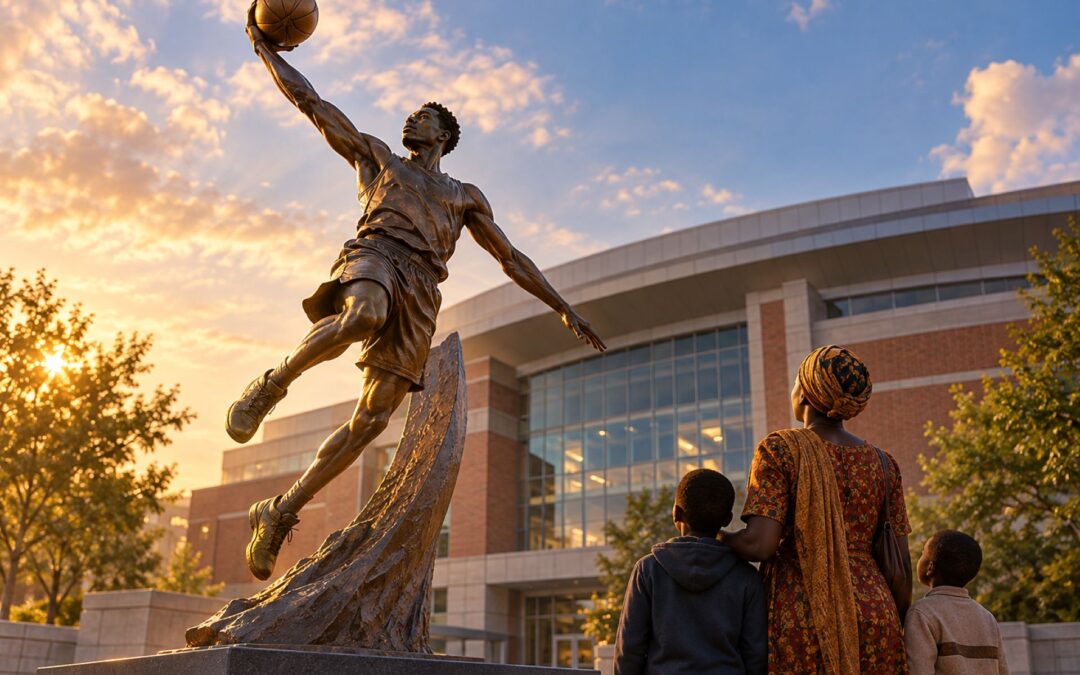
A small gathering assembles outside The Nest for the unveiling of a bronze sculpture honoring Samuel.
The guests include the Walkers, the Sooleymons, university personnel, coaches, teammates, and friends.
The university president gives a brief speech celebrating Samuel’s remarkable achievements and the affection he inspired.
Beatrice is invited to unveil the sculpture.
When the covering falls, the bronze figure depicts Samuel soaring toward the basket, preparing to complete a dunk. The image preserves him in the act that made him famous and that continues to define his public memory.
Students watching from nearby begin chanting his nickname.
The novel ends with the community remembering Sooley, while his mother and brothers stand among the people who helped fulfill the promise he could not complete.
The Contrasting Worlds of Lotta, Rhino Camp, and Durham
The settings of Sooley are essential to understanding the choices available to its characters. Grisham repeatedly contrasts places where ordinary life depends on fragile political circumstances with institutions possessing extraordinary resources and opportunities.
Lotta initially provides Samuel with family, belonging, education, and a sense of home. The village is modest in material terms, but it supports meaningful social relationships and aspirations. Ayak’s commitment to schooling, the boys’ neighborhood basketball court, and the family’s routines establish a life that has value independently of the poverty Samuel hopes to escape.
The rebel attack destroys that security. Homes, possessions, schools, and familiar relationships disappear in a single night. The consequences extend beyond physical danger because displacement also removes the ordinary structures through which people plan their futures.
Rhino Camp South represents a different form of precarious existence.
Beatrice and the children are no longer fleeing armed fighters every day, but their survival depends on systems they do not control. They must register for assistance, wait for food, seek medical attention, and accept accommodations determined by the capacity of humanitarian organizations.
Grisham repeatedly returns to long queues, deteriorating tents, scarce resources, and the difficulty of maintaining health and cleanliness. The repetition reflects the lack of progress in a life organized around meeting immediate needs.
The camp is not without community or agency. Beatrice develops friendships, shares resources, protects her money, seeks treatment for the children, and takes practical steps to improve their circumstances. These actions are important because they prevent her from becoming entirely passive within the narrative.
Yet the possibilities available to her remain severely limited. Even when the children’s schooling improves and the family obtains modest comforts, their future is uncertain.
Durham presents almost the opposite environment.
Samuel receives an education, accommodation, food, training facilities, and access to influential people. His athletic ability can attract attention and eventually financial rewards on a scale unimaginable in Lotta.
North Carolina Central is itself a relatively modest institution within American college basketball. Britt struggles with resources and recruitment, while his players confront opponents from more prestigious programs.
That contrast becomes especially pronounced when Central plays Duke. Two universities located near each other inhabit very different positions within the national basketball economy.
Nevertheless, even Central’s limited resources appear extraordinary beside the material conditions in Rhino Camp South.
The contrast is clearest through Samuel’s experience of food and water. He encounters abundant meals and comfortable homes while knowing that Beatrice must spend substantial parts of her day acquiring basic necessities.
His guilt is understandable because the disparity is not explained by any moral difference between the people in the two settings. It reflects circumstances of birth, violence, mobility, and institutional access.
The late transformation of Beatrice’s life reverses the contrast. She moves from a refugee settlement to expensive hotels and a private aircraft, experiencing forms of luxury that had been almost unimaginable.
Grisham uses the abruptness of this change to demonstrate what money can make possible. The same sequence also exposes a limitation of the novel’s resolution: the family’s escape depends on exceptional private resources rather than a reliable system available to similarly displaced people.
Sooley is most effective when these settings operate through concrete differences in daily life. Its larger social portrait is less developed than its individual stories, however, and the refugee experience is primarily presented through danger, deprivation, and dependence on assistance.
The novel conveys the suffering of displaced people with considerable sympathy, but it does not attempt a comprehensive portrait of South Sudanese society, Ugandan refugee communities, or the political systems responsible for the conflict.
Samuel Sooleymon’s Character: Talent, Loyalty, and Vulnerability
Samuel begins the novel as an enthusiastic teenager whose ambitions extend beyond his actual abilities. He possesses exceptional physical gifts but lacks the refined skills necessary to achieve his dream.
His personality is initially defined by affection, optimism, and eagerness. He loves his family, enjoys basketball, respects his coaches, and approaches new experiences with curiosity.
The destruction of Lotta changes his emotional life without immediately changing his fundamental character.
Samuel becomes burdened by grief and uncertainty. His father’s death removes an important source of guidance, while Angelina’s disappearance leaves him without a clear understanding of the family’s losses.
His determination to succeed in basketball gradually becomes inseparable from his desire to help Beatrice, James, and Chol.
That motivation gives his extraordinary training discipline a convincing psychological basis. His early-morning shooting sessions are driven by genuine ambition, but they also provide a way to respond to helplessness.
He cannot stop the war, repair his village, or immediately rescue his family. He can, however, practice shooting, improve his body, and earn the opportunity to play.
Samuel’s development also reveals a capacity to learn. He accepts correction from Britt, recognizes weaknesses in his game, and gradually becomes a more versatile player.
His athletic transformation is the central source of excitement in the novel, although the speed and scale of that transformation raise questions about credibility.
His relationships show another aspect of his personality.
With Murray, Samuel develops a friendship based on trust, humor, and mutual dependence. He is grateful for Murray’s guidance but does not simply imitate his behavior.
His refusal of Robin’s advances demonstrates that loyalty matters more to him than immediate sexual opportunity. The decision is especially significant because Murray has become the closest thing Samuel possesses to a brother in America.
Samuel also forms strong attachments to Ida and Ernie Walker. Their household provides affection and security, and he gradually accepts their place in his life.
Nevertheless, his growing independence creates tension.
As Samuel becomes famous, he starts receiving attention from people who know little about his personality or family circumstances. His impressive basketball performances encourage the impression that he is unusually mature and capable.
In some respects, he is. His discipline, resilience, and willingness to help others suggest considerable emotional strength.
Yet athletic excellence does not necessarily provide experience with wealth, contracts, sexual relationships, or dangerous social situations.
Samuel’s decision to enter the NBA draft reveals both genuine responsibility and youthful impatience. He wants to secure his family’s future as quickly as possible, but he becomes less receptive to advisers who recommend caution.
His involvement with Arnie is similarly complicated. The agent offers legitimate professional opportunities, and Samuel has good reasons to seek experienced representation. At the same time, he becomes increasingly dependent on people whose influence extends into his finances and personal life.
The relationship with Vallie and the trip to the Bahamas demonstrate how rapidly his habits change once professional success appears assured.
Earlier in the story, Samuel often approaches partying and alcohol cautiously. By the end, he is experimenting with a lifestyle in which expensive entertainment, drugs, and casual intimacy are readily available.
The novel does not portray him as suddenly cruel, selfish, or indifferent to his family. His intentions remain largely consistent, even as his decisions become more impulsive.
This distinction is crucial to understanding his death. Samuel’s tragedy emerges from dangerous judgment in a new environment, rather than a complete moral transformation.
Whether Grisham develops the transition convincingly is a separate critical question. The novel establishes Samuel’s inexperience and growing exposure to celebrity, but the final sequence moves rapidly from professional triumph into fatal drug use.
Samuel is therefore both sympathetic and imperfect. His affection and ambition are genuine, his extraordinary talent changes the lives of many people, and his later vulnerability prevents the story from presenting athletic success as a guarantee of wisdom.
The tragedy is affecting because his life ends while his most important purpose remains unfinished.
Beatrice, Murray, and the People Who Sustain Sooley
Beatrice and Murray are the two supporting characters most essential to the novel’s meaning. They occupy very different positions in Samuel’s life, but both become responsible for preserving something he values.
Beatrice’s experience begins in the familiar role of mother and household caretaker before the attack on Lotta forces her into a struggle for survival.
Her husband is killed, her daughter disappears, and she must protect James and Chol without adequate supplies, reliable transportation, or any assurance that they will reach safety.
Her decisions are practical rather than spectacular. She keeps the children moving, cooperates with other women, searches for food and water, obtains medical attention, and protects the limited money available to her.
These activities reveal endurance under circumstances where dramatic gestures would be largely useless.
Grisham gives her grief and fear considerable attention, but also shows her ability to form relationships and maintain routines. She does not simply wait for Samuel to rescue her; she repeatedly acts within the narrow limits available.
Nevertheless, her narrative becomes increasingly dependent on the assistance of others. Christine, Ecko, humanitarian organizations, and eventually Murray and Gaston possess resources that Beatrice cannot command.
This dependence reflects a genuine feature of her fictional situation, although it also limits the range of agency Grisham allows her in the later chapters.
Murray Walker undergoes a more visible transformation.
When Samuel meets him, Murray is a sociable college basketball player who has not distinguished himself athletically. He enjoys food, jokes, socializing, and the comforts of a supportive family.
His friendship with Samuel gradually requires him to assume responsibilities beyond his previous experience.
He helps Samuel understand university life, supports his training, and becomes involved in the search for Beatrice and the boys.
Murray is not presented as an idealized moral guide. His romantic entanglements, social interests, and enthusiasm for Samuel’s prospective wealth reveal ordinary youthful weaknesses.
His importance comes from loyalty rather than exceptional virtue.
After Samuel becomes famous, Murray recognizes that attention and money may expose his friend to dangers. He worries about the people surrounding Samuel but cannot control his choices.
The Bahamas tragedy leaves Murray devastated and forces him to confront the limits of friendship. He was present during the trip but could not prevent Samuel’s death.
His subsequent discovery of Gaston’s business card gives him a purpose. Instead of remaining entirely absorbed by grief, he decides to pursue the family-rescue project.
The Sooley Fund requires planning, negotiation, administrative work, and the ability to persuade others. Murray’s willingness to organize these efforts demonstrates development that his basketball career alone could never have produced.
By the conclusion, he has become the principal living agent of Samuel’s unfinished commitment.
Ida Walker provides another form of responsibility.
She is intelligent, protective, outspoken, and frequently willing to challenge decisions she considers dangerous. Her legal background makes her especially valuable when Samuel encounters questions about student status, money, contracts, and immigration.
Ida’s protective instincts can be overbearing. Samuel and Murray sometimes resist her advice because they want greater independence and find her concern intrusive.
The novel does not portray her caution as entirely misplaced, however. She recognizes the hazards surrounding young athletes who suddenly acquire wealth and become dependent on professional advisers.
Her determination is particularly consequential during the family’s arrival in America, when immigration processing threatens to complicate the reunion.
Ernie Walker is less forceful but contributes to the family’s atmosphere of stability. His quieter support complements Ida’s energy, and together they give Samuel a household in which he is welcomed without needing to prove his athletic value.
Ecko Lam serves as the original architect of Samuel’s American opportunity.
He identifies physical potential that more conventional recruiters might overlook and persuades Lonnie Britt to take the risk of offering Samuel a scholarship.
Ecko’s role extends beyond basketball. He helps communicate news of the massacre, supports Samuel through grief, visits his surviving family in Uganda, and remains involved after Samuel’s death.
His relationship with Samuel represents a form of mentorship that recognizes the player as a person with obligations beyond the court.
Lonnie Britt is more complicated.
He believes in Samuel’s abilities and provides crucial coaching, but he also has professional ambitions. His desire to move to a larger program is genuine, and Central’s unexpected success helps him achieve that goal.
Britt’s personal advancement does not erase his contribution to Samuel’s development. He teaches, corrects, and eventually trusts an inexperienced player with an extraordinary opportunity.
His character illustrates the overlapping interests within college sports: coaches may care about athletes while simultaneously pursuing careers shaped by institutional status and competitive success.
Christine Moran and Nestor Kymm provide important practical connections between Samuel’s American life and the refugee settlement.
Christine offers humanitarian support and develops a personal relationship with Beatrice. Her difficult task of communicating Samuel’s death demonstrates the emotional burden involved in working with families experiencing repeated losses.
Kymm helps facilitate communication and the television broadcasts that allow the refugees to witness Samuel’s success.
Ayak, although killed early, remains important through his commitment to education and his encouragement of Samuel’s ambitions. His death deprives Samuel of paternal guidance at the moment his life begins changing most dramatically.
Angelina’s disappearance is another enduring absence. Unlike Ayak, whose death is confirmed, she remains missing. The uncertainty prevents the surviving family from achieving complete emotional closure.
James and Chol are primarily presented through their relationships with Beatrice and Samuel, but their survival gives the rescue narrative its most immediate stakes. Chol’s final basketball shot offers a particularly moving connection to his older brother.
Arnie Savage and Reynard introduce the commercial world of professional sports.
They have the contacts and skills needed to help Samuel negotiate a lucrative career, but they also encourage his movement into a lifestyle where financial management, celebrity, and personal indulgence become intertwined.
Their motives are commercially shaped without being reducible to simple villainy.
Vallie represents another aspect of Samuel’s sudden social transformation. Her relationship with him is connected to the attractions of celebrity, although her distress at his death should not be dismissed as insincere.
The supporting cast works best when its members possess recognizable interests and limitations. Some characters, particularly those associated with the later professional environment, are more functional than psychologically developed, but their actions significantly alter Samuel’s circumstances.
Family Obligation, Displacement, and the Meaning of Hope
Samuel’s understanding of basketball changes as the novel progresses.
In Lotta, the sport offers enjoyment, recognition, and the dream of a different future. The prospect of traveling to America is exciting because it might lead to a scholarship or professional opportunity.
After the massacre, success acquires a more urgent purpose.
Samuel wants to help his surviving family, but his ability to do so is limited by distance, money, and immigration restrictions. He continues pursuing basketball partly because it represents the most promising route toward acquiring the resources they need.
This sense of obligation gives his ambition a different character from ordinary sporting aspiration.
He wants to score, win, and become famous, but those achievements are repeatedly measured against Beatrice’s continued suffering.
His weekly calls illustrate the difficulty. They keep the family emotionally connected, yet they also expose the gap between Samuel’s growing opportunities and his limited power to improve their situation.
The novel is particularly effective at portraying the discomfort of safety when loved ones remain vulnerable.
Samuel can eat well, sleep comfortably, and enjoy the hospitality of the Walkers, but those experiences provoke guilt because he knows that his mother and brothers lack similar security.
His success does not remove that guilt. In some respects, greater comfort makes the contrast more painful.
Displacement also affects identity.
Samuel belongs to South Sudan through language, family, history, and memory. In Durham, he becomes Sooley, a nickname adopted by teammates and eventually celebrated by thousands of strangers.
Both identities are genuine, but they belong to different worlds.
The Walkers help him construct a new sense of home without requiring him to abandon his obligations to the old one.
Murray’s friendship becomes especially important because it expands the meaning of family. He has no biological obligation to Beatrice, James, or Chol, yet he eventually accepts responsibility for helping them.
The final rescue therefore extends Samuel’s family commitment beyond Samuel himself.
Grisham’s treatment of hope is strongest when it remains connected to practical action. Samuel trains, Ecko searches for opportunities, Christine assists Beatrice, and Murray organizes fundraising.
Hope does not solve the characters’ problems simply because they possess it. Progress requires resources, personal relationships, and sometimes enormous luck.
That emphasis becomes problematic in the final rescue, which depends on exceptional wealth and privately arranged transportation.
Beatrice’s circumstances are transformed because her son becomes famous, dies tragically, and inspires a successful fundraising campaign. The solution is emotionally satisfying within the story but unavailable to most people facing comparable displacement.
The novel acknowledges the suffering of refugees while resolving its central family’s problem through an extraordinary exception.
Its lasting thematic tension lies in this contradiction. Samuel’s achievements matter enormously, but the safety of his family should never have depended on one teenager becoming an NBA prospect.
Basketball, Education, Money, and the Price of Opportunity
Basketball functions in Sooley as both an athletic pursuit and a system for distributing opportunity.
Samuel begins with exceptional physical potential but little access to the coaching, facilities, and competitive experience necessary to develop it fully.
Ecko’s international recruiting efforts connect that potential with American colleges, where scholarships can provide education and a possible route into professional sports.
The arrangement offers genuine advantages. Without the scholarship at Central, Samuel might have remained in a dangerous country or faced an uncertain future after the destruction of his village.
The university gives him security, training, and access to people willing to invest in his development.
Yet the system also involves competing interests.
College programs need talented players to win games, attract supporters, and generate institutional prestige. Coaches build reputations through their teams’ performances, while athletes must balance education with demanding training and competition.
The guarantee games played against stronger universities illustrate how financial inequality shapes the sport. Smaller programs may accept difficult matchups because the payments support their athletic departments.
Even successful participation does not guarantee equal opportunities. A player at Central receives less initial attention than a comparable prospect at a more prestigious school.
Samuel’s extraordinary performances temporarily overcome that disadvantage. His shooting and athleticism are so unusual that scouts, journalists, and agents cannot ignore him.
His success creates benefits for the university, raising its profile and improving the professional prospects of its coaches.
Britt’s move to Marquette illustrates the professional mobility available through athletic achievement. Samuel’s performance helps make his coach more attractive to a larger program.
The novel also shows how quickly attention shifts from education toward commercial value.
During his first months in Durham, Samuel is an inexperienced freshman attempting to improve his shooting and satisfy academic requirements. After March Madness, he becomes a prospect whose future earnings may be worth millions.
Arnie and Reynard see the economic potential of his abilities. Their interest is understandable within professional sports, where agents provide valuable services to athletes who must negotiate complex contracts.
Nevertheless, the relationship introduces a different distribution of power.
Samuel possesses the athletic talent that makes the arrangement valuable, but Arnie controls much of the knowledge and infrastructure surrounding contracts, investments, and professional access.
Ida worries that Samuel may surrender too much practical control before understanding the consequences.
Samuel, meanwhile, has good reasons to seek immediate financial security. Remaining at Central might improve his education, but it would delay the money he hopes to use to rescue his family.
The decision cannot be evaluated fairly without acknowledging that urgency.
Grisham does not construct a comprehensive criticism of college sports or professional athlete representation. His focus remains on Samuel’s particular experiences.
The novel is more persuasive when it shows how institutions create incentives than when it implies that the luxury surrounding professional sports naturally produces moral danger.
Money gives Samuel access to people and environments he has never encountered, but the resulting tragedy depends on specific actions, not simply the possession of wealth.
The deepest irony is that basketball provides Samuel with an extraordinary opportunity but cannot protect him from the consequences of decisions made outside the court.
His athletic discipline produces a professional contract, yet his inexperience with a new social environment leaves him vulnerable at the moment his future appears most secure.
The Courts, the Name, the Screens, and the Memorial
Several recurring images connect Samuel’s life in South Sudan with his experiences in America.
The basketball court is the most important.
In Lotta, it is an ordinary neighborhood space where Samuel develops his love of the sport and plays with his younger brothers. The facilities are modest, but the court gives him freedom, pleasure, and a recognizable identity.
At Central, the court becomes a place of discipline and transformation. Samuel returns to it early in the morning, working on his shooting until his skills begin to approach his athletic potential.
The same space later becomes a stage for extraordinary public success, with the arena filling with people eager to watch him perform.
After his death, The Nest becomes a place of memory.
When Murray brings James and Chol onto the court, their connection with Samuel is no longer dependent on seeing him alive. The place contains the history of his training and achievements.
Chol’s successful long-distance shot suggests continuity between the brothers without promising that he will repeat Samuel’s career.
Samuel’s physical growth also recurs throughout the novel.
He becomes taller, stronger, and more capable of performing feats that astonish coaches and opponents. Changes in his body and equipment mark his rapid athletic development.
The emphasis on his physical gifts makes his death especially startling. A body that appeared capable of extraordinary achievements proves vulnerable to a dangerous substance.
The nickname Sooley undergoes a similar transformation.
Initially adopted by teammates, it helps Samuel become part of the Central community. As his fame grows, it becomes a public identity recognized by strangers across the country.
By the end, the name is preserved in the Sooley Fund and the university memorial, connecting an individual life to a wider community.
Food and water provide another recurring contrast.
Samuel experiences abundant meals and ordinary household comforts, while Beatrice and the boys spend much of their day securing basic necessities. The differences become especially vivid during the rescue, when unlimited running water and plentiful food astonish the children.
Telephones and television screens repeatedly reduce the emotional distance between the separated family members without removing their physical separation.
The early satellite calls from Lotta, the weekly conversations from Uganda, and the broadcast of Samuel’s tournament performances allow the family to remain connected across continents.
The final bronze sculpture completes these patterns.
It depicts Samuel suspended in an athletic action rather than resting, studying, or grieving. The image preserves the public version of Sooley as an extraordinary basketball player.
For Beatrice and the Walkers, however, the sculpture represents a person whose importance extended beyond the game. The distinction between the admired athlete and the beloved son and friend gives the memorial much of its emotional force.
How Grisham Tells the Story: Intercutting, Game Reports, and Foreshadowing
Grisham constructs Sooley through a predominantly chronological, third-person narrative that alternates between Samuel’s experiences and his family’s circumstances.
The technique establishes suspense in two very different settings.
Samuel’s storyline follows the conventions of sports fiction. It begins with an unpolished athlete, moves through training and setbacks, introduces a coach willing to take a chance, and builds toward increasingly demanding competitions.
Beatrice’s storyline develops through displacement and survival. Its challenges cannot be solved through spectacular individual talent, and progress occurs much more slowly.
The alternation between the narratives prevents the reader from viewing Samuel’s rise as an uncomplicated success story.
A basketball victory may be followed by a scene in which Beatrice waits for food or struggles with an illness affecting her children. The contrast changes the emotional scale of the preceding achievement.
Grisham’s background as a writer of popular suspense is evident in the brisk chapter construction. Many chapters end when an uncertainty has been introduced or a significant decision remains unresolved.
The technique encourages continuous reading, particularly during the tournament and the final rescue.
His basketball scenes often resemble detailed sports reporting.
He describes defensive adjustments, shooting distances, substitutions, scoring runs, foul trouble, and changes in momentum. These details allow the reader to understand why particular games become difficult and how Central manages to overcome stronger opponents.
Samuel’s extraordinary shooting creates a recognizable tactical problem. Defenders must challenge him far from the basket, which opens space for teammates.
The games are most effective when Grisham develops that conflict through changes in strategy rather than relying solely on spectacular scoring totals.
The Duke contest exemplifies the approach. Its suspense grows from institutional inequality, defensive pressure, Samuel’s individual struggle, and Central’s effort to recover from adversity.
Grisham’s personal interest in basketball is significant to the novel’s construction.
In a 2021 interview with John Feinstein for The Washington Post, he identified three major inspirations: young South Sudanese players visiting America, the development of college basketball player Mamadi Diakite, and the death of Len Bias.
These influences help explain the novel’s combination of international recruitment, rapid athletic improvement, and a promising career destroyed by drug use.
They also clarify why the tragedy occupies such an important position in the story. It is connected to Grisham’s conception of the novel rather than appearing as an unrelated development.
His Author’s Note reinforces the significance of basketball to his imagination. He recalls his childhood fascination with the sport, including admiration for Pete Maravich, and acknowledges people who helped him understand the basketball world.
The novel’s three-part structure is particularly revealing.
The first part establishes Samuel’s opportunity and destroys the life to which he expected to return. The second allows his basketball career to flourish while his family remains displaced. The third appears to deliver the economic success necessary for reunion before abruptly ending his life.
This design gives the final tragedy considerable structural force.
However, structural intention does not automatically produce convincing characterization.
The progression toward the NBA becomes increasingly filled with signs of danger: agents, money, parties, new relationships, and the concerns voiced by Ida and others.
Such foreshadowing creates anticipation, but it can also make the outcome feel predetermined. Readers may sense that Samuel is being moved toward disaster rather than observing a sufficiently gradual change in his behavior.
The shift in tone is unusually sharp.
For much of the novel, the basketball narrative offers the excitement of a successful underdog story, complete with last-minute victories and improbable athletic achievements. The final chapters replace that momentum with death, mourning, fundraising, and an international rescue operation.
The contrast is deliberate and emotionally consequential, but it places heavy demands on the novel’s credibility.
Grisham’s prose is generally direct and accessible. His sentences prioritize action, dialogue, and explanation rather than elaborate imagery or psychological introspection.
The style suits the basketball sequences and the practical details of travel, training, and administration. It is sometimes less effective when characters require deeper emotional complexity than the brisk narrative allows.
The result is a novel with considerable narrative momentum and a strongly organized sequence of contrasts. Its construction is confident, although its most dramatic choices occasionally appear more heavily engineered than psychologically inevitable.
What Sooley’s Ending Resolves—and What It Leaves Unfinished
Samuel’s death occurs after he has achieved the financial opportunity that could have secured his family’s future.
This timing gives the tragedy its particular significance.
He survives the destruction of Lotta, travels to America, develops his abilities, attracts national admiration, and signs with a professional agent. The NBA draft appears to provide the resources necessary to rescue Beatrice and the boys.
His death interrupts that progression immediately before the anticipated rewards become fully available.
The loss therefore extends beyond his life and career. It threatens the future of the relatives whose safety has shaped his ambitions.
Murray’s discovery of the rescue arrangements changes the apparent meaning of the ending.
Samuel had not forgotten his family amid the excitement of wealth and celebrity. He had already begun working with Gaston to secure their relocation.
This discovery prevents the later chapters from suggesting that Samuel abandoned his original purpose. His judgment may have become less cautious, but his underlying commitment remained.
Murray’s response transforms the story’s final focus.
For much of the novel, Samuel is the person through whom possibilities become available. His talent attracts Ecko, secures Britt’s scholarship, changes Central’s season, and draws professional interest.
After his death, the responsibility passes to people whose relationships with him were formed through those opportunities.
Murray organizes the fund, Ecko provides guidance, Ida contributes legal expertise, and others support the effort. The rescue becomes a collective achievement rather than another demonstration of Samuel’s extraordinary ability.
The conclusion suggests that an individual’s intentions may continue shaping other people’s actions after death.
Its emotional effect depends on the reader’s understanding of Murray’s friendship with Samuel. Murray is no longer simply the roommate who offered guidance and companionship. He becomes someone willing to assume serious responsibility for people he barely knows because they mattered to his friend.
The reunion in America completes the novel’s most important practical objective.
Beatrice, James, and Chol leave the settlement and enter a safer environment where they can begin rebuilding their lives.
Yet the conclusion does not restore the family that existed in Lotta.
Ayak remains dead. Samuel is buried in North Carolina. Angelina’s fate is unknown. Beatrice has reached America at the cost of losses that no amount of money or assistance can undo.
The family’s immigration status is also unresolved. Ida obtains their release from detention, but the novel does not establish that their long-term right to remain in America has been permanently secured.
The rescue itself introduces ethical complications.
Gaston uses forged passports and questionable arrangements to move the family. Money facilitates access to officials, transportation, and legal assistance that would ordinarily remain unavailable to displaced people.
The narrative largely presents these measures as justified by the urgency of the family’s situation.
Readers may sympathize with that urgency while still recognizing that the operation depends on extraordinary privileges and does not provide a general solution to the problem of refugee displacement.
The final scenes avoid complete emotional restoration.
Beatrice’s visit to Samuel’s grave forces her to confront the absence at the center of her new life. Her arrival is therefore simultaneously a rescue and a bereavement.
When James and Chol enter The Nest, they encounter a place that holds a version of their brother they barely knew. Samuel became famous in America while they were struggling to survive in Uganda.
Chol’s successful shot creates a brief connection between those separate experiences.
The statue offers a more public form of remembrance.
It preserves Samuel as the extraordinary athlete who led Central to the Final Four, giving the university a lasting symbol of an unforgettable season.
For the surviving family and friends, however, the image also represents unrealized possibilities.
Samuel will never play professionally, continue his education, marry, or experience the reunion he worked to arrange.
The ending is therefore hopeful only within definite limits. His family survives and reaches America, and his friends prove that his life had consequences extending beyond his athletic achievements. His death remains irreversible, while the wider conditions that produced his family’s suffering remain unchanged.
Whether this resolution is satisfying depends partly on the credibility readers assign to the rescue operation. Its emotional meaning is clear, but its practical details rely on a sequence of convenient resources, relationships, and interventions.
The conclusion works best as an account of loyalty carried forward through grief, rather than as a realistic model for solving the difficulties of refugee displacement.
Critical Review: Where Sooley Succeeds and Where It Falters
Sooley is an ambitious departure from the legal thrillers for which John Grisham is best known. Its appeal rests on accessible storytelling, an engaging basketball narrative, and the emotional contrast between sudden fame and the precarious lives of a displaced family.
The novel’s strongest sustained achievement is its ability to make Samuel’s athletic development exciting.
Grisham gives readers enough basketball detail to understand why Samuel is initially overlooked and how his unusual abilities become valuable. The repeated shooting sessions, tactical adjustments, and increasing demands of competition provide a progression that is more engaging than a simple account of a gifted athlete winning games.
Samuel’s long period without meaningful playing time is particularly important. It delays the gratification expected from an underdog story and gives the eventual breakthrough greater force.
The NCAA tournament sequence is the most consistently entertaining portion of the novel.
Central’s victory over Duke is especially effective because the game carries several levels of significance. The contrast between the institutions, the defensive effort required to contain Samuel, and the extraordinary nature of the upset combine to create suspense even when the larger narrative appears designed around a successful underdog run.
Grisham also understands the pleasures of team sports fiction.
Samuel may be the principal attraction, but his success depends on Murray, experienced teammates, Coach Britt, and the coaching staff. The game descriptions repeatedly acknowledge the need for cooperation, defensive discipline, and tactical adaptation.
That attention helps prevent the basketball narrative from becoming entirely a succession of individual miracles.
Nevertheless, the scale of Samuel’s improvement strains plausibility.
He begins as a player with serious technical weaknesses and limited high-level experience, yet develops into a remarkably accurate long-range shooter within a relatively short period. His extraordinary physical attributes provide some explanation, and the novel establishes his intense commitment to practice.
Even so, the transformation requires readers to accept an exceptionally rapid improvement that produces performances capable of overwhelming elite college programs.
The problem is not that improbable sporting achievements are incompatible with fiction. Underdog narratives routinely depend on unusual talent and circumstances.
The difficulty is that Samuel’s abilities sometimes become so extraordinary that games risk losing uncertainty. His long-distance shooting can feel like a narrative solution available whenever Central requires another dramatic comeback.
The Villanova defeat restores some competitive limitation, but it comes after a succession of victories heavily dependent on Samuel’s seemingly inexhaustible scoring.
The refugee storyline provides a more serious emotional foundation.
Beatrice’s struggle in Uganda prevents the novel from celebrating Samuel’s success without qualification. The repeated scenes involving shelter, food, illness, and separation demonstrate that his achievements have practical stakes beyond personal fame.
Grisham’s decision to alternate between the narratives gives the basketball victories additional meaning.
When Samuel succeeds, readers understand why his mother and brothers have reasons to hope. When he returns to the comfort of the Walkers’ home, the contrast with Rhino Camp South makes his guilt intelligible.
The strongest humanitarian scenes are grounded in ordinary material details rather than declarations about suffering. Waiting for food, protecting small amounts of money, obtaining treatment for sick children, and adapting to camp routines communicate the family’s predicament effectively.
However, Beatrice’s story sometimes receives less psychological development than its importance deserves.
She is presented sympathetically and performs difficult acts of endurance, but the narrative is primarily concerned with what she must survive and how others eventually assist her.
Her memories, changing identity, and independent aspirations receive less attention than Samuel’s basketball development.
This imbalance becomes more apparent as the story approaches its conclusion. Beatrice’s future is ultimately transformed by Samuel’s fame, Murray’s fundraising, and Gaston’s resources.
The novel’s emphasis on individual rescue provides satisfying narrative closure but narrows its treatment of displacement.
Its portrayal of South Sudan also relies heavily on scenes of violence, poverty, and instability. These circumstances are central to the fictional plot, yet the narrative offers a limited account of the country’s ordinary social complexity or the political forces behind the conflict.
Grisham’s humanitarian concern is evident, but his principal aim is storytelling rather than a comprehensive examination of South Sudanese history or refugee policy.
Samuel himself is a likable protagonist whose virtues are clearly established.
His family loyalty, affection for Murray, willingness to practice, and gratitude toward the Walkers make him easy to support. He also possesses enough youthful enthusiasm and occasional poor judgment to avoid appearing entirely flawless.
Still, he is not a particularly complex character for much of the novel.
His motivations remain stable, and his internal conflicts are often expressed directly through concern for his family or frustration with basketball. Grisham is generally more interested in what Samuel does than in exploring the full psychological consequences of displacement, grief, and sudden fame.
The relationship with Murray compensates for some of this simplicity.
Their friendship develops naturally through shared accommodation, basketball, humor, and mutual support. Murray’s movement from ordinary college student to the person responsible for the rescue provides one of the novel’s more satisfying character arcs.
Ida Walker is another memorable figure.
Her assertiveness, protective instincts, and legal expertise make her immediately recognizable. She is sometimes controlling, but her interventions arise from understandable concern for two inexperienced young men entering circumstances they do not fully comprehend.
Ecko and Britt provide useful contrasts in mentorship.
Ecko sees Samuel’s potential and remains committed to his personal welfare, while Britt combines genuine coaching responsibilities with the professional ambitions of a college basketball coach.
Their roles help establish that support need not be entirely selfless to be valuable.
The novel is less successful with some characters surrounding Samuel’s professional transition.
Arnie’s business operations, Reynard’s influence, and Vallie’s relationship with Samuel serve recognizable narrative purposes, but they are not developed with the same emotional depth as Murray or the Walkers.
Their prominence increases when the plot begins moving toward the Bahamas tragedy, making their roles feel more functional.
The death itself is the novel’s most controversial artistic decision.
The preceding chapters establish Samuel’s increasing exposure to money, celebrity, social pressure, and unfamiliar forms of entertainment. Ida’s warnings and Murray’s concerns provide recognizable foreshadowing.
The author has also constructed Samuel as a teenager whose remarkable athletic maturity does not necessarily extend to other areas of judgment.
These details support the plausibility of a dangerous mistake.
Yet the speed with which the narrative moves from the NBA draft into the festival and fatal drug use remains jarring.
Samuel’s behavior changes, but the psychological development leading to that change is comparatively compressed. Readers who accepted the gradual training narrative may find the fatal reversal insufficiently prepared.
The tragedy is emotionally effective because Samuel is sympathetic and his family’s future depends on him. It also risks feeling imposed on the story to deliver a particular warning about drugs, wealth, and premature celebrity.
Grisham’s own identification of Len Bias as one of his inspirations explains the choice but cannot settle its artistic success.
A fictional event requires more than a recognizable real-world precedent. It must emerge convincingly from the character and circumstances established within the work.
Contemporary reviewers differed on these questions.
In his Associated Press review of Sooley, Rob Merrill emphasized the novel’s readable pace and the effectiveness of juxtaposing Samuel’s basketball success with his family’s refugee experience.
That assessment identifies one of the book’s real strengths. The contrast between the two storylines provides emotional stakes that an ordinary college basketball novel might lack.
The more skeptical Publishers Weekly review raised concerns about the characterization, sentimentality, foreshadowing, and the handling of the late tragedy.
Those concerns are also substantial. The narrative sometimes places characters into circumstances designed to produce strong emotional reactions without giving all of them enough independent depth.
The final rescue presents a related problem of plausibility.
Murray’s decision to continue Samuel’s work grows convincingly from their friendship, and the Sooley Fund provides an emotionally appropriate means of converting public admiration into assistance.
The operation itself, however, involves an unusually accommodating combination of private aviation, forged documents, international contacts, large donations, and legal intervention.
Grisham explains much of the logistical process, which makes the sequence readable and concrete. Nevertheless, the plan succeeds through resources and coincidences that remain extraordinary even within the circumstances of a famous athlete’s family.
The conclusion risks simplifying a complex humanitarian problem into one that can be resolved when sufficient money and determination become available.
The novel does not claim that every displaced family can be rescued through such a method, but its emphasis on the successful exception limits the broader social force of its humanitarian narrative.
The memorial ending is more convincing on an emotional level.
Samuel’s statue and the affectionate chanting of his nickname fit the university’s experience of his extraordinary season. The earlier basketball scene involving Chol also provides a quieter and more personal acknowledgment of his influence.
These moments are effective because they connect to objects, relationships, and places established throughout the novel.
Grisham’s prose remains one of the book’s practical strengths. His straightforward dialogue, brisk chapters, and clear account of complicated sequences make the novel accessible to a broad readership.
He is especially skilled at maintaining narrative momentum through training, competition, travel, and organizational activity.
The limitations of that style become apparent when deeper psychological examination is needed. Samuel’s grief, Beatrice’s displacement, and the repercussions of his death sometimes receive less introspective attention than their significance might warrant.
The novel is most comfortable when characters are doing something observable: shooting baskets, making calls, arranging transportation, arguing about contracts, or helping others.
That preference makes it highly readable while limiting some of its literary complexity.
Sooley therefore succeeds most fully as an emotionally driven popular novel. Its basketball sequences are exciting, its principal relationships are appealing, and its account of a young athlete’s desire to protect his family gives the story an unusually powerful motivation.
Its weaknesses are concentrated in the credibility of Samuel’s exceptional abilities, the limited depth of some secondary characters, and the rapid sequence of tragedy and rescue that concludes the narrative.
These limitations do not make the novel ineffective, but they prevent its humanitarian ambitions from being realized with the same consistency as its sports storytelling.
Is Sooley Worth Reading?
Sooley is worth reading for anyone who enjoys underdog sports stories, accessible contemporary fiction, and narratives in which personal ambition carries consequences beyond individual success.
Readers interested in basketball will find considerable attention to training, competition, strategy, recruiting, and the excitement of an unexpected NCAA tournament run. Grisham makes Samuel’s extraordinary development the foundation of an engaging sequence of games, supported by a cast of coaches and teammates whose relationships give the athletic achievements additional weight.
The novel also offers a moving portrayal of family separation and the obligations Samuel feels toward the people left behind. Beatrice’s experience in Uganda provides the necessary counterpoint to his growing fame and prevents his career from becoming the only measure of his success.
Readers expecting a psychologically intricate literary novel, a nuanced political study of South Sudan, or a consistently plausible account of elite basketball may be less satisfied. The later chapters also depend on accepting an abrupt tragedy and an unusually convenient rescue operation.
The book’s strongest relationship is ultimately the friendship between Samuel and Murray. Their bond develops through ordinary college life and survives Samuel’s death through the responsibility Murray accepts toward his family.
That development gives the conclusion more substance than the public memorial alone could provide.
Sooley is a compelling and often affecting novel whose ambitious combination of basketball, displacement, fame, and grief is not always equally convincing. Its athletic story provides the momentum, its family narrative supplies the emotional stakes, and its ending asks readers to understand Samuel’s achievement through the lives he influenced rather than the professional career he never had.
Last Updated on October 17, 2026 by Aseem Gupta