
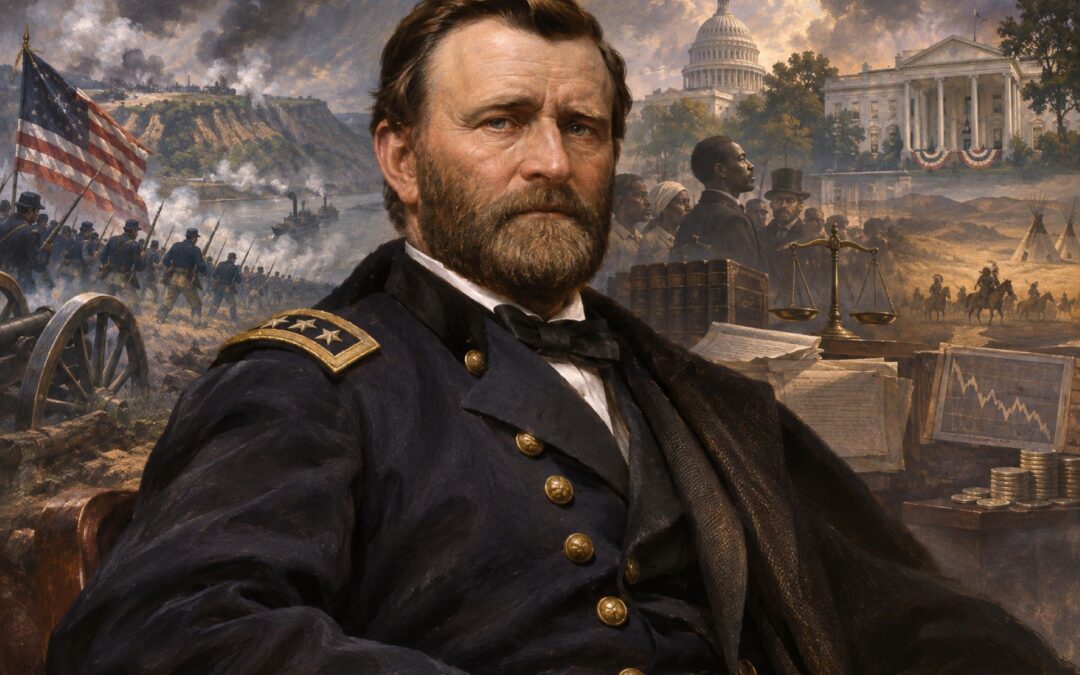
In 1860, Ulysses S. Grant was an obscure former army officer working in his family’s leather-goods business in Illinois. He had struggled as a farmer, failed at several ventures, and sometimes lacked the money to support his growing family. Less than five years later, he would be the most successful general in the United States, the man to whom Robert E. Lee surrendered. Four years after that, he would enter the White House.
Few American lives changed so dramatically, and few reputations have proved so difficult to settle. Grant helped preserve the Union, then used presidential power to defend the rights of people freed from slavery. Yet his administration was troubled by corruption, his policies toward Native nations had devastating consequences, and the gains of Reconstruction proved fragile. To understand Grant is to examine not just an extraordinary rise, but the distance between winning a war and building a just peace.
From Ohio to West Point: The Making of Ulysses S. Grant
The future president was born Hiram Ulysses Grant on 27 April 1822 in Point Pleasant, Ohio. His father, Jesse Root Grant, worked in tanning and the leather trade, while his mother, Hannah Simpson Grant, came from a family with Scots-Irish roots. Ulysses was the eldest of six children in a household that became reasonably comfortable as Jesse’s business prospered. His father was outspoken and politically engaged; his mother was reserved and religious, and Grant later displayed something of her reluctance to talk about himself.
The family moved to Georgetown, Ohio, while Grant was young. He attended local schools and developed an unusual ease with horses, learning to ride, handle difficult animals, and manage teams. The skill would later prove valuable in the cavalry-minded culture of nineteenth-century armies, although he never became a flamboyant military personality. He disliked the work of the tannery and showed little appetite for the commercial career his father understood.
In 1839, Jesse arranged for the seventeen-year-old to be nominated to the United States Military Academy at West Point. The congressman submitting the nomination recorded him as Ulysses S. Grant, apparently assuming that Simpson was his middle name. The academy registered him under that name, and Grant eventually accepted it. The initial did not stand for an officially adopted middle name, but the mistaken designation became his lasting public identity.
West Point did not immediately awaken a passion for military life. Grant performed respectably without excelling in most academic subjects, avoided much of the social display associated with aspiring officers, and stood out especially in horsemanship. He graduated in 1843, ranked twenty-first in a class of thirty-nine, and was commissioned into the Fourth Infantry. He initially hoped that service might provide an opportunity to teach or eventually pursue another life.
His upbringing supplied neither a clear route to greatness nor the kind of early ambition usually attached to heroic biographies. What it did provide was familiarity with practical work, an ability to remain composed around difficult horses, and a temperament that often favored action over elaborate self-presentation. Those qualities would matter more after the army, and the country, entered a crisis neither had prepared for.
The Mexican War, Marriage, and Years of Failure
Grant’s first army postings brought him to the St. Louis area, where he became close to the family of Frederick Dent, a fellow West Point graduate. He fell in love with Frederick’s sister Julia, whose lively confidence complemented his quieter manner. They became engaged in 1844, but military service delayed their wedding for four years. Julia’s family owned enslaved people, an uncomfortable reality for the son of a father who strongly opposed slavery and a contradiction that would remain part of Grant’s own life.
The Mexican-American War began in 1846 following the United States’ annexation of Texas and a disputed border between the Rio Grande and Nueces River. Grant served under Zachary Taylor and later Winfield Scott, seeing combat from Palo Alto through the campaign toward Mexico City. As a regimental quartermaster, he learned that successful armies depended not merely on courage but on food, transport, supplies, timing, and reliable movement. He also gained experience under officers whose decisions he would remember during the Civil War.
The war also exposed Grant to the moral costs of the expansion he was helping enforce. The acquisition of new western territory reopened the explosive question of whether slavery would extend into lands taken from Mexico. Although Grant did not yet play a public political role, the conflict connected his first experience of command to the national dispute that would later bring him back into uniform. His military education and his developing view of American expansion were never entirely separate stories.
The settlement profoundly altered North America. Under the Treaty of Guadalupe Hidalgo, signed on 2 February 1848, Mexico ceded an enormous territory to the United States, including present-day California and New Mexico and lands extending across much of the modern Southwest. Grant later considered the war unjust, viewing it as an aggressive conflict against a weaker neighbor. His participation nonetheless helped prepare him for the military responsibilities he would eventually assume.
Grant and Julia married in August 1848 and eventually had four children: Frederick, Ulysses Jr., Ellen, and Jesse. Their marriage remained affectionate even as postings repeatedly separated them. Assignment to the Pacific coast in the early 1850s was especially difficult; Julia stayed behind with their young family while Grant endured isolation, financial pressure, and repeated moves. Accounts of his drinking during this period are significant but not uniformly reliable, and the precise circumstances surrounding his resignation have long been debated. He submitted his resignation on 11 April 1854, and it took effect that June; the claim that he was formally dismissed for drunkenness is not established.
Civilian life offered little relief. Farming land associated with the Dent family brought exhausting labor but limited income, while real-estate ventures and other business attempts failed. During hard times, Grant sold firewood in St. Louis to keep money coming in. He built a modest house he called Hardscrabble, an apt name for the years in which he seemed unable to find stable footing outside the army.
His relationship to slavery was also more complicated than a simple family inheritance of abolitionism. He lived within a slaveholding household and personally owned an enslaved man named William Jones, whom he freed in March 1859. The surviving record of the manumission of William Jones is important precisely because it complicates a tidy account of Grant as an antislavery hero from childhood. His later defense of Black citizenship should be judged seriously, without erasing what came before it.
By 1860, Grant was working in the family leather business in Galena, Illinois. At thirty-eight, he had neither money nor public standing suggesting a great national career. His return to prominence would come not from finally succeeding in commerce, but from a war that exposed an urgent shortage of effective commanders.
An Unlikely General: Fort Donelson, Shiloh, and Vicksburg
When Confederate forces fired on Fort Sumter in April 1861, the American Civil War began and Grant offered his services to the Union. His earlier army experience made him useful almost immediately in recruiting and training volunteers in Illinois. He soon received a colonelcy and then command responsibilities in the western theater, where the Mississippi River system offered a route into the Confederate heartland. The strategic problem was bigger than occupying individual towns: the Union needed to disrupt Confederate supply lines and prevent its armies from supporting one another.
Grant’s earliest commands were hardly spectacular, but he showed a willingness to move rather than remain paralyzed by reports of enemy strength. In early 1862 he cooperated with naval forces on the Tennessee and Cumberland rivers. Fort Henry fell largely through the action of Union gunboats, while the campaign against Fort Donelson gave Grant a more conspicuous personal victory. Confederate troops attempting to break out were eventually forced to surrender, yielding thousands of prisoners and opening the way deeper into Tennessee.
Grant’s reply to a Confederate request for terms made him famous: he would accept only unconditional and immediate surrender. Newspapers delighted in connecting the initials U. S. with “Unconditional Surrender,” although the battlefield victory mattered more than the wordplay. He had achieved what other Union commanders seemed unable to deliver: an offensive success with strategic consequences. Lincoln and the public began to notice an officer who could translate a military plan into results.
The reputation was tested almost at once. At Shiloh in April 1862, Confederate forces attacked Grant’s army with such force that the first day threatened disaster. Union troops held on, reinforcements arrived, and the fighting ended with a Union victory on the second day. But the battle caused roughly 23,000 casualties on both sides combined, shattering expectations of a quick or comparatively bloodless war. Critics accused Grant of carelessness and returned to stories about his drinking; defenders pointed to his refusal to panic or retreat.
Grant’s greatest western achievement came at Vicksburg, a Confederate stronghold overlooking the Mississippi. Initial attempts to approach the city met formidable terrain, defensive positions, and supply problems. Rather than simply repeat unsuccessful maneuvers, Grant eventually marched his forces down the western bank of the river, crossed south of Vicksburg, and drove inland. In a rapid campaign, he defeated Confederate forces in several engagements and isolated the city from effective relief.
The decisive phase included a crossing of the Mississippi below Vicksburg in late April 1863, a move that temporarily complicated Grant’s traditional supply arrangements but gave his army the initiative. He advanced toward Jackson, disrupted Confederate communications, and defeated enemy forces at Champion Hill before closing on Vicksburg. The sequence mattered because Grant did not simply surround an impregnable fortress and hope it would surrender. He first prevented the Confederate armies in the surrounding region from cooperating effectively.
After assaults failed, Grant settled into a siege. Vicksburg surrendered on 4 July 1863, the day after the Union victory at Gettysburg concluded in Pennsylvania. When Port Hudson surrendered shortly afterward, the Union gained control of the Mississippi River and split the Confederacy’s principal eastern and western regions. Grant had combined risk-taking, logistical improvisation, battlefield command, and patience in a campaign that changed the strategic balance of the American Civil War.
His victories also revealed a recurring tension in his leadership. Grant was prepared to accept casualties and persist after reverses, qualities that could distinguish strategic determination from excessive aggression only when judged against the objective and alternatives. At Vicksburg, endurance produced an unmistakable gain; at other moments, the human cost would be harder to defend. The essential point is that Grant understood warfare as a connected campaign, not a collection of isolated encounters where a general’s reputation rose or fell with a single day’s fighting.
Lincoln’s General: From Chattanooga to Appomattox
The war continued after Vicksburg, especially in Tennessee, Georgia, and Virginia. In September 1863, Confederate forces defeated a Union army at Chickamauga, leaving troops trapped around Chattanooga and their supply routes endangered. Grant was given wider command in the western theater and helped reopen communications before directing the offensive that drove Confederate forces from the heights around the city in November. Chattanooga secured a vital transportation center and opened a route toward Georgia.
Lincoln promoted Grant to lieutenant general in March 1864 and placed him in command of all Union armies. Other generals had possessed superior resources without producing decisive results, and Lincoln valued Grant’s determination to keep moving after setbacks. Grant chose to remain close to the Army of the Potomac, which George G. Meade continued to command directly, while coordinating offensives elsewhere. His objective was to prevent Confederate commanders from shifting troops between threatened regions and to wear down their ability to fight as a unified war effort.
In Virginia, Grant confronted Robert E. Lee, whose Army of Northern Virginia had frustrated successive Union offensives. The Overland Campaign began in May in the tangled woodland of the Wilderness, where fire, limited visibility, and close fighting made the battle especially punishing. Grant’s important decision afterward was to continue south rather than withdraw to recover and begin again. The armies collided repeatedly at Spotsylvania, the North Anna, and Cold Harbor, with appalling losses and no swift breakthrough.
Cold Harbor in June became a particularly enduring stain on Grant’s military reputation. Assaults against strong Confederate positions failed at tremendous cost, and Grant later expressed regret over the attack. Yet viewing the entire campaign only as an exercise in sacrificing superior numbers overlooks his broader design. He was keeping Lee’s army under sustained pressure while Union armies in other theaters attacked the Confederacy’s remaining transportation, industrial, and agricultural capacity.
Grant’s wider design also relied on commanders beyond Sherman. Union troops fought to shut down Confederate supply channels in the Shenandoah Valley, while naval operations restricted ports and coastal routes. Some campaigns failed or progressed slowly, but the intention was to make every region of the Confederacy defend itself without receiving help from another. This helps explain why Grant’s willingness to fight repeated battles in Virginia was inseparable from developments hundreds of miles away.
Grant then shifted south toward Petersburg, whose rail connections were essential to sustaining Richmond and Lee’s forces. An opportunity to seize the city quickly was missed, and fighting settled into a prolonged system of trenches, assaults, raids, and encirclement that lasted into 1865. The static front did not mean the overall war had stopped moving. William Tecumseh Sherman captured Atlanta in September 1864 and later marched across Georgia, damaging infrastructure and supplies that supported Confederate armies. The victory at Atlanta also strengthened Lincoln’s position before his difficult reelection campaign.
By early 1865, Lee’s army was exhausted, supply routes were failing, and desertion weakened his remaining forces. Union attacks broke through the Petersburg defenses in April, forcing the abandonment of both Petersburg and Richmond. Lee attempted to retreat west, but Grant’s forces pursued and blocked escape. On 9 April, the two men met at Appomattox Court House and agreed to terms ending the fighting between their principal armies.
The surrender was notable for its restraint. Lee’s soldiers could return home on parole, officers retained their sidearms, and men who owned horses could take them for planting crops. Grant discouraged triumphal celebration that would humiliate the defeated, recognizing that the country would soon need these soldiers to live alongside former enemies. Appomattox became the symbolic end of the Civil War, although other Confederate armies surrendered over the following weeks.
The human consequences of Grant’s approach remain important. His forces did suffer enormous losses in 1864, and families in the North questioned why apparently successful generals still required so many lives. Yet Lee’s army was losing irreplaceable soldiers and freedom of maneuver as the broader Union campaign advanced. The meaning of Grant’s command lies in this uncomfortable combination of operational success and sacrifice, not in pretending every attack was necessary or every criticism unfair.
Lincoln was assassinated five days later, on 14 April 1865. Grant, who had declined an invitation to attend the theater that evening, suddenly faced a country without the president who had chosen him and backed his military strategy. Winning the war had given Grant national prestige, but it had not resolved the future of slavery’s survivors, the former Confederate states, or the meaning of citizenship. Those questions would shape the second half of his public life.
From Union Hero to the White House
At the end of the war, Grant was probably the country’s most admired living military figure. He had achieved a strategic victory that generations would associate with Lincoln’s presidency, and his measured treatment of Lee made him appear capable of reconciliation. The new president, Andrew Johnson, initially hoped to restore the southern states quickly, often favoring the return of former Confederate elites to political authority. Grant’s own early observations of the South were sometimes sympathetic to a lenient settlement, but the developing struggle over Black rights and federal authority increasingly made their relationship difficult.
Johnson clashed with congressional Republicans who wanted stronger safeguards for formerly enslaved people. In 1867 he suspended Secretary of War Edwin Stanton and appointed Grant to serve temporarily in his place, setting off a constitutional dispute over the Tenure of Office Act. When the Senate refused to support Stanton’s removal, Grant relinquished the office, provoking Johnson’s anger. The episode made the general more clearly aligned with the Republicans, even though he had not built his public identity through ordinary party politics.
The Republican National Convention nominated Grant for president in 1868. His campaign phrase, “Let us have peace,” appealed to a country weary of conflict but left open what kind of peace would follow. He defeated Democratic candidate Horatio Seymour and took office on 4 March 1869 as the eighteenth president of the United States, aged forty-six. The soldier who had struggled to manage a farm and a small business was now responsible for national finances, diplomacy, federal appointments, and the fragile protection of newly recognized freedoms.
Grant possessed personal courage, considerable strategic focus, and a reputation for honesty. None of those traits automatically supplied the experience needed to manage politicians, financiers, departmental officials, or a hostile Congress. His presidency would expose both the strength of his convictions and the limitations of a governing style formed largely in military command.
Reconstruction and the Fight for Black Citizenship
Reconstruction was the defining domestic test of Grant’s presidency. The Civil War had destroyed slavery as a legal institution, but emancipation did not guarantee secure employment, land, education, protection from violence, or political influence. Millions of formerly enslaved people sought to reunite families, build churches and schools, negotiate paid labor, and participate in public life. Their gains threatened a southern order in which white elites had long controlled wealth and power through enslavement.
The federal government had already begun rebuilding political institutions under Lincoln, Johnson, and Congress. The Thirteenth Amendment abolished slavery, with narrow constitutional exceptions, while the Fourteenth established citizenship and equal-protection guarantees. Under Grant, the Fifteenth Amendment was ratified in 1870, prohibiting the denial of voting rights on the basis of race, color, or previous condition of servitude. It did not establish universal suffrage, and women and other excluded groups still faced significant barriers. Nevertheless, the amendment offered a constitutional foundation for Black male political participation.
Grant supported readmission of the remaining former Confederate states under federal conditions and sought to make the new voting rights enforceable. African American communities organized politically, and Black legislators won seats in southern state governments and Congress. Some Reconstruction governments expanded public education and public services, although those achievements varied across states and operated under enormous financial and political constraints. Grant’s importance lay not in creating these movements from above, but in using federal power, however imperfectly, to defend rights that local authorities often refused to protect.
White supremacist violence made this commitment urgent. The Ku Klux Klan and associated groups threatened, assaulted, and murdered Black voters, teachers, officials, and white Republicans who supported Reconstruction. Terror was not simply a series of isolated crimes: it was used systematically to suppress political participation and regain control of state governments. Local juries and sheriffs were often unwilling or unable to prosecute perpetrators, leaving newly enfranchised citizens exposed even when federal law recognized their rights.
Grant backed the Enforcement Acts of 1870 and 1871, which strengthened federal authority over interference with voting and civil rights. His administration also oversaw the creation of the Department of Justice in 1870, giving federal prosecutors a more coordinated role. The Ku Klux Klan Act of 1871 provided additional powers to confront conspiracies and violence; Grant used federal troops and, in certain areas, suspended habeas corpus to break organized intimidation. Hundreds of suspected Klansmen were arrested, and prosecutions weakened the first Klan dramatically in several states.
Grant’s enforcement campaign also took place amid an extraordinary experiment in multiracial democracy. Formerly enslaved men served on juries, voted in elections, and held public office, creating a level of political participation that slaveholding regimes had violently denied. Opponents targeted these everyday practices precisely because they made emancipation visible in courts, legislatures, and communities. Federal law was therefore protecting far more than an abstract principle: it was defending people’s ability to exercise freedom where they lived.
This was among the presidency’s clearest achievements. At a time when political violence was being used to strip Black citizens of practical freedoms, Grant did more than express sympathy. He committed federal authority to enforcement, accepting the argument that constitutional amendments meant little if states could permit terror with impunity. His actions did not eliminate white supremacy, but they temporarily demonstrated that the national government could defend citizenship rather than merely announce it.
Reconstruction’s opponents adapted. Organizations such as the White League and Red Shirts emerged as violent forces in parts of the South, while Democratic political movements known as Redeemers sought to remove Republican state governments. Economic pressure, fraud, intimidation, and overt attacks were used to discourage voting. The Panic of 1873 intensified national financial problems, and northern support for repeated military intervention declined. Grant’s willingness to intervene also varied with political circumstances, leaving protections uneven.
The Civil Rights Act of 1875 sought to protect equal access to certain public accommodations, an ambitious measure whose practical enforcement was weak and whose key provisions the Supreme Court later invalidated. The legislation reflected a genuine federal commitment but could not by itself remake local institutions. By the final years of Grant’s administration, many Reconstruction governments had been displaced and the political movement for equal rights had lost much of its national momentum.
It would be unfair to judge Grant solely by the eventual collapse of Reconstruction, which involved presidential, congressional, judicial, state, and social forces beyond one man’s control. It would be equally misleading to treat his administration’s campaigns against the Klan as a permanent victory. Grant’s record is strongest when understood as a serious, historically consequential defense of Black citizenship carried out within a political coalition that ultimately proved unwilling to sustain the same level of protection.
Economic Crisis, Government Scandals, and Reform
Grant inherited a nation still absorbing the enormous financial cost of the Civil War. Wartime borrowing and the issuance of paper currency had helped finance Union armies, but the relationship between those “greenbacks,” gold, public debt, and commercial confidence remained politically contentious. Creditors generally favored sound-money commitments, while debtors and some farmers wanted greater currency flexibility. What appeared to be a technical question about monetary standards could determine whose savings, wages, loans, and livelihoods were protected.
The Public Credit Act of 1869 reaffirmed the federal government’s commitment to meet its financial obligations in coin. Grant believed this would restore confidence in American credit and place public finance on a more stable footing. Yet stability was not a simple achievement, and the administration soon confronted a dramatic warning about the power of speculation. In September 1869, financiers Jay Gould and James Fisk attempted to corner the gold market; federal gold sales helped break the scheme, but the resulting Black Friday turmoil injured traders and exposed vulnerabilities in the financial system.
The more serious economic catastrophe began in 1873. Railroad expansion had attracted huge investment, sometimes built upon speculative assumptions and fragile financing. When the investment bank Jay Cooke & Company failed, panic spread through financial markets and businesses. A prolonged depression followed, with unemployment, wage pressure, bankruptcies, and labor unrest undermining confidence in the federal government. The crisis had international dimensions, but it struck Americans at a moment when the promises of postwar prosperity seemed particularly important.
Grant resisted some proposals to expand paper currency to stimulate the economy, vetoing an inflation bill in 1874. The Specie Payment Resumption Act of 1875 committed the government to restoring redemption of greenbacks in coin in 1879. Supporters regarded these policies as essential to monetary credibility; opponents argued that restricting money and credit worsened hardship for workers and indebted farmers. Grant’s administration helped set the course for resumption, though it could not simply legislate the depression out of existence.
Financial policy became entangled with a second problem: the ethics of government. During the 1872 campaign, revelations about Crédit Mobilier exposed improper dealings involving a company linked to the Union Pacific Railroad and prominent politicians. Much of the misconduct predated Grant’s presidency, and he was not shown to be a participant. Nevertheless, the affair deepened public suspicion that close relationships among financiers, railroads, and officeholders were distorting government decisions.
The Whiskey Ring scandal cut more directly into the administration. Distillers and revenue officials conspired to divert federal excise taxes, using bribery and fraudulent accounts. Grant supported an investigation that uncovered extensive wrongdoing, but his private secretary Orville Babcock was implicated and Grant stood by him. Babcock was acquitted, yet the president’s loyalty to a trusted associate raised questions about judgment and the appearance of favoritism. The scandal cannot be explained away merely by pointing out that Grant himself did not steal the money.
Secretary of War William Belknap was separately accused of profiting from a corrupt arrangement involving trading-post contracts. His resignation in 1876 did not erase the embarrassment or the broader problem of politically connected officials treating public responsibility as private opportunity. Grant supported some civil-service reforms and appointed capable administrators, but he could also be excessively protective of friends and reluctant to recognize misconduct among people he trusted.
The result was a presidency with a striking divide between personal reputation and administrative performance. Grant’s sincerity and honesty were widely defended, but the executive branch needed more than an honest president. It required reliable appointments, accountability, and institutions strong enough to expose abuse before it flourished. These limitations damaged Grant politically and complicated his efforts to maintain support for Reconstruction.
Diplomacy, Native Nations, and the Limits of Peace
A president famous for winning a devastating war showed little appetite for launching another. Grant relied heavily on Secretary of State Hamilton Fish, an experienced and steady diplomat who helped keep international disputes from turning into armed conflict. Relations with Britain were particularly sensitive because British-built Confederate raiders had attacked Union shipping during the Civil War. Under the Treaty of Washington in 1871, the two governments agreed to arbitration of the Alabama claims, which resulted in an award of $15.5 million to the United States. The settlement improved relations through negotiation rather than retaliation.
Grant’s views on the relationship between government and religion also entered domestic policy. In 1875, he advocated public schooling free from sectarian control, reflecting his concern about religious influence over civic education. He appointed Jewish Americans to federal positions, another respect in which his record could diverge from the prejudices of his era. These measures did not erase the paternalism in his Native American policy, but they show why describing him merely as conservative or progressive flattens the record.
The administration also faced war in Cuba, where rebels challenged Spanish rule beginning in 1868. Grant resisted pressure for outright American intervention, though neutrality became harder to maintain when Spanish authorities seized the American-flagged Virginius and executed members of its expedition in 1873. Closer to home, he pursued annexation of Santo Domingo, now the Dominican Republic, believing it could provide strategic advantages, economic opportunities, and possibly a refuge for Black Americans facing discrimination. The proposal failed amid political opposition, including objections to the methods and assumptions underlying annexation.
These policies reveal a recurring tension. Grant preferred peace between established powers, yet he could still imagine American expansion as beneficial to territories whose populations had their own political aspirations. That contradiction was sharper within the United States, where his administration’s treatment of Native nations mixed reformist language with coercive policies on the expanding frontier.
Grant’s so-called Peace Policy sought to reduce corruption in Indian affairs and replace cycles of frontier warfare with reservation administration, education, and religiously connected agencies. He appointed Ely S. Parker, a Seneca leader who had served on his wartime staff, as commissioner of Indian affairs. The appointment was notable, but the policy’s underlying goal remained assimilation into institutions largely chosen by the federal government. Religious schooling, reservation confinement, and pressure to abandon traditional economies could not be understood simply as benevolent alternatives to military violence.
Treaty obligations provided a stark test of federal intentions. The 1868 Fort Laramie Treaty recognized Lakota rights over a vast territory, including the Black Hills. After a military expedition reported gold there in 1874, prospectors entered the region despite treaty protections. Federal authorities failed to prevent continued incursions and increasingly pressed Native leaders toward concessions. The resulting conflict cannot be explained solely as unavoidable hostility on the Plains; government policy and settler demand helped create the conditions for war.
The Great Sioux War of 1876–1877 included the defeat of Lieutenant Colonel George Armstrong Custer’s command at Little Bighorn, where Lakota, Northern Cheyenne, and Arapaho forces won a major victory. The United States subsequently brought overwhelming pressure against Native resistance. The Black Hills were taken, and many Native communities faced further confinement and loss of autonomy. Grant had already left office when the final settlement took effect, but the conflict developed during his presidency and cannot be separated from its decisions.
The deeper history of American westward expansion helps explain why the same nation could claim to pursue peace while repeatedly overriding Indigenous sovereignty. The official record of Grant’s federal Indian policy shows genuine reform ambitions and serious failures alongside one another. Assessing Grant fairly requires acknowledging both without allowing nineteenth-century comparisons to excuse dispossession.
The Election Crisis of 1876 and the End of Reconstruction
Grant won reelection decisively in 1872, but his second term ended amid economic distress, political scandals, and declining national willingness to defend Reconstruction. He did not stand for another term in 1876. The Republicans nominated Rutherford B. Hayes, while the Democrats chose Samuel J. Tilden, who campaigned heavily against corruption and carried much of the popular vote. The result exposed the fragility of the political system Grant had spent years trying to stabilize.
Tilden secured 184 uncontested electoral votes, one short of a majority, while Hayes had 165. Twenty electoral votes from Florida, Louisiana, South Carolina, and Oregon were disputed. In the three southern states, intimidation, contested returns, and rival claims of victory made it difficult to separate election administration from the struggle over Reconstruction. There were allegations of misconduct on multiple sides, and historians still disagree about how particular disputed votes should be assessed.
The stakes extended well beyond choosing the next president. Federal troops still helped sustain contested Republican governments in parts of the South, and the parties disagreed about whose votes counted when intimidation had suppressed participation. An electoral settlement might preserve the immediate legitimacy of the presidency while accelerating the retreat from Reconstruction. This was the dilemma facing a departing president whose military career had been built on defending the Union but whose final political crisis concerned what that Union could guarantee its citizens.
Congress passed legislation creating a special Electoral Commission, which Grant signed on 29 January 1877. The commission ultimately awarded the contested electoral votes to Hayes along partisan lines, producing the narrowest possible Electoral College victory, 185 to 184. Grant’s responsibility was to preserve order, support the constitutional process, and avoid allowing a bitter dispute to turn into a renewed armed confrontation. He neither personally invented the commission nor possessed the power to settle every disputed return by himself.
The presidential transition is often linked to the disputed Compromise of 1877, an alleged political understanding through which Democratic acceptance of Hayes was accompanied by the removal of remaining federal military protection from southern Republican governments. Historians debate whether there was one definite bargain or a looser convergence of pressures and decisions. The withdrawal of troops under Hayes did not begin white supremacist resistance, and it was not the sole cause of Reconstruction’s collapse. It did, however, symbolize the abandonment of sustained federal protection at a crucial moment.
For Black southerners, the longer consequences were grave. Democratic Redeemers consolidated power, while intimidation, discriminatory laws, and eventually segregation and systematic voter suppression undermined the practical value of constitutional rights. Grant left office in March 1877 having helped secure major legal protections without creating a political settlement capable of reliably enforcing them. His orderly handling of the electoral crisis deserves recognition, but it did not undo the retreat from equality that was already underway.
Around the World, Back to Bankruptcy, and the Final Memoirs
At fifty-four, Grant returned to private life with more freedom than he had enjoyed for sixteen years. He and Julia embarked on an extensive world tour in 1877, visiting Britain and continental Europe before traveling through the Middle East and Asia. The former president was received by monarchs, ministers, veterans, and ordinary crowds, a striking contrast with his financially precarious years before the Civil War. He met Queen Victoria, Otto von Bismarck, and Pope Leo XIII among other prominent figures.
In Asia, Grant visited China and Japan and became involved in discussions about regional tensions and diplomacy. His 1879 meetings with Emperor Meiji were remarkable encounters between a former American president and the leadership of a rapidly changing Japan. Grant offered advice about relations with Qing China, but such exchanges should not be exaggerated into proof that he single-handedly established a lasting peace. The journey broadened his public image from victorious general to widely recognized international figure.
On returning to the United States, Grant found that many Republicans still wanted him in office. Because the two-term limit was then a political tradition rather than a constitutional prohibition, his supporters advanced his name at the party’s 1880 convention. He led early balloting but could not obtain the nomination, which eventually went to compromise candidate James A. Garfield. The defeat marked the end of Grant’s serious pursuit of the presidency, but not of his vulnerability to people promising financial success.
His next business association proved disastrous. Grant joined an investment venture connected to his son and financier Ferdinand Ward, who used fraudulent methods to create the appearance of spectacular profits. When the operation collapsed in 1884, Grant lost much of what he had and faced renewed humiliation. The public increasingly regarded him as a victim of Ward’s deception, yet the episode exposed once again how poorly his trust in other people translated into commercial judgment.
Around the same time, Grant developed throat cancer. He began writing his military memoirs partly to provide for Julia and the family after his death, working through considerable pain as the illness progressed. Mark Twain offered favorable publishing terms, and Grant applied the same persistence to the manuscript that had once kept his armies moving. The result was an unusually direct account of campaigning, command, mistakes, and decisions, notable for its clarity rather than theatrical self-celebration.
Grant completed his memoirs only days before dying on 23 July 1885. A vast funeral procession passed through New York City on 8 August, and his books appeared after his death, producing substantial income for Julia. His remains were later placed in the monumental tomb in Manhattan that became a national landmark. The final achievement was neither a business triumph nor a political comeback, but a work of writing that secured his family’s finances and shaped how future generations would understand his military life.
Reconsidering Grant’s Legacy
For much of the twentieth century, Ulysses S. Grant was often presented as an effective but unimaginative general and a poor president. Some accounts portrayed him as a commander who defeated Lee by wasting soldiers, while hostile interpretations of Reconstruction depicted federal efforts to secure Black rights as corrupt or misguided. Such judgments were influenced not only by evidence about Grant’s decisions but also by Lost Cause narratives and historical traditions sympathetic to the restoration of white southern rule.
Later scholarship challenged those assumptions. Grant’s western campaigns displayed planning, operational flexibility, and an ability to coordinate armies over long distances, while his pursuit of Lee formed part of a larger strategy designed to defeat the Confederacy everywhere at once. Superior Union resources mattered enormously, but those resources had to be organized and used effectively. Victory was not automatic, as repeated failures by earlier commanders had shown.
His presidential record has also received more sympathetic attention. Federal enforcement of Black voting rights and the campaign against the first Ku Klux Klan were not incidental achievements. They revealed a president prepared, at critical moments, to defend the constitutional transformation won through the Civil War. The historical reassessment of Grant’s presidency does not require treating Reconstruction as a complete success; it asks that his attempts to protect citizenship be measured against the resistance he faced and the standards applied to other presidents.
That reassessment must remain critical. Grant made poor appointments, was too loyal to some associates, and presided over recurring administrative scandals. His economic convictions placed him on one side of painful disputes over money and employment, while his peace policy toward Native nations failed to safeguard lands and political autonomy supposedly protected by treaty. His government could vigorously defend Black citizenship in one context and cooperate with coercive expansion in another. Those contradictions are central to his historical meaning, not footnotes to be dismissed.
Grant’s life ultimately resists a single verdict of heroism or failure. The general showed unusual strategic persistence, the president defended an ambitious vision of national citizenship, and the private man repeatedly struggled to judge business opportunities and personal loyalties. Different achievements and failures belong to different settings, and none cancels the others. What makes Grant important is the scale of the responsibilities he assumed and the revealing distance between his intentions, his decisions, and their consequences.
He helped save a country that had broken apart over slavery and then tried to enforce a broader definition of freedom within it. The failure of that freedom to endure securely after his presidency cannot be placed entirely at his feet, but neither can it be separated from the limits of his administration. Remembering Ulysses S. Grant well means holding both truths together: his contribution to preserving the Union was extraordinary, and the struggle to make that Union equal remained painfully unfinished.
Last Updated on November 3, 2026 by Aseem Gupta