
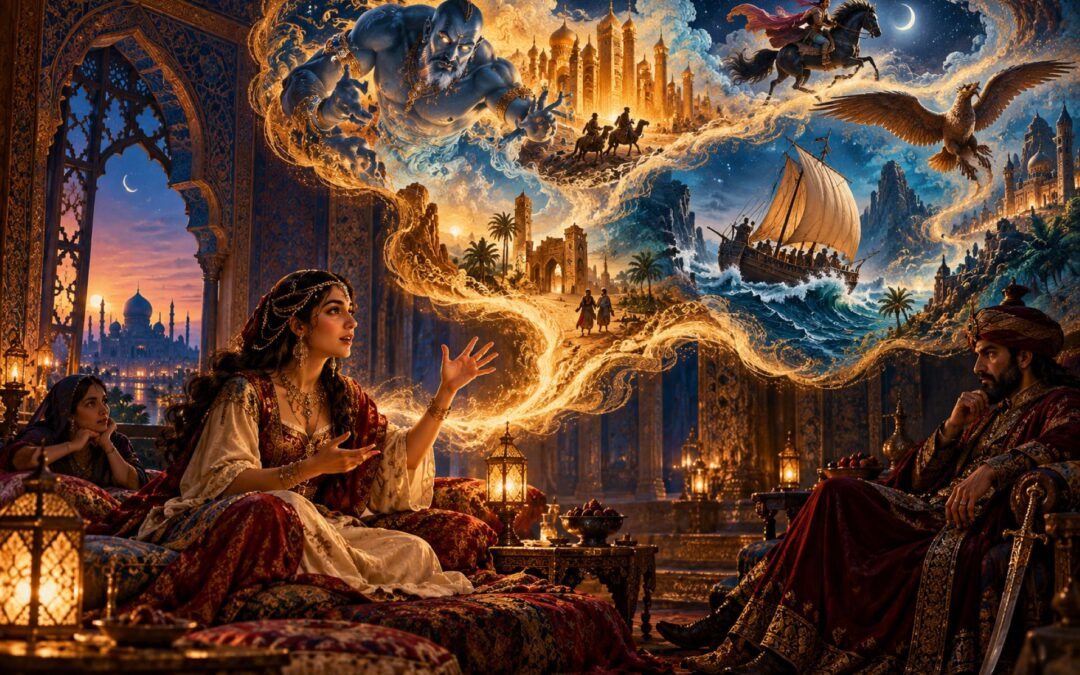
Richard F. Burton’s The Book of the Thousand Nights and a Night is not simply a very long novel, and it is not identical with every book published under the title The Arabian Nights. Burton’s 1885–1886 project is a ten-volume English translation and annotation of one major textual form of a much older, composite storytelling tradition whose contents changed across manuscripts, printed editions, languages, and centuries. The manuscript and textual history of the Nights is therefore essential to understanding what Burton’s volumes are: a particular nineteenth-century arrangement of an anthology that had already been accumulating and transforming for a very long time.
The ten volumes covered here are Burton’s main Thousand Nights and a Night, not his later six Supplemental Nights. That distinction matters because stories now inseparable from the popular idea of the Arabian Nights, especially Aladdin and Ali Baba, are not part of these ten volumes. Readers who want to inspect Burton’s wording and arrangement alongside this article can consult the complete ten-volume Burton text.
This is a full-spoiler guide. It explains the endings of the major stories, all seven voyages of Sindbad, the fate of the principal lovers and rulers, and the final resolution of Shahrazad’s own life-or-death story. Because the collection contains hundreds of narrative units, the sensible unit of summary is the tale or tale-cycle rather than the individual numbered Night: dawn frequently interrupts a story in the middle, while a single large romance may occupy dozens of Nights and contain several stories inside itself.
What gives this seemingly inexhaustible anthology unity is its frame. A king who has concluded that women cannot be trusted begins killing one bride after another. Shahrazad enters his chamber knowing that she is expected to die the following morning and discovers a form of power available to someone who cannot defeat the king by force: she makes him want to know what happens next. From that premise grows an immense world of merchants and demons, rulers and thieves, sailors and slaves, lovers and tricksters, talking animals, enchanted islands, underwater kingdoms, murder mysteries, bawdy jokes, religious exempla, heroic wars, and stories whose characters save their own lives by telling still more stories. By the Thousand and First Night, storytelling has become more than postponement. It has altered the man who possessed the power to kill the storyteller.

The Frame Story: Why Shahrazad Begins Telling Tales
The collection begins not with wonder but with betrayal and violence. King Shahryar rules a vast realm, while his younger brother Shah Zaman governs Samarkand. When Shah Zaman prepares to visit his brother, he unexpectedly returns to his palace and discovers his wife with another man. He kills them both and leaves in a state of despair. At Shahryar’s court he remains visibly miserable until another discovery convinces him that his own brother is being deceived as well.
While Shahryar is away hunting, Shah Zaman witnesses the women of Shahryar’s household joining enslaved men in an elaborate sexual encounter. He eventually tells Shahryar, who insists on seeing the betrayal himself. The brothers then abandon their courts and travel until they encounter an even more extreme example: a woman carried in a chest by a powerful jinni who believes he has kept her beyond the reach of other men. While the jinni sleeps, she forces Shahryar and Shah Zaman to sleep with her and adds their rings to a collection taken from many previous lovers.
The episode confirms the conclusion the brothers are already prepared to reach. Instead of recognizing that individual people have betrayed them, Shahryar universalizes the experience into a theory about women. He returns home, executes his wife and those involved in her infidelity, and creates a system designed to make future betrayal impossible: every night he marries a virgin, consummates the marriage, and orders the bride killed in the morning. His solution to fear is absolute control, and his method turns private trauma into state-sponsored serial murder.
The vizier charged with supplying these women has two daughters, Shahrazad and Dunyazad. Shahrazad is educated, widely read, and described as knowing histories, poetry, rulers, peoples, and the wisdom of earlier generations. When the kingdom has been devastated by Shahryar’s murders, she tells her father that she wants to marry the king. Her father tries to stop her by telling The Tale of the Bull and the Ass, a warning about meddling in dangerous affairs. A merchant who understands the speech of animals overhears an ass giving a bull advice that backfires, and the tale concludes with a brutal lesson about household authority. Yet the warning itself demonstrates precisely the medium Shahrazad intends to use: a story is being deployed to change another person’s behavior.
Shahrazad persists. She arranges for Dunyazad to be present after the marriage and to ask her sister for a story before dawn. Shahryar permits it. Shahrazad begins telling, reaches a suspenseful point as morning approaches, and stops. The king wants the ending badly enough to postpone her execution for one day.
This is the governing mechanism of the entire anthology. Shahrazad does not possess formal authority, military power, or physical security. What she can control is narrative time. Each unfinished story converts the certainty of execution into a temporary future, and every temporary future creates the possibility of another.
Bargains, Jinn and Baghdad Mysteries: Volume I
Volume I establishes almost all the techniques the later collection will elaborate. Stories are exchanged for lives, apparently simple situations unfold into deep nests of testimony, rulers encounter ordinary people in disguise, magic exists beside urban realism, and mistaken judgment repeatedly proves more dangerous than ignorance. The opening tales also train Shahryar—and the reader—to delay punishment until the whole story has been heard.
Stories That Bargain With Death: The Trader and the Fisherman
Shahrazad’s first great tale concerns a merchant who stops during a journey, eats dates, and throws away their stones. A jinni suddenly appears and announces that one of those stones killed his son, so the merchant must die in return. The merchant persuades the jinni to let him go home, settle his affairs, and return at the appointed time. Remarkably, he keeps his word.
While the merchant waits for death, three elderly shaykhs arrive separately, each accompanied by something strange. When they hear why the merchant is about to be killed, they offer the jinni a bargain: if each tells a story more marvelous than the merchant’s crime, the jinni must remit part of the sentence. The first shaykh’s gazelle is his magically transformed wife, whose jealousy led to the transformation of his son and the son’s mother. The second shaykh’s dogs are treacherous brothers whom he repeatedly forgave before supernatural punishment transformed them. The third also produces a wonder worthy of the bargain. By the time the tales are finished, the merchant’s life has been purchased through narrative.
The pattern is crucial. The jinni begins with an apparently straightforward law of vengeance: a life for a life. Storytelling introduces context, complexity, comparison, and mercy. Shahrazad is doing the same thing to Shahryar on a larger scale. The merchant lives because the executioner becomes a listener.
The next major tale begins with a poor fisherman who casts his net four times a day. After several useless catches, he hauls up a sealed brass vessel. When he opens it, smoke pours out and forms a gigantic jinni. The fisherman expects gratitude for releasing him, but the jinni announces that during centuries of imprisonment his attitude toward any rescuer has curdled from generosity into murderous resentment. He now promises the fisherman only the privilege of choosing how to die.
The fisherman cannot overpower him, so he attacks the jinni’s pride and plausibility. He claims not to believe that such an enormous being could ever have fit inside the vessel. The jinni re-enters it to demonstrate, and the fisherman immediately replaces the seal. Physical hierarchy reverses in an instant: the weakest character becomes the one controlling whether the strongest can return to the world.
A contest of stories follows. The jinni asks to be released, while the fisherman invokes The Wazir and the Sage Duban, in which a gifted physician cures a king without conventional medicine only to be destroyed after an envious vizier poisons the king’s mind against him. The sage warns his ruler not to repay good with evil, but the king executes him anyway and is himself destroyed by a poisoned book. Inside that warning are still more exempla: King Sindibad and His Falcon, The Husband and the Parrot, and The Prince and the Ogress all turn on bad judgment, unreliable evidence, or fatal haste.
Eventually the fisherman releases the jinni under conditions designed to prevent betrayal. The jinni leads him to a lake containing fish of four colors and instructs him to bring them to the sultan. Their supernatural behavior leads the ruler to investigate the lake himself and discover The Tale of the Ensorcelled Prince. A young king has been half-petrified by his unfaithful, magical wife, his subjects transformed into fish, and his city reduced to a lake. The visiting sultan tricks and kills the sorceress, breaks the enchantment, restores the city, and rewards both prince and fisherman.
The entire sequence repeatedly asks the same practical question: when should power be exercised, and when should judgment be delayed? The jinni nearly kills his liberator; the king nearly destroys Duban; the suspicious husband misreads the parrot; the prince trusts an ogress; the enchanted king fails to understand his wife’s hidden life until too late. Listening to the full story becomes an ethical discipline.
The Porter, the Three Ladies and the Kalandars
The Porter and the Three Ladies of Baghdad begins in a far more comic register. A porter is hired by an elegant woman to carry an enormous collection of food, drink, perfume, flowers, fruit, and other luxuries to a magnificent house. There he meets three wealthy women and is allowed to remain for an evening of eating, wine, poetry, flirtation, and erotic play on one condition: he must not ask questions about what does not concern him.
The household soon becomes stranger. Three one-eyed Kalandars arrive, each blind in the left eye and each shaved according to the appearance of wandering dervishes. Harun al-Rashid, his vizier Ja’far, and the executioner Masrur also arrive in disguise and are admitted under the same rule of silence. The prohibition naturally produces the desire to break it.
The evening turns disturbing when the women bring in two black dogs, beat them severely, then embrace and weep over them. Another woman exposes scars on her body. The male guests cannot restrain their curiosity. When they demand explanations, armed slaves appear, and everyone suddenly faces death. The household’s apparently playful rule has been backed by real authority all along.
The guests are spared provisionally because each must now explain who he is and how he came there. The first Kalandar is a prince whose adventures include betrayal, subterranean spaces, doomed love, and the loss of his eye. The second is another prince whose education and accomplishments do not protect him from misfortune; his story contains The Tale of the Envier and the Envied, another exploration of jealousy and supernatural reversal. The third Kalandar offers yet another prince’s sequence of travel, forbidden action, catastrophe, and mutilation.
Once the men have told their stories, the women tell theirs. The eldest lady explains that the two dogs are her sisters, whose envy and treachery eventually led to their magical transformation. The Portress explains the origin of her scars through a story of marriage, jealousy, punishment, and rescue. The seemingly inexplicable spectacle at the beginning of the evening becomes legible only after everyone has been permitted to narrate the past.
Harun later summons the women and uses his sovereign power to resolve what remains, including restoring the transformed sisters. Yet the story has already complicated authority. For most of the night the Caliph himself is forced into the role of ignorant guest. He cannot understand what he sees merely because he is ruler; he must hear the same stories as everyone else.
Three Apples, Badr al-Din Hasan and the Hunchback
The Three Apples begins like an early murder mystery. Harun al-Rashid orders Ja’far to investigate a chest pulled from the Tigris containing the dismembered body of a young woman. Failure will mean execution. Ja’far can find no culprit until, at the last moment, a man voluntarily confesses.
The confession reveals that the murdered woman was his wife. When she became ill and desired a rare apple, he traveled to obtain one of only three available from the Caliph’s garden. Later he saw an enslaved man carrying such an apple and boasting that it had been given to him by a lover whose husband had traveled to fetch it. The husband concluded that his wife had committed adultery and killed her. Only afterward did he learn that their child had taken one of the apples and that the slave had stolen it from the child before inventing the sexual story.
The murderer is guilty, but his guilt has been produced by bad evidence and catastrophic certainty. Ja’far then faces another impossible task: find the slave. The investigation circles unexpectedly back toward his own household. Once again the tale’s deepest pattern is not clever detection in the modern sense but the danger of punishing before knowledge is complete.
The long Tale of Nur al-Din Ali and His Son Badr al-Din Hasan shifts into family romance. Two brothers, Shams al-Din and Nur al-Din, quarrel over an imagined future marriage between their hypothetical children. Nur al-Din leaves Egypt, settles in Basra, marries, and has Badr al-Din Hasan. Meanwhile his brother has a daughter, Sitt al-Husn. The quarrel that separated the older generation is ironically answered when supernatural agents intervene in the younger generation’s lives.
Sitt al-Husn is to be married against her will to a grotesque groom. Jinn transport the sleeping Badr al-Din into the wedding, where his beauty and bearing displace the intended husband. He spends the night with his cousin without either fully understanding the family connection, leaves evidence of his identity, and is then carried away again. He wakes in Damascus without proper explanation and is treated as mad when he tells the truth.
Years pass before the scattered evidence is assembled. Badr al-Din becomes a confectioner; the son conceived during the wedding night grows up; family members search across cities; and recognition is achieved through clothes, papers, physical resemblance, and even food. The plot is extravagant, but its emotional logic is precise: a family divided by pride is reunited by the children whose imagined marriage originally caused the dispute.
The Hunchback’s Tale then turns death itself into farce. A tailor and his wife invite a hunchbacked entertainer home, feed him fish, and believe he has choked to death. Terrified of punishment, they place the body where someone else will seem responsible. A Jewish physician in turn thinks he has accidentally killed the man and transfers the body; the corpse then implicates a Muslim steward, a Christian broker, and others.
When several people are about to suffer for the same supposed death, each tells the extraordinary story that brought him to the current situation. The Nazarene Broker, the Reeve, the Jewish Doctor, and the Tailor all contribute narratives of sexual intrigue, mistaken judgment, mutilation, social embarrassment, and astonishing coincidence. The Tailor’s narrative introduces the famous Barber, who insists that he is the least talkative of men before proving the opposite at spectacular length.
The Barber then tells the stories of his six brothers, each a comic catalogue of vanity, lust, credulity, bodily humiliation, or bad luck. By the time the narrative returns to the Hunchback, the accumulation of stories has delayed punishment long enough for the Barber to examine the body. He discovers that the man is not dead after all and removes the obstruction from his throat.
The resolution is almost a comic manifesto for Shahrazad’s method. Had the authorities executed the first apparent culprit, an innocent person would have died over a man who was still alive. Stories create delay; delay makes knowledge possible; knowledge overturns judgment.
Love, Exile and Dynastic War: Volumes II–III
Volumes II and III greatly expand the scale of the anthology. Baghdad court tales remain important, but the collection also moves into long romances where love can require flight across kingdoms and into an enormous dynastic war in which the consequences of desire and revenge pass from one generation to another. The shorter tales embedded around these epics keep changing the pace, preventing the Nights from settling permanently into any one genre.
Nur al-Din and Anis al-Jalis; Ghanim and Qut al-Qulub
Nur al-Din Ali and Anis al-Jalis begins with political corruption in Basra. A ruler orders that an exceptionally accomplished slave-girl be purchased for him, but Nur al-Din, son of an honorable vizier, falls in love with Anis al-Jalis before she reaches the palace. Their attachment exposes them to the hostility of a rival minister who has long hated Nur al-Din’s family.
After Nur al-Din’s father dies, the young man’s generosity and inexperience leave him vulnerable. His enemies manipulate official power against him, and he and Anis are forced to flee Basra. They reach Baghdad and enter a garden associated with the Caliph, where their apparent intrusion becomes another of the collection’s encounters between ordinary fugitives and rulers in disguise.
Harun al-Rashid hears their story and ultimately turns sovereign authority toward correction rather than persecution. The corrupt official who abused power is exposed, while the lovers receive protection. The tale’s political fantasy is characteristic of the Nights: government can be terrifying when mediated through corrupt officials, but an idealized ruler who hears the whole story may restore justice.
Tale of Ghanim bin Ayyub, the Distraught, the Thrall o’ Love develops a similar structure through a more dangerous misunderstanding. Ghanim, a merchant’s son, travels to Baghdad and discovers a chest containing a woman who has been drugged and buried alive. She is Qut al-Qulub, a favored woman of Harun al-Rashid’s household, placed in danger through palace jealousy and intrigue.
Ghanim rescues her, and affection develops between them, but he refuses to violate the Caliph’s claim over her. That restraint cannot protect him from appearances. When Harun returns and believes Ghanim has stolen or seduced Qut al-Qulub, his anger falls not merely on the young man but on Ghanim’s family. Their property and security are destroyed by a ruler acting on incomplete knowledge.
Only Qut al-Qulub’s eventual testimony reverses the injustice. Ghanim is restored and the wider family damage repaired. The structure again resembles Shahrazad’s situation: absolute power first interprets, then punishes, and only later listens. Justice requires reversing that order.
King Omar bin al-Nu’man, Taj al-Muluk and the Wars of the Next Generation
The Tale of King Omar bin al-Nu’man is one of the largest constructions in Burton’s ten volumes and changes the Nights from episodic urban storytelling into something closer to heroic-dynastic romance. The story spreads across generations, kingdoms, military campaigns, sexual relationships, religious difference, revenge plots, concealed identities, and subsidiary love stories.
King Omar rules from Baghdad and has several important children, including Sharrkan, Zau al-Makan, and Nuzhat al-Zaman. The family structure is complicated from the beginning by different mothers, political marriages, and relationships that connect Omar’s household to foreign courts. Sharrkan is a formidable warrior, but the cycle repeatedly shows that martial power cannot protect a dynasty from sexual intrigue, concealed kinship, revenge, or manipulation.
One of the crucial foreign figures is Princess Abrizah, whose relationship with Omar’s world draws Christian and Muslim courts into a chain of violence and retaliation. The cycle is not a reliable chronicle of historical Christian-Muslim relations; its religious geography belongs to romance. Yet religious identity provides an important language for alliance, enmity, conversion, and heroic difference.
The most relentless manipulator is the old woman Zat al-Dawahi. She combines religious disguise, strategic patience, deception, and revenge, repeatedly entering spaces where military enemies could never penetrate. Her success is uncomfortable but structurally revealing: in a world full of armies, the person who can control appearances and information can be more dangerous than the strongest warrior.
The younger generation inherits conflicts it did not create. Zau al-Makan and Nuzhat al-Zaman pass through separation, hardship, and eventual recognition. Sharrkan’s position becomes entangled with succession and war. Deaths do not close the conflict because kinship converts private injury into dynastic obligation.
Within the immense cycle, Taj al-Muluk and the Princess Dunya forms a major romantic branch. Taj al-Muluk becomes obsessed with Dunya through descriptions and images before possessing any ordinary relationship with her. Reaching her requires disguise, mediation, patience, and the interpretation of signs. The familiar romantic pattern of the Nights is intensified: desire is born at a distance, and the beloved exists first as story.
Inside that romance appears Aziz and Azizah, which is emotionally very different. Aziz is engaged to his cousin Azizah but becomes infatuated with another woman after interpreting flirtatious signals badly. Azizah, who actually understands the coded language of the other woman’s gestures, helps him pursue the affair even though she loves him herself.
Aziz repeatedly depends on Azizah’s intelligence while failing to recognize the cost to her. She teaches him what to say and do, protects him from mistakes, and absorbs the emotional injury produced by his desire for someone else. Her eventual death turns a tale of erotic cleverness into one of the anthology’s bleakest accounts of selfishness.
The larger Omar cycle eventually works its way through wars, assassinations, inherited revenge, changes of ruler, and the consequences of Zat al-Dawahi’s long plotting. What began as the story of one powerful king becomes an argument, though not a systematic one, about how unstable dynastic power really is. A throne may command armies while remaining vulnerable to family secrets, erotic decisions, and one person’s capacity to manipulate trust.
Aziz and Azizah, the Animal Fables and Ali bin Bakkar
After the vast dynastic cycle, Volume III changes scale dramatically. The Hashish Eater compresses social fantasy into intoxicated delusion, while Hammad the Badawi returns to the world of rulers, travel, and anecdotal adventure. The shift is characteristic of the collection: a tale lasting hundreds of pages can be followed by one whose entire force depends on a single comic reversal.
A substantial sequence of animal fables then uses beasts to explore prudence, appetite, trust, predation, and deception. The Birds and Beasts and the Carpenter, The Water-Fowl and the Tortoise, The Wolf and the Fox, The Falcon and the Partridge, The Mouse and the Ichneumon, The Cat and the Crow, The Fox and the Crow, The Flea and the Mouse, The Saker and the Birds, The Sparrow and the Eagle, The Hedgehog and the Wood-Pigeons, The Merchant and the Two Sharpers, The Thief and His Monkey, The Foolish Weaver, and The Sparrow and the Peacock vary in detail but often share the same social insight: intelligence matters most when unequal creatures cannot rely on strength.
These stories also demonstrate why it is misleading to call the Nights a single type of book. Its human romances may be expansive and psychologically charged, while its fables often compress a social rule into a few actions. Their coexistence suggests a repertoire designed to supply different kinds of narrative pleasure and instruction rather than one continuous artistic program.
Tale of Ali bin Bakkar and of Shams al-Nahar returns to tragic romance. Shams al-Nahar belongs to the world of Harun al-Rashid’s palace, while Ali bin Bakkar falls desperately in love with her. Friends and intermediaries create opportunities for contact, but the lovers inhabit a political order in which their relationship cannot simply become a marriage.
Longing rather than fulfillment drives the tale. The lovers’ health deteriorates under secrecy and separation, and the social mechanisms that normally help romantic heroes in the Nights cannot produce a stable escape. Their love leads toward death rather than restoration, giving the collection an important counterexample to its many reunion plots.
Volume III then begins Kamar al-Zaman, one of the anthology’s largest and most structurally intricate romances. Its movement into Volume IV marks another transition: the Nights now builds an entire multi-generational narrative around desire, supernatural intervention, gender disguise, kingship, separation, and accidental reunion.
Kamar al-Zaman and the Long Romances of Volumes III–IV
Volumes III and IV contain some of the collection’s strongest evidence that these stories cannot be reduced to simple moral lessons. Characters change gender presentation, rulers are displaced by strangers, lovers are brought together by jinn before ever meeting while awake, and apparently orderly dynasties depend on accidents involving birds, talismans, and mistaken identity. The same volumes also contain dozens of short stories about caliphs, police officials, thieves, scholars, lovers, and dreams, creating an extreme contrast between epic romance and anecdote.
Kamar al-Zaman, Budur, Amjad and As’ad
Prince Kamar al-Zaman is the beautiful son of King Shahriman, but he rejects marriage despite his father’s insistence. Eventually his refusal becomes politically intolerable, and he is confined. Far away, Princess Budur, daughter of a powerful ruler, has developed an equally strong aversion to marriage and has also been punished for refusing suitors.
The supernatural world intervenes. A jinni princess named Maymunah discovers the sleeping Kamar al-Zaman and is astonished by his beauty. A male jinni, Dahnash, claims to know a woman even more beautiful: Budur. Their disagreement turns the two isolated royals into objects of comparison, and Budur is magically transported beside the sleeping prince.
Each wakes separately enough to see and desire the other. They exchange rings, but by morning Budur has been carried home. Both are then treated as irrational when they insist that they have met a beloved whom no one else believes exists. The story transforms love at first sight into a problem of evidence: the lovers possess physical tokens of an encounter that their worlds regard as impossible.
Budur’s foster-brother Marzawan eventually hears enough to connect the stories. He travels to Kamar al-Zaman, helps cure the prince’s apparent madness by validating what happened, and enables the lovers to reunite. Their marriage seems to resolve the central romance, but the tale is only beginning.
The next catastrophe comes through a talisman. During travel, Kamar al-Zaman notices a jewel or magical object associated with Budur and follows a bird that has carried it away. The pursuit separates him from the caravan. Budur wakes to find him missing and recognizes that her own safety, and the safety of those traveling with her, depends on concealing his disappearance.
She therefore puts on Kamar al-Zaman’s clothes and assumes his male identity. This is not merely a brief disguise used to cross a doorway. Budur successfully inhabits a male political role and is treated as a prince. When circumstances lead to a marriage with Princess Hayat al-Nufus, Budur eventually reveals the truth to her new bride, who becomes her ally in maintaining the deception.
Kamar al-Zaman, meanwhile, undergoes the familiar romance pattern of wandering and reduced status. The prince who should command a court survives as an ordinary laborer and gardener. Chance, treasure, travel, and recognition eventually return him to Budur, but their separation has permanently expanded the world of the story.
The next generation brings another crisis. Sons Amjad and As’ad become entangled in accusations produced by forbidden desire within the extended household. Kamar al-Zaman, like so many rulers in the Nights, is prepared to order deadly punishment before possessing complete knowledge. The brothers escape execution and are thrust into adventures involving capture, danger, foreign cities, religion, and recognition.
Their experiences eventually reconnect the scattered branches of the dynasty. The story’s long arc repeatedly converts apparently secure identities—prince, princess, husband, wife, ruler, condemned son—into temporary roles. Budur’s reign is the clearest case: political competence belongs to a person whom everyone assumes must be male because the office itself has been coded that way.
The embedded Ni’amah bin al-Rabi’a and Naomi his Slave-Girl adds another love-and-separation narrative to the cycle. Like many Nights romances, it depends on ownership, household politics, movement through elite spaces, intermediaries, and eventual recovery. Its placement inside the enormous Kamar structure demonstrates the collection’s tendency to answer one romance with another rather than moving directly toward resolution.
Ala al-Din Abu al-Shamat
Ala al-Din Abu al-Shamat is another extended tale of status, travel, accusation, ingenuity, and reversal. Ala al-Din passes through shifts of fortune that repeatedly expose how fragile social identity can be. Wealth and respectability do not guarantee security, while imprisonment or disgrace need not be permanent.
The story combines criminal intrigue with romance and the possibility of restored honor. As elsewhere in the Nights, the hero’s identity matters less as something internally stable than as something other people interpret through clothing, testimony, reputation, and circumstance. A person can become socially different before becoming psychologically different.
That pattern helps connect Ala al-Din’s adventures to the many shorter stories surrounding it. Burton’s anthology repeatedly imagines society as a system of rapidly changing appearances in which the poor may become rich, respectable men may become suspects, rulers may pass as merchants, and criminals may temporarily look more authoritative than officials.
Ali Shar and Zumurrud; Jubayr and Budur
Ali Shar and Zumurrud begins with a young man who has inherited wealth and squandered it. At a slave market he encounters Zumurrud, an extraordinarily capable young woman who is allowed to choose among prospective buyers. She selects Ali Shar, and their relationship immediately complicates the usual hierarchy of buyer and enslaved woman because she possesses more judgment, practical intelligence, and economic skill than he does.
Zumurrud supports the household through her work, but Ali Shar’s carelessness helps expose her to abduction. She passes through a series of dangers involving men who attempt to possess or exploit her. Instead of remaining a passive object of rescue, she escapes through her own ingenuity.
Her most radical transformation comes when she disguises herself as a man and arrives in a place where circumstance leads to her being made ruler. Like Budur, she does not merely pass briefly as male; she performs political masculinity successfully enough to govern. Power that had been denied her as an enslaved woman becomes available through clothing and public identity.
Zumurrud then uses her position to punish some of the men responsible for her suffering. Eventually Ali Shar arrives in her realm without recognizing the ruler as the woman he lost. Their reunion restores the romantic relationship, but the story has already shown a much more striking possibility: a character introduced as property can become sovereign.
The Loves of Jubayr bin Umayr and the Lady Budur offers a shorter but still substantial romance of desire, separation, mediation, and reunion. It belongs to the Nights’ large family of stories in which lovers cannot move directly toward each other because households, rank, distance, and social convention require intermediaries and stratagems.
These tales should not be treated as proving that the anthology has a single progressive view of women. They coexist with stories that regard female sexuality as inherently dangerous. Their importance lies precisely in that contradiction.
Caliphs, Police Chiefs, Rogues, Dreams and Short Urban Tales
Volume IV becomes increasingly urban and anecdotal. Stories such as Hatim of the Tribe of Tayy, the two tales of Ma’an son of Zaidah, The Caliph Hisham and the Arab Youth, and the Yahya bin Khalid stories test generosity and the behavior expected of powerful men. A ruler or notable is often judged not by abstract law but by whether he can recognize merit, repay loyalty, forgive bold speech, or give without humiliating the recipient.
Other tales use wonder to destabilize ordinary geography. The City of Labtayt and The City of Many-Columned Iram and Abdullah Son of Abi Kilabah imagine lost or inaccessible places whose magnificence is inseparable from disappearance. Ibrahim bin al-Mahdi and the Barber-Surgeon, Isaac of Mosul, and the many musician-and-court anecdotes return the collection to elite entertainment, poetry, wit, and the precarious intimacy between rulers and talented dependents.
The urban trickster material is especially rich. The Sweep and the Noble Lady, The Mock Caliph, Ali the Persian, The Lover Who Feigned Himself a Thief, Ja’far the Barmecide and the Bean Seller, and Abu Mohammed Hight Lazybones repeatedly put respectable social categories under pressure. Thieves may behave honorably, officials may misread situations, lazy men may rise through magical or accidental fortune, and anonymous citizens may briefly command the fascination of a caliph.
Harun al-Rashid appears repeatedly, sometimes in disguise and sometimes in court, in stories such as Harun al-Rashid and the Slave-Girl and the Imam Abu Yusuf and Harun al-Rashid and the Damsel and Abu Nuwas. This literary Harun is less a historical portrait than a narrative device: because he can move between absolute sovereignty and anonymous spectatorship, he lets the tales ask what rulers would learn if they could hear what happens outside formal court ritual.
A sequence involving The Sharper of Alexandria and the Chief of Police, Al-Malik al-Nasir and the Three Chiefs of Police, the chiefs of police of Cairo, Bulak, and Old Cairo, The Thief and the Shroff, and The Chief of the Kus Police and the Sharper turns law enforcement itself into a storytelling arena. Officers recount extraordinary criminals, sexual deceptions, thefts, and reversals, with the sharpest mind often belonging to the supposed offender.
The volume also contains stories of piety, charity, dreams, and recovered fortune: The Woman Whose Hands Were Cut Off for Almsgiving, The Devout Israelite, Abu Hasan al-Ziyadi and the Khorasan Man, The Poor Man and His Friend in Need, and The Ruined Man Who Became Rich Again Through a Dream. The last belongs to an international family of folktales in which a dream sends a man far from home only for him to discover that the treasure he seeks was near him all along.
Finally, Al-Mutawakkil and His Concubine Mahbubah, Wardan the Butcher and the Lady and the Bear, and The King’s Daughter and the Ape return to erotic, grotesque, and supernatural registers. Volume IV’s apparent disorder is part of its identity: royal generosity, police comedy, miracle tale, erotic adventure, lost city, and transformation story occupy the same storytelling universe.
Magic, Learning, Piety and the Queen of the Serpents: Volume V
Volume V may be the best single demonstration of the anthology’s refusal to respect modern genre boundaries. It includes flying technology or magic, romantic quests, sexual jokes, court anecdotes, displays of encyclopedic learning, religious exempla, and a vast cosmological story containing other quests inside it. The stories are held together less by subject than by the collection’s appetite for different forms of marvel.
The Ebony Horse and Uns al-Wujud
The Ebony Horse begins when inventors or sages present extraordinary mechanical gifts to a king. The most important is an ebony horse capable of flight when its hidden controls are operated correctly. The king’s son initially treats it with suspicion, but the device soon becomes a means of traveling impossible distances.
The horse enables a romance structured around sudden arrival. The prince reaches a distant palace and encounters a princess whose protected location would ordinarily make access impossible. Their attraction produces pursuit, separation, and competition over control of the machine.
The inventor who understands the horse’s mechanism becomes dangerous because technical knowledge can function like magic. The tale never needs to settle whether readers should interpret the horse as fantastical technology or enchanted object. What matters is that mobility creates power: whoever can control the horse can cross the political and geographic boundaries that normally regulate marriage and kingship.
Uns al-Wujud and Rose-in-Hood offers a different romance of distance. Uns al-Wujud and the vizier’s daughter Rose-in-Hood fall in love, but she is removed and confined in order to prevent the relationship. Their separation drives both into journeys through wilderness, religious spaces, isolation, and longing.
The plot pushes romantic suffering toward spiritual language. Love becomes a state that reorganizes the characters’ perception of the world, while geography itself becomes an obstacle to be read and crossed. The eventual reunion belongs to the familiar restorative pattern of the Nights, but the story’s emotional center lies in the distance that precedes it.
Court, Love and Comic Anecdotes
A long sequence of shorter tales then moves through elite pleasure, erotic cleverness, poetry, marriage, deception, and social embarrassment. Abu Nuwas with the Three Boys uses the famously transgressive poet as a comic and erotic figure, while Abdallah bin Ma’amar with the Man of Bassorah and His Slave-Girl and The Lovers of the Banu Uzrah return to idealized or painful love.
Other tales make domestic relationships into games of wit. The Loves of the Boy and Girl at School, Al-Mutalammis and His Wife Umaymah, Mus’ab bin al-Zubayr and Ayishah His Wife, and Abu al-Aswad and His Slave-Girl explore jealousy, verbal ingenuity, loyalty, or desire on a small scale. The point is rarely to create fully developed psychological characters; the anecdote captures one revealing situation.
Harun al-Rashid again dominates several pieces. The Caliph Harun al-Rashid and Queen Zubaydah in the Bath, Harun al-Rashid and the Three Poets, and multiple stories involving slave-girls show a ruler whose court is simultaneously a political center and an entertainment economy. Poetry, music, sexual attraction, legal interpretation, and patronage all become routes through which people gain or lose favor.
The comic stories are often deliberately coarse. The Miller and His Wife, tales of simpletons and sharpers, stories of schoolmasters, and domestic deceptions derive humor from sex, bodily appetite, stupidity, and reversals of social dignity. Burton’s willingness to preserve this material helped distinguish his edition from more heavily expurgated English versions, though his choices about how to translate and annotate it create separate problems discussed later.
Historical names appear beside legendary figures. Kisra Anushirwan and the Village Damsel, Khusrau and Shirin and the Fisherman, tales of Yahya bin Khalid, Mohammed al-Amin, Ja’far, Omar bin al-Khattab, and Al-Maamun and the Pyramids of Egypt use famous rulers as protagonists in moral or entertaining anecdotes. They should be read as literary uses of historical figures, not as reliable documentary episodes.
The sequence also includes The Thief and the Merchant, Masrur and Ibn al-Karibi, stories of teachers and fools, The Mad Lover, and other compact narratives about desire, fortune, wit, or embarrassment. Their cumulative effect is important: the Nights does not reserve narrative significance for princes. A fisherman, thief, schoolmaster, slave-girl, beggar, or anonymous wife can occupy the center of attention for as long as the story requires.
Tawaddud and the Pious Tales
Abu al-Husn and Tawaddud changes the meaning of display. Tawaddud is an enslaved young woman of extraordinary learning whose master has fallen into financial difficulty. She proposes that her knowledge be demonstrated before the Caliph and that she be valued accordingly.
A series of male experts question her across fields that include religion, law, language, poetry, astronomy, medicine, mathematics, and other branches of learned culture. Tawaddud answers them, challenges them in return, and exposes the limits of men who initially assume that their sex and professional status guarantee superiority.
The episode is partly a fantasy of encyclopedic knowledge. Tawaddud often seems less like a psychologically ordinary person than a vessel through which the culture of learning can be theatrically displayed. Yet that formal function does not erase the gendered force of the contest: men publicly test a woman they regard as subordinate and are repeatedly defeated by her mastery.
The following devotional narratives create another sharp tonal change. Tales of the Angel of Death emphasize mortality and the impossibility of escaping the appointed end. Stories involving Iskandar, Anushirwan, pious rulers, Jewish judges, shipwrecked women, devout slaves, tray-makers, blacksmiths, hermits, and champions examine charity, trust in God, repentance, chastity, justice, and miraculous rescue.
Some of these stories are severe. Poverty and suffering may be treated as tests whose meaning becomes visible only after endurance. Others use supernatural intervention to reward virtue or expose hidden moral worth. The theological logic is not identical across every tale, but divine providence repeatedly limits the apparent sovereignty of human rulers.
The cluster includes The Jewish Kazi and His Pious Wife, The Pious Black Slave, The Devout Tray-Maker and His Wife, Al-Hajjaj and the Pious Man, the blacksmith who can handle fire, The Devotee, the Cloud and the Devout King, The Muslim Champion and the Christian Damsel, Ibrahim al-Khawwas and the Christian King’s Daughter, tales of justice and providence, The Ferryman of the Nile and the Hermit, The King of the Island, and Abu al-Hasan and Abu Ja’far the Leper. Their placement beside erotic and comic material is not an editorial accident to be corrected; moral heterogeneity is one of the collection’s basic conditions.
The Queen of the Serpents, Bulukiya and Janshah
The Queen of the Serpents begins with Hasib Karim al-Din, son of the learned Daniel. Despite predictions that the boy may become wise, Hasib initially fails at formal study and trades. He eventually joins woodcutters, who discover a hidden chamber containing honey.
The companions exploit Hasib and abandon him after using him to retrieve the honey. His entrapment leads him into a subterranean or hidden world where he encounters the Queen of the Serpents. The betrayal that seemed to end his ordinary life instead gives him access to knowledge unavailable in ordinary society.
The Queen tells Hasib a much larger narrative, The Adventures of Bulukiya. Bulukiya undertakes an immense quest connected with sacred knowledge, distant lands, supernatural beings, and the desire to reach what lies beyond ordinary human experience. His journey carries him through a cosmology in which earthly geography opens into realms of angels, jinn, strange creatures, seas, islands, and traditions associated with prophets and Solomon.
Inside Bulukiya’s adventures appears The Story of Janshah, creating one of the anthology’s deepest narrative nests. Janshah’s experiences include supernatural travel, love, separation, marvelous beings, and the familiar problem of crossing boundaries that humans are warned not to cross. The tale feels less like a single linear quest than an expanding universe whose stories generate further worlds whenever one boundary is reached.
Eventually the narrative returns through Bulukiya to the Queen and then to Hasib. Hasib’s future becomes entangled with the Queen’s knowledge and with human demands placed upon him after he returns to society. The tale’s transformations connect wisdom to betrayal: access to hidden knowledge is valuable, but knowledge also creates obligations and dangers.
This enormous story-cycle is important because it shows the Nights at maximum imaginative scale. Baghdad’s streets and domestic bedrooms have not disappeared, but the anthology can now move from an unemployed youth in a cave to a cosmic geography touching prophetic legend, magical zoology, immortality, and the limits of human curiosity.
Sindbad, the City of Brass and the Seven Viziers: Volume VI
Volume VI contains several of the most famous and structurally revealing works in Burton’s ten volumes. Sindbad turns commerce and travel into repeated encounters with death, The City of Brass transforms exploration into meditation on mortality, and The Craft and Malice of Women makes storytelling an explicit contest over whether a prince will live or die. The volume closes by returning to treasure adventure and heroic romance.
Sindbad’s Seven Voyages
The Sindbad cycle begins with a social confrontation. Sindbad the Landsman, an impoverished porter in Baghdad, rests outside the house of a wealthy man and complains about the unfairness of fortune. The owner hears him and summons him inside. The rich man is Sindbad the Seaman, who explains that his wealth was purchased through suffering rather than inherited without cost.
The First Voyage establishes the pattern. Sindbad leaves Baghdad in pursuit of trade, reaches what appears to be an island, and discovers that the “island” is a gigantic sea creature. When fire or human activity disturbs it, the creature dives, leaving travelers struggling in the sea. Sindbad is separated from his companions, survives through chance and ingenuity, reaches another kingdom, and eventually recovers merchandise thought lost.
The Second Voyage begins with Sindbad once again unable to remain content at home. He is accidentally abandoned on an island and encounters the gigantic roc. By tying himself to the bird, he is carried into a valley filled with diamonds but also enormous serpents. Merchants harvest gems by throwing meat into the valley so that birds carry jewel-covered flesh upward. Sindbad turns their method into a means of escape and returns richer than before.
The Third Voyage moves into giant-monster territory. Sindbad and his companions encounter dangerous hairy beings and are captured by an enormous man-eating creature. The survivors blind or attack their captor and escape, but further disasters continue to reduce their number. Survival depends less on heroic invulnerability than on being the person whom catastrophe has not yet killed.
The Fourth Voyage is among the darkest. After another wreck, Sindbad reaches a society whose customs initially seem hospitable, but marriage exposes him to a horrifying funerary practice: when one spouse dies, the survivor is entombed alive with the corpse. When Sindbad’s wife dies, he is lowered into the burial cavern with minimal provisions.
There he survives by killing later victims and taking their food, eventually discovering a route out. The story transforms the civilized traveler into someone who will do almost anything to live. The wealth he extracts from the tomb does not erase the moral ugliness of survival.
The Fifth Voyage returns to the roc, this time after travelers destroy a giant egg. The parent birds retaliate by dropping massive stones on the ship. Sindbad later falls under the domination of the Old Man of the Sea, who climbs onto his shoulders and refuses to dismount, effectively turning him into an animal.
Sindbad escapes by intoxicating the old man with wine and killing him. The episode condenses one of the cycle’s recurring fears: travel repeatedly turns the wealthy merchant into property, prey, or labor for someone stronger.
The Sixth Voyage again begins with shipwreck and deprivation but moves toward a kingdom where Sindbad’s experiences bring him into contact with rulers and immense wealth. He eventually becomes an intermediary between distant courts, including the Caliph’s Baghdad. The merchant who repeatedly leaves home has become not merely rich but politically useful because he can cross worlds.
The Seventh Voyage exists in more than one textual form in Burton’s presentation. In the principal sequence, Sindbad travels again despite his accumulated wealth and reaches another extraordinary society. The cycle finally ends with his return and a declaration that his traveling is over.
After each voyage, the wealthy Sindbad gives money to the poor Sindbad and invites him to return the next day. The structure matters almost as much as the adventures. The porter begins by thinking wealth proves unfair privilege; the sailor answers with a story of risk. Yet the cycle never proves that riches are morally deserved in any modern economic sense. Sindbad survives partly through courage and intelligence, but also through astonishing luck when countless companions do not.
Travel becomes addictive. Each return should logically end the cycle, but prosperity creates restlessness rather than satisfaction. The sea is simultaneously the source of wealth and the force that repeatedly strips Sindbad back to near-nothing.
The City of Brass
The City of Brass transforms expedition literature into an extended encounter with extinction. A ruler becomes interested in the brass vessels associated with traditions about Solomon and the jinn. An expedition travels through harsh landscapes and strange territories in search of them.
The travelers encounter monuments, inscriptions, dead rulers, and magnificent structures that preserve the traces of people whose power could not save them. The city itself is visually overwhelming but socially empty. Splendor survives while its makers have vanished.
The story repeatedly interrupts wonder with written reminders of death. Palaces, treasures, fortifications, and royal claims to greatness become evidence not of immortality but of its impossibility. Reading inscriptions is therefore as important as seeing marvels: the dead speak through text to warn the living that worldly permanence is an illusion.
Unlike many treasure tales, The City of Brass is skeptical about possession. The travelers can bring objects home, but the city’s central revelation cannot be owned. Every empire becomes archaeology eventually.
The Craft and Malice of Women
The Craft and Malice of Women belongs to the wider Seven Viziers or Sindbad tradition and creates a second major life-or-death storytelling contest inside Shahrazad’s own. A prince is placed in danger after a woman accuses him, while circumstances prevent him from defending himself directly. The king is repeatedly pushed toward execution.
Viziers intervene one after another by telling stories meant to demonstrate the danger of acting on women’s accusations or sexual schemes. The woman counters with stories of her own. Narrative becomes legal argument: each tale is less important as an isolated entertainment than as evidence offered to influence a verdict.
The internal stories are extremely varied. The King and His Wazir’s Wife, The Confectioner, His Wife, and the Parrot, The Fuller and His Son, and The Rake’s Trick Against the Chaste Wife revolve around lust, deception, suspicion, or attempts to exploit women. The Miser and the Loaves of Bread, The Lady and Her Two Lovers, The King’s Son and the Ogress, and The Drop of Honey convert small human failings into moral examples.
Other tales turn marriage into a contest of deception: The Woman Who Made Her Husband Sift Dust, Wazir’s Son and the Hammam-Keeper’s Wife, and The Wife’s Device to Cheat Her Husband. The Goldsmith and the Cashmere Singing-Girl, The King’s Son and the Merchant’s Wife, The Lady and Her Five Suitors, and The King’s Son and the Ifrit’s Mistress intensify the erotic plotting.
The cycle also includes stories less reducible to the simple thesis implied by its title. The Man Who Never Laughed, The Page Who Feigned to Know the Speech of Birds, The Three Wishes, The Stolen Necklace, The Two Pigeons, Prince Behram and Princess Al-Datma, The House with the Belvedere, The Sandal-Wood Merchant and the Sharpers, The Debauchee and the Three-Year-Old Child, The Stolen Purse, and The Fox and the Folk broaden the argument toward gullibility, fate, cleverness, social performance, and the dangers of misinterpretation.
The cycle’s misogyny should not be softened. Much of its rhetoric assumes that women are sexually dangerous and that male rulers must be warned against them. But the narrative form undercuts any easy reading in which one side simply possesses truth. Every participant is manipulating the king with selected stories, and the larger Arabian Nights contains women such as Shahrazad, Budur, Zumurrud, Tawaddud, and later Dalilah whose intelligence cannot be contained by the stereotype the viziers promote.
Most importantly, the prince survives because execution is delayed long enough for truth to emerge. The cycle therefore reproduces Shahrazad’s deepest political idea even while some of its embedded tales reproduce the misogynistic assumptions she must survive.
Judar and the Beginning of Gharib and Ajib
Judar and His Brethren returns to family jealousy, magical treasure, and dangerous prosperity. Judar is the more capable or fortunate of brothers whose family relationships become poisonous when wealth enters the picture. Encounters with magicians, enchanted treasure, and extraordinary objects raise him far beyond his original condition.
His brothers repeatedly respond to his generosity with betrayal. Family, which in some Nights romances is the structure restored at the end, becomes here one of the chief sources of danger. Judar’s willingness to forgive does not reform people committed to exploiting him.
The tale’s magical wealth intensifies rather than solves the moral problem. Once prosperity can be produced through supernatural means, the decisive question becomes who controls the source and whether loyalty survives abundance.
Volume VI then begins the huge History of Gharib and His Brother Ajib. Gharib’s life is defined by contested kinship, displacement, warfare, heroic identity, and the accumulation of followers. The story moves through tribal and dynastic conflict on a scale closer to the Omar cycle than to Baghdad anecdote.
Gharib’s military adventures include battles, captures, rescues, and religious conversion motifs. The heroic world is highly stylized: individuals can perform extraordinary feats, warfare reorganizes whole populations, and personal loyalty can have geopolitical consequences. The cycle continues deeply into Volume VII before reaching resolution.
Tricksters, Sea Kingdoms and Supernatural Romance: Volumes VII–VIII
Volumes VII and VIII move between two very different fantasies of power. Gharib acquires power through heroic warfare, while Dalilah acquires it through fraud; Badr Basim is shaped by dynastic connections between human and sea kingdoms, while Hasan of Bassorah crosses supernatural boundaries because of desire and curiosity. The anthology’s idea of adventure has become expansive enough to include the city con artist and the otherworldly quest without treating either as secondary.
Gharib’s Ending and the Short Love and Court Tales
The conclusion of Gharib and Ajib resolves a long heroic narrative of succession, enmity, military struggle, and recognition. Gharib’s movement from vulnerability toward rulership depends on martial ability, alliances, endurance, and the transformation of enemies into subjects or allies. Religion is woven into the heroic pattern through conversion and the presentation of conflict between communities, though the resulting world remains romance rather than sober historical reconstruction.
After the scale of Gharib, a series of shorter pieces resets the pace. Otbah and Rayya, Hind, Daughter of al-Nu’man and al-Hajjaj, and Khuzaymah bin Bishr and Ikrimah al-Fayyaz explore love, generosity, status, and the obligation to repay kindness. Yunus the Scribe and the Caliph, Harun al-Rashid and the Arab Girl, and Al-Asma’i and the Three Girls of Bassorah foreground wit, language, poetry, and the ability of socially marginal speakers to impress powerful men.
The musician and lover tales, including Ibrahim of Mosul and the Devil, The Lovers of the Banu Uzrah, The Badawi and His Wife, The Lovers of Bassorah, Ishak of Mosul and His Mistress and the Devil, and The Lovers of al-Medinah, vary from idealized devotion to comic or supernatural encounters. Love may be proof of fidelity, a source of illness, a path toward poetry, or a force so obsessive that death becomes preferable to separation.
Al-Malik al-Nasir and His Wazir returns to political storytelling. As throughout the collection, the ruler’s access to extraordinary stories becomes a means by which elite authority absorbs experience from beyond the palace.
Dalilah and Mercury Ali
The Rogueries of Dalilah the Crafty and Her Daughter Zaynab the Coney-Catcher is one of the great trickster sequences of the collection. Dalilah lives in a Baghdad where celebrated male rogues such as Ahmad al-Danaf and Hasan Shuman have converted their cunning into official prestige. Her daughter Zaynab points out the injustice: men famous for trickery have been rewarded with positions and salaries while their own family remains ignored.
Dalilah decides to prove that she can outdo them. She disguises herself, adopts religious and respectable identities as needed, and moves through the city exploiting expectation. Her victims repeatedly see what social convention tells them to see—a pious woman, a trustworthy intermediary, a harmless old figure—until their property, dignity, or certainty has vanished.
The pleasure of the story depends partly on escalation. Each success creates the challenge of a more audacious fraud. Dalilah’s tricks are morally dubious, but the narrative’s admiration for technique is unmistakable. Cunning becomes a craft.
Zaynab is no less capable. Mother and daughter inhabit a literary world where female trickery can be condemned in one cycle and celebrated in another. Their skill exposes a double standard already implicit in the setup: male rogues have been domesticated by the state because their talents are useful, while Dalilah must first make herself impossible to ignore.
The sequence eventually connects with the established male tricksters and with official authority. Disorder is not simply eliminated; it is incorporated. The state recognizes the people who understand the city well enough to defeat its ordinary protections.
The Adventures of Mercury Ali of Cairo continues the celebration of professional deception through a male trickster whose abilities in disguise, theft, improvisation, and social reading match the urban world he inhabits. Together the Dalilah and Mercury Ali tales make Baghdad and Cairo feel less like stable hierarchies than theaters in which identity belongs to whoever can perform it most convincingly.
These stories are important to the collection’s politics because they reverse its usual relationship between power and virtue. A good ruler may restore justice elsewhere, but here formal authority is routinely slower than criminal intelligence. The trickster survives by understanding people better than institutions do.
Ardashir, Julnar and Badr Basim, and Sayf al-Muluk
Ardashir and Hayat al-Nufus returns to royal romance, with political arrangements and desire creating the familiar obstacles between lovers. Its importance within this part of the collection lies partly in transition: after urban tricksterism, the Nights moves back toward dynastic and supernatural worlds.
Julnar the Sea-Born and Her Son King Badr Basim of Persia begins by connecting human royalty to an entire civilization beneath or beyond the sea. Julnar enters a terrestrial king’s household but is not simply an ordinary woman with an exotic origin. Her family belongs to a sea people whose bodies, movement, customs, and political relationships open another social world.
Her son Badr Basim therefore inherits more than a throne. His kinship crosses realms. Marriage politics bring him into contact with magical women and supernatural transformations, and the story repeatedly moves characters between human and nonhuman conditions.
One of its strongest motifs is transformation. People may be turned into animals and restored, making bodily identity itself vulnerable to another person’s magical power. As elsewhere in the Nights, the body can become social evidence: a prince who looks like an animal cannot exercise princely authority even if his inner identity remains unchanged.
The sea kingdom is not merely scenery. It produces a second network of family and political obligation that complicates terrestrial succession. Badr Basim’s eventual restoration depends on navigating both worlds.
King Mohammed bin Sabaik and the Merchant Hasan becomes the doorway to Prince Sayf al-Muluk and the Princess Badia al-Jamal, another major quest romance. Sayf falls in love with a woman who is distant, difficult to reach, and connected to supernatural realms. Desire begins through representation and report rather than ordinary courtship.
The prince’s quest requires travel through dangerous landscapes, encounters with marvelous beings, imprisonment or obstruction, assistance from unexpected allies, and repeated confirmation that the world is much larger than his father’s court. The beloved is almost a geographic principle: to reach her he must cross the boundaries separating ordinary kingship from wonder.
The romance continues into Volume VIII before resolution. Its length demonstrates the Nights’ willingness to make desire itself a narrative engine capable of sustaining years of wandering.
Hasan of Bassorah, Khalifah, Masrur and Ali Nur al-Din
Hasan of Bassorah is one of Burton’s longest and most memorable supernatural romances. Hasan begins in an ordinary urban and commercial world but is drawn into danger through a stranger associated with alchemy or magical knowledge. His desire for advancement exposes him to manipulation, and his subsequent journeys progressively detach him from normal geography.
Hasan eventually encounters women who take on bird-like forms by means of magical garments. The motif resembles the widespread swan-maiden story: a man gains access to a supernatural woman by controlling the object that allows her to leave. Marriage follows, but the relationship contains a structural problem from the beginning because one partner’s freedom depends on access to the means of transformation.
The inevitable separation forces Hasan into an immense quest. He crosses deserts, mountains, magical regions, and courts, relying on objects, helpers, old women, supernatural beings, and endurance. Domestic loss expands into cosmic travel.
The story can be read romantically because Hasan refuses to abandon his family, but the underlying gender politics are more complicated. The same act that begins the marriage also restricts the woman’s autonomy. Reunion therefore carries both emotional satisfaction and the residue of coercion.
Khalifah the Fisherman of Baghdad brings the collection back to comedy and sudden fortune. Khalifah’s poverty and bluntness place him at the edge of elite society until accidental contact with power transforms his condition. His story belongs to the Nights’ recurrent fantasy that the urban poor can, through luck or strange encounter, be noticed by rulers.
Masrur and Zayn al-Mawasif returns to erotic adventure and separation. The tale has a more elaborate romantic structure than the brief court anecdotes surrounding it, with desire requiring concealment, strategy, and endurance.
Ali Nur al-Din and Miriam the Girdle-Girl begins a cross-cultural romance that continues into Volume IX. Miriam is connected to Christian or Frankish political space, and the lovers’ movement between Muslim and Christian worlds produces conflict, pursuit, captivity, and cultural caricature as well as romantic adventure.
The story should not be mistaken for neutral information about medieval Europe or Islam. Its foreign peoples are imagined through the conventions and hostilities of romance. What matters narratively is that the lovers’ union must cross religious, geographic, and political boundaries that ordinary society treats as fixed.
Fables, Friendship and Cross-Cultural Encounters: Volume IX
Volume IX combines the conclusion of Miriam’s romance with one of the collection’s largest wisdom cycles and a series of late tales unusually interested in friendship, professional skill, comparative customs, and the moral instability of fortune. After the vast supernatural landscapes of Volumes VII and VIII, some of the strongest stories return to ordinary occupations such as dyeing, barbering, and fishing.
Miriam’s Ending and the Opening Tales of Volume IX
Ali Nur al-Din and Miriam the Girdle-Girl completes its long movement through pursuit, separation, religious difference, and reunion. Its conclusion restores the lovers, but the path there has turned the Mediterranean world into a romance map where political and religious identities determine who may move freely and who becomes captive.
The Man of Upper Egypt and His Frankish Wife continues the cross-cultural motif on a smaller scale. Marriage becomes a point of contact between different imagined communities, but as elsewhere the tale’s representations are literary and polemical rather than ethnographically neutral.
The Ruined Man of Baghdad and His Slave-Girl returns to lost fortune and restoration. The Nights repeatedly treats wealth as temporary: prosperity can disappear overnight, but poverty can also be reversed just as suddenly through intelligence, patronage, coincidence, or providence.
These opening pieces prepare Volume IX’s larger concern with judgment. How should a person interpret fortune, choose companions, recognize virtue, or advise a ruler when appearances change so quickly?
King Jaliad, Shimas and Wird Khan
King Jaliad of Hind and His Wazir Shimas belongs to the mirror-for-princes tradition, in which stories and maxims teach rulers how to govern themselves before governing others. The wise vizier Shimas advises King Jaliad, and the cycle eventually extends toward Jaliad’s son Wird Khan.
The embedded fables function as political arguments in miniature. The Mouse and the Cat examines false friendship and predatory calculation. The Fakir and His Jar of Butter dramatizes fantasy outrunning reality, as imagined future prosperity collapses through one careless movement. The Fishes and the Crab and The Crow and the Serpent turn survival into problems of strategy.
The Wild Ass and the Jackal, The Unjust King and the Pilgrim Prince, and The Crows and the Hawk examine bad counsel, tyranny, and the danger of failing to recognize consequences. The Serpent-Charmer and His Wife moves the problem into domestic relationships, while The Spider and the Wind reduces disproportionate ambition to fable.
The Two Kings, The Blind Man and the Cripple, and The Foolish Fisherman explore cooperation, weakness, and folly. The Boy and the Thieves, The Man and His Wife, and The Merchant and the Robbers use human characters to ask similar questions about trust and prudence. The Jackals and the Wolf, The Shepherd and the Rogue, and The Francolin and the Tortoises return the political lessons to animal form.
The cycle’s governing assumption is that a ruler requires interpretive skill. Power magnifies mistakes. A fool in private life may ruin a household, but a fool on a throne can ruin a kingdom.
That principle links the Jaliad material directly back to Shahryar. Shahrazad’s husband is the most extreme example of a ruler whose private emotional conclusion becomes public policy. The wisdom tales give the collection a vocabulary for understanding why his error is political rather than merely personal.
Abu Kir and Abu Sir, the Two Abdullahs and the Remaining Romances
Abu Kir the Dyer and Abu Sir the Barber begins with two neighbors in Alexandria whose characters are opposites. Abu Kir is a skilled dyer but a habitual cheat who takes customers’ money and cloth, then lies when they ask for their property. Abu Sir is a barber whose livelihood depends more honestly on work.
The two travel together. When hardship strikes, Abu Sir cares for Abu Kir, but the dyer does not return the loyalty. In a new city where dyeing methods are undeveloped, Abu Kir uses his knowledge to become wealthy and important. Instead of helping his companion, he turns status into a weapon.
Abu Sir later discovers another unmet need: the city lacks the kind of bathhouse he knows. He wins patronage, establishes a successful hammam, and becomes prosperous through useful skill rather than fraud. Abu Kir responds with envy and false accusations.
The ruler eventually discovers which man deserves trust. Abu Kir’s attempts to destroy the friend who once cared for him lead to his own punishment, while Abu Sir survives. The tale is unusually clean in its moral architecture: professional knowledge can produce legitimate social mobility, but technical skill without loyalty or honesty becomes destructive.
Abdullah the Fisherman and Abdullah the Merman begins with poverty and an accidental friendship across worlds. The human Abdullah catches the sea-dwelling Abdullah, but instead of treating him merely as prey or wonder, the two establish a relationship based on exchange.
Their friendship allows each to encounter the other’s society. The resulting comparisons are one of the collection’s most interesting uses of fantasy because ordinary human customs become strange when viewed from elsewhere. Wealth, food, social behavior, and assumptions about value can appear natural in one world and absurd in another.
The sea realm is therefore not only marvelous geography. It functions as a comparative mirror. The tale asks readers to imagine that customs seem inevitable primarily to the people who practice them.
The remaining Volume IX narratives continue the late anthology’s interest in fortune and desire. Harun al-Rashid and Abu Hasan, the Merchant of Oman reconnects distant trade to the Caliph’s world. Ibrahim and Jamilah is another substantial love story shaped by distance and persistence. Abu al-Hasan of Khorasan adds a further urban or romantic adventure.
Kamar al-Zaman and the Jeweller’s Wife must not be confused with the great Prince Kamar al-Zaman cycle of earlier volumes. Recurrent names are one of the difficulties of navigating the anthology, and Burton’s table of contents is indispensable for keeping separate narratives distinct.
Abdullah bin Fazil and His Brothers returns to one of the Nights’ oldest obsessions: brothers whose loyalty is tested by wealth, jealousy, travel, or unequal fortune. It forms an appropriate transition toward Volume X, where Ma’aruf’s apparent rise from nothing once again proves how rapidly social position can change.
Ma’aruf and the Thousand and First Night: How Shahrazad’s Story Ends
Volume X’s main narrative is Ma’aruf the Cobbler and His Wife Fatimah, after which the anthology finally returns to the frame that began before Night One. The tale is an unusually suitable final story because it concentrates so many recurring Nights motifs—poverty, abusive domestic life, travel, improvisation, stories told about oneself, sudden wealth, magical power, social mobility, and the danger of believing that fortune can be permanently possessed.
Ma’aruf is a poor Cairo cobbler married to Fatimah, whose treatment of him is violent and abusive. A domestic quarrel over food escalates until the marriage becomes intolerable. Ma’aruf flees, moving from a social world where he is powerless into one where no one knows who he is.
In the new city he encounters an acquaintance who explains a basic truth of social performance: strangers know only what they are told and what they see others believe. Ma’aruf therefore allows himself to be presented not as an impoverished cobbler but as an immensely wealthy merchant whose caravans have supposedly been delayed.
The lie begins creating reality around itself. Because people believe Ma’aruf is rich, they extend him credit and treat his spending as evidence of invisible resources. His generosity strengthens the illusion. Reputation becomes a form of capital before material capital exists.
The danger is obvious. If the imaginary caravan never arrives, the social structure built around Ma’aruf must collapse. Yet the Nights supplies the kind of intervention its wonder tales permit: hidden treasure and supernatural power eventually make Ma’aruf genuinely capable of supporting the identity he first performed.
His rise brings marriage into royalty and gives him control over extraordinary wealth. The magical object or being supporting his fortune also creates vulnerability, because anyone who seizes the source of power may reverse the hierarchy again.
Fatimah eventually re-enters the story and attempts to exploit or seize Ma’aruf’s new circumstances. Her actions lead to her death, while Ma’aruf retains the position he acquired. The resolution is morally rough, but structurally exact: the cobbler whose social identity was once defined by poverty and domestic humiliation ends as a powerful man whose invented self has become real.
Then, after nearly one thousand and one nights of postponement, Shahrazad’s own story reaches its conclusion.
She has borne Shahryar three sons during the years of storytelling. On the final night she brings the children before him and asks for mercy, not merely for herself but for their sake. Shahryar’s response reveals that the transformation has already occurred. He declares that he has pardoned her and recognizes her virtue, wisdom, and fidelity.
The king who began by treating every new bride as a future traitor now distinguishes one person from the paranoid category he created. More importantly, he repudiates the policy built from that category. The nightly executions stop.
The change becomes public. Shahrazad’s father is honored rather than forced to deliver another daughter to death. Celebration replaces secret execution. The kingdom’s social order, which had been organized around the certainty that each royal marriage ended in murder, is reoriented toward continuity.
Shah Zaman returns, and Dunyazad becomes connected to him in marriage. The two sisters seek an arrangement that will allow them to remain near one another, extending the frame’s original alliance between them into the restored dynastic order.
The ending does not resurrect Shahryar’s victims, and the text does not provide a modern process of accountability for mass murder. That unresolved fact matters. The Nights offers transformation and pardon as its resolution, not restitution.
Yet the change is still enormous. At the beginning, Shahryar believes certainty comes from killing a woman before she has time to betray him. At the end, he has spent years doing the opposite: waiting, listening, living with uncertainty, and allowing another person to remain alive long enough to become fully known.
Burton’s Terminal Essay, Notes and Appendices
Burton’s tenth volume does not simply end when Shahrazad does. After the narrative conclusion, the project changes genre. Burton becomes openly visible as translator, commentator, amateur anthropologist, literary historian, polemicist, and Victorian personality.
His Terminal Essay discusses what he believes about the origins and development of the Nights, their reception in Europe, the collection’s literary matter and manner, social customs, prose rhyme, and poetry. Some portions preserve observations or bibliographical work that remain historically interesting. Others are inseparable from nineteenth-century theories about race, sexuality, gender, and cultural hierarchy that should not be treated as reliable current scholarship.
This distinction is essential because Burton deliberately blurred translation and commentary. A modern reader may move from a medieval or early modern story into a footnote where Burton confidently generalizes about entire peoples, sexual practices, or social systems. The note looks authoritative because it sits beneath a primary text, but its authority is Burton’s, not the tale’s.
His annotations can nevertheless be genuinely useful. They identify terms, compare customs, explain linguistic choices, point to parallel stories, and preserve the translator’s immense range of reading and travel experience. Burton often wants the edition to function not just as literature but as a compendium of what he thinks he knows about the societies associated with it.
The appendices extend that encyclopedic ambition. Indices organize tales and proper names; tables catalogue verse; comparative material aligns different printed versions and arrangements; bibliographical notes trace European engagement with the Nights. These materials are not part of Shahrazad’s fiction, but they are part of the experience of reading Burton’s edition.
The larger textual history helps place Burton in perspective. As the scholarly overview in Encyclopaedia Iranica makes clear, the Nights cannot be traced to one simple original whose contents are perfectly preserved in every later version. Indian, Persian, Arabic, Egyptian, and other layers, manuscript traditions, and printed editions contributed to a corpus whose boundaries remained unstable.
Burton’s ten volumes are therefore both an anthology and an intervention in the anthology’s history. He preserves one very large English form of the collection, but he also stamps it with a Victorian translator’s voice so distinctive that reading Burton is never quite the same thing as reading an invisible conduit to an Arabic original.
How the Nested Storytelling Structure Works
The easiest way to misunderstand The Arabian Nights is to imagine that Shahrazad simply tells 1,001 unrelated stories, one per night. She does neither. Some stories last across many Nights, some Nights contain movements between levels of narration, and large tales contain narrators who themselves tell stories containing still other narrators.
The basic frame establishes the highest narrative level: Shahrazad speaks to Shahryar. Inside that frame she tells The Trader and the Jinni. Inside the Trader’s story, the three Shaykhs tell their own stories. The listener therefore moves through several layers while never completely leaving Shahrazad’s bedroom.
This structure is not decorative. The reason a story is being told often determines its meaning. The Shaykhs tell stories to purchase portions of a stranger’s life. The characters in The Hunchback’s Tale tell stories because authorities are deciding who deserves punishment. Viziers in The Craft and Malice of Women tell stories because a prince may be executed. Advisers in the Jaliad cycle tell fables because a ruler’s judgment affects a kingdom.
A narrative can therefore function as evidence, ransom, advice, seduction, entertainment, moral warning, self-defense, or political intervention. Two stories with similar plots may mean very different things because one is being told to save a life and the other to amuse a ruler.
The dawn interruption adds another layer of form. Burton repeatedly marks the moment when Shahrazad perceives daybreak and stops speaking. The interruption can look mechanical when read hundreds of times, but its original narrative logic is severe: sunrise is the hour at which the storyteller is supposed to die.
The formula keeps the threat present even when the embedded story has wandered far from Shahryar. A reader absorbed in Sindbad’s island, Kamar al-Zaman’s separation, or Bulukiya’s cosmological travels is periodically reminded that another woman is narrating all of this under sentence of death.
Long stories exploit that structure differently from short ones. The Omar bin al-Nu’man, Kamar al-Zaman, Gharib, Sayf al-Muluk, and Hasan of Bassorah cycles create sustained fictional worlds with their own secondary casts and embedded tales. Short anecdotes can deliver a reversal in a few pages. Fables can shrink the same problems into animals.
The resulting architecture is sprawling but not shapeless. Repetition creates continuity where plot cannot. Certain situations recur so often that they become the anthology’s grammar: a ruler misjudges, a traveler loses everything, a woman or man adopts a disguise, a lover falls for someone first encountered through description, a jinni changes the scale of possibility, a poor person enters a court, a story interrupts punishment, and fortune reverses again.
The frame makes this accumulation meaningful. Shahrazad does not need every story to prove the same proposition. The more important process is that Shahryar is repeatedly exposed to worlds in which appearances deceive, rash judgment kills, women differ from one another, kings make mistakes, cleverness defeats power, and mercy sometimes produces outcomes vengeance cannot.
That does not turn the Nights into a consciously designed psychological treatment program. The collection is too composite for such neat intention. But Burton’s arrangement allows the reader to experience an emergent pattern: the king who began with one totalizing story about women spends years listening to stories that keep breaking totalizing categories apart.
Shahrazad, Shahryar and Storytelling as Power
Shahrazad is sometimes described simply as a clever storyteller, but that understates the political danger of her position. She enters a system in which Shahryar possesses legitimate state authority, physical control, and the power to execute her without appeal. Her advantage is not equality. It is her ability to create desire inside the mind of the person who controls her fate.
Her first achievement is temporal. Before she begins, the king’s routine is closed: marriage, sex, dawn, execution, replacement. Shahrazad inserts an unfinished action between sex and death. Once Shahryar wants to hear the ending, tomorrow becomes necessary.
That sounds small until one recognizes what his violence depends on. Shahryar’s policy eliminates future uncertainty by killing each woman before she can act unpredictably. Shahrazad makes future uncertainty pleasurable. Every cliffhanger teaches him to tolerate one more period in which he does not control what happens next.
Her knowledge matters because the strategy could not survive on suspense alone. Shahrazad tells comic stories, erotic stories, pious stories, court stories, adventure stories, tragedies, romances, fables, and tales of jinn. Variety prevents the mechanism from becoming transparent. She can continually change the emotional experience she offers.
She also chooses a mode that lets dangerous arguments arrive indirectly. Telling Shahryar that he is a tyrant who kills on insufficient evidence would be suicidal. Telling him about a king who kills a wise physician after listening to an envious vizier allows the same problem to enter the room in fictional form.
The resemblance becomes stronger across the corpus. The husband in The Three Apples kills his wife because he mistakes a slave’s lie for proof. The authorities in The Hunchback’s Tale repeatedly mistake apparent causation for actual guilt. Kings across the anthology condemn sons, wives, ministers, and strangers before understanding events. Shahryar is not directly named in these stories, but he repeatedly listens to distorted versions of his own error.
Dunyazad is essential to the mechanism. She is not merely a passive younger sister included to create atmosphere. Shahrazad’s plan depends on Dunyazad asking for a story at the correct moment, making her the first collaborator in the project.
The sisters therefore form an alliance before either is connected to a king as wife. At the end, when Dunyazad’s marriage becomes part of the restored dynastic arrangement, the relationship that enabled Shahrazad’s survival has not disappeared into royal patriarchy. The sisters explicitly seek continued proximity.
Shahryar’s development is harder to evaluate because the frame offers relatively little interior narration about his gradual change. For most of the anthology his most visible behavior is listening and postponing. The great transformation becomes explicit only at the end.
Yet postponement is itself behavior. A man whose policy allowed no woman to survive the morning permits one woman to live through hundreds of mornings. He fathers children with her. The relationship acquires duration, shared history, and consequences that the original system was designed to prevent.
His final pardon therefore reveals a change that must have been developing before he states it. Shahrazad’s last request does not suddenly persuade him in one speech. He says, in effect, that the decision has already been made because he has come to know her character.
That ending gives storytelling political power without pretending that speech is stronger than force in every situation. Shahrazad succeeds under extraordinarily specific conditions: the king values entertainment, honors his own promises enough to delay execution, and repeatedly chooses to listen. Her genius lies in exploiting the opening available to her.
The relationship should not be sentimentalized. Shahrazad’s husband is the man responsible for killing her predecessors, and she enters the marriage under extreme coercion. Whatever affection or family life later develops exists on top of that violence.
Her victory is therefore not a conventional romance in which love redeems a misunderstood man. It is closer to a transformation in the terms of judgment. Shahryar begins by reducing all women to one category created from betrayal; he ends by recognizing a particular woman well enough to abandon the policy built from that abstraction.
The World of the Nights: Courts, Markets, Cities, Seas and Supernatural Realms
The world of The Arabian Nights feels geographically immense because stories move freely among Baghdad, Basra, Cairo, Damascus, Persia, Yemen, India, China, islands, deserts, seas, Christian territories, subterranean spaces, and supernatural kingdoms. Yet this geography should be read as imaginative geography rather than a reliable atlas. Place-names often mean as much narratively as they do historically.
Baghdad is the collection’s most important urban center. It is associated especially with Harun al-Rashid, Ja’far, Masrur, merchants, musicians, markets, gardens, palaces, police, thieves, taverns, and ordinary citizens. The city allows the anthology to bring the highest ruler and the lowest social figure into the same street.
The recurring device of the ruler in disguise depends on urban density. Harun can leave the palace and become a spectator. Once disguised, he encounters people who would speak differently if they knew a sovereign were listening.
This creates an idealized political fantasy: the good ruler can discover hidden injustice by escaping ceremonial information. The fantasy simultaneously admits a problem with monarchy. If truth reaches the ruler only when he happens to wander incognito, the ordinary machinery of government is unreliable.
Markets are equally important. People, cloth, jewels, food, books, animals, medicines, and enslaved human beings circulate through commercial spaces. The merchant is one of the anthology’s central social types because trade explains why an ordinary person might travel enormous distances and encounter radically different worlds.
Commerce produces mobility but also danger. Sindbad becomes rich through voyages that repeatedly nearly kill him. Abu Kir and Abu Sir turn specialized knowledge into opportunity in a foreign city. Ma’aruf discovers that credit depends partly on belief. Merchants can move between courts and ports in ways even rulers cannot.
Slavery is structurally pervasive. Men and women are bought, sold, gifted, inherited, trained as musicians or scholars, incorporated into households, and used sexually. Some enslaved characters possess extraordinary agency—Anis al-Jalis, Zumurrud, Tawaddud, Qut al-Qulub, and others—but narrative agency does not erase legal or economic subordination.
Modern readers should resist two opposite mistakes. It would be wrong to ignore slavery because the stories sometimes romanticize relationships between owners and enslaved people. It would also be misleading to flatten every enslaved character into pure passivity when the tales themselves grant many of them intelligence, desire, talent, and strategic power.
The court is another major institution. Rulers can grant instant wealth, order executions, marry people, release prisoners, punish officials, and convert strangers into governors. Such concentrated authority makes recognition by a king the fastest route from disaster to restoration.
It also makes the court frightening. Ja’far repeatedly faces death when Harun gives him impossible orders. Princes are condemned because fathers accept accusations. Officials exploit power when rulers do not know what is happening. The same institution that resolves one story may create the next.
The collection’s ordinary social world is therefore hierarchical but unusually permeable in fiction. A fisherman may enter the palace, an enslaved woman may defeat scholars, a cobbler may become the son-in-law of a king, a trickster may obtain official status, and a disguised woman may rule as a man.
Movement becomes even more radical once the sea enters. Sindbad’s voyages treat the ocean as a machine for stripping away civilization. Ships connect markets, but wrecks reduce merchants to isolated bodies. Islands may be animals, monsters may dominate humans, and societies may follow customs incomprehensible to the traveler.
The underwater world of Julnar and Abdullah the Merman expands this destabilization. Human society becomes only one possible arrangement. What seems ordinary on land may appear bizarre under the sea.
Supernatural geography is equally fluid. Jinn occupy deserts, ruins, caves, bottles, palaces, islands, and the air. Magic can transform bodies or transport sleeping people across continents. The world of Bulukiya expands almost cosmologically, while Hasan of Bassorah and Sayf al-Muluk move through spaces whose logic belongs to quest rather than cartography.
The collection therefore creates a world that is socially specific but ontologically open. Religion, markets, marriage contracts, inheritance, rulers, taxes, slaves, and trades coexist with transformations, jinn, enchanted horses, flying journeys, and underwater peoples without requiring a modern division between “realistic” and “fantasy” fiction.
Harun al-Rashid demonstrates another important boundary problem. He was a historical Abbasid caliph, but the Harun of the Nights is a literary figure shaped by centuries of anecdote. Treating his adventures as biography would be like using Arthurian romance as a court record.
This is why Burton’s footnotes require caution. His edition often invites readers to treat narrative details as ethnographic evidence. Some details certainly reflect practices known to storytellers and audiences, but the fictional world is a constructed social imagination, not a camera pointed at one historical “Arabian society.”
Women, Men, Desire and the Collection’s Contradictory Gender Politics
Gender is the problem from which the entire frame narrative grows. Shahryar sees adultery, concludes that women as a class are sexually untrustworthy, and builds a killing system from that conclusion. The anthology then spends ten volumes telling stories in which women are adulterers, saints, slaves, rulers, scholars, tricksters, victims, magicians, lovers, murderers, strategists, and fools.
That variety is why neither “the Arabian Nights is simply misogynistic” nor “Shahrazad makes it feminist” can adequately describe the collection. Misogynistic traditions are undeniably present, but the corpus continually generates women who exceed them.
The opening frame is itself saturated with fear of female sexuality. Shahryar’s horror is not only that his wife has betrayed him but that elite masculine control has failed. The woman imprisoned by the jinni makes the same point grotesquely: even supernatural confinement cannot guarantee sexual possession.
Shahryar’s policy attempts to solve that problem by preventing women from acquiring a future. He will possess each bride but deny her time in which to become an independent actor. Shahrazad’s entire strategy is therefore a struggle over futurity.
The Craft and Malice of Women makes misogyny explicit rather than implicit. Its viziers repeatedly deploy stories that cast women as deceptive sexual threats. The title itself announces a generalization.
Yet the rhetorical structure complicates the ideology. These men are not neutral sociologists; they are advocates trying to influence a king. Their stories are selected because they serve an immediate legal purpose.
Other narratives give women far more complex roles. Azizah understands erotic signals better than Aziz, sacrifices herself for him, and sees clearly what he refuses to see. Her tragedy arises not from female deception but from male selfishness.
Princess Budur’s gender disguise is even more disruptive. Once dressed and recognized as Kamar al-Zaman, she performs kingship convincingly. The story does not discover some hidden masculine essence in her; it discovers how much political authority depends on what others believe they are seeing.
Zumurrud undergoes a parallel transformation. Introduced as an enslaved woman in a market, she escapes victimization, dresses as a man, becomes ruler, dispenses punishment, and finally recovers the lover who initially possessed the formal status of purchaser. Her social ascent is more radical than his.
Tawaddud attacks another form of hierarchy. Her male examiners assume scholarly authority belongs to them, yet she defeats specialist after specialist. The story still exists within a slave-owning society—her knowledge is partly being used to establish her monetary value—but intellectual competence overwhelms gendered expectation.
Dalilah and Zaynab move from scholarship to criminal craft. Their tricks are not presented as evidence that women are uniquely treacherous because the story explicitly compares them with celebrated male rogues. Dalilah’s grievance is that men have been rewarded for the very skill women like her possess.
Shahrazad herself embodies the strongest contradiction. The same anthology containing stories about the supposed malice of women is structurally dependent on a woman whose judgment exceeds that of the king. She remembers more, interprets better, plans further ahead, and manages danger with greater self-control.
Yet the Nights should not be modernized into something it is not. Women are frequently bought and sold. Beauty is often treated as a woman’s primary social capital. Sexual access is entangled with ownership. Husbands, fathers, rulers, and male relatives possess legal or physical powers women do not.
Violence against women is also common, and the narrative voice does not always condemn it in terms a modern reader would recognize. Punishments for perceived sexual wrongdoing can be extreme. Domestic coercion appears in both comic and serious forms.
Men are constrained by gender expectations as well. Princes must prove courage, rulers must display generosity, male jealousy is repeatedly treated as understandable even when its consequences are disastrous, and masculinity is closely tied to sexual possession and honor.
The collection’s deepest gender insight may therefore be less a doctrine than an instability. Social roles are presented as powerful enough to determine life and death, yet stories repeatedly imagine those roles being performed by people who reveal how contingent they are.
Budur can rule when everyone thinks she is male. Zumurrud can move from property to sovereign. Shahrazad can turn a king’s private chamber into the place from which state policy changes. The anthology never builds these examples into a consistent theory of equality, but it cannot contain their implications either.
Fate, Fortune, Providence and Reversal
Few works are more obsessed with reversal than The Arabian Nights. Kings become wanderers, merchants lose ships, slaves become rulers, rich men wake poor, poor men discover treasure, lovers find each other after years, and a man condemned to death survives because someone begins a story at the right moment.
The language of fate often gives these reversals a metaphysical frame. Characters speak of what has been written, what God has decreed, or what no human being can avoid. Yet the plots also reward extreme ingenuity. The Nights rarely asks readers to choose cleanly between destiny and agency.
The fisherman facing the jinni survives because he tricks a stronger being. That looks like agency. Yet he survives long enough to attempt the trick only because chance placed the vessel in his net.
Badr al-Din Hasan’s life is dominated by supernatural transport and coincidence. No realistic planning could arrange the marriage night that unites him with Sitt al-Husn or the later evidence that reunites the family. Fate functions through improbable events.
Sindbad offers the clearest recurring pattern. He repeatedly chooses to travel, so his exposure to danger is voluntary. Once disaster begins, however, survival depends on a combination of intelligence and chance that the dead cannot reproduce.
The survivor naturally tells a story in which his decisions mattered. The cycle quietly reminds us that many equally active companions are eaten, drowned, crushed, abandoned, or buried. Fortune does not distribute itself according to a visible moral calculus.
The pious tales reinterpret reversal through providence. Poverty or persecution may be tests; rescue may reveal divine justice; worldly loss may matter less than spiritual status. The same narrative shape—a person brought low and then raised—therefore supports different explanations depending on genre.
Ma’aruf pushes the question toward social psychology. His fortune begins as fiction. Other people believe he is rich because they are told a convincing story and because his behavior fits their expectation of a great merchant.
The marvelous later turns the lie into material truth, but the first transformation is social rather than supernatural. Fortune partly consists of being interpreted correctly by others.
Dream tales make the boundary even stranger. A dream may send a person across the world only to reveal that the desired treasure was near home. Fate uses apparent misdirection to create knowledge.
The collection’s repeated reversals do not make effort meaningless. They make possession precarious. Wealth, rank, beauty, health, and political favor are never secure enough to justify arrogance.
That instability helps explain the extraordinary popularity of stories about generosity. If fortune changes quickly, the ethical test of wealth is what one does while possessing it. The generous ruler or merchant understands that prosperity is temporary; the miser behaves as though it were permanent.
Justice, Rulership, Class and Social Mobility
The political world of The Arabian Nights is built around concentrated personal authority. Kings and caliphs can transform lives instantly. They can also destroy them on the basis of a rumor.
This makes justice highly dependent on the ruler’s ability to listen. Harun al-Rashid’s best literary moments occur when he suspends formal distance, hears a strange case, and corrects an injustice. His worst moments come when anger precedes investigation.
Ja’far embodies the precariousness of serving absolute power. The Caliph repeatedly gives him tasks under threat of death, as though administrative impossibility were a personal failure. Even the highest minister remains subject to arbitrary command.
The opening frame presents the extreme version. Shahryar converts a private emotional crisis into a legal regime requiring innocent women to die. No institution effectively restrains him.
The Nights often answers this political danger with the fantasy of the ruler in disguise. If the sovereign can walk the streets anonymously, he can hear subjects who would otherwise remain invisible. The stories imply that truthful information is a political resource.
Police stories make the same point from below. Chiefs of police tell tales in which thieves, women, and sharpers repeatedly defeat official assumptions. Enforcement may possess weapons, but criminals often possess better information.
The Jaliad and Shimas cycle responds through counsel. A ruler should cultivate advisers capable of telling stories that reveal consequences before mistakes become policy. Wisdom literature is therefore political technology.
Class remains hierarchical, but the anthology loves mobility. A poor fisherman can receive royal wealth. Abu Sir turns professional expertise into status. Ma’aruf rises from cobbler to royal relation. Enslaved people become powerful through beauty, knowledge, marriage, or extraordinary circumstance.
These fantasies do not mean the stories advocate abolition of hierarchy. More often they imagine hierarchy as open to exceptional movement. The poor man becomes rich rather than eliminating wealth inequality; the enslaved woman may become queen rather than ending slavery.
That difference matters. The Nights can sympathize intensely with a person at the bottom while still taking the larger social order for granted.
Trade provides the most credible route upward because skill and mobility can generate wealth without royal birth. Merchants occupy a middle zone between subject and adventurer. They have enough resources to travel but not enough power to control what travel does to them.
Professional competence also matters. Abu Sir succeeds because he knows how to build and operate something useful. Tawaddud gains prestige through knowledge. Musicians and poets win patronage by performing skills courts value.
Yet social mobility is always vulnerable to interpretation. A stranger without reputation can be jailed as easily as rewarded. Clothing, accent, companions, and testimony determine how institutions classify people.
The anthology is therefore fascinated by status because status is both powerful and unstable. A king’s command can kill instantly, but kings themselves can be displaced. A slave can be bought, yet an enslaved woman may outthink everyone in the room. A merchant may possess caravans today and cling to wreckage tomorrow.
Religion, Magic and the Supernatural
The Nights inhabits a religious world in which Islamic language, prayer, charity, providence, pilgrimage, scriptural references, and moral exhortation are ordinary parts of life. It also contains magic, jinn, transformations, prophetic legends, enchanted objects, and supernatural geography. Modern distinctions between religion and fantasy do not map neatly onto the collection.
Characters routinely invoke God in moments of danger, gratitude, fear, and everyday speech. Pious tales make divine justice their central subject, while other stories use religious formulas without becoming devotional narratives.
The supernatural is often accepted without philosophical anxiety. A fisherman can release a jinni from a bottle; a prince can be transported while asleep; a woman can transform another person into an animal; a horse can fly. Characters may be astonished by individual marvels, but they do not need a theory proving that magic can exist.
Jinn are especially flexible. Some are terrifying, some comic, some romantic, some morally complicated. Their power can dwarf human institutions while remaining subject to rules, promises, or magical constraints.
Solomon traditions connect political sovereignty to control over supernatural beings. Brass vessels, seals, and imprisoned jinn imply a legendary past in which wisdom and authority extended beyond humanity.
Talismans and rings repeatedly concentrate power into small objects. A person’s status may depend on possession of something easily stolen or lost. This turns political security into material vulnerability.
Transformation stories push identity into the body. A person changed into a dog, mule, bird, or other creature may retain human consciousness while losing human social standing. Restoration then becomes both magical cure and return to society.
Dreams occupy an intermediate zone. Some are deceptive, others prophetic, and others send characters into journeys that reveal hidden truths. A dream is subjective experience with possible objective consequences.
The pious narratives insist more strongly on divine order. The Angel of Death stories emphasize that no ruler or wealthy person can purchase additional time. Devout characters may survive persecution through providence, while worldly power proves temporary.
That theological register coexists with tales whose moral universe is far less orderly. Sindbad survives while companions die. Innocent characters suffer for years. Tricksters prosper through deception.
The anthology does not reconcile every contradiction. Its supernatural world is not one systematic theology. It is a shared imaginative space large enough for miracle, magic, providence, folklore, scriptural legend, and narrative convenience.
Comedy, Violence, Eroticism and the Body
Burton’s Arabian Nights can move from execution to slapstick within a few pages. That tonal instability is not a flaw introduced solely by translation; it belongs to the heterogeneous anthology. Burton, however, intensifies the experience by refusing much of the expurgation earlier English readers had encountered.
The body is everywhere. People eat, drink, have sex, become ill, bleed, lose eyes, are beaten, transformed, dismembered, buried, bathed, perfumed, dressed, stripped, and mistaken for corpses. Abstract ideas arrive through bodily stakes.
The Hunchback’s Tale is the clearest comedy of the corpse. Several respectable people are convinced they have killed the same man and repeatedly move his body to protect themselves. Death becomes farce without losing the possibility of execution for the innocent.
The Barber’s brothers intensify bodily humiliation. Sexual desire leads to beatings, nakedness, mutilation, public embarrassment, or physical absurdity. The jokes are often cruel by modern standards because another person’s pain is part of the comic mechanism.
Erotic stories operate across a wide spectrum. Some idealize longing so intensely that lovers die from separation. Others treat sex as appetite, trickery, adultery, or bawdy joke. Still others take place in slave-owning households where desire cannot be separated from unequal power.
The collection is frank about sexual jealousy because jealousy repeatedly drives plot. Shahryar builds the whole frame from it. The husband in The Three Apples commits murder because of it. Lovers conceal themselves because they expect violent consequences if discovered.
Violence is similarly varied. Heroic cycles treat battlefield killing as spectacle. Crime stories may present dismemberment as mystery. Domestic stories can normalize beatings that modern readers will find disturbing. Supernatural tales invent punishments that exceed ordinary physical possibility.
The body also marks social identity. Clothing can create gender, rank, or profession. Budur becomes politically male when dressed as Kamar al-Zaman. Dalilah manufactures respectability through costume. A naked or mutilated body can instantly lose status.
Bathhouses, bedrooms, kitchens, markets, and palaces therefore function as political spaces because bodies move through them under different rules. A bathhouse can become the foundation of Abu Sir’s prosperity; a bedroom can become Shahrazad’s arena of negotiation.
Burton’s notes often turn bodily material into anthropology, sometimes with obsessive attention to sexuality. This is one reason his edition became notorious. It is also where the gap between useful annotation and Victorian pseudo-scientific overconfidence becomes especially important.
Modern readers do not need to choose between sanitizing the anthology and accepting every representation uncritically. Its bodily extremity is part of its literary range, but so are the historical power relations—slavery, patriarchy, punitive violence—within which much of that material operates.
Poetry, Repetition and Oral-Storytelling Form
Burton’s text is full of verse. Characters do not reserve poetry for formal occasions; they recite it when falling in love, grieving, boasting, joking, lamenting poverty, describing beauty, or responding to another poem.
For a modern novel reader, these interruptions can feel excessive. Within the Nights, however, poetry is part of characterization and social competence. The ability to quote or improvise verse marks education, emotional intensity, or courtly sophistication.
Poetry can also slow narrative time. A lover who pauses to recite several couplets delays action in order to transform feeling into language. The story temporarily becomes performance.
Repetition performs a similar function. Descriptions of beauty reuse conventional images. Kings summon ministers in familiar formulas. Journeys are compressed through recurring phrases. Meals, greetings, blessings, and prayers follow recognizable patterns.
The most famous repetition is the dawn formula. Shahrazad perceives morning and ceases her permitted speech. Read occasionally, the phrase creates suspense. Read hundreds of times, it becomes ritual.
That ritual is structurally useful because the tales vary so dramatically. Repeated formulas remind readers that even a story set in another kingdom or generation remains inside the same larger performance.
The collection also carries traces of oral and performative storytelling in its love of recap, anticipation, formula, and direct address. A listener may return after interruption; a storyteller may need to remind the audience where events stand. What looks redundant on a silent modern page can serve memory and rhythm in performance.
Burton’s translation complicates this oral quality because his English is deliberately archaic and highly literary. He often uses unusual vocabulary where a simpler word would have communicated the plot more immediately. The result can sound more ancient and exotic than an ordinary English rendering would.
His verse translations also impose English poetic decisions on material whose Arabic forms operate differently. The important point is not that Burton simply “preserves” the original poetry unchanged. He creates an English poetic equivalent according to his own tastes.
The Nights therefore reaches modern English readers through multiple layers of performance: older storytellers and scribes, manuscript and printed compilers, Arabic literary forms, Burton’s translation choices, and the reading practices of whoever encounters the text now.
Richard Burton’s Translation: Style, Notes, Orientalism and the Payne Problem
Burton did not want his translation to disappear. His title calls the work a “plain and literal translation,” but the English voice is intensely recognizable. Archaic vocabulary, elaborate syntax, unusual transliterations, poetic ornament, deliberately foreign-sounding expressions, and massive annotations constantly remind the reader that Richard Burton is present.
This is partly why the edition remains compelling. Burton’s version has personality on nearly every page. Readers who enjoy linguistic excess can find a density and strangeness absent from smoother modern translations.
It is also why the word “literal” must be handled cautiously. Literalness is never a neutral absence of style. Burton chooses English words, registers, rhythms, spellings, and ways of representing Arabic social language.
Tarek Shamma’s study of nineteenth-century Arabic translation is useful here because it complicates the idea that keeping a text “foreign” automatically respects its difference. Burton’s translation strategy and its exoticizing effects belong to a wider nineteenth-century context in which difference could be emphasized in ways that made the East appear more radically other to European readers.
Burton’s style repeatedly reaches for antiquarian English. Words such as “quoth,” unusual compound expressions, specialized sexual vocabulary, and deliberately nonstandard phrasing create distance between reader and story. That distance can produce atmosphere, but it can also obscure simple action.
A modern reader therefore faces two stories simultaneously. One is whatever tale Shahrazad or an embedded narrator is telling. The other is Burton’s performance of himself as the translator uniquely equipped to reveal an unexpurgated East.
His notes reinforce that persona. Burton explains clothing, food, religion, sex, architecture, language, gestures, law, slavery, bodily practices, folk beliefs, and countless other subjects. Sometimes the notes genuinely help a reader understand an unfamiliar reference.
At other times they expand far beyond the immediate story into sweeping cultural claims. Burton’s confidence can exceed his evidence, especially when he writes about sexuality, race, gender, or supposedly stable characteristics of large populations.
Dane Kennedy’s analysis of Burton’s Nights as a Victorian Orientalist project is useful precisely because Burton’s edition cannot be understood merely as text transfer. Publication strategy, sexual frankness, private subscription, anthropological ambition, imperial experience, and self-fashioning were part of the project.
The Terminal Essay makes this explicit. Burton presents theories about the origins of the Nights, European reception, prose and poetry, social customs, and sexual behavior. Some passages are valuable evidence for the history of nineteenth-century scholarship. They are not reliable merely because Burton had traveled widely.
His treatment of sexuality is particularly famous. Burton wanted to publish material earlier English editions had softened or omitted, and he frequently interpreted sexual practices through large civilizational theories. Modern readers should separate the historical value of his willingness to document and discuss taboo material from the validity of the theories he built around it.
The edition also carries a significant issue of translational authorship: John Payne. Burton openly admired Payne and dedicated Volume II to him. Payne had produced his own English Thousand Nights and One Night shortly before Burton.
For generations, scholars and readers have debated how extensively Burton depended on Payne’s wording. Modern computational research has strengthened the case that the similarities are not incidental. Mohammed Al-Batineh’s forensic-stylistic and corpus analysis of literary retranslation provides quantitative evidence relevant to the long-running accusation that Burton borrowed heavily from Payne.
The fairest conclusion is not that every Burton sentence is merely Payne under another name. Burton’s edition has obvious independent features, particularly its annotation, terminology, verse choices, and editorial personality. But the older romantic image of Burton single-handedly producing an entirely independent monumental translation is difficult to maintain without qualification.
This matters because Burton’s reputation has often overshadowed the collaborative and intertextual reality of translation. The Nights itself is composite; Burton’s English version also emerges from a network of prior texts, translators, editors, informants, scholarship, and literary borrowing.
None of this makes the edition useless. It makes it historically richer and critically messier. Burton’s Arabian Nights is valuable not because it gives twenty-first-century readers transparent access to a pure original, but because it preserves a major form of the corpus while simultaneously recording the ambitions and distortions of one of its most famous Victorian mediators.
Ending Explained: What Shahrazad’s Survival Means
Literally, the ending is simple. Shahrazad reaches the end of the Thousand and First Night alive. She has borne Shahryar three sons and asks him to spare her.
The crucial detail is that Shahryar’s answer indicates the decision is no longer being made from scratch. He has already come to regard Shahrazad as wise, virtuous, faithful, and worthy of life. The woman he originally married under a one-night death sentence has become his long-term partner and the mother of his heirs.
The children matter structurally because they make time visible. The frame has sometimes seemed suspended while hundreds of embedded stories passed through it, but the sons prove that years have elapsed. Shahrazad has not merely survived 1,001 isolated evenings; an entire family history has developed during the postponement.
Dynasty also answers the beginning of the story. Shahryar’s original policy made legitimate continuity almost impossible because every wife was killed. By allowing Shahrazad to live and recognizing their children, he moves from a system built around preventing betrayal toward one capable of producing a future.
His repentance is public rather than purely private. Celebration replaces the hidden repetition of execution. Shahrazad’s father moves from being the official compelled to supply victims to the father of the queen who ended the killings.
Shah Zaman’s return extends the repair. His betrayal helped trigger Shahryar’s collapse at the beginning; his marriage to Dunyazad places the second brother inside the new arrangement created after Shahrazad’s success.
Dunyazad’s role gives the ending an elegant symmetry. She helped initiate the storytelling by asking for the first tale. She is still present when the political world produced by those tales is stabilized.
Thematically, the ending transforms the meaning of suspense. At first Shahrazad’s cliffhangers are tactical. She needs only one more sunrise.
Over time, however, the king’s willingness to wait becomes habitual. Suspense teaches him to inhabit a future in which he does not know everything and does not immediately punish what he fears.
This is the opposite of the psychology behind his murders. His original policy was an attempt to eliminate uncertainty before it could hurt him. Storytelling makes uncertainty valuable.
The ending therefore suggests that narrative can alter judgment by multiplying perspectives. Shahryar begins with one story—women betray men—and makes it total. Shahrazad answers not with a counter-slogan but with hundreds of stories in which human beings resist classification.
Some women betray; others save. Some men are generous; others murder. Kings can be wise or foolish. Slaves can know more than masters. The pious may suffer, rogues may prosper, monsters may show mercy, and respectable men may behave monstrously.
The king does not become wise because every story teaches one consistent moral. He becomes less absolute because the stories repeatedly deny him the comfort of one consistent moral.
Yet the ending remains ethically incomplete. Shahryar’s previous victims are not restored. The text does not center their families or demand punishment for the king.
His transformation therefore solves the ongoing crisis without balancing the past. A modern reader should not confuse cessation of violence with complete justice.
That limitation does not destroy the frame’s power. It clarifies what kind of story this is. Shahrazad cannot undo what happened before she entered the palace; she can stop it from happening tomorrow.
Critical Review: What Burton’s Arabian Nights Achieves—and Where It Fails
The greatest achievement of Burton’s ten-volume Arabian Nights is abundance disciplined by recurrence. Few collections contain so many kinds of narrative without losing all sense of identity. A reader can move from a murder investigation to a talking-animal fable, from a tragic love story to bodily farce, from a merchant voyage to a cosmic quest, and still recognize the world of the Nights.
The frame is responsible for much of that coherence. Shahrazad does not make every story similar; she gives their differences a common stake. Every tale is something told by a woman who must still be alive tomorrow to continue.
Volume I may be the collection’s most consistently brilliant stretch because it introduces the narrative machinery with remarkable economy. The Trader and the Jinni, The Fisherman and the Jinni, The Porter and the Three Ladies, The Three Apples, and The Hunchback’s Tale are not merely famous because they occur early. Each dramatizes the consequences of incomplete knowledge.
The Fisherman and the Jinni is especially effective because its structure mirrors Shahrazad’s. A physically powerless person faces an overwhelmingly stronger being and survives by manipulating narrative, expectation, and pride.
The Porter and the Three Ladies demonstrates the collection’s mastery of narrative curiosity. The reader sees inexplicable acts before receiving the biographies that explain them. Mystery generates stories.
The Hunchback’s Tale is the comic version of the same principle. Everyone is certain about a death that has not occurred. The accumulation of confessions becomes funnier because each apparently final explanation is replaced by another.
The long romances produce different pleasures and more variable results. Kamar al-Zaman has extraordinary narrative energy, especially in the supernatural meeting of the lovers, Budur’s disguise, and the second-generation adventures. It also sprawls far beyond the point at which a modern novelist might conclude.
That sprawl is both limitation and form. The tale is not built around the modern expectation that one central conflict should tighten continuously toward climax. It behaves more like a narrative river into which tributaries keep flowing.
Ali Shar and Zumurrud is one of the collection’s strongest shorter romances because Zumurrud’s agency reorganizes the story. Her progression from enslaved woman to disguised ruler is both entertaining and analytically rich.
The Queen of the Serpents can be bewildering because Hasib’s story opens into Bulukiya’s, which opens into Janshah’s, creating enormous distance from the original protagonist. For readers who value tightly controlled plot, this is structural excess. For readers interested in nested storytelling, it is the anthology operating at maximum capacity.
Sindbad remains deservedly famous. The seven voyages repeat the same broad structure—departure, catastrophe, survival, wealth, return—yet invent enough new threats to keep the pattern alive. The repetition also creates meaning: Sindbad’s inability to remain home becomes as important as any individual monster.
The City of Brass is arguably more intellectually powerful than several longer romances. Its ruined splendor gives the anthology one of its clearest meditations on impermanence. The story knows that wonder can become elegy.
The Seven Viziers material is historically and structurally important but ethically difficult. The Craft and Malice of Women can become repetitive, and its misogynistic generalizations are among the least attractive recurring ideas in the collection.
Yet the larger anthology refuses to let that cycle stand uncontested. Shahrazad, Budur, Zumurrud, Tawaddud, Dalilah, and other women display forms of intelligence the misogynistic exempla cannot explain away.
The trickster stories of Dalilah and Mercury Ali are among the liveliest late sections because they allow the city itself to become the antagonist. Success depends on reading social expectation faster than everyone else.
Abu Kir and Abu Sir is one of the strongest late moral tales because its contrast is so clean without becoming lifeless. Both men possess professional knowledge; one uses skill through fraud and envy, the other through useful work and reciprocity.
Abdullah the Fisherman and Abdullah the Merman is memorable for a different reason. Its fantasy generates comparative anthropology from within the fiction: each society becomes strange when seen by someone who did not grow up inside it.
Ma’aruf the Cobbler is an effective final tale because it returns to social invention. Ma’aruf becomes rich first because others believe a story about him and only later because magic makes the story materially true. Ending the collection with a man transformed by a successful fiction is almost too appropriate.
The principal weakness of the Nights as a complete reading experience is inconsistency. Not every anecdote is equally good. Some short court tales feel interchangeable, and some long heroic cycles repeat battle, capture, rescue, and recognition beyond what many modern readers will find rewarding.
Characterization also varies enormously. Shahrazad, Budur, Zumurrud, Azizah, Sindbad, and a handful of others generate sustained interpretive interest. Many other characters are primarily functions: jealous brother, generous king, clever wife, foolish husband, beautiful slave-girl, envious minister, pious hermit.
This is partly a genre issue rather than simple artistic failure. Folktale and anecdote often depend on recognizable types because speed matters more than psychological interiority. Judging every story by the standards of the nineteenth- or twentieth-century realist novel would be inappropriate.
The world-building is similarly powerful without being consistent. The collection produces an unforgettable cosmopolitan imagination of cities, ports, markets, palaces, seas, deserts, and magical regions. It does not produce a single internally coherent fantasy map.
That inconsistency is inevitable because the corpus is composite. The broader Nights tradition accumulated through different places, periods, storytellers, scribes, and editions rather than emerging from one author’s design.
The treatment of slavery is a major ethical obstacle for modern readers. Enslavement often functions as ordinary social background, including in romantic plots where relationships between owners and enslaved women are presented positively. Characters may be vivid and powerful while the institution containing them remains largely unquestioned.
Violence can also feel casual. Executions, mutilations, domestic beatings, sexual coercion, and battlefield killing may be narrated with little of the psychological aftermath a modern novel would emphasize. Sometimes this produces black comedy; sometimes it simply exposes different narrative assumptions.
Gender is similarly difficult. The collection contains explicit misogyny and extreme punishment of women, yet also some of the most capable female characters in the entire corpus of premodern popular narrative. The contradiction should be preserved rather than resolved in the direction a modern reader prefers.
Religion is one of the collection’s strengths when read with appropriate context. Piety, providence, prayer, charity, and moral obligation are not decorative “Oriental” atmosphere but meaningful parts of the characters’ world. At the same time, the anthology’s magical cosmology should not be confused with formal theology.
Burton’s translation magnifies both the attraction and difficulty of the work. His English can be extraordinary. At its best, the archaic density creates a sense that the reader has entered a linguistic world unlike ordinary Victorian prose.
At its worst, the style becomes obstruction. A simple sentence may be made difficult by rare vocabulary chosen as much for flavor as precision. Readers can spend energy deciphering Burton when they would rather be following Shahrazad.
His notes are similarly double-edged. Few translators have supplied such an enormous apparatus of comparison, explanation, anecdote, and provocation. For readers interested in the history of translation, Orientalism, Victorian sexuality, or Burton himself, the footnotes are part of the attraction.
For readers seeking the stories alone, the notes can become intrusive. More seriously, Burton sometimes moves from observation to sweeping cultural theory with a confidence that modern scholarship does not justify.
The historical scholarship on Burton’s Orientalism makes clear that his project belonged to a particular imperial and intellectual environment. Reading Burton critically means neither discarding every annotation nor accepting his self-image as uniquely authoritative.
The Payne question further weakens any mythology of Burton as completely independent translator. Evidence of substantial reliance on John Payne does not erase Burton’s distinctive contribution, but it requires that credit be distributed more carefully.
Historically, Burton’s edition remains enormously important. It helped establish an English-language Arabian Nights that was expansive, sexually explicit, heavily annotated, and consciously different from family-friendly retellings.
As a first edition for a modern general reader, however, it is difficult to recommend without qualification. Someone primarily interested in story may prefer a modern scholarly translation whose language is less aggressively archaic and whose annotations reflect current knowledge.
Burton remains particularly rewarding for four kinds of reader: someone studying the reception history of the Nights; someone interested in Victorian Orientalism and translation; someone who enjoys archaizing prose; or someone who wants to compare major English versions rather than simply encounter the tales once.
The Arabian Nights itself deserves reading far beyond those specialist interests. Its best stories remain extraordinarily alive because they understand a permanent human fact: people rarely possess enough information when they make their most consequential judgments.
Kings condemn sons, husbands condemn wives, jinn condemn rescuers, officials condemn strangers, and travelers misread worlds they have just entered. Again and again, a second story changes what the first appearance seemed to mean.
That is why Shahrazad remains larger than any single tale she tells. Her achievement is not merely that she knows enough stories to entertain a king for 1,001 nights. She creates a form in which judgment must repeatedly wait for more information.
Burton’s version is not a transparent or ideologically neutral doorway into that achievement. Its scholarship has aged unevenly, its Orientalism must be recognized, its language can be exhausting, and its relationship to Payne complicates the heroic story Burton’s reputation sometimes encourages.
But as an artifact, it is remarkable: ten volumes in which a centuries-old composite storytelling tradition and a flamboyant Victorian translator meet on almost every page. Readers willing to separate the two can appreciate both the brilliance of the tales and the historical strangeness of the edition.
For someone who has never read The Arabian Nights, Burton is therefore not automatically the best starting point. A modern translation may reveal the narrative movement more clearly and offer stronger contemporary scholarship. Burton becomes more valuable once the reader knows what kind of object it is.
What remains indispensable is the structure Burton preserves at the center: a ruler who thinks certainty justifies violence, a woman who survives by creating suspense, and a kingdom slowly changed because the person with absolute power agrees, night after night, to hear one more story before deciding what another human being deserves.
Last Updated on October 7, 2026 by Aseem Gupta