
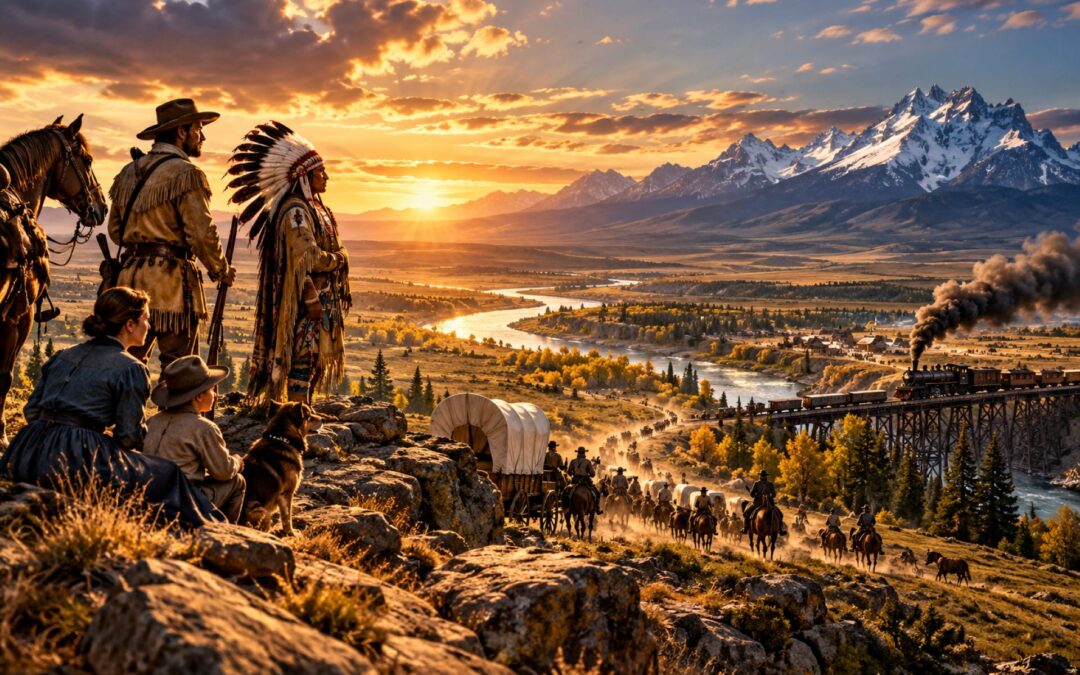
In 1783, the newly independent United States was a relatively small republic whose population was concentrated along the Atlantic coast and in the settlements extending toward the Appalachian Mountains. Its territory officially reached the Mississippi River, but large parts of that land remained beyond the effective control of the federal government. Farther west lay an enormous continent occupied by Indigenous nations, European trading networks, Mexican settlements, and territories claimed by competing powers.
A little more than a century later, the United States stretched from the Atlantic to the Pacific. Cities had appeared across the Great Plains, railroads connected distant coasts, ranches and farms occupied millions of acres, and formerly contested territories had been incorporated into an expanding federal system. The transformation helped establish the geographical, economic, and political foundations of modern American power.
This process, known as American westward expansion, is often remembered through familiar images of pioneers crossing the wilderness, prospectors searching for gold, cowboys driving cattle, and railroads advancing across the plains. These experiences were real, but they represent only part of a much larger history involving diplomacy, land purchases, warfare, immigration, federal legislation, economic development, and the dispossession of Indigenous peoples.
The United States did not simply discover and settle an empty continent. It expanded into lands with existing populations, political authorities, economies, and competing territorial claims. Understanding how the country moved westward therefore requires examining both the opportunities that attracted settlers and the political and military processes that made their settlement possible.
Before the Frontier: The People and Borders of North America
The geographical starting point for American westward expansion was the Treaty of Paris of 1783, which formally ended the American Revolutionary War and recognized the independence of the United States. The treaty established boundaries extending from the Atlantic coast westward to the Mississippi River, with British North America to the north and Spanish possessions to the south and west.
The territory was considerably larger than the original thirteen colonies, but possessing a diplomatic claim was different from exercising political control. Much of the western country had relatively few American settlements, limited infrastructure, and political arrangements that did not depend upon the United States government.
The American Revolution had created an independent republic, but independence did not establish uncontested American authority over every community within the borders described by European diplomats. Indigenous nations remained powerful political actors, while British and Spanish officials continued to influence trade, alliances, and territorial affairs across North America.
Long before Europeans established permanent colonies, the continent had been home to hundreds of distinct Indigenous nations. Their societies had developed different agricultural practices, political institutions, trading systems, and relationships with the environments in which they lived. Some maintained permanent farming communities, while others combined seasonal movement with hunting, cultivation, and long-distance exchange.
In the eastern woodlands, nations such as the Cherokee, Choctaw, Muscogee, Chickasaw, and Haudenosaunee maintained complex political and economic institutions. Across the Great Plains, different communities developed ways of life adapted to grasslands, river valleys, and seasonal resources. In the Southwest, Pueblo communities built settlements and agricultural systems suited to dry environments, while Pacific coastal peoples maintained extensive fishing, maritime, and trading traditions.
These were not isolated populations inhabiting a landscape untouched by human activity. Indigenous communities cultivated crops, managed forests and grasslands, maintained transportation routes, negotiated alliances, and fought territorial conflicts. The Library of Congress’s history of cultural encounters during westward expansion places American migration within this larger history of communities whose lives were transformed by the movement of settlers.
European powers had also established a substantial presence beyond the original United States. Spain controlled Louisiana and much of the Southwest, including the territories associated with New Spain. Britain maintained important commercial interests in the northern interior and Pacific Northwest, while Russian colonial activity extended into Alaska and the North Pacific.
American settlers entering these regions encountered a complicated political geography rather than a vacant wilderness. Indigenous nations negotiated with foreign governments, European traders depended on Native commercial networks, and territorial claims frequently overlapped.
Geography made expansion difficult even where the United States possessed recognized claims. The Appalachian Mountains separated the Atlantic settlements from the Ohio and Mississippi river systems. Farther west, enormous grasslands, difficult river crossings, deserts, and the Rocky Mountains presented obstacles to transportation and permanent settlement.
In 1800, the United States had approximately 5.3 million inhabitants spread across sixteen states. Although settlement remained heavily concentrated in the East, Kentucky and Tennessee had already joined the Union west of the Appalachians. The country was beginning to extend beyond its original coastal foundations, but the greater transformation was still ahead.
Crossing the Appalachians and Acquiring Louisiana
American movement across the Appalachian Mountains had begun well before independence. Colonial settlers, land speculators, hunters, and traders were already seeking routes into the Ohio Valley and Kentucky, encouraged by the prospect of farmland and commercial opportunity.
Among the best-known early frontiersmen was Daniel Boone, whose expeditions into Kentucky helped popularize the region among colonial settlers. Boone traveled through the Cumberland Gap, a mountain passage that Indigenous peoples had used long before European colonization. The route offered access through the Appalachian barrier into lands connected to the Ohio River system.
In 1775, Boone helped develop the Wilderness Road and established Boonesborough in present-day Kentucky. His activities contributed to a growing movement of settlers into the interior, although those migrations repeatedly brought newcomers into conflict with Indigenous nations defending their territories.
The early federal government soon began establishing a legal structure for territorial expansion. The Northwest Ordinance of 1787 organized the Northwest Territory, a region extending north from the Ohio River toward the Great Lakes and west toward the Mississippi. It established procedures through which territories could eventually become states and prohibited slavery within that particular territory.
The ordinance became an important precedent for incorporating new regions into the Union. Rather than maintaining every western acquisition indefinitely as a colonial possession, the United States developed a system through which qualifying territories could establish governments and seek admission as states.
That process nevertheless assumed federal authority over lands where Indigenous sovereignty remained contested. The creation of territorial governments did not automatically settle Native land claims, and expanding settlement produced repeated struggles over territory, treaties, and political power.
Kentucky entered the Union in 1792, followed by Tennessee in 1796. Their admission demonstrated that the country could expand its system of states beyond the original Atlantic colonies. Ohio followed in 1803, reflecting the continuing growth of settlement in the region north of the Ohio River.
The decisive territorial transformation of the early nineteenth century came from an unexpected diplomatic opportunity.
During the closing years of the eighteenth century, France regained control of Louisiana from Spain, although the formal transfer was completed in stages. Napoleon Bonaparte initially viewed the territory as part of a revived French colonial system in the Americas. His ambitions were weakened by the struggle to restore French control over Saint-Domingue, where the Haitian Revolution had devastated France’s plans for a profitable Caribbean empire.
The prospect of renewed warfare with Britain also made the defense of an enormous North American possession increasingly unattractive. Napoleon decided to sell Louisiana to the United States.
In 1803, President Thomas Jefferson’s administration acquired the Louisiana territory for approximately $15 million. The purchase transferred French claims over an immense region extending from the Mississippi River toward the Rocky Mountains, roughly doubling the territory claimed by the United States.
For Jefferson, the acquisition offered several strategic advantages. It secured American interests along the Mississippi River, reduced the possibility of French interference in the interior, and provided access to enormous areas that settlers and commercial interests hoped to develop.
The purchase also transformed the country’s long-term geographical possibilities. The United States was no longer confined principally to lands east of the Mississippi. Its territorial ambitions now extended deep into the continental interior, placing the government in a stronger position to pursue commercial connections and further expansion toward the Pacific.
Yet the Louisiana Purchase did not mean that the United States had purchased uncontested ownership of every acre within its new boundaries. Indigenous nations occupying the region had not been parties to the agreement, and their political rights, landholding systems, and relationships with the territory continued to exist regardless of the diplomatic transaction.
The acquisition created an extraordinary opportunity for American expansion, but turning a territorial claim into a settled and economically connected region would require decades of exploration, negotiation, migration, infrastructure development, and conflict.
Explorers, Traders, and the Trails West
The Louisiana Purchase raised a practical question for the Jefferson administration: what exactly had the United States acquired, and how could the government establish commercial and political connections across such an enormous territory?
In 1804, Meriwether Lewis and William Clark led an expedition westward from the Mississippi River region. The journey combined geographical exploration, scientific observation, diplomacy, and the search for transportation routes that might connect the interior of North America with the Pacific coast.
The expedition traveled up the Missouri River, crossed the continental divide, and eventually reached the Columbia River system. In November 1805, its members arrived near the Pacific Ocean, having completed a journey across some of the most geographically challenging regions of the continent.
Lewis and Clark spent the winter near the Pacific coast before beginning their return journey in 1806. Along the way, they recorded information about rivers, mountains, plants, animals, and the many Indigenous nations whose territories they crossed.
Their success depended considerably on knowledge already possessed by Native communities. Indigenous people provided geographical information, food, horses, translation, diplomatic contacts, and practical assistance. Sacagawea, a Shoshone woman traveling with the expedition, helped facilitate communication and contributed to its ability to navigate unfamiliar political and geographical environments.
The expedition therefore did not discover an unknown continent. It gathered and transmitted information about places that Indigenous peoples had inhabited, traversed, and understood for generations. It also crossed lands beyond the Louisiana Purchase itself, illustrating the growing American interest in routes and commercial opportunities reaching the Pacific.
The expedition’s findings helped expand geographical knowledge available to the federal government and eastern audiences. They also encouraged interest in the fur trade, particularly the valuable animal pelts that could be obtained throughout the western interior.
During the early nineteenth century, fur-trading enterprises became important agents of western exploration. Traders traveled along rivers and mountain routes, established commercial relationships with Indigenous communities, and developed networks of trading posts in remote regions.
The mountain men became especially prominent in this economy. Figures such as Hugh Glass and Jim Bridger gained reputations for their knowledge of difficult terrain, river systems, and mountain passes. Their experiences later became part of frontier folklore, although the practical foundations of their work lay in hunting, trapping, trading, and transportation.
The fur trade connected the American interior to wider commercial markets. Beaver pelts, for example, were valuable in the manufacture of fashionable felt hats. Demand for these products encouraged traders to travel considerable distances and establish commercial routes through areas that lacked extensive American settlement.
Many trading networks relied on Indigenous knowledge and participation. Native hunters and merchants were not simply passive suppliers to European or American businesses; they negotiated terms, maintained alliances, and adapted commercial relationships to their own interests.
Trading posts gradually became important regional meeting places. They offered opportunities to exchange goods, gather information, obtain supplies, and organize further journeys. Some later developed connections to permanent settlements as migration into the surrounding regions increased.
These networks also helped establish or popularize the routes that would become associated with large-scale westward migration.
The Oregon Trail carried migrants from the Missouri River region toward the Pacific Northwest, particularly the fertile Willamette Valley. The California Trail eventually connected eastern departure points with the Sierra Nevada and California, while the Santa Fe Trail developed as an important commercial route between Missouri and Santa Fe after Mexican independence in 1821.
These trails were not uniform roads constructed across the continent. They were networks of paths that changed according to terrain, water availability, seasonal conditions, and practical experience. Travelers followed rivers, crossed mountain passes, and relied on information from earlier expeditions, traders, Indigenous communities, and other migrants.
The journeys could take months. Wagon trains required food, animals, equipment, and reliable access to water, while disease, accidents, exhaustion, severe weather, and difficult crossings threatened travelers’ survival.
The resulting transportation networks gradually made the western interior more accessible to Americans arriving from the East. The fur traders and early explorers did not themselves create mass settlement, but their activities contributed to the geographical and commercial foundations upon which later migration depended.
Manifest Destiny and the Dispossession of Native Nations
As American settlement moved westward, territorial expansion increasingly became associated with a belief that the United States had a special historical mission. Supporters portrayed the spread of American institutions, agriculture, commerce, and Christianity as a desirable transformation of the continent.
These ideas developed over several decades, but the expression Manifest Destiny became prominent in 1845. It captured the conviction that American expansion across North America was natural, justified, and, for some supporters, divinely ordained.
The ideology helped convert territorial ambition into a broader vision of national purpose. Expansion was presented not merely as a way to obtain land or resources, but as part of the United States fulfilling its supposed destiny as a continental republic.
Such arguments often disregarded the political rights and existing societies of the people whose lands settlers wanted to occupy. The belief that American institutions represented progress could become a justification for overriding Indigenous sovereignty, acquiring foreign territory, and imposing federal authority over communities that had not consented to American rule.
The tension between expansion and Indigenous independence had existed since the colonial period. As settlers entered the Ohio Valley and other frontier regions, Native nations pursued different strategies to protect their territories, including diplomacy, treaty negotiations, military alliances, and armed resistance.
During the early nineteenth century, the Shawnee leader Tecumseh attempted to build a broader Indigenous coalition against expanding American settlement. His movement drew strength from the recognition that isolated communities faced severe disadvantages when negotiating separately with increasingly powerful American governments and land interests.
The War of 1812 intensified these struggles. Some Indigenous nations allied with Britain in the hope of resisting further American expansion, while other communities made different choices according to their political interests. Tecumseh’s death in 1813 seriously weakened the resistance movement associated with his leadership.
Federal and state authorities nevertheless continued to pursue access to Indigenous territory through treaties, military campaigns, and settlement pressure.
The most consequential transformation came under President Andrew Jackson.
In 1830, Congress passed the Indian Removal Act, authorizing the federal government to negotiate the relocation of Indigenous nations from lands east of the Mississippi River to territories farther west. Officially, the legislation created a framework for negotiated removal. In practice, the policy operated within a system of intense coercion, unequal political power, and expanding settler demands.
The southeastern United States was home to several nations that American authorities increasingly sought to displace, including the Cherokee, Choctaw, Muscogee, Chickasaw, and Seminole.
These societies possessed established communities, political institutions, agricultural economies, and deep relationships with their homelands. Some had adapted elements of European-American governmental and educational systems while maintaining their own national identities and claims to sovereignty.
The Cherokee Nation, for example, developed a written constitution, established schools, and used legal institutions to challenge encroachments on its territory. Its leaders pursued negotiations and litigation in an effort to protect Cherokee lands against actions by Georgia and the federal government.
In Worcester v. Georgia in 1832, the Supreme Court recognized important limits on Georgia’s authority within Cherokee territory. The ruling did not, however, prevent the federal and state governments from continuing policies that led toward removal.
The process was marked by disputed agreements, coercive pressure, and the rejection of Indigenous objections. The Treaty of New Echota, signed in 1835 by a minority Cherokee faction without the authorization of the principal Cherokee government, became a central instrument used to justify forced removal.
During 1838 and 1839, thousands of Cherokee people were forcibly driven from their homes and transported westward. Disease, exposure, hunger, exhaustion, and inadequate supplies caused widespread suffering and death during the journeys that became known as the Trail of Tears.
Other southeastern nations experienced different forms of displacement. The Choctaw endured early removal operations, Muscogee communities faced coercion and military intervention, and the Chickasaw were compelled to leave their homelands. The Seminole resisted through prolonged conflict in Florida, demonstrating that removal was neither universally accepted nor accomplished without significant opposition.
The Smithsonian’s account of American Indian removal emphasizes the political decisions, Native resistance, and human consequences behind these policies. Removal was not an inevitable demographic movement; it resulted from deliberate governmental choices made in response to demands for Indigenous land.
The land taken from Native nations helped make additional agricultural settlement and commercial expansion possible. In the Southeast, the growth of plantation agriculture increased pressure on Indigenous territories and connected removal to the expansion of slavery.
Indigenous nations continued to exist after displacement. Communities rebuilt institutions, maintained cultural traditions, and defended political rights under difficult conditions. Yet removal frequently fractured societies, separated families from ancestral places, and placed communities in territories where further conflict and displacement remained possible.
The contradiction was fundamental to American westward expansion. A nation that celebrated liberty and self-government repeatedly expanded through policies that denied those principles to the Indigenous peoples already occupying the land.
Texas, Oregon, and the War That Redrew the Map
By the 1840s, American expansion was no longer confined to settlers moving into territories already claimed by the United States. The government increasingly pursued lands under the sovereignty of other states, turning continental ambition into a major question of international diplomacy and war.
Texas became one of the earliest and most consequential examples.
During the period of Mexican rule, authorities had permitted settlers from the United States to establish communities in Texas. They hoped migration would contribute to economic development and strengthen control over a sparsely populated frontier region.
Many newcomers, however, came from the slaveholding American South and brought political and economic expectations that conflicted with Mexican policies. Disagreements over slavery, immigration, federal authority, and regional autonomy contributed to growing tensions between settlers and the Mexican government.
The resulting Texas Revolution produced an independent Republic of Texas in 1836. Mexico did not accept the loss of its territory, leaving the new republic’s international position and boundaries contested.
For several years, the question of American annexation remained politically controversial. Supporters argued that Texas offered economic opportunities and strengthened the nation’s continental position. Opponents feared war with Mexico and the expansion of slavery.
In December 1845, Texas became the twenty-eighth state of the United States.
Annexation intensified a longstanding border dispute. Texas claimed territory extending to the Rio Grande, while Mexico regarded the Nueces River as an important boundary. American military movements into the disputed region contributed to confrontations between the two countries.
In May 1846, the United States declared war on Mexico.
The Mexican–American War continued for almost two years and involved military campaigns across northern Mexico, California, and the interior of the country. American forces ultimately advanced toward Mexico City, occupying the capital in September 1847.
The conflict ended with the Treaty of Guadalupe Hidalgo in February 1848. Mexico recognized the Rio Grande as the boundary of Texas and ceded an immense territory that included California, Nevada, Utah, and substantial portions of the modern American Southwest.
The treaty transformed the geographical position of the United States, establishing its formal sovereignty over lands reaching the Pacific Ocean.
Yet the acquisition was not simply the addition of vacant territory to an existing country. Mexican citizens, Indigenous nations, and established communities already occupied these lands. The treaty promised protections to affected Mexican residents, but subsequent policies, legal disputes, discrimination, and land conflicts often undermined their security.
The war also intensified domestic opposition to expansion. Critics questioned its justification and warned that territorial conquest might strengthen the political power of slaveholders.
Meanwhile, the United States was negotiating another important territorial question in the Pacific Northwest.
The region commonly known as Oregon Country had long been subject to overlapping British and American claims. British commercial influence was exercised partly through the Hudson’s Bay Company, whose fur-trading networks maintained relationships across the region. American interest increasingly focused on agricultural settlement and the migration of families along the Oregon Trail.
Under earlier agreements, Britain and the United States had allowed joint occupation while postponing a final decision about sovereignty. As American migration increased, the arrangement became politically difficult to sustain.
Expansionists demanded that the United States assert control over a much larger portion of the Pacific Northwest. President James K. Polk supported territorial expansion, but war with Britain would have created a serious additional conflict while relations with Mexico were deteriorating.
The two governments reached a diplomatic settlement in June 1846. The Oregon Treaty extended much of the international boundary along the forty-ninth parallel, while leaving Vancouver Island under British control.
The State Department’s history of the Oregon territorial negotiations illustrates how diplomacy, commercial interests, migration, and competing geographical claims shaped the final settlement.
A further acquisition followed in 1853, when the United States negotiated the Gadsden Purchase with Mexico. The agreement transferred land in what is now southern Arizona and southwestern New Mexico, partly reflecting American interest in establishing a suitable southern railroad route.
Together, the Louisiana Purchase, Texas annexation, Oregon settlement, Mexican Cession, and Gadsden Purchase created the essential geographical outline of the contiguous United States.
But territorial expansion had produced a political crisis that could not be resolved simply by drawing new borders.
Every major acquisition raised the question of whether slavery would be permitted in newly organized territories. Southern slaveholders sought protection for the institution and access to land, while opponents feared that expansion would strengthen slavery’s political influence.
The Missouri Compromise of 1820 had already attempted to regulate slavery in the Louisiana Purchase territory. The acquisition of western lands after the Mexican–American War reopened the conflict on an even larger scale.
The Compromise of 1850 admitted California as a free state while creating arrangements for Utah and New Mexico that left major questions about slavery to later territorial politics. The Kansas–Nebraska Act of 1854 further destabilized earlier compromises, allowing settlers to determine whether slavery would be permitted and producing violent confrontation in Kansas.
Territorial expansion therefore contributed directly to the political crisis that led to the American Civil War. The struggle over the future of slavery was inseparable from disagreement about the political and economic organization of the West.
By the middle of the nineteenth century, the United States had acquired most of the territory necessary to become a continental power. The next challenge was transforming those acquisitions into populated, economically connected, and politically incorporated regions.
The California Gold Rush and the Great Overland Migrations
Territorial acquisition created opportunities for settlement, but it did not guarantee that large numbers of people would immediately move west. Distance, transportation costs, uncertain economic prospects, and the dangers of migration continued to limit settlement across much of the interior.
The discovery of gold in California changed those calculations dramatically.
In January 1848, James W. Marshall discovered gold at Sutter’s Mill in California. News of the discovery spread slowly at first, but growing reports of valuable deposits encouraged thousands of people to organize journeys toward the Pacific coast.
By 1849, the rush had become an international movement. Prospectors known as the Forty-Niners arrived from eastern American states, Latin America, Europe, China, Australia, and other regions, hoping to find enough gold to transform their economic circumstances.
For many migrants, the journey was almost as demanding as the search for gold itself.
Some crossed the continent by wagon, following established trails across the Great Plains, mountain passes, and western deserts. Others traveled by sea around Cape Horn or reached the Pacific by crossing the Isthmus of Panama before continuing north toward California.
Overland travel exposed migrants to cholera, accidents, exhaustion, extreme weather, river crossings, and shortages of food or water. The journey required planning and cooperation, but successful preparation could not eliminate the uncertainty involved.
The Oregon and California Trails became symbols of the pioneer experience. Families carried household possessions and provisions in wagons, traveled in organized groups, and relied on animals for transportation. Some sought farmland and permanent homes, while others intended to pursue temporary commercial opportunities.
The dangers were not evenly distributed or always accurately represented in later popular culture. Disease, accidents, and environmental conditions were major hazards, while encounters with Indigenous peoples varied greatly according to the region, political circumstances, and behavior of the travelers involved.
The Donner Party became a particularly famous example of the risks of overland migration. In the winter of 1846–1847, members of the group were trapped by heavy snow in the Sierra Nevada. Their desperate struggle for survival, including instances of cannibalism, became one of the most widely remembered tragedies of the pioneer era.
Such disasters were exceptional, but they demonstrated the limits of transportation before the development of dependable rail connections.
California’s Gold Rush rapidly transformed the population and economy of the region. Prospectors established mining camps, merchants organized supply networks, and towns expanded to accommodate the growing demand for food, transportation, tools, lodging, and services.
By the middle of the 1850s, roughly 300,000 people had migrated to California as part of the Gold Rush era. The population growth helped accelerate California’s admission to the Union in September 1850.
Not everyone who arrived became wealthy.
Gold mining required access to promising deposits, equipment, supplies, and increasingly organized commercial operations. The easiest discoveries attracted intense competition, while later miners often faced greater costs and diminishing opportunities.
Entrepreneurs supplying miners sometimes enjoyed more dependable earnings than the prospectors themselves. Merchants selling tools and clothing, operators of hotels and restaurants, transportation companies, and providers of other services could profit from the enormous demand created by mining communities.
The Gold Rush also produced widespread inequality and exploitation. Chinese and Latin American miners faced discrimination, while Indigenous Californians endured devastating violence, displacement, and the destruction of communities as settler populations expanded.
The sudden increase in migration created pressure on land and resources that transformed California far beyond the mining districts.
Other western regions developed around different incentives.
Utah, for example, became the center of a major migration motivated substantially by religion. Members of the Church of Jesus Christ of Latter-day Saints had experienced persecution, violence, and repeated displacement in eastern and midwestern communities.
Following the death of church founder Joseph Smith, Brigham Young led a movement toward the Great Salt Lake Valley. Mormon pioneers began arriving there in 1847, when the region remained under Mexican sovereignty.
Over the following decades, tens of thousands of Latter-day Saints followed westward migration routes and established communities across the Great Basin. Their settlements developed agricultural systems, irrigation networks, religious institutions, and organized communities in an environment that required considerable adaptation.
The Mormon experience illustrates why western migration cannot be explained entirely through the desire to become wealthy. Religious freedom, community autonomy, family security, and the possibility of building new societies also encouraged people to undertake difficult journeys.
Elsewhere, agricultural opportunity attracted settlers hoping to obtain land and establish independent farms. The promise of property ownership carried particular importance for families who had limited access to land in their previous communities.
Western migration therefore consisted of several overlapping movements rather than a single procession of fortune seekers. Farmers, religious communities, merchants, miners, laborers, traders, and their families crossed the continent for different reasons and encountered different opportunities and obstacles.
Their arrival transformed western societies, but sustainable settlement still depended on reliable transportation, access to markets, and policies that supported the development of permanent communities.
Homesteads, Railroads, and the Economy of Settlement
During the second half of the nineteenth century, the federal government played a decisive role in converting western territories into regions of more extensive settlement and economic production.
The popular image of the pioneer emphasizes individual determination, but private ambition operated within a broader system of public legislation, land distribution, transportation investment, and military protection.
The Homestead Act of 1862 became one of the most important instruments of this policy.
Under the act, eligible applicants could claim up to 160 acres of surveyed federal land, subject to requirements concerning residence, cultivation, and improvement. Claimants generally needed to live on and develop the land for five years before obtaining full ownership, although the legislation also provided alternative purchase arrangements.
The National Archives’ account of the Homestead Act demonstrates how federal land policy encouraged settlement by offering opportunities for property ownership to people willing and able to meet the law’s conditions.
The act did not simply sell land at 1.25 cents per acre, as some simplified accounts suggest. Under its accelerated purchase provision, eligible claimants could acquire land at $1.25 per acre after satisfying the applicable conditions. Ordinary homestead claims involved filing fees and compliance with residence and improvement requirements rather than a straightforward purchase at that price.
Homesteading offered a significant opportunity for some settlers, but its practical benefits varied.
Many applicants lacked the resources required to build homes, acquire equipment, maintain livestock, and survive until their farms became productive. Families in dry regions faced challenges that 160 acres of land could not easily resolve, especially where rainfall was insufficient for conventional farming.
Land speculation, unequal access to credit, environmental conditions, and discriminatory practices also shaped who benefited. Furthermore, much of the land the government classified as available for settlement had been acquired through policies that displaced Indigenous nations or undermined their territorial rights.
Federal land policy was therefore both a mechanism for promoting family farming and part of the larger process by which Native lands were transferred into American agricultural and commercial ownership.
Transportation was equally important.
By the 1860s, railroads had already transformed travel and commerce across much of the eastern United States. Tracks connected manufacturing centers, commercial towns, ports, and agricultural districts, making it possible to transport large quantities of goods more efficiently than earlier overland methods.
The challenge was connecting these networks to the Pacific coast.
Congress enacted the Pacific Railway Acts during the Civil War, providing federal support for the construction of a transcontinental railroad. The project involved extensive land grants and government-backed financial assistance intended to encourage private companies to build across enormous distances.
Construction began in 1863, with the Union Pacific Railroad extending westward from the Omaha region and the Central Pacific Railroad building eastward from Sacramento.
The Civil War complicated the project through demands on labor, materials, finance, and political attention, but construction did not simply stop until peace returned in 1865. Work continued during the conflict and accelerated as the war ended and resources became more readily available.
The task presented formidable engineering challenges.
Workers had to cross mountains, cut through rock, bridge waterways, lay tracks across remote plains, and maintain supply systems in regions far from established industrial centers. Construction required large quantities of timber, iron, explosives, machinery, and skilled and unskilled labor.
Immigrant workers made enormous contributions. The Central Pacific relied heavily on Chinese laborers, many of whom performed dangerous work cutting tunnels and constructing lines through the Sierra Nevada. Irish immigrants and other workers participated extensively in Union Pacific construction.
Their achievements were often accompanied by unequal treatment, difficult working conditions, and dangerous employment. The railroads celebrated as symbols of national progress were built through demanding physical labor performed by people whose contributions were not always equally recognized.
On May 10, 1869, the two companies’ tracks met at Promontory Summit in Utah Territory. The ceremonial driving of the final spike marked the completion of the first transcontinental railroad.
The National Park Service’s history of the Golden Spike and transcontinental railroad records how the project connected distant regions while reflecting the financial, technological, and human demands of nineteenth-century railroad construction.
The railroad transformed the economics of western travel.
A journey that previously required several months could now be undertaken in roughly a week under favorable conditions. Transportation became faster, more predictable, and capable of moving larger volumes of passengers and freight.
For settlers, this reduced some of the risks and costs associated with migration. For farmers and ranchers, railroads created access to distant markets, allowing western agricultural production to serve growing populations in eastern cities.
Railway companies also encouraged settlement along their routes. They promoted land sales, established connections with new towns, and helped attract migrants whose presence could generate passenger traffic and commercial demand.
Telegraph lines further reduced the isolation of western settlements by making long-distance communication possible without requiring messages to travel physically between towns. Later technological developments, including improved steam transportation and the telephone, strengthened communication and commerce across the country.
The consequences extended far beyond the movement of individual settlers.
Railroads stimulated demand for iron, steel, timber, coal, machinery, and financial services. They encouraged mining operations, agricultural production, urban development, and the emergence of businesses capable of operating across large geographical areas.
They also created new pressures on Indigenous territory. Railroad routes crossed lands occupied or claimed by Native nations, encouraged migration into previously less accessible regions, and strengthened the logistical capacity of the federal government and military.
By the late nineteenth century, additional railway networks were extending across the West, making transportation increasingly central to regional economic life.
The Homestead Act and transcontinental railroad reveal an essential feature of American westward expansion: the federal government did not merely watch settlers move westward. Through laws, subsidies, land grants, infrastructure, and military power, it helped create the conditions that allowed migration and economic development to expand on an unprecedented scale.
Cowboys, Mining Towns, and the People of the West
As transportation improved and settlement increased, the American West developed economies that were far more varied than the agricultural communities imagined by many early homesteaders.
Mining, cattle ranching, commerce, transportation, and service industries created different forms of employment and attracted people from across the United States and the wider world.
The Gold Rush had demonstrated how rapidly a mineral discovery could transform an isolated region. Similar developments occurred across the West as prospectors discovered valuable deposits of gold, silver, and other minerals.
Mining attracted investors, workers, merchants, and entrepreneurs. Settlements grew around promising discoveries, sometimes expanding from small camps into towns containing stores, hotels, saloons, banks, boarding houses, workshops, and entertainment businesses.
Places such as Deadwood in South Dakota and Tombstone in Arizona became associated with the mining frontier. Their reputations were later shaped by stories of wealthy prospectors, gamblers, criminals, and famous confrontations.
The underlying economy was often unstable.
A mining town might prosper while deposits remained commercially valuable, only to experience rapid decline when production fell or investment moved elsewhere. Businesses dependent on miners’ spending could disappear alongside the industry that had sustained them.
Some settlements survived by developing diversified economies, transportation connections, or administrative functions. Others declined dramatically, eventually becoming the abandoned towns that later generations associated with the history of the American frontier.
Mining also generated environmental consequences. Extraction altered landscapes, contaminated waterways in some districts, and created disputes over access to land and natural resources.
Cattle ranching produced another distinctive western economy.
The grasslands of Texas and the Great Plains offered opportunities for raising large herds of livestock. Following the Civil War, cattle ranchers developed commercial networks that connected southern and western grazing regions to expanding markets elsewhere in the country.
Cattle drives became a familiar part of western life. Cowboys guided herds across long distances toward railroad connections and markets, where animals could be transported to slaughterhouses and urban consumers.
The work demanded practical knowledge of livestock, weather, terrain, and long-distance travel. Cowboys spent extended periods outdoors, often under difficult working conditions, and their daily responsibilities involved far more routine labor than the dramatic adventures portrayed in popular culture.
The profession also reflected the ethnic and cultural diversity of the West.
Hispanic cattle-handling traditions, particularly those associated with Mexican vaqueros, strongly influenced cowboy equipment, techniques, and terminology. African Americans also formed a significant part of the cattle workforce, with some historical estimates suggesting that Black cowboys accounted for roughly one-quarter of the people working in certain cattle-driving occupations and regions.
The reality of western ranching therefore differed considerably from the image of an almost exclusively white cowboy culture.
As ranching developed, competition over grazing land and water became increasingly important. The expansion of farms, fences, railways, and private property arrangements gradually changed the open-range systems that had supported earlier cattle drives.
Other settlers arrived from Europe in search of economic opportunity.
Irish and German immigrants were particularly important among the nineteenth-century European populations that established homes and businesses across different western regions. Their experiences varied according to occupation, religious background, access to capital, and the communities in which they settled.
Chinese immigrants played an equally consequential role in western development. Many participated in mining, railroad construction, agriculture, commerce, and service industries, contributing labor and expertise to growing regional economies.
Yet Chinese communities frequently faced racial hostility, discriminatory legislation, and violent exclusion. The Chinese Exclusion Act of 1882 restricted Chinese immigration and demonstrated how the federal government could depend upon immigrant labor while denying equal opportunities to particular populations.
African Americans also moved westward, especially after emancipation and the end of the Civil War. Some worked as cowboys, agricultural laborers, entrepreneurs, and railroad workers, while others sought opportunities to establish communities beyond the racial hierarchies of the former slaveholding South.
Freedom from slavery did not guarantee freedom from discrimination. Black western settlers encountered exclusion, unequal treatment, and violence, even as they helped build the economies and communities of the region.
The West also remained home to Mexican and Indigenous populations whose histories preceded American territorial expansion. New political borders did not erase their communities, cultural traditions, or economic activities.
Western settlement was consequently a process of interaction among many populations rather than the creation of society by a single group of pioneers.
Popular memory nevertheless came to emphasize a particular set of frontier characters: the outlaw, the gunfighter, and the lawman.
The geographical scale of western territories could make law enforcement difficult. Small settlements sometimes possessed limited judicial institutions, while transportation routes, banks, stagecoaches, and trains created opportunities for robbery.
Jesse James became notorious for his involvement in outlaw activities following the Civil War. Butch Cassidy and the Sundance Kid later acquired similar reputations through robberies and their association with the Wild Bunch.
Lawmen such as Wyatt Earp and Pat Garrett, along with detectives working for organizations such as the Pinkerton agency, became part of the effort to investigate crime and pursue wanted fugitives.
Their stories were frequently dramatized in newspapers, popular literature, and eventually films. Individual confrontations were transformed into legends that helped establish the familiar image of a violent frontier populated by heroic sheriffs and dangerous outlaws.
Violence certainly occurred, but the mythology can obscure the ordinary activities that sustained western communities. Most people spent their time farming, raising families, operating businesses, maintaining transport networks, attending religious institutions, and dealing with the practical challenges of daily life.
The historical West was not simply a place where conventional society disappeared. It was a region where new institutions, markets, and communities developed unevenly amid rapid migration and political change.
Native Resistance, Reservations, and the End of the Frontier
The enormous expansion of American settlement during the nineteenth century depended not only on acquiring territory and building infrastructure, but also on the extension of federal authority over Indigenous lands.
For Native nations, the consequences varied according to geography, political circumstances, treaties, military strength, and relations with settlers. Yet many communities faced increasing pressure as American migration and commercial development transformed the territories upon which they depended.
Across the Great Plains, Indigenous nations maintained complex political relationships and ways of life adapted to local environments. Some communities relied heavily on the bison for food, clothing, shelter, tools, and trade, while others combined hunting with agriculture and different forms of economic activity.
The expansion of railroads, commercial hunting, ranching, and settlement placed enormous pressure on these systems.
Bison populations collapsed during the nineteenth century as a result of extensive commercial slaughter and other pressures. Their destruction deprived many Plains communities of an essential economic and cultural resource, weakening their capacity to maintain established patterns of life.
The federal government also pursued treaties intended to regulate land use, establish territorial boundaries, and secure migration routes. Such agreements were frequently negotiated under unequal conditions, and their provisions were repeatedly challenged or violated as new settlers and commercial interests sought access to Indigenous lands.
The Smithsonian’s examination of treaties on the Northern Plains helps explain why these agreements must be understood as political relationships involving sovereign Native nations rather than simple transactions transferring land to the United States.
The history of the Black Hills illustrates the consequences of treaty violations.
The Fort Laramie Treaty of 1868 established important territorial protections for the Lakota and associated peoples. Yet the discovery of gold in the Black Hills encouraged outsiders to enter lands protected under the agreement.
As prospectors and settlers demanded access, the federal government increasingly moved toward military confrontation with Native communities defending their territories.
The resulting Great Sioux War of 1876 became one of the most prominent conflicts of the late western frontier.
Native leaders such as Sitting Bull and Crazy Horse played significant roles in resistance against American military expansion. Their leadership reflected broader efforts to preserve territorial independence, established communities, and ways of life threatened by federal policy.
At the Battle of the Little Bighorn in June 1876, Lakota, Northern Cheyenne, and allied warriors defeated a force commanded by Lieutenant Colonel George Armstrong Custer. The battle became one of the most famous Native victories over the United States Army.
The victory did not, however, establish lasting security for the resisting communities.
The federal government committed additional military resources to the region, while continuing settlement pressure and the destruction of traditional economic foundations weakened Indigenous resistance. Many Native communities were eventually compelled to accept reservation arrangements under circumstances shaped by hunger, military pressure, and limited alternatives.
The Apache Wars in the Southwest represented another prolonged struggle over land and political independence.
Apache communities resisted military operations and settlement pressures across territories that eventually became parts of Arizona and New Mexico. Leaders such as Geronimo became closely associated with campaigns involving mobile groups of warriors, difficult terrain, and resistance to American and Mexican authorities.
Geronimo’s surrender in 1886 became an important symbolic moment in the history of armed resistance in the Southwest, although conflict and Indigenous opposition to federal policy did not end with that event.
These struggles were not simply contests between a technologically advanced army and peoples unable to adapt to changing conditions. Native nations used sophisticated military, diplomatic, geographical, and political strategies, but confronted an expanding state with growing resources, transportation networks, settler populations, and the ability to sustain prolonged campaigns.
Even communities that avoided large-scale warfare could lose land through coercive treaties, legal changes, reservation boundaries, and settlement encroachment.
Reservations became a central instrument of federal policy during the later nineteenth century. They restricted many Indigenous peoples to designated territories and placed communities under systems of government supervision that limited political and economic independence.
The conditions varied considerably, but reservation systems frequently disrupted established patterns of movement, agriculture, hunting, trade, and social organization.
Federal policy increasingly went beyond controlling territory to attempting to transform Indigenous societies themselves.
Officials promoted assimilation, arguing that Native peoples should abandon traditional institutions, communal landholding systems, languages, and cultural practices in favor of Euro-American social and economic arrangements.
The Dawes Act of 1887 became an important expression of this policy.
The legislation provided for the division of certain tribal lands into individual allotments, with remaining lands becoming available for transfer to non-Native ownership under federal policy. Its supporters presented individual property ownership as a means of incorporating Indigenous peoples into American society.
In practice, allotment contributed to the fragmentation of Native landholdings and the transfer of substantial territory away from tribal communities. The National Park Service’s history of the Dawes Act explains how federal land policy undermined communal ownership and helped accelerate Indigenous dispossession.
Assimilation policies also affected education and family life.
Government-supported boarding schools attempted to replace Indigenous languages and cultural practices with those favored by American authorities. Many children were separated from their families and communities, and the institutions became sites of coercion, abuse, and lasting cultural harm.
The consequences were not confined to the loss of territory. Federal policy threatened political institutions, intergenerational knowledge, religious traditions, and the social relationships through which communities maintained their identities.
One of the most notorious episodes of violence occurred at Wounded Knee in South Dakota in December 1890.
United States troops killed large numbers of Lakota men, women, and children during a confrontation associated with efforts to suppress the Ghost Dance movement and control Native resistance. The massacre became a defining symbol of the violence accompanying the extension of federal authority across the Plains.
By this period, many Americans had begun to believe that the western frontier was disappearing.
The 1890 census reported that the distribution of settlement no longer permitted the frontier to be identified as a single continuous boundary separating densely settled areas from more sparsely populated lands. The Census Bureau’s historical account of the 1890 census administration provides context for this changing official understanding of the frontier.
The declaration subsequently influenced interpretations of American history. Historian Frederick Jackson Turner famously argued in 1893 that the experience of frontier settlement had played an important role in shaping American institutions and national character.
Yet the claim that the frontier had closed did not mean that all western lands had been settled, that Native political rights had disappeared, or that territorial conflicts had been conclusively resolved.
Large regions continued to experience demographic and economic change, while Indigenous nations remained active political communities with continuing claims, rights, institutions, and cultural traditions.
Nor should the apparent closure of the frontier be understood as proof that the West had finally been conquered in some simple and permanent sense. Federal authority became more extensive, but the process had been uneven, contested, and deeply consequential for the peoples whose lands were incorporated into the United States.
American territorial expansion helped create an economically integrated continental nation. It also produced lasting disputes over sovereignty, treaty obligations, land ownership, cultural autonomy, and the relationship between the federal government and Indigenous peoples.
These consequences continued long after the most famous military campaigns of the western frontier had ended.
Alaska, Hawaii, and What Westward Expansion Left Behind
By the late nineteenth century, the United States had acquired nearly all the territory that would form its contiguous continental boundaries. Its population, transportation networks, agricultural production, and industrial economy had expanded dramatically, transforming the country’s position in North America.
American territorial ambition, however, was not confined entirely to the lands between the Atlantic and Pacific coasts.
In 1867, the United States purchased Alaska from Russia for $7.2 million. The acquisition extended American sovereignty into the far northwest of the continent and reflected strategic interest in Russian territory adjoining British North America.
Alaska remained relatively sparsely populated by settlers arriving from the rest of the United States, although Indigenous peoples had lived in the region for generations and Russian colonial enterprises had already established trading activities there.
During the late nineteenth century, gold discoveries increased commercial interest in Alaska and neighboring Canadian territory.
The Klondike Gold Rush began following discoveries in Canada’s Yukon region in 1896. As reports spread, prospectors traveled north through difficult terrain, frequently using Alaskan ports and transportation routes to reach the Canadian goldfields.
The rush stimulated regional commerce, transportation infrastructure, and settlement activity. Yet the principal Klondike discoveries occurred in Canada, and their relationship to Alaska was partly one of access, services, and the development of neighboring mining districts.
Farther south in the Pacific, American expansion followed a different political path.
Missionaries, merchants, and businessmen had established a growing presence in the Hawaiian Islands during the nineteenth century. American commercial interests became particularly influential through plantation agriculture, trade, and the production of sugar.
Hawaii was an independent kingdom with its own political institutions and ruling monarchy. Its incorporation into the United States therefore involved the displacement of an existing sovereign government rather than the settlement of territory without established political authority.
In 1893, Queen Liliʻuokalani was overthrown by a group of residents and business interests supported by American diplomatic and military representatives. The United States formally annexed Hawaii in 1898.
The State Department’s history of American expansion during the late nineteenth century places this development within a broader period when the United States increasingly pursued strategic and commercial influence beyond continental North America.
Hawaii’s annexation differed from the settlement of the Great Plains or the acquisition of Louisiana. It reflected the country’s growing movement toward overseas power and the increasing importance of Pacific trade and strategy.
The incorporation of western territories into the federal system also continued into the twentieth century.
Oklahoma entered the Union in 1907, followed by New Mexico and Arizona in 1912. Alaska and Hawaii did not become states until 1959, illustrating the considerable distance that could separate territorial acquisition from full statehood.
These milestones completed important aspects of the country’s political geography, but they did not erase the historical consequences of expansion. Indigenous nations continued to pursue treaty rights, sovereignty, and cultural survival, while western communities developed economies and identities shaped by the varied migrations and conflicts of earlier generations.
The modern United States emerged from this period as a vast continental nation with access to two major oceans, extensive natural resources, a growing industrial economy, and transportation networks capable of connecting distant regions.
Its westward expansion was therefore one of the most consequential transformations in American history.
What began as a republic concentrated along the Atlantic coast became a country spanning much of North America. Territorial purchases, diplomatic agreements, wars, settlement policies, migration, mining, agriculture, ranching, and railroads all contributed to that transformation.
Yet the process cannot be understood solely through the opportunities it created for settlers. The same developments often depended upon the dispossession of Indigenous peoples, the extension of slavery into contested territories, unequal treatment of migrants, and political decisions that favored some communities at the expense of others.
The American West was never merely an empty frontier waiting to be discovered. It was a continent of existing societies that experienced profound changes as the United States expanded its territory, institutions, economy, and power.
Understanding that full history explains not only how the map of the United States came to look as it does, but also why the country’s expansion remains central to debates about national identity, sovereignty, opportunity, and justice.
Last Updated on October 30, 2026 by Aseem Gupta