
Reading Time: 33 Minutes
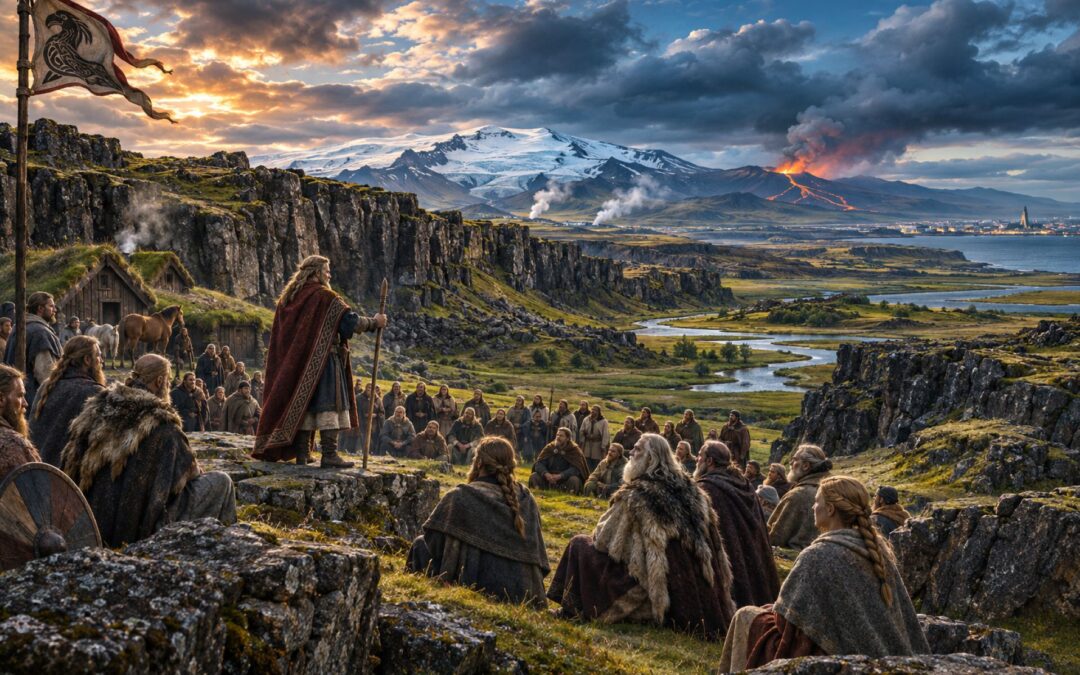
On 17 June 1944, Icelanders gathered at Þingvellir, a dramatic valley of dark rock, grassy plains, and long geological fissures, to celebrate the birth of their republic. The ceremony took place while much of Europe was at war and Denmark, whose king had also been Iceland’s monarch, remained under German occupation. Yet the gathering was deliberately rooted in a much older past. For more than a thousand years, Þingvellir had been associated with the idea that Icelanders could assemble, make laws, and settle the affairs of their island.
The republic did not emerge from an uninterrupted tradition of independence. Iceland had passed from a society of Norse settlers and competing chieftains into centuries of Norwegian and Danish rule. Its people had endured epidemics, hunger, volcanic devastation, economic restrictions, and the hazards of an ocean that both isolated them and connected them to the wider world. Their political institutions changed repeatedly, as did their beliefs, livelihoods, and expectations of freedom. The history of Iceland is therefore not simply a journey from Vikings to modern democracy. It is the story of how a small community repeatedly adapted to difficult conditions while struggling to decide who should govern its future.
A Land Shaped by Fire, Ice, and the Atlantic
Iceland lies in the North Atlantic, between Greenland and Norway, just south of the Arctic Circle. Seen on a map, it can appear remote from the European mainland, but its position has always given it a double identity. The surrounding water made ordinary movement difficult and dangerous, especially before modern navigation. At the same time, the sea offered access to Norway, the British Isles, Greenland, North America, and the commercial networks through which Icelanders acquired things they could not produce at home.
The landscape itself is unusually restless. Iceland sits where the North American and Eurasian tectonic plates are gradually moving apart, above a source of volcanic heat. As magma rises and solidifies, it builds new rock, while earthquakes, eruptions, and geothermal activity continually reshape the surface. Ice caps and glaciers cover portions of the highlands, and meltwater feeds powerful rivers that cut across lava fields and sediment. At Þingvellir, the rift landscape makes deep geological change visible in the same place where some of the country’s most consequential political decisions were made.
This environment offered opportunities but also imposed strict limits. Coastal valleys and lowlands could support hayfields and grazing animals, while much of the interior was too cold, barren, steep, or unstable for permanent agriculture. Trees were scarce compared with the forests familiar to settlers from Scandinavia, and imported timber could be expensive. Households had to store sufficient fodder to keep animals alive through the winter; a bad summer could become a disaster months later. Fishing, seabirds, marine mammals, and access to coastal resources helped support communities, but storms could prevent boats from putting to sea when food was most needed.
The same forces carried contrasting possibilities. An eruption could bury farmland or poison livestock, yet the heat beneath the island would eventually provide dependable warmth to homes and businesses. Glaciers could obstruct travel, but the water flowing from them would later help generate electricity. Iceland’s geography did not determine every event in its history, but it shaped the choices available to successive generations. To understand the country’s political and economic development, it helps to begin with the question its earliest permanent settlers confronted: how could a household survive on such an island?
Viking Settlement and the Creation of Icelandic Society
For most of human history, Iceland had no permanent human population. Medieval Icelandic sources refer to Irish religious travelers, sometimes called papar, who may have reached the island before the Norse. The tradition is plausible in the context of early medieval voyages across the northern seas, but evidence of a substantial, continuous pre-Norse community is lacking. Iceland’s enduring settlement began in the late ninth century, during the wider period of Scandinavian expansion usually called the Viking Age.
The best-known founding story belongs to Ingólfur Arnarson. According to later written tradition, he settled in the area of present-day Reykjavík around 874 after casting his carved high-seat pillars into the sea and choosing to establish a home where they came ashore. The tale reflects the cultural importance attached to founding a household and claiming a place in an unfamiliar landscape. It should not, however, be mistaken for a contemporary eyewitness account. Archaeology offers a separate kind of evidence: early occupation remains in Reykjavík, including structures and material associated with settlement around the late ninth century.
The people who arrived were not a single, uniform Norwegian population. Many settlers came from Norway, but others had lived in the British and Irish Isles, where Scandinavian communities were already involved in settlement, trade, conflict, and political alliances. Research into ancient Icelandic genomes identifies both Norse and Gaelic ancestry among early inhabitants. Some migrants traveled by choice, bringing animals, possessions, skills, and hopes of landownership. Others were brought as enslaved people, whose labor helped sustain households without providing them equal freedom or status. Women were central to the work and continuity of these farms, even within a society whose formal political power was unequally distributed.
A successful farm required far more than a patch of open ground. Its location needed fresh water, pasture, hay-producing land, shelter from wind, and a practical way to reach other settlements or the sea. Families built longhouses using available timber, stone, and thick turf walls, creating insulated spaces that could withstand cold weather. Their animals supplied food, clothing, transport, and wealth, but keeping sheep and cattle alive demanded careful seasonal planning. Hay gathered during the brief growing season determined how many animals could be kept over winter. A household that misjudged its reserves might be forced to slaughter livestock and face a poorer future.
The settlers carried habits and expectations from places they already knew, but familiar farming methods did not always work in Icelandic conditions. Land might seem generous when first claimed, yet good hayfields and sheltered grazing were not unlimited. Families depended on cooperation for construction, seasonal work, and assistance during emergencies, even as they competed over resources and status. Some had the means to command the labor of servants or enslaved people; others had to rely more heavily on their own households and neighbors. The new island became a society of deeply unequal opportunities, not a refuge in which all newcomers automatically started on equal terms.
Settlement also changed the environment. Woodland was cleared for fuel and building, while grazing animals placed pressure on vegetation and delicate volcanic soils. In areas where plant cover disappeared, erosion could expose land that was difficult to recover. These changes unfolded over generations rather than in one dramatic catastrophe, but they made a challenging environment more vulnerable to later climatic or agricultural stress. The social history of settlement and the environmental history of Iceland are inseparable: survival depended on resources that people could also exhaust.
By the early tenth century, farms had spread into many of the habitable parts of the island, with local leaders accumulating influence through land, family connections, and the support of neighbors. Yet the settlers had not established a single king to rule everyone. Their communities needed ways to regulate property, resolve injuries, negotiate compensation, and conduct dealings with families far beyond a single valley. Creating such a system became one of medieval Iceland’s most important experiments.
The Icelandic Commonwealth and the Birth of the Alþingi
Around 930, Icelanders established an island-wide general assembly, the Alþingi, at Þingvellir. Its location offered a recognizable meeting ground where people from different districts could gather during the summer. Participants traveled considerable distances, sometimes bringing animals, supplies, merchandise, and members of their households. Temporary booths and camps arose near the assembly site. What might otherwise have been a remote stretch of land became, for a limited period each year, a center of law, politics, commerce, and social life.
The Alþingi did not function like a parliament elected by universal suffrage. Power rested heavily with chieftains, known as goðar, who maintained relationships with followers and exercised influence through reputation, wealth, kinship, and the ability to offer protection. Farmers with recognized legal standing could pursue disputes and participate in the system, but not everyone possessed equal rights or practical influence. Enslaved people, the poor, and those without powerful connections occupied far weaker positions. The institution was remarkable for organizing a common legal order without a monarch, not for creating a democracy in the modern sense.
Law was at the center of this political culture. In the early Commonwealth, legal rules were preserved and publicly recited before being increasingly committed to writing. The lawspeaker had an especially prominent role in announcing and explaining the law, while courts and assemblies provided venues to bring claims. Disputes might arise over inherited property, boundaries, grazing rights, personal injuries, or acts of violence. A successful case could result in compensation or other penalties, giving an injured party a recognized alternative to immediate retaliation.
But recognizing a judgment was not the same as enforcing it. The Commonwealth had neither a royal bureaucracy nor a standing police force capable of compelling obedience throughout the country. Someone awarded compensation might still depend on relatives, allies, and the support of a chieftain to obtain it. A settlement could end hostilities if the parties accepted it, but an unresolved grievance might continue across generations. Laws and courts therefore existed alongside personal alliances and feuding, sometimes constraining violence and sometimes becoming another arena in which powerful families struggled.
This tension helps explain both the resilience and the limitations of the system. An assembly could coordinate people who lived days apart, create predictable rules, and make political negotiation possible without a king. Yet local influence remained uneven, and the capacity to enforce outcomes varied. A judgment against a powerful opponent could be much harder to carry out than one against an isolated household. The same network of personal obligations that made governance possible could intensify a conflict when one family sought to defend its honor or its claims.
Local assemblies complemented the general gathering, allowing disputes to be addressed closer to the communities where they arose. The arrangement helped connect scattered farms to shared rules, but legal procedure could itself become a source of advantage. A person needed knowledge of the law, witnesses, and supporters prepared to act on a judgment. Those requirements explain why disputes were often as much about relationships and public credibility as they were about determining what had happened. The Commonwealth’s institutions provided a sophisticated vocabulary for resolving conflict while leaving room for power to shape the outcome.
At Þingvellir, legal business was only part of the annual gathering. People traded goods, exchanged news, arranged marriages, sought allies, and encountered communities they might otherwise rarely see. The assembly helped produce a sense of connection across a rugged island whose inhabitants were scattered among farms and coastal settlements. Its significance survived even after the Commonwealth disappeared. The Alþingi would lose and regain powers, stop meeting at Þingvellir, and eventually reemerge as a modern parliamentary institution. That continuity mattered to later nationalists, although the character of the institution changed profoundly over time.
Christianity, the Icelandic Sagas, and Atlantic Exploration
The settlers brought religious customs associated with the old Norse gods, but their Atlantic connections exposed them to Christianity from the beginning. People arrived from lands where Christian communities already existed, and trade and travel continued to carry new beliefs across the sea. By the late tenth century, religion had become a political question as well as a matter of individual devotion. Competing religious loyalties threatened to divide a society whose legal arrangements depended on maintaining some degree of shared authority.
Around the year 1000, the Alþingi adopted Christianity as the community’s common religion. Later Icelandic accounts describe a deliberate attempt to avoid the dangers of separate legal communities, with the lawspeaker Þorgeir Þorkelsson associated with the settlement. The details come from sources written after the conversion and should not be treated as a verbatim report of the debate. Nor did every traditional practice disappear immediately. Nevertheless, the decision established a new public religious framework and strengthened Iceland’s links with European Christian institutions.
Christianization changed the organization of daily life as well as public worship. Churches and clergy became important landholders, while tithes, church property, ecclesiastical authority, and new forms of education developed over time. Episcopal centers at Skálholt and Hólar helped establish enduring religious and intellectual networks. Writing in the Latin alphabet gave Icelandic scholars tools for preserving laws, genealogies, religious instruction, and accounts of the island’s past. Those written records helped make medieval Iceland unusually visible to later historians, although survival of documents should never be confused with a complete record of everyone’s experience.
One of the most important early writers was Ari Þorgilsson, whose Íslendingabók, or Book of Icelanders, was composed in the early twelfth century. It brought together traditions about settlement, political institutions, and conversion in an effort to explain the community’s origins. Later writers produced family sagas, accounts of kings, and stories of voyages and disputes, many of them written down during the thirteenth century. The sagas are not simply chronicles. They are literary works whose dialogue, characterization, and dramatic structure reflect the concerns of the people who composed and transmitted them, sometimes centuries after the events they describe.
Yet the sagas preserve an extraordinary range of social detail. A quarrel over a property boundary might develop into a contest of honor, a lawsuit, a marriage alliance, and a new cycle of revenge. Such stories expose the significance of kinship and reputation in a world without centralized enforcement, while also exploring restraint, compromise, ambition, and the consequences of violence. Historians read them alongside archaeology and other evidence, separating plausible information about social institutions from episodes that cannot be independently verified.
Iceland was also an important link in the Norse expansion across the Atlantic. Settlers from Iceland helped establish Norse communities in Greenland in the late tenth century, while Icelandic traditions preserved accounts of westward voyages associated with Leif Erikson. The stories refer to lands known as Helluland, Markland, and Vinland, whose exact boundaries remain debated. But the existence of a Norse presence in North America is not merely a saga tradition. Archaeological remains at L’Anse aux Meadows in present-day Newfoundland, examined in the wider history of Canada, show that Norse travelers reached the continent centuries before Columbus. Evidence places activity at the site in 1021, without proving every episode described in the sagas.
These voyages make Iceland’s position clearer. It was not an isolated world at the edge of Europe, but a stepping stone in a network that connected Scandinavia to Greenland and North America. Its inhabitants drew on knowledge, ships, and relationships spanning enormous distances. Still, exploration and cultural achievement could not eliminate dependence on uncertain harvests, overseas exchange, and the political stability of a small island society. Those vulnerabilities became increasingly important as influential families competed for control.
The Fall of the Commonwealth and Centuries of Foreign Rule
During the twelfth and thirteenth centuries, authority in Iceland became increasingly concentrated among a smaller number of wealthy families. Chieftaincies and landholdings could be acquired, inherited, or brought under the influence of ambitious leaders, allowing some families to command resources well beyond a single district. The Commonwealth’s legal institutions continued to operate, but they were poorly equipped to restrain powerful factions that were willing to use armed force. Political competition therefore grew more dangerous as those at the top of society sought to dominate one another.
The resulting period, often called the Age of the Sturlungs, was marked by feuds, shifting loyalties, and battles that involved leading families and their supporters. Norwegian kings also had an interest in extending their authority over Iceland, an island whose economy and overseas connections tied it closely to the Norwegian world. Some Icelandic leaders developed relationships with the crown, while others resisted or attempted to preserve their own standing through negotiation. The conflicts were not simply a contest between a united independent nation and an outside invader. They reflected internal divisions in which Icelandic elites themselves made different calculations about security, advantage, and the future of government.
Between 1262 and 1264, Icelandic communities accepted the authority of the Norwegian king through agreements traditionally associated with the Old Covenant, or Gamli sáttmáli. In return, royal rule was expected to bring greater stability and more dependable links with Norway, including the commercial contact on which Iceland relied. The precise scope and interpretation of the surviving agreements remain matters of historical discussion, but their broad constitutional consequence is clear: the independent Commonwealth ended. Iceland’s legal and social practices did not vanish overnight, and the Alþingi survived in altered form, but sovereignty had shifted from its chieftain-based political order to a monarchy overseas.
Foreign rule was not a single unchanging experience. Royal officials, local institutions, church authorities, landowners, and farming families all exercised different forms of power, while transportation and communication remained difficult. The Norwegian and Danish crowns came under a common monarch in 1380, eventually bringing Iceland into a more Danish-centered political and administrative system. Its society continued to be shaped by Icelandic language and custom, even as important decisions about trade, religion, and government were increasingly made beyond the island.
Epidemics revealed how exposed this society could be. The devastating plague that reached Iceland in 1402 spread over the following years, killing large numbers of people and disrupting communities across the island. A second major epidemic struck in the 1490s. Estimates of mortality vary, and the precise identity and movement of disease are subjects of historical investigation. What matters for the social story is the prolonged effect: farms lost workers, families lost relatives and heirs, and land had to be abandoned, consolidated, or reorganized. A community that depended on carefully coordinated household labor could take generations to recover from such losses.
At the same time, the economic importance of fishing and overseas exchange increased. Dried fish could be carried abroad as a valuable commodity, while imported supplies helped compensate for the limited range of goods produced locally. This was a lifeline for some households but created another form of exposure: incomes depended on visiting ships, access to ports, and demand in distant markets. The island’s population had to rebuild after epidemic losses while negotiating a commercial environment in which outsiders increasingly influenced prices and distribution. Political dependence and economic opportunity were thus intertwined rather than simply opposed.
Religion then became a major site of conflict during the sixteenth-century Reformation. As Lutheranism spread through northern Europe, the Danish monarchy pursued religious change within its territories, challenging Catholic institutions that possessed extensive land and legal authority. Icelandic responses were divided, and the struggle involved property, political allegiance, and personal networks as well as doctrine. The most famous resistance was led by Jón Arason, Catholic bishop of Hólar, who sought to defend his position against the emerging Lutheran settlement. He and two of his sons were executed in 1550, an event remembered as a dramatic break in Icelandic religious history.
It would be misleading to portray Jón Arason simply as a modern nationalist fighting Denmark. The people involved had conflicting religious and institutional interests, and later national memory sometimes gave their struggles meanings different from those they held at the time. Lutheranism nevertheless became established, reshaping worship, schooling, church property, and printed culture. Iceland retained a strong sense of local identity, but for centuries it continued to function within a political order in which its most important sovereign decisions were made elsewhere.
Trade Monopolies, Famine, and the Laki Catastrophe
Life under foreign rule was also shaped by a recurring problem: Icelanders needed goods that their island could not reliably supply. Farming provided livestock, dairy products, wool, and other essentials, while the surrounding seas supplied fish that could be dried and exported. But iron, grain, timber, and many manufactured products had to come from abroad. A coastal household might have worked for months to produce fish or wool for exchange, only to find that the terms of trade depended on merchants, ships, prices, and political arrangements far beyond its control.
In the later Middle Ages, English and German merchants increasingly participated in commerce around Iceland, competing for access to fishing grounds, ports, and local products. Trade could bring opportunities and goods, but it also exposed Icelanders to overseas market changes and the risks of dangerous sea crossings. In 1602, the Danish crown introduced a monopoly on Iceland’s overseas trade, granting trading privileges to authorized merchants. The system was not identical in every period or locality, yet its basic effect was to restrict the range of foreign trading partners available to Icelanders.
Those restrictions mattered most when households had little room for error. If fishing was poor, a farmer’s livestock died, or a trading vessel arrived late, obtaining the grain or building materials necessary for survival could become difficult. The monopoly operated through a wider system of obligations, commercial interests, and administrative controls; historians debate the balance of its effects, rather than attributing every hardship to one policy. Still, its limits on commercial freedom made it a persistent grievance in later Icelandic arguments for self-government. The formal monopoly ended in 1787, although wider access to foreign trade emerged gradually and broader commercial freedom arrived in 1855.
No political system could remove the island’s geological hazards. In June 1783, a volcanic fissure system associated with Laki began erupting in southern Iceland, producing extensive lava flows over a period that continued into 1784. Lava destroyed land locally, but the greatest national tragedy came through a chain of environmental and agricultural consequences. Volcanic gases, including fluorine-bearing emissions, harmed vegetation and contaminated grazing. Livestock became sick and died in immense numbers, depriving households of food, milk, wool, and the animals on which their future livelihood depended.
The resulting crisis, remembered as the Móðuharðindin, or Haze Hardships, unfolded not as a single explosive moment but as a prolonged struggle to survive. Families faced reduced harvests, dwindling reserves, weakened animals, and a shortage of dependable food. The destruction of herds meant that even households spared directly by the lava could find their means of subsistence collapsing. Hunger made communities more vulnerable to illness, while limited infrastructure and slow transport complicated efforts to move supplies. An eruption in one region could therefore produce suffering across the wider country through the loss of the agricultural system supporting it.
Iceland’s population fell dramatically in the years following the eruption. A modern study of mortality during the Laki disaster examines a decline of roughly one-fifth and the difficulties of separating deaths associated with famine, disease, and pollution. Assigning every death directly to volcanic gases would oversimplify the evidence. The broader mechanism, however, is unmistakable: widespread livestock losses and food insecurity turned a geological event into an extended human catastrophe. The eruption’s sulphurous haze also reached parts of Europe, demonstrating how an event on a remote island could affect areas far beyond the North Atlantic.
The Laki disaster became a lasting example of Iceland’s precarious relationship with its natural environment. Households could be industrious and experienced, yet still lose almost everything because grazing land and livestock were so vulnerable. At the same time, Icelanders had to negotiate for imported goods within institutions that limited their commercial choices. The combination of environmental risk and economic dependence would later give particular force to demands for greater control over the country’s affairs. Independence was not only a constitutional abstraction; for many, it was bound up with the practical question of who could determine the terms on which Icelanders worked, traded, and survived.
Iceland’s Independence Movement and the Road to Home Rule
By the nineteenth century, the political case for Icelandic self-government was gathering strength. This was part of a wider European era of nationalism and constitutional reform, but it also drew on specifically Icelandic sources of identity: the language, medieval literature, memories of the Commonwealth, and the survival of the Alþingi as a historical symbol. Reykjavík had developed as an administrative and trading center, creating new spaces for political debate and public institutions. The argument was increasingly that Iceland’s affairs should be decided by people accountable to Icelanders, rather than governed primarily from Copenhagen.
The older Alþingi had ceased gathering at Þingvellir in the late eighteenth century and was abolished in 1800. Its restoration in Reykjavík in 1845 was therefore symbolically important, even though the new institution initially held only advisory powers. Icelanders could debate laws and administration, but the Danish monarchy retained decisive authority. That gap between consultation and decision-making made further constitutional demands difficult to avoid. The restored assembly connected a cherished historical institution with a developing modern political movement, though its membership and procedures differed greatly from those of the medieval gathering.
Jón Sigurðsson emerged as the leading intellectual and political advocate of Icelandic autonomy. Living much of his adult life in Copenhagen, he combined historical scholarship with detailed arguments about Iceland’s legal status, finances, trade, and rights. His influence came from research, writing, negotiation, and mobilizing political opinion rather than military command. He helped articulate a claim that self-government was compatible with orderly institutions and responsible administration. Iceland’s road toward independence would largely follow this pattern of constitutional pressure and political organization, not a decisive war of liberation.
In 1874, on the thousandth anniversary traditionally associated with Iceland’s settlement, the country received a constitution that gave the Alþingi legislative authority in domestic matters, subject to important royal and administrative limits. The achievement was significant without amounting to full autonomy. Reform continued through disagreements over the location of executive power, control of public spending, and the right to make decisions on the island itself. Commercial restrictions were also relaxed over time, while schools, communications, and civic organizations helped extend political engagement beyond a small circle of established elites.
Yet rural Iceland was still a difficult place to make a living. Landholding arrangements and obligations could restrict the opportunities of people without property, and harsh seasons continued to undermine agriculture. During the late nineteenth century, thousands of Icelanders emigrated, many settling in North America. Some were attracted by the prospect of farmland, wages, and greater security; others were pushed by limited prospects at home. Their departures exposed a tension in the national story: a community could win more political rights even as individual families decided that they could build better futures elsewhere.
Fishing, meanwhile, was becoming more central to the economy. Improvements in vessels, harbors, processing, transport, and communications increased the possibilities of earning a living beyond traditional farming. Towns expanded as employment and institutions became more concentrated, particularly in Reykjavík. This transformation could produce growth, but it also brought questions about wages, workplace safety, housing, and control of the wealth generated by the fisheries. Political modernization and economic modernization advanced together, yet neither automatically resolved inequality or insecurity.
In 1904, Iceland gained home rule through an Icelandic minister answerable to the Alþingi, giving government conducted on the island a much stronger constitutional basis. The University of Iceland was founded in 1911, reflecting aspirations for national education, professional expertise, and intellectual independence. Political participation widened as well. Women obtained voting rights in national parliamentary elections in 1915 under age and other restrictions, and equal formal voting qualifications for women and men followed in 1920. These changes were part of a broader transformation from a society dominated by inherited hierarchies toward a representative political order. Iceland had not yet attained full republican independence, but the institutions capable of sustaining it were taking shape.
Sovereignty in 1918 and Iceland During World War II
On 1 December 1918, Iceland became a sovereign state under the Act of Union with Denmark. It remained a kingdom and shared the Danish monarch, but the arrangement recognized Iceland as a distinct sovereign entity. Denmark continued to handle certain affairs under agreed arrangements, and the two states maintained important constitutional connections. The milestone was therefore neither complete separation from Denmark nor merely another form of local administrative reform. It marked the achievement of sovereign statehood after generations of argument about Iceland’s political status.
Sovereignty also raised practical questions that constitutional language could not answer by itself. Iceland possessed no large armed forces, depended heavily on overseas commerce, and occupied a position of obvious interest to states controlling North Atlantic routes. Its economy remained vulnerable to shifts in fish prices, international demand, and disruptions to maritime transport. In the interwar decades, the growth of fishing and modern towns gradually changed employment and consumption, while many farming communities still followed seasonal rhythms shaped by the weather. Becoming a sovereign state did not make the island less exposed to pressures from abroad.
Those pressures became acute during the Second World War. When Germany occupied Denmark in April 1940, the shared monarchy and existing arrangements for foreign relations could no longer operate normally. Icelandic authorities assumed responsibility for matters that had previously been handled through Copenhagen. The country had declared neutrality, but belligerent powers considered its location strategically important for the Atlantic war. If German forces obtained bases there, they could threaten shipping between North America and Britain. Iceland’s preferences therefore collided with the security calculations of much larger states.
In May 1940, British troops landed in Reykjavík and occupied the island despite its neutral status. The operation was intended to prevent German control, not to conquer Iceland for permanent British administration, but it was nonetheless a military intervention that Icelanders had not requested. British forces subsequently expanded facilities and defense arrangements, and the United States assumed the principal defense responsibility in 1941, before its own entry into the war later that year. Foreign uniforms, vehicles, construction work, and military infrastructure became familiar sights in places that had previously been relatively distant from great-power conflict.
The military presence brought both benefits and strains. Construction projects and demand for labor created employment and income; roads, airfields, ports, and communications improved. People encountered foreign soldiers and new patterns of consumption, while relationships between servicemen and local women became subjects of public concern and social debate. Wartime demand could stimulate economic life, but it did not mean that Iceland controlled the circumstances that produced it. A small country had gained constitutional sovereignty without gaining the power to exclude foreign forces from its strategically valuable territory.
Icelandic political institutions nevertheless continued to operate, and domestic authorities had to manage the pressures created by occupation alongside ordinary questions of administration and public welfare. The wartime economy changed the choices facing workers and families, sometimes drawing people away from older rural occupations toward jobs connected with military construction or urban services. New infrastructure offered opportunities that endured after the troops departed, but the social adjustments were uneven. For Icelanders, the war was therefore both an episode of unwanted foreign military presence and a period of accelerated change in the country’s everyday economy.
The war also accelerated a constitutional decision already contemplated under the union arrangement. Denmark remained occupied, and communication between the two countries was deeply disrupted. Icelanders had to decide whether to restore the old shared monarchy after the conflict or complete the break by establishing a republic. That question would be settled while the war was still under way, in a ceremony that deliberately returned the nation’s political imagination to Þingvellir.
The Republic of 1944 and Iceland’s Cold War Choices
In May 1944, Icelanders voted overwhelmingly to end the union with Denmark and establish a republic. On 17 June, the new state was formally proclaimed at Þingvellir, where the medieval assembly had once met. The choice of date was deliberate: it was the birthday of Jón Sigurðsson, whose nineteenth-century campaign had helped turn Icelandic autonomy into a sustained constitutional cause. Sveinn Björnsson, who had served as regent during the war, became the republic’s first president. The ceremony united a modern political decision with an older landscape of law and collective identity.
The distinction between 1918 and 1944 matters. Iceland did not first become sovereign at the republican ceremony; its sovereignty had already been recognized under the Act of Union. What changed in 1944 was the dissolution of the remaining constitutional bond with the Danish crown and the selection of an Icelandic head of state. The decision came under unusual circumstances because Denmark was still occupied by Germany. There were diplomatic sensitivities surrounding the timing of the break, even as Icelanders celebrated the end of their shared monarchy. The republic’s creation was a constitutional culmination, not a battlefield victory.
The new constitutional order also required a distinction between the symbolic office of president and the day-to-day conduct of government. Iceland developed as a parliamentary republic, with political parties, elected representatives, and ministers responsible for governing through democratic institutions. The presidency supplied a national head of state, while public policy remained the subject of competition among parties and citizens. This mattered because an independent Iceland was not simply a country that had exchanged one ruler for another. Political authority had to be organized, contested, and made accountable within the society itself.
Winning the right to choose its own government did not resolve the problem of security. As the Second World War gave way to the Cold War, the North Atlantic remained a strategic corridor linking Europe and North America. Iceland’s position could help protect shipping and air routes, but the country had no conventional army capable of defending the island alone. Many Icelanders wanted their country to stay outside military alliances and retain as much independence from great-power rivalry as possible. Others argued that neutrality would provide inadequate protection in a divided world.
In 1949, Iceland joined the North Atlantic Treaty Organization, a decision that caused serious domestic controversy and street protests. The country’s unusual position as a NATO member without a standing army made reliance on partners especially important. A bilateral defense agreement with the United States followed in 1951, and American military facilities at Keflavík became a conspicuous feature of Iceland’s Cold War landscape. The presence of outside forces continued to generate disagreement over security, political autonomy, and the social consequences of military activity.
Both sides of the debate could appeal to the experience of Icelandic history. For supporters, cooperation with stronger allies protected a small sovereign society from threats it could not meet alone. For critics, the dependence risked surrendering too much practical control to foreign powers. Unlike the old struggles among chieftains or the centuries of distant monarchy, this disagreement took place within an elected constitutional system. Sovereignty had become something that Icelanders would continue to debate and redefine, even after independence had been secured.
The Cod Wars and Iceland’s Economic Transformation
For a country whose wealth depended so heavily on the sea, sovereignty also had a direct economic meaning. Fishing supported employment, household incomes, processing industries, and a large share of export earnings. Yet foreign vessels, especially British trawlers, also operated in the waters around Iceland. If more powerful fishing fleets could catch large quantities of fish close to the island, Icelanders feared losing control over a resource on which coastal communities depended. The resulting struggles became known as the Cod Wars, a series of confrontations in which maritime livelihoods and national policy were inseparable.
Iceland extended its fishery limits to 12 nautical miles in 1958, provoking the first of the major disputes with Britain. Further extensions to 50 nautical miles in 1972 and 200 nautical miles in 1975 triggered additional clashes. Icelandic Coast Guard vessels challenged foreign trawlers and sometimes used equipment to cut their trawling gear. British naval vessels escorted fishing boats, producing tense encounters and occasional collisions at sea. These were not conventional wars with armies advancing across territory, but they were dangerous contests involving state authority, economic interests, and the risk of escalation.
The disputes were shaped by changing international ideas about coastal states’ rights over adjacent seas. Agreements and diplomatic pressure eventually produced settlements broadly favorable to Iceland’s position, most notably after the third Cod War in 1976. Control over fishing grounds became a powerful symbol of independence because its consequences were so tangible. The issue was not merely where to draw a line on a maritime chart. It was whether Iceland could manage the resource supporting its principal export industry and the livelihoods of thousands of people.
The country was changing economically in other ways as well. Motorized fishing vessels and larger trawlers altered the scale and location of work, while improved harbors, refrigeration, processing, and transport strengthened links between coastal settlements and overseas markets. Reykjavík grew as administrative offices, industries, services, and employment became increasingly concentrated there. Greater productivity created opportunities, but it also required regulation, investment, and decisions about who would benefit from the wealth of the fisheries. Managing stocks sustainably would remain important because fishing success in one season could undermine future catches if resources were depleted.
Greater control over nearby waters therefore created responsibilities as well as advantages. Iceland had to determine how much fishing should take place, how access would be allocated, and how coastal communities could share in the benefits. Different systems of fisheries management could protect stocks while also concentrating opportunities among some businesses or vessel owners. These debates show why winning the Cod Wars was an important chapter in economic sovereignty but not the end of disagreements over the sea. National control still left difficult domestic decisions about conservation, ownership, and fairness.
Another major change came from geothermal energy. Icelanders had long used hot springs for bathing, washing, and other local purposes, but modern engineering made it possible to move hot water into homes and public buildings. Large-scale district heating began in Reykjavík in 1930 and gradually expanded, replacing much of the need for imported fuels in space heating. The development of geothermal district heating helped transform daily comfort, especially through long, cold winters. Warm homes, schools, hospitals, and swimming pools became increasingly common features of modern Icelandic life.
Hydroelectric power and geothermal electricity complemented this heating revolution. Water flowing from the highlands could drive turbines, while underground heat could be harnessed for generation and industrial activity. These resources gave Iceland access to an unusually renewable energy system, although power projects also raised questions about land use, rivers, habitats, and the distribution of economic benefits. The contrast with earlier centuries is striking: the country’s volcanic landscape had once been associated above all with danger and agricultural disruption, yet the same underlying geological activity could now help sustain households and industries.
Economic modernization did not erase the older relationship with the environment. Fishing communities remained vulnerable to markets and the condition of marine ecosystems; farmers still faced the limits of climate and land; major energy projects could impose costs on valued landscapes. What had changed was the range of tools available to people trying to manage those risks. Iceland had moved from survival through isolated farms and uncertain voyages to a modern economy built around exports, infrastructure, technical expertise, and an increasingly powerful state.
Women’s Rights and the Transformation of Icelandic Society
Changes in Icelandic society were not limited to constitutions, fisheries, or energy systems. Women had always contributed extensively to farming, fishing households, trade, domestic production, and community life, but their work did not give them equal formal political power. As education and political organizing expanded in the late nineteenth and early twentieth centuries, demands for women’s participation became part of the wider debate about what citizenship should mean. The transformation of Icelandic democracy required more than replacing a foreign monarch with domestic institutions: it also meant reconsidering who could shape those institutions.
In 1915, Icelandic women gained the vote in national parliamentary elections, initially subject to age and other restrictions that limited its reach. By 1920, women and men had equal formal voting qualifications. This was a major legal advance, but it did not automatically eliminate inequalities in paid employment, domestic responsibilities, public influence, or opportunities to hold leadership positions. Political rights created new possibilities, while social expectations and economic structures continued to shape what people could do with them.
A dramatic moment came on 24 October 1975, when Icelandic women organized a nationwide Women’s Day Off. Women withdrew from paid jobs and unpaid household work to demonstrate how thoroughly the economy and daily life relied on their labor. Workplaces faced disruption, arrangements for children became a practical problem, and large public gatherings brought the campaign into full view, particularly in Reykjavík. The action made a simple but powerful argument through experience: work that was routinely overlooked could become unmistakable when it stopped.
The demonstration was not an isolated miracle that instantly delivered equality. It built on years of organizing and was connected to broader international movements for women’s rights. Its significance lay in changing public visibility and political expectations, helping to make persistent inequalities harder to dismiss. In 1980, Iceland elected Vigdís Finnbogadóttir as president, making her the world’s first woman democratically elected as a national head of state. Her election was a landmark of representation, but it did not remove the need for subsequent campaigns and policy reforms.
Her presidency also illustrated the difference between recognition and structural change. Having a woman as head of state could challenge assumptions about leadership, inspire political participation, and make national institutions seem more open to people historically excluded from them. But differences in earnings, the division of unpaid care work, and access to positions of authority could not be settled by the election of one person. They depended on further social choices, public policy, workplace practices, and continuing political pressure. The importance of Iceland’s progress lies partly in this combination of visible milestones and slower institutional work.
The comparison with earlier Icelandic institutions is revealing. The medieval Alþingi had created a common legal order while leaving many people outside the circle of power. Modern representative government expanded that circle over time, often because groups that had been excluded organized to demand change. Iceland’s reputation for progress in gender equality rests on this continuing political history, not on a claim that every problem was solved by one election or one extraordinary day.
Iceland’s 2008 Financial Collapse and Recovery
By the early twenty-first century, Iceland’s economy had developed far beyond its traditional reliance on agriculture and fishing. Services, tourism, technology, and international finance offered new employment and sources of growth. The financial sector in particular expanded rapidly after the country’s banks became increasingly involved in overseas lending, borrowing, and acquisitions. Their combined obligations grew to a scale that was enormous in relation to the Icelandic economy. For a small country, the risks were correspondingly large: banks could accumulate international liabilities far beyond the resources a national government could normally mobilize in a crisis.
The system depended on continued access to funding from abroad. Banks borrowed in international markets, built extensive foreign operations, and faced difficulties when the global financial system became less willing to lend. As the 2008 financial crisis intensified, confidence and liquidity deteriorated rapidly. Iceland’s major banks—Glitnir, Landsbanki, and Kaupthing—collapsed in October 2008. Their failure was not simply the local version of an American mortgage crisis. It reflected vulnerabilities created by the extraordinary scale, structure, and foreign-currency exposure of Iceland’s own banking system.
The consequences reached well beyond financial professionals. The Icelandic króna weakened sharply, imports became more expensive, and households and businesses confronted economic uncertainty and debt burdens. International deposit arrangements, including the Icesave controversy, produced disputes over who should bear losses and how obligations would be settled. Authorities had to distinguish between failing international bank operations and the domestic services needed to keep ordinary payments and deposits functioning. The shock exposed how rapidly a prosperous financial system could become a national emergency when its liabilities outgrew the state standing behind it.
The scale of the banks was particularly important because a central bank or government operating with a relatively small national currency could not easily supply all the foreign currency an internationally indebted institution might require. A bank can appear profitable while credit is plentiful, yet still be unable to survive when lenders refuse to renew short-term funding. Iceland’s crisis exposed that mismatch between the size of private financial risks and the resources of the sovereign state. It was a lesson about how international expansion can magnify prosperity in favorable conditions while concentrating danger when confidence disappears.
Public anger followed. Demonstrations challenged the political establishment and raised questions about regulation, oversight, and the decisions that had allowed banks to expand so aggressively. The crisis contributed to major political changes, including the resignation of the government in 2009. Iceland pursued restructuring, imposed temporary restrictions on capital movements, and sought international financial support. The IMF-supported stabilization program provided one framework for addressing the emergency while authorities sought to restore confidence and keep the domestic economy functioning.
Recovery was neither instantaneous nor painless. Households experienced difficult adjustments, the financial system was reorganized, and debates continued over accountability and the distribution of losses. Yet Iceland retained the institutional capacity to hold elections, contest government decisions, and revise its economic arrangements. The episode showed that sovereignty did not mean insulation from global finance any more than it had meant insulation from storms or overseas trade in earlier centuries. It meant retaining the responsibility—and the difficult choices—of responding when outside shocks met vulnerabilities created at home.
The longer recovery drew on economic restructuring and the ability of firms and households to adjust, while also benefiting from activities such as tourism that would become increasingly prominent. It involved contentious choices about debt, public spending, the banking system, and the relationship between Icelandic institutions and international creditors. Political disagreement did not disappear as economic conditions improved; the crisis remained a reference point in debates about financial regulation and trust. Its continuing importance lies not only in the speed of the collapse, but in the warning that economic modernization without effective safeguards can threaten the public institutions it is supposed to strengthen.
Iceland in the Twenty-First Century: Volcanoes, Climate, and Change
Two years after the banking collapse, Iceland again became the focus of international attention for reasons rooted in its geography. In 2010, Eyjafjallajökull erupted beneath an ice cap, and the interaction between volcanic activity and ice contributed to ash reaching high into the atmosphere. Volcanic ash can threaten aircraft engines and equipment, so aviation authorities restricted flights across large parts of Europe. Airports, passengers, airlines, and businesses far from Iceland faced disruption. A sparsely populated island had demonstrated how its geological activity could affect networks that spanned an entire continent.
Volcanic activity became a more immediate concern for Icelandic communities during the 2020s. Eruptions on the Reykjanes Peninsula began in 2021 after a long quiet period, and later episodes near the Svartsengi volcanic system brought threats close to roads, energy infrastructure, and the town of Grindavík. Residents were evacuated as scientists monitored earthquakes, ground movement, and the movement of magma underground. Lava flows damaged infrastructure and altered access to affected areas, while authorities built defenses and adjusted restrictions as conditions changed. Even in a country experienced at living with volcanoes, knowing where and when the next eruption might occur remained difficult.
Modern monitoring helps officials make better decisions, but it cannot eliminate uncertainty. The Icelandic Meteorological Office’s November 2026 assessment described continuing ground uplift and volcanic unrest around Svartsengi, rather than reporting a continuous eruption at that moment. The distinction matters because volcanic danger includes both actual eruptive activity and periods of unrest when people must plan for a possible event. Evacuation, road closures, protective works, and the disruption of normal life can affect communities even when lava is not actively flowing.
Iceland’s environmental challenges are also unfolding more gradually. Glaciers are retreating in a warming climate, changing landscapes that have long influenced the island’s identity, ecosystems, and rivers. Tourism brings jobs, international connections, and foreign revenue, but growing visitor numbers place pressure on roads, housing, services, and fragile natural sites. Decisions about how to protect popular landscapes have to be balanced against the needs of communities that depend on visitors. These pressures are especially visible when development and employment become concentrated around Reykjavík while smaller settlements seek ways to sustain their populations.
Renewable energy offers major advantages without removing the need for difficult choices. Geothermal and hydropower provide abundant electricity and heat, but dams, transmission infrastructure, and new power projects can affect wilderness, waterways, habitats, and local communities. Fishing remains economically and culturally important, yet stock management and global market conditions continue to matter. Iceland’s contemporary prosperity therefore depends on the same combination that shaped earlier centuries: understanding the land and sea, building institutions that can respond to uncertainty, and deciding how the benefits and costs of development should be shared.
The cliffs and fields of Þingvellir still connect these questions to the island’s past. The first assemblies were not democratic in the modern sense, and foreign rule lasted for centuries after the Commonwealth collapsed. Epidemics, volcanic disasters, trade restrictions, political conflict, and financial failure repeatedly exposed the limits of what Icelanders could control. Yet communities endured, recorded their history, changed their institutions, and gradually established a state capable of making its own political decisions.
That is the deeper connection between the settlers who sought workable farms, the chieftains who assembled to make laws, the reformers who demanded home rule, and the citizens who proclaimed a republic in 1944. None lived in an unchanging country, and none confronted exactly the same challenges. Iceland’s history is the history of people learning to govern themselves amid forces—geological, economic, and international—that they could never govern completely. The question posed by that history remains open: how should a society live together, use its resources, and protect its future on an island between the Atlantic and the fire beneath it?
Last Updated on November 23, 2026 by Aseem Gupta