
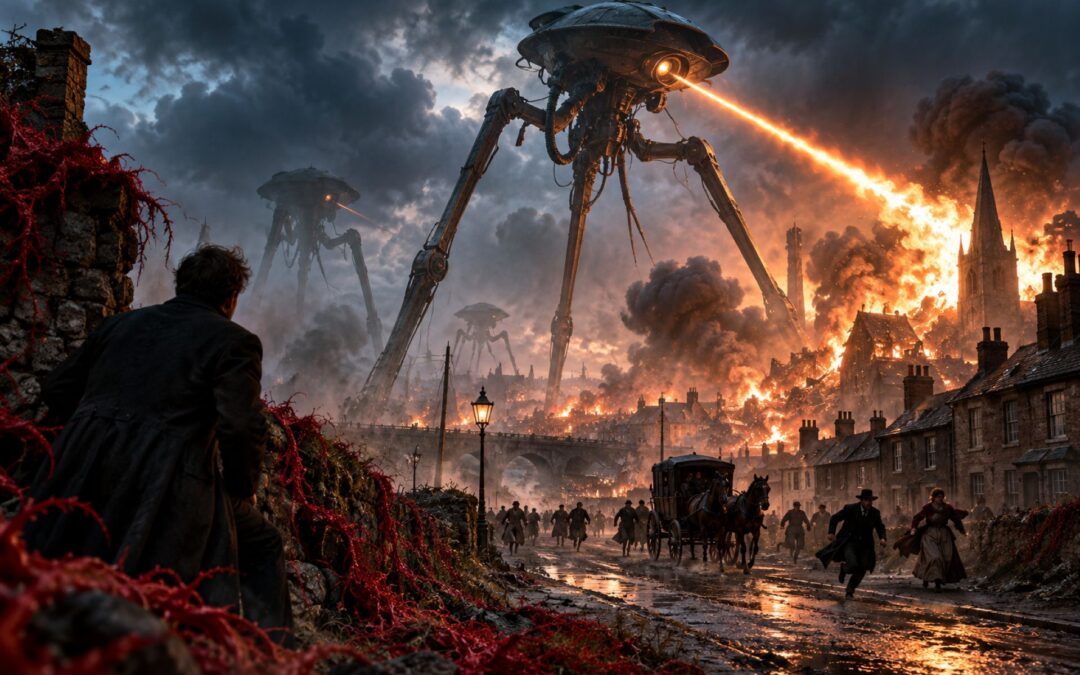
In The War of the Worlds, H. G. Wells imagines what happens when humanity encounters a civilisation so technologically advanced that the most powerful nation on Earth cannot defend itself. The Martians arrive in southern England, destroy military resistance, and turn familiar towns and cities into landscapes of fire, abandoned machinery, and fleeing civilians. The invasion unfolds through the experiences of an ordinary English writer who begins as a curious observer and eventually becomes a desperate survivor.
First published in book form in 1898, the novel helped establish the modern alien-invasion story. Its importance extends beyond the Martian tripods and their destructive weapons. Wells uses an extraterrestrial assault to examine the confidence of Victorian Britain, the vulnerability of civilisation, the consequences of imperial conquest, and the uncertain relationship between intelligence and survival. His Martians possess extraordinary scientific knowledge, yet their knowledge proves insufficient to protect them from an unfamiliar biological environment.
The story is also a study of human behaviour during catastrophe. Soldiers continue fighting against impossible odds, strangers protect one another, crowds turn violent, religious certainty collapses, and ambitious plans for rebuilding society reveal disturbing assumptions about who deserves to survive. By presenting these responses through a narrator whose own judgment repeatedly fails him, Wells refuses to make humanity’s experience a simple contest between heroes and monsters.
Spoiler Warning: This article covers the complete novel, including the fate of the Martians, the deaths of important characters, and the ending.

The Martians Approach Earth and Land on Horsell Common
The novel begins before the invasion, with the unnamed narrator looking back on the years when humanity believed itself secure. Near the end of the nineteenth century, people were occupied with their ordinary affairs, unaware that intelligent beings on Mars had been observing Earth. These beings possessed minds far more developed than human minds, but their planet was becoming increasingly hostile to life.
Mars, as Wells imagines it, is older than Earth and has cooled more rapidly. Its oceans have diminished, its atmosphere has become less hospitable, and its inhabitants face the prospect of extinction. Earth offers conditions that could sustain their civilisation, making invasion an attractive solution to their planetary crisis. The Martians therefore prepare to cross the immense distance between the planets rather than accept the destruction of their species.
Wells establishes the moral implications of this situation immediately. Human beings have treated other species, and sometimes other human populations, as obstacles to their own advancement. The narrator specifically recalls the extermination of Indigenous Tasmanians by European colonists, challenging readers to imagine how a supposedly superior intelligence might regard humanity. The invasion consequently begins with an uncomfortable comparison between the Martians’ intentions and familiar forms of human behaviour.
The first visible evidence appears through unusual activity on Mars. The astronomer Ogilvy invites the narrator to observe the planet, where flashes of light suggest extraordinary disturbances. Astronomers notice gases and other phenomena without understanding their significance. The public remains largely uninterested, and newspapers treat the observations as curiosities rather than warnings.
The Martians are launching projectiles towards Earth. Ten immense cylinders travel through space, each carrying invaders and equipment intended to establish their presence on the planet.
The first cylinder arrives in England as what initially appears to be a falling star. Witnesses see a fiery object move across the sky before crashing onto Horsell Common near Woking. Ogilvy investigates the crater and discovers a huge metallic object, partly buried in sand and surrounded by signs of extraordinary heat. The object is artificial, and its enormous circular end is slowly turning.
Ogilvy assumes that living occupants may be trapped inside. He attempts to investigate but cannot approach safely because of the heat. He eventually informs Henderson, a journalist, and the two return to the site. By the following day, the discovery has attracted scientific attention and public curiosity.
The narrator visits the common and encounters a growing crowd. The object has become a local spectacle, with spectators discussing its possible origins while workmen and scientific authorities attempt to examine it. Stent, the Astronomer Royal, arrives to supervise the investigation. Ogilvy asks the narrator to seek assistance from Lord Hilton because the gathering crowd is interfering with their work.
Despite the cylinder’s unfamiliar design, the visitors initially interpret it through human experience. Some imagine that its occupants will need help, while others anticipate a sensational scientific discovery. Even the narrator, who understands that Mars may contain intelligent life, expects creatures that will have recognisable bodily forms.
The cylinder eventually opens as evening approaches. Its great screw-like lid falls away, and the first Martian becomes visible.
The creature is nothing like the imagined humanlike visitor. It has an enormous rounded head, large dark eyes, a fleshy mouth, and multiple tentacles. Its movements are awkward and repulsive to the spectators. The Martians appear unable to support themselves easily under Earth’s stronger gravity, and their efforts to emerge seem almost helpless.
The sight produces a mixture of fascination and terror. The crowd retreats, and a young man falls into the crater, where he is left in immediate danger. The narrator runs away from the scene, overwhelmed by the discovery that the arriving intelligence has developed along a biological path radically different from humanity’s.
Yet the Martians’ physical weakness encourages another mistaken assumption. If these creatures can scarcely move about on Earth, they might appear incapable of conquering it. Their intelligence is obvious, but the means by which they will use that intelligence remain hidden.
A group of men subsequently approaches the cylinder carrying a white flag. The deputation includes scientists who hope to communicate peacefully with the visitors. Whatever the Martians intend, the humans attempt to begin contact through a recognisable symbol of negotiation.
The attempt ends in slaughter.
From the vicinity of the cylinder, the Martians direct an invisible beam of intense heat towards the approaching men. The deputation is killed almost immediately, including Ogilvy and Stent. Vegetation bursts into flame, human bodies are burned, and the destructive force sweeps across the surrounding landscape.
The weapon becomes known as the Heat-Ray. Unlike conventional artillery, it does not depend on a visible projectile travelling towards its target. Its effects appear wherever the Martians direct the beam, destroying objects and living creatures with terrifying speed. The narrator witnesses enough to understand its power without being able to explain its mechanism.
Panic spreads through the common and nearby roads. Some spectators have already witnessed the attack, but others continue approaching because they have received incomplete or misleading information. People caught in the crowd struggle to escape, and the destruction spreads beyond the original crater.
The Martians have established their first foothold. A discovery initially treated as a scientific spectacle has become an armed occupation, although most of England has not yet understood what has happened.
Woking Falls as the Fighting Machines Advance
The narrator escapes from Horsell Common in a condition approaching mental collapse. He stumbles through vegetation and along unfamiliar paths, unable to organise his thoughts. When he finally encounters people going about their ordinary business, their calmness seems almost incomprehensible.
The contrast is striking because Woking has not yet collectively recognised the danger. News travels slowly, reports are confused, and many people dismiss descriptions of the Martians as exaggerations. The narrator himself begins to recover his confidence once he returns to familiar surroundings.
At home, he tells his wife about the creatures and the Heat-Ray. Although she becomes frightened, the ordinary comforts of the house make the catastrophe seem less immediate. The narrator reasons that the Martians’ inability to move effectively under Earth’s gravity will prevent them from becoming a serious military threat. Once British artillery arrives, he expects their position to become hopeless.
This confidence depends on a crucial misunderstanding. The Martians have travelled through space in elaborate projectiles and possess weapons beyond contemporary human engineering. Their apparent biological helplessness does not mean that their machinery will be equally limited.
Throughout Friday night, activity continues around the landing site. Soldiers approach, civilians observe events from a distance, and additional information reaches London without conveying the full seriousness of the situation. The Martians remain near their cylinder, working behind the protection of the surrounding terrain. Shortly after midnight, a second cylinder arrives.
By Saturday, military resistance is being organised around Horsell Common. Troops move through the area, artillery positions are established, and residents attempt to understand the changing situation. The narrator and his wife remain at home until the sounds of fighting make their position increasingly dangerous.
He eventually decides that his wife must leave. Securing a horse and cart, he takes her towards Leatherhead, where relatives can provide shelter. He hopes that the military will soon contain the invasion and that their separation will be brief.
Their journey takes them through a countryside already disturbed by rumours, military movements, and fear. The narrator tries to reassure his wife, but the prospect of remaining apart during the conflict troubles them both. After leaving her safely with his cousin, he sets out to return the hired vehicle.
The return journey changes his understanding of the invasion completely.
A violent thunderstorm develops as he travels through the dark countryside. Lightning illuminates the landscape, and amid the storm he sees something far more frightening than the creatures struggling inside the cylinder. An enormous mechanical structure is moving across the fields on three towering legs.
The Martians have built fighting-machines.
These machines rise above trees and houses, walking with an extraordinary combination of speed, balance, and mechanical power. Their metal bodies carry the Martians high above the ground, allowing the invaders to move freely through an environment in which their own anatomy would otherwise restrict them.
The narrator sees one machine moving through the storm and then another. Their size and unfamiliar movements make them seem almost alive. They stride across roads, pass over ordinary obstacles, and overwhelm the scale of the human world beneath them.
The narrator’s horse is killed, the cart overturns, and he narrowly escapes. In the confusion, he loses any coherent plan beyond getting away from the machines. He eventually reaches his house, physically shaken and increasingly aware that conventional assumptions about the invasion have become useless.
The domestic security he previously trusted has disappeared. Looking from the windows of his home, he sees a devastated landscape marked by fire, broken buildings, and the remains of military activity. The surroundings are familiar enough to recognise but altered beyond anything he anticipated.
An artilleryman approaches the house and asks for shelter. He has survived the destruction of his gun position and is attempting to find his comrades. His account provides the narrator with a soldier’s perspective on the Martians’ overwhelming power.
The artilleryman describes the destruction of military equipment and the rapid collapse of positions that had appeared defensible. His experiences suggest that courage and training cannot compensate for the difference between human weapons and Martian machinery.
For a time, the two men shelter together and observe the surroundings from the narrator’s window. They eat, discuss the invasion, and attempt to understand the movements of the invaders. Their partnership is practical rather than deeply personal, brought about by the sudden destruction of the social circumstances that would ordinarily keep them apart.
They eventually leave the house and move towards Weybridge and Shepperton, where military forces are still resisting. The narrator witnesses soldiers preparing for battle and civilians attempting to escape. The roads and settlements are filled with uncertainty, but organised human resistance has not yet ended.
Several Martian fighting-machines advance across the landscape. Their towering forms approach the river, and British artillery opens fire. For the first time, the narrator sees a human weapon achieve a decisive result against an invader.
An artillery shell strikes one fighting-machine and destroys its upper structure. The Martian inside is killed, and the machine collapses into the river.
The moment reveals an important limitation in Martian power. Their machines are formidable, but they are not indestructible. Under favourable circumstances, human artillery can damage them and kill their operators.
The surviving Martians respond with extraordinary violence. Heat-Rays sweep across the battlefield, buildings ignite, and the river itself becomes dangerous as water flashes into steam. The surviving machines move against the human positions while civilians scramble for cover.
The narrator enters the Thames to escape the Heat-Ray and suffers painful scalding from the heated water. His immediate survival depends on movement, concealment, and chance rather than any successful resistance of his own.
He eventually finds a small abandoned boat and escapes downstream. The encounter leaves him injured, exhausted, and separated from the artilleryman.
The destruction at Weybridge and Shepperton establishes the character of the wider conflict. A British gun can kill a Martian, but an isolated success does not overcome the invaders’ advantages in mobility, range, and destructive force. The human military is capable of resistance without possessing the means to conduct a successful war.
For the narrator, the battle also marks a personal change. He has stopped thinking of the invasion as a temporary scientific curiosity that established institutions will soon resolve. His immediate concerns are shelter, food, avoiding the machines, and finding some way back to his wife.
The Curate, London’s Warning, and the Black Smoke
After escaping from the river, the narrator moves through the countryside in a state of exhaustion. The destruction has temporarily halted the Martians’ advance, but he has little reliable information about their position or intentions. During his journey, he encounters a curate whose religious understanding has been shattered by the events.
The curate has witnessed death and destruction on a scale he cannot reconcile with his conception of divine order. He repeatedly asks why such suffering has been permitted and whether humanity is being punished for its sins. His questions arise from genuine fear, but they offer little practical guidance.
The narrator initially attempts to reason with him. Their conversation reveals a fundamental difference between their responses to catastrophe. The narrator tries to interpret the Martians as material beings whose actions have causes, while the curate struggles to understand the disaster as an event within a moral universe governed by God.
Neither man is fully prepared for what lies ahead. The narrator has repeatedly underestimated the invaders, and the curate’s inability to adapt psychologically will become increasingly dangerous.
Meanwhile, London continues to receive reports from the affected districts.
The story shifts to the narrator’s younger brother, a medical student living in the capital. His experiences allow Wells to describe events beyond the narrator’s immediate knowledge and show how news of the invasion spreads through a large modern city.
At first, London remains comparatively calm. Newspaper reports describe strange visitors, unusual weapons, and military engagements, but the full significance of these events is obscured by official confidence and incomplete information. Many people assume that the British Army possesses sufficient resources to deal with the threat.
The brother encounters the consequences of the invasion through railway disruptions and reports from people arriving from Surrey. He visits stations, observes the increasing confusion, and follows newspaper accounts. The city still operates through recognisable routines, including church services, commercial activity, public transport, and evening entertainment.
These routines create a misleading impression of stability. Because most Londoners have not seen a Martian, the invasion remains an event taking place elsewhere. Reports of military movements are often interpreted as evidence that the authorities are controlling the situation.
The military campaign, however, is moving rapidly towards catastrophe.
Following the destruction of one fighting-machine near Weybridge, the Martians modify their tactics. They advance more cautiously, attack concealed artillery positions, and employ a new weapon that proves devastating against organised human resistance.
This weapon is the Black Smoke.
The Martians fire containers that release an exceptionally dense, poisonous black vapour. It spreads across the ground, flows into low-lying areas, and overwhelms soldiers and civilians caught within it. People exposed to the smoke collapse and die, while those attempting to escape often find roads and valleys already contaminated.
The Black Smoke defeats a major advantage of ordinary artillery. British gunners may be able to strike a fighting-machine if they can remain concealed long enough, but the Martians can saturate defensive positions with a weapon that makes remaining in place impossible.
The invaders also possess a method of dispersing the smoke after an attack. Their machines direct jets of steam across affected areas, causing the vapour to settle and allowing them to continue their advance.
The combination of Heat-Ray, Black Smoke, and fighting-machines makes sustained resistance extraordinarily difficult. Defending soldiers face an enemy that can attack from an elevated position, move across terrain inaccessible to conventional vehicles, and destroy fortified or hidden positions without approaching them directly.
Several British batteries fight with determination, but their resistance cannot reverse the invasion. Some are destroyed before they can fire effectively, while others achieve temporary results and then succumb to the Martians’ retaliatory attacks.
The narrator later reconstructs these engagements from conflicting accounts, acknowledging that a complete history of the fighting is difficult to establish. The details are nevertheless sufficient to show that the invaders have overcome organised opposition across much of the threatened region.
By Sunday night, the military situation has become desperate. The Martians continue spreading the Black Smoke, and London’s security can no longer be maintained. The institutions responsible for protecting the population are themselves being overwhelmed.
Before dawn on Monday, warnings finally reach the capital with unmistakable urgency. The city must evacuate.
London’s Exodus and the Thunder Child’s Last Stand
The evacuation of London becomes one of the novel’s most extensive descriptions of collective panic. Millions of people attempt to leave a city whose roads, railways, and shipping facilities cannot accommodate a sudden mass departure. The crisis exposes how completely a modern population depends on the ordinary functioning of transport and public authority.
Railway stations fill with desperate passengers. People fight for places aboard trains, crowds crush those unable to move, and the pressure around the platforms becomes dangerous. Railway employees become unwilling or unable to continue operating services into the threatened city.
The roads are equally chaotic. Carriages, carts, bicycles, pedestrians, and people carrying possessions compete for space. Families become separated, supplies disappear, and those with money or access to vehicles attempt to secure advantages over everyone else.
As the Black Smoke approaches, routes that initially seemed safe become impassable. Bridges and streets cease to function as reliable connections between districts. London’s enormous population is forced into an increasingly disorganised movement northward and eastward.
The narrator’s brother becomes caught in this exodus.
He has already experienced the growing alarm and makes unsuccessful attempts to find transport out of the city. After escaping the most dangerous railway crowds, he obtains a bicycle, allowing him to make progress through the congested streets.
During his journey, he encounters two women travelling in a horse-drawn carriage. They are Mrs. Elphinstone and her younger sister-in-law, who have become vulnerable to men attempting to seize their vehicle.
The brother intervenes and helps defend them. His decision places him in danger, but it also creates an alliance that allows all three travellers to continue their escape. He joins the women, and their journey becomes a small example of cooperation within the wider collapse.
The women’s reactions to the emergency differ markedly. Mrs. Elphinstone remains preoccupied with the fate of her husband, whom she has been separated from, and struggles to make decisions without his guidance. Her younger companion proves considerably more practical and courageous, repeatedly taking action when hesitation would make the group vulnerable.
Their journey is difficult even with a carriage. Roads are packed with vehicles, exhausted animals, and people desperate for water or food. At times the movement of the crowd becomes so forceful that individuals can scarcely control their direction.
The brother and the younger woman work together to navigate these conditions. She proves capable of handling the carriage under pressure, while he attempts to protect their position among the fleeing vehicles. Their cooperation is essential because ordinary rules of polite behaviour provide little protection against the demands of survival.
Wells repeatedly shifts the reader’s attention from large crowds to small incidents within them. A person may be trampled because a railway platform becomes too crowded, while another may lose a means of escape because someone stronger takes possession of it. The same emergency that produces selfishness also produces acts of unexpected courage.
The travellers eventually leave the most congested roads and continue towards the coast. The surrounding countryside is crowded with refugees, and reports about the Martians remain uncertain. The brother sees evidence of further cylinders arriving from Mars, making it clear that the invasion is continuing rather than fading.
After travelling through Essex, the party reaches the coastal region near the mouth of the River Blackwater. Ships and smaller vessels are gathering to carry refugees away from England.
The sea offers the prospect of escape, but even this opportunity is unequally distributed. Some passengers pay enormous sums to secure passage, while others plead or struggle for places on overcrowded boats. The refugees are frightened, exhausted, and uncertain whether reaching the water will protect them from the advancing machines.
The brother manages to obtain passage for himself and the two women aboard a small paddle steamer. They leave the coast among numerous vessels heading out to sea.
The Martians soon appear.
Three fighting-machines advance through the shallow coastal waters towards the fleeing ships. Their enormous height allows them to wade into areas where human beings would require boats, and their Heat-Rays threaten vessels that cannot escape quickly enough.
The ships scatter as their passengers realise that the Martians intend to prevent their departure. Engines strain, vessels turn across one another’s paths, and the attempt to escape becomes another dangerous crowd movement, this time on the water.
At this moment, the Royal Navy’s torpedo ram Thunder Child comes to the refugees’ assistance.
The warship is heavily armoured and designed to attack enemy vessels directly. Rather than attempting to remain at a safe distance, it charges towards the Martian fighting-machines at extraordinary speed.
The Martians initially seem uncertain how to respond. Seen from their perspective, the rapidly approaching ironclad may appear to be another powerful mechanical creature rather than an ordinary human vessel. This momentary hesitation allows the ship to close the distance.
One Martian fires a container of Black Smoke towards the warship, but the vessel continues its advance. Another directs a Heat-Ray against it, burning through its structure and causing serious damage.
Despite the attack, Thunder Child continues forward and strikes the first fighting-machine. The Martian collapses into the water, and the refugees watching from their steamer begin cheering.
The warship is now burning, but its engines and steering remain sufficiently functional for another attack. It drives towards a second Martian, whose Heat-Ray inflicts further catastrophic damage. The ship explodes, yet its momentum carries the blazing wreck into the fighting-machine and destroys it.
Two Martians have fallen.
The destruction of Thunder Child marks the end of the engagement for the refugees. Steam, smoke, and distance obscure the surviving third Martian, while the paddle steamer continues heading out to sea.
The warship has sacrificed itself to save people who could not have survived a direct encounter with the invaders. Its attack proves that determination and engineering can still produce limited victories, even against superior technology.
Yet the broader military situation remains unchanged. Two destroyed machines cannot restore London, reopen the railway system, or remove the threat of the remaining Martians. The naval battle offers an extraordinary moment of human courage within a war that humanity is still losing.
With the brother’s escape established, the narrative returns to the narrator and the curate, whose experience of the invasion will become very different from the dramatic events at sea.
Trapped Beneath the Martians
While London has been evacuating, the narrator and curate have been sheltering in a deserted house near Halliford. Their movements have been restricted by the Black Smoke, and their understanding of the wider situation remains fragmentary.
Once a Martian disperses the poisonous vapour from the surrounding area, the possibility of escape returns. The narrator wants to reach Leatherhead, where he hopes his wife is still safe. The curate, exhausted and mentally overwhelmed, has little ability to plan or act independently.
The two men begin moving through the threatened countryside. They avoid roads where possible and take shelter when fighting-machines appear nearby. During one encounter, they witness human captives being carried by Martian machinery, revealing that the invaders may intend to do more with defeated humanity than simply kill everyone.
This discovery is particularly disturbing. Humans are apparently being collected alive, suggesting that the invasion may lead to captivity and exploitation rather than straightforward extermination.
The narrator continues towards his destination despite the enormous danger. He and the curate eventually enter a deserted house near Sheen, where they find food and temporary shelter. Their relief ends when another Martian cylinder falls nearby.
The impact devastates the building.
The cylinder crashes into the surrounding area, destroying much of the structure and leaving the two men trapped among collapsed walls and debris. They survive because part of the house remains standing, but the ruins now overlook a new Martian excavation site.
Their hiding place provides an extraordinary view of the invaders’ activities. From concealed openings in the broken walls, the narrator can observe the Martians working at close range.
One of the first things he studies is a handling-machine.
Unlike the towering fighting-machines, the handling-machine is designed for precise physical work. It possesses multiple jointed limbs, mechanical arms, and flexible appendages capable of grasping, lifting, and assembling objects. Its movements are so coordinated that the narrator initially struggles to distinguish the machine from the creature operating it.
The machinery resembles a giant metallic organism, combining the strength of heavy industrial equipment with the dexterity of living limbs. The Martians use it to remove materials from their cylinder, construct additional machines, and organise their growing installation.
The narrator’s enforced observation also allows him to describe the Martians’ bodies more accurately.
Their enormous rounded heads contain large eyes, a mouth, an auditory organ, and groups of long tentacles. They lack many familiar human anatomical features. Their bodies are dominated by the brain and organs directly necessary for sensation, circulation, and respiration.
Their weakness under Earth’s gravity helps explain their dependence on machinery. Having evolved on Mars, they are poorly adapted to the physical conditions of their new planet. Their technological superiority compensates for this disadvantage by allowing them to operate through powerful artificial bodies.
The most disturbing discovery concerns their method of nourishment.
The Martians do not eat and digest food in the manner of human beings. Instead, they introduce fresh blood directly into their circulatory systems, obtaining it from other living creatures. The narrator witnesses evidence of this process and eventually observes its use on a human captive.
The discovery transforms the significance of the human prisoners. Captured people are not simply enemies who have been defeated in war. They are potential sources of food.
Wells also presents other peculiarities of Martian biology. The creatures reproduce without sexual intercourse, with offspring developing through a form of budding. Their physiology appears to lack many of the organs and bodily processes familiar to terrestrial animals.
The narrator speculates that their biological development has eliminated functions rendered unnecessary by advanced intelligence and technology. Their digestive systems have disappeared, physical strength has become less important, and mechanical devices increasingly perform tasks that human beings accomplish through their bodies.
One apparently minor anatomical difference is especially significant. The Martians seem unfamiliar with the microorganisms responsible for many terrestrial diseases. They may have evolved in an environment where such organisms never existed, or their civilisation may have eliminated them. The narrator cannot yet know the full consequences of this difference.
While the Martians work outside, the relationship between the two prisoners deteriorates.
The narrator attempts to manage their remaining food, preserve silence, and consider possible means of escape. The curate is increasingly frightened, hungry, and unable to control his reactions. Their physical confinement intensifies the differences in their personalities.
The narrator regards silence as essential because the Martians may discover their hiding place. The curate, overwhelmed by religious terror, repeatedly attempts to interpret the catastrophe through divine punishment and human sin.
Their disputes initially concern practical matters, particularly food. The curate wants to eat when he is hungry, while the narrator attempts to establish rations that may sustain them through a prolonged imprisonment. The disagreement becomes increasingly bitter.
The narrator tries persuasion, threats, and physical restraint. He also attempts to investigate the possibility of escaping through the surrounding debris. These efforts are limited by the constant danger of being seen or heard.
Their captivity becomes psychologically exhausting. The two men have little room to move, cannot determine how long the Martians will remain, and have no reliable knowledge of whether other people are surviving outside.
The curate gradually becomes unable to speak quietly. His religious declarations grow louder, and he threatens to reveal their presence. What initially appeared as a philosophical disagreement becomes a direct danger to both men’s lives.
The narrator recognises that a Martian handling-machine is working close enough to hear them. He repeatedly implores the curate to remain silent, but the curate becomes convinced that he must publicly proclaim divine judgment.
On the eighth day of their imprisonment, the situation reaches its breaking point.
The curate begins shouting loudly enough to attract attention from the Martian excavation. Terrified that both men will be discovered, the narrator grabs a meat chopper hanging on the wall.
He turns the blade away and strikes the curate with the blunt end.
The curate collapses and lies motionless. The narrator has attempted to silence him through violence, but the consequences are immediate and irreversible.
A handling-machine enters the ruined building. Its metallic tentacles move through the opening, examining the wreckage and searching among the debris.
The narrator retreats into the coal cellar and hides beneath firewood and coal. Through the doorway, he sees the machine investigating the fallen curate. The Martian eventually drags the man’s body away.
The narrator remains concealed as the searching appendages approach his hiding place. He is terrified that the machine will discover him or infer that another human being must have struck the curate.
After an extended period of suspense, the machine withdraws without finding him.
The curate has disappeared into the Martian excavation, and the narrator is left alone.
His survival has required an act that he later remembers with discomfort, even though he does not initially experience conventional remorse. The incident makes his position morally complicated. He has been threatened by an alien civilisation that treats human beings as expendable creatures, yet his own desperate response has involved using force against a vulnerable companion.
The ruined house has become a place where the ordinary distinctions between civilisation and savagery are increasingly difficult to maintain.
Fifteen Days Later: The Red Weed and the Artilleryman’s Plans
After the curate’s removal, the narrator remains hidden in the wrecked building. He is uncertain whether the Martians are still searching for him, and he has lost the companionship that previously helped structure his days.
His food supplies diminish until almost nothing remains. He becomes weak, hungry, and desperate for water, surviving on what he can obtain from the damaged house and its surroundings. He considers the possibility of catching an animal to eat, revealing how far his circumstances have moved from ordinary domestic life.
The Martians continue working outside for a time, but their activity gradually becomes less noticeable. The narrator hears fewer mechanical sounds and eventually begins to wonder whether they have abandoned the excavation.
Meanwhile, an unfamiliar red vegetation spreads across the ruins.
The plant, brought from Mars, grows rapidly in the damp conditions around the cylinder. Its branches invade the openings in the damaged house, turning the available light into an eerie reddish glow. The narrator observes the vegetation without initially understanding how extensively it is changing the surrounding environment.
On the fifteenth day, he hears a dog moving among the ruins. Encouraged by the signs of animal life and the absence of Martian activity, he cautiously approaches the opening from which he has been observing the pit.
He discovers that the Martians have left.
The enormous excavation remains, together with abandoned materials and damaged structures, but the machinery that once dominated the site has disappeared. After days of concealment, the narrator finally emerges into daylight.
The outside world has undergone an extraordinary transformation.
Buildings have been demolished, roads are obstructed, and the red weed has spread across formerly familiar ground. Areas that were ordinary English landscapes before the invasion now resemble a different planet.
The plant has grown particularly vigorously around water. In some places its mass has obstructed streams and rivers, causing flooding across meadows, gardens, and settlements. The Thames valley has become a landscape of red vegetation, stagnant water, ruined houses, and deserted roads.
The narrator searches desperately for food. He finds mushrooms, vegetables, and other scraps of nourishment, sometimes eating them without knowing whether they are safe. Hunger has reduced his choices to whatever he can obtain.
He also notices that the red weed is beginning to deteriorate. Its colour fades, its branches weaken, and diseased patches spread through the vegetation. The plant’s extraordinary growth has not been matched by an ability to withstand Earth’s biological environment.
This process foreshadows the fate of the Martians themselves.
The narrator initially fears that the apparent absence of people means humanity has been exterminated. He encounters deserted houses, skeletal remains, and an unnerving silence across landscapes that should contain ordinary signs of human activity.
The destruction is extensive, but it is also irregular. Some buildings have been reduced to wreckage, while nearby houses remain almost untouched. The mixture of devastation and normality creates a particularly disturbing impression, as though human civilisation has been abandoned rather than completely destroyed.
The narrator eventually reaches Putney Hill, where he unexpectedly encounters the artilleryman who had sheltered in his house near the beginning of the invasion.
The soldier has survived and appears to have developed a comprehensive theory of humanity’s future under Martian domination.
He argues that the old civilisation has ended and that people must stop behaving as though ordinary social arrangements can be restored. Human beings, he believes, will become subordinate creatures living under the control of the Martians.
Some may be captured and used for nourishment. Others may be kept as pets or trained servants, while those unwilling to accept such conditions must learn to survive independently.
The artilleryman proposes a different form of human society.
He imagines selected survivors living beneath London, using existing underground infrastructure and extending it into a network of hidden settlements. These communities would preserve useful knowledge, raise children, and gradually prepare for a future in which humanity could resist the invaders.
The plan includes maintaining scientific learning and training future generations to understand Martian technology. If humans can eventually operate captured fighting-machines, he believes they may be able to recover some measure of power.
His vision initially impresses the narrator. It acknowledges the failure of conventional military resistance and recognises that survival might require long-term adaptation rather than an immediate return to normality.
However, the artilleryman’s scheme contains disturbing assumptions.
He believes that only certain people are worth preserving. Those he considers weak, unintelligent, or unwilling to accept strict discipline would be excluded. His projected underground society would therefore be organised according to an uncompromising hierarchy of physical and intellectual fitness.
Women appear primarily in his scheme as mothers and teachers, valued according to their perceived usefulness to the community. The language of selection and exclusion reveals that the soldier’s proposed civilisation would reproduce some of the most severe forms of domination even while claiming to protect humanity from an oppressive enemy.
The narrator initially overlooks these difficulties because the soldier speaks with extraordinary confidence. After his own experiences of helplessness, the prospect of organised resistance offers psychological relief.
Yet the narrator’s admiration begins to weaken when he examines what the artilleryman has actually accomplished.
The soldier has spent approximately a week working towards his underground refuge, but the excavation is scarcely more than a small burrow. His practical achievements are completely disproportionate to his ambitious plans for rebuilding civilisation beneath London.
The two men begin discussing work, but their efforts quickly lose momentum. They eat, drink, smoke, and eventually settle into a card game.
The artilleryman produces champagne and justifies their relaxation as necessary preparation for the enormous labour ahead. Their supposed programme for humanity’s survival becomes an afternoon of leisure.
The narrator participates enthusiastically at first, demonstrating how easily he can also be distracted from unpleasant realities. He later recognises the absurdity of their behaviour and becomes ashamed of his willingness to believe the soldier’s promises.
His disillusionment is both practical and moral. The artilleryman possesses the language of determination without the discipline needed to carry out his plans, and his proposed society offers little reassurance that survival would preserve the values worth saving.
The narrator decides to leave him and continue towards London.
His journey takes him into a nearly abandoned metropolis, where he expects either to discover the Martians’ plans or to encounter the remaining members of his species. Instead, he finds a city whose silence seems increasingly unnatural.
Dead London, the Martians’ Defeat, and the Reunion
London has become a landscape of deserted streets, ruined buildings, abandoned shops, and scattered human remains. The narrator moves through districts that once contained immense crowds but now seem almost entirely empty.
The red weed still covers portions of the city, although disease is spreading through it. Black dust left by the Martians’ poisonous weapon lies across streets and buildings, sometimes covering the bodies of those who died during the invasion.
The narrator finds occasional evidence of surviving human activity, including abandoned supplies and signs that people have passed through the area. He encounters an intoxicated man who cannot provide useful information. Most of the city, however, seems devoid of ordinary life.
What particularly disturbs him is the contrast between the enormous scale of London and the absence of its population.
Houses, commercial districts, parks, and public buildings remain as evidence of the civilisation that created them. Yet the social activity that gave these structures their purpose has vanished. The city appears like an enormous machine whose operating force has suddenly disappeared.
The narrator eventually hears a strange, repeated Martian cry coming from the direction of Primrose Hill.
The sound initially reassures him that something remains alive within the deserted city. He follows it through the streets, passing damaged machinery and encountering increasingly extensive signs of abandonment.
Eventually, the cry stops.
The sudden silence produces an even stronger sense of terror. Without the repeated sound, the narrator can no longer reassure himself that the Martians are actively occupying the city. The darkness, ruined buildings, and possibility of unseen enemies overwhelm him.
He takes shelter for the night, but his despair deepens. He has lost contact with his wife, witnessed extraordinary destruction, and become increasingly convinced that civilisation has been permanently defeated.
By the following morning, he is prepared to approach a Martian fighting-machine even if doing so means death.
As he moves towards Primrose Hill, he sees a motionless machine. Birds are gathering around its upper structure, and something is visibly wrong.
The Martian inside is dead.
The narrator climbs towards the principal Martian encampment and discovers more bodies scattered among the machinery. Some lie within damaged fighting-machines, while others have collapsed near the excavation and working equipment.
The invaders have died without being defeated by human weapons.
The explanation is biological.
The Martians have no developed resistance to Earth’s disease-causing and putrefactive microorganisms. Once they begin living and feeding in the terrestrial environment, these organisms enter their bodies and cause fatal illnesses.
Human beings have developed varying degrees of resistance to microorganisms through their evolutionary history. The Martians, having evolved under different conditions, lack comparable defences against the organisms they encounter on Earth.
Their scientific intelligence and destructive machinery cannot protect them from this invisible danger. The biological vulnerability that seemed insignificant beside the Heat-Ray and the fighting-machines becomes the decisive factor in their destruction.
The red weed has suffered a similar fate. Its rapid growth initially overwhelmed native vegetation, but terrestrial microorganisms eventually destroyed it.
The narrator now understands that the Martians were becoming increasingly vulnerable even while humanity believed itself defeated. Their extraordinary military success concealed a biological failure developing beyond their awareness.
The discovery transforms the immediate situation. The occupation has ended, the fighting-machines are motionless, and surviving human beings can begin returning to their homes.
Yet the narrator’s emotional response is more complicated than straightforward celebration.
After recognising the Martians’ defeat, he experiences an overwhelming psychological collapse. He later remembers little of the following three days, during which others care for him and attempt to restore his health.
News of the invaders’ destruction spreads internationally. Telegraphic communication helps transmit the discovery, and surviving populations begin the process of returning to devastated areas.
When the narrator recovers, he learns something devastating about Leatherhead.
The town where he left his wife has been destroyed during the invasion. He assumes that she and the relatives sheltering her must have died.
His personal hopes have apparently been extinguished even as humanity begins to celebrate its survival.
For several days, he remains with people who have helped him recover. Eventually, he becomes determined to return to his old home near Woking, despite believing that doing so will only confirm the destruction of his former life.
The journey takes him through landscapes bearing the marks of the invasion. He sees evidence of returning human activity, but the devastation and his own exhaustion make recovery feel uncertain.
When he finally reaches his house, he discovers that it has remained largely as he left it.
Inside, ordinary objects preserve the details of his former existence. The remains of food and drink are still present, recalling the time when he and the artilleryman sheltered together. Familiar rooms survive as physical evidence of a domestic life that the narrator believes can never return.
The scene is painful precisely because the house is so recognisable. Unlike the ruined countryside, it has not been transformed beyond identification. Its preservation allows the narrator to remember the life he shared with his wife before the invasion.
Then he hears a familiar voice.
His wife and cousin have returned to the house. They survived the destruction that he believed had killed them.
The narrator turns and sees his wife, who is equally astonished to find him alive. Both have believed the other dead.
Their reunion restores the central personal relationship that has motivated much of the narrator’s struggle. After wandering through a world of abandoned homes, he finally returns to one that can again contain the people he loves.
The epilogue, however, refuses to end the novel in complete reassurance.
The narrator reviews the information obtained after the invasion. Scientists have examined Martian bodies and machinery, but important questions remain unresolved. The precise operation of the Heat-Ray and the composition of the Black Smoke are still imperfectly understood.
The biological explanation for the Martians’ deaths is persuasive, but aspects of their physiology and previous environment remain uncertain. Their unexpected vulnerability has not made humanity fully knowledgeable about them.
The possibility of another invasion also remains.
The narrator considers whether future Martian projectiles might be destroyed before their occupants emerge, now that humanity understands the danger. Yet he recognises that the invaders might adapt their methods or prepare more effectively.
There is also speculation that the Martians may have attempted to colonise Venus. The possibility raises questions about the future of intelligent life throughout the solar system.
Humanity’s understanding of its place in the universe has permanently changed. People can no longer assume that Earth is an isolated home protected from external threats.
For the narrator, the consequences are deeply personal. He remains haunted by memories of the invasion, sometimes experiencing familiar streets as though their inhabitants were ghosts occupying a city he has already seen destroyed.
Even his reunion with his wife carries an unsettling quality. Both have lived through the conviction that the other was dead, and their restored relationship cannot completely erase that experience.
The novel ends with humanity alive but permanently deprived of its former confidence.
The Martian Occupation: Biology, Machines, and a Remade Landscape
The Martian invasion works because Wells develops the invaders as a biological and technological civilisation rather than merely presenting them as monsters equipped with powerful weapons. Their anatomy, machinery, methods of warfare, and unfamiliar environment form a connected speculative system.
The human world they invade is recognisably late-Victorian Britain. Its inhabitants depend on railways, newspapers, horse-drawn vehicles, telegraphic communication, organised armies, and increasingly sophisticated industrial machinery. Britain possesses substantial military power, but that power is organised around conflicts between human armies operating under familiar physical limitations.
The Martians undermine those assumptions immediately.
Their fighting-machines combine tremendous height, speed, and mobility with offensive weapons that can destroy ordinary military positions. Their three-legged design allows them to stride across landscapes that would obstruct conventional human vehicles. They can also enter shallow coastal waters, threatening shipping that might otherwise escape a land-based enemy.
The tripods are particularly effective because their operators are physically weak. The Martians cannot move comfortably in Earth’s stronger gravity, yet their machines enable them to dominate much larger and stronger creatures. The novel therefore separates bodily fitness from technological capacity in a way that remains central to its speculative imagination.
The handling-machines develop this idea further.
Where fighting-machines function as weapons and means of transport, handling-machines provide dexterity and industrial capability. Their articulated limbs allow the Martians to construct equipment, manipulate heavy objects, and perform complex operations without relying on the anatomical capacities of their own bodies.
Wells describes the machines in terms that make them resemble living organisms. The narrator initially mistakes the handling-machine’s structure for the body of a giant creature, only gradually recognising the Martian operating it.
The confusion is significant because the invaders have effectively extended their bodies through technology. Their machines perform functions for which human beings still depend on muscles, hands, and physical coordination.
The Heat-Ray represents another departure from human military technology.
Its destructive effects appear without a visible projectile. The narrator attempts to explain its operation through concentrated radiant heat and unfamiliar optical mechanisms, but he acknowledges that the true process is uncertain.
What matters operationally is its speed and precision. A weapon that can ignite structures and kill exposed people almost instantaneously undermines the protective value of ordinary distance and defensive positions.
The Black Smoke serves a different military purpose. Whereas the Heat-Ray destroys concentrated targets, the poisonous vapour spreads across areas occupied by soldiers and civilians. It flows into valleys and other low-lying spaces, defeating the assumption that concealment or established positions can provide reliable protection.
The Martians can disperse the smoke after an attack, allowing them to occupy territory they have rendered uninhabitable for humans. Their warfare is consequently directed towards controlling the environment as well as killing opponents.
Their strategy is not entirely without weaknesses.
The destruction of a fighting-machine at Weybridge proves that the machines can be physically damaged. The Thunder Child demonstrates that a powerful vessel can destroy them through a combination of speed, armour, and direct impact.
These successes remain exceptional because the Martians can modify their tactics. They learn to approach artillery positions more cautiously and use Black Smoke against defences that might otherwise threaten them.
The invaders also reveal an ability to treat humans as resources rather than simply enemies.
Captives are collected and transported in machinery, apparently for nourishment. The narrator’s observation of blood-feeding transforms the occupation into a biological relationship in which one intelligent species consumes another.
The Martians’ anatomy provides the explanation for this practice. Their enormous brains and developed sensory organs contrast with the absence of conventional digestive structures. Instead of consuming and processing food, they introduce blood directly into their circulation.
Their mode of reproduction is equally alien. The narrator describes young Martians developing through budding rather than sexual reproduction, suggesting a biological history different from that of terrestrial vertebrates.
These features create an uncomfortable question about what biological advancement means.
The Martians appear to have developed intelligence and technological control to extraordinary levels, yet they have lost capacities that human beings regard as fundamental. Their bodies depend on machinery for movement and on other living creatures for nourishment.
They are formidable precisely because their physical limitations have been compensated for through artificial means. However, that dependence also makes them vulnerable to failures in systems they do not fully understand.
Their apparent freedom from disease is another important characteristic. The narrator suggests that their home environment may lack microorganisms responsible for terrestrial infections, although he cannot establish whether this absence is natural or the result of advanced sanitation.
This apparent advantage eventually proves fatal.
The ecological effects of the invasion extend beyond the bodies and machines of the Martians themselves.
The red weed spreads with extraordinary speed across the English countryside, particularly in wet environments. It overwhelms familiar vegetation, obstructs waterways, and helps create the flooded landscapes the narrator encounters after escaping the ruined house.
The plant changes the visual character of England. Ordinary houses, roads, and rivers become part of an unfamiliar red environment, allowing Wells to depict the effects of planetary conquest without moving the narrative away from Earth.
Yet this transformation is temporary. The red weed cannot resist terrestrial microorganisms, and its rapid growth is followed by equally rapid destruction.
The machinery, the Martians’ bodies, and the invading vegetation collectively reveal the limits of technological control. The invaders can dominate military institutions and alter the landscape, but they cannot reliably manage the biological relationships of an environment in which they have never evolved.
Their greatest weakness lies outside the ordinary military contest they have so decisively won.
The Narrator, His Brother, and the People Who Face the Invasion
Wells places relatively ordinary people at the centre of an extraordinary catastrophe. The principal human characters are not national leaders, celebrated soldiers, or scientists possessing the knowledge necessary to defeat the invaders. They are people trying to understand events that repeatedly exceed their expectations.
Several remain unnamed, including the narrator and his wife. This relative anonymity allows their experiences to represent a wider human vulnerability, although it also limits the psychological detail available to readers. The most revealing moments often occur when circumstances expose differences between what the characters believe and how they behave.
The Narrator and His Wife
The narrator is a writer concerned with speculative philosophy, accustomed to reasoning about scientific and intellectual questions. His interests make him receptive to the possibility of life beyond Earth, but they do not prepare him for direct contact with an unfamiliar intelligence.
During the early stages of the invasion, he displays an uncomfortable mixture of curiosity and misplaced confidence. He visits Horsell Common because the cylinder interests him, retreats in terror when the Martians emerge, and later persuades himself that conventional artillery will defeat them.
His initial assumptions repeatedly collapse because he interprets extraordinary evidence through familiar categories. The Martians appear physically weak, so he assumes they cannot become effective conquerors. Military preparations appear orderly, so he expects them to succeed. The existence of a familiar home briefly reassures him even after he has witnessed mass killing.
As the invasion develops, his behaviour becomes increasingly practical. He takes his wife to Leatherhead, seeks shelter, attempts to avoid Martian machinery, and manages limited supplies while imprisoned with the curate.
He is capable of courage, but Wells does not make him consistently heroic. He panics, loses direction, makes dangerous decisions, and sometimes survives because of chance. His observational abilities also become more useful once he begins to recognise the limitations of his previous assumptions.
The ruined-house chapters provide his most complicated psychological experience.
He attempts to maintain discipline during captivity, but the curate’s behaviour gradually drives him towards violence. When he strikes the curate, his immediate justification is that continued shouting will reveal their presence to the Martians.
The situation is dangerous enough to make his fear understandable. Yet his willingness to use force against a distressed companion also reveals the moral instability produced by desperate circumstances.
His subsequent reflections do not provide a simple confession of guilt. He remembers the curate’s death with discomfort but initially experiences little conventional remorse. This emotional detachment is part of the psychological damage caused by prolonged fear and deprivation.
The narrator’s later encounter with the artilleryman exposes another weakness. Despite having witnessed repeated failures of confident reasoning, he becomes temporarily captivated by the soldier’s elaborate survival plan.
His disillusionment eventually shows that he retains the capacity to reassess his beliefs. Nevertheless, the episode demonstrates how attractive certainty becomes to someone who has spent days without reliable knowledge or control.
His final psychological collapse makes the limits of his resilience clear. Discovering the Martians’ defeat does not immediately restore him to ordinary life, and the loss of memory that follows suggests that his experiences have exceeded his ability to process them.
The narrator’s relationship with his wife gives this uncertain progression a personal direction.
She appears directly in relatively few scenes, but his separation from her motivates many of his decisions. He takes her to Leatherhead because he wants to protect her, repeatedly attempts to discover her fate, and interprets the destruction of the town as evidence that he has lost the central relationship of his life.
Her character receives less independent development than his. Wells presents her primarily through the narrator’s emotional experience rather than giving readers sustained access to her thoughts or actions during the invasion.
This limitation reduces the complexity of the marriage as a relationship between two fully developed individuals. Yet the separation and reunion provide an important human counterpart to the larger catastrophe.
When the narrator returns home and discovers his wife alive, the restoration of ordinary affection matters because the novel has repeatedly shown how easily such relationships can be destroyed. Their reunion gives him something that the defeat of the Martians alone could not provide.
The Brother and the Elphinstone Women
The narrator’s younger brother offers a different perspective on the catastrophe. As a medical student living in London, he initially encounters the invasion through news, rumours, and disruptions to ordinary urban life rather than direct contact with the Martians.
His response becomes increasingly practical as the danger grows. He attempts to find transport, observes the breakdown of public systems, and eventually escapes the city through a combination of initiative and physical effort.
The encounter with the Elphinstone women reveals his strongest qualities.
When he sees men threatening their carriage, he intervenes rather than concentrating exclusively on his own escape. His decision creates immediate danger for himself but allows the women to continue their journey.
This action distinguishes him from the more selfish figures who appear throughout the evacuation. He is not immune to fear, but he is capable of acting responsibly while frightened.
The younger Elphinstone woman becomes an important partner in the escape. She makes decisions under pressure, handles the carriage competently, and helps navigate situations in which hesitation could prove disastrous.
Her behaviour challenges the assumption that the male characters necessarily possess greater practical authority. During the exodus, competence depends more on judgment and willingness to act than on ordinary social position.
Mrs. Elphinstone responds differently. Her concern for her missing husband and her difficulty accepting the changed circumstances frequently obstruct the group’s progress. Her behaviour is frustrating to her companions, but it also reflects the disorientation of someone whose family and social expectations have abruptly collapsed.
The relationship among the three travellers develops through cooperation rather than elaborate personal revelation. They are people who might never have formed a lasting connection under ordinary circumstances, yet their immediate survival depends on their willingness to protect and assist one another.
The younger brother’s perspective also performs a structural function. Through him, Wells can describe the enormous London evacuation and the Thunder Child battle, events the main narrator could not have witnessed.
His story expands the novel from the experiences of one frightened survivor into a broader account of national catastrophe.
The Curate and the Artilleryman
The curate and artilleryman are among the novel’s most important secondary characters because they embody different responses to the apparent destruction of human civilisation. Both initially offer the narrator a way of understanding his circumstances, but both eventually reveal serious limitations.
The curate approaches the catastrophe through religious interpretation.
He has previously inhabited a world in which familiar spiritual explanations provide a structure for suffering and moral responsibility. The Martian invasion destroys that structure by confronting him with violence that seems arbitrary and immeasurably disproportionate to ordinary human wrongdoing.
His repeated references to punishment, sin, and divine judgment show his attempt to restore moral order to events that resist such explanations.
The curate’s crisis is genuine, but his inability to adapt eventually becomes destructive. Rather than developing a practical response, he increasingly relies on religious declarations that neither clarify the Martians’ behaviour nor improve his chances of survival.
During imprisonment, his distress turns into compulsive speech, demands for food, and threats to reveal the hiding place. The narrator interprets him as an intolerable danger, and their relationship deteriorates into physical confrontation.
Wells’s treatment invites criticism because the curate is frequently presented through his companion’s hostile perspective. Readers know his fear and religious confusion, but they receive little independent access to his inner life.
Nevertheless, the narrator’s violence complicates any easy dismissal of the curate as merely foolish. A man whose beliefs have collapsed becomes the victim of another person’s desperate attempt to survive.
The artilleryman initially appears more adaptable.
He has experienced the destruction of military resistance and recognises that the previous assumptions of human superiority are no longer useful. His proposed underground communities are based on accepting the possibility of permanent Martian domination.
He understands that survival may require changes in habits, shelter, education, and technology. His desire to preserve scientific knowledge also distinguishes him from those who simply expect the old order to return.
However, his intelligence is undermined by his social assumptions.
He divides humanity into those he believes deserve preservation and those he considers expendable. His plan values discipline, strength, usefulness, and obedience while offering little protection to people who fail his standards.
Women are judged largely according to their reproductive and educational roles. Those he regards as weak or foolish would be excluded from the society he imagines.
The soldier’s proposed civilisation therefore risks reproducing a harsh hierarchy of power within the very population threatened by alien conquest.
His practical failures expose another contradiction.
Although he speaks confidently about building underground settlements and eventually operating captured Martian machinery, his actual excavation is insignificant. His enthusiasm for food, alcohol, cigars, and card-playing rapidly displaces the labour that his programme supposedly requires.
The narrator’s changing response to him is important. At first, the soldier’s confidence provides relief from uncertainty. Later, the narrator recognises that an elaborate explanation of the future is worthless without a corresponding ability to act.
The curate and artilleryman fail in different ways. One cannot reconcile the catastrophe with his existing understanding of the world, while the other constructs an apparently comprehensive new understanding without demonstrating the discipline or ethical seriousness needed to realise it.
Both relationships test the narrator’s judgment, and neither produces a reliable model of human survival.
The Soldiers, Scientists, and Martians
The scientific characters at Horsell Common represent humanity’s desire to understand unfamiliar phenomena. Ogilvy recognises that the cylinder may contain living beings, while Stent and the other investigators attempt to bring the object within established scientific procedures.
Their curiosity is understandable and, in ordinary circumstances, admirable. Yet their deaths during the first Heat-Ray attack demonstrate that knowledge and peaceful intentions do not guarantee safety when another intelligence has fundamentally different purposes.
The soldiers represent a more varied response.
Some become overwhelmed by fear, while others continue fighting despite enormous disadvantages. The artillerymen who destroy a fighting-machine near Weybridge demonstrate professional courage and effectiveness, even though their local success cannot halt the invasion.
The crew of Thunder Child provides the clearest example of organised human sacrifice. Their attack is undertaken to protect escaping civilians, and its effectiveness depends on a combination of technical capability, speed, and willingness to accept enormous risk.
The novel does not dismiss human courage as meaningless. Instead, it presents bravery as morally significant without pretending that bravery alone can overcome every material disadvantage.
The Martians possess little individual psychological development. Readers do not learn the names, private motives, or personal disagreements of particular invaders.
They are primarily understood through their collective actions, physical characteristics, and technology. Their intelligence is evident, but their emotional lives remain largely inaccessible.
This distance contributes to their frightening quality. Human beings cannot readily negotiate with them because the familiar assumptions of shared behaviour and mutual recognition appear absent.
At the same time, their motive for invasion is comprehensible within the narrator’s account. They inhabit a dying planet and seek survival elsewhere. Their methods are monstrous from the human perspective, but their expansion resembles familiar biological and imperial struggles for territory and resources.
Their collective character is therefore defined by a contradiction. They possess extraordinary intelligence and technical achievement, yet their conduct towards other living beings shows little evidence of compassion or moral restraint.
Empire Turned Upside Down: Conquest, Extermination, and Moral Perspective
One of the novel’s most important ideas appears before the first Martian cylinder reaches Earth. The narrator suggests that humanity should not judge the invaders too harshly without remembering its own treatment of other species and conquered peoples.
The explicit reference to the extermination of Indigenous Tasmanians establishes a connection between the coming Martian invasion and European colonial history.
In Wells’s late-Victorian setting, Britain is a major imperial power. Its political and military institutions operate within a culture accustomed to imagining European technological superiority as evidence of historical advancement.
The Martians reverse that relationship.
They arrive with machines and weapons beyond British engineering, and their superiority makes human military power appear suddenly inadequate. The people who inhabit the world’s dominant imperial society are reduced to vulnerable creatures whose territory can be occupied and whose lives can be taken without negotiation.
The comparison becomes especially disturbing when the Martians begin collecting people for nourishment.
Human beings are no longer recognised as participants in a common moral order. They become biological resources available to a technologically superior civilisation.
This treatment echoes the processes through which imperial systems have denied equality and autonomy to conquered populations. The difference in power allows the invaders to behave as though the interests of the occupied population require no serious consideration.
The violence is not limited to killing. The invasion deprives people of homes, transport, social organisation, and the ability to make ordinary decisions about their lives.
London’s evacuation demonstrates how rapidly imperial confidence can dissolve when the direction of domination is reversed. A society accustomed to projecting power abroad discovers that its own institutions cannot protect it against a stronger adversary.
The narrator’s retrospective voice makes the moral comparison particularly effective. He does not present humanity as an innocent species suddenly exposed to unimaginable cruelty. Instead, he acknowledges that similar relationships of power already exist within human history.
This interpretation is supported by scholarly analysis of racial superiority and colonial power in Wells’s novel, which examines how the invasion challenges assumptions about the natural dominance of particular peoples or civilisations.
Nevertheless, the novel’s treatment of empire is more complicated than a straightforward condemnation of colonialism.
Wells sometimes describes competition among species and populations through the language of evolutionary fitness. The opening suggests that struggles for existence may operate without reference to familiar human ideas of justice.
Such language can expose the cruelty of conquest, but it can also risk making domination appear inevitable whenever one group possesses greater power.
The artilleryman’s underground-survival scheme intensifies this ambiguity. Although he intends to resist Martian control, his proposed community excludes people whom he considers weak or useless.
His response to domination involves creating another hierarchy in which the supposedly fit determine the fate of everyone else.
Wells subjects the soldier’s character to irony, particularly through the contrast between his ambitious plans and his laziness. Yet the wider tension between evolutionary competition and moral equality remains important.
A related line of academic interpretation concerning alien invasion, vulnerable bodies, and racialised biological assumptions complicates readings that treat the novel’s reversal of colonial power as an uncomplicated solution to the ideas it criticises.
The Martians themselves also complicate the hierarchy of superiority.
They are more technologically advanced than humans, but their bodies are less adapted to Earth’s conditions. Their apparent advantage proves dependent on circumstances that they do not fully understand.
Their destruction challenges the assumption that a civilisation’s military achievements demonstrate comprehensive superiority.
The novel’s political force comes from this instability. It makes the familiar relationship between conqueror and conquered suddenly reversible, showing that power can depend on historical and environmental circumstances rather than permanent differences in human or biological worth.
Evolution, Intelligence, and the Limits of Progress
The Martians’ physical characteristics are closely connected to evolutionary speculation. Wells imagines a civilisation in which the development of intelligence and machinery has transformed the relationship between the brain and the body.
The Martians possess enormous heads, complex sensory organs, and highly developed mental capacities. Their physical weakness is partly explained by the conditions of Mars, where gravity differs from Earth’s and where their bodies have evolved under unfamiliar environmental pressures.
Their dependence on machinery represents another stage of development.
Human beings use tools to extend their physical abilities, from simple implements to industrial equipment. Wells imagines the Martians carrying this process so far that machinery becomes the principal means through which their intelligence interacts with the environment.
Their fighting-machines supply mobility and destructive strength. Handling-machines provide dexterity and industrial power. Other equipment performs specialised work that the Martians’ bodies cannot accomplish independently.
This arrangement allows their civilisation to develop capabilities beyond anything available to human beings.
However, it also raises the question of whether greater intelligence necessarily produces a more complete or resilient form of life.
The Martians have eliminated or lost familiar anatomical functions, including conventional digestion. Their method of nourishment is efficient in certain respects, but it also depends on a supply of living blood from other organisms.
Their reproductive process and apparent freedom from common diseases further distinguish them from terrestrial animals.
Wells’s speculation reflects the scientific and astronomical debates of his time.
During the late nineteenth century, observations of markings on Mars encouraged competing explanations of the planet’s surface. Some observers imagined extensive canals or other features that might indicate intelligent engineering.
These historical theories about Martian canals and planetary civilisation help explain why Wells could use Mars as a setting for advanced extraterrestrial life while still grounding his fiction in contemporary scientific discussion.
The novel’s cooling-Mars premise also reflects a period when scientists and popular writers were intensely interested in planetary evolution, environmental change, and the future of life.
Modern astronomy does not support the existence of the canal-building Martian civilisation imagined by Wells. The novel’s biological and technological explanations belong to speculative fiction rather than established scientific fact.
Their literary importance lies in the relationships Wells constructs among environment, anatomy, intelligence, and adaptation.
The Martians are successful in some environments and vulnerable in others. Their advanced machinery allows them to overcome Earth’s stronger gravity, but their bodies remain exposed to unfamiliar terrestrial microorganisms.
Their technological progress cannot automatically compensate for every biological weakness.
The same principle appears in the red weed.
The Martian plant grows with astonishing speed in Earth’s damp environment, initially overwhelming native vegetation. Yet its apparent success conceals a lack of resistance to organisms already present in the terrestrial ecosystem.
The invaders’ fate depends on their failure to understand this environmental relationship.
Their destruction therefore complicates a simple model of progress in which increasing intelligence leads naturally towards greater survival.
The Martians may possess superior minds, but their evolutionary history has prepared them for a different set of conditions. The traits that make them successful on Mars do not necessarily make them successful on Earth.
Human beings survive partly because their ancestors have experienced a long history of interaction with terrestrial microorganisms. This process has not eliminated disease or made humans invulnerable, but it has produced forms of resistance unavailable to the newly arrived invaders.
The result does not establish that humanity represents a higher stage of evolution. It shows that adaptation is relative to environmental circumstances.
Wells’s treatment of progress remains unsettling because no species possesses complete knowledge of the conditions necessary for its survival. Intelligence can extend biological capacity dramatically, but it cannot abolish dependence on the material environment.
Fear, Faith, Self-Preservation, and Social Collapse
The Martian invasion reveals how much ordinary human behaviour depends on stable expectations. In the early chapters, people continue working, travelling, reading newspapers, and enjoying social life even after the first evidence of catastrophe has appeared.
These activities are not inherently irrational. People ordinarily rely on institutions and routines because they have proved dependable. The problem arises when those routines continue to generate confidence after the underlying conditions have changed.
Woking’s response illustrates the danger.
The first cylinder becomes a spectacle because spectators assume that unfamiliar phenomena can be investigated safely. The arrival of troops then encourages further confidence that established military power will restore order.
Once the fighting-machines appear, these assumptions collapse.
People who believed themselves secure discover that their familiar resources offer little protection. Houses can be destroyed, roads become dangerous, and organised military resistance cannot guarantee safety.
London demonstrates the consequences on a much larger scale.
The city’s vast population depends on railways, roads, supplies, public authority, and shared expectations of orderly behaviour. When everyone attempts to escape simultaneously, those systems cannot accommodate the demand placed upon them.
The resulting panic includes violence, selfishness, and reckless competition for transport.
Yet Wells does not present human beings as uniformly cruel during catastrophe.
The narrator protects his wife by taking her to Leatherhead. His brother risks his own safety to assist the Elphinstone women. Soldiers continue fighting even after the advantages of the enemy are apparent.
The crew of Thunder Child makes the most conspicuous sacrifice by confronting the Martians to protect escaping refugees.
These actions demonstrate that cooperation and courage remain possible even when familiar institutions fail.
At the same time, the novel refuses to suggest that ordinary moral standards remain untouched by the demands of survival.
The narrator’s imprisonment with the curate is the clearest example.
Their practical disagreement over food becomes increasingly bitter because neither man can escape the other’s company. The curate’s mental deterioration threatens to reveal their location, while the narrator’s attempts to maintain discipline become increasingly coercive.
When the narrator finally strikes him, the action emerges from immediate fear rather than a carefully considered moral decision.
The episode is troubling because the narrator’s motive is understandable while the result remains terrible.
His act may help preserve his own life, but the novel does not establish that the curate deserved what happened to him. The narrator’s inability to experience straightforward remorse also complicates the reader’s assessment of his conduct.
The curate’s religious collapse raises a related question about the usefulness of inherited beliefs during unprecedented suffering.
He interprets the invasion through punishment, sin, and divine judgment, attempting to make the catastrophe fit a familiar moral framework.
Yet the Martians do not behave as instruments distributing punishment according to human wrongdoing. They destroy soldiers, scientists, civilians, and religious figures without regard to the distinctions that structure the curate’s understanding.
His repeated appeals cannot provide practical protection or explain why particular people suffer.
Wells does not need to prove that religious belief is inherently worthless to make this criticism effective. The curate’s failure lies in his inability to revise an interpretation that is no longer helping him understand or endure his circumstances.
The artilleryman’s response is almost the opposite.
He discards the expectation that ordinary civilisation will return and attempts to construct a practical system for survival. His programme is organised around material realities rather than religious explanation.
Nevertheless, his confidence creates its own distortions.
He assumes that he can identify the people worthy of survival, imagines elaborate future achievements without establishing the means to accomplish them, and mistakes the possession of a theory for effective action.
The narrator’s attraction to this scheme shows that ideological certainty can provide comfort even when its practical foundations are weak.
Wells’s characters therefore respond to catastrophe through different forms of explanation: conventional military confidence, religious judgment, technological survivalism, and scientific observation.
None offers complete protection against error.
The novel’s most credible forms of human conduct are often more modest. Individuals survive through practical decisions, assistance from others, willingness to revise assumptions, and occasional good fortune.
Even these resources do not guarantee safety, but they preserve possibilities that rigid certainty tends to overlook.
Red Weed, Black Smoke, Fire, and the Changing Meaning of Nature
Wells repeatedly uses familiar landscapes transformed by unfamiliar forces to make the invasion disturbing. His English countryside contains ordinary fields, roads, houses, trees, and waterways, but the Martians’ arrival changes how these objects appear and function.
Fire dominates the early stages of the invasion.
The Heat-Ray ignites vegetation, destroys buildings, and turns recognisable settlements into burned landscapes. Its effects are immediate and violent, often appearing before the narrator can understand how the weapon operates.
Fire also represents the failure of established boundaries. Houses and roads that ordinarily organise human movement cease to provide security when destruction passes through them without warning.
The Black Smoke produces a different form of terror.
Its danger is not always visible in the manner of flames or collapsing machinery. It moves across terrain as a poisonous atmosphere, filling spaces that people might otherwise use for shelter.
The smoke converts the environment itself into an instrument of attack.
Its black residue also remains after the immediate danger has passed, marking the streets of London and covering the bodies of the dead. The landscape carries evidence of the invasion even when the Martians are absent.
The red weed transforms the countryside more gradually.
Initially, its spread suggests that Martian life may successfully replace native forms. It grows across ruined buildings, covers roads, fills waterways, and contributes to flooding.
Its colour contrasts sharply with familiar English greenery, producing the impression that Earth is being remade according to the biological conditions of another world.
The weed’s destruction reverses this apparent transformation.
Once terrestrial microorganisms attack it, the invader’s rapid growth proves unsustainable. Its collapse anticipates the deaths of the Martians and connects the occupation of the landscape to the biological limits of conquest.
The ecological dimension of this process has been examined in Christina Alt’s research on ecological invasion narratives and Martian vegetation, which places Wells’s imagery within a broader discussion of introduced species and environmental change.
Water is another important recurring element.
The narrator escapes military destruction through the Thames, but the river is also dangerous when the Heat-Ray converts its surface into scalding steam. Later, waterways become obstructed by the red weed, turning ordinary geographic features into unfamiliar barriers.
The same environment can therefore provide refuge, danger, or evidence of biological transformation depending on the circumstances.
Abandoned homes carry a more personal meaning.
The narrator’s own house initially represents security and ordinary domestic life. When he returns after witnessing the Martians’ destruction, that same setting has become a place of concealment and uncertainty.
The ruined house near the Martian excavation offers shelter but also becomes a prison. Its damaged walls provide a view of the invaders while preventing escape.
At the novel’s conclusion, the narrator returns to his original home and finds familiar objects preserved. Their survival is comforting only because they recall the life he believes has been permanently lost.
The sudden appearance of his wife transforms the meaning of that space once again.
Silence also changes throughout the narrative.
During the invasion, unfamiliar sounds indicate danger: the movements of machines, the firing of weapons, and the cries of Martians. Later, the absence of those sounds makes London seem almost supernatural.
The repeated Martian cry initially provides evidence that something remains alive within the abandoned city. When it stops, the narrator experiences an even more frightening uncertainty.
This pattern makes the destruction of civilisation perceptible through ordinary sensory experiences. Readers do not need to understand every aspect of Martian technology to recognise the horror of streets where familiar sounds, movements, and human relationships have disappeared.
The Narrator’s Voice and the Realism of Catastrophe
The novel’s first-person retrospective narration is central to its credibility. The narrator describes extraordinary events as someone attempting to reconstruct a disaster after surviving it, often distinguishing between what he witnessed directly and what he learned later.
His opening perspective already contains knowledge unavailable to the people experiencing the invasion. He knows the Martians’ purpose, understands the significance of the astronomical flashes, and can explain why humanity failed to recognise the approaching danger.
During the chronological narrative, however, he frequently returns to his earlier uncertainty.
At Horsell Common, he does not know what the cylinder contains. After the first attack, he misunderstands the significance of the Martians’ physical weakness. During the military campaign, he cannot reliably determine how many machines are operating or where they will attack.
This shifting relationship between immediate observation and later understanding gives the narrative much of its suspense.
Readers receive a retrospective explanation of the catastrophe while still experiencing the narrator’s confusion as events unfold.
Wells also relies heavily on geographical specificity.
Horsell Common, Woking, Weybridge, Shepperton, Leatherhead, Richmond, Putney Hill, and Primrose Hill are recognisable locations within southern England. Roads, railway stations, waterways, and familiar districts establish the material circumstances through which characters move.
This geography matters because the invasion is not presented as an abstract destruction of civilisation.
The narrator must travel along particular roads, cross specific bodies of water, find shelter in actual kinds of buildings, and calculate his distance from places where he expects family members to be safe.
The Martian machines become frightening partly because their immense scale changes the practical meaning of these locations. A distance that would require a substantial human journey may be crossed rapidly by a fighting-machine, making previously reasonable plans suddenly dangerous.
News reports and reconstructed testimony broaden the narrative’s apparent documentary basis.
The narrator includes information from soldiers, newspapers, scientists, and other survivors. He also reports developments that he did not personally witness, especially the military campaigns and the destruction spreading beyond his immediate location.
The brother’s experiences provide the most substantial alternate perspective.
Without his story, the novel would remain largely confined to the narrator’s movements through Surrey and the western approaches to London. The evacuation chapters reveal the response of a much larger population and allow Wells to depict the Thunder Child engagement.
The transition also changes the scale of the catastrophe.
The narrator’s journey concerns the survival of one individual and his attempt to return to his wife. His brother’s account concerns the disintegration of a metropolis whose ordinary infrastructure can no longer sustain its inhabitants.
These perspectives complement one another, although the reconstruction raises legitimate questions about how the narrator obtains such detailed knowledge of events he did not personally experience.
Wells sometimes acknowledges the uncertainty of these reports. Military accounts conflict, and the narrator cannot provide an exact description of every engagement.
This qualification strengthens the documentary effect by allowing gaps in knowledge rather than presenting every event with impossible certainty.
The two-book structure further shapes the reader’s experience.
The first book follows the arrival, expansion, and military success of the Martians. Its major scenes involve movement, direct attacks, evacuations, and increasingly large confrontations.
The second book slows the narrative and places the narrator in conditions where observation and reflection become unavoidable. Imprisonment replaces escape, and the biological nature of the invaders becomes more important than their immediate battlefield successes.
This division gives the novel a progression from invasion as military catastrophe to occupation as a problem of long-term human survival.
The structure also reflects the book’s publication history. The story first appeared serially in 1897 before publication in an 1898 book edition recorded by the Morgan Library.
The transition between these forms involved substantive revisions. Research into the textual changes made for the 1898 edition documents the formal two-book division, the addition of The Man on Putney Hill, and changes to the epilogue.
These revisions matter because the Putney Hill chapter complicates the novel’s apparent movement towards defeat and recovery. It forces readers to consider what permanent Martian domination might mean before the discovery that the invasion has already collapsed.
Wells’s prose combines scientific explanation with vivid sensory description.
He frequently describes machinery by comparing it with familiar objects or animals, allowing readers to imagine something beyond contemporary engineering without requiring a complete technical account.
The handling-machine resembles a metallic spider or crablike creature. The fighting-machines appear almost biological in their movement, while the Heat-Ray is identified primarily through its effects.
Such comparisons make the unfamiliar temporarily understandable, even when the narrator lacks precise knowledge of the technology.
The style also shifts according to circumstance.
Military scenes often move rapidly, with the narrator observing destruction faster than he can interpret it. The ruined-house chapters become slower and more analytical, matching the enforced stillness of captivity.
The London evacuation expands into crowded, cumulative descriptions that reproduce the overwhelming experience of mass movement.
Wells occasionally interrupts the action with speculation about Martian physiology or evolutionary development. These passages can slow the immediate narrative, but they also establish the conceptual relationships necessary for the ending.
The novel’s realism therefore depends on more than detailed geography. It comes from the repeated contrast between what the narrator can observe, what he believes those observations mean, and what later events reveal about the limits of his knowledge.
Why Microbes Win and Why the Ending Is Not a Simple Victory
The defeat of the Martians is among the most distinctive features of the novel because it does not result from a final military confrontation. Human beings possess weapons capable of destroying individual fighting-machines, but they never develop a strategy sufficient to defeat the invasion as a whole.
Organised resistance has collapsed, London has been abandoned, and the surviving population is scattered. The narrator discovers the Martians’ bodies only after he has accepted the apparent destruction of civilisation.
The immediate cause of their deaths is infection by terrestrial microorganisms.
The Martians have evolved in an environment where they apparently lack exposure to organisms capable of causing the diseases familiar to Earth. Their bodies therefore possess no developed resistance to many of the microorganisms they encounter after landing.
Human beings, by contrast, have undergone a long evolutionary history involving contact with terrestrial pathogens. Their resistance is incomplete, as the existence of disease demonstrates, but it provides a degree of adaptation that the Martians lack.
The invaders’ weakness begins affecting them after their arrival, while their machinery continues to dominate the countryside.
This distinction is essential to understanding the ending.
The Martians are not defeated because human civilisation becomes more powerful than theirs. They fail because their biological systems cannot withstand an aspect of the environment they intended to conquer.
Their superior intelligence does not guarantee an accurate understanding of every local danger.
The narrator retrospectively recognises that the Martians were already vulnerable during the period when humanity believed itself nearly extinct. The collapse of the invaders was developing beneath the visible evidence of their success.
Wells prepares this resolution through the novel’s earlier attention to biology and environmental adaptation.
The Martians’ physical difficulties under Earth’s gravity demonstrate that their bodies are not universally superior. Their unusual methods of nourishment and reproduction further establish that they have evolved under conditions unlike those of terrestrial animals.
The red weed provides a related example. Its extraordinary growth initially suggests successful ecological conquest, but the plant begins to die once terrestrial microorganisms attack it.
By the time the narrator discovers the dead Martians, the novel has already established the relationship between biological difference and environmental vulnerability.
The ending nevertheless raises questions about dramatic satisfaction.
Readers have followed a long narrative of human fear, resistance, and suffering, yet the decisive event occurs without human planning or intervention. The Martians die because of biological processes rather than because the narrator or another character discovers a means of defeating them.
For readers expecting a conventional adventure, this may seem to remove human agency from the climax.
That absence of agency is also central to the novel’s meaning.
A heroic military victory would restore the hierarchy that the invasion has challenged. Humanity would regain its position through superior courage, intelligence, or technical achievement, allowing the catastrophe to end in renewed confidence.
The biological conclusion prevents that reassurance.
Humanity survives because it is better adapted to one crucial aspect of Earth’s environment, not because it has demonstrated comprehensive superiority over the invaders.
The microbes are not consciously defending human beings. They operate according to biological processes that exist independently of the conflict between civilisations.
The ending is therefore neither a moral reward nor proof that nature favours humanity.
It also exposes a weakness in the Martians’ understanding of progress.
Their civilisation has developed extraordinary mechanical power, but their evolutionary history and apparent freedom from disease have deprived them of protection against familiar terrestrial organisms.
What appears to be an advantage in one environment becomes a liability in another.
The narrator’s personal recovery introduces a different form of resolution.
His reunion with his wife restores the relationship that motivated much of his journey. He has survived the destruction of organised society and returned to a familiar home where someone he loves is still alive.
This is emotionally satisfying, but it does not erase what happened.
The narrator remains haunted by the invasion, and the epilogue makes clear that humanity’s restored security is uncertain.
Scientists continue investigating the Martians, but their machinery and biology are not completely understood. The possibility of future attacks remains, and the speculation about Martian activity on Venus suggests that the struggle for planetary survival may continue elsewhere.
The narrator also recognises that humanity’s understanding of the universe has been permanently altered.
Before the invasion, people could imagine Earth as an essentially secure home. Afterwards, they must acknowledge that intelligent life may exist beyond their planet and possess capabilities radically exceeding their own.
The ending therefore produces two kinds of knowledge.
Human beings learn something about the biological limits of the invaders, but they also discover the limits of their own previous assumptions.
The restoration of everyday life cannot restore ignorance. The narrator may again live with his wife, walk through London, and observe ordinary traffic, but he now sees these familiar activities against the memory of their disappearance.
This continuing insecurity is the final consequence of Wells’s invasion. The Martians are dead, yet the worldview that existed before their arrival cannot be recovered.
Where Wells’s Alien Invasion Story Succeeds
The novel’s greatest artistic achievement is the convincing progression from ordinary life to overwhelming catastrophe. Wells does not begin with a society already prepared for invasion. He follows people whose assumptions remain reasonable only as long as the world continues behaving according to familiar rules.
The early chapters are particularly effective because they allow danger to develop before the characters understand it.
The falling cylinder attracts curiosity, the scientists attempt investigation, and the spectators assume that the visitors will behave in recognisably human ways. The sudden Heat-Ray attack transforms those expectations into immediate danger.
The subsequent appearance of the fighting-machines produces another reversal. Readers have already seen the Martians struggling under Earth’s gravity, making their mechanical mobility especially shocking.
This pattern of mistaken assumptions gives the invasion narrative unusual force.
The characters are not simply ignorant of the Martians. They repeatedly possess information that appears sufficient for one conclusion, only to discover that they have overlooked a decisive part of the situation.
Wells also handles the destruction of familiar geography with considerable skill.
The ruined streets of Woking, the fighting near Weybridge, the crowded roads around London, and the deserted districts of the capital are effective because the settings remain recognisable.
The extraordinary events acquire weight through their effects on ordinary places.
The evacuation chapters are especially memorable. Rather than treating national disaster as a series of military engagements, Wells describes how people struggle for transportation, food, water, and information.
The crowds behave as crowds under extreme pressure might behave: sometimes generously, sometimes selfishly, and often without clear awareness of what is happening beyond their immediate surroundings.
The Thunder Child engagement provides the novel’s strongest conventional action sequence.
Its drama depends on a clear physical situation. Three Martians threaten an escaping fleet, and a warship intervenes through speed, armour, and deliberate attack.
The battle is exciting because its mechanics remain comprehensible. Readers understand the danger, the limited options available, and the consequences of the ship’s decisions.
Its emotional power is strengthened by the fact that the sacrifice does not resolve the wider invasion. The sailors achieve something worthwhile without becoming the heroes of a final human victory.
The ruined-house chapters demonstrate a different strength.
By confining the narrator close to the Martians, Wells creates opportunities for detailed observation while increasing psychological pressure. The reader learns about alien biology and machinery through a situation in which the observer cannot safely leave.
The conflict with the curate adds a moral problem that cannot be resolved through scientific explanation alone.
The novel’s speculative imagination is also remarkably coherent. Martian anatomy, machinery, warfare, and biological vulnerability are connected rather than presented as unrelated inventions.
Wells uses those connections to challenge simple assumptions about intelligence, progress, and survival.
The novel’s political criticism strengthens this imaginative structure. By making imperial Britain experience conquest from the weaker position, Wells gives familiar arguments about power and civilisation an unsettling reversal.
His treatment is not free from contradiction, but the reversal remains one of the book’s most effective ideas.
The ending is particularly successful when judged according to the novel’s central purpose.
The Martians’ destruction by microorganisms follows from the biological questions established throughout the story. It also prevents the narrative from restoring human supremacy through an artificially triumphant military conclusion.
Wells’s achievement is consequently both dramatic and intellectual. He creates a compelling disaster narrative while making the reader question the assumptions that ordinarily support confidence in civilisation.
The Novel’s Weaknesses and Unresolved Questions
The novel’s limitations are most apparent in its characterisation. The narrator is psychologically convincing in his changing fear, uncertainty, and exhaustion, but his individual identity remains relatively indistinct.
Readers learn about his intellectual interests, practical decisions, and emotional reactions, yet comparatively little about the broader experiences that shaped him before the invasion.
This limitation partly serves the novel’s purpose. A relatively ordinary narrator allows the catastrophe to remain larger than any individual’s personal story.
Nevertheless, the approach restricts the depth of psychological exploration available to the reader.
The treatment of women is even more limited.
The narrator’s wife provides his principal emotional motivation, but she spends most of the novel beyond his observation. Her experiences during the invasion remain largely unknown until the reunion.
The younger Elphinstone woman demonstrates courage and practical intelligence, yet she is developed primarily through her contribution to the brother’s escape.
Mrs. Elphinstone is often defined by fear and concern for her husband.
These characters perform important narrative functions, but they rarely receive the sustained independent attention granted to the narrator or the artilleryman.
The curate also presents difficulties.
His religious collapse is dramatically effective, particularly during the imprisonment, but his behaviour sometimes approaches caricature. The narrator’s hostility encourages readers to regard him as foolish or intolerable, and his perspective receives little opportunity to challenge that judgment.
The episode becomes more interesting when considered as a conflict between two frightened and increasingly unstable men rather than as a demonstration of the superiority of one worldview over another.
The artilleryman is more sharply characterised, but he also functions as a vehicle for ideological criticism. His grandiose plans, selective principles, and practical laziness are arranged to expose a particular form of survivalist thinking.
The result is effective satire, although the character can appear designed to demonstrate the limitations of his ideas rather than to develop independently of them.
The retrospective narration creates another problem.
The narrator presents extensive accounts of military campaigns, public reactions, and his brother’s experiences, including details he could not have witnessed. Wells usually provides a plausible documentary framework through reports and later testimony, but the amount of reconstructed information sometimes stretches credibility.
This is particularly noticeable during the London evacuation, where the narrative moves confidently among numerous events and settings.
The broader perspective is essential to the novel’s scale, but the distinction between personal testimony and historical reconstruction is not always equally convincing.
Pacing can also be uneven.
The early invasion chapters move rapidly through discoveries, attacks, and military encounters. The ruined-house sequence slows considerably while the narrator examines Martian anatomy and machinery.
These explanations are necessary to the novel’s scientific and philosophical design, yet they sometimes interrupt the immediate tension of the imprisonment.
The Putney Hill chapter introduces an extended ideological conversation at a point when readers may be eager to discover the fate of the Martians and the narrator’s wife.
Its length is justified by the questions it raises about human adaptation and the future of civilisation, but the interruption can still feel substantial.
Some of the speculative science has also aged.
The astronomical understanding of Mars available to Wells differed considerably from modern evidence, and the novel’s assumptions about planetary habitability, Martian evolution, and advanced technology cannot be treated as accurate scientific predictions.
These limitations are not necessarily literary failures. The book belongs to a tradition of speculative fiction that uses contemporary scientific possibilities to construct imagined situations.
The relevant question is whether the speculative system remains sufficiently coherent to support the story.
For the most part, it does.
The Martians’ dependence on machinery and their unfamiliar biology create a plausible fictional relationship between technological superiority and environmental vulnerability. Certain details remain difficult to reconcile, but the central explanation is consistent enough to sustain the novel’s argument.
The biological ending remains more debatable.
Its thematic suitability is strong, yet its dramatic effect depends on a catastrophe that resolves itself without the surviving human characters discovering or applying the decisive solution.
Some readers may find this intellectually satisfying but emotionally less rewarding than a conclusion produced through human action.
The novel also leaves unresolved tensions in its treatment of evolutionary hierarchy.
Its criticism of imperial domination is powerful, but some of its language about biological competition and fitness can suggest that domination remains a natural consequence of superior capabilities.
Wells complicates those assumptions through the Martians’ eventual destruction, but he does not eliminate every contradiction.
These weaknesses matter because the novel repeatedly encourages readers to treat evolutionary and technological ideas as explanations of human social arrangements. The relationship between scientific description and moral judgment therefore requires careful attention.
Despite these limitations, the weaknesses do not destroy the novel’s central achievement.
Its relatively narrow characterisation, uneven pacing, and historically situated science are balanced by the force of its narrative construction and the complexity of the questions it raises.
Why The War of the Worlds Still Matters
The War of the Worlds remains one of the foundational works of modern alien-invasion fiction because it establishes a compelling relationship between extraterrestrial technology, human vulnerability, and the collapse of familiar civilisation. Its influence can be recognised in the many later stories that imagine humanity confronting a power it does not understand and cannot initially defeat.
The novel has also inspired numerous adaptations, including Orson Welles’s famous 1938 radio drama and several film versions. Its continuing cultural presence reflects the adaptability of its central premise, although those adaptations often change the characters, settings, or mechanics of the invasion.
The historical reception of the 1938 radio broadcast also shows why its legacy should be distinguished from exaggerated popular accounts of universal panic. The novel’s importance does not depend on such myths.
What remains most distinctive in Wells’s original story is the refusal to make technological superiority equivalent to permanent security.
The Martians can defeat armies, destroy cities, and transform the environment, yet they cannot escape their dependence on biological conditions they have failed to understand. Human beings survive without proving themselves morally or intellectually superior, and their survival does not restore the comfortable belief that Earth is beyond the reach of external danger.
The novel will particularly reward readers interested in science fiction, disaster narratives, Victorian literature, the history of imperialism, and the relationship between scientific imagination and social criticism. Readers looking for intricate personal relationships or a character-driven adventure may find its relatively anonymous narrator and extended speculative passages less satisfying.
Nevertheless, the book remains worth reading in its original form. Its vivid action, carefully staged collapse of familiar life, unusual biological conclusion, and unsettling political implications retain their force well beyond the scientific assumptions of the nineteenth century.
The final reunion between the narrator and his wife restores something intimate and human, but the epilogue prevents that restoration from becoming a return to innocence. The narrator has seen London empty, watched human authority disintegrate, and discovered how completely civilisation depends on conditions outside its control. When he returns to ordinary life, he can no longer regard its security as permanent.
That changed perspective is the novel’s most enduring achievement. Wells allows humanity to survive the invasion while making it impossible for humanity to believe in its former supremacy quite so easily again.
Last Updated on October 15, 2026 by Aseem Gupta