
John Grisham’s Theodore Boone: The Accomplice is the seventh Theodore Boone novel, but its central problem is unusually serious even by the standards of a series built around crime and courtrooms. Theo’s friend Woody Lambert is arrested after being present when another teenager commits an armed robbery. Woody never enters the store, never handles the weapon, never shares in the stolen money, and insists that he did not know the robbery was going to happen. Yet those facts do not immediately free him. Instead, he discovers how quickly an accusation can separate a child from his family, school, freedom, and sense of control.
The novel was first published in 2019 and is positioned by Penguin Random House as middle-grade mystery and adventure fiction. Grisham uses that accessible form to explore questions that are more complicated than the robbery itself. Garth Tucker, the boy who actually commits the crime, comes from a wealthy family and obtains experienced private counsel and rapid release. Woody and his older brother Tony come from a financially strained household, depend on an overloaded public defender, struggle to raise bail money, and spend days confined even before guilt has been established.
That inequality becomes the real engine of The Accomplice. The novel does not argue that Woody made no mistakes: he drinks beer underage, goes along with older boys he should distrust, and later unknowingly violates a condition of his release. What Grisham keeps separating is bad judgment from criminal guilt. Woody’s most important test arrives when adults begin offering him easier ways out that require him to support something untrue.
Spoiler warning: this article covers the entire novel, including the robbery, arrests, detention, defense strategy, attempted bribe, trial, verdict, and ending.

The Complete Story of Theodore Boone: The Accomplice
Although Theodore Boone remains the series protagonist, much of The Accomplice belongs emotionally to Woody Lambert. The plot begins with Theo noticing that his friend is drifting and ends with Woody having learned how much courage can be required simply to insist on the truth when the legal and social incentives around him point elsewhere.
The twenty-five chapters form a mostly linear progression. A reckless evening becomes an arrest; the arrest becomes an education in bail and detention; release creates new legal vulnerabilities; and Garth Tucker’s desperate defense eventually places Woody and Tony under pressure to lie. The final trial resolves whether the brothers were accomplices, but it does not erase everything that happened to them while they were waiting for that question to be answered.
Woody’s Trouble and the Night of the Robbery
Theo first becomes concerned about Woody before there is any criminal case. Woody has grown quiet, his schoolwork is deteriorating, and his family situation gives him little stability. His mother, Daisy, works hard but has limited money and time, while Woody’s stepfather is largely absent from the daily responsibilities of the household. Tony, Woody’s older brother, has already developed a reputation for trouble and has accumulated disciplinary and legal problems of his own.
Theo’s concern reflects the difference between their lives. Theo grows up in the orderly world of Boone & Boone, with two lawyers for parents, an uncle who knows the legal system intimately, and adults who expect him to be ambitious and responsible. Woody’s household does not provide the same cushion. He is not presented as delinquent by nature, but as a thirteen-year-old who is vulnerable to older boys, weak supervision, economic pressure, and the attraction of belonging somewhere.
The immediate trouble begins when Woody accompanies Tony on a pizza-delivery shift. Tony’s eighteen-year-old friend Garth Tucker joins them. Garth has money, confidence, and a taste for risk, and the evening gradually turns into the kind of situation Woody should leave but does not. The boys drink beer, and Garth deals with a gambling debt. Woody is already making a bad decision by remaining with them, but nothing he has agreed to resembles the crime that follows.
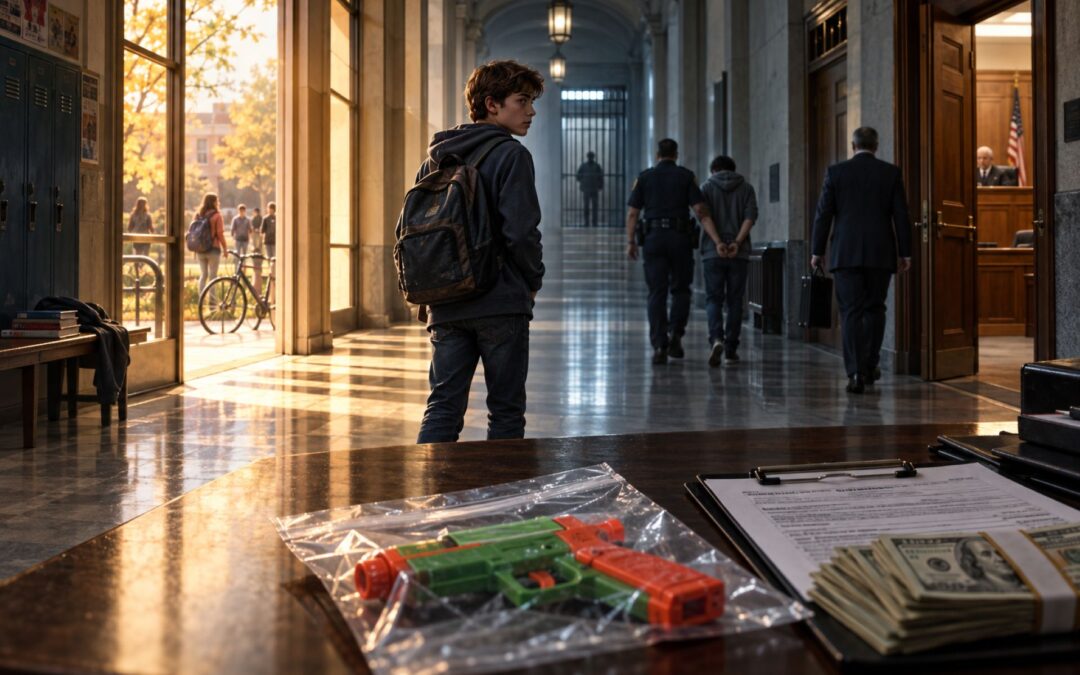
At Kall’s convenience store, Garth suddenly decides to commit a robbery. He enters the store with what appears to be a firearm and confronts the owner, Clem Hamm. The gun is actually a realistic-looking water pistol, but that fact does not make the experience harmless to the person staring at it. Hamm has no reason to know that the weapon is fake, and Garth uses its appearance to obtain money and beer.
Woody and Tony remain outside. The crucial distinction throughout the novel is that they are present with Garth but do not know in advance that he intends to rob the store. They do not enter the store, brandish the weapon, or share in a planned scheme. Their proximity, however, is enough to place them under immediate suspicion once the police stop the vehicle.
Woody is arrested, handcuffed, processed, tested for alcohol, and questioned. For a thirteen-year-old who has never imagined himself as a serious criminal suspect, the transition is disorienting. One moment he is an adolescent making a foolish choice about whom to spend time with; the next he is inside a system whose adults control where he sits, what he may do, and when he may see his family.
During interrogation, detectives tell Woody that Tony and Garth have blamed him for the gun. The tactic is designed to shake his confidence and encourage him to change his story. Woody nevertheless maintains that Garth committed the robbery and that he and Tony knew nothing about it beforehand.
The claim about Tony becomes especially important when the brothers are finally able to compare accounts. Neither has actually blamed the other. They realize that the police used the possibility of betrayal as leverage during questioning. Instead of turning against each other, they decide to stay with the same account: they were drinking and they were with Garth, but they were not part of the robbery plan.
Meanwhile Daisy struggles even to discover what has happened to her sons. The episode makes the family’s lack of power visible before the subject of bail formally enters the plot. A well-connected family might know whom to call and how to move quickly. Daisy has to search for information while two frightened boys remain behind locked doors.
Jail, Bail and the Price of Freedom
Theo learns at school that Woody has been arrested and immediately shifts from worried friend to informal legal advocate. He goes to Youth Court, where Judge Frank Pendergrast is handling the Lambert brothers’ case. Theo understands far more legal vocabulary than most boys his age, but he does not possess the authority he often feels he should have. His knowledge lets him identify problems; it does not automatically give him the power to solve them.
Woody and Tony cannot simply hire the kind of lawyer Garth’s family can afford. Their case moves toward public representation, but the public-defense system is busy and their assigned lawyer, Rodney Wall, is difficult to reach. Theo tries to persuade adults to release the boys or accelerate the process, yet court procedure does not bend merely because he feels certain that Woody is innocent.
The difference between the defendants soon becomes stark. Garth’s father has the money and legal resources to arrange a commercial bond, and Garth leaves custody relatively quickly. The person who actually entered Kall’s, displayed the fake pistol, and took the money is therefore able to go home while Woody and Tony remain locked up.
That contrast initially seems absurd to Theo because he instinctively thinks of detention as a response to guilt. The legal system, however, is still deciding guilt. The immediate question is whether each defendant can satisfy the conditions imposed for release while the case is pending.
Mr Mount, Theo’s government teacher, also explains why Woody’s statement that he never entered the store does not automatically end the legal inquiry. Accomplice liability can reach someone who intentionally assists a crime even if that person does not personally carry out every act. The prosecution’s problem will eventually be whether it can prove that Woody and Tony knowingly participated in Garth’s plan rather than merely being nearby.
The legal distinction makes sense to Theo, but the practical inequality remains. Marcella Boone, Theo’s mother, becomes involved after Theo asks for help. She is cautious about entering another lawyer’s case, partly because professional boundaries matter, yet she recognizes that the boys are caught in a process their family barely understands.
When the Lambert brothers return to Youth Court, Judge Pendergrast sets bond at $10,000 for each boy. That does not mean Daisy must personally produce $20,000 in cash if she uses a commercial bondsman, but even the required premium is beyond what the family can easily afford. What looks like a neutral number on paper therefore has entirely different effects on the families involved.
Theo begins thinking seriously about the mechanics of bail. In his government class, the subject becomes an example of how formal equality can produce unequal results. Two defendants can face the same nominal bond and experience completely different realities if one family regards the cost as routine while the other cannot raise it at all.
Woody also makes a choice that reveals the depth of his loyalty to Tony. If enough money can be found to release only one of them, he does not want to leave his brother behind. Tony helped put him in this situation, but Woody refuses to treat freedom as something he should purchase individually while Tony remains confined.
Theo now tries to convert his legal understanding into practical help. He confronts Rodney Wall but finds the lawyer defensive and unwilling to discuss confidential matters with a child. Wall’s limitations are initially understandable: he carries professional obligations Theo does not, and he appears to be operating within a strained public-defense environment.
Daisy’s financial position leaves Theo looking elsewhere. He considers contributing his own savings and contacts a bondsman, hoping there might be flexibility in the fee. He learns that sympathy does not change the economics of commercial bail. The family needs real money, and legal innocence will not substitute for it at the release desk.
Inside detention, the human cost of that delay is becoming more severe. Woody and Tony are housed with other young detainees, including Jock, an aggressive boy who intimidates them. Their confinement is no longer merely an abstract inconvenience or a lesson in procedure. It is becoming an environment in which fear, violence, and humiliation shape every day.
Fundraising, Detention and the Fight to Get Free
Theo responds to the bail problem by doing what his social world enables him to do: he starts asking people for help. His network includes adults with money, legal knowledge, institutional credibility, and affection for him. Woody does not have the same network independently, which is precisely why Theo’s friendship becomes so consequential.
The urgency increases after Jock attacks Woody and Tony. The boys are injured, yet institutional discipline does not produce the simple moral division Theo expects. Because they are involved in a fight inside detention, punishment can reach them even when they were not the ones seeking conflict.
Woody’s experience becomes even harsher when he is placed in solitary confinement. Here Grisham shifts attention away from Theo’s energetic activity and lets the reader remain with the person who cannot do anything. Woody has no meaningful control over the pace of his case, the availability of his lawyer, the amount of his bond, or the rules governing his confinement.
That helplessness produces reflection rather than instant transformation. Woody knows he made mistakes before the robbery. He knows that drinking and going along with Tony and Garth placed him in danger. But he also understands that those mistakes are not the same thing as knowingly helping to rob Kall’s, and the distinction becomes more important to him the longer he is treated as though it does not matter.
Outside, Theo widens the effort to raise bail money. Mr Mount contributes. Uncle Ike, Theo’s disbarred but legally experienced uncle, becomes involved. Woody’s father is approached. Theo’s friends help, and Chase creates an online “Free Woody” campaign that turns the problem from a private family crisis into a community cause.
The fundraising is one of the novel’s clearest demonstrations of social capital. The money matters, but so do the relationships that make the money available. Theo can explain the case to teachers, friends, parents, and adults who trust his judgment. Each connection reduces Woody’s isolation from the system.
Eventually enough money is assembled to arrange the bonds. Even then, freedom does not come immediately. A hold appears in the system after the detention-center fight, preventing the boys’ release despite the financial problem having supposedly been solved.
The timing makes matters worse. Offices are closing, the weekend is approaching, and every procedural delay can become additional days behind bars. Grisham repeatedly emphasizes that incarceration before trial is experienced in units of ordinary life: missed school, missed sleep, fear, inability to see family, and exposure to dangerous people.
Woody sees the contradiction with painful clarity. Garth, whose actions caused the entire case, is already outside. Jock, who attacked the brothers, can also appear to move through the system more easily than Woody. Woody’s legal status as someone not yet convicted does not make his confinement feel provisional when he is the person sleeping inside a locked facility.
The ordeal also changes Tony. He recognizes that Woody followed him into the situation and that his own choices helped expose his younger brother to Garth. Tony apologizes, and the brothers make a broader commitment to improve their behavior rather than treating acquittal on the robbery charge as permission to continue exactly as before.
Marcella eventually reaches Judge Pendergrast outside normal court hours and discovers that the supposed hold keeping the boys confined was not something the judge intended. Once the problem is clarified, the release process can finally move forward. The bondsman completes the arrangements, and Woody and Tony leave detention.
Their release is an enormous relief, but Grisham does not treat it as the conclusion. Woody has missed school and fallen further behind. Theo and Mr Mount help him catch up, and returning to ordinary academic life becomes part of restoring the identity that detention temporarily replaced with a case number and accusation.
Theo, meanwhile, begins thinking beyond Woody’s individual problem. Conversations with Uncle Ike push him toward a more skeptical understanding of criminal justice. Ike’s own legal history makes him less reverent toward institutions than Theo’s parents, and he encourages Theo to see bail reform as a question citizens can argue about rather than a set of rules that must be accepted simply because they are established.
That widening perspective matters because the novel is gradually changing its scale. At first, Theo wants one friend released. By the midpoint, he has begun asking why freedom before trial can depend so heavily on the ability to pay.
Rufus and Theo’s Parallel Courtroom Case
After the intensity of Woody’s detention, Grisham temporarily shifts to a much smaller dispute involving a rabbit named Rufus. Theo is asked to represent the animal in Strattenburg’s Animal Court after neighbors complain that Rufus wanders at night, causes trouble, and provokes dogs.
The chapter initially feels like comic relief. The stakes are deliberately tiny compared with Woody’s possible criminal liability, and the spectacle of legal procedure being applied to a rabbit restores some of the playful tone associated with earlier Theodore Boone adventures.
Yet the case also echoes the larger novel. Witnesses claim to know what Rufus has been doing at night, and Theo tests how reliable their identification really is. Judge Pendergrast himself becomes part of the proceedings as a witness, which lets the book rearrange familiar courtroom roles for comic effect.
The dispute ends through a negotiated arrangement rather than a dramatic victory. Rufus can remain at home under restrictions designed to address the neighbors’ concerns. The chapter therefore reinforces several ideas circulating through Woody’s case—evidence, identification, restrictions on freedom, negotiation, and the difference between accusation and proof—without equating a rabbit dispute with juvenile detention.
Its main function remains structural. The episode gives readers a breather and reminds them why Theo loves the law in the first place. At the same time, its length and placement interrupt the momentum of Woody’s case, a choice that becomes important when assessing the novel’s pacing.
Garth’s Defense Strategy and Woody’s Second Arrest
The focus returns to Garth as the adult criminal process against him advances. His family hires Clifford Nance, an experienced and formidable defense lawyer whose resources immediately distinguish Garth’s legal position from that of the Lambert brothers.
At Garth’s preliminary hearing, the evidence against him looks powerful. Clem Hamm can describe the robbery, surveillance footage captures the crucial events, and the realistic pistol and stolen property connect Garth directly to what happened. The central uncertainty that exists around Woody and Tony—whether they knowingly participated—does not protect Garth from evidence of his own actions inside the store.
Nance therefore faces a difficult defense problem. His client is not merely associated with the crime; he is the person captured carrying it out. The lawyer’s task becomes less about denying the visible act than about finding a way to reduce Garth’s exposure and improve his bargaining position.
Woody, meanwhile, spends time at Scout camp at Lake Marlo. The change of setting matters because the camp represents almost the opposite of juvenile detention. Both environments impose rules and place children under adult supervision, but one is built around trust, skill, responsibility, and belonging rather than suspicion and punishment.
Major Ludwig emerges as an important adult in Woody’s life. He volunteers in Youth Court and also participates in Scouts, giving him knowledge of both institutional worlds. Woody can discuss his detention experience with someone who understands the legal system without reducing him to a defendant.
The relative calm does not last. After camp, Woody is unexpectedly arrested at school by Bob Hawley, the bondsman connected with his release. The reason has nothing to do with new evidence about the robbery. By leaving Stratten County for Scout camp, Woody has violated a condition of his bond.
Woody did not knowingly defy the court. He did not understand that the restriction applied to the trip, and the adults responsible for his legal representation had not made the condition clear enough. Nevertheless, a technical violation is sufficient to put his freedom at risk again.
At the hearing, Major Ludwig takes responsibility for the Scout trip, while Rodney Wall admits that he failed to explain the condition adequately. Judge Pendergrast responds more flexibly than Woody fears. Rather than simply returning him to detention, the judge recognizes the violation as an honest mistake and releases Woody on personal recognizance under supervision.
The incident complicates any interpretation of Pendergrast as an uncomplicated antagonist. He imposes rules that contribute to Woody’s earlier confinement, but he is also capable of individual judgment when accurate information reaches him. The institutional critique is therefore broader than “bad judge harms innocent child.”
The more troubling development occurs in the professional relationship between Clifford Nance and Rodney Wall. Nance approaches the younger, less established public defender in a way that mixes professional flattery with strategic opportunity. He suggests that Wall might have a future in a more prestigious setting and then introduces a story that could help Garth.
Under this alternative version, Woody could be associated with the gun while the boys supposedly admit to a lesser common plan. Spreading responsibility would complicate the clean separation between Garth as robber and the Lambert brothers as unwitting companions. It could create leverage for Garth’s defense and improve Nance’s ability to negotiate.
The important problem is not merely that the story differs from what Woody says happened. Lawyers routinely develop theories that favor their clients. The ethical danger is that Nance is encouraging Wall to move his own clients toward an account Wall has reason to know is false, while professional advancement hangs implicitly in the background.
Wall does not instantly become a cartoon villain. He hesitates and understands that the proposal is dangerous. Yet his vulnerability to Nance’s influence marks the moment when the novel’s critique shifts from underfunding and delay to compromised professional judgment.
Pressure to Lie and the Attempted Bribe
Woody tells Theo that Wall is now encouraging the Lambert brothers to cooperate with a different account of the robbery. The proposal is framed as practical. If everyone supports a version that spreads responsibility, perhaps the cases can be negotiated in a way that reduces the danger to all three boys.
For Woody, however, the practical advantage does not erase the fact that the account is false. He did not possess the gun, did not know Garth planned a robbery, and did not agree to a shared criminal scheme. Accepting a convenient story would mean converting his actual poor judgment into a crime he did not commit.
Woody consults Theo, and the issue reaches Major Ludwig. Major makes the stakes explicit: knowingly giving false testimony can itself become a serious legal problem. The advice matters because Woody has begun receiving pressure from adults who are supposed to understand the system better than he does.
The situation also tests a subtle distinction in the novel’s moral framework. Grisham does not portray every negotiated plea as inherently corrupt, nor does he argue that a defendant should always demand trial regardless of evidence. The problem in Woody’s case is that the proposed compromise depends on affirming facts he says are untrue.
Woody refuses. His decision shows how far he has moved from the boy who followed Tony and Garth because resisting the group was difficult. Earlier, passivity helped place him in danger. Now he is willing to oppose his own lawyer rather than allow other people to define his actions for him.
The pressure soon becomes more direct for Tony. While delivering pizza, he encounters Garth, who apologizes but again promotes the fabricated story. Garth then produces an envelope represented as containing $5,000 and offers the money as an inducement to cooperate.
The offer exploits exactly what the novel has spent so much time establishing. The Lambert family needs money. They struggled to raise bail, Daisy works hard, and Tony knows what $5,000 could mean to people in their position. Garth’s wealth therefore becomes more than an explanation for his superior legal resources; it becomes a tool he can use to tempt someone else into sharing his liability.
Tony does not take the offer. That choice completes part of his own development. The older brother whose influence helped draw Woody into the disastrous evening now refuses a profitable escape from responsibility when the escape would require deception.
Theo tells Uncle Ike about what happened, and Woody separately informs Major Ludwig. Both adults warn the boys that accepting money in exchange for false testimony could create additional legal jeopardy. Ike is especially alert to the possibility that what looks like easy money could become another trap.
By this stage, the original robbery has become almost secondary to the question of narrative control. Garth needs a version of events that reduces his isolation as the principal offender. Nance needs a defensible path for his client. Wall is tempted by a strategy that might make his own difficult cases easier. Woody and Tony possess one thing the more powerful actors cannot simply manufacture without them: testimony.
Their refusal to surrender that testimony becomes the moral center of the novel.
The Trial, Acquittal and Unfinished Consequences
The Lambert brothers’ Youth Court trial finally puts the competing accounts before Judge Pendergrast. Unlike earlier stages, where money, procedure, administrative holds, and lawyer access often seemed more important than the underlying facts, the trial brings attention back to what can actually be proved.
Clem Hamm testifies about the robbery. His account confirms the terror created by the realistic-looking pistol and supports the prosecution of Garth, but it does not place Woody or Tony inside the store. Neither Lambert brother appears in the surveillance footage carrying out the robbery.
Police evidence likewise fails to connect them to the weapon or the stolen money. Their presence with Garth establishes opportunity and association, but the prosecution still needs evidence that they intentionally joined the criminal plan.
Garth’s testimony is awkward for the case against them. He answers some questions but invokes the Fifth Amendment when particular responses could expose him in his own pending criminal matter. His legal right to protect himself therefore limits how completely the Youth Court can use him to construct the prosecution’s version of events.
Tony testifies and maintains the same essential account the brothers have given since comparing stories after their arrest. They were with Garth and had been drinking, but they did not know he intended to rob the store. Their own misconduct does not disappear from the testimony, which strengthens the distinction they have been making all along: admitting one wrongdoing does not require admitting another.
Woody then gives his account. His testimony is consistent with the objective evidence that places Garth inside the store and the brothers outside. The boy who was frightened and disoriented during his first interrogation now has an opportunity to speak in a setting where credibility is being formally assessed.
Judge Pendergrast ultimately finds the brothers believable. The state has not produced evidence sufficient to establish that Woody and Tony knowingly assisted Garth’s robbery. They are acquitted of the accomplice allegations.
The verdict vindicates the central claim they have maintained from the beginning, but it does not turn the entire night into something harmless. Their underage drinking remains a separate problem. Tony’s existing probation status creates additional concerns, and the adults around them make clear that escaping a false robbery conviction does not excuse the behavior that put them in Garth’s company.
Rodney Wall behaves after the verdict as though the favorable outcome reflects comfortably on his representation, creating an uneasy contrast with the pressure he exerted privately. Major Ludwig and the boys know that the path to acquittal was far less straightforward than Wall’s public posture suggests.
Garth’s future is also deliberately left unresolved. He still faces his own adult criminal case, and Nance will continue working to minimize the consequences. Major expects that money and high-quality representation will matter, even with strong evidence against Garth.
Theo receives the news while at school when Woody sends word that the brothers have been found not guilty. The moment releases months of worry, and Theo celebrates with his friends. Yet the ending does not claim that the justice system has repaired itself. One particular accusation has been defeated; the conditions that made the experience so punishing remain.
Strattenburg’s Legal World and the Unequal Paths Through It
Strattenburg is more than a generic backdrop for Theo’s adventures. Grisham builds the city as a compact civic ecosystem in which schools, courtrooms, law offices, bail businesses, police facilities, judges, lawyers, Scouts, and families repeatedly intersect. Theo moves among these places with unusual ease because his identity is already embedded in the city’s professional network.
That mobility is one of the series’ central conveniences. Theo can leave school for legal reasons, recognize courthouse officials, call adults who understand procedure, ask his parents for advice, and consult Uncle Ike when he wants a less conventional opinion. Because both of his parents are lawyers, the institutional world that frightens most children is familiar territory to him.
Woody experiences the same city very differently. He does not know which adult to call, what a bond means, why a hold can delay release, or how a restriction on travel might affect Scout camp. Legal rules reach him mainly as restraints rather than as tools.
The contrast reveals one of the book’s deeper understandings of inequality. Money matters, but knowledge matters too. So do respected parents, teachers who listen, adults who return calls, and people who know the difference between a routine delay and something that should be challenged.
Theo’s ability to help Woody therefore contains a productive contradiction. His friendship is admirable precisely because he uses his advantages on someone else’s behalf, yet those advantages also demonstrate the problem. If Woody needs a thirteen-year-old friend with lawyer parents, a legally experienced uncle, a supportive teacher, and courthouse access merely to navigate ordinary pretrial problems, then the system is not functioning equally for children who lack those connections.
The novel’s institutions are not uniformly cruel. Judge Pendergrast eventually corrects the mistaken hold and later treats Woody’s county-travel violation as an honest error. Mr Mount educates rather than condemns. Major Ludwig offers supervision instead of punishment. Marcella Boone uses her professional position to help without pretending normal rules do not exist.
That mixture keeps Strattenburg from becoming a simple dystopia. The problem is less that every official wants to harm Woody than that institutional routines can produce harmful outcomes unless someone with knowledge and authority actively intervenes.
The Animal Court adds another layer to this civic world. It is comic and eccentric, but it also shows Theo’s attraction to legal procedure in its least threatening form. He enjoys argument, questioning, evidence, and negotiated solutions when the stakes are manageable.
Woody’s case exposes the other side of the same fascination. Law is not merely an intellectual game. A bond figure can determine whether a child sleeps at home or behind a locked door, and a lawyer’s explanation—or failure to explain—can determine whether that child is arrested again.
Character Analysis
The Accomplice remains a Theodore Boone novel, but it does not distribute dramatic weight evenly between Theo and Woody. Theo is the organizer, investigator, connector, and legal enthusiast; Woody is the person whose freedom, reputation, and moral independence are being tested.
That division gives the novel a useful double perspective. Theo can explain how institutions work because he understands them, while Woody shows what those institutions feel like when a person has very little control over them.
Theodore Boone
Theo’s defining trait is not simply intelligence but confidence in the usefulness of knowledge. When something goes wrong, his instinct is to learn the rule, identify the responsible official, make an argument, and keep asking questions until the situation changes. That mindset makes him an unusually effective friend.
His loyalty to Woody is practical rather than sentimental. Theo does not merely insist that Woody is a good person. He goes to court, asks lawyers questions, explains bail to classmates, contributes money, recruits adults, organizes academic support, and keeps looking for the next point where intervention might help.
At the same time, the novel makes Theo’s privilege difficult to ignore. He is able to help because he inhabits a social world full of professionals who take him seriously. His parents are respected attorneys, Uncle Ike knows the legal system from experience, Mr Mount encourages his interests, and courthouse figures recognize him.
Theo sometimes behaves as if persistence should entitle him to information or influence that professional rules properly restrict. His frustration with Rodney Wall partly arises because Wall cannot simply discuss a client’s confidential matter with a curious child. Theo’s tendency to push boundaries is usually productive in the series, but it also keeps him from being an entirely reliable judge of when an institution is failing and when it is merely refusing to operate on his preferred timetable.
The character is most convincing when those two qualities coexist. Theo genuinely cares about justice, and his access to institutions is unusually privileged. The novel does not need to choose between those facts.
His development in The Accomplice occurs mainly in the expansion of his legal imagination. He begins by wanting Woody out of detention. Through the bail fight, he starts asking why people who have not been convicted can experience radically different levels of freedom based on financial resources.
That movement from individual advocacy to structural curiosity is significant for a character who dreams of becoming a lawyer. Theo still believes institutions can work, but the novel makes his faith less automatic.
Woody Lambert
Woody is the book’s most important character transformation. At the beginning, his main danger is passivity. He is struggling academically, drifting toward Tony’s social world, and willing to follow older boys even when he senses that their choices are bad.
The robbery punishes him disproportionately for that passivity, but it also forces him to define himself. During interrogation he must decide whether to accept the police suggestion that Tony has betrayed him. In detention he must endure fear without knowing when he will get out. During the bail process he must decide whether he will leave if Tony cannot.
His loyalty to Tony is one of his strongest traits, yet it is not presented as uncomplicated. Tony helped place him in danger. Woody loves his brother without pretending Tony’s choices are harmless, and Tony’s eventual apology gives that loyalty a more reciprocal foundation.
Detention also changes Woody’s understanding of freedom. Before his arrest, rules are things adolescents test or ignore. Once confined, he sees how completely adults and institutions can control movement, communication, food, sleep, contact with family, and access to the outside world.
The second arrest over the Scout trip deepens that lesson. Woody has tried to return to school and a healthier environment, yet a condition he does not fully understand can still send him back toward detention. His legal status follows him even into an activity meant to represent responsibility and belonging.
The greatest development comes when Woody is asked to support the false defense story. At the beginning of the novel, he cannot say no to Tony and Garth strongly enough to leave their company. Near the end, he can say no to his own lawyer.
That change is the clearest measure of his growth. Woody does not become fearless, legally sophisticated, or morally perfect. He becomes more capable of deciding what he will and will not accept from people with greater authority.
His acquittal matters because he is innocent of the accomplice charge, but his character arc would remain meaningful even without the verdict. The essential victory occurs earlier, when he refuses to exchange truth for a potentially easier legal outcome.
Tony Lambert and Garth Tucker
Tony and Garth initially occupy similar positions as older boys whose behavior influences Woody, but their arcs move in opposite directions. Tony is irresponsible, already involved in trouble, and willing to drink and socialize with Garth despite obvious risks. His younger brother pays part of the price for that carelessness.
Detention forces Tony to recognize his responsibility. He cannot undo the robbery or the arrests, but he can acknowledge that Woody followed him into a dangerous situation. His apology is important because it does not depend on Tony suddenly becoming innocent of every bad choice.
The attempted bribe later provides a more demanding test. Garth offers money to a boy from a family that has just struggled desperately to meet bail costs. Tony’s rejection of the offer demonstrates that his experience has produced some moral growth rather than merely fear of punishment.
Garth develops very differently. His original robbery combines impulse, entitlement, and extraordinary disregard for consequence. The fake gun captures his mentality perfectly. Because he knows it is not a real firearm, he can treat the act as less serious than it appears to the person being threatened.
That same inability to take another person’s perspective continues afterward. Garth knows that Woody and Tony did not plan the robbery, yet he becomes willing to encourage a fabricated account that could shift some responsibility onto them. His priority is minimizing his own exposure.
Wealth amplifies rather than creates those flaws. Money does not make Garth commit the robbery. It does, however, give him a quick route out of detention, sophisticated legal representation, and a belief that financial inducement may solve a testimony problem.
The $5,000 offer to Tony is therefore a natural extension of his character. Garth has already experienced money as something that changes legal reality. He assumes it might change personal loyalty and truth as well.
Major Ludwig, the Boone Family and Woody’s Adult Allies
Major Ludwig becomes one of the most important adults in the novel because he combines authority with genuine attention to Woody as a person. He knows Youth Court, participates in Scouts, and has enough credibility to offer the court a form of supervision that does not require another period of detention.
His role shows what rehabilitation can look like when adults treat a troubled teenager as someone who needs structure rather than only punishment. Scout camp gives Woody expectations, community, and responsibility at a moment when the justice system has largely defined him through accusation.
Marcella Boone contributes differently. She understands professional boundaries more clearly than Theo does, but once she recognizes the seriousness of the Lambert family’s position, she uses her legal competence to intervene effectively. Reaching Judge Pendergrast over the mistaken hold is especially important because the episode demonstrates how much difference one knowledgeable adult can make.
Woods Boone is less central to the case, but the existence of Boone & Boone forms part of Theo’s underlying advantage. Theo never has to wonder whether legal advice exists somewhere beyond his reach. His household speaks the language of the institutions affecting Woody.
Uncle Ike offers another perspective. His own damaged legal career makes him skeptical of professional respectability and more willing to question the system itself. Where Theo’s parents often teach him how law should function, Ike is more inclined to ask what happens when incentives, money, status, and human weakness distort that ideal.
Mr Mount similarly expands the circle of support through education. His explanations of accomplice liability and bail help Theo and other students separate emotional reactions from legal mechanics. The school also becomes a place where Woody can begin recovering academically rather than being permanently defined by his arrest.
Together, these adults show the importance of advocacy that extends beyond courtroom representation. Money, supervision, academic help, explanation, professional access, and personal encouragement all affect Woody’s ability to recover.
Rodney Wall and Clifford Nance
Rodney Wall is one of the novel’s most difficult characters because Grisham places two kinds of criticism around him. The first is institutional: Wall operates inside an overburdened public-defense environment in which time and resources are limited. The second is personal: he eventually makes choices that cannot be excused simply by workload.
Early in the novel, Theo’s frustration with Wall should be treated carefully. A public defender is not obligated to satisfy a thirteen-year-old friend’s curiosity, and confidentiality legitimately limits what Wall can discuss. His difficult caseload also helps explain why clients may receive less attention than wealthy defendants can purchase.
His failure to explain Woody’s travel restriction, however, has concrete consequences. Woody is arrested again because a legal condition affecting his daily life was not made sufficiently clear. The episode turns inadequate communication into loss of liberty.
Wall’s later interaction with Clifford Nance is more serious. Nance is a highly capable defense attorney doing what criminal-defense lawyers are expected to do in one sense: search aggressively for ways to protect his client. The ethical boundary appears when the strategy requires other defendants to support facts that are not true.
Nance also understands Wall’s professional vulnerability. The suggestion that Wall might have opportunities beyond his current position creates a conflict between career aspiration and duty to existing clients. Grisham does not need an explicit bribe between lawyers to make the pressure visible.
Wall’s willingness to relay the false strategy to Woody and Tony represents his central failure. The problem is not that he considers compromise; criminal defense frequently involves negotiation. The problem is that the proposed compromise asks clients to affirm events they deny happened.
The book should not be read as a judgment on public defenders generally. Indeed, one of its broader concerns is that poorer defendants often depend on lawyers working with fewer resources than wealthy private counsel. Wall is an individual character whose weaknesses occur inside that inequality; he is not evidence that public defense itself is inherently unethical.
Nance, meanwhile, is more interesting than a conventional villain precisely because much of what he does is recognizable as strategic lawyering. His skill becomes troubling when winning for Garth requires shifting risk toward people with fewer resources. He embodies the difference between zealous advocacy and advocacy that becomes indifferent to truth and the rights of others.
Wealth, Bail and the Meaning of Equal Justice
The novel’s most sustained social argument concerns the gap between equal rules and equal consequences. Garth, Woody, and Tony are all caught in the same criminal event, but their experiences diverge almost immediately because their families possess different amounts of money, knowledge, and professional power.
The bail issue makes that difference visible in a form young readers can understand. A judge can set the same dollar amount for two defendants and still produce radically unequal outcomes. For one household, a bond premium may be an unpleasant but manageable expense. For another, it may represent money that simply does not exist.
The real-world debate around cash bail and commercial bond premiums gives Grisham’s fictional conflict a recognizable policy foundation. Financial conditions of release can keep people detained before trial when they cannot afford the required amount, while commercial bond arrangements commonly involve payments that are not returned to the family in the way a refundable court deposit might be.
The Accomplice turns that institutional mechanism into narrative experience. Woody does not understand inequality through statistics. He experiences it by knowing that Garth is outside while he is inside.
That distinction matters because pretrial detention can change a life before any verdict is reached. Woody misses school, encounters violence, spends time in isolation, loses contact with ordinary routines, and begins to think of himself through the logic of confinement. Even an eventual acquittal cannot retroactively make those days disappear.
The fundraising sequence complicates the book’s argument in a useful way. Woody’s family cannot solve the bail problem alone, but Theo’s community can. The campaign works because enough people contribute money and because Theo is unusually capable of activating a network.
The outcome is heartening on the level of friendship, yet troubling on the level of principle. Access to freedom should not depend on whether an accused child happens to have a charismatic friend who can organize teachers, lawyers, classmates, family members, and online donors.
The mistaken hold after enough money has been raised deepens the critique. It shows that paying the required amount does not necessarily restore control. Bureaucratic information can become another barrier, especially when the people affected do not know which office has authority to correct the problem.
Woody’s second arrest demonstrates a different form of inequality. Release on bond comes with conditions, and those conditions can be difficult to navigate for a family receiving poor legal communication. A child may technically be free while still carrying restrictions capable of returning him to custody.
Judge Pendergrast’s later decision to release Woody on personal recognizance under Major Ludwig’s supervision points toward another model. Instead of making money the principal guarantee of compliance, the court can consider the person, available supervision, and actual risk.
The novel does not produce a systematic policy proposal, nor should it be read as if every feature of Strattenburg law applies identically across the United States. Its achievement is simpler and more concrete. It teaches young readers to ask whether a rule is genuinely fair merely because it is written in the same form for everyone.
Money also shapes the quality of representation. Garth receives Clifford Nance, an experienced lawyer whose attention is concentrated on protecting one important client. Woody and Tony receive an attorney whose workload, communication failures, and career insecurity all affect their experience.
The inequality therefore extends beyond the price of release. Wealth buys time, attention, strategic planning, and the confidence that powerful professionals are focused on your interests.
Theo’s privilege adds a final layer. He is not wealthy in the flamboyant way Garth’s family appears to be, but he possesses institutional capital. He knows lawyers, judges, teachers, court staff, and adults who return his calls. His ability to help Woody shows that legal power is distributed through relationships as well as bank accounts.
The book’s title, The Accomplice, consequently acquires a wider resonance. The formal legal question is whether Woody and Tony were accomplices to Garth’s robbery. The broader moral question is what social arrangements indirectly help unequal outcomes persist even when nobody consciously intends injustice.
Truth, Responsibility and the Pressure to Take the Easy Way Out
Woody’s innocence would be less interesting if the novel portrayed him as completely blameless. Grisham instead gives him a mixture of innocence and responsibility that makes the later ethical conflict more credible. Woody does not plan a robbery, but he does make decisions that put him in the car with Garth.
He drinks underage and follows Tony into a social situation he knows is risky. The novel never needs to deny those facts in order to defend him against the accomplice charge. That separation is one of its strongest moral distinctions.
Bad judgment can justify criticism without justifying a false conviction. A teenager can deserve consequences for drinking or violating rules without becoming legally responsible for an armed robbery he neither knew about nor intended to assist.
The interrogation scene tests that distinction immediately. Police pressure encourages Woody to think strategically rather than truthfully. If Tony has supposedly blamed him, perhaps self-protection requires him to blame Tony in return.
Woody resists. Later, when he and Tony discover that neither brother actually accused the other, their shared commitment to one truthful account becomes stronger.
The most sophisticated pressure arrives not from police but from defense lawyers. Nance’s proposed story is attractive precisely because it can be presented as a solution rather than an obvious threat. It promises to distribute liability, create negotiating leverage, and reduce the danger of an unpredictable trial.
For Woody, however, the price is the same regardless of how sophisticated the explanation sounds. He would have to endorse something that did not happen.
The issue becomes more difficult because plea bargaining and negotiated resolutions are ordinary parts of criminal justice. The novel does not prove that every compromise is morally suspect. A defendant may rationally accept a plea when evidence is strong and the proposed resolution is truthful and legally advantageous.
Woody’s situation is different because his lawyer is not merely asking him to choose among legal options. He is being asked to change the factual foundation of his case.
Major Ludwig’s warning about perjury clarifies the danger, but Woody’s resistance is not based solely on fear of another charge. By this point, truth has become connected to his developing independence. He is learning to stop letting older or more powerful people make his decisions.
The attempted $5,000 payment to Tony makes the pressure tangible. Garth’s proposal is effective because the money would genuinely matter to the Lambert family. A bribe has more force when it is offered to someone who has recently experienced financial desperation.
Tony’s refusal is therefore significant for the same reason Woody’s refusal is. Neither brother suddenly becomes morally spotless. They simply reach a point at which hardship no longer gives other people permission to rewrite what they know happened.
The novel also asks what responsibility looks like for Garth. His first moral failure is not only the robbery but his refusal to comprehend what his behavior does to everyone around him. Woody and Tony are jailed, Daisy is terrified, Theo raises money, and multiple adults spend time untangling legal problems created by one reckless act.
Garth’s later efforts to redistribute blame show that he still views other people primarily through their usefulness to his own defense. Apology without acceptance of consequence becomes another form of self-protection.
The final trial validates the brothers’ insistence on factual distinctions. They can admit drinking and bad companionship without admitting robbery participation. In that sense, the verdict does more than declare them not guilty; it confirms that accountability is most meaningful when it is attached to what a person actually did.
Friendship, Community and Rehabilitation
Theo’s friendship with Woody is the emotional bridge connecting the legal plot to the novel’s more hopeful view of community. Theo cannot erase the charges or order the court to release his friend, but he can refuse to let Woody face the system alone.
His help takes forms appropriate to each stage of the crisis. At first he gathers information and appears in court. Later he helps organize money, finds adults who can intervene, supports Woody academically, and keeps asking questions when procedures appear inconsistent.
The crowdfunding effort broadens that friendship into collective action. Classmates, teachers, family members, and other adults contribute because they believe Woody should have a fair opportunity to defend himself outside detention. Their support does not determine his guilt; it gives him the practical ability to wait for that determination without remaining unnecessarily confined.
The sequence reveals the strength and weakness of community-based rescue. Compassion can correct an immediate injustice, but it does so unevenly. Another child without Theo’s network might remain detained under similar circumstances.
Still, Grisham treats social connection as an important alternative to isolation. Woody’s return to school matters not only because he needs better grades but because school restores ordinary expectations. He is again a student who has homework, classmates, and a future beyond his case.
Scouting serves a similar function. At camp, Woody is not primarily “the boy accused of robbery.” He is part of a structured group in which responsibility can be demonstrated through behavior rather than assumed from an arrest record.
Major Ludwig is particularly important because he embodies rehabilitative authority. He does not excuse Woody’s mistakes, but he does not treat those mistakes as proof of a fixed criminal identity. His willingness to supervise Woody gives Judge Pendergrast an alternative to monetary control.
Tony’s development also belongs to this rehabilitative theme. His apology to Woody marks an acceptance of responsibility that punishment alone could not force. He begins trying to improve because he understands what his choices did to someone he loves.
The novel’s optimism therefore depends on relationships rather than institutional perfection. Adults and peers repeatedly create better outcomes by paying attention to an individual child instead of reducing him to an accusation.
Theo himself learns something from this process. Legal knowledge is powerful, but knowledge works best when combined with trust, money, supervision, education, and people willing to act. Justice, in the novel, is never produced by one courtroom moment alone.
Symbols, Motifs and the Parallel Animal Court Case
The Accomplice is written in a direct middle-grade style, so its symbols are generally concrete rather than obscure. The most effective recurring objects and settings arise naturally from the plot rather than demanding elaborate interpretation.
The fake pistol is the clearest example. To Garth, it is not a real gun, which allows him to minimize the robbery in his own mind. To Clem Hamm, it is indistinguishable from a lethal weapon at the moment of confrontation.
The object therefore exposes a failure of perspective. Garth evaluates his behavior according to what he privately knows; the victim experiences it according to what he can reasonably see. The gap between those perspectives mirrors Garth’s broader inability to understand the consequences he imposes on other people.
Money functions almost like a repeated measure of freedom. It appears in the original robbery, Garth’s gambling debt, bail, fundraising, legal representation, commercial bond fees, and the attempted $5,000 payoff to Tony.
Its meaning changes across those appearances. Stolen money begins the criminal case, legitimate money determines access to release and lawyers, donated money becomes solidarity, and offered money becomes corruption. The novel repeatedly asks what money can purchase and what it should not be able to purchase.
Handcuffs, locked cells, holds, travel restrictions, and repeated arrest form another motif: constrained movement. Woody’s legal crisis is experienced physically through adults deciding where he may go.
That makes Scout camp especially meaningful. It appears to be a space of freedom, activity, and responsible independence, yet the bond system follows Woody there indirectly. When the trip leads to another arrest, the novel shows that conditional freedom remains fragile.
Courtrooms recur at different levels of seriousness. Youth Court decides matters that can transform children’s lives, adult court confronts Garth with stronger criminal exposure, and Animal Court turns legal ritual into comedy.
The Rufus episode should not be inflated into an elaborate allegory, but its structural parallels are clear. Theo tests witness identification, challenges assumptions, and helps produce a negotiated resolution involving restrictions. The smaller case echoes the larger book’s concern with how authorities decide what actually happened.
The tonal contrast also serves an important purpose. Animal Court reminds readers that law can be playful, rational, and constructive, preventing Woody’s detention from becoming the only image of legal institutions in the novel.
At the same time, the interruption exposes a pacing weakness. Readers deeply invested in Woody’s fate may experience a full chapter about a rabbit as an unnecessary detour. The episode works thematically better than it works dramatically.
Narrative Style, Structure and Legal Education
Grisham writes The Accomplice in a straightforward third-person style designed to keep legal material understandable for younger readers. The prose rarely calls attention to itself. Dialogue, action, and explanation carry most of the narrative weight.
Theo remains the organizing protagonist, but the narrative gives Woody enough independent attention that the book does not feel entirely like a case observed from outside. Scenes of detention and solitary confinement are especially important because Theo cannot witness them. The reader needs direct access to Woody’s experience for the legal issues to acquire emotional force.
The chronology is mostly linear, which suits the book’s educational purpose. Each legal development follows visibly from the one before it: arrest leads to detention, detention leads to bail, bail leads to fundraising, release leads to conditions, and those conditions create another arrest.
Grisham frequently embeds legal explanations inside conversations. Mr Mount explains concepts to students, Theo questions adults, lawyers discuss strategy, and courtroom scenes demonstrate procedure through action. This allows the novel to teach without using a separate narrator who lectures readers directly.
The method is effective when the legal concept creates immediate consequences. Bail is memorable because Woody remains jailed while Garth goes home. A bond condition is understandable because Woody is arrested after Scout camp. Perjury becomes concrete because the false story might be told under oath.
The weakness is that legal exposition sometimes becomes the plot rather than support for it. After the robbery, the book contains relatively little mystery about who committed the central crime. Suspense depends instead on hearings, bonds, holds, lawyer conversations, and procedural decisions.
That shift produces a genuine audience divide. A classroom review in Tes recorded reactions from younger readers who liked the courtroom world and characters but also found parts of the legal material complicated, slow, or less exciting than they expected.
Those responses identify the book’s central stylistic trade-off rather than a simple defect. Grisham wants young readers to understand why procedure matters, which means he cannot reduce every legal development to an action scene. Yet the more thoroughly he explains those procedures, the farther the book moves from the rapid suspense suggested by the “legal thriller” label.
The Animal Court episode intensifies that tension. In series terms, it feels entirely natural: Theo is a boy lawyer who enjoys eccentric local disputes. Within this particular plot, however, the excursion comes after readers have become invested in Woody’s much more serious legal jeopardy.
The prose presents a similar trade-off. Its plainness makes legal concepts accessible and keeps the story readable for the middle-grade audience identified by the publisher. Adult readers or older teenagers accustomed to Grisham’s more complex novels may find the characterization and dialogue comparatively simple.
Theo’s extraordinary access to courts, judges, lawyers, and school flexibility is another structural convenience. It is fundamental to the series premise, because an ordinary thirteen-year-old could not plausibly participate in this many legal matters. The device works as children’s adventure logic, but readers looking for strict realism will notice how often institutions accommodate Theo’s involvement.
The novel is strongest when legal instruction and character development occur simultaneously. Woody’s bond problems teach readers about pretrial release while changing his understanding of justice. His false-story dilemma teaches something about testimony and perjury while completing his movement from follower to independent moral actor.
When those two functions separate, the book can feel didactic. When they reinforce each other, Grisham’s method works extremely well.
Ending Explained: What Woody’s Acquittal Does—and Does Not—Resolve
The ending can appear simple because the courtroom result is clear: Woody and Tony are found not guilty of acting as accomplices to Garth’s robbery. The evidence does not establish that they knew the robbery was going to occur or intentionally helped carry it out.
That distinction has been present since the opening chapters. Neither brother enters Kall’s with Garth, the surveillance evidence does not place them inside committing the robbery, and the prosecution cannot convert their association with Garth into proof of a shared plan.
Their consistent testimony matters as well. They do not present themselves as entirely innocent boys who did nothing wrong that night. They admit conduct such as drinking while denying the specific criminal intent required for the robbery accusation.
Judge Pendergrast believes them. The verdict therefore resolves the legal question that has governed Woody’s case: he was not Garth’s knowing accomplice.
The acquittal does not erase Tony’s probation issues or the brothers’ underage drinking. Major Ludwig’s post-trial guidance reinforces the idea that being innocent of one serious crime is not the same as being free of all responsibility.
That distinction keeps the ending from becoming a simplistic celebration in which the legal system declares the entire evening acceptable. Woody and Tony are vindicated where they deserve vindication and still accountable where they made actual mistakes.
Garth’s case remains open. The novel does not tell readers his final sentence, plea, or verdict. He faces strong evidence, but he also has money and a skilled attorney committed to securing the best possible outcome.
That unresolved thread is important because Garth’s fate is not necessary to prove Woody’s innocence. Grisham refuses to make justice for the Lambert brothers depend on witnessing a perfectly symmetrical punishment for Garth.
The attempted bribe also remains outside the final adjudication. Tony’s refusal matters morally, but the trial is about whether the brothers assisted the robbery. The ending does not neatly prosecute every unethical act that has occurred along the way.
Rodney Wall’s conduct similarly receives no dramatic formal punishment. His behavior may disappoint the reader, but the novel’s purpose is not to convert every professional failure into a disciplinary proceeding before the last page.
The broader inequality remains unresolved too. The verdict cannot return the days Woody spent confined, undo his beating, remove the fear of solitary confinement, or reimburse the community for the money required to secure release.
That is why the ending is more complicated than a courtroom victory. Woody receives the correct result eventually, but the story has already demonstrated that a correct final result can coexist with damaging pretrial experiences.
His personal development provides the deeper resolution. The boy who begins the novel drifting toward trouble ends it having resisted police pressure, lawyer pressure, peer pressure, and financial temptation.
Theo’s celebration is therefore justified without implying that the system has been perfected. Friendship helped, knowledgeable adults intervened, a judge ultimately evaluated evidence carefully, and the truth prevailed in the specific case.
The novel’s optimism rests on those human choices. It does not rest on the idea that institutions automatically produce justice.
How Real Is the Book’s Critique of Bail and Juvenile Justice?
The Accomplice is fiction, and Strattenburg’s exact court procedures should not be treated as a guide to juvenile law across the United States. Bail practices, juvenile detention rules, court organization, commercial bonding, and release conditions vary substantially among jurisdictions and have continued to change since the novel appeared in 2019.
The broader concerns Grisham dramatizes, however, are not invented. The Brennan Center’s explanation of cash bail describes the central structural problem that animates Woody’s story: financial release conditions can produce detention for people who cannot pay, while defendants with greater resources can secure freedom while their cases are pending.
The novel simplifies that issue by placing two contrasting families inside the same story. Garth has access to money and a high-powered lawyer; Woody’s family has difficulty raising a much smaller amount and depends on friends, donations, and a commercial bondsman.
That contrast is rhetorically efficient, perhaps even unusually neat, but it helps younger readers see why “the same bail amount” does not necessarily mean “the same burden.”
The book’s concern about counsel also has a real foundation. The US Department of Justice’s Office of Juvenile Justice and Delinquency Prevention has treated juvenile access to counsel as a significant rights issue, reflecting the importance of effective legal representation when young people face proceedings they may barely understand.
Grisham turns that concern into the character of Rodney Wall, but this is where readers need to separate the institutional issue from the fictional individual. Overworked or under-resourced defense systems can create genuine problems of communication and attention. That does not mean public defenders as a profession resemble Wall’s later unethical behavior.
The Scout-camp arrest similarly illustrates a plausible general concern without proving the universality of the exact rule. Release conditions can restrict conduct and movement, and misunderstanding those conditions can have serious consequences. Whether a particular real juvenile defendant would face Woody’s precise county-travel restriction depends on local law and court orders.
The book also compresses the accessibility of judges and hearings for narrative purposes. Theo and Marcella can sometimes reach people with a speed that makes the story move and allows specific procedural problems to be corrected. Real defendants may encounter far more complicated bureaucratic barriers.
The trial itself is relatively clean. Evidence aligns with the brothers’ story, their testimony remains consistent, and the judge reaches the result the narrative has prepared readers to consider correct. Real criminal and juvenile cases can involve much messier factual ambiguity.
These simplifications do not invalidate the novel’s social argument. Middle-grade fiction routinely creates a manageable model of a larger problem so that readers can understand the underlying mechanism.
The more useful question is whether The Accomplice teaches the right questions. Why should money affect pretrial freedom? What happens when an accused child does not understand legal conditions? What does effective representation require? How much punishment can occur before conviction? When does negotiation become pressure to say something untrue?
On that level, the book is successful. It encourages skepticism about the assumption that a formally neutral process is automatically an equally experienced one.
Its limitations emerge only if the fictional system is mistaken for a complete description of real juvenile justice. Grisham gives readers an accessible entry point, not a substitute for jurisdiction-specific legal information.
Critical Review: What The Accomplice Achieves and Where It Falls Short
Theodore Boone: The Accomplice is most successful when judged as a middle-grade legal novel rather than as a conventional mystery. The central crime is not mysterious for long. Readers know what Garth did, and much of the evidence against him is straightforward.
The uncertainty lies elsewhere: whether Woody can survive the legal consequences of being associated with Garth, whether money will determine how long he remains confined, whether his own lawyer will protect him properly, and whether he will preserve the truth when lying appears strategically easier.
That shift gives the novel a distinctive strength. Grisham makes structural inequality visible without requiring young readers to absorb a policy treatise. Garth goes home; Woody does not. That simple fact does more explanatory work than several pages of abstract argument could.
Woody is the main reason the approach succeeds emotionally. His vulnerability makes detention feel consequential, while his imperfect behavior prevents the story from reducing justice to a contest between an angelic child and evil adults.
His arc is also satisfying because the final verdict is not the only evidence of growth. The more meaningful development occurs when he learns to resist pressure from people older, richer, more experienced, or professionally authoritative.
Theo remains engaging, particularly when friendship pushes his legal obsession beyond curiosity. He uses his knowledge for someone who cannot navigate the system alone, which gives his familiar precociousness a stronger moral purpose.
The book occasionally avoids interrogating Theo’s privilege as deeply as it might. His extraordinary ability to move among institutions is treated partly as normal series machinery. Yet in this story, that machinery unintentionally reinforces the central theme: Woody’s chances improve dramatically because his friend happens to possess unusual social and legal access.
Major Ludwig is another strong element. He offers a form of adult authority that neither indulges Woody nor defines him by his worst evening. His willingness to supervise and mentor makes the book’s idea of rehabilitation concrete.
Garth works effectively as a contrast, although his wealth and entitlement sometimes make him simpler than he could have been. The novel is more interested in what his resources allow him to do than in developing a complicated psychology behind the robbery.
Rodney Wall presents a larger difficulty. His early limitations are persuasive because they emerge from workload, communication problems, and unequal resources. His later willingness to press a false account makes the conflict more dramatic, but it also risks turning a systemic problem into an individual failure too neatly.
Clifford Nance is more convincing because his behavior develops from recognizable professional incentives. He is intelligent, experienced, and focused on protecting his client. The ethical unease comes from watching that legitimate goal expand until the truth and the interests of poorer defendants become obstacles to manage.
The book’s strongest theme is economic inequality, but Grisham wisely avoids making every wealthy person malicious or every poor person virtuous. Money changes options more reliably than it determines character.
Garth uses money badly, but Theo’s financially comfortable family uses resources to help Woody. Community donations become a force for freedom. The point is not that money is morally corrupt; it is that access to money changes what choices are available inside the legal system.
The novel is similarly effective at distinguishing innocence from irresponsibility. Woody and Tony should not have been drinking, and Woody should have been more careful about whom he followed. Those facts can be true without making them accomplices.
That nuance gives the trial a stronger ethical foundation. The desired verdict is not “these boys are good, therefore they cannot be guilty.” It is “the evidence does not show that they knowingly joined this crime.”
The main weakness is pacing. The opening robbery, arrest, and detention generate immediate momentum, but the middle of the book shifts heavily into bail explanations, hearings, fundraising, conversations with adults, and procedural obstacles.
Readers interested in law may find that material compelling because the procedures are the point. Readers expecting escalating action may feel that the story slows just when the initial crime seems to promise a more conventional thriller.
The contemporary response to the book reflects that divide. A 2019 review in Deccan Herald emphasized the novel’s concern with bail, juvenile detention, and unequal justice, treating those elements as central strengths rather than distractions.
The younger readers represented in the Tes classroom review were more divided. Some enjoyed the legal world, while others found the amount of legal discussion complicated or insufficiently exciting. Neither reaction is surprising because the novel is trying to do two things that do not always reinforce each other: teach and thrill.
The Animal Court chapter illustrates the tension especially clearly. It is charming on its own, faithful to the series’ lighter personality, and thematically connected to questions of proof and restriction. Yet it interrupts the central legal drama at a point when many readers will want the book to keep pushing Woody’s case forward.
Grisham’s prose produces a related trade-off. It is exceptionally easy to follow, which suits the intended readership and allows complex legal topics to remain manageable. Readers seeking richer characterization, stylistic complexity, or the sharper atmosphere of Grisham’s adult novels may find it too plain.
The resolution is satisfying but somewhat tidy. By trial, much of the objective evidence favors Woody and Tony’s version, and their consistent accounts give the judge a clear path to acquittal. The moral difficulty of reaching trial is greater than the evidentiary difficulty of the trial itself.
Garth’s unresolved case may also frustrate readers who want complete narrative symmetry. The boy responsible for the robbery has not received his final legal outcome when the novel ends.
That incompleteness is defensible, however. The story is about whether Woody and Tony are accomplices, not about watching every consequence of Garth’s conduct play out. Ending after the brothers’ acquittal keeps the focus on the accusation that has governed their lives.
As part of Grisham’s broader body of work, The Accomplice adapts familiar concerns about lawyers, criminal defendants, unequal power, and compromised institutions for younger readers. Those themes become much darker in his adult legal fiction such as Rogue Lawyer, but the underlying suspicion is related: access to justice depends partly on who represents you, what resources you possess, and whether someone inside the system is willing to challenge routine assumptions.
The novel’s lasting value lies in the questions it gives younger readers permission to ask. A person can be presumed innocent and still suffer before trial. Equal-looking rules can have unequal effects. Lawyers can face conflicting incentives. Good people can make bad decisions without becoming guilty of every accusation attached to those decisions.
Most importantly, The Accomplice does not present truth as automatically powerful. Woody’s truthful account needs evidence, persistence, competent adults, money, and a court willing to listen before it finally prevails.
That makes the book more serious than its straightforward prose initially suggests. Justice is not portrayed as a machine into which facts are inserted and correct verdicts automatically emerge. It is a human process, which means character, resources, judgment, and intervention matter.
For readers seeking a fast mystery built around discovering a hidden culprit, this is not the strongest Theodore Boone premise. Garth’s responsibility is too obvious, and procedural conflict replaces much of the investigative suspense.
For younger readers interested in courtrooms, law, fairness, civic institutions, or the real consequences of legal procedure, however, it is one of the series’ more substantial entries. The book takes concepts such as bail, public defense, accomplice liability, release conditions, perjury, and testimony and ties them to a boy whose ordinary life is interrupted by each one.
Its fairest overall evaluation is therefore that The Accomplice works better as a legal and social novel for young readers than as a relentless thriller. The same procedural detail that slows the story is also what gives it educational and moral weight.
Woody’s acquittal provides the ending readers want, but the novel wisely stops short of pretending that the verdict solves everything. He cannot recover the nights he spent locked up, the fear he experienced, or the knowledge that Garth’s money gave him options the Lambert family did not have.
What he does recover is control over his own story. By the time he enters court, Woody no longer allows police tactics, older boys, wealthy friends, lawyers, or financial pressure to tell him what he must say happened.
That is why the ending feels hopeful without being naïve. Justice arrives because evidence ultimately matters, but also because Theo refuses to abandon his friend, adults choose to intervene, a community supplies resources, Tony accepts responsibility, Woody resists dishonesty, and a judge finally separates actual guilt from mere association.
For readers within or near its intended middle-grade audience, Theodore Boone: The Accomplice remains worth reading not because it offers the series’ most intricate mystery, but because it makes an important legal idea unusually easy to feel: being treated equally on paper is not always the same thing as having an equal chance to protect your freedom, tell the truth, and be heard.
Last Updated on September 15, 2026 by Aseem Gupta