
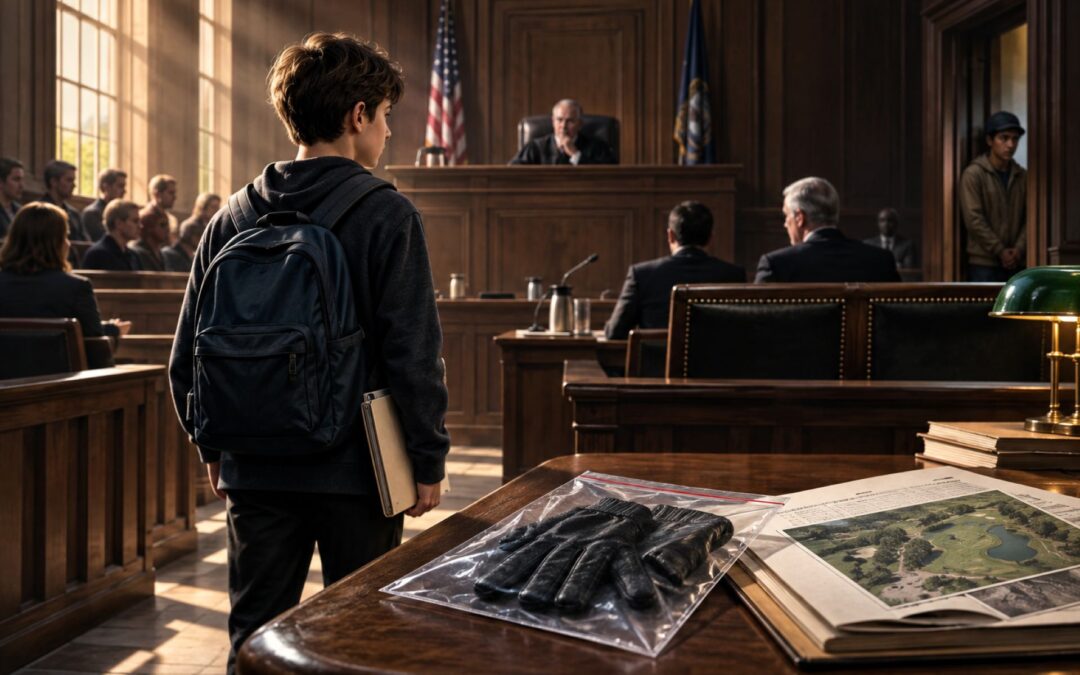
John Grisham built his reputation on legal thrillers about adults trapped inside courtrooms, law firms, conspiracies, and institutions powerful enough to destroy lives. In Theodore Boone: Kid Lawyer, he reduces that world to the scale of a thirteen-year-old without removing the central problem that makes legal fiction compelling: knowing what probably happened is not the same thing as proving it in court. The first book in Grisham’s Theodore Boone series introduces a boy who knows judges, clerks, lawyers, and legal procedures better than most adults around him, then forces him into a situation where that knowledge is no longer enough.
The novel was published in 2010 and appeared under slightly different titles in different markets. The complete Hodder & Stoughton edition has also been marketed simply as Theodore Boone, but it is the same first novel generally known as Theodore Boone: Kid Lawyer. This discussion covers the complete story, including the Pete Duffy murder trial, the secret eyewitness, the golf gloves, Judge Gantry’s decision, and the ending. Full spoilers follow throughout.
What makes the novel more interesting than its premise initially suggests is Theo’s change in his understanding of law. At the beginning, trials are almost sporting events to him. He loves the courthouse, memorizes procedures, enjoys helping classmates with legal problems, and dreams of becoming a great trial lawyer. The Pete Duffy case teaches him that law is not merely an intellectual game. Evidence can remain unusable, vulnerable people can be harmed by doing the “right” thing, and a court can follow its rules while still risking an outcome that feels profoundly unjust.

Complete Plot Summary of Theodore Boone: Kid Lawyer
The novel unfolds over twenty-two numbered chapters and follows a largely linear progression. The Pete Duffy murder trial provides the main plot, but Grisham repeatedly interrupts it with smaller legal problems involving Theo’s friends and acquaintances. Those episodes establish why people call Theo a “kid lawyer” and show that law in Strattenburg is not confined to dramatic murder trials; it reaches into divorce, foreclosure, criminal charges, animal disputes, debt, and ordinary family crises.
Chapters 1–5: Theo’s Legal World and the Pete Duffy Trial
Thirteen-year-old Theodore Boone lives in the small city of Strattenburg with his parents, Woods and Marcella Boone, both lawyers. Their law firm, Boone & Boone, occupies an old converted house near the courthouse. Theo has grown up immersed in legal language and procedure, and he treats the courthouse almost as another home. He knows judges, clerks, police officers, lawyers, courtrooms, and schedules, and he spends more time thinking about trials than most children spend thinking about sports.
His closest friend is April Finnemore, whose parents are going through an ugly divorce. April is miserable because neither home seems safe or appealing, yet she expects the judge to ask which parent she wants to live with. She would rather live with an aunt in Denver, but that option is unavailable. Theo listens to her, keeps her confidences, and tries to explain how custody decisions work. His advice is imperfect because he is still a child working from what he has absorbed from his mother, but April trusts him because he takes her problem seriously.
At the same time, the biggest legal event in Strattenburg is approaching. Pete Duffy is about to stand trial for murdering his wife, Myra. Theo is fascinated by the case and desperately wants to attend. He visits Judge Henry Gantry, his favorite judge, and persuades him to arrange courtroom seating for Theo’s Government class. To Theo, the opening of the trial has the excitement of a championship game.
That excitement is tempered by what Theo already understands about criminal law. His Government class discusses the case, and Theo explains the importance of the presumption of innocence and proof beyond a reasonable doubt. The police and prosecutors believe Duffy killed his wife, but the case is circumstantial. There is motive and opportunity, yet no eyewitness has publicly placed him at the scene, no decisive forensic evidence ties him to the killing, and no murder weapon provides the missing connection.
The novel broadens Theo’s legal world through another problem when his classmate Sandy Coe comes to see him. Sandy’s father is out of work, his family has fallen behind on its mortgage, and Sandy has overheard his parents talking about foreclosure. Theo patiently explains what foreclosure means and recognizes that bankruptcy may temporarily protect the family from losing its home. Crucially, he does not try to act as an actual attorney. He points Sandy toward an adult lawyer capable of handling the case.
Theo also visits his Uncle Ike, his father’s estranged brother. Ike once practiced law but was disbarred, and he carries both deep legal knowledge and bitterness toward the profession. Where Woods and Marcella represent respectable legal practice, Ike speaks more cynically about lawyers, judges, evidence, and human motives. He becomes an important counterweight to Theo’s idealized view of the system.
Discussing the Duffy case with Ike makes the weakness of the prosecution clearer. Pete Duffy had financial problems and stood to benefit from arrangements involving his wife’s death, but motive is not proof. The prosecution’s theory requires Duffy to have left the golf course where he was playing, travelled to his house, murdered Myra, and returned without anyone definitively seeing him do so.
When the trial begins, prosecutor Jack Hogan and defense attorney Clifford Nance offer opposing stories based on the same incomplete record. Hogan presents Duffy as a financially pressured husband with both motive and opportunity. Nance emphasizes what the state cannot prove: there is no eyewitness, no clear physical evidence placing Duffy in the house at the crucial moment, and no direct evidence demonstrating that he killed Myra.
Theo watches the lawyers turn facts into narratives. The experience reinforces something he already knows intellectually but has not yet had to confront personally: a courtroom does not decide whether a story feels plausible. It decides whether admissible evidence proves the charge to the required legal standard.
Chapters 6–12: From Courtroom Spectator to Keeper of a Secret
As the trial continues, Theo and his classmates argue over whether Duffy is guilty. Theo privately feels convinced, even while reminding himself that lawyers are supposed to respect the presumption of innocence. The tension between his instinctive judgment and the formal requirements of the law becomes important later, because the novel refuses to let his certainty count as proof.
The prosecution calls investigators and other witnesses to build its circumstantial case. Medical testimony establishes essential details about Myra Duffy’s death, while financial evidence is intended to strengthen the theory that Duffy had a motive. Yet Theo can see that the case remains vulnerable. A theory may explain the crime, but the jury still lacks the witness or physical evidence that would connect Duffy directly to the critical period.
Around the courthouse, Theo notices Omar Cheepe, a former federal agent who now works in investigation and surveillance. Cheepe is associated with Duffy’s defense team and has a menacing reputation. Theo’s mother has encountered him professionally before, and Theo knows enough about him to be uneasy. Cheepe’s presence introduces a threat that exists outside the polite rules of courtroom advocacy.
The novel then returns briefly to the Boone family’s ordinary routine. On Tuesday nights they work at a soup kitchen and shelter, a family commitment that places Theo in regular contact with people living very different lives from his own. His parents are financially secure professionals with legal knowledge, social connections, and institutional confidence. Families at the shelter may face unemployment, immigration insecurity, homelessness, or problems they do not have the resources to navigate easily.
April’s family situation remains unresolved. She has appeared in the divorce proceedings, but the court does not immediately resolve custody. Theo worries about her because he understands enough to recognize that legal procedure cannot instantly repair a damaged family. Her subplot never becomes part of the Duffy mystery, but it reinforces the book’s larger point that courts deal not only with crimes and dramatic verdicts but with messy human situations for which no decision can create a perfect outcome.
Theo continues following the murder trial whenever school and his parents allow it. He studies what he misses and tries to reconstruct the case like an apprentice lawyer. During one courtroom visit, he notices Julio, a boy connected with the shelter, watching from the balcony. Julio does not seem like someone who would attend a murder trial for entertainment.
More disturbing is the fact that Omar Cheepe is watching Julio.
Julio eventually tells Theo why he is interested. His cousin works at Waverly Creek, the golf course where Pete Duffy was playing on the morning of his wife’s death. During his lunch break, Julio’s cousin was concealed near the course and saw a man he identifies as Duffy leave, move toward the Duffy house, and later return. His account fills precisely the gap the prosecution has been unable to close.
The revelation transforms Theo’s relationship to the case. Until now, he has been a spectator trying to predict a verdict. Suddenly he may possess information capable of changing that verdict.
There is an immediate complication. Julio’s cousin is living in the United States without lawful immigration status and fears that speaking to police or appearing in court could lead to detention or removal. He does not see the justice system as Theo does. To Theo, judges and lawyers are familiar adults; to the witness, official attention may destroy the fragile life he has built.
Theo agrees to meet him. When he does, he questions the witness carefully, using maps and photographs to determine where he was positioned, when he saw the man, and how certain he can be that the man was Pete Duffy. Theo wants to test the story rather than merely believe it because Julio trusts his cousin.
The account holds together well enough to frighten him. The witness may possess the evidence Jack Hogan desperately needs, but Theo has promised secrecy. He also worries that telling his parents could automatically place the information in the hands of lawyers who would feel ethically compelled to disclose it.
Unable to manage the burden, Theo turns to Ike. He initially withholds the witness’s identity but explains the essential problem: there is a secret eyewitness who could transform the murder trial and who refuses to come forward.
Ike immediately sees complications Theo had not fully understood. The prosecution is already deep into its case. Introducing a surprise witness at such a late stage is not as simple as walking into court and telling the judge that new evidence exists. The defense would demand time to investigate, procedural fairness would have to be protected, and the trial might have to be disrupted entirely.
While this enormous problem grows, Theo continues handling much smaller ones. Hallie, one of the most popular girls in his grade, asks him for assistance in Animal Court in a case involving a troublesome dog. Theo takes the matter seriously and succeeds, enjoying the satisfaction of helping someone through a legal process he understands.
The contrast is deliberate. In Theo’s ordinary “practice,” a problem has identifiable rules, he knows the correct person or procedure, and a grateful client walks away. The Duffy problem has no such clean answer. Doing what helps one person may endanger another.
By the end of this stage, Theo is no longer excited merely because he knows a secret. The secret has become a burden. Time is running out, the prosecution still appears capable of losing, and Theo understands that silence could contribute to an acquittal that cannot simply be undone because new evidence appears later.
Chapters 13–17: The Gloves, the Family Meeting and the Judge
The situation becomes far more serious when Julio brings Theo a clear plastic bag containing two golf gloves. Julio says his cousin obtained them after seeing the man identified as Duffy discard them. The gloves appear to connect Duffy’s movements with the eyewitness story and potentially with the murder itself.
Theo is horrified rather than triumphant. Physical evidence has now entered Boone & Boone because of him, yet he has no lawful or practical way to hand it to the authorities without exposing the source. An anonymous delivery seems impossible because investigators would immediately ask where the gloves came from and who had possessed them.
That night, Theo’s imagination makes the moral stakes vivid. He thinks about Myra Duffy and about what it would mean if her killer were acquitted because decisive evidence never reached the court. He also thinks about the rule against double jeopardy. If Duffy receives a final acquittal, prosecutors cannot simply retry him for the same murder because a stronger case later appears.
Theo’s insomnia shows how much his understanding of law has changed. Legal doctrine is no longer something to explain proudly in Government class. It has consequences that may determine whether a killer escapes prosecution and whether an innocent witness loses his security and family life.
Another classmate, Woody, approaches Theo with a problem involving his older brother, who has been arrested on a drug charge. Theo is initially frustrated because he already has more secrets than he can handle, but Woody’s distress reminds him of his own advantages. Theo has stable parents, access to lawyers, and adults he trusts. Woody’s family is chaotic, and Julio’s cousin possesses even less institutional security.
Theo eventually checks the relevant court information and assures Woody that his brother will have a public defender familiar with such cases. Again, Theo’s smaller legal intervention does not solve the underlying family problem, but it provides information and direction.
The Duffy crisis can no longer be contained. Ike pulls Theo out of school under a false story about attending a funeral, and Theo finally tells him the complete truth about the eyewitness and the gloves. Ike realizes that the problem has moved beyond anything Theo can responsibly manage alone.
Theo then tells his parents. Woods and Marcella are alarmed by the discovery that their son has been carrying information about a murder trial and hiding possible physical evidence in the law office. Yet their response is not simply punishment. Once they understand the witness’s fear and the promise Theo made, they must wrestle with the same moral conflict.
The Boone adults conclude that Judge Gantry needs to know that the trial may be proceeding without critically important evidence. Theo, Woods, Marcella, and Ike meet privately with the judge and explain that a witness exists. They cannot initially present him in the ordinary manner because he remains terrified of exposure.
Gantry refuses to treat secondhand information as proof. He cannot simply declare Duffy guilty or order the jury to believe a witness he has never heard. The witness is still, from the court’s perspective, almost a phantom.
For Theo, the scene is transformative. He has spent years treating Gantry as a heroic figure because he controls a courtroom with authority and intelligence. Now Theo sees the harder part of judging. Gantry must decide what fairness requires when legal procedure and potentially decisive factual information are pulling in different directions.
Meanwhile, the defense case proceeds. Pete Duffy takes the witness stand, a strategically risky decision because it allows Jack Hogan to question him directly. Duffy presents himself as a grieving husband and attempts to weaken the state’s theory of financial motive. His lawyers portray his financial problems as manageable rather than desperate.
Hogan’s cross-examination exposes vulnerabilities. He pushes Duffy about his business troubles, foreclosure problems, financial pressure, and marriage. Duffy is slick and prepared, however. Without the secret eyewitness, Hogan still cannot conclusively place him at the Duffy home at the time of the murder.
Judge Gantry eventually adjourns proceedings for the weekend before closing arguments. That pause becomes crucial. Theo and the adults now have a narrow window in which to determine whether the secret witness can be brought into the judicial process before the jury is allowed to decide the case as it currently stands.
Chapters 18–22: Bobby’s Testimony, the Mistrial and What Comes Next
For the first time in days, Theo sleeps well after involving his parents. Sharing responsibility with trustworthy adults does not solve the problem, but it ends the isolation that has made the secret unbearable.
Woods and Theo visit Waverly Creek to test the witness’s account. They retrace the relevant geography and timing, studying where the worker would have been, what he could have seen, and how Duffy could have travelled between the golf course and his house. The exercise gives Woods greater confidence that the story is plausible.
Their investigation is not entirely private. Duffy becomes aware of their activity, and the atmosphere around Theo grows more threatening. Omar Cheepe and people connected with him continue watching developments, suggesting that Duffy’s side understands that something unexpected may be emerging.
The Boone family also spends time with Julio and the children from the shelter, taking them to a college baseball game. The interlude is not merely a diversion. Theo learns more about Julio’s family and finally learns the secret witness’s name: Bobby Escobar, whose given name is Roberto.
Naming him matters. Until this point, Bobby has largely existed in Theo’s mind as “the witness” or Julio’s cousin. Once Theo thinks of him as Bobby, the legal dilemma becomes more personal. He is not simply evidence the prosecution needs. He is a frightened human being who may suffer because other people need what he knows.
Theo pressures Julio to convince Bobby that he must come forward. Bobby remains afraid of police and immigration authorities, and activity around his neighborhood makes those fears more immediate. Theo arranges to meet him at Truman Park while Woods watches from a distance.
Bobby’s fear highlights the enormous difference between his world and Theo’s. Theo can approach a judge, ask clerks for information, move through the courthouse, and expect adults in authority to listen. Bobby sees official attention as something capable of exposing him and his family.
Theo tries to convince him that the Boones will not simply use his testimony and abandon him. When Bobby needs a safe place, the Boone home becomes a refuge. That gesture enlarges the moral meaning of Theo’s family: their legal knowledge and social security can be used to protect someone who possesses neither.
The crisis finally reaches Judge Gantry. On Sunday evening, Gantry comes to Boone & Boone while the family and Bobby are there. Bobby sits at a table with Julio helping interpret and family members nearby. Theo uses aerial photographs and careful questioning to establish the witness’s location and observations.
Bobby describes being near the sixth fairway during his lunch break on the day Myra Duffy died. He explains what he saw and identifies Pete Duffy as the man who left the course and later returned. The golf gloves are also shown to Gantry. For the first time, the judge hears the substance of the missing evidence directly from the person who possesses it.
Gantry now confronts an extraordinary dilemma. The trial itself has not obviously collapsed because of misconduct visible to the jury. Both prosecution and defense have been presenting their cases under the existing rules. Yet allowing the case to proceed immediately to closing arguments and a verdict could produce an acquittal while critically important evidence remains outside the formal record.
On Monday morning, the courtroom expects closing arguments. Instead, Judge Gantry announces that there will be none. He declares a mistrial.
The distinction is essential. Pete Duffy is not convicted. He is also not acquitted. The existing trial is terminated, the immediate charges are dismissed only in the procedural sense necessary to end that trial, and prosecutors can bring the murder charge again. A new trial is expected in June, this time with the opportunity to investigate and properly use Bobby’s testimony.
The decision prevents the weak first trial from reaching a verdict that could permanently close the case. It does not prove Duffy’s guilt as a matter of law, nor does it eliminate the danger surrounding Theo. Omar Cheepe looks directly at him after the mistrial announcement, communicating that he understands Theo played some role in what happened.
Outside the courthouse, Cheepe again notices Theo. The threat does not become an immediate physical confrontation, but it remains unresolved. Grisham closes the central mystery on a deliberately provisional note: justice has been preserved as a possibility, not completed.
Theo’s own understanding of his future changes as well. At the beginning, he dreams of becoming a great trial lawyer. After watching Gantry carry the burden of deciding what to do when rules, evidence, fairness, and consequences collide, Theo begins thinking that perhaps he would rather become a judge.
The novel then returns him to school. April’s family situation remains unresolved, Woody’s brother still has serious problems, and ordinary life resumes. School secretary Miss Gloria quietly asks Theo for help because her brother has been arrested for drunk driving. Theo immediately knows which adult lawyer handles those cases and gives her a referral.
He leaves behind another satisfied client.
The ending returns Theo to exactly the kind of small legal problem with which the novel began, but the meaning has changed. He is still the “kid lawyer” who knows where people should go for help. He now understands much better that the law is not primarily about knowing rules or feeling clever for predicting verdicts. It is about what happens to people when those rules are applied.
Strattenburg, the Courthouse and the Social World of the Novel
Strattenburg is not elaborate world-building in the fantasy sense, but Grisham constructs a remarkably complete institutional environment around Theo. The courthouse, Boone & Boone, Theo’s school, Uncle Ike’s office, Waverly Creek, the Highland Street shelter, the soup kitchen, police facilities, and the various specialized courts form a small ecosystem through which Theo can move almost entirely by bicycle. The compactness makes his extraordinary access to adult legal life plausible within the heightened realism of a children’s novel.
The courthouse is the center of Theo’s imaginative world. He knows its staircases, courtrooms, clerks, schedules, and judges, and he enters spaces that intimidate many adults. For him, the building represents order. Problems arrive, evidence is presented, lawyers argue, and judges decide.
The Duffy case teaches him that institutions are less complete than they appear. A crucial witness can exist outside the system. Relevant evidence can remain hidden. A person with information may have powerful reasons to fear the very authorities who need his help. The courthouse can process only what reaches it through recognizable procedures.
That difference is clearest when Theo is compared with Bobby. Theo belongs to a financially secure professional family. His mother and father are lawyers; Judge Gantry knows him personally; courthouse employees greet him; even his disgraced uncle can conduct legal research on his behalf. When Theo faces a problem too large for him, an entire network of competent adults surrounds him.
Bobby occupies the opposite position. He works in a vulnerable economic environment, lacks secure immigration status, and has good reason to fear attracting official attention. He may hold the most important factual information in the city, yet he cannot safely use institutional channels in the straightforward way Theo assumes people should.
Waverly Creek sharpens the social contrast. The golf course is linked to Duffy’s affluent world, but the worker who sees what matters does so from an economically marginal position. The privileged man moves through the course as a member; Bobby sees him because he works there.
The soup kitchen and shelter perform a similar function. They keep Theo’s life from becoming entirely enclosed within middle-class professionalism and expose him to families dealing with instability his own household largely shields him from. These scenes are sometimes digressive in thriller terms, but they matter to the book’s moral architecture because they help explain why Theo eventually sees Bobby as someone to protect rather than merely a witness to deliver.
Strattenburg is somewhat idealized for narrative convenience. Theo appears to know almost every important legal professional, and the town’s various institutions are accessible enough to support his unusually independent movements. Yet that compression suits the novel’s purpose. The city operates as a legal classroom large enough to contain real social differences but small enough for one curious child to observe how its institutions connect.
Character Analysis and Relationships
The novel’s characterization is deliberately clearer and less psychologically complicated than Grisham’s adult work. Theo occupies the center, while most other characters represent different relationships to law, responsibility, family, or institutional power. The strongest characterization therefore emerges not from deep interior complexity but from the contrasts among Theo’s parents, Ike, Gantry, Bobby, Duffy, and the people who seek Theo’s help.
Theo Boone: From “Kid Lawyer” to Moral Responsibility
Theo begins as an unusually capable but also unmistakably romantic admirer of law. He loves legal vocabulary, famous trials, courthouse routines, and the feeling that he knows things his classmates do not. He keeps what amounts to a tiny office at Boone & Boone, accepts “clients,” and derives genuine satisfaction from directing people toward legal solutions.
His confidence could easily make him insufferable, but Grisham gives it a moral foundation. Theo generally wants to help. He keeps April’s confidences, explains foreclosure to Sandy without mocking him, takes Hallie’s Animal Court problem seriously, and worries about Woody’s brother even while carrying his own enormous secret.
His greatest flaw is closely related to his greatest strength. Because Theo knows so much about law for his age, he sometimes believes he can manage problems that actually require adult authority and professional judgment. The Bobby situation exposes the limit of his precocity.
At first, Theo treats secrecy almost like a professional duty he must personally manage. He has promised Julio and Bobby that he will protect them, and that promise matters deeply to him. Yet the longer he holds the secret, the clearer it becomes that loyalty alone cannot resolve the conflict.
Theo must choose between incompatible responsibilities. Protect Bobby completely, and Duffy may be acquitted. Expose Bobby immediately, and Theo may betray someone who trusted him while triggering consequences the witness fears. Keep searching for a perfect solution, and time may run out.
His anxiety is therefore a crucial part of his development. Sleeplessness, obsessive thinking, and fear replace the excitement with which he began the trial. Law stops being a spectator sport because Theo finally experiences the weight of possessing information that affects other people.
The most mature decision Theo makes is not solving the Duffy case. It is admitting that he cannot solve it alone. Turning to Ike, then his parents, and eventually helping bring Bobby before Gantry marks a move away from childish self-sufficiency. Theo learns that responsible legal judgment often consists of knowing when a problem exceeds one person’s authority.
His changing career ambition completes the arc. Trial lawyers initially fascinate him because they stand at the center of courtroom drama. Gantry ultimately impresses him more because the judge must take responsibility for fairness when no option is easy. Theo begins the novel admiring performance and ends it admiring judgment.
There is still an element of idealization in him. As Publishers Weekly observed in its contemporary review, Theo can feel like an adult conception of an extraordinarily responsible child rather than an ordinary thirteen-year-old. His knowledge, access, ethical seriousness, and independence strain realism. Within the intended middle-grade adventure, however, that heightened competence is also the source of the fantasy: the reader gets to imagine knowing enough to matter in an adult world.
Woods, Marcella and Ike Boone: Three Models of Legal Adulthood
Theo’s family gives him three distinctly different models of what a legal life can become. Woods Boone represents steadiness, procedure, practical reasoning, and the quieter side of legal work. He is not primarily a glamorous courtroom performer. His role in Theo’s life is to provide stability and eventually help test Bobby’s story rationally.
Marcella is similarly professional but works in areas where law intersects directly with damaged relationships and human vulnerability. Theo draws on her knowledge when advising April, and her work helps establish that courts routinely handle painful situations for which no clean solution exists.
Together, Woods and Marcella create the secure structure that makes Theo’s unusual independence possible. They set rules, expect homework to be completed, participate in community service, and insist that their son remain a child even while recognizing that he possesses exceptional legal knowledge. When the Duffy secret finally reaches them, they do not let Theo continue carrying an adult responsibility by himself.
Ike is a much more complicated mentor. He knows the law but has been expelled from respectable legal practice, leaving him cynical about lawyers and institutions. Theo likes him partly because Ike speaks with fewer filters than his parents and is willing to discuss the darker sides of professional life.
His disbarment gives him a position outside the legal establishment that becomes useful when Theo needs confidential advice but fears immediately activating formal obligations. Ike can think about loopholes, mistrials, practical consequences, and strategy in ways Theo’s idealized vision of law initially does not.
The relationship between Woods and Ike also prevents the Boone family from becoming completely sentimental. Something serious happened between the brothers and the legal profession, and the estrangement remains part of the family background. Yet when Theo faces a true crisis, Ike becomes part of the protective circle around him.
The three adults therefore educate Theo differently. His parents teach him that legal authority carries obligations, while Ike teaches him that rules operate inside imperfect institutions populated by imperfect people. Theo needs both lessons.
Judge Henry Gantry: Law, Fairness and Difficult Judgment
Judge Gantry begins almost as Theo’s personal hero. He is confident, respected, comfortable in the courtroom, and important enough that Theo regards knowing him as a privilege. Gantry also indulges Theo’s enthusiasm, arranging access for his class and treating his interest in law seriously.
The Duffy crisis deepens that admiration by making Theo see what a judge actually does. Gantry cannot merely follow his own belief about whether Duffy is guilty. He must protect the legitimacy of the process for the defendant as well as the prosecution.
His initial refusal to act on vague secondhand information is therefore important. Theo and his family know that an eyewitness may exist, but Gantry has not yet heard the person or tested the substance of the account. A judge cannot substitute rumor for evidence simply because the rumor points toward the result Theo wants.
When Bobby finally appears, Gantry’s dilemma becomes sharper. He now knows that the trial may be proceeding toward a verdict while a significant eyewitness remains outside the formal case. The mistrial is his way of preventing the existing jury from deciding before the new information can be properly handled.
Within the novel’s moral architecture, Gantry represents the movement from certainty to responsibility. Theo can say, “Duffy is guilty.” Gantry must ask a harder question: “What may a judge fairly do when important evidence appears at the wrong moment?”
That distinction is why Theo ends the novel considering the judiciary rather than trial advocacy. Gantry does not win the case. He prevents the process from reaching what may be an irreversible conclusion before the factual problem has been addressed.
Bobby Escobar, Julio and the Cost of Telling the Truth
Bobby is central to the plot despite entering it late and spending much of the novel hidden from public view. The legal system needs him because he possesses what the prosecution lacks: direct observations concerning Duffy’s movements during the murder window.
Yet reducing Bobby to “the missing witness” would reproduce the very mistake the novel wants Theo to outgrow. Bobby’s testimony is valuable to everyone else precisely because speaking threatens him.
Julio serves as the bridge between Bobby and Theo. He knows that Theo understands law, but he also knows Bobby cannot simply walk into a police station. Julio therefore approaches someone his family can trust rather than an institution they fear.
Theo initially processes the problem as evidence. He asks where Bobby stood, what time he saw Duffy, what Duffy was wearing, and how certain he is. Those questions are sensible, but over time Theo begins to see the human consequences surrounding them.
The gradual revelation of Bobby’s name matters because it changes the moral frame. “The witness” is an evidentiary object. Bobby Escobar is a person with relatives, fears, work, and something to lose.
Bobby’s predicament also exposes unequal access to law. Theo can rely on the Boones, Ike, Gantry, and an entire professional network. Bobby’s survival strategy has been to remain unnoticed. Telling the truth is therefore not equally safe for both boys.
The baseball outing and Bobby’s eventual refuge with the Boones expand the relationship beyond the trial. Theo’s family begins trying to provide security, not merely obtain testimony. That move does not erase the imbalance between them, but it gives the book’s emphasis on community service a direct narrative function.
Pete Duffy, Omar Cheepe and the Threat Behind the Trial
Pete Duffy is less psychologically developed than the protagonist or the Boone family. His primary function is to create the legal problem around which Theo’s moral education develops.
The prosecution sees a husband with financial troubles, opportunity, marital problems, and a potentially lucrative reason to want his wife dead. Duffy and Clifford Nance counter that interpretation by presenting him as a businessman whose financial difficulties have been exaggerated and whose ordinary financial arrangements are being transformed into a murder motive.
Duffy’s decision to testify allows him to perform innocence directly before the jury. He is prepared and composed enough that even an aggressive cross-examination cannot substitute for the eyewitness the prosecution does not have.
This makes him effective as a legal-thriller antagonist even if he is not a particularly deep character. The danger is not that Duffy has discovered some ingenious loophole. It is that the state may simply lack sufficient admissible evidence to prove what happened.
Omar Cheepe provides the more physical sense of menace. His skills in investigation and surveillance allow the book to suggest that Duffy’s defense is not confined to respectable courtroom argument. His observation of Julio, his presence around Theo, and his reaction after the mistrial all create the possibility that discovering the truth may make Theo a target.
Cheepe remains deliberately underdeveloped because the book does not turn into an action thriller. He is a pressure at the edge of the legal narrative, enough to remind Theo that criminal cases involve people who may not respect courtroom boundaries.
April, Sandy, Hallie, Woody and Theo’s Smaller “Cases”
The secondary cases are structurally important because they show what Theo normally does with his knowledge. A classmate appears with a problem, Theo identifies the relevant legal issue, explains enough to reduce confusion, and directs the person toward an adult solution.
Sandy’s foreclosure problem demonstrates Theo’s ability to translate frightening adult language into something a child can understand. Hallie’s Animal Court matter gives him a low-stakes opportunity to enjoy advocacy and success. Woody’s brother’s arrest reminds Theo that family instability can turn legal trouble into terror for children who do not have his support system.
April is more significant than the other minor clients because she is Theo’s friend rather than merely someone seeking information. Her custody crisis cannot be solved by a referral. Theo listens, advises, worries, and ultimately has to accept that the court may make a decision he cannot control.
That unresolved plot has thematic value, but it also contributes to one of the novel’s weaknesses. April receives enough attention early in the story to suggest that her family problem may become a major narrative strand, yet the book does not provide meaningful resolution before ending.
Miss Gloria’s request in the final chapter completes the structural pattern. Even after the extraordinary Duffy crisis, Theo returns to the modest service he performed before it. He does not become a superhero. He remains a boy who knows enough about law to point people toward the help they need.
Themes and Ideas: What Justice Requires
The novel does not present its ideas through philosophical speeches. It embeds them in a series of practical legal problems, culminating in the conflict over Bobby’s testimony. Its strongest theme is the distinction between believing that justice demands a particular result and building a process that can legitimately reach that result.
Factual Guilt vs Legal Proof
Theo spends much of the book believing Pete Duffy is guilty. His intuition becomes increasingly well supported once Bobby appears, and the gloves strengthen the picture further. Yet the legal system cannot operate on Theo’s private certainty.
This distinction is introduced long before Bobby enters the story. The Government-class discussion of reasonable doubt teaches readers that a criminal conviction requires more than a believable theory. Prosecutors carry the burden because the consequences of conviction are severe.
The Duffy trial dramatizes that principle by making the prosecution’s problem easy to understand. Hogan can show motive, financial pressure, and opportunity. He can present evidence consistent with murder. What he cannot initially do is place Duffy away from the golf course and at his home during the crucial period.
Clifford Nance does not need to prove an alternative killer. His job is to show the jury that the state has not completed its chain of proof. That is why the defense can appear to be “winning” even though Theo’s suspicions remain strong.
Bobby changes factual knowledge before he changes legal proof. Theo may become convinced after meeting him, but the jury still knows nothing about him. The novel therefore separates truth as privately possessed information from truth as evidence capable of entering a legal proceeding.
The mistrial preserves that distinction. Gantry does not respond to Bobby by declaring Duffy guilty. He stops a trial that is no longer proceeding under an adequate understanding of the available evidence so that another trial can address the information properly.
Justice, Loyalty and Collateral Harm
Theo’s deepest conflict begins because two morally compelling duties point in opposite directions. He has promised to protect Bobby’s identity. He also believes remaining silent could allow a murderer to escape.
The easy version of a children’s mystery would treat secrecy as an obstacle and disclosure as obviously heroic. Grisham makes the problem harder by giving Bobby a legitimate reason to fear disclosure. If Theo tells authorities everything, Bobby may help prosecute a murderer while suffering devastating consequences himself.
Theo therefore learns that justice for one person can produce collateral harm for another. Myra Duffy deserves accountability for her murder. Bobby deserves not to be treated as disposable evidence.
His loyalty to Julio and Bobby is admirable, but absolute secrecy becomes morally untenable as the likelihood of an acquittal increases. Conversely, immediately betraying them to the police would ignore the power imbalance that caused them to seek Theo rather than authorities in the first place.
The eventual solution depends on widening the circle of responsibility. Theo involves Ike, then his parents, then Gantry. The adults cannot guarantee a perfect outcome, but they can provide legal knowledge, protection, and institutional authority Theo lacks.
That progression is one of the book’s strongest moral lessons. Growing up does not mean becoming capable of handling every crisis alone. It means understanding when loyalty, secrecy, and personal judgment have reached their limits.
Family, Mentorship and Community Service
Theo’s competence is inseparable from the family around him. His parents give him stability, access, education, boundaries, and an example of professional life. Ike gives him a different kind of legal wisdom, and Gantry represents the institutional authority he admires.
The Boone household is therefore not merely background characterization. It is part of the explanation for why Theo can act with such confidence. He has spent his life around adults who answer questions, debate legal problems, and take his interests seriously.
The soup-kitchen and shelter scenes extend that model outward. The Boones do not treat legal knowledge as something valuable only because it produces income or professional status. Community service is part of the family’s routine.
That background becomes directly relevant when Bobby needs help. The family does not approach him solely as a useful witness. Their instinct to provide a safer environment grows naturally from the service ethic the novel has already established.
Ike complicates the family theme because he shows that professional failure does not eliminate a person’s capacity to contribute. He has lost his formal place within the legal profession, but not his knowledge or his relationship with Theo. When Theo’s crisis becomes serious, Ike’s marginal position becomes useful rather than disqualifying.
Class, Immigration and Unequal Security
Bobby’s fear gives the novel its clearest social dimension. Two boys living in the same city can have radically different relationships with the law depending on family, class, and immigration status.
Theo experiences institutions as accessible. When confused, he can ask a lawyer. When worried about a trial, he can speak to a judge. His parents understand court rules, know other professionals, and possess enough resources to protect him from many ordinary forms of insecurity.
Bobby experiences visibility as risk. He does not need to distrust Theo personally to fear what may happen once information passes into official channels. His reluctance is therefore rational within his circumstances.
This imbalance changes the meaning of civic duty. Telling authorities what one witnessed may sound like a universal moral obligation, but the personal cost of doing so is not universal. The novel asks young readers to recognize that people do not approach institutions from equal positions.
At the same time, the book simplifies immigration law considerably. The Boones’ desire to help Bobby should be read as evidence of their commitment to him, not as a reliable description of how lawful immigration status can be obtained. Current USCIS rules for family-based petitions depend on qualifying legal relationships; financial support or willingness to “sponsor” someone is not by itself an independent pathway to permanent residence.
That simplification does not destroy the thematic point. Bobby is vulnerable because involvement with the state carries risks Theo does not face. The legal mechanics are less precise than the moral contrast.
Law as Vocation, Education and Service
Theo initially loves law partly because it is interesting. He enjoys rules, terminology, arguments, and courtroom ritual. Mr. Mount’s Government class allows that curiosity to become education for his classmates as well.
The smaller cases broaden the idea of legal vocation beyond litigation. Sandy needs someone who understands foreclosure and bankruptcy. Woody needs information about criminal representation. April needs someone who can explain custody and listen without judgment. Miss Gloria needs the name of a lawyer who handles drunk-driving cases.
Theo is most useful when he understands the limits of what he can do. He rarely tries to represent these people as if he were actually licensed. His knowledge has value because he can translate systems and direct people toward adults who possess authority.
The Duffy case is the ultimate test of that principle. Theo gets into trouble precisely because the problem cannot be solved by another clever referral. He possesses evidence affecting a murder trial, and ordinary “kid lawyer” competence is insufficient.
His final interest in becoming a judge marks a maturation of vocation. He begins by imagining legal greatness as standing before a jury and winning. He ends by admiring the person responsible for protecting the fairness of the process itself.
Gender and the Limits of the Novel’s Social World
Some aspects of the novel’s social assumptions have aged less well than its legal themes. Theo’s school maintains an unusually rigid division between boys and girls, and the narration sometimes describes girls through stereotypes that feel more old-fashioned than the rest of the book.
April is more complicated than those stereotypes because she is emotionally important to Theo and presented as a talented, troubled individual. Marcella Boone is also a competent professional whose legal expertise matters. Even so, the book frequently organizes school life and adolescent behavior around conventional assumptions about what boys and girls are supposedly like.
A contemporary Kirkus review criticized these gender assumptions particularly sharply. That criticism remains worth taking seriously because the issue is not merely a stray dated phrase. Gender separation is built into the school setting and occasionally into the narration’s way of characterizing young people.
This limitation does not dominate the murder story, but neither should it be ignored when evaluating how the book reads now. Its treatment of law often encourages young readers to question institutions and fairness, while its treatment of gender can be much more conventional and unexamined.
Motifs and Recurring Patterns
The novel does not rely on an elaborate symbolic system. Its strongest recurring devices are structural motifs: repeated situations, locations, and objects that gradually acquire more meaning as Theo’s understanding changes. These patterns are most effective when read as narrative echoes rather than hidden symbols requiring elaborate interpretation.
The Courtroom as Game—and Then as Burden
Early in the novel, Theo thinks about major trials the way other children think about sporting events. He wants the best seat, discusses strategies, predicts outcomes, and is thrilled by courtroom performance.
That language captures genuine enthusiasm, but it also reveals immaturity. Theo can treat the Duffy trial as entertainment because he initially bears none of its consequences.
Bobby’s appearance destroys that distance. Once Theo knows something capable of affecting the verdict, attending court becomes stressful rather than exciting. He is no longer watching two skilled teams compete; he is wondering whether his silence may help produce an acquittal.
The shift culminates in Gantry’s chambers. The judge’s task is the opposite of spectatorship. He cannot enjoy the drama or simply choose the side he believes deserves to win. He must accept responsibility for a procedurally legitimate outcome.
That transformation explains why Theo’s ambition changes. What he once admired about law was performance. What he comes to admire is judgment.
Theo’s “Clients” and the Satisfied-Client Pattern
Theo’s miniature practice appears almost comic at first. Children and adults approach him because he knows enough about local law to point them toward a solution.
Sandy’s family receives help with foreclosure and bankruptcy. Hallie gets assistance with Animal Court. Woody receives information about his brother. April receives advice and emotional support even when Theo cannot solve her problem.
These cases establish a pattern of manageable legal service. Someone arrives confused, Theo identifies the issue, and the person leaves less helpless than before.
The Duffy case disrupts that pattern because no quick referral can solve it. Theo becomes overwhelmed when he tries to treat a murder witness as another problem that cleverness can manage.
The final scene restores the pattern after he has learned its limits. Miss Gloria asks about her brother’s DUI, Theo knows the lawyer to recommend, and another satisfied client leaves his informal practice. The circular ending suggests that the Duffy crisis has not destroyed Theo’s love of helping people. It has taught him the boundary between useful knowledge and professional responsibility.
Gloves, Secrets and Evidence
The golf gloves are the closest thing the novel has to a conventional symbolic object, though their narrative function is more important than any abstract meaning.
Before the gloves appear, Theo possesses a story. Bobby saw something, Julio passed it on, and Theo believes it. The gloves give the secret physical form.
They also intensify the ethical problem. Information can remain in someone’s memory, but physical objects create questions about possession, handling, chain of custody, authenticity, and disclosure. Theo cannot pretend the matter is merely hypothetical once possible evidence is hidden inside Boone & Boone.
The gloves therefore mark the point where private knowledge becomes impossible to contain comfortably. They do not prove the murder by themselves, but they make Theo feel that the crime has entered his physical world.
School and the Courthouse
Theo constantly moves between school and the courthouse, and the two institutions represent different stages of his life. School is where he is officially supposed to be: studying Geometry, Chemistry, Government, and the ordinary subjects of adolescence. The courthouse is where his imagination wants to live.
His attempts to move between them create much of the novel’s humor. He wants to skip class for testimony, studies trial developments during the school day, and repeatedly becomes the person classmates approach for legal knowledge.
Yet school also prevents him from becoming a miniature adult completely. His parents insist on attendance and grades, and teachers continue treating him as a student no matter how much he knows about trials.
The final return to school is therefore significant. Theo has participated indirectly in a murder case, but he is not suddenly liberated from childhood. He still has classes to attend and adults whose rules govern him.
Narrative Structure, Point of View and Style
Grisham writes Theodore Boone: Kid Lawyer in a clear, accessible style designed to make legal procedure understandable without requiring readers to arrive with legal knowledge. The story is predominantly centered on Theo’s perspective, allowing readers to learn about evidence, courts, reasonable doubt, and procedure through his curiosity.
The chronology is straightforward. The novel moves through the Duffy trial while inserting school scenes, family conversations, Theo’s smaller cases, and visits to the courthouse. This makes the book easy to follow even when legal concepts become important.
Dialogue carries much of the exposition. Theo explains foreclosure to Sandy, reasonable doubt to classmates, court procedure to friends, and witness problems to adults. His parents and Ike then explain more complicated matters to him, allowing information to move in both directions.
That structure reflects Grisham’s own stated approach to writing for younger readers. In an interview about writing suspense for children, he explained that the challenge involved simplifying the plot without talking down to the audience. He also acknowledged that editorial feedback pushed him to increase the danger and suspense in the story.
The result is deliberately less intricate than his adult legal thrillers. There are not multiple conspiracies, layers of corrupt institutions, or long reversals involving hidden financial schemes. The central mechanism is simple enough for young readers to understand completely: prosecutors are about to lose because they lack a witness, and Theo knows where that witness is.
That simplicity works especially well when the novel explains legal reasoning. A reader can understand why the prosecution’s theory is plausible, why plausibility is insufficient, why Bobby changes the case, and why his late appearance creates procedural complications.
The smaller cases also contribute to the educational design. Instead of delivering a textbook explanation of bankruptcy, divorce, criminal defense, or Animal Court, Grisham gives Theo a person who needs help. Legal concepts therefore arrive attached to recognizable problems.
The disadvantage is pacing. Every mini-case temporarily interrupts the murder plot, and some readers may find the legal instruction more prominent than suspense. The story spends a great deal of time talking, explaining, observing, and thinking compared with the amount of physical action.
That restraint is partly intentional and partly a limitation. The book is interested in how legal systems work, and Theo’s real challenge is ethical rather than physical. Yet Cheepe’s threatening presence sometimes promises a level of danger the first volume does not fully deliver.
The point of view occasionally moves far enough away from Theo to show what adults or antagonists are doing, particularly near the climax. Those shifts increase suspense by giving readers information Theo may not possess, but the narrative remains overwhelmingly his story.
The novel also functions clearly as a series opener. Duffy’s ultimate fate remains unresolved, Cheepe remains dangerous, April’s family situation remains open, and Theo’s role as an informal adviser survives intact. Instead of closing every strand, Grisham establishes a durable world in which later legal adventures can occur.
The Ending Explained: Why Judge Gantry Declares a Mistrial
The ending can be misunderstood if a reader remembers only that Theo “stops Duffy from getting away with murder.” Theo does not prove Duffy guilty in court, and Judge Gantry does not convict him. The novel ends before Pete Duffy’s guilt receives a final judicial determination.
Before Bobby appears, the Duffy case is approaching closing arguments. The prosecution has built a circumstantial theory but still lacks the eyewitness necessary to explain Duffy’s movements during the murder window. If the jury finds reasonable doubt and acquits him, the state cannot simply conduct another trial because stronger evidence later appears.
Bobby’s testimony changes what Gantry knows about the situation. The judge hears an eyewitness describe seeing Duffy leave the golf course and return during the relevant period, and he learns about the gloves. That does not automatically make the evidence ready for presentation to the existing jury.
The defense has not had an ordinary opportunity to investigate the witness, challenge his account, examine the new evidence, or prepare a response. Simply placing Bobby on the stand without addressing those procedural concerns could create a different form of unfairness.
Gantry’s answer is therefore to stop the existing trial. By declaring a mistrial before a verdict, he prevents the case from reaching a potentially final acquittal while allowing prosecutors to investigate the newly available evidence and prepare another prosecution.
Duffy consequently leaves court neither convicted nor vindicated. Another trial is expected, and Bobby can be prepared as a witness. Justice has been preserved as a possibility rather than completed.
That incomplete resolution is thematically more important than a conventional guilty verdict would have been. Theo began the story wanting a trial to deliver a clean answer. He ends it having learned that the legal system sometimes has to protect the integrity of a future decision rather than produce an immediate one.
The mistrial also changes Theo’s understanding of Judge Gantry. A trial lawyer’s job is adversarial: represent one side effectively within the rules. Gantry must consider the legitimacy of the entire process.
Theo’s new interest in becoming a judge therefore follows naturally from what he has witnessed. His admiration moves from the person who makes the strongest argument to the person responsible for deciding what fairness requires.
There are important unresolved threads. Duffy remains free pending future proceedings, and Cheepe’s reaction suggests that Theo may have attracted dangerous attention. Bobby still faces immigration insecurity. April’s custody situation remains uncertain. The novel does not pretend that one judicial decision has repaired every life connected with the story.
The final Miss Gloria scene is important precisely because it follows such an unresolved climax. Theo returns to school and immediately encounters another ordinary person frightened by the law. He gives her the name of an appropriate lawyer and moves on.
That closing “satisfied client” restores the everyday scale of Theo’s vocation. He cannot personally guarantee justice in a murder case, fix April’s family, or eliminate Bobby’s vulnerability. What he can do is understand systems, help people navigate them, and recognize when a problem belongs in more capable hands.
Critical Review: How Well Does Theodore Boone: Kid Lawyer Work?
The fairest way to evaluate Theodore Boone: Kid Lawyer is as middle-grade legal fiction rather than as a reduced version of an adult Grisham novel. Its central achievement is making procedure itself understandable and suspenseful enough to sustain a young reader’s attention. Its weaknesses appear most clearly when that educational purpose competes with characterization, realism, or thriller momentum.
What the Book Does Well
The premise is genuinely distinctive. Children’s mysteries often give young protagonists knowledge adults lack, but Theo’s special ability is not supernatural intelligence or detective genius. He understands institutions.
That makes his competence unusually concrete. He knows which court handles which problem, what reasonable doubt means, why foreclosure threatens Sandy’s family, how lawyers differ by specialty, and why a late witness creates complications. His knowledge feels useful rather than decorative.
Grisham is particularly effective at showing legal reasoning through opposing interpretations of evidence. The prosecution sees Duffy’s finances as motive; the defense sees them as normal business trouble. Theo may suspect guilt, but the reader can understand why the jury could still have reasonable doubt.
The Bobby plot then turns legal instruction into moral suspense. The question is not merely whether Theo can uncover a clue. He already has the clue. The question is what he should do with it.
That is a stronger dilemma because every obvious solution has a cost. Silence may help Duffy. Disclosure may hurt Bobby. Continuing to handle the matter alone may allow time to run out.
The Boone family is another major strength. Woods and Marcella are stable without being invisible, while Ike prevents the adult world from seeming morally uniform. Theo has unusually good support, but the adults around him disagree, carry histories, and bring different kinds of knowledge.
The novel also succeeds in presenting law as a form of service. Theo’s smaller clients prevent the story from suggesting that legal work matters only when murder, television cameras, or dramatic trials are involved. For Sandy, foreclosure is every bit as frightening as the Duffy trial is exciting to Theo.
The prose is easy to follow, and legal vocabulary is usually introduced at the moment the reader needs it. That quality makes the novel potentially appealing to younger readers who are curious about courts but would find an adult legal thriller unnecessarily complex.
Even Publishers Weekly’s mixed review recognized the smoothness of Grisham’s storytelling and the book’s ability to function as a tutorial in criminal justice. The criticism that the tutorial sometimes outweighs the excitement is fair, but the educational accessibility itself is a genuine achievement.
Where the Novel Is Less Convincing
The clearest weakness is suspense. The premise promises a thirteen-year-old caught in the middle of a murder case, and Omar Cheepe repeatedly introduces the possibility of danger, but much of the actual narrative consists of conversations, court observation, research, and ethical deliberation.
For readers who enjoy procedure, that can be satisfying. For readers expecting the pace suggested by the phrase “legal thriller,” the story may feel surprisingly gentle.
Philip Ardagh’s contemporary review in The Guardian identified this imbalance between dialogue, legal process, and action. That criticism captures the central structural tradeoff. The very material that makes the novel educational also slows the mystery.
The mini-cases create a similar problem. Sandy, Hallie, Woody, April, and Miss Gloria help build Theo’s character and demonstrate different areas of law, but they repeatedly divert attention from the Duffy case. Some are integrated thematically better than others.
April’s subplot is particularly frustrating. Her troubled family life gives Theo emotional depth and shows that courts cannot create simple solutions to human problems. Yet the book invests enough early attention in her custody situation that its lack of resolution feels less like deliberate ambiguity and more like a thread being reserved for later books.
Theo himself sometimes strains credibility. His command of legal systems, access to courthouse information, ease around judges, confidence with adults, ethical seriousness, and ability to manage other people’s crises make him an appealing fantasy figure, but not always a psychologically convincing thirteen-year-old.
That problem is partly unavoidable because the entire series premise depends on unusual precocity. The book generally works when Theo’s knowledge is balanced by genuine emotional immaturity, especially during his panic over Bobby. It works less well when adults accept his involvement too easily.
The villains are also thinner than the protagonists. Pete Duffy functions effectively as the man the prosecution may fail to convict, but the novel spends relatively little time exploring his psychology. Omar Cheepe is threatening largely because other characters describe him as dangerous and because he watches people ominously.
The treatment of gender has also aged poorly in places. The rigid division of boys and girls at school and recurring stereotypes about their interests or behavior can feel strangely old-fashioned beside the otherwise modern legal setting. Kirkus’s contemporary criticism of the novel’s gender assumptions remains one of the more substantial objections to the book because those assumptions are woven into the school environment rather than confined to a single dated expression.
None of these weaknesses destroys the novel’s central project. They do, however, explain why the book is stronger as an introduction to legal thinking and ethical responsibility than as a tightly engineered murder thriller.
Legal Realism and What Readers Should Not Treat as Legal Advice
Grisham knows legal procedure extremely well, but Theodore Boone: Kid Lawyer is fiction written for younger readers, not a procedural manual. Several events simplify or bend real-world legal practice to create a climax Theo can participate in.
The clearest example is Judge Gantry’s private involvement with Theo, the Boone family, and Bobby while the Duffy prosecution is still pending. In the story, the sequence allows the judge to learn about the missing witness without immediately exposing Bobby to the entire public machinery of the case.
Modern judicial ethics place significant restrictions on that kind of substantive one-sided communication. The ABA Model Code of Judicial Conduct’s rule on ex parte communications generally prohibits judges from initiating, permitting, or considering substantive communications about a pending matter outside the presence of the parties, subject to defined exceptions.
That does not mean every procedural detail in the novel can be declared “wrong” without knowing the fictional state’s law and all circumstances. It does mean readers should not treat Gantry’s secret receipt of case-changing factual information as a model of ordinary judicial practice.
The same caution applies to the mistrial. The novel presents Gantry as possessing very broad discretion to stop the trial once he believes the hidden witness could affect the verdict. Real mistrial doctrine is more complicated and highly dependent on jurisdiction, timing, prejudice, constitutional protections, and the circumstances prompting the request or decision.
Grisham simplifies those layers because the middle-grade story needs a comprehensible solution. The important dramatic idea is that Gantry prevents a verdict long enough for the new evidence to be handled properly.
Bobby’s immigration situation is simplified as well. The Boones’ willingness to help or “sponsor” him expresses generosity, but immigration status cannot ordinarily be solved merely because an unrelated financially secure family wants to take responsibility for someone. USCIS distinguishes immigration petitions based on qualifying relationships from separate financial sponsorship obligations, as its guidance on immigration sponsorship makes clear.
These simplifications matter because one of the novel’s attractions is educational. Young readers may reasonably assume that a book written by a famous lawyer-novelist closely resembles actual legal practice.
The right conclusion is not that the novel fails because it simplifies law. Almost all fiction simplifies professional systems. The better approach is to distinguish the principles it conveys effectively from the procedures it compresses.
The broad principles are useful: suspicion is not proof; criminal defendants receive procedural protections; evidence has to enter a case in legitimate ways; witnesses can have reasons to fear participation; lawyers have professional responsibilities; and judicial decisions involve more than simply choosing the result that feels morally correct.
Those ideas survive even where the precise mechanism of the climax belongs more to legal fiction than to a courtroom practice guide.
Who Should Read It and Whether It Still Holds Up
The strongest audience remains younger readers who enjoy mysteries, arguments, institutions, or the idea of understanding an adult world better than their classmates do. Theo’s special knowledge offers the same fantasy other children’s heroes receive from magic, gadgets, athletic talent, or detective ability: competence.
Readers curious about law may get even more from it. The novel makes terms such as reasonable doubt, foreclosure, bankruptcy, mistrial, criminal defense, and courtroom procedure understandable through situations rather than definitions.
Adults revisiting the book may notice the contrivances more easily. Theo’s access is extraordinary, the antagonists are simple, and parts of the social setting have dated. The suspense is also far milder than someone familiar only with Grisham’s adult reputation might expect.
Yet the central ethical problem still works. Bobby’s situation forces Theo to confront a question without a painless answer, and that problem gives the book more substance than a conventional child-solves-murder story.
The novel therefore holds up best when approached as a gateway legal mystery rather than a miniature A Time to Kill or The Firm. It is interested less in terrifying readers with the power of institutions than in teaching them how those institutions think—and then showing that rules alone cannot remove human difficulty.
Final Verdict: Is Theodore Boone: Kid Lawyer Worth Reading?
Theodore Boone: Kid Lawyer is worth reading for young mystery readers who like stories built around knowledge, reasoning, and institutions rather than constant physical danger. Its greatest strength is that it makes law understandable without reducing it to a collection of trivia. Readers learn why the prosecution can believe Pete Duffy is guilty and still be in danger of losing, why Bobby’s eyewitness account matters, and why introducing that account into an ongoing trial is more difficult than simply “telling the truth.”
Theo is more idealized than realistic, several secondary plots remain unfinished, the thriller mechanics are relatively mild, and parts of the book’s gender representation have aged noticeably. The climax also simplifies real judicial and immigration procedure enough that the novel should never be treated as legal advice.
Those limitations do not undermine its central achievement. Theo begins as a child who loves the law because it makes him feel knowledgeable and close to exciting adult events. Bobby’s secret teaches him that legal knowledge becomes meaningful only when other people’s lives depend on what someone does with it.
The mistrial is therefore a more fitting ending than a triumphant conviction would have been. Theo does not solve everything, and the legal system does not magically produce perfect justice. What changes is Theo’s understanding of responsibility.
He returns to school still thirteen years old, still giving informal legal guidance, and still delighted when he can send someone toward the right lawyer. But the boy who once saw the courtroom mainly as the place where he hoped to perform has begun to understand why the harder role may belong to the person who must decide what fairness requires. That development gives Theodore Boone: Kid Lawyer its lasting value: beneath the accessible mystery, it is a story about discovering that justice is not simply knowing who is right, but learning how much responsibility comes with trying to prove it.
Last Updated on September 12, 2026 by Aseem Gupta