
Theodore Boone: The Activist takes John Grisham’s thirteen-year-old aspiring lawyer out of the courtroom-centered mysteries that define much of the series and puts him inside a political fight over land, development, environmental damage, public money, and local government. Published by Dutton Books for Young Readers in 2013, it is the fourth Theodore Boone novel and one of the series’ clearest attempts to explain how ordinary citizens can influence decisions even when they lack formal political power.
The central dispute concerns a proposed highway project called the Red Creek Bypass. Supporters argue that it will relieve traffic and encourage economic development, while opponents warn that it will destroy homes and farms, damage the environment, threaten a school and recreation areas, and enrich private developers. Theo becomes involved when his friend Hardie Quinn reveals that his family’s farm lies in the bypass’s path. What begins as a legal question about eminent domain grows into a conflict involving suspicious land deals, violence against Theo and his dog, social-media activism, professional confidentiality, and a packed public hearing that could determine the future of the project.
The novel’s most interesting problem, however, is not simply whether Theo can help stop the bypass. It is whether he is willing to win by using confidential information that he has no ethical right to possess. That dilemma ultimately makes The Activist more than a story about standing up to powerful adults. It becomes a story about the limits that should remain in place even when the cause feels righteous.
Spoiler warning: This article explains the complete plot, including the hidden land deal, the attack on Judge, Theo’s ethical dilemma, the County Commission vote, and the ending.

How the Red Creek Bypass Draws Theo In
The novel opens far from the bypass controversy, with Theo Boone doing something he already knows how to do well: debate. He is captain of Strattenburg Middle School’s eighth-grade debate team, and the opposing team from Central has challenged Theo and his classmates on a politically contentious issue involving access to public colleges for the children of undocumented immigrants. Theo closes for his side by arguing that children should not be punished for choices made by their parents and that qualified students should be judged on merit rather than immigration history.
The scene immediately establishes several important things about Theo. He loves public argument, understands that persuasion requires preparation and control, and already imagines himself as a future trial lawyer. He has learned to manage nerves, speak clearly, and structure a case so that listeners can follow it. Those skills initially seem like part of his personality and ambition, but they eventually become crucial political tools.
Grisham then places Theo in a much smaller conflict that quietly prepares the novel’s larger one. Theo has joined a beginner music class largely because of his friend April Finnemore, but the school suddenly cancels the program because of budget cuts. Theo is annoyed by the abruptness of the decision and helps organize the students to protest. They confront school authority and make their case, only to discover that persuasion does not guarantee victory when administrators are operating under financial constraints beyond their immediate control.
That episode teaches Theo an early lesson in institutional power. People in authority may listen sincerely and still say no. Local decisions are shaped by budgets, taxes, employment, and competing priorities, and Theo begins to see how financial pressures affect public institutions. His family’s legal world reinforces that understanding. His mother, Marcella Boone, handles divorce and family-law cases in which unemployment and financial stress can destabilize marriages, while his father, Woods Boone, works in real estate and spends his days dealing with property, contracts, and transactions that Theo considers less exciting than courtroom drama.
The Red Creek Bypass first enters Theo’s life through local news and family discussion. The proposed project would take Highway 75 around Strattenburg through a more rural portion of the county. Its supporters claim that the bypass will reduce traffic congestion and encourage economic growth. Opponents question the price, the environmental damage, the destruction of established property, and the possibility that developers will benefit disproportionately from the new route.
Theo does not instantly become an activist. At first, he is curious. He asks questions about how the project would be paid for, what governments can legally do with private land, and why people become so angry about roads, taxes, and development. His parents do not present one unified answer. Woods is comparatively receptive to the language of growth and progress, while Marcella is more skeptical of the cost and disruption.
The issue becomes personal through Hardie Quinn, another boy in Theo’s Scout troop. Hardie explains that the Quinn family farm, which has belonged to his relatives for generations, lies directly in the proposed path of the bypass. The government can take the land even if the family refuses to sell, provided that it follows the law and compensates them. Hardie is not merely worried about money. The property holds family history, memories, graves, a home, and a landscape that cannot be replaced by a payment.
Theo knows the term eminent domain, but Hardie’s situation forces him to think beyond the textbook definition. The legal rule may be clear: governments can sometimes acquire private property for public use. The moral question is harder. A family that has lived on a piece of land for generations can still be required to surrender it if officials decide a sufficiently important public project requires the property.
Major Ludwig, Theo’s Scout leader, gives the novel one of its most important counterarguments. When Theo and Hardie ask him about eminent domain, Ludwig points to Lake Marlo. The lake exists because land was taken and an earlier community was flooded. What was catastrophic for the people who lost their property eventually created something that many later residents considered a public good. His point is not that Hardie should accept the bypass but that eminent domain itself cannot automatically be dismissed as injustice.
That distinction keeps the novel from presenting the conflict as simply government versus freedom. The real question is whether this particular project justifies its particular costs. Major Ludwig also refuses to turn the Scout troop into a political organization, but he tells Hardie that if he truly believes the bypass is wrong, he should oppose it as a citizen. Theo is beginning to understand that public issues cannot always be solved by discovering a legal rule. They require judgment about competing interests.
When the Conflict Becomes Personal
The bypass remains the novel’s central political conflict, but Grisham delays Theo’s full involvement by giving him a separate leadership crisis. That subplot initially feels disconnected from the road project, yet it becomes important because it teaches Theo that doing the right thing after a disaster is not the same as preventing a disaster when one has the responsibility to act.
The Copperhead and Theo’s Lesson in Leadership
During a Scout trip, Theo leads the Falcon Patrol on a hike around Mount Thatch. One of the boys, Percy Dixon, spots a copperhead snake and treats the encounter as an opportunity for bravado rather than danger. Theo knows the Scouts should move away, but curiosity holds the group in place longer than it should.
Percy eventually behaves recklessly enough to be bitten. The moment the emergency begins, Theo performs impressively. He remembers his first-aid training, rejects foolish ideas about treating snakebite, keeps the other Scouts organized, and manages the situation until Major Ludwig can take over. Percy survives, and Theo initially believes that his competent response should prove his leadership.
Major Ludwig sees the matter differently. Theo’s responsibility did not begin when Percy was bitten. It began when Theo, as patrol leader, recognized the danger and failed to order everyone away immediately. Ludwig temporarily suspends Theo from leadership because a leader must be accountable not only for responding to mistakes but also for using authority before those mistakes become emergencies.
Theo thinks the punishment is unfair. He did not provoke the snake, and he was the person who handled the crisis most effectively. His parents nevertheless agree with Ludwig’s reasoning. Leadership sometimes means accepting responsibility for what happens under one’s supervision even when another person made the most foolish decision.
Theo briefly considers quitting Scouts. Instead, he stays. That decision matters because the novel will later place him in another form of leadership, this time without an official title. When students begin organizing against the bypass, Theo will again have influence over other people. The snakebite episode ensures that his later activism occurs after he has been forced to think about the consequences of leadership rather than merely enjoying its visibility.
Fast Ford, the Quinn Farm, and the Attack on Judge
Uncle Ike pushes Theo toward the darker side of the bypass controversy. Ike is Woods Boone’s brother and a former lawyer who lost his license years earlier. He is cynical, politically suspicious, and connected to parts of Strattenburg that respectable members of the legal community tend to avoid. He tells Theo that a developer named Joe Ford, widely known as Fast Ford, appears to be positioning himself to profit enormously if the bypass is approved.
According to Ike’s information, Ford is interested in about two hundred acres near Sweeney Road, where the new highway would create a highly valuable development site. Land that is currently rural could become ideal for motels, restaurants, strip malls, car washes, and other roadside businesses. Ike sees this as a familiar pattern: public infrastructure raises land values, developers move early, and the people closest to the opportunity make fortunes.
Theo is disturbed, but Ike’s information is still rumor. Then Theo discovers something that brings the matter uncomfortably close to home: Joe Ford is one of Woods Boone’s clients.
The discovery confuses Theo. He sees his father as ethical and cautious, yet Ford strikes him almost immediately as unpleasant and money-driven. Theo has not learned enough about professional ethics to separate representing a questionable client from endorsing that client’s values. His instinct is that if Ford is bad, then a good lawyer should want nothing to do with him.
The conflict becomes much more personal when Hardie takes Theo and Woody to the Quinn property. Seeing the farm transforms the bypass from a line on a map into a physical threat. The boys look across the land, the house, the fields, and the surrounding landscape while Hardie explains where the road would cut through. Theo has already understood that the Quinns oppose the project, but being physically present gives that opposition emotional weight.
The outing turns violent when the boys encounter employees of Strategic Surveys working on the property. A confrontation begins over whether the men have the right to be there and whether they are trespassing. The dispute escalates beyond words. Theo and his friends are assaulted, and one of the survey men brutally beats Theo’s dog, Judge, with a survey stake.
Judge’s injuries are severe enough that survival is uncertain. Theo suffers an asthma attack during the chaos and then spends hours fearing that his dog may die. The bypass has now touched almost every part of his life: his friend’s family property, his father’s legal practice, his political curiosity, and his closest animal companion.
It is important not to overstate what the assault proves. The men work for a survey company connected to activity around the bypass, but the novel does not establish that Ford, Stak, or some larger conspiracy ordered them to attack Theo or Judge. Their violence makes the political struggle feel uglier, but it should not be treated as evidence of a centrally directed intimidation campaign.
The authorities eventually arrest the four men involved. Meanwhile, Judge begins to recover. His survival gives Theo relief, but the attack has changed the emotional temperature of the story. What had been a policy fight about roads and development now feels to Theo like a conflict in which arrogance, money, property, and force are becoming dangerously entangled.
Animal Court and the First Legal Victory
The attack on Judge produces one of the novel’s most entertaining legal episodes: Animal Court. Strattenburg’s courthouse contains a low-status courtroom that handles animal-related matters under Judge Yeck, an unconventional local judge who dresses casually and treats the proceedings with a mixture of informality and seriousness. Theo already knows the court well and is delighted by any environment where legal argument is possible.
The criminal charges involving assault, trespass, and violence against the boys belong elsewhere, but the accusation of animal cruelty falls within Judge Yeck’s jurisdiction. The four survey employees appear with a lawyer and attempt to defend themselves against Theo’s complaint.
Their strategy depends heavily on credibility. The defense tries to suggest that Judge’s injuries resulted from an accident involving a bicycle rather than a deliberate beating. That explanation conflicts with the veterinary evidence. Dr. Kohl’s account of Judge’s injuries makes the fabricated story increasingly difficult to sustain, and the proceeding becomes as much about lying under oath as about cruelty to the dog.
Larry Samson is ultimately found guilty of animal cruelty and receives a six-month sentence. Perjury creates additional consequences: Samson receives another sixty days, and two other members of the crew are punished for repeating false testimony. One man avoids that fate because he refuses to support the invented account.
For Theo, the scene is deeply satisfying. Evidence matters. False testimony can be tested. A judge can listen to competing accounts and reach a formal decision. Compared with the bypass dispute, Animal Court offers a reassuring version of justice because the forum has rules, the misconduct is comparatively clear, and a legally authorized decision-maker can impose punishment.
That clarity will not exist in the political fight. County commissioners are not judges deciding whether an act violated a defined law. They are elected officials balancing policy, pressure, economics, public opinion, and their own preferences. Theo is about to move from a legal arena where truth can produce a judgment to a political arena where even strong arguments may not produce the desired result.
From Private Knowledge to Public Activism
Judge’s recovery and the Animal Court victory do not stop the bypass. If Theo wants to protect the Quinn farm and challenge the project, he must move from reacting to individual events into organized political action. At the same time, he is about to discover information that could potentially destroy the bypass campaign from within, creating a conflict between effectiveness and ethics.
Building the Opposition
The consequences of Theo’s growing involvement reach Boone & Boone. Joe Ford ends his relationship with Woods Boone, and Woods makes clear that Theo should not interfere with a lawyer’s professional relationship with a client. Theo may distrust Ford, but a lawyer does not get to reveal or misuse client information simply because the client is unpopular.
The dispute also introduces Theo to Sebastian Ryan, an environmental lawyer working with the Strattenburg Environmental Council. Sebastian becomes an important model for Theo because he demonstrates a kind of legal career Theo has barely considered. Theo has always pictured legal greatness in terms of dramatic courtroom trials. Sebastian shows him that lawyers can fight through regulatory processes, public hearings, environmental advocacy, research, negotiation, and political pressure.
The opposition begins identifying constituencies with concrete reasons to care. Jackson Elementary School lies close enough to the proposed route that opponents worry about increased traffic, noise, and pollution. The bypass would also affect a large youth soccer complex. Those places matter politically because they connect the issue to hundreds of families who might otherwise treat a road project as someone else’s problem.
Theo, Hardie, April, Woody, Chase, and others begin gathering names and contacts. Their activism is partly old-fashioned organizing and partly early-2010s digital campaigning. They identify soccer families, use online information, circulate material, and gradually create a network capable of generating turnout.
Some of their methods are ethically messier than others. Chase, the group’s computer expert, pushes well beyond ordinary public research, and the novel treats his technical intrusions with considerably more comic lightness than it gives Theo’s later confidentiality dilemma. That unevenness matters, because Grisham is very strict about some forms of information misuse while treating others primarily as cleverness.
Reporter Norris Flay also circles the developing story. Theo understands that journalists want useful information and that Ford’s relationship with Boone & Boone could be newsworthy. Yet he has grown up inside a law office where client information is guarded carefully. Even before his most serious ethical test arrives, he knows that gossip and professional secrets are not interchangeable.
April remains important during this period as more than a campaign assistant. Her unstable family life contrasts with Theo’s comparatively secure home, reminding readers that not every child in Strattenburg benefits from the same structure and protection that Theo often takes for granted. She is also one of the friends who helps transform Theo’s legal intelligence into collective action rather than letting him dominate the campaign alone.
The activists eventually bring more adults into the network, including people connected to youth soccer. That expansion matters because Theo and his friends cannot defeat a major infrastructure project by themselves. Their real power lies in making the bypass relevant to people who have families, votes, public credibility, and reasons to attend the hearing.
The Parkin Land Trust Secret and the Ethics of Confidentiality
Theo’s most consequential discovery happens almost accidentally. He returns to Boone & Boone on a Sunday because he has left a book there. The office is empty, and while moving through storage areas he notices a retired Joe Ford file. Theo has always been dangerously curious around legal records, and he gives in to that curiosity.
Inside the file, he finds documents connected to Sweeney Road. One is an option giving Parkin Land Trust the right to buy roughly two hundred acres from a landowner if the bypass is approved. The economics are straightforward: if the road goes through, the property becomes strategically valuable. If the project dies, the deal becomes far less attractive.
The deeper revelation lies in the ownership of Parkin Land Trust. Joe Ford owns half of the company. Frederick Coyle and Stu Malzone each hold twenty percent, while Peter Kyzer holds the remaining ten percent. Theo begins researching the unfamiliar names and discovers that Stu Malzone is the son-in-law of Mitchell Stak, chairman of the County Commission and one of the bypass’s strongest public supporters.
The implication is serious. If approval of the bypass dramatically increases the value of the property, Stak’s son-in-law could benefit financially from a decision Stak is actively pushing. Even without proof of a direct payment to Stak, the arrangement creates the appearance of a concealed conflict of interest around one of the most influential officials in the process.
Theo’s discovery is not equivalent to proof of bribery or criminal conspiracy. The option itself is not presented as illegal. A developer can lawfully acquire land in anticipation of infrastructure. Woods Boone’s preparation of corporate documents does not prove that he knew about Malzone’s family relationship to Stak or understood the political implications of the ownership structure.
Theo nevertheless feels sick when he realizes that his father helped create the corporate vehicle. He has difficulty separating the ordinary role of a lawyer from the moral character of the transaction the client hopes to pursue. His eventual conclusion is more cautious: Woods may simply have performed legitimate legal work for Ford without knowing every motive or relationship behind it.
The larger problem is that Theo should never have read the file in the first place. He possesses potentially explosive information, but he acquired it by snooping through confidential client records. His belief that the information matters to the public does not erase the circumstances under which he learned it.
Ike becomes unexpectedly important here. The cynical former lawyer who distrusts developers and politicians nevertheless insists on a strict professional boundary. Whatever Ike thinks of Ford, whatever he thinks of the bypass, and whatever political value the information might possess, client secrets cannot simply be taken from a law office and used in a campaign.
That creates the novel’s strongest ethical question. Theo now knows something that might change the political outcome. If he exposes the relationship, he could save the Quinn farm, damage Stak, embarrass Ford, and perhaps kill the bypass. Yet doing so would require him to benefit from information he had no right to obtain and that his father’s professional obligations require the firm to protect.
“Bypass to Nowhere” and the Letters Theo Refuses to Mail
Instead of immediately exploiting the secret documents, Theo and his friends continue building public opposition. With help from Mr. Mount, they decide that a short, vivid video can reach more people than a stack of technical arguments. They create a mock debate around the bypass and wear bright yellow surgical masks to symbolize pollution and danger.
The video turns the project’s alleged costs into simple images and memorable claims. Theo points to the homes, farms, recreation areas, school, and river crossings affected by the route. The young activists dramatize the pro-development side in deliberately exaggerated terms, presenting the project as something that mainly enriches trucking companies, developers, contractors, and other businesses.
This is not neutral public education. It is advocacy. The group uses humor, theatrical conflict, simplified arguments, visual symbolism, and deliberately provocative staging to make viewers care. Grisham treats that process positively while also showing that political communication differs from a formal debate in which both sides are supposed to receive their strongest case.
The strategy works. The “Bypass to Nowhere” campaign spreads through online networks, families, schools, and the local press. Yellow surgical masks become a recognizable symbol of opposition. Students at Jackson Elementary join the visual protest, and the movement becomes increasingly difficult for the commissioners to ignore.
At the same time, Theo cannot stop thinking about the Parkin Land Trust file. He eventually drafts an anonymous letter to Mitchell Stak. The message would tell Stak that the writer knows about Stu Malzone’s ownership stake and the conditional land purchase. Theo proposes a bargain: oppose the bypass, and the information remains secret; support it, and the documents go to the press.
Theo researches the legality of anonymous mail and tries to reason his way toward permission. He distinguishes threats of unlawful harm from threats of lawful exposure. He imagines using plain paper, avoiding fingerprints, printing away from home, using a false return address, and mailing copies from a location that would not reveal him.
His legal reasoning gradually becomes a way of avoiding the more important question. Even if he can convince himself that sending the letter would not constitute a crime, does he have the moral right to use information stolen from a client file? Is an outcome good enough to justify a method that violates the professional principles he claims to admire?
Theo eventually prepares three letters and rides to a mailbox intending to send them. At the decisive moment, his conscience wins. He realizes that he would be exploiting secret information he had no legitimate right to possess. The fact that exposing the information could advance a cause he believes in does not transform the method into something ethical.
He puts the letters back in his backpack and rides away without mailing them.
That decision is the deepest turning point in Theo’s development. The public hearing will provide the spectacular climax, but the mailbox scene supplies the moral one. Theo chooses to fight the bypass through persuasion, organizing, public participation, and argument rather than through confidential leverage that could never be used openly without compromising the values he associates with becoming a lawyer.
The Public Hearing, the Vote, and the Celebration
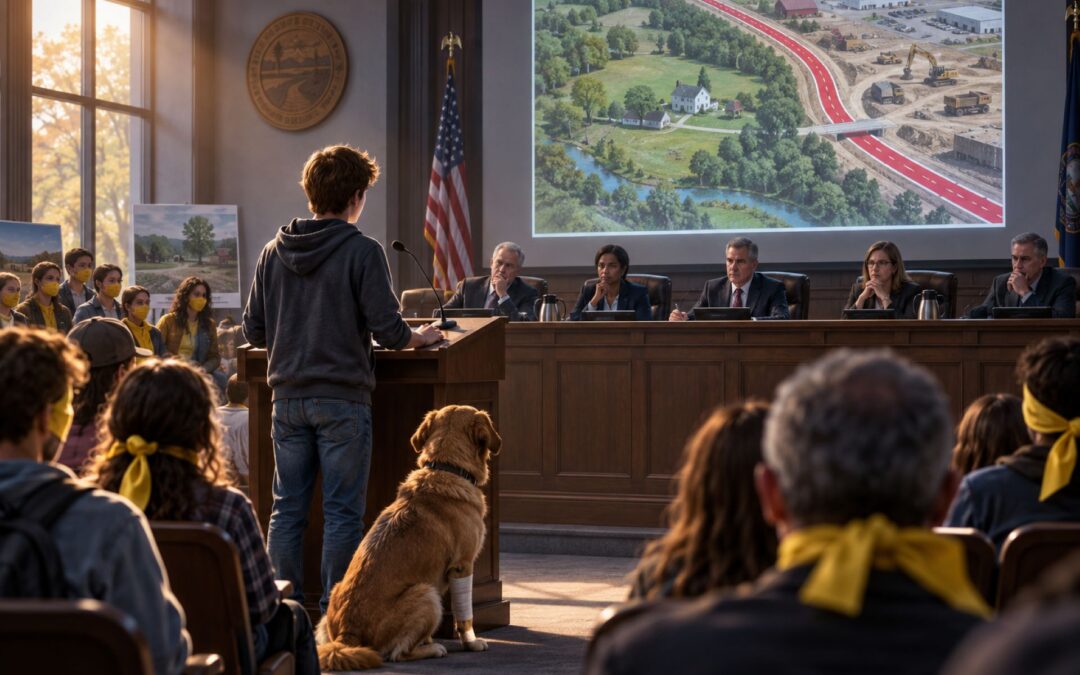
By the night of the County Commission hearing, the activists have transformed a technical infrastructure dispute into a public event. Hundreds of people gather outside the building before the meeting begins. Yellow masks and bandannas turn the opposition into an immediately visible bloc, and the large number of children makes the protest especially difficult for elected officials to dismiss.
The hearing nevertheless begins on the project supporters’ terms. State highway representatives present technical arguments, traffic studies, maps, and projections. The material is lengthy and difficult to follow, and opponents suspect that the exhausting presentation may help thin the crowd. Grisham uses the sequence to show another form of institutional power: expertise and procedure can shape a public meeting long before anyone casts a vote.
Sebastian Ryan eventually receives time to answer the official presentation. His opposition is more structured than the children’s campaign. He attacks the bypass point by point and tries to challenge the assumptions supporting the project. Commissioners who favor the road push back aggressively, especially Lucas Grimes and Buddy Klasko.
The hearing becomes increasingly contentious. People demand the opportunity to speak, commissioners debate how many speakers can reasonably be accommodated, and procedural rules are altered because the meeting cannot continue indefinitely. Supporters emphasize congestion, business needs, trucking, and growth. Opponents emphasize lost land, community damage, environmental concerns, and the use of eminent domain against families such as the Quinns.
Hardie’s father speaks on behalf of property owners whose homes and farms lie in the route. His position gives the eminent-domain question emotional and moral force, but Grisham has already prepared readers to understand that the issue cannot be resolved simply by declaring all compulsory acquisition illegitimate. The argument is specifically about whether the Red Creek Bypass creates enough public benefit to justify these losses.
Theo has not planned to become the central speaker. Sebastian unexpectedly calls upon him to represent the children, forcing Theo into the most intimidating public-speaking moment of his life. His success in debate has made him confident when prepared, but this time he has no notes, no structured argument, and no expectation that he will be at the podium.
At first he nearly freezes. Then Mr. Mount’s training returns to him. Theo begins with something personal and familiar: the legal importance of property. From there he moves into eminent domain and the way public power can take land from people who do not wish to sell.
He then broadens his argument to the children gathered around him. The bypass is not only about commuters and businesses. It affects a school, recreation, families, homes, and the environment in which children will grow up. Theo becomes more effective as he speaks because he stops trying to sound like a miniature adult expert and instead speaks from the position he genuinely occupies: a child who has learned enough law to understand the seriousness of the decision but who will also live with its consequences.
The scene completes an arc that began in Chapter 1. Theo’s debate skills were first used in a controlled school contest. Now they operate inside a real political conflict where no teacher will declare him the winner and no formal scoring system exists. Public speaking has become civic action.
The children remain clustered near the podium even after Theo is done. The crowd begins demanding a vote, denying the commissioners the ability to retreat into the usual rhythms of delay and private discussion. Faced with overwhelming public pressure, the commission proceeds.
Mitchell Stak votes yes. Lucas Grimes votes yes. Mr. Cerroni votes no. Sam McGray votes no.
The decision therefore reaches Buddy Klasko with the vote tied 2–2. Klasko has behaved throughout the hearing like a supporter of the project, so the opposition has reason to expect defeat. Instead, after visibly hesitating, he abstains.
Without three affirmative votes, the bypass motion fails.
The victory is politically dramatic but narratively ambiguous in one important respect: Grisham never explains why Klasko abstains. Theo’s anonymous letters cannot have influenced him because Theo never mailed them. The Parkin Land Trust documents were never released. The story offers no secret scene revealing that Klasko discovered the conflict of interest or changed his mind because of some private conversation.
The safest reading is therefore the literal one. The activists create enormous public pressure, the hearing exposes the intensity of opposition, Theo gives an effective speech, and one commissioner who had appeared supportive refuses to cast the decisive yes vote. Anything more specific about Klasko’s motive would be speculation.
The final chapter moves away from government buildings and legal arguments to the Quinn farm. The family hosts a celebration for the people who helped oppose the bypass. Theo attends with his parents, friends, activists, and Judge, whose injuries have largely healed.
That setting matters. The farm is no longer a symbol on a planning map or a parcel subject to acquisition. It is once again a lived place where families eat, children play, dogs run, and generations remain connected to the land. Reverend Quinn gives thanks for people who help one another in difficult times, and Theo quietly shares the sense of gratitude.
The ending therefore belongs to the community rather than to Theo alone. He becomes the most visible young activist, but the novel refuses to make him solely responsible for the outcome. The bypass is defeated by accumulated effort: landowners, environmental organizers, teachers, students, parents, lawyers, reporters, voters, and the pressure created by a public meeting too crowded and politically charged to ignore.
Theo Boone and the People Who Shape His Choices
Theo is unquestionably the center of the novel, but The Activist works by surrounding him with people who embody different relationships to law, authority, responsibility, and public action. His growth comes less from abandoning old beliefs than from learning how those beliefs operate when they collide with real institutional constraints.
Theo Boone
Theo begins the novel as a highly capable thirteen-year-old who already sees himself as belonging to the legal world. He spends time in courtrooms, follows trials for entertainment, has his own small office at Boone & Boone, knows judges and lawyers around town, and imagines his future in unusually specific terms. His confidence can be admirable, but it can also become nosiness and overreach.
His strongest quality is his instinct for fairness. In the opening debate, he argues from fairness toward a position involving undocumented students. With Hardie, he quickly sees that legal compensation cannot fully answer the emotional problem of losing ancestral property. After Judge’s beating, he wants accountability. During the bypass campaign, he responds intensely to the possibility that children and families will bear costs imposed by more powerful adults.
Yet Theo does not always distinguish moral intuition from legitimate authority. He reads information he should not read. He interferes with matters involving his father’s client. He initially believes that if he knows something important and the cause is good, using that information may be justified.
That is why the anonymous-letter sequence matters so much. Theo’s ethics mature when he accepts a limit that works against his preferred outcome. He would like to force Stak away from the bypass. He possesses information that might do exactly that. Instead, he concludes that the means would compromise the professional values he claims to respect.
Theo’s development is therefore real but not transformative in the conventional sense. He does not begin selfish and become compassionate, or begin cowardly and become brave. His basic values are stable from the start. What changes is his understanding of how difficult those values become when they conflict.
This relative stability is also one of the limitations noted by Common Sense Media’s review of the book, which describes Theo as more plot-driven than psychologically complex. That criticism is fair up to a point. Theo remains recognizably the same ambitious, law-loving, justice-oriented boy, but the confidentiality dilemma gives him more moral depth than a purely static hero would possess.
Hardie Quinn and Judge
Hardie is the character who turns the bypass into something Theo cannot treat as an intellectual puzzle. Without Hardie, Theo might follow the controversy, debate it with his parents, and move on. Hardie makes the stakes personal by connecting the project to a specific family, specific land, and a specific history.
Hardie is not as analytically gifted or rhetorically dominant as Theo, which is precisely why their friendship works. He does not need to become the campaign’s mastermind. His function is to represent what abstract public policy looks like when it arrives at someone’s home.
Judge serves a different but equally important role. The dog is Theo’s constant companion, part comic presence and part emotional anchor. When the survey men beat him, the conflict becomes visceral in a way that maps, budgets, and political speeches cannot achieve.
Judge’s suffering also complicates Theo’s activism. After the attack, Theo has understandable reasons to hate the people associated in his mind with the bypass. That anger could make ethical shortcuts feel easier to justify. The novel therefore gives Theo his confidentiality test only after he has acquired a deeply personal grievance.
By the time Judge is running around the Quinn farm in the final chapter, his recovery parallels the restoration of ordinary community life. Both the dog and the farm have survived forces that briefly appeared capable of destroying them.
Woods, Marcella, and Ike Boone
Theo’s parents offer contrasting but complementary models of legal adulthood. Woods Boone practices real-estate law and initially seems less exciting to Theo because he rarely appears in court. Yet The Activist reveals why transactional law matters. Woods’s work touches land ownership, companies, contracts, options, and development—the very machinery beneath the bypass controversy.
Woods also represents professional restraint. Theo resents the idea that his father would represent Joe Ford, but Woods understands something Theo still has to learn: lawyers do not automatically share their clients’ character or politics. Representation creates duties that survive personal preference.
Marcella Boone is more openly sympathetic to Theo’s activism. Her work as a family lawyer exposes her to people under pressure, and she tends to treat her son’s political involvement as an opportunity to exercise judgment rather than something children should avoid. She still worries about his safety, especially once the campaign becomes public and hostile, but she supports his right to participate.
Ike is the most complicated of the three adults. He is cynical about politics, dismissive of developers, suspicious of powerful people, and personally disgraced within the legal profession. Theo might reasonably expect him to endorse almost any tactic that hurts Ford or the bypass.
Instead, Ike becomes the character who draws the hardest ethical line. Client information remains protected even when the client is unpleasant and the information could help a cause Ike himself supports. That makes Ike’s advice more persuasive because it does not arise from sympathy for Ford. It arises from respect for a professional rule that must matter most when breaking it would be convenient.
Sebastian Ryan, Mr. Mount, Major Ludwig, and Theo’s Friends
Sebastian Ryan expands Theo’s imagination of what a lawyer can be. Until this novel, Theo tends to associate legal greatness with trials, judges, and dramatic courtroom contests. Sebastian practices advocacy in a different arena, using environmental law, public meetings, research, and organizing to challenge development decisions.
Theo admires Sebastian almost immediately. The admiration has an element of hero worship, but it also represents intellectual growth. Law can operate before a project is built, before someone is prosecuted, and before a dispute becomes a trial. Lawyers can shape policy as well as litigate after harm occurs.
Mr. Mount teaches Theo the practical communication skills that make his political role possible. Debate training gives Theo more than confidence. It teaches him how to structure arguments, respond under pressure, control pacing, and connect abstract issues to concrete examples. Those habits culminate at the commission hearing.
Major Ludwig contributes a different lesson. He teaches Theo responsibility rather than persuasion. The copperhead episode forces Theo to accept that leadership can involve blame for failing to act soon enough, even when someone else behaved more recklessly.
April, Woody, Chase, and the other young activists prevent Theo from becoming a fantasy of solitary genius. April helps shape campaign ideas, Chase brings technical ability, Woody participates in research and action, and Hardie supplies the personal cause. Theo often becomes the speaker, but the campaign’s power comes from collaboration.
Joe Ford, Mitchell Stak, and the Political Opposition
Joe Ford and Mitchell Stak are less psychologically complex than Theo’s family and mentors. Ford primarily represents speculative development and the ability of well-positioned businessmen to profit from public infrastructure. His interest in the bypass is not ideological. It is economic.
Stak represents a different problem. As chairman of the County Commission and one of the loudest bypass supporters, he occupies public office while his son-in-law secretly owns a substantial interest in a company positioned to profit if the project succeeds. The arrangement creates a serious appearance of conflicted incentives.
The novel does not establish that Stak personally received money, that Ford bribed him, or that either man committed a proved crime. That distinction matters because the ethical power of Theo’s dilemma depends on the evidence being troubling without being magically complete. Theo has discovered something the public would probably consider important, but not a document that neatly explains every motive.
That nuance contrasts with the relatively broad way the book depicts some pro-development figures. Ford is easy to dislike, and certain commissioners seem aggressively committed to growth. The political conflict therefore sometimes divides too cleanly between sympathetic families and activists on one side and profit-oriented adults on the other.
Even so, Grisham avoids making the final victory depend on a villain’s confession or arrest. Ford remains Ford. Stak votes for the bypass. The project fails because the political coalition supporting it cannot secure a majority at the decisive moment.
Strattenburg as a Civic System
Strattenburg does not require “world-building” in the fantasy sense, but Grisham constructs it as a remarkably dense civic ecosystem. Theo moves among schools, law offices, courthouses, Scout meetings, family homes, newspapers, government offices, environmental groups, recreation facilities, churches, farms, and political hearings. Each setting represents a different kind of authority.
The school can cancel programs because of budget pressure. Major Ludwig can discipline Theo within the Scout structure. Judge Yeck can impose legal penalties within the scope of Animal Court. Woods Boone controls professional information inside his law firm. The County Commission can approve or reject the bypass. The newspaper can shape public awareness. Sebastian’s organization can coordinate opposition. Families and students can create pressure without possessing formal governmental authority.
That institutional variety is one of the book’s strongest educational features. Theo learns that “the law” is not one person or one courtroom. It includes property rules, contracts, professional ethics, criminal charges, civil disputes, public procedures, elected officials, and constitutional ideas about government power.
Eminent domain sits at the center of this system. Hardie experiences it as a threat to his family’s land, while Major Ludwig reminds Theo that compulsory acquisition has sometimes produced public benefits that communities later value. The existence of Lake Marlo is meant to complicate rather than erase Hardie’s argument.
The dispute is therefore about justification. A society may need roads, reservoirs, schools, railways, or other infrastructure. Private ownership cannot always function as an absolute veto. But the state’s ability to take property also creates extraordinary power, and The Activist asks young readers to consider who defines the public good, who pays the price, and who profits from the decision.
The economic system surrounding the bypass further complicates the idea of “progress.” Supporters can plausibly argue that traffic relief and new business are beneficial. Developers can also profit heavily from land whose value changes because of government action. Those two facts can coexist.
Theo becomes suspicious when private financial interests appear hidden behind public rhetoric. That suspicion is reasonable, but the novel’s best moments resist turning suspicion into proof. The Parkin Land Trust file is powerful precisely because it reveals an incentive structure rather than a complete criminal conspiracy.
Media forms another layer of civic power. Norris Flay can expose stories, but Theo must decide what information he is entitled to provide. YouTube and Facebook allow children to bypass traditional gatekeepers, but the campaign’s success depends on simplification and spectacle. The public hearing offers formal participation, but procedural rules determine who gets to speak and for how long.
Strattenburg is thus a small model of democratic life. Citizens have rights, but rights operate through institutions. Officials have legal authority, but public legitimacy matters. Money matters, but so do organized voters. Information matters, but ethical rules limit how some information may be used. The novel’s civic world is simplified for younger readers, yet the basic tensions are real.
The Book’s Major Themes and Ideas
The Activist can easily be reduced to a simple lesson about standing up for what is right, but that description misses what gives the story its distinctive shape. The book repeatedly asks what responsible action looks like when law, conscience, power, property, money, and persuasion point in different directions.
Law, Conscience, and Ethical Restraint
Theo loves rules because rules make conflict understandable. In court, evidence matters. Jurisdiction matters. Lying under oath has consequences. Legal reasoning gives him a structure for deciding difficult questions.
The bypass conflict refuses to stay within that structure. No law tells Theo exactly how he should feel about the Quinn farm. Eminent domain can be lawful and still painful. Development can be legal and still destructive. A commissioner can have a troubling family financial connection without the available documents proving a prosecutable crime.
The confidentiality dilemma pushes this tension furthest. Theo can construct an argument that mailing the anonymous letter may not itself be criminal. That does not answer whether using stolen professional information is ethical.
His final decision recognizes a distinction that matters well beyond legal practice: the absence of a clear prohibition does not automatically create moral permission. Theo chooses restraint when violating the rule might have produced the outcome he most wanted.
That choice gives the novel a stronger ethical foundation than a conventional children’s thriller in which exposing the secret would automatically be celebrated. Grisham instead suggests that integrity matters precisely when ethical rules become inconvenient.
Youth Civic Agency and Collective Action
Theo cannot vote. Neither can Hardie, April, Chase, Woody, or the elementary-school children wearing yellow masks. Yet they influence the political process because formal voting is only one form of civic participation.
The children conduct research, make arguments, organize families, build a recognizable symbol, use social media, contact communities affected by the project, attend the hearing, and speak publicly. Their influence comes from visibility and coordination.
Theo is important, but the novel repeatedly expands beyond him. The campaign becomes powerful only when the issue reaches hundreds of soccer families, schoolchildren, parents, environmental activists, property owners, reporters, and other residents. Even Theo’s final speech occurs while other children physically surround the podium.
That collective structure prevents the ending from becoming a fantasy in which a brilliant thirteen-year-old single-handedly defeats government. Theo helps create momentum, but the commissioners react to a political environment produced by many people.
The title The Activist therefore refers to more than Theo becoming outspoken. He learns that activism is organizational. A belief becomes politically meaningful only when people can communicate it, mobilize around it, and present it where decisions are made.
Development, Property, and Environmental Cost
The Red Creek Bypass represents competing visions of public good. Supporters see mobility, economic development, construction, commerce, and relief from congestion. Opponents see demolished homes, damaged landscapes, school exposure, lost recreation, disrupted farms, debt, and speculative development.
Grisham clearly sympathizes with the opposition, but the novel does not entirely erase the pro-development argument. Major Ludwig’s discussion of Lake Marlo demonstrates that communities sometimes accept severe local sacrifices for projects that later benefit many people.
The harder question is whether the promised benefits are substantial enough and fairly distributed. The Quinn family bears an immediate and irreversible loss. Joe Ford potentially gains a lucrative development opportunity. Residents elsewhere may gain improved traffic. The environmental costs are spread across the community.
The hidden Parkin Land Trust arrangement sharpens the theme because private gain can influence how public projects are promoted. Even when the project itself has legitimate arguments, concealed financial interests create reasonable suspicion about whose definition of “progress” is guiding the decision.
The novel therefore treats property as more than market value. The Quinn farm contains memories, family history, relationships, graves, and continuity. Compensation can assign a price to acreage, but it cannot fully replace attachment.
Speech, Media, and Procedure as Forms of Power
Theo’s most consistent power is communication. The opening debate establishes him as someone who can take a controversial issue, identify its moral center, and speak persuasively before an audience. That ability evolves throughout the novel.
The failed attempt to save the music class shows that argument alone has limits. Animal Court shows how testimony and evidence matter within formal legal procedure. Norris Flay represents journalistic power. Sebastian Ryan represents professional advocacy. The “Bypass to Nowhere” video demonstrates the ability of visual media and social networks to simplify an issue and spread it rapidly.
The yellow masks are especially effective because they communicate before anyone speaks. A room filled with children wearing the same color turns a scattered set of objections into an image of collective political identity.
The public hearing brings all of these forms together. Technical experts use statistics and official presentations. Sebastian uses rebuttal. Citizens use testimony. Children use symbolism and turnout. Theo uses spontaneous public speaking. The crowd uses chanting to pressure the commission into acting immediately.
Procedure matters because power is exercised through rules. Who speaks, when they speak, how long they speak, whether the meeting continues, and when the vote occurs all affect political possibilities. Grisham makes those procedural details part of the suspense rather than treating democracy as a simple contest of opinions.
Symbols and Motifs: Yellow Masks, Judge, the Bypass, and the Files
The yellow surgical masks become the novel’s strongest visual symbol. At first they are props in a deliberately theatrical campaign video, connecting the bypass to pollution and the health of children near Jackson Elementary. Once the image spreads, the masks become something larger: a shared political identity.
Their power comes from repetition. One child in a mask could be dismissed. Hundreds of children wearing them at a public meeting create an image elected officials cannot easily ignore. The masks turn an abstract environmental concern into a visible claim about who will breathe the consequences of the project.
Judge represents a different kind of vulnerability. The dog is innocent of the political dispute, which makes the brutality of his beating feel especially senseless. His injuries transform Theo’s anger from intellectual opposition into personal rage.
Yet Judge is not merely a victim. His recovery becomes part of the story’s emotional resolution. By the final celebration, he is once again moving freely around the Quinn property. The dog’s physical restoration parallels the temporary restoration of the threatened landscape.
The bypass itself is both literal infrastructure and an image of forced transformation. On government maps it is a line connecting transportation points. On the ground it becomes a path through homes, farms, fields, streams, and recreational spaces. The conflict between those perspectives is central to the novel.
Maps repeatedly compress lived places into planning decisions. Hardie sees family history where officials see a route. Ford sees development potential where others see rural land. The map is therefore not deceptive, but incomplete. It presents space without attachment.
The secret files at Boone & Boone represent another kind of compressed power. A few documents reveal connections that the public cannot see. Theo’s temptation arises from the fact that knowledge can be powerful even before it becomes public.
Unlike the masks, however, the files cannot legitimately become part of Theo’s campaign. That contrast is important. Public activism depends on making information visible, while legal ethics sometimes requires keeping information hidden.
Courtrooms, debate stages, and public hearings form a final recurring motif. Theo repeatedly enters spaces where words are organized by rules. He is most comfortable when those rules are clear, but the novel gradually moves him from controlled contests toward messier democratic conflict.
Style, Structure, and Grisham’s Middle-Grade Method
Grisham writes The Activist in an accessible third-person style closely aligned with Theo’s perspective. Readers understand institutions largely as Theo understands them, which allows legal and political concepts to be explained without making the novel sound like a textbook. When Theo encounters a new rule, procedure, or problem, the explanation usually emerges through conversation or action.
That method is one reason the book has considerable educational value for younger readers. As Common Sense Media notes in its review, the story naturally introduces ideas such as eminent domain, property taxes, legal procedure, debate, and public speaking while remaining a narrative rather than a civics lesson.
The structure is more deliberate than it initially appears. Chapter 1 presents formal debate. The music-class episode introduces unsuccessful petitioning. The Scout sequence explores leadership responsibility. The survey attack leads to courtroom accountability. Sebastian introduces public-interest advocacy. The secret files create an ethics problem. The viral campaign introduces mass communication. The County Commission hearing finally combines argument, organization, procedure, and political pressure.
This progression turns the novel into a widening civic education. Theo begins by thinking like a future courtroom lawyer and ends by understanding that legal life extends into transactions, government, professional confidentiality, public advocacy, and democratic institutions.
Grisham also uses humor to prevent the instructional material from becoming dry. Animal Court is intentionally eccentric. Theo’s opinions about adults, school, Scouts, and formal procedure often carry comic exaggeration. The children’s anti-bypass video uses theatrical absurdity as part of its appeal.
The prose rarely aims for psychological subtlety or lyrical description. It is built for momentum, clarity, and comprehension. Dialogue carries large amounts of exposition, and characters sometimes explain legal or civic concepts more directly than adults would in ordinary conversation.
That approach suits the intended readership, but it creates trade-offs. Some scenes exist partly because they teach. The Scout snakebite subplot occupies considerable narrative space before the bypass becomes dominant, and readers primarily interested in the central political mystery may initially wonder why Percy’s copperhead matters.
Its real function becomes clearer later: Theo’s suspension teaches him that leadership creates responsibility. Still, the sequence is longer than strictly necessary for that lesson and slightly delays the novel’s strongest material.
The antagonistic side of the bypass debate can also become broad. Joe Ford is presented primarily as an aggressive developer. Several supporters appear more interested in profit and growth than in difficult moral trade-offs. The children’s campaign video openly caricatures their arguments.
That simplicity makes the political stakes easy for younger readers to follow but reduces the complexity established earlier by Major Ludwig’s defense of legitimate eminent domain. The book is strongest when it acknowledges that public projects can have genuine benefits and that ethical problems arise from how costs, power, and incentives are distributed.
The most sophisticated structural choice is also the one most likely to frustrate readers: Grisham does not turn Theo’s discovery of Parkin Land Trust into the mechanism of final victory. In a more conventional thriller, the secret file would become the weapon that destroys the corrupt scheme. Here, Theo refuses to use it.
That choice strengthens the moral arc but weakens the mystery payoff. The information feels narratively explosive, and readers naturally expect some external consequence. Instead, it primarily changes Theo.
Ending Explained: Why the Bypass Fails—and What Remains Unresolved
The literal ending is straightforward. The five county commissioners must decide whether to approve the Red Creek Bypass. Mitchell Stak votes yes. Lucas Grimes votes yes. Cerroni votes no. Sam McGray votes no.
Buddy Klasko therefore holds the decisive fifth vote. Although he has appeared sympathetic to the bypass, he abstains. The final result is two votes in favor, two against, and one abstention, which means the motion fails because supporters cannot produce a majority.
The bypass is defeated.
What remains unclear is why Klasko abstains. The novel shows his hesitation and discomfort but never enters his mind or provides a later explanation. Readers can imagine several possibilities: the enormous public turnout may have frightened him politically, Theo’s speech may have influenced him, Sebastian’s arguments may have created doubts, or he may simply have lost confidence in supporting the project under such intense scrutiny.
None of those explanations is confirmed.
The Parkin Land Trust documents cannot directly explain his vote. Theo never mails the letters to Stak, never sends the documents to Norris Flay, and never publicly reveals the Malzone connection. There is no scene in which Klasko learns the secret from Theo.
That unresolved separation between the secret deal and the final vote is essential to understanding the book. Theo discovers potentially damaging information but chooses not to use it. He then continues the fight through legitimate public methods.
The final political victory therefore belongs to open action rather than hidden leverage. The campaign mobilizes families. The video reaches a large audience. The yellow masks create visible solidarity. The public hearing draws an overwhelming crowd. Citizens speak. Theo makes a compelling argument. Political pressure becomes impossible to ignore.
Whether those forces directly cause Klasko’s abstention cannot be proved, but they form the visible context in which he refuses to provide the third yes vote.
The unresolved Parkin Land Trust subplot can be read in two ways. The more generous interpretation is that Grisham deliberately denies readers a conventional corruption exposé because Theo’s ethical choice matters more than punishing Ford or Stak. The boy who wants to become a lawyer proves that ambition means accepting professional boundaries even when violating them would help his friends.
The less generous interpretation is that the novel sets up an unusually compelling mystery and does not fully pay it off. Ford’s scheme remains hidden from the public. Stak faces no investigation. Woods never receives a complete reckoning with the possibility that his work helped create a vehicle for ethically questionable development. Klasko’s vote remains unexplained.
Both interpretations can be true at once. The unresolved plot strengthens Theo’s moral development while weakening conventional narrative closure.
Chapter 29 provides a different kind of closure. Instead of exposing corruption or celebrating inside a courtroom, the characters gather at the Quinn farm. The place that might have been bulldozed becomes the location of the final celebration.
Judge is recovering. Theo’s parents are present. His friends are there. Sebastian and other activists attend. The Quinn family feeds the people who helped them, and Reverend Quinn expresses gratitude for community support.
The novel ends, appropriately, with what the bypass debate was supposed to be about in the first place: people and places rather than lines on a map. Theo has his moment at the podium, but the final image belongs to a community that acted together.
Critical Review: Strengths, Limitations, and Lasting Value
Theodore Boone: The Activist works best as a middle-grade civic and legal thriller rather than as a miniature version of John Grisham’s adult courtroom novels. Its strengths come from explaining complicated institutions without stripping away narrative momentum. Readers encounter eminent domain, professional confidentiality, land speculation, local government, public hearings, debate, environmental advocacy, perjury, and political organizing through situations Theo personally cares about.
The book’s strongest achievement is its handling of Theo’s ethical dilemma. Many stories for younger readers teach that a good person should expose wrongdoing regardless of consequences. The Activist makes the harder argument that possessing truthful information does not always create the right to use it.
Theo’s decision not to mail the letters gives the novel moral seriousness. He does not simply choose honesty over dishonesty because the choice is easy. He gives up a tactic that could plausibly help his closest friend, protect a farm he has come to love, embarrass a politician he distrusts, and stop a project he believes is harmful.
That is a meaningful sacrifice.
Animal Court is another major strength. The sequence delivers the legal pleasure readers expect from the Theodore Boone series while remaining accessible. Competing stories are tested, medical evidence matters, witnesses expose themselves through false testimony, and the court separates the issues it has authority to decide from those that belong elsewhere.
The public hearing is similarly effective. Grisham understands that political suspense does not require a gun, murder, or secret courtroom surprise. Rules of procedure, exhausted crowds, limited speaking time, uncertain votes, and a commissioner’s hesitation can create genuine tension.
Theo’s final speech also works because it has been structurally earned. The novel has spent hundreds of pages showing him debate, research, argue, fail, overreach, accept discipline, learn confidentiality, and practice advocacy. His ability to speak under pressure does not appear suddenly because the plot needs a heroic climax.
The civic message is constructive without becoming entirely idealistic. Children lack votes, but they can still participate through research, communication, public presence, and coalition-building. Theo alone does not save the day. His effectiveness depends on parents, teachers, lawyers, activists, friends, property owners, reporters, and hundreds of other children.
The novel also deserves credit for not treating eminent domain as automatically evil. Major Ludwig’s Lake Marlo example introduces a genuine competing principle: governments sometimes require property to create public goods. That one conversation prevents the entire novel from becoming a simplistic argument that private ownership always overrides collective need.
Yet the book does not always maintain that level of balance. As the bypass conflict escalates, supporters become easier to dislike. Ford is primarily a symbol of profit-seeking development. The survey workers become violent criminals. Several commissioners come across as impatient or hostile toward opponents.
The “Bypass to Nowhere” video deliberately exaggerates the pro-bypass position for comic and persuasive effect. That makes sense as activism, but because the novel itself largely sympathizes with Theo, the distinction between the campaign’s rhetoric and the book’s own position can narrow.
Characterization presents a similar limitation. Theo is likable, intelligent, and ethically engaged, but his fundamental identity barely changes. He begins as a boy who loves law, wants to become a lawyer, believes in fairness, and enjoys public speaking. He ends as a boy who loves law, wants to become a lawyer, believes in fairness, and has learned a more mature version of professional restraint.
That is development, but it is development within a stable personality rather than transformation. Several secondary figures are even more functional. Sebastian is the admirable activist lawyer. Mr. Mount is the wise debate coach. Major Ludwig is the leadership mentor. Ford is the developer. Stak is the pro-growth politician with a troubling connection.
For the intended age range, that clarity has advantages. Readers rarely lose track of what each character contributes. For older readers, however, the moral and political world may feel cleaner than the real conflicts it imitates.
The Scout subplot illustrates another trade-off. Percy’s copperhead bite and Theo’s suspension provide a useful lesson about leadership, and that lesson does matter later. Even so, the sequence slows the central bypass storyline before the novel reaches its most distinctive conflict.
The most significant weakness is the unresolved Parkin Land Trust plot. Once Theo discovers the ownership structure connecting Ford, Malzone, and Stak, the story appears to be building toward a major revelation. That expectation is reasonable because Grisham gives the discovery substantial narrative weight.
Theo’s refusal to misuse the information is excellent character writing. The problem is that the external story then almost abandons the secret. No independent investigator uncovers it. No journalist finds the documents another way. No commission inquiry begins. Stak does not face public questions about his son-in-law’s financial interest.
The ending therefore produces two different kinds of satisfaction. Ethically, Theo makes the right choice. Politically, the bypass fails. Mysterially, however, the most intriguing unanswered question remains unanswered.
That may be intentional, but it still costs the novel some payoff.
The social-media material also dates the book to the early 2010s. Facebook pages and YouTube virality are treated as relatively novel tools of grassroots mobilization. The exact platforms and mechanics now feel period-specific, but the underlying idea has aged well: political campaigns can spread rapidly when ordinary citizens create emotionally effective content that travels outside traditional media.
Other aspects have aged even better. Infrastructure disputes still involve conflicts among development, property rights, environmental effects, public budgets, traffic, and private economic incentives. Political campaigns still rely on visual symbols, turnout, media attention, and simplified messaging. Officials still face questions about conflicts of interest. Professionals still confront situations in which confidential information may reveal something troubling but cannot simply be disclosed at will.
For younger readers, the book’s greatest continuing value may be that it refuses to treat civics as something that begins at voting age. Theo cannot cast a ballot, but he can learn the issue, identify affected communities, speak publicly, persuade adults, and participate in a formal hearing.
At its best, The Activist shows democracy not as a clean mechanism that automatically produces correct outcomes but as a system requiring information, organization, argument, procedure, pressure, and ethical restraint.
Is Theodore Boone: The Activist Worth Reading?
Theodore Boone: The Activist is worth reading for younger readers who enjoy mysteries, legal stories, debate, politics, environmental conflicts, or characters who solve problems primarily through thought and communication rather than physical power. It is especially effective for readers curious about how courts, local government, property law, and public hearings work because Grisham explains those systems through events that carry personal stakes.
Existing Theodore Boone readers will also find meaningful development in Theo’s understanding of what becoming a lawyer actually demands. His fascination with the profession has always involved courtroom excitement, argument, and justice. Here he encounters one of the less glamorous obligations: information may remain confidential even when revealing it would help a cause he believes is morally right.
Readers seeking the psychological complexity, moral ambiguity, or intricate corruption plotting of an adult political thriller may find the novel too simplified. The antagonists are sometimes broad, the Scout material delays the central plot, and the Parkin Land Trust mystery never receives the full external resolution that its setup seems to promise.
Those limitations do not undermine the book’s strongest achievement. Theo wins his most important battle before the County Commission ever votes. At the mailbox, he decides that activism does not give him permission to abandon the ethical limits he wants to live by.
The bypass ultimately fails through public organizing, persuasion, turnout, and political pressure. Theo therefore emerges not simply as a boy who learned how to fight authority, but as one beginning to understand something more difficult: a good cause does not automatically justify every available method. That distinction gives Theodore Boone: The Activist its lasting value and makes it one of the Theodore Boone novels most interested in what responsible citizenship actually requires.
Last Updated on September 12, 2026 by Aseem Gupta