
Reading Time: 20 Minutes
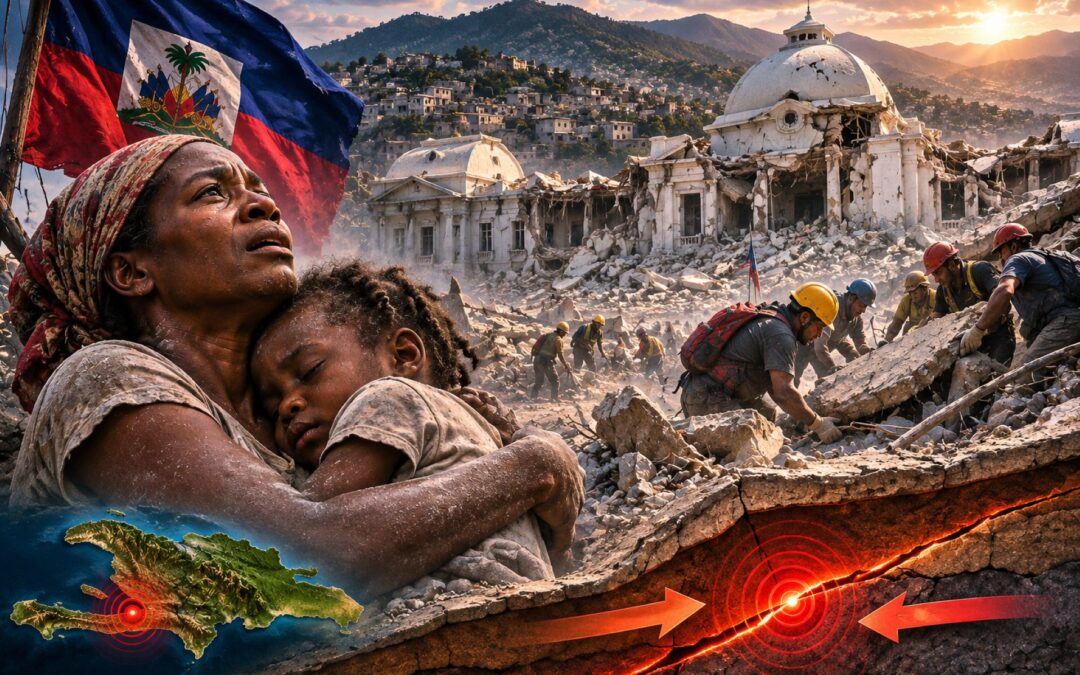
At 4:53 p.m. on 12 January 2010, the ground began shaking beneath southern Haiti. In Port-au-Prince, people rushed from offices, homes and shops as walls cracked and buildings collapsed. The National Palace, an emblem of the republic, was badly damaged. Hospitals and schools fell, streets disappeared beneath rubble, and communications failed. Within roughly half a minute, an already vulnerable country faced a disaster of extraordinary proportions.
The earthquake measured magnitude 7.0. That made it a major event, but not an exceptional one by global standards. Later that year, a far stronger magnitude 8.8 earthquake struck Chile. Yet the Haitian disaster killed vastly more people, despite releasing only a fraction of the seismic energy. Why did a powerful but far from unprecedented earthquake become one of the deadliest of modern times?
The answer lies partly underground, where tectonic forces had accumulated for centuries. But the crucial difference was above ground: where people lived, how buildings were constructed, whether hospitals could function, and how much capacity the state possessed when its own institutions were destroyed.
Haiti’s tragedy is a stark demonstration that an earthquake is a natural hazard, while the scale of the catastrophe it creates depends heavily on human decisions.
The Earthquake and the Fault Beneath Hispaniola
Haiti occupies the western portion of Hispaniola, an island it shares with the Dominican Republic. Its mountains, coastal plains and valleys were formed partly through the enormous forces generated by moving sections of Earth’s crust. Beneath and around the island, the Caribbean and North American tectonic plates move relative to one another, accumulating strain along a complicated network of faults.
The plates do not glide smoothly past each other everywhere. Sections can remain locked while the surrounding crust continues to deform. Eventually, accumulated stress overcomes resistance and rock slips suddenly, sending seismic waves outward. The waves shake the ground and everything resting on it. Their effects depend not only on how much energy is released, but also on depth, distance, local geology and the kinds of structures they encounter.
Southern Haiti lies near the Enriquillo–Plantain Garden fault zone, which extends through the region toward Jamaica. Northern Hispaniola is influenced by the Septentrional fault system. Both are part of a broader plate-boundary region capable of producing destructive earthquakes. The risk was no secret to geologists, and it had a long historical record.
Major earthquakes struck the area around Port-au-Prince in 1751 and 1770, causing extensive destruction during the French colonial period. Another devastating earthquake hit northern Haiti in 1842, including Cap-Haïtien, and powerful seismic events have affected the wider island since then, including in 1946. The historical record was incomplete, but it provided ample reason not to regard Hispaniola as geologically quiet.
During the long interval without a comparably destructive earthquake near Port-au-Prince, public attention increasingly shifted toward other threats. Hurricanes, flooding, political upheaval and poverty were far more visible from year to year. The absence of a recent earthquake did not mean strain had disappeared beneath the surface. It simply allowed the danger to become easier to overlook.
Scientists were sounding warnings before 2010. In 2008, researchers including Paul Mann and Eric Calais discussed accumulated strain along Hispaniola’s fault systems and the possibility of a large earthquake in southern Haiti. The warning identified a serious hazard, not the day or year on which a rupture would occur. Seismology could recognize the risk, but it could not issue a precise countdown.
At approximately 4:53 p.m. local time on 12 January 2010, a magnitude 7.0 earthquake struck near the town of Léogâne, roughly 25 kilometers southwest of Port-au-Prince. Its focal depth was estimated at about 13 kilometers—shallow enough for strong shaking to reach densely inhabited areas without losing much intensity along the way.
An earthquake’s epicenter is the point on the surface above the location where rupture begins underground; it is not necessarily where damage is worst. Seismic waves travel outward, and the intensity of their motion changes with distance and local ground conditions. Two neighborhoods at similar distances from an epicenter may experience very different shaking if one stands on firm rock and the other on softer sediments. That distinction would become crucial in explaining the damage observed around the bay and the nearby hills.
Early reporting frequently stated that the Enriquillo–Plantain Garden fault itself had ruptured. Subsequent geological and satellite investigations complicated that conclusion. The main mapped strand showed no clear surface rupture in the inspected area; much of the earthquake’s motion appears to have involved a previously unmapped or poorly understood fault near Léogâne, with a complex mixture of horizontal and compressional movement. Being close to a known fault system was important, but identifying the exact rupture required evidence gathered after the disaster.
The main shock lasted only tens of seconds, followed by aftershocks that frightened survivors and threatened already damaged structures. Ground conditions also mattered. Soft deposits can amplify shaking, while unstable slopes can fail and coastal fills can shift or liquefy. Landslides occurred in the surrounding hills, and sections of the Port-au-Prince waterfront suffered ground deformation that damaged port facilities.
Magnitude itself measures the size of an earthquake at its source; it does not determine the death toll. Each whole-number increase on the moment-magnitude scale corresponds to roughly 32 times the energy, so the magnitude 8.8 Chilean earthquake released hundreds of times more energy than Haiti’s magnitude 7.0 event. Yet Chile had decades of experience with earthquakes and had invested considerably more in earthquake-resistant construction. Haiti’s far greater mortality was a warning against equating geological force with human consequences.
Why So Many Buildings Collapsed
The most immediate reason so many people died was that buildings failed around them. A strong earthquake becomes a mass-casualty event when homes, workplaces, schools and hospitals cannot withstand lateral shaking. In Haiti, large numbers of structures had been erected without engineering systems capable of carrying those forces safely from roof to foundation.
Concrete and concrete blocks were common construction materials. Neither is inherently unsuitable for an earthquake-prone country: properly designed reinforced-concrete buildings can perform well under intense shaking. The difficulty arises when heavy concrete slabs and masonry infill are supported by poorly detailed columns, weak connections, inadequate steel reinforcement or unreliable foundations. A building may stand for decades under its ordinary weight and still have very little capacity to resist sideways movement.
Many families had built incrementally, adding rooms or floors as money became available. That approach reflected necessity, not ignorance. Land was expensive, wages were low, professional engineering advice could be difficult to obtain, and official inspection was inconsistent. A household needing shelter immediately could not necessarily afford a more sophisticated structural system simply because scientists knew the danger existed.
Poor workmanship compounded the problem. In some buildings, concrete mixes were weak or steel bars were insufficient, wrongly positioned or poorly anchored. Columns could fail where they met beams, and heavy concrete-block walls could crack or detach from frames. The building’s apparent solidity was deceptive: weight without appropriate reinforcement could make collapse more deadly.
The USGS and Earthquake Engineering Research Institute investigation documented widespread failures associated with inadequate earthquake-resistant design, deficient structural dimensions, poor reinforcement details and construction practices. Its engineers also observed examples of buildings designed with seismic forces in mind that performed substantially better. Those contrasting outcomes demonstrated that the devastation was not unavoidable simply because the ground shook.
Engineers paid particular attention to the interaction between concrete frames and the masonry walls built between them. A wall that appears to fill an empty frame may alter how forces pass through columns during an earthquake. If one floor is relatively open for shops or parking while upper floors contain stiff walls, the open level can become a soft story, concentrating movement where columns are least able to resist it. Details invisible to an untrained eye can decide whether a building cracks, bends or fails completely.
The problem was not limited to informal settlements. Government offices, institutions and commercial properties could also be constructed without adequate seismic design. Money alone offered no guarantee of safety when inspection was weak and the engineering assumptions behind a building were inadequate. Conversely, low-cost design improvements could reduce risk considerably when builders understood why reinforcement and connections mattered.
One particularly deadly pattern was pancake collapse. When supporting columns or walls failed, an upper floor could drop onto the floor below, which in turn collapsed under the sudden weight. Several stories might then pile together, leaving almost no survivable space between the slabs. People buried in these compact layers could be extremely difficult to locate or extract before dehydration, injury or further collapse killed them.
Other buildings tilted, partially collapsed or shed heavy walls. Structures on steep slopes were vulnerable to unstable foundations and landslides. Narrow streets could be blocked by debris falling from both sides, leaving residents trapped even when their own houses remained standing. A single unsafe building could therefore endanger its occupants, its neighbors and the emergency route beside it.
Haiti had faced a practical conflict between hazards for generations. After destructive eighteenth-century earthquakes, colonial authorities reportedly encouraged or required lighter timber construction in some areas. Timber can be forgiving during seismic shaking, but poorly built lightweight houses are also vulnerable to hurricanes, a frequent Caribbean threat. The solution is not simply to choose wood over concrete or vice versa; it is to design for both earthquakes and storms using materials, joints, roofs and foundations appropriate to the location.
Retrofitting an existing building also requires money and technical capacity. Strengthening columns, improving connections and checking foundations are less visible than constructing a new façade or adding another floor. In places where residents and officials are overwhelmed by immediate needs, preventive engineering can seem easy to postpone. The costs of that postponement become clear only when the ground moves.
The damage extended across nearly every category of building. Thousands of schools were damaged or destroyed, along with hospitals, apartment blocks, hotels, offices and places of worship. The Cathedral of Our Lady of the Assumption in Port-au-Prince collapsed, killing people inside, including Archbishop Joseph Serge Miot. The Hotel Montana, an important gathering place for visitors and aid workers, also suffered catastrophic collapse.
The exact number of buildings destroyed depends on which assessment is used and whether severely damaged but standing structures are counted separately. A major post-disaster assessment identified roughly 115,000 buildings destroyed and 145,000 seriously damaged. The scale matters more than the false impression that every published building statistic represents the same definition. For the people underneath the ruins, the failure was immediate and irreversible.
Port-au-Prince: Concentrated Exposure and Fragile Lifelines
The earthquake struck close to Haiti’s principal urban and administrative center. Port-au-Prince had grown rapidly as families moved from rural areas seeking employment, education, medical care and opportunities unavailable closer to home. This concentration put an enormous number of people and buildings near the strongest shaking, but it also placed much of the country’s economic and institutional capacity in the same danger zone.
The capital was not simply a densely populated collection of homes. It housed government ministries, universities, hospitals, banks, wholesalers, international organizations and major transport connections. A damaged building in such a city could mean more than the loss of one workplace. It might interrupt a service on which people in distant towns relied.
Growth had often outpaced urban planning. Informal settlements spread across steep hillsides, ravines and other difficult ground, while families subdivided existing dwellings or added stories to make room. Crowded neighborhoods were vulnerable both to collapsing structures and to blocked escape routes. It is important not to turn these communities into a stereotype: the earthquake destroyed expensive hotels and official buildings too. Unsafe construction was widespread, although the poorest residents had the fewest resources for avoiding it.
The concentration of essential functions in Port-au-Prince made the earthquake’s damage especially disruptive. When a road became impassable or a warehouse collapsed, the effects could travel well beyond the surrounding streets. Deliveries of food, water, medical supplies and fuel depended on a relatively small number of transport links already operating under difficult conditions.
The city’s port sustained serious damage, including collapse and lateral spreading of waterfront structures built on vulnerable ground. Cargo handling was disrupted just as enormous quantities of relief supplies needed to enter the country. The international airport remained a crucial point of access, but terminal and control facilities were damaged and capacity was quickly overwhelmed. The distinction matters: the airport was not simply erased, yet it was unable to function normally when demand suddenly multiplied.
Fuel storage, water distribution and power supplies became additional points of fragility. A generator is useful only while fuel can reach it, and a water pump cannot serve a community when electricity and pipes are damaged simultaneously. Even facilities that survived structurally could cease operating because the systems they depended on had been interrupted. Modern cities are networks of interdependent services, and the quake damaged so many links at once that restoring one did not automatically restore the others.
Roads were obstructed by rubble, damaged vehicles and fallen buildings. Emergency workers could not always reach neighborhoods that were geographically close, and relatives struggled to find one another across a city with disrupted communications. Telephone networks and electricity supplies suffered interruptions, leaving many survivors unsure where to seek care, whether family members were alive or what had happened beyond their immediate streets.
Hospitals faced the worst possible combination of circumstances: their buildings and staff were affected at the same moment that casualties surged. Injured people needed surgery, wound care, fluids and treatment for crush injuries, while facilities lacked power, equipment and safe operating space. Medical teams often worked outdoors or in improvised treatment areas because remaining inside damaged structures was dangerous.
Léogâne, much closer to the epicenter, suffered extraordinary destruction of its own. The focus on the capital can obscure the devastation in nearby towns and rural communities where homes, churches and schools also collapsed. Their residents had even fewer alternative facilities and transport options, and assistance sometimes reached them later than highly visible areas of Port-au-Prince.
The timing made the catastrophe especially cruel. At 4:53 p.m., people were at work, studying, shopping and traveling. Families were separated across neighborhoods, and many school and office buildings were occupied. But the death toll cannot be explained by the clock alone: the same shaking at a different hour would still have threatened thousands of unsafe homes.
When the Disaster Struck the Government Itself
One of the earthquake’s most consequential effects was the destruction of the institutions expected to organize the response. The National Palace suffered spectacular damage, and parliament and numerous ministry buildings were badly damaged or destroyed. Government employees were killed or injured, records and equipment were lost, and officials suddenly had to administer a national emergency without functioning offices.
Haiti’s public administration had long been concentrated in Port-au-Prince. That arrangement reduced the availability of alternative centers capable of taking over essential functions. A government whose ministries, courts, emergency offices and transport systems are concentrated near one fault has very little margin for error when the entire area is struck.
The Haitian National Police and other public services were affected along with civilians. Damaged police stations, prisons and court buildings disrupted public security and justice. Prisoners escaped from the National Penitentiary amid the destruction, adding to the burden on security services that were already struggling to account for their personnel and protect survivors.
The United Nations was not spared. Its peacekeeping mission, MINUSTAH, had been operating in Haiti since 2004, but the Hotel Christopher, housing its headquarters, collapsed. The mission’s leader, Hédi Annabi, and many staff members died. The organization that might have been expected to provide logistical support had to recover its own leadership and operational capacity while the country was in crisis.
Outside organizations were similarly exposed because so many international agencies and relief groups maintained headquarters in or near the capital. Their vehicles, communications equipment and offices could be trapped or damaged alongside those of Haitian institutions. The shock did not neatly distinguish between a vulnerable local administration and a supposedly better-equipped international organization. It exposed how much of the response system, domestic and foreign alike, had been concentrated in the very area most likely to need rescuing.
This was more than the loss of a few important buildings. A ministry requires staff, communications, documents, payroll and authority to direct resources. When those components disappear together, even officials who survive may not be able to perform routine tasks. Requests for assistance, purchasing decisions, building inspections and coordination with donors become harder precisely when speed matters most.
Some commentary portrays the government as doing nothing after the quake. That is unfair to Haitian civil servants, health workers, firefighters, local authorities and ordinary citizens who worked despite personal losses and extraordinary obstacles. Their efforts were constrained by the collapse of the institutions, equipment and infrastructure on which an organized response depended.
The destruction made even the most basic administrative decisions harder. Lists of missing people, hospital needs, shelter locations and damaged public buildings had to be assembled while telephone service was unreliable and offices were inaccessible. Coordination was partly improvised among surviving officials, neighborhood groups, military and medical personnel, and incoming foreign teams. No single organization possessed a complete picture of the emergency, and the resulting delays could have fatal consequences for people awaiting rescue or treatment.
It also created a dilemma over who should make decisions during reconstruction. Donors understandably wanted safeguards for large financial commitments, but bypassing the surviving Haitian public administration risked leaving it weaker in the long run. The country needed not only temporary logistical help but the recovery of its ability to plan, inspect, tax, coordinate and deliver services under its own authority.
The disaster also exposed the danger of treating a capital city as the entire nation. Economic opportunity and public services had been pulled toward Port-au-Prince over many decades, encouraging migration and leaving rural regions comparatively underserved. The earthquake turned that centralization into a national vulnerability. A decentralized network of functioning hospitals, administrative offices and transport connections could not have prevented the shaking, but it might have provided more ways to respond when the capital was incapacitated.
Rescue, Reconstruction and the Limits of International Aid
In the first hours, rescue was overwhelmingly local. Survivors dug through debris with their hands or improvised tools, pulled relatives and strangers from damaged homes, shared water and opened whatever space they could find. Neighbors tended the injured while fearing aftershocks that could bring down structures still standing. Families spent the night outside, uncertain whether it was safe to return indoors and often unable to contact loved ones.
The scenes were chaotic, but they were not evidence of a passive population waiting for foreigners. Haitians were already responding while international organizations assembled teams and transported equipment. Community knowledge—knowing who lived in which house, where a passageway led, who might be buried beneath a wall—was indispensable in the earliest rescue efforts.
The scale soon overwhelmed what local communities could accomplish alone. Specialized search teams, heavy machinery, surgical supplies, clean water and temporary shelter were urgently needed. Foreign governments, humanitarian agencies, medical professionals and Haitian communities abroad mobilized assistance. The Dominican Republic opened hospitals to injured Haitians, while countries farther away sent aircraft, ships, medical teams and supplies.
The opening days revealed the importance of time. People trapped in collapsed structures faced injuries, dehydration and the danger of further collapse; many survivors searched without knowing whether specialist teams would reach their street. At makeshift clinics, treatment decisions were made under severe pressure because surgical capacity and medical supplies were limited. Meanwhile, households that had escaped injury still urgently needed drinking water, food and a place to sleep away from unstable buildings.
Delivery was a formidable challenge. Port facilities were damaged, the airport had limited handling capacity, and blocked roads slowed distribution. Some emergency priorities competed with one another: clearing a runway or restoring the road to a hospital might seem less urgent than treating a person already injured, yet without functioning transport links supplies could not reliably reach thousands of patients. Effective relief required both immediate medical care and the less visible work of logistics.
The scale of human loss was immense, but even the headline death toll remains disputed. Early official Haitian estimates were about 222,000–230,000 deaths, and the government later cited roughly 316,000. Independent household surveys and other analyses have suggested substantially lower figures, with differing methods and large uncertainty. Destroyed records, rapid burials, displacement and incomplete registration made any definitive count extremely difficult. It is responsible to describe the disaster as killing very large numbers of people without presenting the highest estimate as an established fact.
Hundreds of thousands were injured, and approximately 1.5 million people sought shelter in camps or other makeshift arrangements. Broader counts of displacement were higher because some survivors moved in with relatives or left the capital altogether. The number of people directly and indirectly affected ran into the millions. Many households had lost family members, income, homes and documents at once.
The economic damage was similarly vast. A joint post-disaster assessment estimated $7.8 billion in damage and losses, a sum comparable to or greater than Haiti’s annual economic output at the time. The cost was not merely the price of replacing buildings. Schools were closed, workers lost their jobs, trade stopped, businesses lost stock and equipment, and public administration could barely function. Reconstruction was a national economic challenge as well as an engineering one.
International pledges raised hopes of transformation. Governments and charities promised homes, roads, healthcare facilities and schools. Conferences brought together donors who spoke of building back better: not simply replacing unsafe structures but creating a country less vulnerable to future disasters. In principle, the opportunity was real. Rebuilding could have combined safer construction, improved land use and stronger local institutions.
In practice, funding was difficult to coordinate and promises did not always translate into functioning projects. Some donor money went through foreign contractors and nongovernmental organizations because supporters feared corruption or inadequate financial controls within Haitian institutions. That approach sometimes delivered urgent services, but it also meant Haitian ministries and local businesses had limited opportunities to manage projects, learn from them or retain the investment.
The difference between money pledged, money committed and money disbursed also distorted public expectations. A pledge announced at a conference was not cash immediately available to a neighborhood needing shelter. Money recorded as spent might have financed emergency transport, international staff, debt relief or procurement abroad rather than a completed building in Haiti. Comparing a headline donation total with the number of new homes therefore required knowing exactly which funds were intended for housing and what other obligations they covered.
International coordination efforts included the Interim Haiti Recovery Commission, intended to review and organize reconstruction projects. Its existence reflected a real problem: many governments and charities were making decisions across overlapping sectors. But a coordinating body could not by itself resolve disputes over land, finance ministries adequately or ensure that foreign agencies listened to the priorities of communities living in camps.
Housing reconstruction revealed the difficulties. Land ownership was sometimes disputed or poorly documented, rubble removal was expensive, and families needed work and safe locations as well as new walls. Projects could be delayed by procurement problems, shifting plans and costs that rose after designs were approved. A permanent house could not simply be placed wherever a tent had stood without considering property rights, drainage, access and the safety of the next building.
One widely publicized investigation found that the American Red Cross, despite raising roughly half a billion dollars for Haiti, had directly built just six permanent homes in a particular flagship housing project. The figure should not be misrepresented as the totality of the organization’s relief activity, which included other forms of assistance. It was nevertheless a vivid example of the gap between fundraising expectations and the tangible housing outcomes of a celebrated initiative.
Aid also produced genuine results. Emergency medical services saved lives, water and sanitation projects reduced immediate risks, debris was cleared, schools reopened and some communities gained safer houses. The problem was not that every foreign organization failed or that no Haitian recovery occurred. It was that fragmented projects and weak accountability made it difficult to turn large amounts of assistance into durable national improvements on the scale required.
Then, in October 2010, Haiti experienced another catastrophe: cholera. The disease spread through communities with inadequate sanitation and limited access to clean water. Subsequent scientific investigations traced its introduction to sewage contamination associated with United Nations peacekeepers from Nepal at a camp near the Artibonite River. Cholera was not caused by tectonic shaking, and the epidemic should not be counted as direct earthquake mortality. But damaged infrastructure and widespread poverty helped make the outbreak devastating.
The epidemic sickened hundreds of thousands and caused thousands of deaths over subsequent years. The United Nations was slow to accept responsibility and in 2016 acknowledged its role and apologized for the suffering. The episode compounded distrust of international intervention, showing how a relief and security presence could cause serious harm when sanitation and accountability failed.
Long after the cameras and donor conferences had gone, displaced families continued struggling to obtain permanent housing. Haiti also confronted recurring storms, political upheaval and another major earthquake in August 2021, when a magnitude 7.2 shock devastated parts of the southwest. The later event was not proof that the 2010 earthquake had somehow triggered every subsequent disaster. It was proof that seismic danger remained real and that recovery had to be measured by resilience to the next event, not just by the amount of money pledged after the last one.
What the Earthquake Revealed About Disaster Risk
The central lesson of 12 January 2010 is not that magnitude 7.0 earthquakes inevitably kill vast numbers of people. Comparable or even stronger earthquakes have caused far fewer deaths where buildings are engineered, emergency systems are functional and institutions have the resources to act. Haiti’s enormous losses reflected an alignment of geological hazard with socially produced vulnerability.
Reducing that vulnerability requires more than publishing a building code. Regulations must be realistic for local construction, understood by builders, supported by training and checked during the work itself. Simple improvements in reinforcement, connections, foundations and structural layout can make a meaningful difference. Rebuilding the same heavy, brittle structures without those changes would leave families exposed despite the appearance of recovery.
Construction quality is also a chain of responsibilities. A design can be sound on paper and still fail if the contractor substitutes weak materials, reinforcement is misplaced or alterations are made without checking their effect. Building inspectors need professional authority, reliable funding and freedom from political pressure. Residents need information they can use when hiring builders, and engineers need incentives to design structures that are both safe and financially practical. None of those protections can be supplied by a dramatic rescue operation after the damage is done.
Risk reduction must also reflect poverty. People cannot follow safer practices if materials are unaffordable, secure land is unavailable or professional help is beyond their reach. Public investment, practical guidance, access to credit and enforceable standards have to work together. Otherwise, safety becomes something only wealthy households and institutions can purchase.
Better hazard mapping and land-use planning can identify dangerous slopes, soft soils and vulnerable coastal fills, while strengthened hospitals, schools and transport corridors can keep essential services operating after shaking. Emergency communications, drills and locally led search-and-rescue training create valuable time when outside assistance cannot arrive immediately. Decentralizing services would give communities alternatives if Port-au-Prince were struck again.
There is an important difference between predicting an earthquake and preparing for one. Scientists cannot reliably say which day a fault will rupture, but they can identify regions where damaging shaking is plausible. The warnings issued before 2010 were therefore useful even without a date. Waiting for certainty meant accepting a risk that geology had already made clear.
The contrast with Chile and other earthquake-prone societies should not become a competition over whose people are more competent. Governments with greater resources can afford inspection systems, engineered schools and hospitals, and redundant emergency infrastructure. Haiti entered the disaster with far fewer of those advantages. Its citizens demonstrated extraordinary resourcefulness, but resourcefulness cannot replace steel reinforcement, an equipped hospital or an accessible road.
The 2010 earthquake showed how disasters can destroy the systems needed to recover from them. A failed school removes education and shelter; a collapsed hospital removes treatment; a damaged port delays supplies; a destroyed ministry undermines coordination. Each failure increases the consequences of the others. Preventing that cascade is as important as preventing the collapse of any single building.
Haiti did not choose the fault beneath Hispaniola, or the afternoon on which the ground finally moved. But the extreme death toll was not written into the geology. It grew from fragile structures, concentrated exposure, neglected infrastructure and institutions that could not withstand the same shock as the buildings around them.
The most meaningful way to remember the people killed in 2010 is to distinguish what could not be controlled from what could. Earthquakes will continue to occur in the Caribbean. Whether they become catastrophes of comparable scale depends on the homes people can afford, the services their communities can reach and the decisions made long before the next tremor begins.
Last Updated on November 18, 2026 by Aseem Gupta