
Reading Time: 20 Minutes
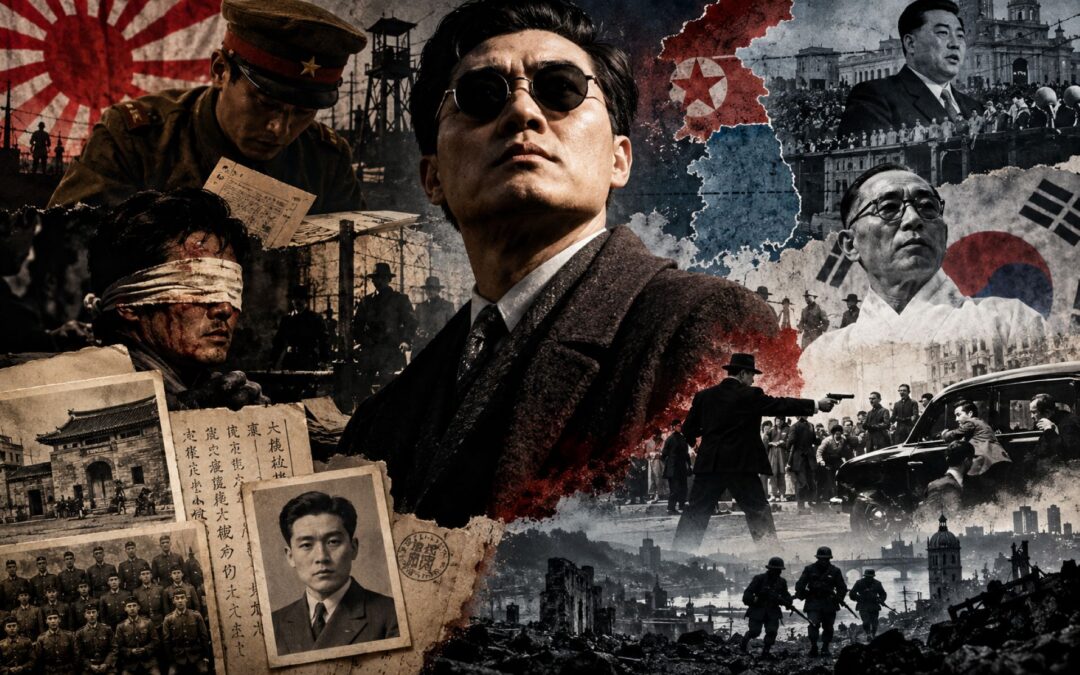
In June 1949, an American intelligence officer produced a report describing one of South Korea’s most secretive political figures. The man was Yeom Dong-jin, a partially blind former independence activist who commanded a clandestine anti-communist organization known as the White Shirts Society. His followers regarded him as a patriot, his enemies feared his operatives, and American intelligence officers considered him a valuable source of information.
Yet Yeom’s reputation concealed a remarkable contradiction. Before becoming an anti-communist militant, he had spent years working as a paid informant for the Japanese military police in Manchuria. The man who presented himself as a defender of Korean independence had served an intelligence organization responsible for suppressing resistance to Japanese imperial rule.
Yeom’s career unfolded during one of Korea’s most violent political transformations. He moved through nationalist organizations in China, Japanese intelligence networks, secret societies in Pyongyang, and anti-communist operations in southern Korea. His name became associated with political assassinations, clandestine infiltration, and attempts to eliminate communist leaders.
For decades, much of his history remained obscure. Later archival research exposed details of his wartime collaboration while raising further questions about his responsibility for political violence after liberation. His life reveals how the struggle for Korean independence became entangled with ideological rivalry, personal ambition, and the emerging Cold War.
From Colonial Korea to the Nationalist Exile Networks (1909–1935)
Yeom Dong-jin was born Yeom Eung-taek on February 14, 1909, in Pyongyang, which was then part of the Korean Empire. Japan formally annexed Korea the following year, placing his childhood within a colonial system that would dominate the peninsula until 1945.
Japanese rule restricted Korean political independence and subjected nationalist and revolutionary movements to surveillance and repression. Colonial authorities also reorganized education, commerce, transportation, and industry to serve imperial interests. For young Koreans seeking opportunities beyond the colonial system, political activism and exile offered possible paths toward national liberation.
Yeom attended Chunghwa Public Primary School before enrolling at Sunrin Commercial School in Seoul in April 1926. He graduated in March 1931, apparently displaying sufficient academic ability to pursue opportunities beyond Korea. Accounts of his life describe him as physically imposing, trained in judo, and unusually skilled in foreign languages, including Chinese, Japanese, English, German, and French.
The language claims require qualification. A later American intelligence report repeated Yeom’s reputation for multilingual fluency but also noted that he had used interpreters when communicating with American personnel. His reported abilities therefore form part of his biography without establishing that he possessed equal proficiency in every language attributed to him.
After graduation, Yeom spent some time in Paju before travelling to Shanghai, where Korean independence activists maintained extensive political networks.
The Korean Provisional Government had been established in Shanghai in 1919 following the March First Movement, a nationwide campaign demanding independence from Japan. Operating in exile, it sought international recognition and coordinated nationalist resistance. However, the independence movement was never politically unified.
Some activists preferred diplomatic pressure and political organization, while others advocated armed struggle. Nationalists, socialists, communists, and military leaders disagreed over the future political order of an independent Korea. Their organizations frequently competed for funding, influence, personnel, and assistance from foreign governments.
China became particularly important because the Kuomintang, or Chinese Nationalist Party, was itself struggling against Japanese expansion and the Chinese Communist movement.
Chiang Kai-shek’s Nationalist government supported various Korean independence organizations, partly because Korean resistance could undermine Japan’s position in East Asia. This assistance was valuable, but it also brought Korean activists into China’s complicated internal politics.
A major turning point occurred on April 29, 1932, when Korean independence activist Yun Bong-gil detonated a bomb at a Japanese military ceremony in Shanghai’s Hongkou Park. The attack killed and wounded senior Japanese officials and attracted considerable attention to the Korean independence cause.
Japan responded with an intensified campaign against Korean nationalist networks. Members of the Provisional Government relocated, and many activists sought protection or military training elsewhere in China.
Yeom became associated with independence circles that included Ji Cheong-cheon, a former Japanese-trained military officer who had joined the Korean nationalist struggle. Accounts of Yeom’s early career also place him briefly at Sun Yat-sen University in Guangzhou in late 1933, although the more securely documented part of his education began the following year.
In March 1934, Yeom entered the Korean special training class at the Luoyang branch of China’s Central Military Academy. The program was supported by Chinese Nationalist authorities and offered military instruction to Korean activists preparing for the struggle against Japan.
The academy exposed Yeom to the divisions within the independence movement. Kim Gu, an influential leader of the Provisional Government, disagreed with other nationalist figures over training arrangements, leadership, and control of students. Rival factions developed within the program, and Yeom aligned himself with Ji Cheong-cheon’s circle rather than Kim Gu’s supporters.
After completing his training in 1935, Yeom briefly served as foreign affairs director in the New Korean Independence Party associated with Ji Cheong-cheon. The position provided political experience and reinforced his credentials within nationalist circles.
However, disputes over ideological direction and organizational mergers continued. Yeom reportedly opposed arrangements that brought his associates closer to left-leaning nationalist groups, including organizations connected to Kim Won-bong.
These experiences established two features of Yeom’s political career. He had genuine connections to Korean nationalist institutions, but his allegiances were already shaped by intense hostility toward communism and rival political factions. Those relationships would later help him construct the public identity that concealed his activities under Japanese rule.
The Kwantung Army Informant and the Story of the Blind General (1936–1944)
The most consequential transformation in Yeom’s life occurred in Manchuria during the second half of the 1930s.
After leaving his earlier nationalist associations, Yeom reportedly adopted alternative identities and became involved with Chinese Nationalist intelligence networks. Accounts supplied by former associates connect him with the Blue Shirts Society, a secretive, intensely nationalist movement associated with Chiang Kai-shek’s political apparatus.
The Blue Shirts drew inspiration from authoritarian nationalism and strongly opposed communism. Later accounts also place Yeom within intelligence organizations connected to the Kuomintang. However, his exact formal memberships and the chronology of these affiliations remain less securely established than his subsequent work for Japanese authorities.
In March 1936, Yeom was arrested by the military police of Japan’s Kwantung Army in the Tonghua region of Manchuria.
The Kwantung Army was responsible for Japanese military power in Manchuria, where Tokyo had established the puppet state of Manchukuo. Its military police, commonly known as the Kempeitai, combined security investigations, political repression, surveillance, and intelligence gathering. Korean and Chinese resistance organizations were among its principal targets.
Accounts of Yeom’s detention describe severe torture that permanently damaged his eyesight. His failing vision eventually became a defining feature of his public identity, contributing to the nickname the Blind General.
What happened during his interrogation became a subject of conflicting narratives.
Yeom later told American counterintelligence officer George E. Cilley that Chinese communists had tortured him after he was betrayed by a Korean associate. This account portrayed Yeom as a committed nationalist who had suffered at the hands of communists rather than someone whose wartime activities required explanation.
For years, uncertainty surrounded the possibility that Yeom had collaborated with Japanese authorities. Some accounts suggested that he had been forced into intelligence work, while others treated the accusations as politically motivated attempts to discredit an anti-communist leader.
Modern archival research has substantially clarified this question.
In a 2021 historical study of Yeom’s intelligence career and his relationship with independence activist Kim Hyuk, historian Jung Byung Joon identified evidence that Yeom became an informant for the Kwantung Army’s military police following his arrest in March 1936.
Jung’s findings establish that Yeom worked for the Tonghua military-police headquarters for more than eight years, continuing until March 1944. His activities were not limited to a brief period of coercion immediately following interrogation.
Between June 1940 and March 1944 alone, Yeom received intelligence payments on 34 occasions, totalling 2,418 yen. These payments provide documentary evidence of a sustained professional relationship with Japanese military intelligence.
His assignments involved gathering information about underground organizations, anti-Japanese resistance networks, communications, supplies, and political activity in northeastern China. The intelligence included information on Chinese communist organizations and the anti-Japanese guerrilla movement, along with the attitudes of workers and local communities.
Some operations reportedly involved monitoring transportation routes, food supplies, ammunition, and the activities of underground political organizers. Such information could help Japanese security forces identify resistance networks, disrupt their operations, and locate individuals regarded as threats.
There is an important distinction between documenting Yeom’s intelligence service and establishing the outcome of every assignment. The records support his sustained employment as an informant, but they do not necessarily reveal every report he submitted or every arrest and death that may have followed.
His anti-communist convictions may help explain why he could operate within both Chinese nationalist and Japanese intelligence environments despite their larger conflict. Japanese authorities regarded communist resistance as a major threat, creating a limited convergence of interests with fiercely anti-communist Koreans.
That overlap did not make collaboration with Japan equivalent to participation in the independence movement. Whatever his personal motivations, Yeom supplied information to an occupying power actively suppressing anti-Japanese resistance.
His declining eyesight eventually contributed to his return to Pyongyang before liberation. Accounts differ over the precise timing, placing his return in the early 1940s, while his documented intelligence service continued until March 1944. He married during this period and began rebuilding connections with nationalist circles in his hometown.
The contradiction was extraordinary. A man with authentic nationalist credentials had also acquired a documented record of working for Japan’s military police. When Japanese rule collapsed in 1945, Yeom would have powerful reasons to ensure that only one part of his career became widely known.
Liberation, Political Murder, and the Birth of the White Shirts Society (1943–1945)
During his final years under Japanese rule, Yeom became associated with nationalist circles centered on Buddhist monk Park Go-bong in Pyongyang.
In August 1944, Yeom and his associates reportedly established Daedongdan, a secretive right-wing organization concerned about the growing influence of left-wing activists. The group attracted young supporters, including students, and developed connections among nationalist and anti-communist circles.
At this stage, the organization operated in a country still controlled by Japan. Its subsequent significance, however, came from the political vacuum created when Japanese rule ended.
Japan surrendered in August 1945, bringing thirty-five years of colonial rule to an end. Yet Korea did not immediately become a unified independent state.
Soviet forces entered northern Korea, while American forces assumed responsibility for the southern occupation zone. The division along the 38th parallel was initially an administrative arrangement, but competing political movements rapidly developed different visions of Korea’s future.
The struggle over political authority in northern Korea after liberation involved nationalists, communists, returning independence activists, local committees, and Soviet military officials. The political situation was particularly fluid in Pyongyang, where cooperation between ideological rivals coexisted with increasingly bitter competition.
One important figure was Hyun Jun-hyok, a communist activist who had previously suffered imprisonment under Japanese colonial rule. After liberation, he became a prominent leader in the South Pyongan communist organization and served as deputy chairman of a political committee that brought nationalist and left-wing figures together.
Hyun represented a form of communist participation that had initially operated within a broader political coalition. His prominence also made him a target amid the struggle between nationalist security groups and communist organizations.
On September 3, 1945, Hyun was assassinated while travelling with nationalist leader Cho Man-sik near Pyongyang.
Contemporary accounts describe a young gunman approaching their vehicle and shooting Hyun. The killing immediately produced competing accusations, including suggestions that Soviet authorities had arranged the assassination to remove an inconvenient political figure.
Later historical research identified connections between the perpetrators, nationalist security organizations, and the network that became the White Shirts Society. Jung Byung Joon attributes responsibility to Yeom’s organization, placing the assassination within the struggle for political dominance in northern Korea.
The timing matters. Hyun was killed before the White Shirts Society had developed its later institutional form in Seoul. Describing the assassination as an operation by the fully established southern organization would obscure the continuity between Daedongdan, its Pyongyang associates, and Yeom’s subsequent network.
The killing also demonstrated that Korea’s political conflict was becoming violent before two separate Korean governments had formally emerged.
Yeom came under investigation in connection with the assassination. Accounts describe his arrest and release, with his wife reportedly appealing to Soviet military authorities. The details of his release are less securely documented than the assassination and its wider political consequences.
As pressure increased, Yeom and several associates crossed into southern Korea. Park Go-bong and other members of the earlier network did not all accompany him, reflecting the continuing separation of members across the emerging occupation boundary.
In Seoul, Yeom reorganized his followers into the White Shirts Society, known in Korean as Baeguisa. Historical accounts differ slightly over the formal founding date, placing its organization around October or November 1945.
The group’s name and structure reflected Yeom’s familiarity with clandestine political organizations in China, particularly the Blue Shirts Society. Its members adopted militant anti-communism as their central political identity and developed a secret network capable of undertaking surveillance, infiltration, and targeted violence.
Yeom became its leading figure, surrounded by trusted lieutenants and operatives who were often deliberately kept unaware of the identities of other members.
The organization benefited from his reputation as a former independence activist. His military training and associations with nationalist leaders made him appear credible within the anti-communist environment of southern Korea. Knowledge of his Japanese intelligence career, by contrast, threatened the entire image he had constructed.
The fate of Kim Hyuk illustrates how dangerous that concealed history had become.
Kim Hyuk had studied alongside Yeom at Luoyang Military Academy and had subsequently endured approximately three years of imprisonment for anti-Japanese independence activities. After liberation, he cooperated with Korean police intelligence personnel and participated in action against a former Japanese detective associated with colonial repression.
Crucially, Kim knew about Yeom’s Japanese intelligence activities.
Jung Byung Joon’s research identifies Yeom’s responsibility for Kim Hyuk’s assassination and interprets the killing as an attempt to silence someone who could expose his collaborationist past. The precise operational details are not all established by the available evidence, but the historical significance is clear.
Yeom’s wartime connections had helped him develop the skills and relationships useful for clandestine activity. Preserving his postwar reputation now required concealing where some of those skills had been employed.
The White Shirts Society consequently emerged not simply as an anti-communist resistance network, but as an organization whose leader’s political identity depended upon a selective account of his earlier life.
Cross-Border Espionage and Anti-Communist Violence (1946–1948)
By early 1946, the White Shirts Society had developed into an underground organization combining political activism, intelligence gathering, and violent operations.
Yeom attempted to maintain control through secrecy and compartmentalization. Members were recruited into separate groups, and information about one unit was often withheld from others. This reduced the risk that captured operatives could expose the entire network.
According to accounts of its methods, operatives sent into northern Korea were selected partly for their familiarity with local conditions and dialects. Native speakers of a particular region could move more convincingly among local communities, helping them avoid detection while gathering information or recruiting sympathizers.
The organization reportedly maintained contacts within government offices, security organizations, the military, and other sectors of southern Korean society. Its leaders sought information about political movements while attempting to influence the emerging post-liberation order.
The precise size of the White Shirts Society remains uncertain. Some later accounts attributed thousands of members to the organization, but its clandestine structure made membership difficult to verify. Contemporary descriptions also suggested that Yeom preferred personal intermediaries and kept much of the network’s actual composition hidden.
Its operations extended beyond ordinary political surveillance.
The White Shirts Society opposed communist influence in northern Korea and sought to support nationalist groups resisting the consolidation of Soviet-backed authority. It developed links with activists associated with the former Korean Provisional Government, particularly those who rejected communist dominance and proposals for international trusteeship.
In a 2024 study of the Provisional Government’s clandestine operations against northern Korea, Jung Byung Joon documents cooperation between the White Shirts Society and a Political Operations Unit connected to the Provisional Government’s Ministry of the Interior.
These activities involved propaganda, underground political organization, intelligence collection, and attacks against communist leadership.
The Provisional Government’s networks attempted to develop contacts among Christian groups, Korean Independence Party organizations, and anti-communist activists in northern Korea. Their operations were particularly important in areas where opposition groups retained local relationships despite increasing communist control.
Hwanghae Province, situated near the division line, offered opportunities for cross-border communication and organization. Networks associated with the Korean Independence Party also conducted clandestine military training, including activities in the Mount Guwol region.
The White Shirts Society operated within this larger political environment, but it was not simply a branch of the Provisional Government. Different organizations cooperated when their objectives aligned while retaining their own leadership, methods, and political ambitions.
The distinction matters because the same operation could involve members of several overlapping networks. A connection to a particular attack does not automatically establish which individual planned it, who authorized it, or how widely its objectives were shared.
The most dramatic operations occurred in March 1946.
On March 1, as Kim Il-sung addressed a public gathering near Pyongyang Railway Station, an attacker threw a grenade toward him. Kim survived the attempted assassination. Accounts describe a Soviet officer, Yakov Novichenko, being seriously injured while attempting to remove the explosive from danger.
The attack occurred during commemorations of the March First Movement, the nationwide independence demonstrations of 1919. An occasion associated with resistance to Japanese colonial rule had become the setting for violence between rival political movements competing over Korea’s future.
Other attacks followed against figures connected to the northern communist leadership.
Historical accounts describe attempted attacks on the homes of Choe Yong-gon and Kim Chaek, prominent members of the emerging northern political establishment. Another attack targeted the household of Kang Ryang-wook, a Christian political figure associated with Kim Il-sung’s government, causing deaths among members of his household and others present.
These operations were not simply efforts to obtain intelligence. Their immediate purpose was to kill political opponents and weaken the institutions through which communist leaders were consolidating authority.
Jung’s research identifies cooperation between the White Shirts Society and other anti-communist networks in these attacks. It also places them within the broader conflict over political leadership in northern Korea, rather than reducing them to the actions of one isolated extremist organization.
Yeom’s followers were simultaneously involved in espionage.
Accounts of the White Shirts Society describe contacts with the United States Army Counter Intelligence Corps, or CIC. American personnel were interested in obtaining information about Soviet activities and the development of communist-controlled military forces in the northern occupation zone.
The society reportedly trained operatives in clandestine movement, surveillance, infiltration, and escape. Some accounts also describe instruction in demolition and guerrilla methods. Yeom’s organization claimed to dispatch regular groups of agents northward during 1946, although the reported numbers cannot be treated as independently verified totals.
One set of missions in May 1946 reportedly sought information about northern troop deployments, military strength, and Soviet equipment deliveries. Such intelligence could have been valuable to American authorities attempting to understand developments beyond the occupation boundary.
These contacts must be understood carefully. Evidence of cooperation with American counterintelligence personnel does not establish that the United States directed every action undertaken by the White Shirts Society. Intelligence collection, assistance to agents, and responsibility for political assassinations are separate questions.
The distinction became increasingly important as the emerging Cold War rivalry transformed the Korean Peninsula into a strategically important confrontation between Soviet and American power.
The United States and Soviet Union possessed competing visions for Korea, but Korean political groups were not merely passive instruments of foreign governments. Figures such as Yeom pursued their own ideological objectives and organizational interests, sometimes using relationships with external powers to strengthen their position.
By 1947, the White Shirts Society’s activity also extended to violence against political figures in southern Korea.
On July 19, 1947, Lyuh Woon-hyung, a prominent politician who advocated cooperation across ideological divisions and opposed the country’s permanent separation, was assassinated in Seoul.
Lyuh had worked to develop a political alternative to the growing polarization between the right and left. His assassination further weakened efforts to construct a broad political coalition capable of negotiating Korea’s future.
Historical research associates individuals connected with the White Shirts Society with the killing. Accounts also attribute a role to Yeom in supplying weapons or directing participants, although the degree of his personal operational responsibility requires careful distinction from the perpetrators’ actions.
The assassination was particularly revealing because Lyuh was not a northern communist leader. He was a Korean nationalist attempting to pursue compromise within an increasingly polarized political environment.
His death demonstrated how militant anti-communism could turn against figures who refused to accept the political objectives of the radical right.
The White Shirts Society had therefore developed into something more extensive than a network of anti-Soviet informants. It combined clandestine intelligence work with political assassination, infiltration, and attempts to shape Korea’s emerging political institutions through violence.
By 1948, however, the environment that had allowed private militant organizations to acquire influence was beginning to change.
The Kim Ku Assassination and the Limits of the Cilley Report (1949)
On June 26, 1949, Kim Gu, one of Korea’s most prominent independence leaders, was assassinated in Seoul by Ahn Doo-hee, an officer in the South Korean military.
Kim had spent decades resisting Japanese colonial rule and had become an important national symbol. After liberation, he opposed the permanent division of Korea and pursued negotiations aimed at establishing a unified political future.
His assassination raised questions about the political forces that opposed him, particularly elements of the military, security establishment, and radical right-wing organizations.
Three days after the killing, American intelligence officer George E. Cilley prepared a report concerning the circumstances surrounding Kim’s death. The document, dated June 29 and forwarded on July 1, contained information collected through Cilley’s contacts with Korean political and intelligence figures.
The original American counterintelligence report on Kim Gu’s assassination is an important contemporary record of Yeom Dong-jin and the White Shirts Society.
Cilley described Yeom, rendered in the report as Lyum Tong Chin, as a powerful clandestine organizer who had suffered torture and serious damage to his eyesight. Much of this biographical account reflected information supplied by Yeom himself, including the claim that Chinese communists had been responsible for his injuries.
The report also described the White Shirts Society as an underground organization with agents operating across Korean society. It emphasized the secrecy surrounding its membership, the difficulty of estimating its size, and the use of small groups for sensitive operations.
One particularly revealing passage identified Ahn Doo-hee as a member of the clandestine organization and described his connection to a special attack group. The report also associated individuals involved in earlier political assassinations with the same underground network.
These statements strengthened suspicions that the White Shirts Society had connections to the violent political circles surrounding Kim Gu’s assassination.
Yet the report was not a complete criminal investigation. It combined firsthand impressions, information supplied by contacts, intelligence assessments, and claims whose independent verification was sometimes uncertain.
It also offered a complicated picture of Yeom’s relationship with Kim Gu.
Although Yeom had reportedly criticized Kim on political matters, Cilley described channels through which Yeom communicated information to him. The document suggested that both men were connected, in different ways, to factions within the military that opposed President Syngman Rhee.
The report reproduced information concerning a possible right-wing military conspiracy against Rhee’s government. It suggested that the political tensions surrounding such plans could help explain the circumstances in which Kim Gu became a target.
However, these observations do not establish that Yeom personally ordered Kim’s assassination.
When the report attracted public attention in 2001, historian Do Jin-sun challenged the interpretation that it proved Yeom had commissioned the murder. In a contemporary account of Do’s objections to the assassination allegations, he argued that the document did not describe an actual chain of command through which Yeom directed Ahn Doo-hee to kill Kim.
Do emphasized that Yeom and Kim appeared to have maintained a relationship involving cooperation and mutual political interests, despite their disagreements. He interpreted the report as evidence of American intelligence perceptions and the surrounding political environment rather than definitive proof of Yeom’s personal responsibility.
Other historians, including Jung Byung Joon, have connected Yeom and the White Shirts Society to the assassination within a broader pattern of political violence. Those conclusions are significant, particularly when considered alongside the organization’s earlier activities.
Nevertheless, several propositions must remain distinct: Ahn Doo-hee killed Kim Gu; Ahn had reported connections to clandestine right-wing networks; the White Shirts Society was implicated in political violence; and Yeom was its leader. Those facts and assessments do not, by themselves, prove that Yeom issued the order to assassinate Kim.
The wider question of who organized or supported the killing remains entangled with competing historical interpretations of the military, intelligence services, political factions, and the Rhee government.
The Cilley report is therefore valuable for a different reason as well. It reveals how an American intelligence officer understood Yeom’s influence and relationships during a period when Korean political violence was intersecting with organized military power.
It also illustrates the limitations of intelligence records. Such documents can preserve information unavailable elsewhere, but they may contain unverified claims, selective disclosures, and interpretations shaped by the concerns of the officers who created them.
For Yeom, the report became part of a historical record that exposed both his influence and the uncertainty surrounding some of the most serious accusations against him.
From the Korea Liaison Office to Yeom’s Disappearance (1949–1950)
The establishment of the Republic of Korea in August 1948 changed the political environment in which the White Shirts Society operated.
During the American occupation, private militant organizations had benefited from weak institutions, widespread ideological conflict, and overlapping security networks. With the formation of a South Korean government, intelligence and military activities increasingly moved into formal state structures.
The White Shirts Society began losing much of its independent significance. Some members returned to civilian occupations, while others sought positions in official military and intelligence organizations. Accounts indicate that approximately one hundred remaining operatives eventually became available for absorption into newer intelligence networks.
General Charles Willoughby, intelligence chief under General Douglas MacArthur, was interested in strengthening the collection of information about northern Korea. On June 1, 1949, the Korea Liaison Office, commonly known as KLO, was established as part of the developing American-led intelligence apparatus.
Former White Shirts Society personnel became involved in these operations, bringing experience in infiltration, clandestine communications, and intelligence gathering. Their incorporation into more formal structures reduced the need for Yeom’s organization to operate as an independent private network.
The transition also reflected the changing nature of conflict on the peninsula. Covert intelligence work was becoming part of an increasingly militarized confrontation between two rival states, each claiming authority over all of Korea.
Yeom’s own position became less certain.
He had built his influence through personal relationships, secrecy, ideological militancy, and the loyalty of carefully selected followers. The growth of official intelligence institutions reduced the importance of some of those advantages.
On June 25, 1950, North Korean forces invaded South Korea, beginning the Korean War.
As northern troops approached Seoul, many government officials, political activists, and people associated with anti-communist organizations attempted to flee. Yeom reportedly chose to remain in the city despite warnings about the danger he faced.
He disappeared during the opening phase of the war.
Some accounts suggest that he was captured by advancing North Korean forces. Others leave open the possibility that he was killed, went into hiding, or disappeared under circumstances that were never documented. The available record does not conclusively establish where, when, or how he died.
His disappearance ended a remarkable career spanning Japanese colonial rule, Chinese nationalist politics, wartime espionage, and the violent creation of divided Korea.
Yeom Dong-jin’s life presents a difficult historical contradiction. He possessed genuine connections to the Korean independence movement, yet archival research establishes his extended service as a Japanese military-police informant. After liberation, he used nationalist credentials and anti-communist militancy to build an organization implicated in political assassinations and clandestine operations.
He was not simply a misunderstood patriot, nor does every allegation about him carry the same evidentiary weight. His Japanese intelligence service is documented far more clearly than his personal responsibility for every assassination attributed to the White Shirts Society.
What makes his biography significant is the way these competing identities intersected. The political world that emerged from liberation allowed former collaborators, independence activists, nationalist militants, and intelligence operatives to establish new allegiances while competing for power.
Yeom exploited that environment, but his career also reveals its dangers. The distinction between national liberation and ideological domination became increasingly blurred as rival movements attempted to determine Korea’s future through coercion and violence.
His final fate remains uncertain. The consequences of the political networks and methods he helped develop, however, extended beyond his disappearance into the intelligence struggles and unresolved divisions of the Korean Peninsula.
Last Updated on October 29, 2026 by Aseem Gupta