
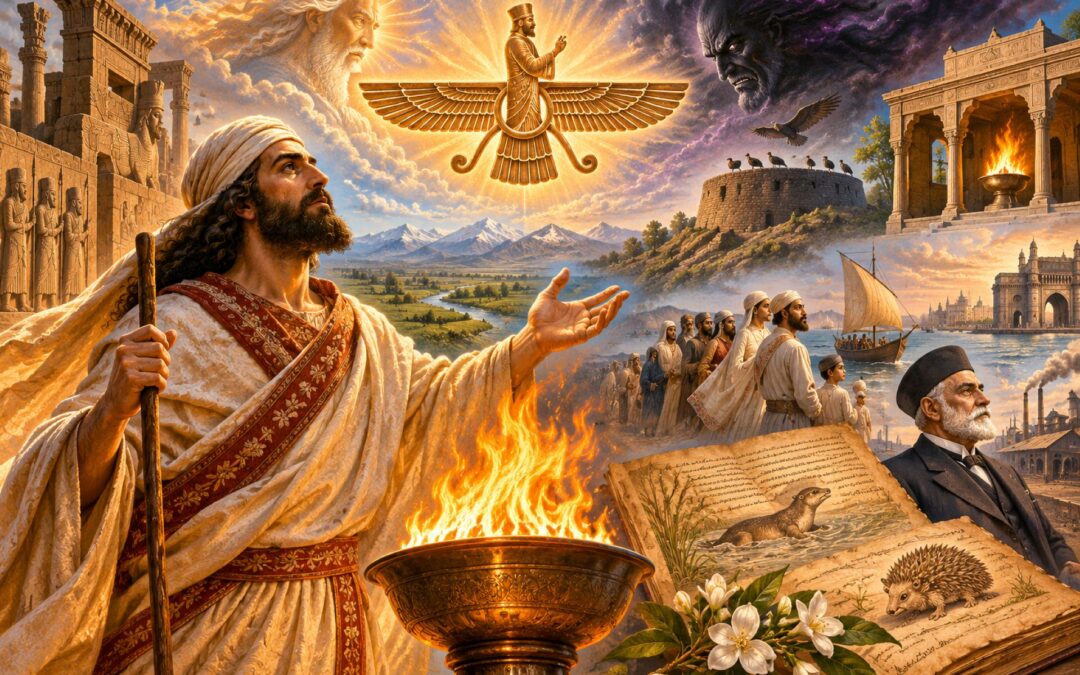
Reading Time: 21 Minutes
Long before Christianity or Islam existed, people in ancient Iran were asking a question that still troubles humanity: if the world was created by a good divine power, why was it filled with cruelty, suffering, and injustice? Their answers developed into Zoroastrianism, one of the world’s oldest living religious traditions. Its followers came to see everyday decisions not as insignificant private choices, but as contributions to a struggle over the fate of creation itself.
For centuries, Zoroastrian traditions shaped the religious landscape of Iranian empires. Today, their communities are relatively small, yet their history reaches from the palaces of Persian kings to the fire temples of India and the global Parsi diaspora. The Tata family and the musician Freddie Mercury belong to that wider story, but the faith is more than a remarkable history of survival. It begins with a prophet’s vision and an insistence that human beings can help make the world good.
From Ancient Iran to Zarathustra’s Revelation
Zoroastrians generally trace their religion to Zarathustra, known to Greek writers as Zoroaster. Many call their faith Mazdayasna, meaning worship or reverence of Mazda, the Wise Lord. It did not emerge in the modern nation-state of Iran, but among ancient Iranian-speaking communities whose religious language and practices developed across a much older Indo-Iranian cultural world.
That background helps explain why elements of the earliest Iranian religious vocabulary resemble those found in ancient Indian traditions. Both worlds knew sacred fire, ritual offerings, hymns, and inherited names for divine beings. The Iranian daevas, however, eventually became powers to reject in Zoroastrian teaching, while the related devas retained divine status in many Indian traditions. These differences reveal related religious histories, not simply one religion copied from another.
When did Zarathustra live? There is no securely established answer. The language of hymns attributed to him suggests a very early period, and proposed dates range widely across the second and early first millennia BCE. Traditional chronologies sometimes put him much later, while ancient Greek writers offered fantastically remote dates. The uncertainty matters because it prevents us from confidently placing every episode of his life against a known king or empire.
The most vivid story of his calling comes from religious tradition rather than independently verifiable biography. Zarathustra is described as a priest troubled by a world of violent raiders, suffering households, and rituals that seemed to have lost their moral purpose. The portrait of people harmed by greed and cruelty gives his message a human setting: a search for a form of religious life concerned with justice, not merely correct ceremony.
According to later accounts, when Zarathustra was about thirty, he went to a river to gather water for a ritual. There he encountered a luminous figure associated with Vohu Manah, the Good Mind, who led him into the presence of Ahura Mazda. The revelation gave Zarathustra a mission: to teach that truth and goodness belonged to the divine order, and that people must choose whether to cooperate with it.
Tradition also gives Zarathustra a powerful patron, a ruler named Vishtaspa, whose acceptance of the message helps explain its spread. Scholars caution against confidently identifying him with the father of the later Persian king Darius, who bore a similar name. The older hymns suggest a world in which patrons, cattle, kinship, and the vulnerability of communities mattered deeply, but they do not supply a complete chronological biography.
The historical prophet is difficult to reconstruct behind this sacred narrative. His earliest surviving voice is found in the Gathas, poems of prayer, praise, questioning, and moral urgency. As the British Academy’s introduction to Zoroastrian communities and traditions emphasizes, the religion has a long history of development and cannot be reduced to a single timeless set of practices. Zarathustra’s importance lies not in a biography that historians can date to the year, but in a religious vision that transformed the meaning of human choice.
Ahura Mazda, Angra Mainyu, and the Struggle Between Good and Evil
At the centre of Zoroastrian devotion stands Ahura Mazda, the Wise Lord: eternal, wise, and associated with truth, goodness, and the creation of what is good. The deity is not simply the strongest among competing gods. In the tradition’s theological language, Ahura Mazda is the source of a morally ordered universe, worthy of worship because of wisdom and goodness rather than arbitrary force.
Ahura Mazda’s qualities are expressed through the Amesha Spentas, usually understood as six Beneficent or Holy Immortals, although their enumeration and relationship to the divine vary across texts and interpretations. Among them are Good Mind, Best Truth or Order, Desirable Dominion, Holy Devotion, Wholeness, and Immortality. They may be presented as divine beings, manifestations of God’s attributes, and models for the qualities humans should cultivate. Later traditions associate these holy powers with aspects of creation, such as waters, earth, plants, and living creatures. Their spiritual significance therefore connects inward virtues to outward responsibilities: caring for what Ahura Mazda has made is one way of honouring the divine order. Calling them archangels is a useful comparison for some readers, but it can obscure what makes the Zoroastrian understanding distinctive.
Opposing goodness is the destructive spirit Angra Mainyu, also known in later tradition as Ahriman. Associated with deception, corruption, death, and disorder, Angra Mainyu seeks to spoil a creation that is fundamentally good. The daevas become allies of falsehood and destruction. This gives the religion its characteristic moral contrast: asha, truth and right order, against druj, the lie.
It is tempting to picture Ahura Mazda and Angra Mainyu as two equal, eternal gods ruling rival kingdoms. That description, however, flattens a complex religious history. The Gathas speak in ways that scholars interpret differently, while later Zoroastrian texts developed more elaborate accounts of opposing spirits and the world’s destiny. Some historical interpretations, often described as Zurvanite, gave primordial Time a special place in explaining the two spirits. They should not be treated as the uncontested belief of all Zoroastrians. Another interpretive difficulty involves Spenta Mainyu, the Beneficent Spirit, whose relationship to Ahura Mazda and the opposing destructive spirit has been understood in more than one way. A historical study of early Zoroastrianism helps explain why differences between ancient texts and later theology matter.
In an influential later cosmological account, the powers of goodness and destruction exist apart, associated with infinite light and darkness. Ahura Mazda creates the physical world, sometimes called getig, knowing that evil will enter it but can ultimately be defeated there. Angra Mainyu’s assault introduces disease, death, blighted plants, and disorder. Myths describe pure waters becoming salty, fertile land becoming desert, and fire becoming troubled by smoke. These are religious explanations of the world’s damaged condition, not accounts of physical events established by science.
The present age is sometimes called Gumēzišn, the Mixture, when good and evil are entangled in the same world. That does not make the material world evil. In Zoroastrian thought, land, water, animals, human bodies, and productive work belong to a creation worth protecting. Evil is an intruder and corruption, not the true nature of existence.
Most importantly, this struggle is not expected to continue forever. Human beings are not helpless spectators waiting for divine powers to settle their dispute. Their truthful speech, responsible choices, and useful work participate in restoring creation. The world can be wounded by evil precisely because it is good enough to be worth saving.
Asha and the Power of Good Thoughts, Words, and Deeds
The central ethical idea is asha, a word broader than any single English translation. It encompasses truth, right order, integrity, justice, and the fitting way things ought to be. Its opposite, druj, is not merely telling an occasional lie; it is the destructive force of falsehood, deceit, and disorder. In this framework, morality concerns the structure of reality as well as personal conduct.
Zoroastrians believe that human beings can recognize and choose the better path. Vohu Manah, or Good Mind, is both a sacred principle and a way of describing the moral discernment people need to exercise. Seeing another person’s suffering as wrong is only the beginning. The choice matters when that recognition becomes truthful speech and concrete action.
Truthfulness also has a social dimension. A leader who judges fairly, a trader who refuses dishonesty, and someone who protects a vulnerable neighbour can embody asha in very different circumstances. The religious contrast between truth and the lie is therefore not confined to what a person believes about the unseen world; it reaches into public trust and the conditions under which people can live together.
This is expressed in the familiar principle good thoughts, good words, and good deeds. The three belong together: intention without action is insufficient, speech can heal or deceive, and even a seemingly useful deed may be compromised by a dishonest purpose. Rather than measuring holiness only through ritual observance or inherited status, this ethic gives ordinary conduct a place in the religious life.
Its practical scope is wider than private kindness. Supporting a struggling neighbour, caring for the sick, sharing resources, confronting injustice, and participating honestly in communal life all help sustain a better world. Traditional Zoroastrian respect for agriculture, useful labour, water, and animals reflects the same conviction: preserving what is good in creation is itself a moral responsibility.
The ideal should not be confused with a claim that Zoroastrian communities have always lived in perfectly equal or harmonious societies. Like other religious civilizations, Iranian kingdoms and later diaspora communities developed hierarchies, disagreements, and rules of belonging. The ethical teaching establishes a standard against which conduct can be judged; it does not erase the complications of religious history.
Free will is crucial here. If people had no meaningful choice, their thoughts and deeds could hardly participate in the struggle between truth and falsehood. This does not mean every misfortune is someone’s moral failure, or that suffering can be resolved by positive thinking. It means that human beings remain responsible for what they do within an imperfect world, and their actions are never entirely inconsequential.
Death, Judgment, Heaven, Hell, and the Final Renovation
The moral choices of a lifetime are believed to matter beyond death. In many traditional accounts, the soul remains near the body for three nights, while family members and priests offer prayers. It then approaches the Chinvat Bridge, often translated as the Bridge of Judgment or Bridge of the Separator. The passage dramatizes the difference between a life oriented toward truth and one given over to falsehood.
Later descriptions include divine figures associated with judgment and the weighing of deeds. The soul encounters its own daena, a manifestation of the person’s religious conscience or accumulated moral character, sometimes appearing as a beautiful maiden or a frightening figure. The bridge is wide and passable for the righteous but perilously narrow for those whose actions have led them astray. These are images from religious teaching, not a single unvarying procedure described identically in every text.
The good destination is frequently called the House or Abode of Song, a realm of light and happiness. The wicked face a House of the Lie, associated with darkness, misery, and separation from goodness. Some accounts also describe Hamistagan, an intermediate condition for souls whose good and bad deeds are balanced. What determines a person’s fate is moral conduct, not simply wealth, fame, political authority, or the class into which they were born.
The images of crossing and judgment also prevent a simple assumption that religious status guarantees salvation. The soul confronts the moral significance of its own life. The person who had little worldly power may have followed truth more faithfully than someone who commanded wealth or an army. These judgments appear in varying literary forms, but they consistently connect ultimate destiny with responsibility.
Yet judgment immediately after death is only part of the religious story. The universe itself moves toward a final restoration, known as Frashokereti or Frashgird, when the damaged creation is made new. In later Zoroastrian traditions, a saviour called the Saoshyant plays a decisive role. Narratives of his extraordinary birth and mission differ across sources, and should not be reduced to the claim that every Zoroastrian text predicts one identical virgin-born figure.
The final events are startlingly physical. The dead rise, and a flood or river of molten metal passes across the world. For the righteous it is described as harmless, even comforting; for those burdened by wrongdoing it becomes a painful purification. Hell is emptied in important accounts of the final renovation, while evil loses its power to contaminate creation. The fate of Angra Mainyu and the exact language used about the end of evil vary across traditions, but the fundamental direction is clear: destruction is not granted the final victory.
This vision distinguishes Zoroastrian hope from an endless equilibrium between good and evil. The struggle is real, suffering is not dismissed, and individual actions remain accountable. But the world’s original goodness will ultimately be restored rather than abandoned. Human morality and cosmic destiny are parts of the same story, which is why an ordinary choice to tell the truth or help another person can carry such extraordinary religious significance.
Sacred Fire, Ritual Purity, and Towers of Silence
Zoroastrianism is sometimes described as fire worship, but that phrase mistakes the symbol for what it represents. Fire is revered as a powerful sign of purity, illumination, and the presence of Ahura Mazda; Zoroastrians do not ordinarily understand themselves as worshipping fire as a separate god. Its visible light and transforming heat offer an image of truth that cannot easily be concealed or confused with darkness.
Fire is important in temples, where priests maintain sacred flames and conduct prayers and rituals, but religious life is not limited to public gatherings. Different categories of temple fire have different ritual standing: the Atash Behram is not identical to an Atash Adaran or a simpler Atash Dadgah. Priests prepare themselves carefully before approaching consecrated fires, and worshippers ordinarily encounter them within a disciplined setting of prayer and respect. Families pray at home, and personal practices may include the sudreh, a sacred shirt, and kusti, a cord tied and retied with prayer. An initiation ceremony often called navjote among Parsis marks a child’s formal entry into religious practice. Calendars and observances vary, but Nowruz and the seasonal Gahambars express the connection between worship, community, and the renewal of creation.
The most sacred category of consecrated temple fire is the Atash Behram. Its elaborate preparation traditionally brings together fires from sixteen different sources, each subjected to ritual purification before the combined flame is enthroned. A lightning-kindled source forms part of this striking religious ideal. Such rites are highly specialized; not every fire temple maintains an Atash Behram, and the details should not be projected onto every local place of worship.
Purity concerns more than cleanliness in the ordinary sense. Fire, water, earth, and other parts of creation deserve protection from contamination. Death is especially associated with the invading power of decay, and traditional funeral rules seek to honour the deceased without allowing a corpse to pollute the elements. These ideas have produced some of the most distinctive and often misunderstood practices in the religion.
After a death, relatives and ritual specialists may perform prayers and prescribed ceremonies, with rules limiting unnecessary contact with the body. In some traditions a dog is brought to look toward the deceased in a rite known as sagdid. Specialized bearers then carry the body to a place of exposure. The purpose is not indifference to the dead, but a combination of respect for the person, care for the living, and ritual protection of the natural world.
The best-known exposure structures are dakhmas, popularly called Towers of Silence. In traditional forms, bodies rest on stone surfaces within an open-air enclosure, where sunlight and carrion birds help remove the flesh. The remaining bones are eventually gathered in a central place. This avoids putting decomposing remains directly into the earth or burning them in a sacred element, and the consumption by birds can be understood as a final contribution to living creation.
In recent times, these practices have faced serious challenges. Vulture declines, changing land use, urban expansion, public-health rules, and differing community preferences have made exposure difficult or impossible in some places. Different Zoroastrian communities now use or debate burial, cremation, and technological adaptations, including solar concentrators intended to assist decomposition. Iran’s shift toward cemetery burial began in places such as Tehran in the twentieth century; it was not simply one nationwide prohibition that instantly ended every tower practice.
As Encyclopaedia Iranica’s study of Zoroastrian corpse disposal shows, funerary practices have a history rather than one timeless form. Outsiders sometimes see the Tower of Silence as a strange spectacle. Within its religious logic, however, it expresses the same belief found in the reverence for fire and the protection of water: the physical world is sacred because it is good, and human obligations continue even at death.
The Avesta: Sacred Poetry, Lost Scriptures, and Unusual Animals
The principal body of Zoroastrian sacred literature is known as the Avesta. It is not one book written at a single moment by one author. Its surviving works grew through different periods of religious composition, recitation, interpretation, and preservation, in forms of the ancient Avestan language. For much of that history, priests passed sacred words from one generation to the next through disciplined oral transmission.
At the centre are the seventeen Gathas, arranged in five groups and traditionally attributed to Zarathustra himself. Their ancient language is difficult, and translating them requires judgments about poetry, grammar, ritual vocabulary, and theology. They are less like a modern handbook of religious rules than intense hymns in which the speaker questions, praises, seeks wisdom, and urges people to choose the path of truth. Their place in the tradition is foundational even though much of the detailed ritual and cosmology familiar today developed in other texts.
The wider Avesta includes prayers, liturgical materials, hymns to divine beings, and texts concerned with purity and religious observance. Scholars distinguish the Old Avestan language of the Gathas and closely related passages from the Younger Avestan of much of the remaining corpus. The surviving collection also reflects a complicated history of priestly editing and later transmission, as Encyclopaedia Iranica’s overview of the Avesta explains.
Zoroastrian tradition remembers catastrophic losses of sacred literature. One famous account blames Alexander the Great, whose conquest of the Achaemenid Empire and burning of Persepolis became symbols of devastation in later Iranian memory. Stories describe a magnificent complete Avesta written in gold on thousands of hides and destroyed in the turmoil. That detail belongs to retrospective religious accounts; historians cannot establish that such a complete manuscript existed or was destroyed in the way the story claims. Loss, reconstruction, selective preservation, and changing religious institutions provide a more complicated history than a single fire.
One surviving work, the Vendidad, offers an especially unfamiliar perspective to modern readers. It contains laws and narratives about pollution, purification, the treatment of corpses, and the protection or destruction of particular animals. Its categories make sense within a worldview in which beings may help sustain the good creation or assist forces of corruption, rather than within today’s biological classification of animals.
A hedgehog, described in some passages as a kind of prickly-backed dog, can be praised for destroying harmful creatures, while the text casts certain other animals, including the tortoise, in a very different religious light. The discussion in Vendidad, Fargard 13 makes clear how highly useful animals could be valued in this ritual system. These classifications should be presented as ancient religious categories, not as modern judgments about whether a species is naturally good or evil.
The protection of the otter becomes even more elaborate. Called a water-dog in traditional translation, it is the subject of detailed obligations and severe penalties in Vendidad, Fargard 14 for anyone who kills one. Such passages can seem startling, and some prescriptions are not straightforward descriptions of how every Zoroastrian lived. Yet they reveal something distinctive: the struggle against destruction was imagined to extend beyond temples and human society to the fate of animals and the purity of water.
The Avesta therefore contains very different kinds of religious writing. To understand Zoroastrianism, readers need both the searching moral poetry of the Gathas and an awareness of the later, highly detailed ritual world preserved alongside it. Neither can stand alone as a complete picture of a tradition that has changed for millennia.
From Persian Imperial Religion to a Faith in Exile
Zoroastrianism eventually became closely associated with the political history of Iran, but its relationship with kingship was neither simple nor unchanging. The Achaemenid Empire, founded by Cyrus the Great in the sixth century BCE, ruled peoples of many languages and religions. Royal inscriptions, especially those of Darius I, invoke Ahura Mazda, but historians debate how closely the earliest Achaemenid rulers followed the religious system familiar from later Zoroastrian sources.
Cyrus’s conquest of Babylon in 539 BCE became especially important in Jewish memory because it helped make possible the return of Judean exiles and the restoration of religious life in Jerusalem. His imperial policies reflected political needs as well as forms of religious accommodation. This belongs to the larger history of Persia, where governing a vast, diverse empire required more than making every subject share one faith.
Greek accounts also describe Iranian priests called Magi. The term became associated in Greek and later European imagination with specialized ritual knowledge, astrology, and supernatural arts; it contributed to words such as magic and magician. But neither the Greek fascination with Magi nor the prominence of Ahura Mazda in royal inscriptions proves that the entire Achaemenid population followed one uniform Zoroastrian orthodoxy. Xerxes and other ancient kings lived within a religious landscape far more varied than such labels suggest.
Under the Parthians, Iranian religious traditions continued in different regions alongside other cults and local practices. A more strongly institutionalized relationship between Zoroastrian priesthood and monarchy emerged under the Sasanian dynasty, which ruled from the third to the seventh centuries CE. Royal patronage, fire temples, religious learning, and priestly authority helped make Zoroastrianism central to the public identity of the empire. Yet Jews, Christians, Manichaeans, and followers of other traditions also lived within Sasanian territories, sometimes peacefully and sometimes under pressure.
The Sasanian rulers also navigated religious conflict within their own realm. Mani, whose teachings combined elements of several traditions into what became Manichaeism, attracted followers but ultimately suffered persecution and was put to death under Sasanian authority. Other movements and communities experienced both accommodation and restrictions depending on political circumstances. Such episodes are a reminder that Zoroastrianism’s imperial prominence did not make every religion in Iran part of one peaceful consensus.
The Sasanian state collapsed during the Arab-Muslim conquests of the seventh century. Its political defeat undermined the institutions that had sustained Zoroastrian religious power, but conquest did not make the population Muslim overnight. Zoroastrians continued to live in Iran for centuries, while conversion, taxation, social advantage, local coercion, marriage, migration, and the spread of Islamic religious institutions changed the country’s religious landscape gradually and unevenly. The wider transformation belongs to the history of the Islamic empires, not to a single moment when one religion simply disappeared and another took its place.
Many Iranian Zoroastrians remained in their ancestral towns and villages, preserving prayer, ritual, and communal ties under changing rulers. Others travelled to the Indian subcontinent through migration networks that included traders as well as groups seeking greater religious security. The traditional account of the Parsis’ arrival in Gujarat places enormous emphasis on flight from persecution, but the precise dates and routes cannot be reduced to one securely documented refugee voyage.
As Encyclopaedia Iranica’s history of Zoroastrianism after the Arab conquest demonstrates, the religion’s survival was a prolonged process of adaptation. The end of a Zoroastrian imperial monarchy was not the end of Zoroastrian religious life. Political power vanished, while family practices, sacred literature, ritual expertise, and new communities helped the faith endure.
The Parsis and Zoroastrianism in the Modern World
The Zoroastrians who settled in India became widely known as Parsis, a name recalling their Persian origins. A cherished community narrative tells how refugees arrived in Gujarat and negotiated permission to stay. In one version, a local ruler presents a bowl filled with milk to suggest that his land has no room for newcomers; the visitors add sugar without spilling the milk, promising to enrich their new home without displacing its people. The story expresses an ideal of coexistence, though it is not a verbatim record of a conversation historians can verify.
The story of the Parsis also needs a distinction: not every Zoroastrian who lives in India belongs to the same historical migration community. Later arrivals from Iran, often called Iranis in the Indian setting, developed related but sometimes distinct communal identities and customs. Meanwhile Zoroastrians who remained in Iran maintained their own local histories, festivals, and relationships with the wider Iranian society.
Over centuries, Parsi families established communities in Gujarat and later in Bombay, now Mumbai, participating in trade, education, industry, and civic life. Their achievements should not be mistaken for the story of every individual Parsi, but some became important figures in modern Indian history. Jamsetji Tata, whose industrial enterprises laid the foundation for the Tata Group, belonged to this community. Dadabhai Naoroji, an early leader of Indian nationalism and critic of colonial economic exploitation, was also a Parsi.
Philanthropy became a prominent feature of Parsi public life, with community organizations supporting schools, hospitals, housing, relief efforts, and other charitable institutions. These activities resonate with the religious importance of good deeds, although they also arose from the particular economic and social histories of Parsi communities. Religion can help explain an ethical ideal without turning the accomplishments of varied individuals into evidence that all members of a community behave alike.
Zoroastrian history also extends far beyond India and Iran. Parsi merchants and families settled in East Africa, including Zanzibar, and in trading centres such as Hong Kong and Singapore. Later generations established communities in Britain, North America, Australia, and elsewhere. Freddie Mercury, born Farrokh Bulsara in Zanzibar to Parsi parents, became one of the best-known people of Zoroastrian family background. His life illustrates how far the diaspora travelled, though it should not be treated as a statement about his personal religious practice.
Reliable worldwide population estimates are difficult because censuses use different categories, some states do not count religion in comparable ways, and community definitions of Zoroastrian identity vary. India and Iran remain major historical centres, while expatriate communities sustain temples, associations, religious instruction, and festivals. Modern Zoroastrians also debate conversion, intermarriage, participation in religious ceremonies, and how children inherit or choose community membership. There is no single answer shared by every family or organization.
In India, some groups face an ageing population and questions about whether inherited practices can adapt to a changing society. Iranian Zoroastrians confront a different set of social and institutional circumstances. Across the diaspora, preserving a sacred language, supporting priests, and maintaining communal life become difficult when members live far apart. Survival is therefore not simply the possession of an ancient identity; it is an ongoing series of choices about what to conserve, reinterpret, and share.
Did Zoroastrianism Influence Other World Religions?
The possible influence of Zoroastrianism on Judaism, Christianity, and Islam is one of the most fascinating—and most easily overstated—parts of its history. Ancient Iranian and Jewish communities came into sustained contact under Persian rule. Cyrus’s decision to allow Judean exiles to return made him an unusually positive figure in the Hebrew Bible; the Book of Isaiah even calls him God’s anointed, a term often translated as messiah in this passage.
Such contact makes the exchange of ideas plausible. Religious traditions associated with the Iranian world developed elaborate concepts of cosmic evil, heavenly beings, final judgment, resurrection, and the renovation of creation. Related themes became important in Jewish writings of the Second Temple period and in later Christianity and Islam. The chronology and geographical contact give historians reasons to ask about influence, but similarity alone cannot settle the question.
Jewish belief did not suddenly acquire the idea of one God from Persia. Israelite and Judean religious traditions had their own long history of changing understandings of divine supremacy and exclusive worship. Likewise, angels, judgment, and the hope of restoration appear in texts written in different circumstances and shaped by internal debate. Some scholars propose significant Iranian contributions to particular developments; others emphasize shared regional ideas, independent evolution, or the difficulty of proving a direct line of borrowing.
The case becomes still more complicated when Christian and Islamic beliefs enter the comparison. Christianity inherited and reworked Jewish scriptures and religious expectations, while Islam emerged many centuries later in a world where Jewish, Christian, Iranian, and Arabian traditions had interacted. It is therefore misleading to present these religions as straightforward copies of Zoroastrianism, or to assume that every apparent parallel travelled in one direction.
The Magi in the Gospel of Matthew offer a concrete example of how easily history becomes tradition. Matthew describes visitors from the east who follow a star and honour the infant Jesus with gifts. He does not give their number, name them kings, or explicitly identify them as Zoroastrian priests. Later Christian traditions commonly settled on three wise men, often associated with the gifts of gold, frankincense, and myrrh, and their visit became linked with Epiphany on 6 January. As this account of the Magi and their later interpretations explains, the familiar story contains layers that go beyond the biblical text.
Contacts were not limited to the eventual Abrahamic religions. Greek authors wrote about Persian priests and Zarathustra, sometimes mixing genuine observation with exotic legends about eastern wisdom. Ideas, names, and artistic forms also circulated between Persian and Mediterranean cultures through conquest and trade, though broad claims that Zoroastrianism originated Greek philosophy go far beyond what can be demonstrated. Even the word paradise, which reached English through Greek and other languages from an Old Iranian term for an enclosed garden, offers a modest example of cultural transmission rather than proof that one whole theology came from another.
The reach of these images is visible even in modern fantasy, where sacred fire, light, moral conflict, and saving figures can echo themes associated with several religious traditions, including Zoroastrian ones. But cultural resemblance in a contemporary story is not evidence of what ancient believers borrowed from one another. The more meaningful legacy is historical as well as philosophical: a religion rooted in ancient Iran became part of the shared intellectual environment in which other communities asked questions about evil, justice, death, and hope.
Zoroastrianism’s continued existence also guards against treating it merely as a precursor to larger religions. It is a living faith with its own texts, ceremonies, disagreements, languages, and people. Its central conviction—that truth and falsehood are not morally equivalent, and that humans help determine which gains ground—has survived empires, exile, and profound social change. The promise of a restored world begins, in its ethical vision, with what a person chooses to think, say, and do today.
Last Updated on November 8, 2026 by Aseem Gupta