
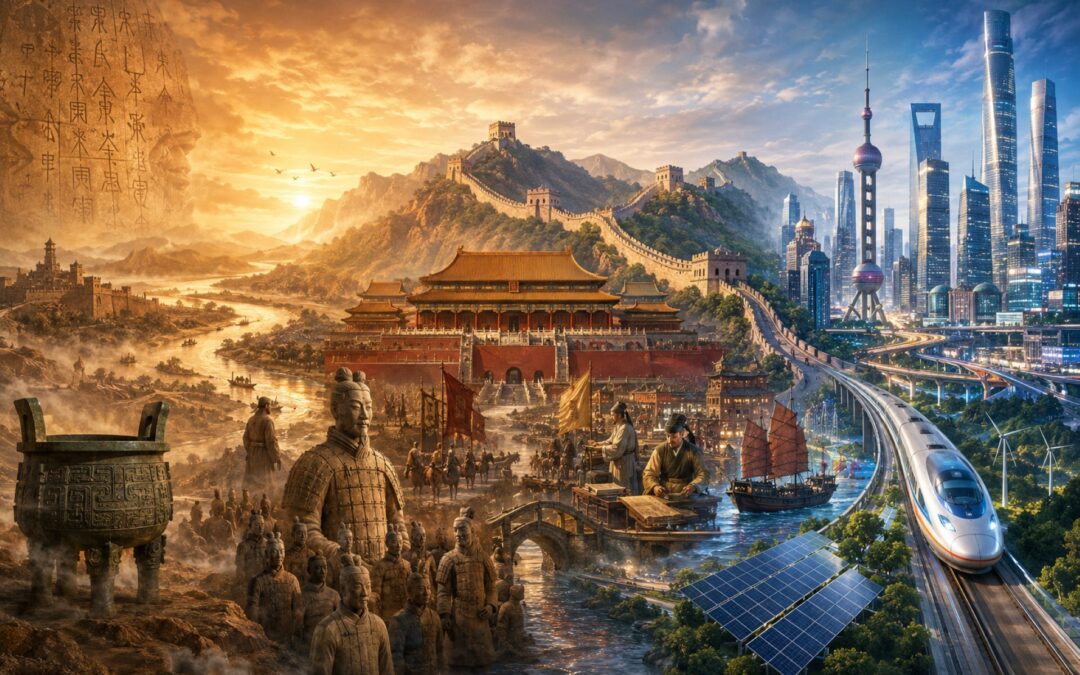
China is often described as a civilisation with five thousand years of continuous history. The phrase captures something real: an exceptionally long tradition of writing, political thought, historical memory and cultural inheritance. Yet it can also create a misleading picture of one country advancing through time without interruption.
China’s past was anything but uninterrupted. Empires fractured. Capitals were destroyed. Conquerors crossed the northern frontier. Rebellions killed millions. Foreign powers imposed humiliating treaties. Revolutionaries abolished the monarchy, fought one another and rebuilt the state around an entirely different ideology.
The more remarkable story is not that China remained unchanged. It is that political unity was reconstructed so many times.
The territory governed by different Chinese dynasties varied enormously, as did the ethnic identities of their rulers, the institutions they used and the ideas through which they justified power. The Xia belongs partly to legend. The Shang left written evidence. The Qin created the first centralised empire. The Han made that empire durable. The Tang ruled a cosmopolitan Eurasian power. The Mongols and Manchus governed China as conquerors before becoming dynastic rulers themselves. The Republic ended imperial government, and the Communist revolution transformed the state again.
The broad chronology of Chinese history therefore contains both continuity and reinvention. Even the familiar sequence of dynasties must be approached carefully: the traditionally dated but unconfirmed Xia dynasty does not rest on the same evidence as the Shang, Han or Tang.
What persisted was not a single political system. It was an unusually durable expectation that division was temporary, that political unity could be restored, and that legitimate rulers should govern through a central state capable of taxation, administration, defence, infrastructure and social order.
That expectation survived the rulers who repeatedly failed to fulfil it.
Before the Dynasties: Rivers, Farming, and the Problem of Origins
Chinese civilisation did not begin at a single moment or in a single settlement. Early farming communities emerged across different regions, but two river systems became especially important to the societies that eventually formed the Chinese political world.
In the north, the Yellow River carried enormous quantities of fine soil known as loess. The sediment made the surrounding plains fertile, but it also raised riverbeds and contributed to unpredictable, destructive flooding. Communities depended upon the river while remaining vulnerable to it.
Farther south, the Yangtze basin supported rice cultivation and eventually became one of China’s most productive agricultural regions. Over time, interaction among northern and southern communities created a more complex landscape of farming, trade, migration and political competition than the traditional story of a single birthplace suggests.
Later Chinese texts connected the beginning of political order to Yu the Great, a heroic figure said to have controlled a catastrophic flood. According to the legend, Yu succeeded where his father had failed because he did not merely block the water. He redirected it through channels, allowing the rivers to flow towards the sea.
Yu’s achievement supposedly earned him the right to rule. He became the founder of the Xia dynasty, and the transfer of power to his son marked the beginning of hereditary monarchy.
The story mattered enormously to later Chinese political culture. It associated legitimate rule with mastery over the environment, public service and the transformation of chaos into order. A ruler deserved authority because he protected agricultural society and made civilisation possible.
But Yu cannot be treated as a securely documented emperor. The Xia dynasty appears in texts written long after the period it supposedly governed. Archaeologists have uncovered complex Bronze Age settlements that may correspond to societies later remembered as Xia, but no surviving contemporary inscription identifies a Xia ruling house.
The distinction is important. China’s ancient traditions are not worthless merely because they contain mythology. Legends can reveal what later societies believed political authority should mean. They cannot, however, be substituted for contemporary evidence.
That evidence becomes far stronger with the Shang dynasty.
At the archaeological site of Yin Xu, where oracle-bone inscriptions reveal the world of the late Shang, historians encounter recognisable rulers, royal ancestors, warfare, agriculture, ritual sacrifice and administrative concerns. Questions were carved onto animal bones and turtle shells, heated until they cracked and interpreted as messages from the spiritual world.
These inscriptions are the earliest known mature form of Chinese writing. Some of their characters developed into forms that remained part of the written language across later millennia.
The Shang were therefore not simply another legendary royal family. They governed a stratified Bronze Age society centred on powerful kings, aristocratic lineages, fortified settlements, military force and religious ritual. Their authority depended upon relations with ancestors whose support was believed to affect harvests, warfare, childbirth and royal succession.
Bronze vessels demonstrated both technical sophistication and political power. Producing them required specialised knowledge, access to metals and the ability to mobilise labour. They were used in ceremonies that connected the living elite to their ancestors and displayed the prestige of royal and noble families.
The Shang world was sophisticated, but it was not peaceful. Kings launched military campaigns, captured prisoners and performed human sacrifices. Their political order rested on inequality, warfare and the concentration of resources among an elite.
Around the middle of the eleventh century BCE, a western people known as the Zhou defeated the last Shang king. The conquest did more than replace one royal house with another. It produced one of the most influential political ideas in Chinese history.
A ruler could lose the right to rule.
Shang and Zhou: Writing, Bronze, and the Mandate of Heaven
The Zhou justified their conquest by claiming that Heaven had withdrawn its favour from the Shang. The last Shang ruler was portrayed as corrupt and cruel, while the Zhou presented themselves as the morally worthy recipients of a divine political commission.
This doctrine became known as the Mandate of Heaven.
It differed from a simple claim of sacred kingship because the mandate was conditional. Heaven might grant authority to a virtuous ruler, but it could also remove that authority when a dynasty became oppressive, incompetent or incapable of protecting society. Rebellion could consequently be interpreted not merely as treason but as evidence that a ruling house had already lost divine approval.
Later historians applied this model backwards to the legendary fall of the Xia and forwards to nearly every dynastic collapse. Floods, famine, military defeat, corruption and popular rebellion could all become signs of moral and political failure.
The doctrine did not give ordinary people a formal mechanism for removing a ruler. Victorious rebels usually announced the loss of the mandate after they had already won. Nevertheless, the idea established a durable principle: political legitimacy depended upon performance as well as inheritance.
The Zhou initially governed through a network of royal relatives, hereditary nobles and regional lords. This arrangement is sometimes described as feudalism because land and authority were distributed through personal and family relationships. Yet it was not identical to medieval European feudalism. It was a lineage-based aristocratic order built around ritual rank, military obligations and loyalty to the Zhou king.
For several centuries, the system enabled the Zhou to govern a large territory without a uniform central bureaucracy. Over time, however, regional rulers accumulated land, armies and administrative capacity of their own. The king’s practical power weakened even as his ceremonial status survived.
The movement of the Zhou court eastward in 771 BCE marked a decisive decline in royal authority. China entered centuries of political competition conventionally divided into the Spring and Autumn period and the Warring States period.
War became larger, more organised and more destructive. States conscripted infantry, developed cavalry, built defensive walls, improved weapons and strengthened taxation. Rulers sought advisers who could help them survive in an environment where ineffective states were conquered.
The era’s violence generated an extraordinary intellectual response. Thinkers asked what made government legitimate, how rulers should behave, whether human beings were naturally cooperative or selfish, and whether order should rest on morality, ritual, law or withdrawal from artificial social ambition.
Confucius, born in the sixth century BCE, believed social order could be rebuilt through ethical cultivation and properly conducted relationships. He did not present a revolutionary programme for destroying hierarchy. He wanted hierarchy to acquire moral obligations.
Rulers should act with virtue. Officials should serve with integrity. Children should respect parents, but parents should care for children. Ritual was not empty ceremony; it trained people to behave with restraint, dignity and awareness of their responsibilities.
The wider tradition of classical Chinese ethical thought developed far beyond a simple list of relationships. Confucian thinkers debated benevolence, justice, education, family duty, moral example and the formation of character. Their central hope was that good government could emerge when individuals, families and rulers cultivated virtue.
Daoist traditions offered a different response to disorder. Texts associated with Laozi and Zhuangzi criticised ambition, rigid categories, excessive government and the human desire to force the world into artificial systems. The Dao was the underlying way or process through which reality unfolded. Wisdom required recognising limits, acting without unnecessary coercion and allowing natural patterns to develop.
The principle often translated as “non-action” did not necessarily mean doing nothing. It suggested action that was unforced, proportionate and aligned with circumstances rather than driven by ego or restless intervention.
The tradition commonly labelled Legalism was more concerned with the architecture of power. The transcript’s caricature—that Legalists simply believed everyone was evil—misses much of what made their ideas historically important. Legalist theories of state power and administration emphasised clear rules, predictable rewards and punishments, central authority, agricultural production, military strength and techniques for preventing ministers from manipulating rulers.
Legalist thinkers distrusted reliance on personal virtue. A state could not assume that every official would be wise or benevolent. It needed institutions that worked even when individuals were selfish.
These traditions were not sealed off from one another. Later Chinese governments combined them. Confucian ideals provided a moral language of legitimate rule, while administrative practices often reflected Legalist concerns with law, discipline and central control. Daoist concepts influenced religion, medicine, art and political thought, while Buddhism later entered the same intellectual world.
By the third century BCE, seven major states dominated the struggle for supremacy: Qin, Chu, Qi, Yan, Han, Zhao and Wei. Each experimented with administrative and military reform.
The western state of Qin proved the most relentless.
Its rulers reduced the independent authority of hereditary nobles, organised households for taxation and military service, rewarded battlefield achievement and strengthened direct government control. When Ying Zheng became king of Qin, he inherited a formidable state equipped to conquer its rivals.
In 221 BCE, the last independent kingdom surrendered.
For the first time, the competing states were united under a ruler who claimed authority over the entire political world of China.
Qin and Han: The Imperial System Takes Shape
Ying Zheng did not consider himself merely another king. He created a new title conventionally translated as First Emperor: Qin Shi Huang.
His empire lasted only about fifteen years, but the governing transformation it initiated survived for more than two millennia.
The Qin abolished much of the old aristocratic territorial order and divided the empire into administrative units governed by appointed officials. Authority flowed from the centre rather than through hereditary regional rulers. Officials collected taxes, enforced laws, registered households and supplied the state with labour and soldiers.
The government standardised weights, measures, coinage and important elements of the writing system. Roads and transport networks strengthened communication across formerly independent states. Defensive walls along northern frontiers were connected or expanded, creating predecessors of the structure later known collectively as the Great Wall.
Standardisation did not erase regional identities, nor did it instantly produce a culturally homogeneous population. It did, however, make administration, taxation, trade and political communication more uniform. It gave later dynasties a model of what a unified empire could look like.
Qin government was also severely coercive. Heavy labour demands supported roads, palaces, frontier fortifications and the emperor’s enormous burial complex. Collective punishments and strict laws attempted to discipline both officials and ordinary households. Political criticism was dangerous.
Traditional accounts accuse the emperor of burning books and burying hundreds of scholars alive. The details come largely from later Han histories and require caution. The Qin court did attempt to control rival political and historical narratives, but the familiar story of a simple war between Legalism and Confucianism exaggerates a more complicated struggle over authority.
Qin Shi Huang’s mausoleum nevertheless reveals the scale of imperial ambition. Its Terracotta Army was constructed to accompany the emperor after death, with thousands of individually modelled soldiers arranged in military formations. The project joined religion, military imagery, mass labour and the emperor’s desire to extend his rule beyond mortality.
Yet no administrative system, however formidable, could eliminate the problem of succession.
After the First Emperor died in 210 BCE, court conspiracies placed a weaker son on the throne. Revolts spread under the pressure of taxes, compulsory labour and brutal punishment. Regional leaders and former soldiers mobilised against the dynasty. The Qin state that had conquered all its rivals collapsed with astonishing speed.
Its failure did not destroy its political design.
Liu Bang, a man of relatively modest origins who prevailed in the struggles following Qin collapse, established the Han dynasty in 206 BCE. Han rulers reduced some of the Qin’s most severe laws and initially allowed limited regional autonomy, but they preserved the central principle of imperial unity.
This combination became a recurring pattern in Chinese history. A new dynasty condemned the cruelty or corruption of its predecessor while retaining the institutions required to govern the territory it had inherited.
The Han dynasty’s political and cultural consolidation gave the imperial system greater durability. The court developed a large bureaucracy, expanded state education and gradually elevated Confucian learning as an important language of government.
The mature civil-service examination system belonged to later dynasties, especially the Sui and Tang. Han officials were more often recruited through recommendation, education, family influence and court connections. Even so, the principle that political service required literacy and cultivated ability became increasingly important.
Under Emperor Wu, who ruled from 141 to 87 BCE, Han power expanded dramatically. Armies campaigned against the Xiongnu confederation to the north and west, while imperial control reached into Central Asia, the Korean peninsula, the south-west and areas of present-day Vietnam.
The relationship between the Xiongnu and the later European Huns remains debated. They should not be treated as a single people without qualification. What is clear is that conflict with mobile frontier powers shaped Chinese military organisation, diplomacy and territorial expansion for centuries.
Han expeditions into Central Asia helped create connections with societies far beyond the empire. The term Silk Road was coined much later and can give the false impression of one continuous highway. In reality, the networks later called the Silk Roads consisted of overlapping routes through which merchants, diplomats, soldiers, migrants and religious teachers transmitted goods and ideas.
Chinese silk travelled westward. Horses, glass, precious materials and crops moved eastward. Buddhism eventually entered China through these networks, developing into one of the most influential religious traditions in East Asia.
Expansion brought prestige and resources, but it was expensive. Military campaigns required taxation, labour and grain. Large landowners accumulated property, while many peasants became vulnerable to debt. Court factions, imperial relatives and powerful officials competed for influence.
In the early first century, the reformer Wang Mang seized power and established the short-lived Xin dynasty. He attempted sweeping changes involving land, currency and state control, but his government faced elite resistance, administrative confusion, flooding, famine and rebellion.
The Han was restored under Liu Xiu, known as Emperor Guangwu. The capital shifted east to Luoyang, beginning the Eastern Han period. Government and trade recovered, while scholarship and technology continued to develop. Paper emerged through a gradual process of experimentation, with later improvements traditionally associated with the official Cai Lun.
Over time, however, the court again became divided. Imperial families, eunuchs, officials and regional elites fought for control. Large landholders gained power as the central government weakened.
The Yellow Turban Rebellion of 184 was defeated, but suppressing it required the court to empower regional commanders. These men developed independent armies and political bases.
The Han emperor remained on the throne, but the empire had already begun to fracture around him.
Division and Reunion: From the Three Kingdoms to the Sui
The fall of the Han produced one of the most famous periods in Chinese history. It has been remembered through historical chronicles, theatre, folklore, games and the great Ming-era novel Romance of the Three Kingdoms.
The reality was less romantic. It involved famine, displacement, disease, military conscription and prolonged warfare among regional strongmen.
Cao Cao established control over the north while claiming to act in the name of the last Han emperor. Liu Bei built a regime in the south-west and drew legitimacy from his claimed relationship to the Han ruling house. Sun Quan controlled the lower Yangtze region.
After the formal end of the Han in 220, their regimes became Wei, Shu and Wu. The resulting struggles, political calculations and eventual reunification are explored more fully in the history of China’s Three Kingdoms period.
For the wider history of China, the most important point is that none of the three states restored enduring unity. Shu fell to Wei. The Sima family then displaced the Wei rulers and founded the Jin dynasty. Jin forces conquered Wu in 280, reuniting the empire.
The reunification proved fragile.
A destructive succession struggle known as the War of the Eight Princes weakened the court. Northern groups who had served, settled or fought within the empire established regimes of their own. Jin power retreated south, while northern China passed through a succession of states governed by rulers of varied ethnic origins.
For centuries, the political world remained divided between northern and southern courts.
This was not simply an empty interval between “real” dynasties. It transformed Chinese society. Large populations migrated southward, accelerating the agricultural and economic development of the Yangtze basin. Northern regimes adopted Chinese administrative traditions while also preserving elements of their own military and cultural organisation.
Buddhism expanded dramatically. Monasteries became centres of learning, landholding, charity and artistic production. Translated scriptures introduced new concepts of suffering, rebirth, compassion and salvation. Cave temples and monumental sculpture connected religious devotion with political patronage.
The meaning of Chinese identity consequently became more complex. Political legitimacy no longer belonged exclusively to one hereditary line or even to rulers from one ethnic background. States competed to claim the institutions, rituals and historical inheritance associated with governing China.
The Sui reunification and Tang cultural order emerged from this transformed world.
Yang Jian, later known as Emperor Wen of Sui, founded the Sui dynasty in 581 and defeated the southern Chen dynasty in 589. For the first time in nearly four centuries, most of China was again governed by one imperial court.
The Sui strengthened central administration, revised taxation and revived systems for recruiting educated officials. Its rulers supported both Buddhism and Confucian political institutions.
The dynasty’s most enduring infrastructural achievement was the expansion of the Grand Canal. By connecting northern political centres with the increasingly productive Yangtze region, the canal allowed grain and other goods to move across enormous distances. It helped make long-term imperial unity materially possible.
But the Sui repeated a familiar mistake. Its state demanded more than society could sustain.
Emperor Yang pursued huge construction projects, rebuilt capitals, extended canal systems and launched costly campaigns against the Korean kingdom of Goguryeo. Conscription and labour obligations placed immense pressure on rural communities. Military defeats undermined confidence in the court.
Rebellions spread. Among the leaders who turned against the dynasty were Li Yuan and his son Li Shimin. Their forces captured the capital, and the Sui collapsed in 618.
The dynasty had ruled for less than four decades. Like the Qin, however, it had rebuilt an imperial structure that its successor would use far more successfully.
That successor was the Tang.
Tang and Song: Expansion, Wealth, and Innovation
The Tang dynasty inherited a reunited empire, an improved canal system and administrative institutions capable of linking local society to the imperial court. Under capable early rulers, it transformed those foundations into one of the most powerful states of the medieval world.
Li Yuan founded the dynasty, but his son Li Shimin became its defining early emperor. Li Shimin seized power after killing two of his brothers during a palace confrontation in 626. The violence of his accession did not prevent later historians from remembering him as Emperor Taizong, an exemplary ruler who accepted criticism, appointed talented ministers and combined military strength with administrative restraint.
Taizong’s government stabilised the countryside, maintained relatively moderate taxation and expanded imperial authority across Inner Asia. After defeating the Eastern Turkic Khaganate, he received recognition from some steppe leaders as a ruler whose authority extended beyond the agricultural empire.
Tang China was not culturally sealed from the world around it. Its capital, Chang’an, became one of the largest and most cosmopolitan cities of its age. Merchants, diplomats, monks and travellers arrived from Central Asia, Korea, Japan, India, Persia and other regions.
Buddhism flourished alongside Daoism and Confucian learning. Foreign musical forms, clothing, foods and artistic styles entered elite culture. Chinese institutions and writing influenced neighbouring states, while China absorbed ideas from across Eurasia.
The dynasty’s examination system expanded the role of literary education in government, though aristocratic families continued to possess substantial advantages. Mastery of classical texts and written composition became increasingly important to official careers.
Tang poetry reached extraordinary heights. Writers such as Li Bai and Du Fu explored friendship, nature, war, displacement, ambition and the vulnerability of human life. Their work survived not merely as court literature but as part of a shared cultural canon.
The dynasty’s strength nevertheless created new vulnerabilities. Expansion required frontier armies, and those armies were increasingly commanded by powerful regional military governors. The court’s dependence on them grew as central institutions weakened.
In 755, the general An Lushan rebelled. His forces captured Luoyang and threatened Chang’an, forcing Emperor Xuanzong to flee. The rebellion became a long civil war involving regional armies and outside allies.
The human losses were immense, but exact claims that a fixed percentage of the population died should be treated cautiously. The dramatic decline in census registration reflected not only death but also displacement, lost territories and the state’s reduced ability to count households.
The political consequences are clearer. The Tang court recovered its capitals, but it never fully restored its former authority. Provincial commanders retained armies and tax bases. Palace eunuchs became influential. Frontier territories were lost, while rebellions and banditry grew.
The uprising led by Huang Chao in the late ninth century devastated major regions and briefly captured Chang’an. The dynasty finally ended in 907, followed by the politically fragmented Five Dynasties and Ten Kingdoms period.
Yet southern regions often remained economically productive even while northern dynasties replaced one another rapidly. When the Song dynasty reunified much of China from 960 onwards, it inherited a society already undergoing profound commercial change.
Song rulers deliberately reduced the power of military commanders and strengthened civil administration. This protected the dynasty from the kind of warlord takeover that had destroyed the Tang, but it contributed to military difficulties against powerful northern neighbours.
The Song lost territory first to the Khitan Liao and later to the Jurchen Jin. In 1127, Jurchen forces captured the northern capital of Kaifeng and took members of the imperial household prisoner. The court retreated south and established a new capital at Lin’an, present-day Hangzhou.
Political loss did not prevent economic achievement.
Song China experienced one of the most important periods of commercialisation in world history. Improved rice varieties increased agricultural output. Markets connected villages, towns and cities. Merchants moved goods through river, canal and coastal networks. Large urban populations supported restaurants, theatres, printing businesses, workshops and specialised trades.
The government issued paper currency on an unprecedented scale. Printing made books and examination materials more widely available. The magnetic compass improved navigation. Gunpowder, discovered gradually through earlier alchemical experimentation, acquired increasingly important military uses.
The Song-era economic and technological transformation did not consist of isolated inventions appearing from nowhere. It emerged from population growth, urban demand, state institutions, commercial networks, skilled labour and the circulation of technical knowledge.
Neo-Confucian thinkers attempted to reconstruct Confucian philosophy in response to Buddhism and Daoism. They developed comprehensive accounts of morality, human nature, education and cosmic order. These ideas later shaped schools, families and government across East Asia.
The Southern Song also developed a strong navy and used gunpowder weapons against its enemies. Yet it remained under pressure from the north.
During the thirteenth century, a far greater military power emerged from the Mongolian steppe. The Song initially cooperated with the Mongols against the Jin, helping eliminate one enemy while strengthening another.
The Mongol conquest would place China inside the largest connected land empire the world had ever seen.
Conquest and Restoration: Yuan and Ming China
Temüjin, later proclaimed Genghis Khan, unified rival Mongol groups through warfare, alliance-building and military reorganisation. His armies combined disciplined cavalry, intelligence gathering, mobility, psychological warfare and a willingness to incorporate useful specialists from conquered societies.
The violence of Mongol expansion was immense. Cities that resisted could be destroyed, and civilian populations suffered heavily. Precise personal death totals attributed to Genghis Khan are impossible to establish and should not be treated as reliable measurements of one individual’s responsibility.
The Mongols first attacked states along China’s northern and western frontiers. They conquered the Jin dynasty in 1234 and then intensified their campaign against the Southern Song.
The terrain, fortified cities and waterways of southern China made conquest difficult. Mongol armies adapted by recruiting engineers, developing siege warfare and constructing naval forces. Under Kublai Khan, the final Song resistance was defeated in 1279.
Kublai established the Yuan dynasty and ruled from a capital at Dadu, present-day Beijing. He adopted Chinese imperial titles and institutions while remaining the Great Khan of a wider Mongol political world.
The Yuan dynasty was therefore both a Chinese ruling house and part of the fragmented Mongol Empire.
Mongols occupied the highest positions in the regime’s social and political hierarchy. Other Central and Western Asian peoples also received privileges, while northern and southern Chinese populations were classified below them. Access to office, legal treatment and social status could vary according to these categories.
Yet Yuan rule was not simply an external military occupation imposed upon an unchanged society. Mongol rulers governed through Chinese administrative structures, patronised different religions, repaired transport networks and relied on officials drawn from many parts of Eurasia.
Trade expanded across territories protected or connected by Mongol states. Merchants, envoys, artisans and religious figures travelled over greater distances. The Grand Canal was restored and redirected towards the northern capital. Paper money circulated widely, though fiscal mismanagement later weakened confidence in it.
Marco Polo’s famous account introduced European readers to a wealthy empire using coal, paper currency and vast urban markets. Parts of his narrative have been debated, but the fascination it generated reflected the exceptional connectivity of the Yuan world.
Mongol rule also encountered limits. Expeditions against Japan and parts of South-East Asia failed. Court rivalry, inflation, corruption, flooding, famine and epidemic disease weakened the dynasty.
The origins and spread of the fourteenth-century plague remain subjects of continuing research. It should not be presented as a single, settled story beginning with a precisely counted Chinese catastrophe.
As conditions deteriorated, rebellion spread. One movement, associated with the Red Turbans, produced the leader who would drive the Mongols from the capital and found the Ming dynasty in 1368.
Zhu Yuanzhang, known as the Hongwu Emperor, had risen from extreme poverty. His early life as an orphan, labourer and Buddhist novice shaped his intense concern with grain supply, agriculture and rural stability.
The Ming court restored rule by an ethnically Han dynasty, but it did not simply revive a pre-Mongol world. It inherited Yuan territorial practices, administrative knowledge and a capital system transformed by centuries of conquest and migration.
Hongwu rebuilt agricultural production, repaired irrigation systems and organised military households. He restored Confucian institutions and the examination system while concentrating extraordinary authority in the emperor’s hands.
His government was effective and deeply suspicious. Purges eliminated officials and perceived rivals. The emperor’s fear of conspiracy produced collective punishment and large-scale executions.
Later Ming rulers maintained one of the world’s most powerful states. The Yongle Emperor moved the principal capital to Beijing, built the Forbidden City and sponsored maritime expeditions commanded by Zheng He.
Between 1405 and 1433, Zheng He’s fleets travelled through South-East Asia and the Indian Ocean, reaching South Asia, Arabia and East Africa. The voyages projected imperial power, carried diplomatic missions and integrated maritime relationships into the Ming tributary order.
They were not a straightforward programme of colonial conquest, nor did their end prove that China suddenly abandoned the sea. Private trade and coastal commerce continued, although policy shifted and court priorities changed.
The Ming also strengthened northern defences against renewed Mongol pressure. Much of the brick and stone Great Wall visible today dates from Ming construction rather than the age of Qin Shi Huang.
Commercial growth transformed the later dynasty. Silver became central to taxation and exchange. Markets expanded, cities prospered and printed literature circulated widely. The novel Romance of the Three Kingdoms emerged from this vibrant literary world.
But dependence on silver exposed the state to changing global flows. Court factionalism, corruption, climate pressures, military costs and rural distress weakened the dynasty. Rebellions spread during the seventeenth century.
In 1644, the rebel leader Li Zicheng captured Beijing, and the final Ming emperor killed himself. A Ming commander then allowed Manchu forces through the northern defences in an attempt to defeat the rebellion.
The Manchus took Beijing and founded the Qing dynasty.
Once again, a conquering people would claim the institutions and political inheritance of imperial China.
The Qing Empire and the Crisis of the Nineteenth Century
The Manchus came from north-east Asia and had constructed a powerful military state before entering Beijing. Their Eight Banner system organised soldiers and households, while their rulers adopted Chinese imperial institutions and presented themselves differently to the empire’s many peoples.
To Han Chinese officials, the Qing emperors could appear as Confucian sovereigns. To Mongol elites, they could rule through Inner Asian traditions. In Tibet, they supported Buddhist relationships. Their legitimacy was therefore plural rather than culturally uniform.
The conquest was violent, and resistance continued for decades. Qing rulers imposed the Manchu queue hairstyle on many male subjects as a sign of submission. At the same time, they retained the examination system and employed large numbers of Chinese officials.
Under the Kangxi, Yongzheng and Qianlong emperors, the Qing became one of the largest and most powerful empires in the world. It expanded into Taiwan, Mongolia, Tibet, Xinjiang and other frontier regions, creating much of the territorial framework inherited by the modern Chinese state.
The eighteenth century brought population growth, commercial expansion and cultural achievement. The court sponsored scholarship, collected texts and governed through an immense bureaucracy.
Success, however, created pressure. Population increased faster than the supply of easily available farmland. Local officials governed more people with limited administrative resources. Corruption and inequality weakened confidence in the state.
Relations with European commercial powers introduced another challenge.
British demand for Chinese tea, porcelain and silk produced a trade imbalance because China imported relatively few British goods. Silver flowed towards Qing markets. British merchants sought a commodity that could reverse that flow and found it in opium produced in British-controlled India.
Although Qing authorities restricted the drug, smuggling expanded. Addiction caused social harm, while silver began leaving the Chinese economy.
In 1839, the official Lin Zexu confiscated and destroyed large stocks of opium at Canton. Britain responded with military force.
The conflict exposed an enormous difference in naval power, weaponry and logistical organisation. The Qing could mobilise large armies, but it struggled against steam-powered vessels and long-range naval guns.
The resulting First Opium War and Treaty of Nanjing transformed China’s relationship with the Western powers. The Qing government ceded Hong Kong, opened treaty ports and paid 21 million Spanish silver dollars in indemnities and debts.
Later agreements expanded foreign privileges, including forms of extraterritoriality that protected foreign nationals from ordinary Chinese legal jurisdiction.
These treaties became known in China as unequal treaties because they were imposed through military defeat and restricted sovereignty.
Western powers remained dissatisfied with the access they had gained. Disputes over diplomacy, trade and foreign rights produced the renewed conflict of the Second Opium War. British and French forces entered Beijing and destroyed the imperial garden complex commonly known as the Old Summer Palace.
Further treaties opened more ports, expanded foreign travel and diplomatic rights, imposed additional indemnities and legalised the opium trade.
The Qing faced this external pressure while confronting an even deadlier internal rebellion.
Hong Xiuquan, a failed examination candidate from southern China, experienced visions that he interpreted through Christian missionary literature. He came to believe he was the younger brother of Jesus and had been commanded to destroy demons ruling the world.
His movement combined an unconventional form of Christianity with opposition to the Qing, hostility towards established religious traditions and promises of social transformation. It attracted peasants, workers, miners and marginalised communities suffering from economic distress and ethnic conflict.
In 1851, Hong proclaimed the Taiping Heavenly Kingdom. Its armies captured Nanjing and turned it into their capital. At its height, the movement controlled substantial parts of southern and central China.
Taiping rule promoted certain radical principles, including the formal condemnation of foot-binding and claims of greater equality between men and women. Yet it also imposed severe religious discipline, separated the sexes, executed opponents and developed its own hierarchical court.
Internal power struggles weakened the movement. Meanwhile, the Qing court relied increasingly upon regional armies raised by officials such as Zeng Guofan. Western governments, initially uncertain about the rebels, ultimately assisted Qing-aligned forces when Taiping expansion threatened treaty-port interests.
The Taiping Rebellion’s transformation of the Qing state extended far beyond its commonly cited death toll of approximately twenty million. The war devastated agricultural regions, destroyed cities and shifted military power away from the central banner forces towards provincial commanders.
The dynasty survived, but the state had changed. Regional officials now possessed armies, financial networks and political authority that would prove difficult to recentralise.
Some Qing officials responded through the Self-Strengthening Movement. They established arsenals, shipyards, schools, translation bureaux and modern military industries. Their aim was not to abandon the imperial order but to acquire foreign technology while preserving Chinese political and cultural foundations.
The reforms achieved real results, but they remained uneven. Rival bureaucratic interests, fragmented funding and institutional conservatism prevented a comprehensive transformation.
Japan modernised far more rapidly after the Meiji Restoration. When conflict over Korea produced the First Sino-Japanese War in 1894, the Qing suffered a shocking defeat. The Treaty of Shimonoseki recognised Korean independence, transferred Taiwan to Japan and imposed a large indemnity.
The loss demonstrated that China was no longer merely vulnerable to Western empires. A neighbouring East Asian state had surpassed it militarily and industrially.
Foreign powers demanded further concessions. Missionary activity and external influence provoked resentment that contributed to the Boxer movement. In 1900, Boxers attacked Chinese Christians and foreigners, while the Qing court eventually supported their campaign.
An international force occupied Beijing and imposed another punitive settlement.
The court introduced late reforms, including changes to education, the military and administration. The examination system that had shaped elite life for centuries was abolished in 1905. Constitutional plans were announced.
The changes came too late to restore confidence.
Revolutionary groups argued that the Manchu dynasty could not save China. Sun Yat-sen promoted nationalism, republican government and social reform. Revolutionary networks spread among overseas Chinese communities, students and soldiers.
In October 1911, mutinying troops seized Wuchang. Provinces began withdrawing their loyalty from the Qing. Sun returned from abroad and became provisional president of a republican government in Nanjing.
The revolutionaries still lacked the military power to defeat the Qing’s strongest forces. They negotiated with Yuan Shikai, an experienced commander who agreed to support abdication in exchange for the presidency.
The child emperor Puyi formally abdicated in 1912. The 1911 Revolution that ended imperial rule closed the dynastic era.
It did not create a stable nation-state.
Revolution, Warlords, and War: 1911 to 1949
The Republic of China inherited the name and international position of the Qing state, but it did not inherit uncontested control of its territory.
Sun Yat-sen surrendered the provisional presidency to Yuan Shikai as part of the settlement that ended the monarchy. Yuan commanded the strongest army in China and appeared capable of holding the new republic together.
He soon undermined its institutions. Parliament was suppressed, political opponents were removed and power became increasingly personal. In 1915, Yuan attempted to proclaim himself emperor.
The plan provoked widespread resistance. Provincial leaders rejected the restoration of monarchy, and Yuan abandoned the throne shortly before his death in 1916.
Without a stable succession, military commanders divided the country. The warlord era was not a period in which every region became entirely independent, but central authority was weak and alliances shifted constantly. Rival governments claimed national legitimacy while controlling only parts of the state.
Foreign pressure continued. During the First World War, Japan expanded its influence in China. At the Paris Peace Conference, former German concessions in Shandong were transferred to Japan rather than returned directly to China.
The decision provoked mass demonstrations on 4 May 1919. Students protested foreign imperialism and the weakness of Chinese political leadership. The May Fourth Movement expanded into a wider intellectual challenge to inherited traditions.
Writers and activists debated science, democracy, nationalism, women’s rights, language reform, liberalism, anarchism and Marxism. Some concluded that only a revolutionary political organisation could unite China and resist foreign domination.
The Chinese Communist Party was founded in 1921. Sun Yat-sen’s Nationalist Party, or Kuomintang, was simultaneously rebuilding its own movement in southern China.
With Soviet assistance, the Nationalists and Communists formed an alliance to defeat warlords and unify the country. After Sun’s death in 1925, Chiang Kai-shek emerged as the principal Nationalist military leader.
The Northern Expedition launched in 1926 defeated or absorbed several warlord regimes. As Nationalist power expanded, however, Chiang came to view Communist labour organisers and armed groups as a threat.
In 1927, Nationalist forces and allied organisations attacked Communists in Shanghai. The purge ended the first alliance and opened a prolonged civil war.
The Communist movement nearly collapsed in the cities. Mao Zedong argued that revolution in China would have to rely heavily on the rural population rather than following a strictly urban model.
Communist forces established bases in remote regions, redistributed land and organised guerrilla armies. Nationalist encirclement campaigns eventually forced them to abandon their principal southern base.
The Long March of 1934–35 was a military retreat of extraordinary hardship. Communist forces crossed mountains, rivers, hostile territory and warlord-controlled regions before reaching a new base in the north-west.
Only a fraction of those who began the march completed it. Yet the survival of the movement strengthened Mao’s position and became a foundational story of Communist legitimacy.
While the Nationalists and Communists fought one another, Japanese expansion created a far greater national crisis.
Japan had seized Manchuria in 1931 and established the puppet state of Manchukuo under Puyi. Chiang Kai-shek prioritised Communist suppression while attempting to avoid a full war for which he believed China was unprepared.
Pressure from officers eventually forced a renewed Nationalist–Communist alliance. In July 1937, fighting near Beijing escalated into the Second Sino-Japanese War.
Japanese forces captured major cities, including Shanghai and Nanjing. After entering Nanjing in December 1937, troops committed mass murder, rape, looting and other atrocities against civilians and prisoners of war.
Casualty estimates remain debated, but the scale of the crime is not. The massacre became one of the defining atrocities of the Second Sino-Japanese War.
The Nationalist government moved inland, eventually establishing its wartime capital at Chongqing. Japan controlled many cities and transport routes but struggled to conquer China’s vast interior.
Nationalist armies fought major conventional campaigns, while Communist forces expanded guerrilla operations behind Japanese lines. Both claimed leadership of national resistance, although cooperation between them remained deeply distrustful.
China’s war formed a central part of the wider history of World War II. Chinese resistance tied down substantial Japanese forces for years before the Pacific War brought the United States and other Allied powers directly into the conflict.
Japan surrendered in 1945, but peace did not follow. Nationalists and Communists rushed to occupy territory, weapons depots and strategic cities.
The United States attempted mediation, but civil war resumed. Initially, the Nationalist government appeared to possess overwhelming advantages: international recognition, larger forces, major cities and superior equipment.
Those advantages were eroded by inflation, corruption, administrative failures and declining popular confidence. Communist land policies and rural organisation strengthened their support in many areas. Their military forces became increasingly capable of conventional warfare.
By 1948, Communist victories in Manchuria and northern China had transformed the balance of power. Major Nationalist armies surrendered or were destroyed.
In 1949, Mao Zedong proclaimed the People’s Republic of China in Beijing. Chiang Kai-shek and the Nationalist government retreated to Taiwan, where the Republic of China continued to exist.
The Communist victory of 1949 reunified most of the mainland under a central government for the first time in decades.
It also began one of the most radical attempts to transform Chinese society in its history.
Mao’s China: Revolution, Famine, and Upheaval
The Communist victory ended warlord fragmentation and decades of large-scale warfare on the mainland. The new government extended administrative control, stabilised the currency and attempted to rebuild an economy devastated by conflict.
For many Chinese citizens, the establishment of the People’s Republic represented national restoration after foreign invasion, civil war and the long decline of imperial power.
It also introduced a revolutionary state determined to destroy the old social order.
Land reform redistributed rural property and eliminated the political power of landlords. The process was not merely administrative. Mass meetings, denunciations and public trials encouraged villagers to identify class enemies.
Many landlords and other targeted people were executed. Estimates vary, but the death toll reached into the hundreds of thousands and possibly beyond one million.
The new state also expanded education, promoted public-health campaigns and reformed marriage law. Women received stronger formal rights to divorce and choose partners, although social practice changed unevenly.
Private businesses initially continued under increasing regulation. By the mid-1950s, however, the government moved towards socialist transformation. Agriculture was collectivised, while urban industry and commerce came under state ownership.
Mao believed China could overcome poverty and catch up with industrial powers through mass mobilisation. In 1958, the government launched the Great Leap Forward.
Rural households were organised into enormous communes. Communal kitchens replaced domestic cooking in many areas. Local officials were pressured to report ever-higher harvests, while the state extracted grain on the assumption that these exaggerated figures were real.
Labour was diverted from agriculture into irrigation schemes and backyard furnaces intended to increase steel production. Villagers melted tools and household objects, often producing unusable metal.
The deeper problem was not simply a misguided enthusiasm for furnaces. It was an authoritarian information system in which officials feared admitting failure. Inflated production figures travelled upward, while grain was taken from communities that had far less than the state believed.
Poor weather and ecological damage worsened conditions, but policy was central to the disaster. Movement was restricted, criticism was punished and local suffering was concealed.
Famine spread across the countryside.
There is no universally accepted death toll. Research discussed in scholarly estimates of the Great Leap famine includes figures ranging from the low twenties of millions to substantially higher estimates, depending upon demographic methods and definitions of excess mortality.
The catastrophe damaged Mao’s standing within the leadership. More pragmatic officials, including Liu Shaoqi and Deng Xiaoping, introduced measures that restored household incentives and agricultural production.
Mao did not lose his symbolic position, but he feared that the revolution was becoming bureaucratic and that Communist officials were creating a new privileged class. He also believed China might follow the Soviet Union towards ideological compromise.
In 1966, he launched the Cultural Revolution.
Students organised as Red Guards were encouraged to attack authority figures, expose supposed enemies and destroy the “Four Olds”: old ideas, culture, customs and habits. Teachers, officials, intellectuals and ordinary citizens were denounced, beaten, imprisoned or driven to suicide.
Temples, books, artworks and historical sites were damaged or destroyed. Families concealed their backgrounds and possessions. Revolutionary loyalty was often demonstrated through public performance and attacks upon others.
The movement was not a single centrally managed campaign unfolding exactly as Mao intended. Competing factions claimed to represent the truest form of Maoism and fought one another. Local political struggles became entangled with personal grievances, institutional rivalries and military interests.
The resulting political turmoil of the Cultural Revolution disrupted government, schools and industry. The army was eventually ordered to restore order, even as political campaigns continued.
Many urban youths were sent to rural areas in the “Down to the Countryside” movement. Their displacement became one of the defining experiences of a generation.
The human cost remains difficult to calculate because the violence took different forms across regions and phases. Research into the Cultural Revolution’s human impact has estimated between 750,000 and 1.5 million deaths, a similar number of permanent injuries and persecution affecting tens of millions.
These figures should not be collapsed into a single personal body count for Mao. Famine mortality, execution, factional killing, imprisonment, overwork and political persecution involved different mechanisms and degrees of responsibility.
Mao remained the central political authority and the object of an extraordinary personality cult. His death in 1976 removed the figure around whom revolutionary conflict had repeatedly been organised.
The arrest of the radical leaders known as the Gang of Four marked the formal end of the Cultural Revolution.
The Communist Party now faced a profound question. It had unified the country and transformed its social structure, but repeated mobilisation had produced famine, violence and economic disruption.
The next transformation would preserve one-party rule while abandoning much of Mao’s economic model.
Reform, Wealth, and Centralised Power: Deng to Xi
Deng Xiaoping did not become China’s leader through a single formal office. His influence emerged through party authority, alliances, revolutionary prestige and control over the direction of policy.
From 1978 onwards, Deng and other reformers argued that economic development should take priority over permanent class struggle. Ideological language remained important, but practical results became a new measure of legitimacy.
Agricultural communes were dismantled gradually through the household responsibility system. Rural families received greater control over production and could sell output beyond state obligations.
Special economic zones invited foreign investment and experimented with market incentives. Coastal manufacturing expanded. Township and village enterprises created employment outside traditional state industries.
China did not simply switch from socialism to unrestricted capitalism. State ownership remained important, land continued to be publicly owned and the Communist Party retained political control. Reform produced a hybrid system combining market competition, state planning, local experimentation and party supervision.
The results were extraordinary. The World Bank’s assessment of China’s post-1978 economic transformation describes average growth above 9 per cent for decades and close to 800 million people escaping extreme poverty.
Industrialisation, infrastructure, exports and urbanisation changed daily life. Hundreds of millions moved from rural areas to cities. New consumer markets emerged, while China became central to global manufacturing supply chains.
The transformation also created inequality, labour exploitation, environmental damage, corruption and uneven access to public services. Migrant workers often contributed to urban growth without receiving the same benefits as registered local residents.
Economic reform raised expectations about political change. During the 1980s, students and intellectuals debated corruption, censorship, inflation, democracy and the future of socialism.
The death of the reform-minded former party leader Hu Yaobang in April 1989 triggered mourning gatherings that developed into a wider protest movement. Students occupied Tiananmen Square and demanded dialogue, greater transparency, press freedom and political reform.
The movement expanded beyond the student population. Workers and Beijing residents joined demonstrations, although different groups did not always share the same priorities.
Within the Communist Party, leaders disagreed over negotiation and repression. Martial law was declared. Troops initially encountered resistance from residents blocking their movement into the city.
On the night of 3–4 June, the People’s Liberation Army advanced using lethal force. Civilians and soldiers died in clashes across Beijing. The exact casualty total remains unknown, but declassified records of the 1989 Tiananmen crackdown confirm the severity of the military operation and the political debate surrounding it.
The iconic image of an unidentified man standing before a line of tanks was captured on 5 June. It became an international symbol of individual resistance, even as public discussion of the protests was suppressed within mainland China.
The crackdown established a boundary that shaped the reform era: economic opening would continue, but the Communist Party would not accept an organised political movement capable of challenging its monopoly on power.
After a period of uncertainty, Deng renewed the push for market reform in the early 1990s. China attracted investment, expanded exports and joined the World Trade Organization in 2001.
The country’s role in the global economy grew rapidly. It built ports, railways, roads, power systems and industrial cities at extraordinary speed. Its companies moved from low-cost production into telecommunications, electric vehicles, batteries, solar energy, high-speed rail and other advanced sectors.
The development of China’s clean-energy manufacturing dominance demonstrates how large domestic markets, supply-chain concentration, state policy, infrastructure and industrial scale combined to create global power in strategic industries.
Economic integration did not lead automatically to political liberalisation.
Xi Jinping became general secretary of the Communist Party in 2012 and president in 2013. He inherited a country far wealthier and more influential than the one Deng had begun reforming, but also one facing corruption, inequality, environmental stress, local debt and doubts about party discipline.
Xi launched a sweeping anti-corruption campaign. It punished genuine misconduct, but it also removed political rivals and strengthened the authority of the central leadership.
Party committees acquired greater influence across government, universities, media and businesses. Ideological education intensified, while censorship and digital surveillance expanded.
In 2018, the National People’s Congress approved the removal of presidential term limits. Xi subsequently received a third term as party general secretary in 2022 and a third presidential term in 2023.
The change did not abolish every institution or return China mechanically to imperial rule. It did, however, weaken the expectation of regular leadership succession that had developed after Mao and concentrate authority more closely around one leader.
Descriptions of China’s social-credit system often exaggerate this centralisation by imagining a universal numerical rating assigned to every citizen. The reality of China’s fragmented social-credit systems is more complex.
China has developed blacklists, regulatory records, court-enforcement databases, commercial credit systems and local experiments. These mechanisms can impose serious restrictions, but they do not amount to one national score measuring every person’s ideological loyalty.
Contemporary China also faces a demographic transformation. Decades of declining fertility and the legacy of birth restrictions have produced a rapidly ageing population.
According to China’s official 2025 population communiqué, the mainland population stood at approximately 1.40489 billion at the end of 2025 and had declined by 3.39 million during the year. India’s emergence as the world’s most populous country in 2023 marked the end of China’s long-held demographic position.
A shrinking workforce, rising pension obligations and changing household structures will affect economic growth and social policy. At the same time, automation, education and productivity may partly offset the numerical decline.
China’s global influence now extends through trade, investment, infrastructure finance, technology, diplomacy and military power. Its relationships in Africa, Asia and Latin America cannot be reduced to either benevolent development or simple neocolonialism. Host governments possess agency, while projects create different combinations of opportunity, dependency, debt and strategic influence.
Hong Kong has undergone stronger political integration with the mainland. Beijing continues to claim Taiwan and has not renounced the use of force, while military pressure around the island has increased.
An invasion should not be treated as inevitable. Taiwan’s future involves Chinese nationalism, Taiwanese identity, United States policy, military deterrence, economic interdependence and the enormous risks of war.
The People’s Republic is now one of the world’s leading economic, technological and military powers. It is also a state confronting slower growth, property-sector problems, local debt, demographic ageing, international competition and the consequences of highly centralised decision-making.
The history of China does not offer a simple prediction of what comes next.
It offers something more useful: an explanation of why the Chinese political world has repeatedly survived transformations that seemed capable of ending it.
China’s continuity has never depended upon avoiding collapse. It has depended upon what successive societies built from the remains.
The Qin created a centralised imperial framework, but the Han made it governable. Centuries of division altered the ethnic, religious and economic character of the realm before the Sui reunited it. The Tang turned that reunification into a cosmopolitan empire, while the Song demonstrated that commercial and technological vitality could survive military weakness.
Mongol conquerors incorporated China into a wider Eurasian order. The Ming restored native rule without returning to an untouched past. The Manchu Qing expanded the empire before foreign intervention and internal revolt exposed the limits of its institutions.
The Republic abolished dynastic government but failed to establish immediate unity. The Communist Party achieved that unity through revolution, then subjected society to catastrophic experiments before reinventing the economy around markets, industry and global trade.
Modern China therefore carries several inheritances at once. It possesses an imperial territorial imagination, a bureaucratic tradition, a revolutionary party-state, a market economy shaped by political control and a global industrial system built through international integration.
None of these elements is timeless. None guarantees permanent success.
Political centralisation can accelerate mobilisation, but it can also suppress criticism. National unity can create extraordinary state capacity, but it can intensify conflict over borders and identity. Economic openness can generate prosperity while creating dependence upon global markets. Historical memory can strengthen collective purpose while encouraging leaders to interpret compromise as humiliation.
China’s past demonstrates exceptional adaptive capacity. It also demonstrates that every successful reconstruction creates new contradictions.
The country that emerged from ancient river valleys, imperial unifications, foreign conquest, republican revolution, Maoist upheaval and market reform is not the same state repeatedly returning in identical form.
It is a civilisation and political order repeatedly remade—and each remaking has changed what China means.
Last Updated on July 25, 2026 by Aseem Gupta