
Reading Time: 32 Minutes
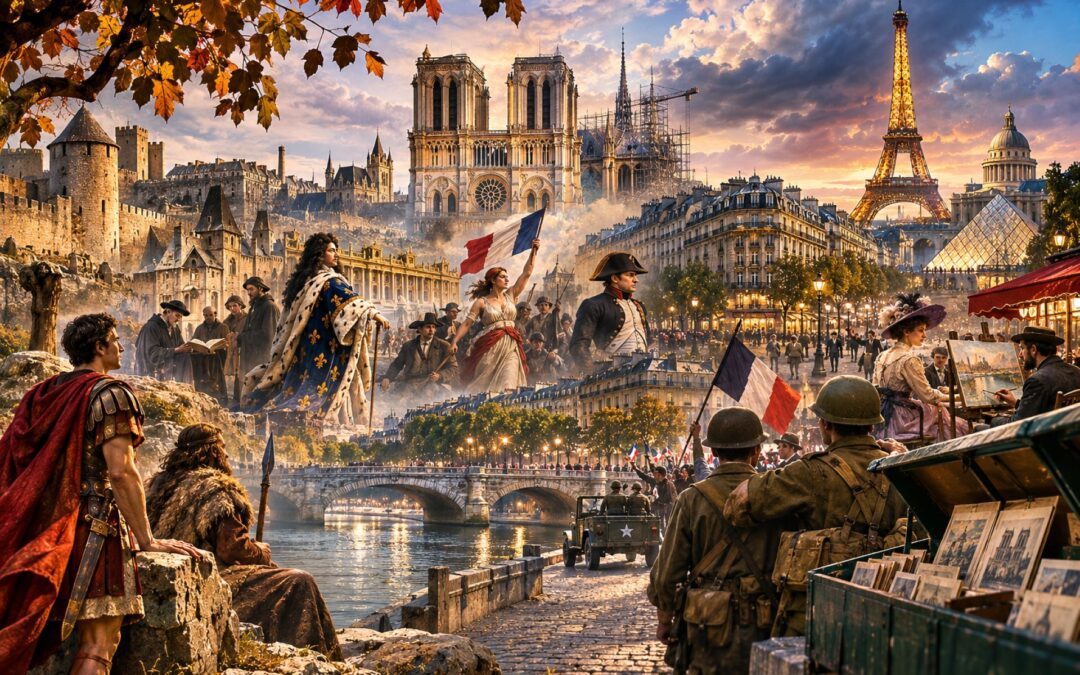
Paris is a city in which more than two thousand years of history remain visible in everyday life. Roman ruins stand beneath busy streets, medieval churches rise above neighborhoods transformed in the nineteenth century, and avenues designed for imperial grandeur have repeatedly become the setting for protests and revolutions. Few cities reveal their past through so many overlapping layers of architecture, political power, and cultural life.
Yet the Paris familiar today was never the inevitable outcome of its beginnings. It developed from a relatively modest settlement beside the Seine into a medieval royal capital, a center of European intellectual and artistic life, and the setting for some of the most consequential political upheavals in modern history. Its importance grew through commerce and royal patronage, but it was repeatedly threatened by invasion, disease, religious violence, civil conflict, and foreign occupation.
The history of Paris is therefore not simply a story of beautiful monuments and celebrated artists. It is the history of a city that continually changed its relationship with the rulers who governed it, the people who inhabited it, and the wider world. Understanding how Paris became the City of Light means following these transformations from the banks of the ancient Seine to the streets of the modern French capital.
Paris Before Paris: The Parisii and Roman Lutetia
Long before Paris became the capital of France, the surrounding region was inhabited by prehistoric communities drawn to the resources of the Seine basin. The river provided freshwater, fish, transportation, and access to an extensive network of waterways connecting northern Europe with the interior of Gaul. Archaeological discoveries suggest human activity in the area extending back thousands of years, although the origins of the permanent settlement that became Paris are considerably more recent.
During the third century BCE, a Celtic-speaking people known as the Parisii established themselves in the region. They belonged to the diverse collection of communities whom the Romans collectively called the Gauls, and their territory occupied an advantageous position along the Seine. River crossings and commercial routes gave the Parisii access to goods moving between different parts of Gaul, helping their community develop into an important local trading center. Their prosperity is reflected in distinctive gold coinage produced before the Roman conquest.
The exact location of their principal settlement remains debated. The traditional identification places Gallic Lutetia on the Île de la Cité, the island that later became the historic heart of Paris, but archaeological discoveries at Nanterre have complicated that interpretation. What is clear is that the Parisii controlled territory surrounding a strategically valuable stretch of the Seine and were drawn into the conflicts that accompanied Rome’s expansion into Gaul.
In 58 BCE, Julius Caesar began the campaigns that eventually brought much of Gaul under Roman control. When Gallic resistance intensified in 52 BCE, the Parisii joined the wider struggle against Roman expansion. According to Caesar’s account of the Battle of Lutetia, the defenders burned their settlement and destroyed its bridges rather than allow the Romans to use them. Roman forces under Titus Labienus ultimately defeated the Gallic army, bringing the region under Roman authority.
The Roman settlement that subsequently developed was known as Lutetia, later commonly distinguished as Lutetia Parisiorum. Much of the Roman town occupied the Left Bank, where its streets followed an organized pattern centered on the main north–south road. Public buildings reflected the architectural and civic traditions of the Roman world, including a forum, baths, temples, and an amphitheater. The remains of the Arènes de Lutèce and the thermal baths incorporated into the Musée de Cluny still provide tangible evidence of this period.
Lutetia became a prosperous regional town, although it never rivaled the largest urban centers of Roman Gaul, such as Lugdunum, modern Lyon. Its inhabitants participated in a Gallo-Roman society that combined Roman administration, language, religion, and building practices with surviving local traditions. Trade and transportation remained essential to its development, while roads connected the settlement to the wider imperial network.
During the third century CE, Christianity gradually established a presence in the region. Later Christian tradition associated its early spread with Saint Denis, whose martyrdom became an important part of Parisian religious identity. At the same time, the Roman Empire was experiencing growing political instability, military pressure, and economic disruption. These difficulties would fundamentally change both the physical organization of Lutetia and the political world to which it belonged.
From a Fortified Island to a Frankish Capital
By the late third century, the security that had supported Roman urban life was deteriorating. Raids, political instability, and the weakening of imperial defenses encouraged residents to retreat from exposed districts on the Left Bank toward the more defensible Île de la Cité. Stones from abandoned public buildings were reused to construct fortifications, creating a compact defensive settlement protected by the surrounding river.
This movement marked an important transition in the city’s development. The monumental Roman town gradually gave way to a smaller fortified center, while the name Lutetia increasingly disappeared from official usage. By late antiquity, the settlement was commonly identified with the Parisii, eventually giving rise to the name Paris.
Christianity became central to the city’s identity during this transformation. Saint Denis was traditionally remembered as an early missionary and martyr, associated with an execution at Montmartre. His burial was connected with the site that eventually became the great Basilica of Saint-Denis, north of Paris, rather than with a surviving church on Montmartre itself. The basilica would later acquire extraordinary importance as the burial place of French monarchs.
Another influential religious figure was Saint Geneviève, who lived during the fifth century. According to Christian tradition, she encouraged the inhabitants of Paris to remain steadfast when the Huns threatened Gaul in 451. Although the precise historical circumstances are difficult to separate from later accounts of her life, Geneviève became deeply associated with the city’s protection and eventually received recognition as its patron saint.
As Western Roman authority collapsed, Germanic kingdoms established themselves throughout former imperial territories. The Franks emerged as the dominant political force in northern Gaul under Clovis I, who consolidated his authority through warfare and alliances during the late fifth and early sixth centuries. His adoption of Nicene Christianity strengthened his relationship with the influential Gallo-Roman Church, helping establish the political and religious foundations of the kingdom from which medieval France would develop.
Paris became an important royal residence under Clovis, who died in 511 and was buried in the city. However, its political importance fluctuated under subsequent Frankish rulers, particularly after the rise of the Carolingian dynasty in 751. The centers of royal power shifted, and Paris frequently occupied a secondary position within a kingdom whose political geography extended far beyond the Seine.
The city nevertheless remained valuable because of its river crossings, religious institutions, and commercial connections. These advantages also exposed it to attack during the Viking Age, when Scandinavian raiders used rivers to penetrate deep into western Europe. Viking fleets reached Paris repeatedly during the ninth century, including an attack in 845 that ended with the payment of a substantial ransom.
The most celebrated confrontation occurred during the siege of 885–886, when Viking forces attempted to overcome the city’s defenses. The defenders resisted, turning the siege into an important episode in the history of Frankish political authority. The campaign forms part of the wider story of Viking expansion across Europe, during which Scandinavian raiders, traders, and settlers transformed the political landscape of the continent.
Paris’s position improved decisively after the accession of Hugh Capet in 987. Although the early Capetian kings controlled only a relatively small royal domain surrounding Paris and Orléans, their dynasty gradually consolidated power over the wider kingdom. As France developed from fragmented Frankish territories into a stronger medieval monarchy, Paris increasingly became the center of royal administration, commerce, religion, and political influence.
The Medieval City: Kings, Merchants, Scholars, and Cathedrals
Between the eleventh and thirteenth centuries, Paris underwent a transformation that established many of the defining features of its historic urban landscape. The growth of Capetian royal power brought political stability and investment, while expanding commerce attracted merchants, craftsmen, students, and religious institutions. By the High Middle Ages, the city had become one of the most important urban centers in western Europe.
Its geography encouraged the development of three distinct but interconnected districts. The Île de la Cité remained the center of royal and ecclesiastical authority, with palaces, administrative institutions, and important churches. The Right Bank developed around river commerce, markets, ports, and workshops, while the Left Bank became increasingly associated with monasteries, schools, and intellectual life.
The Right Bank’s commercial expansion reflected Paris’s growing economic importance. Merchants transported goods along the Seine, supplying the city with food, wine, cloth, building materials, and commodities from distant regions. Markets and warehouses flourished, while specialized trades became concentrated in particular neighborhoods. Craft guilds regulated training, workmanship, and commercial privileges, giving organized artisans an important place in urban society.
The Left Bank developed a different character through its religious and educational institutions. Schools associated with the cathedral and religious communities attracted scholars from across Europe, gradually giving rise to the University of Paris during the twelfth and thirteenth centuries. Its institutional development occurred over time rather than through a single precisely documented founding event. The university became particularly influential in theology, philosophy, and the study of medieval intellectual traditions.
The founding of the Collège de Sorbonne by Robert de Sorbon in the thirteenth century strengthened this academic environment. Although the history of the Sorbonne belongs to a later stage of the university’s development, its name eventually became synonymous with Parisian scholarship. Generations of students, teachers, and religious thinkers helped establish the city’s reputation as one of Europe’s major centers of learning.
The growing authority of the monarchy also transformed Paris physically. King Philip II Augustus, who ruled from 1180 to 1223, ordered the construction of defensive walls around significant portions of both banks. These fortifications, built largely between the 1190s and the early thirteenth century, included towers and guarded gates that protected the expanding urban population. Philip also commissioned a fortress on the western edge of the Right Bank, creating the original Louvre as a military stronghold rather than a royal art museum.
The medieval city was equally shaped by ambitious religious architecture. Construction of Notre-Dame Cathedral began in 1163 under Bishop Maurice de Sully, replacing earlier religious buildings on the Île de la Cité. The project required generations of architects, masons, sculptors, and craftsmen, reflecting both the resources available to medieval Paris and the growing confidence of Gothic architecture. Its pointed arches, ribbed vaults, flying buttresses, and extensive sculptural decoration represented a remarkable combination of structural innovation and religious symbolism.
The cathedral’s development extended across several generations, and its appearance continued to change long after the medieval period. The architectural history of Notre-Dame illustrates how successive builders modified and expanded the church as construction techniques and aesthetic ambitions evolved. Its towers eventually became one of the most recognizable features of the Parisian skyline.
Another outstanding example of Gothic craftsmanship appeared during the reign of Louis IX. Between 1241 and 1248, the king commissioned Sainte-Chapelle within the royal palace complex on the Île de la Cité to house sacred relics associated with the Passion of Christ. Its extraordinary stained-glass windows transformed biblical narratives into a luminous architectural setting, demonstrating the close relationship between royal power, religious devotion, and artistic patronage.
By the early fourteenth century, Paris had become one of Europe’s largest cities, with estimates often placing its population at around 200,000 inhabitants. This enormous growth created opportunities for commerce and culture, but it also produced severe challenges. Housing was crowded, sanitation remained inadequate, and the city depended upon an extensive surrounding countryside to supply its population with food and essential materials.
Medieval Paris was consequently a city of striking contrasts. Royal palaces, university colleges, and magnificent churches existed alongside crowded workshops, narrow streets, and densely occupied neighborhoods. Its prosperity rested on political authority, commerce, religion, and learning, but the same concentration of people and resources made it vulnerable to disease, war, and social unrest.
Plague, War, and the Struggle for Paris
The expansion of medieval Paris did not produce equal prosperity for its inhabitants. Society was organized through overlapping hierarchies of wealth, occupation, religious status, and inherited privilege. Noble households and senior clergy possessed considerable resources, while merchants and successful craftsmen exercised growing economic influence. Laborers, servants, casual workers, and the urban poor remained particularly exposed to fluctuations in employment, food prices, and public health.
The city’s crowded living conditions created serious sanitary problems. Waste disposal was inconsistent, drinking-water quality varied, and narrow streets accommodated people, animals, and commercial activity within limited space. Outbreaks of infectious disease were therefore a recurring danger, particularly when hunger and warfare weakened the population.
The Black Death reached Paris in 1348, during a pandemic that devastated communities throughout Europe. Mortality was enormous, although precise estimates for the city’s losses remain uncertain. The epidemic disrupted commerce, weakened households, and intensified social and economic instability, while subsequent outbreaks prevented a rapid return to earlier conditions.
Disease arrived during a period of increasing political conflict. The Hundred Years’ War, which began in 1337, emerged from dynastic disputes and competing English and French claims over territory and sovereignty. Although Paris was not continuously under siege, the war damaged the surrounding countryside, disrupted trade, and exposed the city to the consequences of political instability.
French defeats at Crécy in 1346 and Poitiers in 1356 undermined confidence in royal leadership. During periods of military uncertainty, armed groups and unemployed soldiers ravaged agricultural communities, weakening the economic networks that supplied urban populations. Paris itself became an arena of political agitation as merchants, nobles, royal officials, and ordinary inhabitants struggled over taxation and authority.
The city’s defenses were expanded during the fourteenth century. Charles V strengthened royal control and oversaw major construction, including fortifications associated with the eastern boundary of medieval Paris. The Bastille was begun during his reign as a defensive fortress protecting a vulnerable approach to the capital. Centuries later, the same structure would become one of the most potent symbols of royal oppression.
Paris’s fortunes deteriorated further during the early fifteenth century. Following the English victory at Agincourt in 1415 and the political settlement established by the Treaty of Troyes in 1420, the city came under Anglo-Burgundian control. In 1431, the young Henry VI of England was crowned King of France at Notre-Dame, an extraordinary demonstration of the contest over French sovereignty.
French forces eventually recovered Paris in 1436, although the damage caused by war and political division required years of rebuilding. The city gradually regained population and commercial strength as the French monarchy consolidated its position. By the beginning of the sixteenth century, Paris was once again among Europe’s most important political and cultural centers, ready to participate in the artistic and intellectual transformations of the Renaissance.
Renaissance Paris and the Wars of Religion
The sixteenth century introduced new artistic ambitions and intellectual influences to Paris. The French monarchy’s involvement in the Italian Wars brought the royal court into contact with Renaissance architecture, painting, and scholarship. These cultural exchanges encouraged new approaches to construction and artistic patronage, gradually modifying the appearance of a city still dominated by medieval buildings.
King Francis I, who ruled from 1515 to 1547, became particularly associated with Renaissance culture. He supported artists, scholars, and architects while commissioning improvements to royal buildings, including the Louvre. Classical architectural elements increasingly appeared alongside Gothic traditions, reflecting the monarchy’s desire to demonstrate sophistication and prestige.
Paris also developed into an important center of printing and education. Printing presses expanded the circulation of religious texts, scholarly works, political arguments, and literature, helping intellectual debates reach a broader audience. Francis I encouraged the study of classical languages and subjects that were not always comfortably accommodated within existing university traditions. The institution that eventually became the Collège de France emerged from these efforts to strengthen advanced scholarship.
Public construction reflected changing expectations of urban life. Bridges, fountains, municipal buildings, and private residences increasingly incorporated Renaissance design principles. The city remained crowded and unevenly developed, but its commercial wealth and royal patronage supported a growing architectural ambition.
This cultural flourishing coincided with religious conflict that would threaten the kingdom for decades. Protestant ideas spread through France during the sixteenth century, challenging the established authority of the Catholic Church. Religious disagreements became entangled with aristocratic rivalries, struggles over royal government, and competition among powerful political factions.
Paris remained strongly Catholic, making it an especially dangerous environment for Protestants during periods of heightened tension. The crisis reached a terrible climax in August 1572, when Protestant nobles had gathered in the capital for the marriage of Henry of Navarre and Margaret of Valois. An attempt to eliminate prominent Protestant leaders escalated into widespread killings beginning around the night of 23–24 August.
The violence became known as the St. Bartholomew’s Day Massacre. Thousands of Protestants were murdered in Paris, and the killings spread to other French cities over the following weeks. Precise casualty estimates remain contested, but the massacre demonstrated how religious hostility, factional politics, and urban violence could combine with devastating consequences.
The French Wars of Religion continued until the end of the century. After becoming Henry IV in 1589 and consolidating his authority, the former Protestant leader adopted Catholicism and pursued policies intended to stabilize the kingdom. His Edict of Nantes in 1598 granted limited protections to French Protestants, creating a political settlement that helped reduce the immediate threat of religious civil war.
Henry IV also worked to repair and improve Paris. Projects associated with his reign included the completion of the Pont Neuf and the development of Place Dauphine, while the Place Royale, later renamed Place des Vosges, became an important example of planned urban architecture. The Pont Neuf was particularly innovative because it was built without the houses that commonly crowded earlier Parisian bridges.
Henry’s assassination in 1610 brought another moment of political uncertainty, but the rebuilding initiatives of his reign helped establish the foundations of a new royal Paris. The city’s architectural transformation would continue under his successors, even as the monarchy’s relationship with the capital became increasingly complicated.
Royal Paris: Palaces, Boulevards, and Enlightenment Cafés
During the seventeenth century, Paris grew into one of Europe’s most influential centers of royal administration, architecture, and cultural production. The Bourbon monarchy supported ambitious construction projects while encouraging institutions devoted to literature, painting, science, and intellectual life. The city’s population expanded, and its aristocratic neighborhoods increasingly displayed the wealth and prestige of the French court.
Marie de Médicis, the widow of Henry IV, commissioned the Luxembourg Palace beginning in 1615, drawing inspiration from Italian architecture. Under Louis XIII and his powerful minister Cardinal Richelieu, royal patronage continued to strengthen the cultural institutions of Paris. The Académie française, established in 1635, became an important institution for the cultivation and regulation of the French language.
Following the accession of Louis XIV in 1643, the monarchy moved toward an increasingly centralized form of government. Yet the king’s relationship with Paris was influenced by the Fronde, a series of rebellions that challenged royal authority during his childhood. These disturbances contributed to his distrust of the capital and strengthened his determination to control the political environment surrounding the crown.
Louis XIV gradually developed Versailles into the principal setting for royal government. On 6 May 1682, the court and government formally established themselves there, creating a magnificent political center outside Paris. As the history of Versailles’s transformation into the royal capital demonstrates, the palace was more than an extravagant residence: it helped organize aristocratic life around the king and reinforced the ceremonial structures of absolute monarchy.
Paris nevertheless continued to grow while the court resided at Versailles. Its older defensive walls were increasingly unnecessary as military technology and the city’s geography changed. Several fortifications were removed or incorporated into broader streets and promenades, while planned avenues and public gardens reflected new ideas about urban beauty and movement.
The transformation was particularly visible in the development of the Tuileries gardens and the avenue that became the Champs-Élysées. These spaces introduced long visual axes, formal landscaping, and more extensive public routes into an otherwise dense and irregular city. Architectural improvements brought grandeur to selected districts, although many ordinary inhabitants continued to live in crowded and unsanitary conditions.
The eighteenth century also witnessed the growing importance of Parisian intellectual culture. Cafés, salons, publishing houses, and literary circles became places where educated citizens discussed politics, philosophy, science, and society. Thinkers associated with the Enlightenment, including Voltaire and Jean-Jacques Rousseau, challenged inherited assumptions about authority, religious tolerance, social inequality, and political legitimacy.
Not everyone could participate equally in these conversations. Education, wealth, gender, and social position continued to restrict access to influential intellectual networks, while censorship and royal authority imposed limits on political expression. Nevertheless, new ideas circulated through books, pamphlets, private gatherings, and public debate, contributing to a broader transformation in French political culture.
By the late eighteenth century, Paris combined magnificent royal monuments with deep social tensions. Food prices, inequality, public debt, and dissatisfaction with the monarchy placed increasing pressure on the political system. The same city that symbolized the cultural achievements of Bourbon France was becoming the center of a movement that would challenge the monarchy itself.
Revolution, Empire, and the Return of the Barricades
The French Revolution began amid a severe political and financial crisis. The monarchy faced enormous debts, an unequal system of taxation, and growing resistance to reforms that threatened privileged interests. Poor harvests and high bread prices intensified public anger, particularly in Paris, where large numbers of working people depended upon purchasing food in urban markets.
When Louis XVI summoned the Estates-General in 1789, the resulting political struggle raised fundamental questions about representation and sovereignty. Paris became increasingly tense as rumors circulated about royal efforts to suppress the emerging National Assembly. The dismissal of finance minister Jacques Necker in July helped trigger demonstrations and confrontations that rapidly escalated beyond the government’s control.
On 14 July 1789, crowds stormed the Bastille, seeking weapons and gunpowder while attacking a fortress associated with arbitrary royal authority. The prison held relatively few inmates, but its capture carried enormous symbolic importance. Parisians had demonstrated their capacity to challenge the monarchy through collective action, and the event became one of the defining moments of the French Revolution.
The revolutionary movement transformed the political role of Paris. Municipal institutions changed, political clubs and newspapers multiplied, and crowds regularly intervened in disputes between competing revolutionary factions. In October 1789, demonstrators marched to Versailles over food shortages and political grievances, ultimately forcing the royal family to return to Paris.
The monarchy’s relocation to the Tuileries Palace placed the king under much closer observation by revolutionary politicians and citizens. Political tensions continued to intensify as France struggled to establish a constitutional settlement, while distrust increased following the king’s attempted escape in 1791. War against foreign monarchies and growing fear of counterrevolution eventually contributed to the overthrow of the monarchy in August 1792.
Louis XVI was executed on 21 January 1793 at the Place de la Révolution, now Place de la Concorde. His death represented a decisive rupture with the political order that had governed France for centuries. Yet the revolutionary republic soon experienced deep internal divisions, emergency measures, political repression, and the violence associated with the Reign of Terror.
The instability of the revolutionary decade created opportunities for military leaders who promised order. In November 1799, Napoleon Bonaparte seized power in the coup of 18 Brumaire, replacing the Directory with the Consulate. His government restored a measure of administrative stability while concentrating increasing authority in his own hands.
Napoleon proclaimed himself Emperor of the French in 1804, and his coronation took place at Notre-Dame Cathedral on 2 December. The ceremony demonstrated the extraordinary political transformation that France had undergone: a general who rose during the Revolution now ruled as an emperor. Although much of his reign was dominated by military campaigns across Europe, Napoleon also pursued projects intended to establish Paris as an imperial capital.
Grand monuments became central to this ambition. The Arc de Triomphe was commissioned to celebrate French military achievements, while the column at Place Vendôme commemorated victories associated with Napoleon’s armies. Bridges, public buildings, and improvements to urban infrastructure reinforced the image of Paris as the administrative and symbolic center of a powerful European empire.
These projects formed part of the broader history of Napoleon’s rise and the wars that reshaped Europe, but their meaning within Paris was distinctly urban. They connected imperial power to public space, establishing monuments that continued to shape the city’s identity long after Napoleon’s political system collapsed.
In 1814, coalition forces captured Paris, contributing to Napoleon’s first abdication. His brief restoration during the Hundred Days ended with defeat at Waterloo in 1815, after which the Bourbon monarchy returned under Louis XVIII. The restoration attempted to reconcile hereditary monarchy with a constitutional framework, but disputes over royal authority, political rights, and public expression remained unresolved.
Under Charles X, increasingly restrictive policies provoked renewed opposition. In July 1830, attempts to suppress press freedom and alter the political system triggered an uprising in Paris. Barricades appeared throughout the city, and several days of fighting forced the king to abdicate, allowing Louis-Philippe to assume the throne as a constitutional monarch.
The revolutionary culture of Paris did not disappear under the new regime. Rapid population growth, industrial development, and widening economic inequalities produced repeated disturbances during the 1830s. The June Rebellion of 1832, later immortalized in Victor Hugo’s Les Misérables, revealed the continuing frustration of those who believed the revolution of 1830 had failed to produce meaningful political and social change.
In February 1848, another uprising ended Louis-Philippe’s reign and established the Second Republic. Louis-Napoleon Bonaparte, Napoleon’s nephew, was elected president later that year, but he staged a coup in December 1851 and subsequently proclaimed himself Napoleon III. His rise opened a new chapter in Parisian history, one in which the government attempted to transform the physical structure of the city as thoroughly as earlier revolutions had transformed its political institutions.
Haussmann’s Paris: A City Rebuilt and a Society Displaced
By the middle of the nineteenth century, Paris was experiencing intense pressure from industrialization and population growth. Railway connections brought people and goods into the capital, while expanding commercial activity attracted migrants from across France. Large sections of the city still contained narrow medieval streets, overcrowded housing, inadequate sanitation, and limited access to open spaces.
Napoleon III regarded urban modernization as essential to both economic development and political authority. He appointed Georges-Eugène Haussmann as Prefect of the Seine in 1853, giving him extensive responsibility for transforming the capital. The resulting reconstruction became one of the most ambitious urban-planning projects in nineteenth-century Europe.
Haussmann’s reforms were intended to improve circulation, sanitation, public health, and the appearance of the city. Broad boulevards were cut through densely developed neighborhoods, replacing complicated networks of narrow streets with more direct routes between important districts. Railway stations, administrative buildings, markets, and public spaces became connected through a more coordinated urban system.
These changes required extensive demolition. Entire streets and neighborhoods were cleared, while thousands of buildings disappeared to create new avenues and public squares. The scale of reconstruction altered the daily geography of Paris, changing how residents moved between workplaces, markets, railway stations, and residential areas.
The city’s administrative boundaries also expanded. In 1860, Paris annexed surrounding communes and reorganized its territory into twenty arrondissements, replacing the earlier twelve-district structure. This enlargement incorporated areas that had previously developed outside the old municipal limits, creating the administrative geography that still defines Paris today.
Architectural regulations helped produce the recognizable appearance of Haussmannian Paris. Buildings along new avenues followed relatively consistent rules governing height, façades, balconies, and alignment. Cream-colored limestone, regular windows, and continuous rooflines created a visual harmony that distinguished many of the reconstructed districts from the irregular building patterns of medieval neighborhoods.
The modernization extended beneath the streets. Engineers developed water-supply and sewerage infrastructure, improving the city’s ability to provide clean water and remove waste. Gas lighting expanded, while improved roads and transportation networks supported growing commercial activity. These projects reflected the wider transformation of urban engineering into a central responsibility of modern government.
Public parks became another important part of the reconstruction. The Bois de Boulogne and Bois de Vincennes provided extensive green spaces on opposite sides of the capital, while parks such as Parc Monceau and the Buttes-Chaumont introduced landscaped recreation into the urban fabric. Their development reflected changing expectations about public health, leisure, and the relationship between crowded cities and open space.
The transformation was not limited to streets and parks. The Palais Garnier opera house, begun under Napoleon III and inaugurated in 1875, became an outstanding expression of the imperial ambition to associate Paris with culture and architectural magnificence. New commercial buildings, hotels, and department stores also reflected the city’s growing importance as a center of finance, consumption, and fashionable society.
Yet Haussmannization carried serious social consequences. Demolition displaced residents and businesses, while the cost of new buildings and infrastructure contributed to rising rents in many renovated districts. Wealthier households benefited disproportionately from improvements in central Paris, whereas lower-income residents were often pushed toward less expensive neighborhoods farther from the city’s most prestigious areas.
Critics also questioned the political purposes of the new boulevards. Wider streets could facilitate the movement of troops and make traditional barricade fighting more difficult, although the reconstruction cannot be explained solely as a strategy of military control. As accounts of Haussmann’s reconstruction of Paris demonstrate, modernization combined practical engineering objectives with political authority, economic interests, and ideas about urban grandeur.
Haussmann was dismissed in 1870 amid mounting criticism of the project’s financial and administrative consequences. Nevertheless, the transformation he directed fundamentally changed Paris. The broad avenues, coordinated façades, parks, and infrastructure established during the Second Empire remain among the most recognizable features of the modern capital.
Siege, Commune, and the Belle Époque
The Second Empire collapsed in the aftermath of France’s disastrous war against Prussia and its German allies. In September 1870, Napoleon III was defeated and captured at the Battle of Sedan, destroying the political foundations of his government. A republic was proclaimed in Paris, but the war continued as German forces advanced toward the capital.
Paris soon endured a prolonged siege. Beginning in September 1870, the German blockade restricted supplies and created growing shortages of food, fuel, and essential goods. As conditions deteriorated during the winter, residents struggled to survive, and accounts of the siege described the consumption of animals that would ordinarily never have been considered food.
Bombardment and continued military pressure intensified the crisis. Paris eventually capitulated in January 1871, leaving its population exhausted, humiliated, and deeply divided over the political settlement that followed. Many Parisians believed the national government had betrayed the capital by accepting defeat and negotiating peace.
The immediate aftermath produced one of the most extraordinary political experiments in the city’s history. On 18 March 1871, an attempt by government forces to seize artillery in Paris triggered resistance and helped produce a revolutionary municipal government. The Paris Commune was formally proclaimed on 28 March, asserting a political authority distinct from that of the national government based at Versailles.
The Commune brought together different revolutionary traditions, including socialists, republicans, and supporters of greater municipal autonomy. Its leaders attempted reforms concerning education, labor, public administration, and relations between Church and state. The movement also reflected wider tensions over class, political representation, and the right of Parisians to govern their own city.
The experiment lasted only a few weeks. In May 1871, government troops entered Paris and fought the Communards through streets defended by barricades. During the final period, remembered as the Bloody Week, thousands were killed, while major buildings were destroyed or burned during the fighting. The suppression of the Commune became a defining episode in the history of revolutionary politics and state violence.
The Musée Carnavalet’s historical collections place the Commune within the longer history of Parisian political conflict and urban transformation. Its significance extended far beyond France, as later socialist, anarchist, and revolutionary movements debated its achievements, failures, and political meaning.
Despite the destruction of 1871, Paris entered a period of remarkable cultural and economic development during the final decades of the nineteenth century. This era became known as the Belle Époque, a retrospective name associated with technological progress, artistic innovation, expanding entertainment, and the growing confidence of modern urban society.
Department stores transformed patterns of shopping and consumption. Businesses such as Le Bon Marché and Galeries Lafayette developed new commercial environments in which advertising, display windows, fashionable goods, and increasingly elaborate retail interiors attracted large numbers of customers. Cafés, restaurants, theaters, and entertainment venues contributed to the city’s reputation as a center of pleasure and sophistication.
Industrial and artistic innovation were showcased through international exhibitions. The most famous architectural legacy emerged from the Exposition Universelle of 1889, organized during the centenary of the French Revolution. Gustave Eiffel’s iron tower was completed for the exhibition and became its most recognizable structure, although the project initially provoked substantial criticism.
The tower’s inauguration on 31 March 1889 marked the appearance of a monument that would eventually become inseparable from Paris itself. As the Eiffel Tower’s history explains, a structure designed in connection with a temporary international exhibition endured because of its engineering significance, practical uses, and growing popularity. What had initially seemed an intrusive industrial object gradually became a defining symbol of the city.
Paris was also transforming the visual arts. Painters such as Édouard Manet, Claude Monet, Pierre-Auguste Renoir, and Edgar Degas challenged established artistic conventions, exploring modern urban life, changing light, movement, and everyday experience. Later generations of artists, including Henri de Toulouse-Lautrec, Pablo Picasso, and Henri Matisse, contributed to an increasingly experimental artistic environment.
The city’s cultural development was accompanied by improvements in transportation. In 1900, Paris inaugurated its first Métro line during another major international exhibition, connecting important urban destinations through a new underground railway system. The history of Métro Line 1 reflects the technological ambition of a city seeking to accommodate increasingly complex patterns of movement.
The Belle Époque was not equally prosperous for everyone. Industrial workers continued to experience insecure employment, crowded housing, and social inequality, while political divisions remained prominent. Yet the period established Paris as an international symbol of artistic creativity, modern technology, consumer culture, and urban sophistication.
Paris in the First World War and the Interwar Years
The outbreak of the First World War in August 1914 abruptly interrupted the confidence of the Belle Époque. Germany’s invasion of Belgium and northern France brought the fighting dangerously close to Paris, raising fears that the capital might fall as it had during earlier wars. The French government temporarily relocated to Bordeaux while military forces attempted to halt the German advance.
In September, French and British armies counterattacked during the First Battle of the Marne. The successful defense prevented the Germans from achieving a rapid victory over France, although the war soon developed into a prolonged conflict of trenches and industrial destruction. Parisian taxis famously transported troops toward the front during the crisis, creating an enduring image of civilian participation in the defense of the capital.
The taxis were symbolically important rather than decisive to the military outcome. Nevertheless, the episode entered popular memory as an example of the city’s contribution to the national war effort. Paris remained a major administrative, industrial, medical, and logistical center throughout the conflict, supporting armies fighting across northern and eastern France.
The city also experienced attacks from the air and from long-range artillery. German aircraft and airships carried out raids, while the Paris Gun fired shells from distant positions during 1918. Although the capital escaped the devastation suffered by towns directly along the Western Front, the war brought fear, casualties, shortages, and enormous pressure upon civilian life.
The armistice of November 1918 brought relief, but peace did not immediately restore stability. Inflation, unemployment, and political tensions complicated economic recovery, while the enormous human losses of the conflict affected families throughout France. Paris became the setting for major diplomatic negotiations as the victorious powers attempted to construct a new international order.
During the 1920s, the city experienced another extraordinary period of cultural creativity. Writers and artists from Europe and the United States were attracted by its intellectual communities, comparatively affordable living conditions for some expatriates, and vibrant publishing and artistic networks. Ernest Hemingway, James Joyce, Gertrude Stein, and other prominent figures contributed to the reputation of Paris as a gathering place for modern literature.
Experimental painting, music, and performance flourished. Picasso and other artists continued challenging traditional forms, while jazz gained popularity in clubs and entertainment venues. Performers such as Josephine Baker became major celebrities, and Black musicians, writers, and intellectuals helped shape a cultural scene that connected Paris with wider developments across the Atlantic.
Yet artistic innovation existed alongside economic hardship and growing political divisions. The Great Depression weakened commercial activity during the 1930s, while competing political movements struggled over the direction of French society. Fascism, communism, republicanism, and nationalist movements increasingly confronted one another in an atmosphere of international uncertainty.
By the end of the decade, memories of the First World War contributed to widespread anxiety about another European conflict. Paris remained internationally celebrated for art, fashion, literature, and intellectual life, but its apparent cultural confidence concealed deep political insecurity. In September 1939, the outbreak of war between Germany and the European powers once again placed the city’s future in danger.
Occupation, Resistance, and the Liberation of Paris
The German invasion of western Europe in May 1940 produced a military collapse that stunned France. German forces bypassed important French defenses, advanced through the country, and threatened Paris within weeks. As the French army retreated, large numbers of civilians fled the capital, fearing bombing, fighting, and the arrival of occupation forces.
Paris was declared an open city to avoid extensive destruction through direct military resistance. German troops entered on 14 June 1940, taking control of a capital that had been among Europe’s most important political and cultural centers. The French government subsequently accepted an armistice, dividing the country between German-occupied territory and a regime based at Vichy that collaborated with Nazi Germany.
The occupation transformed ordinary life. German military authorities controlled important buildings and institutions, while requisitioned hotels, offices, and public spaces served the needs of the occupying forces. Food rationing, shortages, restrictions, surveillance, and the presence of foreign soldiers became familiar features of daily existence.
Parisians responded in different ways. Some cooperated with the occupation authorities, whether through political sympathy, commercial interests, or efforts to protect their positions. Others attempted to avoid confrontation and continue their lives under difficult circumstances. Resistance networks gradually developed through clandestine publications, intelligence gathering, sabotage, and assistance to people threatened by German repression.
The occupation proved particularly devastating for the city’s Jewish population. Anti-Jewish regulations excluded Jews from many occupations and public institutions, while identification requirements, confiscation of property, arrests, and deportations intensified persecution. French authorities participated in implementing discriminatory policies and organizing arrests, demonstrating that the machinery of collaboration extended beyond direct German military commands.
One of the most notorious episodes occurred on 16–17 July 1942, when French police conducted the Vel d’Hiv roundup. According to the Mémorial de la Shoah’s historical account, 13,152 Jewish men, women, and children were arrested in Paris and its surroundings during the operation. Many were detained in appalling conditions before being transferred to camps, and most of those subsequently deported were murdered.
The persecution of Jews formed part of the wider machinery of the Holocaust. Parisian Jewish communities lost thousands of members, including children who had been born or raised in France. The deportations left a lasting wound in the city’s history and later became central to debates about French responsibility for wartime collaboration.
Resistance activity increased as the military situation changed. Following the Allied landings in Normandy in June 1944, German control across northern France became increasingly vulnerable. Armed resistance groups, political organizations, and underground networks prepared to challenge occupation authorities while Allied armies advanced toward the capital.
An uprising began in Paris during August 1944. Resistance fighters seized strategic positions, erected barricades, and confronted German forces, while negotiations and military developments shaped the struggle for control. Elements of the French 2nd Armored Division under General Philippe Leclerc, supported by American forces, entered the city as the German position deteriorated.
On 25 August 1944, the German commander surrendered, marking the liberation of Paris. The city’s liberation, preserved through the collections of the Musée de la Libération, became one of the most powerful symbolic events of the war. The following day, Charles de Gaulle participated in a triumphant procession through the capital, asserting the restoration of French political authority.
The liberation did not erase the suffering of occupation or immediately resolve the divisions it had produced. Questions of collaboration, resistance, responsibility, and national identity continued to shape public debate for decades. Nevertheless, the recovery of Paris represented a decisive turning point in the struggle to restore French sovereignty and republican government.
Unlike several European cities devastated by prolonged urban warfare, much of Paris’s historic architecture survived the Second World War. Its monuments, avenues, and neighborhoods remained largely recognizable, but the political and social consequences of occupation transformed how the city understood its recent past. Liberation became both a celebration of freedom and the beginning of a difficult process of national reckoning.
Postwar Paris: Immigration, Protest, and Cultural Reinvention
The decades following the Second World War brought new economic opportunities and social challenges to Paris. France entered a period of reconstruction and industrial expansion, while improvements in transportation, housing, education, and public services changed expectations about urban life. The capital retained its administrative and cultural importance, but the pressures of growth increasingly extended beyond the historic city center.
Immigration played a major role in reshaping metropolitan Paris. Workers and families arrived from other parts of France, neighboring European countries, and territories connected to France through colonial rule and decolonization. Communities originating in Algeria, Morocco, Tunisia, and parts of sub-Saharan Africa contributed to the development of new neighborhoods, commercial networks, religious institutions, and cultural traditions.
These changes enriched the city’s social and cultural life while also exposing inequalities in housing, employment, and public services. Migrants frequently encountered discrimination and difficult living conditions, particularly in areas where rapid development outpaced infrastructure. The expansion of suburban housing and transport systems reflected the growing importance of the wider metropolitan region.
The political upheavals of May 1968 demonstrated that Paris remained capable of becoming the center of national protest. Student demonstrations against university conditions and established social conventions escalated into confrontations with the police. Barricades appeared in the Latin Quarter, reviving a form of urban resistance closely associated with earlier Parisian revolutions.
The movement soon extended far beyond the universities. Strikes involving millions of workers disrupted economic activity across France, transforming the crisis into a nationwide challenge to established political and social relationships. As the historical photographs of May 1968 in Paris reveal, the confrontation drew upon the city’s long tradition of political mobilization while expressing new demands concerning education, work, authority, and personal freedom.
Although the protests did not overthrow the French government, their cultural and political consequences were significant. Debates over gender roles, sexuality, education, workplace relations, and individual autonomy became increasingly prominent. Paris’s reputation as a center of intellectual dissent gained a new association with the student and labor movements of the late twentieth century.
Urban modernization continued during these decades. The RER regional railway network strengthened connections between the capital and its expanding suburbs, while major roads and commercial developments changed the metropolitan landscape. At La Défense, a modern business district of office towers and large commercial buildings developed beyond the historic urban center, creating a striking contrast with the architecture of central Paris.
Cultural institutions also underwent substantial transformation. The Centre Pompidou, inaugurated in 1977, introduced a radically different architectural language through its exposed structural and mechanical systems. Its development reflected the ambition to make contemporary art and culture accessible within a major public institution.
By the 1980s, Paris had reaffirmed its international reputation as a center of art, fashion, literature, cinema, and cuisine. Yet this prestige coexisted with persistent social tensions and changing demographics. The modern capital was becoming increasingly metropolitan and multicultural, with its identity shaped as much by new communities and cultural movements as by the monuments inherited from earlier centuries.
Modern Paris and the Layers of Its Past
The final decades of the twentieth century brought another wave of ambitious cultural construction. Under President François Mitterrand, major public projects attempted to express the confidence and sophistication of contemporary France through architecture. These initiatives continued a long tradition in which political leaders used the built environment to establish a lasting presence within the capital.
One of the most controversial and ultimately recognizable projects was the glass pyramid designed by architect I. M. Pei for the Louvre. Inaugurated in 1989, it created a modern entrance to the museum while transforming circulation through the historic palace complex. As the Louvre’s account of the pyramid’s history demonstrates, the project connected modern architecture with a site whose history extended from medieval fortress to royal palace and national museum.
Other developments transformed transport, public spaces, and the use of former industrial and commercial sites. The redevelopment of former railway facilities, the expansion of cultural institutions, and continued improvements to metropolitan infrastructure reflected changing expectations of urban life. Paris was no longer simply preserving its inheritance; it was adapting historic spaces to new functions.
The challenge of maintaining the city’s architectural heritage became particularly visible after the fire at Notre-Dame Cathedral on 15 April 2019. The blaze destroyed the spire and severely damaged the roof, provoking an extraordinary international response. Restoration required extensive structural investigation, conservation work, historical research, and the skills of specialists in traditional building techniques.
Notre-Dame reopened in December 2024, marking an important moment in the continuing history of the cathedral. The reopening ceremonies represented more than the completion of a major repair project. They demonstrated the continuing importance of a medieval monument to a modern city whose religious, political, and cultural identity has changed repeatedly since construction began in the twelfth century.
Modern Paris also faces pressures that cannot be solved through architectural preservation alone. Housing costs, economic inequality, tourism, environmental concerns, and the relationship between the historic city and its wider metropolitan region all shape its development. Efforts to create more accessible public spaces and improve urban sustainability must operate within an environment where infrastructure, heritage, commerce, and residential life are closely intertwined.
The city’s continuing influence nevertheless rests on more than its monuments. Paris remains a center of political debate, artistic production, international education, and cultural exchange, shaped by inhabitants whose backgrounds reflect centuries of migration and historical change. Its identity has never belonged exclusively to a single dynasty, social class, artistic movement, or historical period.
The history of Paris is ultimately a record of accumulated transformation. Roman foundations, medieval churches, royal palaces, revolutionary squares, Haussmannian boulevards, industrial structures, and contemporary cultural institutions coexist within the same urban landscape. Each generation has inherited a city shaped by earlier conflicts and ambitions, while leaving its own imprint upon the streets and institutions that follow.
Paris became the City of Light not because its development was uninterrupted or harmonious, but because it repeatedly absorbed enormous changes without losing its importance. Its rulers built monuments to proclaim authority, its inhabitants challenged that authority through protest and revolution, and its artists and thinkers continually questioned established ideas. The modern city is the result of these competing forces, making Paris not merely a preserved capital of the past, but a place where history remains an active part of everyday life.
Last Updated on November 1, 2026 by Aseem Gupta