
Reading Time: 24 Minutes
The president of the United States is one of the most powerful people in the world. A successful president can guide the country through war, economic turmoil, and social upheaval. An unsuccessful one can make an already dangerous situation considerably worse, sometimes leaving consequences that endure for generations.
American history offers plenty of examples. Some presidents defended slavery when the country desperately needed a solution to its growing divisions. Others mishandled economic crises, undermined civil liberties, appointed corrupt officials, or led the nation into disastrous wars. A few inherited almost impossible circumstances, but their decisions still made matters worse.
Yet identifying the worst presidents in American history is more complicated than compiling a list of scandals and failures. A president who served during a catastrophe did not necessarily cause it, while someone who appeared successful during his lifetime might have left behind policies with devastating long-term consequences.
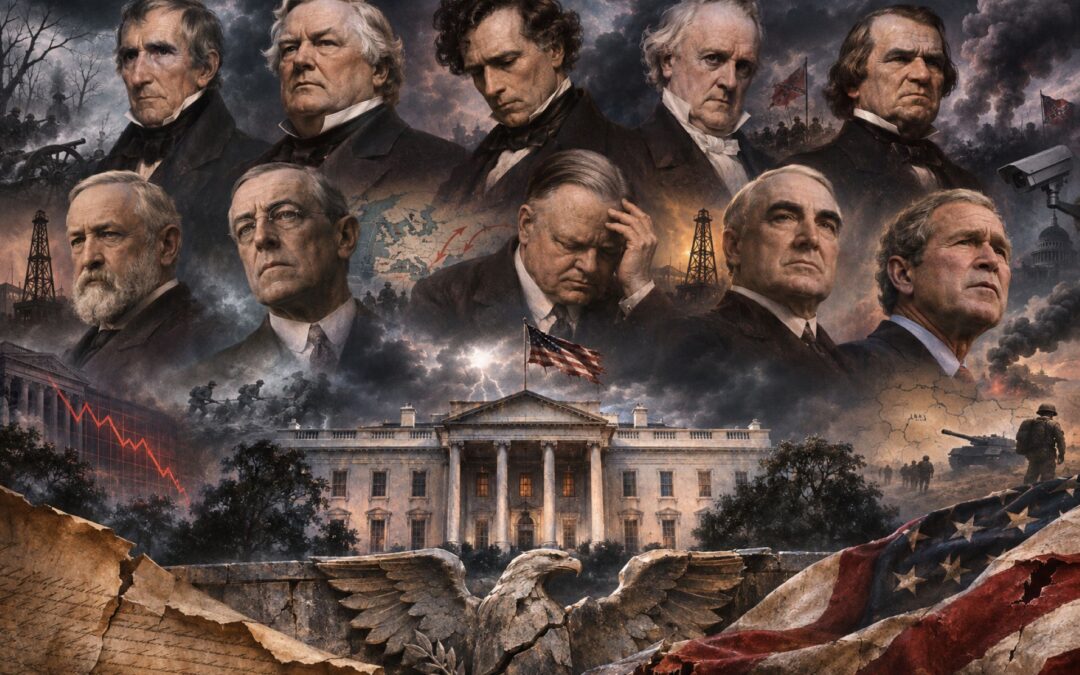
These ten presidents illustrate different kinds of failure. Some are consistently ranked among America’s least successful leaders. Others have more complicated records, with significant achievements alongside serious mistakes. Together, their stories reveal what can happen when political judgment, moral responsibility, and presidential power come apart.
What Makes a President One of History’s Worst?
How do historians determine whether a president was good or bad? Winning elections, enjoying popularity, or presiding over a prosperous economy cannot provide the entire answer. Presidents are judged partly by the circumstances they inherited, the decisions they made, and the consequences of those decisions.
Presidential rankings attempt to make these judgments more systematic. C-SPAN’s 2021 Presidential Historians Survey evaluated former presidents using ten leadership characteristics, including public persuasion, crisis leadership, economic management, moral authority, administrative skills, and performance in international relations. These categories recognize that someone might excel in one dimension while failing badly in another.
The 2024 Presidential Greatness Project survey, involving nearly 200 scholars, offered another perspective. Abraham Lincoln remained first, with Franklin D. Roosevelt moving ahead of George Washington into second place. At the bottom were Donald Trump, James Buchanan, Andrew Johnson, and Franklin Pierce, while Warren G. Harding also occupied one of the lowest positions.
But rankings are not objective measurements like a country’s population or an election result. They reflect scholarly judgments, changing historical priorities, and different interpretations of presidential responsibility. Benjamin Harrison, for example, is generally regarded as a middling president rather than one of the very worst, while William Henry Harrison’s extremely short tenure makes meaningful evaluation unusually difficult.
There is also a difference between making a destructive decision and failing to prevent a disaster. James Buchanan’s inability to confront secession raises different questions from George W. Bush’s decision to invade Iraq. Similarly, Warren Harding’s failure to supervise corrupt associates differs from Woodrow Wilson’s deliberate restrictions on political dissent.
The most useful question is therefore not simply which president deserves the lowest ranking. It is what each presidency reveals about the ways political leadership can fail, even when the president believes he is acting in the country’s best interests.
The Presidents Who Made America’s Slavery Crisis Worse
Slavery was the central moral and political contradiction of the early American republic. The Constitution established a government dedicated to liberty while protecting an institution that denied millions of people control over their lives. As the United States expanded westward, every new territory raised another explosive question: would slavery be permitted there?
Political leaders repeatedly attempted to resolve the dispute through compromises designed to preserve the Union. These arrangements sometimes postponed open conflict, but they rarely addressed the underlying contradiction. The presidencies of Millard Fillmore, Franklin Pierce, and James Buchanan demonstrate how attempts to protect the existing political order helped bring that order to the point of collapse.
Millard Fillmore and the Fugitive Slave Act
Millard Fillmore became president in July 1850 after Zachary Taylor died in office. He inherited a country increasingly divided over slavery, particularly following the acquisition of western territories from Mexico. Southern politicians feared that admitting more free states would eventually undermine their political influence and threaten slavery itself.
Senator Henry Clay and other political leaders proposed a package of measures that became the Compromise of 1850. California entered the Union as a free state, the slave trade was prohibited in Washington, D.C., and the question of slavery in certain western territories was left to local political processes. But the compromise also included a particularly controversial concession to Southern slaveholders.
The Fugitive Slave Act of 1850 strengthened federal mechanisms for capturing people who had escaped slavery. Federal commissioners could oversee proceedings concerning alleged fugitives, while federal officers were obligated to enforce the law. Authorities could summon bystanders to assist them, and people who obstructed captures or knowingly sheltered escapees could face penalties.
The legislation did not literally require every American to spend time hunting escaped slaves. Nevertheless, it made the federal government an active instrument of slaveholders’ claims, including in states where slavery was prohibited. Accused fugitives faced proceedings with extremely limited protections, creating opportunities for abuse and wrongful seizure.
The law transformed slavery from something many Northerners regarded as a Southern institution into a controversy that could confront them directly. People who had escaped slavery faced renewed danger even after establishing lives in free states. Abolitionist networks expanded their efforts to protect fugitives, while several Northern states adopted measures resisting aspects of federal enforcement.
One particularly revealing episode occurred in Boston in 1854, when Anthony Burns, an escaped enslaved man, was arrested under the law. His case provoked enormous demonstrations, and federal authorities used substantial force to ensure his return to slavery. The spectacle convinced many Northerners that preserving the Union had come to mean enforcing slavery against their own communities’ wishes.
Fillmore believed compromise might prevent disunion. Instead, the legislation he signed deepened sectional hostility and helped turn previously indifferent Americans against slavery’s expansion and enforcement. What was intended to preserve peace exposed how unstable that peace had become.
Franklin Pierce and Bleeding Kansas
Franklin Pierce entered the White House in 1853 with considerable political advantages. He was relatively young, personally appealing, and had won a decisive presidential election. He also belonged to a Democratic Party that still maintained significant support in both Northern and Southern states.
But Pierce faced the same unresolved question that had troubled his predecessors. Western settlement was expanding, and politicians wanted to organize territories that would eventually become states. Senator Stephen A. Douglas of Illinois proposed legislation to organize Kansas and Nebraska, partly to facilitate settlement and a possible transcontinental railroad route.
The difficulty was that the Missouri Compromise of 1820 had prohibited slavery in much of this territory. Douglas proposed resolving the issue through popular sovereignty, allowing settlers to determine whether slavery would be permitted. Pierce supported the measure, and the Kansas–Nebraska Act became law on 30 May 1854.
Its political consequences were immediate. Rather than settling the slavery question, the legislation reopened a dispute many Americans believed had already been resolved. Proslavery and antislavery settlers rushed into Kansas, each hoping to establish a majority before the territory became a state.
The competition quickly turned violent. Armed groups intimidated voters, rival governments claimed legitimacy, and fraudulent elections undermined confidence in the political process. Proslavery raiders attacked the antislavery town of Lawrence in May 1856, destroying property and printing equipment. Shortly afterward, abolitionist John Brown and his associates murdered five proslavery men near Pottawatomie Creek.
These incidents became part of the prolonged violence remembered as Bleeding Kansas. The conflict demonstrated that popular sovereignty was not a peaceful solution when both sides believed the territory’s future would determine the survival or expansion of slavery.
Pierce compounded the crisis by recognizing the proslavery territorial authorities despite serious concerns about electoral fraud. His administration treated the rival antislavery government as illegitimate and used federal authority in ways that strengthened the recognized territorial regime.
The Kansas conflict contributed to the collapse of older political alliances and the emergence of the Republican Party as a major antislavery political force. Pierce had hoped territorial self-government would remove the issue from national politics. Instead, his signature legislation turned Kansas into a rehearsal for the violence that would engulf the country.
James Buchanan and the Road to Secession
If Pierce helped destabilize the political system, James Buchanan inherited the consequences and struggled to prevent its collapse. Elected in 1856, Buchanan was an experienced politician and diplomat who believed his background prepared him to reconcile sectional disagreements.
One of the most consequential developments of his presidency occurred almost immediately. In March 1857, the Supreme Court issued its decision in Dred Scott v. Sandford, ruling against an enslaved man who had sought freedom based on his residence in free territory.
Chief Justice Roger B. Taney’s majority opinion went much further than resolving one person’s legal status. It denied that Black Americans descended from enslaved people could claim federal citizenship under the Constitution and declared the Missouri Compromise’s restriction on slavery in the territories unconstitutional.
Buchanan hoped a definitive judicial ruling would settle the national argument. Yet as the White House Historical Association’s account of Buchanan’s presidency explains, he had communicated with Justices John Catron and Robert Grier before the decision was announced. His involvement raised serious concerns about presidential interference in a supposedly independent judicial process.
Rather than resolving the controversy, the decision outraged Northern opponents of slavery. It suggested that slavery might receive federal protection throughout the territories, regardless of local political opposition. Buchanan’s subsequent support for the proslavery Lecompton Constitution in Kansas further alienated Northern Democrats, including Stephen Douglas.
The final crisis came after Abraham Lincoln won the presidential election of November 1860. Southern states began declaring their secession from the Union, beginning with South Carolina in December. By the time Lincoln took office in March 1861, seven states had announced secession and Confederate authorities were challenging federal control over installations in the South.
Buchanan maintained that secession was unconstitutional, but he also argued that the federal government lacked constitutional authority to compel a state to remain in the Union. His administration did take some measures to defend federal property, yet its overall response appeared hesitant and inconsistent as the national crisis intensified.
Buchanan did not create slavery, secessionism, or every political division that produced the conflict. However, his policies and failures of leadership helped destroy confidence that the existing political system could manage those divisions.
The full sequence of escalating violence and political breakdown is central to understanding the American Civil War. Buchanan’s presidency remains a classic example of how disastrous inaction can become when a leader refuses to confront a crisis that compromise can no longer resolve.
Andrew Johnson and the Failure of Reconstruction
Abraham Lincoln’s assassination in April 1865 came at a moment when the United States faced the enormous task of rebuilding itself after civil war. The Confederacy was collapsing, slavery was being abolished, and millions of formerly enslaved people were seeking the practical meaning of freedom.
Vice President Andrew Johnson, a Southern Unionist from Tennessee and a former slaveholder, suddenly became president. Although he had opposed secession and remained loyal to the Union, he did not share the commitment to racial equality that many congressional Republicans regarded as essential to Reconstruction.
Johnson favored restoring former Confederate states relatively quickly, with limited federal interference in their domestic arrangements. He issued numerous pardons to former Confederates, including prominent political figures and wealthy former slaveholders. These measures helped former Southern elites regain political influence in governments formed after the war.
The results were deeply troubling. Southern legislatures enacted Black Codes that restricted the movement, employment, and legal independence of formerly enslaved people. Although the Thirteenth Amendment abolished slavery, many white Southern leaders sought to preserve systems of racial control through new laws and economic arrangements.
Congress responded by attempting to establish stronger federal protections. The Civil Rights Act of 1866 was designed to recognize national citizenship and provide basic civil rights, including the ability to make contracts, own property, and receive equal legal protection.
Johnson vetoed the legislation, claiming that Congress was exceeding its constitutional authority and interfering with state government. In an extraordinary confrontation, Congress overrode his veto, making the measure law despite the president’s opposition.
The confrontation intensified over the Fourteenth Amendment, which established constitutional guarantees concerning citizenship, due process, and equal protection. Johnson opposed the amendment, while congressional Republicans pushed forward with more demanding Reconstruction policies. Congress subsequently enacted Reconstruction Acts that placed former Confederate states under military supervision and established conditions for readmission.
Johnson’s resistance was not merely a disagreement over administrative details. His willingness to restore political power to former Confederates while opposing stronger protections for Black Americans weakened the prospects for creating an enduring multiracial democracy.
The conflict eventually led to impeachment. In 1868, the House of Representatives impeached Johnson after he attempted to remove Secretary of War Edwin Stanton in defiance of the disputed Tenure of Office Act. The Senate failed to convict him by a single vote, allowing him to complete his term.
Johnson did not single-handedly create the later Jim Crow system. Racial violence, economic coercion, judicial decisions, and the eventual retreat from federal Reconstruction all contributed to the establishment of segregation and disenfranchisement. Nevertheless, his presidency represented a crucial lost opportunity to consolidate the freedom and citizenship promised by Union victory.
His legacy demonstrates that winning a war does not guarantee the achievement of its political objectives. The federal government had defeated the Confederacy, but Johnson’s approach to Reconstruction helped preserve the influence of people determined to resist meaningful racial equality.
Economic Misjudgments and the Cost of Presidential Failure
Economic crises present a different problem for evaluating presidents. Financial collapses rarely result from a single decision, and their causes frequently develop over many years. A president may inherit dangerous conditions without understanding their severity, or make policy choices that worsen vulnerabilities already present.
Benjamin Harrison and Herbert Hoover illustrate these difficulties. Both became associated with major economic downturns, although the extent of their personal responsibility differed substantially.
Benjamin Harrison and the Economic Reckoning of 1893
Benjamin Harrison served as president from 1889 to 1893, during a period of rapid industrial development and growing political conflict over tariffs, federal spending, and monetary policy. He was the grandson of William Henry Harrison, another president whose brief tenure would create a very different historical reputation.
One of the most controversial measures of Benjamin Harrison’s administration was the McKinley Tariff of 1890. It raised duties on many imported goods to protect American manufacturers from foreign competition. Supporters argued that tariffs strengthened domestic industry, protected employment, and helped American businesses compete against overseas producers.
Critics countered that higher import duties increased costs for consumers and disadvantaged farmers who depended on international markets. Trading partners could retaliate against American exports, while protected industries faced less foreign competition. The legislation became politically unpopular, although its precise economic effects varied considerably between industries and products.
Harrison’s presidency also saw substantial increases in federal expenditure. The Republican-controlled Congress expanded veterans’ pensions and supported other spending measures, helping consume a federal surplus that had been politically prominent before his administration. Opponents derided the legislature as the Billion-Dollar Congress.
Another consequential measure was the Sherman Silver Purchase Act of 1890, which required the federal government to purchase large quantities of silver. Intended partly to satisfy demands for monetary expansion, the legislation contributed to uncertainty about the government’s ability to maintain gold convertibility under the prevailing monetary system.
Harrison lost his reelection campaign to Grover Cleveland in 1892. Shortly after Cleveland returned to office, the Panic of 1893 triggered a severe economic depression marked by bank failures, railroad bankruptcies, business closures, and widespread unemployment.
It would be misleading to blame the entire crisis on Harrison. Railroad overinvestment, fragile financial institutions, international capital movements, and concerns about gold reserves all contributed. Nevertheless, policies enacted during his administration formed part of the economic environment in which the crisis developed.
His record also contains important achievements that complicate his inclusion among the worst presidents. Harrison signed the Sherman Antitrust Act, supported federal civil-rights legislation that failed in Congress, and advanced conservation measures and important foreign-policy initiatives.
The Miller Center’s assessment of Benjamin Harrison describes a president whose historical reputation has improved over time. Rather than a universally condemned failure, Harrison illustrates how economic policy controversies can overshadow accomplishments, and how assigning responsibility for a subsequent crash requires careful historical judgment.
Herbert Hoover and the Great Depression
Few presidents have become more closely identified with economic disaster than Herbert Hoover. When he won the presidential election of 1928, his reputation was exceptional. He had succeeded in business, organized major humanitarian relief efforts, and served effectively as secretary of commerce.
The Republican campaign associated prosperity with promises such as a chicken in every pot and a car in every garage. Although this imagery should not be confused with a direct personal guarantee from Hoover, it captured the optimism surrounding his election.
That optimism collapsed in October 1929, when the American stock market crashed. The crash was not the sole cause of the Great Depression, but it exposed weaknesses in an economy already vulnerable to speculation, debt, uneven income distribution, and unstable financial institutions.
As businesses reduced production and banks began failing, unemployment climbed dramatically. By 1933, roughly one-quarter of the American workforce was unemployed. Families lost homes and savings, businesses disappeared, and charitable organizations struggled to meet demands for food and shelter.
Hoover believed that economic recovery depended partly on preserving confidence, encouraging voluntary cooperation, and avoiding forms of direct federal intervention he considered destructive. He urged businesses to maintain employment and supported public works, but resisted broad federal relief payments to individuals.
Contrary to the familiar claim that Hoover simply did nothing, his administration eventually undertook important interventions. In January 1932, he signed legislation creating the Reconstruction Finance Corporation, which supplied emergency credit to banks, railroads, and other institutions. He also supported additional lending and public works measures.
The difficulty was that these efforts were insufficient to reverse the crisis, and some policies aggravated economic distress. The Smoot–Hawley Tariff of 1930 raised trade barriers during a worldwide contraction, prompting retaliation and adding to international trade tensions. Hoover also supported a major tax increase in 1932 while the economy remained severely depressed.
The inadequacy of the response became unmistakable during the Bonus Army protests in 1932. Thousands of World War I veterans traveled to Washington, demanding early payment of bonuses scheduled for the future. Many were unemployed and desperately needed money to support their families.
Veterans established camps near the capital, including a large settlement along the Anacostia River. After Congress rejected early payment, many demonstrators left, but thousands remained. On 28 July, police attempted to remove protesters from federal buildings, violence broke out, and two demonstrators were killed in clashes with police.
Hoover authorized the Army to restore order. General Douglas MacArthur led federal troops supported by cavalry, armored vehicles, and tear gas. The soldiers drove protesters away, and the Anacostia encampment was eventually burned.
As the National Park Service’s account of the Bonus Army shows, the confrontation became one of the most disturbing spectacles of the Depression. MacArthur exceeded important limits placed on the operation, but Hoover bore responsibility for calling in the military and for the administration’s handling of the crisis.
Images of soldiers confronting impoverished veterans devastated Hoover’s public standing. His defeat by Franklin D. Roosevelt later that year was overwhelming.
The economic mechanisms behind the catastrophe are explored more fully in the history of the Great Depression. Hoover’s presidency illustrates the danger of responding too cautiously to an emergency whose magnitude overwhelms established political assumptions. His experience and humanitarian reputation could not compensate for a government response that failed to match the scale of the suffering.
William Henry Harrison and the Presidency That Barely Happened
William Henry Harrison presents perhaps the strangest case among presidents remembered for failure. He did not preside over an economic collapse, initiate a disastrous war, or oversee a major corruption scandal. His presidency lasted just 31 days, making it the shortest in American history.
Harrison took office on 4 March 1841 at the age of 68, then the oldest person to become president. A former military commander and territorial governor, he had been elected through an energetic Whig campaign that promoted his military reputation and portrayed him as a man of ordinary American virtues.
His inauguration became legendary for its extraordinary length. Harrison delivered an address containing more than 8,000 words, the longest inaugural speech in American history. He spoke outdoors without an overcoat or hat, apparently determined to demonstrate his vigor despite his age.
The traditional account claims that exposure to cold, wet weather during the address caused him to develop pneumonia. But the evidence is much less certain than the popular story suggests. Harrison did not become seriously ill immediately after the inauguration, and later researchers have questioned the explanation.
A 2014 medical reassessment published in Clinical Infectious Diseases proposed that Harrison may have suffered from enteric fever associated with unsanitary conditions in nineteenth-century Washington. The diagnosis cannot be established conclusively, but it challenges the familiar claim that one overly ambitious speech killed a president.
Harrison died on 4 April 1841, having accomplished very little of the political program for which he had been elected. The brevity of his presidency meant that he had almost no opportunity to demonstrate whether he would have been an effective leader.
His death nevertheless created an important constitutional question. Article II of the Constitution stated that presidential powers and duties would devolve upon the vice president when a president died, but the precise meaning of succession had never been tested.
Vice President John Tyler insisted that he had become president outright rather than merely serving as acting president. Despite resistance from some political figures, Tyler established a precedent that later became firmly embedded in American constitutional practice.
As the constitutional history of presidential succession explains, the Twenty-fifth Amendment eventually formalized this understanding.
Harrison’s presidency was unquestionably unsuccessful in the limited sense that he could not fulfill his elected mandate. But placing him alongside presidents who actively damaged institutions or pursued destructive policies demonstrates the limitations of presidential rankings. An absence of achievement is not necessarily equivalent to disastrous leadership.
War, National Security, and the Erosion of Freedom
War and terrorism create immense pressure on national leaders. Presidents must protect their countries against genuine threats, often while acting under uncertainty and facing demands for immediate decisions.
The danger is that emergency powers can outlast emergencies, while military interventions can produce consequences far beyond their original objectives. Woodrow Wilson and George W. Bush both confronted major national-security crises, and both left legacies shaped by controversial decisions made in the name of protecting the United States.
Woodrow Wilson: Democracy Abroad, Repression at Home
Woodrow Wilson entered the presidency in 1913 as an ambitious progressive reformer. His administration helped establish the Federal Reserve System, enacted major economic reforms, and expanded the federal government’s role in national affairs.
Yet Wilson’s presidency also exposed a profound contradiction between the democratic ideals he promoted internationally and his willingness to restrict rights domestically.
When the United States entered World War I in April 1917, Wilson argued that American participation was necessary to defend international order and establish conditions for a more peaceful world. His administration mobilized industry, expanded the military, and sought to build public support for the war.
Congress passed the Espionage Act of 1917, followed by the Sedition Act of 1918, which extended restrictions on certain forms of speech. These laws were used against people accused of obstructing recruitment, undermining the war effort, or expressing prohibited opposition to the government and military.
The scope of prosecution was substantial. Socialists, labor organizers, antiwar activists, and ordinary citizens faced criminal charges for political expression. Socialist leader Eugene V. Debs received a ten-year prison sentence after delivering an antiwar speech in Ohio in 1918.
The Supreme Court initially upheld important wartime speech restrictions, including in cases involving opposition to military recruitment. Under the standards applied at the time, expressions that would receive stronger constitutional protection in later decades could lead to imprisonment.
Wilson’s administration also tolerated and expanded racial segregation within parts of the federal government. Black employees were separated from white colleagues, reassigned, or denied opportunities in departments that adopted discriminatory policies.
The U.S. Department of Labor’s historical study of Wilson-era federal employment documents both these discriminatory measures and the resistance they encountered. Not every federal agency followed the same policies, but Wilson’s failure to oppose segregation damaged the position of Black civil servants.
As the Miller Center’s examination of Wilson’s domestic presidency demonstrates, his reform achievements existed alongside serious infringements of civil liberties and racial equality. These contradictions make his reputation especially contentious.
Internationally, Wilson championed the creation of the League of Nations after the war. He believed a permanent international organization could help prevent future conflicts by providing mechanisms for diplomacy and collective security.
But the United States Senate rejected American membership. Opposition centered partly on concerns that the League’s commitments could compromise congressional authority over war and entangle the country in foreign conflicts. Wilson’s unwillingness to accept certain compromises, compounded by a severe stroke in 1919, contributed to the failure.
The Treaty of Versailles also became controversial for the punitive conditions imposed upon Germany. These provisions contributed to grievances exploited by German nationalists, although it would be historically inaccurate to attribute World War II solely to Wilson or the treaty.
Wilson’s presidency therefore combined genuine institutional achievements with a troubling willingness to suppress dissent and tolerate racial discrimination. His failure was not a lack of ambition, but an inability to reconcile his expansive vision of democracy with consistent respect for democratic freedoms at home.
George W. Bush: The Legacy of September 11
George W. Bush entered office in January 2001 after one of the most contentious elections in modern American history. His presidency initially focused on tax reductions, education reform, and a more restrained vision of American foreign intervention.
Everything changed on 11 September 2001, when al-Qaeda terrorists hijacked four passenger aircraft and attacked the World Trade Center and the Pentagon. A fourth aircraft crashed in Pennsylvania after passengers resisted the hijackers. Nearly 3,000 people were killed.
Bush’s immediate response brought an extraordinary degree of national unity. His public statements and appearances reassured many Americans that their government was capable of responding to the attacks. His approval rating rose to approximately 90 percent in the weeks that followed.
The United States invaded Afghanistan in October 2001 to dismantle al-Qaeda’s sanctuary and overthrow the Taliban government that had sheltered it. The initial military campaign succeeded in dislodging the Taliban from power, but the conflict developed into a prolonged struggle whose ultimate objectives became increasingly difficult to achieve.
The most controversial decision came in March 2003, when the United States invaded Iraq. Bush’s administration argued that Saddam Hussein’s government possessed weapons of mass destruction and presented a serious security threat. The invasion rapidly overthrew Hussein’s regime, but the anticipated stockpiles of prohibited weapons were not found.
The intelligence failures and administration’s presentation of the threat became central to the controversy. Iraq descended into insurgency, sectarian violence, and prolonged political instability. More than 4,400 American service members died during the conflict, alongside far greater numbers of Iraqi casualties whose precise total remains contested.
The war also involved enormous financial costs extending long after the initial invasion. Beyond direct military expenditure, veterans’ medical care, long-term obligations, and the conflict’s wider economic consequences increased the burden.
Meanwhile, the Bush administration dramatically expanded American national-security powers. The USA PATRIOT Act, signed in October 2001, broadened investigative and surveillance authorities. Separately, the administration authorized classified warrantless surveillance activities that later became the subject of significant constitutional and legal controversy.
These developments are essential to understanding how mass surveillance works in the United States. The legal authority to investigate suspected terrorists was not identical to unrestricted permission to monitor every American, but the combination of secret programs, expanded surveillance capabilities, and limited public oversight raised serious questions about executive power.
Bush’s domestic crisis management faced another devastating test in August 2005, when Hurricane Katrina struck the Gulf Coast. Catastrophic flooding followed levee failures in New Orleans, leaving large parts of the city underwater and thousands of residents stranded.
The Louisiana Superdome became an emergency shelter for tens of thousands of people. Its damaged facilities, overcrowding, inadequate sanitation, and deteriorating conditions became powerful symbols of the disaster. The federal response, particularly the performance of the Federal Emergency Management Agency, faced widespread criticism for failures of preparation, coordination, and speed.
Responsibility for Katrina’s aftermath extended across local, state, and federal authorities. Nevertheless, the president and his administration were judged for their inability to coordinate an effective national response to a catastrophe of such magnitude.
Bush’s record was not exclusively negative. His administration supported major educational reforms and launched PEPFAR, an international HIV/AIDS initiative that expanded access to treatment and saved lives. His initial leadership after September 11 also remains an important positive element of his historical reputation.
The Miller Center’s assessment of George W. Bush’s legacy reflects these competing judgments. Yet the Iraq War, expanded surveillance, Hurricane Katrina, and the financial crisis of 2008 have ensured that his presidency remains deeply controversial.
Bush’s case illustrates how a president can respond effectively to an immediate national trauma while making subsequent decisions whose consequences are far more difficult to control.
Warren G. Harding and the Corruption of Public Trust
Warren G. Harding was elected president in 1920 after promising a return to normalcy. Americans had endured World War I, political repression, inflation, labor unrest, and the upheavals associated with the influenza pandemic. Harding’s reassuring personality and relatively modest political ambitions appealed to voters exhausted by years of national tension.
He appeared to offer a calmer presidency after the ideological battles of the Wilson administration. But Harding’s preference for familiar associates and political allies created serious problems in the management of government.
A circle of politicians and officials associated with him became known as the Ohio Gang. The label suggested a network of friends and political cronies, although not everyone associated with the group was personally close to Harding or involved in corruption.
Some of Harding’s appointments were highly capable, including Secretary of State Charles Evans Hughes and Commerce Secretary Herbert Hoover. Others demonstrated how dangerous presidential patronage could become when loyalty or personal familiarity mattered more than integrity.
The most notorious scandal involved Interior Secretary Albert B. Fall. The federal government controlled valuable petroleum reserves intended partly for naval emergencies, including the Teapot Dome reserve in Wyoming and reserves in California.
Fall arranged to lease federal oil reserves to private companies without competitive bidding. The transactions involved secret financial benefits, including payments and loans from businessmen with interests in the leases. As the U.S. Senate’s history of the Teapot Dome investigation explains, congressional scrutiny exposed corruption at one of the highest levels of government.
Fall eventually became the first former U.S. cabinet secretary imprisoned for a felony committed while holding office. The scandal revealed how valuable public resources could be exploited through private arrangements made by powerful officials.
Another disturbing case involved Charles R. Forbes, whom Harding appointed to lead the Veterans Bureau. The organization was responsible for administering benefits and medical services for Americans who had served in the armed forces, including those injured during World War I.
The bureau controlled substantial resources and oversaw programs intended to assist veterans with medical care, rehabilitation, and other needs. Forbes became involved in corrupt dealings involving government contracts and the handling of veterans’ facilities and supplies.
The Department of Veterans Affairs’ history of the Veterans Bureau describes the institutional problems and scandals surrounding the organization. Forbes ultimately received a prison sentence for conspiracy to defraud the government.
The contrast was particularly damaging. Money and resources intended for people who had suffered during military service were being mismanaged through corrupt arrangements involving senior officials. The scandal therefore represented more than ordinary political patronage: it exposed the vulnerability of public welfare programs to personal enrichment.
Harding’s attorney general, Harry Daugherty, also became the subject of allegations involving influence peddling and misconduct during Prohibition. Daugherty faced investigations and criminal proceedings after leaving office, although he was not convicted of the charges brought against him. His case illustrates why allegations against an administration must be distinguished from offenses established in court.
Harding’s private life also attracted considerable attention. He maintained extramarital relationships, and accounts of gambling and drinking contributed to his reputation as a president more interested in personal enjoyment than government. Such behavior supplied sensational material for later biographies, but personal scandals should not automatically be confused with criminal misconduct or failed public policy.
The more serious question concerns what Harding knew about the corruption occurring around him and whether he took adequate steps to prevent it. Evidence suggests that he became increasingly troubled by problems involving associates, but the extent of his knowledge of particular schemes remains debated. There is no sound basis for treating every crime committed by an appointee as a crime personally committed by Harding.
In August 1923, while traveling through the western United States, Harding became seriously ill and died in San Francisco. His death was commonly attributed to a heart attack, although the precise diagnosis remains uncertain because no autopsy was performed.
His successor, Calvin Coolidge, inherited an administration whose scandals were still emerging. As investigations continued, the public learned more about the corruption concealed behind Harding’s reassuring political image.
Harding’s administration nevertheless achieved some important results, including budget reforms, international naval arms-limitation agreements, and measures supporting economic recovery after the 1920–1921 recession. These accomplishments complicate the image of a presidency defined entirely by incompetence.
The central failure was one of judgment and supervision. Harding entrusted considerable authority to individuals whose conduct he did not adequately control, allowing corruption to undermine institutions responsible for national resources and public welfare.
His presidency demonstrates that a leader does not need to personally organize a corrupt scheme to bear serious responsibility for the conditions that allow it to flourish.
Why Presidential Failure Still Matters
The failures of these ten presidents were not interchangeable. Millard Fillmore sought compromise but helped strengthen slavery’s reach into free states. Franklin Pierce reopened a territorial dispute that descended into violence, while James Buchanan failed to manage the secession crisis threatening the Union.
Andrew Johnson resisted efforts to secure the civil and political rights of formerly enslaved Americans. Benjamin Harrison made controversial economic choices in a vulnerable financial environment, while Herbert Hoover struggled to construct an adequate response to an unprecedented economic collapse.
William Henry Harrison barely had an opportunity to govern, making his inclusion in assessments of failure fundamentally different from the others. Woodrow Wilson defended democratic principles abroad while tolerating racial discrimination and restricting political dissent at home. George W. Bush united the country after a devastating terrorist attack but pursued policies and military interventions with lasting and deeply contested consequences.
Warren Harding’s presidency exposed another danger: the corruption that becomes possible when personal relationships and political loyalty substitute for effective administration and accountability.
These comparisons also explain why presidential reputations change. Historical judgments are influenced by new evidence, shifting public priorities, and a greater understanding of people whose experiences were previously neglected. A president once praised for maintaining political stability may later be criticized for preserving injustice, while another who appeared ineffective during a crisis may be reassessed in light of circumstances beyond his control.
There is no single formula for measuring the damage caused by bad leadership. A financial crisis can destroy livelihoods, a military intervention can reshape entire regions, and a failure to protect constitutional rights can affect generations of citizens. Some consequences become obvious immediately; others take decades to emerge.
What unites the most consequential presidential failures is the gap between the responsibilities of the office and the judgment exercised by the person holding it. Presidential power can amplify courage, wisdom, and effective administration, but it can just as easily amplify prejudice, complacency, arrogance, and poor decisions.
The history of these presidencies is therefore more than a collection of political disasters. It is a reminder that institutions do not operate independently of the people entrusted to lead them. When those leaders misjudge a crisis, neglect their obligations, or place political interests above public responsibilities, the consequences can outlast their time in office by generations.
The lasting question is not simply who deserves to be remembered as America’s worst president. It is whether the country can recognize the patterns of failure before they become irreversible.
Last Updated on November 11, 2026 by Aseem Gupta