
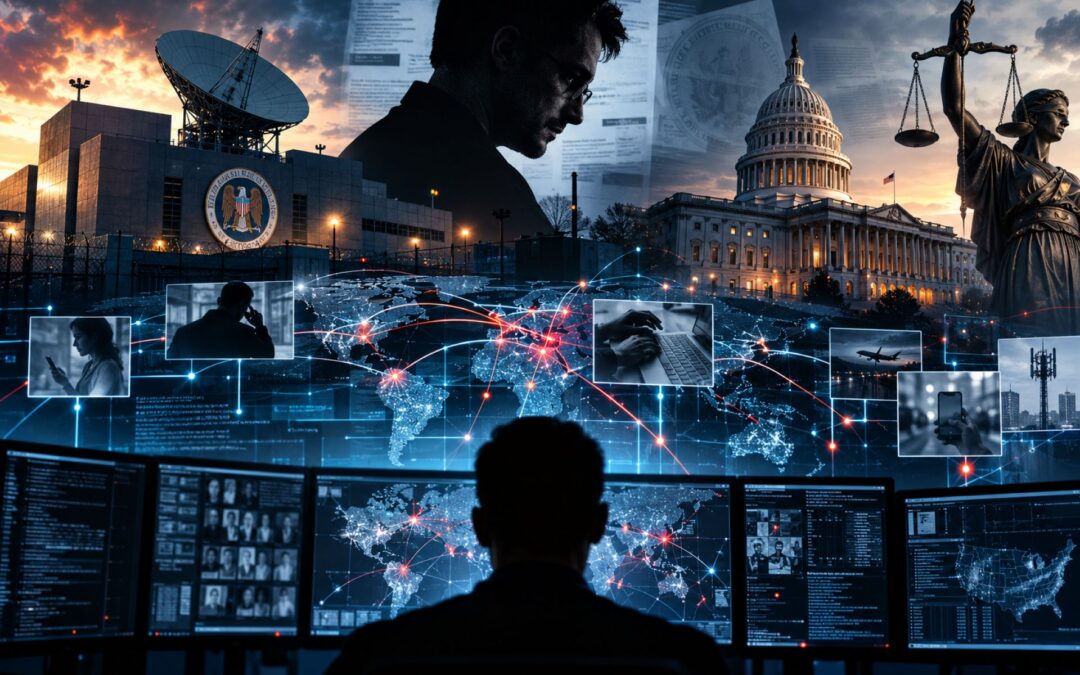
Every time someone makes a telephone call, sends an email, searches the internet, or uses a smartphone, they generate information that can reveal something about their life. The contents of a conversation may be private, but the surrounding details—who contacted whom, when they communicated, and how often—can sometimes reveal relationships and behavior just as effectively. For intelligence agencies equipped with sophisticated collection and analytical systems, that information can become a powerful investigative resource.
The United States has spent decades developing the ability to intercept, acquire, store, and analyze electronic communications. What began as an effort to gather foreign intelligence during international conflicts gradually became a complex system involving government agencies, telecommunications companies, internet platforms, specialized databases, and secret courts. The expansion accelerated after the terrorist attacks of September 11, 2001, before Edward Snowden’s disclosures in 2013 revealed surveillance practices that had remained largely hidden from the public.
However, American mass surveillance is not a single program that records everything everyone does. Different agencies operate under different legal authorities, and the ability to collect information is not necessarily the same as permission to examine or use it. Understanding how the system actually works requires separating its history, technology, legal powers, and oversight mechanisms.
From Cold War Intelligence to Domestic Surveillance
The foundations of modern American surveillance were established long before smartphones, social media, or the internet existed. During World War II, governments recognized the enormous intelligence value of intercepting enemy communications, breaking codes, and analyzing patterns in military and diplomatic traffic. These capabilities remained strategically important after the war, particularly as the United States and Soviet Union entered their prolonged confrontation.
In 1952, President Harry Truman formally established the National Security Agency (NSA). Its principal responsibility was signals intelligence, commonly called SIGINT: obtaining intelligence from intercepted electronic signals and communications. This included foreign military, diplomatic, and intelligence communications, along with the technical work necessary to understand and sometimes decrypt them.
The NSA’s establishment reflected the growing importance of intelligence in the Cold War rivalry between the United States and the Soviet Union. Both superpowers wanted to understand their adversary’s military capabilities, political intentions, technological developments, and international relationships. Electronic surveillance offered ways to acquire information that conventional diplomacy and openly available sources could not provide.
American intelligence operations also benefited from international cooperation. The United States and United Kingdom had developed extensive signals-intelligence partnerships during World War II, and the 1946 UKUSA agreement established the foundation of what eventually became the Five Eyes intelligence alliance. Alongside the United States and United Kingdom, the partnership came to include Canada, Australia, and New Zealand.
Cooperation allowed the participating countries to share intelligence and coordinate aspects of their collection capabilities. One system historically associated with this network was ECHELON, which attracted public attention because of its reported capacity to intercept international satellite and other communications. A European Parliament investigation in 2001 concluded that an international interception system existed, although popular descriptions often exaggerated its ability to monitor every communication worldwide.
The more troubling domestic history involved the use of intelligence capabilities against Americans engaged in political activities. Under FBI Director J. Edgar Hoover, the bureau conducted extensive surveillance of suspected communists, civil-rights organizations, antiwar activists, and other individuals considered potential security threats. Its COINTELPRO operations involved not merely gathering information but also attempts to monitor, infiltrate, disrupt, and discredit political groups.
The NSA was implicated in related activities. Under Project MINARET, the agency monitored certain international communications involving Americans whose names appeared on watch lists, including individuals associated with political dissent. Project SHAMROCK involved the acquisition of international telegram traffic through arrangements with communications companies. These programs demonstrated how intelligence systems designed for foreign threats could also expose domestic political activity to government scrutiny.
The abuses eventually provoked congressional investigations. In 1975, the Senate established the Church Committee, led by Senator Frank Church, to investigate intelligence-agency misconduct. Its findings, documented in the US Senate’s history of the Church Committee investigation, revealed extensive surveillance and intelligence activities that had operated without adequate democratic accountability.
The resulting reform movement helped establish a more formal legal structure for intelligence surveillance. The Foreign Intelligence Surveillance Act of 1978 created a framework for specified foreign-intelligence surveillance activities and established the Foreign Intelligence Surveillance Court, commonly called the FISA Court or FISC. Rather than allowing every intelligence operation to depend solely on executive discretion, the legislation introduced judicial procedures for certain forms of surveillance.
Nevertheless, technological development continued to create new possibilities that existing laws had not fully anticipated. The shift from analog telecommunications to digital communications would eventually transform both the amount of information available and the methods used to collect it.
The Surveillance Expansion After 9/11
The terrorist attacks of September 11, 2001, fundamentally changed the American government’s approach to national security. Nearly 3,000 people were killed when al-Qaeda terrorists hijacked four commercial aircraft and attacked the World Trade Center and Pentagon, while a fourth aircraft crashed in Pennsylvania after passengers resisted the hijackers. The attacks exposed serious failures in intelligence coordination and intensified fears that additional plots might already be developing.
Preventing another attack became an overriding priority. Intelligence agencies faced enormous pressure to identify terrorist networks, trace communications between suspected operatives, and discover threats before they could be carried out. In this environment, the government increasingly emphasized the possibility that seemingly ordinary communications could reveal hidden connections to terrorist organizations.
Congress responded by passing the USA PATRIOT Act in October 2001. The legislation expanded or modified several investigative and intelligence authorities, including provisions concerning access to business records and information sharing. Supporters argued that intelligence and law-enforcement agencies needed stronger powers to investigate threats that crossed national borders and relied on modern communications.
The government’s response extended beyond the PATRIOT Act. President George W. Bush authorized a classified surveillance program that permitted certain intelligence activities outside ordinary FISA procedures. The program involved interception of communications believed to have connections to international terrorism, including some communications involving people inside the United States.
The legal controversy centered on whether the president could authorize such surveillance without following the procedures Congress had established. Administration officials defended the activities as necessary exercises of national-security authority, while critics argued that executive power could not override statutory restrictions and constitutional protections.
Because significant aspects of the program remained classified, neither the public nor most lawmakers initially understood its full operation. The secrecy also complicated oversight: an elected representative might support stronger counterterrorism capabilities without knowing precisely which methods the executive branch had already authorized.
In December 2005, The New York Times publicly reported the existence of the warrantless surveillance program. The disclosure triggered a major debate over executive authority, the Fourth Amendment, and the relationship between national-security operations and established legal procedures.
Subsequent legislative changes created additional foundations for electronic intelligence collection. The Protect America Act of 2007 and FISA Amendments Act of 2008 addressed surveillance involving foreign targets and modern communications systems. The latter legislation introduced Section 702, which would become one of the most consequential and controversial intelligence authorities in the following decades.
The expansion coincided with extraordinary changes in communications technology. Emails were replacing letters, mobile phones were becoming ubiquitous, and increasingly large amounts of information passed through internet infrastructure and private technology companies. Communications that once required separate telephone or physical channels could now move through interconnected digital networks.
These developments created a significant intelligence opportunity. Instead of relying exclusively on human informants, intercepted radio signals, or individual telephone taps, agencies could increasingly obtain information from electronic systems that already processed enormous quantities of communication.
But the collection of large amounts of information introduced another problem. The government needed to distinguish relevant intelligence from the activities of people who had no connection to terrorism, espionage, or other national-security threats. The larger the collection system became, the more important its rules governing acquisition, searching, retention, and access would become.
What Metadata Reveals Without Recording a Conversation
One of the most important concepts in modern surveillance is metadata. Broadly speaking, metadata is information describing other information. In telecommunications, it may include telephone numbers, the time of a call, its duration, or the technical systems involved in carrying it.
The distinction between metadata and communications content is important. The content of a telephone call consists of what the participants actually say. The associated call records may instead establish that one number contacted another at a particular time and that the conversation lasted for several minutes.
Similarly, an email system may record information about senders, recipients, timestamps, and routing, separately from the contents of the messages themselves. Depending on the service and type of collection, digital records may also contain IP addresses or other identifying information. Location data, browsing activity, and online purchases can reveal further information, but they are not automatically components of the same telephone-metadata program.
At first glance, these details may appear less sensitive than the actual conversations. Yet metadata can become remarkably revealing when numerous records are examined together. Repeated communications establish patterns, while changes in those patterns may indicate important events or relationships.
Consider a hypothetical example. An investigator obtains records showing that one person regularly communicates with three particular numbers. One belongs to a colleague, another to a family member, and the third to someone whose identity is initially unknown. Over several months, the frequency of contact with the unknown number increases sharply, particularly late at night.
The records do not explain what anyone discussed or prove that anything suspicious occurred. Nevertheless, they reveal an association and a pattern that the investigator might decide to examine further. By comparing the records with other available information, the investigator may be able to infer additional details about the relationship.
The same principle operates on a much larger scale through social-network analysis. Intelligence analysts can represent people, telephone numbers, accounts, or devices as points within a network and their observed interactions as connections. Such arrangements are often called social graphs.
If an intelligence agency possesses records connecting thousands of individuals, it can investigate clusters of relationships, identify frequently contacted accounts, and examine connections between otherwise separate groups. Analysts may use these patterns to generate investigative leads or assess whether known intelligence targets communicate with other people of interest.
The central limitation is that a connection does not establish wrongdoing. Someone communicating with a person under investigation might be a relative, journalist, professional contact, customer, or entirely uninvolved individual. Treating every connection as evidence of suspicious activity would produce misleading conclusions and potentially subject innocent people to unnecessary scrutiny.
Scale also matters. A targeted investigation involving a suspect’s communications is different from acquiring records covering millions of people before determining which individuals might be relevant. The second approach raises a broader privacy question because people with no suspected connection to wrongdoing become part of an intelligence dataset.
It is also important to distinguish collection from subsequent use. An agency may acquire information, retain it for an authorized period, process it automatically, or allow particular personnel to search it under specified conditions. These are different activities, and each can be subject to separate rules and oversight.
The historical NSA bulk telephone-records program exposed by Edward Snowden involved large-scale acquisition of call-detail records rather than continuous recording of every conversation. Its significance lay in the government’s ability to assemble and search extensive communications relationships. Although that particular program later ended, the underlying lesson remains: information about communications can reveal a great deal without disclosing the communications themselves.
PRISM, XKeyscore, and the Snowden Disclosures
In June 2013, Edward Snowden, a former CIA employee working as an NSA contractor, became the central figure in one of the most consequential intelligence disclosures in American history. He provided journalists with classified documents describing surveillance programs, technical systems, legal arrangements, and intelligence practices that had previously remained secret.
The initial reporting was published by The Guardian and The Washington Post, with journalists including Glenn Greenwald, Laura Poitras, and Barton Gellman playing major roles. The documents exposed a surveillance system far more extensive and technically sophisticated than most members of the public had understood.
One early revelation concerned the NSA’s bulk collection of telephone metadata under Section 215 of the PATRIOT Act. The disclosed material showed how the government had obtained large volumes of call-detail records through secret legal orders. Although the records did not contain the conversations themselves, they allowed analysts to examine communications relationships within an enormous dataset.
Another major disclosure involved PRISM. As described in the original Washington Post investigation into the PRISM program, classified documents identified a mechanism through which American intelligence agencies acquired communications associated with selected foreign-intelligence targets from major internet service providers.
The companies named in the leaked material included Microsoft, Google, Facebook, Apple, and other digital-service providers. Information obtained through the program could include communications content such as emails, documents, photographs, or online chats, depending on the selected target and the services involved.
The original reporting created enormous controversy because the documents appeared to describe direct collection from company servers. Technology companies rejected suggestions that intelligence agencies possessed unrestricted access to their systems and said they provided information in response to legally authorized requests. Understanding PRISM therefore requires distinguishing the government’s ability to compel production of selected information from the much broader claim that intelligence officers could freely browse every user’s private data.
PRISM was associated with surveillance authorities concerning foreign-intelligence targets, not a legal authorization to indiscriminately target every American internet user. That distinction did not eliminate the privacy concerns, particularly because communications involving Americans could also be acquired when they interacted with properly selected foreign targets.
Snowden’s disclosures also revealed XKeyscore, an analytical system used to search and examine communications-related intelligence. Reporting based on leaked NSA documents described powerful capabilities for finding relevant information across collected internet traffic, using identifiers and other search criteria.
XKeyscore was not simply another name for PRISM. Whereas PRISM concerned a method of acquiring certain communications from service providers, XKeyscore concerned the ability to search and analyze information obtained through collection systems. Understanding the difference helps explain why surveillance involves both acquiring data and developing tools to make the acquired information useful.
The system’s reported capabilities generated concern that analysts could investigate people’s online activities using relatively broad search criteria. The NSA responded that XKeyscore access was restricted to trained personnel operating under legal rules and oversight procedures, including auditing and supervisory controls.
The existence of such controls is an important factual qualification, but it does not settle whether the safeguards were always sufficient or correctly followed. A technically powerful system can have formal restrictions while still presenting risks from mistaken searches, inappropriate access, insufficient supervision, or weaknesses in accountability.
Snowden’s disclosures brought these questions into public debate. They forced Americans to confront not merely whether the government possessed advanced surveillance capabilities, but whether the laws and oversight processes governing those capabilities had kept pace with technological development.
The revelations also created a profound disagreement over Snowden himself. Supporters considered him a whistleblower who exposed surveillance practices requiring public scrutiny. Critics argued that revealing classified intelligence methods damaged national security and endangered legitimate intelligence operations. Those competing judgments did not change the underlying significance of the documents: they made previously secret aspects of government surveillance available for public examination.
The disclosures ultimately contributed to legislative reform, judicial scrutiny, public pressure on technology companies, and wider international debates about privacy. Yet exposing a surveillance system did not mean that every component of it would be dismantled.
What the USA FREEDOM Act Actually Changed
The political controversy following Snowden’s disclosures led to a significant legislative response in 2015. Congress passed the USA FREEDOM Act, which changed the legal framework governing the NSA’s bulk telephone-metadata collection under Section 215 of the PATRIOT Act.
The reform addressed a specific problem: the government had been acquiring extensive collections of telephone records even though most of the people represented in those records were not individual intelligence targets. The legislation ended the government’s authority to continue that form of bulk acquisition under Section 215.
According to the intelligence community’s official explanation of the USA FREEDOM Act’s implementation, the earlier bulk collection ended in November 2015. The replacement system was designed to leave telephone records with telecommunications providers rather than transferring the same broad datasets into government possession.
Instead of retaining an enormous collection of records, the government could seek relevant call-detail information using more specific identifying terms, often called selectors. The procedures generally involved authorization from the FISA Court, with special arrangements for qualifying emergencies.
This represented a meaningful restriction on one particularly controversial surveillance practice. It changed both the scale of government-held telephone metadata and the process through which intelligence agencies could obtain relevant records.
However, the reform did not establish a universal requirement for an ordinary judicial warrant before the government could acquire any communications-related information. Other intelligence authorities continued to operate under their own legal standards, including Section 702.
The replacement call-detail-records program also encountered operational difficulties. The NSA ultimately discontinued using that mechanism, and its later statutory authority was not renewed as an ongoing collection program. Consequently, it would be inaccurate to describe the original Section 215 bulk telephone-records system as an active feature of American surveillance in 2026.
The broader significance of the USA FREEDOM Act is therefore more specific than either complete victory or complete failure. It demonstrated that public disclosures and political pressure could produce substantive restrictions on intelligence collection, while leaving unresolved many questions about other forms of electronic surveillance.
How Section 702 Can Capture Americans’ Communications
Section 702 of the Foreign Intelligence Surveillance Act is among the most important authorities for understanding contemporary American signals intelligence. Congress introduced it through the FISA Amendments Act of 2008, creating a legal framework for collecting foreign-intelligence information by targeting certain non-American individuals located outside the United States.
The law was designed around a practical challenge. Increasingly, communications between people abroad passed through infrastructure or service providers connected to the United States. Intelligence agencies wanted a legal mechanism for acquiring relevant foreign communications without obtaining the kind of individual court order traditionally required for certain surveillance activities inside the country.
Under Section 702, surveillance targets must be non-US persons reasonably believed to be located outside the United States. The government cannot lawfully use this authority to target Americans directly, target individuals located inside the United States, or deliberately select a foreign person merely as a pretext for monitoring an American.
The US intelligence community’s explanation of Section 702 describes the authority as targeted foreign-intelligence collection rather than an unrestricted bulk-surveillance program. Targeting decisions are supposed to follow documented procedures, and the government must operate within approved requirements governing collection, minimization, and querying.
Nevertheless, Section 702 can result in the acquisition of Americans’ communications. The reason is straightforward: a lawful foreign-intelligence target may communicate with someone inside the United States.
Imagine that an intelligence agency has lawfully selected a person living overseas as a foreign-intelligence target. If that person exchanges emails with an American resident, the communications may be acquired as part of the surveillance directed at the foreign target.
The American correspondent was not necessarily suspected of wrongdoing, and the government did not need to select that American as a separate surveillance target for the exchange to be collected. The person’s messages became part of the acquired information because they communicated with the individual who was being monitored.
This is commonly described as incidental collection. It is one of the central reasons Section 702 raises privacy concerns even though the statute prohibits directly targeting Americans.
The collection process may involve legally compelled assistance from electronic communications service providers. Information can include communications content, not merely records describing when messages were exchanged. The particular information acquired depends on the collection method, target, technical circumstances, and applicable legal procedures.
Another important distinction concerns what happens after information has been collected. Section 702 data can be retained and searched under approved rules, and intelligence agencies may use identifiers associated with Americans to locate relevant information within already acquired records.
Such searches are commonly called US-person queries. They do not necessarily initiate a new interception of the American’s communications. Instead, they examine information that the government already possesses through a foreign-intelligence collection process.
This distinction is legally significant. Critics argue that searching an intelligence database for an American’s communications can raise privacy concerns comparable to obtaining that information directly. Supporters of the authority contend that access to lawfully collected information is essential for understanding foreign threats and protecting national security.
The Foreign Intelligence Surveillance Court plays an oversight role, but it does not ordinarily issue a separate individualized warrant for every foreign person targeted under Section 702. Instead, it reviews the government’s certifications and procedures governing targeting, minimization, and querying. Individual targeting decisions are made within that approved framework and are subject to compliance reviews.
Minimization procedures are intended to protect information concerning Americans by regulating its acquisition, retention, dissemination, or use. They do not necessarily require every incidentally acquired American communication to be immediately destroyed, particularly when the information meets legally recognized intelligence or investigative requirements.
The procedures have evolved as surveillance practices and legal controversies have changed. The Reforming Intelligence and Securing America Act of 2024 introduced additional restrictions and oversight requirements, including reforms directed at FBI queries of Section 702 information. The legislation did not resolve every disagreement about whether government agents should generally obtain a judicial warrant before searching for Americans’ communications.
By 2026, that disagreement had become central to another reauthorization debate. Section 702’s underlying statutory authority lapsed on June 12, 2026, after Congress failed to enact a longer extension. However, the lapse did not immediately terminate surveillance operating under existing court-approved certifications.
As explained in October 26, 2026 reporting on the Section 702 renewal debate, collection remained possible under previously approved Foreign Intelligence Surveillance Court authorizations. The latest certifications were approved in March 2026 and permit authorized collection to continue through March 17, 2027.
The situation is therefore unusual but not contradictory. Congress allowed the underlying statutory authority to expire, while transition provisions preserved surveillance conducted under valid existing certifications. The government could continue approved activities for the remaining certification period even without a new long-term reauthorization.
The political debate remained active in October 2026. Some lawmakers supported renewing Section 702 because they regarded it as indispensable for foreign-intelligence gathering. Others wanted stronger protections, particularly judicial warrants for certain searches involving Americans, before agreeing to extend the authority.
The outcome matters because Section 702 sits at the intersection of two legitimate concerns. The government has a substantial interest in collecting intelligence about foreign threats, but Americans also have a substantial interest in preventing information acquired for foreign-intelligence purposes from becoming a means of improperly examining their private lives.
The New Frontier: Technology Companies, Data Brokers, and Automated Analysis
Modern surveillance increasingly depends on information generated and stored outside government agencies. Telecommunications operators, internet platforms, cloud providers, and other companies process enormous quantities of communications and associated records as part of their ordinary business activities.
This does not mean that every technology company provides intelligence agencies with unrestricted access to its customers. Government access can occur through different arrangements, each with its own legal and technical characteristics.
One arrangement involves compulsory legal process. Depending on the authority invoked, a company may be required to disclose specified information or assist with intelligence collection. The scope and rules differ between ordinary law-enforcement requests, intelligence orders, and mechanisms associated with foreign-intelligence surveillance.
Another involves information that government agencies can obtain commercially. Companies routinely collect or acquire data about consumer behavior, devices, locations, transactions, and online activity. Some of this information is subsequently made available through commercial data markets.
For intelligence agencies, commercially obtainable information can offer investigative value even when it was originally collected for advertising, business analysis, or other non-government purposes. Information that appears anonymous or fragmented may sometimes become revealing when combined with additional records.
The Office of the Director of National Intelligence has publicly acknowledged both the usefulness and sensitivity of these sources. Its Intelligence Community Policy Framework for Commercially Available Information establishes principles for accessing, collecting, processing, and safeguarding such information, while recognizing that commercial datasets can expose intimate details about individuals.
Importantly, this category is legally distinct from information obtained through compulsory process. A company selling or licensing a dataset is not necessarily participating in the same legal activity as a provider complying with a surveillance directive issued under FISA.
The distinction matters because privacy protections can depend on how information is acquired. A government agency purchasing information from a commercial provider may raise different legal questions from an agency intercepting a private message or obtaining records through a court order.
Once information has been acquired, analytical technology can make it more useful. Software may help analysts search large databases, identify communications patterns, connect records from different sources, and prioritize information for closer examination.
Artificial intelligence can expand these capabilities by assisting with classification, correlation, and analysis. Yet there is an important difference between identifying patterns and reliably predicting future criminal behavior. A statistical association is not proof that a particular person intends to commit a crime, and inaccurate data or poorly designed analytical methods can produce misleading assessments.
Concerns about automated surveillance therefore involve more than how much information can be collected. They also concern the accuracy of conclusions drawn from that information, the transparency of the systems involved, and the consequences when an analytical mistake leads to investigative action.
The expanding role of private-sector data complicates the conventional distinction between government surveillance and commercial information collection. Information gathered for one purpose may later become useful for another, making the rules governing acquisition, analysis, and access increasingly important.
Who Watches the Watchers?
The American surveillance system operates within a legal and institutional framework intended to balance intelligence requirements with constitutional protections. That framework includes Congress, the federal courts, executive-branch oversight bodies, inspectors general, and internal compliance procedures.
One of the most important institutions is the Foreign Intelligence Surveillance Court. Established under FISA in 1978, it reviews certain government surveillance applications and, under Section 702, evaluates certifications and procedures governing foreign-intelligence collection.
The court differs from ordinary public judicial proceedings because much of its work involves classified intelligence information. Proceedings are frequently conducted without the direct participation of individuals whose information may be affected, although statutory mechanisms provide for additional expert perspectives in some circumstances. This secrecy is partly intended to protect intelligence methods, but it can also limit public understanding of how surveillance law is interpreted.
Congress provides another layer of oversight through legislation, intelligence committees, hearings, and reporting requirements. The Department of Justice and intelligence-community oversight bodies review compliance with applicable rules, while inspectors general investigate institutional practices and identify failures requiring correction.
These safeguards have repeatedly encountered problems in practice. In particular, the FBI’s use of Section 702 databases generated controversy over queries involving identifiers associated with Americans.
Investigations and government oversight reviews documented instances in which FBI personnel conducted queries that did not comply with applicable requirements. Some involved searches conducted without adequate justification or contrary to approved procedures. The concern was not simply that intelligence agencies possessed sensitive information, but that personnel could search it improperly.
The government’s response included changes to training, approvals, recordkeeping, and auditing. These reforms are important because they demonstrate that surveillance systems are not legally static: procedures can be tightened when oversight reveals deficiencies.
A significant assessment appeared in the Justice Department inspector general’s October 2025 review of FBI querying practices under Section 702. The report found that the FBI had implemented the querying reforms required by the 2024 legislation and that identified noncompliant queries had fallen substantially following successive changes.
The findings provided evidence of improved compliance, but they did not establish that improper searches were impossible. The review relied on existing oversight determinations rather than independently reassessing every query, and it emphasized the continuing importance of effective internal and external supervision.
The debate also involves the Fourth Amendment, which protects against unreasonable searches and seizures. Courts and lawmakers have long disagreed over how its protections should apply to modern intelligence collection, particularly when an American’s communications were incidentally acquired through lawful surveillance of a foreign target.
Civil-liberties advocates argue that querying collected information for Americans’ communications can become a way to examine private material without the individualized judicial authorization ordinarily associated with domestic searches. Intelligence officials respond that foreign-intelligence collection operates under a distinct legal framework and that rapid access to relevant information may be necessary to identify threats.
These positions reflect different assessments of risk. A government that cannot effectively investigate foreign threats may fail to protect the public, while a government with extensive access to personal information but insufficient accountability may undermine the liberties it is supposed to defend.
The controversy remained unresolved in October 2026. On October 26, Senators Ron Wyden and Adam Schiff demanded the release of a classified March 17, 2026 FISA Court opinion that they said documented serious abuses of Americans’ rights. They argued that the government had failed to release the opinion by the legally required deadline and that lawmakers needed to understand its contents before considering Section 702 reauthorization.
Because the full opinion had not been publicly released, its specific findings could not be independently evaluated in their entirety. The senators’ allegations were significant, particularly given the approaching reauthorization debate, but they should not be confused with publicly verified conclusions about every underlying incident.
The wider question is how democratic societies can hold secret institutions accountable. Intelligence operations cannot always disclose their targets, capabilities, or sources without compromising legitimate missions. Yet excessive secrecy can make it difficult for courts, legislators, journalists, and citizens to determine whether agencies are operating within appropriate limits.
The tension invites comparisons with George Orwell’s fictional surveillance state in 1984, where constant observation forms part of an apparatus of political domination. The United States is not Orwell’s Oceania: its intelligence agencies operate within a constitutional system containing courts, legislation, elections, public criticism, and mechanisms for challenging government conduct.
Nevertheless, the comparison illustrates why surveillance can have consequences beyond individual investigations. When people believe their associations, communications, or political activities may be monitored, they may become less willing to exercise freedoms that democratic societies are supposed to protect.
Effective oversight therefore requires more than establishing that a surveillance authority has a legal basis. It also requires meaningful restrictions on its use, reliable records of government activity, independent assessment of compliance, mechanisms for addressing abuses, and sufficient transparency for the public to evaluate the system’s general operation.
American mass surveillance is best understood as an evolving collection of technologies, institutions, and legal authorities rather than one limitless government database. Some historically controversial programs have ended, others have been modified, and important foreign-intelligence capabilities remain. The rules governing them have repeatedly changed in response to security threats, technological developments, judicial decisions, legislative disputes, and public disclosures.
The fundamental issue is not simply whether the government can acquire large quantities of information. It is who can access that information, under what circumstances, for what purposes, and with what consequences when the rules are violated. Powerful collection systems become especially sensitive when their contents can be retained, combined, and searched long after the original communications occurred.
The history of American surveillance shows that national security and civil liberties cannot be treated as questions settled once and for all. Both require institutions capable of examining how power is exercised as technology changes. The enduring challenge is to preserve legitimate intelligence capabilities while ensuring that secrecy and technical sophistication do not place government surveillance beyond meaningful democratic control.
Last Updated on October 27, 2026 by Aseem Gupta