
Reading Time: 35 Minutes
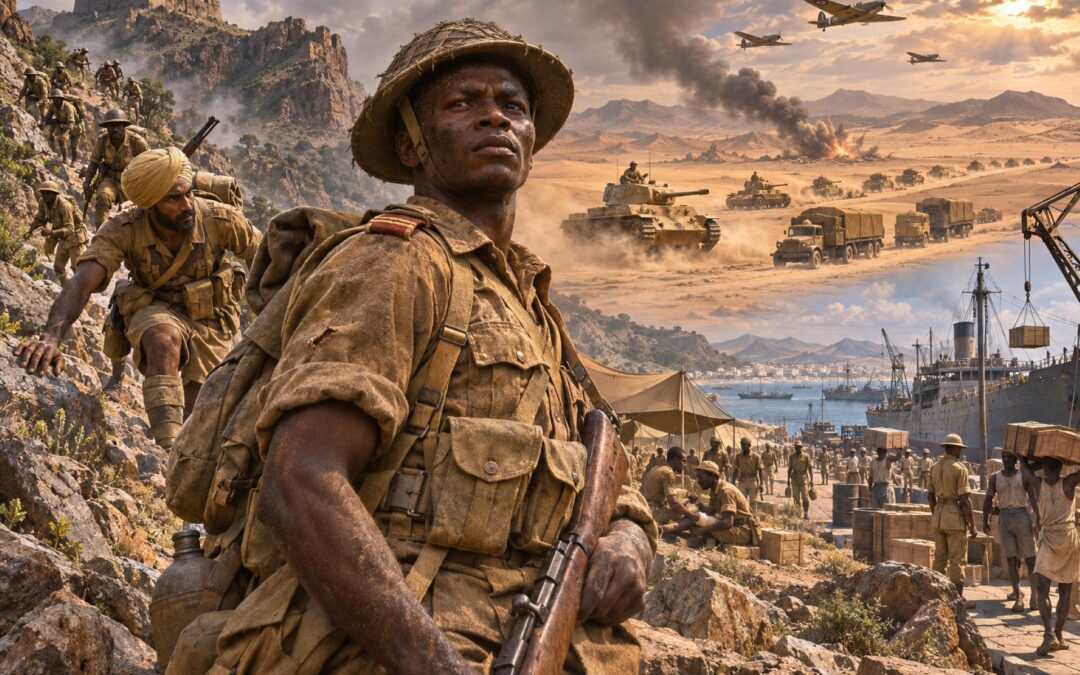
On a ridge above Keren in Eritrea, men fought over stone, scrub and narrow mountain paths. Below them lay the Dongolaas Gorge, a crucial passage toward the highland capital of Asmara and the Red Sea port of Massawa. Indian infantry climbing the slopes faced Italian troops and Eritrean askaris entrenched among rocky heights. Ammunition, food and water had to reach the fighting positions along tracks that offered little protection from observation or gunfire.
By March 1941, the struggle had already lasted weeks. The renewed Allied assault beginning on 15 March was not the opening of the Battle of Keren but its final, decisive phase. When the defenders withdrew on 27 March, they had delayed an army that possessed superior resources at a cost of thousands of casualties on both sides. The battle demonstrated something that the familiar imagery of tanks speeding across flat desert rarely conveys: Africa’s war was fought in mountains, towns, harbours and fields, by soldiers whose identities cannot be reduced to the flags over their headquarters.
For many readers, the Second World War in Africa begins with Erwin Rommel and ends with Bernard Montgomery at El Alamein. Those battles mattered enormously, but they formed only part of a larger struggle stretching from the Horn of Africa to the Atlantic coast. Behind the famous offensives stood African soldiers serving rival empires, Indian infantry, Free French formations, American newcomers, dockworkers, drivers, farmers and families living under occupation. Their experiences explain not only how the Allies fought but also what the war cost the continent and why its consequences lasted long after the last Axis army surrendered.
Africa in 1939: An Imperial Map Already Built for War
In 1939, most of Africa was governed by European empires. Britain controlled extensive territories in the east, centre, west and south; France governed much of North and West Africa; Belgium ruled the Congo; Portugal held Angola and Mozambique; and Spain possessed colonies and enclaves. Italy held Libya, Eritrea and Italian Somaliland, while its 1935 invasion had brought Ethiopia under occupation. Political boundaries frequently reflected conquests accomplished within the lifetimes of people who were now being asked to fight another European war.
It is tempting to say that only two African countries were independent, but that neat formulation conceals important distinctions. Liberia was sovereign. Egypt had formal independence yet remained subject to sweeping British military influence, especially around the Suez Canal under the 1936 treaty. South Africa governed itself as a dominion, while a racially restricted franchise excluded most of its population from political power. Ethiopia’s sovereignty had been violently challenged by Italy, though the conquest did not erase Ethiopian claims or armed resistance. Independence, legal recognition and meaningful freedom from foreign control were not the same thing.
Italian expansion showed the stakes of these distinctions. Colonial conquest in Libya involved long campaigns of repression, mass displacement and internment, especially in Cyrenaica during the early 1930s. Thousands died in camps and under conditions created by forced removal. In the occupation of Ethiopia, Italian aircraft used mustard gas during the invasion, while occupation authorities carried out reprisals and massacres after Addis Ababa fell in 1936. Emperor Haile Selassie went into exile, but Ethiopian fighters continued resisting across regions the occupiers never fully pacified.
The same colonial systems that could compel taxes or requisition livestock could also supply a modern army. District officials maintained population registers, communicated orders through local chiefs, controlled transport corridors and organised labour for public works. When fighting spread in 1940, European governments did not have to invent administrative machinery to collect grain, recruit porters or direct men toward military service. Those powers already existed. Their application varied greatly between territories, but the general pattern was unmistakable: political control could be converted into wartime resources.
Geography made Africa more than a collection of colonies on the margins of the conflict. The Suez Canal shortened Britain’s maritime connections to India, Australia and Asia, while bases in Egypt supported troops defending access to the eastern Mediterranean and Middle Eastern oil. Alexandria offered a major naval facility; workshops, railways and airfields supported an entire military infrastructure. If Axis forces could close the canal or threaten Egypt, Britain would lose a crucial strategic route and face additional pressure on shipping already stretched by war.
The Mediterranean offered a shorter passage than sending ships around the Cape of Good Hope. Convoys forced to take the longer route absorbed vessels, crews, fuel and time that might otherwise have served the fighting fronts. Italy wanted to turn its African possessions into the nucleus of a grander Mediterranean empire. Germany initially saw the region more as a place to rescue an ally and keep Britain occupied. Britain considered Egypt and the canal essential to the functioning of its worldwide war effort.
Africa’s political boundaries also divided communities that had long traded or moved across regions. Military planners tended to see those borders as spaces to defend or cross, while colonial governments treated them as boundaries of jurisdiction, policing and taxation. Wartime campaigns thus brought together two different geographies: the operational map of roads and objectives, and the lived map of migration, family ties, local markets and relationships with the authorities. That difference helps explain why an army’s arrival could have meanings very different from those assigned to it in military headquarters.
The people living along these routes experienced strategic importance in more immediate ways. Armies demanded food and vehicles; military authorities controlled roads and ports; civilians faced bombardment, inflation and forced movement. Some hoped one empire’s defeat might weaken another’s grip. Others had direct reasons to fear an Italian or German advance. Their choices were rarely as simple as support for either the Allies or the Axis. The war arrived in societies whose existing inequalities and political conflicts would shape every campaign that followed.
The War in East Africa: Ethiopia, Eritrea and Keren
When Italy entered the war in June 1940, Italian East Africa was geographically vast but strategically isolated. It brought together Eritrea, Italian Somaliland and occupied Ethiopia, with a substantial military establishment that included large numbers of locally recruited African troops. Eritrean askaris had served Italy for generations. Military employment could confer wages, pensions, family prestige and a recognised professional identity, even though the structures within which they served were colonial and unequal.
The Italian command initially took advantage of Britain’s exposed frontier positions. Troops occupied posts along the borders with Sudan and Kenya, then attacked British Somaliland in August 1940. British and Commonwealth defenders withdrew toward Berbera and evacuated across the Gulf of Aden. Fascist propaganda could claim a tangible imperial success. Yet the conquest did little to solve the basic problem facing Italy’s East African forces: they were cut off from reliable overseas resupply.
British naval predominance in the Red Sea restricted the arrival of fuel, replacement aircraft, spare parts and ammunition. Supplies available at the start of the war had to sustain an enormous territory with poor internal communications and formidable terrain. Vehicles could be kept running by stripping components from others; aircraft could be grounded for want of parts rather than destroyed in combat. Every engagement required commanders to consider not merely the enemy ahead but what material could be replaced afterward. An army might look imposing on a map while gradually losing the means to manoeuvre.
The Allied counteroffensive began in January 1941 from two directions. Lieutenant-General William Platt advanced from Sudan toward Eritrea with British and Indian forces, including the 4th and 5th Indian Divisions. Lieutenant-General Alan Cunningham attacked northward from Kenya through Italian Somaliland with South African and African colonial formations. Meanwhile, Ethiopian patriots, known as the Arbegnoch, intensified their struggle against Italian occupation, aided in some areas by British missions and forces associated with Orde Wingate.
These campaigns had connected but different political purposes. Britain sought to eliminate a threat to its Red Sea communications. Haile Selassie sought the restoration of Ethiopian sovereignty after years of occupation. African soldiers serving British formations had their own reasons for joining, whether employment, loyalty to a regiment, pressure from colonial officials or expectations of advancement. Eritrean troops in Italian service also had histories and motivations that cannot be explained by calling them simply collaborators. The uniforms identified opposing armies; they did not settle the complicated relationships between each soldier and the state he served.
The northern offensive confronted the most stubborn resistance at Keren. Approaches to the Eritrean highlands passed through the Dongolaas Gorge and steep ridges that gave entrenched defenders strong observation and fields of fire. Early attacks beginning in February failed to secure the decisive heights. Indian units fought for positions around Mount Sanchil and neighbouring ridges while engineers and transport personnel struggled to maintain the routes needed for an assault. A direct advance could quickly become an exercise in climbing under fire and trying to retain a small ledge against counterattack.
The defenders included Italian regulars and Eritrean askaris who knew the terrain and fought tenaciously from prepared positions. Artillery, grenades and machine guns turned rocky approaches into killing grounds. Reinforcements and supplies moved laboriously along mountain tracks; water was a military necessity as immediate as ammunition. On 17 March, General Orlando Lorenzini, an Italian commander renowned for earlier fighting in Libya, was killed. His death did not end resistance, but it occurred during the final phase of a battle that had exhausted troops on both sides.
A renewed Allied offensive, launched in mid-March after earlier failures and preparation, gradually broke through the defences. The Italians abandoned Keren on the night of 26–27 March. British official figures put Allied losses in the battle at roughly 3,800 killed and wounded, while Italian and Eritrean casualties were also severe and differently recorded. The surrender of Asmara followed on 1 April, and Massawa fell soon afterward. The Red Sea route became markedly safer, opening important possibilities for Allied maritime supply.
Farther south, Cunningham’s forces covered extraordinary distances. Mogadishu fell in February, and the advance through Somaliland and Ethiopia was made possible not only by infantry and armour but by drivers, repair crews and transport columns keeping moving troops supplied. Addis Ababa was entered on 6 April 1941. On 5 May, five years after Italian forces had marched into the capital, Haile Selassie returned. The symbolism was powerful: a state conquered by a fascist power had been restored while Axis armies still held much of continental Europe.
The fighting did not immediately end. The Duke of Aosta surrendered at Amba Alagi in May, but Italian positions remained, notably at Gondar, until November 1941. Ethiopia’s liberation was also complicated by disagreements over British influence and the restoration of imperial authority. Still, the destruction of Italian East Africa eliminated an important Axis threat, strengthened British control of the Red Sea and freed forces for other fronts. The campaign linked a local war of resistance dating from 1935 to a global war whose outcomes reshaped the whole region.
From Operation Compass to Rommel: The Desert War Begins
In September 1940, Italian forces advanced from Libya into Egypt and stopped around Sidi Barrani. Their progress was limited, and the positions they constructed were separated by stretches of desert that made mutual support difficult. The British command under Archibald Wavell recognised an opportunity. A comparatively small and mobile force could attack individual camps before neighbouring units could respond effectively.
Operation Compass began on 9 December as a limited raid but developed into a sweeping offensive. Indian infantry and British armour struck the Italian positions, while the 6th Australian Division later assaulted the fortified ports of Bardia and Tobruk. British units pursued the retreating Tenth Army across Cyrenaica. Rather than simply following the coastal road, armoured troops crossed the desert interior and intercepted the withdrawal at Beda Fomm. By February 1941, about 130,000 Italian prisoners had been captured and the Tenth Army effectively destroyed.
The result was one of Britain’s earliest major land victories in the war. It also exposed a recurring danger: success could carry an army far beyond its most dependable bases. British reinforcements and veteran formations were diverted to Greece, where the Allied expedition suffered defeat. The Western Desert force was consequently weaker when German troops began arriving to support Italy. Hitler had sent the Afrika Korps to stabilise the situation, but its commander, Erwin Rommel, soon took a more aggressive course than his initially defensive instructions suggested.
Rommel attacked in March 1941 while German formations were still assembling. British positions collapsed across much of Cyrenaica; by April, Axis forces had reached the Egyptian frontier. The speed of the advance made his reputation as a daring commander, yet it was also enabled by an opponent weakened by strategic diversion and organisational difficulties. His willingness to push beyond his supply arrangements sometimes succeeded magnificently and sometimes planted the conditions for later failure.
One important Allied position did not fall: Tobruk. The port and its perimeter defences remained in Allied hands, with the 9th Australian Division forming the garrison’s core alongside British, Indian and other units. Besieged from April, Tobruk was supplied largely by sea, with naval vessels and smaller craft making hazardous runs under air and artillery attack. The garrison’s endurance denied Rommel access to a port that could have shortened the long supply journey from western Libya.
Life within the perimeter was exhausting. Troops faced dust, insects, shortages of water, constant shellfire and the work of repairing positions that might be damaged again the following night. Defenders learned to judge the strength of an attack against the ammunition available to answer it. The Axis nickname of the “Rats of Tobruk” was adopted defiantly by the Australians, turning an intended insult into an emblem of endurance. Behind the legend stood ordinary military tasks performed repeatedly under difficult conditions.
Attempts to relieve Tobruk failed before Operation Crusader began in November 1941. In a confused series of tank battles and counterattacks, Allied formations eventually broke the siege in December and drove Axis forces back to El Agheila. Rommel attacked again in January 1942, exploiting British overextension and the slow replacement of equipment. The front crossed familiar positions so often that place names—Sollum, Halfaya, Derna and Gazala—became landmarks in a repeating struggle rather than permanent victories.
In May 1942, Rommel attacked the Gazala Line, a system of defended positions and minefields extending south from the Mediterranean. At its southern end stood Bir Hakeim, defended by the 1st Free French Brigade under Marie-Pierre Kœnig. Its soldiers included Foreign Legion troops and contingents drawn from French colonial territories in Africa and the Pacific. These were not interchangeable units, but their defence tied together the military and imperial histories of several continents.
The Free French held against repeated German and Italian attacks while other parts of the Gazala position deteriorated. They endured artillery bombardment and air attack, then carried out a night breakout on 10–11 June. Their resistance delayed the Axis offensive and offered Free France a much-needed demonstration of military credibility. Nevertheless, the British line was broken. Tobruk fell on 21 June 1942, and approximately 33,000 Allied personnel were captured, including South Africans and Black and Coloured South African servicemen assigned to support formations.
Rommel pushed into Egypt, creating alarm at British headquarters in Cairo, where preparations were made for a possible emergency evacuation. Yet a captured port did not mean unlimited fuel, working cranes or sufficient lorries. Once more, a spectacular advance had lengthened the Axis supply line while bringing British forces closer to their principal bases. That geographical change would become central to the next phase of the war.
Why Ports, Fuel and Malta Mattered as Much as Tanks
The desert war often appears to have been decided by the movement of armoured divisions. Tanks mattered, but they were only the most visible end of an enormous chain of supply. A military vehicle required fuel to move, spare parts when it broke, tyres to replace those worn by rough ground and ammunition for its weapons. Its crew needed water, food and medical support. An infantry division consumed large quantities of material each day even when it was holding position rather than attacking. Someone had to deliver all of it.
The North African coastline made the problem unusually severe. Tripoli was roughly 1,500 kilometres west of El Alamein. Benghazi and Tobruk offered shorter routes to the front, but their capacity, condition and vulnerability to air attack mattered as much as their location. Cargo discharged at a port was not cargo delivered to a battlefield. It had to be sorted, loaded onto vehicles, driven along limited roads and protected against breakdown or attack, with further supplies needed to keep the transport system itself operating.
This produced an apparent paradox: an advancing army could capture more territory and become less capable of fighting. Each kilometre added to the journey from a functioning depot consumed more driver hours, lorry capacity and petrol. A truck carrying fuel also burned fuel while carrying it. An army might possess a stockpile at a harbour and still have too few operational vehicles to move enough of that stockpile forward. The problem intensified when a commander sought to exploit a breakthrough before supply organisations had caught up.
In North Africa, equipment could also be disabled without receiving a single enemy shot. Sand worked into engines; tyres and axles deteriorated; water was needed for cooling systems; recovery vehicles struggled to reach broken-down transport. Workshops attempted to keep damaged tanks and lorries in service by repairing components or using parts from vehicles beyond repair. The opposing armies experienced similar physical problems, but not with identical resources. Britain drew on an imperial maritime network, bases and workshops in Egypt, and eventually the manufacturing power of the United States.
For the Axis, getting supplies across the Mediterranean was a battle before the land campaign could even begin. Ships left Italian ports carrying vehicles, ammunition, food and fuel for Libya. They faced mines, submarines, aircraft and surface vessels before reaching harbours vulnerable to further attacks. The Italian navy devoted substantial resources to escorting this traffic and paid for the effort in vessels and crews. Success at sea only completed the first half of the journey; the rest still had to travel overland.
Malta sat in a position that made this entire system precarious. British aircraft, submarines and naval units operating from the island could attack shipping moving between Italy and North Africa. The Axis responded with intensive bombing intended to neutralise Malta’s airfields and harbour. At times, the pressure severely reduced its ability to interfere with convoys. At others, Allied operations from Malta helped cut the flow of equipment and fuel to the Western Desert. This relationship was not mechanically perfect—weather, intelligence, available aircraft and many other factors mattered—but its strategic importance was fundamental.
Signals intelligence added another complication. Allied codebreaking and reconnaissance could help identify the movement of Axis convoys, but knowing that a ship was sailing did not guarantee that aircraft or submarines could intercept it. Likewise, a successful attack on shipping did not always produce an immediate crisis at the front, since stores already landed in Libya might remain available. Supply and combat were connected through delays, accumulated shortages and the uneven capacity to recover from losses.
The Allies faced a reverse problem: Malta had to be supplied so it could continue disrupting Axis supplies. In August 1942, Operation Pedestal sent a convoy of fourteen merchant ships toward the island under heavy naval escort. Only five merchantmen reached Malta. One was the oil tanker Ohio, severely damaged by attacks and brought into harbour with assistance from warships supporting her on either side. Its arrival, together with the surviving cargoes, helped prevent Malta from being starved into military uselessness at a critical moment.
The supply chain was sustained by people rarely photographed with the generals. At Alexandria and Suez, workers unloaded vessels under the threat of bombing. Railway employees moved stores inland, while workshops such as those at Tel el Kebir repaired damaged machinery. Merchant seamen, including Indian and Chinese sailors employed across the imperial shipping system, faced dangers that did not cease at the edges of the battlefield. African and Asian drivers and labourers serviced bases and routes whose importance seldom appeared in the celebrated accounts of armoured warfare.
There is a reason the desert campaign’s logistical difficulties recur throughout its military history. Rommel could choose a daring line of advance, and Montgomery could plan a carefully prepared assault, but neither could ignore the distance between the front and a supply depot. Logistics did not make tactical choices irrelevant. It determined how frequently guns could fire, how quickly losses could be replaced and whether an apparent victory could be held once the vehicles stopped moving.
El Alamein, Operation Torch and the Fall of Tunisia
By July 1942, Axis forces had advanced deep into Egypt, but their movement was stopped at El Alamein. The battlefield was unlike the wide stretches of desert that had allowed earlier flanking manoeuvres. The Mediterranean bounded it to the north and the difficult terrain of the Qattara Depression limited movement to the south. An army seeking to reach Alexandria could no longer simply swing around the defending forces in a broad sweep across open country.
General Claude Auchinleck led the British defence in the First Battle of El Alamein, preventing a further Axis advance. That achievement is sometimes obscured by the fame of his successor. Bernard Montgomery took command of the Eighth Army in August and concentrated on rebuilding its readiness, training formations and ensuring sufficient equipment was available. The Allies benefited from supply lines that became shorter as the front approached Egypt, while the Axis faced increasing strains on movement and replenishment.
The Second Battle of El Alamein began on the night of 23 October 1942 with a massive artillery bombardment. Allied forces possessed substantial advantages in tanks, guns, aircraft and available reserves. Their infantry formations were multinational: British troops fought alongside Australians, New Zealanders, Indians and South Africans, supported by other Allied contingents. Much of the armour and equipment reflected American industrial production, while intelligence and attacks on Axis shipping influenced the balance of resources long before the opening barrage.
Despite the superiority of their material, the attackers could not simply drive through the Axis line. Deep minefields, defended positions and antitank guns forced engineers to clear lanes under fire. Infantry units captured ground in limited advances, held it against counterattack and waited for armour to pass through openings that could be blocked again. The fighting unfolded over nearly two weeks rather than as one spectacular charge. At every stage, the ability to coordinate artillery, infantry and transport mattered as much as the number of tanks assembled behind the front.
German formations were not the only defenders. Italian divisions took severe losses, and some infantry units fought on even when the withdrawal made organised escape almost impossible. When Rommel finally retreated in early November, the scarcity of transport left many men and much equipment behind. The Axis line broke decisively on 4 November. El Alamein did not by itself end the campaign, but it removed the immediate prospect of an Axis advance to Alexandria and marked the beginning of a sustained retreat westward.
Five days after the breakthrough, another Allied operation changed the war’s geography. On 8 November, Anglo-American forces landed in French Morocco and Algeria during Operation Torch. It was the first major American ground operation against the European Axis war effort in this theatre, involving landings around Casablanca, Oran and Algiers. The invaders did not meet a uniformly welcoming population or garrison. Vichy French troops initially resisted, and fighting killed men who had once served within allied military establishments before France’s defeat.
At Algiers, local resistance activists, many from the Jewish community, seized key installations and disrupted Vichy authority during the landings. The Allies nevertheless negotiated with Admiral François Darlan, a senior figure in the Vichy establishment, to secure a ceasefire and administrative cooperation. The arrangement reduced military resistance but produced a political problem: Allied control had arrived without immediately removing the personnel or discriminatory laws associated with Vichy rule. Liberation on the battlefield and liberation under the law did not occur at the same speed.
Germany and Italy responded by rapidly occupying Tunisia, creating a new defensive bridgehead between the Anglo-American forces advancing from Algeria and the Eighth Army pursuing them from Libya. The Allies could not quickly take Tunis. Winter rain turned tracks to mud, hills channelled movement toward defensible passes and Axis aircraft and shipping initially delivered reinforcements. The campaign ceased to resemble the open-desert movements that dominated popular depictions of North African warfare.
In February 1943, Axis forces attacked American positions around Kasserine Pass. Inexperienced units were driven back amid confusion over command and coordination. The defeat became an important military education, prompting changes in leadership and better arrangements for artillery, air support and combined operations. George Patton subsequently commanded II Corps, followed by Omar Bradley, while British and Commonwealth armies continued pressing from the east. None of these improvements was instantaneous, and the later Allied success belonged to a larger process of learning and supplying a coalition army.
The Eighth Army breached the Mareth Line in March and broke through at Wadi Akarit in April. From the west, Allied troops compressed the Axis pocket, while air and naval superiority increasingly restricted reinforcement and evacuation. British forces entered Tunis and American troops entered Bizerte on 7 May. Organised Axis resistance ended with the final surrender on 13 May 1943, with roughly a quarter of a million German and Italian personnel taken prisoner during the final phase, depending on the count used.
North Africa had become a base for the invasion of Sicily in July, while reduced pressure on Mediterranean shipping improved the Allied position. Yet the surrender was not the defeat of Nazi Germany itself; the far larger war on the Eastern Front and the mobilisation of Allied industry remained decisive to the eventual outcome. Africa’s victory was strategically significant precisely because it achieved particular things: protecting imperial communications, eliminating an Axis army, preparing the assault on southern Europe and giving American forces hard-earned combat experience.
African Soldiers on Both Sides of the Front
An army called British did not necessarily consist of men from Britain. The Eighth Army brought together units from Britain, Australia, New Zealand, India and South Africa, with Free French and other Allied formations alongside them at different stages. In East Africa, African colonial regiments and Indian divisions carried much of the campaign. Even the words used in conventional histories—”British victory,” “Italian defence,” “French resistance”—can hide the very different origins and political positions of those doing the fighting.
The British colonial African military establishment expanded enormously during the war. The National Army Museum notes that fewer than 15,000 men served in Britain’s African colonial armies at the outbreak, while more than half a million Africans were serving in British uniform by its end. These were not all combat infantry in North Africa. Many served in East Africa, Madagascar and Burma, and a large share worked in transport, supply or other support roles essential to making combat units effective.
The King’s African Rifles recruited in British East and Central Africa, drawing men from territories including Kenya, Uganda, Tanganyika, Nyasaland and Northern Rhodesia. The Royal West African Frontier Force drew recruits from Nigeria, the Gold Coast, Sierra Leone and the Gambia. The Sudan Defence Force operated within its own distinct colonial setting. Each formation had particular traditions, responsibilities and relationships with the communities from which its men were recruited; together, they made the idea of a single uniform “African soldier” historically misleading.
Some enlisted because army wages offered a rare opportunity for regular cash income or a useful trade. Others joined regiments in which relatives had served or took pride in a unit’s local reputation. Military service could bring social standing and experiences unavailable at home. But recruitment also operated through chiefs, district officers and administrative pressure. In some places, quotas and coercive labour regulations blurred the boundary between a freely chosen enlistment and a decision made under the authority of people difficult to refuse.
The range of motives matters because service in a colonial army did not necessarily signify approval of colonial rule. A soldier could value his battalion’s courage while resenting the restrictions imposed on him. He might seek promotion or education from an institution that denied him equal opportunity with European personnel. There was no single political belief shared by hundreds of thousands of people from different communities and circumstances.
Those inequalities were not informal misunderstandings. Racial distinctions influenced command appointments, promotion prospects, pay, living conditions and recognition. White officers generally occupied the commissioned ranks in African colonial units, with extremely limited exceptions. Officials who praised African fighting ability could simultaneously argue that Africans were unfit for higher command. The contradiction was institutional: men asked to defend freedom against fascist conquest served governments that restricted their political and professional freedoms.
South Africa made the contradiction especially visible. The government under Jan Smuts committed the country to the Allied war, despite substantial domestic opposition among people who opposed fighting Germany. White South Africans served in combat formations in East and North Africa. Black South Africans and men classified as Coloured were enrolled in bodies such as the Native Military Corps and the Cape Corps, frequently without the same permission to bear arms and often on unequal terms.
These servicemen drove trucks, worked on defences, served as stretcher-bearers and supported engineering and medical operations. When Tobruk fell in June 1942, South African support personnel went into captivity alongside combat troops. Their work was indispensable to the military formations that relied on them, yet the racial assumptions of the state shaped how they were armed, housed, rewarded and remembered. Wartime necessity strained those assumptions without automatically dismantling them.
The armies opposing the Allies also drew heavily on Africans. Italy’s occupation forces in East Africa included many Eritrean askaris and other colonial troops, while Libyan units served in North African operations. Eritrean military service had a history stretching back to the nineteenth century, with established expectations around salary, veterans’ standing and family tradition. Some units resisted fiercely at Keren and Amba Alagi. Their military competence cannot be explained away simply because they fought for a brutal colonial state.
Defeat created another set of problems for these troops. European personnel might be repatriated or recognised through well-established veterans’ organisations. Eritrean and other African former soldiers often returned to societies transformed by the war, with uncertain entitlements and possible suspicion from people who had fought Italian occupation. Their position differed sharply from that of Ethiopian patriots who viewed the conflict as liberation from foreign rule. The consequences of choosing, or being assigned, a uniform did not end when the uniform was taken off.
Comparing these armies requires moral precision. Nazi Germany and fascist Italy pursued violent expansion, racial persecution and, in Germany’s case, genocide on an immense scale. Their defeat mattered to the populations they threatened. At the same time, Allied victory did not erase the racial hierarchy of colonial recruitment or the denial of rights to African servicemen. Recognising that contradiction does not make the systems equivalent. It makes the record of the people who fought them more complete.
Free France, Vichy and the African Empire That Split
France’s defeat in June 1940 did not bring all French territories under one settled authority. Marshal Philippe Pétain’s government at Vichy claimed legal control over much of the colonial empire and its armed forces, while Charles de Gaulle, speaking from London, called on French soldiers and administrators to continue the war. For people in Africa who had never enjoyed equal power within the French political system, the question of legitimate government could be imposed from above and enforced by competing commanders.
The political division did not neatly follow geography. A port might remain loyal to Vichy while an inland administration chose Free France; some local authorities changed allegiance only after military pressure or negotiations. Colonial officials weighed their careers and responsibilities against the unpredictable direction of the war. Soldiers and civilians rarely had the same freedom to choose: a garrison’s allegiance could determine which army a man would fight without his having participated in any decision about France’s constitutional future.
The division immediately produced dangerous choices for Britain. French warships might eventually be used by Germany or Italy, and British leaders feared allowing that possibility while fighting for their own survival. On 3 July 1940, after attempts to arrange the neutralisation of a French squadron at Mers-el-Kébir near Oran failed, the Royal Navy attacked. Nearly 1,300 French sailors were killed. The operation reflected a serious strategic fear but also caused lasting bitterness and strengthened the determination of some French officers to resist British interference.
The consequences became visible in September, when a British and Free French force approached Dakar in French West Africa and hoped the colony would change sides. The Vichy defenders refused, and gunfire from shore batteries and warships helped defeat the attempt. The operation ended after three days. Its failure showed that de Gaulle’s claim to represent fighting France would not be accepted automatically by every colonial commander—or by every French unit operating far from Europe.
Central Africa followed a different course. In August 1940, Chad rallied to Free France under Governor Félix Éboué, a French Guianan administrator of African descent whose career had already challenged some assumptions about who could hold high colonial office. Other territories of French Equatorial Africa and Cameroon joined the movement, though Gabon had to be brought over by force in November. The events were politically consequential because they gave Free France something more substantial than radio broadcasts and symbolic declarations.
Territory meant airfields, taxes, recruits, access to roads and sources of food. It gave de Gaulle’s movement the capacity to conduct operations, train units and maintain an administrative presence beyond Britain. French colonial soldiers and African communities became part of a contest over the future of France in which their own political aspirations were rarely granted equal standing. For many participants, the meaning of fighting for a free France was inseparable from the unanswered question of whether colonial subjects would ever be free themselves.
From Chad, Philippe Leclerc organised a force that crossed daunting Saharan distances to attack Italian positions. The capture of Kufra in 1941 had symbolic and practical importance, while operations in the Fezzan helped extend Free French participation in the African war. The men who served in these mobile columns and formations included Europeans and Africans with very different backgrounds. Their achievements depended on knowledge of desert routes and the ability to move men, petrol and supplies through extremely difficult country.
The defence of Bir Hakeim in 1942 further strengthened Free France’s reputation. The brigade under Kœnig included Foreign Legion soldiers and troops from African and Pacific territories. Its stand was military resistance to an Axis offensive, but it also demonstrated that France’s continuing war effort existed in large part because colonial possessions and their people had enabled it to survive after the metropolitan state collapsed.
Vichy authority persisted in Algeria, Morocco and other territories until the Allied offensives altered the balance. Yet Operation Torch revealed how tangled military expediency and political legitimacy had become. Anglo-American commanders accepted cooperation from François Darlan in exchange for an end to fighting, and much of the local administrative machinery initially remained in place. For people persecuted under Vichy laws, the arrival of Allied troops did not immediately guarantee the restoration of their rights.
The larger history of the French colonial empire makes this division more revealing. France’s competing wartime authorities sought control of territories whose populations had often been ruled without democratic consent. African resources and soldiers were essential to the survival of Free France, but that contribution did not automatically establish a new political bargain between the French state and its colonial subjects.
Persecution and Forced Labour Beyond Europe
The phrase “war in the desert” can suggest a conflict occurring far from ordinary civilian life. Yet North Africa contained long-established Jewish communities, major towns, farms, trading centres and networks of migrants and refugees. When the French government fell in 1940, antisemitic policies developed by the Vichy regime reached communities across its African territories. In Italian-controlled Libya and later German-occupied Tunisia, persecution took other forms. These histories belong to the African war, not to an unrelated European story.
The Jewish populations of Algeria, Morocco, Tunisia and Libya did not share one legal position. Most Algerian Jews had acquired French citizenship under the Crémieux Decree of 1870, while Morocco and Tunisia were protectorates with different arrangements for residents, local sovereign institutions and colonial law. The anti-Jewish legislation imposed across North Africa therefore operated differently from territory to territory. Explaining those differences matters because persecution was administered through the legal systems that already governed daily life.
In October 1940, Vichy revoked the Crémieux Decree, depriving more than 100,000 Algerian Jews of the citizenship held by many families for generations. Other measures excluded Jews from public employment, restricted access to professions and education, and permitted interference with businesses and property. Quotas and prohibitions reached schools, universities and occupations whose credentials and incomes had seemed secure before the change of government. A population’s legal place within society could be altered by administrative decree without its members having moved or committed any offence.
This episode also reveals a distinction that simple accounts of Allied liberation frequently miss. The landings in Algeria in November 1942 ended Vichy’s military control only through a series of negotiations and transfers of authority. They did not immediately restore Jewish citizenship. The Crémieux Decree was restored in October 1943, nearly a year after Operation Torch, following political pressure and changes in the French authorities. The gap exposes the difference between defeating an enemy army and undoing the structures of persecution left behind.
Vichy rule also expanded a network of internment, penal and labour camps in North and West Africa. Prisoners included Spanish Republican refugees who had fled Franco, foreign Jews, former international volunteers, political opponents, people classified as undesirable and others detained under wartime emergency measures. Sites such as Bou Arfa in Morocco and Djelfa and Hadjerat M’Guil in Algeria became part of a geography of confinement that rarely appears on military maps of the Second World War.
Conditions varied between camps, and not all prisoners had the same legal status or suffered the same treatment. Nevertheless, the North African system of internment and forced-labour camps exposed detainees to hard labour, inadequate rations, isolation, abuse and, in some locations, fatal conditions. At Hadjerat M’Guil, allegations of particularly severe brutality led to postwar proceedings against responsible personnel. The locations were distant from Europe’s notorious detention sites, but distance did not make detention benign.
Some forced labour was channelled into construction of the projected Trans-Saharan Railway. Presented by its supporters as a development scheme that would connect French territories across the desert, the project relied in part on coerced workers performing arduous tasks in extreme heat. Railway building required moving earth, preparing track beds and maintaining camps in places where water, medical care and shelter were scarce. The rhetoric of improvement concealed the unequal power that determined who had to perform the work and under what conditions.
Italian-controlled Libya presented another case of persecution shaped by colonial rule and military events. Jews in Cyrenaica were affected by Fascist racial policy, wartime suspicion and repeated changes to the front. Thousands were deported or interned, including at Giado, an inland camp south of Tripoli. Disease, deprivation and inadequate living conditions caused hundreds of deaths there; more than 500 Jewish prisoners are commonly recorded as having died. The name matters: Giado was not Giarabub, another place in the Libyan desert, and confusing them obscures the history of those imprisoned.
After the Allied landings in Morocco and Algeria, German and Italian forces occupied Tunisia in November 1942. Tunisia became the only North African country subjected to direct Nazi German occupation during the war. The occupation lasted roughly six months, but the speed with which persecution was organised showed what German control meant for Jewish communities. An SS detachment associated with Walter Rauff arrived in Tunis and demanded labour, money and compliance from community leaders.
About 5,000 Jewish men were compelled to work in camps or labour detachments during the occupation. They built or repaired military positions, airfields and defences, sometimes under bombardment from Allied aircraft attacking installations whose workers had no freedom to leave. The Germans also imposed fines, seized property and used threats and hostages to enforce their orders. A levy of 20 million francs was imposed on the Jewish community in December 1942, with German authorities claiming it was compensation for Allied bombing damage. Forced workers faced exhaustion, illness and physical violence, while their families struggled to find out where they had been taken.
The short duration of German control and the progress of Allied armies limited the persecution apparatus that could be established. Tunisia was not subjected to the scale of deportation and extermination carried out in occupied Europe, although some individuals were deported and others died through abuse, deprivation or violence. It would be equally misleading to describe the occupation as merely an interruption because it lasted only months. For a family whose wage earner was seized for labour, uncertainty could be immediate and total.
North Africans were not all passive witnesses. The resistance activity that aided the Allied landings in Algiers included many young Jewish participants who risked their lives against Vichy authority. In Tunisia, individuals and households responded to persecution in different ways, from assistance and concealment to accommodation with those holding power. These choices occurred amid fears about military occupation, colonial policing and retaliation. They should not be simplified into sweeping judgements about entire religious or national communities.
The persecution of Jews and other detainees in Africa demonstrates why the war’s moral and political history cannot be confined to European concentration camps or the front lines of tanks and artillery. Colonial legal systems, wartime emergency powers and occupying armies could strip people of rights, property, freedom and life. Even when armies changed sides or cities were liberated, dismantling those arrangements took further struggle and time.
The Civilians Who Supplied the Campaign
The most famous photographs of North Africa show distant horizons, isolated vehicles and columns crossing sand. The principal fighting routes, however, passed through inhabited coastal regions. Benghazi, Tobruk, Tripoli, Alexandria, Tunis and other towns were not empty locations on an operational map. They were places where people worked, traded, raised families and depended on harbours, roads and markets that the armies wanted for themselves.
Benghazi changed hands repeatedly as the front moved between Libya and Egypt. Tobruk endured a long siege and later a sudden assault. Alexandria and Tunis were exposed to air attacks, while ports and railway installations became military targets even when civilians continued working nearby. A bomb aimed at shipping or warehouses could also destroy streets and homes. The distinction between a military target and the adjoining civilian neighbourhood had limited practical meaning for the person living within range of an air raid.
Armies requisitioned buildings for headquarters, storage and accommodation. Vehicles, draught animals and food might be bought, seized under official authority or simply taken amid the confusion of movement. Roads were reserved for military transport, fields were damaged by tracked vehicles and crops could be lost when fighting passed through farmland. As troops competed with residents for grain, meat, fuel and water, prices could rise beyond the means of families already coping with wartime disruption.
Supporting the army also required an enormous amount of work away from battle. Stevedores unloaded ammunition and fuel from ships at Alexandria and Suez. Railway workers moved equipment along lines connecting ports to depots and forward bases. Mechanics repaired engines damaged by sand and hard use, while drivers carried supplies toward units that could become powerless without the next delivery. These occupations were not decorative additions to military history. They were part of the physical process by which fighting became possible.
In East Africa, Kenyan, Somali, Tanganyikan and other workers moved stores along routes with limited roads and difficult terrain. Porters could carry equipment where vehicles could not travel, and labour gangs built or repaired the facilities required by advancing formations. Elsewhere, African workers were directed toward airfield construction, timber cutting, transport, mining and agriculture. Ships servicing the wider imperial network also relied on crews that included large numbers of Asian seamen who faced torpedoes, aerial attack and the dangers of damaged vessels in port.
Not everyone who performed this work entered it voluntarily. Colonial authorities used emergency regulations, chiefs and district officers to meet manpower requirements. In some regions, workers received pay or rations; in others, orders and obligations left little genuine freedom to refuse. Conditions differed widely, so no single category covers every porter, railwayman or agricultural labourer. Yet the war clearly intensified the capacity of colonial administrations to demand work from populations that lacked equivalent influence over the policies being enforced.
Mobilisation reached villages far from the fighting. When men joined armies or were taken into labour detachments, their absence altered farming schedules and household responsibilities. Women and older relatives often had to maintain production while caring for children and meeting demands for food and taxes. Colonial governments simultaneously wanted crops, cattle, minerals and other raw materials to feed the wider war economy. The cost of sustaining military operations could therefore fall on people who would never see the front and whose contribution appeared in records as output rather than service.
Some civilians interpreted the shifting military situation through their own political hopes. Egyptian nationalists did not all agree about Britain, the Axis or the possibility that a British defeat might alter Egypt’s subordination. In Libya, the memory of Italian conquest and internment could shape responses to incoming British forces. In Tunisia, reactions to Vichy authority and German occupation ranged across communities and individual circumstances. It would be wrong to equate opposition to British imperial power with endorsement of Nazi racial policies, or to presume that everyone who welcomed an Allied advance supported continued colonial administration.
The same imbalance appeared in whose suffering could be measured. Armies kept operational statistics, prisoner counts and equipment returns, but records of uprooted households or women performing extra agricultural work were less systematic. Some families received compensation for requisitioned property, while others lacked the means to prove what had been taken. A military victory might therefore be recorded precisely even when its civilian costs remained dispersed across local complaints, administrative correspondence and memories passed between generations.
The physical aftermath extended beyond the surrender of the armies. Damaged vehicles, discarded explosives and extensive minefields remained in the landscape. In Libya and the area around El Alamein, wartime mines and unexploded ordnance endangered civilians and obstructed land use for decades. The people later injured while herding animals, farming or crossing old battle areas were casualties of a war that had officially ended long before. The history of the campaign includes those delayed consequences as well as the deaths recorded during fighting.
The ordinary economic work of war is difficult to commemorate. A tank has a regiment and a commander; a supply train has a schedule; a requisitioned harvest may have only an entry in an administrative ledger. But armies did not operate independently of these systems. The visible battle and the largely invisible labour behind it were two parts of the same military effort, and both imposed costs on the societies through which the armies moved.
What Africa Won—and What Colonial Rule Denied
The Allied victories in Africa accomplished several important strategic objectives. The defeat of Italian East Africa helped secure the Red Sea and restored Ethiopia’s monarchy. The North African campaign protected Egypt and the Suez route, removed a threat to Allied shipping and deprived the Axis of an army, matériel and the prospect of pushing eastward from Libya. The victory in Tunisia provided the staging ground for the invasion of Sicily in July 1943 and helped bring American forces into sustained combat against German formations.
Free France also emerged with a stronger claim to represent a continuing French war effort. Without the territories, soldiers and administrative resources made available in Africa, de Gaulle’s movement would have been in a far weaker position after 1940. The campaign consumed Axis ships, aircraft and fuel at a time when Germany and Italy were fighting on multiple fronts. Its significance should not be exaggerated into the claim that Africa alone decided the Second World War, but neither should it be reduced to a sideshow because the largest armies fought elsewhere.
For African societies, victory was far less straightforward. Soldiers who fought against expansionist and racist dictatorships returned to territories where European officers still dominated military hierarchies, racial laws or practices shaped opportunity, and most inhabitants had no equal political voice. Wartime service did not automatically produce land, fair pensions or better treatment from colonial officials. Men who had learned technical skills, travelled abroad or worked alongside Europeans could come home with expectations their governments had little inclination to meet.
The consequences were not uniform. Some veterans became politically active, some pursued professional careers, some returned to village life and others continued serving in colonial forces. Nationalist movements existed before the war and grew from many sources, including land disputes, economic inequality, intellectual and religious networks and earlier resistance to conquest. The war did not create independence movements from nothing. It changed circumstances and arguments by exposing both the dependence of empires on colonised populations and the limits of the rights those empires were prepared to concede.
In the Gold Coast, these tensions emerged with particular force. Ex-servicemen complained about promised benefits, payments and the treatment they received after returning home. On 28 February 1948, veterans marched toward Christiansborg Castle in Accra to deliver a petition to the colonial governor. The demonstrators were confronted by police, and three veterans—Sergeant Cornelius Francis Adjetey, Corporal Patrick Attipoe and Private Odartey Lamptey—were shot and killed.
The shooting of the Gold Coast ex-servicemen became a flashpoint for wider unrest. Protests and riots followed amid anger over economic hardship and colonial governance. The crisis intensified political mobilisation and helped transform the struggle for self-government, though Ghana’s independence in 1957 resulted from years of organising, negotiation and confrontation rather than from a single event. The veterans’ march remains a powerful example of how demands rooted in wartime service became entangled with claims to citizenship and national freedom.
Remembrance followed the inequalities of wartime institutions. European generals published memoirs, commanders appeared in films and armoured divisions received elaborate official histories. Many African troops were recorded through regimental files that offered little room for their personal stories; workers and porters were more likely to appear in accounts of expenditure and manpower than in narratives of courage. Those who survived carried memories that could be rich within their families while barely entering the public record of the nations whose armies they had served.
The Commonwealth War Graves Commission confronted another aspect of this history in 2021, when an investigation documented discriminatory practices in commemoration, particularly affecting First World War dead from Africa and elsewhere. The findings should not be misrepresented as a direct tally of uncommemorated African soldiers in the Second World War. They nevertheless illuminate a longer history in which assumptions about race, recordkeeping and whose relatives would visit a grave could determine who received individual recognition and who did not.
Understanding Africa’s war therefore requires holding two outcomes together. Axis defeat protected people from further conquest and persecution, and the military gains were real. Yet Allied success left most colonial structures intact in the immediate aftermath. Veterans, workers and civilians were entitled to ask why the sacrifice demanded of them had produced a more secure imperial order without guaranteeing them the freedom celebrated in the victors’ language.
The surviving military maps show fronts moving west and east until they meet in Tunisia. They cannot show every household disrupted by conscription, every worker on a dangerous harbour shift or every former soldier arguing about his pension. Those histories need their own place beside the map, because they explain how the struggle changed Africa after its famous battles were over.
At Keren, Indian infantry and Eritrean askaris fought on opposing sides of a mountain pass, each carried there by institutions and histories larger than any single battle. Farther west, sailors tried to bring damaged ships into Malta, labourers moved fuel from Alexandria’s docks, Jewish prisoners worked under guard in North Africa, and Tunisian families lived through occupation and bombardment. Their circumstances differed profoundly, but none was incidental to the African campaign.
Rommel, Montgomery and El Alamein will remain central to the story. They should. What changes when the view widens is not the importance of those commanders or battles but our understanding of what made their operations possible and what followed from them. World War II in Africa was fought by armies, sustained by colonial societies and experienced by people whose contributions rarely became famous. Its full history begins when all of them are allowed back into the picture.
Last Updated on November 20, 2026 by Aseem Gupta