
Reading Time: 35 Minutes
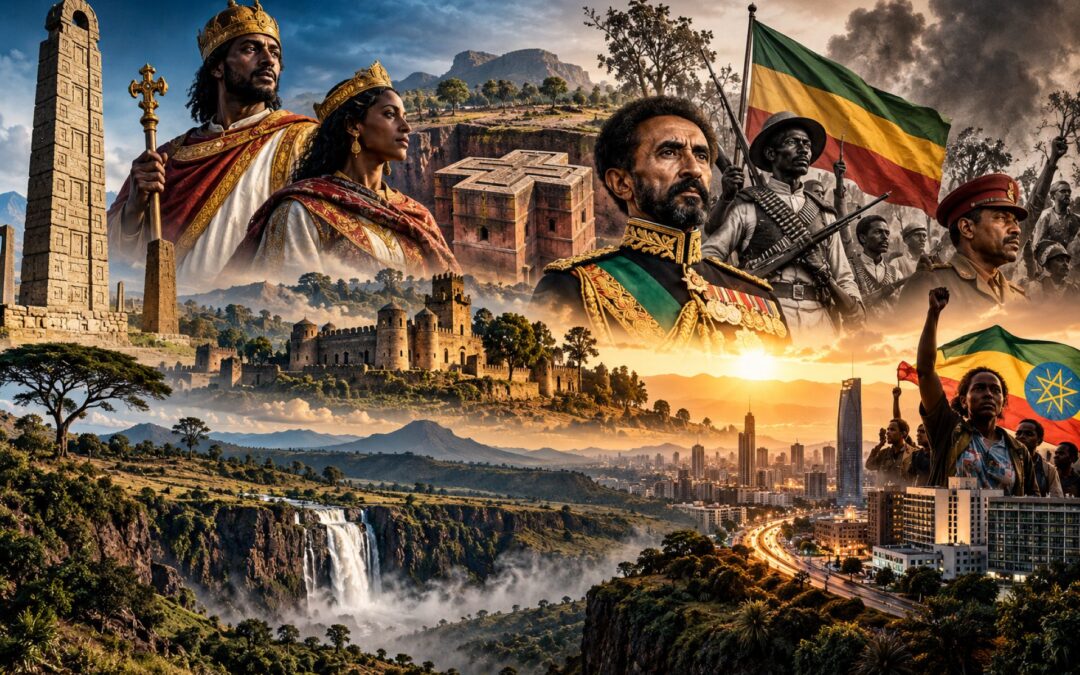
In the ancient city of Aksum, enormous stone monuments still rise above the northern Ethiopian highlands. Some stand upright, while others lie broken where they fell centuries ago. These carefully carved stelae were built by a kingdom that once commanded important trade routes between Africa, Arabia, and the wider ancient world. Its rulers minted coins, recorded military victories, and adopted Christianity long before much of Europe had become Christian.
Yet the kingdom that built these monuments eventually lost its political power. The royal court moved, commercial networks changed, and new dynasties emerged. Over the following centuries, Ethiopia experienced religious wars, territorial expansion, foreign invasion, revolution, famine, and repeated struggles over the relationship between central government and regional communities.
The remarkable feature of Ethiopian history is not that one government survived uninterrupted for thousands of years. It is that successive generations inherited institutions, traditions, and ideas of political legitimacy from earlier societies while repeatedly constructing new systems of government. The territories controlled by those governments changed, as did the people who exercised authority and the communities included within their borders.
Understanding the history of Ethiopia therefore requires more than celebrating its survival against foreign conquest. It means examining how Ethiopian states were built and rebuilt, why some populations defended them while others resisted them, and why the struggle to reconcile national unity with political autonomy remains so important today.
Yeha and Aksum: The First Foundations of Ethiopian Power
Long before Ethiopia existed as a modern nation-state, complex societies developed in the northern highlands of what are now Ethiopia and Eritrea. Their location gave them access to fertile agricultural land, mountainous defensive positions, and trading routes leading toward the Red Sea. Communities in this region were connected to northeastern Africa, the Arabian Peninsula, and commercial networks that extended far beyond their immediate surroundings.
One of the earliest important centers was Yeha, where a monumental stone temple was constructed during the first millennium BCE, probably around the eighth or seventh century BCE. The temple’s construction demonstrates that the region possessed organized communities capable of mobilizing skilled labor and substantial resources. Archaeological evidence also reveals cultural and commercial connections with South Arabia, including influences visible in inscriptions, religious practices, and architecture.
These connections do not mean that Ethiopian civilization was simply transplanted from Arabia. Local African societies participated actively in the development of their own political institutions and material culture. The balance between indigenous developments and influences from across the Red Sea remains an important subject of historical research.
The kingdom commonly associated with this early period is Dʿmt, although its political organization, geographical extent, and relationship to later states are not fully understood. It is more accurate to regard Yeha and the surrounding highlands as part of a developing regional civilization than to imagine an uninterrupted Ethiopian monarchy beginning at this point.
Centuries later, Aksum emerged as one of the most influential powers in northeastern Africa. By the first centuries CE, its rulers controlled territory linking the highlands with the Red Sea coast, including access to the important port of Adulis. Merchants moved ivory, agricultural products, animal goods, and other commodities through these networks, while imported goods and ideas arrived from Arabia, the Mediterranean, and the Indian Ocean.
Aksum’s strength rested partly on its ability to benefit from this exchange. Its kings exercised authority over productive agricultural regions and strategic trade routes, allowing them to collect resources, maintain armed forces, and project influence beyond the capital. Aksumite rulers also mounted military expeditions across the Red Sea, demonstrating that their kingdom was an active participant in regional politics rather than an isolated African civilization.
The material evidence of this power remains visible in the monumental remains of Aksum documented by UNESCO. The city’s enormous carved stelae, royal tombs, inscriptions, and architectural remains reflect the ambitions of a wealthy and politically organized kingdom. Its rulers used monumental construction to display their status, establish connections with ancestors, and make royal authority visible.
Aksumite kings also issued their own coinage, an important indication of their participation in international commerce. Coins bearing royal portraits, names, and religious symbols circulated beyond the immediate royal court. Together with monumental inscriptions, they helped communicate political authority across distances that a king could not personally govern.
One of the most consequential changes occurred during the fourth century, when King Ezana adopted Christianity. The conversion was associated with the missionary activity of Frumentius, who became an important figure in the establishment of the Ethiopian Christian tradition. Christian symbols subsequently appeared on royal coinage, demonstrating that the new religion had become closely associated with kingship.
Christianity gave Aksum’s monarchy an additional source of legitimacy. Its rulers could present themselves not only as military and political leaders but also as defenders of a religious order connected to a wider Christian world. Over time, churches, clergy, religious literature, and written traditions became central institutions in the northern highlands.
This religious transformation also had consequences that far outlasted the kingdom’s political dominance. The Ethiopian Orthodox Tewahedo Church developed distinctive liturgical, theological, and cultural traditions, with Geʽez becoming an important language of religious learning and worship. The survival of these institutions helped preserve connections with the Aksumite past even when royal authority changed.
Aksum’s decline was gradual rather than the result of one decisive military defeat. From the seventh century onward, changes in Red Sea commerce and regional politics altered the environment in which its rulers operated. The rise of Islamic powers around the Red Sea changed commercial and diplomatic relationships, while internal economic and political developments also influenced the kingdom’s fortunes.
The precise chronology and causes of Aksum’s political decline remain debated. Royal authority contracted, the location of effective political power shifted, and the kingdom eventually ceased to function in its earlier form. Nevertheless, the religious institutions, historical memory, and cultural traditions associated with Aksum continued to influence later Ethiopian rulers.
This distinction is fundamental to Ethiopia’s history. The Aksumite state did not survive unchanged, but elements of its civilization remained available to successive generations. Later dynasties would build new political systems while claiming connections to a kingdom whose prestige had endured long after its political power faded.
After Aksum: Zagwe Kings and Solomonic Legitimacy
As Aksumite authority declined, the political center of the Christian highlands gradually shifted southward. New ruling families emerged, and the relationship between religious institutions and royal government evolved. The transition was neither immediate nor completely understood, but it eventually produced a medieval political order whose most famous monuments survive at Lalibela.
The Zagwe dynasty governed substantial parts of the Ethiopian Christian kingdom between approximately the twelfth and thirteenth centuries, although the precise beginning of Zagwe rule is disputed. Its rulers inherited a Christian religious tradition associated with earlier highland kingdoms, while establishing their own centers of royal authority. Their legitimacy depended on military power, relationships with regional communities, and patronage of the church.
The dynasty’s most celebrated achievement is the extraordinary complex of rock-hewn churches at Lalibela. Instead of constructing these buildings by placing stone upon stone, workers excavated directly into the surrounding rock, creating churches, passages, courtyards, and interconnected sacred spaces. The scale of the undertaking required skilled craftsmanship, coordinated labor, and sustained political support.
The rock-hewn churches of Lalibela remain among the most distinctive monuments of medieval Christianity. They also demonstrate how architecture could reinforce political legitimacy. By sponsoring sacred construction, Zagwe rulers associated their authority with religious devotion and created institutions whose significance could survive dynastic change.
Lalibela became an important pilgrimage destination, and the complex acquired associations with Jerusalem and the sacred geography of Christianity. The monuments helped establish the Zagwe monarchy within a religious tradition that connected Ethiopian believers to a much wider Christian world. They also reinforced the idea that royal patronage could preserve sacred institutions even when the ruling family itself changed.
In 1270, Yekuno Amlak overthrew the Zagwe dynasty and established the ruling line usually known as the Solomonic dynasty. This change in government was accompanied by a powerful claim about royal ancestry. Supporters of the new dynasty maintained that its rulers descended from the biblical King Solomon and the Queen of Sheba.
The tradition was developed most famously in the Kebra Nagast, a religious and political text that connected Ethiopian kingship to the biblical world. According to the story, Solomon and the Queen of Sheba had a son, Menelik, whose descendants became the rightful rulers of Ethiopia. The narrative also associated Ethiopia with the Ark of the Covenant and a special place in sacred history.
This genealogy is not established historical fact. Its significance lies in the political and religious authority that the tradition helped create. By presenting Yekuno Amlak’s dynasty as the restoration of an ancient royal line, its supporters transformed a change of government into an apparent recovery of legitimate kingship.
The claim was especially useful because political authority in the Ethiopian highlands was never maintained through military force alone. Rulers depended on relationships with regional nobles, landholding institutions, religious communities, and powerful monasteries. A shared story of sacred ancestry could help bind these groups to an imperial court whose practical control varied across different territories.
Nevertheless, the Christian monarchy represented only one part of the region’s political and social world. Muslim communities had long existed throughout the Horn of Africa, and commercial networks connected the highlands to the coast through merchants, towns, and political authorities that did not necessarily recognize the Christian emperor.
Muslim principalities and sultanates developed around these networks, sometimes trading peacefully with Christian-controlled territories and sometimes competing over routes, agricultural resources, taxation, and political influence. These relationships cannot be reduced to an uninterrupted religious war. Economic competition, political alliances, territorial ambitions, and local interests often shaped events as much as religious affiliation.
The medieval Ethiopian kingdom therefore developed within a region containing multiple political and religious traditions. The Solomonic monarchy possessed a powerful narrative of historical legitimacy, but that narrative did not automatically give it control over every population or commercial route.
Its ability to govern depended on managing relationships with neighboring states and internal regional powers. Those relationships would become increasingly unstable during the sixteenth century, when warfare transformed the political and demographic landscape of the highlands.
Adal, Oromo Expansion, and the Fragmentation of Royal Power
By the early sixteenth century, the Christian Ethiopian kingdom faced growing competition from Muslim states linked to the eastern lowlands and Red Sea trading networks. Among these, the Sultanate of Adal became particularly important. Its rulers and military leaders sought control over territory, commercial routes, and resources that also mattered to the Christian monarchy.
The conflict reached a decisive stage under Ahmad ibn Ibrahim al-Ghazi, commonly known as Ahmad Gragn. Beginning in 1529, forces under his leadership launched major campaigns against the Christian kingdom, defeating imperial armies and extending their control deep into the Ethiopian highlands. The invasions represented one of the most destructive military crises in the kingdom’s history.
Ahmad’s forces benefited from military organization, local alliances, and access to weapons through connections around the Red Sea. Firearms became increasingly significant, particularly as the conflict developed within a wider environment of Ottoman and Portuguese competition. However, the campaigns cannot be explained simply as a confrontation between technologically superior Muslim armies and an entirely unprepared Christian kingdom.
The success of Adal’s armies also reflected political weaknesses within the Ethiopian monarchy and the ability of Ahmad’s leadership to mobilize support. Christian royal forces suffered repeated defeats, and the conflict devastated settlements, agricultural communities, churches, and religious institutions across extensive territories.
The Ethiopian emperor eventually appealed to Portugal for military assistance. Portuguese forces arrived in 1541, introducing an additional foreign element into a conflict that had already become connected to wider Red Sea rivalries. After several campaigns and reversals, Ahmad was killed at the Battle of Wayna Daga in 1543.
His death helped the Christian monarchy survive, but victory did not restore the earlier political order. Years of warfare had weakened established institutions, damaged agricultural production, displaced communities, and altered the balance between royal authority and regional power. Both Christian and Muslim populations experienced profound disruption.
The conflicts also coincided with major movements and transformations among Oromo communities. From the sixteenth century onward, Oromo groups expanded and settled across extensive parts of the Ethiopian region, changing its political, linguistic, and social landscape.
These movements did not constitute a single invasion directed by one supreme commander. Different Oromo communities pursued different strategies according to their circumstances. Some fought neighboring populations, others established alliances or negotiated access to territory, and many developed lasting relationships with communities they encountered.
Over generations, Oromo groups became established in regions with diverse religious and political traditions. Some communities adopted Christianity or Islam, while others maintained existing beliefs and institutions. Intermarriage, political accommodation, military service, and cultural exchange produced complex patterns of integration and change.
An important institution within many Oromo communities was the Gadaa system, which organized political authority, leadership succession, and social responsibilities through generational arrangements. Leadership was transferred according to established rules, commonly involving eight-year cycles, rather than being permanently inherited by one royal household.
The Gadaa system recognized by UNESCO included institutions concerned with administration, dispute resolution, community responsibilities, and the regulation of leadership. It provided a framework through which participating communities could organize collective affairs, mobilize resources, and respond to changing political circumstances.
Gadaa should not be described as identical to modern universal democracy. Historical participation in its principal governing institutions was structured by gender, generation, and social conventions, and practices differed among Oromo communities. Nevertheless, it represented a sophisticated political tradition that operated independently of the Christian imperial monarchy.
As Oromo communities became more firmly established throughout the region, their leaders increasingly participated in broader Ethiopian political institutions. Oromo military commanders, nobles, and regional authorities acquired influence within the imperial system, while different communities maintained varying degrees of autonomy.
This transformation complicated any simple distinction between an established Ethiopian state and outsiders. The population of the empire was changing, and people whose ancestors had once fought royal armies could later become central figures in imperial politics. Conversely, regional communities could resist the monarchy while still participating in the wider cultural and economic life of the region.
During the seventeenth century, Ethiopian emperors attempted to strengthen royal government by developing a permanent political center at Gondar. Emperor Fasilides established Gondar as his capital in 1636, and successive rulers constructed palaces, castles, churches, and administrative buildings there.
The royal complex became a symbol of imperial prestige, while the city developed into an important center of court culture, religious learning, and political negotiation. A more permanent capital allowed the monarchy to concentrate ceremonial authority and administrative activity in one location.
Yet impressive buildings did not eliminate the empire’s dependence on regional nobles. Powerful families controlled military forces, agricultural resources, and provincial networks that the emperor needed in order to govern. When the monarchy weakened, these regional authorities could exercise considerable independence.
Over time, the imperial court became increasingly vulnerable to rivalries among nobles and regional commanders. Some emperors retained formal sovereignty while powerful figures competed to control appointments, taxation, and military decisions. The monarchy’s religious and ceremonial prestige could survive even when the emperor’s practical authority was severely restricted.
The political crisis became especially pronounced after 1769, marking the beginning of the period usually called the Zemene Mesafint, or Era of Princes. During this era, regional rulers frequently exercised more effective power than the emperors whose authority they nominally recognized.
This was not the disappearance of Ethiopia’s religious or political traditions. It was a fragmentation of central government within a society that continued to possess regional institutions, cultural connections, and competing claims to imperial legitimacy. The crown survived, but its ability to command the wider country was limited.
The next major transformation would come from rulers who sought to reverse this fragmentation. Their attempts to reconstruct centralized authority would reshape Ethiopia’s territory and determine its response to European imperial expansion.
Menelik’s Empire: Conquest, Independence, and the Victory at Adwa
By the middle of the nineteenth century, the Ethiopian highlands remained politically divided among competing regional authorities. The emperor’s symbolic position had survived the Era of Princes, but restoring an effective central government required more than claiming an ancient title. A ruler needed soldiers, resources, alliances, and the ability to overcome nobles who had become accustomed to exercising substantial independence.
Tewodros II attempted to achieve this transformation after becoming emperor in 1855. He sought to reduce the autonomy of regional rulers, reorganize military power, and establish a stronger monarchy capable of confronting internal rebellion and foreign pressure. His ambitions also included military modernization and a more effective central administration.
These efforts faced formidable obstacles. Regional resistance, financial difficulties, and Tewodros’s increasingly coercive methods weakened his position. His detention of European nationals brought a British military expedition against him, culminating in the capture of Maqdala in 1868 and his death.
Tewodros failed to create the centralized state he had envisioned, but the problem he attempted to solve remained. Ethiopia needed an imperial government capable of coordinating regions that retained their own powerful political identities and military organizations.
Yohannes IV, who became emperor in 1872, pursued a different approach to imperial authority. He attempted to maintain relationships with major regional rulers while confronting external military threats. His reign involved conflicts with Egyptian forces, Italian expansion, and armies associated with the Mahdist movement in Sudan.
Yohannes’s achievements depended heavily on balancing cooperation with coercion. He could not simply eliminate regional political power, so his government relied on negotiation, military leadership, and the recognition of influential provincial rulers. His death in battle against Mahdist forces in 1889 brought another major transition.
Menelik, the ruler of Shewa, emerged as the dominant imperial figure. His rise coincided with a period of aggressive European expansion across Africa, when colonial powers were claiming enormous territories and attempting to convert commercial or diplomatic advantages into political control.
Menelik understood that an enlarged and more effectively organized empire could mobilize resources on a scale that smaller competing kingdoms could not. From his power base in Shewa, he expanded his influence across southern, southwestern, and eastern territories through diplomacy, military campaigns, and arrangements with local rulers.
The character of this expansion varied greatly. Some authorities accepted alliances or negotiated subordinate positions within the growing empire, while others resisted and were defeated. The result was not simply the peaceful reunification of populations that had previously belonged to an identical Ethiopian state.
Many of the territories incorporated into Menelik’s empire had their own institutions, identities, political histories, and traditions of autonomy. Their incorporation changed who controlled land, taxation, military authority, and political decision-making.
This process is central to the interpretation of Ethiopia’s nineteenth-century transformation examined by historian Teshale Tibebu. Imperial consolidation strengthened Ethiopia’s capacity to confront foreign powers, but it also expanded the reach of central authority over communities that had not necessarily regarded the emperor as their legitimate ruler.
The Arsi Oromo experience illustrates the violence that could accompany imperial expansion. Arsi communities mounted prolonged resistance to forces advancing into their territory during the nineteenth century. Their struggle involved political organizations and local leadership traditions that could coordinate opposition to outside domination.
The conquest produced severe suffering and changes in local landholding and political relationships. Imperial soldiers, officials, and settlers received access to land and agricultural resources in conquered regions, while many existing inhabitants faced new obligations, forms of dependency, and loss of control over their livelihoods.
As documented in research on conquest and resistance among the Arsi Oromo, these events cannot be understood only as administrative integration into a national state. They involved military coercion, contested authority, and lasting consequences for communities whose experience differed sharply from the imperial narrative of unification.
It would also be misleading to assume that all southern peoples experienced expansion identically. Patterns of resistance, negotiation, accommodation, land transfer, and political participation varied across regions. Menelik’s empire brought together populations with different histories and relationships to imperial power.
The expansion nevertheless gave the monarchy access to additional agricultural wealth, military manpower, and territorial resources. These strengthened its ability to resist foreign intervention at a moment when European colonial ambitions were advancing rapidly throughout Africa.
Italy had already established a colonial presence along the Red Sea coast and formally declared Eritrea a colony in 1890. Italian leaders hoped to extend their influence into the Ethiopian highlands and gain control over the empire’s foreign relations.
The immediate diplomatic dispute centered on the Treaty of Wuchale, signed between Menelik and Italy in 1889. Article XVII became particularly contentious because its Italian and Amharic versions were not equivalent.
The Italian version represented Ethiopia as having accepted a relationship under which its foreign affairs would be conducted through Italy. The Amharic wording instead permitted Ethiopia to use Italian diplomatic assistance without making that assistance compulsory. Italy used its interpretation to assert that Ethiopia was an Italian protectorate.
Menelik rejected this claim. The disagreement was not a minor translation problem but a dispute over whether Ethiopia remained an independent sovereign state or had surrendered control over its international relations.
As negotiations deteriorated, Italy attempted to enforce its political ambitions through military force. Ethiopian forces confronted the invading army during the conflict of 1895–1896, and Menelik mobilized soldiers from different parts of the enlarged empire.
Empress Taytu Betul played an important role in resisting Italian claims and supporting the mobilization against invasion. Her political influence and determination helped shape the Ethiopian response, although the victory itself depended on the collective efforts of commanders, soldiers, and supporting communities.
The Ethiopian army was not a single homogeneous force. It brought together military contingents from different regions, including territories that had recently been incorporated into the empire. Their participation reflected the political and military structure Menelik had constructed, as well as the immediate necessity of confronting a foreign invader.
On 1 March 1896, Ethiopian forces decisively defeated the Italian army at the Battle of Adwa. Italian commanders had underestimated their opponents and faced serious difficulties involving coordination, intelligence, and battlefield operations. Ethiopian forces exploited these weaknesses while demonstrating their own ability to mobilize, maneuver, and fight effectively.
The victory forced Italy to recognize Ethiopian independence. At a time when European powers controlled or were conquering much of Africa, Adwa became an extraordinary demonstration that an African army could defeat a European colonial invasion.
Its significance reached beyond Ethiopia. Adwa became a symbol of African political independence and an inspiration to people challenging European racial and imperial claims. It also strengthened the international standing of the Ethiopian monarchy.
Yet the victory exposed a profound contradiction within the empire. Ethiopia had defended its independence from external conquest, but the state that achieved this victory included populations whose own autonomy had recently been reduced through imperial expansion.
For those who experienced Menelik’s rule as protection against European colonialism, Adwa represented national survival. For communities subjected to conquest, the same political order could represent dispossession, taxation, and external control.
Both experiences belong to Ethiopian history. Recognizing the costs of imperial expansion does not diminish the military significance of Adwa, just as celebrating Adwa does not erase the political experiences of conquered populations.
This tension between protecting the state’s independence and determining whose freedom the state should protect would reappear under subsequent governments. The empire had become stronger internationally, but the challenge of governing its diverse populations remained unresolved.
Haile Selassie: Fascist Occupation, Centralization, and the Monarchy’s Fall
The Ethiopian monarchy entered the twentieth century facing a difficult combination of pressures. Its rulers wanted to strengthen central authority, modernize government institutions, and defend the country’s sovereignty. At the same time, the empire contained regions with different political traditions, unequal landholding arrangements, and competing expectations about the relationship between local communities and the imperial court.
Haile Selassie became emperor in 1930 after years of increasing political influence under his earlier title, Ras Tafari. He believed that stronger national institutions and a more centralized government were essential to Ethiopia’s security and international standing.
His reign introduced important administrative and constitutional reforms, including the 1931 constitution. The monarchy also pursued changes in education, government organization, and international diplomacy. Nevertheless, modernization did not necessarily mean the democratization of political power.
The emperor remained the dominant figure within the political system, while many regional communities continued to experience government through hierarchies of officials, landlords, and local authorities. The concentration of power in Addis Ababa strengthened the central state but also generated resentment among those who sought greater control over regional affairs.
The most immediate threat came from fascist Italy. Benito Mussolini regarded Ethiopia as a target for colonial expansion and hoped to avenge Italy’s defeat at Adwa. In October 1935, Italian forces invaded from their colonial positions in Eritrea and Italian Somaliland.
The invading armies possessed major advantages in aircraft, artillery, armored vehicles, and logistical resources. Italian forces also used chemical weapons, including mustard gas, in violation of international restrictions. Ethiopian soldiers resisted fiercely, but technological disparities and military difficulties contributed to the loss of major positions.
Addis Ababa fell in May 1936, and Italy declared the annexation of Ethiopia as part of its new colonial empire. Haile Selassie went into exile, where he appealed to the League of Nations and denounced the aggression against his country.
The League failed to prevent the occupation, revealing the weakness of the international system that was supposed to protect states against aggression. Ethiopia’s experience also became an important episode in the broader history of fascist expansion and the diplomatic failures preceding the Second World War.
Italian forces controlled the capital, major roads, and important administrative centers, but their occupation faced continuing armed resistance. Ethiopian fighters operated from rural areas, maintained resistance networks, and attacked colonial positions. The occupation should therefore not be mistaken for the disappearance of Ethiopian opposition or the complete pacification of the countryside.
Italian authorities responded to resistance through harsh repression. One of the most notorious episodes occurred in February 1937, following an attempt to assassinate the Italian viceroy, Rodolfo Graziani. Italian soldiers, security personnel, and other participants attacked civilians in Addis Ababa in a massacre remembered as Yekatit 12.
Large numbers of people were killed, although historians continue to dispute the precise death toll. The massacre formed part of a wider pattern of colonial violence involving executions, imprisonment, collective punishment, and attempts to terrorize the population into submission.
Italy’s occupation eventually became vulnerable as the wider Second World War expanded. British-led Allied forces, including troops from different parts of the British Empire, advanced against Italian positions in East Africa. Ethiopian resistance fighters also played an important role in weakening the occupation and restoring national authority.
During the wider Allied campaigns of World War II, Italian forces suffered major defeats in East Africa. Haile Selassie returned to Addis Ababa in May 1941, although fighting against remaining Italian positions continued beyond the liberation of the capital.
The emperor’s restoration reinforced his belief that political fragmentation had endangered Ethiopia. In the years following the occupation, he attempted to draw greater administrative, military, and political authority toward the central government.
The consequences were particularly significant in Eritrea. Italy had ruled Eritrea as a colony for decades, and the territory subsequently came under British administration following Italy’s defeat. Its population contained different religious, political, and regional interests, including competing views about independence and association with Ethiopia.
In 1950, the United Nations approved a plan to federate Eritrea with Ethiopia. The arrangement came into effect in 1952 and provided Eritrea with its own institutions, including a parliament and powers over important local matters, while placing certain responsibilities under the Ethiopian crown.
The federation was intended to reconcile Eritrean autonomy with its association with Ethiopia. In practice, the imperial government gradually weakened Eritrea’s separate political institutions, restricted political opposition, and increased central control.
Resistance developed before the federation was formally abolished. The armed Eritrean independence struggle began in 1961, and the following year the Ethiopian government ended Eritrea’s federal status and incorporated it more directly into the empire.
The sequence matters because the independence movement did not simply appear in response to the final annexation. As documented in the Library of Congress’s historical study of Ethiopia, Eritrean opposition had already developed in response to the erosion of political rights and competing claims over the territory’s future.
The long war that followed became one of the most consequential conflicts in modern Ethiopian history. It challenged the monarchy’s territorial claims and later continued under the government that replaced Haile Selassie.
Elsewhere in Ethiopia, social and economic grievances were growing. Large numbers of rural people worked land controlled by landlords, religious institutions, or other powerful interests. Tenancy arrangements and obligations varied across regions, but demands for land reform became central to political opposition.
Students, intellectuals, and political activists increasingly criticized inequality, authoritarian government, and the concentration of economic and political power. The emperor’s international prestige could not conceal the difficulties faced by many ordinary Ethiopians.
The crisis intensified during the famine in Wollo and neighboring regions in the early 1970s. Drought and crop failure contributed to food shortages, but poverty, inadequate infrastructure, weak administrative responses, and the government’s handling of information worsened the suffering.
The famine revealed the gap between the monarchy’s image as a modernizing national institution and its ability to protect vulnerable populations. Public anger grew as information about the disaster circulated and political opposition intensified.
By 1974, demonstrations, strikes, student activism, and military discontent had created a revolutionary crisis. A committee of military officers and soldiers known as the Derg gradually seized power, and Haile Selassie was deposed in September.
The monarchy’s fall ended a system whose rulers had claimed continuity with the ancient Solomonic tradition. Yet the revolution did not settle the underlying questions of land ownership, regional autonomy, political legitimacy, or centralized authority.
The new government promised to overturn the old inequalities. It would soon establish an even more coercive system of political control.
The Derg: Land Reform, Terror, War, and Famine
The military revolution of 1974 fundamentally transformed Ethiopia’s political institutions. The Derg rejected the monarchy and adopted an increasingly radical socialist orientation, promising to eliminate entrenched privilege and create a more equal society. Its leaders regarded the old system of land ownership as one of the principal foundations of exploitation.
In 1975, the government nationalized rural land. The reform ended many existing landlord claims and granted peasant households rights to cultivate land under a new system. For people who had faced burdensome tenancy arrangements, the destruction of landlord power represented a significant change.
However, land nationalization did not establish unrestricted private ownership for farmers. The state retained ultimate authority over land, while local organizations and officials acquired important powers over its allocation and administration.
Peasant associations became central institutions in rural government. They could organize local affairs and distribute land, but they also became mechanisms through which the state exercised political control. The relationship between farmers and government was therefore transformed rather than simply liberated from external authority.
The historical development of Ethiopian rural policy examined by the OECD demonstrates how land reform became connected to broader programs of agricultural administration, state intervention, and rural reorganization.
The revolution also produced fierce struggles over political power. Different revolutionary organizations competed to determine the country’s future, while the Derg progressively eliminated opponents within and outside the military establishment.
Mengistu Haile Mariam emerged as the dominant figure in this process. By 1977, his leadership was associated with a campaign of violent repression commonly known as the Red Terror.
Security forces and revolutionary organizations arrested, tortured, and killed people accused of opposing the regime. Students, activists, suspected members of rival political movements, and other civilians became targets of detention and execution.
Violence also occurred among competing revolutionary groups, but the Derg possessed the institutional and military power of the state. Its use of coercion became a defining feature of the revolutionary government, and the full number of victims remains uncertain.
The revolutionary state simultaneously faced serious territorial and military challenges. In 1977, Somalia invaded the Ogaden region of eastern Ethiopia, seeking to bring predominantly Somali-inhabited territories under Somali control.
The conflict reflected longstanding disputes over borders, identity, and the political future of Somali populations in the Horn of Africa. It also became an important episode in the global rivalry between the United States and the Soviet Union.
Somalia had previously received substantial Soviet support, but Moscow shifted toward Ethiopia after the Derg adopted a Marxist-Leninist orientation. Soviet weapons and advisers, together with Cuban military forces, helped Ethiopia reverse Somalia’s advances.
The wider Cold War rivalry that shaped conflicts across the Horn of Africa thus influenced the outcome of a war whose underlying territorial disputes were rooted in regional history rather than simply in global ideology.
Ethiopia regained control over the contested territory, but the victory did not produce domestic stability. The Derg continued to fight armed movements in other parts of the country, particularly in Eritrea and Tigray.
Eritrean independence organizations had been fighting against Ethiopian authority since the monarchy. Their struggle continued because the military revolution had not resolved their demand for self-determination. The Derg treated the preservation of Ethiopia’s territorial integrity as a fundamental objective of the state.
In Tigray, political and military opposition also grew. The Tigray People’s Liberation Front, established in 1975, became an important insurgent movement against the government. Its aims and political relationships developed over time, but resistance to centralized military rule was central to its struggle.
The government responded to insurgencies through military campaigns, security operations, restrictions on movement, and administrative measures that affected civilian populations. The wars consumed resources and disrupted agriculture, markets, transportation, and everyday economic life.
These conditions became devastating when drought affected large parts of northern Ethiopia during the early 1980s. Crop failures and shortages contributed to a famine that reached catastrophic proportions between 1983 and 1985.
The disaster became internationally associated with images of starving children, overwhelmed relief centers, and desperate communities. Those images communicated the scale of human suffering but often failed to explain the political circumstances that made the famine so destructive.
Drought was an important trigger, but it was not a sufficient explanation. Many households depended on access to functioning markets, livestock trading, seasonal employment, and movement between regions. Warfare could destroy those opportunities even when food remained available elsewhere.
Military operations disrupted commercial routes and transport networks. Restrictions imposed by government authorities could prevent civilians from leaving threatened areas, while fighting made journeys toward markets or relief centers dangerous.
Government agricultural policies, coercive population movements, and resettlement programs also contributed to suffering. Some people were moved from their homes under conditions that exposed them to disease, deprivation, and the loss of familiar livelihoods.
The historical analysis of Ethiopia’s 1983–1985 famine makes clear that the catastrophe must be understood through the interaction of environmental stress, political conflict, government decisions, and unequal access to resources.
This distinction changes how the famine is understood. A failed harvest can reduce the food available to a community, but whether people survive also depends on their ability to obtain food, travel safely, retain assets, and receive assistance.
For a family living in a conflict-affected farming district, a blocked road could mean losing access to a market, relief supplies, or relatives able to help. The same drought might therefore produce very different outcomes in regions with different levels of security and economic access.
International humanitarian campaigns raised enormous public awareness and mobilized assistance. Yet relief efforts operated within a conflict in which aid delivery, access to territory, and the movement of populations were affected by government and rebel actions.
The Derg survived the immediate famine crisis but continued to confront increasingly effective insurgent movements. Its military strategy imposed enormous costs, while public grievances and political repression undermined the legitimacy of its rule.
By the late 1980s, changing international circumstances further weakened the government. The Soviet Union’s priorities shifted, and the Derg could no longer rely on the same degree of external military and political support.
Eritrean forces gained major victories in the north, while the TPLF became a leading component of the Ethiopian People’s Revolutionary Democratic Front, or EPRDF. The insurgencies increasingly threatened the government’s ability to hold its remaining territory.
In May 1991, Mengistu fled Ethiopia as EPRDF forces advanced toward Addis Ababa. The military government collapsed, and the victorious movements began constructing a new political system.
The revolution had destroyed the monarchy, abolished the old landlord structure, and transformed Ethiopia’s economic institutions. Yet it had also established an authoritarian state that attempted to control political opposition and regional demands through military power.
Its collapse demonstrated that ending one form of centralized government did not automatically resolve the conflicts that had weakened earlier regimes. Ethiopia now faced the task of rebuilding its institutions while confronting the consequences of decades of war.
Ethnic Federalism After 1991: Autonomy Under Party Control
The collapse of the Derg in 1991 created an opportunity to reorganize Ethiopia’s political system. The victorious EPRDF coalition, led by the TPLF, inherited a country deeply affected by warfare, displacement, economic difficulties, and disputes over the relationship between different populations and the central state.
The new leadership recognized that attempts to govern the country through centralized imperial or military institutions had repeatedly produced resistance. It therefore advanced a political arrangement that gave formal recognition to Ethiopia’s different nations, nationalities, and peoples.
The most immediate territorial change concerned Eritrea. After decades of armed struggle, Eritrean independence forces had achieved effective control over the territory. In 1993, Eritreans voted overwhelmingly for independence in a referendum, and Eritrea became a separate sovereign state.
For Ethiopia, this meant a major alteration of its internationally recognized territory and the loss of direct access to the Red Sea. For Eritrea, independence represented the achievement of a long political and military struggle whose participants had resisted both the imperial monarchy and the Derg.
Within Ethiopia, the EPRDF pursued a new constitutional order based on ethnically defined federalism. Regional states were organized largely around language and identity, although their populations were not always homogeneous and territorial boundaries could remain contested.
The system was intended to acknowledge historical grievances and provide communities with greater opportunities to govern their own affairs. Rather than insisting that political unity required uniformity imposed from Addis Ababa, the federal arrangement formally recognized the country’s diversity.
The 1995 constitution established rights concerning language, culture, regional self-government, and political self-determination. Article 39 went unusually far by recognizing a constitutional right of nations, nationalities, and peoples to self-determination, including secession under specified procedures.
These provisions represented a major departure from earlier forms of Ethiopian government. The monarchy had grounded legitimacy in dynastic tradition and imperial sovereignty, while the Derg had emphasized revolutionary authority and centralized state control. The federal constitution instead described political unity through a system that formally acknowledged distinct collective identities.
Nevertheless, the existence of constitutional rights did not guarantee that power was exercised democratically. The EPRDF remained the dominant political organization, and its influence extended through national institutions, regional party structures, security organizations, and administrative networks.
Opposition parties faced restrictions, and political competition remained constrained. Regional governments possessed constitutional responsibilities, but their practical freedom depended heavily on the structure of the ruling coalition and its ability to control political decisions across the country.
The system also produced substantial debates over the relationship between ethnicity and citizenship. Supporters argued that ethnic federalism corrected historical patterns of cultural suppression and domination. Critics contended that organizing politics around collective identity could deepen divisions, intensify territorial disputes, and restrict political alternatives.
These competing interpretations were not merely theoretical. Federal institutions influenced the distribution of resources, regional administration, language policy, and political representation. Disagreements over boundaries, local authority, and the identity of particular territories could become disputes over the constitutional structure itself.
The EPRDF period also brought significant economic and infrastructural development, including investment in roads, public services, and state-led development programs. Such achievements existed alongside political repression and unresolved concerns about accountability.
The tension became increasingly visible after the contested elections of 2005 and during later waves of public protest. Demonstrations in Oromia and Amhara reflected grievances involving political exclusion, land, regional power, and the conduct of security forces.
By the second half of the 2010s, public pressure had become a major challenge to the ruling coalition. The government faced growing demands for reform, greater political participation, and changes to the distribution of authority.
In 2018, Abiy Ahmed became prime minister amid this crisis. His arrival generated expectations that Ethiopia might finally reconcile political openness with the constitutional promises of federalism.
Yet the structure he inherited contained competing interpretations of how the country should be governed. The next crisis would emerge from the unresolved question of whether Ethiopia needed a stronger national political center or greater independence for its federal regions.
Abiy Ahmed, Tigray, and Ethiopia’s Renewed Conflicts (2018–2026)
Abiy Ahmed became prime minister in April 2018 at a moment of widespread political dissatisfaction. Protest movements had challenged the existing ruling coalition, and many Ethiopians hoped that a leadership change would open the political system and reduce the violence associated with earlier governments.
His initial reforms generated considerable optimism. Political prisoners were released, restrictions on some opposition organizations were relaxed, and political exiles were encouraged to return. The government presented these changes as the beginning of a more open and inclusive national political order.
Abiy also moved to end the prolonged hostility between Ethiopia and Eritrea. The two countries had fought a devastating border war between 1998 and 2000, and relations remained tense despite the formal end of that conflict.
The rapprochement with Eritrean President Isaias Afwerki in 2018 was internationally celebrated. Abiy received the Nobel Peace Prize in 2019, reflecting hopes that the agreement would contribute to regional stability and a broader transformation of Ethiopian politics.
Yet the opening of the political system also exposed disputes that had been managed or suppressed under earlier EPRDF governments. Political organizations differed over the meaning of federalism, the rights of regional governments, the distribution of resources, and the proper role of national institutions.
Abiy favored a reorganization of the ruling political system. In 2019, the Prosperity Party was created as a new national political organization incorporating much of the previous ruling coalition.
The TPLF, which had played a dominant role within the earlier EPRDF system, refused to join. Its leaders argued that the proposed restructuring threatened Ethiopia’s federal arrangement and risked concentrating power within the national government.
The disagreement involved political influence, but it also raised constitutional questions. Regional leaders feared that a stronger national political organization could reduce their ability to govern independently, while supporters of Abiy’s approach argued that Ethiopia required institutions capable of overcoming divisions and providing more coherent national leadership.
These disagreements intensified during the COVID-19 pandemic. National elections scheduled for 2020 were postponed, generating disputes over constitutional legitimacy and the continuation of government mandates.
Tigray’s regional authorities held their own elections in September 2020 despite objections from the federal government. Each side challenged the political legitimacy of the other’s actions, deepening an already serious breakdown in relations.
The crisis moved from political confrontation to armed conflict in November 2020. Fighting began after a confrontation involving the Ethiopian military’s Northern Command, with federal and Tigrayan authorities offering competing explanations of responsibility and the events that triggered hostilities.
The federal government launched military operations against Tigrayan forces. What was initially presented as a limited effort to restore constitutional order developed into a prolonged and devastating war involving multiple armed actors.
Eritrean troops entered the conflict, and forces from the Amhara region also participated in military operations. Their involvement reflected regional security concerns, political alliances, and territorial disputes that could not be reduced to the original confrontation between Abiy’s government and the TPLF.
The fighting quickly exposed civilian populations to extraordinary danger. Military operations disrupted farming, commerce, transportation, health services, and the distribution of essential supplies.
Investigations documented serious violations of international humanitarian law and human rights abuses by multiple parties. These included unlawful killings, attacks against civilians, conflict-related sexual violence, forced displacement, and other forms of coercion.
The abuses were not identical in every region or attributable to one collective actor. Specific incidents, patterns of conduct, and responsibility require careful examination of evidence rather than treating all participants as interchangeable.
In western Tigray, investigations by Human Rights Watch and Amnesty International documented widespread abuses and a campaign of ethnic cleansing directed against Tigrayan civilians. These findings became central to demands for accountability and the protection of displaced communities.
The humanitarian consequences extended far beyond direct battlefield casualties. Large numbers of people were forced from their homes, while conflict and restrictions on access disrupted food systems and medical services.
The number of people who died from direct violence, hunger, disease, and other war-related consequences remains difficult to establish reliably. Differing estimates reflect serious limitations in access to evidence and the challenges of measuring mortality during a prolonged conflict.
The war also spread beyond Tigray at different stages, affecting neighboring regions and creating additional displacement and destruction. Attempts to secure military advantage repeatedly undermined the possibility of restoring stable civilian administration.
After prolonged negotiations and international diplomatic pressure, the federal government and TPLF signed the African Union-mediated Pretoria cessation-of-hostilities agreement on 2 November 2022.
The agreement provided a framework for ending major hostilities, addressing security arrangements, restoring services, facilitating humanitarian assistance, and beginning a process of political stabilization. It was an important diplomatic achievement after two years of destructive warfare.
Nevertheless, a cessation-of-hostilities agreement is not the same as resolving the underlying conflict. Important questions remained concerning disarmament, territorial administration, the presence and withdrawal of armed forces, political authority in Tigray, and the return of displaced populations.
The agreement also did not automatically settle disputes involving every actor in the war. Eritrea was not a signatory to the Pretoria agreement, and competing claims over territories in western Tigray continued to complicate efforts to restore a durable peace.
For civilians, the difference between an agreement and practical recovery was considerable. Families who had lost homes or livelihoods required security, access to land, functioning institutions, and the opportunity to return without facing further violence.
Reconstruction also demanded more than the reopening of roads or administrative offices. War had damaged trust between communities, institutions, and political authorities, making questions of accountability and political representation especially difficult.
The conflict exposed weaknesses in Ethiopia’s federal structure that had existed before Abiy came to power. The constitution promised regional autonomy, but the country lacked an accepted political mechanism for resolving fundamental disputes between powerful regional authorities and the federal government when political negotiations failed.
At the same time, the Ethiopian state faced serious security problems beyond Tigray. Violence and armed insurgency continued in parts of Oromia, while federal forces became involved in an expanding confrontation with Amhara militia networks, commonly associated with the Fano movement.
The conflict in Amhara intensified after disputes over security arrangements and the restructuring of regional forces. The fighting involved broader grievances about political authority, regional interests, and the role of the federal government.
In Oromia, violence involved armed opposition groups, government security operations, and local conflicts. Civilians faced insecurity, displacement, and competing claims concerning responsibility for attacks.
These conflicts differed in their origins and political objectives. They should not be treated as one coordinated national rebellion or interpreted as evidence that every Ethiopian community held the same position on federal authority.
By 2026, the situation in northern Ethiopia had deteriorated again. Renewed confrontations threatened the fragile stability established after Pretoria and raised concerns about the possibility of another large-scale regional war.
In September 2026, renewed fighting in the north demonstrated how unresolved political and security disputes could escalate even after a formal agreement had ended the previous phase of conflict.
On 10 October 2026, the United Nations Secretary-General warned about renewed hostilities in Ethiopia, particularly developments affecting Tigray, Afar, and Amhara. The statement underscored the danger of further escalation and the urgent need to protect civilians and pursue peaceful solutions.
These developments were especially troubling because the political and humanitarian consequences of the earlier war had not been fully addressed. Displaced communities continued to face obstacles to return, while regional tensions and disputes over authority complicated the restoration of normal civilian life.
The situation also carried wider implications for the Horn of Africa. Ethiopia’s relationship with Eritrea remained sensitive, and renewed military confrontation risked affecting neighboring states whose security interests were connected to developments inside Ethiopia.
Meanwhile, the continuing violence in Oromia and Amhara made it clear that the country’s security challenges were not confined to Tigray. In October 2026, reports of deadly attacks against civilians in Oromia further illustrated the insecurity facing communities outside the northern conflict zone. Responsibility for particular attacks remained contested, making careful attribution essential.
The Ethiopian government’s position emphasized the importance of national sovereignty, territorial integrity, and security. Regional political actors, opposition movements, and affected communities advanced differing arguments about autonomy, representation, protection, and the distribution of power.
These competing claims cannot be resolved merely by choosing between an entirely centralized government and unrestricted regional independence. Ethiopia’s institutions must also confront disagreements over citizenship, historical territory, language, political participation, and accountability.
The central problem is therefore not simply the presence of multiple ethnic identities. Ethiopia has always contained diverse populations, languages, faiths, and political traditions. Conflict emerges when institutions fail to manage competing claims peacefully and when political disputes become inseparable from the control of armed force.
This is also why the country’s contemporary conflicts cannot be understood only through the personalities of Abiy Ahmed or the leaders of the TPLF. Their decisions matter, but the deeper tensions involve the political framework inherited from earlier governments and the expectations of communities whose experiences of Ethiopian statehood have been very different.
The empire expanded through military conquest, the monarchy strengthened centralized administration, the Derg attempted to impose revolutionary authority, and the EPRDF established a formally decentralized federation under a dominant ruling coalition. Each system sought to solve problems created or exposed by earlier forms of government.
None produced a universally accepted settlement over the relationship between central power, regional autonomy, and the rights of the people living within the state.
As of October 2026, Ethiopia’s future remains uncertain. Continuing violence, unresolved territorial disputes, political fragmentation, and humanitarian needs make any prediction of a stable outcome premature.
What can be said is that the country’s central political challenge has not disappeared. Ethiopia must establish institutions capable of maintaining national security and political cooperation without making centralized authority dependent on coercion or treating regional autonomy as an existential threat.
That is a more difficult task than winning a battle or replacing a government. It requires a political settlement that different communities can regard as legitimate, institutions capable of resolving disputes without war, and a state whose protection extends to the populations living within its borders.
The monuments at Aksum remain an appropriate place to consider Ethiopia’s extraordinary history. The kingdom that raised them disappeared as a political power, but its religious traditions, written culture, and historical prestige influenced later generations. Subsequent rulers constructed new states, expanded their territories, and claimed different sources of legitimacy while inheriting elements of earlier political traditions.
Ethiopia survived foreign invasions and repeatedly rebuilt its governing institutions, but survival came through processes that could involve conquest, resistance, accommodation, and profound social change. The same state-building efforts that strengthened national independence sometimes restricted the autonomy and security of communities within the country.
The history of Ethiopia is therefore neither the uninterrupted triumph of an ancient nation nor a simple succession of failed governments. It is the history of a diverse civilization whose political institutions have repeatedly been transformed in response to internal conflicts and external pressures.
Its continuing challenge is to build a government capable of preserving the country’s independence while earning the trust of the different peoples it governs. Ethiopia’s past demonstrates its capacity to survive repeated political upheavals. Whether its institutions can achieve a more inclusive and durable form of political stability remains one of the most consequential questions facing the country.
Last Updated on November 7, 2026 by Aseem Gupta