
Reading Time: 24 Minutes
Few cities have influenced the world as profoundly as Baghdad without leaving behind much of the architecture that made them famous. Its original circular walls have disappeared, its palaces have vanished, and the libraries associated with its greatest scholars survive mainly through manuscripts scattered across other places. Yet the ideas developed, translated, argued over, and transmitted through medieval Baghdad continue to shape mathematics, medicine, literature, and the way knowledge travels between cultures.
Founded as the capital of a new empire in 762, Baghdad grew from an ambitious architectural project into one of the medieval world’s great commercial and intellectual centres. It attracted merchants from distant ports, officials trained in competing political traditions, and scholars who worked across linguistic and religious boundaries. Its celebrated prosperity was neither effortless nor permanent: imperial rivalries, civil wars, and changes in military power repeatedly threatened the city long before the Mongols captured it in 1258.
Baghdad’s history is therefore more than the story of a lost golden age. It is a story about how political power and commercial wealth can concentrate knowledge in one place, how intellectual traditions outlive the rulers who finance them, and how a city can survive even after the institutions that created its fame have fallen.
The Abbasid Revolution and the Birth of Baghdad
Baghdad’s rise began with a political revolution hundreds of kilometres away. After the death of the Prophet Muhammad in 632, Muslim armies brought large territories of the Byzantine and Sasanian empires under new rule. The Rashidun caliphs were followed by the Umayyad dynasty, which governed from Damascus beginning in 661. Within a few generations, the caliphate stretched from the Iberian Peninsula across North Africa and the Middle East toward Central Asia and the Indian subcontinent. Its extraordinary reach also created formidable problems of administration, succession, and legitimacy.
The Umayyad state was not simply an Arab government ruling unwilling foreigners, but Arab military and tribal elites enjoyed advantages that generated considerable resentment. Many non-Arab converts to Islam expected religious membership to carry greater equality, while regional factions disagreed over taxation, offices, military rewards, and the ruler’s right to govern. Opposition was particularly effective in Khurasan, the vast eastern region whose armies and political networks could challenge Damascus. Religious claims associated with the Prophet’s family strengthened the coalition, although its members did not all imagine the same political future.
In 750, the Abbasid movement defeated the Umayyads and established a new dynasty under Abu al-Abbas al-Saffah. The revolution did not eliminate inequality or factional struggle, but it shifted the caliphate’s political centre eastward. The second Abbasid caliph, Abu Ja’far al-Mansur, wanted a capital that would embody the new regime rather than inherit the associations of Damascus. A fresh imperial city would allow him to position his court, military supporters, and administrators within a landscape designed around Abbasid authority.
Mesopotamia offered economic advantages as well as symbolic ones. The region’s irrigated farmland could support a large population, and its river routes connected agricultural estates, trading towns, and the Persian Gulf. Roads extended toward Iran and Central Asia while other networks reached Syria, the Mediterranean, and India. A settlement already called Baghdad existed in the vicinity; the name’s deeper history is debated, despite traditions connecting the locality with ancient Mesopotamian records. What al-Mansur founded was not the first human habitation in the area but a new imperial capital on an altogether different scale.
Construction began in 762, traditionally in the summer, and continued over several years. The official name was Madinat al-Salam, the City of Peace, but Baghdad eventually prevailed in everyday usage. Thousands of workers and craftsmen were reportedly recruited to raise its fortifications, roads, and government buildings. The new capital was not merely where the caliph happened to live. Its location and design announced that the Abbasids intended to govern a far-reaching empire whose political inheritance included Arab, Iranian, and older Mesopotamian traditions.
Inside al-Mansur’s Round City
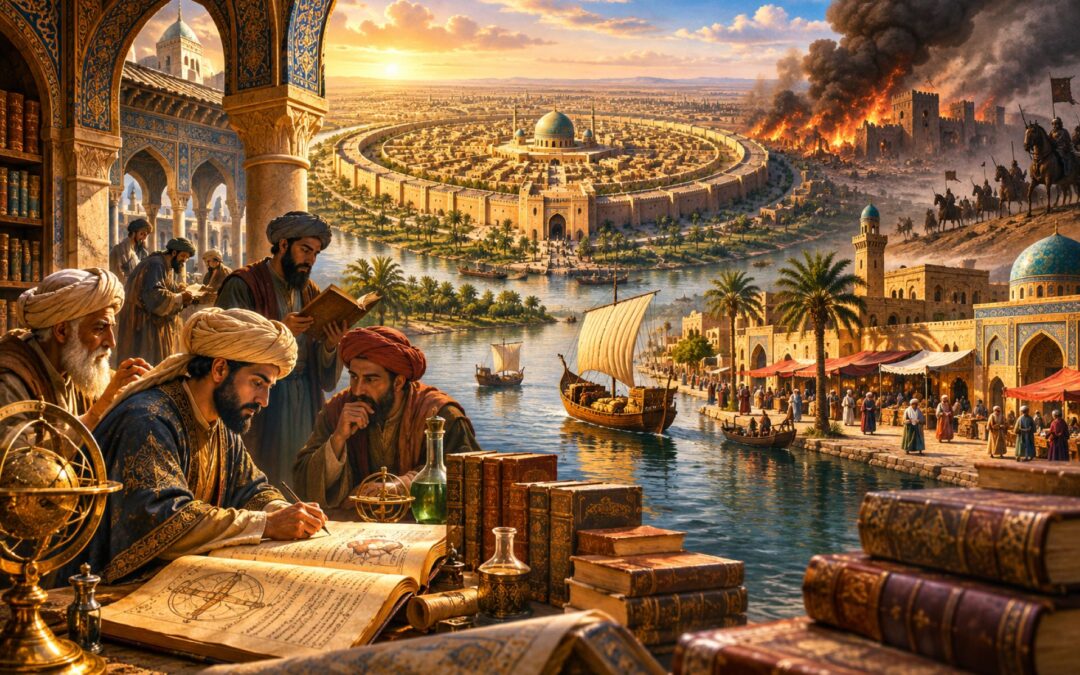
The most striking part of al-Mansur’s Baghdad was its shape. Instead of growing around a crossroads or gradually expanding from a fortress, the original centre was laid out as a near-perfect circle, roughly two and a half kilometres across. Its monumental arrangement impressed later writers so deeply that the Round City became almost a shorthand for Abbasid ambition. The surviving archaeological evidence is limited, however, so modern plans rely heavily on descriptions in medieval texts rather than intact walls or excavated streets.
The planned enclosure had major brick defences, protective ditches, and successive rings separating its outer approaches from the centre. Four principal gates connected it to the wider caliphate. The Damascus Gate pointed toward Syria, the Basra Gate toward southern Iraq and the Gulf, the Kufa Gate toward another major Iraqi centre, and the Khurasan Gate toward the dynasty’s eastern political base. The roads passing through them were both routes of circulation and a statement about the empire’s geographical reach.
Inside, residential and administrative areas surrounded a central precinct containing the caliph’s palace and the principal congregational mosque. Medieval descriptions call the palace the Palace of the Golden Gate and describe its prominent green dome. The symbolism was unmistakable: the ruler occupied the heart of a city whose roads converged toward his residence. Power had been translated into a street plan. For a visitor entering through a gate, the city’s geometry offered a visible lesson in the new political order.
This architecture was not an isolated flash of Arab invention. As the Iranian influences on Baghdad’s foundation demonstrate, its planning and early administration belonged to a world that had inherited Sasanian and other pre-Islamic practices. Circular or centrally organised settlements had older precedents, and the Abbasids employed architects, officials, and craftspeople familiar with traditions beyond Arabia. Baghdad’s distinctiveness lay in the way those influences were assembled into an imperial statement.
The plan also contained a practical contradiction. A protected ceremonial centre might help the caliph control access, but an expanding commercial capital needed far more room than its walls could provide. Markets attracted crowds, animals, workshops, warehouses, and constant movement. Accounts describe al-Mansur transferring some commercial activity outside the original enclosure, partly because the bustle so close to the palace raised security concerns. Urban suburbs expanded along the roads and waterways, while new quarters emerged across the Tigris.
Within generations, Baghdad had become much larger than the circle that gave it its famous form. Its older brickwork was gradually dismantled or absorbed into later construction, and the court itself occupied different palatial areas over time. The architectural history of the Abbasids survives more visibly at other sites, including Samarra, which became a separate caliphal residence in the ninth century. The Great Mosque of Samarra is a remarkable Abbasid monument, but it is not a surviving building from the Round City of Baghdad.
The Round City was therefore both extraordinarily successful and short-lived as the physical centre of urban life. Al-Mansur had designed a capital to represent an empire. The commercial and residential metropolis created by that empire quickly outgrew his design.
A Metropolis of Merchants, Canals, and Cultures
The Baghdad that developed beyond the walls was not sustained by the caliphs’ prestige alone. It relied on the fertile countryside of Iraq, an intricate system of waterways, and networks of merchants who carried goods across regions that rarely shared the same ruler. Canals helped irrigate farmland, moved supplies, and connected districts to the Tigris and Euphrates river systems. In a hot climate, water also shaped gardens, baths, riverside residences, and the everyday rhythms of urban life.
The bazaars offered products that reflected the reach of Afro-Eurasian commerce. Textiles and silk arrived through Asian routes, while spices crossed the Indian Ocean and Persian Gulf. Furs, timber, metals, and other commodities moved through northern connections; African trading networks supplied valuable goods, including gold and enslaved people. Baghdad’s merchants did not control all of the Silk Roads, as some romantic accounts suggest. They participated in a larger, shifting commercial system whose sea lanes and caravan routes connected many competing cities and ports.
Such exchanges brought more than merchandise. Merchants, soldiers, tax collectors, artisans, pilgrims, and scholars arrived with different languages, religious practices, and technical skills. Arabic served increasingly as an important language of administration and scholarship, but Persian, Syriac, Greek, and other languages retained roles in social and intellectual life. Muslims lived alongside Christians, Jews, Zoroastrians, and members of other communities. Their relationships included cooperation, rivalry, legal inequality, and the ordinary negotiations of neighbours sharing a crowded city.
The city’s population is difficult to calculate. Medieval writers sometimes presented Baghdad as a metropolis of a million inhabitants, and later retellings repeat the number confidently. Modern estimates vary sharply because neither a reliable census nor a stable definition of the urban boundary survives. Some economic historians suggest several hundred thousand residents in the ninth and tenth centuries, while other reconstructions are considerably higher. Even without a precise figure, Baghdad was one of the largest and most influential urban concentrations of its age.
Descriptions of tree-lined canals, pleasant promenades, public baths, gardens, horse races, polo matches, and exotic animals preserve something of the world that affluent residents and visitors imagined. They also need to be read as literary descriptions, not inventories of facilities available equally to everyone. A palace garden did not represent the housing of a porter or labourer. The wealthy could enjoy elaborately landscaped residences while ordinary residents contended with crowded streets, periodic insecurity, disease, and the taxes on which courtly splendour depended.
Some striking archaeological discoveries far from Iraq, including objects combining Christian imagery and Arabic inscriptions in northwestern Europe, suggest just how widely goods and artistic practices circulated across early medieval trade networks. Such objects do not prove direct journeys between Baghdad and every distant findspot. They illustrate the long chains of exchange through which materials, scripts, techniques, and fashions could pass from one trading community to another. The city’s wealth came from its place within those chains, not from isolation behind its impressive walls.
The Palace: al-Khayzuran, Harun al-Rashid, and Imperial Power
One of the most revealing figures in early Abbasid Baghdad was not a caliph but al-Khayzuran, a woman who entered the ruling household enslaved and became one of the dynasty’s most powerful political actors. She was associated with the court of al-Mahdi, the third Abbasid caliph, and eventually gained her freedom and the position of wife. Her experience shows both the opportunities for extraordinary advancement within elite households and the coercive institution of slavery that made such careers possible.
Highly educated women within palatial households could acquire knowledge of poetry, music, administration, and courtly etiquette, and some developed substantial political networks. Al-Khayzuran used her access to al-Mahdi, her wealth, and her relationships with officials to influence state affairs. Later accounts describe petitioners and dignitaries approaching her, sometimes bypassing formal channels. She supported public works and charitable initiatives and acquired estates of her own. Her influence was not proof that the Abbasid court practised gender equality; it was a remarkable exercise of power within a strongly hierarchical institution.
Al-Mahdi’s succession intensified her importance. Her sons Musa al-Hadi and Harun were elevated in the dynasty’s line of succession, despite the claims of other relatives. When al-Mahdi died unexpectedly in 785, al-Khayzuran helped secure support for Musa, who was not immediately present in the capital. The episode depended on quick communication, court alliances, and the ability to persuade military and administrative figures that the transition would hold. Baghdad’s politics could turn on decisions made by people who never formally occupied the throne.
The relationship between al-Khayzuran and her elder son deteriorated once he became caliph. Accounts describe al-Hadi resenting the stream of petitioners approaching his mother and trying to limit her authority. Some narratives report hostile confrontations and attempted poisonings; other versions claim that she arranged his death. Al-Hadi died in 786 after a short reign, but the dramatic poisoning stories are disputed and should not be presented as established history. What is clear is that the struggle represented a serious conflict over who could exercise authority within the Abbasid household.
Harun al-Rashid succeeded his brother and maintained a closer relationship with their mother. When al-Khayzuran died in 789, a historical account describes Harun walking barefoot through mud while helping carry her funeral bier. Whether every detail was transmitted exactly or embellished, the episode became a memorable image of a ruler publicly honouring a woman whose influence had shaped three successive reigns. It also makes the personal politics of the palace unusually visible.
Harun’s reign, from 786 to 809, became synonymous with Baghdad’s magnificence. Imperial revenues sustained a complex court, powerful armies, elaborate gifts, and patronage of literature and scholarship. Campaigns against the Byzantine Empire helped secure tribute and diplomatic leverage, while officials and governors dealt with revolts and frontier disputes. Abbasid military practice included cavalry equipment such as stirrups, incendiary weapons using naphtha, and specialised personnel trained to deploy fire. Claims about particular uniforms, medical units, or battlefield innovations need caution: warfare evolved through exchange and adaptation, not a single empire inventing every technique.
The caliphate also operated within a diplomatic world that stretched far beyond its borders. Harun exchanged embassies with Charlemagne, the Frankish ruler crowned emperor in 800. The most famous gift was an elephant named Abul-Abbas, which arrived at Charlemagne’s court in 802 after a complicated journey through Mediterranean and European routes. The elephant later died in 810, and the Frankish annals recorded its passing. Stories that Charlemagne regularly used it in battle are much less secure than the animal’s documented diplomatic career.
Such exchanges reflected strategic interests as much as personal friendship. Both rulers faced the Byzantine Empire in different ways, but the relationship should not be reduced to an imaginary alliance built entirely on shared dislike of Constantinople. Expensive animals, textiles, perfumes, and mechanical curiosities demonstrated political stature. The famous stories of water clocks and exotic presents also helped later generations picture a wealthy and technologically sophisticated Abbasid court.
A great deal of Harun’s administration was managed through the Barmakids, a prominent family with eastern Iranian and Central Asian connections whose ancestors were associated with Buddhist religious institutions in the Balkh region. Yahya ibn Khalid and his sons rose to powerful positions, combining administrative expertise with courtly patronage. Ja’far al-Barmaki became particularly close to Harun, though the relationship ended in the family’s dramatic downfall in 803. The reasons remain debated, involving court power, political suspicion, and later storytelling rather than one securely documented scandal.
Harun and Ja’far acquired an entirely different afterlife in One Thousand and One Nights, also known as The Arabian Nights. Its framing narrative concerns King Shahryar, who orders the deaths of successive brides after a betrayal, and Scheherazade, who survives by telling stories that end at moments of suspense. Across a thousand and one nights, storytelling gradually transforms the king’s relationship with violence and trust. The collection was assembled and reshaped over centuries from different literary traditions; familiar tales such as Aladdin and Ali Baba entered some European versions relatively late. It is a literary world in which the historical Baghdad of Harun becomes a stage for adventure, disguise, justice, and fantasy, not a reliable transcript of life at his court.
Paper, Translation, and the House of Wisdom
An empire can gather treasure without becoming a centre of learning. Baghdad’s intellectual importance developed because wealth, political patronage, book production, and the movement of scholars converged in unusual ways. The spread of paper was an especially consequential part of that convergence. Papermaking originated in China and reached Central Asia and the Islamic world through a long process of technical transmission, often associated in popular accounts with contacts following the Battle of Talas in 751. The precise route was more complicated than the story of one captured craftsman handing over a secret.
Paper was generally more practical and cheaper to produce in large quantities than parchment, which required treated animal skins, and it gradually displaced other writing materials for many uses. Baghdad developed workshops and a flourishing book trade. Copyists, translators, editors, booksellers, binders, and scholars could now participate in a culture where texts circulated in greater numbers. Paper did not itself create scientific genius, but it made the repeated copying, correction, exchange, and preservation of elaborate arguments far easier.
The Abbasids inherited societies whose educated inhabitants had long been studying Greek medicine, philosophy, and science in Syriac, Persian, and other languages. Under Arabic-speaking courts and administrations, these strands of learning were brought into new contact. Translators worked from Greek manuscripts, Syriac versions, and texts in Persian and Sanskrit. The process depended heavily on Christian scholars proficient in Greek and Syriac, as well as Jewish, Muslim, and other intellectuals who belonged to the shared scholarly world of the caliphate.
The most famous name associated with this activity is the House of Wisdom, or Bayt al-Hikma. It is often imagined as an enormous university with lecture halls, laboratories, a universal library, and scholars of every faith working together under one roof. A court library or collection bearing this name existed, but historians disagree about the institution’s precise functions and the extent of its involvement in translating Greek texts. The extraordinary translation movement is real; the familiar picture of one modern-style research institute directing everything is not securely established.
Harun’s son al-Ma’mun, who ruled from 813 to 833, became a particularly important patron of scholarship. After a destructive succession conflict with his brother, he supported the collection and study of scientific and philosophical texts, and traditions describe envoys seeking books from foreign courts. Such activities formed part of a wider culture in which wealthy families, officials, physicians, and private scholars also commissioned translations. The imperial household did not act alone, and Baghdad’s achievements cannot be credited to one benevolent caliph simply instructing people to be clever.
Among the major translators was Hunayn ibn Ishaq, a ninth-century Christian physician and scholar whose circle produced influential Arabic and Syriac versions of Greek medical literature. Translating a difficult technical work involved much more than substituting equivalent words. Scholars compared manuscripts, clarified obscure terminology, checked arguments, and sometimes revised earlier versions that were inaccurate or unreadable. The resulting texts helped create a common technical vocabulary through which readers from many backgrounds could participate in scientific discussion.
The transmission of Greek medical learning into Arabic was especially complex because Syriac-speaking intellectuals had maintained contact with Hellenistic traditions for centuries before the Abbasids. Baghdad was a major site of synthesis, not the place where Europeans’ forgotten heritage was miraculously rescued from total extinction. Nor did Muslim scholars merely copy what they received. They interpreted, criticised, corrected, and sometimes rejected inherited ideas, drawing on practical observations and additional traditions unavailable to earlier Greek authors.
Indian mathematics and astronomy entered these conversations, while Persian administrative literature and ethical writings influenced ideas about rulership. Books could move onward through North Africa, al-Andalus, Sicily, and other channels to Latin-speaking readers. Some ancient works survived in multiple textual traditions; others are known partly through Arabic translations. This exchange helped shape subsequent European learning, but it also mattered in its own right to generations of scholars working in Arabic across Asia and Africa.
The phrase Islamic Golden Age remains useful if it describes a broad historical setting rather than attributing every achievement to one religion or ethnic group. Intellectuals were Muslim, Christian, Jewish, and members of other communities; they worked in Baghdad, Cairo, Central Asia, al-Andalus, and many smaller centres. Arabic was often their shared scholarly language, but that did not make every scholar Arab. Baghdad’s distinction lay in its extraordinary ability to connect different traditions and support work that developed beyond their original boundaries.
Algebra, Astronomy, and the Making of New Knowledge
One of the clearest examples of Baghdad’s intellectual culture is the mathematician Muhammad ibn Musa al-Khwarizmi, active in the early ninth century. His name survives in the word algorithm, derived through medieval Latin forms of his name, while the word algebra comes from al-jabr, a term appearing in the title of his influential mathematical treatise. These linguistic traces hint at how far mathematical ideas travelled after they were written and taught in the Abbasid world.
Al-Khwarizmi did not invent the act of solving equations. Babylonian, Greek, Indian, and other mathematicians had developed important methods long before him. His achievement was to present procedures for solving classes of equations in a systematic, teachable form. By manipulating relationships between quantities, he made it possible to handle problems that might otherwise have depended on particular numerical examples or geometric diagrams. The modern symbolic language of x and y came later; his work was largely expressed in words, with geometric reasoning used to justify solutions.
The practical questions could be surprisingly ordinary. How should an inheritance be divided? What measurements follow when one knows the area of a piece of land? How can a commercial obligation be expressed and calculated? Algebra offered general methods for problems of this kind. Instead of a collection of clever tricks, it became an organised field in which different cases could be recognised and treated according to principles. The history of al-Khwarizmi’s mathematical writings shows how closely practical calculation and abstract reasoning could develop together.
Another major contribution was the wider transmission of the Indian place-value number system. Numerals now widely called Arabic numerals originated in India and were refined and circulated through scholars writing in Arabic. Place value allows the same digit to represent different amounts depending on its position; zero makes it possible to mark an empty place and eventually to reason about zero as a mathematical entity. Those concepts profoundly simplified many kinds of calculation compared with systems lacking convenient positional notation. They were not adopted everywhere instantly, and commercial, astronomical, and scholarly communities continued using several numerical methods for centuries.
Astronomy made the need for sophisticated mathematical work particularly clear. Scholars studied inherited Greek models, examined Indian astronomical tables, and developed their own procedures for predicting planetary motions and determining useful positions in the sky. Religious practices, including prayer times and the direction of Mecca, created some practical demands, but astronomical inquiry also served navigation, calendars, astrology, and theoretical curiosity. Mathematical tables could be recalculated, compared, and improved when new observations exposed errors.
The astrolabe became an especially versatile instrument. Its rotating components represented the celestial sphere and could help users estimate the altitude of a star or the Sun, determine time, and solve problems in spherical astronomy. Earlier forms had been developed in the Greek world, but scholars and instrument makers working in Arabic expanded its uses and refined its construction. An astrolabe was neither a modern GPS receiver nor simply a decorative device. In trained hands it was a portable model of the heavens and a practical calculating instrument.
Al-Ma’mun supported investigations of the Earth’s size that demonstrate how ambitious Abbasid science could become. Teams reportedly measured the distance on the ground corresponding to a change of one degree in the Sun’s observed altitude along a meridian. Multiply that distance by 360, and one can estimate the circumference of the planet. Historians debate the precise units, procedures, and accuracy of the surviving figures, so it is misleading to offer one modern kilometre value with an exact percentage error as though a laboratory report had survived intact.
The astronomer al-Farghani later described calculations and cosmological ideas that reached Latin readers. His work became influential in medieval Europe, and popular accounts connect its estimates with Christopher Columbus’s expectations about distances across the Atlantic. The details of Columbus’s geographical reasoning remain complicated, involving several ancient and medieval authorities and differing concepts of the mile. What matters is that the scholarly work of the Abbasid world entered later geographical debates in ways neither its authors nor their patrons could have foreseen.
Astronomical observations were associated with installations and organised programmes under al-Ma’mun, including work near Baghdad and Damascus. These were important early state-sponsored efforts to check inherited models rather than the simple invention of the world’s first observatory. Arabic names or forms entered the modern names of many stars—among them familiar stars in the constellation Ursa Major—because European astronomical traditions absorbed catalogues and terminology transmitted in Arabic. Words such as zenith and nadir similarly point to that history of exchange.
Scientific vocabulary can preserve centuries of travel in just a few syllables. Algebra and algorithm, like terms associated with alchemy and alkali, reflect particular routes through Arabic learning into European languages. Their etymologies do not establish that every practice they name began in Baghdad. They reveal something more interesting: mathematics and astronomy grew through repeated borrowing, criticism, and reworking across cultures, and Baghdad was one of the places where that process accelerated.
Medicine, Chemistry, and Ingenious Machines
Baghdad’s scholars also worked on problems that could be seen, touched, tasted, and treated. Physicians drew upon Greek and Syriac medical writings, Indian knowledge, Persian clinical traditions, and their own encounters with patients. The medical life of the city involved court physicians, private practitioners, teaching circles, pharmacists, and institutions supported by rulers and wealthy patrons. It did not resemble a modern national healthcare system, but it helped develop durable forms of organised medical practice.
A hospital, or bimaristan, was established in Baghdad during Harun al-Rashid’s reign, probably around the beginning of the ninth century; accounts differ over whether the caliph or his vizier Yahya ibn Khalid was chiefly responsible. The institution drew upon earlier medical traditions, including those associated with Jundishapur in Iran. Over time, hospitals in Baghdad and other cities supported treatment, medicine preparation, teaching, and charitable provision, often through patronage or endowments. Care was not always limited to one religious community, although equality of treatment should not be assumed uniformly across periods and institutions.
Later hospitals developed specialised practices, and physicians discussed diseases of the body and mind in ways that deserve attention without claiming they had invented contemporary psychiatry. Medical texts describe clinical observations, procedures, drug preparation, and professional responsibilities. The physician al-Razi, associated with Baghdad and other centres around the turn of the tenth century, became especially influential for his medical writings and attention to experience. Stories about testing neighbourhood air with suspended pieces of meat before building a hospital are colourful, but their chronology and historicity require caution.
The claim that Baghdad invented modern medical licensing, clinical trials, peer review, or every major surgical instrument is anachronistic. There were examinations and regulatory efforts in parts of the medieval Islamic world, and physicians sometimes compared treatments or recorded cases. These practices varied enormously and should not be equated uncritically with standardised modern systems. In ophthalmology, Arabic medical writings describe methods of treating cataracts, including suction techniques attributed to some practitioners. They belong to a long and uneven history of eye surgery, not a direct equivalent of today’s laser procedures.
Chemistry and related crafts likewise combined inherited theory with skilled experimentation. Distillation uses differences in volatility to separate or concentrate substances, and scholars and artisans developed equipment useful in perfumery, pharmacy, and other work. Rosewater and aromatic oils were prized in cosmetics, personal care, foods, and elite households. Soapmaking and the refinement of petroleum-derived substances were important crafts across the wider region. The development of hard soaps, lamp fuels, and other products cannot be compressed into a claim that Baghdadi scientists invented modern gasoline, plastic, or asphalt paving.
Perhaps the most delightful part of the engineering tradition involved machines designed to move or respond without continuous human control. Three brothers known as the Banu Musa—Muhammad, Ahmad, and al-Hasan, sons of Musa ibn Shakir—worked within Baghdad’s ninth-century scholarly milieu. Their Book of Ingenious Devices described hydraulic tricks, vessels that regulated liquid flow, automatically changing fountains, and other mechanisms. Some employed valves, siphons, weights, floats, and carefully controlled pressure. An automatic musical device associated with the brothers has sometimes been called an early programmable instrument because a rotating mechanism could determine its sequence of notes, although claims of priority need qualification.
These were not robots in the electronic sense. Their sophistication lay in mechanically arranging actions that might appear spontaneous to an observer: water changing direction, a container dispensing a measured quantity, or an instrument playing through a prearranged sequence. The devices also belonged to a wider world of mechanical entertainment, practical water management, and courtly display. A spectacular mechanism could be a technological demonstration and an amusing performance at the same time.
Another engineer, al-Jazari, wrote the celebrated Book of Knowledge of Ingenious Mechanical Devices around 1206. He worked at the Artuqid court in Diyarbakir, in present-day Turkey, not at ninth-century Baghdad’s House of Wisdom. His designs included intricate water clocks, handwashing automata, and musical entertainment machines. The elephant clock combined imagery from several cultural traditions with a sophisticated sequence of floats and moving figures. Manuscript illustrations of automated attendants, musicians, and elaborate drinking devices show the imagination invested in such mechanisms, though not every depicted machine is known to have been built and operated exactly as drawn. One particularly elaborate entertainment device depicted a miniature gathering arranged on several levels: a figure dispensing wine, musicians, a dancer, and a horseman whose rotating lance could indicate the person expected to drink. The charm was not merely the spectacle of moving figures. A series of concealed mechanical actions transformed a social game into a timed performance, letting an apparently lifelike object carry out a sequence that its maker had designed in advance. Such devices reveal how ingenuity could serve play as readily as agriculture or medicine.
The surviving illustrations of al-Jazari’s devices are evidence of a later and geographically distinct chapter of medieval engineering. Linking his achievements to the Banu Musa is valuable because it reveals continuity and development across centuries, not because Baghdad invented everything that followed. The same principle applies to medicine and chemistry: Baghdad’s significance rests in its contribution to growing intellectual traditions whose ideas travelled, changed, and flourished in many different cities.
Why Abbasid Political Power Began to Fracture
Baghdad’s reputation for prosperity can obscure how frequently its rulers struggled to control their own empire. Even at the height of Abbasid power, succession was contested, military commanders had interests of their own, and provincial governors could become powerful enough to bargain with the centre. The most destructive early example followed Harun al-Rashid’s death in 809, when his sons al-Amin and al-Ma’mun fought over the caliphate. Their civil war culminated in a prolonged siege of Baghdad and al-Amin’s death in 813.
The conflict damaged neighbourhoods, disrupted commerce, and exposed the gap between imperial prestige and political stability. Al-Ma’mun eventually ruled, but the capital had not simply resumed an uninterrupted golden age. Court factions, taxation disputes, revolts, and the rising importance of military groups changed how authority worked. The caliphs continued to patronise scholarship and monumental projects even when their capacity to direct distant territories was uncertain.
In the ninth century, tensions between Baghdad’s inhabitants and the troops employed by the court contributed to the creation of a new administrative and military centre at Samarra. The caliphs resided there for much of the period from 836 to 892. Turkish military personnel and other professional soldiers became central to politics, while commanders increasingly influenced appointments and succession. Their power should not be described as a unified ethnic takeover; military households and factions competed with one another, sometimes turning the caliph into a figure whose formal dignity exceeded his actual independence.
The empire also fragmented geographically. Rulers in Egypt, Iran, and Central Asia exercised growing autonomy while still sometimes recognising the Abbasid caliph for religious or ceremonial purposes. In 945, the Buyids, a dynasty of Iranian origin, entered Baghdad and held effective political power while allowing the caliph to remain. The Seljuks later displaced them in 1055, again making a distinction between the caliph’s symbolic position and the authority of the rulers and armies surrounding him.
This fragmentation affected Baghdad, but it did not switch off its intellectual life. Religious scholarship, literature, commerce, and scientific learning had already spread through networks of teachers, patrons, institutions, and manuscripts far beyond the original Round City. Political authority could weaken while cultural influence endured. That distinction matters because it explains why Baghdad’s final defeat in 1258 was a catastrophe without being the single moment at which an entire civilisation stopped thinking.
The Mongol Sack and Baghdad’s Survival
By the middle of the thirteenth century, Mongol armies had already transformed the political map of Eurasia. Their conquests destroyed some states, incorporated others, and created vast new lines of movement under Mongol rule. Hulagu, a grandson of Genghis Khan, led a campaign through Iran and toward Iraq, demanding submission from rulers in his path. The Abbasid caliph al-Musta’sim faced an enemy possessing formidable resources and a record of devastating attacks on cities that resisted.
The Mongols besieged Baghdad in early 1258. After breaching its defences and defeating attempts at resistance, they took the city in February. The caliph was captured and killed, ending the Abbasid caliphate as an effective ruling institution in Baghdad. Large numbers of inhabitants were killed, parts of the city were looted, and important buildings and collections were destroyed or damaged. The exact number of victims cannot be established from the extravagant figures supplied by some medieval chroniclers, but uncertainty over totals does not diminish the catastrophe.
Perhaps the most famous images of the sack are the stories that the Tigris ran red with blood and then black with ink from books flung into its waters. They have become symbols of the destruction of Baghdad’s libraries and scholarly life. They are not reliable measurements of what happened to the river, nor should every manuscript collection in the city be assumed to have vanished. Later writers used powerful images to convey cultural loss, and historians must distinguish that literary memory from the specific events the surviving sources allow us to establish.
The damage was severe, yet Baghdad did not disappear. Research into libraries and scholarship under Ilkhanid rule has shown that texts, teachers, and intellectual networks survived and sometimes developed under later patrons. The Mongol conquest did not end the exchange of knowledge across the Islamic world. Centres such as Cairo, Damascus, and cities in Iran and Central Asia continued to support learning, and subsequent generations made important contributions in their own circumstances.
Baghdad’s political fortunes nevertheless changed repeatedly. After the Mongol period, it passed through the hands of different regional rulers, including the Timurids and Turkmen dynasties, before the Ottoman Empire established control in the sixteenth century, interrupted at times by Safavid rule. The city remained important but did not recover its early Abbasid position as the undisputed centre of a vast caliphate. Its economic prospects shifted with political borders, river conditions, conflicts, and competition from other cities.
The modern transformation brought new ruptures. British forces occupied Baghdad in 1917 during the First World War, and the city became the capital of the new Iraqi state in 1921, decades before Iraq became a republic in 1958. Wars, sanctions, authoritarian rule, the United States-led invasion of 2003, insurgency, sectarian violence, and subsequent reconstruction have all shaped its recent history. Treating these events as a simple continuation of medieval decline would overlook the specific political decisions and human experiences of each period.
Yet Baghdad’s literary identity remains remarkably persistent. On al-Mutanabbi Street, associated with booksellers and readers, the city’s relationship with written culture is visible in a form that needs no imaginary reconstruction of al-Mansur’s palace. The street is not literally a thousand-year-old unchanged commercial strip, and its recent history has included devastating violence and efforts at revival. Its significance lies in the decision of successive generations to keep making room for books, discussion, and memory. In 2015, UNESCO recognised Baghdad as a Creative City of Literature, acknowledging a cultural tradition that has survived enormous political disruption.
The most lasting achievement of medieval Baghdad was not any one building, ruler, instrument, or library. It was the concentration of people and resources that allowed different intellectual traditions to encounter one another, be challenged, and emerge changed. Its scholars did not create knowledge from nothing; they inherited it, tested it, translated it, and passed it onward. Its merchants did not connect an otherwise isolated world; they strengthened links that were already crossing deserts, seas, and frontiers.
Baghdad’s history also resists a comforting contrast between a perfect golden age and a single night of destruction. The city experienced social inequality and political violence while producing extraordinary scholarship, and it continued to support cultural life after losing the empire that had built it. The Round City disappeared, but the habits of inquiry and exchange associated with Baghdad travelled much farther than its walls ever could.
Last Updated on November 26, 2026 by Aseem Gupta