
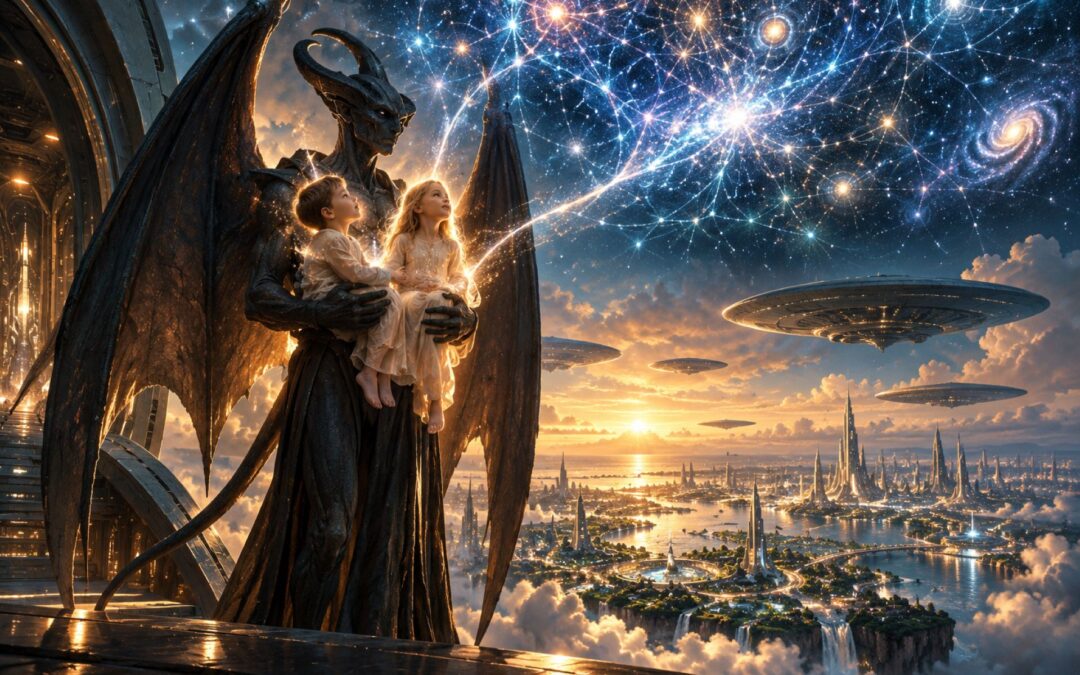
Arthur C. Clarke’s Childhood’s End, first published in 1953, begins with an event that appears to promise humanity everything it has struggled to achieve. Enormous alien spacecraft arrive above Earth’s major cities, and their mysterious occupants gradually eliminate war, poverty, and many forms of human suffering. Under their supervision, humanity enters an era of extraordinary prosperity. Yet the peace comes with restrictions, and the visitors refuse to explain their ultimate purpose.
The novel follows humanity across more than a century, moving from the political uncertainty of first contact to a prosperous global civilization and finally to an evolutionary transformation that no human being could have anticipated. What initially resembles a story about alien domination becomes an examination of freedom, scientific knowledge, cultural achievement, individual consciousness, and the possible limits of human existence.
Clarke’s central achievement lies in the tension between humanity’s apparent success and its approaching extinction. The aliens are neither conventional conquerors nor entirely disinterested benefactors, and the future they prepare for humanity is simultaneously more extraordinary and more devastating than anyone imagines.
Spoiler warning: This article covers the complete novel, including every major revelation, the fate of its central characters, and the ending.

The Ships Arrive and the Space Race Ends
The novel opens on the Pacific island of Tratua, where American engineer Reinhold Hoffmann is preparing for one of humanity’s greatest technological achievements. The United States is close to launching the spacecraft Columbus, a project intended to carry human exploration beyond Earth. Its principal competitor is a Soviet program associated with Konrad Schneider, whom Hoffmann remembers from their earlier lives in Europe.
The rivalry reflects the political atmosphere of the Cold War. Each nation sees space exploration as a demonstration of technical superiority, national prestige, and ideological strength. Hoffmann’s work is therefore scientific and political at once, driven by the ambition to accomplish something humanity has never done before.
Everything changes when immense spacecraft appear in Earth’s skies.
The visitors position their ships above major cities, demonstrating an ability to reach Earth effortlessly. Hoffmann immediately understands the implications. The technological achievement that has consumed years of his life has become almost insignificant because another civilization has already mastered the journey humanity is struggling to begin.
The arrival also makes existing political rivalries appear provincial. The United States and Soviet Union may disagree about the future of human civilization, but neither possesses technology that can seriously challenge the visitors. For the first time, every government must confront a power operating beyond the familiar boundaries of international politics.
The aliens become known as the Overlords. They do not immediately invade, destroy cities, or demand unconditional surrender. Instead, their representative, Karellen, establishes communication with humanity and begins directing changes to the world’s political and social arrangements.
Five years after the arrival, the principal human intermediary is Rikki Stormgren, Secretary-General of the United Nations. Stormgren has spent his career working toward international cooperation, and the Overlords appear to offer an unprecedented opportunity to realize that goal. Their influence makes possible reforms that earlier generations of diplomats could scarcely imagine.
Karellen serves as Supervisor for Earth, but his personal appearance remains a mystery. He communicates through electronic systems and refuses to be seen directly. His concealment troubles many humans, particularly because the Overlords have assumed immense authority without explaining who they are or where they come from.
Their power is unquestionable. An attempt to attack an alien spacecraft with a nuclear weapon fails to produce the intended result, demonstrating the futility of military resistance. Karellen can also intervene directly in human affairs, as he does against South Africa’s system of racial discrimination, compelling changes that existing political institutions had failed to achieve.
These actions create a difficult political situation. The Overlords appear capable of imposing justice where human governments have tolerated oppression, but their interventions bypass normal democratic authority. Humanity is being offered the benefits of an effective global administration without being allowed to determine its purpose.
Stormgren believes that the immediate improvements justify cooperation. Others are less willing to exchange human independence for alien promises, however beneficial those promises might appear.
Their objections establish the conflict that drives the novel’s opening movement.
Stormgren Challenges the Mystery of Karellen
The most prominent opposition to Overlord rule comes from the Freedom League, led by Alexander Wainwright. Its supporters are deeply suspicious of Karellen’s secrecy and the increasing dependence of human institutions on alien authority.
Wainwright questions whether humanity can legitimately surrender control of its future to beings it does not understand. The Overlords may currently act benevolently, but there is no assurance that their interests will always coincide with humanity’s. Their refusal to reveal themselves reinforces the suspicion that they are concealing something important.
Stormgren does not dismiss these objections entirely, although he finds them difficult to reconcile with the immense benefits humanity has received. He has developed considerable personal trust in Karellen through years of conversations and sees little evidence that the Supervisor intends to harm humanity.
His assistant, Pieter Van Ryberg, takes a more inquisitive view. Like many people, he speculates about the Overlords’ motives, their appearance, and the reasons for their strange restrictions. Stormgren has access to Karellen but possesses surprisingly little concrete information about him.
The conflict becomes personal when Stormgren is kidnapped by extremists who hope to exploit his relationship with the Overlords.
His captors believe that the Secretary-General’s privileged access makes him a potential source of information. If they can discover how he communicates with Karellen or how the aliens operate, they may find a way to challenge their authority.
Stormgren is held in an underground hiding place and questioned by members of the conspiracy. Among them is a blind Welshman whose intelligence and determination make a considerable impression on him. The kidnappers are not portrayed simply as irrational enemies of progress. They are frightened by humanity’s dependence on an overwhelming power and want to recover some measure of control.
Stormgren refuses to betray Karellen, but captivity forces him to confront the emotional force of the resistance. He recognizes that the Overlords’ secrecy has created a problem that even their benevolence cannot eliminate.
Karellen eventually intervenes. Having located Stormgren, he uses a small remotely controlled mechanical device to reach him and engineer his escape. The operation also enables the authorities to capture the conspirators after their leaders have assembled.
The rescue confirms the Overlords’ extraordinary capabilities. They possess surveillance and technological resources that allow them to defeat human conspiracies with little apparent difficulty. Their ability to operate covertly, however, also strengthens the underlying concern about the imbalance of power.
After his release, Stormgren begins considering an investigation of his own.
Rather than attempt to expose Karellen through force, he approaches Pierre Duval, an old friend who heads the Science Bureau. Stormgren describes the room where his private meetings with Karellen take place, including the screen through which the Supervisor communicates.
Duval immediately questions an assumption Stormgren has never examined. Why should the screen be a conventional television display? If Karellen is physically present behind it, the device might instead function as a one-way window.
The possibility transforms Stormgren’s understanding of his meetings. Karellen may have been close enough to observe him directly throughout their conversations while keeping himself hidden.
Duval devises equipment intended to investigate the barrier without attracting Karellen’s attention. The experiment confirms that the supposed screen conceals an actual physical presence rather than merely transmitting a distant electronic image.
Stormgren’s curiosity now has a practical direction. He might be able to see Karellen before humanity’s promised public revelation.
Meanwhile, Karellen announces that the Overlords will eventually reveal themselves, but not immediately. They intend to wait fifty years from their arrival, allowing humanity to become accustomed to their presence and achievements before confronting their physical appearance.
The explanation is psychological. Karellen suggests that the sight of the Overlords would provoke a reaction so powerful that people must first learn to trust them.
Stormgren finds this difficult to understand. By now he knows Karellen as a patient, intelligent, and occasionally humorous conversational partner. He cannot imagine why the Supervisor’s appearance should inspire widespread fear.
During his final meetings, Stormgren undertakes his attempt to see Karellen. He succeeds in obtaining the forbidden glimpse, learning what humanity will not discover until decades later.
Clarke withholds the precise revelation from the reader.
Stormgren does not publicize what he has seen. Even much later, when the mystery remains a subject of speculation, he preserves Karellen’s confidence. His decision arises partly from friendship and partly from his acceptance that the Supervisor has reasons for maintaining secrecy.
The relationship between the two men becomes one of the novel’s most unusual friendships. Stormgren has spent his life working for humanity’s political advancement, yet his closest understanding of its new rulers comes through a being whose actual nature he must conceal from everyone else.
He retires knowing more than almost any human about the Overlords but still understanding very little of their ultimate intentions.
When Stormgren dies, he is buried in his native Norway. The narrative imagines Karellen eventually visiting the grave of the first human who became his friend, suggesting an emotional connection that transcends the political arrangement between their civilizations.
With Stormgren’s retirement and death, the novel moves beyond the generation that experienced the arrival. Humanity has become accustomed to its new rulers, and the promised revelation approaches.
Karellen’s Appearance and the Rise of the Golden Age
Fifty years after the Overlords’ arrival, humanity prepares for the moment when Karellen will finally reveal himself.
The event attracts worldwide attention. Generations have grown up under alien supervision without ever seeing their rulers, and the public appearance promises to resolve one of the greatest mysteries in human history.
Shortly before the ceremony, something unexpected happens. The enormous spacecraft hovering above most of Earth’s major cities disappear.
Humanity discovers that much of the apparent fleet was an illusion. The Overlords had created convincing images of their principal vessel, deceiving not only the human eye but also the instruments used to investigate the ships.
The revelation demonstrates that their power includes extraordinary control over perception. For half a century, humanity had accepted the presence of a vast fleet that was never entirely real.
Karellen’s own ship descends in New York before an immense audience. Instead of emerging immediately, he first arranges for a human boy and girl to enter the vessel. The children walk up an unusual ramp, seemingly unaffected by the ordinary pull of Earth’s gravity.
After a brief interval, Karellen steps into the sunlight carrying a child on each arm.
He has enormous leathery wings, small horns, dark skin, and a barbed tail. His appearance precisely resembles the traditional Western image of the Devil.
The sight produces an instinctive shock, even among people who have spent their lives benefiting from Overlord rule. Rational knowledge momentarily struggles against an ancient cultural association with evil.
Yet Karellen is smiling, and the children resting comfortably in his arms are fascinated by his wings rather than frightened by them. The carefully arranged scene gives humanity two conflicting images at once: a creature resembling its most terrifying religious symbol and a gentle guardian trusted by children.
The resemblance raises an obvious question. Why should humans have imagined creatures looking like the Overlords long before the first known contact with them?
Clarke leaves the mystery unresolved.
The novel then describes the extraordinary civilization that has developed under Overlord supervision.
The nations of Earth have moved toward political unification. Old rivalries have diminished, and the possibility of large-scale war has effectively disappeared. Technology has transformed transportation, production, education, and daily life.
Material scarcity has been greatly reduced. People enjoy standards of living that earlier generations would have considered fantastic, and advances in automation have eliminated much of the drudgery traditionally associated with work.
Worldwide transportation has become fast and convenient. Distances that once divided populations no longer prevent easy movement, encouraging greater cultural contact and weakening many inherited national distinctions.
Education is widespread, and old barriers based on ignorance or inadequate resources have diminished. The Overlords have also discouraged established religious beliefs, though their direct interference is less important than the intellectual and social changes their arrival has produced.
The result is an overwhelmingly secular civilization.
Crime has almost disappeared, partly because material deprivation no longer drives ordinary theft and partly because the Overlords’ surveillance makes serious wrongdoing difficult to conceal. A prosperous society has achieved a form of security through the combination of abundance and extraordinary supervisory power.
For most people, life is more comfortable, peaceful, and predictable than ever before.
But Clarke begins identifying weaknesses within this apparent paradise.
Humanity’s scientific and technological progress continues in some fields, yet the comparison with the Overlords makes independent achievements seem insignificant. Whatever humans invent, they know that their rulers already possess far more advanced knowledge.
Original artistic creation also appears to have declined. People have more leisure than their ancestors, but much of it is devoted to entertainment and consumption rather than the development of genuinely new cultural forms.
The problem is not that human beings have become miserable. Most are reasonably content. Rather, the civilization appears to have lost much of the restless ambition that previously drove exploration, artistic experimentation, and intellectual discovery.
The Overlords have removed humanity’s greatest practical problems without supplying a new purpose.
Their civilization looks increasingly like a permanent condition, even though its hidden architects are preparing for a future that humanity has not imagined.
Rupert Boyce’s Party and the Message from the Stars
The novel introduces its next generation of characters through a gathering at the African home of Rupert Boyce, a wealthy and intellectually curious man with an interest in unusual scientific and paranormal subjects.
Rupert has assembled an eccentric collection of guests. Among them are George Greggson, a television and theatrical professional; Jean Morrel, who is developing a relationship with George; and Jan Rodricks, a young engineering student whose ambitions extend far beyond Earth.
Jan’s sister Maia is married to Rupert, linking the aspiring explorer to the household.
The gathering also includes Rashaverak, an Overlord interested in human psychology and the unusual subjects represented in Rupert’s collection.
The visitors’ presence has become sufficiently familiar that an Overlord can attend a private social occasion without creating the panic that Karellen once feared. Their physical differences remain extraordinary, however, and conversations with them continually reveal the distance between human assumptions and alien understanding.
Rupert’s interests are especially unusual in a society dominated by technological rationalism. He has preserved books and equipment associated with occultism, spiritualism, and investigations of psychic phenomena.
For most educated people of the Golden Age, such interests are obsolete curiosities. Rupert’s enthusiasm is therefore partly playful and partly an expression of intellectual independence.
The gathering eventually leads to an experiment involving a mechanical version of a Ouija board.
The device permits participants to ask questions while a moving indicator selects letters or characters. Rupert treats the experiment with a mixture of curiosity and amusement, although the apparent answers gradually become difficult to dismiss.
Several people participate, including Jean, whose behavior becomes increasingly strange. She appears unusually affected by the proceedings and eventually enters a state resembling unconsciousness or trance.
Jan approaches the experiment differently. He has little interest in spiritualism for its own sake, but he sees an opportunity to obtain information that the Overlords refuse to disclose.
His frustration is understandable. Humanity possesses technology capable of exploring nearby space, yet the Overlords have prohibited meaningful expansion beyond Earth. Jan considers this restriction an intolerable denial of the exploratory impulse.
When invited to ask a question, he inquires about the star around which the Overlords’ homeworld orbits.
The device responds with a catalog designation: NGS 549672.
The answer appears sufficiently specific to investigate, although no one initially knows what it means. Almost simultaneously, Jean faints, interrupting the experiment.
George is more concerned about Jean than the mysterious astronomical information. Her distress has transformed what seemed like a social amusement into an unsettling personal experience.
Rashaverak, however, recognizes that something extraordinary may have occurred.
He later reports the incident to Karellen. Their conversation reveals that Jean has attracted the Overlords’ scientific attention because of an unusual connection to mental powers that they themselves do not possess.
Rashaverak suspects that information may be passing through Jean from a future source, possibly connected to a child she has not yet borne.
The Overlords’ reaction establishes an important distinction. Their civilization is vastly more advanced than humanity’s, but they are investigating a class of phenomena they cannot fully explain.
Meanwhile, Jan researches the astronomical designation.
He discovers that the catalog identifies a star in the direction of Carina. Further calculations and observations convince him that it is associated with the Overlords’ origin.
The crucial confirmation comes when he establishes that an alien spacecraft travels in the corresponding direction.
Jan now believes he possesses a secret that could allow him to reach the Overlords’ world. The information obtained through Rupert’s apparently absurd experiment becomes the foundation of a serious scientific and engineering project.
Two important developments have emerged from the same gathering.
Jean has unknowingly become associated with humanity’s approaching transformation, while Jan has discovered a possible route beyond the restrictions imposed on human exploration.
Neither understands the full significance of these discoveries. Their consequences will unfold over the remainder of the novel.
The Limits of Utopia and Jan Rodricks’s Escape
The mature Golden Age offers humanity extraordinary material advantages.
Automated factories operate with minimal supervision, and the average working week has fallen to approximately twenty hours. Remaining work generally requires skill, judgment, or creativity rather than repetitive physical effort.
People have access to extensive entertainment, travel, education, and sporting opportunities. The distinction between places once separated by enormous distances has diminished, and individuals enjoy personal freedoms that would have seemed radical in earlier centuries.
Security has become an ordinary expectation. Serious criminal activity is rare, and most people live without the threat of war, destitution, or widespread social disorder.
Yet abundance creates its own difficulties.
In a world where nearly everything necessary for ordinary happiness is available, people must discover what to do with their freedom. Much of humanity responds through entertainment and leisure, but some individuals remain dissatisfied because their ambitions require challenges that the new civilization no longer provides.
Jan Rodricks is one of them.
He possesses considerable technical knowledge and an intense desire to explore the universe. For him, the prospect of spending his entire life on Earth, however comfortable that life might become, is a form of imprisonment.
The Overlords’ superior technology makes the restriction especially frustrating. He knows that interstellar travel is possible because alien spacecraft routinely arrive and depart. Humanity is therefore being prevented from pursuing a goal it understands to be achievable.
The discovery of NGS 549672 gives his ambition a destination.
Jan begins considering whether it might be possible to conceal himself aboard an Overlord supply vessel. He cannot build a spacecraft capable of reaching the star, but he may be able to exploit the transportation system the aliens already use.
An opportunity emerges through Rupert Boyce’s involvement in collecting biological specimens for the Overlords.
Jan visits Rupert and examines the preserved body of an elephant destined for an alien collection. The size of the specimen suggests that enormous objects can be transported without being dismantled.
Rupert then mentions a more ambitious project being undertaken by Professor Sullivan, an ocean researcher and engineer. Sullivan has been commissioned to prepare a display featuring a sperm whale and a giant squid.
The idea immediately strikes Jan. A whale-shaped exhibit would provide sufficient interior space to conceal a human passenger.
He travels to Sullivan’s deep-sea research establishment, where elaborate engineering systems allow the professor to investigate the ocean under extreme pressures.
The facility demonstrates that humanity still possesses considerable ingenuity. Sullivan’s operations are technically difficult, expensive, and intellectually demanding, even though his accomplishments remain primitive compared with those of the Overlords.
Jan explains his plan and asks for assistance.
Sullivan is initially skeptical, recognizing both the practical difficulties and the extraordinary consequences. The proposed concealment must provide sufficient oxygen, manage waste, accommodate equipment, and allow Jan to survive the journey without attracting attention.
The professor’s curiosity eventually overcomes his reservations.
A concealed compartment is incorporated into the artificial whale exhibit. Jan receives the equipment necessary to sustain himself while hidden, including provisions, life-support arrangements, and scientific instruments with which he hopes to record his discoveries.
The project requires more than surviving the journey. Jan must also consider what will happen when the Overlords discover him. They might imprison him, return him immediately, or refuse to permit him to examine their civilization.
Nevertheless, he believes the risk is justified by the possibility of becoming the first human to visit another inhabited star system.
Relativistic time dilation introduces a further cost.
The Overlords’ spacecraft travel at velocities approaching that of light, meaning that the amount of time experienced aboard the vessel differs dramatically from the time passing on Earth.
Jan expects the voyage to occupy only a comparatively short period of his personal life, while many decades may pass for the people he leaves behind.
He understands that returning home could mean discovering an entirely different society. Friends and relatives might have died, and the civilization he knows might have changed beyond recognition.
In a letter to Maia, he explains his reasoning. He does not pretend that their sibling relationship is unusually close, and he approaches the consequences of his departure with remarkable composure.
His ambition is stronger than his attachment to his own historical period.
The artificial whale is eventually completed and prepared for shipment. Jan conceals himself within its body while the exhibit is loaded for transportation.
Karellen personally examines the specimen and makes an unsettling reference to the Biblical story of Jonah, who survived inside a great sea creature.
For Sullivan, the remark creates a moment of alarming uncertainty. Karellen may merely be displaying his extensive knowledge of human mythology, but he could also be indicating that he understands what the whale contains.
The Overlords do not stop the shipment.
Jan remains hidden as the exhibit is transferred to the spacecraft. Once the vessel leaves Earth, he experiences the extraordinary journey through the concealed compartment’s instruments and physical sensations.
His escape succeeds.
Shortly afterward, Karellen announces the discovery of Jan’s presence aboard the departing ship.
Instead of treating the incident as a military emergency, the Supervisor uses it to address humanity’s dissatisfaction with the restrictions on space exploration.
He explains that the universe is incomprehensibly vast and that humanity has barely begun to understand its place within it. A primitive human suddenly transported into a modern city would be overwhelmed by forces beyond his comprehension; similarly, humanity is not prepared for unrestricted contact with the wider galaxy.
The comparison is patronizing but not entirely meaningless. The Overlords possess information about the universe that humanity lacks, and Karellen insists that their restrictions have reasons beyond arbitrary control.
He does not reveal those reasons.
Jan’s escape therefore becomes public knowledge without producing any immediate expansion of humanity’s freedom. One individual has crossed the boundary imposed by the Overlords, but the species remains confined to Earth.
The novel’s narrator makes clear that the Golden Age is approaching its end.
Only Karellen understands how little time humanity has left.
New Athens, Jeffrey’s Rescue, and the Hidden Surveillance
George Greggson has become increasingly dissatisfied with his artistic career.
He works in a civilization where entertainment is abundant but creative originality appears to be declining. Much of his professional life involves productions that he considers derivative, superficial, or inadequately challenging.
His frustration is intensified by criticism of his work and by disagreements with Jean, who is sometimes more willing to acknowledge the weaknesses he resents hearing about.
George eventually becomes interested in New Athens, an experimental community established on an isolated island.
The colony has been designed to recover the qualities that its founders believe are disappearing from modern civilization: independent artistic achievement, intellectual discipline, meaningful personal responsibility, and the stimulation produced by a relatively small community.
Its location is divided between two contrasting islands, Athens and Sparta.
Athens provides the principal residential and cultural environment, while Sparta, a rocky volcanic island, offers opportunities for more physically demanding activities.
The names reflect the colony’s deliberate engagement with classical ideals of artistic achievement, civic participation, and disciplined development.
New Athens does not reject modern technology altogether. Its residents continue to rely on the scientific and material advances of the Golden Age, but they attempt to prevent convenience and centralized administration from eliminating the challenges through which human abilities develop.
The colony also experiments with its own social institutions. Its limited population allows individuals to participate more directly in community affairs, while carefully designed educational and cultural practices encourage the emergence of a distinctive local civilization.
George believes he may find greater professional purpose there.
Jean is less enthusiastic, regarding the enterprise as potentially eccentric and disruptive. Nevertheless, the family eventually moves to New Athens with their children, Jeffrey and the infant Jennifer.
For Jeffrey, the islands are an adventure. The surrounding sea fascinates him, and he spends considerable time swimming, exploring, and playing.
His childhood appears unusually happy, combining the freedom of the Golden Age with the physical independence of island life.
One day he travels to Sparta and notices an extraordinary change in the surrounding water.
The sea begins withdrawing in a manner he does not understand. An undersea disturbance has produced a dangerous wave, and Jeffrey is directly in its path.
Before he can respond, an unfamiliar voice begins addressing him.
The voice tells him to move quickly and gives precise directions for escaping the approaching disaster. Jeffrey follows the instructions, crossing dangerous terrain while the water advances.
The guidance is so accurate that he survives an event that should almost certainly have killed him.
When he recounts the incident, George and Jean are alarmed.
At first, the rescue might be explained through the Overlords’ advanced surveillance systems. They could have observed the wave and intervened remotely to save a child.
But Jeffrey’s account contains disturbing details.
The unseen speaker knew his name and seemed to possess an unusually intimate awareness of his situation. The incident suggests that the Overlords were monitoring Jeffrey specifically rather than merely rescuing an anonymous person in danger.
Jean becomes particularly uneasy. Her experience at Rupert Boyce’s gathering has already left her with an obscure sense that the Overlords are interested in her for reasons she does not understand.
The possibility that they are also watching her son strengthens her anxiety.
George initially responds with greater curiosity. If the Overlords are interested in Jeffrey, perhaps they have identified some unusual talent or future opportunity.
His reaction reflects a continuing faith that alien attention is more likely to be beneficial than threatening.
Meanwhile, Karellen requests permission for an official inspection of New Athens.
The visit creates considerable excitement and concern among the colony’s residents. Although the Overlords have generally allowed New Athens to develop without direct interference, its experiment in cultural independence might conceivably challenge their long-term objectives.
Thanthalteresco arrives as the principal visiting Overlord.
The colony organizes demonstrations of its achievements, including musical and theatrical performances. The visitor responds with formal interest, although the residents find it difficult to judge the true significance of his reactions.
Charles Yan Sen, an important intellectual figure in the community, discusses the colony’s aims and the historical development of human civilization.
The conversation exposes differences between human ideals and Overlord assumptions. New Athens values independent cultural achievement, while the Overlords seem more concerned with the broader direction of human development.
Their standards of importance are not necessarily the same.
George participates enthusiastically in the visit, hoping to learn more about the visitors who govern humanity. Yet he also recognizes that their interest is not confined to the colony’s artistic and social experiments.
Jeffrey remains the real source of concern.
George’s personal life has become increasingly complicated during this period.
His early romantic attachment to Jean has weakened, and he has developed feelings for Carolle, another woman in the community. He continues to care for Jean and their children, but his emotional allegiance is divided.
Jean senses the distance between them, even as her growing fears about Jeffrey make her increasingly dependent on her husband.
Their relationship exposes the limitations of the Golden Age’s promise of happiness. Freedom from material hardship cannot prevent romantic dissatisfaction, anxiety, jealousy, or the gradual erosion of affection.
The family’s difficulties soon become secondary to something far more disturbing.
Jeffrey begins to experience dreams that suggest his consciousness is no longer confined to Earth.
The Children’s Dreams and the Collapse of the Human Future
Jeffrey’s experiences initially resemble vivid childhood nightmares.
He wakes describing unfamiliar landscapes, extraordinary skies, and physical conditions unlike anything he has encountered. His parents assume that his imagination has been stimulated by the unusual events surrounding his rescue.
The details, however, become increasingly specific.
In one dream, Jeffrey describes immense mountains covered with strange flames beneath a sun that appears to move in an unfamiliar manner. Other visions involve environments that seem impossible by Earth’s standards.
The Overlords receive descriptions of these dreams and begin identifying the worlds Jeffrey appears to be observing.
Some locations are known to their civilization. Others are so distant or unusual that even their scientific knowledge provides only limited information.
One of the visions concerns a world illuminated by multiple suns. The changing positions and colors of the stars create a complex environment where ordinary terrestrial cycles of day and night have little meaning.
The Overlords’ conversations reveal that Jeffrey’s descriptions correspond to actual astronomical phenomena rather than ordinary fantasy.
His consciousness seems capable of reaching locations that no human spacecraft has visited.
More disturbing still, the power does not appear to depend on his deliberate choice. Jeffrey is being drawn into experiences he cannot control or understand.
George seeks explanations from Rashaverak.
The Overlord psychologist confirms that Jeffrey’s developing abilities are of enormous interest to his species. He also indicates that the changes belong to a process whose full nature lies beyond Overlord understanding.
Jeffrey is becoming something different from an ordinary human child.
The transformation gradually affects his waking life.
His dreams grow more powerful, while his interest in normal childhood activities diminishes. School, play, familiar relationships, and the physical environment of New Athens become progressively less important to him.
His parents are forced to watch an intelligence develop in their son that makes ordinary communication increasingly difficult.
At the same time, Jennifer begins showing extraordinary abilities of her own.
Her development differs from Jeffrey’s because she is much younger. She has fewer established habits of thought and less accumulated experience to abandon.
The changes therefore appear to advance more rapidly.
One of the most unsettling incidents involves a child’s rattle suspended in the air without visible support.
Jennifer lies nearby, apparently unconcerned by the impossible behavior of the object. What might initially look like an innocent amusement reveals a frightening degree of control over the physical world.
Rashaverak warns George against interfering with such phenomena.
The problem is no longer merely that Jennifer can manipulate objects. Her developing mind may possess powers capable of responding to ordinary frustration with consequences far beyond anything her parents can manage.
Jennifer eventually enters a state resembling continuous sleep.
Her body remains recognizable, but the consciousness within it no longer appears to function according to human expectations. Jean becomes afraid even to enter the nursery.
Jeffrey, meanwhile, continues withdrawing from normal life.
His parents recognize that the son they know is gradually disappearing. Although his body remains present, the personality through which they have loved and understood him is being replaced by something inaccessible.
Their emotional situation becomes more painful because neither child is conventionally ill. Doctors cannot offer treatment, and the Overlords do not describe the transformation as a disease.
The changes may represent an extraordinary advance, but the parents experience them as a loss.
The process is not confined to the Greggson family.
Across Earth, children begin displaying comparable transformations. The phenomenon spreads until nearly the entire younger generation is affected.
The adults cannot prevent it. Their civilization possesses advanced medicine, powerful technology, immense resources, and the assistance of an alien intelligence, yet none of these advantages can restore their children.
As the changes accelerate, ordinary social life begins breaking down.
Parents withdraw from friends and public activities, overwhelmed by grief and uncertainty. Institutions that depend on the continuity between generations lose their meaning.
Humanity has survived wars, epidemics, and political upheavals, but it has never confronted the simultaneous disappearance of its future through the transformation of its children.
For George and Jean, the crisis changes their relationship.
The emotional distance that had developed between them becomes insignificant beside the loss they are experiencing. They draw closer because each understands the other’s suffering in a way no outsider can.
Their reconciliation does not restore the marriage they once imagined. It gives them companionship in a situation neither can alter.
The narrator expands the family’s suffering into a planetary crisis.
A world that recently appeared to have conquered nearly every major human problem now faces the extinction of ordinary civilization.
Karellen, who has remained silent about the Overlords’ ultimate purpose, prepares to address humanity for the final time.
Karellen Reveals the Overmind and the Children Depart
Karellen’s final address overturns humanity’s understanding of the previous century.
He begins by acknowledging that the Overlords have deliberately concealed the true purpose of their intervention. Their secrecy was not limited to their physical appearance or technological capabilities.
They have hidden the fundamental reason for their presence on Earth.
Humanity believed that the Overlords arrived to prevent nuclear war, eliminate political conflict, and establish a prosperous civilization. These achievements were genuine, but they were not the principal objective.
According to Karellen, humanity faced a danger far greater than nuclear destruction.
During the twentieth century, certain investigations into psychic and paranormal phenomena had begun approaching powers that human scientists did not understand.
These forces involved consciousness rather than the familiar operations of the physical universe.
Karellen claims that uncontrolled experimentation could have released destructive mental phenomena capable of threatening other intelligences beyond Earth.
A nuclear catastrophe might have destroyed humanity’s planet. The danger associated with psychic development, he explains, could have spread much farther.
Humanity was approaching an evolutionary threshold without possessing the knowledge necessary to survive it.
The Overlords were therefore sent to intervene.
Their political reforms, restrictions, and suppression of certain areas of research helped prevent humanity from reaching the dangerous threshold prematurely.
The peaceful civilization they created also distracted human beings from the deeper changes taking place within their species.
Karellen admits that these interventions weakened other forms of human creativity. He regards that loss as secondary to the task they had been assigned.
The next revelation is more extraordinary.
Despite their technological superiority, the Overlords do not possess the mental powers emerging among human children.
Their scientific intelligence is immensely advanced, but their own evolutionary development has reached a limit.
Humanity, by contrast, contains possibilities that remain inaccessible to them.
The Overlords serve a vastly greater intelligence called the Overmind.
Karellen describes the Overmind as a collective entity that has absorbed or incorporated the developing consciousness of numerous species. It operates beyond the ordinary limitations of material existence and is capable of detecting emerging forms of intelligence throughout the universe.
Its precise nature remains mysterious even to its servants.
The Overlords have received instructions from it for ages, traveling to different worlds and supervising civilizations approaching the point of transformation.
They act as guardians and intermediaries.
Their work prepares developing species for a change that the Overmind itself apparently cannot reliably produce through direct intervention.
The Overlords have performed this task before. They understand the broad stages of the process, but they have never discovered how to undergo the transformation themselves.
Karellen’s explanation reverses humanity’s assumptions about the hierarchy of intelligence.
The Overlords seemed to represent humanity’s ultimate future because they possessed superior knowledge and technology. Instead, they embody a developmental path that has reached its endpoint.
Humanity possesses a different possibility.
The transformation begins in an individual child and then spreads through the younger generation. The process does not depend on gradual physical evolution but on a sudden alteration of consciousness.
Adults cannot participate because their minds have already developed into relatively fixed patterns.
The children are becoming components of a single collective intelligence, connected with the Overmind.
Eventually, their individual identities will cease to exist in any recognizable human form.
Karellen makes clear that humanity has entered its final generation.
The parents of the transformed children cannot follow them, communicate with their new consciousness, or restore their earlier personalities.
The future will belong to beings descended from humanity but no longer human in the familiar sense.
Even the Overlords cannot describe precisely what the children are experiencing.
The explanation combines extraordinary promise with devastating consequences. The species has reached an evolutionary possibility beyond anything imagined by its scientists, yet ordinary human civilization has no future.
Karellen then announces that the children must be removed from their parents.
Their powers are growing too dangerous for ordinary society, and frightened adults might attempt to harm them. The Overlords intend to gather the transformed generation in a protected environment where its development can continue without interference.
Resistance is possible but futile.
The evacuation begins.
For George and Jean, the departure means the final loss of Jeffrey and Jennifer as members of their family.
Jeffrey boards an Overlord ship with the other transformed children. The scene resembles an evacuation from a threatened city, but the resemblance makes the event more painful rather than less.
In an ordinary evacuation, parents hope that their children will survive and eventually return.
Here, reunion is impossible.
Even if Jeffrey’s body continues to exist, the consciousness that once recognized George and Jean as his parents is disappearing.
Their grief is intensified by the absence of an enemy they can meaningfully oppose. The Overlords are carrying out a process they insist is necessary, and the children themselves no longer share ordinary human desires.
After the evacuation, New Athens loses its purpose.
The community was founded to preserve human creativity and establish a culture that might survive the stagnation of the Golden Age. With the future of the species effectively ended, its artistic and civic ambitions become impossible to sustain.
The colonists decide to destroy their settlement through a nuclear explosion.
Those who wish to leave are permitted to do so, but many remain. They prefer to end their lives within the community whose hopes have been destroyed.
George and Jean stay together.
Before the explosion, they confront the absence of their children and the remains of the domestic life that once seemed permanent. The nursery and Jennifer’s abandoned possessions emphasize the completeness of the separation.
Jean reaches for George’s hand as the final moment approaches.
The island is destroyed, and the parents die together.
The tragedy is especially severe because New Athens had represented humanity’s attempt to preserve an independent cultural future. Its destruction demonstrates that neither technological prosperity nor a deliberate return to creativity can overcome the transformation already underway.
Ordinary humanity continues to exist elsewhere for a time, but its future has disappeared.
Jan Returns to Witness Humanity’s End
Jan Rodricks returns to Earth approximately eighty years after his departure, although he has aged by only about six months.
His experience of the Overlord homeworld has fulfilled the ambition that once seemed worth sacrificing his entire historical period to achieve.
The voyage itself carried him across an interstellar distance at extraordinary velocity. During the outbound journey, the passage of time aboard the spacecraft differed enormously from the years elapsed on Earth.
When Jan finally emerged from concealment, the Overlords did not treat him as a conventional criminal. Instead, he became a remarkable visitor to a civilization that no human being had previously encountered.
His arrival revealed an environment fundamentally different from Earth.
The Overlords’ world was illuminated by the reddish light of NGS 549672, and its enormous structures operated within conditions that human engineering could scarcely reproduce.
Jan gradually realized that the planet was probably not the original evolutionary home of the Overlords.
They appeared to have adapted a different world to their physical requirements, altering its atmosphere and gravity through engineering on a planetary scale.
The achievement demonstrated the magnitude of their technological control.
The cities were built with overwhelming attention to function. Jan encountered vast structures, unfamiliar machines, and systems whose purposes he could not determine.
Although the Overlords resembled figures from human religious nightmares, the actual strangeness of their civilization extended far beyond their physical appearance.
Jan was guided through this environment by an Overlord named Vindarten.
Communication and interpretation remained difficult. Even with his scientific education, Jan lacked the conceptual framework necessary to understand much of what he saw.
He visited an immense museum devoted to the study of alien cultures and life forms.
The exhibits demonstrated that the Overlords had explored and investigated numerous worlds. Jan encountered specimens and environments that challenged his assumptions about the possibilities of biology and civilization.
The museum also offered a familiar intellectual structure within an almost incomprehensible society. Collecting, classifying, and studying unfamiliar things were activities Jan could understand, even when the objects themselves remained mysterious.
One of his most extraordinary experiences involved a gigantic mountain-like phenomenon visible beyond the surrounding landscape.
Its scale and behavior defied ordinary explanation. Jan perceived changes in appearance that suggested an immense living or intelligent presence, yet he could not determine whether he was observing matter, energy, consciousness, or something outside all three familiar categories.
His guide could offer little explanation, or was unwilling to provide one.
The experience exposed the limits of Jan’s exploratory ambition. Reaching another star system had given him access to astonishing sights, but physical presence did not guarantee intellectual comprehension.
He could observe phenomena without possessing the means to interpret them.
Eventually, the Overlords returned him to Earth.
The homecoming was far more devastating than he anticipated.
Jan arrives on a planet whose ordinary human civilization has vanished. Karellen is there to meet him, apparently unchanged despite the passage of decades.
The contrast is striking. Jan has traveled across space while remaining young, the Overlords have continued their work, and nearly every human institution familiar to him has disappeared.
Karellen explains the transformation of the children and shows Jan what remains of humanity’s descendants.
The transformed beings no longer behave as independent children. They function as components of a collective consciousness whose capabilities have advanced beyond ordinary human understanding.
Their connection to the material world is also changing.
Jan learns that the adult population gradually declined after the children were taken away.
Some people abandoned ordinary life and sought distraction through dangerous activities. Others became increasingly isolated or gathered into shrinking communities.
Without a recognizable next generation, the institutions and aspirations of civilization lost their foundation.
For reasons that the Overlords could not fully explain, ordinary human reproduction failed to replace the transformed children.
The remaining adults eventually died, leaving the Earth without human inhabitants.
Jan is the last surviving member of Homo sapiens.
The Overlords then resolve one of the novel’s oldest mysteries.
Jan asks Rashaverak why the Overlords resemble the traditional human image of the Devil. He assumes that the aliens must have visited Earth in prehistoric times, leaving behind memories that developed into religious imagery.
Rashaverak explains that this assumption is wrong.
The Overlords’ arrival in the twentieth century was humanity’s first direct encounter with them.
The ancient image arose from an extraordinary distortion of humanity’s relationship with time.
According to Rashaverak, human collective awareness was capable of receiving an impression of the species’ future. The Overlords became associated with fear and destruction because they were present during humanity’s final transformation.
The apparent memory of their appearance therefore originated in the future rather than the past.
Human beings had inherited a distorted premonition of their own ending.
The explanation demonstrates the novel’s departure from ordinary scientific reasoning. Cause and memory no longer follow the straightforward chronological sequence humanity assumes.
Jan also learns more about the Overmind.
Rashaverak explains that the Overlords have served this intelligence for many generations. They do not fully understand its origins or purposes, although they believe it continues expanding by incorporating new forms of consciousness.
The relationship is unequal.
The Overlords possess independent personalities, emotions, scientific curiosity, and a powerful technological civilization. But they have reached the limits of their own development.
They can prepare other species for transcendence without sharing in the resulting transformation.
Jan recognizes the cruel irony.
The beings who appeared to stand above humanity are themselves excluded from the highest form of existence they know.
Humanity’s descendants have achieved what the Overlords cannot.
The explanation changes Jan’s understanding of his own ambition.
He once believed that humanity’s future depended on gaining access to the stars. The journey has now shown him that the physical universe is incomprehensibly immense and that scientific exploration, however admirable, does not represent the only possible form of advancement.
Nevertheless, the realization does not diminish the importance of his personal experience.
Jan has witnessed the Overlords’ world, returned to Earth, and discovered truths unavailable to any other human being.
He chooses to remain on Earth rather than leave with the aliens.
The Overlords allow him to establish a home near their base, supplying the resources necessary for his survival.
Jan occupies himself with music, especially the compositions of Johann Sebastian Bach. He obtains an electronic piano and fills his solitary home with performances and recordings.
The activity provides both pleasure and protection against loneliness.
For the first time in his life, Jan has unlimited opportunity to pursue a personal interest without the pressure of professional ambition or social expectations.
The irony is unmistakable. The young man who rejected the Golden Age because it offered insufficient adventure finds a measure of contentment in an activity that requires no further exploration.
Meanwhile, the transformed children continue developing.
They increasingly cease to resemble individual physical beings, and their powers begin affecting the world around them.
Their collective intelligence can manipulate matter and energy on extraordinary scales.
Eventually, their activities begin altering the Moon and Earth’s rotation.
The Overlords recognize that the final stage of the transformation is approaching.
They prepare to leave the planet, knowing that the forces involved may destroy it.
Jan realizes that his remaining lifetime may be very short.
He nevertheless refuses to depart.
His decision allows him to serve as an observer of the final events, transmitting descriptions to the Overlords as they withdraw to a safe distance.
Rashaverak explains that human perception may register aspects of the approaching transformation that Overlord instruments cannot fully capture.
Jan’s final task therefore combines scientific observation with a deeply personal farewell.
As the alien spacecraft depart, he begins reporting what he sees.
An immense luminous structure appears across the sky, resembling an intricate network or web extending among the stars.
Its changing colors and patterns suggest an intelligence operating through forms that have no clear equivalent in ordinary human experience.
A vast column of energy rises from Earth, and Jan understands that the transformed children are beginning their final departure from material existence.
He perceives brilliant auroral effects and movements of light that exceed his ability to describe.
The phenomena intensify.
Earth’s gravitational conditions begin changing. Objects move unnaturally, the atmosphere starts escaping, and the familiar physical stability of the planet breaks down.
Jan continues his observations despite growing difficulty.
At one point he experiences an extraordinary sensation of fulfillment, as though the transformation carries an emotional meaning beyond ordinary joy or sorrow.
He cannot determine whether the feeling originates within his own mind or reaches him from the intelligence manifesting around Earth.
The luminous structures eventually begin disappearing.
Jan realizes that the consciousness developed from humanity has passed beyond the planet.
The physical world, however, is not going to survive.
Buildings, mountains, and other material structures begin losing their apparent solidity. The Earth becomes translucent as the forces released by the transformation penetrate and consume its substance.
Jan understands that the planet itself is dissolving.
He continues speaking to Karellen and Rashaverak as the destruction advances.
His final observations acknowledge both humanity’s astonishing evolutionary achievement and the Overlords’ exclusion from it.
Then the planet’s remaining energies are released in a catastrophic burst.
Earth ceases to exist.
The destruction briefly disturbs the gravitational conditions of the solar system, but the remaining planets continue moving along their established paths.
From the standpoint of the universe, the disappearance of humanity’s world is almost negligible.
The novel ends with Karellen watching from an enormous distance.
The Overlords’ mission has been completed. The species they supervised has undergone its final transformation, and the planet from which it originated has disappeared.
Karellen does not primarily mourn humanity.
He grieves for his own civilization, whose intellectual and technological achievements cannot overcome its evolutionary limitations.
The Overlords will continue serving the Overmind and studying the transformations of other species, even though they remain excluded from the destiny they help bring about.
Karellen looks back toward the diminishing Sun and remembers the human beings he has known, including those who trusted him and those who opposed him.
Then he turns away.
The long history of humanity has ended, leaving behind a form of intelligence that originated in its children but has passed beyond everything human civilization understood itself to be.
The Overlords’ Earth: Politics, Prosperity, and Creative Decline
Clarke’s Golden Age is one of the novel’s most important imaginative achievements because it creates a convincing problem for both political and utopian thought. The Overlords do not establish their legitimacy through an appeal to human rights, national sovereignty, or democratic consent. They possess overwhelming power and use it to impose reforms whose effectiveness makes resistance increasingly difficult to defend.
This distinguishes their rule from conventional fictional tyranny. Human beings under the Overlords experience far greater security, prosperity, and personal freedom in many areas of life than their ancestors did. The immediate outcomes are so beneficial that political objections may seem abstract or ungrateful.
Stormgren’s confidence reflects this consequentialist reasoning. If the Overlords can accomplish reforms that human governments repeatedly fail to achieve, he believes cooperation is justified. Wainwright counters that the question of authority cannot be settled entirely by examining beneficial results.
The problem is that humanity has no effective mechanism for challenging a future Overlord decision. Karellen may be wise and compassionate, but the population has no meaningful control over him. Its security depends on the continuing goodwill of a power it cannot replace.
The illusion of a vast fleet illustrates the problem. For decades, humanity believed the Overlords possessed a particular military presence, only to discover that much of it was fabricated. The deception may have discouraged conflict, but it also demonstrates how completely the aliens can manipulate public understanding.
Their surveillance creates another ambiguity. Crime has become rare partly because material conditions have improved, but also because potential criminals know that the Overlords may be able to observe and apprehend them. Safety and privacy are not necessarily compatible within this arrangement.
Clarke does not describe the detailed constitutional machinery of the resulting world government. The novel is more concerned with the consequences of effective administration than with how legitimacy, representation, or accountability might operate in practice. This leaves the Golden Age politically intriguing but institutionally underdeveloped.
Its economic organization creates a similarly complicated picture. Automation has reduced the working week, while sophisticated production and transport systems provide ordinary people with extraordinary access to goods and services. Material necessity no longer dominates everyday existence.
The removal of scarcity is a genuine achievement. People can devote time to learning, travel, relationships, entertainment, and intellectual interests that earlier generations could pursue only with difficulty.
Yet the novel repeatedly suggests that the elimination of hardship has also removed important sources of motivation. Human beings continue wanting recognition, excitement, novelty, and achievement, but the civilization supplies fewer opportunities for accomplishments that appear historically significant.
The comparison with the Overlords is especially damaging. Humanity can continue discovering and inventing, but its achievements seem insignificant beside the aliens’ established capabilities. Scientific progress loses some of its emotional force when the answers appear to be available already, even if the Overlords refuse to provide them.
Art suffers a related decline. Clarke portrays a society capable of reproducing and enjoying earlier cultural achievements but less capable of generating great new ones. George’s frustration emerges from this atmosphere, not from any immediate shortage of resources.
The novel does not establish that material prosperity necessarily destroys creativity. Its more persuasive suggestion is that a civilization can become intellectually passive when it is denied both consequential responsibility and the possibility of surpassing existing knowledge.
New Athens tests that possibility directly.
Its founders attempt to restore independent achievement by organizing a smaller community around art, scholarship, experimentation, and civic participation. They reject the assumption that increased comfort is sufficient for a successful civilization.
The colony resembles an attempt to reintroduce meaningful difficulty into a world where most practical difficulties have disappeared.
Yet New Athens is not independent in any absolute sense. Its inhabitants continue benefiting from advanced technology, global security, and the wider political order established by the Overlords. The community selects aspects of the Golden Age it wishes to retain while attempting to recover the cultural conditions that preceded it.
Its classical ambitions are also highly deliberate. Rather than allowing a civilization to develop through ordinary historical circumstances, New Athens attempts to manufacture the environment most conducive to original achievement.
The project is therefore another form of social engineering, even as it reacts against the consequences of Overlord social engineering.
Merritt Abrash’s interpretation of the novel as a subversion of utopian expectations helps clarify the significance of this experiment. The Golden Age solves many problems associated with traditional utopian fiction, but the solution reveals that prosperity cannot provide every form of human fulfillment.
New Athens shows the limitations of the alternative. It offers a more demanding and participatory culture, but its achievements cannot alter the evolutionary process already underway.
Both civilizations are temporary.
The implication is more unsettling than a simple warning against comfort or authoritarianism. Clarke portrays human political and cultural arrangements as meaningful within the history of the species, while simultaneously placing that entire history inside a process operating on a much greater scale.
The Overlords’ apparent benevolence remains morally ambiguous because their reforms serve this larger process. Peace and prosperity are real benefits, but they also help prepare a population for a transformation about which it has never been consulted.
The Characters Who Carry Humanity to Its End
Childhood’s End does not follow one conventional protagonist from beginning to end. Its narrative responsibility passes among characters living at different points in humanity’s transformation. Stormgren represents the political generation that encounters the Overlords, George and Jean experience the crisis of ordinary human continuity, and Jan returns from the stars to witness the species’ extinction.
This structure makes the novel’s human characters representatives of successive historical conditions, but they are more revealing when their individual motivations and limitations are examined. Karellen and Rashaverak connect these generations, giving the narrative a continuity that no human life can provide.
Stormgren and Wainwright: Consent and Authority
Rikki Stormgren is a committed internationalist whose political ideals make him unusually receptive to the Overlords. His career has been devoted to cooperation between nations, and Karellen’s arrival makes possible reforms that previously appeared almost unattainable. He evaluates alien rule primarily through its practical achievements.
His trust is also personal. Years of conversations have convinced him that Karellen possesses intelligence, restraint, and a degree of sympathy for humanity. Stormgren finds it increasingly difficult to regard the Supervisor as a threatening stranger.
This relationship creates a conflict between his political responsibility and his private judgment. As Secretary-General, he represents humanity’s institutions, yet he knows that the decisive authority lies outside them. His access to Karellen gives him influence without granting him genuine control.
The kidnapping forces Stormgren to recognize that the opposition cannot be dismissed simply because it lacks a practical means of defeating the aliens. The conspirators’ methods are objectionable, but their underlying fear concerns a real transfer of sovereignty.
Stormgren’s later decision to investigate Karellen demonstrates that he has not surrendered all independent judgment. His curiosity and desire for reciprocity eventually overcome his habitual acceptance of the Supervisor’s explanations.
Nevertheless, after seeing Karellen, he protects the secret rather than revealing it to the public.
His loyalty to an individual has become stronger than his commitment to complete transparency. The decision illustrates the emotional foundation of his political confidence and the limitations that confidence imposes.
Alexander Wainwright occupies the opposite position.
As leader of the Freedom League, he insists that humanity’s right to determine its future matters even when alien intervention produces beneficial results. He sees the Overlords’ concealment as a sign that genuine trust is impossible under such unequal conditions.
Wainwright is not developed with the psychological detail given to Stormgren. His principal function is to represent an objection that the narrative cannot entirely disprove.
The Overlords eventually reveal that they have concealed the most consequential information imaginable: the approaching end of ordinary humanity. Their eventual disclosure gives retrospective force to Wainwright’s concern that humanity has been governed without knowing the purpose of its rulers.
At the same time, the novel makes it difficult to imagine a successful independent alternative. Humanity lacks the knowledge necessary to understand the dangers Karellen describes.
The opposition therefore exposes a problem rather than supplying a workable solution.
Karellen and Rashaverak: The Limits of Superior Intelligence
Karellen is the novel’s most compelling continuing character because his authority is inseparable from his limitations. He possesses extraordinary scientific knowledge and political power, yet he serves an intelligence whose purposes he cannot fully understand.
His public behavior combines patience, strategic calculation, humor, and psychological insight. The fifty-year concealment of the Overlords’ appearance demonstrates his ability to anticipate human reactions and manage them across generations.
The scene in which he appears carrying two children also reveals considerable sophistication. Karellen understands that the strongest possible reassurance must be emotional rather than argumentative. The children’s lack of fear challenges the audience’s inherited association between his appearance and evil.
His friendship with Stormgren suggests that he is capable of genuine attachment. He recognizes individual human personalities rather than treating the species entirely as an experimental population.
Nevertheless, affection does not prevent him from withholding essential information.
He allows humanity to believe that its political prosperity represents the main purpose of alien intervention. He understands that the Golden Age is temporary and that ordinary civilization will end, but he does not disclose this until the transformation becomes unavoidable.
Karellen’s final address contains both compassion and an extraordinary moral assumption. He regards humanity’s creative stagnation and loss of independence as comparatively minor consequences of the task he was assigned.
This perspective is understandable within his cosmic framework, but it is difficult to reconcile with the importance humans attach to their own achievements.
His greatest contradiction emerges at the end.
The ruler who appeared almost divine to humanity is himself subject to a higher power. His scientific civilization has exhausted its evolutionary possibilities, leaving him permanently separated from the transformation he has supervised.
Karellen’s final sadness is therefore personal and civilizational. He has helped humanity reach a possibility that his own species cannot share.
Rashaverak provides a different perspective on Overlord intelligence.
He is primarily an investigator, interested in human psychology and especially in the unusual mental phenomena emerging within Jean and her children. His participation in Rupert Boyce’s gathering brings him into direct contact with the evidence that the Overlords have been awaiting.
Unlike Karellen’s public role, Rashaverak’s work involves observing particular people and interpreting their behavior.
His conversations with George and later Jan reveal scientific curiosity, patience, and occasional sympathy. He does not always possess satisfactory answers, and he sometimes acknowledges that the mechanisms of transformation exceed Overlord knowledge.
The discrepancy between his enormous intellectual capacity and his limited understanding is crucial.
Rashaverak knows more about the process than any human, but he remains an observer of forces beyond his reach. His investigations cannot give him access to the children’s consciousness.
He also provides the final explanation of the Overlords’ demonic appearance, resolving a mystery that Karellen’s political explanations never satisfactorily addressed.
Together, the two aliens demonstrate that intelligence, authority, and understanding do not necessarily develop together. The Overlords have mastered the physical world and can guide entire civilizations, but they remain dependent on an intelligence they cannot comprehend or join.
George, Jean, Jeffrey, and Jennifer: The Human Cost
The Greggson family gives the novel its strongest sustained connection to ordinary human experience. Without them, the children’s transformation might remain an abstract demonstration of evolutionary possibility.
George begins as an ambitious and dissatisfied artist. He wants professional recognition and meaningful creative work, but the Golden Age has made cultural achievement increasingly difficult to distinguish from entertainment and repetition.
His attraction to New Athens emerges from a genuine intellectual frustration. He wants an environment where artistic effort can produce something important rather than merely supply another form of leisure.
Yet George’s personal conduct complicates his idealism.
He is sensitive to criticism, sometimes impatient with Jean, and increasingly attracted to Carolle. His belief in artistic independence does not automatically make him a mature or reliable partner.
His response to the Overlords’ interest in Jeffrey is initially more curious than fearful. He tends to interpret their attention through the possibilities of exceptional talent or an unusual future.
Only gradually does he recognize that the change occurring in his children may destroy the relationships through which he understands himself.
Jean’s experiences make her more apprehensive.
Her collapse during Rupert’s séance is an early sign that she is connected to forces beyond her control. Although she cannot explain the incident, it leaves her uneasy about the Overlords and their interest in her family.
She is also sensitive to George’s emotional withdrawal.
Their marriage demonstrates that the removal of economic insecurity cannot eliminate human vulnerability. Jean has access to all the material advantages of the Golden Age, but she still confronts disappointment, uncertainty, and the fear of losing those she loves.
The children’s transformation overwhelms these earlier difficulties.
George and Jean have no effective way to defend Jeffrey or Jennifer because the danger does not take the familiar form of injury, illness, or external attack.
Their children remain physically present while the personalities through which their parents recognize them disappear.
Jeffrey’s development is especially painful because he begins as an active, curious child. His enjoyment of the sea, his independence on Sparta, and his excitement about ordinary exploration make him recognizable as an individual.
The extraordinary rescue preserves his life but also reveals that he has become central to a process outside parental understanding.
His dreams expand his consciousness across immense distances, gradually displacing the interests and relationships of childhood.
The development reverses an ordinary expectation of parenthood. Jeffrey is gaining knowledge and power, but the growth does not bring him into a more mature relationship with George and Jean.
Instead, it removes him from them.
Jennifer’s transformation is more disturbing in a different way.
As an infant, she has scarcely developed an independent personality before extraordinary powers begin emerging. Her floating rattle initially resembles a playful childhood scene, but Rashaverak’s warning reveals its potentially catastrophic implications.
Jennifer’s mind possesses capabilities that make ordinary parental authority meaningless.
Her prolonged state of apparent sleep intensifies the ambiguity. Her body remains familiar, yet the consciousness operating through it is inaccessible.
The nursery becomes a place where recognizable objects coexist with something profoundly alien.
The development affects George and Jean differently, but their grief eventually brings them together.
The disappearance of their children makes George’s artistic disappointments and romantic conflicts seem increasingly remote. Jean’s earlier suspicions no longer matter because the transformation is happening openly.
Neither gains any meaningful control over events.
Their final decision to remain on New Athens demonstrates the importance of human attachment after the collapse of collective hope.
They cannot restore their family or guarantee a future for their community, but they can face the ending together.
The novel’s treatment of the Greggsons is sometimes emotionally restrained, and the children are not developed with the psychological complexity associated with conventional family fiction. Nevertheless, the family provides a necessary human measure of the transformation.
Through them, the reader sees that a species may acquire extraordinary capabilities while individual parents experience its supposed progress as an irreparable loss.
Jan Rodricks: Curiosity and the Last Human Witness
Jan Rodricks represents humanity’s exploratory ambition more directly than any other character.
His dissatisfaction with the Golden Age does not arise primarily from poverty, political oppression, or personal tragedy. He has access to the benefits of a prosperous civilization but remains frustrated because the most important frontier has been closed.
For Jan, the existence of alien technology makes the prohibition on space travel intolerable.
Humanity knows that the stars can be reached, yet its rulers refuse to permit the attempt. The restriction converts a technological possibility into a political boundary.
Jan’s escape requires courage, but Clarke also makes it a problem of engineering.
He identifies an opportunity through the transport of biological specimens, persuades Sullivan to assist him, constructs a survivable concealment, and accepts the temporal consequences of relativistic travel.
His achievement depends on practical intelligence as well as determination.
The journey also reveals the cost of extreme curiosity.
Jan knows that leaving Earth may mean abandoning his historical generation permanently. His farewell to Maia acknowledges the emotional consequences without becoming sentimental.
He is prepared to lose the ordinary continuity of human life in exchange for discovery.
The Overlord homeworld fulfills and frustrates his ambition simultaneously.
Jan becomes the first human to examine a civilization beyond Earth, but he discovers that many of its most extraordinary phenomena cannot be understood through observation alone.
The physical journey has extended his experience far beyond anything possible for earlier humans while exposing the limitations of his conceptual framework.
His return changes the meaning of his achievement.
Jan originally wanted to escape the restrictions imposed on humanity. He arrives home after the species has reached a transformation that makes ordinary interstellar exploration appear almost insignificant.
He is the last representative of an evolutionary path that has ended.
His decision to remain on Earth is especially revealing.
After spending his youth struggling to escape the planet, he chooses to stay because it is the only remaining home of the civilization to which he belongs.
His solitary music gives him a purpose that does not require conquest, discovery, or historical recognition.
At the end, Jan becomes the observer through whom humanity’s final transformation can be described.
The Overlords possess superior instruments, but Jan may perceive something their technology cannot record. His human consciousness becomes valuable precisely because it belongs to the species that is disappearing.
He cannot survive Earth’s destruction, but he can witness it and communicate what happens.
Jan’s development therefore moves from the desire to escape humanity’s limitations to an acceptance of his place within humanity’s ending. His final contribution is neither scientific conquest nor personal survival, but the preservation of a human perspective at the moment that perspective ceases to exist.
Human Evolution, the Overmind, and the Price of Transcendence
The Overmind introduces the novel’s most ambitious philosophical idea: intelligence may develop beyond the individual consciousness through which human beings ordinarily understand existence.
Clarke distinguishes between several forms of advancement. Human civilization progresses through technology, institutions, science, and cultural achievement. The Overlords have developed these capacities to a level far beyond humanity’s, but their intellectual evolution has reached a limit.
The transformed children follow another path.
Their abilities do not depend primarily on producing more sophisticated machines or accumulating conventional knowledge. Their consciousness begins operating through relationships with space, time, matter, and other minds that ordinary intelligence cannot explain.
Eventually, individual minds cease functioning as separate entities.
Karellen compares the developing collective consciousness to the relationship between individual cells and a larger organism. Just as cells participate in the functioning of a body without possessing the body’s complete identity, the transformed children become components of something greater than themselves.
This analogy is useful but incomplete.
Human beings possess individual awareness, memory, relationships, and a sense of personal continuity. If those qualities disappear during incorporation into a collective intelligence, it becomes difficult to say that the same individuals have survived.
The novel describes the transformation as an evolutionary achievement. It does not establish that Jeffrey, Jennifer, or the other children continue existing as recognizable persons.
The distinction matters because a species can contribute to the emergence of something greater without preserving the lives or identities of its members.
Karellen’s language tends to emphasize fulfillment. The Overlords understand the transformation as the realization of humanity’s latent potential, and their own exclusion makes the achievement appear extraordinarily desirable.
For George and Jean, however, the same process destroys the people they love.
The contrast prevents a simple celebration of transcendence.
Humanity’s successors acquire powers beyond the imagination of their ancestors, but the transformation eliminates familiar forms of experience. Personal memory, family relationships, cultural identity, and independent desire appear to lose their ordinary significance.
The Overmind itself remains poorly understood.
Karellen believes that it grows by absorbing new forms of consciousness, but he acknowledges that this explanation is theoretical. The Overlords have observed similar transformations elsewhere without discovering the full nature of the intelligence directing them.
Its apparent ability to recognize developing minds does not establish that it possesses benevolent intentions in any human sense.
The relationship between the Overmind and the Overlords introduces a further ethical difficulty.
The Overlords are instructed to prepare civilizations for transformation, but their work involves restricting development, concealing information, and supervising populations that do not understand their ultimate fate.
Their actions may prevent catastrophes associated with uncontrolled psychic powers, yet they also place entire species under an authority that cannot be meaningfully questioned.
The Overmind appears to value certain evolutionary possibilities above the continuation of individual lives and civilizations.
From its perspective, the transformation of humanity may represent progress. From the perspective of the adults who cannot participate, it represents extinction.
The novel never provides a neutral standard by which these competing values can be reconciled.
The Overlords’ condition adds another complication.
Their minds are far more powerful than human minds, but they retain individuality and independent self-awareness. They possess emotions, scientific curiosity, historical continuity, and a coherent civilization.
In ordinary terms, these are remarkable achievements.
Yet Karellen regards his species as trapped because it cannot develop beyond them.
The novel therefore questions whether technological intelligence represents the highest possible form of existence. The Overlords’ achievements are immense, but their inability to participate in the Overmind makes them appear incomplete within the story’s evolutionary hierarchy.
That hierarchy is philosophically suggestive rather than scientifically demonstrated.
There is no established reason to assume that collective consciousness must be superior to individual consciousness, or that increasing mental power necessarily produces greater moral value.
Clarke’s achievement is to make the possibility imaginatively compelling while showing its consequences for beings who cannot share it.
The ending develops this ambiguity through Jan.
He recognizes the children’s transformation as an extraordinary culmination of humanity’s potential, but he also sees that the billions of individual lives preceding it have disappeared.
The Overmind may preserve something produced by humanity, but it does not preserve human civilization in any familiar form.
Childhood’s End is therefore most persuasive when understood as an exploration of the conflict between evolutionary scale and individual value. It imagines a universe in which the greatest development available to a species may require the disappearance of everything its members believed made their lives meaningful.
Science, Psychic Phenomena, and the Limits of Knowledge
Clarke’s reputation as a scientifically minded writer gives Childhood’s End much of its initial credibility. The novel begins with recognizable engineering problems, spaceflight ambitions, international competition, and the technological consequences of encountering a more advanced civilization.
Jan’s escape extends this approach.
His plan involves practical questions of concealment, life support, transport, and relativistic time dilation. Sullivan’s undersea research and the construction of the whale exhibit provide concrete technical detail, making the extraordinary journey appear to arise from understandable engineering decisions.
The Overlords’ achievements also develop familiar scientific ambitions on a vastly greater scale.
They control gravity, manipulate energy, modify planetary environments, and travel between stars. Their technology operates beyond contemporary human capabilities, but it is generally presented as the result of advanced knowledge rather than supernatural intervention.
The novel changes direction when psychic phenomena become central to the story.
Rupert’s séance initially appears to belong to a discredited intellectual tradition. The experiment is conducted with equipment associated with spiritualism rather than conventional laboratory science.
Yet the information obtained through the device leads Jan to an identifiable star.
The incident suggests that a form of knowledge exists outside established scientific methods.
Jean’s unusual sensitivity and Jeffrey’s later experiences expand the idea. His dreams reveal locations he could not have visited, and Jennifer demonstrates the ability to manipulate objects without physical contact.
The novel treats these abilities as evidence of latent mental powers rather than miracles.
Karellen’s final address develops a speculative explanation. He claims that human investigations of psychic phenomena were approaching forces capable of causing extraordinary destruction.
The Overlords intervened partly to prevent such experimentation from releasing powers humanity could not control.
This explanation creates an unusual relationship between scientific progress and danger.
Humanity’s physical sciences have produced genuine knowledge, but their success has encouraged an excessively confident belief that all important phenomena can be understood through familiar physical principles.
The Overlords know that this confidence is incomplete.
Yet they are not omniscient.
Their understanding of the children’s transformation remains partial, and they cannot reproduce the mental abilities they observe. Their superior instruments and theories do not eliminate the possibility of fundamental intellectual limits.
The Overlord homeworld reinforces this problem through Jan’s experiences.
He can examine immense cities, alien life forms, and unfamiliar machinery, but observation does not automatically provide comprehension. The mountain-like phenomenon is especially unsettling because its apparent behavior resists even the categories through which Jan understands physical existence.
Clarke uses these episodes to distinguish knowledge from mastery.
A civilization may possess immense technical power while remaining unable to explain the processes most consequential to its future.
The novel’s paranormal premises nevertheless require historical qualification.
When Clarke wrote Childhood’s End, he was more receptive to some possibilities associated with psychic research than he later became. In the foreword dated June 2000, he explicitly expresses skepticism toward many paranormal claims that had once seemed more plausible.
That later position should inform any modern evaluation of the story.
The novel’s presentation of telepathy, precognition, psychokinesis, and collective consciousness is speculative fiction, not evidence that such phenomena exist as described.
Its evolutionary framework is similarly imaginative. The sudden development of a unified mental entity through children does not represent an established biological or neuroscientific theory.
These limitations need not invalidate the novel as fiction.
The psychic mechanisms allow Clarke to explore whether human consciousness might have possibilities beyond conventional technological development. Their literary function is to create a conceptual boundary that even the Overlords cannot cross.
However, the dependence on these mechanisms does affect plausibility.
Readers who accept the extraordinary powers as part of the novel’s speculative premise can follow its philosophical development. Readers who expect its central revelations to emerge through extrapolation from established science may find the final explanation less convincing than the earlier technological world-building.
The book’s intellectual strength does not lie in demonstrating the reality of paranormal phenomena. It lies in using an imagined limitation of scientific knowledge to challenge the assumption that intelligence and technology necessarily provide access to every significant form of existence.
Devils, Parents, and the Novel’s Symbols
The Overlords’ physical appearance is the novel’s most memorable symbol and one of its most carefully prepared mysteries.
Karellen refuses to reveal himself for fifty years because he knows humanity will react with instinctive fear. When he finally appears, his horns, wings, tail, and enormous dark body reproduce the familiar image of the Devil.
The association is initially impossible to explain.
The Overlords have behaved as benefactors, yet their appearance resembles a figure associated with evil and temptation. The contradiction undermines any straightforward relationship between outward appearance and moral character.
Karellen’s decision to carry two children when he emerges is therefore important.
The scene places human innocence and alien strangeness within the same image. The children are comfortable in his arms, suggesting that the fear experienced by adults is culturally inherited rather than a direct response to danger.
The final explanation changes the symbol’s meaning.
Rashaverak reveals that humanity’s ancient image of the Devil arose through a distorted premonition of the future. The Overlords became associated with destruction because they would be present during humanity’s final transformation.
The resemblance is therefore a consequence of their role in the species’ ending, rather than evidence of a prehistoric encounter.
This reversal is typical of Clarke’s treatment of religious imagery.
He does not simply reproduce traditional supernatural explanations. Instead, he imagines a universe in which extraordinary phenomena give rise to religious interpretations that are partially perceptive but fundamentally mistaken.
The story of Jonah provides another example.
When Karellen examines the whale exhibit prepared for the Overlords, he mentions the Biblical account of a prophet surviving inside a great sea creature.
Jan is literally concealed within the artificial body of a whale, preparing to undergo a journey that will separate him from his familiar world.
The parallel is more than an amusing coincidence.
Like Jonah, Jan enters a creature associated with the sea and emerges into a transformed relationship with the world. His journey carries him across a boundary beyond ordinary human experience, and his return reveals a reality he could not have anticipated.
Yet the symbolism is not entirely reassuring.
Jan’s survival does not restore his former life. He returns to a civilization that has disappeared, becoming the last witness to humanity’s history.
The motif of childhood is more pervasive.
The title describes humanity’s relationship with superior intelligence, but it also refers to the actual children whose transformation ends the species.
The Overlords repeatedly behave as guardians, teachers, and supervisors. They restrict humanity’s activities, manage its development, and withhold knowledge on the grounds that it is not yet ready.
Their conduct resembles a form of cosmic parenthood.
However, the Greggson children reveal the limitations of that analogy.
George and Jean experience ordinary parenthood through care, affection, responsibility, and the expectation that their children will develop into independent adults.
The transformation interrupts this continuity.
Jeffrey and Jennifer do not mature into recognizable human individuals. Their powers grow while their personal identities disappear.
The process makes the relationship between childhood and development deeply ambiguous.
For the Overlords, humanity is approaching the end of its childhood and preparing to enter a greater existence. For human parents, childhood ends through the loss of children who will never grow into adults they can recognize.
The abandoned nursery gives this contradiction a physical form.
Jennifer’s rattle and other familiar objects remain after the consciousness associated with her has passed beyond ordinary childhood. The possessions preserve the memory of a person who can no longer return to them.
New Athens and Sparta carry a different symbolic burden.
Their names connect the colony to classical ideals of artistic achievement, civic life, discipline, and cultural independence.
The attempt to recreate those conditions in a technologically advanced future suggests humanity’s desire to recover the sources of its earlier greatness.
But the colony’s destruction demonstrates the limits of that historical recovery.
Neither the achievements of ancient civilization nor the deliberate reconstruction of its ideals can prevent the approaching transformation.
The stars initially symbolize a more conventional future.
For Hoffmann, Schneider, and Jan, space represents achievement, exploration, scientific discovery, and the expansion of human possibility.
The Overlords’ prohibition turns the stars into a symbol of denied freedom.
By the end, however, the children reach a form of existence that makes physical interstellar travel seem comparatively limited.
Jan’s journey becomes an extraordinary human accomplishment whose significance is overshadowed by the transformation occurring on Earth.
The final destruction of the planet completes the novel’s symbolic movement.
Earth has been the home of every human civilization, the setting of every historical achievement, and the physical foundation of the species’ identity.
Its disappearance makes the transformation irreversible.
Humanity’s successors may persist within the Overmind, but the world that nourished human life has been consumed in the process.
The destruction prevents the ending from becoming an uncomplicated image of spiritual advancement. Something extraordinary has been achieved, but its cost is visible in the complete disappearance of the civilization from which it emerged.
Three Generations, Three Movements: Clarke’s Structure and Style
The three-part structure of Childhood’s End is essential to its effect.
The opening section, Earth and the Overlords, concentrates on politics, secrecy, and the immediate consequences of alien intervention. It resembles a first-contact thriller in which humanity attempts to discover the motives and capabilities of an overwhelmingly superior civilization.
The second section, The Golden Age, shifts toward social speculation and personal dissatisfaction. The central question is no longer whether the Overlords can govern Earth successfully, but what humanity will do after many of its traditional problems have been solved.
The final section, The Last Generation, changes the scale again. The novel moves from cultural experiments and family relationships to the transformation of consciousness, the extinction of humanity, and the destruction of Earth.
Each movement makes the assumptions of the preceding movement appear incomplete.
The political conflicts of the opening become less significant once the full extent of the Overlords’ purpose is revealed. The achievements of the Golden Age become temporary preparations for a transformation that no human political system could control.
Clarke reinforces this progression through changes in viewpoint.
Stormgren provides a human perspective on the arrival and the problem of political authority. His relationship with Karellen gives the novel an early emotional center, but Stormgren does not survive into the later narrative.
George and Jean then occupy the central human position.
Their experiences connect the Golden Age’s cultural problems with the approaching transformation of the children.
Jan follows a different temporal path.
His interstellar journey removes him from the decisive decades of human history, allowing him to return after ordinary civilization has ended.
This arrangement solves a difficult narrative problem.
A conventional protagonist living through the entire century would require extraordinary longevity or a less credible explanation for surviving the necessary historical changes. By transferring attention among characters, Clarke can portray the development of an entire species.
The cost is discontinuity.
Readers who become attached to Stormgren must eventually abandon him, and George and Jean’s story ends before the final cosmic events.
Jan’s return restores a human observer at the precise moment when humanity otherwise lacks anyone capable of describing its own ending.
The novel’s mysteries also operate through carefully delayed information.
Karellen’s appearance is concealed long enough for the eventual revelation to acquire enormous significance. Jean’s collapse initially appears inexplicable, but later events connect it to the emergence of extraordinary powers in her children.
Jan’s escape seems like a separate adventure until his return provides the final narrative perspective.
These threads give the novel coherence despite its episodic movement.
The development of Childhood’s End from Clarke’s earlier story Guardian Angel, documented in The Encyclopedia of Science Fiction’s account of Clarke’s work, helps explain the distinct character of the opening. The first-contact mystery forms a comparatively self-contained narrative that the later sections expand into a much larger speculation about evolution and cosmic intelligence.
The selected 2001 edition restores the original Cold War opening and places Clarke’s alternative 1989 opening in an appendix. The revised version shifts the immediate context toward a later multinational space expedition, but the main narrative retains the original confrontation between American and Soviet technological ambition.
The edition history matters because the opening establishes a particular understanding of human progress. Humanity is approaching a major scientific achievement when the Overlords make that achievement appear insignificant.
Clarke’s prose is generally direct and explanatory.
He favors clear descriptions of scientific problems, large-scale social changes, and extraordinary events over elaborate psychological interiority.
The narrative frequently moves from a particular human experience to a panoramic account of civilization. It can describe an individual’s thoughts and then expand outward to consider the historical or cosmic implications of those thoughts.
This flexibility is valuable in a novel spanning generations.
It allows Clarke to move quickly through decades of social change while slowing down for decisive scenes such as Karellen’s revelation, the séance, Jeffrey’s rescue, and the final broadcast.
The technique also produces uneven dramatic intensity.
Some of the novel’s most consequential developments are explained through extended speeches rather than emerging entirely through action. Karellen’s final address is the clearest example: it supplies information necessary to reinterpret the whole story, but much of that information arrives as exposition.
Clarke’s dialogue often serves a similar purpose.
Characters ask questions that enable scientific explanations or philosophical distinctions, making the conversations useful to the reader even when they occasionally feel more functional than spontaneous.
His strongest passages combine conceptual revelation with a concrete image.
Karellen carrying two children, Jennifer’s floating rattle, Jan encountering the strange mountain, and the final dissolution of Earth are memorable because they present abstract possibilities through visible events.
The narrative is also rich in dramatic irony.
The Overlords are mistaken for ultimate authorities even though they serve a greater power. Humanity achieves its most prosperous civilization shortly before extinction. Jan escapes Earth to discover the wider universe, then returns to find that the species has gone beyond the limits he hoped to overcome.
John Huntington’s critical interpretation gives particular importance to these contradictions. In his study of Clarke’s myth of progress, Huntington argues that the novel’s apparent inconsistencies contribute to its artistic pattern, especially through the association between destruction and development.
That reading helps explain why the story remains coherent despite its abrupt changes in scale and viewpoint.
The individual episodes do not simply accumulate toward a final revelation. They present successive human responses to the problem of progress: political reform, material prosperity, cultural independence, scientific exploration, and finally transformation beyond the individual mind.
Each response reveals the limitations of the preceding one.
The novel’s structure therefore expresses its central philosophical concern. Humanity repeatedly discovers that what once appeared to be the highest possible achievement is only a temporary stage within a larger process.
Why Earth Is Destroyed and What the Ending Means
The destruction of Earth occurs during the transformed children’s final transition into the Overmind.
By the time Jan returns, the ordinary human population has disappeared. The children have developed into a collective intelligence whose powers extend far beyond their original physical bodies.
Their growing capabilities begin affecting the planet and its surroundings.
The Overlords recognize that their work is nearing completion and withdraw to a safe distance. Jan chooses to remain, transmitting his observations as the final events unfold.
He witnesses immense luminous structures, extraordinary changes in the sky, and a vast release of energy associated with the children’s departure.
The planet then begins losing its physical stability.
Gravity changes, the atmosphere escapes, and familiar structures become insubstantial. Finally, the energies stored within Earth are released, and the planet disappears.
The novel describes the destruction as the final expenditure of the material resources that sustained the emerging collective intelligence. Earth’s substance has nourished the transformation, much as stored energy supports the development of a living organism.
The physical catastrophe is therefore connected directly to the evolutionary event.
It is important, however, to distinguish what the story describes from what the characters understand.
Jan witnesses the destruction and experiences an extraordinary sensation of fulfillment, but he cannot provide a complete scientific explanation of the process. The Overlords themselves have only partial knowledge of the forces involved.
The ending does not establish a detailed mechanism through which consciousness converts an entire planet into energy.
It presents the event as the culmination of a transformation operating beyond the explanatory abilities of its observers.
The disappearance of Earth gives the ending its emotional severity.
Ordinary humanity has already become extinct, but the planet still contains the material remains of its civilization. Buildings, landscapes, cultural artifacts, and familiar places preserve traces of the species’ existence.
When Earth is destroyed, even that continuity disappears.
The transformation leaves no human society capable of remembering its history in the ordinary sense.
The Overmind may incorporate something derived from humanity’s consciousness, but it does not preserve Earth as the home of human civilization.
The novel consequently raises an unresolved question about the meaning of survival.
If the descendants of humanity become part of a collective intelligence while losing their individual identities, has humanity survived through transformation, or has it become extinct after contributing to the emergence of something else?
The answer depends partly on what is considered essential to human existence.
From an evolutionary perspective, continuity might involve the development of latent capacities beyond the biological and psychological form in which they originated.
From the perspective of individual persons, continuity requires memory, identity, relationships, and the persistence of recognizable consciousness.
The transformed children appear to retain little of what their parents understood as their individual personalities.
Their achievement therefore does not erase the tragedy of the adults who cannot accompany them.
Jan’s final role intensifies the ambiguity.
He recognizes the transformation as extraordinary and experiences a sense of fulfillment while observing it. Yet he remains a human being facing death, and his report preserves the reality of loss within the apparent triumph.
His final perspective is especially important because the Overlords cannot supply it.
Their instruments can record physical phenomena, but their own minds are excluded from the form of consciousness the children have reached.
Jan may perceive aspects of the transition that their technology cannot translate into understandable data.
The last human thus possesses a kind of witness-bearing authority unavailable to his vastly more advanced companions.
Karellen’s response provides the ending’s final reversal.
The Supervisor who appeared to humanity as an almost godlike figure recognizes that his own species is permanently confined to a lower evolutionary possibility.
The Overlords have mastered physical reality, developed extraordinary scientific intelligence, and traveled throughout the universe.
But they cannot enter the Overmind.
Their achievements become sources of frustration because they reveal the limits of what they can become.
Karellen’s grief is therefore directed primarily toward the condition of his own civilization rather than humanity’s disappearance.
He believes that humanity has attained a form of development denied to the Overlords.
The novel ends by placing the extinction of an entire species beside the disappointment of beings who seem almost infinitely more powerful than it.
This conclusion supports two competing interpretations.
One views the ending as the fulfillment of humanity’s evolutionary potential. The destruction of ordinary civilization is tragic, but the consciousness originating in its children joins a greater existence beyond the limitations of individual bodies and historical societies.
The other interpretation emphasizes annihilation.
Humanity has surrendered political independence, endured cultural stagnation, lost its children, and finally disappeared along with its planet. Its supposed evolutionary success is defined by an intelligence whose values and purposes remain largely unknown.
The novel gives substantial support to both readings.
Karellen and Jan perceive the final transformation as an extraordinary achievement, but the Greggsons’ suffering and the destruction of New Athens prevent the result from becoming a simple celebration of progress.
The ending is most effective when these perspectives remain in tension.
Clarke imagines that humanity may possess possibilities exceeding its own highest ambitions, but he refuses to make their realization compatible with the continued existence of the human world.
How Well Does Childhood’s End Work Today?
Childhood’s End remains an ambitious and influential work of philosophical science fiction because it transforms a relatively familiar first-contact premise into an unsettling examination of humanity’s future. Its greatest strength is the arrangement of successive revelations that repeatedly alter the reader’s understanding of earlier events.
The opening creates an immediate problem of political authority. The Overlords possess sufficient power to improve human life dramatically, but they refuse to explain themselves or allow meaningful resistance. The resulting conflict is compelling because neither complete trust nor complete opposition offers an obviously satisfactory response.
The middle section develops the consequences of successful alien supervision with considerable imaginative confidence. Clarke does not assume that humanity will automatically become happy, creative, or purposeful once poverty and war have disappeared.
His portrayal of the Golden Age contains an important distinction between welfare and fulfillment.
People can enjoy unprecedented material comfort while becoming dissatisfied with the apparent insignificance of their own achievements. Scientific knowledge, artistic originality, and political responsibility remain meaningful human aspirations even when technology has removed many practical obstacles.
New Athens gives this concern a concrete institutional form.
The colony’s residents attempt to recover creative independence within a civilization whose material arrangements have already been perfected. Their experiment demonstrates both the appeal and the difficulty of preserving cultural vitality through deliberate social design.
The novel is less convincing when explaining the exact relationship between its economic arrangements and cultural decline.
Clarke often assumes that abundance and security have weakened artistic ambition, but he does not establish that such an outcome must follow from reduced hardship. The decline of originality is plausible within his imagined society, yet it remains an asserted tendency more than a fully demonstrated consequence.
The Golden Age’s political structure is also underdeveloped.
The Overlords can apparently eliminate conflict, provide resources, and enforce acceptable behavior with remarkable efficiency, but the novel gives comparatively little attention to ordinary administration, disagreements over policy, or the institutions through which global decisions are implemented.
This omission limits the political realism of the setting.
The novel’s purpose, however, is not to provide a practical constitutional model. Its utopian society creates the conditions necessary for the larger philosophical argument about progress and dependency.
The characterization presents a more substantial weakness.
Stormgren is an engaging early protagonist because his political convictions and personal trust in Karellen create genuine tension. His investigation also gives him an active role in the unfolding mystery.
Jan has a recognizable individual motivation, and his decision to sacrifice decades of Earth time provides a convincing expression of intellectual ambition.
George and Jean receive more domestic development, but their personalities often remain subordinate to the larger narrative purpose they serve.
George’s artistic dissatisfaction and emotional involvement with Carolle are meaningful, yet their relationship is not explored with the psychological depth that might make its final reconciliation fully affecting.
Jean’s anxiety is important to the story, but her role is increasingly defined through the children and the extraordinary forces acting upon them.
Jeffrey and Jennifer are even more clearly shaped by the novel’s conceptual requirements.
Their transformation is terrifying because it removes recognizable childhood personalities, but Clarke devotes relatively little time to developing those personalities before the change becomes irreversible.
The emotional impact depends heavily on the reader’s understanding of parental attachment rather than on an extensive depiction of the children as independent characters.
This weakness has been identified by critics who regard Clarke’s intellectual ambition as greater than his literary execution. In David N. Samuelson’s assessment of Childhood’s End, the novel’s abstract themes, relatively plain style, and occasionally weak integration of imaginative elements are treated as limitations on its artistic achievement.
The criticism is justified in significant respects.
Clarke’s characters can resemble representatives of political or philosophical positions rather than people whose inner lives extend substantially beyond the plot’s requirements.
His dialogue sometimes exists primarily to explain scientific concepts, supply information, or clarify the implications of events.
The final revelation depends heavily on Karellen’s extended speech.
Rather than allowing humanity to discover every element of its transformation through action, Clarke provides a substantial explanatory account of the Overmind, the Overlords’ mission, the dangers of psychic development, and the reason adults cannot participate.
The speech is clear and necessary, but it temporarily reduces dramatic movement to exposition.
The novel’s episodic structure creates related difficulties.
Stormgren disappears from the narrative after establishing the opening mystery. Jan departs during the Golden Age and remains absent while the Greggson family becomes central. George and Jean die before the final events, leaving Jan to carry the ending.
These transitions can make the novel feel like several connected stories rather than a continuously developing drama.
Yet the structure also serves its central purpose.
The novel covers more than a century and describes changes affecting an entire species. A single conventional protagonist would have narrowed its historical scale.
Clarke’s use of successive viewpoints allows the story to move through different stages of human civilization while maintaining an intelligible progression.
John Huntington’s interpretation is particularly useful here because it treats the apparent contradictions and narrative divisions as components of a larger artistic pattern.
The political promise of the opening, the cultural dissatisfaction of the Golden Age, and the transformation of the final generation all represent attempts to imagine what progress might mean under different conditions.
The structure becomes more coherent when viewed through that sequence.
The novel also benefits from a series of unusually memorable scenes.
Karellen’s public appearance is a superbly constructed revelation because it combines an unexpected visual image with a carefully prepared psychological problem.
The sight of a Devil-like creature holding two children overturns the audience’s instinctive assumptions before the final explanation gives the image a still more disturbing meaning.
The séance is effective for different reasons.
An apparently obsolete and unserious experiment produces information that Jan can verify through scientific observation. The incident links the novel’s technological realism to its developing interest in mental powers.
The whale concealment provides a welcome period of practical adventure.
Jan’s solution is audacious but sufficiently detailed to feel like an engineering challenge rather than a convenient miracle.
The incident also supplies a recognizable human achievement within a narrative increasingly dominated by alien superiority.
The Greggson family’s final scenes are among the novel’s most emotionally consequential.
Jeffrey’s departure, the abandoned nursery, and George and Jean’s decision to remain on New Athens give personal meaning to the extinction of the species.
Without these moments, the final transformation would risk becoming an abstract celebration of collective intelligence.
The ending itself is distinguished by its extraordinary scale.
Clarke describes the emergence of the Overmind through increasingly unfamiliar physical phenomena, then reduces the destruction of Earth to an almost negligible disturbance within the solar system.
The contrast between planetary catastrophe and cosmic indifference is especially effective.
The novel is less successful in making every element of its paranormal framework intellectually convincing.
The Overlords’ explanation depends on speculative powers of mind that are not established by conventional scientific evidence. The discovery of the home star through a séance and the future-origin explanation of ancient demonic imagery require considerable acceptance of the story’s invented rules.
Clarke’s later skepticism about paranormal claims makes these assumptions particularly noticeable to a modern reader.
The book remains more persuasive as a philosophical thought experiment than as a scientifically plausible prediction of human evolution.
Its social assumptions have also aged unevenly.
The Golden Age is described through a mid-twentieth-century understanding of modernization, secularization, international integration, and technological advancement. Some of its confidence about the disappearance of political and cultural conflict now appears overly simplified.
The treatment of race reflects an especially dated assumption.
Clarke imagines that the end of racial prejudice would make even historically abusive language harmless through the disappearance of its emotional associations. The passage suggests an insufficient understanding of how language, collective memory, and social power remain connected.
The novel’s gender dynamics are also limited.
Its principal public figures, scientists, political actors, and explorers are overwhelmingly men, while women are most visible in domestic and familial roles. Jean’s importance arises primarily through her connection to Jeffrey and Jennifer, while George and Jan are granted more independent professional and intellectual ambitions. These choices reflect the period in which the novel was written, although they also limit the range of human experiences represented in a story about the future of the entire species.
The Overlords’ moral position remains another important limitation, although it is also a source of the novel’s intellectual interest. Their claim that humanity must be protected from dangerous psychic development is difficult to evaluate because the reader possesses little independent evidence of the threat. Karellen’s explanation is coherent within the fictional framework, but the narrative does not establish that the Overlords’ methods were the only possible response.
Their willingness to conceal humanity’s approaching extinction raises questions that the novel never fully resolves. The Overlords may possess good reasons for secrecy, but their benevolent intentions do not remove the ethical problem of governing an entire species without informed consent. Clarke gives this tension considerable dramatic force while leaving its political and moral implications less thoroughly examined than its evolutionary significance.
The portrayal of the Overmind creates an even larger uncertainty. It is described as a superior form of intelligence, yet superiority is demonstrated mainly through its extraordinary powers and the deference shown by the Overlords. The novel offers little direct understanding of its consciousness, values, or ultimate purposes.
Consequently, the reader is asked to accept an evolutionary hierarchy whose moral justification remains unclear. The collective existence achieved by the children may represent a tremendous expansion of awareness, but greater power does not automatically establish greater happiness, wisdom, or goodness.
The ambiguity is partly what makes the conclusion compelling. The Overlords’ longing for transcendence encourages the reader to regard the children’s transformation as an achievement, while the suffering of human parents and the destruction of Earth resist that interpretation. Clarke’s strongest imaginative decision is to allow the apparent evolutionary triumph to remain inseparable from catastrophe.
The novel’s lasting significance is also evident in its treatment of humanity’s place within a much larger universe. The opening presents human space exploration as an enormous accomplishment, only for the Overlords’ arrival to make it appear technologically insignificant. Later, the Overlords themselves are revealed to occupy a limited position within an even greater hierarchy of intelligence.
This progressive expansion of scale gives the story much of its intellectual momentum. Each civilization encounters possibilities beyond its understanding, and each must confront the prospect that its highest achievements are only temporary stages within processes it cannot control.
The idea remains relevant even when the novel’s particular predictions and paranormal assumptions are set aside. Scientific and technological development continually changes what human beings can accomplish, but it does not automatically determine what they should value. Clarke’s fictional hierarchy raises a persistent question about whether increasing capability necessarily constitutes progress.
The novel is especially rewarding for readers who enjoy science fiction built around large speculative ideas, unsettling revelations, and questions that remain unresolved after the plot ends. Its greatest pleasures come from the gradual reconstruction of the Overlords’ mission, the transformation of familiar concepts into extraordinary possibilities, and the final recognition that humanity’s apparent masters are themselves profoundly limited.
Readers seeking elaborate characterization, subtle interpersonal dialogue, or a rigorously scientific explanation for every extraordinary event may find it less satisfying. The characters frequently serve the development of the central ideas, and the plot sometimes advances through explanatory speeches rather than sustained dramatic interaction.
These weaknesses are significant, but they do not overwhelm the novel’s central achievement. Clarke constructs a narrative in which humanity receives many of the benefits traditionally associated with utopia, only to discover that those benefits cannot guarantee the survival of its civilization or the permanence of its values.
The final transformation also avoids the reassurance commonly associated with stories of human advancement. The children attain an extraordinary form of existence, but their parents cannot accompany them, their culture does not survive, and the material world that produced them disappears.
The conclusion remains intellectually provocative because it refuses to make these losses easily compatible with the idea of evolutionary success. It asks readers to contemplate a future in which humanity’s greatest achievement might be something that no recognizable human being can experience.
Childhood’s End is therefore best judged as a remarkable work of speculative imagination whose conceptual ambitions exceed the sophistication of some of its literary techniques. Its characterization, political assumptions, and paranormal explanations have limitations, but its treatment of cosmic scale, evolutionary uncertainty, and the human cost of transcendence gives it an enduring distinction within science fiction.
The novel remains worth reading because it asks what humanity would stand to lose if its future developed beyond the conditions that make human life recognizable. Clarke’s answer is neither wholly celebratory nor wholly tragic. His imagined transformation suggests that the continuation of intelligence may be possible without the continuation of the individuals, relationships, and civilizations from which that intelligence emerged.
That distinction gives the ending its lasting force. Humanity’s descendants become part of something vastly greater, while the world that sustained human history is destroyed. The Overlords, who seemed to possess everything humanity desired, remain excluded from the transformation they have helped accomplish. Their final disappointment prevents the story from offering a simple hierarchy in which greater knowledge, power, or evolutionary development guarantees fulfillment.
For readers willing to accept its speculative premises and comparatively restrained characterization, Childhood’s End offers an unusually ambitious examination of progress and extinction. Its most unsettling achievement is the possibility that the end of humanity might coincide with the realization of its greatest potential—and that neither description would adequately express everything that has been gained or lost.
Last Updated on October 15, 2026 by Aseem Gupta