
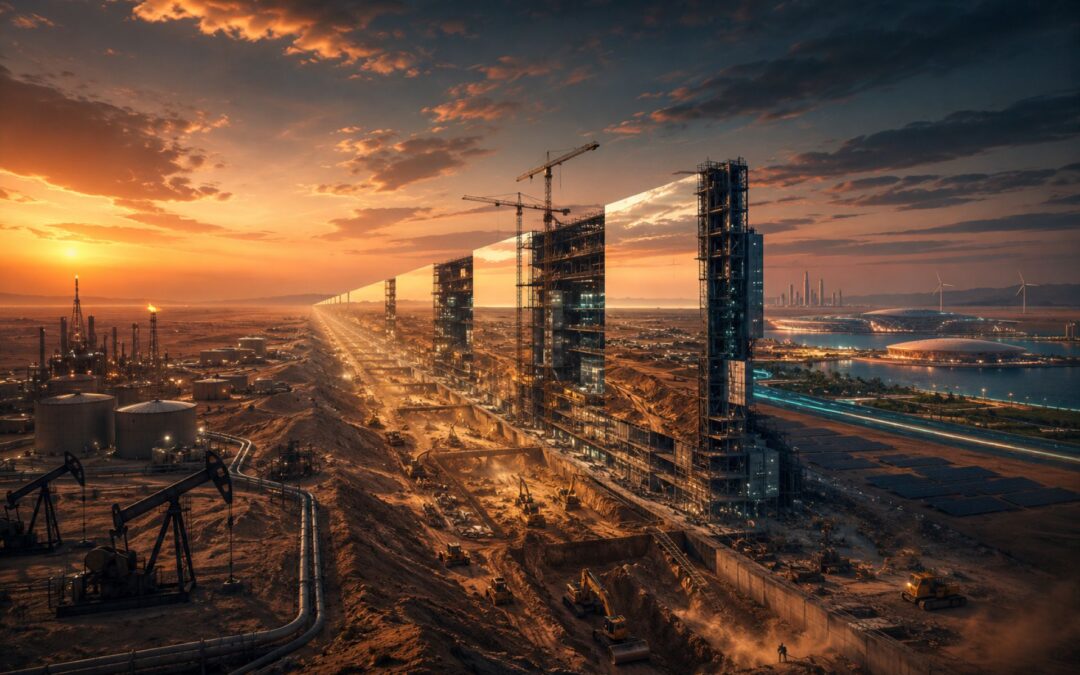
In 2016, Saudi Arabia presented the world with an extraordinary picture of its future. A kingdom built on oil would become a center of technology, tourism, finance, culture, entertainment, and global business. New industries would employ a younger and more productive population. International investors would arrive. Foreign professionals would relocate. Vast developments would rise from the desert, led by NEOM and its most audacious proposal, The Line.
Ten years later, Saudi Arabia has undeniably changed. Women participate in the workforce in far greater numbers. New entertainment and tourism industries exist where almost none operated before. The state has improved digital services, opened sectors to private investment, attracted major international events, and pushed millions of Saudis toward private-sector employment.
Yet the most visible symbols of the transformation have also encountered rising costs, reduced timelines, delayed construction, and uncomfortable questions about commercial viability. The starkest critics have described Vision 2030 as an $8 trillion disaster, arguing that Saudi Arabia is trying to purchase economic success through scale and spectacle.
That conclusion is too simple. Vision 2030 is not an imaginary transformation, nor can its achievements be dismissed as accounting tricks. But its central economic question remains unresolved.
Saudi Arabia is using oil wealth to finance an economy that is supposed to become less dependent on oil. That strategy can work only if government spending eventually creates productive companies, skilled workers, competitive exports, private investment, and recurring demand that no longer require the state to keep writing larger cheques.
The true test of Vision 2030 is therefore not whether every futuristic render becomes reality. It is whether the kingdom can turn extraordinary spending into an economy capable of sustaining itself.
How Oil Built Saudi Arabia—and Made Diversification Necessary
When Abdulaziz Ibn Saud unified most of the Arabian Peninsula in 1932, the new Kingdom of Saudi Arabia was not a wealthy state. Its economy depended heavily on agriculture, livestock, trade, religious pilgrimage, and the limited revenues available to a government ruling a vast and sparsely populated territory.
The Great Depression placed additional pressure on those fragile sources of income. Demand for Arabian pearls had already been damaged by competition from cultured pearls, while the global downturn reduced trade and the number of pilgrims able to travel to Mecca.
Searching for a new source of revenue, Ibn Saud granted an oil concession to Standard Oil of California in 1933. Years of difficult exploration followed. The breakthrough came at Dammam Well No. 7, where the discovery that began producing commercially in 1938 transformed the country’s future. The history of the discovery at Dammam No. 7 became the foundation of what would eventually become Saudi Aramco.
Oil did more than make Saudi Arabia rich. It built the modern Saudi state.
Petroleum revenue financed roads, airports, electricity, hospitals, universities, water systems, public administration, and national defense. It allowed the monarchy to provide subsidized energy, public employment, housing support, education, and other benefits without relying heavily on taxation.
This arrangement created a powerful social contract. The state distributed oil wealth, citizens received stability and material advancement, and the government became the dominant employer and investor.
The same model also produced deep structural dependence.
Oil came to dominate exports and government revenue. Public spending rose and fell with energy prices. Private companies depended heavily on government contracts. Many Saudi citizens preferred secure and well-paid public-sector employment, while much of the private economy relied on lower-cost foreign labor.
The danger was not necessarily that the world would suddenly stop using oil. Saudi Arabia remained one of the world’s lowest-cost producers and could continue earning enormous revenues for decades. The deeper problem was demographic and fiscal.
A growing young population needed jobs, housing, infrastructure, and opportunities. Government expenditure could not expand indefinitely without becoming increasingly vulnerable to fluctuations in the oil market. Nor could the state create enough public-sector positions to employ every new entrant to the labor force.
The oil-price collapse that began in 2014 exposed that vulnerability. By 2016, Saudi leaders faced a clear strategic challenge: use the country’s petroleum wealth while it remained abundant to build other sources of national income.
That was the logic behind the original Vision 2030 program. The plan was not simply a branding campaign or a collection of construction projects. It was an attempt to renegotiate the economic foundations of the Saudi state.
Oil had given Saudi Arabia the capital to transform itself. Vision 2030 was designed to ensure that oil would not remain the only system capable of sustaining that transformation.
Vision 2030’s State-Led Bet on a Post-Oil Economy
Vision 2030 rests on a paradox. Saudi Arabia wants to reduce its dependence on oil by spending the wealth created by oil.
There is nothing inherently irrational about that approach. Countries often use revenue from a dominant industry to build infrastructure, educate workers, attract investment, and develop new sectors. The question is whether the initial spending creates productive capabilities that survive after state support declines.
Saudi Arabia chose an unusually aggressive version of this strategy.
Rather than waiting for private investors to slowly develop new industries, the government would create markets itself. It would build destinations, establish companies, finance infrastructure, change regulations, recruit international partners, and generate demand through public spending.
The Public Investment Fund became the main vehicle for this transformation. PIF was no longer expected to behave only like a conventional sovereign wealth fund seeking financial returns. It was also tasked with creating industries, developing strategic assets, attracting foreign investment, and expanding the private sector.
Tourism, entertainment, mining, logistics, technology, renewable energy, sport, real estate, and advanced manufacturing were all identified as potential pillars of a more diversified economy. Social reforms accompanied the economic strategy because restaurants, cinemas, concerts, tourism, and international business could not expand under the kingdom’s previous restrictions.
The scale of the effort produced genuine changes. Official Vision 2030 annual reporting records progress in women’s labor-force participation, home ownership, tourism, digital government, private-sector employment, and the creation of new commercial activities.
But the strategy also created a temptation to equate spending with transformation.
A government can announce a project, allocate land, establish a company, award contracts, and begin construction relatively quickly. It is much harder to create a competitive industry with independent demand, capable management, productive workers, reliable institutions, and customers willing to pay enough to generate a return.
Saudi Arabia’s gigaprojects were designed to compress that development process. Projects such as NEOM, Qiddiya, Diriyah, and the Red Sea developments were expected to attract residents, tourists, businesses, investors, and international attention at the same time.
The kingdom was borrowing elements from other Gulf economies, particularly Dubai. But how Dubai built a diversified economy cannot be reduced to skyscrapers and luxury tourism.
Dubai developed a connected commercial system. Its ports supported trade. Its airline connected those trade routes to global passenger networks. Free zones reduced barriers for foreign companies. Property development served a growing expatriate population. Tourism benefited from aviation, hospitality, retail, and relatively open social rules. Each component strengthened the others.
Saudi Arabia has far more land, capital, natural resources, and domestic demand than Dubai. It also faces a more difficult coordination problem. It is not building one commercial city around an established trading hub. It is attempting to transform a country of more than 30 million people while creating several new industries and destinations simultaneously.
An independent ten-year assessment of Vision 2030 found substantial progress but argued that the next phase must move beyond asset creation toward productivity, human capital, foreign investment, and commercial viability.
That distinction is crucial. Building infrastructure can create the conditions for diversification. It cannot substitute for diversification itself.
Nowhere is that tension more visible than at NEOM.
NEOM and The Line: When Ambition Outran Delivery
NEOM was announced as a new economic region in northwestern Saudi Arabia, spanning mountains, coastline, and desert. Its official vision combines tourism, logistics, manufacturing, technology, renewable energy, urban development, and experimental forms of city planning.
The most famous proposal within NEOM is The Line.
Originally presented as a 170-kilometer linear city, The Line was supposed to house nine million people within two parallel mirrored structures. Residents would live in an ultra-dense, car-free urban environment supported by high-speed transport and artificial intelligence.
The proposal captured global attention precisely because it rejected almost every convention of normal urban development. It also concentrated an extraordinary number of risks into a single project.
Conventional cities develop gradually. Housing follows jobs. Transport responds to movement patterns. Commercial districts expand with demand. Infrastructure is extended as population grows.
The Line attempted to reverse that sequence. Saudi Arabia would first construct an unprecedented urban form in a remote region and then attract residents, employers, institutions, retailers, and visitors at sufficient scale to justify it.
Engineering difficulty was only one obstacle. The city would require enormous quantities of materials, energy, transport infrastructure, financing, and skilled labor. It would need to persuade millions of people to live in a place without an existing economy, established neighborhoods, mature institutions, or organic community life.
The original 170-kilometer concept was never realistically going to be completed by 2030. Reporting in 2024 suggested that plans for the initial 2030 phase had been reduced to a much shorter section housing fewer than 300,000 people.
That did not amount to a formal cancellation of The Line. Large infrastructure projects are commonly divided into phases, and Saudi officials continued to defend the long-term concept. But the reduction revealed how far the promotional timetable had diverged from practical delivery.
Costs became even more concerning.
An internal audit examined by The Wall Street Journal reportedly estimated that completing NEOM’s original ambitions over several decades could eventually require spending measured in trillions of dollars. The widely repeated figure of $8.8 trillion referred to a long-range internal estimate stretching toward 2080, not an approved budget already committed or spent.
Even with that qualification, the number exposed the danger of allowing aspirational designs to advance without sufficiently hard financial constraints.
NEOM also became a governance test.
Large projects need people who can tell senior leaders that assumptions are unrealistic. Engineers must be able to challenge architects. Financial teams must question demand forecasts. Project managers must disclose delays. Consultants must have incentives to present accurate numbers rather than produce the answer favored by the client.
When political authority, funding decisions, and creative direction are concentrated around one leader, honest feedback becomes more difficult. Executives may avoid delivering bad news. Consultants may compete to make ambitious ideas appear feasible. Managers may learn that reducing projected costs is rewarded more than identifying real risks.
This does not mean every NEOM component is doomed. The development includes projects with different purposes and risk profiles. Ports, industrial facilities, resorts, renewable-energy systems, and selected urban districts may prove viable even if The Line is delayed or redesigned.
Scaling a project is not automatically evidence of total failure. It can also be evidence that financial discipline has finally entered the planning process.
Saudi Arabia increasingly appears to recognize that correction is necessary. PIF has accepted an $8 billion reduction in the valuation of several gigaproject investments, while newer strategy documents emphasize returns, partnerships, and value realization rather than announcing ever larger assets.
The lesson of NEOM is not that Saudi Arabia should abandon ambition. Ambition helped break the political inertia that protected the old oil-dependent model.
The lesson is that ambition without institutional resistance becomes expensive fantasy. A national transformation needs imagination, but it also needs managers and financial systems empowered to say no.
Is Saudi Arabia’s Non-Oil Growth Truly Sustainable?
Critics of Vision 2030 sometimes argue that Saudi Arabia’s reported non-oil growth is essentially artificial because so much of it is created by government spending.
That criticism identifies a real vulnerability but reaches the wrong conclusion.
Construction is genuine economic activity. A hotel employs workers. A railway purchases materials. A new restaurant generates income. Tourism, logistics, entertainment, retail, business services, and manufacturing all contribute real output whether their initial demand comes from the state or the private sector.
Saudi Arabia’s non-oil economy has expanded. Private credit has grown. New industries have appeared. Consumer spending and business activity have increased. The IMF’s latest assessment described non-oil activity as robust while also recommending spending reprioritization and continued fiscal discipline.
The important question is not whether the activity exists. It is whether the demand supporting it can survive without continued oil-funded expenditure.
Suppose the government finances the construction of a resort. During construction, the project raises GDP, creates jobs, and generates contracts for private companies. Once completed, however, the resort must attract enough guests to cover operating costs, maintain the property, repay capital, and produce an acceptable return.
If it cannot, the state must subsidize it, accept losses, or write down the investment. The construction activity was real, but it did not create an independent source of future income.
This distinction applies across Vision 2030.
A state-funded entertainment district may stimulate restaurants and retail. A new airline may create aviation jobs. A sports league may support broadcasting and hospitality. A manufacturing plant may develop local suppliers. These investments can become self-sustaining if they produce skills, customers, exports, technologies, or productivity that continue after the initial public spending ends.
They can also become permanent claims on the state budget.
PIF sits at the center of this tension. It is expected to earn commercial returns while transforming the Saudi economy. Those objectives can reinforce each other, but they can also conflict.
A purely commercial investor would avoid projects with uncertain demand, weak returns, or very long development periods. A national development fund may invest precisely because the market is unwilling to bear those risks.
That can be valuable. Ports, industrial clusters, transport systems, and new technologies often require patient capital. A country attempting structural change cannot rely exclusively on projects that generate immediate profits.
The danger arises when the development mandate protects investments from market judgment. If every loss can be defended as strategic, it becomes difficult to distinguish patient investment from poor capital allocation.
PIF’s foreign portfolio also cannot be judged simply by comparing its investment returns with the size of Saudi Arabia’s non-oil economy. The fund’s international assets provide diversification, financial income, partnerships, and access to technology. Its domestic portfolio is intended to reshape the economy directly.
The more useful comparison is Norway’s very different approach to oil wealth. Norway invests most of its petroleum wealth abroad and restricts how much of the fund can be used in the domestic economy. That approach protects the country from overheating, political spending pressure, and excessive dependence on resource revenue.
Saudi Arabia has chosen almost the opposite strategy. It is using sovereign wealth as an instrument of domestic transformation.
Norway’s model prioritizes preservation and fiscal insulation. Saudi Arabia’s model prioritizes development and speed. Neither can be copied mechanically because the countries have different populations, institutions, labor markets, and development needs.
But the Saudi model carries greater execution risk. It requires the state to identify viable sectors, manage complex companies, select projects, coordinate infrastructure, recruit talent, and eventually attract private capital on commercial terms.
The kingdom has made meaningful reforms. An IMF review of structural reforms documents improvements in business regulation, governance, labor participation, and the investment environment.
Yet foreign direct investment remains an especially important test. Private investors bring more than money. They bring independent judgment. When companies risk their own capital without state guarantees, subsidies, or procurement contracts, they demonstrate confidence that an industry can compete.
PIF’s newly approved strategy appears to acknowledge that the first phase of transformation cannot continue indefinitely. The fund’s new value-realization strategy emphasizes capital efficiency, partnerships, sustainable returns, and extracting value from assets already created.
That shift may be more important than another round of spectacular announcements.
The first decade of Vision 2030 proved that Saudi Arabia could mobilize capital and build quickly. The next must prove that what it built can generate value without relying permanently on the same state that financed it.
The Human Capital Problem Money Cannot Solve
Cities, resorts, factories, hospitals, research centers, and technology companies do not become productive because their buildings are impressive. They become productive because skilled people choose to work in them, companies organize those people effectively, and institutions reward useful ideas.
Saudi Arabia’s most difficult transformation may therefore be social and institutional rather than physical.
The kingdom needs to create productive employment for Saudi citizens while continuing to attract foreign expertise. Those objectives are related but not identical.
For decades, the economic model divided the labor market. Many Saudis sought secure public-sector jobs with attractive wages and benefits. Private companies relied heavily on expatriates, including millions of lower-paid workers from South Asia, Southeast Asia, Africa, and elsewhere.
This arrangement allowed rapid development but weakened the relationship between education, productivity, wages, and private-sector demand.
Vision 2030 has attempted to change that structure through Saudization requirements, labor-market reform, education initiatives, entrepreneurship programs, and efforts to increase female employment.
The gains are real. Saudi unemployment has fallen substantially from earlier levels, and women now participate in economic life on a scale that would have appeared unlikely before 2016. Private companies employ more Saudi citizens, while new industries have created careers that previously did not exist.
But numerical participation does not automatically produce a knowledge economy.
Employers still need workers with the right technical and managerial skills. Universities must produce graduates capable of contributing to competitive firms. Private-sector wages must reflect productivity rather than only localization requirements. Companies must be able to reward performance and dismiss poor performers. Entrepreneurs need predictable regulation, access to finance, and markets not dominated by state-connected entities.
Saudization can create opportunities and force companies to invest in local talent. It can also encourage superficial compliance if firms hire citizens to satisfy quotas without developing meaningful responsibilities.
The public sector remains part of the problem. When government employment offers greater security, shorter hours, or better compensation than many private jobs, young Saudis make a rational choice by preferring it. Changing that preference requires improving the quality of private careers, not blaming individuals for responding to incentives.
The foreign-talent challenge is different.
Saudi Arabia can attract international professionals through high salaries, tax advantages, ambitious projects, and rapid promotion. Engineers, consultants, executives, doctors, academics, designers, and hospitality workers already relocate to the kingdom in large numbers.
The harder task is retention.
A professional may accept a three-year contract without viewing Saudi Arabia as a permanent home. Families consider schools, personal freedoms, legal predictability, career opportunities for spouses, residency rights, and the ability to build a life beyond one employer.
Saudi Arabia has loosened many social restrictions, expanded entertainment, improved residency pathways, and made daily life more attractive to foreigners. Those changes matter.
Remaining legal constraints also matter. Human Rights Watch has documented restrictions under Saudi Arabia’s personal-status law, particularly in areas affecting marriage, divorce, and family authority.
These rules will not prevent every highly skilled worker from moving to Saudi Arabia. Many people prioritize income, career opportunities, safety, or proximity to family over political and social considerations.
But Saudi Arabia competes with Dubai, Singapore, London, Toronto, Sydney, and other international hubs for people who have choices. Attracting someone for a project is easier than persuading that person to invest emotionally, professionally, and financially in the country for decades.
Labor conditions lower down the wage scale create another reputational and institutional problem.
Saudi Arabia has introduced reforms intended to improve worker mobility and reduce employer control over expatriates. Yet implementation, enforcement, and coverage remain uneven. Workers with limited bargaining power remain vulnerable to delayed wages, unsafe conditions, recruitment debt, and dependence on employers.
A knowledge economy cannot be built on the assumption that labor protections matter only for elite professionals. Institutions reveal their strength through the treatment of those least able to challenge them.
The deeper issue is trust.
Talented people need to believe that contracts will be enforced, promotions will reflect competence, managers can challenge senior officials, research will be evaluated honestly, and failures can be reported without destroying careers.
Money can hire expertise. It cannot immediately create professional cultures in which expertise has authority.
Saudi Arabia can purchase laboratories, universities, consulting services, and technology platforms. Creating a society that consistently produces innovation requires habits that develop more slowly: intellectual independence, institutional accountability, tolerance for criticism, meritocratic advancement, and the willingness to abandon favored ideas when evidence turns against them.
Vision 2030 has begun changing the Saudi labor market. Its long-term success depends on whether those changes produce capability rather than only participation.
Tourism, Sport, and the Search for Global Demand
Tourism is one of the most plausible elements of Saudi Arabia’s diversification strategy.
The kingdom possesses assets that cannot be replicated elsewhere: Mecca and Medina, long coastlines, desert landscapes, archaeological sites, distinctive regional cultures, and a location connecting Asia, Africa, and Europe.
For decades, Saudi Arabia treated international tourism outside religious travel as a minor priority. Visa restrictions, limited entertainment, conservative social rules, and an underdeveloped hospitality sector discouraged many potential visitors.
Vision 2030 changed that approach. The government introduced tourism visas, expanded entertainment, developed heritage sites, hosted international events, and financed resorts along the Red Sea.
The results are significant. Official tourism figures reported approximately 30 million inbound visitors in 2024.
Religious tourism accounts for a large share of those arrivals, but that should not be treated merely as an asterisk. Pilgrimage is a durable competitive advantage. Few countries possess a destination that millions of people consider a religious obligation to visit.
The real question is whether Saudi Arabia can use that advantage to develop a wider tourism economy.
Pilgrims may extend their stays. Domestic tourism can retain spending that previously flowed abroad. Business events, sport, entertainment, heritage, and coastal resorts can attract different visitors. New airlines and airports can improve access.
Still, rising visitor numbers do not prove that every tourism project is viable.
A resort must compete with destinations offering established hospitality networks, accessible alcohol, familiar legal systems, beaches, nightlife, culture, and years of international reputation. Saudi Arabia can overcome some disadvantages through exceptional service, unique attractions, and high-quality infrastructure. It cannot assume that luxury construction automatically creates demand.
The same distinction applies to sport.
Saudi Arabia has spent heavily to become a visible force in global golf, football, boxing, motorsport, and other competitions. LIV Golf offered star players enormous guaranteed contracts. PIF-backed Saudi football clubs recruited Cristiano Ronaldo, Neymar, Karim Benzema, and other internationally recognized names.
These investments purchased attention quickly. They placed Saudi Arabia inside global sporting conversations that would otherwise have taken decades to enter.
They have not yet produced mature commercial ecosystems.
Reuters reported that LIV’s investment and accumulated losses had reached several billion dollars. Saudi Pro League clubs attracted famous players, but match attendance and international television audiences remained far below those of Europe’s leading leagues.
That outcome is not surprising. Sporting institutions derive value from more than talent.
Major football clubs possess inherited rivalries, multigenerational fan communities, iconic stadiums, historic victories, local identity, youth systems, broadcasting reach, and decades of collective memory. Those forms of loyalty cannot be purchased on a normal investment timetable.
Saudi Arabia may nevertheless achieve objectives beyond immediate profitability.
Sport expands domestic entertainment. It encourages participation and provides careers. International competitions bring visitors. Famous athletes increase global recognition. Major events support the kingdom’s tourism strategy and preparations for the 2034 World Cup. Sporting influence can also create political relationships and international prestige.
The problem arises when these different goals are blended together to avoid judgment.
A project justified as a profitable business should eventually be judged by revenue and returns. A project justified as tourism promotion should be judged by visitors and spending. A domestic sports-development initiative should be judged by participation, local talent, audiences, and institutional growth.
If every investment is defended simultaneously as business, diplomacy, tourism, national pride, and social reform, failure becomes impossible to define.
Saudi Arabia’s sports and tourism strategies are not empty simply because they cost money. New industries often require years of investment before reaching scale.
But visibility is not the same as demand. Celebrity is not the same as community. A successful strategy must eventually produce people who choose to return, watch, subscribe, spend, invest, and participate without being continuously paid or subsidized to do so.
What Would Make Vision 2030 Succeed?
Vision 2030 will not be decided by whether The Line reaches 170 kilometers or whether every project announced in its first decade survives unchanged.
National transformations are rarely delivered according to their original renderings. Projects are cancelled. Budgets tighten. Strategies evolve. Some investments fail while others create unexpected industries.
Saudi Arabia’s willingness to revise its plans may ultimately matter more than its willingness to announce them.
The clearest evidence of success would be a growing private economy that no longer depends primarily on government contracts. Saudi companies would invest because customers exist, not because PIF has created demand. Foreign businesses would commit capital without requiring extraordinary subsidies or guarantees.
Non-oil exports would become more competitive. Productivity would rise. Saudi workers would acquire skills that employers value beyond localization targets. International professionals would stay longer, build companies, and establish roots.
Tourism developments would attract repeat visitors. Sports organizations would develop audiences and commercial income. PIF-owned companies would generate sustainable returns or produce measurable public value at a defensible cost.
Most importantly, the state would demonstrate that it can stop.
It would cancel projects whose economics no longer make sense. It would reduce the scale of developments when demand is insufficient. It would allow independent financial analysis to overrule political enthusiasm. Managers would be rewarded for identifying problems early rather than concealing them until losses became unavoidable.
That is the transition Vision 2030 now requires: from mobilization to selection.
The first decade rewarded speed, scale, visibility, and disruption. Those qualities helped dismantle old restrictions and made the world take Saudi ambition seriously. The second decade must reward productivity, discipline, institutional learning, and commercial judgment.
Saudi Arabia possesses advantages few countries can match. It has enormous financial resources, low-cost oil, a young population, political capacity to execute large decisions, an important geographic position, and religious sites that guarantee continuing global relevance.
It also faces constraints that capital cannot erase: a state-dominated economy, limited institutional challenge, dependence on expatriate labor, uneven human-capital development, and projects whose ambition has sometimes exceeded credible demand.
Vision 2030 has already changed Saudi Arabia. It has not yet proved that Saudi Arabia can sustain those changes without the continuing force of oil revenue and government spending.
That is why the program should be understood neither as a triumphant success nor as a desert hallucination.
It is a vast economic experiment attempting to use the proceeds of one development model to build its replacement. The outcome will depend less on the height of its towers than on the quality of its institutions, less on the celebrities it can recruit than on the talent it can retain, and less on the assets it can construct than on the value those assets can create.
Oil wealth can buy time, infrastructure, expertise, and attention.
Whether it can buy a post-oil economy depends on what Saudi Arabia learns to build after the money has been spent.
Last Updated on July 21, 2026 by Aseem Gupta