
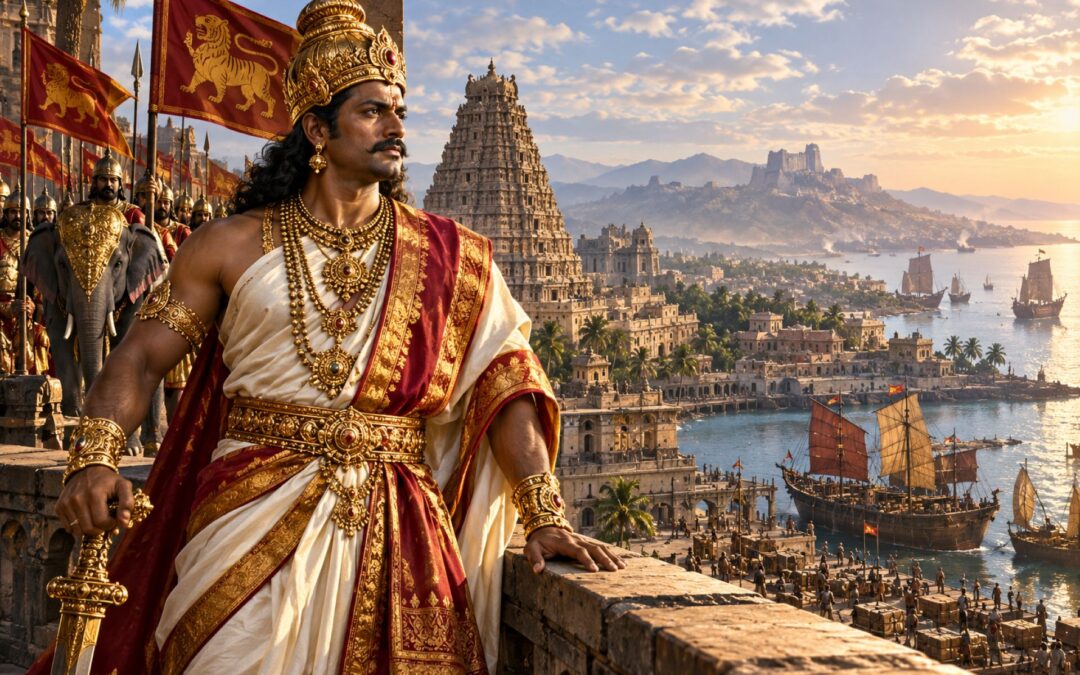
In 1070 CE, the Chola Empire faced a dangerous succession crisis. Emperor Virarajendra had died, his successor Adhirajendra’s brief reign ended violently, and powerful rivals were competing to shape the future of one of South India’s greatest empires. The Western Chalukya prince Vikramaditya had already established himself as an influential figure in Chola politics through military campaigns and a royal marriage alliance. Amid the uncertainty, another claimant emerged: Kulottunga, a prince whose ancestry connected the Cholas with the Eastern Chalukya rulers of Vengi.
Kulottunga’s accession would begin a reign lasting approximately half a century, during which he confronted rival dynasties, rebellious territories, difficult succession arrangements, and changing commercial interests across Asia. He inherited an empire accustomed to ambitious conquest, but the challenge before him was different. The Cholas had accumulated enormous territories and influence under earlier rulers, yet controlling that inheritance required more than battlefield victories. Kulottunga’s significance lies in how he maintained imperial authority through a combination of warfare, negotiation, provincial administration, and economic policy, even as some territories slipped permanently beyond his control.
The Empire Kulottunga Inherited
By the middle of the eleventh century, the Cholas had transformed themselves from a regional Tamil dynasty into one of the most formidable political powers in Asia. Their resurgence began in the ninth century, when Vijayalaya Chola established a foothold at Thanjavur amid conflicts involving the Pallavas and other regional powers. Subsequent rulers expanded the kingdom, but its imperial strength emerged particularly under Rajaraja Chola I and his son Rajendra Chola I.
Rajaraja, who ruled from 985 to 1014, conquered substantial territories across southern India and extended Chola authority into Sri Lanka. Rajendra continued these campaigns, led an expedition toward the Ganges, and established the monumental capital of Gangaikondacholapuram. His most famous overseas operation targeted Srivijaya and associated commercial centres in Southeast Asia around 1025. These achievements demonstrated the extraordinary reach of earlier Chola imperial expansion, but expanding an empire and maintaining its political unity were different challenges.
The empire’s financial strength depended heavily on productive agricultural regions, particularly the Kaveri delta. Irrigation networks supported cultivation, while assessments of land and agricultural production provided resources for royal government, religious establishments, armies, and public works. Ports on the Coromandel and Malabar coasts connected these inland economies with merchants operating across the Indian Ocean. Control over fertile territories and profitable commercial routes consequently became an important objective of imperial competition.
The eastern Deccan kingdom of Vengi, corresponding broadly to parts of modern Andhra Pradesh, was especially valuable. Its fertile river plains, coastal settlements, and strategic position made it attractive to both the Cholas and their Western Chalukya rivals. Marriage alliances between the Chola and Eastern Chalukya royal families had already created close political connections, but those relationships also produced overlapping dynastic claims that could become contentious whenever a ruler died.
The Chola government was sophisticated, though it was not a uniformly centralised bureaucracy exercising identical control everywhere. Royal relatives, military commanders, landholding elites, temple institutions, village assemblies, and subordinate rulers all participated in administering the empire. Some territories were directly integrated into the royal government, while others maintained considerable autonomy in return for tribute, military cooperation, or recognition of Chola supremacy. This flexibility helped the empire expand, but it also meant that local rulers could exploit uncertainty at the centre to challenge imperial authority.
Following Rajendra’s death in 1044, the throne passed through several of his sons, including Rajadhiraja I, Rajendra II, and Virarajendra. They continued defending and extending Chola interests, particularly against the Western Chalukyas. By the time Virarajendra died in 1070, however, repeated military struggles and complicated family relationships had created a political environment in which a contested succession could threaten the cohesion of the empire.
The Vengi Prince With a Claim to Two Thrones
Kulottunga was born into the close relationship between the Chola and Eastern Chalukya dynasties. His father, Rajaraja Narendra, ruled Vengi, while his mother, Ammangadevi, was a daughter of the Chola emperor Rajendra I. This ancestry made Kulottunga a potential heir to his father’s kingdom and gave him a significant maternal connection to the Chola imperial family.
Before becoming emperor, he was known as Rajendra Chalukya. His name and parentage reflected a political world in which marriage alliances could connect ruling houses without eliminating their separate interests. A prince belonging to two powerful dynastic traditions might enjoy unusual opportunities, but he could also become involved in disputes over which relatives possessed the strongest hereditary claims.
Rajaraja Narendra’s death, generally placed around 1061, created precisely such a problem in Vengi. Kulottunga had a claim through his father, but his uncle Vijayaditya VII also sought and exercised authority in the kingdom. The succession was influenced by competing family interests and the wider struggle between the Cholas and Western Chalukyas. Kulottunga did not immediately secure undisputed possession of his paternal inheritance.
His early career is associated with military activity beyond the traditional Chola heartland. Accounts connect him with operations in Chakrakuta, usually identified with the region around present-day Bastar and neighbouring parts of central India. These campaigns suggest that he had acquired experience in warfare and regional politics before his accession to the imperial throne. Nevertheless, the precise sequence and circumstances of his early expeditions are not sufficiently documented to reconstruct a continuous account of his movements.
Some historical narratives also associate the young prince with Chola military intervention at Kadaram, generally identified with Kedah on the Malay Peninsula. Chola inscriptions provide evidence of a campaign involving Kadaram during Virarajendra’s reign, but the extent of Kulottunga’s personal participation is uncertain. It would therefore be misleading to describe him confidently as the commander who overthrew a Southeast Asian king and installed a loyal subordinate. Such an intervention was consistent with Chola maritime interests, but the surviving evidence does not establish every detail of the prince’s involvement.
What matters most about Kulottunga’s early career is the combination of dynastic legitimacy and practical political experience he brought into the crisis of 1070. His ancestry connected him to two important ruling houses, while his association with military campaigns made him more than a distant relative of the reigning emperor. Yet neither bloodline nor experience guaranteed his accession. His opportunity emerged from a succession struggle that involved other members of the Chola family and one of the most ambitious rulers of the Western Deccan.
The Chola Succession Crisis of 1070
The Cholas and Western Chalukyas had fought repeatedly over territories in the Deccan, particularly around Vengi and the strategically important regions farther west. Their rivalry involved military prestige, access to agricultural revenues, control over trade routes, and influence over subordinate rulers. Campaigns could devastate contested territories without producing permanent settlements, allowing disputes to resume under successive monarchs.
Vikramaditya VI, a younger son of the Western Chalukya ruler Somesvara I, emerged as a particularly formidable participant in this rivalry. His military reputation and political ambitions eventually brought him into conflict with his elder brother, Somesvara II, who inherited the Western Chalukya throne in 1068. Rather than simply continuing his family’s hostility toward the Cholas, Vikramaditya cultivated an independent relationship with the Chola emperor Virarajendra.
The relationship was reinforced by Vikramaditya’s marriage to one of Virarajendra’s daughters. Royal marriages could serve as instruments of diplomacy, creating obligations and opportunities across otherwise hostile political boundaries. For Vikramaditya, the alliance strengthened his position against his brother while giving him a personal stake in the Chola succession. For Virarajendra, cooperation with one ambitious Chalukya prince offered a way to weaken or divide a longstanding rival.
When Virarajendra died in 1070, his son Adhirajendra succeeded him, but his reign lasted only a short time. The circumstances of Adhirajendra’s death and the subsequent accession of Kulottunga are among the most disputed episodes in later Chola history. Royal inscriptions, literary works, and later historical reconstructions do not supply one complete, mutually consistent account of what happened.
The court poet Bilhana, whose Vikramankadevacharita celebrates Vikramaditya VI, presents events from a perspective favourable to the Chalukya prince. His narrative associates Vikramaditya with efforts to secure his Chola brother-in-law’s position amid political disturbances. Chola records, by contrast, emphasise Kulottunga’s legitimate authority and his role in restoring order after turmoil. Both traditions contain historically valuable information, but neither should be treated as a neutral account of the succession.
The historical reconstruction of Kulottunga’s reign in Later Chola Temples examines these competing traditions and the political circumstances surrounding his accession. The evidence supports a succession crisis in which Adhirajendra died and Kulottunga subsequently became emperor. It does not establish beyond dispute that Kulottunga personally led a rapid invasion of the Tamil heartland, fought a decisive battle against Adhirajendra, or deliberately arranged his predecessor’s death.
Religious traditions have introduced another layer of controversy. Later accounts concerning the Vaishnava philosopher Ramanuja describe persecution by a Chola ruler, and different interpretations have identified that ruler in different ways. Adhirajendra has sometimes been implicated in popular retellings, while other interpretations have associated the episode with Kulottunga or another Chola monarch. Yet the scholarly examination of the Ramanuja persecution tradition demonstrates why these accounts require careful attention to their chronology, sources, and later transmission. They cannot securely establish that Adhirajendra’s supposed religious intolerance caused his overthrow.
Kulottunga nevertheless emerged as the successful claimant. His accession in 1070 inaugurated the Chalukya-Chola line of rulers, joining his paternal Eastern Chalukya ancestry with his maternal Chola inheritance. This did not mean that a wholly foreign dynasty had displaced the Cholas. Kulottunga possessed genuine Chola royal descent, and his government continued many of the political and institutional traditions of his predecessors.
The succession gave him control of the imperial throne, but that was only the beginning of the problem. The circumstances of his accession had created opportunities for opponents, while Vikramaditya remained an ambitious military leader with claims, alliances, and influence extending across the Deccan. Kulottunga now had to demonstrate that his dynastic position could be translated into durable political authority.
Vikramaditya VI and the Fight for Vengi
Vengi was central to the contest between Kulottunga and Vikramaditya because it linked dynastic politics with territorial strategy. Its location along the eastern Deccan connected the Chola heartland with fertile river valleys, commercial ports, and routes toward Kalinga. Whoever exercised authority there could gain revenues, military resources, and a valuable position from which to influence neighbouring territories.
Kulottunga’s paternal connection to Vengi did not automatically give him effective control over every part of the kingdom. His uncle Vijayaditya VII continued exercising authority there for several years after Kulottunga became Chola emperor. The resulting political arrangement illustrates the distinction between hereditary claims, recognition of royal supremacy, and day-to-day government. Kulottunga’s accession strengthened his wider position, but consolidating Vengi required continuing negotiation and the management of competing interests.
Vikramaditya had strong reasons to resist that consolidation. A secure political connection between the Chola throne and Vengi would place a valuable eastern region under the influence of his principal southern rival. At the same time, Vikramaditya was seeking to overcome Somesvara II and establish himself as the dominant ruler of the Western Chalukya state. The struggles over Vengi and the Western Chalukya succession consequently became interconnected.
The military confrontations of the mid-1070s are described in sources that celebrate victories from different political perspectives. Chola accounts emphasise successful campaigns against Vikramaditya and his supporters, including operations extending toward regions associated with modern Karnataka. The available evidence indicates serious fighting and shifting alliances, but it does not justify a neatly reconstructed series of battles ending in the permanent submission of one empire to the other.
Vikramaditya eventually defeated his brother and established himself as Western Chalukya emperor in 1076. His accession marked the beginning of a long and influential reign, traditionally associated with the Chalukya-Vikrama era. Rather than disappearing as a political threat after an early setback, he became Kulottunga’s enduring rival across much of the Deccan.
The death of Vijayaditya VII around 1075–1076 created an opportunity for Kulottunga to strengthen his position in Vengi. He subsequently placed members of his own family in charge of the region, extending the practice of using royal princes to govern strategically important territories. Among those associated with Vengi’s administration were his sons Rajaraja Mummadi Chola, Vira Choda, and Vikrama Chola, although their appointments and periods of responsibility belonged to different stages of the reign.
Such appointments were politically useful because they allowed the emperor to preserve dynastic connections while delegating responsibility for distant territories. A royal viceroy could mobilise military resources, negotiate with local elites, supervise revenues, and represent imperial authority without requiring the emperor’s continuous presence. However, the system also depended on the loyalty and competence of the appointed prince, the cooperation of regional powers, and the broader military balance.
Vengi remained contested throughout Kulottunga’s reign. Western Chalukya pressure did not vanish after the campaigns of the 1070s, and later developments demonstrated that Chola control could be weakened or reversed when political circumstances changed. Kulottunga’s achievement was therefore not the permanent removal of Vikramaditya from eastern Deccan politics. It was his ability to maintain a significant Chola position there for much of a long reign despite the ambitions of a powerful neighbouring emperor.
The Loss of Sri Lanka and Wars in the South
While Kulottunga struggled to secure his northern and northeastern interests, the Cholas also faced a major reversal in Sri Lanka. Earlier emperors had conquered substantial parts of the island and established an administrative presence there, but Chola rule encountered continuing resistance from Sinhalese leaders and communities. Military occupation did not eliminate established political traditions or guarantee the lasting allegiance of the island’s population.
Vijayabahu I became the most important leader of the resistance. After years of warfare and efforts to consolidate his position, he succeeded in challenging the Chola presence and restoring Sinhalese royal authority over much of the island. The recovery of Sri Lanka unfolded through a prolonged struggle rather than a single rebellion that Kulottunga could simply choose to forgive.
The breakdown of Chola control coincided with the unsettled beginning of Kulottunga’s reign, when the imperial government faced rival claimants and military threats elsewhere. The resulting loss represented a significant contraction of the empire built by Rajaraja and Rajendra. Kulottunga did not succeed in reversing it through a new conquest, and Vijayabahu’s restored monarchy remained an important independent power.
It is tempting to interpret this outcome entirely as a deliberate strategic sacrifice, with Kulottunga willingly abandoning Sri Lanka to concentrate on more valuable mainland territories. The evidence does not establish such a simple calculation. His government faced competing priorities, and the costs of another successful invasion would have been considerable, but the island’s independence resulted fundamentally from sustained resistance and the collapse of Chola authority. The emperor’s inability or unwillingness to restore control must be understood within those military and political circumstances.
The situation in the Pandya country, in the far south of the Indian peninsula, presented a different challenge. The Pandyas belonged to an established Tamil royal tradition with their own sources of legitimacy, political supporters, and territorial ambitions. Earlier Chola emperors had attempted to manage the region through conquest, royal representatives, and arrangements with subordinate rulers, but Pandya resistance repeatedly re-emerged whenever imperial authority weakened.
Kulottunga conducted campaigns intended to reassert Chola supremacy across the southern territories. Military positions and garrisons helped reinforce control at important locations, while arrangements with local rulers offered alternatives to continuous direct administration. The distinction mattered because a region might acknowledge an emperor’s superior authority while preserving much of its own internal political leadership.
Kerala and the western coastal regions also required attention. These territories were commercially valuable and politically diverse, with rulers whose interests did not necessarily align with the Chola court. Campaigns could compel submission or secure particular strategic positions, but the resulting relationships often depended on changing balances of military strength and local cooperation.
Kulottunga’s southern policy consequently revealed both the reach and the limitations of imperial power. He could mount campaigns against rival rulers, restore influence in important districts, and maintain military arrangements across extensive territories. What he could not accomplish was the permanent elimination of regional identities and competing dynastic ambitions. The empire survived partly because its government could tolerate different degrees of subordination rather than insisting that every province be administered in exactly the same way.
Kalinga, Karunakara Tondaiman, and the Limits of Victory
Kalinga, on the eastern coast of the Indian subcontinent, occupied another important position within Chola imperial strategy. Its territories connected the eastern Deccan with regions farther north, while its ports and inland routes contributed to the commercial and political networks of the Bay of Bengal. The area had figured in earlier Chola military campaigns, and its rulers maintained complicated relationships with the dynasties of Vengi.
Kulottunga’s reign witnessed more than one campaign associated with Kalinga. An earlier expedition, conventionally placed in the 1090s, involved efforts to reinforce Chola influence in the northeastern territories and their surrounding political networks. The precise territorial consequences require caution because inscriptions often describe royal victories more confidently than they establish the duration or geographical extent of subsequent administration.
The better-known Kalinga campaign occurred around 1110 and became closely associated with the Chola commander Karunakara Tondaiman. The opposing ruler was Anantavarman Chodaganga of the Eastern Ganga dynasty, whose royal background also reflected dynastic connections with the Cholas. Those family relationships did not prevent political conflict, particularly when questions of tribute, allegiance, or regional independence arose.
The campaign was celebrated in the Tamil literary work Kalingattuparani, traditionally attributed to the poet Jayamkondar. The poem glorifies Karunakara’s military achievements and presents the conflict through vivid descriptions of destruction, defeated enemies, and the superior power of the Chola ruler. It is an important historical source for understanding royal ideology and the cultural celebration of victory, but its literary purpose must be distinguished from an impartial military account.
The Chola army appears to have achieved significant success during the expedition, and royal traditions commemorated the humiliation of Kalinga’s ruler. However, the popular claim that Anantavarman was overthrown and never heard from again is demonstrably wrong. He survived the campaign and continued ruling for decades, with his long reign generally extending until 1147. His subsequent political career establishes that the Chola operation did not permanently destroy the Eastern Ganga monarchy.
That distinction is crucial to understanding Kulottunga’s military record. A successful expedition could punish a rival, seize wealth, compel temporary submission, and strengthen the emperor’s prestige without resulting in lasting territorial annexation. The Kalinga campaigns demonstrated the Cholas’ capacity to project military power beyond their immediate heartland, but they also showed why claims of victory in royal literature cannot automatically be equated with permanent political control.
Karunakara Tondaiman’s reputation illustrates another feature of Kulottunga’s government: the importance of capable military subordinates. Imperial power depended not only on the emperor’s personal leadership but also on commanders who could mobilise troops and conduct campaigns far from the capital. The celebration of Karunakara’s achievements shows how military service, royal patronage, and literary prestige could reinforce one another within the Chola political order.
Taxes, Merchant Guilds, and Diplomacy Across Asia
Kulottunga’s importance extended beyond his military campaigns. His long reign is also associated with fiscal measures, administrative continuity, commercial connections, and relationships with political powers across the Indian Ocean. These activities were particularly significant because the Chola Empire governed a combination of productive agricultural territories and ports linked to one of the world’s most extensive trading systems.
One of Kulottunga’s celebrated titles was Sungam-tavirtta-Cholan, commonly interpreted as the Chola who removed tolls or customs duties. The title suggests that the remission of certain commercial levies became an important part of his royal reputation. Reducing burdens on the movement of goods could benefit merchants, encourage exchange, and reinforce the image of a ruler attentive to economic prosperity.
The precise scope of these measures is not completely clear. The existence of an abolition or remission of sungam does not establish that Kulottunga eliminated every commercial charge throughout the empire or abandoned taxation as a source of royal revenue. Land-based revenue obligations and other forms of assessment remained essential to government. His reign is also associated with land surveys and administrative efforts to maintain reliable information about taxable resources.
This combination of fiscal policy and record-keeping reflected the practical demands of imperial government. Agricultural revenue sustained armies and institutions, while commercial activity connected the monarchy with prosperous ports and influential trading communities. A ruler interested in maintaining military strength and political authority had reasons to encourage commerce without surrendering the state’s capacity to collect revenue.
South Indian merchant organisations were important participants in this economy. Associations such as the Ainnurruvar, often connected with the Five Hundred of Ayyavole, along with Manigramam and Anjuvannam, maintained relationships across different regions and commercial environments. Their activities involved merchants, financiers, brokers, and other participants who needed access to markets, dependable agreements, and protection for goods travelling considerable distances.
Inscriptions document the reach of these commercial communities in India and Southeast Asia. Some merchant organisations maintained relationships with armed personnel or arranged protection for valuable property, reflecting the dangers of travelling through contested territories. Yet it would be misleading to imagine that all merchant guilds possessed permanent private armies capable of determining imperial wars or compelling Kulottunga to adopt particular foreign policies.
Their importance lay in the relationship between political and commercial interests. Rulers benefited from prosperous trade, the availability of imported goods, and connections with distant ports, while merchants valued security and favourable treatment by authorities. Cooperation did not require complete agreement, and merchants could operate under foreign rulers without turning the territories where they traded into Chola dependencies.
The expansion of Song China’s economy made the eastern maritime world particularly attractive. Chinese markets offered opportunities for merchants carrying commodities from South Asia and Southeast Asia, while Chinese manufactured goods circulated through the same trading networks. The Cholas participated in these wider maritime relationships with Song China, where diplomacy, commercial access, and political prestige could reinforce one another.
Chinese records document a mission associated with the Chola court in 1077, during Kulottunga’s reign. Such embassies could facilitate trade and formal political relationships, but they were not evidence that China had submitted to Chola authority or that the emperor personally controlled commerce across the entire route. The exchange illustrates how South Indian rulers participated in international diplomacy while merchants maintained networks that extended far beyond any single kingdom.
Evidence from Southeast Asia also demonstrates the persistence of these connections. An inscription from Barus in Sumatra, dated to 1088, records the activities of a South Indian merchant organisation. The record is especially significant because it shows Tamil commercial associations operating overseas decades after Rajendra’s expedition against Srivijaya. Their continuing presence reflected the adaptability of merchant networks rather than the existence of permanent Chola administration throughout Sumatra.
Relations involving Nagapattinam and Kadaram reveal another dimension of this maritime world. Records associated with Buddhist religious institutions at Nagapattinam, including copper-plate evidence from around 1090, preserve connections between South Indian royal patronage and Southeast Asian political relationships. Religious affiliations did not prevent diplomatic cooperation, and Buddhist institutions could receive support within a Chola kingdom whose royal traditions were strongly associated with Shaivism.
Later evidence also points toward connections between the Chola court and Cambodia, although the dates, political circumstances, and significance of individual records require careful interpretation. These relationships belonged to a wider environment of diplomacy, religious patronage, and commerce in which Southeast Asian rulers pursued their own interests. They should not be presented as proof that Kulottunga governed those kingdoms or maintained a permanent system of overseas vassal states.
The historical research collected in Nagapattinam to Suvarnadwipa helps place Chola maritime activity within this broader network of political and economic interactions. It also reinforces the need to distinguish military intervention from territorial administration and commercial influence from direct royal control. The Cholas could strike distant rivals, support political relationships, and benefit from trade without possessing sovereignty over every place where Tamil merchants operated.
Kulottunga’s economic and diplomatic policies are therefore best understood as part of the same governing challenge that shaped his wars. He needed to sustain the resources of the empire, accommodate influential commercial communities, and maintain relationships with foreign powers while facing military threats closer to home. His government operated within an international economy that no single ruler could monopolise, but whose opportunities could strengthen a kingdom capable of participating effectively.
A Long Reign, a Smaller Empire, and a Lasting Dynasty
Kulottunga’s reign was remarkable for its duration. Having taken the throne in 1070, he remained the central figure of Chola imperial government for approximately fifty years, surviving a succession crisis that might have led to a more serious fragmentation of royal authority. His longevity allowed administrative practices, dynastic relationships, and military institutions to continue across generations, even as the political landscape around the empire changed.
The success of his government depended on more than the decisions of one monarch. Royal princes governed important territories, commanders such as Karunakara Tondaiman conducted military campaigns, and officials helped administer land, revenue, temples, and local political relationships. The Chola system combined strong claims of royal sovereignty with extensive dependence on regional institutions and the cooperation of influential families.
Religious patronage also formed part of this political order. Chola rulers were closely associated with Shaiva religious traditions, and temples remained important centres of landholding, economic activity, ceremonial life, and royal prestige. However, the existence of that association does not justify describing every Chola ruler as uniformly hostile to other traditions. The historical record includes evidence of religious relationships that crossed sectarian boundaries, alongside later narratives of conflict whose details remain disputed.
Kulottunga’s reign should therefore not be simplified into a story of religious persecution or universal tolerance. The traditions surrounding Ramanuja demonstrate the difficulty of establishing individual responsibility from later accounts, especially when the identity of the ruler involved is contested. His government’s record is better assessed through the surviving administrative, political, and religious evidence than through assumptions drawn from one dramatic episode.
Despite its resilience, the empire faced mounting territorial pressures toward the end of his reign. In the western regions, the rising Hoysala power challenged older political arrangements, and Chola influence in Gangavadi weakened. These setbacks reflected a changing balance among South Indian dynasties rather than the sudden disappearance of Chola military capacity. Regional powers that had once acknowledged or accommodated Chola authority increasingly possessed resources and opportunities to pursue their own ambitions.
Vengi remained another vulnerable frontier. The long rivalry with Vikramaditya VI continued to influence the eastern Deccan, while successive royal appointments could not guarantee uninterrupted Chola control. Around 1118, Western Chalukya pressure and changing local alignments contributed to a significant weakening of the Chola position in the region. This was particularly important because Vengi had been central to Kulottunga’s dynastic identity and to the political strategy of much of his reign.
Kulottunga’s son Vikrama Chola had previously been associated with the administration of Vengi and later became increasingly important in the imperial succession. The final years of Kulottunga’s reign involved the transition toward Vikrama’s rule, although historical accounts differ somewhat on the precise chronology of Kulottunga’s death and the division of authority during the succession. His reign is generally dated from 1070 to approximately 1122, with Vikrama’s accession marking the continuation of the Chalukya-Chola line.
The empire that Kulottunga left behind was not identical to the one he had inherited. Sri Lanka had escaped Chola control, the northern and western frontiers remained contested, and the ambitions of regional dynasties continued to challenge imperial supremacy. Yet the monarchy itself endured, its administrative institutions continued functioning, and the Cholas remained an important South Indian power long after the original succession crisis.
This combination of achievements and limitations offers a more useful assessment than describing Kulottunga as an emperor who simply reversed decline and restored every former conquest. His reign demonstrated that imperial resilience could depend on preserving institutions, adjusting political arrangements, delegating authority, and making use of economic relationships as much as it depended on military victory. He successfully maintained a formidable kingdom, but he could not permanently resolve all the pressures that had made its government difficult.
Kulottunga Chola I’s historical importance lies in the survival and adaptation of the empire during an age of dynastic competition. His accession connected the Eastern Chalukya and Chola royal traditions, while his subsequent rule maintained imperial authority through wars, provincial appointments, fiscal measures, and diplomacy. The achievement was considerable, especially given the instability surrounding his rise.
The Cholas nevertheless lost important territories during his reign, and their relationships with powerful neighbours remained vulnerable to changing political circumstances. Kulottunga’s success was not the creation of an empire immune to decline, but the preservation of a political system capable of surviving repeated challenges without immediately disintegrating. His reign shows how an empire built through conquest could endure through a different kind of achievement: the sustained, imperfect work of governing the territories and relationships that earlier victories had brought together.
Last Updated on October 26, 2026 by Aseem Gupta