
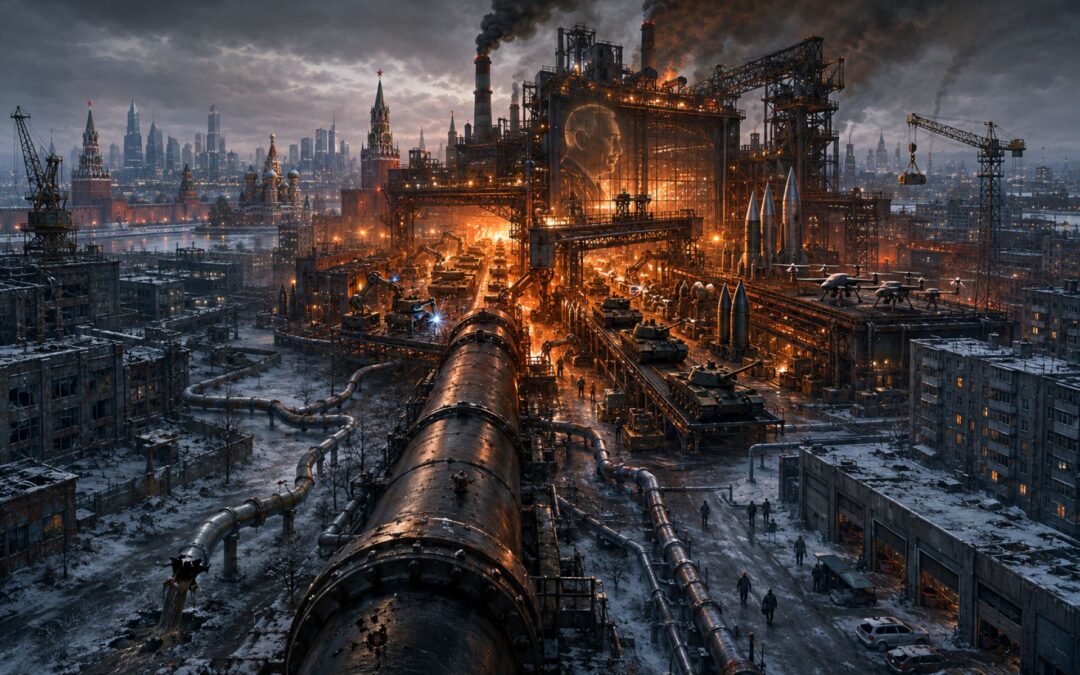
When Russia invaded Ukraine on February 24, 2022, Western governments responded with one of the most extensive sanctions campaigns ever imposed on a major economy. Russian banks were cut off from important international financial networks, foreign reserves were immobilized, technology exports were restricted, and Europe began dismantling its dependence on Russian energy. Many analysts expected these measures to impose such enormous costs that Moscow would struggle to sustain its invasion.
Instead, Russia’s economy survived the initial shock and entered an extraordinary period of wartime expansion. Factories increased production, military wages rose, oil continued flowing to international markets, and government spending propelled economic growth. By 2024, Russian GDP was growing faster than that of many European economies, apparently contradicting predictions that sanctions would cripple the country.
Yet the apparent success concealed a fundamental economic transformation. Russia was increasingly directing its workers, factories, banks, and public finances toward military production, while civilian businesses faced labor shortages, expensive borrowing, and restricted access to technology. After growing by almost 5% in 2024, the economy slowed sharply in 2025, with growth remaining weak in 2026.
The central question is no longer whether Russia survived sanctions. It clearly did. The more important question is whether an economy built to sustain a prolonged war can continue functioning without steadily undermining the civilian prosperity, productive capacity, and financial stability on which its future depends.
The Economic Model Putin Inherited—and Rebuilt Around Energy
Russia’s present economic system emerged from one of the most traumatic transformations in its modern history. The end of the Cold War and the collapse of the Soviet Union in 1991 dismantled a centrally planned economy that had connected factories, suppliers, transport networks, and entire industrial regions across fifteen Soviet republics. Enterprises that once operated within a single political and economic system suddenly found themselves separated by international borders, disrupted supply chains, and collapsing government orders.
Under President Boris Yeltsin, Russia attempted to replace communist central planning with a market economy through rapid reforms commonly described as shock therapy. Prices were liberalized, foreign trade was opened, and state-owned businesses were privatized. However, Russia lacked many of the institutions needed to manage such a transformation, including reliable commercial regulation, effective tax collection, and a dependable legal framework for private enterprise.
The consequences were devastating. Industrial production contracted, inflation destroyed household savings, wages frequently went unpaid, and public services deteriorated. A small group of politically connected businessmen acquired enormous influence over banks, natural resources, and major industrial enterprises through controversial privatization arrangements. Organized crime expanded as millions of ordinary Russians experienced insecurity and declining living standards.
The collapse cannot be attributed entirely to shock therapy. The disintegration of Soviet production networks, inefficient inherited industries, declining military orders, monetary instability, and weak political institutions all contributed. Nevertheless, for many Russians, the transition became associated with economic humiliation and the concentration of wealth in the hands of oligarchs.
Vladimir Putin inherited this deeply damaged political and economic system when he became president in 2000. Fortunately for him, conditions were beginning to improve. Russia had emerged from the 1998 financial crisis with a devalued currency and unused industrial capacity, while international oil prices were entering a prolonged period of growth.
Russia possessed enormous reserves of oil, natural gas, coal, and other valuable resources, including metals and minerals essential to global industry. Rising energy revenues allowed the government to repay debts, accumulate financial reserves, increase pensions and public-sector wages, and restore greater control over the economy. Living standards improved considerably during Putin’s early years, creating a powerful contrast with the turmoil of the preceding decade.
Putin did not eliminate the oligarchic economic system. Instead, he changed its political foundations. Wealthy businessmen could retain substantial fortunes provided they did not challenge the Kremlin, while strategic sectors such as energy, banking, infrastructure, and defense came under stronger state influence.
This arrangement formed an important part of Putin’s political legitimacy. The government offered economic stability, improved consumption, and rising incomes while progressively weakening independent institutions and political competition. The contrast with the insecurity of the 1990s helped make stability one of the defining promises of his rule.
Energy exports also became an instrument of foreign policy. Russia developed extensive pipeline networks and long-term supply agreements with European customers, making its oil and gas essential to industries, power generation, and household heating across the continent. Before the full-scale invasion of Ukraine, Russia supplied approximately 45% of the European Union’s imported natural gas and more than a quarter of its imported oil.
For Russia, these relationships generated enormous revenues and international influence. For Europe, they offered relatively affordable energy and the expectation that economic interdependence would discourage major confrontation. Both sides had substantial financial interests in maintaining the relationship, but those interests would prove insufficient to prevent war.
Why the Invasion Did Not Produce the Expected Economic Collapse
Putin’s previous military interventions had produced consequences that were economically manageable for Moscow. In 2008, Russian forces entered Georgia and helped consolidate the position of Moscow-backed separatist territories. In 2014, Russia seized Crimea and supported armed separatism in eastern Ukraine, provoking Western condemnation and targeted sanctions without fundamentally excluding Russia from international energy markets or financial networks.
These experiences may have encouraged the Kremlin to believe that another military operation could achieve its objectives before international opposition became decisive. Russian forces entered Ukraine in February 2022 apparently expecting a relatively quick victory, the collapse or displacement of the Ukrainian government, and the restoration of Moscow’s political influence over the country.
Instead, Ukrainian resistance prevented Russia from achieving its initial objectives. Russian forces withdrew from northern Ukraine, and the conflict developed into a prolonged war of attrition. Moscow suddenly faced an economic challenge far greater than surviving a brief period of diplomatic confrontation: it needed to sustain years of military operations while confronting unprecedented international restrictions.
Western sanctions attacked several elements of the Russian economy simultaneously. Financial measures restricted major Russian banks and prohibited transactions involving the central bank’s reserves held in participating jurisdictions. Several banks lost access to SWIFT, the international messaging system used to coordinate cross-border payments, although not every Russian bank was disconnected.
Export controls targeted advanced semiconductors, industrial machinery, telecommunications equipment, aircraft components, sensors, and other technologies with civilian and military applications. Western governments also attempted to reduce Russian energy earnings through restrictions on coal and oil purchases and the introduction of a price cap on seaborne Russian crude.
The oil cap reflected an important compromise. Its purpose was not to eliminate every Russian barrel from international markets, which could have created a global supply shortage and driven prices sharply higher. Instead, participating countries attempted to reduce Russia’s earnings by restricting access to their shipping, insurance, and financial services when covered oil was sold above the permitted price.
The initial financial shock was severe. The ruble fell sharply, households rushed to withdraw money, imports declined, and inflation accelerated. On February 28, 2022, the Bank of Russia increased its key interest rate from 9.5% to 20%, attempting to stabilize the currency and prevent panic from spreading throughout the banking system.
Interest rates were only one part of the response. The authorities restricted international financial transfers, limited foreign-currency cash withdrawals, required exporters to convert portions of their foreign earnings into rubles, and temporarily suspended trading in parts of Russia’s financial markets. Banks received emergency liquidity and regulatory assistance, while foreign investors faced restrictions on selling Russian assets and removing their money.
These measures helped contain the immediate crisis. The ruble recovered from its initial collapse, bank withdrawals stabilized, and the central bank gradually reduced interest rates, reaching 7.5% by September 2022. Russia had prevented a financial breakdown that might otherwise have undermined its ability to function.
However, the ruble’s recovery did not mean the economy had returned to normal. A currency can strengthen when imports collapse, exporters are required to sell foreign earnings, and investors are prevented from transferring money abroad. Russia had stabilized its financial system partly by restricting the openness that previously connected it to international markets.
The emergency response bought Moscow something enormously valuable: time to reorganize trade, industrial production, and government spending around the requirements of a long war.
How Russia Kept Trade and Energy Exports Moving
One of the greatest weaknesses in the sanctions strategy was the assumption that Russia could be isolated from the international economy. Although the United States, European Union, United Kingdom, Japan, and several other countries imposed extensive restrictions, much of the world did not participate in the sanctions coalition.
Russia consequently began redirecting trade toward countries willing to maintain commercial relationships. China became particularly important as a supplier of machinery, electronics, vehicles, industrial equipment, and consumer goods that Russia could no longer obtain as easily from Western manufacturers.
Other countries served as intermediaries. Products moved through Türkiye, the United Arab Emirates, Kazakhstan, Armenia, Kyrgyzstan, and additional trading centers before reaching Russian customers. Some arrived through parallel imports, in which goods were legally purchased in one market and resold without the original manufacturer’s authorization. Other transactions involved more opaque networks intended to conceal the ultimate destination of restricted products.
A Western component that could no longer be exported directly to a Russian company might travel through several distributors before reaching its final buyer. Payments increasingly involved Chinese yuan, local currencies, smaller financial institutions, and complex third-country arrangements.
These workarounds allowed Russian businesses to continue operating, but they did not make sanctions irrelevant. Additional intermediaries increased transaction costs, delayed deliveries, complicated payments, and created uncertainty about whether banks or suppliers would suddenly refuse to participate. Access to advanced equipment remained more difficult, particularly when replacement components required specialized Western technology.
Energy exports provided an even more important source of resilience. Unlike specialized industrial goods, Russian oil could be transported by sea and redirected toward willing buyers. India, previously a comparatively minor customer for Russian crude, dramatically increased its purchases, while China remained one of Moscow’s most important energy partners.
According to the US Energy Information Administration’s analysis of Russia’s changing oil trade, Asia and Oceania received approximately 81% of Russia’s crude-oil and condensate exports in 2024. China imported an average of roughly 2.2 million barrels per day, while India imported approximately 1.7 million barrels per day.
These purchases helped preserve Russian export volumes and provided the Kremlin with vital foreign earnings. India and China benefited from access to discounted crude, while Russia gained enormous markets outside the Western sanctions coalition.
However, maintaining export volumes was not equivalent to preserving the same profits. Buyers could demand discounts, while alternative shipping routes, insurance arrangements, financial intermediaries, and sanctions compliance created additional expenses.
Russia also developed a large network of oil tankers commonly described as a shadow fleet. Many operated through complicated ownership arrangements, changing flags, non-Western insurance providers, and companies established in jurisdictions that did not mirror Western sanctions.
These vessels reduced Russia’s reliance on shipping and insurance services covered by Western restrictions. They also created environmental and maritime risks because some ships were older, inadequately insured, or operated through opaque management structures that complicated accountability.
International trading hubs played a significant role in this transformation. Dubai became an important center for Russian crude transactions as some traditional commodity traders reduced their exposure to sanctioned business. Its established financial infrastructure, commercial networks, and international connectivity allowed trading firms to reorganize transactions outside some Western-controlled channels. The broader role of Dubai as an intermediary in Russian oil trading illustrates how commercial networks can adapt when geopolitical restrictions change.
Not every transaction involving Russian oil or an intermediary jurisdiction constitutes sanctions evasion. The legal position depends on the parties, services, prices, applicable restrictions, and jurisdictions involved. Nevertheless, these complex arrangements made enforcement more difficult and raised the costs of international trade.
Russia’s success in finding alternative buyers should also not obscure how profoundly its relationship with Europe changed. The European Commission’s assessment of Europe’s reduced dependence on Russian energy shows that Russia’s share of EU gas imports declined from approximately 45% in 2021 to around 12% in 2025. Russian oil fell from roughly 27% to approximately 2%, while Russian coal imports were eliminated.
Some Russian energy continued entering European markets, including liquefied natural gas and supplies through remaining routes. But the old relationship had been fundamentally weakened, and Russia could not simply redirect every pipeline previously serving Europe toward Asia.
Moscow had succeeded in keeping much of its international energy trade functioning. It had not preserved its former customers, pricing power, technological relationships, or commercial independence.
How Military Spending Engineered the Boom
Once Russia stabilized its financial system and reorganized essential trade, the Kremlin began spending on a scale that transformed the domestic economy.
Military factories received enormous orders for artillery shells, missiles, drones, armored vehicles, uniforms, electronics, and other equipment. Production lines expanded, factories introduced additional shifts, and defense contractors competed aggressively for workers. Construction, transportation, metals, chemicals, engineering, and logistics businesses benefited from the resulting demand.
The government also increased payments to soldiers, introduced substantial recruitment bonuses, and provided compensation to families affected by the war. Defense-dependent industrial regions experienced rising wages and investment as the state directed resources toward military production.
Financial policy reinforced these changes. State influence over the banking sector allowed the government to channel credit and subsidies toward strategically important enterprises. Defense manufacturers and related industries could continue receiving financial support even when ordinary businesses faced expensive borrowing conditions.
By 2025, Russia’s military expenditure had reached an estimated $190 billion, equivalent to approximately 7.5% of GDP, according to SIPRI. The scale of this commitment helps explain why the economy initially appeared so resilient despite sanctions and the enormous cost of the war.
Government spending generated genuine economic activity. Defense factories employed workers, suppliers received contracts, and additional wages supported spending on housing, food, transport, and consumer services. Money circulating through the economy created further demand and tax revenue, allowing some households and businesses to experience substantial improvements in their financial circumstances.
This helps explain why Russia’s GDP could expand rapidly even while its international relationships deteriorated. Gross domestic product measures the value of goods and services produced within an economy. It does not directly measure whether those goods improve living standards, create lasting productive assets, or strengthen the country’s future economic capacity.
A factory manufacturing refrigerators and a factory manufacturing artillery shells both contribute to recorded economic output. Yet the long-term economic consequences differ. A refrigerator provides household utility over many years, while productive infrastructure can support further economic activity. A shell consumed on the battlefield does not create the same continuing civilian benefit, although it may serve the government’s military objectives.
War expenditure can therefore increase GDP without producing an equivalent improvement in civilian prosperity. Some military investment creates usable infrastructure, and some defense-related technology can have civilian applications, but a large share of wartime production is intended for immediate military consumption.
Russia’s economic expansion was not imaginary. Factories were producing, people were earning wages, and government spending was stimulating demand. The problem was that the economy’s growth increasingly depended on activities selected for their contribution to the war rather than their ability to improve long-term civilian productivity.
As defense factories approached their production limits, this model began encountering a more fundamental constraint: Russia could create additional demand through government spending, but it could not create unlimited workers, machinery, materials, or productive capacity.
The Two-Speed Economy Behind the GDP Figures
Russia’s headline economic figures concealed an increasingly divided industrial system. Businesses connected to military procurement enjoyed enormous state-backed demand, while much of the civilian economy struggled with the consequences of that same spending.
Defense manufacturers benefited from government contracts, subsidized credit, and political priority. Suppliers of steel, chemicals, electronics, machinery, and transportation services could also benefit when their products supported military production. In industrial regions dependent on defense facilities, employment and wages sometimes improved considerably.
Civilian businesses faced very different conditions. Manufacturers of household appliances, consumer vehicles, and other ordinary goods had to compete for workers and raw materials against defense contractors whose orders were financed by the government. At the same time, sanctions complicated access to imported equipment, replacement components, and international customers.
The distinction was not absolute. Steel producers, engineering firms, transportation companies, and construction businesses could serve both military and civilian customers. Nevertheless, the government’s spending priorities increasingly determined which industries received favorable financing, investment, and scarce productive resources.
Labor became one of the most serious constraints.
Hundreds of thousands of working-age Russians were drawn into military service or defense-related employment. Others left the country after the invasion and the partial mobilization announced in September 2022, including people working in technology and other skilled professions. Russia’s aging population and pre-existing demographic difficulties further restricted the available workforce.
The result was intense competition for employees. Military contractors could offer wages supported by large government contracts, while recruitment bonuses made military service financially attractive to some workers. Civilian businesses frequently struggled to match these offers without increasing the prices they charged customers.
For employees who remained in favored industries, higher wages represented a genuine economic benefit. Household spending continued, and certain regions experienced improvements in employment and income. But rising wages did not necessarily reflect an equivalent improvement in productivity.
When businesses pay more for workers without producing proportionately more goods and services, their costs increase. Companies may respond by raising prices, which encourages employees to demand further wage increases to protect their purchasing power. Government spending can reinforce the cycle by maintaining strong demand even when the economy lacks the capacity to increase production sufficiently.
Russia consequently experienced serious inflationary pressure. Consumer-price inflation reached approximately 9.5% in 2024, while defense factories were operating close to capacity and civilian employers were competing for increasingly scarce labor.
The Bank of Russia faced a difficult choice. Allowing inflation to accelerate would weaken purchasing power and undermine monetary stability, but increasing interest rates would make borrowing more expensive for businesses and households already struggling with sanctions and higher production costs.
In October 2024, the central bank raised its key interest rate to 21%, reflecting the extraordinary pressure created by government expenditure, limited labor supply, and rapid credit growth. Higher rates were intended to discourage borrowing and reduce demand sufficiently to contain inflation.
Yet the impact was uneven. The Kremlin could continue financing priority military programs through budget allocations, subsidies, and state-influenced banking institutions. Ordinary businesses generally lacked those protections.
Mortgages became more expensive, consumer borrowing slowed, and private companies postponed investment. Manufacturers that needed new machinery or additional facilities found that financing projects had become increasingly difficult, even when their products remained commercially viable.
The pressure was particularly damaging for companies facing simultaneous shortages of labor and imported equipment. Some civilian industries, including motor vehicles and household appliances, experienced sharp declines from their pre-invasion production levels. Restricted access to Western technology also made maintaining and modernizing existing industrial equipment more difficult.
Russia’s monetary position subsequently improved enough for the central bank to reduce interest rates, but the underlying constraints did not disappear. In its September 2026 monetary-policy assessment, the Bank of Russia held its key rate at 14%, with annual inflation measured at approximately 6.3% on September 7. The bank described labor-market tightness as easing but still significant, while inflation remained above its 4% target.
A 14% policy rate was substantially below the wartime peak, but it remained restrictive for companies considering long-term investment. The government continued prioritizing defense production while many civilian firms faced uncertainty about future demand, technological access, and financing costs.
This helps explain the slowdown in overall economic growth. Russia’s GDP expanded by approximately 4.9% in 2024, according to revised figures, before slowing to around 1% in 2025. The Bank of Finland’s October 2026 forecast projected growth of approximately 1% in 2026 and just 0.5% in 2027.
These figures do not imply that every Russian industry entered recession. Military-related production remained important, some businesses continued expanding, and households experienced different economic conditions depending on their occupations and regions.
The larger problem was that Russia had moved closer to the limits of its productive capacity. When factories are already operating intensely and workers are difficult to find, additional government orders cannot automatically generate equivalent increases in output. Instead, they can produce higher wages, higher prices, competition for scarce inputs, and greater pressure on industries outside the state’s priorities.
The war economy had helped Russia overcome the initial impact of sanctions. It was now restricting the country’s ability to achieve balanced and sustainable growth.
Oil Prices, Fiscal Deficits and the Cost of Continuing the War
Military production cannot continue indefinitely without reliable financing. For Russia, oil and gas revenues remain an essential part of the state’s ability to fund the war while maintaining its other financial commitments.
The importance of energy exports extends beyond the number of barrels Russia sells. Government revenue depends on international prices, the discounts buyers demand, the exchange rate, transportation costs, production expenses, and the taxes collected from energy companies.
A country can therefore maintain relatively strong export volumes while receiving less financial benefit from those sales. If Russian crude sells at a larger discount or becomes more expensive to transport, the Kremlin may collect less revenue even when tankers continue carrying substantial quantities of oil to international customers.
This vulnerability became increasingly evident as Russia’s wartime spending remained elevated. The International Energy Agency reported that Russian oil revenue fell to approximately $11 billion in November 2025, around $3.6 billion below the level recorded a year earlier, reflecting weaker prices and export volumes.
Oil-market conditions subsequently fluctuated, including periods of higher international prices that temporarily supported Russian export earnings. Such increases can ease fiscal pressure, particularly when oil revenues are converted into rubles, but they do not eliminate the underlying dependence on international energy markets.
By 2026, the budgetary strain was becoming increasingly visible. According to Russian Finance Ministry figures reported in October 2026, the federal deficit reached approximately 5.186 trillion rubles during January–September, equivalent to 2.2% of GDP. The government’s full-year deficit projection was raised to 3.2% of GDP, while oil and gas revenues had fallen 17.2% compared with the corresponding nine-month period of 2025.
These figures matter because military expenditure is only one responsibility of the Russian state. The government must also finance pensions, healthcare, education, regional administrations, infrastructure, public-sector salaries, and support for industries affected by sanctions or weak demand.
When defense commitments absorb a larger share of available resources, other priorities become more difficult to finance. The state can increase taxation, reduce or postpone civilian spending, borrow more money, or use financial reserves accumulated during previous years of strong energy earnings.
One of Russia’s principal fiscal buffers has been the National Wealth Fund. The fund accumulated assets partly to provide support when oil revenues weakened and to help the government manage long-term financial obligations.
However, not every asset held by the fund is immediately available for budgetary expenditure. Some resources are invested in companies, infrastructure, or other relatively illiquid holdings that cannot simply be converted into cash without complications.
The distinction has become increasingly important as the government has drawn upon accessible resources. According to Finance Ministry figures published in October 2026, the liquid portion of the National Wealth Fund stood at approximately 3.8 trillion rubles, or around $45 billion, at the beginning of October. That represented roughly 1.6% of projected annual GDP.
Before the full-scale invasion, the fund’s liquid resources had represented a considerably larger share of the economy. Their decline reduced the government’s capacity to absorb additional financial shocks without relying more heavily on taxation, borrowing, or spending cuts.
Nevertheless, the depletion of liquid reserves would not automatically make Russia bankrupt or incapable of financing military operations. Russian government debt remains relatively low compared with that of many major economies, allowing Moscow some additional borrowing capacity.
The Kremlin can issue domestic bonds, encourage state-influenced banks to provide financing, increase taxes and fees, or redirect funds from civilian priorities. Inflation and exchange-rate movements can also alter the real burden of government expenditure, although these mechanisms impose costs elsewhere in the economy.
Each alternative carries consequences. Higher taxes weaken household purchasing power and business profitability. Additional borrowing increases future interest obligations, while reductions in civilian expenditure can undermine infrastructure, services, and investment. Directed financing may sustain strategically important industries but create further distortions in credit allocation.
Natural gas presents a related challenge. Unlike seaborne oil, pipeline gas depends on extensive infrastructure connecting specific producers and customers. The termination of Russian gas transit through Ukraine at the beginning of 2025 further reduced established European sales routes, while replacing those customers with Asian buyers required infrastructure that could not be built immediately.
The proposed Power of Siberia 2 pipeline illustrates the difficulty. Russia and China advanced the project through a memorandum in 2025, but important negotiations remained unresolved in October 2026. Even a completed agreement would not immediately reproduce the commercial terms or revenue generated by Russia’s former European pipeline relationships.
China also possesses considerable bargaining power. Because Russia has fewer alternative customers for some of its resources, Beijing can negotiate prices and conditions from a stronger position. India and other major buyers have similarly benefited from Moscow’s need to maintain access to international markets.
Russia still possesses substantial financial and natural resources, but the cost of maintaining its wartime economic system increasingly extends beyond the military budget. It also appears in reduced fiscal flexibility, greater dependence on external buyers, higher taxation, constrained civilian investment, and the gradual consumption of resources that could otherwise support future development.
What Sanctions Have—and Have Not—Achieved
Assessing the effectiveness of sanctions requires distinguishing their different objectives. A measure intended to destroy a financial system within months should not be judged by the same standard as one designed to restrict technological access or reduce long-term economic growth.
If sanctions were expected to produce an immediate collapse of the Russian economy, force Putin from power, or compel Moscow to abandon the invasion quickly, they did not achieve those outcomes. Russia stabilized its banks, maintained major energy exports, reorganized international trade, and substantially expanded military production.
Western restrictions also failed to eliminate Russian access to every prohibited technology. Goods continued reaching Russian businesses through intermediary countries, alternative suppliers, and complex trading networks. The existence of these channels demonstrated how difficult it was to isolate a large, resource-rich economy from global commerce when many countries remained outside the sanctions coalition.
However, the failure to produce immediate capitulation does not mean sanctions were economically inconsequential.
Restrictions reduced Russia’s access to advanced machinery, financial services, and important export markets. Businesses faced higher transportation costs, less reliable payments, more complicated supply chains, and difficulties acquiring specialized components. Europe substantially reduced its dependence on Russian energy, while Moscow increasingly relied on discounted sales and alternative commercial arrangements.
These changes have weakened Russia’s longer-term economic opportunities. Investment in modern civilian industry becomes more difficult when companies cannot reliably obtain equipment, technology, or affordable financing. A country may continue manufacturing existing products while gradually falling behind competitors that retain access to international innovation and investment.
Russia’s growing dependence on China introduces another strategic disadvantage. China provides crucial machinery, electronics, financial channels, and export markets, but it is not economically dependent on Russia to the same degree. Moscow’s reduced alternatives allow Chinese businesses and policymakers to negotiate from a position of relative strength.
At the same time, sanctions should not be blamed for every difficulty in Russia’s economy. The Kremlin’s decision to sustain a prolonged war has itself diverted labor, industrial equipment, financial resources, and political attention away from civilian development. Mobilization, military procurement, and state-directed investment would create substantial economic trade-offs even without international restrictions.
The effects of sanctions and wartime policy have reinforced one another. Sanctions made it harder to expand productive capacity, while military spending increased demand for resources that were already becoming scarce.
Russia’s experience therefore illustrates a distinction between economic punishment and political compulsion. Western sanctions have increased the cost of the war and constrained Russia’s economic development, but they have not demonstrated sufficient power to force the Kremlin to abandon its central military objectives.
How Long Can Russia Sustain This Economy?
Russia’s ability to continue financing the war looks very different depending on the period being considered.
In the short term, Moscow retains considerable economic resources and political control over their distribution. The country continues exporting oil, collecting taxes, and borrowing domestically. Its defense factories have established production facilities, trained workers, supply chains, and government contracts that allow military output to continue.
The Kremlin also has considerable influence over banks, major industries, and public spending decisions. It can prioritize weapons production, military salaries, and strategic infrastructure even when civilian businesses face limited financing and households experience higher economic burdens.
Russia’s relatively low government debt provides additional room to borrow. Higher energy prices or favorable currency movements may temporarily improve budget revenues, while the state can postpone nonmilitary projects or increase taxation to protect military commitments.
These mechanisms do not guarantee unlimited financial capacity, but they make an immediate economic event that renders continued warfare impossible difficult to assume. A government willing to sacrifice civilian consumption and future investment can sustain military priorities longer than headline growth figures alone might suggest.
Over the medium term, however, the economic trade-offs become increasingly severe. Defense factories cannot expand indefinitely without additional skilled workers, machinery, imported components, and investment. Once industrial facilities approach their operational limits, spending more money produces progressively smaller increases in real output.
Additional borrowing raises financing costs, higher taxes weaken private-sector incentives, and persistent labor shortages make production more expensive. Civilian businesses may struggle to modernize equipment or invest in productivity improvements, increasing the gap between Russia’s industrial capabilities and those of economies with broader access to technology.
Economists disagree about how quickly these pressures could become destabilizing. The Kiel Institute’s assessment of Russia’s wartime economic limits emphasizes growing structural exhaustion, depleted financial buffers, constrained production, and Russia’s increasingly unequal economic relationship with China.
The Bank of Finland’s October 2026 forecast also identifies weak growth and persistent structural problems but does not suggest that Russia is about to lose the financial capacity to support its military operations. These assessments are not necessarily contradictory. An economy can become less productive and more financially strained while retaining enough resources to sustain the government’s highest political priority.
The longer-term challenge may ultimately be more difficult than an immediate fiscal crisis.
Years of restricted technological access, limited civilian investment, and dependence on commodity exports can weaken productivity. The departure of skilled workers and an aging population may compound labor shortages, while industrial machinery and infrastructure become increasingly difficult to replace or modernize.
Russia’s defense industry also creates a problem for any future transition away from war. Factories that depend heavily on military contracts may struggle when those contracts decline, and regions built around defense employment could experience serious economic disruption.
Research from the Carnegie Russia Eurasia Center on the difficulties of returning to a civilian economy estimated that employment in Russia’s military-industrial complex had risen to approximately 3.8 million people. The precise figure will change over time, but the scale illustrates how deeply wartime production has become embedded in the country’s industrial and employment structures.
Reducing military expenditure could release resources for civilian uses, but the transition would require new markets, different production lines, retraining, and investment. Maintaining elevated defense spending indefinitely would avoid some immediate industrial disruption while continuing to consume resources that might otherwise support civilian development.
These economic constraints also carry political implications for Putin.
His authority has long been associated with the promise that Russia would never return to the insecurity and instability of the 1990s. Rising living standards and the restoration of state power helped establish that reputation, even as political competition and independent institutions weakened.
A prolonged period of stagnant incomes, higher taxes, deteriorating public services, and limited economic opportunities could place that political bargain under greater strain. Nevertheless, economic dissatisfaction does not automatically translate into political change, particularly in a system where media, opposition activity, and public protest face substantial restrictions.
The Kremlin may be able to maintain political control while requiring ordinary Russians to accept increasing economic sacrifices. That possibility makes the durability of the regime different from the long-term health of the economy it governs.
Russia has demonstrated that a large authoritarian state with substantial natural resources, industrial capacity, and control over domestic finance can adapt to severe international pressure. Its economic resilience has been more durable than many early predictions suggested.
But the measures that sustained the war have also created a system increasingly dependent on military demand, state intervention, limited labor, and vulnerable commodity revenues. The Kremlin can continue directing resources toward weapons production, yet doing so leaves fewer resources available for the investment, innovation, and civilian prosperity that determine a country’s long-term economic strength.
Russia’s war economy has not collapsed, and its slowdown does not mean the war must end soon. Its central weakness is more gradual: the country can remain capable of fighting while steadily sacrificing the economic opportunities that might otherwise have defined its future.
Last Updated on October 20, 2026 by Aseem Gupta