
Reading Time: 29 Minutes
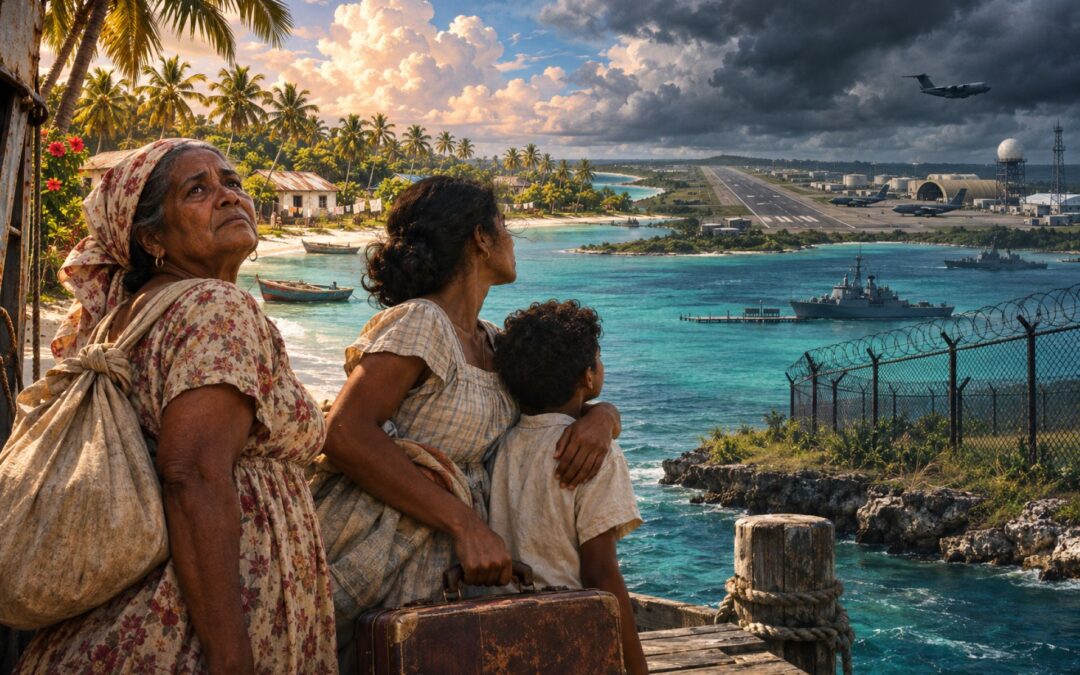
In the middle of the Indian Ocean, more than a thousand kilometres from the nearest major landmass, lies an island that has become one of the most strategically important military installations in the world. Diego Garcia has long runways capable of accommodating American strategic bombers, a deep-water anchorage for warships, communications facilities, and infrastructure supporting military operations across the Middle East, Africa, and Asia.
The island belongs to the Chagos Archipelago, a collection of coral atolls surrounded by turquoise lagoons and tropical waters. Officially administered by Britain for decades, Diego Garcia has served primarily as a joint British-American military installation. Its residents are military personnel and civilian contractors, many recruited from overseas.
Yet Diego Garcia was not always a military base. For generations, it was home to a community with its own language, traditions, families, and history. The Chagossians lived on these islands long before American bombers began using their runways.
Between 1967 and 1973, Britain systematically removed the entire Chagossian population, with American support, to make the archipelago available for military purposes. Families were separated, homes abandoned, and people who had lived on the islands for generations were transported to Mauritius and the Seychelles, where many experienced devastating poverty.
What followed was a struggle lasting more than half a century. The Chagossians fought through protests, courts, and international institutions to reclaim their homeland, only to discover that military strategy and competing claims of sovereignty repeatedly took precedence over their rights.
Life in the Chagos Islands Before the Base
The Chagos Archipelago lies in the central Indian Ocean, approximately 2,200 kilometres northeast of Mauritius. It consists of seven coral atolls containing around sixty islands, although the precise count depends on how individual islands and small landforms are classified. Together, they occupy only a small area of land scattered across an enormous expanse of ocean.
Diego Garcia, the largest island, is a horseshoe-shaped atoll enclosing a sheltered lagoon. Its natural harbour, location near important maritime routes, and relative isolation would eventually attract American military planners. Before that transformation, however, its geography supported a very different way of life.
The Chagos Islands were uninhabited before permanent colonial settlement began in the eighteenth century. French colonial authorities and plantation owners established coconut plantations and brought enslaved people from Madagascar and the African mainland, particularly Mozambique, to work on them.
The islands were administered as dependencies of the French colony of Mauritius. When Britain captured Mauritius during the Napoleonic Wars, it also gained control of Chagos. France formally ceded Mauritius and its dependencies to Britain under the Treaty of Paris in 1814.
The change in colonial rulers did not immediately transform the islands’ economy. Coconut plantations continued operating, and the people working them remained dependent on plantation owners and administrators.
After slavery was abolished in the British Empire, plantation owners increasingly relied on contracted and indentured workers, including migrants from India. Over generations, descendants of enslaved Africans and Malagasy people, Indian labourers, and others formed a distinct island community.
They became known as the Chagossians, also historically called the Ilois.
Their identity developed through the shared experiences of living on isolated islands, working the plantations, raising families, and adapting cultural traditions brought from different parts of the Indian Ocean world. Chagos Kreol, a French-based Creole language, became a central expression of community identity. Most Chagossians were Roman Catholic, and religious observances, music, dance, and family gatherings formed important parts of everyday life.
The economy revolved around coconuts, particularly copra, the dried coconut flesh processed to produce coconut oil. Plantation workers harvested coconuts, prepared copra, maintained equipment, transported supplies, and performed the other tasks needed to keep the plantations operating.
The system was neither prosperous nor egalitarian. Plantation owners controlled employment, housing, supplies, and many aspects of daily life. Workers had limited economic independence, and opportunities for education or occupations outside plantation employment were restricted.
Nevertheless, the community possessed certain forms of security that would become especially significant after displacement.
Families generally occupied plantation housing without paying rent. Some homes passed from one generation to the next, although residents did not necessarily possess legal ownership. Plantation arrangements provided access to basic healthcare, schooling, and other services, while families supplemented their diets through fishing, gardening, and raising animals.
Life was difficult, but people knew their neighbours, their family histories, and the places where generations of relatives had lived and died. Cemeteries, churches, houses, fishing grounds, and familiar paths carried meanings that could not be reproduced simply by relocating people elsewhere.
The distinction matters because Chagossians were frequently described by British officials as temporary plantation workers who could be transferred when their employers no longer needed them.
That description overlooked a fundamental reality: employment on a plantation did not make the islands any less their home.
By the early 1960s, the archipelago supported a settled population numbering roughly 1,500 to 2,000 people, depending on the estimate and period. Some families had lived there for several generations. Children were born on the islands, married, raised their own children, and buried their relatives in Chagossian soil.
The islands had become a homeland, even though the people living there lacked political power over their future.
Why the United States Wanted Diego Garcia
After the Second World War, the United States emerged as a global military superpower. Its strategic interests extended far beyond North America, and American defence planning increasingly depended on installations located close to potential conflicts, maritime routes, and areas of geopolitical competition.
During the Cold War, the Soviet Union was America’s principal military rival. Washington sought the ability to deploy naval forces, aircraft, communications systems, and logistical support across different regions without depending entirely on bases located in politically unstable countries.
The Indian Ocean presented a particular challenge.
Its waters connected the Middle East, East Africa, South Asia, and Southeast Asia. Commercial shipping and energy supplies moved through nearby sea lanes, while the region bordered countries considered strategically important to both superpowers.
American planners wanted reliable access to facilities from which they could monitor naval activity, support ships and aircraft, and maintain communications across this enormous region.
Diego Garcia offered several advantages.
The island was geographically isolated, reducing the immediate political complications associated with a base beside a large civilian population. Its lagoon could support naval operations, while its land offered space for a runway and supporting infrastructure. Its location also provided access to regions that were increasingly important to American military strategy.
The strategic concept predated the final decision to establish the base. In 1959, the US Navy developed a plan identifying islands that might be secured for future military use, and American defence authorities approved the broader approach the following year.
A February 1970 memorandum preserved in the US State Department’s diplomatic records explained the strategy and described Diego Garcia as a location for naval logistics, communications, aircraft operations, and support for American forces.
The documents reveal that the base was initially presented as a relatively modest installation. Proposed facilities included communications equipment, waterfront infrastructure, fuel storage, and a runway. Its eventual military role would become much larger.
There was, however, an important political complication.
Diego Garcia was part of the British colony of Mauritius, whose independence movement was gaining strength. An independent Mauritius would have its own government and could potentially reconsider the conditions under which a foreign military facility operated.
American officials preferred an arrangement secured through Britain, whose strategic partnership with Washington made long-term access more predictable.
Britain had its own reasons to cooperate.
The Second World War had weakened British finances, and maintaining a worldwide empire was becoming increasingly expensive. Independence movements were transforming Britain’s colonial possessions, while the United States had become the dominant Western military power.
Nevertheless, Britain wanted to preserve influence in strategically important regions, even as it reduced its conventional military presence overseas.
The wider decline of the British Empire and its system of colonial administration therefore created an unusual opportunity. Britain could retain authority over a strategically valuable island while permitting the United States to develop and operate a major military installation there.
The arrangement suited both governments.
For Washington, Diego Garcia promised a dependable base in the Indian Ocean. For London, it offered a way to remain involved in regional security without bearing the full cost of maintaining an extensive military presence.
The inhabitants were the remaining obstacle.
Rather than design an agreement that protected the Chagossians’ existing communities, the two governments pursued arrangements that would make the islands available for military use without a permanent civilian population.
The Secret Deal That Erased an Entire Population on Paper
The transformation of Diego Garcia required more than building military infrastructure. Britain first had to separate the Chagos Archipelago from colonial Mauritius and create a legal framework under which it could retain control after Mauritian independence.
The negotiations unfolded during the 1960s, when decolonisation had become a central issue in international politics.
In December 1960, the United Nations General Assembly adopted Resolution 1514, the Declaration on the Granting of Independence to Colonial Countries and Peoples. It affirmed colonial peoples’ right to self-determination and opposed attempts to disrupt the territorial integrity of countries undergoing decolonisation.
This created an obvious problem for Britain’s intentions.
Mauritius was moving towards independence, yet Britain wanted to retain part of its territory for strategic purposes. The separation would serve the interests of two foreign governments rather than result from an independent political choice by the people living on the islands.
During constitutional discussions in 1965, British officials pressured Mauritian representatives to accept the detachment of Chagos. The arrangement included a payment of £3 million and commitments connected with defence and the islands’ possible future return.
Mauritian representatives agreed, but the circumstances surrounding that agreement have remained central to the legal dispute. Mauritius maintains that the detachment was imposed under colonial pressure and did not represent freely given consent.
On 8 November 1965, Britain formally created the British Indian Ocean Territory, commonly abbreviated BIOT, through an Order in Council.
The new territory included the Chagos Archipelago and several island groups detached from the Seychelles. Those additional islands were returned to Seychelles when it became independent in 1976, but Chagos remained under British administration.
The House of Lords’ examination of the later Chagos sovereignty agreement recounts these events, including the creation of BIOT and the subsequent Anglo-American defence arrangements.
An Order in Council was a constitutional instrument used by the British executive under royal authority. In this instance, the new colony was established without a specific parliamentary statute debating whether the Chagossians should lose their homeland.
Mauritius became independent on 12 March 1968, but without the Chagos Archipelago.
Even before that independence, the United Nations had objected to the separation. In December 1965, Resolution 2066 called on Britain not to take action that would dismember Mauritius and violate its territorial integrity.
Britain proceeded regardless.
The next step was to secure American military access.
On 30 December 1966, Britain and the United States concluded an agreement making BIOT available for defence purposes. The initial arrangement provided for American access over fifty years, with an extension mechanism.
Although the arrangement was publicly presented as involving no straightforward commercial rental payment, the financial relationship was more complicated. American diplomatic records describe approximately $14 million in detachment costs offset through adjustments connected with Britain’s purchase of Polaris nuclear missile technology.
The arrangement was therefore not simply an uncomplicated gift of territory to an ally. Military cooperation, financial considerations, and colonial administration were closely connected.
But the most revealing evidence concerns the Chagossian population.
British officials understood that a settled civilian community created legal and political obligations. A population with lasting connections to the islands could claim rights concerning residence, representation, and the future administration of its territory.
Their solution was to describe those residents as temporary workers instead.
Official correspondence repeatedly referred to Chagossians as Mauritian or Seychellois contract labourers who happened to be employed on the plantations. Such descriptions minimized the significance of their births, family histories, and permanent connection to Chagos.
One internal memorandum notoriously discussed obtaining the territory while ensuring that no indigenous population remained, apart from birds. Other correspondence used openly racist descriptions of the islanders.
These were not merely careless expressions. They reflected an administrative policy designed to make the population’s removal easier to justify.
British officials considered giving inhabitants temporary residence permits and describing them as people whose presence depended entirely on plantation employment. If the plantations closed, the government could then argue that the workers’ reason for remaining had disappeared.
Yet many inhabitants had been born on the islands and were citizens of the United Kingdom and Colonies, or possessed other legally significant connections to British colonial territory.
The authorities were aware of these complications.
In January 1970, Foreign Office legal adviser Anthony Aust discussed the proposed immigration legislation. Among its purposes was providing legal powers to deport unwilling residents and maintaining the official fiction that Chagos lacked a permanent or semi-permanent population.
His reasoning later appeared in the evidence examined during Chagossian litigation.
The intention was clear: if the inhabitants could be classified as temporary labourers, their removal could be presented as an administrative consequence of changing employment arrangements rather than the forced displacement of an established community.
The policy also helped Britain avoid international scrutiny of a newly created colonial territory whose population had not been given meaningful control over its political future.
In 1971, BIOT immigration legislation formalised the government’s authority to restrict entry, residence, and removal. The legislation provided the administrative means to exclude people from the land where they and their ancestors had lived.
The British government had created a political category that served its military objectives. It then treated that category as if it accurately described the people whose lives it would govern.
The Chagossians had not disappeared from the islands, but they had effectively been erased from the official account of who belonged there.
How the Chagossians Were Forced Out
The removal of the Chagossians was not accomplished through one announcement or a single mass evacuation. It unfolded over several years through restrictions, deteriorating conditions, intimidation, and ultimately direct expulsion.
The first measures were deceptively simple.
Beginning in 1967, Chagossians who travelled to Mauritius or the Seychelles for medical treatment, holidays, or family matters were prevented from returning home.
Sea transport was essential to everyday life in such an isolated community. A person might leave for treatment unavailable on the islands, expecting to return on a later ship. Under the new policy, that ordinary journey could become permanent exile.
Some travellers had left behind children, siblings, parents, houses, possessions, and employment. They had no reason to believe they were saying goodbye to their homes forever.
Rita Bancoult was among those whose family experienced the consequences of these restrictions. She travelled to Mauritius with a sick child and subsequently faced the impossibility of returning to the life she had left behind.
Other families experienced similar separations. Children remained on the islands while relatives found themselves stranded elsewhere, and people waiting for loved ones to return received little clear information about what was happening.
The authorities also made life increasingly difficult for residents who remained.
Supply shipments became less reliable. Plantation services declined, and teachers and healthcare workers ceased arriving as before. Families who depended on regular deliveries of food, medicine, and essential supplies found themselves increasingly vulnerable.
Because the plantations controlled much of the local economy, closing or reducing their operations deprived people of livelihoods and undermined the basic arrangements that had supported their communities.
These measures created pressure to leave while allowing officials to describe departures as connected with the closure of commercial enterprises.
By 1971, the American military project had progressed from planning towards physical construction. The US Navy’s construction personnel began developing facilities on Diego Garcia, and the remaining civilian population faced direct removal.
A particularly disturbing episode involved the islanders’ dogs.
Dogs were common companions in Chagossian households. Families kept them as pets, and children developed close attachments to animals that formed part of everyday life.
In 1971, the authorities ordered the dogs on Diego Garcia to be destroyed.
After attempts to kill them through shooting and poisoning, large numbers were reportedly gassed using exhaust fumes. Accounts collected from former residents describe the distress caused by the destruction of animals they had known and cared for.
The Human Rights Watch investigation into the Chagossians’ forced displacement documents the episode through testimony and historical records.
The killing of the dogs served as more than an isolated act of cruelty in the memories of those who witnessed it. It demonstrated that the authorities could destroy familiar elements of island life without the residents having any meaningful power to stop them.
Some islanders feared that the same people who had killed their animals might eventually turn against them.
The authorities did not publicly describe the operation as a threat to the population. Nevertheless, its intimidating effect became part of the Chagossians’ collective memory of their expulsion.
When the inhabitants of Diego Garcia were ordered to leave, many were initially transferred to other islands in the archipelago, particularly Peros Banhos and the Salomon Islands.
This temporary movement created a painful contradiction.
The Chagossians were prepared, in some cases, to relocate within their homeland rather than abandon it altogether. But the British-American plan ultimately required the removal of the civilian population from the archipelago, not merely from the immediate construction area.
The outer islands were never intended to become a permanent refuge.
There, plantation operations and supplies continued to deteriorate. Families struggled to obtain essentials, and residents were eventually informed that they would also have to leave.
Transportation conditions were often appalling.
Some Chagossians were carried in crowded ships with inadequate sleeping arrangements, sanitation, and provisions. Accounts describe families travelling below deck, enduring sickness and exhaustion during journeys lasting several days.
The treatment of animals aboard these ships became another source of humiliation. British colonial administrator Bruce Greatbatch had insisted on transporting horses, and former passengers recalled that animals sometimes received more comfortable accommodation than the people being displaced.
For islanders who had spent their lives within a small and familiar community, the journeys marked the beginning of an uncertain existence thousands of kilometres away.
The testimony of Liseby Elysé provides an especially powerful account.
Born on Peros Banhos in 1953, Elysé was pregnant when she was forced to leave in April 1973. She later described the filthy and overcrowded conditions aboard the vessel, where people travelled alongside animals and lacked adequate sanitation.
After arriving in Mauritius in early May, she suffered a miscarriage. She associated the loss with the trauma and conditions surrounding her displacement.
Her experience illustrates how the consequences of expulsion extended far beyond the loss of a house or job.
Her journey was not, however, the final deportation from Chagos.
On 26 May 1973, the vessel Nordvaer departed Peros Banhos carrying the last group of Chagossians removed from the archipelago. It reached Mauritius in June after travelling through the Seychelles.
The final passengers included men, women, and dozens of children.
By the middle of 1973, the established civilian communities of Chagos had been eliminated from their homeland.
The plantations were closed, the families were gone, and the islands had been transformed into territory controlled for military purposes.
The people had not voluntarily abandoned a declining settlement. Their removal was the result of deliberate policies pursued by Britain to secure the islands for American defence requirements.
Exile: Poverty, Grief and the Meaning of Sagren
When Chagossian families arrived in Mauritius and the Seychelles, many discovered that the promises made before their departures had little connection with the reality awaiting them.
Some had been told that employment, accommodation, or other support would be available. Instead, families often arrived with few possessions, little money, and nowhere secure to live.
The transition was particularly difficult because their previous lives had operated within a plantation economy where housing and basic services were closely connected to employment.
That system had been restrictive, but it had also provided a framework through which families obtained shelter, food, and access to essential services.
In Mauritius, displaced islanders suddenly had to find accommodation and employment in a cash economy they had little experience navigating.
They needed money for rent, food, transport, and medical treatment. Yet many lacked qualifications recognised outside plantation work, had limited formal schooling, and possessed no savings with which to establish themselves.
The consequences were severe.
Families crowded into inadequate housing, struggled to find regular employment, and became vulnerable to debt. Some borrowed money for necessities and encountered exploitative lending arrangements.
The Chagossians also faced social discrimination. Although Mauritius had historical connections with the archipelago, the displaced islanders were not simply absorbed into a welcoming community.
Their language, customs, poverty, and history sometimes marked them as outsiders. People whose identities had been shaped by an isolated island society found themselves marginalised in places where they had never expected to live.
Those transported through the Seychelles experienced their own hardships. Some were temporarily accommodated in prison facilities before continuing to Mauritius, while Chagossians who remained in the Seychelles faced restricted opportunities and inadequate compensation.
The suffering was not limited to material poverty.
Displacement separated people from family graves, familiar landscapes, places of worship, and the social relationships through which they understood their lives. Older residents who had spent decades on the islands struggled particularly with the realization that they might never return.
Chagossians use the Creole word sagren to describe profound grief, sorrow, and the emotional suffering associated with their loss.
For some, the word came to express the devastating effects of exile on their health and well-being. Families believed that the grief of displacement contributed to illnesses and deaths among relatives who could not adjust to the circumstances imposed upon them.
Such experiences should not be simplified into a claim that sorrow always directly caused particular deaths. Poverty, inadequate healthcare, poor living conditions, and psychological distress interacted in ways that were difficult to separate.
The emotional consequences were nonetheless real.
Rita Bancoult, whose family had been displaced from Chagos, lost several children after their removal. Other parents described the deaths of young children during years when families faced hardship and insecurity.
These accounts reveal why compensation calculated only through lost wages or property could never fully capture what had happened.
The Chagossians had lost not only an economic arrangement but also the ability to live within a community organised around shared history, language, relationships, and a particular homeland.
The British government initially provided funds to Mauritius for resettlement, including £650,000 in the early 1970s. Further compensation arrangements followed during the 1980s, but the sums distributed to individuals were limited, and the process became deeply controversial.
People who had already endured years of hardship often possessed little bargaining power when presented with settlement documents.
The compensation arrangements also raised questions about whether recipients had knowingly relinquished future legal claims. Language barriers, limited literacy, and the use of thumbprints on documents became important parts of the controversy.
Many Chagossians believed they had received neither adequate compensation nor meaningful recognition of the wrong committed against them.
The displacement also continued to shape the lives of subsequent generations.
Some Chagossians eventually moved to Britain after changes to nationality law expanded access to British citizenship in 2002. Yet migration to Britain did not automatically end their difficulties.
Families encountered unemployment, housing insecurity, unfamiliar institutions, and discrimination. Some arrived without adequate support and struggled to establish themselves in a country whose government had played a central role in their original displacement.
Their descendants inherited a connection to islands they had never seen. Chagos survived through family stories, photographs, language, cultural traditions, and the persistent determination to return.
A community physically removed from its homeland had not ceased to exist.
Diego Garcia Becomes a Base for Global War
As the Chagossians struggled to survive in exile, Diego Garcia developed into the military installation that British and American officials had envisioned.
The original facilities expanded over subsequent decades. Runways were lengthened, storage and communications systems improved, and infrastructure was developed to support increasingly substantial naval and air operations.
The island’s location made it especially useful to the United States.
Unlike facilities situated within heavily populated countries, Diego Garcia could accommodate sensitive operations far from ordinary public scrutiny. Its sheltered lagoon and maritime infrastructure supported ships, while its airfield allowed military aircraft to operate across vast distances.
The base became an important logistics and operational centre for American forces in the Indian Ocean.
During the 1991 Gulf War, Diego Garcia supported military operations against Iraq. Its role expanded during the wars in Afghanistan and Iraq after 2001, when American long-range bombers operated from the island.
Aircraft such as the B-52, B-1, and B-2 could use the installation within broader American military operations, supported by refuelling, communications, and logistical networks extending far beyond Diego Garcia itself.
The base also supported naval operations and the movement of military supplies.
For strategic planners, its value lay in combining geographic isolation with the ability to project military power towards several regions.
For the Chagossians, that same isolation had been used to justify their exclusion.
The contrast between military activity and civilian access became increasingly striking.
The island developed recreational facilities for personnel, alongside accommodation, workplaces, and services supporting the base. Civilian contractors from countries including the Philippines and Mauritius performed a variety of operational and maintenance tasks.
Yet the people whose families had lived on Diego Garcia for generations remained unable to resettle there.
This arrangement exposed the weakness in arguments that the island was inherently unsuitable for people to inhabit. Its facilities supported a substantial working population, although maintaining a civilian community with permanent rights would involve different security, infrastructure, and governance requirements.
Military planners considered those differences important. Chagossians argued that security could not permanently extinguish their rights to their homeland.
Diego Garcia also became entangled in controversies surrounding the American government’s detention and rendition practices after the September 2001 attacks.
Extraordinary rendition refers to transferring detainees outside ordinary legal processes, sometimes to places where they face a risk of torture or other ill-treatment.
For years, British officials denied allegations that Diego Garcia had been used in such operations.
In February 2008, however, Foreign Secretary David Miliband acknowledged that American aircraft carrying detainees had refuelled on Diego Garcia during two flights in 2002.
The British Parliament’s examination of those rendition flights documented the contradiction between earlier assurances and the later admissions.
The confirmation damaged confidence in official claims concerning military activity on the island.
There were also allegations that Diego Garcia had served as a secret detention facility. These allegations must be distinguished from the confirmed rendition flights. American authorities denied operating a CIA holding facility on the island, and the admission of aircraft movements did not conclusively establish that a secret prison operated there.
The controversy nevertheless demonstrated how restrictions on public access and limited transparency complicated independent scrutiny of the base.
Diego Garcia remained strategically relevant as tensions in the Middle East continued.
In March 2026, the British government confirmed that it had agreed to limited American use of British bases for specified defensive operations against Iranian missile facilities. Such permissions reflected the military importance of installations capable of supporting operations beyond the immediate Persian Gulf.
The precise involvement of Diego Garcia in individual missions must be established through reliable evidence rather than inferred from the presence of aircraft or the strategic capabilities of the installation.
What is beyond serious dispute is that Diego Garcia became a major component of American military power.
The facility that began as a proposed communications and logistics station developed into a strategic installation supporting operations across several wars and generations of changing military priorities.
Its continued importance helped explain why the British and American governments resisted proposals that could introduce political uncertainty over access to the island.
The Long Campaign to Return Home
The Chagossians did not simply accept their displacement.
During the years following the expulsions, they organised protests, demanded compensation, challenged their treatment, and sought recognition of their right to return.
Women played a particularly important role in the early movement.
Many had experienced the loss of children, family members, homes, and economic security. They helped organise demonstrations and hunger strikes, keeping the grievances of the displaced community visible when British officials preferred to deal primarily with the government of Mauritius.
Charlesia Alexis emerged as one of the prominent figures associated with this resistance. Her participation in protests and the treatment she received from authorities became symbols of the Chagossians’ determination to challenge their circumstances.
Rita Bancoult also helped sustain the struggle. Her son Olivier Bancoult would eventually become one of its leading representatives through the Chagos Refugees Group.
The movement faced a difficult political problem.
Britain had displaced the islanders, but the governments of Mauritius and the Seychelles were often treated as the principal parties in discussions about their welfare. The Chagossians themselves had limited opportunities to influence negotiations concerning compensation or their future.
During the 1980s, Britain provided further money under arrangements intended to settle claims connected with the expulsions.
The payments followed years of protest and litigation, but many Chagossians regarded them as inadequate. Settlement documents and legal waivers became contentious because some recipients had limited knowledge of English or did not fully understand the implications of the agreements.
The compensation controversy raised a broader question: could payments made under such circumstances extinguish the rights of people who had been forcibly removed from their homeland?
The Chagossians increasingly turned towards the courts.
Their struggle also created a revealing comparison with Britain’s policies elsewhere.
In 1982, Argentina invaded the Falkland Islands, another British-administered archipelago whose sovereignty was disputed. Britain launched a major military campaign to retake the territory, emphasizing the importance of protecting the islanders and their wishes.
The history of the Falklands War and the competing sovereignty claims involved legal and historical circumstances different from those of Chagos. The Falkland Islanders had an established community that strongly wished to remain under British administration, while the Chagossians had been expelled from their community by the British government itself.
Nevertheless, the comparison exposed a significant tension in Britain’s approach to self-determination.
In the Falklands, the preferences of an established island population became central to Britain’s political argument. In Chagos, the preferences of an established island population had been deliberately excluded from the decision that determined its future.
By the 1990s, increasing access to historical documents and legal advice enabled the Chagossians to pursue more substantial challenges.
Olivier Bancoult brought proceedings contesting the legality of the restrictions that prevented the displaced population from returning.
On 3 November 2000, the High Court delivered a landmark judgment.
In the Bancoult judgment concerning the 1971 immigration legislation, the court concluded that the powers used to exclude the islanders could not lawfully justify their wholesale removal from their homeland.
The judgment was especially important because it examined the official records surrounding the creation of BIOT and the planning of the expulsions.
It exposed the discrepancy between the administrative language used to describe the Chagossians and the reality that they belonged to the islands.
The British government initially accepted the judgment and changed the legal arrangements governing access to parts of the archipelago.
For a brief period, Chagossians appeared to have a possibility of returning to some of the outer islands, although Diego Garcia remained excluded.
That possibility did not translate into substantial resettlement.
Families lacked the resources required to rebuild homes, infrastructure, and communities on islands whose plantations had closed and whose basic services no longer existed. Returning after decades of exile would have required transport, housing, employment opportunities, healthcare, and other practical support.
The British government did not establish a comprehensive programme enabling the population to rebuild its former communities.
In 2004, the government reversed the earlier opening.
New Orders in Council prohibited residence and restricted entry throughout the territory, including the outer islands. The government cited defence requirements and concerns about the feasibility of resettlement.
Bancoult challenged these measures, winning in lower courts before the House of Lords upheld the government’s position in 2008.
The decision illustrated how a legal victory could be overturned through the interaction of executive authority, colonial law, and subsequent judicial interpretation.
Another controversy emerged in 2010 when Britain established a large marine protected area around the Chagos Archipelago.
The government presented the measure as an environmental initiative intended to protect important marine ecosystems.
Conservation was a legitimate concern. The waters around Chagos contain extensive coral reefs, marine habitats, and wildlife of considerable ecological importance.
However, leaked diplomatic correspondence suggested that British officials had also discussed the reserve as a potential means of preventing Chagossians from resettling.
The resulting legal dispute examined whether the marine reserve had been established for an improper purpose and whether the consultation process had adequately considered Chagossian interests.
In the 2014 Court of Appeal proceedings concerning the marine protected area, the court rejected Bancoult’s appeal. It did not establish that the policy had been unlawfully adopted to prevent resettlement.
The distinction matters. The diplomatic correspondence raised serious questions about government intentions, but those questions did not produce a successful legal finding invalidating the reserve on that basis.
The larger sovereignty struggle meanwhile moved beyond British courts.
Mauritius argued that Britain’s separation of Chagos in 1965 had violated the principles governing decolonisation and territorial integrity. Unlike the displaced Chagossians, Mauritius was a sovereign state with access to international diplomatic institutions and legal procedures.
In 2017, the United Nations General Assembly requested an advisory opinion from the International Court of Justice concerning the legal consequences of the separation.
On 25 February 2019, the Court delivered its opinion.
By thirteen votes to one on the central conclusions, the judges determined that the detachment of Chagos had not been based on the free and genuine expression of the will of the people of Mauritius.
The Court concluded that Mauritius’s decolonisation had not been lawfully completed in 1968 and that Britain was obliged to end its administration of the archipelago as rapidly as possible.
The International Court of Justice’s advisory opinion on Chagos represented a major victory for Mauritius’s sovereignty claim.
An advisory opinion is not identical to a binding judgment in a contentious case between two consenting states. Nevertheless, the Court’s authoritative interpretation of international law significantly strengthened demands for Britain to end its administration.
In May 2019, the United Nations General Assembly endorsed the broad direction of the opinion, voting 116 to six in favour of a resolution calling for Britain to withdraw its administration and cooperate in completing decolonisation.
Britain did not immediately comply.
For the Chagossians, the international legal developments offered new hope but also exposed the complexity of their position.
Mauritius wanted sovereignty over the territory. The Chagossians wanted recognition, justice, and meaningful control over their relationship with their homeland.
Those objectives could reinforce one another, but they were not necessarily identical.
A transfer of sovereignty could resolve the dispute between Britain and Mauritius without automatically providing the displaced community with the practical ability or guaranteed right to return.
That distinction would become central to the next stage of negotiations.
The 2025 Sovereignty Treaty and the Unfinished Struggle
Following years of international pressure and diplomatic disagreement, Britain and Mauritius began negotiations over the future of Chagos in 2022.
The negotiations sought to resolve a sovereignty dispute that had become increasingly difficult for Britain to sustain.
The International Court of Justice had concluded that the separation of Chagos from Mauritius was unlawful, the United Nations General Assembly had supported ending British administration, and Mauritius had pursued its claims through additional international legal processes.
But Diego Garcia remained the decisive strategic consideration.
Britain and the United States wanted to preserve the existing military installation and avoid any arrangement that might undermine its security or operations.
Negotiations therefore concentrated on separating the question of sovereignty over the wider archipelago from the long-term military control of Diego Garcia.
In October 2024, Britain and Mauritius announced an agreement in principle. Further negotiations continued, and on 22 May 2025 the governments signed a formal treaty.
The agreement proposed recognising Mauritian sovereignty over the Chagos Archipelago while preserving extensive British authority over Diego Garcia for defence purposes.
Under the arrangement, Britain would retain rights over the military base for an initial period of 99 years, with possible extensions by agreement.
Mauritius would acquire sovereignty, but Diego Garcia would remain subject to special arrangements ensuring continued British and American military access.
The House of Commons Library’s detailed examination of the 2025 treaty explains the arrangement, its costs, security provisions, and implications for the islands.
Financial commitments were a substantial component of the agreement.
Britain agreed to payments associated with its continued use of Diego Garcia. The government’s published calculation placed the average annual cost over the initial 99-year period at approximately £101 million in 2025–26 prices, although actual payments were structured differently across the agreement’s lifetime.
This distinction is important because the frequently quoted £101 million figure is an average, not an identical annual rental payment in every year.
The wider package also included funding intended to benefit the Chagossian community and support development in Mauritius.
From a British strategic perspective, the treaty offered an opportunity to secure the base while reducing the international legal and diplomatic problems associated with continued sovereignty over the islands.
From Mauritius’s perspective, it promised recognition of a territorial claim maintained since independence.
From the Chagossians’ perspective, the outcome was more complicated.
The treaty allowed Mauritius to pursue resettlement on islands other than Diego Garcia, subject to its provisions and Mauritian law. It did not guarantee that a resettlement programme would actually occur, nor did it establish an unconditional right for displaced Chagossians to return to Diego Garcia.
That exclusion was especially painful for people born on the island and descendants of families whose homes and burial grounds remained there.
Diego Garcia possessed far more substantial infrastructure than many outer islands. Yet the territory most closely associated with the original American base decision would remain subject to restrictions on permanent civilian habitation.
The proposed arrangement therefore raised an uncomfortable possibility: the sovereignty dispute could be settled while some of the people whose displacement had made the base possible remained excluded from their birthplace.
It also raised questions about who would determine the terms of resettlement.
Chagossian representatives repeatedly criticised the lack of meaningful participation in negotiations. Some welcomed recognition of Mauritian sovereignty as a step towards ending colonial administration, while others feared that the Mauritian government would not adequately protect their interests.
There were historical reasons for this distrust.
Many displaced families had experienced poverty and discrimination in Mauritius, and some believed that previous compensation and resettlement arrangements had failed them.
Other Chagossians, particularly those living in Britain, had developed strong connections with British citizenship and institutions. Some did not wish to see sovereignty transferred to Mauritius without direct consultation or stronger guarantees concerning their rights.
The community’s views could not be reduced to a single position.
The House of Lords’ investigation into Chagossian perspectives on the agreement documented these differences.
Its evidence reflected a widespread emotional connection to Chagos, but also varied opinions about resettlement, employment opportunities, the role of Mauritius, and future governance.
Some respondents wanted to return permanently. Others hoped to visit, maintain cultural ties, or have their ancestral connection recognised without necessarily relocating their families.
Many also recognised the practical problems involved in rebuilding communities after more than fifty years.
The outer islands would require reliable transport, housing, schools, medical facilities, clean water, communications, and employment opportunities. Environmental protection would also matter, particularly on small coral islands vulnerable to ecological pressures.
Restoring a viable community would therefore require more than permitting former residents to step ashore.
It would require a sustained commitment to rebuilding the conditions under which people could live with dignity.
The treaty’s future became uncertain during 2026.
The United States expressed changing positions concerning the proposed sovereignty transfer, and the British government made clear that the agreement could not enter into force without the necessary arrangements concerning continued American use of Diego Garcia.
The legislation required to implement the agreement in British domestic law did not complete its parliamentary passage before the 2025–2026 parliamentary session ended.
The treaty consequently remained unratified.
As the House of Commons Library’s October 2026 assessment of international law and Chagos explained, the proposed transfer had stalled, and negotiations concerning the military base and sovereignty arrangements remained unresolved.
The dispute thus returned to the central contradiction that had shaped it since the 1960s.
The Chagos Archipelago was treated as strategically indispensable because of its location and military facilities, while the political rights and aspirations of its former inhabitants remained dependent on decisions made by governments with competing priorities.
For Britain, the question concerned its international obligations and its defence relationship with the United States.
For Mauritius, it concerned territorial integrity, decolonisation, and sovereign authority.
For the United States, Diego Garcia represented a military facility that officials considered difficult to replace.
For the Chagossians, the issue was more fundamental.
It concerned the right to live in, visit, remember, and maintain a meaningful relationship with the place from which their families had been forcibly removed.
The distinction between sovereignty and return is essential to understanding why the struggle has continued for so long.
A country may obtain legal sovereignty over territory without automatically resolving the rights of people previously displaced from it. A government may offer compensation without making good the loss of community, culture, and home. A military agreement may guarantee access for armed forces while leaving the original inhabitants without comparable guarantees.
Human Rights Watch has characterised the forced displacement and continuing abuses against the Chagossians as crimes against humanity and has called for reparations, restitution, and accountability.
That is an important legal and human rights assessment, not a claim that an international criminal court has convicted British or American officials of those crimes.
Whatever the future legal arrangements, the historical responsibility for the expulsions cannot be separated from the decisions that created Diego Garcia’s military role.
The islanders were removed because their presence was considered incompatible with the strategic plans of Britain and the United States. Their exclusion then persisted through decades of changing governments, military operations, legal challenges, and international negotiations.
More than half a century after the final deportations, the question of return remains unresolved.
The original Chagossian communities have disappeared from the islands, but their history has survived in the people who remember them and in the generations who inherited that memory.
For elderly Chagossians born on Diego Garcia, Peros Banhos, or the Salomon Islands, the possibility of seeing their homeland again is becoming increasingly remote. Some may never return, regardless of how the sovereignty dispute is eventually settled.
For their children and grandchildren, the islands represent both an inherited identity and a continuing political struggle.
Diego Garcia demonstrates how a small and seemingly remote place can become central to global military strategy. But its history also shows the human consequences of treating territory primarily as a strategic asset.
The decisions that created the base were made by powerful governments. The people who bore the greatest immediate costs had almost no voice in those decisions.
Resolving the dispute between Britain and Mauritius may settle an important question of international law. Securing American military access may satisfy the strategic priorities of two longstanding allies.
Neither outcome, by itself, answers the question that has shaped Chagossian lives since the expulsions: whether the people removed from these islands will finally be able to determine what returning home means for them.
Last Updated on November 9, 2026 by Aseem Gupta