
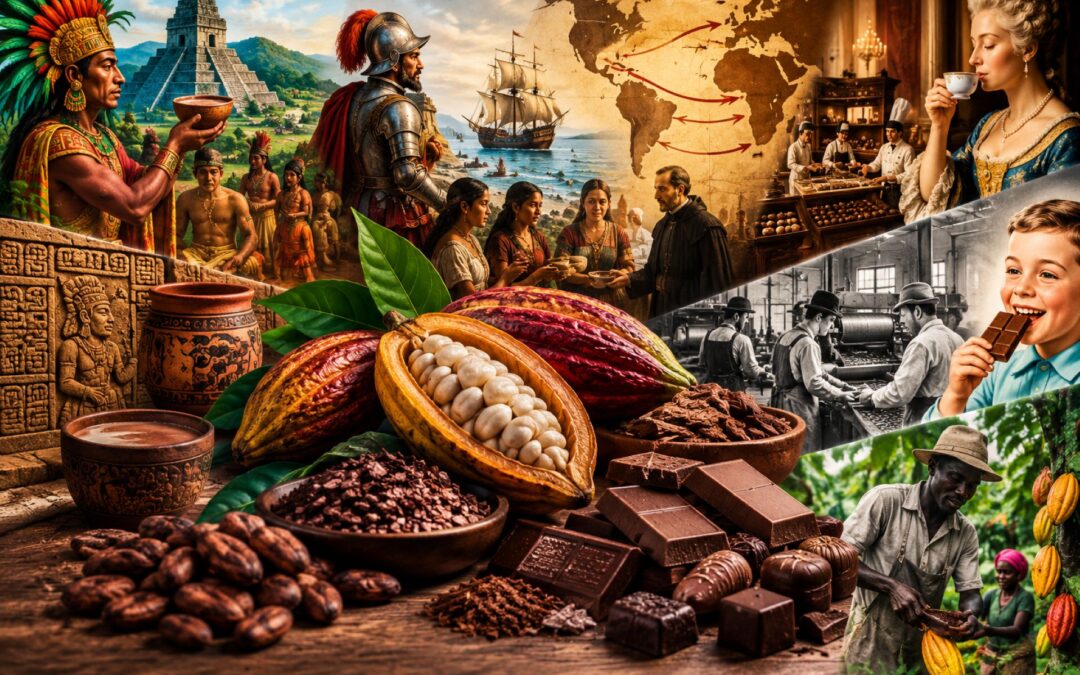
Chocolate is one of the world’s most familiar indulgences. It comes in bars, truffles, cakes, drinks, and countless other forms, usually associated with sweetness, pleasure, and celebration. Yet for most of its history, chocolate looked and tasted very different from the products filling supermarket shelves today. It was a bitter, often frothy beverage that carried religious, social, and economic significance among the peoples of the ancient Americas.
Its transformation into modern chocolate took centuries. Indigenous communities developed sophisticated methods of cultivating and preparing cacao long before Europeans encountered it. Spanish colonial expansion carried the beverage across the Atlantic, where it became an expensive luxury associated with aristocrats and wealthy households. Industrial inventions eventually made solid chocolate practical to manufacture, while advertising helped turn it into a product that ordinary consumers wanted to buy.
But the history of chocolate is also inseparable from conquest, colonial plantations, forced labour, and the unequal distribution of wealth. The same industry that made chocolate more affordable and widely available developed an enormous demand for inexpensive cacao, often produced by farmers and workers who received only a small share of the value they helped create.
Understanding the history of chocolate therefore means following more than the evolution of a food. It means tracing how an ancient agricultural product travelled between civilizations, changed its physical form, acquired new cultural meanings, and became the foundation of a global industry.
Before Chocolate Was Sweet: The Origins of Cacao
Chocolate begins with the cacao tree, Theobroma cacao, a tropical evergreen native to the Americas. Unlike many familiar agricultural crops, cacao produces large pods that grow directly from its trunk and larger branches. Inside each pod are numerous seeds surrounded by a sweet, pale pulp. These seeds, commonly called cacao beans, eventually become the primary ingredient in chocolate.
The tree thrives in warm, humid conditions, particularly in tropical regions close to the equator. Its dependence on particular environmental conditions shaped chocolate’s history from the beginning. Communities living in suitable agricultural regions could grow cacao, while people elsewhere had to obtain it through exchange, trade, or political control.
For a long time, the earliest history of chocolate was associated primarily with the ancient civilizations of Mesoamerica, particularly the Olmecs, Maya, and Aztecs. Archaeological discoveries have since shown that cacao’s history reaches considerably further back.
A 2018 study published in Nature Ecology & Evolution identified evidence of cacao use at the Santa Ana-La Florida archaeological site in southeastern Ecuador, dating to approximately 5,300 years ago. Researchers examining pottery associated with the Mayo-Chinchipe culture found evidence including cacao starch grains, chemical residues, and ancient DNA. The findings suggest that people in the Upper Amazon region were using cacao long before the better-known Mesoamerican civilizations flourished.
This discovery is important because it distinguishes the earliest known use of cacao from the later development of chocolate traditions. Evidence that ancient communities used cacao does not necessarily establish that they prepared the same fermented, roasted beverages consumed in later Mesoamerican societies. The history of the plant, its cultivation, and the foods and drinks prepared from it developed over a long period.
By the time the Olmec civilization flourished along the Gulf Coast of present-day Mexico, cacao had become part of the wider cultural and agricultural world of Mesoamerica. Archaeological evidence from sites associated with early Mesoamerican societies indicates that cacao-containing beverages were being consumed centuries before the height of Maya civilization.
Preparing cacao required considerable knowledge and labour. In processes resembling those used in chocolate production today, harvested seeds could be fermented, dried, roasted, and separated from their outer shells. The remaining edible material, known as cacao nibs, was ground into a paste containing both cocoa solids and natural cocoa butter.
Fermentation was particularly important because it helped develop the complex flavours associated with chocolate. Fresh cacao seeds do not taste like a finished chocolate bar. The chemical changes occurring during fermentation, drying, and roasting transform their bitterness and other flavour characteristics, creating the foundation of recognisable chocolate.
Ancient preparation methods varied between communities and periods, but grinding cacao was central to many Mesoamerican traditions. The resulting paste could be combined with water and other ingredients to produce a drink. Unlike modern hot chocolate, it was not necessarily served hot, and it was generally not the sweet, milk-based beverage familiar today.
Traditional preparations could include maize, chilli peppers, vanilla, flowers, and other locally available flavourings. Different combinations created drinks that ranged from bitter and spicy to aromatic and richly textured. Sweeteners were not completely unknown in the Americas, but the modern formula of chocolate dominated by refined sugar and milk developed much later.
One especially distinctive feature of Mesoamerican cacao beverages was their froth. Preparers could pour the liquid repeatedly between vessels, sometimes from a considerable height, producing a foamy layer considered desirable in its own right. The drink’s texture and presentation mattered alongside its taste.
These methods reveal that cacao was already the subject of sophisticated culinary experimentation long before it reached Europe. The ancient Americans were not simply consuming raw beans. They had developed techniques for transforming a demanding tropical crop into beverages with distinctive flavours, textures, and cultural meanings.
How the Maya and Aztecs Turned Cacao into Ceremony, Currency, and Power
Among the Maya, cacao occupied an important place in social and ceremonial life. It appeared in artistic representations, written records, and objects associated with elite households and ritual activity. Some Classic Maya vessels were decorated with inscriptions identifying their contents as cacao, providing unusually direct evidence of the beverage’s importance.
Cacao drinks were served at significant gatherings and could form part of exchanges between powerful individuals and families. They were associated with hospitality, feasting, ceremonial obligations, and occasions that reinforced political or personal relationships. Their value came partly from the difficulty of producing and obtaining cacao, but also from the social meanings attached to consuming and sharing it.
Marriage customs provide one example of this broader significance. In some Maya traditions, cacao formed part of exchanges connected with courtship, marriage arrangements, or wedding ceremonies. These practices varied between communities, but they demonstrate how a food product could become integrated into important social relationships.
Cacao also had religious associations. Maya mythology and imagery connected agricultural abundance, fertility, the supernatural world, and valuable foods in ways that gave cacao meanings beyond ordinary nutrition. Its appearance in ceremonial settings should not, however, be taken to mean that every Maya community used cacao identically or that all consumption was restricted to religious occasions.
The crop also became an important commercial commodity. Cacao was grown in suitable regions and transported through exchange networks linking agricultural producers, merchants, settlements, and political centres. Communities unable to cultivate it could acquire it through trade, while powerful groups could seek to control the regions and routes from which it originated.
Over time, cacao beans also served as a medium of exchange in parts of Mesoamerica. Rather than being valued only as an ingredient, individual beans could function as small units of purchasing power. Historical accounts from the late pre-Hispanic and early colonial periods describe cacao being used in transactions involving food and other goods.
This gave cacao an unusual dual identity. A bean could be consumed, stored, traded, or used to acquire something else. Its utility as food helped give it value, while established trading conventions allowed it to circulate as a form of money.
The practice also created opportunities for deception. Historical accounts describe counterfeit cacao beans, including attempts to disguise inferior or artificial substitutes as genuine currency. Like other valuable exchange media, cacao required people to judge authenticity and quality.
The Mexica, who dominated the political alliance commonly known as the Aztec Empire during the fifteenth and early sixteenth centuries, incorporated cacao into an increasingly extensive system of tribute and exchange. Their capital, Tenochtitlan, stood in the highlands of central Mexico, where the climate was generally unsuitable for growing cacao on a large scale.
Cacao cultivation instead flourished in warmer regions, including parts of southern Mexico and Central America. Control over those producing territories, or access to their commercial networks, therefore became important to the consumption habits of powerful people in the Mexica capital.
The Aztec imperial system required subject communities to provide various forms of tribute, including agricultural products, textiles, valuable materials, and cacao. Tribute records offer evidence of the quantities and categories of goods that moved toward imperial centres. These payments were part of a broader political economy in which military power and commercial activity were closely connected.
Chocolate beverages were especially associated with elites, including rulers, nobles, and other privileged groups. Their preparation could involve expensive ingredients and elaborate serving vessels, making them expressions of wealth and rank. Warriors also appear in accounts of cacao consumption, although access and practices should not be reduced to a simple universal rule about who was permitted to drink it.
Cacao’s importance to these societies was therefore both practical and symbolic. It offered nourishment, provided a valued drink, supported trade, helped structure ceremonial relationships, and contributed to systems of political authority.
Its economic value also explains why European newcomers quickly recognised its usefulness, even when they initially found its taste unfamiliar. The Spanish would encounter a product that was already embedded in complex agricultural, commercial, and social institutions. They did not introduce chocolate to the Americas; they entered societies that had been developing cacao traditions for centuries.
How Chocolate Crossed the Atlantic
The arrival of Spanish expeditions in the Americas marked a turning point in chocolate’s history. During the early sixteenth century, Europeans encountered Indigenous societies whose agricultural products and culinary customs were often unfamiliar to them. Cacao was among the goods that gradually attracted their attention.
A Spanish expedition reached the Yucatán Peninsula in 1517, while Hernán Cortés began his campaign in Mexico in 1519. The conquest of Tenochtitlan in 1521 depended heavily on Indigenous alliances, particularly with communities opposing Mexica domination, as well as warfare, political disruption, and the devastating effects of introduced diseases.
These events formed part of the wider expansion of the Spanish Empire, which connected American territories to commercial and political networks extending across the Atlantic and eventually the Pacific. Conquest opened new routes for moving goods, people, knowledge, and agricultural products, although these exchanges occurred within profoundly unequal colonial relationships.
The Spanish quickly recognised cacao’s established economic value. In parts of colonial Mexico and Central America, cacao beans continued to circulate as a medium of exchange, and colonial authorities sometimes adapted existing Indigenous practices rather than immediately replacing them. The bean’s usefulness as money was easier to appreciate than its unfamiliar flavour.
European reactions to cacao beverages were mixed. The Italian traveller Girolamo Benzoni, whose account of his American travels appeared in the sixteenth century, famously described chocolate with considerable distaste before acknowledging that familiarity could change one’s opinion. Such accounts illustrate the gap between European expectations and Indigenous drinking traditions, although they cannot represent every newcomer’s experience.
Chocolate did not become popular in Europe through a single encounter or the enthusiasm of one famous conquistador. Its adoption developed gradually within colonial societies, where Spaniards, Indigenous peoples, Africans, and their descendants lived and interacted under unequal systems of authority.
Indigenous women played important roles in these culinary exchanges. They cultivated and prepared local foods, maintained knowledge of ingredients and cooking methods, and contributed to the households and communities in which colonial food traditions emerged. Intermarriage, domestic labour, trade, and everyday cultural interaction all helped transmit knowledge about preparing cacao.
These relationships produced changing food cultures rather than a simple replacement of Indigenous practices by European ones. The society commonly described as mestizo developed through many forms of cultural interaction, although the term should not obscure the coercion, unequal power, and diversity involved in colonial life.
Spanish consumers gradually adapted cacao to their own preferences. Sugar became increasingly important, while ingredients such as cinnamon and other flavourings helped create European variations of the beverage. Some older Mesoamerican preparation techniques remained influential, particularly the emphasis on grinding cacao and producing a desirable texture.
Religious institutions and commercial networks also contributed to chocolate’s movement. Missionaries encountered cacao in the communities where they lived and worked, while merchants transported it between American colonies and European markets. Gifts, private consumption, and elite social relationships helped introduce the beverage to influential European households.
Chocolate’s movement across the Atlantic accelerated during the seventeenth century, although the surviving evidence does not support every dramatic claim about the quantities imported during its earliest decades. What began as a relatively unfamiliar American product gradually became a recognised commodity in Spain and then elsewhere in Europe.
The word chocolate also underwent a complicated linguistic journey. The familiar explanation that Spaniards simply combined a Maya word meaning hot with a Nahuatl word meaning water is not an established historical fact. The linguistic history of cacao terminology reflects interactions among several Mesoamerican languages and later colonial usage, while the precise origin of chocolate remains debated.
This uncertainty matters because language preserves traces of the cultural encounters through which foods spread. Europeans adopted cacao-related terms along with the product itself, but the resulting vocabulary did not develop through one simple or universally agreed process.
By the seventeenth century, chocolate had crossed more than a geographical boundary. It had entered a new system of consumption in which colonial trade, European wealth, and changing tastes would gradually reshape its identity.
Chocolate Becomes a European Luxury
When chocolate became established in European society, it remained a beverage rather than a solid confection. Its preparation required valuable imported ingredients, specialist equipment, and time, making it particularly attractive to wealthy households and aristocratic circles.
Spain played an important early role in its European adoption. From there, chocolate spread through commercial, diplomatic, and social connections to places including Italy, France, and England. Different societies incorporated it into their existing traditions of hospitality, fashionable consumption, and elite dining.
The drink became associated with courts, nobles, wealthy merchants, and religious institutions. In some cities, specialised chocolate houses emerged as places where paying customers could enjoy the beverage, although this did not mean that chocolate had already become affordable for the general population.
European consumers also continued experimenting with recipes. Sugar and spices were increasingly used to modify the bitterness of cacao, while regional preferences encouraged different methods of preparation. The result was not one standard European chocolate but a growing collection of fashionable variations.
Italian aristocratic culture offers an especially revealing example. Cosimo III de’ Medici, Grand Duke of Tuscany, was associated with an elaborate jasmine-infused chocolate preparation. Such recipes involved considerable effort and demonstrated how chocolate could become a vehicle for culinary sophistication and social distinction.
Other historical European preparations used ingredients that might seem unusual today, including highly aromatic substances and combinations of sweet and savoury flavours. Chocolate’s later association with sugary desserts should not obscure the more experimental culinary world in which Europeans initially encountered it.
Religious communities also developed complicated relationships with chocolate. Missionaries and clerics encountered the drink in colonial settings, but their attitudes were not uniformly enthusiastic. Questions arose about luxury, discipline, personal indulgence, and whether particular forms of consumption were appropriate within religious life.
Historical research into Jesuit debates over chocolate consumption demonstrates that the order’s leadership sometimes attempted to restrict its use among members. This complicates the familiar image of missionaries enthusiastically promoting chocolate throughout Europe for commercial gain.
Individual religious institutions and members certainly participated in colonial economies, including agricultural production and trade. Yet those activities should not be confused with a single, consistent institutional policy toward drinking chocolate.
The growing European market also depended on developments far removed from fashionable courts. Cacao cultivation in the Americas operated within colonial systems marked by Indigenous dispossession, coerced labour, demographic catastrophe, and the enslavement of Africans. Conditions differed between regions and periods, but the wealth generated by plantation commodities was frequently distributed through deeply unequal relationships.
Chocolate consequently acquired two contrasting identities. For wealthy consumers, it could represent refinement, hospitality, and pleasure. For many people involved in cultivating and transporting its ingredients, it was part of an economic system structured by colonial power and labour exploitation.
Even as the beverage became increasingly familiar, its manufacturing methods limited its wider commercial appeal. Preparing drinking chocolate remained relatively laborious, and the natural fat content of cacao made it difficult to produce the smooth, convenient drinks and solid products that later consumers would expect.
The next major transformation would come not from another royal court, but from changes in the technology of chocolate manufacturing.
The Inventions That Turned Chocolate into a Modern Bar
The chocolate bar was not simply invented when somebody decided to let drinking chocolate harden. Cacao contains a substantial quantity of natural fat, and producing a stable, smooth, pleasant solid requires careful control over the relationship between that fat, the cocoa solids, sugar, moisture, and other ingredients.
Early chocolate makers faced several practical problems. Ground cacao could form a thick, oily paste, while preparations intended for drinking often contained particles that were difficult to disperse evenly in water. The texture could be coarse, and the product’s natural bitterness limited its appeal to consumers accustomed to sweeter foods.
Industrial innovation gradually changed these characteristics, allowing manufacturers to separate, recombine, refine, and process chocolate’s ingredients with far greater control.
One of the most important breakthroughs occurred in the Netherlands in 1828. Casparus van Houten is credited with developing a hydraulic press capable of extracting much of the cocoa butter from processed cacao. The remaining material could be broken down and ground into cocoa powder.
This was a significant change because cocoa butter and cocoa solids have different physical properties. Cocoa butter is the fat that helps chocolate melt smoothly, while cocoa solids contribute much of its characteristic flavour and colour. Separating them allowed manufacturers to control their proportions instead of relying entirely on the natural composition of the cacao bean.
Cocoa powder was particularly useful for preparing beverages. Removing a substantial portion of the fat made the resulting material easier to handle and incorporate into recipes, although its ability to disperse in liquids still depended on how it was processed.
A related development was the Dutching process, associated with Casparus’s son, Coenraad van Houten. This involved treating cocoa with alkaline substances to modify its acidity, flavour, colour, and processing characteristics. Dutched cocoa could produce a milder flavour and darker colour, while often dispersing more readily in liquids.
These were distinct innovations. The cocoa press addressed the separation of fat from cocoa solids, while alkalisation changed the characteristics of the cocoa material itself. Together, they helped make chocolate manufacturing more versatile and commercially practical.
The next important advance came in Britain. In 1847, J. S. Fry & Sons developed a mouldable eating chocolate by combining cocoa powder, sugar, and cocoa butter. Adding cocoa butter back into the mixture in a controlled way helped create a paste that could be shaped into a solid product.
This was a major step toward the modern chocolate bar. Instead of being manufactured primarily as something to dissolve or prepare as a drink, chocolate could be produced as a ready-to-eat solid. The bar was portable, easier to distribute, and more convenient for consumers.
Fry’s innovation did not immediately produce the smooth, creamy bars familiar today. Early eating chocolate could still be relatively coarse and bitter by modern standards. Nevertheless, it established a practical manufacturing approach that other producers could refine.
Swiss manufacturers subsequently played an important role in improving chocolate’s flavour, consistency, and commercial appeal. François-Louis Cailler, Philippe Suchard, and other nineteenth-century entrepreneurs developed manufacturing operations and processing techniques that helped establish Switzerland as an important centre of chocolate production.
These advances benefited from the wider industrial environment. Improvements in machinery, transport, food processing, and commercial distribution made it increasingly feasible to produce consistent quantities of chocolate and move them to distant markets.
Milk chocolate represented another major challenge. Milk contains water, and introducing too much moisture into chocolate can interfere with its texture, stability, and storage. Simply mixing ordinary liquid milk with existing chocolate was therefore not a satisfactory solution for reliable mass production.
Daniel Peter, a Swiss chocolate maker, spent years experimenting with ways to combine milk and chocolate. Advances in milk preservation and concentration, associated with manufacturers such as Henri Nestlé, helped make the problem more manageable.
In the 1870s, Peter developed a commercially important form of milk chocolate using concentrated milk ingredients. The resulting product offered a milder flavour and creamier character than traditional dark chocolate, opening chocolate to consumers who preferred less bitterness.
Milk chocolate was not simply dark chocolate with milk added as an afterthought. Its development required solving problems involving moisture, texture, proportions, and preservation. Once those difficulties were overcome, it became possible to produce a new category of chocolate with enormous commercial potential.
Another decisive innovation followed in 1879, when Rodolphe Lindt developed the process commonly known as conching. This involved prolonged mechanical working of chocolate to improve its texture, flavour, and consistency.
Conching helped reduce the coarse sensation of inadequately refined chocolate by distributing ingredients more evenly and changing the way the mixture behaved. It also contributed to flavour development and the reduction of some undesirable volatile compounds, depending on the processing conditions.
The importance of this invention becomes obvious when considering what consumers expect from a good chocolate bar. Modern chocolate is valued not only for its taste but also for how it melts, how smoothly it coats the mouth, and how consistently it behaves from one piece to the next.
The combined effect of these innovations was revolutionary. Manufacturers could separate cocoa butter from cocoa solids, formulate products with different proportions of ingredients, produce solid bars, incorporate milk, and refine chocolate into a much smoother substance.
As the history of solid chocolate manufacturing illustrates, the modern product emerged through successive improvements rather than one isolated invention.
Industrial production also changed chocolate’s economics. Machinery increased output and helped manufacturers standardise quality, while expanding transport and distribution networks made it easier to reach consumers beyond wealthy households.
Chocolate did not become universally affordable overnight, and different products continued to serve different markets. Nevertheless, industrial manufacturing gradually weakened its older identity as an expensive beverage reserved mainly for privileged consumers.
By the end of the nineteenth century, the essential foundations of modern chocolate had emerged. The product was increasingly solid, smooth, sweetened, and suitable for commercial distribution. Its manufacturers now faced a different challenge: persuading a much larger public to buy it.
How Cadbury and Advertising Reinvented Chocolate
Manufacturing improvements made chocolate easier to produce and sell, but technology alone could not explain its growing popularity. Chocolate companies also had to persuade consumers that their products were desirable, trustworthy, and suitable for particular occasions.
The Cadbury business in Britain became especially important in this transformation. Founded in Birmingham by John Cadbury in 1824, it initially operated within the market for cocoa, drinking chocolate, and related products. As the industry developed, subsequent generations expanded its manufacturing capabilities and commercial ambitions.
Richard Cadbury recognised that packaging could do more than protect chocolate during transport. It could turn an ordinary purchase into a socially meaningful gift, making the product attractive for occasions that involved affection, celebration, and personal relationships.
In 1861, Cadbury introduced increasingly elaborate decorative boxes for chocolates. These packages used attractive illustrations and artistic designs to make the contents feel more valuable and suitable for presentation.
The association between chocolate and Valentine’s Day became particularly significant. Richard Cadbury is widely credited with popularising the heart-shaped chocolate box associated with Valentine’s gifting, with the earliest recognised Valentine’s chocolate-box milestone dating to 1868.
The innovation worked because it connected chocolate with an emotional occasion rather than simply promoting its ingredients. Consumers were not merely purchasing something sweet. They were buying an object that could communicate romance, generosity, or affection.
The boxes themselves reinforced the message. Their decorative designs encouraged people to preserve and reuse them, allowing the gift to remain visible after the chocolates had been eaten. Packaging therefore extended the emotional and commercial value of the original purchase.
Chocolate advertising increasingly adopted similar techniques. Companies associated their products with happy children, affectionate families, attractive landscapes, and comforting domestic scenes. Such images suggested that chocolate belonged not only to aristocratic indulgence but also to ordinary household life.
Milk chocolate offered particularly useful marketing possibilities. Advertisements could emphasise milk’s familiar associations with nourishment and childhood, encouraging consumers to view the product as wholesome and suitable for families. These were commercial messages, not proof that sugary chocolate should be understood as a health food.
Swiss chocolate manufacturers also benefited from imagery associated with Alpine landscapes, clean mountain environments, dairy farming, and traditional craftsmanship. The associations helped construct a reputation for purity and quality that extended beyond the specific ingredients or manufacturing methods used.
This emphasis on purity had an important historical context. Nineteenth-century food markets were troubled by adulteration, including products diluted with cheaper ingredients or contaminated by harmful substances. Investigations and public campaigns exposed concerns about the quality and safety of goods sold to consumers, including cocoa and chocolate.
Manufacturers consequently faced pressure to establish trust. Improvements in processing allowed reputable companies to distinguish their products from inferior competitors, while advertising presented purity as a central commercial advantage.
Cadbury’s famous claim, “Absolutely Pure, Therefore Best,” reflected this strategy. The company’s investment in cocoa-processing technology allowed it to market products with fewer unwanted ingredients, turning manufacturing quality into an important part of its public identity.
The relationship between product quality and marketing was not always straightforward. Images of healthy children, caring families, and natural landscapes could create powerful impressions without necessarily providing meaningful information about nutritional value or production conditions.
Nevertheless, advertising helped change chocolate’s social position. A product once associated primarily with privileged European consumers became increasingly connected with everyday pleasures, childhood treats, gifts, romance, and celebrations.
This commercial transformation also encouraged further innovation. Companies developed different sizes, shapes, textures, fillings, and price points, giving consumers more reasons and opportunities to purchase chocolate.
By the twentieth century, the industry’s major manufacturers were selling far more than cacao-based products. They were selling recognisable brands and the emotions attached to them.
Chocolate had become a modern consumer good, supported by industrial production and sophisticated marketing. Yet its growing accessibility created a problem that could not be solved in European factories: manufacturers needed enormous quantities of cacao, and the crop could only be cultivated successfully in particular parts of the world.
Why the Cocoa Trade Moved to West Africa
The increasing popularity of manufactured chocolate created a sustained demand for cacao. European factories could process, refine, package, and advertise chocolate, but they remained dependent on agricultural producers in tropical regions.
For centuries, cacao had been cultivated primarily in the Americas, where its production was intertwined with Indigenous agricultural knowledge, colonial commerce, plantation systems, and various forms of coerced labour. As global demand increased, European commercial interests looked for additional regions where the crop could be grown.
West and Central Africa offered suitable tropical environments, and the expansion of cacao cultivation there gradually transformed the geography of the global chocolate industry.
Portuguese colonial territories played an important early role. Cacao was introduced to São Tomé and Príncipe during the nineteenth century, with planting material brought from the Americas. The islands became important centres of cocoa production, particularly through plantation agriculture.
Their production systems were deeply affected by coercive labour practices. Even after formal abolition measures, plantation employers relied on arrangements that could severely restrict workers’ freedom, including the recruitment and movement of labourers under exploitative conditions. International criticism of these systems became an important issue for chocolate companies purchasing African cocoa.
Cacao cultivation also expanded beyond plantation territories. In the Gold Coast, the territory that later became Ghana, African farmers increasingly adopted the crop during the late nineteenth century. The development of cocoa farming depended heavily on local initiative, agricultural experimentation, access to land, and commercial networks.
Tetteh Quarshie is widely remembered in Ghanaian history for his association with the introduction and spread of cocoa cultivation, although the broader agricultural transformation involved many farmers, traders, and communities. The growth of the industry cannot be explained solely through the actions of one individual.
Farmers recognised that cocoa could provide a valuable commercial crop. As demand increased and trading connections developed, cultivation spread across suitable areas. Roads, railways, ports, and expanding merchant networks helped move beans from producing districts toward international markets.
The Gold Coast became one of the world’s leading cocoa producers during the early twentieth century. Its success demonstrated that the African expansion of cacao was not simply a matter of Europeans transferring plantations from one continent to another. African smallholder farmers played a central role in establishing and sustaining the industry.
Côte d’Ivoire subsequently developed its own extensive cocoa-growing economy, eventually becoming the world’s largest individual producer. Together, Côte d’Ivoire and Ghana emerged as the dominant centres of global cocoa supply.
The International Cocoa Organization’s account of cocoa cultivation helps explain how a crop originating in the Americas became established across different tropical regions through successive agricultural and commercial movements.
This geographical transformation also altered the relationship between chocolate manufacturers and cacao producers. Many of the world’s best-known chocolate companies developed their products, brands, and consumer markets in industrialised economies, while much of their principal agricultural ingredient came from farming communities thousands of kilometres away.
The economic rewards were distributed unevenly. Farmers supplied an essential commodity but often had limited control over international prices, processing, manufacturing, branding, and retail distribution. A large share of the value associated with finished chocolate accumulated further along the supply chain.
Smallholder cocoa farming also created particular vulnerabilities. Producers faced fluctuating prices, crop disease, weather-related risks, limited access to finance, and the need to maintain farms that could take years to become productive. Their incomes depended on conditions that individual households could rarely control.
Colonial economic structures contributed to these inequalities, but the modern industry cannot be understood entirely through colonial history. After independence, national governments, agricultural institutions, trading systems, international buyers, and multinational manufacturers continued to shape the conditions under which cocoa was produced and sold.
The expansion of chocolate consumption therefore depended on more than the invention of efficient factories. It required a vast agricultural supply system capable of meeting demand from consumers around the world.
That system helped make chocolate widely available, but it also created persistent questions about how the people growing cacao were compensated and treated.
The Human Cost of Chocolate—and the Effort to Change It
The global chocolate industry has an uncomfortable historical continuity. Although manufacturing methods, brands, and consumer markets have changed dramatically, the production of cacao has repeatedly involved serious inequalities between those who grow the crop and those who profit from its sale.
During the colonial period, cacao production was connected with slavery, coercive labour arrangements, and the exploitation of vulnerable populations. Indigenous communities in the Americas suffered dispossession and forced labour, while enslaved Africans were transported to work in plantation economies across parts of the Atlantic world.
The expansion of cocoa cultivation into Africa did not immediately eliminate these abuses. Some plantation systems developed exploitative labour practices despite formal changes in the legal status of slavery. International campaigns and investigations exposed the gap between official claims of free labour and the conditions faced by many workers.
Modern cocoa production operates within different political and legal systems, and the majority of cocoa farms in Ghana and Côte d’Ivoire are smallholder agricultural operations rather than the large colonial plantations often associated with historical slavery. Nevertheless, poverty, unequal market relationships, and inadequate protections continue to expose workers and children to serious risks.
Child labour is one of the industry’s most extensively documented problems. Children may participate in agricultural activities within family farming households, but not every form of participation is legally or ethically equivalent. The critical distinctions concern age, the nature of the work, exposure to hazards, schooling, and whether the child is being exploited or coerced.
Hazardous child labour can involve carrying heavy loads, using sharp agricultural tools, handling dangerous chemicals, or working under conditions that threaten health and development. Such activities can interfere with education and expose children to injuries or long-term harm.
A major NORC investigation estimated that approximately 1.56 million children were involved in child labour in cocoa production in Ghana and Côte d’Ivoire during the 2018–19 agricultural season. The finding demonstrated the scale of the problem in the world’s most important cocoa-producing region, although it should not be presented as a freshly measured figure for 2026.
Forced labour and human trafficking raise additional concerns. These involve different forms of coercion and exploitation and must not be treated as interchangeable with every instance of child labour. The existence of children working on family farms does not automatically mean that all such children are enslaved.
The U.S. Department of Labor’s cocoa supply-chain findings document continuing risks associated with child labour and forced labour in cocoa production. These problems are especially difficult to address when supply chains involve numerous farms, intermediaries, traders, processors, and international buyers.
The economic pressures facing farming households are central to the issue. Cocoa prices can fluctuate substantially, while many producers operate on small farms with limited savings and few alternative sources of income. When households struggle to meet basic needs, they may depend on the labour of family members, including children.
Limited access to quality schooling can reinforce these pressures. Distance, costs, inadequate facilities, and household responsibilities may make regular education difficult, particularly in rural communities. Eliminating hazardous labour consequently requires more than instructing farmers not to employ children.
Chocolate companies have faced growing scrutiny over their sourcing practices and their promises to address exploitation. Public pressure, investigative journalism, government initiatives, and civil society organisations have encouraged manufacturers to introduce monitoring systems, supplier requirements, educational programmes, and other interventions.
However, identifying the presence of a policy is not the same as demonstrating that the underlying problem has been solved. The complexity of cocoa supply chains makes it difficult to ensure that every farm meets the standards announced by companies selling finished chocolate.
Certification systems such as Fairtrade have attempted to improve conditions by establishing standards for producers and commercial relationships. Fairtrade arrangements can include a minimum price mechanism, additional premiums for participating producer organisations, and requirements concerning labour and environmental practices.
These mechanisms aim to address several related problems. More stable commercial arrangements may help producers manage price volatility, while premiums can support community priorities and organisational development. Labour standards and monitoring programmes can also help identify risks and encourage corrective action.
Yet certification cannot guarantee that every participating farmer earns a living income or that no child labour occurs within a supply chain. Farms operate within wider economic conditions, and monitoring programmes may fail to detect particular cases of exploitation. Meaningful improvement depends on how standards are implemented, enforced, and supported over time.
The Fairtrade programme expansion reported in 2026 illustrates the emphasis on prevention and remediation. Rather than treating certification as proof that problems no longer exist, such programmes aim to identify risks, support affected communities, and strengthen systems for responding to child labour.
These efforts are important, but they cannot replace broader economic and institutional changes. Sustainable improvements also depend on farmer incomes, educational opportunities, labour-law enforcement, functioning public institutions, agricultural investment, and greater accountability throughout the commercial chain.
Responsibility therefore extends beyond individual farmers or consumers. National governments, international buyers, chocolate manufacturers, trading companies, certification organisations, and local communities all influence the conditions under which cacao is produced.
Consumers can contribute by paying attention to sourcing practices and credible evidence of improvement, but the responsibility for making an enormous global industry more equitable cannot rest entirely on the choices made in supermarket aisles.
The history of chocolate also continues to involve Indigenous communities in the Americas, including people maintaining or renewing traditional cacao cultivation and chocolate-making practices. Their participation is a reminder that the crop’s story did not end when its commercial centre shifted across the Atlantic.
Chocolate’s future will depend partly on whether the industry can create better conditions for the people whose agricultural knowledge, labour, and resources sustain it. The technological achievements that made chocolate smooth, inexpensive, and convenient demonstrated an extraordinary capacity for innovation. Addressing its economic and social inequalities requires sustained innovation of a different kind.
The history of chocolate is ultimately a history of transformation. A cacao product developed through the knowledge and traditions of ancient American societies became a prestigious beverage in colonial and European markets, then a manufactured food capable of reaching consumers around the world.
Each transformation changed more than the product itself. Trade carried cacao between societies, colonial expansion altered its commercial networks, industrial technology reshaped its texture and availability, and advertising gave it associations with love, family, pleasure, and celebration. Meanwhile, the geography of production shifted dramatically, creating relationships between agricultural communities and consumer markets separated by continents.
The chocolate bar we recognise today is therefore the result of centuries of accumulated knowledge, cultural exchange, agricultural development, and technological experimentation. Its familiar sweetness can make that complicated history easy to overlook, especially the unequal labour relationships that helped make mass consumption possible.
To understand chocolate fully is to recognise both sides of its development: the remarkable human ingenuity that transformed cacao into a global food and the continuing responsibility to ensure that the people producing its essential ingredient share more fairly in the prosperity it creates.
Last Updated on October 29, 2026 by Aseem Gupta