
Reading Time: 23 Minutes
Turkmenistan is a country of remarkable contrasts. Most of its territory is covered by one of Central Asia’s largest deserts, yet its ancient oases supported prosperous cities and powerful civilizations. Its capital is famous for dazzling white marble buildings, while the surrounding countryside contains colourful canyons, rugged mountains, archaeological ruins and villages where traditions have survived for generations.
The country is often portrayed as an isolated dictatorship governed by eccentric presidents. Although its political restrictions are important, they reveal surprisingly little about the people who live there. Turkmenistan has a distinctive cultural identity shaped by its geography, ancient trading networks, Turkic heritage, Islamic traditions and decades under Russian and Soviet rule.
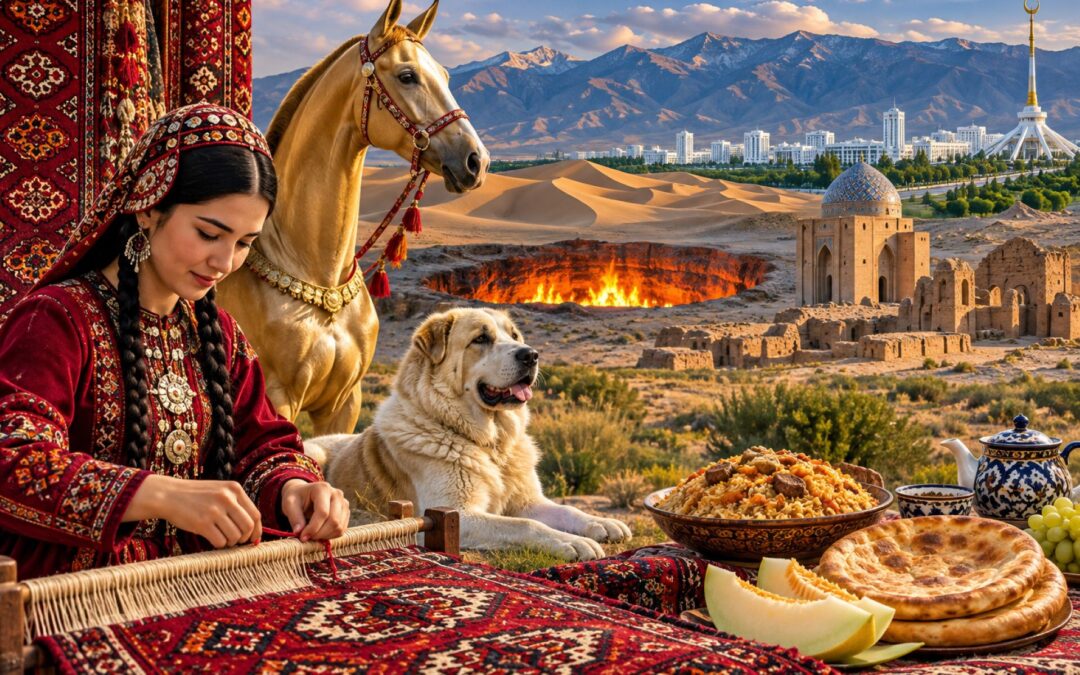
Its people are known for elaborate handwoven carpets, prized Akhal-Teke horses, powerful shepherd dogs, storytelling, music and a deep attachment to family and community. These traditions are not simply remnants of the past. They remain part of everyday life, connecting modern Turkmen society with centuries of history.
Understanding Turkmenistan therefore requires looking beyond its political reputation. The country’s geography explains where people settled and how they survived, while its cultural traditions reveal how different communities developed a shared identity across an often inhospitable landscape.
A Country Shaped by Desert and Water
Turkmenistan occupies approximately 488,100 square kilometres in Central Asia, making it slightly larger than Sweden and considerably larger than Germany. It borders Kazakhstan to the northwest, Uzbekistan to the north and east, Afghanistan to the southeast, Iran to the south, and the Caspian Sea to the west.
Despite its long Caspian coastline, Turkmenistan is considered landlocked because the Caspian Sea has no natural connection to the world’s oceans. Ships can reach other maritime systems through waterways crossing Russia, but the country does not possess direct access to an open sea.
The most important geographical feature is the Karakum Desert, which covers approximately 80% of the national territory. Its name is commonly translated as Black Sand, although the landscape contains much more than enormous dunes.
The desert includes sandy plains, gravel surfaces, clay depressions, salt flats and scattered vegetation adapted to extreme conditions. Summers are intensely hot, with temperatures often exceeding 40°C, while winter temperatures can fall below freezing.
This environment has profoundly influenced settlement patterns. Agriculture and permanent habitation are concentrated around rivers, mountain foothills, irrigation systems and the edges of the desert rather than spread evenly across the country.
The geographical profile of Turkmenistan identifies its southern, eastern and northeastern oases as the country’s principal population centres.
The Amu Darya is particularly important. One of Central Asia’s major rivers, it forms part of Turkmenistan’s eastern and northeastern geographical system and provides water for agriculture and settlements.
Historically, the river flowed towards the Aral Sea, although extensive irrigation withdrawals have transformed its downstream environment. Its waters support communities across several countries, making their management an important regional concern.
Another important river is the Murghab, which originates in the mountains of Afghanistan and flows northward into Turkmenistan. Rather than reaching the Caspian Sea or another major body of water, it spreads into an inland oasis system around Mary and ancient Merv.
That oasis supported some of the most important settlements in Central Asian history.
The relationship between water and civilization is particularly striking at Merv. A city surrounded by an enormous desert could become wealthy because irrigation transformed the surrounding land into productive farmland, while routes crossing the region connected it with distant markets.
The same principle continues to influence modern Turkmenistan.
During the Soviet period, engineers constructed the Karakum Canal to transfer water from the Amu Darya across large sections of the desert. Beginning in the 1950s, the project expanded irrigation and helped support settlements, industry and cotton production.
The canal became one of the world’s largest artificial water-transfer systems. However, inefficient irrigation, evaporation and the diversion of river water also contributed to environmental problems, including salinization and the wider Aral Sea disaster.
Turkmenistan therefore faces a difficult water-management challenge. Its agriculture depends heavily on irrigation, but water resources are limited, and climate change may increase the pressure on already vulnerable systems.
The southern border presents a different landscape.
The Kopet Dag Mountains rise along much of the frontier with Iran, creating rugged terrain and distinctive environments that contrast sharply with the central desert.
These mountains have historically influenced movement, settlement and cultural exchange between Turkmenistan and the Iranian plateau. Communities living near the foothills have developed agricultural and pastoral traditions suited to their environment.
Farther east, the landscape becomes mountainous again near the border with Uzbekistan. Turkmenistan’s highest point, Ayrybaba, rises to approximately 3,139 metres in the Köýtendag range.
The country’s geography is therefore much more varied than the familiar image of endless desert suggests.
From Caspian shores to mountain valleys, fertile oases and arid plains, Turkmenistan contains environments that have shaped different ways of life. Its geography has never merely determined where people could survive; it has influenced the development of communities, trade routes and cultural traditions.
Turkmenistan’s Extraordinary Natural Landscapes
Turkmenistan contains some of Central Asia’s most unusual natural landmarks, although many remain relatively unknown internationally because the country receives comparatively few foreign visitors.
One of the most visually remarkable is Yangykala Canyon in western Turkmenistan.
The region contains dramatic cliffs, layered rock formations and broad expanses of exposed sedimentary terrain. Bands of red, white, pink and yellow rock create an extraordinary landscape that changes appearance as the light moves across it.
Unlike the familiar river-carved image associated with the Grand Canyon, Yangykala owes much of its geological character to ancient marine sedimentation, subsequent uplift and erosion.
Large parts of the region were once connected to ancient seas, and the rocks preserve evidence of environments very different from today’s desert.
The resulting formations create wide natural amphitheatres, steep escarpments and ridges overlooking an immense, sparsely populated landscape.
Yangykala is especially memorable because its colourful cliffs seem to emerge unexpectedly from the surrounding plains. Its remoteness contributes to the sense of isolation, but also makes reaching the area challenging.
Another extraordinary geographical feature is Garabogazköl, a highly saline lagoon connected to the Caspian Sea through a narrow channel.
The lagoon’s water balance is unusual because evaporation is exceptionally high. Water entering from the Caspian evaporates, leaving concentrated salts that have supported mineral extraction.
Soviet attempts to regulate the lagoon’s connection with the Caspian produced severe environmental consequences. A causeway completed in 1980 interrupted the inflow, and the lagoon largely dried out during the following years.
Restoration of the connection in the early 1990s allowed water to return, illustrating how quickly human intervention can transform fragile inland water systems.
The Caspian coastline itself offers a different view of Turkmenistan.
The country possesses beaches, coastal wetlands, industrial ports and resort development along the inland sea. Türkmenbaşy is an important port city, while the nearby Awaza tourism zone reflects government ambitions to develop coastal recreation.
The Caspian is also an ecologically important body of water, supporting fish, migratory birds and other wildlife. Its changing water levels and environmental pressures affect all the countries sharing its shores.
Farther inland lies Turkmenistan’s best-known natural attraction: the Darvaza gas crater.
Often called the Door to Hell or Gates of Hell, it is a large burning crater in the Karakum Desert, where flames emerge from numerous points across the ground.
The familiar explanation is that Soviet geologists accidentally opened an underground gas pocket during drilling in the 1970s and ignited the escaping gas to prevent a dangerous accumulation.
However, the precise circumstances surrounding the crater’s formation and ignition are disputed. The popular story is widely repeated, but its exact chronology has not been firmly established.
What makes Darvaza extraordinary is the persistence of the fire. The crater has remained an unusual example of burning natural gas in an exposed geological formation for decades.
After dark, the flames illuminate the crater and surrounding desert, creating the appearance of a vast glowing furnace.
The spectacle has made Darvaza internationally recognizable, but it also raises environmental concerns. Methane is a powerful greenhouse gas, and uncontrolled emissions from natural gas deposits present a serious problem even when some escaping gas is burning.
Turkmenistan has periodically discussed reducing the emissions or extinguishing the fire. Any attempt to address the problem must account for the underlying gas deposits and the challenges of controlling escaping fuel.
The country’s eastern mountains contain another remarkable attraction.
The Köýtendag region is known for its caves, unusual geological formations and dinosaur footprints. At the Dinosaur Plateau, numerous fossilized tracks preserve evidence of prehistoric animals that travelled across the area millions of years ago.
The Dinosaurs and Caves of Koytendag have been proposed for UNESCO World Heritage recognition, highlighting their geological and palaeontological importance.
The region also contains extensive cave systems, mountain springs and habitats supporting distinctive plants and animals.
Closer to Ashgabat, the Kow Ata underground lake offers an entirely different experience. The lake lies inside a cave and contains warm, mineral-rich water. Its underground setting has made it a popular recreational attraction, although visitors encounter a very different environment from the country’s open desert landscapes.
Turkmenistan also supports wildlife specially adapted to arid environments.
Desert reptiles, rodents, birds of prey, foxes and other animals survive in habitats where water and vegetation are scarce. Mountain regions support different species, including wild sheep and other mammals.
The country’s protected areas include the Repetek and Gaplaňgyr reserves, which help conserve important desert ecosystems.
Parts of Turkmenistan were included in the Cold Winter Deserts of Turan UNESCO World Heritage property in 2023, alongside protected landscapes in Kazakhstan and Uzbekistan.
These ecosystems illustrate that deserts are not empty environments. They contain intricate relationships between plants, animals, climate and soil, many of which are vulnerable to disturbance.
Taken together, Turkmenistan’s landscapes challenge the assumption that the country’s natural beauty begins and ends with the Darvaza crater.
Its colourful canyons, Caspian shores, underground lakes, mountain caves and ancient fossil sites reveal an extraordinary variety of environments, each with its own history and ecological significance.
Who Are the Turkmen People?
The majority population of Turkmenistan identifies as ethnically Turkmen, a Turkic people whose historical roots are closely associated with the Oghuz groups of Central Asia.
The Oghuz were not a single unified nation in the modern sense. They consisted of communities and tribal confederations that moved across Central Asia, interacting with Iranian-speaking populations, other Turkic groups and the political powers controlling the region.
Over centuries, migration, settlement, trade, intermarriage and religious change contributed to the development of distinct Turkmen communities.
The Turkmen language belongs to the Oghuz branch of the Turkic language family, which also includes Turkish and Azerbaijani. These languages share important structural and historical similarities, although speakers cannot necessarily understand one another without prior exposure.
Turkmen identity has also been shaped by tribal affiliations.
Among the best-known groups are the Teke, Yomut, Ersari, Saryk, Salor, Goklen and Chowdur. Their histories are associated with different regions, patterns of settlement and cultural traditions.
The Teke became particularly influential around the Akhal and Merv oases. The Yomut have long been associated with western and northern areas, while Ersari communities are prominent around the Amu Darya.
These associations should not be treated as rigid geographical boundaries. Migration and intermarriage have produced overlapping identities, and individual families may have connections with several tribal groups.
Tribal distinctions historically influenced relationships, marriage networks, craft traditions and the organization of communities. They remain culturally meaningful, but they do not necessarily determine a person’s modern profession, political outlook or everyday behaviour.
The national flag reflects this heritage through five distinctive carpet motifs, commonly called göl or gul, representing major Turkmen tribal traditions.
This is an unusual example of textile patterns becoming symbols of national identity.
Turkmenistan also contains ethnic minorities, including Uzbeks, Russians, Kazakhs, Azerbaijanis, Tatars, Armenians and Baloch communities.
Their distribution reflects centuries of regional migration, imperial expansion, Soviet settlement policies and cross-border relationships.
Uzbeks are especially important in areas near Uzbekistan, while Russian-speaking communities developed through the Russian and Soviet periods.
The country’s official population figures and detailed ethnic proportions should be interpreted cautiously because independent demographic information is limited. Estimates vary according to methodology, migration and the dates of available surveys.
Turkmen society therefore contains both a dominant national identity and considerable historical diversity.
The creation of the modern state after the Soviet Union’s collapse strengthened efforts to promote a common Turkmen language, history and cultural heritage.
Yet national identity is not the same thing as cultural uniformity.
Families may differ in their regional traditions, language use, religious observance, professional backgrounds and experiences of urban or rural life.
A resident of Ashgabat may have a very different daily routine from a farmer near Mary or a family living in the Dashoguz region.
Nevertheless, shared cultural practices provide important connections across these differences.
Hospitality, family relationships, traditional celebrations, respect for elders and the preservation of crafts remain widely recognized aspects of Turkmen social life.
The Turkmen people are therefore best understood not as representatives of an exotic and unchanging tribal society, but as members of a modern nation whose identities have developed through centuries of interaction, adaptation and cultural continuity.
Language, Religion and Everyday Traditions
Turkmenistan’s official language is Turkmen, and its modern written form uses a Latin-based alphabet introduced after independence.
The language has undergone several changes in its writing system.
Before Soviet rule, Turkmen was commonly written using Arabic-based scripts. Soviet authorities introduced a Latin alphabet during the 1920s before replacing it with Cyrillic in 1940.
Following independence, the government adopted another Latin-based system to emphasize the country’s distinct national identity.
These changes were not merely symbolic. Each transition affected schooling, publishing, administration and access to older written materials.
Russian remains important in some communities, particularly among older generations, urban residents and people connected with education, commerce or the country’s Soviet-era institutions.
Other languages, including Uzbek and various minority languages, are spoken within particular communities.
Religion adds another dimension to Turkmen identity.
Most Turkmen people identify with Sunni Islam, generally associated with the Hanafi tradition. Islam became deeply rooted in the region through centuries of contact with Muslim scholars, merchants, rulers and communities.
However, religious practice has also been shaped by older customs, local traditions, Sufi influences and the experience of Soviet secularization.
The result is not a single uniform pattern of observance.
Some families actively practice religious rituals, while others place greater emphasis on cultural identity or participate selectively in religious traditions.
Turkmenistan is constitutionally a secular state, and its government closely regulates organized religion. Restrictions on religious organizations and public religious expression are part of the country’s broader political environment.
Those restrictions should not be confused with an absence of religious belief among the population.
Islamic holidays remain important occasions for families and communities, while weddings, funerals and other life events can incorporate religious practices alongside local traditions.
Family relationships occupy a central position in social life.
Extended families often maintain close connections, and respect for parents and older relatives is an important cultural ideal. Important decisions may involve consultation with family members, particularly concerning marriage and major celebrations.
Hospitality also has deep roots in Turkmen traditions.
In communities historically shaped by travel across difficult landscapes, providing food, water and shelter to visitors carried considerable practical importance.
That heritage survives in the cultural value placed on welcoming guests and sharing meals.
Tea frequently accompanies conversation, hospitality and everyday social gatherings.
Traditional clothing provides another visible connection with the past.
Men may wear embroidered garments, long robes or distinctive headwear, while women’s traditional clothing often features colourful fabrics, intricate embroidery and decorative jewellery.
The large sheepskin hat known as the telpek is particularly recognizable. Its thick wool has historically provided protection against the temperature extremes of Central Asian environments.
Women’s traditional dresses and accessories may incorporate motifs associated with family, locality, marriage or ceremonial occasions.
Clothing practices vary considerably between cities and rural communities, and traditional garments are not necessarily worn in the same way by every generation.
Wedding celebrations can involve elaborate clothing, music, family negotiations and customs that differ between communities.
Some traditions incorporate playful symbolic exchanges, including demands for payment before particular wedding activities can proceed. Accounts of livestock gifts and marriage-related payments also reflect older pastoral customs, although their continued practice varies greatly.
These traditions are best understood as parts of a changing social world rather than obligations followed identically by every household.
Carpets, Textiles and National Symbols
Few cultural objects are as closely associated with Turkmenistan as its carpets.
Traditional Turkmen carpets are renowned for their rich red colours, dense woollen construction and distinctive geometric patterns.
Their significance extends far beyond decoration.
For generations, carpets and other woven textiles provided practical furnishings for homes and portable shelters. They were used as floor coverings, sleeping surfaces, wall hangings, storage containers and components of family and ceremonial life.
In communities where people moved between settlements or grazing areas, durable textiles were particularly valuable.
Carpets could be transported more easily than heavy wooden furniture, while their warmth and flexibility made them well suited to different living environments.
Over time, practical craftsmanship developed into a sophisticated artistic tradition.
Different Turkmen groups became associated with distinctive designs, patterns and weaving practices. The geometric medallions known as göl are especially important, although their forms and meanings have changed through generations of artistic exchange.
These patterns were not always simple labels identifying a fixed tribal identity. Designs circulated between communities, and weavers adapted them according to available materials, family knowledge and changing tastes.
The production of a traditional carpet requires substantial skill.
Wool must be prepared, spun and dyed before weaving begins. The weaver then creates patterns by tying knots around warp threads and building the textile row by row.
The quality of the finished carpet depends on many decisions involving material preparation, colour, knotting technique, design and finishing.
Traditional knowledge has often passed between generations within families, particularly through women who learned the craft from mothers, grandmothers and other experienced weavers.
In 2019, UNESCO recognized traditional Turkmen carpet-making art as part of the Intangible Cultural Heritage of Humanity.
The recognition emphasized the craft’s importance for social identity, community continuity and the transmission of knowledge.
Carpets remain important symbols of national heritage and are produced both through traditional methods and modern commercial enterprises.
Turkmenistan even celebrates a national holiday dedicated to them.
Turkmen Carpet Day takes place on the last Sunday of May and honours the country’s weaving traditions through exhibitions, competitions, public celebrations and cultural activities.
The country’s attachment to carpets is visible on its national flag.
Unlike most national flags, Turkmenistan’s design contains a detailed vertical red stripe with five carpet motifs.
These represent the Teke, Yomut, Saryk, Chowdur and Ersari traditions, arranged as symbols of the country’s tribal heritage.
The remaining green field contains a white crescent and five stars.
The crescent represents national aspirations and is also associated with the country’s Islamic cultural background, while the stars are commonly connected with its five administrative regions.
Olive branches appear beneath the carpet motifs, expressing the country’s commitment to peace and neutrality.
The flag’s complexity makes it one of the most distinctive national designs in the world.
Its carpet patterns are especially significant because they transform the artistic traditions of different communities into a common national symbol.
The coat of arms incorporates additional elements associated with national identity, including cotton, wheat and the Akhal-Teke horse.
An eight-pointed star also appears prominently in Turkmen national symbolism.
The star is frequently associated with Oghuz heritage and appears in architectural details, decorations and public spaces.
Its repetition reflects the importance that modern Turkmenistan places on historical symbols connecting the population with its Turkic ancestry.
Carpets are not the country’s only significant textile tradition.
Traditional embroidery is widely used on clothing, ceremonial garments and household objects. Patterns may incorporate flowers, geometric arrangements and symbolic forms associated with particular communities.
In 2022, UNESCO recognized Turkmen-style needlework art, shared by communities in Turkmenistan and Iran.
The recognition highlighted the importance of embroidery for social identity and the transmission of knowledge between generations.
Turkmen textiles therefore preserve more than artistic techniques.
They reflect relationships between geography, livelihoods, community identity and family tradition, allowing cultural knowledge to survive through objects that remain part of everyday life.
Horses, Dogs, Poetry and Music
Two animals occupy an especially prominent position in Turkmen culture: the Akhal-Teke horse and the Alabai dog.
Both are closely connected to the country’s pastoral heritage and have become important national symbols.
The Akhal-Teke is one of the world’s most recognizable horse breeds, admired for its endurance, agility, distinctive appearance and often striking metallic sheen.
Its name is associated with the Akhal region and the Teke Turkmen, whose horse-breeding traditions contributed to the breed’s development.
For communities living across deserts and open plains, horses were historically essential for travel, communication, herding and warfare.
A reliable horse could make the difference between successfully crossing difficult terrain and becoming stranded far from water or shelter.
Breeding practices therefore emphasized qualities such as stamina, adaptability and the ability to maintain performance in demanding conditions.
The relationship between horses and their owners also extended beyond practical necessity.
Horses became associated with status, honour, beauty and personal identity. Stories and songs celebrated exceptional animals, while elaborate decorations transformed important horses into ceremonial symbols.
Traditional practices surrounding Akhal-Teke horses include naming rituals, competitions, racing and the production of decorative equipment.
In 2023, UNESCO recognized the art of Akhal-Teke horse breeding and decoration as Intangible Cultural Heritage.
The recognition emphasized that horse breeding includes not only the animals themselves but also skills, rituals and relationships transmitted between generations.
Modern Turkmenistan celebrates National Horse Day, held on the last Sunday of April.
The Akhal-Teke also features prominently in national monuments, official ceremonies and public imagery.
The Alabai occupies a different but equally important cultural position.
Commonly associated with the Central Asian shepherd dog, the Alabai is a powerful livestock guardian traditionally used to protect sheep and other animals from predators.
Its strength, independence and protective instincts made it valuable in pastoral communities where livestock represented essential household wealth.
These dogs were not simply pets in the modern urban sense.
They performed demanding practical work, often accompanying herders and guarding animals across open terrain.
Over time, the Alabai became a symbol of loyalty, courage and endurance.
The modern government has incorporated both horses and dogs into national celebrations and monumental architecture, including elaborate statues in Ashgabat.
However, their cultural importance existed long before their association with modern political leaders.
Turkmen poetry provides another important expression of national identity.
The poet Magtymguly Pyragy, who lived during the eighteenth century, is widely regarded as a foundational figure in Turkmen literature.
His work addressed morality, spirituality, personal suffering, social relationships and the difficulties faced by divided Turkmen communities.
He also expressed the hope that different groups could overcome their conflicts and develop a stronger sense of shared identity.
His poetry remains influential in Turkmenistan and beyond, appearing in education, public celebrations, music and cultural commemorations.
Magtymguly’s importance lies partly in his contribution to the development of a recognizable literary Turkmen language.
His poems helped connect regional communities through shared themes, stories and expressions, even when they remained politically divided.
The preservation of poetry has long been connected with music.
One of Turkmenistan’s most important traditional instruments is the dutar, a long-necked, two-stringed lute used in instrumental music, singing and storytelling.
Its construction requires specialized knowledge of wood preparation, shaping, assembly and tuning.
Traditional dutar makers use carefully selected materials, while musicians develop performance techniques through sustained practice and instruction.
The instrument often accompanies performers known as bagshy or bakhshi, who sing traditional songs, recite poetry and perform extended narrative compositions.
These performances preserve stories that circulated orally long before modern recording technology.
In 2021, UNESCO recognized dutar craftsmanship and traditional musical performance.
The recognition emphasized the connection between instrument-making, singing, storytelling and community gatherings.
The Turkmen epic tradition is equally important.
The heroic figure Gorogly appears in a cycle of stories celebrating courage, loyalty, justice and friendship.
The epic follows the legendary hero and his companions through adventures involving conflict, moral choices and the defence of their communities.
Performers combine narration, poetry, music and improvisation, adapting familiar stories to different audiences and occasions.
UNESCO recognized the epic art of Gorogly in 2015, acknowledging its role in preserving traditional knowledge and cultural identity.
Another distinctive performance tradition is Kushtdepdi, a combination of singing and dancing associated with communal celebrations.
The performance involves rhythmic movement, vocal improvisation and expressions of goodwill.
In 2017, UNESCO recognized the Kushtdepdi rite, emphasizing its role in connecting generations through shared cultural practices.
Traditional music has evolved alongside modern forms of entertainment, including popular music and contemporary performance.
Soviet cultural institutions shaped music education and public performance, while post-independence governments have promoted selected traditional art forms as expressions of national identity.
Political restrictions have also affected artistic freedom, making it important to distinguish between officially sponsored performances and the wider creative lives of musicians.
Turkmen culture is therefore neither a frozen collection of ancient traditions nor a modern identity invented entirely by the state.
Its horses, dogs, poetry and music reflect generations of practical knowledge, artistic expression and cultural adaptation.
Turkmen Food, Festivals and Community Life
Turkmen cuisine reflects the country’s geography and historical connections with the wider Central Asian region.
Traditional food relies heavily on grains, bread, meat, dairy products and ingredients suited to agricultural and pastoral life.
Lamb, beef and other meats are commonly used, while wheat-based dishes provide an important source of everyday nourishment.
Many dishes resemble foods found in neighbouring countries, but Turkmen communities have developed distinctive preparations and regional variations.
Bread occupies an important place in both daily meals and hospitality.
Round flatbreads are commonly baked in traditional ovens and served alongside meat, soups, tea and other dishes.
Sharing bread carries cultural significance, and fresh bread is frequently associated with welcoming guests and family gatherings.
One characteristic Turkmen dish is dograma.
It consists of finely crumbled or chopped flatbread combined with meat, onions and broth.
The preparation transforms simple ingredients into a substantial meal, often served during gatherings and special occasions.
Dograma reflects the practical foundations of Central Asian cuisine, where bread and cooked meat could be combined into filling dishes suitable for feeding families or larger groups.
Another traditional preparation is fitçi, a baked meat pie typically containing minced meat and onions.
The pastry is commonly prepared in individual portions and provides an example of the country’s distinctive savoury baked foods.
Turkmen cuisine also includes rice dishes similar to those found throughout Central Asia.
Palaw, related to pilaf or plov, usually combines rice, meat, carrots and seasonings.
Its ingredients and preparation vary between households and regions, reflecting both shared Central Asian traditions and local preferences.
Other dishes include çekdirme, a meat-based preparation often cooked with vegetables, and gowurdak, associated with meat cooked in fat.
Dairy products also have a long history in pastoral communities.
Milk from cows, sheep, goats and camels may be consumed fresh or processed into other products.
Camel milk and fermented dairy preparations have been particularly associated with communities familiar with livestock raising in arid environments.
Tea is an important part of hospitality.
It may be served throughout the day, during family gatherings, or when guests arrive.
Green tea is commonly consumed, although preparations differ between households and regions.
The significance of tea is not simply nutritional. Offering it provides an opportunity for conversation, rest and the maintenance of social relationships.
Turkmenistan is also known for melons.
The country’s agricultural traditions include the cultivation of distinctive melon varieties, and the government celebrates Turkmen Melon Day as a national cultural occasion.
The festival reflects the importance of agriculture in a country otherwise dominated by desert landscapes.
Food is especially important during festivals.
One of the major celebrations is Nowruz, the spring festival associated with the beginning of the new year in Iranian and Central Asian traditions.
Celebrated around the March equinox, Nowruz marks renewal, the arrival of spring and the restoration of social connections.
Its traditions vary widely across the region, but often include festive food, family visits, music, public performances and community gatherings.
In Turkmenistan, Nowruz celebrations may feature decorated yurts, traditional clothing, swings, music, dancing and displays of cultural activities.
The celebration connects the country with a much wider cultural world stretching from the Iranian plateau across Central Asia and beyond.
Islamic holidays also play an important role.
Oraza Bayram, associated with the conclusion of Ramadan, and Kurban Bayram are occasions for religious observance, family gatherings and the sharing of food.
Families may prepare special meals, visit relatives and offer hospitality to neighbours or guests.
The importance of these festivals extends beyond formal religious practice because they provide opportunities to strengthen relationships and maintain community traditions.
National celebrations add another layer to the cultural calendar.
Turkmen Carpet Day honours traditional weaving, while National Horse Day celebrates the Akhal-Teke and the country’s equestrian heritage.
Other occasions commemorate independence, national identity and important historical figures.
Public celebrations frequently include music, traditional clothing, handicraft exhibitions and performances.
The government plays a prominent role in organizing national ceremonies, but many of the traditions being celebrated have roots in communities far older than the modern state.
Everyday community life remains closely connected to social relationships.
Weddings are particularly significant events, often involving extended families, elaborate preparations and several forms of celebration.
Music, traditional clothing, food and ceremonial practices may bring together large numbers of relatives and acquaintances.
The details vary according to regional background, family resources and personal preferences.
It would be misleading to assume that every Turkmen wedding follows an identical sequence or that older customs are observed uniformly across the country.
Modern urban households may adapt traditional practices to contemporary circumstances, while rural communities sometimes maintain different arrangements.
Similar variation can be found in household roles, education, employment and relationships between generations.
Family and community traditions continue to matter, but Turkmen people also participate in modern professional life, use digital technologies, pursue higher education and maintain connections with the wider world.
This combination is central to understanding the country’s culture.
Traditional food and festivals are not simply tourist attractions. They are living practices through which families maintain relationships, transmit knowledge and express a shared sense of belonging.
Experiencing Turkmenistan Beyond the Headlines
Turkmenistan presents an unusual challenge for anyone hoping to understand the country through direct experience.
Its restrictive visa arrangements and controls on foreign travel can make independent exploration difficult. Visitors may need approved itineraries, local guides or additional permission to travel between particular regions.
These restrictions affect the kinds of experiences available to outsiders.
A conventional tour may emphasize Ashgabat’s monumental architecture, the Darvaza crater and famous archaeological sites, while providing fewer opportunities to understand ordinary neighbourhoods or provincial communities.
Nevertheless, the country offers far more than its best-known attractions.
Ashgabat contains functioning markets, shopping areas, parks, residential neighbourhoods, restaurants and recreational facilities alongside its white-marble ceremonial districts.
Its everyday life is more varied than photographs of empty avenues might suggest.
Public buses, shared transport and informal taxi arrangements remain important parts of local mobility.
The city also contains cultural attractions, museums, amusement facilities and a circus associated with the country’s performance traditions.
Outside the capital, visitors encounter a different combination of landscapes and communities.
The western Balkan region provides access to the Caspian coast and Yangykala Canyon, while the southern foothills offer mountain scenery and distinctive settlements.
Eastern Turkmenistan contains the Köýtendag region, with its caves, dinosaur footprints and natural habitats.
The country’s archaeological heritage is equally remarkable.
The Parthian Fortresses of Nisa preserve the remains of a major centre of the ancient Parthian world.
Near Mary, the ancient city of Merv reveals the scale of a civilization that once stood among the great commercial and intellectual centres of Central Asia.
In northern Turkmenistan, Kunya-Urgench preserves monuments associated with the historic Khwarazm region.
Together, these sites demonstrate that the territory of modern Turkmenistan played an important role in the development of several civilizations long before the modern country existed.
For visitors interested in culture, however, meeting local people can be as important as seeing famous monuments.
In one encounter in Ashgabat, a Turkmen woman named Aylar, originally from Dashoguz, described her family background as connected with the Teke, Yomut and Chowdur traditions.
Her identity reflected the way different tribal heritages can exist within a single family.
More importantly, she emphasized that Turkmenistan should not be reduced to its reputation as an unusual or strange country.
She encouraged visitors to connect with local people rather than depend entirely on the impressions created by organized tours.
Her perspective illustrates a distinction that is often lost in international discussions of Turkmenistan.
The country’s political institutions may be exceptionally restrictive, but its citizens are individuals with ordinary interests, relationships, ambitions and cultural attachments.
They are not simply extensions of their government.
That distinction does not require ignoring political repression.
The restrictions on independent journalism, public expression and freedom of movement are substantial and affect how both residents and visitors experience the country.
They are important aspects of modern Turkmenistan, but they should not erase the broader society.
The country’s political system is one part of its story. Its ancient settlements, cultural traditions and everyday communities reveal other dimensions that are equally necessary for a fuller understanding.
Turkmenistan is home to people who preserve intricate weaving techniques, breed prized horses, perform traditional music, celebrate festivals and maintain family relationships across generations.
Its geography has helped shape those traditions, while its historical connections with Persia, the Turkic world, the Silk Road and the Soviet Union have continually transformed them.
The country’s most remarkable characteristic may therefore be the persistence of cultural continuity across such an extraordinary history of change.
Ancient oases became centres of civilization, trading networks introduced new ideas, empires rose and disappeared, and modern governments attempted to redefine national identity.
Through those transformations, communities preserved and adapted the practices that made their culture recognizable.
Turkmenistan’s extraordinary landscapes and living traditions deserve to be understood on their own terms, not merely as curiosities overshadowed by the country’s political reputation.
Behind the marble monuments and desert headlines lies a society shaped by geography, history and the enduring creativity of its people.
Last Updated on November 17, 2026 by Aseem Gupta