
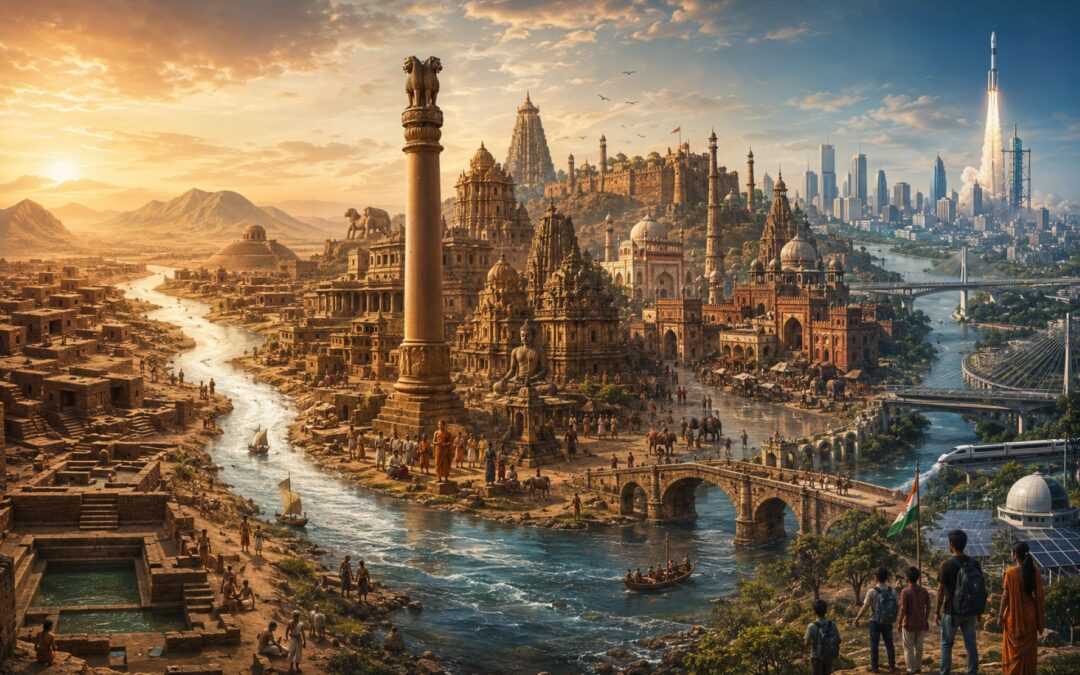
India is at once a modern republic, a geographical region and a civilizational space whose boundaries have never remained fixed for long. The kingdoms and empires of the past rarely governed the exact territory marked on today’s political map. Many of the most important centres of ancient Indian civilization now lie in Pakistan or Bangladesh, while the histories of Nepal, Afghanistan, Sri Lanka and Southeast Asia repeatedly intersect with India’s own.
Political unity was the exception rather than the rule. The Mauryas, Guptas, Mughals and British each brought substantial parts of the subcontinent under one authority, but none erased its regional languages, religious traditions, social structures or local identities. When central power weakened, older centres of authority returned. New kingdoms emerged, trade continued and culture developed through networks that did not depend upon one emperor ruling everything.
This is the central tension running through the history of India: extraordinary diversity repeatedly met equally ambitious projects of integration.
India’s religions, literary traditions, commercial networks and social institutions often endured longer than the states that patronized them. Conquerors entered from Central Asia, Persia, Afghanistan and Europe, yet their encounters with the subcontinent usually produced both conflict and exchange. Foreign dynasties became Indian dynasties. Imported artistic styles acquired local forms. New religious communities emerged from conversation, resistance and synthesis.
The Republic of India created in 1947 was therefore not the rebirth of one ancient nation-state. It was a new political answer to a very old historical problem: how could an immense and internally varied subcontinent be governed without destroying the differences that gave it life?
Before Empires: The First Peoples and the Indus Cities
Human beings have inhabited the Indian subcontinent for tens of thousands of years. Their descendants cannot be reduced to one original population, nor can the communities now described as Adivasi be treated as a single unchanged people who lived in India before everyone else arrived.
“Adivasi,” meaning original inhabitant, is a modern umbrella term for hundreds of distinct communities with different languages, histories and relationships to the land. Some preserved ways of life that remained outside the expanding agricultural states of the plains. Others traded with kingdoms, served in armies, adopted new religions or were gradually displaced into forests and hills. Their histories are an essential part of India’s past, but they cannot be compressed into one primordial beginning.
The first large urban civilization of the subcontinent emerged in the northwestern river systems during the fourth and third millennia BCE. Usually called the Indus Valley Civilization or the Harappan Civilization, it extended far beyond the Indus River itself, across territories now divided between Pakistan and India.
Its best-known cities include Harappa and Mohenjo-daro, but the civilization consisted of hundreds of settlements ranging from major urban centres to small farming and craft communities. At their height after approximately 2600 BCE, the Harappans created some of the earliest carefully planned cities in the world.
Their cities reveal an impressive command of engineering. Streets often followed deliberate grids. Brick dimensions were standardized across distant settlements. Drains ran beside or beneath houses. Wells, bathing areas, storage spaces and workshops were incorporated into the urban landscape.
The archaeological remains of Dholavira in present-day Gujarat offer an especially vivid example. Built in an arid environment, the city captured water from seasonal streams through reservoirs and channels. Its fortified districts, ceremonial ground, workshops, houses of differing sizes and carefully organized water system suggest both social hierarchy and sophisticated public coordination.
Harappan merchants participated in long-distance trade. Beads, shells, metals, textiles and other goods circulated within the civilization, while archaeological evidence connects Harappan centres to Oman and Mesopotamia. Mesopotamian records refer to trade with a region called Meluhha, which many historians associate with the Harappan world.
Yet the people who built these cities remain partly hidden from us. They left short inscriptions on seals, pottery and other objects, but their writing has not been convincingly deciphered. Without readable archives, historians cannot name Harappan rulers, poets, merchants or priests. Even the language or languages they spoke remain uncertain.
A proposed connection with later Dravidian languages is plausible but unproven. The Harappan world may have contained several linguistic communities, just as later India did.
The civilization did not disappear in one catastrophe. Beginning around 1900 BCE, major cities declined, long-distance trade contracted and populations shifted toward smaller settlements, especially farther east and south. Urban life gave way to more localized forms of agriculture and exchange.
Environmental change was important, but no single dried river or sudden drought explains the whole transformation. Recent paleoclimate research on the Harappan transformation points to prolonged river drought and weakening water availability, while changes in monsoon patterns, flood regimes, agriculture and trade probably affected different regions in different ways.
The people themselves did not vanish. They adapted, migrated and mixed with other populations. Archaeology and ancient DNA research on South Asian population formation show that the peoples of the subcontinent emerged through repeated movement and mixture rather than through a simple succession in which one race entirely replaced another.
Harappan cities declined, but parts of their agricultural knowledge, craft traditions, settlement patterns and possibly religious practices may have continued among later communities. The exact connections remain debated. What is clear is that India’s first urban age ended not with the disappearance of its population, but with a reorganization of life across the subcontinent.
The Vedic Age and the Making of Early Indian Society
During the second millennium BCE, pastoral peoples speaking early Indo-Aryan languages entered northwestern South Asia through a long process of migration and interaction. They were part of a broader Indo-Iranian and Indo-European world stretching across Central Asia.
Their arrival should not be imagined as one enormous army invading and instantly replacing the Harappans. Different groups probably moved over generations, forming alliances, fighting rivals, marrying local populations and adapting to new environments. The result was cultural transformation and population mixture.
These communities referred to themselves in some texts as arya, a term associated with cultural belonging and status rather than a modern racial identity. Their language developed into Vedic Sanskrit, and their ritual poetry was preserved orally with extraordinary precision.
The oldest collection, the Rigveda, contains hymns addressed to deities associated with fire, storms, dawn, cosmic order and sacred drink. Later collections—the Samaveda, Yajurveda and Atharvaveda—expanded the ritual world, while prose commentaries and philosophical texts gradually reinterpreted sacrifice, existence and the relationship between the individual and the cosmos.
Early Vedic communities were largely pastoral. Cattle represented wealth, prestige and exchange. Horses and chariots carried military and ritual importance, although the history of the horse in South Asia is more complicated than the claim that one migrating population simply introduced it for the first time.
Political organization centred on clans and tribes rather than territorial states. Chiefs gained prestige through warfare, generosity and sacrifice. Rival groups raided one another for cattle and land, while priests preserved rituals believed to sustain social and cosmic order.
As communities moved eastward from the Punjab toward the Ganges and Yamuna plains, their world changed. Agriculture became increasingly important. Iron tools, spreading after approximately 1200 BCE, helped communities clear forests and cultivate new land. Villages became more permanent, populations grew and political authority became increasingly territorial.
Social distinctions also hardened. The famous Purusha hymn of the Rigveda imagines society as a cosmic body divided into four varnas. Brahmins emerged as ritual specialists; Kshatriyas as rulers and warriors; Vaishyas as cultivators, herders and traders; and Shudras as servants and labourers.
This fourfold model was a prescriptive ideal, not a complete description of everyday society. It should not be treated as identical to the later caste system.
The social order commonly called caste developed over many centuries through the interaction of varna with thousands of local jatis—communities shaped by occupation, kinship, geography, marriage and inherited status. A person’s lived identity usually depended more on jati than on the four broad categories described in Sanskrit texts.
Nor was Vedic society the whole of India. Communities across the Deccan, eastern India and the south followed different patterns. Archaeological cultures such as the Jorwe settlements of present-day Maharashtra developed alongside the Vedic world and cannot be understood merely as marginal versions of it.
India’s later civilization would draw deeply from Vedic language, ritual and philosophy. Yet it grew from a much wider field of peoples whose voices rarely entered the texts preserved by Brahmin scholars.
New Cities, New Religions, and the Rise of Magadha
By the middle of the first millennium BCE, northern India experienced a second great period of urbanization. Towns expanded along the Ganges basin, trade intensified, metal coinage circulated and new political states emerged.
The older tribal territories known as janapadas developed into larger mahajanapadas. Tradition remembers sixteen of these major states, although their borders shifted and their political systems varied. Some were monarchies. Others, such as the Vajji confederacy, were governed by assemblies dominated by aristocratic families.
Urban life created spaces in which merchants, rulers, priests, artisans and wandering teachers encountered one another. Wealth was no longer tied only to land, cattle or ritual status. Commercial groups could patronize intellectual movements that questioned Brahmin authority and expensive sacrifice.
The result was one of the most creative periods in the religious history of the world.
Jain tradition traces its teachings through a succession of enlightened teachers called Tirthankaras. Its most historically prominent early leader was Mahavira, who probably lived during the sixth or fifth century BCE. Born into an elite family, he renounced ordinary life and embraced extreme ascetic discipline.
Jainism taught that living beings were bound to the cycle of rebirth through karma and could attain liberation through spiritual purification. Its ethical core included truthfulness, non-stealing, non-possession, chastity and ahimsa—radical nonviolence toward all living creatures.
Buddhism emerged from the same wider culture of wandering teachers and renunciants. Siddhartha Gautama, later called the Buddha, belonged to the Shakya community near the Himalayan foothills. The precise dates and many details of his life remain debated, while familiar stories about his sheltered childhood and first encounters with sickness, old age and death come from religious traditions written down later.
The central insight attributed to the Buddha was that ordinary existence is marked by dissatisfaction and suffering. Craving gives rise to that suffering, but liberation is possible through the ending of craving. The Eightfold Path joined ethical behaviour, mental discipline and wisdom, while the Middle Way rejected both indulgence and severe self-torture.
Buddhism and Jainism shared concepts already circulating across northern India, including karma, rebirth and liberation. Both challenged the idea that ritual sacrifice and inherited rank alone could lead to spiritual achievement. Both also attracted merchants and rulers whose patronage helped monastic communities grow.
At the political centre of this changing world stood Magadha, in present-day Bihar. Its eventual dominance was not accidental. The region possessed fertile land suited to wet-rice agriculture, access to rivers that carried people and goods, nearby iron resources and forests containing elephants valued in warfare.
Agricultural surplus supported cities, craftsmen, administrators and soldiers. Rivers aided taxation and transport. Rulers who could coordinate these resources gained a decisive advantage over smaller rivals.
Kings such as Bimbisara and Ajatashatru are remembered in Buddhist, Jain and later literary traditions, although their exact dates and biographies remain uncertain. What matters more than palace stories is the political process they represented: Magadha absorbed neighbouring territories, strengthened its army and built a durable fiscal base.
The city of Pataliputra, located near the confluence of major rivers, became the centre of this expansion. From Magadha would emerge the first state capable of ruling most of the subcontinent.
The Mauryan Empire and Ashoka’s Moral Turn
Alexander of Macedon entered the northwestern subcontinent in 326 BCE after conquering the Persian Empire. His forces defeated King Porus near the Hydaspes River, but Alexander’s advance ended at the Beas when his exhausted troops refused to continue eastward.
Ancient accounts claimed that enormous Indian armies and thousands of elephants awaited them. Such figures cannot be accepted literally, but the stories reflected a real political fact: the Gangetic states were richer and more populous than the territories Alexander had already crossed.
Alexander’s invasion was brief. He conquered part of the northwest, appointed governors and withdrew. His death in 323 BCE fragmented his empire and created opportunities for new powers.
One beneficiary was Chandragupta Maurya. His origins and exact route to power are obscure, but by approximately 321 BCE he had overthrown the Nanda dynasty of Magadha. Later traditions associate his rise with Kautilya, also called Chanakya, the strategist linked to the political treatise known as the Arthashastra.
Chandragupta extended Mauryan control across northern India and into territories once held by Alexander’s successors. A conflict with Seleucus I ended in a settlement through which the Mauryas gained territory in the northwest while Seleucus received hundreds of war elephants. Diplomatic relations followed, including the presence of the Greek ambassador Megasthenes at Pataliputra.
The Mauryan Empire was the first known state to unite most of the subcontinent under one political authority. It relied on taxation, officials, roads, fortified centres and a large military. Yet it almost certainly did not govern every region with equal intensity. Direct administration was strongest around the imperial core, while distant territories required local intermediaries.
The empire reached its greatest territorial extent under Chandragupta’s grandson Ashoka. Early in his reign, Ashoka conquered Kalinga on the eastern coast. His own inscriptions later described immense suffering: people killed, deported and separated from their families.
Rather than relying entirely on legends written centuries later, historians can approach Ashoka through his surviving rock and pillar edicts, which were inscribed across the empire in several scripts and languages.
In them, Ashoka expressed remorse for the destruction of Kalinga and announced a commitment to dhamma. This was not simply a declaration of Buddhist theology. It was a public ethic emphasizing respect for parents and elders, generosity, restraint, humane treatment, tolerance among religious communities and concern for subjects.
Ashoka supported Buddhist institutions and pilgrimage sites, but he also instructed officials to respect Brahmins and other religious groups. He described medical provisions, wells, shade trees and officers appointed to promote welfare and moral conduct.
His transformation should not be exaggerated into complete pacifism. The Mauryan state retained armies, punishments and frontier peoples whom Ashoka warned he could still discipline. Dhamma offered an ideal of restrained imperial rule; it did not abolish imperial coercion.
Ashoka’s inscriptions were also political communication. By carving messages into rocks and pillars across a vast territory, he made the ruler’s voice visible far beyond the capital. The edicts presented the emperor as a morally responsible guardian whose legitimacy rested not only on conquest but on conduct.
After Ashoka’s death around 232 BCE, Mauryan power declined. The empire’s scale made succession difficult, provincial elites grew more autonomous and fiscal resources became harder to control. Regional states broke away, and the last Mauryan ruler was overthrown around 185 BCE.
It is tempting to blame the collapse on Ashoka’s rejection of aggressive warfare, but that explanation is too simple. Large empires often fragment when central authority weakens. The Mauryan achievement remained significant precisely because later rulers would repeatedly seek, but rarely attain, comparable authority across the subcontinent.
After the Mauryas: Migration, Trade, and Regional Power
The centuries after the Mauryas were once described as a dark age because no single empire controlled northern India and the written record became uneven. In reality, this was an age of mobility, commerce and political experimentation.
The Shungas and Kanvas succeeded the Mauryas in parts of the Gangetic heartland, but their authority was limited. In the northwest, Greek-ruled kingdoms descended from the Hellenistic world established themselves in parts of Afghanistan, Pakistan and northern India. Their rulers minted bilingual coins, adopted local titles and interacted with Buddhist communities.
Later migrants included the Sakas, groups of Central Asian origin often described as Indo-Scythians, and the Yuezhi, one branch of whom created the Kushan Empire.
The Kushans connected northern India to Central Asia and the Silk Roads. Their kings issued coins depicting deities from Greek, Iranian, Buddhist and Indian traditions, revealing an imperial world comfortable with multiple cultural languages. Under rulers such as Kanishka, Buddhist institutions received substantial patronage.
In Gandhara, artists produced images that combined Mediterranean-influenced forms with Buddhist subjects. The human representation of the Buddha became increasingly prominent, and Buddhist ideas travelled through Central Asia toward China.
Farther south, the Satavahanas ruled much of the Deccan for several centuries. Their position allowed them to connect inland agriculture and craft production with ports on both coasts. They competed with Saka rulers for control of commercially valuable territory while patronizing Buddhist and Brahmin institutions.
Trade tied the subcontinent to the Roman world. Ships crossed the Arabian Sea carrying pepper, gemstones, ivory, textiles and other luxury goods. Roman coins have been found in large numbers in southern and western India, although they did not always function there exactly as Roman currency. Indian merchants, sailors and intermediaries participated in a commercial system extending from the Mediterranean to Southeast Asia.
Southern India developed through its own powerful political and literary traditions. The Tamil-speaking region known as Tamilakam included much of present-day Tamil Nadu and Kerala and was associated with the Chera, Chola and Pandya dynasties.
Sangam poetry, composed and compiled over centuries, describes a world of warfare, generosity, courtly honour, love, landscape and trade. Its heroes include kings and warriors, but also merchants, farmers, performers and women whose presence is more visible than in many northern Sanskrit sources.
Tamil society was not isolated from northern India, yet it was not simply an extension of Vedic culture. Local deities, kinship structures and political traditions remained strong. Brahmins and Sanskritic ideas gradually became more influential, but they entered an already developed cultural world.
The Pandyas ruled from Madurai, while ports along the Tamil coast linked India with Rome and Southeast Asia. Political rivalry did not prevent the emergence of a shared Tamil literary identity.
This period demonstrates why political fragmentation should not be confused with civilizational decline. India was divided among many rulers, but goods, religious ideas, artistic forms and people moved more widely than before.
The Gupta Age and the Classical Traditions of India
The Gupta dynasty emerged in northern India during the fourth century CE. Its early history is obscure, but rulers such as Chandragupta I, Samudragupta and Chandragupta II expanded control across much of the Gangetic plain and northern India.
The Guptas did not recreate the Mauryan state exactly. Their emperors controlled a political core while accepting tribute and loyalty from subordinate rulers who retained considerable local power. This approach allowed expansion without requiring one centralized bureaucracy to administer every district directly.
Samudragupta celebrated his victories in inscriptions listing rulers he defeated, reinstated or accepted as tributaries. Chandragupta II extended Gupta influence westward and gained access to important trade routes. Other kingdoms, including the Vakatakas of the Deccan, were connected to the Guptas through marriage and diplomacy rather than simple conquest.
The Gupta period is often called a golden age because of major achievements in Sanskrit literature, mathematics, astronomy, sculpture and temple architecture. The description captures real cultural influence, but it must be used carefully. Prosperity and creativity were uneven, and the surviving evidence reflects educated and courtly elites more clearly than labourers, women or marginalized communities.
Sanskrit became a language of royal prestige across large parts of the subcontinent. Rulers far beyond direct Gupta control adopted Sanskrit inscriptions, genealogies and political titles. The Ramayana and Mahabharata continued to evolve toward forms recognizable today, although neither work was composed at one moment or by one author.
The epics offered more than stories. They became reservoirs of political ideals, moral dilemmas, religious devotion and regional adaptation. Their characters entered temple traditions, vernacular poetry, performance and everyday language. Their cultural significance does not require treating every event within them as archaeologically proven history.
Scientific and mathematical work flourished. Aryabhata, writing in the late fifth and early sixth centuries, described the apparent movement of the heavens in ways that recognized the Earth’s rotation. He explained eclipses through shadows rather than supernatural beings and calculated a highly accurate approximation of pi.
Indian mathematicians developed place-value notation and the conceptual foundations that eventually allowed zero to function as a number. The process unfolded across centuries. Brahmagupta’s seventh-century rules for calculations involving zero were especially important; it would be inaccurate to credit the invention to one earlier scholar alone.
Learning did not take place only in royal courts. The monastic and scholastic complex at Nalanda developed into one of Asia’s most influential centres of organized study. Its monasteries and educational buildings supported the transmission of Buddhist philosophy, logic, medicine, grammar and other fields over many centuries.
Nalanda later attracted scholars from China, Tibet, Korea and Southeast Asia. It embodied a wider Indian intellectual world in which monasteries could become international institutions supported by rulers, donors and landed wealth.
Religious life also changed. Devotional traditions centred on Vishnu, Shiva and the goddess became increasingly prominent. Temples emerged as important centres of worship, patronage and local economy. Puranic literature organized myths, cosmology and pilgrimage traditions that made religious ideas accessible far beyond specialists in Vedic sacrifice.
What is now called Hinduism did not appear suddenly as one uniform religion. It developed through the interaction of Vedic ritual, local gods, philosophical schools, devotional movements, temple institutions and regional practices.
Social hierarchy remained powerful. Brahminical texts increasingly emphasized restrictions on women’s autonomy and the duties of wives and widows, although prescriptions did not describe every household. Evidence of sati exists, but it was neither universal nor uniformly accepted.
The Kama Sutra, probably compiled during the early centuries CE, illustrates both social control and complexity. It is often reduced to a manual of sexual positions, yet most of the work concerns relationships, courtship, household management, urban life and the socially acceptable pursuit of pleasure.
By the late fifth century, Gupta authority weakened. Powerful regional rulers became more independent, while Huna groups entered northwestern India and placed military pressure on the empire. Gupta rulers and other Indian states eventually resisted them, but central authority did not recover.
The empire faded during the sixth century. Its political unity disappeared, yet the Sanskritic, artistic, mathematical and religious traditions associated with the era continued to shape India long after Gupta rule ended.
Regional Empires and the Making of Medieval India
The collapse of Gupta authority did not produce a political vacuum. It created space for regional kingdoms whose power rested on new alliances among monarchs, warriors, temples, landholders and local communities.
In northern India, Harsha created a substantial kingdom during the early seventh century. Coming to power after violence within his family, he expanded from the Punjab toward the Gangetic plain and made Kannauj a major centre.
Harsha is known partly through Banabhatta, his court poet, and through the Chinese Buddhist traveller Xuanzang. These sources praise his learning, charity and religious patronage, but their admiration should not obscure their closeness to elite power. Harsha supported both Buddhist and Brahmin institutions and maintained diplomatic contact with Tang China.
His authority remained largely northern. When he attempted to move south, he was checked near the Narmada by Pulakeshin II of the Chalukya dynasty.
The Chalukyas ruled much of the Deccan from Badami and competed with the Pallavas of southern India. Their conflict produced both destruction and remarkable cultural patronage. Rock-cut shrines, structural temples and inscriptions reveal rulers using religious architecture to display legitimacy.
Farther northwest, the expansion of Islamic power transformed the political environment. Arab armies conquered Sind in the early eighth century, establishing the first enduring Muslim-ruled territory within the historical subcontinent.
This conquest mattered, but it was not the only way Islam entered India. Arab and Persian merchants had long visited western coastal ports. Muslim communities settled in commercial towns, where local rulers generally allowed them to trade, worship and establish families.
Conflict and cooperation therefore developed together from the beginning.
By the eighth century, three major dynasties competed for influence over northern India and the prestigious city of Kannauj. The Gurjara-Pratiharas were centred in western and northern India, the Palas in Bengal and Bihar, and the Rashtrakutas in the Deccan.
Their repeated rivalry is known as the Tripartite Struggle. None permanently conquered the others, but all built influential political cultures. The Pratiharas developed powerful cavalry forces and resisted expansion from Sind. The Buddhist Palas patronized monasteries such as Nalanda and later Vikramashila, helping sustain connections with Tibet and Southeast Asia. The Rashtrakutas ruled a multilingual Deccan empire and patronized Hindu, Jain and Muslim communities.
In the Tamil south, the Cholas re-emerged as the leading imperial power from the ninth century. Under Rajaraja I and Rajendra I, they conquered much of southern India, invaded Sri Lanka and exercised influence across the Bay of Bengal.
Chola strength rested on more than warfare. Productive agriculture in the Kaveri delta generated revenue. Merchant guilds connected ports to inland markets and overseas trading communities. Temples accumulated land, employed craftsmen, redistributed resources and displayed royal authority.
The Great Living Chola Temples demonstrate how architecture, sacred worship and state power were joined. Monumental towers and sculpture proclaimed imperial ambition, while inscriptions recorded donations, landholding, ritual obligations and administrative activity.
The Cholas also possessed unusual naval capacity. In the eleventh century, Rajendra I attacked the maritime kingdom of Srivijaya and struck centres in the Malay world. These expeditions displayed the reach of Chola power and protected commercial interests, but they did not create a permanent Chola empire over all Southeast Asia.
Medieval India was thus neither politically united nor culturally static. Its rulers competed in familiar ways, but regional languages, temple institutions, merchant networks and devotional traditions became increasingly influential.
India was becoming more connected internally even while its political map remained divided.
Sultanates, Vijayanagara, and the Indo-Islamic World
From the eleventh century onward, Muslim dynasties based in Afghanistan and Central Asia launched increasingly ambitious campaigns into northern India. Mahmud of Ghazni conducted repeated raids, targeting cities, forts and wealthy temples. His conquests within India were not permanent, but the raids weakened northwestern states and brought immense wealth into the Ghaznavid world.
The Ghurids went farther. Muhammad of Ghor defeated major north Indian forces during the late twelfth century, and his commanders established control over Delhi and the Gangetic plain.
After Muhammad’s death, Qutb al-Din Aibak created an independent sultanate centred on Delhi. The Delhi Sultanate would endure for more than three centuries under five dynastic houses: the Mamluks, Khaljis, Tughluqs, Sayyids and Lodis.
These dynasties were founded by military elites with Central Asian, Turkic, Afghan and Persian connections, but their states rapidly became rooted in India. They depended on Indian revenue, soldiers, craftsmen and local intermediaries. Persian became a language of administration and high culture, while interaction with Indian languages eventually contributed to new literary and linguistic forms.
The sultans faced a central problem shared by earlier empires: how to govern a large and overwhelmingly non-Muslim population through a relatively small ruling elite.
Policies varied. Some rulers destroyed temples in warfare, imposed discriminatory taxation or presented campaigns in religious language. Others patronized Hindu officials, granted land to local elites and protected religious institutions whose cooperation supported the state. Political calculation, fiscal need and personal conviction often operated together.
The Sultanate transformed warfare. Mounted archers, mobile cavalry and later gunpowder increased the importance of military specialization. Delhi’s rulers also faced repeated Mongol attacks, forcing them to maintain fortifications, frontier armies and large standing forces.
Alauddin Khalji expanded Sultanate influence into Gujarat and the Deccan and introduced aggressive market and revenue controls to sustain his military. Muhammad bin Tughluq attempted ambitious administrative experiments, including shifting the capital toward the Deccan and issuing token currency. His projects were not simply acts of madness, as later caricatures suggest, but their scale and execution caused severe disruption.
As Delhi’s authority weakened during the fourteenth century, provincial states broke away. In the Deccan, the Bahmani Sultanate emerged as an independent Muslim kingdom. South of the Krishna River, Vijayanagara developed into a powerful Hindu-ruled empire.
The two states competed for fertile territory, strategic forts and control of trade. Their wars carried religious symbolism, but each also employed soldiers and officials from different faiths. Alliances could cross religious boundaries, and internal political factions were often as important as ideological opposition.
Vijayanagara’s capital at Hampi became one of the largest cities of the medieval world. The surviving monuments of Hampi reveal an urban landscape of temples, markets, waterworks, palaces, fortifications and ceremonial spaces. Foreign travellers described a prosperous capital filled with merchants and goods from distant regions.
The empire’s rulers drew legitimacy from older South Indian traditions while adopting cavalry, firearms and administrative practices circulating through the wider Indo-Islamic world. Vijayanagara and the Deccan sultanates were not sealed civilizations facing each other across an absolute cultural frontier. They were rivals within a shared political and commercial system.
In 1565, a coalition of Deccan sultanates defeated Vijayanagara at the Battle of Talikota. The capital was sacked and never fully recovered, but the empire did not vanish immediately. Successor rulers continued from other centres, while its political and artistic traditions shaped southern India for generations.
The Delhi Sultanate, meanwhile, had been devastated by Timur’s invasion of 1398 and weakened further under the Sayyids and Lodis. In 1526, a new Central Asian conqueror defeated the last Lodi sultan at Panipat.
The Mughal era had begun.
The Mughal Empire: Conquest, Accommodation, and Splendour
Babur descended from Timur on his father’s side and claimed descent from Genghis Khan through his mother. Driven from much of his Central Asian inheritance, he established himself in Kabul before turning toward India.
At the First Battle of Panipat in 1526, Babur defeated Ibrahim Lodi through disciplined cavalry tactics, field fortifications and gunpowder artillery. His victory did not instantly secure India. He still had to defeat Rajput and Afghan opponents, and his new state remained fragile when he died in 1530.
Babur was both warrior and writer. His memoirs describe landscapes, plants, military campaigns and court life with unusual directness. He admired India’s wealth but often judged it according to Central Asian preferences.
His son Humayun lost the empire to the Afghan ruler Sher Shah Suri, who created an efficient territorial state and strengthened roads, currency and revenue administration. Humayun recovered the Mughal throne in 1555 with Persian support but died the following year, leaving the empire to his young son Akbar.
Akbar transformed a vulnerable conquest state into a durable Indian empire.
Military expansion brought Gujarat, Bengal, Rajasthan and much of northern and central India under Mughal authority. Yet conquest alone could not hold such a territory. Akbar incorporated Rajput rulers into the imperial elite, allowed them to retain lands and status and built marriage alliances with important families.
The mansabdari system assigned officials graded ranks connected to military and administrative obligations. Revenue reforms associated with figures such as Raja Todar Mal improved assessment and gave the state a more dependable claim on agricultural production.
Akbar also reconsidered the relationship between imperial authority and religion. He abolished the jizya tax on non-Muslims, participated in debates involving Muslim scholars, Hindus, Jains, Christians and Zoroastrians and sought a political language capable of embracing subjects of different faiths.
His tolerance was both conviction and statecraft. Religious accommodation strengthened imperial loyalty, but Akbar’s curiosity also appears genuine. The cultural synthesis of the early Mughal court can be seen in illustrated manuscripts, architecture and painting that combined Persianate techniques with Indian materials, artists and subjects.
The Mughals did not abandon their Central Asian and Persian heritage. They made it part of an increasingly Indian imperial culture.
Under Jahangir, court painting reached new levels of naturalism and detail. His wife Nur Jahan became one of the most politically powerful women in Mughal history. As an imperial consort, she issued orders, influenced appointments, participated in court alliances and had coins struck in association with her authority.
Her rise did not follow the romanticized story of Jahangir forcibly ending her previous marriage. She was a widow when they married in 1611.
Shah Jahan inherited a wealthy and sophisticated empire. His reign produced some of the most celebrated Mughal architecture, including the Red Fort in Delhi and the Taj Mahal in Agra. The Taj was commissioned as a mausoleum for his wife Mumtaz Mahal, who died during childbirth in 1631.
Its beauty emerged from the work of architects, calligraphers, stonecutters and labourers within a mature imperial tradition. The familiar claim that Shah Jahan mutilated its craftsmen is unsupported. He died in 1666 and was buried beside Mumtaz.
Mughal India also witnessed the development of Sikhism. Guru Nanak, born in Punjab in 1469, taught devotion to one God, ethical labour, equality and service. The Sikh community grew under successive gurus, acquiring sacred texts, institutions and a stronger collective identity.
Relations with Mughal authority deteriorated at several moments. Guru Arjan was executed under Jahangir in 1606. Guru Tegh Bahadur was executed in 1675 under Aurangzeb. Under Guru Gobind Singh, the creation of the Khalsa gave Sikh identity a more explicitly martial form.
Aurangzeb inherited the throne after defeating his brothers and imprisoning Shah Jahan. He expanded Mughal territory to its greatest extent, conquering the Deccan sultanates of Bijapur and Golconda. Yet expansion imposed enormous costs.
His religious policies were more orthodox than Akbar’s. He restored the jizya, supported Islamic legal scholars and ordered the destruction or appropriation of some temples, particularly where political rebellion and religious authority overlapped. At the same time, Hindu officials continued to serve in large numbers, and imperial policy varied by region and circumstance.
Aurangzeb’s reign cannot be explained solely as a religious conflict. Long wars in the Deccan, fiscal pressure, succession struggles, local resistance and the autonomy of regional elites all weakened the state.
The Marathas became the most formidable challengers. Shivaji Bhonsle built a kingdom through mobile warfare, strategic forts and alliances in the western Deccan. In 1674, he was crowned as an independent sovereign. Mughal armies captured territory after his death, but they could not eliminate Maratha resistance.
When Aurangzeb died in 1707, the empire was territorially vast but politically exhausted. Successors faced court rivalries, provincial independence and invasions by Nader Shah and Ahmad Shah Durrani.
The Mughals remained symbols of sovereignty, but practical power shifted to regional states: the Nizam of Hyderabad, the nawabs of Bengal and Awadh, the Maratha confederacy, Mysore and the Sikh misls.
European trading companies entered this fragmented but still wealthy political world. One of them would eventually use India’s own revenue and soldiers to conquer the rest.
From European Traders to British Conquerors
European merchants did not arrive in an isolated or economically stagnant India. They entered one of the world’s great commercial regions, whose textiles, spices and manufactured goods were sought across Asia, Africa and Europe.
Vasco da Gama reached Calicut in 1498 after sailing around the Cape of Good Hope. The Portuguese initially sought trade, but quickly used naval artillery and fortified ports to dominate strategic routes. They captured Goa in 1510 and built an Indian Ocean network based on coastal strongholds rather than extensive inland conquest.
The Dutch, English and French followed. Each created a chartered company capable of combining private investment, state support, diplomacy and armed force.
The English East India Company, chartered in 1600, obtained permission to trade within the Mughal Empire and established factories at Surat, Madras, Bombay and Calcutta. For much of the seventeenth century, the Company remained dependent on Indian rulers. Its servants purchased goods, negotiated customs privileges and competed with other merchants.
European naval power mattered, but Indian states were not uniformly technologically inferior. They possessed firearms, artillery and large armies. The Company’s eventual success came from combining military organization with credit, maritime supply, political intelligence and alliances within Indian conflicts.
During the eighteenth century, Mughal decline and European wars transformed the balance. The British and French backed rival claimants in the Carnatic and Hyderabad. Indian rulers used European-trained troops, while European companies acquired territorial influence through Indian succession disputes.
British victories during the Carnatic Wars weakened French power, but Bengal provided the decisive breakthrough.
Bengal was one of the richest regions in the world. Its textiles, agriculture and river trade generated immense revenue. When Nawab Siraj ud-Daulah moved against the Company’s fortified settlement at Calcutta, Company forces under Robert Clive responded.
At the Battle of Plassey in 1757, the British did not defeat Bengal through battlefield superiority alone. They had secretly secured the betrayal of Mir Jafar and other figures within the nawab’s camp. Much of Siraj’s army remained inactive, allowing a small Company force to prevail.
Plassey gave the Company influence over Bengal’s ruler and access to enormous payments. It did not yet grant full sovereignty, but it allowed British officials to manipulate succession and extract wealth.
The greater constitutional turning point came after the Battle of Buxar in 1764, when the Company defeated the combined forces of the Mughal emperor, the nawab of Awadh and the displaced ruler of Bengal.
In 1765, the Mughal emperor granted the Company the Diwani—the right to collect revenue in Bengal, Bihar and Orissa. A commercial corporation now controlled the fiscal resources of one of India’s richest regions. Indian taxes could finance Indian armies commanded by British officers, which could conquer more territory and generate more taxes.
This self-reinforcing system made Company expansion possible.
Its rise was not inevitable. Mysore under Hyder Ali and Tipu Sultan inflicted serious defeats on British forces. Mysore used disciplined infantry, fortifications and iron-cased rockets, while seeking French support against the Company. Four wars were required before Tipu was killed at Seringapatam in 1799.
Hyderabad survived by accepting subsidiary alliance, which placed British troops within its territory and restricted independent diplomacy.
The Maratha confederacy remained the largest Indian power after Mughal decline. Its decentralized structure gave regional houses considerable flexibility but made unified strategy difficult. British officials repeatedly intervened in succession conflicts, backed rival leaders and imposed treaties that increased Company influence.
The Treaty of Bassein in 1802 placed the Peshwa under British protection and provoked resistance from major Maratha houses. Defeat in the Second and Third Anglo-Maratha Wars ended the confederacy’s independence by 1818.
In the Punjab, Ranjit Singh united Sikh misls into a powerful state with a modernized army. His empire balanced Sikh, Muslim and Hindu elites and resisted Afghan pressure. After his death in 1839, rapid successions and court conflict weakened the state. Two Anglo-Sikh Wars ended with British annexation in 1849.
Elsewhere, Company power expanded through warfare, subsidiary alliances, financial pressure and the Doctrine of Lapse, under which states lacking an heir recognized by the British could be annexed.
By the middle of the nineteenth century, the East India Company controlled most of the subcontinent either directly or through princely states. It had not conquered India simply because Europeans possessed better weapons. It succeeded because it inserted itself into Indian rivalries, gained control of revenue, recruited hundreds of thousands of Indian soldiers and repeatedly prevented its opponents from forming lasting coalitions.
Company Rule and the Rebellion of 1857
The Company had acquired a territorial empire without creating a government designed for the welfare of its subjects. Its primary obligations were to shareholders, creditors and the British state.
The consequences appeared quickly in Bengal. During the famine of 1769–1770, crop failure combined with fragile markets and a revenue system that continued to demand payment from suffering communities. Early estimates of ten million deaths were probably exaggerated, but mortality was catastrophic.
British Parliament gradually imposed greater oversight. The Regulating Act of 1773 created the office of governor-general, while later legislation strengthened government supervision of Company affairs.
Administrative reform did not end racial hierarchy. The Cornwallis Code sought to reduce private corruption and regularize revenue and justice, but it largely excluded Indians from senior positions. British officials increasingly portrayed themselves as morally and intellectually superior to the people whose taxes sustained their power.
Company rule altered landholding and taxation through systems such as the Permanent Settlement in Bengal, ryotwari arrangements in parts of southern and western India and mahalwari settlements in the north. Their local effects differed, but all attempted to make agricultural revenue predictable for the colonial state.
The nineteenth century also brought railways, telegraphs, steamships, canals and English-language education. These technologies eventually transformed India, but their immediate purposes were imperial. Railways moved troops and export goods efficiently. Telegraph lines helped officials coordinate rule. Education produced clerks and intermediaries required by the colonial administration.
Indians nevertheless appropriated these systems for their own purposes. Railways carried pilgrims, workers and political organizers. Print created new reading publics. English education introduced ideas of rights, representation and liberal government that Indians would turn against British rule.
Social reform became another contested field. The colonial government prohibited sati in 1829 and later acted against slavery and other practices. Indian reformers had already campaigned against sati, and many welcomed legal change.
The issue was not whether Indian society should change. It was who possessed the authority to define reform. British officials used selected abuses to justify a “civilizing mission” while denying Indians political equality and ignoring exploitation within colonial rule.
Resentment intensified through annexation, racial discrimination, military grievances and interference with established elites. The annexation of Awadh in 1856 angered nobles, landholders, soldiers and peasants whose livelihoods were tied to the old state.
The immediate crisis began among sepoys, Indian soldiers serving in Company armies. A new rifle cartridge had to be bitten open, and rumours spread that it had been greased with cow and pig fat. This threatened Hindu and Muslim religious observance.
The truth about particular supplies and official intentions remains complicated. What mattered politically was that many soldiers no longer trusted British assurances. The controversy appeared to confirm a wider fear that the colonial state intended to undermine Indian religions.
On May 10, 1857, sepoys at Meerut rebelled, killed European officers and civilians and marched to Delhi. There they proclaimed the elderly Mughal emperor Bahadur Shah Zafar as a symbolic sovereign.
The rebellion spread through much of northern and central India. Soldiers, dispossessed rulers, landholders and civilians joined for different reasons. Major centres included Delhi, Kanpur, Lucknow and Jhansi, where Rani Lakshmibai became one of the rebellion’s most famous leaders.
Violence was brutal on all sides. Rebels killed British civilians, including women and children. British forces responded with mass executions, collective punishment, destruction and indiscriminate reprisals.
The uprising was neither a fully unified national war nor merely an army mutiny. Its participants did not share one political programme, and large parts of India remained quiet. Sikh troops, Gurkhas, princely rulers and many Indian soldiers supported the British.
The rebellion failed militarily, but it destroyed the Company’s legitimacy. In 1858, the British government dissolved Company rule and transferred its territories to the Crown. Bahadur Shah Zafar was exiled, formally ending the Mughal dynasty.
The new British Raj promised to respect religious customs and princely states more carefully. The colonial army was reorganized to prevent soldiers from one region or community from dominating it. Indians were divided into categories the British considered loyal or “martial,” deepening ethnic and religious classification.
The Raj had survived the greatest challenge to British power, but 1857 revealed the danger of ruling a continent while refusing its people meaningful authority.
The Raj and the Rise of Indian Nationalism
Direct Crown rule changed the structure of the colonial state, but it did not end economic extraction or racial inequality.
India remained central to British trade. Cotton, jute, tea, indigo, wheat and opium moved through ports and railways, while British manufactured goods entered Indian markets. Some industries expanded, particularly jute mills in Bengal and cotton mills in western India, but profits and access to capital remained unevenly distributed.
The railways became one of the most visible legacies of the Raj. They linked regions, reduced some transport costs and eventually carried millions of passengers. Yet routes and freight systems were designed largely around military movement and exports, while their financing frequently guaranteed British investors returns at Indian expense.
British people remained a tiny minority, concentrated in military cantonments, administrative centres and socially segregated districts. Clubs, residences and institutions enforced racial boundaries even when Indians possessed equal or greater wealth and education.
Missionaries established schools, printed books and sometimes developed written forms for regional languages. Christianity, however, had existed in India long before British rule, especially among ancient communities on the Malabar Coast. Colonial missions expanded Christian populations in some regions, but they did not create Indian Christianity from nothing.
Missionaries often combined education and medical work with open contempt for Indian religions. Their attitudes reinforced fears that colonial reform was part of a project of cultural domination.
Famines and epidemics further damaged imperial legitimacy. British officials frequently attributed famine to drought and population pressure, but export priorities, taxation, purchasing power and rigid administrative doctrines affected who could obtain food. Relief policies varied, and millions died during late nineteenth-century crises.
Educated Indians initially sought reform through petitions rather than revolution. In 1885, lawyers, journalists, professionals and public figures founded the Indian National Congress. Its early leaders demanded greater Indian participation in administration, expansion of legislative councils and fairer access to the civil service.
Congress was not immediately a mass independence movement. It represented a small educated elite and often expressed faith that Britain might honour its own liberal ideals.
The partition of Bengal in 1905 transformed that politics. The British divided the large province into eastern and western units, claiming administrative necessity. Many Hindu political leaders saw an attempt to weaken Bengali nationalism by separating communities.
The Swadeshi movement answered with boycotts of foreign goods, promotion of Indian production, public demonstrations and national education. Politics moved beyond petitions into economic non-cooperation.
The partition also exposed religious divisions. Many Muslims in eastern Bengal welcomed a province in which they formed a majority, believing it might improve political representation. The All-India Muslim League was founded in 1906 to protect Muslim political interests.
The original partition was annulled in 1911, but the conflict had changed Indian politics. Nationalism had gained a mass vocabulary, and separate political organization increasingly shaped Hindu-Muslim negotiations.
The First World War intensified demands for change. More than a million Indian soldiers and labourers served the British war effort across Europe, the Middle East and Africa. India supplied money, food and materials while facing inflation and economic strain at home.
After the war, limited constitutional reform disappointed expectations. The Rowlatt Acts extended emergency powers, allowing detention without ordinary trial protections. Gandhi called for resistance through satyagraha, the disciplined use of nonviolent non-cooperation.
In Amritsar on April 13, 1919, Brigadier General Reginald Dyer ordered troops to fire on an unarmed gathering at Jallianwala Bagh. The enclosed ground offered few routes of escape. Hundreds were killed.
The massacre broke the remaining faith of many Indians in the moral claims of the Raj. Even British critics condemned Dyer, but the admiration he received from imperial supporters demonstrated how differently Indian and British lives were valued.
Mohandas Gandhi emerged as the central leader of mass nationalism. Trained as a lawyer, he had spent more than two decades in South Africa, where racial discrimination shaped his political methods.
Gandhi’s satyagraha rejected violence while demanding active resistance. Participants were expected to refuse unjust laws, accept punishment and deny the state the cooperation it required. His politics connected constitutional questions to everyday life: cloth, salt, village poverty, caste discrimination and religious relations.
Congress became a mass organization under his influence. Yet Gandhi never controlled the entire independence movement. Revolutionary groups, socialists, labour organizers, peasant movements, Muslim political leaders, anti-caste thinkers and regional parties pursued different visions of freedom.
Jawaharlal Nehru pushed Congress toward full independence and a more socialist economic programme. In 1929, Congress declared complete sovereignty rather than limited self-government within the empire as its objective.
The Salt March of 1930 made imperial authority tangible. By walking to the coast and producing salt in defiance of the government monopoly, Gandhi turned an ordinary necessity into a symbol of foreign rule. The act could be repeated by rich and poor alike.
The British arrested tens of thousands, but repression could not restore unquestioned obedience.
India entered the Second World War in 1939 without consultation with elected Indian leaders. Congress opposed fascism but demanded a meaningful transfer of power in return for cooperation. When Britain refused, Congress ministries resigned.
The scale of India’s military contribution was nevertheless immense. The Indian armed forces in the Second World War expanded to approximately 2.5 million army personnel, with tens of thousands more serving in naval and air forces. Indian troops fought in East and North Africa, Italy, the Middle East and, above all, Burma.
Subhas Chandra Bose pursued a radically different strategy. Believing Britain’s wartime vulnerability offered a unique opportunity, he sought support from Nazi Germany and imperial Japan. Indian prisoners of war were recruited into military formations intended to fight British rule.
Bose’s commitment to Indian independence gave him enduring appeal, but his alliances require moral clarity. The Axis powers were not liberators, and their racial and imperial projects offered no secure path to democratic freedom.
The Japanese-backed Indian National Army entered northeastern India during the 1944 offensive toward Imphal and Kohima. Indian and Allied forces defeated the invasion, halting Japanese expansion from Burma.
Meanwhile, Gandhi and Congress launched the Quit India Movement in 1942. The British arrested the national leadership and tens of thousands of supporters. With senior organizers imprisoned, protests became decentralized and sometimes violent.
The wartime crisis reached its most devastating point in Bengal in 1943. Crop problems, inflation, the loss of Burmese rice imports, wartime procurement, transportation failures, market speculation and policy decisions combined to destroy access to food.
The causes remain debated, but historical research on government famine relief in Bengal demonstrates that the disaster cannot be explained by one factor alone. Administrative conflict, delayed intervention and wartime priorities contributed to a catastrophe in which roughly two to three million people may have died.
The famine exposed the central contradiction of empire. Britain claimed the right to rule India because it could provide order and progress, yet it could not—or would not—protect millions of its subjects from starvation.
By 1945, Britain had won the war but lost the political, economic and moral capacity to preserve the Raj.
Independence, Partition, and the Founding of the Republic
The end of British rule was certain after the Second World War. The form of independence was not.
Congress claimed to represent a united Indian nation in which religious identity would not determine citizenship. The Muslim League under Muhammad Ali Jinnah argued that Muslims constituted a political nation whose rights could not be protected within a Hindu-majority state without strong constitutional safeguards or a separate homeland.
These positions developed through decades of failed negotiation, provincial competition and mutual distrust. Partition was not the inevitable result of ancient religious hatred. It emerged from modern mass politics, British constitutional arrangements, communal violence and the inability of political leaders to agree on how power would be shared.
The Cabinet Mission of 1946 proposed a loose Indian union with substantial provincial autonomy. Its failure narrowed the remaining options. Violence in Calcutta, Bihar, Noakhali, Punjab and elsewhere hardened communal fears.
In February 1947, Britain announced that power would be transferred no later than June 1948. Lord Mountbatten, the final viceroy, accelerated the timetable dramatically. The speed of withdrawal left little time to divide armies, institutions, assets or territory.
The archival record of Britain’s transfer of power reveals how decisions about independence and Partition unfolded under intense political pressure.
British India was divided into India and Pakistan. Pakistan consisted of two geographically separated wings: western territories around Punjab, Sindh, Baluchistan and the North-West Frontier Province, and eastern Bengal more than a thousand miles away.
A boundary commission chaired by Cyril Radcliffe had only weeks to divide Punjab and Bengal. Its award was not publicly released until August 17, 1947, after Pakistan and India had already become independent.
The borders cut across villages, irrigation systems, railways, markets and families. Millions of Hindus and Sikhs found themselves in Pakistan, while millions of Muslims lived in India.
Fear triggered one of the largest forced migrations in history. Approximately fourteen to fifteen million people crossed the new borders. Trains, roads and refugee columns became targets for armed groups. Murder, abduction and sexual violence occurred on a massive scale.
Estimates of the dead vary widely, but the toll probably reached hundreds of thousands and may have exceeded one million. Numbers alone cannot express the destruction of communities whose members had lived beside one another for generations.
Most violence occurred in Punjab, where populations were rapidly separated along religious lines. Bengal also experienced displacement and brutality, though migration there unfolded over a longer period.
The princely states, formally outside direct British provincial administration, had to choose whether to join India or Pakistan. Most acceded without war, but Hyderabad, Junagadh and Jammu and Kashmir created major disputes.
Kashmir had a Muslim-majority population ruled by the Hindu maharaja Hari Singh. When armed groups from Pakistan entered the state in October 1947, Hari Singh sought Indian military assistance and signed an Instrument of Accession to India.
War followed between India and Pakistan. A United Nations-backed ceasefire took effect in 1949, leaving the former princely state divided. The original ceasefire line was later redesignated the Line of Control after the 1972 Simla Agreement.
The conflict established a rivalry that would produce repeated wars, militarization and eventually nuclear danger.
Gandhi spent the final months of his life trying to stop communal violence. His insistence that Muslims were equal citizens of India angered Hindu extremists. Nathuram Godse assassinated him in Delhi on January 30, 1948.
Independence had been achieved, but its leading advocate of nonviolence was killed by the very communal hatred he had tried to overcome.
The new state faced an extraordinary challenge. It had to integrate princely territories, resettle refugees, construct institutions, address poverty and persuade hundreds of millions of people that a common political future was possible.
India’s answer was constitutional democracy.
The Constitution came into force on January 26, 1950. The constitutional system of India established parliamentary government, federal institutions, an independent judiciary, fundamental rights and equality before the law.
Universal adult suffrage was adopted despite widespread poverty and illiteracy. India did not wait to become wealthy before allowing ordinary people to vote. Citizenship, rather than property, education, caste, religion or gender, formed the basis of political participation.
The Constitution rejected the establishment of a Hindu state. It protected religious freedom and gave citizens formal equality, while permitting state intervention against discriminatory social practices.
Untouchability was abolished. Reservations in legislatures, education and public employment sought to improve representation for Scheduled Castes and Scheduled Tribes whose exclusion could not be corrected through legal equality alone.
Language presented another danger. Hindi became an official language of the Union, but English continued, and states were eventually reorganized largely along linguistic lines. Bengali, Tamil, Telugu, Marathi and other languages received institutional protection rather than being suppressed in the name of national uniformity.
India’s founders did not eliminate its differences. They attempted to give those differences a constitutional place.
From Nehru to Liberalization: Building Modern India
Jawaharlal Nehru became independent India’s first prime minister and remained in office until his death in 1964. His government shaped the institutions, economic strategies and international posture of the early republic.
Nehru believed political independence would be meaningless without economic transformation. India inherited widespread poverty, weak industry, low literacy and inadequate public health. The state therefore adopted five-year plans, invested in heavy industry and infrastructure and placed key sectors under public ownership.
The result was a mixed economy rather than complete socialism. Private business continued, but licensing and regulation—later known collectively as the Licence Raj—gave the government extensive control over investment and production.
Major dams, steel plants, laboratories and engineering institutions symbolized national development. India established its first Indian Institute of Technology at Kharagpur in 1951, followed gradually by other IITs. It would be incorrect to claim that twenty-three were created at once in 1950.
Nehru also defended secularism, parliamentary debate and federal accommodation. Congress dominated elections, but opposition parties operated, newspapers criticized the government and transfers of power occurred at state level.
Foreign policy centred on non-alignment. India refused to become a formal subordinate of either the United States or the Soviet Union during the Cold War. Non-alignment did not mean neutrality on every issue; it meant preserving room for independent judgement.
India maintained warm relations with anticolonial states, supported decolonization and helped create a wider movement of countries unwilling to be absorbed into rival blocs.
The policy faced severe tests. In 1961, India used military force to end Portuguese rule in Goa after negotiations failed. In 1962, unresolved Himalayan border disputes led to war with China. Indian forces suffered a humiliating defeat, exposing weaknesses in military preparation and damaging Nehru’s reputation.
After Nehru’s death, Lal Bahadur Shastri led India during the 1965 war with Pakistan but died soon after. Indira Gandhi, Nehru’s daughter, became prime minister in 1966.
Her government presided over important changes. The Green Revolution expanded the use of high-yield crops, irrigation, fertilizers and agricultural research. Food production increased, reducing India’s dependence on emergency imports, although the benefits were uneven and environmental costs accumulated.
In 1971, India intervened in the conflict that created Bangladesh. The Pakistani military’s violent repression in East Pakistan drove millions of refugees into India. After Pakistan launched air strikes on Indian bases, India entered the war openly. Pakistani forces in the east surrendered within two weeks.
The victory strengthened Indira Gandhi enormously. India tested a nuclear device in 1974, presenting itself as a major strategic power. Pakistan would not conduct its first acknowledged nuclear tests until 1998.
Indira’s greatest damage to Indian democracy came in 1975. After a court found her guilty of electoral malpractice, she declared a national Emergency rather than leave office.
Civil liberties were suspended, opposition leaders imprisoned and the press censored. Her son Sanjay Gandhi exercised influence without democratic accountability, while coercive sterilization and slum-clearance campaigns inflicted suffering on poor communities.
The Emergency ended in 1977 when Indira called elections and was defeated. The result demonstrated that Indian democracy had survived its most severe internal assault. Voters removed an authoritarian government through the ballot box.
A divided Janata coalition struggled to govern, and Indira returned to power in 1980.
Her final term was dominated by conflict in Punjab. Sikh political grievances, demands for greater autonomy and militancy surrounding Jarnail Singh Bhindranwale escalated into violence. In June 1984, the government launched Operation Blue Star against armed militants inside the Golden Temple complex in Amritsar.
The use of troops and heavy weapons at Sikhism’s holiest shrine caused profound outrage. Two Sikh bodyguards assassinated Indira Gandhi on October 31, 1984. Organized anti-Sikh violence followed, killing thousands, particularly in Delhi, while state institutions failed to protect victims and political figures were accused of complicity.
Rajiv Gandhi succeeded his mother. His government promoted computers, telecommunications and administrative modernization, but it also faced corruption allegations and regional conflicts.
India’s intervention in Sri Lanka’s civil war became a costly failure. Indian forces fought the Liberation Tigers of Tamil Eelam after an agreement intended to impose peace collapsed. A Tamil Tiger suicide bomber assassinated Rajiv Gandhi in 1991.
That year, India confronted an economic crisis. Foreign-exchange reserves had fallen dangerously low, and the government struggled to finance essential imports. Prime Minister P. V. Narasimha Rao and Finance Minister Manmohan Singh responded by devaluing the currency, reducing industrial licensing, opening sectors to foreign investment and reforming trade.
Liberalization did not eliminate the state, but it changed the balance between government direction and markets. Indian companies faced greater competition, foreign capital entered and services—especially information technology—expanded rapidly.
The reforms produced faster growth but also uneven development. Cities and skilled workers benefited disproportionately, while agriculture, informal labour and poorer regions often advanced more slowly.
Politically, Congress lost its near-monopoly. Regional parties grew, and the Bharatiya Janata Party emerged as a national challenger based partly on Hindutva, an ideology that defined Indian nationhood through Hindu civilizational identity.
From 1989 to 2014, India was usually governed through coalitions. Governments rose and fell as regional parties negotiated for influence. This instability did not destroy democracy; it reflected a political system in which more communities and states could shape national power.
Atal Bihari Vajpayee led a BJP-headed coalition that conducted nuclear tests in 1998. Pakistan tested its own weapons weeks later. In 1999, Pakistani forces and militants crossed the Line of Control near Kargil, provoking a limited war fought under the shadow of nuclear escalation.
India recovered the occupied positions, but the conflict showed how Partition’s unresolved borders continued to endanger the subcontinent.
Over the decades after liberalization, India’s economy became larger, more urban and more internationally connected. The World Bank’s account of India’s economic transformation notes that the economy nearly quadrupled in real terms after 2000 and per-capita income almost tripled, while persistent inequality, informality, gender gaps, uneven public services and climate vulnerability remained major constraints.
Modernization had not solved every historical problem. It had given India greater capacity to confront them.
India in the Twenty-First Century
India entered the twenty-first century with a stable electoral system, a growing economy, a large scientific and technical workforce and unresolved conflicts inherited from independence.
Economic expansion changed everyday life. Mobile communications, digital payments, new roads, global service industries and rising consumer markets connected millions to opportunities unavailable to earlier generations. Indian companies and professionals became influential in technology, pharmaceuticals, finance and global business.
Yet growth remained unequal. Informal employment dominated much of the economy. Access to quality education, healthcare, water and secure housing varied greatly between states, cities and social groups. Urban prosperity existed alongside precarious labour and rural distress.
Demography magnified both potential and pressure. The United Nations projected that India overtook China in April 2023, making it the world’s most populous country—not in March 2024, as sometimes reported.
A young population can generate growth if people receive education, health, employment and mobility. Without those foundations, the same scale can deepen unemployment, inequality and pressure on land, water and cities.
India also faced environmental disasters and security threats. The 2001 Gujarat earthquake, the 2004 Indian Ocean tsunami, floods, heatwaves and water shortages demonstrated the vulnerability of dense settlements and uneven infrastructure.
Terrorist attacks intensified fears around regional conflict. The 2008 Mumbai assault, conducted by Pakistan-based militants, killed civilians across hotels, a railway station, a Jewish centre and other locations. India and Pakistan avoided full-scale war, but relations remained fragile.
The state also fought Maoist insurgents in parts of central and eastern India, while separatist movements and ethnic conflicts periodically challenged governance elsewhere.
At the same time, India’s scientific ambitions became increasingly visible. The space programme, developed over decades despite limited resources, combined practical satellite applications with planetary exploration.
India placed the Mars Orbiter Mission into orbit around Mars in 2014. On August 23, 2023, the Chandrayaan-3 mission achieved a successful soft landing near the Moon’s southern polar region and deployed the Pragyan rover. The achievement made India the fourth country to complete a lunar soft landing and the first to land in that region.
The mission symbolized more than technological prestige. It demonstrated that a postcolonial country once treated primarily as a supplier of raw materials and labour had built institutions capable of advanced scientific engineering.
Politically, the most important change came with the rise of Narendra Modi and the BJP. Modi became prime minister in 2014 and won a second term in 2019. In 2024, the BJP lost its solo parliamentary majority but remained the largest party, and Modi began a third term at the head of a coalition. He remained prime minister in July 2026.
Supporters credit his governments with expanding infrastructure, digital administration, welfare delivery, international visibility and confidence in India’s civilizational identity. They see him as a leader capable of overcoming bureaucratic hesitation and projecting national power.
Critics point to centralized decision-making, pressure on institutions, restrictions on dissent, rising religious polarization and the vulnerability of Muslim and other minority communities. They argue that majoritarian nationalism threatens the constitutional balance between majority culture and equal citizenship.
These interpretations cannot be settled by presenting Modi as either the inevitable saviour of Indian civilization or the sole author of every modern tension. His rise reflects longer developments: the decline of Congress, the growth of Hindu nationalist organizations, economic aspiration, resentment toward old elites, new media and the search for a stronger national identity.
Hindutva differs from Hinduism as a broad and internally diverse religious world. It is a political ideology that treats Hindu civilization as the central foundation of Indian nationhood. Its supporters argue that India’s Hindu heritage was suppressed by colonial and post-independence elites. Its opponents fear that defining the nation through the majority faith inevitably makes minorities conditional members of it.
The dispute became powerfully visible in Ayodhya. Hindu tradition identifies the city as the birthplace of Rama. The Babri Masjid, a sixteenth-century mosque, stood on the contested site until a Hindu nationalist mob demolished it in December 1992, triggering communal violence.
After decades of litigation, India’s Supreme Court awarded the disputed land for the construction of a Hindu temple while directing that Muslims receive another site for a mosque.
On January 22, 2024, Modi led the consecration of the Ram temple in Ayodhya. For many Hindus, the ceremony represented the restoration of a sacred place and the fulfilment of a generational aspiration. For critics, the prime minister’s central role blurred the constitutional distinction between religious devotion and state power.
The controversy concentrated themes visible throughout Indian history: the political use of sacred geography, the memory of conquest, the patronage of temples by rulers and the danger of defining belonging through one community’s narrative.
India’s international position also grew more complex. It developed closer strategic ties with the United States, Europe, Japan and Australia while preserving its relationship with Russia and participating in BRICS. This diplomacy resembled non-alignment in updated form: India resisted exclusive dependence on any one bloc.
Relations with China remained tense after border clashes and competing influence across Asia. Relations with Pakistan remained constrained by terrorism, Kashmir and the absence of sustained political trust.
India is now wealthier, more connected and more capable than at any earlier point in its history. Its scale gives it an enormous internal market, military weight, diplomatic influence and scientific potential.
Scale, however, is not the same as cohesion.
The logistical challenge of educating, employing, housing and protecting more than a billion people is inseparable from the political challenge of representing them. Regional inequality, caste discrimination, religious polarization, environmental stress and institutional pressure cannot be solved by economic growth alone.
The deepest question confronting modern India is therefore an old one. Can a central state create common purpose without requiring cultural uniformity? Can the majority celebrate its traditions without reducing the citizenship of others? Can regional and linguistic communities retain real autonomy while participating in a shared national project?
Earlier Indian empires often weakened when central authority became too coercive, succession failed or regional elites no longer saw value in remaining loyal. The republic possesses something those empires did not: electoral legitimacy, constitutional rights, federal negotiation and institutions capable of correcting power without requiring dynastic collapse.
Those institutions are India’s greatest historical innovation—and their durability will determine the meaning of its rise.
India’s past cannot be reduced to an uninterrupted golden age destroyed by outsiders, nor to a sequence of conquests imposed upon passive people. It is a history of cities that adapted to changing rivers, migrants who became part of the societies they entered, religious movements that questioned established authority and empires that survived by negotiating with local power.
Political unity appeared and disappeared. Cultural memory accumulated.
The modern republic is historically exceptional because it attempts to govern more people, languages, religions and inherited identities through democratic citizenship than any Mauryan, Mughal or colonial administration could have imagined.
Its success has never depended on making those differences vanish. India has endured because communities repeatedly absorbed ideas, reshaped institutions and created new forms of belonging without completely surrendering older ones.
That flexibility produced extraordinary creativity. It also produced conflict whenever rulers tried to convert one tradition, language or community into the only legitimate expression of India.
The country now possesses greater wealth, knowledge, military strength, scientific capacity and popular political participation than at any previous moment. But power alone does not resolve the central tension of its history.
India’s future will depend on whether it can use that power to sustain a common state spacious enough for its many pasts.
That is not a departure from Indian history.
It is the most ambitious answer India has ever attempted to give it.
Last Updated on July 22, 2026 by Aseem Gupta