
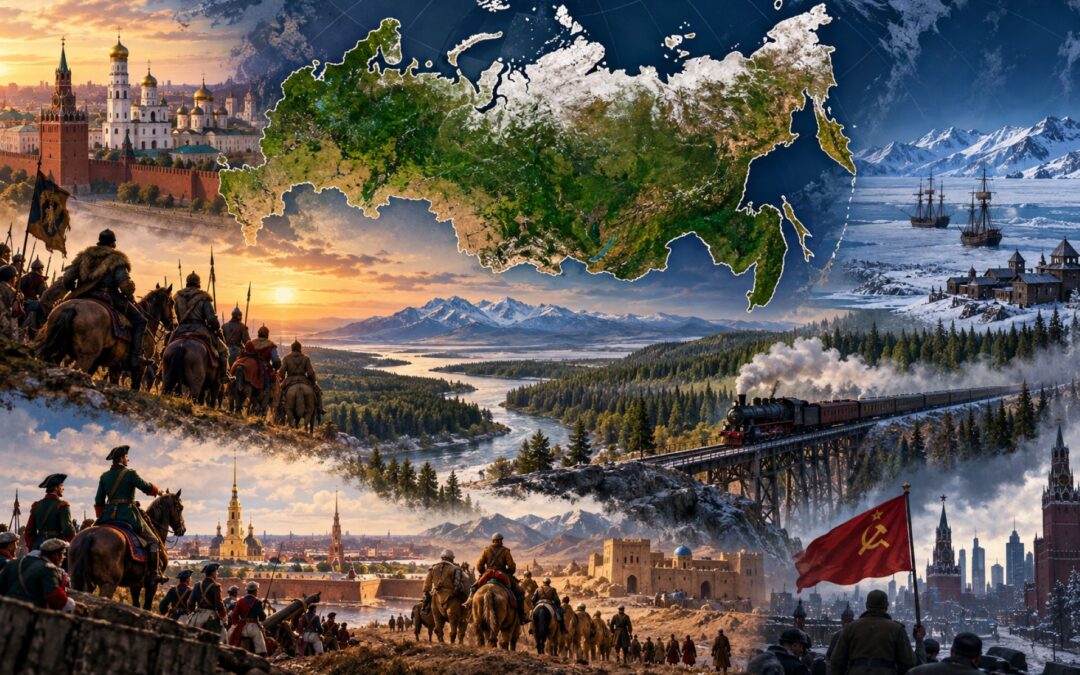
Russia is the largest country in the world, covering approximately 17.1 million square kilometres, or 6.6 million square miles. It stretches from the Baltic region in the west to the Pacific Ocean in the east, crosses eleven time zones, and occupies more than one-tenth of the world’s land surface. Canada, the second-largest country, is considerably smaller, while the distance between Russia’s westernmost and easternmost territories exceeds 9,000 kilometres.
Yet Russia did not begin as an enormous country spanning two continents. Its political foundations emerged among medieval principalities in Eastern Europe, and its transformation into a transcontinental empire took centuries of conquest, settlement, diplomacy, and territorial consolidation. Understanding Russia’s position between Europe and Asia requires examining how a state centred on Moscow acquired territories extending across northern Eurasia.
Russia was not the largest empire in history. According to Guinness World Records’ comparison of historical empires, the Mongol Empire covered approximately 24 million square kilometres at its peak, while the Russian Empire reached about 22.8 million square kilometres around 1895. The British Empire eventually controlled an even larger area, although its territories were scattered across the globe rather than forming one continuous landmass.
What makes Russia particularly remarkable is that it retained so much territory after losing its monarchy, much of its European empire, its North American possessions, and eventually the Soviet Union itself.
Its extraordinary size was not the result of a single military campaign or an uninterrupted expansionist strategy. Different rulers pursued different objectives, from controlling valuable trading routes and acquiring furs to securing ports and establishing defensible frontiers. Sometimes Russian armies conquered neighbouring states; elsewhere, traders, settlers, and Cossacks established footholds that the government subsequently incorporated into its expanding territories.
The story of how Russia became the world’s largest country is therefore also the story of how a relatively small European state transformed itself into a vast Eurasian power—and how its enormous territorial core survived the collapse of successive political systems.
From the Rus’ Principalities to the Rise of Moscow
The origins of the Russian state lie in the interconnected societies of medieval Eastern Europe, where Slavic, Finnic, Baltic, Scandinavian, and steppe peoples inhabited the forests, plains, and river valleys between the Baltic and Black Seas. Long before Moscow became politically important, these communities maintained commercial networks connecting northern Europe with Constantinople, the Islamic world, and Central Asia.
Rivers were central to this development. The Dnieper, Volga, and their tributaries provided routes through territories where overland journeys were difficult and frequently dangerous. Merchants transported furs, wax, honey, slaves, and other commodities along these waterways, exchanging them for silver, textiles, luxury goods, and manufactured products.
During the ninth century, Scandinavian traders and warriors known as Varangians became influential participants in these networks. Some established themselves among local populations and entered regional politics, while others travelled southward to trade with or raid the Byzantine Empire and the territories of the Islamic caliphates.
Traditional accounts associate the emergence of Rus’ political authority with Rurik and his successors, although historians continue to debate the precise nature of Scandinavian involvement. By the late ninth century, a powerful political network had developed around Kyiv, forming what historians commonly call Kyivan Rus’.
This early polity was not equivalent to modern Russia. Its history belongs to the shared medieval heritage of present-day Ukraine, Belarus, and Russia, whose later political identities emerged through different historical experiences. Nevertheless, the political institutions, trading networks, and religious traditions of the Rus’ lands contributed significantly to the development of the states that followed.
The adoption of Byzantine Christianity under Prince Vladimir in 988 strengthened connections with Constantinople and introduced institutions that would profoundly influence the region’s religious and political development. Meanwhile, cities such as Kyiv, Novgorod, and other commercial centres prospered through regional and international exchange.
By the twelfth century, however, the Rus’ political world had fragmented into competing principalities. Local dynasties struggled for influence, and authority became increasingly dispersed among regional rulers.
This fragmentation created vulnerabilities that became especially consequential during the thirteenth century.
In 1223, Mongol forces defeated a coalition of Rus’ princes and their allies at the Battle of the Kalka River. Although the Mongols subsequently withdrew, they returned in greater strength under Batu Khan during the late 1230s.
Between 1237 and 1240, Mongol armies devastated numerous Rus’ territories, capturing major cities and destroying Kyiv in 1240. Many principalities subsequently came under the supremacy of the Golden Horde, a Mongol successor state that exercised authority over extensive parts of the Eurasian steppe.
Not every principality experienced Mongol domination in the same way. Some cities suffered direct destruction, while others avoided comparable devastation by submitting to the khans and agreeing to provide tribute. Local rulers frequently retained their positions, but their authority depended partly on recognition by the Mongol leadership.
One of the principalities that gradually benefited from these arrangements was Moscow.
Moscow’s rulers strengthened their position through strategic marriages, alliances, military campaigns, territorial purchases, and cooperation with the Golden Horde’s tribute system. Their growing influence allowed them to compete with other regional centres and gradually consolidate neighbouring lands.
The city’s location also provided advantages. Situated within a network of river routes and surrounded by territories capable of supporting agriculture and commerce, Moscow was well placed to develop into a regional administrative and economic centre.
During the fourteenth century, Moscow’s princes increasingly challenged rival principalities. The victory of Dmitry Donskoy over a Mongol-led army at the Battle of Kulikovo in 1380 became an important symbol of resistance, although it did not immediately end the Golden Horde’s supremacy.
More decisive territorial consolidation occurred under Ivan III, who ruled from 1462 to 1505.
Ivan annexed Novgorod in 1478 and Tver in 1485, substantially increasing Moscow’s territory and economic resources. Novgorod was particularly valuable because of its commercial connections with northern Europe and its extensive northern lands. The absorption of its territories strengthened Moscow’s position across a large part of northeastern Europe.
In 1480, a confrontation along the Ugra River became associated with the end of Moscow’s formal subordination to the Golden Horde. The process of independence was more gradual than the traditional account of a single decisive encounter suggests, but Ivan III’s reign unmistakably strengthened Moscow’s political autonomy.
His successors continued consolidating neighbouring territories. Vasily III annexed Pskov in 1510, extending the authority of the increasingly centralised Muscovite state.
By the early sixteenth century, Moscow had emerged as the dominant political power across much of northeastern Rus’. It possessed a growing administrative structure, expanding agricultural territories, and the military capacity to challenge neighbouring states.
The foundations of the future Russian Empire were now in place, although the greatest expansion was still to come.
The Volga Conquests That Opened Russia’s Eastern Frontier
The next major stage of Russian expansion unfolded under Ivan IV, better known as Ivan the Terrible.
In 1547, Ivan was formally crowned Tsar of All Russia, adopting a title that expressed increasingly ambitious claims about the monarchy’s political authority. His reign combined institutional development, territorial conquest, internal repression, and prolonged warfare.
One of his most consequential objectives was to extend Muscovite control along the Volga River.
The Volga was among the most important waterways in Eastern Europe, connecting northern territories with the Caspian Sea and the wider commercial networks of the steppe. Controlling its course would strengthen Russian trade, facilitate military movement, and weaken neighbouring powers that could threaten Muscovy’s southern and eastern frontiers.
Much of the middle and lower Volga remained under the influence of khanates that had emerged from the fragmentation of the Golden Horde. These included Kazan, located along the middle Volga, and Astrakhan, situated closer to the river’s outlet into the Caspian Sea.
Relations between Moscow and these khanates involved trade, diplomacy, military campaigns, shifting alliances, and disputes over political influence. Ivan IV eventually pursued direct conquest.
In 1552, Russian forces captured Kazan after a major siege. Four years later, in 1556, Astrakhan came under Muscovite control.
These victories fundamentally changed Russia’s geographical position.
Moscow now controlled much more of the Volga corridor, strengthening its access to the Caspian region and increasing its capacity to project military and commercial power toward the east and southeast. Territories that had previously been governed by independent political authorities became subject to Russian rule.
The acquisitions also transformed the composition of the expanding state. Muslim Turkic communities, alongside other peoples with distinct languages, religious traditions, and political institutions, were incorporated into a monarchy whose ruling elite was primarily associated with Eastern Orthodox Christianity.
Conquest did not automatically produce peaceful integration. Russian authorities encountered resistance, negotiated arrangements with local elites, and gradually introduced administrative and military institutions designed to maintain control.
The Volga campaigns were particularly significant because they brought Muscovy into closer contact with the territories extending beyond the Ural Mountains. Traders and military adventurers increasingly explored opportunities farther east, where valuable natural resources provided strong commercial incentives.
The Urals marked a conventional geographical transition between Europe and Asia, but they were not an impassable barrier. Routes through and around the mountain system connected the Volga basin with western Siberia, allowing merchants, soldiers, and settlers to move into regions previously outside Moscow’s effective control.
Ivan IV’s conquests did not themselves establish Russian authority across Siberia. They nevertheless helped create the strategic and geographical conditions that made sustained eastward expansion possible.
What followed would eventually transform Russia from a large Eastern European state into an empire stretching across the northern half of Asia.
The Conquest of Siberia: Furs, Cossacks, and the Pacific
The conquest of Siberia was the most geographically consequential phase of Russia’s expansion. Within little more than a century, Russian expeditions travelled from the Ural Mountains to the Pacific Ocean, establishing claims over territories extending thousands of kilometres beyond Moscow.
The speed of this movement was remarkable, but the process was neither straightforward nor peaceful. Russian influence spread unevenly through military expeditions, commercial ventures, fortified settlements, tribute collection, and prolonged negotiations or conflicts with Indigenous peoples.
The initial driving force was economic.
Siberia contained enormous populations of fur-bearing animals, including sable, foxes, martens, and other species whose pelts commanded high prices in European and Asian markets. Valuable furs were relatively easy to transport compared with bulky agricultural products or minerals, making them particularly attractive commodities in a region where long-distance movement was difficult.
Russian rulers already recognised the importance of the fur trade as a source of revenue. Expanding access to Siberian animals offered opportunities for merchants, private investors, military adventurers, and the state itself.
One family closely associated with the early expansion was the Stroganovs, wealthy merchants who received privileges to develop and defend territories near the eastern frontier. They supported armed expeditions intended to secure commercial interests and challenge neighbouring political authorities.
The best-known early expedition was led by Yermak Timofeyevich, a Cossack commander whose forces crossed the Urals in the early 1580s.
Cossacks were not a single ethnic group or a uniform state army. They were communities and military formations associated with the frontier regions of Eastern Europe and the Eurasian steppe, known for mobile warfare, raiding, and a degree of political autonomy. Their relationships with Russian rulers ranged from cooperation and paid service to conflict and resistance.
Yermak’s expedition targeted the Khanate of Sibir, a political formation in western Siberia ruled by Khan Kuchum. Russian forces defeated important opposing forces and captured the khanate’s capital near the Irtysh River in 1582.
These victories helped establish a Russian foothold beyond the Urals, but they did not immediately secure the surrounding region. Kuchum continued resisting, and Yermak himself died in 1585. Russian authorities subsequently organised additional expeditions and built fortified settlements to establish a more durable presence.
The advance into Siberia depended heavily on geography.
Much of northern Asia was covered by extensive forests, wetlands, rivers, and sparsely distributed settlements. Roads were limited, and travel overland could be extraordinarily difficult. Russian expeditions therefore relied on connected river systems, moving by boat where possible and carrying vessels or supplies between waterways when necessary.
The Ob, Yenisei, and Lena river basins offered routes through enormous territories. Although these rivers generally flow northward toward the Arctic Ocean, their tributaries and connecting passages allowed travellers to move progressively eastward.
Russian authorities established fortified settlements known as ostrogs at strategically important locations. These posts served as military bases, administrative centres, trading stations, and collection points for tribute.
Tobolsk, founded in 1587, became an important centre of Russian authority in western Siberia. Farther east, settlements such as Yeniseisk, established in 1619, and Yakutsk, founded in 1632, helped support movement toward the Lena basin and the Pacific frontier.
The expansion proceeded through a combination of private initiative and government involvement. Traders pursued profits, Cossack detachments sought opportunities and rewards, and officials attempted to establish systems through which the expanding territories could generate revenue for Moscow.
A central institution was yasak, a tribute obligation frequently imposed on Indigenous communities and commonly collected in valuable furs.
Russian authorities often demanded sable pelts and other products from local populations, sometimes using military force, hostage-taking, or threats to secure payment. Tribute could be negotiated through existing political relationships, but the system rested on unequal power and imposed serious burdens on many communities.
The administration of this system was not always simple. Different societies understood political allegiance, taxation, and reciprocal obligations differently. A study in Slavic Review examines how Muscovite bureaucratic practices confronted Indigenous Siberian systems of oath-taking and tribute obligations, illustrating the difficulties of extending Russian administrative authority into unfamiliar political environments.
For Moscow, an oath could signify submission to the tsar and recognition of permanent obligations. For some frontier communities, comparable ceremonies might instead reflect negotiated relationships, mutual commitments, or temporary arrangements. These differences created recurring disputes over the meaning of imperial authority.
Siberia was not an empty wilderness awaiting discovery by Russians. It was inhabited by numerous Indigenous peoples, including Khanty, Mansi, Evenki, Yakuts, Chukchi, and many others, whose societies possessed established economic practices, languages, political relationships, and cultural traditions.
Some communities traded or negotiated with Russian newcomers, while others resisted military incursions, tribute demands, and settlement. The consequences of expansion included warfare, displacement, disease, economic disruption, and significant changes to Indigenous ways of life.
Russian control also varied considerably across the enormous territory. Establishing a fort or demanding tribute did not necessarily mean that surrounding communities had been permanently subdued or that the government could exercise continuous authority over distant settlements.
Nevertheless, the network of expeditions and outposts continued moving east.
In 1639, Russian explorers reached the Sea of Okhotsk, establishing a route toward the Pacific coast. In 1648, an expedition associated with Semyon Dezhnev travelled around the northeastern extremity of Asia, passing through the region later known as the Bering Strait.
Other expeditions explored the Amur basin, where Russian expansion brought settlers and military detachments into conflict with Qing China. The resulting struggle eventually produced the Treaty of Nerchinsk in 1689, which established arrangements governing parts of the frontier between the two states.
Russian exploration of Kamchatka expanded during the late seventeenth century, extending imperial interests into the northeastern Pacific.
Reaching the ocean, however, did not bring an end to expansion.
During the eighteenth century, the Russian government sponsored further voyages intended to investigate the geographical relationship between Asia and North America. Vitus Bering, a Danish navigator serving the Russian state, led important expeditions across the northern Pacific.
In 1728, Bering sailed through the strait between Asia and North America, although the voyage did not completely resolve the geographical questions that motivated it. During a later expedition in 1741, Russian vessels reached the North American coastline, helping stimulate renewed interest in Alaska and the surrounding islands.
Bering died during that expedition, but the voyages contributed to the expansion of Russian maritime knowledge and commercial activity in the North Pacific.
Russian fur traders subsequently established operations in Alaska and the Aleutian Islands, seeking valuable sea otter pelts. Indigenous communities, particularly the Unangan people of the Aleutian Islands and other coastal peoples, experienced coercive labour practices, violence, disease, and major economic disruption.
In 1799, the Russian-American Company received an imperial charter that gave it extensive commercial privileges in Russian America. The company combined trading activities with colonial administration, although Russian settlement remained comparatively limited.
By this period, Russia’s imperial reach extended from Eastern Europe across Siberia to North America.
The geographic scale of these acquisitions was enormous, but it would be misleading to assume that all territories were controlled with equal intensity. Some were firmly administered, others were governed through distant outposts and local intermediaries, and still others remained areas of contested authority.
Siberian expansion nevertheless created the territorial foundation of modern Russia. Unlike overseas colonies separated from their metropolitan centres by oceans, most of these Asian possessions formed a connected landmass adjoining the Russian state’s original territories.
That geographical continuity would become increasingly important as later imperial borders changed.
Peter the Great and the Baltic Breakthrough
While Russian expeditions were pushing eastward across Siberia, the monarchy faced a different strategic problem in Europe.
Russia possessed extensive territory, but its access to major European maritime trading routes remained constrained. The northern port of Arkhangelsk provided an important commercial connection, yet its remote location and seasonal ice conditions restricted its usefulness.
The Baltic Sea offered more direct access to commercial networks connecting Northern and Western Europe. However, Sweden controlled significant territories around the eastern Baltic and the Gulf of Finland, limiting Russia’s ability to establish a secure maritime position.
Peter I, better known as Peter the Great, regarded improved access to European markets and military technology as essential to strengthening the Russian state.
After gaining effective control of government during the late seventeenth century, Peter pursued far-reaching military and administrative reforms. He travelled through Western Europe in 1697–1698, studied shipbuilding and technical practices, and recruited foreign specialists to assist with modernisation.
His reforms sought to strengthen the army, develop a navy, improve government administration, and expand Russia’s industrial and technical capabilities. These policies were costly and frequently coercive, placing significant demands on the population through taxation, military service, and labour obligations.
Peter’s territorial ambitions became particularly evident during the Great Northern War, fought between 1700 and 1721.
Russia joined a coalition challenging Swedish power, but its early military efforts suffered serious setbacks. At the Battle of Narva in 1700, Swedish forces under Charles XII defeated a much larger Russian army, exposing weaknesses in Russia’s military organisation.
Peter responded by continuing military reforms, improving recruitment and training, and strengthening artillery production. Over time, Russia’s armed forces became more effective, allowing them to take advantage of Sweden’s growing difficulties across several fronts.
In 1703, while the war was still being fought, Peter founded Saint Petersburg near the eastern end of the Gulf of Finland. The city was established on territory recently captured from Sweden and was intended to serve as a major maritime, administrative, and commercial centre.
Building Saint Petersburg required immense resources and labour. Thousands of workers, including conscripted labourers, were employed under harsh conditions, while the government invested heavily in fortifications, canals, buildings, and port facilities.
The decisive military turning point came in 1709, when Russian forces defeated the Swedish army at the Battle of Poltava. The victory weakened Sweden’s position and confirmed Russia’s emergence as a formidable European military power.
The war eventually ended with the Treaty of Nystad in 1721. As detailed in the Saint Petersburg Encyclopaedia’s history of the Great Northern War, Russia secured important Baltic possessions, including Estonia, Livonia, Ingria, and parts of Karelia.
These acquisitions transformed Russia’s strategic position.
Saint Petersburg became the imperial capital in 1712, replacing Moscow as the principal seat of government. Its location and European-influenced architecture symbolised Peter’s determination to connect Russia more closely with European commerce, diplomacy, and political life.
In 1721, Peter formally adopted the title of emperor, and Russia’s political standing among the European great powers had been substantially strengthened.
The Baltic expansion demonstrated that Russian territorial growth was not simply a continuous march across Asia. Its rulers also pursued carefully chosen European territories that promised military security, commercial access, and greater international influence.
Peter died in 1725, leaving behind a state that was larger, more militarily capable, and more deeply involved in European affairs than the one he had inherited.
Catherine the Great, Crimea, and the Partitions of Poland
Russia’s expansion continued during the eighteenth century, particularly under Catherine II, who ruled from 1762 to 1796.
Where Peter the Great had concentrated much of his strategic attention on the Baltic, Catherine pursued opportunities around the Black Sea and Russia’s western frontier. These regions were politically important because they offered access to maritime trade, agricultural territories, and routes connecting Eastern Europe with the Mediterranean world.
The Ottoman Empire controlled or influenced significant territories along the northern Black Sea and across the Balkans. Its relationship with the Crimean Khanate also gave it strategic influence over a region that had long been involved in conflict and raiding across the steppe frontier.
Russia’s ambitions brought the two empires into repeated confrontation.
In 1768, war broke out between Russia and the Ottoman Empire. Russian forces achieved major victories on land and at sea, strengthening Catherine’s negotiating position and undermining Ottoman authority around the Black Sea.
The conflict ended with the Treaty of Küçük Kaynarca in 1774.
Under the settlement, the Crimean Khanate was formally declared independent of Ottoman authority, although it increasingly came under Russian influence. Russia also secured important strategic advantages, including territorial gains and expanded rights connected with Black Sea navigation.
These developments did not immediately amount to the formal annexation of Crimea. That occurred in 1783, when Catherine’s government incorporated the peninsula into the Russian Empire.
The annexation significantly strengthened Russia’s position along the northern Black Sea coastline. It also affected the Crimean Tatars, whose political institutions and society experienced profound changes under Russian rule.
A further Russo-Turkish War began in 1787, reflecting continuing Ottoman opposition to Russia’s growing influence. The conflict ended with the Treaty of Jassy in 1792, which confirmed Russia’s possession of Crimea and established additional territorial arrangements along the northern Black Sea frontier.
The Royal Collection Trust’s historical survey of the Russo-Turkish wars distinguishes these successive conflicts and their settlements, showing how Russian influence advanced through several stages rather than a single conquest.
At roughly the same time, Catherine pursued territorial opportunities farther west through the disintegration of the Polish-Lithuanian Commonwealth.
The Commonwealth had once been among Europe’s largest and most influential political formations. By the eighteenth century, however, internal political disputes, institutional weaknesses, foreign intervention, and pressure from neighbouring states had undermined its sovereignty.
Russia, Prussia, and Austria increasingly interfered in Commonwealth politics, supporting competing factions and resisting developments that threatened their influence.
In 1772, the three powers carried out the first partition, acquiring substantial Commonwealth territories. Further partitions followed in 1793 and 1795, eventually eliminating the independent Polish-Lithuanian state.
Russia received extensive eastern territories, including large parts of lands corresponding to present-day Belarus, Lithuania, and Ukraine, as well as areas associated with the historical Polish state.
The partitions of the Polish-Lithuanian Commonwealth represented one of the most consequential territorial reorganisations of eighteenth-century Europe. They dramatically enlarged Russia’s western possessions while placing millions of people under foreign rule.
For Russia, the combination of Black Sea expansion and and brought millions of additional inhabitants under the Russian monarchy, strengthening its position as one of Europe’s dominant powers.
These acquisitions also created new challenges. The empire now governed an increasingly diverse population, including communities with different languages, religions, political traditions, and historical loyalties. Maintaining control required extensive administrative systems, military garrisons, negotiations with local elites, and, at times, coercive policies designed to suppress resistance.
By the end of Catherine’s reign in 1796, Russia had expanded considerably along both its southern and western frontiers. Combined with the enormous territories acquired across Siberia, these gains established Russia as one of the world’s most geographically extensive and politically influential states.
The Nineteenth-Century Empire: The Caucasus, China, and Central Asia
The nineteenth century brought Russia closer to the maximum geographical extent of its imperial power. Expansion continued along several frontiers, but its direction and methods varied according to the political conditions in Europe, the Caucasus, Central Asia, and the Far East.
Under Alexander I, who ruled from 1801 to 1825, Russia became deeply involved in the Napoleonic Wars. The conflict transformed the European balance of power and created opportunities for territorial acquisition.
In 1809, following a war against Sweden, Russia acquired Finland, which became an autonomous grand duchy within the empire. The Russian emperor also held the title of Grand Duke of Finland, while the territory retained distinctive administrative and legal institutions.
Russia’s role in the struggle against Napoleon further strengthened its standing among the European powers. In 1812, Napoleon invaded Russia with a multinational army, hoping to force Alexander I into submission and restore French dominance over continental Europe.
Russian armies retreated across considerable distances, avoiding decisive destruction while gradually weakening the invading force. Supply shortages, difficult communications, scorched-earth measures, disease, military resistance, and eventually severe weather contributed to the French catastrophe.
Although Napoleon entered Moscow, he could not compel Russia to surrender. His retreat became one of the most disastrous military campaigns in European history, severely weakening the French Empire and helping pave the way for Napoleon’s eventual defeat.
Russia’s success in resisting the invasion increased its diplomatic influence. Following the final defeat of Napoleon in 1815, the Congress of Vienna reorganised Europe’s political boundaries, and Alexander I secured a dominant position in the newly constituted Kingdom of Poland, commonly called Congress Poland.
The kingdom retained some separate institutions, but it was linked to the Russian monarchy and increasingly subjected to imperial control. Its autonomy was subsequently reduced, particularly after Polish uprisings against Russian rule.
These developments expanded Russia’s influence in Europe, but the empire’s ambitions were not confined to the west.
Throughout the nineteenth century, Russian authorities pursued territorial gains across the Caucasus, the strategically important region separating the Black Sea and Caspian Sea. The area contained numerous peoples and political formations, making imperial expansion a complicated mixture of warfare, diplomacy, resistance, and negotiated submission.
Russia’s involvement in the Caucasus had already intensified during the eighteenth century. In 1801, it annexed the eastern Georgian kingdom of Kartli-Kakheti, and subsequent campaigns expanded Russian control over additional Georgian territories and neighbouring regions.
Conflict with Persia, ruled by the Qajar dynasty, resulted in major Russian gains. The Treaty of Gulistan in 1813 and the Treaty of Turkmenchay in 1828 transferred extensive territories in the South Caucasus to Russia, including lands corresponding to parts of present-day Azerbaijan and Armenia.
These acquisitions strengthened Russia’s position along the Caspian Sea and established a more substantial imperial presence south of the main Caucasus mountain range.
Conquest in the northern Caucasus proved particularly difficult. Russian armies faced prolonged resistance from communities defending their political independence and local institutions. The Caucasian War, conventionally dated from 1817 to 1864, involved decades of military campaigns, shifting alliances, and devastating consequences for local populations.
Imam Shamil became one of the most prominent leaders of resistance in the northeastern Caucasus, organising a sustained struggle against Russian forces before his surrender in 1859.
Farther west, Russian campaigns against Circassian communities culminated in the conquest of the northwestern Caucasus in 1864. The fighting and subsequent imperial policies resulted in mass displacement, with enormous numbers of Circassians expelled or forced to flee, principally into Ottoman territories.
The Caucasian campaigns illustrate how Russian territorial expansion could involve much more than defeating another state in a conventional war. It frequently required decades of military occupation, administrative restructuring, and the violent suppression of communities that rejected imperial authority.
Russia also continued competing with the Ottoman Empire for influence around the Black Sea and Balkans. These rivalries were closely connected with its desire to protect southern approaches, influence Orthodox Christian populations under Ottoman rule, and secure access to important maritime routes.
The Crimean War of 1853–1856 exposed the limitations of Russian power when Britain, France, and the Ottoman Empire opposed its ambitions. Russia suffered defeat and faced restrictions on its Black Sea military position under the resulting peace settlement.
Later in the century, Russia again fought the Ottoman Empire during the Russo-Turkish War of 1877–1878. Russian military victories initially produced the Treaty of San Stefano, which would have greatly expanded Russian influence in the Balkans through the establishment of a large autonomous Bulgarian principality.
Other European powers feared that this arrangement would upset the regional balance of power. At the Congress of Berlin in 1878, they revised the settlement, reducing the territory assigned to autonomous Bulgaria while recognising the independence of Romania, Serbia, and Montenegro.
Russia did not obtain the sweeping Balkan influence originally envisaged under the San Stefano settlement, although it retained certain territorial gains. The episode demonstrated that imperial expansion in Europe increasingly depended on the interests and opposition of other great powers.
Meanwhile, on the opposite side of Eurasia, Russia was establishing new territorial positions along its frontier with China.
During the nineteenth century, the Qing dynasty experienced growing internal difficulties and military pressure from Western powers. Russia used this period of weakness to negotiate major territorial concessions in the Far East.
The Treaty of Aigun in 1858 altered the frontier along the Amur River, while the Convention of Peking in 1860 confirmed additional Russian acquisitions, including the territory between the Ussuri River and the Sea of Japan.
These agreements gave Russia control of strategically important lands along the Pacific coast. They also contributed to the establishment of Vladivostok in 1860, a settlement that eventually developed into a major naval and commercial centre.
The acquisitions were particularly important because much of Russia’s earlier Pacific activity had depended on remote ports and difficult transport connections. As documented in Harvard’s historical account of Russia’s imperial development in the Far East, these territorial changes strengthened Russia’s position in a region where Chinese, Japanese, and European interests increasingly intersected.
Vladivostok later became a crucial Pacific naval base, although it would be inaccurate to describe it as an entirely ice-free port throughout the year. Russia continued facing significant logistical difficulties in maintaining communication and transporting supplies across the immense distances separating European Russia from its eastern territories.
This geographical problem would eventually encourage major infrastructure projects, most notably the Trans-Siberian Railway, whose construction began in 1891. The railway gradually connected the Russian heartland with Siberia and the Far East, improving the movement of people, goods, and military resources across the empire.
Although Russian expeditions had reached the Pacific centuries earlier, developing reliable connections between these distant territories and the imperial centre remained an enormous undertaking.
Russia’s nineteenth-century history also included an important territorial retreat: the sale of Alaska.
The Russian Empire had maintained settlements and commercial operations in North America since the eighteenth century, but Russian America remained distant from the state’s principal centres of population and power.
The fur trade that had originally encouraged colonisation faced commercial difficulties as valuable animal populations declined and economic conditions changed. Maintaining and defending settlements across the North Pacific was expensive, while the possibility of conflict with Britain raised concerns about Russia’s ability to protect its possessions.
Russian officials increasingly questioned whether retaining Alaska justified the financial and strategic costs.
In 1867, Russia agreed to sell Alaska to the United States for $7.2 million. The agreement was negotiated during the administration of President Andrew Johnson and formally transferred the territory to American control later that year.
The Library of Congress account of the Alaska Purchase explains how changing commercial interests and strategic considerations contributed to the transaction.
Although Alaska later became associated with valuable natural resources and immense strategic importance, those later developments should not be projected backward as if Russian officials possessed reliable knowledge of the territory’s future economic potential.
Nor was the sale simply an effort to compensate for territorial ambitions in Central Asia. Russian involvement in Central Asian affairs had developed long before 1867 and continued for reasons largely independent of the North American decision.
The conquest of Central Asia became another defining feature of nineteenth-century Russian expansion.
Russian authorities had maintained connections with the Kazakh steppe for generations, developing relationships with local rulers and gradually establishing forts, administrative institutions, and military positions. Over time, these arrangements increasingly undermined the autonomy of Kazakh political communities.
During the nineteenth century, Russian military campaigns extended imperial authority across territories corresponding to much of present-day Kazakhstan, Uzbekistan, Kyrgyzstan, Tajikistan, and Turkmenistan.
Russian forces captured Tashkent in 1865, a major development in the conquest of the region. The city became an important administrative centre, and the establishment of the Governor-Generalship of Turkestan in 1867 strengthened Russian control over newly acquired territories.
Expansion subsequently brought Russian forces into conflict with the Emirate of Bukhara, the Khanate of Khiva, and the Khanate of Kokand.
Following military defeats, Bukhara and Khiva became Russian protectorates, retaining local rulers and certain internal institutions while losing substantial freedom in foreign affairs and strategic policy. Kokand, by contrast, was eventually abolished and incorporated directly into the Russian Empire in 1876.
Russian military campaigns also extended into the territories inhabited by Turkmen communities. The conquest of the Akhal-Teke region, including the devastating Russian assault on Geok Tepe in 1881, demonstrated the violence involved in extending imperial control across the southern Central Asian frontier.
By the late nineteenth century, Russia had established authority over vast parts of Central Asia, substantially enlarging its imperial possessions and bringing millions of people under its political and military administration.
These developments alarmed Britain, whose government feared that Russian advances might eventually threaten the approaches to British India.
The resulting diplomatic and strategic rivalry became known as the Great Game.
Britain and Russia competed for influence across Central Asia, particularly in Afghanistan and Persia. Their rivalry involved intelligence gathering, diplomatic pressure, military expeditions, negotiations, and attempts to establish favourable frontier arrangements.
Britain regarded Afghanistan as an important buffer against potential Russian expansion toward India, while Russian authorities sought to secure their southern territories and prevent rival powers from dominating neighbouring regions.
The contest was not a conventional war fought directly between the two empires. Instead, it unfolded through complicated interactions involving local rulers, frontier societies, imperial officials, and military forces operating across a politically fragmented region.
Afghanistan retained its status as a separate state, although its independence and foreign relations were constrained by imperial pressure. Persia likewise remained formally independent while experiencing considerable British and Russian interference.
The struggle formed part of the wider competition through which the British Empire sought to protect its interests in India and Central Asia.
Russian expansion in Central Asia was therefore not simply the acquisition of lightly defended territory. It involved the conquest and subordination of existing states, prolonged resistance, conflicts over commercial routes, and increasing confrontation with another major imperial power.
By the closing decades of the nineteenth century, the Russian Empire extended across much of northern Eurasia, from Eastern Europe through Siberia to the Pacific, with additional possessions in the Caucasus and Central Asia.
Its greatest geographical extent was reached during this general period, even though Alaska had already been sold. Historical estimates depend on how territories and imperial dependencies are counted, but Russia had unquestionably become one of the largest territorial empires ever assembled.
The empire’s enormous geographical size, however, concealed serious internal weaknesses. Political repression, uneven industrial development, rural poverty, social tensions, and the difficulties of governing a highly diverse population created problems that territorial expansion alone could not resolve.
Those weaknesses would become increasingly apparent during the early twentieth century.
Revolution and War: From the Tsar’s Empire to the Soviet Union
By the beginning of the twentieth century, the Russian Empire controlled an extraordinary amount of territory, but its political and social institutions faced mounting pressure.
Industrialisation had transformed parts of the country, creating new factories, railway networks, and urban working populations. Yet much of the population remained dependent on agriculture, while political authority was concentrated in an autocratic monarchy that allowed limited public participation in government.
Social inequality, demands for political reform, regional nationalist movements, and dissatisfaction with imperial administration contributed to growing unrest.
Russia’s defeat in the Russo-Japanese War of 1904–1905 weakened confidence in the monarchy and helped trigger the Revolution of 1905. Although Tsar Nicholas II made concessions, including the creation of an elected legislature, the underlying tensions remained unresolved.
The outbreak of World War I in 1914 placed the empire under even greater strain.
Russia’s enormous population and territorial resources did not compensate for military difficulties, inadequate supplies, economic disruption, and the enormous human costs of prolonged warfare. Defeats at the front and shortages in major cities intensified public dissatisfaction with the government.
In February 1917, according to the Russian calendar then in use, a revolution in Petrograd forced Nicholas II to abdicate, bringing more than three centuries of Romanov rule to an end.
A Provisional Government attempted to continue the war and govern the country, but it struggled to establish stable authority. Political radicalisation, military disintegration, and demands for land and peace created opportunities for the Bolsheviks, led by Vladimir Lenin.
In October 1917, the Bolsheviks seized power in Petrograd and subsequently consolidated their position in Moscow.
The political upheavals associated with the Russian Revolution and the collapse of the Romanov monarchy transformed not only the government but also the territorial structure of the former empire.
The Bolsheviks’ seizure of power did not establish immediate control over all Russian territory. Instead, the country descended into a prolonged civil war involving Bolshevik forces, commonly called the Reds, and numerous opponents, often collectively described as the Whites.
These opponents were not a single unified movement. They included monarchists, conservatives, liberals, regional nationalists, and other groups with substantially different political objectives.
Foreign governments also intervened in various ways, while nationalist movements in territories formerly controlled by the Russian Empire attempted to establish independent states.
The Bolsheviks eventually secured victory across much of the former empire, but important territorial changes had occurred.
Finland declared independence in December 1917, and its sovereignty survived the subsequent turmoil. Poland re-emerged as an independent state in 1918 and fought a war against Soviet Russia, with a peace settlement reached in 1921.
Estonia, Latvia, and Lithuania also established independent republics during the revolutionary and postwar upheavals.
Other territories experienced different outcomes. Bolshevik forces eventually established Soviet rule in Ukraine, Belarus, the South Caucasus, and much of Central Asia, although the process involved wars, political upheaval, and resistance.
The result was neither a simple continuation of the Romanov Empire nor the disappearance of Russian influence across its former territories.
In December 1922, the Union of Soviet Socialist Republics was formally established. Its founding members were the Russian Soviet Federative Socialist Republic, the Ukrainian Soviet Socialist Republic, the Byelorussian Soviet Socialist Republic, and the Transcaucasian Soviet Federative Socialist Republic.
The Soviet Union was organised as a federal state composed of republics, although real political authority became increasingly concentrated in the Communist Party leadership.
Its constitutional structure and ideology differed from those of the Russian Empire, but the Soviet government retained authority over much of the enormous Eurasian territory that the tsars had acquired.
The Soviet Union’s borders changed again during the following decades, particularly around World War II.
In 1939, the Soviet Union occupied eastern territories of Poland under arrangements associated with the Molotov–Ribbentrop Pact between Nazi Germany and the USSR. Soviet forces also fought Finland during the Winter War of 1939–1940, after which Finland ceded territory but retained its independence.
In 1940, the USSR occupied and annexed Estonia, Latvia, and Lithuania, incorporating them as Soviet republics. These annexations were not universally recognised internationally, and the Baltic countries’ claims to restored independence remained politically significant throughout the Soviet period.
Germany’s invasion of the Soviet Union in June 1941 brought an immense military and humanitarian catastrophe. Soviet forces suffered devastating initial defeats, but the country eventually mobilised extraordinary military, industrial, and human resources to resist the invasion.
By 1943, the Soviet military position had improved, and the Red Army began advancing westward. Its campaigns ultimately carried Soviet forces across much of Eastern Europe and into Germany itself.
When World War II ended in 1945, the Soviet Union had emerged as one of the world’s two principal superpowers.
Its territorial position had changed, but its influence extended considerably farther than its formal borders.
The Baltic republics remained incorporated into the USSR, while Soviet territorial gains were consolidated elsewhere in Eastern Europe. The Soviet Union also acquired northern East Prussia, including Königsberg, which was renamed Kaliningrad in 1946.
Across much of Eastern Europe, however, Moscow exercised political influence through separate communist-led states rather than incorporating them into the Soviet Union.
Poland, Czechoslovakia, Hungary, Romania, Bulgaria, and East Germany remained formally distinct countries, even though Soviet military power and political intervention substantially constrained their sovereignty.
That distinction is essential to understanding the Soviet territorial position. The Soviet Union possessed an enormous formal territory, but the wider Soviet sphere of influence was larger still.
Why Russia Remained So Large After the Soviet Collapse
Following World War II, the Soviet Union entered a prolonged rivalry with the United States that became known as the Cold War.
The USSR possessed immense military capabilities, nuclear weapons, substantial industrial resources, and considerable influence over communist governments and political movements abroad. Yet the Soviet system also faced persistent economic inefficiencies, technological challenges, and mounting difficulties in meeting the expectations of its population.
The country’s size provided access to valuable natural resources, including oil, natural gas, timber, coal, and minerals. However, its enormous distances, difficult climate, and unevenly distributed population also imposed substantial transport and infrastructure costs.
By the 1970s and 1980s, economic stagnation and political dissatisfaction had become increasingly serious problems.
When Mikhail Gorbachev became General Secretary of the Communist Party in 1985, he introduced reforms intended to revitalise the Soviet system. His policies of perestroika, or restructuring, and glasnost, or openness, encouraged economic and political change while loosening restrictions on public discussion.
The reforms, however, also exposed longstanding tensions within Soviet society. Economic difficulties persisted, criticism of the Communist Party intensified, and nationalist movements across the constituent republics increasingly demanded autonomy or independence.
During 1989, communist governments across Eastern Europe began losing power. Poland, Hungary, East Germany, Czechoslovakia, Romania, and Bulgaria experienced dramatic political transformations that weakened or ended the Soviet-dominated regional order.
The end of communist rule in these countries did not itself reduce the USSR’s formal territory, because they had remained separate states. It did, however, demonstrate the collapse of Moscow’s ability to maintain its former sphere of influence.
Inside the Soviet Union, political disintegration accelerated.
Lithuania declared the restoration of its independence in March 1990, while Estonia and Latvia pursued their own paths toward restored sovereignty. Independence movements also gained strength elsewhere, including Ukraine, Georgia, Armenia, and the other Soviet republics.
An attempted coup against Gorbachev in August 1991 further weakened the central government and accelerated the fragmentation of the union.
In December 1991, the leaders of Russia, Ukraine, and Belarus agreed that the Soviet Union would cease to exist. The process of dissolution concluded later that month, with Gorbachev resigning as Soviet president on 25 December.
The following day, the Soviet Union formally ceased to exist.
As described in the U.S. State Department’s account of the Soviet collapse, the dissolution ended the political existence of a state that had shaped international affairs for almost seven decades.
Fifteen independent states emerged from the former Soviet republics: Russia, Ukraine, Belarus, Estonia, Latvia, Lithuania, Moldova, Georgia, Armenia, Azerbaijan, Kazakhstan, Uzbekistan, Turkmenistan, Kyrgyzstan, and Tajikistan.
For Russia, the territorial consequences were profound.
It no longer governed the Baltic republics, the South Caucasus, most of Central Asia, Ukraine, Belarus, or Moldova. Areas that had been incorporated into Russian imperial or Soviet authority became independent countries with their own governments and internationally recognised borders.
The Soviet Union had covered approximately 22.4 million square kilometres. The Russian Federation that emerged from its dissolution retained approximately 17.1 million square kilometres, making it substantially smaller than the former USSR but still much larger than any other modern country.
The reason lies primarily in the distribution of territory within the Soviet Union itself.
The Russian Soviet republic occupied by far the largest share of the USSR’s landmass. It extended from Eastern Europe across the Ural Mountains, through Siberia, and to the Pacific Ocean, encompassing most of the enormous northern Asian territories acquired during earlier centuries.
When the Soviet Union dissolved, those territories generally remained within the Russian Federation rather than becoming separate independent states.
The political breakup therefore removed substantial territories from the former Soviet state without dismantling the geographical core that had made Russia exceptionally large.
Siberia was particularly important to this outcome. Although Russia lost control over independent states in Central Asia and elsewhere, it retained the immense expanse of forests, rivers, tundra, mountains, and sparsely populated territory stretching across northern Asia.
This continuity explains why modern Russia remains a transcontinental country.
European Russia contains major historical, political, economic, and population centres, including Moscow and Saint Petersburg. Asian Russia occupies a far greater share of the country’s territory, extending through Siberia to the Pacific coast.
Russia’s borders have continued to be politically contested since 1991, particularly in relation to Ukraine. Such disputes must be distinguished from internationally recognised territory, and territorial claims should not be treated automatically as legitimate changes to the country’s geographical extent.
Nevertheless, the fundamental historical explanation for Russia’s size does not depend on these contemporary disputes.
The modern Russian Federation inherited most of the connected Eurasian landmass accumulated by the Muscovite state, Russian Empire, and Soviet Union across centuries.
Its remarkable geographical scale survived because the Soviet Union’s dissolution separated several major regions from Moscow’s control while leaving the great majority of the old northern Eurasian territorial core within Russia.
Understanding this process also helps explain why the end of the Cold War and the dissolution of Soviet power transformed the political map of Europe and Asia without removing Russia’s position as the world’s largest country.
Russia’s immense size is therefore best understood as the cumulative result of several distinct historical processes rather than an uninterrupted series of military victories.
Medieval Moscow consolidated surrounding principalities and established the political foundations of an expanding state. The Volga conquests opened routes toward the east, while Cossack expeditions, fur revenues, military settlements, and imperial administration extended Russian authority across Siberia.
Later rulers acquired territories through wars, treaties, annexations, and diplomatic pressure in the Baltic, Black Sea, Caucasus, Central Asia, and Far East. Some possessions were subsequently relinquished, including Alaska, while others became independent following the collapses of the Romanov Empire and the Soviet Union.
This expansion was neither inevitable nor universally accepted. It depended on changing economic incentives, military capabilities, political opportunities, and the efforts of states and communities that sometimes cooperated with Russian authorities and often resisted them.
The decisive geographical legacy was the incorporation of northern Eurasia into a connected territorial state. Although the political institutions governing that territory changed repeatedly, most of the landmass remained under Russian administration.
That is why a country whose origins lay in the comparatively small principalities of medieval Eastern Europe still stretches across eleven time zones and remains, by a considerable margin, the largest country on Earth.
Last Updated on October 30, 2026 by Aseem Gupta