
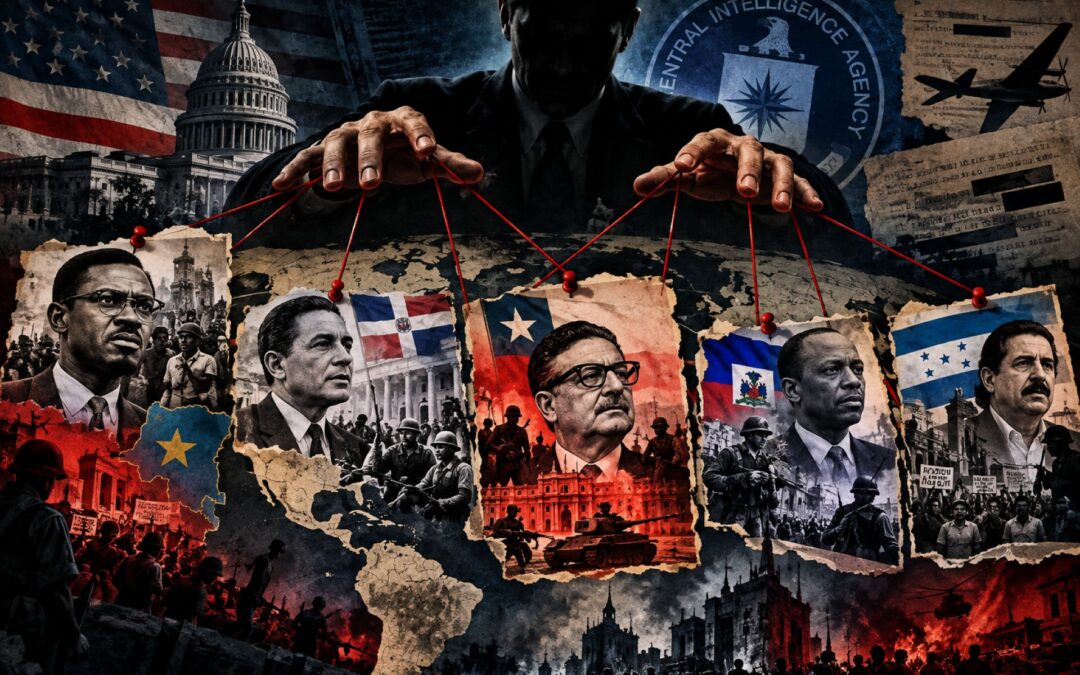
The Central Intelligence Agency is best known for gathering secrets. Its officers recruit foreign informants, penetrate hostile intelligence networks, and collect information that American policymakers cannot obtain through ordinary diplomatic channels. Yet intelligence gathering has never been the full extent of the CIA’s responsibilities. Throughout the Cold War, the agency also participated in operations intended to influence elections, weaken political movements, remove foreign leaders, and shape the governments of other countries.
Some of these operations are among the most thoroughly documented interventions in modern history. Declassified records reveal American financing of foreign political parties, propaganda campaigns, relationships with military conspirators, and even plans to assassinate political leaders. In several countries, these activities contributed to political upheavals that ultimately benefited authoritarian rulers.
The consequences were often profound. Governments that Washington considered dangerous or unreliable lost power, while military officers and political factions regarded as strategically useful received assistance. Populations that had expected independence, democratic government, or political reform instead experienced repression, instability, and prolonged authoritarian rule.
However, the history is more complicated than the claim that the CIA simply installed dictators wherever it pleased. American officials did not control every foreign military, local political conflict, or eventual outcome. Some interventions were directly organized by the CIA, others involved indirect assistance, and still others remain subjects of disputed allegations. The distinction matters because responsibility should be established through evidence rather than assumed from a country’s subsequent political history.
The experiences of Congo, the Dominican Republic, and Chile reveal how American intervention operated under different circumstances. Later crises in Haiti and Honduras illustrate the difficulties of establishing covert responsibility when the available evidence is less conclusive. Together, these cases provide a revealing account of how national-security objectives, local power struggles, and clandestine operations could become entangled in the rise and survival of authoritarian governments.
Covert Regime Change: What the CIA Could—and Could Not—Do
The CIA was established in 1947 as the United States reorganized its national-security institutions after the Second World War. Intelligence collection remained one of its central responsibilities, but American leaders also developed mechanisms for influencing events abroad without openly acknowledging their involvement. These activities became particularly important as Washington entered an increasingly dangerous confrontation with the Soviet Union.
Covert action differs from conventional intelligence gathering because its purpose is not merely to discover what foreign governments are doing. It seeks to influence political, economic, or military conditions in ways that advance American objectives while concealing or limiting public recognition of the US government’s role. Operations might involve propaganda, financial assistance to political organizations, support for friendly military officers, or more direct intervention in foreign political struggles.
The distinction does not mean that the CIA independently determined American foreign policy. Major covert operations were frequently authorized or directed by presidents and senior national-security officials, sometimes through specialized interagency committees. The agency provided intelligence networks, operational expertise, clandestine financing, and relationships with foreign actors that made particular policies possible. Understanding a CIA intervention therefore requires examining both the people conducting it and the policymakers who approved its objectives.
The principal justification for many Cold War interventions was the containment of communism. American leaders feared that the Soviet Union and its allies would expand their political influence through revolutionary movements, sympathetic governments, and military assistance. Within the wider Cold War rivalry between the United States and the Soviet Union, an election or political crisis in a relatively small country could become a matter of considerable strategic importance.
These concerns were not entirely imaginary. The Soviet Union maintained intelligence networks, supported political movements, and used military force to preserve its influence in several countries. Cuba’s revolution and subsequent alignment with Moscow also transformed American perceptions of political developments in Latin America. Nevertheless, the existence of genuine geopolitical competition did not mean that every nationalist, socialist, reformist, or anti-colonial leader was secretly controlled by the Soviet Union.
This distinction frequently disappeared from American policymaking. Governments pursuing land reform, greater control over natural resources, or independence from established Western economic interests could be viewed as potential communist threats even when their domestic objectives were more complicated. Political movements challenging traditional elites sometimes found themselves treated as dangers to American security because their success might weaken an existing regional order.
Economic considerations added another dimension. American companies held substantial interests in foreign agriculture, mining, infrastructure, and trade, while policymakers worried about nationalization and the loss of access to strategically important resources. Economic interests did not explain every intervention, nor should they be treated as an automatic substitute for ideological and security concerns. In particular cases, however, these considerations reinforced one another and contributed to American hostility toward particular governments.
The methods of intervention could vary considerably. Financing opposition parties was different from organizing a military conspiracy, just as supporting a government after a coup was different from directing the coup itself. A covert propaganda campaign might weaken a president’s legitimacy without determining whether domestic opponents could remove that president from office.
The United States had also demonstrated a willingness to participate directly in overthrowing governments. The CIA’s involvement in Iran in 1953 and Guatemala in 1954 provides particularly clear historical examples of covert operations intended to bring about regime change. Those precedents help explain why later allegations of CIA involvement attracted attention, but they do not establish that the agency directed every subsequent political overthrow.
Foreign political actors also possessed their own interests and ambitions. Military commanders could resent civilian oversight, business groups could oppose economic reforms, and political parties could seek power independently of Washington. American intervention might encourage these actors, provide resources, or change their calculations, but it rarely eliminated the domestic political forces shaping events.
Consequently, the central question is not simply whether the CIA was present in a country experiencing political upheaval. It is what the agency was authorized to do, what its officers actually did, how local participants responded, and whether those activities contributed to the eventual outcome.
The distinction becomes especially important in Congo, where documented American efforts to remove a political leader coincided with a violent post-independence crisis and the eventual rise of one of Africa’s most enduring dictators.
Congo: Lumumba’s Removal and Mobutu’s Rise
On June 30, 1960, the Belgian Congo became independent after decades of colonial domination. For the country’s population, independence promised political self-determination and an opportunity to build institutions that would serve Congolese interests rather than those of a European colonial power. Yet the new government inherited a state whose administration, military hierarchy, and economic arrangements had been shaped by Belgian control.
Patrice Lumumba emerged as one of the most prominent leaders of the independence movement. A former postal worker and salesman, he became an influential nationalist politician through his ability to articulate demands for unity, independence, and political dignity. His political movement appealed to Congolese citizens who wanted genuine sovereignty rather than a formal transfer of power that left colonial relationships largely intact.
Lumumba became prime minister, while Joseph Kasa-Vubu assumed the presidency. Their government faced the enormous challenge of holding together a country with regional divisions, weak institutions, and an economy heavily influenced by foreign interests. Even before the new leadership could establish effective authority, conflicting expectations about independence were creating serious political tensions.
At the independence ceremony, Lumumba delivered a speech that openly confronted the abuses of colonial rule. In the presence of Belgium’s King Baudouin, he described the humiliation, exploitation, and coercion experienced by Congolese people under colonialism. His remarks contrasted sharply with the more conciliatory ceremonial language preferred by Belgian officials and attracted international attention.
The speech represented Lumumba’s political outlook, but it did not itself cause his removal. His growing vulnerability resulted from a much wider crisis involving the military, provincial separatists, Belgian intervention, domestic rivals, and foreign governments concerned about Congo’s future alignment.
Within days of independence, Congolese soldiers mutinied against the existing military hierarchy, where Belgian officers retained influential positions. Belgium subsequently deployed troops, claiming the need to protect its citizens. Meanwhile, the mineral-rich province of Katanga, led by Moïse Tshombe, declared its separation from Congo.
Katanga’s secession was especially consequential because the province contained valuable mineral resources, including copper and cobalt. Its departure threatened the economic viability and territorial integrity of the new state. Belgian political and commercial interests also remained closely connected to developments in the region, complicating Lumumba’s efforts to establish a genuinely independent national government.
The Congolese leadership appealed to the United Nations for assistance. UN forces were deployed, but Lumumba became increasingly frustrated by the limits of international intervention and the failure to resolve the secessionist crisis on his terms. He eventually sought Soviet assistance, including military equipment, in an attempt to restore the government’s authority.
For Lumumba, obtaining foreign assistance was connected to the immediate problem of preserving Congo’s unity. For officials in Washington, however, Soviet involvement raised the possibility that a strategically important African country might move into Moscow’s sphere of influence. The same political development could therefore be interpreted as a desperate attempt to defend national sovereignty or as evidence of a dangerous geopolitical realignment.
American hostility toward Lumumba intensified rapidly. The CIA station in Léopoldville, the city now known as Kinshasa, reported concerns that he might establish an authoritarian government under communist influence. Senior American officials increasingly regarded his removal as essential to preventing a Soviet advantage in central Africa.
The documentary evidence establishes that American involvement went far beyond expressing diplomatic concern. According to the US State Department’s declassified history of covert operations in Congo, Washington authorized a political programme in August 1960 designed to remove Lumumba from power and strengthen more pro-Western alternatives. The CIA provided financial assistance to selected Congolese political figures, supported propaganda activities, and helped sustain governments considered strategically acceptable.
The agency also developed plans to assassinate Lumumba. In August 1960, CIA Director Allen Dulles informed the station that removing him was an urgent priority. Subsequent discussions involved obtaining toxic biological material that could be used in an assassination operation.
CIA scientist Sidney Gottlieb became associated with the development and delivery of the material. The intended operation involved secretly administering a lethal substance, but executing such a plan required reliable access to Lumumba. The agency’s officers were unable to establish the necessary opportunity, and the contemplated poisoning did not cause his death.
The distinction is important because the existence of an assassination plan establishes a grave form of American intervention without proving that the CIA successfully carried out the killing. The records show that officials pursued an operation against a sitting foreign leader, while the circumstances of his eventual death followed a different and more complicated course.
Congo’s internal political crisis reached another turning point in September 1960. President Kasa-Vubu announced that he was dismissing Lumumba as prime minister, while Lumumba rejected the decision and challenged Kasa-Vubu’s authority. Their competing claims created a constitutional confrontation at a moment when the army and central government were already unstable.
On September 14, Colonel Joseph-Désiré Mobutu intervened in the crisis. Mobutu had been appointed to a senior military position under Lumumba, but he now used his command of the armed forces to sideline the competing civilian authorities and establish an interim administration. His intervention marked an important step toward the political dominance he would eventually consolidate.
Mobutu’s action did not occur in isolation from American involvement. Declassified records show that the CIA provided covert financial assistance to the government established after his September intervention. American officials subsequently supported political groups and leaders intended to prevent Lumumba from returning to power.
Lumumba was increasingly isolated. After escaping from confinement in late November, he attempted to reach supporters elsewhere in the country but was recaptured by troops loyal to Mobutu. He was imprisoned and eventually transferred to Katanga, where his political enemies exercised considerable influence.
The circumstances surrounding his capture and transfer remain historically significant. The State Department’s review of the Church Committee investigation and the Belgian parliamentary inquiry documents CIA contact with Congolese authorities during the search for Lumumba. The Belgian investigation later suggested that the agency’s role in the pursuit may have been more substantial than some American testimony acknowledged, while also identifying limits in the available documentary evidence.
On January 17, 1961, Lumumba was executed in Katanga alongside two political associates, Maurice Mpolo and Joseph Okito. Congolese opponents and Belgian personnel were involved in the events surrounding his killing. Subsequent investigations exposed the violence and political decisions that led to his death, making the episode a defining symbol of the dangers facing newly independent African states.
The CIA’s unsuccessful assassination planning and its broader efforts against Lumumba are established historical facts. Direct American operational responsibility for the final execution, however, must be distinguished from those earlier activities and from the documented involvement of Congolese and Belgian actors.
Lumumba’s death did not resolve Congo’s crisis. Political instability continued, rival factions contested authority, and the United States remained involved in efforts to strengthen governments it regarded as pro-Western. American support included clandestine political financing and, during later conflicts, military assistance intended to sustain the central government against insurgent forces.
Mobutu ultimately seized lasting presidential power in another coup on November 25, 1965. Unlike his temporary intervention five years earlier, this takeover established the foundations of a dictatorship that would endure for more than three decades. He consolidated control over political institutions, restricted opposition, and developed a highly personalized system of government.
In 1971, Mobutu renamed the country Zaire as part of a programme emphasizing national identity and a break with colonial-era names. His government promoted an image of national unity and independence, but political life became increasingly dominated by the president and his supporters. State resources were diverted through networks of patronage and corruption, while political opponents faced intimidation, detention, and repression.
Throughout much of his rule, Mobutu benefited from American political and material support because successive administrations regarded him as a valuable anti-communist ally. His government’s domestic abuses and corruption did not eliminate its strategic usefulness to Washington. The arrangement helped him maintain international standing even as the country’s institutions and economy deteriorated.
Mobutu remained in power until 1997, when his government collapsed amid rebellion and regional conflict. The country subsequently recovered the name Democratic Republic of the Congo, but the effects of decades of authoritarian rule and institutional weakness did not disappear with his removal.
Congo demonstrates how American intervention could contribute to a political transformation without explaining every development that followed. The CIA pursued Lumumba’s removal, planned his assassination, supported selected Congolese leaders, and helped sustain a political order in which Mobutu eventually consolidated power. At the same time, Belgian interests, Congolese political rivalries, military decisions, and regional conflicts were indispensable parts of the story.
The result was not the instantaneous installation of a dictator through a single successful CIA operation. It was a prolonged struggle in which covert American support repeatedly strengthened preferred political actors, helping create conditions favorable to an authoritarian regime that Washington would support for decades.
Dominican Republic: A 1963 Coup and a 1965 US Invasion
The Dominican Republic experienced a different form of political upheaval. Its crisis began with the collapse of a longstanding dictatorship, developed into a struggle over constitutional government, and eventually prompted a large-scale American military intervention. The history illustrates why the overthrow of a president and the subsequent deployment of foreign troops must be examined as separate events.
For more than thirty years, Rafael Trujillo dominated Dominican political life through authoritarian control, repression, and powerful relationships with the military and security establishment. His assassination in May 1961 opened the possibility of political reform, but the institutions created under his rule could not be transformed immediately. Military officers, wealthy families, political organizations, and conservative interests continued to compete for influence.
Juan Bosch emerged as a leading figure in the movement toward democracy. A writer and political exile who had opposed Trujillo, he won the country’s presidential election in December 1962 and assumed office in February 1963. His victory represented an important departure from the political order that had dominated the Dominican Republic for decades.
Bosch sought to establish constitutional government, protect civil liberties, and address longstanding social inequalities. His administration introduced a new constitution with stronger guarantees of individual rights and measures intended to reduce entrenched privileges. These reforms attracted support among Dominicans who wanted meaningful democratic change rather than the continuation of Trujillo’s political system under different leadership.
Yet Bosch encountered resistance almost immediately. Landowners and business interests worried about economic reform, conservative political and religious groups objected to aspects of his programme, and military officers feared losing privileges and political influence. The president also had difficulty establishing effective control over institutions accustomed to operating with considerable independence from civilian authority.
Anti-communism became an important political weapon against his administration. Critics portrayed Bosch’s reforms as openings for radical left-wing influence, even though constitutional reform and social liberalization did not establish that his government intended to create a communist state. In a region still reacting to the Cuban Revolution, such accusations could undermine a president’s legitimacy among domestic elites and foreign observers.
On September 25, 1963, Bosch was overthrown by the Dominican military after approximately seven months in office. His removal ended the country’s brief experiment with a reformist elected government and returned political power to forces hostile to his constitutional programme. The overthrow was a Dominican military coup, and it should not be confused with the American military operation that occurred nearly two years later.
The evidence supporting American intervention in 1965 does not establish that Operation Power Pack caused or directed Bosch’s removal in 1963. Treating the two events as one operation obscures both the domestic origins of the coup and the circumstances that later brought American troops into the country.
Following Bosch’s overthrow, successive governing arrangements failed to establish lasting political stability. The country remained divided between those who wanted to restore constitutional rule and those who opposed Bosch’s return. Tensions eventually intensified within the armed forces themselves, where younger officers sympathetic to the former president challenged more conservative military commanders.
On April 24, 1965, military officers seeking to restore Bosch’s constitution launched an uprising against the government of Donald Reid Cabral. They became known as Constitutionalists, while opposing forces were generally identified as Loyalists. The revolt quickly developed into a wider armed confrontation as military units and civilians entered the struggle.
The Constitutionalists wanted the return of legitimate constitutional government and Bosch’s restoration. Their opponents feared that such a victory would threaten their political position and might open the way for revolutionary change. The conflict therefore combined disputes over democracy, military authority, social reform, and the distribution of power.
Washington initially watched the crisis with growing concern. President Lyndon Johnson was already overseeing an escalating American commitment in Vietnam, while memories of the Cuban Revolution strongly influenced American policy toward the Caribbean. Officials worried that an unstable Dominican government might be replaced by political forces sympathetic to communism.
US Ambassador William Tapley Bennett reported the deteriorating security situation, including threats to American citizens. The Johnson administration emphasized the need to protect foreign nationals while also expressing concern that communist elements might gain influence within the Constitutionalist movement. Those two objectives became central to the explanation for intervention.
American Marines began evacuation operations as violence increased in Santo Domingo. The deployment then expanded into a substantial military intervention involving Marines and Army forces, including the 82nd Airborne Division. The operation became known as Operation Power Pack.
The US Army’s official history of the Dominican Republic intervention documents how American forces established positions around strategic facilities and developed a military corridor separating the opposing factions. By early May 1965, roughly 24,000 American troops were available to the US commander, making it one of the largest American interventions in Latin America during the period.
The American deployment changed the balance of the conflict. Although officials presented their intervention in terms of evacuation, stabilization, and preventing a communist takeover, US troops also constrained the Constitutionalists’ ability to achieve an outright military victory. Their presence made the country’s political future dependent in part on negotiations conducted under the influence of foreign military power.
The scale of intervention produced considerable controversy. Critics argued that the United States had exaggerated the communist threat and had effectively intervened against a movement seeking the restoration of a democratically elected president. Supporters maintained that a rapidly deteriorating security situation and the possibility of revolutionary takeover justified decisive action.
Neither interpretation removes the need to examine Dominican political agency. The Constitutionalists were not merely instruments of an international ideological movement, while conservative military forces had interests and objectives of their own. Washington’s assessment of the situation influenced the American response, but it did not create all the domestic divisions that made the civil war possible.
The Organization of American States subsequently became involved in efforts to contain the conflict and develop an internationally supported settlement. A ceasefire and transitional arrangements helped reduce the immediate confrontation, although political reconciliation remained difficult. Constitutionalists did not achieve Bosch’s immediate restoration to the presidency.
Elections in 1966 brought Joaquín Balaguer to power. Bosch participated in the election but lost, and the political environment remained affected by the violence, polarization, and military intervention of the preceding years. The Dominican Republic continued to confront problems of democratic accountability and political coercion.
The significance of Operation Power Pack lies in what it reveals about the relationship between American military power and domestic political change. The United States did not need to engineer the original removal of Bosch to shape the outcome of the later struggle over his restoration. By intervening directly in 1965, Washington became a decisive participant in determining how the constitutional crisis would end.
This was not the same kind of intervention as the CIA’s covert political campaign in Congo. It was a large, overt military operation justified through national-security concerns and carried out during an existing domestic civil war. Nevertheless, both cases illustrate how American fears of communist influence could lead Washington to support political outcomes that limited the immediate prospects of reformist government.
Chile: The Campaign Against Allende and the Rise of Pinochet
Chile provides one of the clearest documentary records of American covert political intervention during the Cold War. Unlike cases in which allegations depend heavily on competing testimony, the Chilean experience has been examined through congressional investigations, declassified intelligence documents, diplomatic records, and later assessments of political repression. The evidence reveals a sustained American campaign against a democratically elected socialist government, although it does not establish every allegation about CIA participation in the military coup that ultimately destroyed that government.
Salvador Allende had been an important figure in Chilean politics long before becoming president. A physician and socialist politician, he advocated greater economic equality, expanded public control over major industries, and a political transformation pursued through Chile’s existing democratic institutions. His programme challenged powerful domestic interests while offering an alternative to revolutionary movements that sought political change primarily through armed struggle.
In September 1970, Allende won the largest share of the vote in Chile’s presidential election, although he did not secure an outright majority. Under Chile’s constitutional procedures, Congress had to confirm the result. His eventual assumption of office therefore depended on a political process in which the military’s willingness to respect constitutional authority was particularly important.
For American officials, Allende’s victory presented a strategic problem. Chile was a politically important Latin American country with valuable mineral resources and substantial connections to American companies. His proposed nationalization policies threatened existing economic interests, while his socialist orientation raised fears that Chile might develop closer political relationships with Cuba and the Soviet Union.
These concerns did not mean that Allende was simply an agent of Moscow. He had emerged from Chilean electoral politics, led a domestic political coalition, and pursued a programme rooted in Chile’s own economic and social conflicts. Nevertheless, members of the Nixon administration regarded his success as a potentially dangerous example of a socialist government reaching power through democratic elections.
American intervention had begun well before Allende’s victory. During Chile’s 1964 presidential election, the CIA spent approximately $3 million seeking to prevent his election. Financial support for preferred political forces and propaganda activities formed part of a broader effort to influence the political environment in favor of candidates considered more acceptable to Washington.
The agency’s intervention expanded dramatically after the 1970 election. The US Senate’s Church Committee investigation of covert action in Chile documented approximately $8 million in clandestine American expenditures during the period between 1970 and the September 1973 military coup. This was separate from the earlier spending associated with the 1964 election.
The objective was not limited to encouraging opposition to Allende’s policies. President Richard Nixon instructed American officials to explore ways of preventing him from assuming office, including the possibility of encouraging military intervention. The political and intelligence operations associated with this effort became commonly known as Track I and Track II.
Track I involved political and constitutional maneuvering intended to prevent Allende’s confirmation or otherwise produce an acceptable political alternative. American officials considered ways of influencing the congressional process and encouraging political arrangements that would deny Allende the presidency. These efforts relied on Chilean political institutions and their willingness to act against the election’s expected outcome.
Track II was more aggressive. Nixon instructed the CIA to pursue the possibility of a military coup without coordinating the operation through the normal diplomatic and interdepartmental channels. The agency was expected to establish contact with Chilean officers prepared to act against Allende and help create the circumstances in which military intervention could succeed.
An important obstacle stood in the way of such a plan: General René Schneider, commander-in-chief of the Chilean Army. Schneider believed that the military had a duty to respect the constitution and remain subordinate to the country’s legitimate political institutions. His commitment to constitutional government made him an obstacle to officers considering the removal of an elected president.
CIA officers developed contacts with Chilean military conspirators who wanted to prevent Allende’s accession. Plans emerged to kidnap Schneider, with the expectation that his removal would create a crisis that could encourage military intervention. The agency provided assistance to coup-oriented groups, including weapons supplied to one group of conspirators.
The details matter because the available documents do not establish that CIA-supplied weapons were used in the attack that killed Schneider. The Church Committee concluded that the group involved in the fatal kidnapping attempt apparently differed from the group that received the agency’s weapons. Nevertheless, the CIA’s efforts to encourage a coup and its involvement with conspirators planning Schneider’s abduction are documented.
On October 22, 1970, Schneider was shot during an attempted kidnapping. He died three days later, producing widespread shock within Chile. Rather than creating the political conditions necessary for an immediate military takeover, the attack reinforced support for the constitutional process.
The attempted intervention failed to prevent Allende from becoming president. He assumed office in November 1970, while the military coup envisioned by American planners did not materialize. Yet the failure of the initial operation did not bring an end to American efforts to weaken his government.
The Nixon administration continued pursuing policies intended to prevent Allende from consolidating political and economic power. American officials restricted opportunities for financial assistance and maintained pressure through diplomatic and economic channels. These measures operated alongside covert political activities designed to strengthen domestic opposition.
The CIA provided substantial financial support to opposition political parties, media organizations, and selected private-sector groups. One particularly important recipient of assistance was the opposition newspaper El Mercurio, which played a prominent role in political criticism of the Allende government. Such activities helped sustain an organized anti-government political environment during a period of increasing polarization.
The agency also maintained relationships with members of Chile’s military. Intelligence officers gathered information about coup plotting and continued to communicate with individuals who opposed Allende. These contacts became significant when the possibility of military intervention re-emerged during the growing political crisis.
Chile’s economic and political problems were genuine, but their causes cannot be reduced to a single American operation. Allende’s programme generated resistance among domestic businesses, conservative political groups, and sectors of the middle class. Inflation, shortages, labor disputes, political confrontation, and disputes over economic management placed his government under increasing pressure.
At the same time, American policies aggravated an already difficult situation. Covert financing helped opposition organizations maintain political resistance, while economic restrictions increased the government’s difficulties. The combined effect cannot be measured by assuming that every strike, shortage, or protest was orchestrated by the CIA, but the evidence establishes that Washington actively attempted to weaken Allende’s position.
The Chilean armed forces also underwent an important internal transformation. Officers who had previously accepted constitutional civilian authority increasingly considered intervention as political confrontation intensified. By 1973, influential figures in the military believed that the existing government could no longer resolve the crisis.
Augusto Pinochet became commander-in-chief of the Chilean Army in August 1973. He joined other senior military officers in the political confrontation that culminated in the September coup. The overthrow involved several branches of the armed forces, including the Navy and Air Force, and should not be understood as an operation carried out by Pinochet alone.
On September 11, 1973, Chilean military forces moved against Allende’s government. The armed forces seized strategic positions, communications facilities, and government installations. Fighter aircraft attacked the presidential palace, La Moneda, where Allende remained as his government collapsed.
Allende delivered a final radio address before dying inside the palace. Subsequent forensic investigations confirmed that he died by suicide during the military assault. His death became one of the defining moments of the coup and symbolized the violent destruction of Chile’s democratic political order.
The central historical question is the extent of direct American involvement in the military operation itself. CIA documents establish that the agency had advance knowledge of coup preparations and maintained contact with individuals involved in military plotting. However, that does not establish that American officers organized the final operational plan, commanded Chilean troops, or directly executed the overthrow.
The National Security Archive’s examination of declassified intelligence surrounding the September 1973 coup reveals that American intelligence officers received detailed information about the planned military action. A September 10 cable warned that the coup would take place the following day, demonstrating that Washington possessed substantial advance intelligence about the approaching overthrow.
The Church Committee subsequently investigated the agency’s activities and reported that it had found no evidence of direct CIA participation in the execution of the September 1973 coup. At the same time, the investigation established that the United States had sought a military coup in 1970, spent years destabilizing Allende’s government, and maintained intelligence relationships with officers engaged in later coup plotting.
These findings are not contradictory. An intelligence agency can attempt to create favorable conditions for regime change, maintain relationships with conspirators, and possess advance knowledge of a coup without directly commanding the operation that ultimately removes the government. That distinction limits what can responsibly be claimed about the CIA’s role in September 1973, but it does not erase the agency’s earlier intervention.
The immediate result was the installation of a military dictatorship. Pinochet emerged as the dominant figure in a junta that suspended democratic political institutions, dissolved Congress, restricted political activity, and established extensive mechanisms of repression. His government remained in power until 1990.
Opponents of the dictatorship faced severe persecution. Political activists, trade unionists, students, intellectuals, and others suspected of opposing military rule were arrested, interrogated, tortured, imprisoned, forced into exile, or made to disappear. State security organizations developed extensive systems for monitoring and suppressing dissent.
The scale of repression has been documented through successive official investigations. Chile’s government programme preserving the memory of dictatorship-era human-rights violations reflects the work of commissions that recognized more than 40,000 victims across categories including political imprisonment, torture, execution, and enforced disappearance.
These categories must be understood carefully. The official total does not mean that every recognized victim was executed or that hundreds of thousands of people were formally recognized as political prisoners. Different investigations addressed different abuses, and their findings provide a far more reliable basis for describing repression than unsupported claims about enormous numbers of detainees.
American relations with the Pinochet government continued after Allende’s overthrow. Washington regarded Chile’s new rulers as strongly anti-communist and maintained important political and security relationships with the dictatorship. American officials also expressed criticism of human-rights abuses, particularly as evidence of repression attracted international attention.
The relationship therefore combined strategic accommodation with periods of diplomatic tension. Support for a government perceived as geopolitically useful could coexist with public concern about its methods, producing an uncomfortable gap between American democratic ideals and the political consequences of its international alliances.
Chile demonstrates the importance of assigning responsibility precisely. The CIA did not need to issue operational orders to the troops attacking La Moneda for its earlier intervention to matter historically. Years of political financing, propaganda, attempts to encourage a military coup, and pressure on Allende’s government formed part of the environment in which the overthrow occurred.
At the same time, Chilean political parties, business organizations, military officers, and social movements made decisions that cannot simply be attributed to Washington. The dictatorship that followed was led by Chilean military commanders who exercised their own power and carried out their own programme of repression.
The American role was nevertheless substantial and documented. What makes Chile particularly revealing is not an unsupported claim that the CIA personally directed every moment of the coup, but the demonstrated willingness of a democratic government to undermine another country’s constitutional political process in pursuit of strategic objectives.
Haiti and Honduras: Where the Evidence Is More Contested
The Cold War provides the background for many of the CIA’s best-documented interventions, but allegations of American involvement in foreign regime change did not disappear with the collapse of the Soviet Union. Later political crises have frequently been interpreted through the history of earlier interventions, particularly in countries where the United States maintained longstanding diplomatic, military, or intelligence relationships.
Historical precedents can make such allegations worth investigating, but they cannot establish responsibility by themselves. Haiti in 2004 and Honduras in 2009 demonstrate why it is necessary to distinguish documented American influence, controversial policy decisions, and claims of direct CIA involvement that the available evidence does not conclusively establish.
Haiti, 2004: Aristide’s Disputed Departure
Jean-Bertrand Aristide emerged as an influential political figure during Haiti’s difficult transition away from dictatorship. A former Catholic priest, he became associated with popular demands for political reform and greater participation by Haiti’s poor. His election in 1990 represented a significant democratic breakthrough in a country long dominated by authoritarian rulers and military interference.
Aristide first assumed office in February 1991, but his government was overthrown by a military coup later that year. His removal triggered an international crisis, with the United States and other governments eventually pursuing measures intended to restore constitutional authority. In 1994, an American-led military intervention helped secure his return to office.
This earlier episode complicates attempts to portray American policy toward Aristide as consistently devoted to removing him. Washington played an important role in restoring his government during one period, while relations with his later administration became increasingly strained. The political relationship changed alongside developments inside Haiti and shifting American priorities.
Aristide returned to the presidency after the disputed political process surrounding the 2000 elections. His government faced accusations of electoral irregularities, political intimidation, and failures of governance, while opposition groups challenged his authority. Haiti’s already fragile institutions struggled with economic problems, political violence, and deep disagreements over the legitimacy of the government.
By early 2004, the situation had deteriorated into an armed rebellion. Insurgent groups captured territory, and opposition movements demanded Aristide’s departure. International diplomatic efforts failed to produce a settlement capable of preventing further violence.
The United States increased pressure on Aristide as rebels advanced toward Port-au-Prince. American officials criticized his political leadership and argued that the crisis required a negotiated solution. On February 29, 2004, Aristide left Haiti aboard an aircraft that took him into exile.
The circumstances of his departure became intensely disputed. Aristide subsequently alleged that he had been forced out of office and described his removal as an abduction. The American government denied that account, maintaining that he had resigned and that US personnel assisted with his departure amid a rapidly deteriorating security situation.
The Congressional Research Service’s account of Haiti’s political crisis and US policy documents the growing American pressure, the armed rebellion, Aristide’s departure, and the competing explanations of what occurred. It also describes the subsequent international intervention and the establishment of an interim political arrangement.
Aristide’s departure was followed by further instability. A multinational force initially involving American, French, and Canadian personnel entered Haiti under a United Nations mandate, and a UN peacekeeping mission subsequently assumed responsibility. Political conflict, institutional weakness, and insecurity continued to complicate the country’s recovery.
One allegation surrounding the episode connects Aristide’s removal to his demands that France compensate Haiti for historical payments imposed following independence. These demands formed part of the broader political controversy, but the available documentary evidence does not establish that the CIA organized Aristide’s removal specifically to prevent a reparations settlement.
There are legitimate questions about the extent of American pressure, the credibility of the competing accounts, and whether foreign governments prioritized stability over Haiti’s elected leadership. Those questions deserve examination without presenting an alleged CIA kidnapping as an established historical finding.
Haiti’s later problems also cannot responsibly be attributed to a single event. The country entered 2004 with a long history of dictatorship, political violence, economic hardship, and fragile public institutions. Subsequent political decisions and crises contributed to its continuing instability.
The 2004 episode illustrates a different kind of American influence from the documented CIA operations against Lumumba or Allende. Washington unquestionably played a role in the political and diplomatic circumstances of Aristide’s departure. The precise claim that the CIA covertly kidnapped him as part of a reparations-related conspiracy, however, requires evidence beyond the historical record considered here.
Honduras, 2009: Zelaya’s Ouster and the US Response
Honduras experienced a constitutional crisis five years later, when President Manuel Zelaya became embroiled in a dispute with the country’s political and judicial institutions. Zelaya had taken office in 2006 and subsequently adopted positions that placed him in conflict with elements of the political establishment. His government developed closer relationships with left-wing regional leaders, including through participation in the Bolivarian Alliance for the Peoples of Our America, commonly known as ALBA.
The relationship with ALBA was controversial because the organization had been established by Venezuela and Cuba as an alternative framework for regional political and economic cooperation. American policymakers were often skeptical of initiatives associated with governments hostile to Washington. Nevertheless, Honduras’s participation in ALBA does not itself establish that American intelligence officials decided to overthrow Zelaya.
The immediate constitutional dispute concerned Zelaya’s attempt to organize a public consultation about the possibility of convening a constituent assembly. His opponents argued that the process threatened existing constitutional restrictions and could ultimately enable him to remain in power. Supporters maintained that the proposed consultation was not itself a direct mechanism for immediate presidential reelection.
Honduran courts and other state institutions opposed the initiative, and the confrontation escalated. On June 28, 2009, Honduran military forces detained Zelaya and flew him to Costa Rica. He was removed from the country rather than allowed to complete the judicial process that his opponents claimed justified action against him.
The military’s conduct transformed an institutional confrontation into a coup. Honduras’s Congress subsequently selected Roberto Micheletti to assume the presidency, while the new authorities argued that they had acted to defend the constitution. Critics rejected that justification, pointing to the military’s forced removal of an elected president and his exile from the country.
The United States had longstanding military and security relationships with Honduras. Honduran personnel had received American military training, and the country’s armed forces maintained institutional connections with their American counterparts. These relationships are important background, particularly given the history of US involvement in Central American security affairs.
However, training foreign military personnel is not equivalent to directing every subsequent action taken by those personnel. Establishing CIA responsibility for Zelaya’s overthrow would require evidence of operational planning, instructions, financing, coordination, or comparable involvement specifically connected to the June 2009 coup.
The examined documentation does not establish such direct CIA direction. Instead, the official record shows an American government publicly condemning Zelaya’s removal while attempting to influence the political settlement that followed.
The US Government Accountability Office’s review of the American response to the Honduran crisis records that American officials characterized the events as a coup and continued recognizing Zelaya as Honduras’s legitimate president. Washington supported negotiations intended to restore constitutional order and adopted diplomatic and assistance-related measures in response to the crisis.
The subsequent American position nevertheless generated controversy. As efforts to restore Zelaya failed, Washington eventually accepted the results of the November 2009 presidential election, even though the former president had not returned to office. Other governments considered the political conditions surrounding the election insufficient to restore full democratic legitimacy.
The Congressional Research Service’s analysis of the Honduran political crisis details these disagreements, including the constitutional dispute, Zelaya’s forced expulsion, international condemnation, attempted negotiations, and divisions over recognizing the post-coup political order.
These developments invite scrutiny of American priorities and their consequences. Critics can reasonably question whether the United States exerted sufficient pressure for Zelaya’s restoration or whether its eventual acceptance of the election helped normalize the results of an unconstitutional removal. Such criticisms, however, are different from the claim that American intelligence officers planned and executed the original coup.
Honduras therefore demonstrates the importance of separating direct operational responsibility from diplomatic influence and post-coup political recognition. American policy affected the international response to the crisis, but the available evidence does not justify treating Zelaya’s overthrow as a proven CIA-directed operation.
What These Cases Actually Reveal About CIA Power
The history of American intervention becomes more revealing when the differences between these cases are preserved rather than erased. Congo, the Dominican Republic, Chile, Haiti, and Honduras involved political crises shaped by local institutions, foreign interests, competing ideologies, and struggles over constitutional authority. Yet the nature and strength of the evidence linking American agencies to each outcome vary substantially.
In Congo, the CIA pursued the removal of Patrice Lumumba, developed an assassination plan, financed selected political forces, and supported a political environment in which Mobutu eventually established an authoritarian government. These activities are documented, although they do not prove that American officers carried out Lumumba’s eventual execution or controlled every stage of Mobutu’s rise.
In the Dominican Republic, American military intervention decisively affected an existing civil conflict over the restoration of constitutional government. Operation Power Pack was not the covert operation that removed Bosch in 1963, but it gave Washington substantial influence over the political settlement that followed the uprising of 1965.
Chile demonstrates an extensive campaign of covert political interference, including attempts to encourage a military coup, financial support for opposition organizations, propaganda, and sustained pressure on an elected socialist government. The evidence does not establish direct CIA execution of the September 1973 coup, but it establishes an interventionist American policy that sought to prevent Allende from governing successfully.
Haiti and Honduras require greater caution. Both involved controversial American policies during political crises that ended with elected leaders losing power. Neither case, on the evidence examined, supports every specific allegation of covert CIA direction made about the respective overthrow.
These differences reveal several ways in which foreign intervention can operate. An intelligence agency may help organize a coup, finance political opponents, provide resources to military conspirators, or attempt to weaken a government without ultimately controlling the political result. A foreign power may also support a new government after a coup, helping it consolidate authority even when direct participation in the original overthrow has not been established.
This last distinction is particularly important when assessing authoritarian regimes. Directly installing a dictator and supporting a dictator who has already emerged are not identical actions. Nevertheless, external political, military, and financial assistance can make authoritarian rule more sustainable, especially when domestic opposition is fragmented or state institutions depend on foreign support.
The CIA’s activities must also be placed within the political system that authorized them. Presidents and senior national-security officials frequently established the objectives of covert intervention, while intelligence agencies carried out the operational tasks needed to pursue those objectives. Describing everything as the work of the CIA alone risks concealing the responsibility of elected administrations and the wider institutions of American foreign policy.
Anti-communism supplied a powerful justification for intervention during the Cold War. Policymakers feared that losing influence in strategically important regions would strengthen the Soviet Union and undermine American security. Yet these concerns sometimes encouraged officials to interpret domestic political reform, nationalist movements, and challenges to established economic interests primarily through an ideological framework.
That framework could produce serious misjudgments. A government attempting to control its natural resources might be regarded as moving toward Soviet domination, while a military ruler promising anti-communist stability could be treated as an acceptable partner despite systematic repression. The immediate objective of preventing a perceived geopolitical loss could outweigh concern for democratic institutions and long-term political consequences.
The consequences were rarely confined to the removal of a particular president. Political interventions could weaken civilian authority, encourage military involvement in government, deepen social polarization, and undermine confidence in democratic procedures. Where authoritarian rulers subsequently consolidated power, the resulting repression could persist for decades after the original foreign policy decisions had been made.
Local responsibility remained indispensable throughout these developments. Congolese rivals helped bring about Lumumba’s death, Dominican military factions contested Bosch’s political programme, Chilean officers overthrew Allende, and Honduran institutions participated in Zelaya’s removal. Recognizing these actors does not absolve foreign governments of their documented conduct. It explains how external intervention interacted with domestic conflicts rather than replacing them.
Historical accountability also depends on distinguishing different forms of evidence. Declassified operational records, congressional investigations, diplomatic correspondence, official inquiries, and testimony can establish important facts, but they do not always answer every question. Intelligence records may remain classified, participants may provide conflicting accounts, and governments may attempt to conceal embarrassing activities.
Uncertainty should therefore be acknowledged without allowing it to become an excuse for dismissing established facts. The CIA’s political intervention in Congo and Chile does not depend on speculation; extensive documentary evidence confirms it. Equally, the absence of sufficient evidence for particular allegations about Haiti or Honduras does not become proof simply because similar American operations occurred decades earlier.
The broader historical pattern is clear enough. American administrations repeatedly used clandestine operations, military assistance, economic pressure, and diplomatic influence to pursue preferred political outcomes abroad. In certain cases, these efforts weakened elected governments and helped strengthen authoritarian regimes whose policies aligned with American strategic interests.
What cannot be sustained is the simpler claim that every dictator emerging after a political crisis was personally created by the CIA. That assertion replaces historical investigation with a universal explanation that obscures differences in operational responsibility, domestic politics, and the available documentary record.
The most consequential lesson of these interventions concerns the gap between the objectives governments pursue and the political systems their actions help produce. Policies defended as necessary for stability, security, or the containment of hostile influence sometimes contributed to the destruction of constitutional government and the empowerment of rulers who denied their own citizens basic political freedoms.
The CIA’s documented history of covert regime change is serious enough without exaggeration. Its operations in Congo and Chile, alongside the overt American intervention in the Dominican Republic, demonstrate how foreign policy conducted in the name of national security could undermine political self-determination and strengthen authoritarian forces. Haiti and Honduras illustrate the equally important responsibility to distinguish proven involvement from disputed accusations.
Understanding these events requires neither assuming that Washington controlled every outcome nor accepting that strategic concerns justified whatever actions were taken. It requires examining the decisions, interventions, local participants, and human consequences together. Only then does the history reveal the full cost of allowing geopolitical objectives to take precedence over the political rights and sovereignty of other nations.
Last Updated on October 27, 2026 by Aseem Gupta