
Slaughterhouse-Five, published in 1969, is Kurt Vonnegut’s account of war, survival, death, and the difficulty of making sense of experiences that resist ordinary explanation. Its central character, Billy Pilgrim, is an American soldier who survives the Allied firebombing of Dresden during World War II. Years later, Billy becomes a successful optometrist, marries, raises a family, and claims to have become unstuck in time, traveling involuntarily between different moments of his life and visiting an alien planet called Tralfamadore.
The novel moves unpredictably between Billy’s childhood, wartime captivity, prosperous middle age, encounters with extraterrestrials, and knowledge of his own future death. These episodes gradually reveal a man who has survived extraordinary violence without acquiring the confidence, wisdom, or sense of purpose usually associated with fictional heroes. Vonnegut uses science fiction, absurd comedy, historical material, and a deliberately fragmented narrative to explore how people remember suffering and whether resignation can offer meaningful comfort in a world governed by forces beyond their control.
The destruction of Dresden gives the novel its historical and emotional center, but the bombing itself occupies relatively little space. Instead, Vonnegut builds a story around the years before and after the catastrophe, showing how the event continues to shape Billy’s life even when he appears outwardly successful. The resulting tension between Billy’s acceptance of fate and the novel’s persistent concern for human suffering is central to understanding its meaning.
Spoiler warning: This article covers the complete plot of Slaughterhouse-Five, including its major revelations, characters’ deaths, ending, literary themes, and critical interpretations.

The Story Vonnegut Cannot Tell Straight
Slaughterhouse-Five begins with Kurt Vonnegut speaking directly to the reader about his unsuccessful attempts to write a book about Dresden. He explains that he was an American prisoner of war when Allied aircraft destroyed the German city in February 1945. He survived because he and other prisoners were sheltered beneath a slaughterhouse, but the experience did not provide him with a clear story to tell.
For years, Vonnegut imagines turning his memories into a conventional war narrative. He assumes that the events must contain enough drama, suffering, and historical importance to support a substantial book. Yet the details remain difficult to organize, and the episodes he remembers most vividly often seem trivial or absurd. He recalls prisoners emerging into the ruined city, Russian soldiers stealing clocks, and an American being executed for taking a teapot from the wreckage.
Vonnegut visits Bernard V. O’Hare, who was imprisoned with him, hoping that their combined memories will help reconstruct what happened. The conversation proves disappointing because neither man remembers enough to create the orderly narrative Vonnegut wants. Their inability to recover a satisfying sequence becomes part of the book’s explanation for its unconventional form.
During this visit, O’Hare’s wife, Mary, becomes visibly uncomfortable. Eventually, she accuses Vonnegut of preparing to transform the young soldiers into glamorous heroes resembling the masculine stars of Hollywood war films. Her objection is that the soldiers were scarcely more than children, and that presenting them as confident fighting men would perpetuate the romantic image of war that helps encourage future generations to participate in it.
Vonnegut promises that his book will avoid glorifying combat and proposes The Children’s Crusade as a subtitle. Mary accepts his assurance, and the narrator subsequently recounts the historical Children’s Crusade, drawing on Charles Mackay’s account of collective delusion. The comparison emphasizes the vulnerability of young people caught in events organized and justified by others.
The narrator also recalls filmmaker Harrison Starr’s suggestion that writing an antiwar book is as futile as writing a book against glaciers. The comparison suggests that wars may continue regardless of literary protests. Vonnegut recognizes the force of this argument without abandoning his determination to describe what happened.
His attempt to organize Dresden into a conventional plot eventually gives way to an unusual approach. Rather than building suspense toward a dramatic climax, he will repeatedly announce deaths before they occur, interrupt scenes with unrelated memories, and allow events to appear without the reassuring explanations supplied by conventional fiction.
Vonnegut also describes returning to Dresden in 1967 with O’Hare and meeting Gerhard Müller, a German taxi driver who helps them revisit the slaughterhouse. The city has been rebuilt, although its landscape still carries traces of wartime destruction. Their conversations and memories connect the historical events with the much later attempt to write about them.
The opening chapter concludes with the biblical story of Lot’s wife, who disobeyed an instruction not to look backward at a destroyed city and was turned into a pillar of salt. Vonnegut admires her desire to look back despite the prohibition and the danger. The story establishes a tension that will run through the novel: remembering destruction can be painful and apparently useless, but turning away from it may amount to abandoning the dead.
In a later interview with The Paris Review, Vonnegut confirmed that Mary O’Hare’s objection helped him understand how to write about the young soldiers he had known. The autobiographical opening therefore establishes the book’s central artistic decision. Its broken form arises from an effort to resist the familiar conventions through which war is often made entertaining.
Billy Pilgrim’s Unstuck Life and the Battle of the Bulge
Billy Pilgrim is introduced as a man who experiences his life outside normal chronological order. He claims that he has seen both his birth and his death, traveling unpredictably between them without being able to control where he goes. A moment in 1944 might be followed by an episode from his childhood, a visit to the future, or an experience on another planet.
Born in 1922 in Ilium, New York, Billy is the only child of a barber. He grows into an awkward, physically weak young man whose appearance and manner attract little respect. His childhood includes frightening experiences that other people fail to recognize as traumatic, including being thrown into a swimming pool by his father and taken to the Grand Canyon, where the immense landscape overwhelms him.
Billy studies at the Ilium School of Optometry before being drafted into the United States Army during World War II. He becomes a chaplain’s assistant, a role that provides neither military prestige nor meaningful preparation for combat. He does not carry a weapon and is poorly equipped for the conditions he eventually encounters.
In December 1944, during the Battle of the Bulge, Billy joins a military unit that is already being destroyed by the German offensive. The chaplain he was meant to assist has been killed, and Billy finds himself wandering through the snow without adequate boots, proper equipment, or any practical understanding of survival in combat.
He becomes separated from the main American forces alongside two experienced scouts and Roland Weary, an aggressive antitank gunner. The scouts try to move quietly through the countryside while avoiding German soldiers, but Billy struggles to keep up. He is exhausted, confused, and repeatedly prepared to surrender or be left behind.
Weary reacts to Billy’s helplessness with increasing rage. He imagines himself and the scouts as a heroic group of comrades resembling the Three Musketeers, even though the scouts do not share his fantasy. He has accumulated stories about military weapons, torture, and heroism, and he repeatedly tries to transform their desperate circumstances into evidence of his own courage.
The scouts eventually become frustrated with the delay caused by Billy and Weary. They abandon the pair, leaving Weary without the companions whose presence sustained his heroic self-image. Rather than acknowledge the danger of their situation, he blames Billy for destroying the imagined brotherhood.
Weary attacks Billy and prepares to inflict serious injury. Before he can do so, German soldiers arrive and capture them. Their presence makes the situation even more absurd: one American soldier has been attempting to murder another while both are endangered by an enemy army.
Throughout these events, Billy experiences flashes of his later life. The reader learns that he will return to Ilium after the war, complete his optometry training, and marry Valencia Merble, the daughter of a wealthy optometrist. Her family’s connections help Billy establish a lucrative professional career, and he eventually becomes a prosperous businessman with two children, Barbara and Robert.
His adult life includes an apparently comfortable home, professional respectability, and financial security. However, he remains strangely detached from the people and events around him. He also claims that extraterrestrials abducted him in 1967 and transported him to Tralfamadore, where he learned that death and time operate differently from what human beings ordinarily believe.
Billy begins publicly discussing these experiences after surviving a serious airplane crash in 1968. His daughter Barbara considers his statements evidence of mental deterioration, while Billy insists that he has discovered something important about the universe.
These glimpses of his future do not make the wartime episodes less frightening. Instead, they establish a peculiar contrast between Billy’s outwardly successful adulthood and the helpless young man trapped in the snow. The narrative supplies the broad outline of his entire life long before it explains the events that have made him who he is.
Captivity, Prison Trains, and the English POW Camp
The German soldiers who capture Billy and Weary are far removed from the idealized military figures of conventional war stories. Some are very young, while others are elderly or poorly equipped. A borrowed police dog appears no more prepared for combat than Billy himself.
The captors search their prisoners and photograph them for propaganda purposes. Billy’s inadequate footwear and the Americans’ exhausted appearance become material for images designed to make the defeated soldiers look ridiculous. The photographs do not reveal heroic struggle or military achievement; they turn helplessness into an object of public display.
As the prisoners move through Germany, Billy encounters other captured Americans, including a dying colonel known as Wild Bob. The colonel imagines addressing the soldiers of his regiment, even though most of the men around him have never served under his command. His attachment to the language of military fellowship persists when the reality that sustained it has disappeared.
The prisoners are eventually crowded into railway boxcars for transportation farther into Germany. Conditions deteriorate as the journey continues. Food and water are scarce, sanitation is primitive, and the men must take turns standing or lying on the floor because there is insufficient space for everyone to rest.
Despite their circumstances, the prisoners sometimes cooperate with remarkable tenderness. They share what little food they receive and attempt to make their cramped surroundings bearable. Their conduct contrasts with the organized system responsible for transporting them and the relatively comfortable conditions enjoyed by their guards.
Roland Weary suffers terribly from injuries to his feet. Gangrene develops, and he eventually dies during the journey. In his delirium, he repeatedly accuses Billy of causing his suffering and demands revenge.
Weary’s accusations reach another prisoner, Paul Lazzaro, who takes them seriously. This connection will eventually establish a threat extending far beyond the end of the war.
After their exhausting journey, the American prisoners arrive at a German camp containing prisoners from several Allied countries. They undergo processing, are stripped and washed, and receive identity tags designed to identify their bodies if they die.
Billy’s physical awkwardness and inadequate clothing make him a figure of ridicule. He eventually acquires a short civilian coat and unsuitable footwear, creating an appearance so ridiculous that other prisoners struggle to regard him as a soldier.
The Americans encounter British prisoners who have been held in Germany for years. Through an unusual combination of circumstances and access to Red Cross supplies, the British have maintained comparatively comfortable conditions. They possess food, clothing, organized entertainment, and a degree of discipline that contrasts sharply with the Americans’ exhaustion.
The British initially approach the newcomers with cheerful hospitality. They organize a feast and a theatrical performance of Cinderella, hoping to raise the spirits of their guests. The Americans, however, are too hungry, ill, and physically depleted to respond as expected.
The contrast produces several grotesque episodes. Some Americans become sick after eating rich food their weakened bodies cannot tolerate, while Billy’s clothing catches fire near a stove without him immediately noticing. His behavior seems so disturbed that he is sent to the camp hospital and given morphine.
The hospital brings Billy into contact with Edgar Derby, an older American prisoner who had been a high-school teacher, and Paul Lazzaro, whose cruelty will become increasingly apparent. Derby retains a measure of dignity despite his circumstances, while Lazzaro approaches other people primarily through threats and fantasies of vengeance.
The narrator briefly enters the story as another prisoner suffering from illness after the British feast. These intrusions remind the reader that the fictional episode is connected to Vonnegut’s memories of actual captivity.
The British production of Cinderella remains an especially strange element of the episode. Its artificial elegance, royal costumes, and theatrical transformation provide a temporary fantasy of order and happiness, while the American prisoners remain trapped in circumstances where such transformations are impossible.
The suffering of Russian prisoners held elsewhere in the camp also exposes the uneven treatment of different groups. The relative privileges of the British do not represent the experience of every captive. The camp is a world in which nationality, institutional arrangements, and power help determine the conditions under which people live or die.
Tralfamadore and Billy’s Postwar Life
After the war, Billy returns to the United States and attempts to resume his education. His psychological condition deteriorates, however, and he voluntarily enters a veterans’ psychiatric hospital. There he meets Eliot Rosewater, another former soldier who has become deeply alienated from ordinary life.
Rosewater introduces Billy to science-fiction literature, particularly the works of Kilgore Trout. These stories present unfamiliar worlds in which human habits and assumptions become objects of criticism. They offer Billy an alternative to the everyday reality that he seems unable to accept comfortably.
Billy eventually resumes his studies and marries Valencia Merble, whose father helps him become successful in the optometry business. Valencia loves Billy intensely, but their marriage is marked by an imbalance in emotional investment. Billy accepts her affection and the material benefits of their life together without consistently displaying comparable enthusiasm.
They have two children, Barbara and Robert. Barbara eventually marries another optometrist, while Robert, initially a troubled adolescent, joins the Green Berets and serves in Vietnam. Billy’s professional and family life appears conventionally successful, even as his emotional detachment persists.
The novel’s science-fiction narrative begins with Billy’s claim that he was abducted by Tralfamadorians on the night of Barbara’s wedding in 1967. He leaves his house, expecting a flying saucer to arrive, and is taken aboard an extraterrestrial spacecraft.
The Tralfamadorians are described as small creatures whose bodies resemble plungers, with flexible shafts, little hands, and single eyes. Their biology and appearance are strange, but their understanding of time is more important than their physical form.
The aliens explain that human beings mistakenly perceive time as a sequence in which one event replaces another. Tralfamadorians experience the entire span of existence simultaneously. To them, a person’s life is a complete collection of moments, each permanently existing in its own position.
A person who dies in one moment therefore remains alive in all the other moments of that person’s life. From the alien perspective, death is a limited condition associated with a particular moment rather than the permanent destruction of an individual’s existence.
Billy finds this explanation comforting. It apparently allows him to regard the dead as still alive somewhere in time and to accept events without attempting to change them.
The aliens also describe an unusual understanding of literature. Their books are composed of separate arrangements of moments rather than conventional sequences with beginnings, developments, and endings. The complete pattern is intended to produce an overall emotional impression.
On Tralfamadore, Billy is placed in a transparent enclosure resembling a zoo exhibit. The aliens provide him with an artificial environment designed to imitate comfortable earthly conditions, but his life remains completely controlled by his captors.
Eventually, the Tralfamadorians abduct Montana Wildhack, a motion-picture actress, and place her in the enclosure as Billy’s companion. Montana initially reacts with fear and anger, but she gradually becomes accustomed to the situation. The two develop an intimate relationship and eventually have a child.
Billy’s experiences on Tralfamadore alternate with events from his life on Earth. He returns to episodes from childhood, wartime captivity, marriage, medical treatment, and his prosperous professional existence.
He also encounters familiar human anxieties from a distance. His daughter’s concern, his wife’s affection, the commercial routines of optometry, and the conventions of American respectability appear increasingly strange beside the aliens’ radically different perspective.
In the Tralfamadorian account of existence, even the destruction of the universe is predetermined. The aliens explain that a future experiment involving spacecraft fuel will destroy everything, yet they see no reason to attempt to prevent it because the event occupies an unchangeable moment.
This philosophy becomes the foundation of Billy’s apparent peace. When he encounters death, disappointment, or cruelty, he can imagine that these events coexist with countless other moments, some of which are pleasant.
The novel nevertheless leaves open the relationship between these experiences and Billy’s earlier exposure to science-fiction stories. His alien adventures may belong to the novel’s speculative reality, represent a means of psychological escape, or perform both functions simultaneously.
Dresden Before the Firebombing
After the American prisoners have spent time in the camp with the British, they are transferred to Dresden to work as laborers. They arrive in January 1945, when Germany is approaching military defeat but the city remains comparatively intact.
Billy and the other Americans are in terrible physical condition. They are weak, hungry, badly dressed, and exhausted by captivity. Their appearance strikes German civilians as ridiculous, particularly because their clothing includes improvised combinations of civilian and military garments.
Dresden itself makes a strong impression on the prisoners. Its buildings, streets, and architectural beauty contrast with the devastated communities through which they have traveled. For a short time, the city seems almost impossibly preserved within a country being destroyed by war.
The prisoners are housed in a former slaughterhouse. Their accommodation is a concrete building originally intended for pigs, and its official designation is Schlachthof-Fünf, or Slaughterhouse Five. The address supplies the novel’s title and establishes a setting where human beings occupy facilities associated with the confinement and killing of animals.
The Americans are assigned work in a factory producing malt syrup enriched with vitamins and minerals for pregnant women. Their tasks include washing equipment, cleaning, packaging, and other forms of routine labor.
The factory scenes emphasize how hunger shapes the prisoners’ behavior. The syrup contains nutrients their bodies desperately need, but they are not permitted to consume it freely. Workers nevertheless steal small quantities whenever they can.
One afternoon, Billy manages to obtain a spoonful of syrup while remaining unseen by the guards. He experiences intense physical pleasure as the concentrated sweetness and nutrients enter his starving body.
Edgar Derby sees what Billy has done and silently requests some for himself. Billy shares the syrup, and Derby begins to cry. The incident is an unusually tender moment between prisoners whose everyday existence is dominated by deprivation and humiliation.
The Americans also encounter Werner Gluck, a sixteen-year-old German guard. While searching for a communal kitchen, Billy and Werner accidentally open a door onto women taking a shower. Their embarrassment briefly replaces the usual distinction between prisoner and guard with the shared awkwardness of inexperienced young men.
Another episode reveals the more brutal environment surrounding this apparently preserved city. Billy witnesses the public hanging of a Polish laborer, whose execution exposes the violence of the Nazi system operating beneath everyday urban life.
Shortly before the bombing, Howard W. Campbell Jr., an American who has become a Nazi propagandist, visits the prisoners. He attempts to recruit them into a German military formation that would fight against the Soviet Union.
Campbell appeals to their hunger, discomfort, and resentment. He promises material advantages and offers an ideological account of the war intended to separate American interests from those of the other Allies.
Most of the prisoners are too exhausted to respond meaningfully. Edgar Derby, however, rises and rejects Campbell’s proposal, defending the Allied cause and the principles for which he believes the Americans are fighting.
Derby’s intervention provides a moment of clear moral resistance in a novel otherwise dominated by helplessness and confusion. He is not particularly glamorous or physically impressive, but he recognizes an attempt to exploit the prisoners and refuses to cooperate.
The episode takes place shortly before the city’s destruction. Dresden’s relative intactness, its continuing routines, and the prisoners’ fragile moments of companionship make what follows more disturbing. The reader has encountered the city as an inhabited place before witnessing its transformation into ruins.
The Firebombing and the Ruined City
The novel does not approach Dresden’s destruction through a conventional military buildup. Instead, Billy recalls the event while attending his wedding-anniversary celebration many years later.
At the party, a barbershop quartet performs for Billy and Valencia. The singers’ faces and expressions produce an unexpected physical and emotional response in Billy. He becomes visibly distressed without initially understanding why the performance affects him so strongly.
Eventually, he remembers the faces of four German guards after the bombing of Dresden. The connection between the singers and the guards allows the catastrophe to enter the narrative through an involuntary recollection rather than a straightforward account of military events.
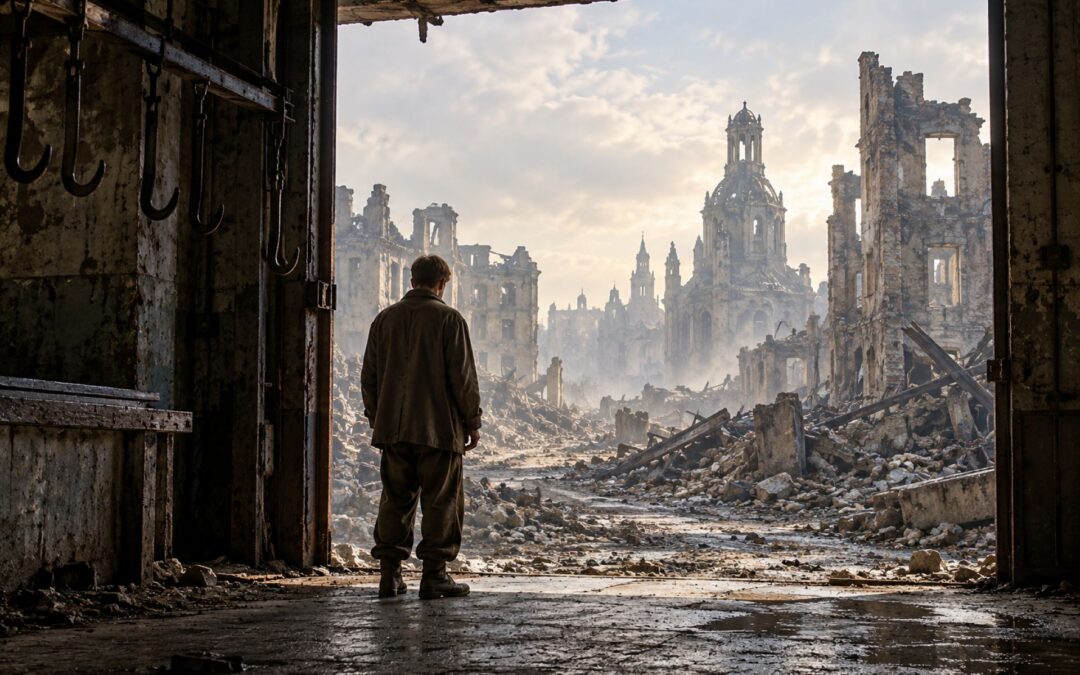
On February 13, 1945, Billy and the other Americans take shelter beneath the slaughterhouse in a deep meat-storage area. The shelter contains animal carcasses hanging from hooks, and the prisoners wait while the city above them is attacked.
The explosions are heard underground, but the shelter protects its occupants from the worst effects of the bombing. Billy and the other prisoners survive while the destruction continues above them.
When the survivors eventually emerge, Dresden has been transformed. Buildings have collapsed, streets are blocked, smoke obscures the sky, and the surrounding district appears almost entirely lifeless.
The Germans who had guarded the prisoners are overwhelmed by what they see. Their families, homes, and city have been destroyed, and they struggle to respond to the scene before them.
Billy remembers the expressions on their faces as resembling those of a silent barbershop quartet. This is the image that returns to him years later during the anniversary celebration.
The destroyed city resembles the surface of the moon, stripped of the ordinary signs of human habitation. Its streets and buildings have become mineral debris, and the distinction between familiar urban space and an alien landscape has nearly disappeared.
The novel describes the deaths of people whom Billy had encountered during his imprisonment, including women from the surrounding neighborhood. Their destruction is presented without individualized death scenes, emphasizing how quickly the identities and routines of ordinary people can disappear.
The prisoners and their surviving guards move through the ruins in search of safety. During this journey, the novel depicts Allied aircraft firing on people below, an incident that belongs to the fictional account but must be distinguished from the disputed historical evidence concerning such attacks during the Dresden raids.
They eventually reach an inn outside the destroyed city. Its blind proprietor, his wife, and their daughters have prepared for the possibility that refugees might arrive. Although almost nobody has reached them, they continue maintaining their establishment.
The family provides the Americans with food, drink, and a place to sleep in the stable. Their hospitality creates a striking contrast with the impersonal destruction surrounding them.
The prisoners cannot simply leave the ruins behind. German authorities subsequently require them to return to Dresden and help recover bodies from beneath collapsed buildings.
They dig into cellars and shelters where people had taken refuge during the bombing. The work becomes known as corpse mining because the dead are buried beneath layers of stone, timber, and rubble.
Billy works alongside a Maori prisoner who had been captured during an earlier campaign. As they excavate one of the ruined shelters, they uncover a space containing numerous dead civilians. The experience overwhelms the Maori prisoner, who becomes violently ill and dies.
As the bodies decompose, the conditions become increasingly unbearable. The authorities eventually begin burning remains within the underground spaces rather than attempting to recover each individual corpse.
Vonnegut reports these events in restrained, matter-of-fact language. The narration records the consequences of destruction through labor, bodily suffering, and the practical treatment of the dead rather than through elaborate descriptions of the bombardment itself.
The eventual execution of Edgar Derby belongs to this aftermath. He is found with a teapot taken from the ruins, accused of looting, and shot. After so many people have died in the bombing, the execution of a relatively decent man for taking an object from the wreckage completes one of the novel’s most bitter sequences.
Billy’s Survival, Foretold Death, and the Final Birdsong
Billy survives the war and returns to a life that outwardly appears remarkably fortunate. He completes his education, becomes wealthy through optometry, marries into a prosperous family, and raises two children. Yet the apparent rewards of civilian life do not produce a corresponding sense of emotional stability.
Years after Dresden, Billy joins a group of optometrists traveling by chartered aircraft to a convention in Montreal. His father-in-law, Lionel Merble, accompanies him, along with other passengers and members of a barbershop quartet.
Billy claims to know in advance that the aircraft will crash. He nevertheless says nothing, partly because he does not wish to embarrass himself by warning the other passengers.
The aircraft strikes Sugarbush Mountain in Vermont. Nearly everyone aboard is killed, including Lionel Merble, but Billy survives, along with the copilot. He suffers a serious head injury and is taken to a hospital.
Valencia learns about the accident and drives toward the hospital in a state of panic. She misses a turn, brakes suddenly, and is struck from behind by another vehicle. Although she is not seriously injured in the collision, the exhaust system of her damaged Cadillac allows carbon monoxide to enter the passenger compartment.
Valencia continues driving because she is desperate to reach Billy. By the time she arrives at the hospital, she has inhaled a fatal quantity of the gas. She dies while Billy remains unconscious and unable to respond.
Billy later shares a hospital room with Bertram Copeland Rumfoord, a prominent history professor who is recovering from a skiing injury. Rumfoord is researching the Allied bombing campaign and collecting material for a historical account of the air war.
Rumfoord initially regards Billy as intellectually insignificant and mentally disturbed. He does not believe that his quiet, apparently confused roommate could have witnessed an important wartime event.
When Billy begins speaking about Dresden, Rumfoord dismisses his statements. He eventually recognizes that Billy really was present during the bombing, but their understanding of its historical significance remains different.
Rumfoord’s belief in military necessity clashes with Billy’s experience of the civilian aftermath. Billy has seen the ruined streets and recovered bodies, while Rumfoord approaches the event through strategic accounts, official statements, and military history.
After leaving the hospital, Billy becomes increasingly determined to communicate the lessons he believes he has learned from Tralfamadore. He travels to New York, where he visits a bookstore containing science-fiction novels and pornographic publications.
There he encounters material referring to Montana Wildhack, the actress whom he claims to have known on Tralfamadore. He also discovers a novel by Kilgore Trout whose plot closely resembles his own account of extraterrestrial captivity.
Billy eventually participates in a late-night radio discussion with literary figures. His assertions about time travel and extraterrestrial life bewilder the other participants, and his daughter Barbara is summoned to retrieve him.
The narrative also describes Billy’s supposed future death. During his wartime confinement, Paul Lazzaro had threatened to avenge Roland Weary by arranging Billy’s murder after the war.
Billy claims to have already experienced this assassination. According to his account, he will die on February 13, 1976, while delivering a public lecture in Chicago about flying saucers and the nature of time.
His imagined future America has fragmented into numerous independent political entities following further catastrophic violence. Billy addresses a crowd in a covered stadium and calmly explains that he expects to die.
An assassin armed with a laser weapon shoots him from a distant position. Billy experiences death as a temporary absence of consciousness before returning to another moment in his life.
Because he believes every moment exists permanently, he regards the assassination without fear. His knowledge of death does not inspire resistance; it confirms his conviction that events cannot be altered.
A different episode from the end of the war provides one of Billy’s clearest expressions of compassion. He and several American prisoners travel through the ruined streets of Dresden in a horse-drawn wagon.
A German couple notices that the horses have been badly mistreated. Their mouths and hooves are injured, and they are suffering from neglect. When Billy is made to confront their condition, he begins to cry.
The episode is notable because Billy’s direct emotional response to the suffering animals is stronger than many of his reactions to human tragedy. The wounded horses make suffering immediate and comprehensible in a way that the mass destruction of Dresden often does not.
The final chapter returns to Vonnegut’s own perspective, mentioning contemporary political assassinations and the continuing violence of the Vietnam War. The narrative then moves back to Dresden in 1945.
Billy and the other prisoners continue recovering bodies until their work becomes impossible. Edgar Derby is executed for taking the teapot, and the surviving prisoners remain under German control as the war approaches its conclusion.
Eventually, the soldiers guarding them disappear, and the prisoners discover that their confinement has effectively ended. They emerge into a quiet landscape where spring is beginning.
The surrounding world contains little traffic or human activity. Trees are producing new leaves, and the remnants of wartime destruction remain visible.
The novel ends when a bird addresses Billy with the sound “Poo-tee-weet?”
It is an ending without a conventional resolution to Billy’s psychological suffering, a final explanation for Dresden, or an answer to the philosophical questions raised throughout the book. The war has ended, but the events that occurred during it cannot be undone.
The Three Settings and the Systems That Govern Them
The novel moves principally among wartime Europe, postwar America, and Tralfamadore. Each environment operates according to different institutions and social expectations, but all three place Billy within systems that he struggles to influence.
Wartime Europe is governed by military organization, national identity, captivity, and the constant possibility of arbitrary death. Billy’s experiences reveal how little control an individual soldier can possess within a conflict involving enormous political and technological forces.
His capture shows an army in collapse, with its equipment, procedures, and heroic mythology unable to protect its members. The prison trains reduce men to bodies requiring food, water, and space, while their treatment varies according to nationality and the institutional arrangements governing their captivity.
Dresden initially provides a contrasting urban environment. The city has architecture, work routines, public spaces, and ordinary social encounters, but these features do not protect its inhabitants when military decisions made elsewhere determine its fate.
The slaughterhouse itself condenses the relationship between institutional power and physical vulnerability. The Americans are housed in a building designed for animals awaiting death, and they survive the bombing in a space used to store carcasses.
Postwar Ilium appears vastly more comfortable. Billy’s professional life is shaped by commercial opportunity, family wealth, and social respectability. He possesses the material rewards associated with American prosperity, including an established business and an affluent household.
Yet this environment has its own expectations. Billy must perform the roles of husband, father, businessman, and respectable citizen even though his emotional life does not fit comfortably within them. His family’s concern becomes another source of pressure, while public appearances expose the distance between his ideas and ordinary social conventions.
The contrast becomes particularly sharp when Billy travels through parts of Ilium damaged by racial unrest and urban redevelopment. These locations remind him of destroyed European cities. American progress and prosperity have not eliminated the capacity of institutions and communities to produce devastation.
Tralfamadore represents an even more radical form of control. The aliens possess extraordinary technology, but they use it to confine Billy and Montana in a public exhibit. They determine the conditions of the humans’ lives while insisting that every event is inevitable.
The zoo is physically comfortable but politically absolute. Billy receives protection and apparent affection without freedom, reproducing the central tension of his existence in an especially concentrated form.
Across these settings, the novel repeatedly asks how much individual security is worth when the structures providing it also restrict meaningful choice. The answer is never entirely straightforward because Billy sometimes appears more comfortable in captivity than he does in ordinary life.
Billy Pilgrim, Powerlessness, and the Limits of His Perspective
Billy Pilgrim is an unconventional protagonist because he rarely takes decisive action, even when events directly threaten his survival. His defining quality is not extraordinary courage, intelligence, or moral ambition, but his tendency to endure circumstances that he cannot or will not resist.
His childhood helps establish this pattern. When his father attempts to teach him to swim by throwing him into a pool, Billy experiences the event as overwhelming rather than instructive. His terror is treated as something he must overcome through exposure, without serious attention to what he feels.
Later, his father takes him to the Grand Canyon, where Billy is frightened by the landscape’s immense scale. These scenes introduce a recurring condition: Billy is placed in situations that other people regard as normal, educational, or exciting, but he experiences them as threatening.
His military life extends this helplessness into circumstances with genuinely fatal consequences. He cannot keep pace with the scouts, defend himself against Weary, or understand the military organization to which he supposedly belongs.
Billy’s apparent willingness to die during the Battle of the Bulge is particularly unsettling. He does not seek death with heroic determination; he seems unable to imagine a successful alternative to whatever happens next.
After the war, Billy acquires wealth and a respectable position without fundamentally changing his attitude toward events. His marriage is arranged within a social environment that offers material advantages, and he accepts the resulting life with little visible enthusiasm.
His relationship with Valencia demonstrates how passivity can affect other people. Billy rarely behaves with deliberate cruelty toward her, but his emotional absence prevents the marriage from becoming an equal relationship. Valencia’s considerable devotion receives limited reciprocation.
As a father, Billy is similarly distant. Barbara responds by adopting an increasingly parental role toward him, while Robert eventually enters military service in Vietnam, a decision that places the family within another generation of warfare.
Billy’s refusal to warn the passengers before the predicted plane crash shows the most troubling consequence of his philosophy. If he genuinely knows what will happen, he possesses information that might allow him to protect others, yet his belief in inevitability discourages any attempt.
His calmness therefore cannot automatically be regarded as wisdom. It may provide personal relief while weakening his sense of responsibility toward other people.
Nevertheless, Billy is not completely incapable of compassion. He shares food with Derby, shows tenderness in certain encounters, and cries when confronted with the suffering horses in Dresden.
These moments reveal a person whose emotional responsiveness has not disappeared but has become irregular and difficult to sustain. His detachment appears especially pronounced when confronted with events too large or terrible to comprehend.
Billy’s perspective also limits the reader’s access to the world around him. The story frequently follows what he sees, remembers, or claims to experience without offering a stable external explanation.
His experiences on Tralfamadore can therefore be understood in several ways. They may be literal events within the novel’s speculative universe, imaginative constructions that help him survive psychological distress, or narrative devices that allow Vonnegut to examine time and mortality.
Reducing Billy to a clinical diagnosis would oversimplify the character. The novel presents recognizable patterns of distress and emotional withdrawal, but it does not establish a definitive medical explanation for everything he experiences.
His greatest significance lies in the tension between survival and recovery. Billy continues living after Dresden, builds a prosperous existence, and reaches old age in his own account, yet he never acquires a stable sense of control over the life he has survived.
The Soldiers and Prisoners Who Expose War’s Absurdity
The supporting characters reveal different responses to violence, authority, fear, and humiliation. Their contrasting personalities prevent the novel’s antiwar perspective from collapsing into the claim that every participant behaves identically.
Roland Weary represents a particularly dangerous form of military romanticism. He regards war as an opportunity to enact fantasies of masculine courage, loyalty, and revenge, even though his actual circumstances provide little support for those fantasies.
His imagined Three Musketeers reveal how deeply he depends on stories about heroic brotherhood. When the scouts abandon him and Billy, Weary interprets the situation as a personal betrayal rather than a consequence of Billy’s exhaustion and the group’s danger.
Weary’s need to dominate someone weaker than himself is a recurring habit. His violence toward Billy reproduces the cruelty he supposedly encounters in war, undermining his belief that he represents military virtue.
Paul Lazzaro takes this mentality further. He openly celebrates revenge and describes sadistic acts with enthusiasm, including deliberately torturing a dog. His behavior lacks even Weary’s desire to appear heroic.
Lazzaro considers vengeance the greatest pleasure available to him. His promise to kill Billy for Weary’s death transforms a wartime accusation into a threat that supposedly survives for decades.
The relationship between Weary and Lazzaro shows how easily violence can become self-perpetuating. Neither man’s conduct is necessary for military victory, yet both justify personal cruelty through ideas of loyalty and retaliation.
Wild Bob represents another form of military delusion. As he dies, he imagines addressing devoted soldiers who are largely absent. His affectionate understanding of military command survives even when the regiment and authority sustaining it have collapsed.
Edgar Derby offers a contrasting example. Older than most of the prisoners, physically substantial, and formerly a teacher, he possesses a conventional sense of duty that could easily appear ridiculous in Vonnegut’s satirical world.
Yet Derby’s belief in moral principle survives his humiliation. When Howard Campbell offers the Americans material comfort in exchange for cooperation with the Nazis, Derby rejects the proposal and defends the cause for which they have been fighting.
His courage is modest but genuine. Unlike Weary, Derby does not need violence to demonstrate masculinity, and unlike Lazzaro, he does not define human relationships through revenge.
Derby’s eventual execution is especially bitter because the novel has shown that he possesses virtues the larger machinery of war fails to recognize. His decency cannot protect him from arbitrary punishment.
Howard Campbell provides one of the novel’s clearest examples of ideological manipulation. His elaborate costume combines American national imagery with Nazi symbolism, turning politics into theatrical display. His appeal to the prisoners attempts to exploit their discomfort while disguising the nature of the regime he serves.
Werner Gluck, by contrast, is a young guard whose awkwardness and embarrassment reveal how little some individuals resemble the confident figures of military propaganda. His encounter with Billy near the women’s showers briefly emphasizes their shared youth rather than their opposing national identities.
The British prisoners complicate the picture further. Their relative comfort enables them to preserve discipline and entertain the Americans, but it also makes them less capable of understanding the extent of the newcomers’ physical suffering.
Russian prisoners occupy a much harsher position within the camp’s hierarchy. Their deprivation underscores the fact that captivity is not a single uniform experience and that ideological and racial distinctions within the Nazi system have material consequences.
Together, these characters demonstrate the novel’s range of moral responses. People can become cruel, ridiculous, courageous, indifferent, or compassionate under pressure, even when the larger circumstances restrict their freedom.
Vonnegut does not deny these differences. His treatment of Derby in particular suggests that moral choices remain meaningful even when they cannot change the outcome of a war.
Family, Intimacy, and the Treatment of Women
Billy’s family relationships reveal how his emotional detachment continues after the war. Although his marriage and professional success appear to confirm his return to ordinary life, intimacy often seems to require more involvement than he can provide.
Valencia Merble loves Billy with an intensity that the narrative repeatedly emphasizes. She admires him, worries about his well-being, and devotes herself to the marriage despite his reserved responses.
Billy does not appear to marry Valencia because of overwhelming romantic affection. Her father’s wealth and professional connections help establish the material conditions of their relationship, while Billy largely allows events to unfold around him.
The novel frequently describes Valencia through her body, appetite, and awkwardness. These details contribute to Vonnegut’s satire of middle-class prosperity, but they also risk reducing a devoted and emotionally vulnerable woman to a comic figure.
Her death reveals the limits of that treatment. When Billy’s aircraft crashes, Valencia’s desperate attempt to reach him leads to a minor collision and the carbon-monoxide poisoning that kills her.
Her final actions are motivated by genuine love and concern. The contrast between her emotional urgency and Billy’s apparent indifference makes the marriage more tragic than the earlier jokes might suggest.
Barbara responds to Billy differently. After his claims about Tralfamadore become public, she attempts to protect him from embarrassment and possible danger, assuming increasing authority over his life.
Her behavior can be controlling and condescending, but it is not simply unreasonable. Billy publicly describes experiences that other people cannot verify, survives a serious head injury, and demonstrates limited concern for how his actions affect those closest to him.
Barbara’s attempts to manage her father therefore arise from legitimate anxiety as well as frustration. Their relationship reverses conventional expectations about parenthood, with the daughter increasingly treating her father as someone unable to make responsible decisions.
Billy’s son Robert follows another path. Initially rebellious and unsuccessful at school, he becomes disciplined through military service and eventually fights in Vietnam as a Green Beret.
His transformation reproduces one of the familiar narratives that Slaughterhouse-Five questions: the idea that military institutions can turn an undisciplined young man into a respectable adult. The novel does not provide enough of Robert’s inner life to settle whether his development should be understood as genuine maturation, social conformity, or both.
Billy’s relationship with his mother also illustrates his inability to return affection comfortably. She worries about him and visits him during his psychiatric hospitalization, but her attempts to express love intensify his distress.
Montana Wildhack occupies a more complicated position. She is introduced as a sexually attractive actress whom extraterrestrials abduct and place alongside Billy in a zoo.
Initially, Montana experiences fear and anger at her captivity. Over time, she becomes Billy’s companion, and their relationship develops into a domestic arrangement with a child.
For Billy, Montana appears to offer intimacy without the demands and complications of his marriage on Earth. The aliens have arranged a companion for him, and the conditions of the relationship require little initiative on his part.
Yet Montana has not freely chosen this situation. She is taken from Earth, displayed before spectators, and assigned a reproductive role within an environment controlled by extraterrestrials.
The novel’s treatment of her consequently raises questions about the difference between companionship and possession. Billy’s apparent happiness on Tralfamadore depends partly on conditions that deprive another person of autonomy.
Vonnegut’s portrayal of women is among the book’s meaningful limitations. Valencia is frequently caricatured, Montana is strongly sexualized, and Barbara is often seen through Billy’s resentment of her attempts to control him.
These portrayals may reflect the novel’s criticism of the fantasies and assumptions governing Billy’s life, but they also restrict the independent psychological depth available to its female characters. The resulting tension is significant because a book deeply concerned with helplessness does not always extend the same attention to every character’s experience of it.
Kilgore Trout and the Stories That Make Reality Bearable
Kilgore Trout is a struggling science-fiction writer whose bizarre stories play an important role in Billy’s understanding of reality. His work enters Billy’s life through Eliot Rosewater, the fellow patient he meets during his hospitalization after the war.
Rosewater has experienced military violence that makes ordinary civilian existence difficult to accept. He collects inexpensive science-fiction novels and uses them to imagine different arrangements of human life.
Billy encounters Trout’s stories in this environment, where fiction serves as a means of confronting experiences that familiar social assumptions cannot explain.
One of Trout’s books, The Gospel from Outer Space, imagines an extraterrestrial visitor studying Christianity and discovering a troubling feature of its moral message. The visitor becomes concerned that the story’s special treatment of a divine figure might leave ordinary, powerless people without comparable protection.
The fictional writer’s solution exposes how easily moral systems can become organized around status and authority rather than compassion. The episode matters because Billy’s own suffering frequently arises from his inability to command respect or exercise power.
Trout’s work also satirizes humanity’s distorted moral priorities. One story features a robot whose relationship to destructive violence matters less to the people around it than a comparatively trivial violation of social expectations.
The contrast reflects the absurdity of a society capable of tolerating mass killing while reacting intensely to offenses against custom, decorum, or convention.
Billy eventually meets Trout in Ilium, where the writer is working in an ordinary commercial job. Trout attends Billy and Valencia’s anniversary celebration and participates awkwardly in the social world that Billy has inhabited since the war.
Their friendship is limited, but it provides Billy with an intellectual connection that differs from his family and professional relationships. Trout’s imagination gives Billy a language for questioning the apparent normality of human behavior.
The most striking connection appears when Billy discovers Trout’s The Big Board in a New York bookstore. The novel concerns human beings abducted by extraterrestrials and placed in an artificial environment for observation.
Its premise closely resembles Billy’s account of Tralfamadore. This resemblance creates a possible explanation for the alien adventures: Billy may have incorporated material from the science fiction he encountered during psychiatric treatment into his later understanding of his own life.
The book does not require readers to accept this explanation as definitive. Instead, the connection makes Billy’s experience more ambiguous and raises questions about the relationship between memory, imagination, and psychological survival.
Trout’s stories also illustrate the novel’s broader interest in the moral consequences of storytelling. Fiction can reveal uncomfortable truths by making familiar assumptions strange, but it can also provide explanations that relieve people of the obligation to confront reality.
Billy’s attraction to Tralfamadorian philosophy emerges from this uncertain territory. The stories he encounters may help him understand suffering, but they may also offer an elaborate means of avoiding the most disturbing implications of what he has witnessed.
Time Travel, Free Will, and the Temptation of Fatalism
Time travel is the novel’s most recognizable speculative device, but its significance extends beyond the mechanics of moving between different periods. Billy’s experiences challenge the ordinary assumption that people inhabit an unfolding present in which their choices influence what happens next.
The Tralfamadorians reject this understanding of time. They perceive past, present, and future as existing simultaneously, much as a human observer might see different parts of a landscape at once.
For them, the universe is composed of permanently established moments. Each event occupies its fixed position, and nothing can be added, erased, prevented, or revised.
Human beings ordinarily understand death as the end of an individual’s existence. From the Tralfamadorian perspective, however, a person who dies at one point remains alive in all the other moments that constitute that person’s life.
This conception offers Billy a form of consolation. The people he has lost, including soldiers killed in combat and civilians destroyed in Dresden, continue to exist at moments when they were alive.
The philosophy also changes the meaning of regret. If every event has always occupied its position in time, attempts to imagine what might have happened differently are futile.
The aliens recommend concentrating on pleasant moments rather than dwelling on unpleasant ones. Their advice transforms emotional well-being into a question of attention rather than action.
The problem is that this worldview eliminates meaningful free will. If everything is predetermined, the difference between trying to prevent suffering and accepting it becomes difficult to justify.
The novel dramatizes this consequence through Billy’s behavior. When he believes he knows that his plane will crash, he makes no attempt to warn the other passengers.
His silence is not presented as the result of careful moral reasoning. It follows from his acceptance of a universe in which every event must occur exactly as it already has.
The aliens’ account of the universe’s eventual destruction makes the implications still clearer. They explain that a Tralfamadorian experiment will someday destroy all existence, but they insist that the catastrophe cannot be prevented because it is already part of the structure of time.
A civilization possessing extraordinary scientific knowledge therefore behaves as though foresight carries no responsibility. Its intelligence does not produce ethical progress; it justifies resignation.
This creates a profound contradiction within the novel. Billy adopts the aliens’ perspective as a means of accepting violence and death, while Vonnegut’s narrative persistently invites readers to recognize cruelty, mourn victims, and question the decisions that produce suffering.
One interpretation is that the novel depicts a universe genuinely governed by absolute determinism. Under this reading, Billy has discovered the true nature of existence, and his calm acceptance represents a form of philosophical insight.
A second interpretation understands his time travel as a psychological response to wartime trauma. Billy’s movement between moments resembles the experience of being unable to keep painful memories safely confined to the past.
A third interpretation treats Tralfamadore as a deliberate literary construction. The aliens provide a system of ideas that allows Vonnegut to explore the attraction and limitations of fatalism without requiring readers to decide whether they actually exist.
These readings need not exclude one another. The novel can function as speculative fiction while simultaneously presenting an emotionally revealing account of a traumatized survivor.
Salman Rushdie’s interpretation of Slaughterhouse-Five emphasizes the importance of irony in understanding the apparent conflict between the book’s fatalistic statements and its moral commitments. The Tralfamadorian philosophy should not automatically be treated as a set of conclusions endorsed by Vonnegut.
The distinction becomes especially important when considering Edgar Derby. Derby’s decision to oppose Howard Campbell does not prevent his eventual execution, but the novel nevertheless presents his resistance as meaningful.
If nothing anyone does matters, Derby’s courage becomes difficult to distinguish from Lazzaro’s cruelty. Yet Vonnegut’s treatment clearly encourages readers to recognize the difference.
The Serenity Prayer, which appears later in the novel, further complicates the question. It distinguishes between circumstances that must be accepted and those that can be changed, rather than assuming that every event belongs to the first category.
Billy appears to have accepted a philosophy that offers relief from pain by reducing the burden of responsibility. The novel’s larger perspective remains uneasy about the price of that comfort.
Its central philosophical tension is therefore unresolved rather than simply contradictory. The wish to escape the suffering produced by irreversible events is understandable, but a world in which no one attempts to prevent future cruelty would be morally impoverished.
Trauma, Memory, and the Return of Dresden
Billy’s unusual relationship with time can also be understood as a literary representation of the way traumatic experiences disrupt memory. Although the novel does not establish a definitive psychological diagnosis, his behavior repeatedly suggests that the war has altered his capacity to experience ordinary life.
His movements through time occur without his control. An everyday incident can suddenly place him in a different moment, often one associated with fear, helplessness, or suffering.
This resembles the way powerful memories can intrude upon the present without being consciously summoned. For Billy, the boundary between what has happened and what is happening seems unusually unstable.
His difficulty begins before Dresden. Childhood experiences involving water, immense landscapes, and parental authority already establish a pattern in which he becomes overwhelmed by events other people regard as manageable.
Wartime captivity intensifies this vulnerability. Billy witnesses death, starvation, humiliation, and arbitrary cruelty while possessing almost no ability to protect himself.
After the war, he enters psychiatric treatment and struggles to establish emotionally satisfying relationships. His outward achievements do not erase the distance between his private experience and the expectations of civilian life.
One of the novel’s most revealing details is Billy’s tendency to cry without fully understanding why. He may appear calm during extraordinary events and then become distressed by something apparently insignificant.
His emotional response to the suffering horses in Dresden illustrates this pattern. The neglected animals provide a concrete object of compassion, allowing Billy to recognize suffering in a form that does not overwhelm him with the scale of the destroyed city.
The anniversary-party episode is even more important. When a barbershop quartet performs, Billy becomes intensely uncomfortable before he consciously understands the reason.
The singers’ expressions resemble those of the German guards who emerged with him from the shelter after the bombing. Their faces connect a pleasant celebration in postwar America with a catastrophe that remains emotionally unresolved.
The novel makes a significant distinction at this point. Billy does not merely experience another involuntary displacement in time; he actually remembers the connection between the present moment and Dresden.
The recollection suggests that part of his suffering arises from memories he has never fully integrated into his understanding of himself. The past remains available to him, but ordinary chronological distance has not rendered it emotionally manageable.
Tralfamadore offers an alternative way of organizing these experiences. If all moments exist permanently, the distinction between remembering an event and being present at it becomes less important.
Such a worldview might allow Billy to experience his disordered relationship with time as a kind of revelation rather than a symptom of distress.
It may also help him avoid confronting the emotional consequences of what happened. The aliens’ advice to focus on pleasant moments supplies consolation without requiring the difficult work of understanding the painful ones.
The novel’s form reinforces this ambiguity. Its chronology resembles Billy’s fractured experience, but the authorial frame reminds readers that the fragmentation is also a deliberate literary decision.
Vonnegut’s account therefore connects the difficulties of remembering trauma with the difficulties of representing it in narrative. Neither Billy nor the narrator can easily convert Dresden into a coherent sequence with a beginning, meaningful development, and satisfying conclusion.
The Language of Death: “So It Goes,” the Serenity Prayer, and Other Motifs
The most recognizable recurring phrase in Slaughterhouse-Five is “So it goes.” The narrator uses it repeatedly after references to death, whether the victim is a major character, an anonymous casualty, an animal, or someone whose death is mentioned only in passing.
The repetition gives radically different deaths a shared verbal treatment. An intimate personal loss can receive the same brief response as the destruction of thousands of people.
At first, the phrase may seem callous or excessively casual. Its meaning changes as the reader encounters it more frequently and becomes familiar with the Tralfamadorian perspective on mortality.
For the aliens, death occupies one moment among countless others. Their philosophy makes the phrase appear consistent with the belief that death does not erase the rest of a person’s existence.
But the narrator’s repeated use also exposes the inadequacy of conventional language. Faced with death on an enormous scale, explanations and expressions of grief may begin to seem repetitive or insufficient.
The phrase can therefore communicate resignation, emotional exhaustion, irony, and suppressed sorrow. It does not necessarily mean that the narrator regards every death as unimportant.
The illustrated gravestone that appears in the novel offers a related form of dark comedy. Its message imagines a life entirely free from pain, expressed with the artificial cheerfulness of a conventional memorial inscription.
The contrast between this cheerful sentiment and the novel’s recurring violence exposes the emptiness of easy assurances about suffering.
Montana Wildhack’s locket contains the Serenity Prayer, which asks for help distinguishing what can be changed from what must be accepted. Its appearance on Tralfamadore creates an important tension with the aliens’ insistence that nothing can be changed.
The prayer assumes that judgment and action remain possible. The Tralfamadorian philosophy removes that distinction by treating all events as predetermined.
The contrast invites readers to question whether Billy has discovered genuine wisdom or adopted a form of resignation that prevents him from distinguishing unavoidable loss from preventable harm.
Clocks recur throughout the novel as reminders of humanity’s conventional understanding of time. The narrator remembers clocks stolen from Dresden, while the Tralfamadorians manipulate the clocks displayed in Billy’s enclosure.
Their manipulation emphasizes how easily the visible measurement of time can be controlled without changing the underlying events. The clock becomes an instrument through which one being imposes an apparent order on another’s experience.
The film Billy watches backward before his supposed abduction provides another important image. In reverse, bombers return from missions, weapons disappear into factories, and processes of destruction appear to undo themselves.
The reversed sequence imagines a world in which violence moves backward toward innocence. Its emotional appeal comes from something the Tralfamadorian philosophy denies: the desire to reverse damage and restore lost lives.
Dresden’s transformation into a moonscape is equally significant. The image strips the city of its historical and social identity, turning streets and buildings into an unfamiliar mineral landscape.
The comparison also connects the wartime scenes with the novel’s science-fiction imagery. Billy does not need to travel to another planet to encounter a world made strange by forces beyond his comprehension.
The suffering horses introduce a smaller and more intimate symbol. Their injuries expose the consequences of neglect that Billy has failed to notice, creating a moment in which compassion becomes possible through attention to particular living creatures.
The repeated references to children and infants serve a related purpose. They undermine the assumption that soldiers enter war as fully formed, heroic adults who understand and accept the violence surrounding them.
The Cinderella performance provides a different form of contrast. Its theatrical promises of transformation and happiness appear beside starving prisoners whose physical circumstances cannot be changed through costume or storytelling.
Finally, the bird’s cry at the end brings the novel’s treatment of language to its limit. After the accumulation of deaths, philosophical claims, jokes, and explanations, the book concludes with a sound that carries no clear human meaning.
The repeated motifs collectively reveal the inadequacy of ordinary consolations while preserving the impulse to search for them. People continue telling stories, offering prayers, counting time, and imagining reversals because suffering remains difficult to endure without some structure of meaning.
The Meaning of Dresden’s Ending and the Birdsong
The final chapter returns the narrative to Dresden after the bombing, completing the wartime sequence that has remained fragmented throughout the novel. Billy and the other prisoners are forced to recover bodies until decomposition makes the work unbearable.
Edgar Derby’s execution follows without the dramatic treatment that conventional storytelling might have given it. The narrator has already announced Derby’s fate repeatedly, so the event cannot function as a surprise.
This choice is important because Derby’s death is morally disturbing without being historically spectacular. Thousands of people have died in the bombing, yet an exhausted prisoner is later executed for taking a teapot from the ruins.
The disproportion reveals the failure of institutions to distinguish between meaningful justice and arbitrary punishment. It also frustrates the expectation that a brave or decent character will receive an appropriately heroic ending.
When the surviving prisoners are finally released, the novel does not celebrate liberation through an elaborate scene of triumph. They simply emerge into springtime and discover that the familiar machinery of war has stopped operating around them.
The quiet landscape contains signs of renewed life, including trees producing leaves and birds making sounds. These details suggest that the natural world continues even when human history has produced catastrophic destruction.
Yet the ending offers no assurance that the survivors have recovered psychologically or that future generations will avoid similar violence. The novel’s opening frame has already mentioned the Vietnam War, making clear that the end of World War II did not end organized killing.
The final birdsong captures this absence of resolution. Its sound can be understood as a response to events for which meaningful language has become impossible.
The bird’s question-like call also resists the reader’s desire for a final explanation. It does not identify the moral of the story, justify the bombing, or explain why some people survived while others died.
Salman Rushdie’s discussion of Vonnegut’s ending is useful here because the conclusion is inseparable from the novel’s refusal to make atrocity reassuringly intelligible.
The birdsong may also suggest a limited kind of hope. Life continues, and living creatures remain capable of producing sounds, movement, and renewal.
But this is not the same as declaring that suffering has been redeemed. Vonnegut allows the world to continue without pretending that continuation supplies an adequate explanation for what has happened.
Metafiction, Black Humor, and the Fragmented Form
The structure of Slaughterhouse-Five is one of its most distinctive achievements. Rather than presenting events in chronological order, Vonnegut moves among different periods while repeatedly returning to wartime experiences that remain emotionally unresolved.
The novel’s opening chapter makes the process of writing part of the story itself. The narrator describes his failures, memories, research, conversations, and dissatisfaction with conventional narrative techniques before introducing Billy Pilgrim.
This creates a metafictional structure in which the book openly examines its own construction. Readers are not encouraged to forget that they are encountering a deliberately shaped account of events.
The narrator occasionally interrupts Billy’s story to identify himself among the prisoners. These brief appearances prevent the fictional narrative from becoming completely detached from Vonnegut’s historical experience.
At the same time, the distinction between author and protagonist remains important. Billy is not simply Vonnegut under another name. His personal history, temperament, civilian life, and science-fiction experiences belong to a fictional construction.
The fragmented chronology serves several functions. It reproduces Billy’s claimed experience of time, prevents the reader from approaching death through ordinary suspense, and places moments of apparent security beside scenes of catastrophe.
Because important deaths are announced early, the reader frequently knows what will happen before it occurs. Derby’s execution and Billy’s predicted assassination are among the clearest examples.
This technique changes the reader’s attention. Instead of asking whether a character will survive, the reader must examine the circumstances surrounding a known outcome and consider what that outcome means.
The novel also uses black humor to expose contradictions between social expectations and physical reality. Military photographs stage heroic defeat, prisoners perform Cinderella while starving Americans suffer, and a man can be executed for a teapot after an entire city has been destroyed.
These episodes are funny in uncomfortable ways because their absurdity is inseparable from suffering. The jokes do not remove the cruelty of the events; they reveal the mismatch between institutional language and human experience.
Vonnegut’s prose reinforces the effect. His sentences are frequently short, direct, and conversational, even when describing events of extraordinary violence.
The restraint makes grotesque details more disturbing because they appear without the emotional preparation supplied by elaborate narration.
The book also juxtaposes events that conventional fiction might separate. A pleasant wedding anniversary can suddenly evoke Dresden, while childhood memories interrupt captivity and extraterrestrial philosophy appears alongside descriptions of death.
These transitions initially seem disorderly, but recurring images and ideas create connections across the narrative. Clocks, corpses, captivity, animals, and questions about free will appear in different settings, inviting readers to recognize patterns that chronology alone would obscure.
The Tralfamadorian description of books supplies a model for understanding Vonnegut’s own experiment. Separate moments can be arranged into an overall pattern whose significance does not depend on a conventional beginning-to-end progression.
Nevertheless, the novel is not completely without narrative direction. The story gradually approaches Dresden, reveals the bombing, examines its aftermath, and finally returns to the end of the war.
Its fragmented surface therefore conceals a carefully constructed progression. The book denies the comforts of conventional storytelling while retaining enough structure to make the consequences of its central catastrophe intelligible.
Dresden’s Historical Reality and the Novel’s Moral Claims
The historical destruction of Dresden is essential to understanding Slaughterhouse-Five, but the novel’s factual claims cannot all be accepted without qualification. Vonnegut’s experience as a prisoner of war gave him direct knowledge of the bombing’s aftermath, while some of the historical information available to him when writing the book was inaccurate.
On February 13 and 14, 1945, British aircraft carried out major bombing raids on Dresden using high-explosive and incendiary weapons. American aircraft conducted further attacks, including raids on February 14 and 15. The resulting destruction caused extensive civilian casualties and devastated much of the city’s built environment.
The Deutsches Historisches Museum’s account of the bombing explains that Dresden had remained relatively undamaged earlier in the war and had become an important destination for refugees fleeing the Soviet advance. It also served as a significant transport center and contained industrial facilities connected to the German war effort.
These facts complicate descriptions of Dresden as a city without military significance. Its rail connections supported German troop movements, and the wider urban economy included industries serving wartime needs.
The existence of military targets, however, does not by itself establish that the scale, methods, and civilian consequences of the raids were justified. The distinction between strategic importance and the proportionality of attacks remains central to the historical debate.
The National WWII Museum’s examination of the raids describes their military planning, the use of incendiary weapons, the destructive firestorm, and the extensive suffering of civilians and prisoners of war.
The most important factual correction concerns the death toll. Slaughterhouse-Five repeats a figure of approximately 135,000 deaths, reflecting estimates that circulated widely in the decades following the war.
Subsequent historical research established that this number was greatly inflated. The Dresden historians’ commission’s investigation, commissioned by the city of Dresden, concluded that the number of people killed by the February 1945 raids was approximately 25,000.
The lower estimate does not diminish the horror of the bombing or the suffering of those who died. It does mean, however, that comparisons based on the older figure are historically misleading.
Vonnegut relied in part on David Irving’s The Destruction of Dresden, which appeared before Irving became widely known for Holocaust denial and historical distortion. Irving’s interpretation contributed to the circulation of inflated casualty estimates and a representation of Dresden as an unparalleled massacre.
George Packer’s essay on the historical memory of Dresden traces the political uses of the bombing, including exaggerations promoted through Nazi propaganda and subsequently repeated in other contexts.
These distortions have serious implications. Presenting Dresden as an event that morally cancels or outweighs Nazi atrocities risks obscuring the historical responsibility of the German regime for the war, occupation, genocide, and systematic persecution that preceded the Allied bombing.
The moral problem cannot be resolved by treating one set of victims as unworthy of attention because their country had committed terrible crimes. Civilians killed in Dresden experienced real suffering, but their deaths should be understood within the larger history of a war initiated and pursued by Nazi Germany.
The novel also contains specific wartime details requiring qualification. Its descriptions of soap and candles supposedly produced from victims of Nazi persecution should not be treated as evidence of generalized industrial manufacture. The Auschwitz-Birkenau State Museum’s discussion of human-fat soap production in Gdańsk concerns a limited and specific historical case rather than the broad scenario suggested by such imagery.
Similarly, the novel depicts Allied aircraft firing on people moving through the ruins. Historical investigations have found no convincing evidence supporting the commonly repeated stories of low-flying attacks on civilians in Dresden during the February raids. The scene remains part of Vonnegut’s fictional presentation, but it should not be cited as established historical fact.
These corrections matter because Slaughterhouse-Five occupies an unusual position between autobiographical testimony, historical memory, and imaginative fiction. The book’s emotional authority derives partly from Vonnegut’s genuine experience, but personal survival does not make every subsequent historical interpretation accurate.
The central artistic achievement can be recognized without accepting its inflated statistics or misleading claims about Dresden’s military significance. Vonnegut’s descriptions of hunger, captivity, devastated streets, recovered bodies, and the bewilderment of survivors remain central to the novel’s power.
The strongest historical reading therefore distinguishes between the suffering the novel represents and the broader factual conclusions it sometimes draws. The bombing raises serious ethical questions about the conduct of modern warfare, but those questions become more meaningful when examined through accurate evidence rather than exaggeration.
What Slaughterhouse-Five Achieves—and Where It Falls Short
The greatest achievement of Slaughterhouse-Five lies in its refusal to transform the destruction of Dresden into a conventional narrative of heroic endurance. Vonnegut does not organize the bombing around a noble protagonist, an escalating sequence of military challenges, or a moment of triumph that would allow readers to regard the suffering as necessary preparation for a satisfying conclusion.
Instead, he makes Billy Pilgrim a physically unimpressive, emotionally detached man who survives largely through circumstance. Billy does not defeat his captors, save a city, or acquire extraordinary moral authority from his experiences.
This choice gives the novel a distinctive perspective on war. Much military fiction concentrates on courage, tactical decisions, loyalty, and sacrifice, but Vonnegut repeatedly directs attention toward hunger, humiliation, boredom, illness, accidents, and the absurd consequences of institutional power.
The scene in which Billy shares malt syrup with Edgar Derby demonstrates the effectiveness of this approach. Neither man performs a heroic deed, but the exchange reveals their physical desperation and capacity for kindness more vividly than a formal statement about suffering could.
The ruined horses provide another example. Their injuries might appear insignificant beside the deaths of thousands of people, yet Billy’s reaction makes the consequences of neglect emotionally immediate.
Vonnegut’s restraint is especially effective because he avoids assigning a grand meaning to every terrible event. Derby’s execution is not presented as a noble sacrifice, and the liberation of the surviving prisoners does not become a triumphant conclusion.
The fragmented structure is equally important to the novel’s achievement. By announcing deaths before they occur, Vonnegut changes the nature of suspense and forces the reader to concentrate on the conditions surrounding loss rather than the possibility of avoiding it.
The recurring movement between war and civilian life also prevents the bombing from remaining safely confined to the past. Billy’s prosperous existence does not erase his captivity, and seemingly ordinary events continue to produce disturbing connections with Dresden.
The anniversary-party scene is one of the clearest demonstrations of this structural intelligence. Its emotional power depends on the delayed connection between the quartet’s expressions and the German guards emerging from the destroyed city.
Such moments show that the nonlinear narrative is more than a decorative experiment. Its arrangement allows readers to experience connections that would be less forceful in a strictly chronological account.
Vonnegut’s science-fiction elements extend the novel’s intellectual reach. Tralfamadorian philosophy supplies a coherent alternative to conventional understandings of time and mortality, while exposing the emotional appeal of a universe in which death never completely destroys a person.
The alien worldview also introduces a genuine philosophical problem. Accepting that every moment exists permanently may comfort an individual survivor, but it can weaken the distinction between accepting unavoidable suffering and refusing to prevent avoidable harm.
The novel’s refusal to resolve this contradiction is both a strength and a limitation. Readers receive a provocative account of fatalism without a fully developed alternative theory of moral agency.
The ambiguity of Billy’s time travel produces a similar effect. Its resemblance to psychological disturbance gives the narrative emotional plausibility, while its speculative elements allow Vonnegut to examine experiences that resist realistic description.
Yet Billy’s passivity can also make him difficult to understand as a fully developed individual. His lack of initiative serves the novel’s artistic purpose, but it sometimes limits the range of emotional and interpersonal responses available to him.
This limitation affects several supporting characters. Weary and Lazzaro are vivid figures, but their personalities are organized strongly around bullying and cruelty. Other characters often appear primarily because they reveal a particular moral or philosophical contradiction.
Edgar Derby is more successful because his decency gives the novel a meaningful counterexample to its emphasis on helplessness. His resistance to Howard Campbell establishes that individual conduct can matter even when a person has little control over larger events.
The female characters receive less consistently satisfying treatment. Valencia’s death is moving, but her earlier characterization relies heavily on jokes about her appearance, appetite, and social position.
Montana Wildhack is especially limited by the novel’s treatment of sexuality and captivity. Her relationship with Billy raises disturbing questions about freedom and consent, but the narrative does not explore her experience with the same seriousness it gives Billy’s suffering.
These weaknesses do not invalidate the novel’s compassion, but they expose the boundaries within which that compassion is most fully developed.
The treatment of Dresden presents a more consequential problem. Vonnegut’s reliance on inflated casualty estimates and historically misleading material weakens the authority of his historical comparisons.
The errors are not minor decorative details. They concern the scale and significance of the event around which the entire novel is organized.
George Packer’s historical criticism demonstrates why this distinction matters. Dresden’s suffering has repeatedly been incorporated into political narratives that exaggerate Allied crimes while minimizing Nazi responsibility.
Recognizing this history does not require rejecting Vonnegut’s moral objections to the bombing. It requires separating the legitimacy of mourning civilian victims from inaccurate claims about historical events.
The novel’s apparent equivalence between different forms of organized violence also warrants scrutiny. While the narrative is attentive to the cruelty of the Nazi system in particular episodes, its broad emphasis on human absurdity can sometimes blur distinctions between aggressors, resisters, and victims.
This tendency becomes more troubling when the historical context is simplified. A general condemnation of war is ethically incomplete if it obscures the differences between initiating aggressive violence, resisting conquest, committing genocide, and making morally contested military decisions within a wider conflict.
Nevertheless, the book does contain resources for making such distinctions. Derby’s resistance to Campbell, the treatment of Russian prisoners, and the portrayal of ideological manipulation prevent the story from presenting every actor as morally interchangeable.
Vonnegut’s humor is another source of both strength and possible frustration. His jokes expose contradictions that conventional solemnity might conceal, and their brevity often makes terrible events more unsettling.
However, the continual use of irony can also create emotional distance. Readers seeking sustained psychological interiority or detailed historical explanation may find that the novel moves away from suffering at the moment they expect it to examine that suffering more directly.
The prose compensates through its precision and economy. Vonnegut can establish a character’s vulnerability, reveal an institutional absurdity, or connect distant events with remarkably little explanation.
His style is accessible without being simplistic. The short sentences and conversational observations make the book easy to read at the level of individual passages, while the fragmented arrangement and philosophical contradictions demand much more careful attention.
The novel’s literary originality also remains substantial. Its mixture of authorial confession, speculative fiction, black comedy, and historical catastrophe creates a form that resists easy classification.
Its influence should not be measured merely by the popularity of its most recognizable phrase. The more enduring contribution is its demonstration that the structure of a novel can embody its subject’s difficulties rather than simply describe them.
The same refusal of conventional form that occasionally frustrates readers makes the book’s emotional argument possible. The destruction of Dresden does not become a dramatic episode from which Billy emerges transformed into a heroic survivor; instead, it remains present across his later life in fragmented recollections and unresolved grief.
The fairest overall judgment is strongly favorable but not unqualified. Slaughterhouse-Five is an original, humane, formally accomplished novel whose most important literary qualities survive its historical inaccuracies and representational weaknesses.
Its central achievement lies in making the limits of explanation visible. Rather than providing an emotionally satisfying justification for suffering, Vonnegut shows how people attempt to live with experiences that ordinary narratives cannot adequately contain.
Who Should Read Slaughterhouse-Five Today
Slaughterhouse-Five remains especially valuable for readers interested in war literature, experimental fiction, dark satire, and the relationship between memory and storytelling. Its treatment of Billy Pilgrim offers a distinctive way of examining how catastrophic experiences can shape a person’s life long after the immediate danger has ended.
Readers interested in philosophy will find the Tralfamadorian account of time particularly engaging. The novel raises difficult questions about free will, responsibility, fatalism, mortality, and whether accepting painful events can become an excuse for failing to prevent future harm.
Those approaching the book primarily for its historical account of Dresden should read it alongside reliable historical research. Vonnegut’s personal experience provides an important foundation for the narrative, but the novel’s casualty estimates and some of its wartime claims do not reflect the conclusions of later scholarship.
The book may be less satisfying for readers who prefer chronological plots, psychologically transparent protagonists, or science-fiction worlds governed by clearly explained rules. Billy’s passivity and the narrative’s repeated interruptions can initially make the story seem emotionally distant or deliberately evasive.
Its humor also requires a willingness to encounter grotesque and disturbing situations without receiving a conventional signal about how to respond. Vonnegut frequently places comedy beside suffering, trusting the reader to recognize the discomfort created by their proximity.
For readers prepared to accept those challenges, the novel offers an unusually demanding and rewarding experience. Its characters and narrative structure continue to provoke questions that cannot be settled by identifying a single message about war.
Billy’s apparent acceptance of an unchangeable universe provides one possible response to suffering, but the novel’s attention to the dead, the vulnerable, and the forgotten continually tests that response. Vonnegut’s own decision to write about Dresden, despite doubting that an antiwar book can prevent war, demonstrates the continuing importance of bearing witness.
The enduring value of Slaughterhouse-Five is found in that unresolved tension. The past cannot be reversed, and the book offers no convincing promise that humanity will stop repeating its cruelties. Yet its careful attention to particular lives refuses to allow the magnitude of suffering to erase the significance of the people who experienced it.
Vonnegut’s novel remains worth reading because it recognizes how difficult it can be to tell the truth about catastrophe without imposing a comforting meaning upon it. The final birdsong leaves readers without an answer, but the book has already given them something more substantial: an account of why the question remains necessary.
Last Updated on October 16, 2026 by Aseem Gupta