
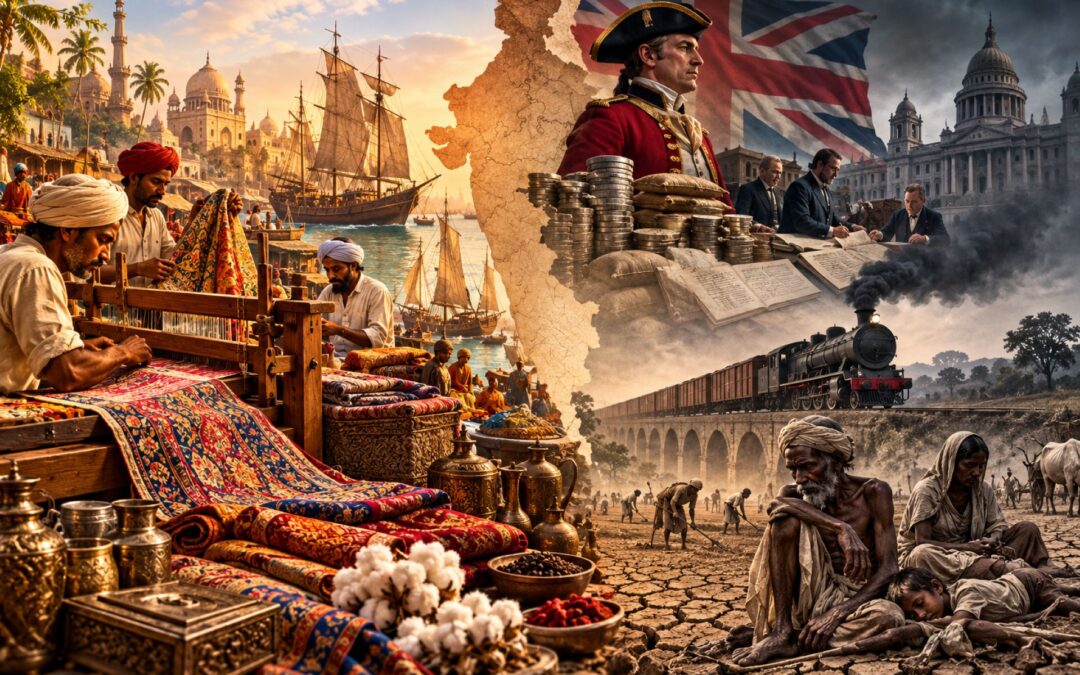
When the British East India Company established itself in India, it entered an economy that was already deeply connected to international trade. Indian cotton fabrics were sold across Asia, Africa, and Europe. Merchants financed complex commercial networks, shipbuilders supplied vessels for maritime trade, and skilled artisans produced goods valued far beyond the subcontinent. Britain initially participated in this economy as a customer, purchasing products that European consumers wanted.
By the time British colonial rule ended in 1947, India’s economic position had changed dramatically. Traditional manufacturing had lost much of its international dominance, agriculture supported an enormous share of the population, and widespread poverty remained a defining feature of everyday life. The country inherited railways, ports, universities, and administrative institutions, but also an economy shaped by nearly two centuries of foreign political control.
Explaining that transformation requires more than contrasting a prosperous past with an impoverished present. India was never uniformly wealthy, and its economic fortunes were affected by political fragmentation, technological change, environmental pressures, and competition from other countries. British rule nevertheless introduced a crucial difference: decisions about taxation, trade, public expenditure, and industrial development were increasingly made by authorities whose primary responsibilities lay outside India.
The economic impact of British rule therefore depended not simply on what Britain built or destroyed, but on how colonial power changed the relationship between those who produced wealth, those who controlled it, and those who benefited from it.
The Economy Britain Encountered Was Already Connected to the World
Before European colonial dominance, India occupied an important position in the commercial networks connecting the Indian Ocean, Central Asia, and the wider world. Its economy was geographically diverse, with agricultural regions supporting large populations and specialized manufacturing centres supplying domestic and international markets. Indian merchants traded with Southeast Asia, the Persian Gulf, East Africa, and European commercial intermediaries long before British territorial rule began.
Textiles were among India’s most internationally successful products. Bengal produced fine cotton muslins and silk fabrics, Gujarat supplied cotton textiles and commercial goods, and the Coromandel Coast became particularly important for painted and printed cotton cloth. These products were valued for their craftsmanship, colours, patterns, and durability. Indian fabrics served different markets, from relatively inexpensive cloth used in everyday trade to luxurious materials purchased by wealthy customers.
Manufacturing depended on more than the individual skill of weavers. Farmers cultivated cotton, spinners produced yarn, dyers and printers finished cloth, and merchants organized financing, procurement, storage, and transportation. Commercial intermediaries linked rural workshops to ports and international buyers. The resulting networks could coordinate production across substantial distances without relying on modern factories.
India also possessed important traditions of metalworking, shipbuilding, and other specialized crafts. Indian Ocean ports supported ship construction and repair, while various regions produced sophisticated iron and steel products. Agricultural production and inland commerce sustained the larger economic system, although prosperity varied enormously between communities, regions, and social groups.
Historical reconstructions suggest that the subcontinent accounted for a substantial portion of global economic activity before European industrialization. The Maddison Project’s historical economic estimates help researchers compare output across countries and centuries, but these figures require careful interpretation. Estimates of historical GDP are reconstructed from incomplete evidence, and India’s large population contributed significantly to its share of world production. A substantial national economy did not necessarily mean that ordinary Indians enjoyed high incomes or equal access to wealth.
India’s strength in international manufacturing was more clearly demonstrated by the demand for its products. European merchants repeatedly encountered Asian commercial systems in which Indian textiles were competitive and often highly desirable. Britain did not initially arrive with an overwhelming manufacturing advantage; its traders sought access to goods that Indian producers already made successfully.
The political environment nevertheless changed significantly during the eighteenth century. After the death of Mughal emperor Aurangzeb in 1707, imperial authority weakened as provincial governors and regional powers exercised increasing independence. Maratha expansion, competition among Indian states, and struggles over revenue and succession transformed the political landscape. The Persian ruler Nader Shah’s invasion and sack of Delhi in 1739 further demonstrated the vulnerability of central Mughal authority.
These developments did not instantly destroy Indian commerce or reduce the subcontinent to political helplessness. Bengal, Hyderabad, Awadh, Mysore, the Maratha states, and other powers maintained substantial military, fiscal, and commercial resources. However, the fragmentation of Mughal political authority created opportunities for foreign trading companies to participate in regional conflicts, negotiate preferential arrangements, and eventually acquire powers far beyond ordinary commerce.
How the East India Company Turned Trade Into Tax-Funded Power
The English East India Company received its royal charter in 1600 to pursue trade in Asian markets. During its early decades, the Company operated primarily as a commercial organization and depended on the permission of powerful Asian governments. Its representatives established trading relationships with Indian merchants and officials, gradually developing centres at Surat, Madras, Bombay, and Calcutta.
For much of the seventeenth century, the Mughal Empire possessed considerably greater military and political resources than the English Company. European traders could negotiate privileges, maintain warehouses, and develop fortified settlements, but they could not simply dictate terms to India’s rulers. Their position changed through a combination of expanding commercial resources, military organization, diplomatic alliances, and growing involvement in Indian political disputes.
European rivalry contributed to this process. British and French companies supported competing rulers and political factions in parts of southern India, seeking commercial privileges and strategic advantages. Indian rulers also employed European military specialists and developed their own armies using changing military techniques. Colonial expansion emerged from these interactions rather than from a straightforward confrontation between a technologically advanced Britain and a defenseless India.
The decisive transformation occurred in Bengal, one of the subcontinent’s richest commercial and agricultural regions. The Company’s conflict with Nawab Siraj ud-Daulah culminated in the Battle of Plassey in 1757. Robert Clive’s victory depended not merely on battlefield performance but also on arrangements with influential members of the nawab’s political establishment, including Mir Jafar.
Plassey gave the Company substantial influence over Bengal’s government and access to large financial payments. Yet it did not immediately establish complete Company sovereignty. The more consequential institutional change followed the Battle of Buxar in 1764, when Company forces defeated a coalition involving the Mughal emperor, the nawab of Awadh, and Bengal’s displaced ruler. In 1765, the Company received the Diwani rights to collect revenue in Bengal, Bihar, and Orissa.
The significance of this arrangement was profound. Previously, the Company had largely needed to bring commercial resources into India to purchase Indian goods. It could now use revenues collected from Indian subjects to pay for purchases, finance administration, and support military operations. The distinction between earning money through trade and exercising power over the people who generated that money became increasingly blurred.
Revenue also financed expansion. Company armies consisted largely of Indian soldiers serving under British command, while Indian merchants, financiers, and political allies supplied essential resources. Victories produced additional territories and revenue streams, which in turn supported further military campaigns. The corporation had created a system in which conquest could help finance more conquest.
This process also transformed how European companies converted commercial privileges into territorial rule. British power grew through alliances, treaties, military intervention, financial pressure, and the exploitation of rivalries among Indian political authorities. Mysore and the Maratha Confederacy resisted Company expansion for decades, demonstrating that British dominance was neither automatic nor uncontested.
Parliament increasingly intervened as the Company developed into a territorial government. The Regulating Act of 1773 and Pitt’s India Act of 1784 expanded political supervision, while the rebellion of 1857 eventually led to the transfer of Company territories to the British Crown in 1858. The institutional form of colonial government changed, but India remained subject to an imperial political system in which ultimate authority rested outside the country.
This transfer of economic and political power was the foundation of the colonial transformation. British officials could influence what Indian producers sold, how agricultural revenue was collected, which industries received protection, and how public resources were spent. Those powers affected the fortunes of entire communities.
Why Indian Textiles Lost Their Global Dominance
Indian textiles provide one of the clearest examples of how colonial power and international industrial competition reshaped the economy. Before British territorial dominance, Indian cotton fabrics enjoyed an established international reputation. Their success rested on highly developed manufacturing skills, commercial specialization, and networks connecting producers with distant buyers.
European consumers purchased Indian calicoes, chintzes, muslins, and other fabrics for their colours, designs, quality, and often competitive prices. British manufacturers initially struggled against these imports. English restrictions on certain imported cotton textiles during the early eighteenth century reflected the political pressure exerted by domestic textile interests that wanted protection from foreign competition.
As the Company’s influence expanded in Bengal, however, its relationship with Indian producers changed. Company officials increasingly exercised commercial authority backed by political power, allowing them to influence contracts, prices, and access to markets. Merchants and weavers who had previously negotiated among competing buyers could find themselves dealing with an organization capable of using administrative pressure to enforce its interests.
Historian Om Prakash’s research on the shift from negotiation to coercion in Indian textile manufacturing documents important changes in eighteenth-century Bengal. Company procurement practices increasingly imposed obligations on producers and reduced some of the bargaining advantages they had previously enjoyed. However, coercion did not mean that every weaving community immediately disappeared or that all manufacturing was destroyed at the same moment.
The Company’s commercial agents could use advances and contracts to secure future deliveries, while disputes over prices, competing buyers, and contractual obligations became entangled with the authorities supporting Company trade. These arrangements placed particular pressure on producers who depended on advances to purchase materials and maintain their livelihoods. The effects varied across regions and periods, making it misleading to describe every Indian weaver as experiencing precisely the same conditions.
An additional transformation came from Britain’s Industrial Revolution. Mechanized spinning and weaving dramatically increased British textile output, while coal, steam power, and factory organization altered production costs. British manufacturers gained the capacity to produce large quantities of cloth at prices that traditional producers increasingly struggled to match in important markets.
Industrialization interacted with the commercial inequalities created by colonial rule. Britain had historically protected parts of its domestic textile industry against Indian competition, while its growing manufacturing power enabled British goods to penetrate Indian markets. Indian textile producers were consequently affected by both changes in market access and the expansion of mechanized foreign production.
The result was a major reversal in international trade. India had previously been an important exporter of finished cotton textiles; during the nineteenth century, it increasingly imported machine-made British cloth. At the same time, Indian cotton and other raw materials supplied manufacturing systems in Britain and elsewhere. The movement from exporting valuable finished goods toward importing manufactured products altered employment opportunities and the distribution of commercial profits.
The scale of this transformation was substantial. Economic historians David Clingingsmith and Jeffrey Williamson estimate that India’s share of world industrial output declined from approximately 25% in 1750 to around 2% by 1900. Their research emphasizes the multiple causes of Indian deindustrialization, including the decline of Mughal political authority, changing agricultural conditions, Britain’s industrial ascent, and shifts in international competitiveness.
These numbers should not be mistaken for India’s share of world GDP or textile trade specifically. Nor do they demonstrate that British colonial policy alone produced the entire decline. They describe a long-term transformation in industrial production during a period when global manufacturing became increasingly concentrated in mechanizing economies.
The consequences were especially serious for communities dependent on traditional handicraft employment. A weaving household that lost commercial orders could not necessarily transfer its skills or capital into modern manufacturing. Some artisans moved into other occupations, while many households became more dependent on agriculture or supplemented farming with lower-paid forms of work.
This increased dependence on land contributed to broader economic vulnerability. Agricultural communities already faced risks from rainfall, crop prices, debt, and official revenue demands. When alternative manufacturing livelihoods contracted, families often possessed fewer ways to compensate for agricultural distress.
Yet the transformation was not uniform. Certain specialist crafts survived, weaving continued in many regions, and Indian entrepreneurs eventually established modern textile enterprises of their own. The important historical distinction is between a substantial decline in the international competitiveness and employment of traditional manufacturing and the much stronger claim that industrial activity simply ceased across India.
Britain’s industrial rise changed the global economy, but colonial political power influenced how India experienced that change. Indian producers confronted technological competition within a system where many of the most consequential economic decisions were controlled by a foreign government.
Shipbuilding, Steel, and the Industries That Did Not Simply Disappear
Textiles were not the only important part of India’s manufacturing economy. The subcontinent also possessed established traditions of shipbuilding, metalworking, and specialized craft production. These industries reveal both the depth of precolonial expertise and the limitations of describing British rule as the complete destruction of Indian technical knowledge.
Indian shipbuilders had long worked with materials and construction techniques suited to commercial navigation across the Indian Ocean. Ports on the western and eastern coasts supported the construction and repair of vessels used by merchants, regional governments, and maritime trading communities. Indian teak was particularly valued for shipbuilding because of its durability and resistance to deterioration.
During the colonial period, Bombay developed into an important shipbuilding centre. The Wadia family became closely associated with the construction of major vessels, including ships built for British naval service. Research into the Wadia family’s shipbuilding activities under colonial rule demonstrates that Indian shipbuilding expertise continued to serve demanding maritime requirements even after Britain had established substantial political influence.
This history complicates the idea that colonial rule immediately extinguished indigenous industry. Indian craftsmen could remain technically capable and commercially valuable while operating within an economic system increasingly controlled by imperial interests. The continuation of production did not necessarily imply that Indian firms or communities possessed equal control over contracts, financing, naval policy, or the profits generated by their work.
India also had a distinguished history of steelmaking, particularly the production of crucible steel commonly known as wootz. Such techniques produced high-carbon steel valued in wider commercial networks and associated with some traditions of fine blade manufacture. Their existence shows that sophisticated metallurgical expertise developed in India independently of modern European industrial methods.
However, preindustrial expertise should not be confused with the ability to compete automatically against nineteenth-century steel industries using new machinery, larger furnaces, and different production processes. Changes in technology, investment requirements, transport, and demand affected traditional metalworking. Colonial conditions shaped these changes, but they cannot all be reduced to an intentional policy of eliminating every Indian craft.
Modern industries also emerged during British rule. Indian-owned cotton mills developed in cities such as Bombay and Ahmedabad, while jute manufacturing expanded in Bengal. These enterprises did not compensate evenly for the decline of older manufacturing livelihoods, but their growth demonstrates that industrialization in colonial India was constrained and uneven rather than entirely absent.
The more accurate account is therefore one of changing industrial structure and unequal opportunity. Established industries lost markets, others adapted, and new enterprises emerged within a system whose major financial and political institutions reflected imperial priorities.
Land Revenue, Poverty, and the Drain of Wealth
Agriculture remained the principal livelihood for much of India’s population throughout the colonial period. Control over agricultural revenue was therefore central to British economic power. The East India Company had become a territorial ruler partly because it acquired the authority to collect taxes from some of the subcontinent’s most productive regions.
Land revenue supported administration, armies, territorial expansion, and other governmental obligations. For agricultural households, however, taxation could represent a substantial claim on income that was already vulnerable to uncertain harvests and changing market prices. The impact depended on the level and timing of assessments, local land rights, the availability of credit, and the ability of cultivators to sell produce at satisfactory prices.
British administrators developed several major systems of land-revenue collection. Under the Permanent Settlement introduced in Bengal in 1793, recognized landholders known as zamindars were made responsible for fixed payments to the colonial government. The arrangement gave certain landholding interests important legal rights while exposing cultivators and tenants to relationships that could involve rent demands, insecurity, and unequal bargaining power.
Elsewhere, ryotwari arrangements assessed revenue more directly from individual cultivators, while mahalwari systems operated through villages, estates, or other collective revenue units. These approaches differed in their administration and legal consequences, but all sought to organize agricultural production within a framework capable of supplying government revenue.
No single percentage accurately describes the tax burden across the entire subcontinent and the whole colonial period. Assessments, collection practices, agricultural conditions, and the proportion of produce or income claimed by the state varied considerably. What mattered was how these demands interacted with existing inequalities, rural indebtedness, and the ability of households to withstand economic shocks.
Revenue pressure could encourage cultivators to borrow money, sell produce under unfavourable conditions, or prioritize crops that generated cash. Commercial agriculture also expanded through both market demand and various forms of pressure. Cotton, indigo, opium, tea, jute, and other commodities connected Indian production more closely to international markets, but these connections did not guarantee that cultivators received a proportionate share of the resulting commercial benefits.
Agricultural exports could generate income for merchants, landholders, and some producers while leaving poorer households exposed to volatile prices and limited purchasing power. Investment in irrigation, productivity, credit, and rural infrastructure remained uneven. The economy could become commercially integrated without delivering widespread improvements in agricultural living standards.
The political importance of taxation also extended beyond the countryside. Colonial revenues supported expenditures outside India as well as obligations within it. This formed the basis of the nationalist economic criticism commonly described as the drain of wealth.
Dadabhai Naoroji, one of the earliest major Indian economic critics of British rule, argued that substantial resources were transferred from India without equivalent benefits returning to the Indian population. His analysis drew attention to administrative salaries, pensions, remittances, military expenses, and payments connected to the operation of colonial government. These transfers were especially controversial because Indians had limited authority over the decisions that generated them.
The financial arrangements were more complicated than the physical movement of coins or valuable goods. Colonial India often exported more merchandise than it imported, but the resulting foreign earnings could be used to meet obligations owed abroad. Payments administered through the Secretary of State for India, including the financial instruments known as Council Bills, helped connect Indian trade receipts with expenditures in Britain.
The study of Council Bills and the financing of the Raj is important because it reveals how export earnings, government finance, and overseas payments were linked. A positive merchandise trade balance did not necessarily mean that an equivalent amount of foreign purchasing power remained available for investment within India.
The so-called Home Charges included several categories of expenditure undertaken on behalf of the Indian administration in Britain. These could include pensions, administrative expenses, debt-service obligations, military-related payments, and purchases. Their economic significance depended on the nature of the obligations, the services received, and the extent to which the spending served Indian needs rather than imperial objectives.
Some international payments genuinely purchased equipment, services, or investment capital. Others reflected the costs of maintaining a foreign ruling establishment or obligations that Indians had little power to question. Recognizing this distinction is essential: not every payment abroad was automatically uncompensated extraction, but the existence of legitimate transactions does not erase the fundamental inequality of colonial fiscal authority.
Debate over the total scale of the drain continues. Economist Utsa Patnaik has advanced a retrospective estimate of approximately $45 trillion in wealth transferred from India under British colonial rule. Her calculation focuses on colonial export surpluses and applies a compounded rate of return to estimate their cumulative present-value equivalent, rather than simply adding the nominal sums transferred at the time.
Patnaik explains the argument behind her calculation of colonial extraction, emphasizing how Indian export earnings were appropriated through financial arrangements associated with imperial control. The estimate provides one interpretation of the enormous long-term opportunity cost of resources leaving the colonial economy.
Economic historian Tirthankar Roy challenges the assumptions behind such multitrillion-dollar valuations. In his critique of modern colonial-drain calculations, he questions whether all the relevant payments should be treated as transfers without economic value and whether compounding them produces a meaningful measure of colonial losses.
The disagreement matters because a precise modern-dollar estimate can create a false impression of certainty. A compounded hypothetical value is not the same as an independently audited sum of money physically removed from India. Different assumptions about prices, trade balances, services, investment, and returns can produce substantially different conclusions.
Nevertheless, the underlying political-economic question remains important even without a universally accepted total. Colonial India’s public finances were directed through institutions in which ultimate authority belonged to Britain. Indian revenue and trade earnings could support imperial military operations, overseas administrative expenses, and financial obligations shaped by priorities that did not necessarily correspond to those of the Indian population.
The drain-of-wealth argument was therefore about more than the amount transferred. It concerned the loss of control over economic resources and the possibility that money, labour, and productive capacity could have supported different forms of domestic development under a government accountable to Indian society.
The Railways: Built for Empire, Useful to Indians Too
Railways remain among the most visible physical legacies of British colonial rule. The first passenger railway in India began operating between Bombay and Thane in 1853, and the network expanded substantially during the following decades. By connecting distant regions, railways changed the movement of people, goods, information, and military forces across the subcontinent.
Their development was closely connected to imperial priorities. British authorities needed reliable transportation for troops and military supplies, while merchants and administrators sought routes connecting agricultural and mineral-producing regions with major commercial centres and ports. Railways could therefore strengthen both the economic reach of colonial commerce and the government’s ability to respond rapidly to political disturbances.
Financing also reflected the structure of colonial power. Early railway companies received guarantees of returns on invested capital, with the Indian government assuming important financial obligations if operating revenues failed to meet the guaranteed amounts. The system helped attract investment from Britain, but it also exposed Indian public resources to risks associated with private railway financing.
Construction created additional demand for equipment and materials, some of which were purchased from British manufacturers. These arrangements could support British industrial employment and investors while using Indian revenue to finance the network. The distribution of benefits was consequently shaped not only by where railway lines were built but also by how they were funded and supplied.
Yet it would be equally misleading to conclude that the railways provided no economic benefit to India. Before extensive railway construction, long-distance movement of bulky goods depended heavily on roads, rivers, coastal shipping, and other transport arrangements with varying reliability and cost. Railways reduced travel times, improved connections between inland markets, and made the movement of some agricultural and manufactured goods considerably cheaper.
Lower transportation costs could help farmers reach more distant buyers, allow merchants to respond to changing regional prices, and reduce some of the economic isolation experienced by communities far from major commercial routes. Railways also enabled migration, pilgrimage, travel, and political organization on a scale that became increasingly important in Indian public life.
Economic historian Dave Donaldson’s research on the measurable effects of colonial railways on trade and real incomes finds substantial reductions in trade costs and increased trade associated with railway connections. His analysis also identifies improvements in real agricultural incomes in connected regions, demonstrating that infrastructure created benefits beyond the direct interests of imperial administrators.
These gains were not necessarily distributed equally. The location of railway lines, access to stations, differences between commercial crops and subsistence production, and disparities in landownership all affected who could take advantage of improved transportation. Some communities benefited directly from market integration, while others continued to face poverty and limited bargaining power.
Nor did better transportation automatically prevent famine. Railways made it physically easier to move grain between regions, but people could still go hungry when they lacked enough purchasing power to buy food. The ability to transport supplies and the ability of vulnerable households to obtain them were related but distinct economic problems.
The railways illustrate a central contradiction of colonial development. Infrastructure designed partly to advance imperial commerce and military control could also become economically valuable to the people governed by the empire. Recognizing those benefits does not require overlooking unequal financing arrangements or the political priorities behind construction.
Why Colonial Famines Became Catastrophes
Some of the most devastating consequences of economic vulnerability under British rule appeared during periods of food scarcity. Famines occurred in South Asia before colonial government, and India’s dependence on seasonal rainfall meant that agricultural shocks remained a persistent danger. Under British administration, however, major food crises exposed the interaction between environmental stress, market access, taxation, purchasing power, and government policy.
The Bengal famine of 1769–1770 unfolded during the early years of East India Company revenue control. Severe agricultural distress and food shortages struck a society whose political and fiscal institutions had recently undergone major disruption. Revenue demands, economic instability, and weaknesses in relief contributed to the catastrophe, although estimates of the death toll and the relative weight of its causes remain uncertain.
The famine revealed a fundamental problem with a government heavily dependent on agricultural revenue. When harvests failed, households lost both food and income, but the state’s fiscal requirements did not automatically disappear. Cultivators could be forced to sell assets, borrow money, or sacrifice future productive capacity to meet immediate obligations.
Over the nineteenth century, other major famines devastated different regions of India. The crisis of 1876–1878 affected substantial parts of southern and western India, while further severe famines occurred during the 1890s and around the turn of the twentieth century. These disasters killed enormous numbers of people and exposed the limits of colonial institutions claiming to provide stable and orderly administration.
Drought and crop failure were often major triggers. Changes in monsoon rainfall could reduce harvests across large areas, affecting both the food available for consumption and the earnings of households dependent on agriculture. When several regions experienced shortages simultaneously, the resulting pressure could overwhelm established commercial and social systems.
Research on the historical relationship between drought and major Indian famines finds that five of six major famines examined between 1870 and 1943 were associated with agricultural drought. This evidence makes it inappropriate to describe famine as entirely independent of environmental conditions. However, it does not establish that drought alone determined the scale of human suffering.
A failed harvest becomes a humanitarian catastrophe through the relationship between food availability and access to food. Landless labourers can lose employment when agricultural production contracts. Small cultivators may need to sell grain or other assets to repay debts and survive. Rising prices can then put food beyond the reach of families whose purchasing power has already collapsed.
Commercial markets can distribute food effectively under many conditions, but they do not guarantee that people without money will receive enough to eat. Food may remain available for purchase while vulnerable populations experience severe deprivation. Relief policy, public employment, grain distribution, price conditions, and the willingness of authorities to intervene can therefore determine whether scarcity results in widespread mortality.
Colonial government decisions were often influenced by assumptions about fiscal restraint, market functioning, and the appropriate limits of public responsibility. Officials did establish famine-relief arrangements and administrative procedures, particularly after the disasters of the late nineteenth century. Nevertheless, the existence of relief codes did not ensure that assistance reached every vulnerable community promptly or adequately.
The problem was not that British administrators never recognized famine. Rather, the effectiveness of their responses varied, while political and financial priorities could limit the scale or accessibility of assistance. A government might possess expanding administrative and transportation capabilities while failing to protect people whose access to food depended on public action.
The Bengal famine of 1943 demonstrated a particularly complicated form of food insecurity. It occurred during the Second World War, when Japanese expansion in Southeast Asia had disrupted regional trade and eliminated rice imports from Burma that had previously supplied important markets. Wartime procurement, inflation, transport problems, speculation, and disruptions to agricultural production further destabilized food availability and prices.
Bengal’s agricultural conditions were affected by multiple shocks, but the famine cannot be adequately explained as a straightforward consequence of drought. Food access deteriorated sharply for groups whose wages and earnings failed to keep pace with rising prices. Rural labourers, poorer households, and other vulnerable communities were particularly exposed.
Government decisions also mattered. Wartime priorities shaped transportation and procurement, while failures to contain price pressures or organize sufficiently effective relief aggravated the crisis. The Bengal famine demonstrated that food insecurity could emerge through the collapse of purchasing power and distribution arrangements even when the explanation was not simply an extreme reduction in total food production.
Historians commonly estimate that approximately two to three million people died as a result of the 1943 catastrophe, although its precise mortality remains disputed. These figures describe an immense human tragedy, but their uncertainty is important. Estimates compiled across multiple famines are even more difficult to compare because demographic records, affected territories, and methods of identifying famine deaths varied substantially.
Colonial rule did not create India’s dependence on monsoon agriculture, and it would be historically inaccurate to attribute every famine death directly to one administrative decision. Yet colonial policies influenced taxation, relief, market institutions, public expenditure, and the distribution of resources. Those decisions helped determine how environmental and wartime shocks translated into human suffering.
One of the most significant developments after independence was the disappearance of major famines despite the continuation of severe droughts and widespread poverty. This change reflected expanding public responses, agricultural development, food procurement and distribution arrangements, and greater political pressure on governments to prevent mass starvation.
The contrast demonstrates that vulnerability to drought does not make famine inevitable. Food crises emerge from the interaction of nature, economic organization, and political responsibility. Under colonial rule, millions of Indians experienced the consequences when those institutions failed to protect their access to food.
What Britain Left Behind in 1947—and What Changed After Independence
When India became independent in 1947, its economy contained both significant productive capabilities and deep structural weaknesses. Agriculture employed an enormous share of the population, average incomes were low, and substantial inequalities separated different regions and social groups. Industrialization had advanced in selected cities and industries, but it had not created employment or prosperity on a scale sufficient to transform living standards across the country.
The decline of traditional manufacturing was one part of that inheritance. India still possessed skilled workers, surviving craft industries, cotton mills, jute factories, commercial institutions, and entrepreneurial networks. However, the older relationship between extensive artisanal manufacturing and international markets had changed substantially, while the development of modern industry remained geographically concentrated.
Agriculture presented another difficult legacy. Rural households frequently faced insecure incomes, limited access to capital, unequal landholding arrangements, and vulnerability to environmental shocks. Although colonial governments had undertaken irrigation projects and other public works, investment in agricultural productivity and broader rural development had not eliminated persistent poverty.
Economic historian Bishnupriya Gupta’s work on India’s long-run transition out of the colonial economy emphasizes the importance of agricultural underinvestment and the country’s long period of relative stagnation. Her analysis also recognizes the emergence of modern industry under British rule, demonstrating why a complete account cannot treat colonial economic development as either uniformly destructive or consistently beneficial.
The infrastructure inherited in 1947 was substantial. Railways connected large parts of the country, ports supported international commerce, and legal, educational, and administrative institutions provided elements of a functioning modern state. These systems had often been developed to serve colonial needs, but independent India could adapt them to different political and economic purposes.
Their existence did not resolve the difficulties facing the new government. Low mass literacy, limited public-health provision, poverty, uneven infrastructure, and the economic disruption surrounding Partition created enormous challenges. Independence transferred political authority to Indian institutions, but it could not immediately reverse the consequences of long-term economic structures.
Indian governments consequently pursued policies intended to strengthen domestic production and increase economic self-reliance. Public investment, industrial planning, infrastructure development, and agricultural programmes reflected a belief that the state needed to play a major role in overcoming inherited weaknesses. These choices emerged from both criticism of colonial economic arrangements and debates among Indian policymakers about how development should proceed.
Agricultural change became especially important. Improvements in irrigation, crop varieties, procurement, and food distribution eventually helped reduce vulnerability to large-scale shortages. The Green Revolution, beginning in the later 1960s, contributed to major gains in foodgrain production in selected regions, although its benefits and environmental consequences were uneven.
These developments did not mean that poverty, inequality, or rural insecurity disappeared after 1947. Independent India’s economic history includes its own policy failures, institutional constraints, and difficult choices. Responsibility for those later outcomes cannot be assigned automatically to British rule, just as the achievements of independent India cannot be credited entirely to the institutions Britain left behind.
The most consequential change was political. Indian governments gained the authority to determine industrial policy, trade arrangements, taxation, and public expenditure through domestic institutions. Decisions could be contested by Indian citizens and political movements rather than ultimately imposed by an imperial government responsible to Britain.
The economic legacy of colonial rule therefore extended beyond the loss of particular industries or the transfer of particular sums abroad. It included the long-term structure of production, the concentration of public resources, the uneven development of infrastructure, and the limited opportunities available to much of the population. Independent India inherited those conditions while also acquiring the political capacity to change them.
British colonial rule reshaped India’s economy by placing an established commercial and manufacturing society within a system of foreign political authority. The East India Company’s acquisition of revenue rights transformed the relationship between trade and government, while later colonial institutions influenced manufacturing, agriculture, public finance, infrastructure, and responses to food insecurity.
That transformation cannot be explained entirely through deliberate destruction. British industrialization, global market competition, political instability, and environmental shocks all contributed to India’s changing economic fortunes. Indian industries survived and adapted, and certain colonial investments produced benefits that extended beyond their imperial purposes. None of those qualifications removes the importance of unequal political power in determining how resources were collected and used.
The central economic consequence of colonialism was that India did not exercise sovereign control over the decisions shaping its development. Wealth generated within the country could support imperial obligations, while the needs of Indian producers and households competed with priorities determined elsewhere. Independence did not instantly create prosperity, but it changed who possessed the authority to make those decisions. Understanding the economic impact of British rule requires recognizing both the material consequences of colonial policy and the deeper significance of a society losing control over its own economic future.
Last Updated on October 26, 2026 by Aseem Gupta