
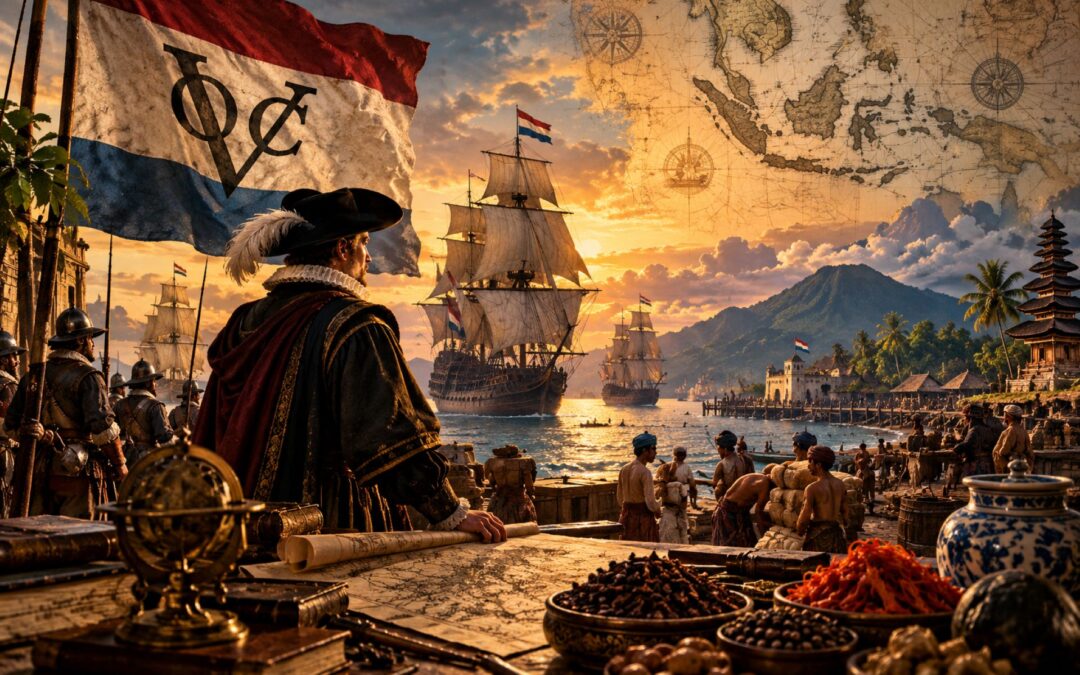
In Amsterdam, a neighbourhood east of the historic city centre contains streets named Balistraat, Sumatrastraat, and Borneostraat. Their names refer to islands thousands of kilometres away, in what is now Indonesia. They are reminders of a period when the Netherlands established an extraordinary commercial and colonial presence across Southeast Asia, transforming the fortunes of Dutch merchants and the lives of the people whose lands and trade networks came under their influence.
At the centre of that history stood the Dutch East India Company, commonly known by its Dutch abbreviation, VOC. Founded in 1602, it became one of the most powerful commercial organizations of the early modern world. It operated fleets of merchant ships and warships, maintained armed forces, negotiated treaties, established settlements, and governed territories. Its shares were traded in Amsterdam, while its officials exercised powers in Asia that were normally associated with sovereign governments.
The company helped pioneer forms of corporate organization that would influence later international business. Yet its commercial achievements depended not only on investment and maritime expertise but also on monopolies, warfare, coercion, and colonial exploitation. Its growing scale eventually produced financial and administrative burdens that it could no longer sustain.
How did a collection of Dutch trading ventures become an organization capable of exercising such enormous power, and why did that organization ultimately disappear? The answer begins before the VOC existed, when Dutch merchants found themselves increasingly excluded from one of Europe’s most profitable international trades.
Why the Dutch Went to the East Indies
During the sixteenth century, European demand for Asian goods created substantial opportunities for merchants willing to finance long-distance trade. Pepper, cloves, nutmeg, cinnamon, silk, porcelain, and other valuable commodities travelled through networks connecting producers, merchants, ports, and markets across Asia and Europe. These networks were already highly developed long before Dutch ships entered the Indian Ocean.
Portugal had established a particularly influential position in this trade. Following Vasco da Gama’s voyage to India in 1498, Portuguese merchants and military commanders developed trading posts, fortified settlements, and maritime routes extending from Africa to India and Southeast Asia. Their commercial activities gave European buyers greater access to Asian products while enabling Portuguese authorities to influence important sections of international commerce.
The Portuguese had also captured strategically valuable ports, including Malacca in 1511. Situated beside the strait connecting the Indian Ocean with the South China Sea, Malacca was a major centre for the exchange of Indian textiles, Chinese manufactured goods, and Southeast Asian spices. The Portuguese conquest of Malacca strengthened Portugal’s regional position, although it never gave Portuguese authorities complete control over Asian trade.
For much of the sixteenth century, Dutch merchants participated in this commercial system indirectly. The cities of Bruges and Antwerp were important European trading centres, attracting merchants from across the continent. Portuguese traders brought Asian commodities into European markets, where merchants from the Low Countries could acquire them for distribution elsewhere.
The political environment supporting these arrangements was increasingly unstable. The territories that now constitute the Netherlands, Belgium, and Luxembourg were ruled by the Spanish Habsburg monarchy. Religious divisions, political grievances, taxation disputes, and opposition to royal authority contributed to unrest, including the iconoclastic disturbances of 1566. The armed struggle commonly known as the Dutch Revolt or Eighty Years’ War is conventionally dated from 1568.
The conflict transformed the commercial position of the Dutch provinces. Following the Iberian Union of 1580, Portugal and Spain shared a monarch, further entangling Portuguese overseas commerce with Dutch-Spanish hostilities. Restrictions on Dutch access to Iberian trading networks and the disruption of established supply arrangements encouraged merchants in the emerging Dutch Republic to seek alternatives.
Amsterdam became increasingly important as merchants and capital moved northward, particularly after Spanish forces captured Antwerp in 1585. Its expanding commercial community had ships, financing networks, and experience in European maritime trade, but reaching Asian producers independently presented enormous difficulties. A voyage to Southeast Asia required navigational knowledge, reliable ships, provisions, skilled crews, and enough money to survive years without a commercial return.
The Portuguese guarded valuable information about their eastern routes. Dutch merchants nevertheless acquired navigational knowledge through European contacts, maritime experience, and published descriptions of Portuguese voyages. One influential source was the work of Jan Huygen van Linschoten, whose writings helped make information about Asian navigation and commerce more widely accessible.
In 1595, four Dutch ships departed under an expedition associated with Cornelis de Houtman. They reached Banten, an important pepper-trading port on Java, in 1596. The expedition encountered hostility, commercial difficulties, disease, and heavy losses among its crews before returning to the Netherlands in 1597.
Commercially, the voyage was disappointing. Its significance was that it demonstrated that Dutch merchants could reach Asian markets directly rather than depend entirely on established Portuguese networks.
Subsequent expeditions produced much more encouraging results. A fleet commanded by Jacob van Neck departed in 1598, established profitable trading relationships, and returned valuable cargoes to Europe. As the National Maritime Museum in Amsterdam explains in its history of the first Dutch voyages, these early expeditions helped establish the commercial possibilities that encouraged further Dutch involvement in Asian trade.
Success attracted investment, but it also produced a new problem. Independent Dutch merchant groups increasingly competed against one another in Asian markets, potentially driving up the prices they paid for commodities while increasing the quantities arriving in Europe. Competition that benefited individual merchants on one voyage could undermine their collective profitability over time.
The Dutch had demonstrated that they could participate in the Asian spice trade. Their next challenge was to organize that participation on a scale capable of competing with the Portuguese and other emerging European rivals.
What Made the VOC a New Kind of Company
Before the Dutch East India Company was founded, merchants organized overseas expeditions through several separate trading associations. These ventures, commonly described as the voorcompagnieën or predecessor companies, pooled funds to finance ships and acquire cargoes. Successful voyages generated returns for investors, but each expedition exposed its backers to substantial risks.
Ships could disappear in storms, crews could succumb to disease, and merchants could fail to obtain profitable cargoes. War, piracy, and hostile authorities could destroy years of investment. Spreading capital across multiple voyages reduced the consequences of any single failure, while coordinating operations offered the possibility of greater bargaining power in Asian markets.
The organization of these enterprises therefore became a matter of national commercial policy. Dutch authorities wanted an institution powerful enough to challenge Portuguese influence while preventing competing Dutch merchants from undermining one another.
On March 20, 1602, the States General of the Dutch Republic granted a charter to the Vereenigde Oostindische Compagnie, or United East India Company. The organization became widely known as the VOC.
Its creation united existing trading ventures into a single chartered enterprise with privileged access to Dutch commerce east of the Cape of Good Hope and west of the Strait of Magellan. The monopoly was granted by the Dutch government; it did not mean that all merchants, rulers, and communities across the Indian Ocean accepted Dutch control.
The company’s initial subscribed capital was approximately 6.5 million guilders, an enormous financial commitment for the period. Investors contributed money to a common enterprise rather than financing an isolated expedition that would be liquidated upon its completion. This arrangement gave the VOC access to a more durable financial base for ships, commercial establishments, employees, and military operations.
The company was organized through six regional chambers: Amsterdam, Zeeland, Delft, Rotterdam, Hoorn, and Enkhuizen. Each participated in company administration and commercial operations, while overall policy was coordinated by a governing board known as the Heeren XVII, or Seventeen Gentlemen.
These directors represented the chambers and supervised matters such as investment, shipping, appointments, and commercial strategy. Amsterdam was particularly influential because of its financial resources and importance in Dutch international trade, although the company’s governance also reflected the political and commercial interests of other cities.
Another important development concerned ownership. Investors received interests in the company that could be transferred to other buyers, creating opportunities to trade shares rather than wait for a completed voyage to recover their investment. This contributed to the development of organized securities trading in Amsterdam.
The company’s financial arrangements were not identical to those of a modern public corporation from the moment of its founding. The permanence of its capital, the treatment of shareholder rights, and the legal separation of corporate and investor obligations developed over time. Historical research into the formative years of the modern corporation shows how institutional changes during the VOC’s early decades helped establish features that later became important to corporate finance.
The VOC was therefore a major pioneer of modern corporate organization, although describing it as the world’s first corporation or first multinational enterprise without qualification overlooks older commercial institutions and earlier forms of collective investment.
Its most distinctive characteristic was not simply financial.
The company also possessed powers that went far beyond ordinary commerce. Under its charter, it could establish forts, negotiate agreements with foreign rulers, maintain military forces, conduct warfare, and administer certain overseas possessions. These activities operated within a framework of authority granted by the Dutch Republic, but geographical distance allowed company officials in Asia considerable practical independence.
The VOC consequently combined private investment with public power. Its shareholders expected financial returns, while the Dutch state benefited from an institution capable of expanding overseas influence without requiring the government to finance and administer every operation directly.
This arrangement created considerable advantages. A company that controlled shipping, maintained soldiers, and possessed fortified settlements could protect its operations and exert pressure on rivals in ways unavailable to an ordinary merchant. Yet it also created serious conflicts between commercial profit, political ambition, and the rights of the people affected by company decisions.
The VOC’s history cannot be understood as an early example of unrestricted free-market capitalism. Its business model depended on state-sponsored privileges and the ability to restrict competition, sometimes through military force.
Those powers became especially significant once the company established a permanent centre of operations in Southeast Asia.
How Batavia Became the Company’s Asian Capital
The VOC initially concentrated on building commercial relationships and establishing trading positions across the Indonesian archipelago. Banten, on the western coast of Java, was particularly important because it connected merchants to regional commerce and offered access to pepper.
European newcomers entered an environment governed by established Asian states and commercial authorities. Local rulers controlled ports, collected duties, negotiated agreements, and balanced competing foreign interests. The Dutch could obtain privileges through diplomacy and exchange, but their position remained vulnerable to political changes and competition from other merchants.
The VOC gradually sought stronger and more permanent positions. Trading posts provided warehouses, administrative facilities, and places where merchants could assemble cargoes, but the directors wanted greater security and more effective coordination across the company’s expanding network.
Jayakarta, situated near an important harbour on Java’s northwestern coast, became a focus of these ambitions. Dutch operations there developed during the early seventeenth century, but the city remained politically contested. Dutch authorities faced opposition from local rulers and competition involving English merchants and other regional interests.
Jan Pieterszoon Coen, who became Governor-General in 1619, pursued a particularly aggressive strategy. He believed that Dutch commercial dominance required firm control over strategic ports, shipping routes, and the production of valuable commodities.
In 1619, VOC forces seized and destroyed Jayakarta. The company established a new fortified colonial city, Batavia, on the site. Its creation involved the violent displacement and destruction of the existing settlement rather than the peaceful development of an unoccupied trading station.
Batavia became the principal headquarters of the VOC in Asia. It contained administrative buildings, warehouses, fortifications, docks, and commercial facilities from which company officials directed a geographically dispersed network of settlements and trading posts.
The Governor-General and Council in Batavia exercised authority over many of the company’s Asian operations. They implemented commercial policies, supervised regional officials, coordinated military activities, and negotiated with local rulers. The directors in the Netherlands retained ultimate corporate authority, but communication between Amsterdam and Batavia required long sea voyages, making immediate supervision impossible.
This geographical separation gave colonial administrators substantial freedom to interpret instructions and respond to local circumstances. Their decisions could involve diplomatic agreements, military campaigns, commercial restrictions, and the movement of labour and supplies across the region.
Batavia also became a centre of Asian migration and economic activity. Chinese merchants, Indonesian communities, South Asian traders, Europeans, and enslaved people contributed to its development. The city depended on these diverse populations even as colonial authorities imposed unequal legal and social arrangements upon them.
The Indonesian National Archives’ account of the VOC and its records illustrates the breadth of the company’s administration and the importance of Batavia to its overseas operations.
The establishment of Batavia did not give the VOC control over all the territories that would later become Indonesia. Numerous rulers and political communities retained substantial independence, and Dutch influence varied greatly across the archipelago.
What Batavia provided was a durable centre from which the company could coordinate commerce, project military power, and pursue exclusive control over profitable commodities.
That pursuit became especially destructive in the Spice Islands.
How the VOC Used Force to Control the Spice Islands
The Indonesian archipelago contained some of the world’s most valuable spice-producing regions. Cloves were closely associated with parts of the Maluku Islands, particularly Ternate, Tidore, and neighbouring islands, while the Banda Islands were the principal historic source of nutmeg and mace.
These commodities commanded high prices in European markets because they were desirable, transportable, and produced in geographically concentrated areas. Their commercial value attracted merchants from across Asia long before Europeans arrived.
Local producers were not isolated communities waiting to be incorporated into international trade. They participated in established systems of exchange, selling valuable spices to merchants who brought textiles, rice, metals, and other goods from different parts of the region.
The VOC wanted to transform those flexible commercial relationships into exclusive supply arrangements. Rather than merely purchasing spices in competitive markets, company officials sought agreements requiring producers and rulers to sell designated commodities to the Dutch on terms favourable to the company.
Such agreements could help secure predictable supplies and restrict the ability of English, Portuguese, and Asian competitors to obtain the same products. However, the company frequently encountered resistance because exclusive contracts threatened existing trading relationships and local commercial autonomy.
The distinction between a legal monopoly granted in the Netherlands and an enforceable monopoly in Asia was fundamental. Dutch authorities could grant the VOC exclusive rights against competing Dutch merchants, but they could not simply declare that Asian producers and governments were obliged to abandon their established commercial systems.
To establish effective control, the company increasingly relied on fortifications, naval blockades, political pressure, military campaigns, and forced restrictions on production and trade.
The consequences were devastating in the Banda Islands.
During the early seventeenth century, Dutch officials sought exclusive access to the islands’ nutmeg and mace. Bandanese communities continued trading with other merchants, including Asian and English buyers, challenging the VOC’s attempts to enforce a monopoly.
Jan Pieterszoon Coen responded with a campaign of extraordinary violence in 1621. VOC forces attacked the islands, killed inhabitants, executed local leaders, and drove many survivors from their homes. Large numbers of people were enslaved, displaced, or forced to flee.
The population of the Banda Islands was devastated. The scale and circumstances of the killings have led historians to examine the campaign as an episode of colonial mass violence and genocide.
As documented in the Amsterdam City Archives’ historical account of the VOC and the Banda Islands, Dutch conquest was followed by the reorganization of nutmeg production under a colonial plantation system.
The company distributed plantations, known as perken, to European settlers and managers who operated under VOC supervision. Labour was supplied substantially through enslavement, including people brought from other parts of Asia. Nutmeg cultivation was therefore transformed from production undertaken by local communities participating in regional trade into a tightly controlled enterprise serving Dutch commercial interests.
The Banda campaign demonstrates how monopoly enforcement could involve more than taking control of an existing market. The VOC sought to reorganize who could produce a commodity, who could trade it, how much could be sold, and who would receive the resulting profits.
Its commercial objectives were inseparable from the political violence required to enforce those arrangements.
The VOC employed coercive measures elsewhere in the spice-producing regions as well. Company authorities attempted to restrict unauthorized cultivation and trading, negotiated alliances with local rulers, and used military pressure against communities that resisted their demands.
These policies did not establish effortless Dutch supremacy. Indigenous rulers and merchants continued to negotiate, evade restrictions, resist company forces, and exploit rivalries among European competitors. Dutch power expanded unevenly, frequently depending on alliances and the ability to concentrate military resources against particular opponents.
The English East India Company became one of the VOC’s most important European rivals.
Founded in 1600, the English East India Company pursued access to many of the same Asian markets. During its early decades, it established commercial positions in parts of Southeast Asia, where English merchants challenged Dutch efforts to control valuable spice-producing territories.
Commercial rivalry sometimes escalated into armed conflict and diplomatic confrontation.
One particularly notorious episode occurred on Ambon in 1623. VOC authorities accused a group of English traders and Asian soldiers of participating in a conspiracy to seize a Dutch fort. Several defendants were tortured during the investigation, and the authorities executed English, Japanese, and a Portuguese-linked defendant.
The proceedings became known in England as the Amboyna Massacre. English accounts portrayed the executions as evidence of Dutch cruelty and commercial aggression, while Dutch authorities defended the action as a response to an alleged conspiracy.
The validity of the accusations and the conduct of the proceedings have remained subjects of historical scrutiny. What is clear is that the incident seriously damaged Anglo-Dutch relations and became a powerful symbol in later disputes over Asian commerce.
The Amboyna affair did not, by itself, cause the First Anglo-Dutch War of 1652. That conflict emerged from broader maritime competition, commercial restrictions, political disputes, and rivalry between two expanding naval powers. Nevertheless, the memory of Amboyna helped sustain hostility between their trading interests.
The VOC also competed with the Portuguese, whose early dominance of Asian maritime commerce was weakening. Dutch forces captured important Portuguese positions, including Malacca in 1641, with the assistance of regional allies. These victories helped redirect significant sections of European-controlled commerce toward Dutch networks.
Even at the height of its power, the VOC never controlled every trader, port, or production centre across Southeast Asia. Its influence varied according to geography, political alliances, military resources, and the willingness or ability of local communities to resist its demands.
The company’s extraordinary commercial position was therefore not simply the result of being more efficient than its competitors. It was built through a combination of financial organization, diplomatic negotiation, naval strength, and the capacity to exercise violence against producers and rival merchants.
Those coercive monopolies secured valuable commodities, but the company’s wealth also depended on a much broader network of trade.
The Asian Trade Network That Made the VOC Rich
The familiar image of the VOC is that of a fleet carrying spices from Indonesia to Europe. Although this trade was central to its early ambitions, it captures only part of how the company operated.
The VOC developed an extensive network linking commercial centres across East Asia, Southeast Asia, South Asia, and the Indian Ocean. Its ships exchanged goods between Asian ports, sometimes completing multiple transactions without the merchandise ever travelling to Europe.
This system was necessary because European merchants could not assume that their own manufactured products would be desirable in every Asian market. Indian, Chinese, Japanese, and Southeast Asian producers supplied goods that were already valued internationally, while Asian trading communities possessed sophisticated commercial and financial networks.
The company therefore needed to acquire goods or purchasing power that could be exchanged for the commodities it wanted.
Japan became an important source of precious metals, particularly silver and copper. The VOC acquired these metals through trade and used them to purchase valuable products elsewhere in Asia. Restrictions and changing Japanese policies later affected the availability of these resources and the conditions under which the company could conduct business.
Indian textiles were another indispensable component of the network. Cotton fabrics from regions such as the Coromandel Coast and Bengal were valued for their quality, variety, and usefulness. Dutch merchants purchased these textiles for sale in Europe, but many were also exchanged within Asian markets.
A shipment of Indian cloth, for example, could be carried to Southeast Asia and exchanged for spices. Precious metals obtained through trade with Japan could be used to acquire Chinese silk or other goods, which might then enter further regional transactions.
Such exchanges reduced the company’s dependence on shipping every product directly between Amsterdam and its place of origin. The VOC could exploit commercial differences between ports and markets while using Batavia to coordinate movements of goods, ships, and financial resources.
The company’s records provide evidence of the complexity of this activity. The Huygens Institute’s Bookkeeper-General Batavia project documents the commercial administration of the VOC’s Asian network and helps historians reconstruct the movement of commodities between trading centres.
These records reveal a commercial world extending well beyond a simple Europe-to-Indonesia shipping route.
The company’s Indian operations included factories and commercial establishments along important coastal trading regions. In Sri Lanka, Dutch expansion brought control over significant territories and valuable cinnamon-producing areas, although local rulers and communities continued to contest Dutch authority.
China supplied silk, porcelain, and other desirable products, while trade with Japan developed under especially restrictive political conditions.
The VOC initially maintained a Japanese trading position at Hirado. In 1641, Dutch traders were required to move to Dejima, an artificial island in Nagasaki harbour that had originally been developed for Portuguese commerce.
Japan’s Tokugawa authorities tightly regulated overseas contacts, and Dejima became the principal permitted location for Dutch trade. The Dutch obtained access that was denied to most other Europeans, but this access depended on Japanese political decisions rather than Dutch territorial power.
Trade at Dejima continued after the VOC ceased to exist, so the later history of Dutch-Japanese commerce should not be treated entirely as an achievement of the company itself.
Across Asia, company merchants acquired spices, textiles, porcelain, silk, tea, coffee, and other products. Cargoes selected for European markets could generate valuable returns, while intra-Asian exchanges supported the company’s broader commercial infrastructure.
This complexity was one reason the VOC became such a formidable organization. It combined access to European investors with commercial positions across multiple Asian economies and the ability to coordinate shipping on an extraordinary scale.
During its seventeenth-century expansion, the company employed tens of thousands of people and operated substantial fleets. Its ships required crews, provisions, navigators, shipwrights, accountants, administrators, and armed protection. The company also depended on large numbers of workers, merchants, and intermediaries outside its formal European employment structure.
Successful operations generated substantial revenues and enabled distributions to shareholders. Contemporary company accounts record periods of exceptionally high dividends, but these payments fluctuated and should not be confused with a dependable annual return of 40 percent.
Nor do enormous revenues or fleet sizes establish a reliable modern monetary valuation of the company. Comparisons claiming that the VOC was worth a particular number of present-day trillions often combine unlike measures or apply questionable methods to historical share prices.
Its historical importance is more securely established through the scale of its operations, the sophistication of its financial organization, and its influence on international commerce.
Yet the same network required costly infrastructure and constant protection. The company maintained ships and forts, paid officials and soldiers, administered settlements, and frequently used military power to defend its commercial privileges.
These commitments initially helped sustain its dominance. Over time, however, they also made the company increasingly expensive to operate.
How Far VOC Ships and Settlements Reached
The VOC’s influence extended beyond the principal Asian markets in which it purchased and sold goods. Its voyages supported settlements, exploratory expeditions, and maritime connections across several oceans.
One important challenge was the distance between Europe and Asia. Ships spent months at sea, and crews faced illness, shortages of drinking water, storms, accidents, and difficult sailing conditions. Establishing reliable places to obtain supplies could reduce some of these dangers and improve the continuity of long-distance commerce.
In 1652, a VOC expedition under Jan van Riebeeck established a provisioning station near the southern tip of Africa, at what would become Cape Town.
The original purpose of the settlement was to supply passing ships with fresh food, water, and other necessities. Its position along the maritime route between the Netherlands and Asia made it strategically valuable to the company.
The settlement gradually expanded beyond its initial provisioning function. European settlers established farms, cultivated land, and developed commercial activities, bringing them into conflict with indigenous communities, particularly Khoikhoi pastoralists.
Colonial expansion involved the appropriation of land, disruption of indigenous livelihoods, and the development of systems of forced labour and slavery. Enslaved people were brought to the Cape from places including Madagascar, East Africa, India, and Southeast Asia.
As the history of the VOC in South Africa demonstrates, the company’s attempt to support maritime trade helped create a colonial settlement with consequences extending far beyond the original requirements of passing ships.
Exploration was another important dimension of the VOC’s overseas activity.
In 1609, the company commissioned the English navigator Henry Hudson to investigate the possibility of reaching Asia through a northeastern passage. European merchants hoped that alternative routes might provide access to valuable markets while avoiding established competitors.
Hudson encountered ice that prevented his intended passage through Arctic waters. He subsequently sailed westward and explored parts of the North American coastline, including the river that now bears his name.
His voyage contributed to Dutch geographical knowledge and commercial interest in northeastern North America. However, the later establishment of New Netherland and New Amsterdam should not be attributed directly to the VOC.
Those colonial activities became principally associated with the Dutch West India Company, established in 1621 as a separate organization. New Amsterdam would eventually pass into English hands and develop into New York.
The distinction matters because Dutch overseas expansion involved multiple companies, institutions, and branches of government, rather than a single corporation controlling every Dutch settlement around the world.
VOC expeditions also contributed to European mapping of Australia and the surrounding region.
In 1606, Willem Janszoon, commanding the Duyfken, reached part of the Australian coastline during a voyage associated with the company’s Asian operations. Later Dutch expeditions charted additional coastal regions, sometimes as a consequence of navigational errors, commercial voyages, or attempts to identify new routes.
Abel Tasman undertook important exploratory voyages during the 1640s, reaching areas associated with present-day Tasmania and New Zealand. His expeditions expanded Dutch geographical knowledge of the southwestern Pacific.
These encounters were not the discovery of lands previously unknown to humanity. Indigenous populations had inhabited Australia, Tasmania, and New Zealand long before European ships arrived. The voyages were significant for European maritime mapping and commercial exploration, not because the regions lacked existing inhabitants or histories.
Nor did charting coastlines automatically lead to Dutch political control. The Netherlands did not establish colonial rule over Australia or New Zealand through these VOC expeditions.
Together, the Cape settlement, Hudson’s voyage, and Pacific exploration illustrate the geographical scale of Dutch maritime ambition. They also demonstrate why it is necessary to distinguish commercial infrastructure, exploratory activity, European settlement, and the exercise of colonial sovereignty.
The VOC helped connect distant regions through navigation and commerce, but its operations produced different consequences in different places. Some became permanent centres of colonial administration, while others remained trading stations, mapped coastlines, or routes of exploration.
Maintaining such a dispersed system demanded enormous organizational resources. That growing complexity became increasingly difficult to sustain as the company’s commercial environment changed.
Why the VOC’s Business Model Started to Fail
By the second half of the seventeenth century, the VOC had established a formidable position in Asian commerce. Its maritime network, fortified settlements, access to capital, and control over certain spice-producing regions supported large-scale trading operations.
Yet commercial dominance did not guarantee permanent profitability.
The markets in which the company operated were changing. European consumption evolved, competitors expanded their operations, and the economic importance of particular products shifted. The early VOC had concentrated heavily on valuable spices that could produce substantial returns from relatively limited quantities of cargo.
Over time, the company increasingly participated in commerce involving textiles, tea, coffee, sugar, and other commodities. These products could generate substantial revenues, but expanding their trade often required moving larger volumes and maintaining more extensive purchasing and distribution networks.
Higher sales did not necessarily mean proportionately higher profits.
A company might increase the quantity of goods transported while also incurring greater expenses for ships, crews, warehouses, commercial agents, and financing. If margins became narrower, an expansion in total trading activity could still produce disappointing returns on the additional capital committed.
Competition placed further pressure on the VOC’s commercial position. The English East India Company expanded its operations and developed substantial trading connections in India and elsewhere in Asia. Other European enterprises also sought opportunities in markets that had previously been especially profitable for the Dutch.
The VOC sometimes attempted to defend its position by increasing supplies of particular commodities, reducing market prices, or using its established commercial infrastructure to compete aggressively. Such strategies could make life difficult for rivals, but they also demonstrated that the company’s position depended on continuing efforts to manage competition and pricing.
The English were not simply passive participants in these contests. Their commercial organization evolved, their maritime power increased, and their relationships with Asian merchants and political authorities created opportunities for expansion.
Japan presented another difficulty. The VOC had benefited from access to Japanese precious metals, but restrictions on their export and changes in Japanese monetary and commercial policy complicated the company’s Asian trading arrangements.
The company consequently needed alternative sources of purchasing power and financing to sustain its commercial network.
These pressures encouraged borrowing and complicated financial management. Merchants needed funds to acquire goods before those goods could be shipped to Europe and sold. Long travel times meant that large amounts of capital could remain tied up in inventories, ships, and overseas operations for extended periods.
At the same time, the VOC’s political and military commitments remained expensive.
Fortifications required maintenance, soldiers had to be paid, warships needed equipment, and administrative institutions had to be supported. Colonial settlements depended on systems of provisioning and labour that could become costly and difficult to supervise.
The company could not simply abandon every unprofitable military or political responsibility without risking its position elsewhere. Territorial commitments and monopolies created obligations that extended beyond the commercial value of individual voyages.
Governance problems compounded these difficulties. Company officials worked far from the Netherlands, while directors relied on delayed reports and complicated accounting systems to supervise overseas activities.
The distance between decision-makers and employees created opportunities for corruption, private commercial dealings, favouritism, and the misuse of company resources. Officials sometimes pursued personal enrichment or local political objectives that did not necessarily benefit shareholders.
These failings should not be treated as a sufficient explanation for the company’s decline. Corruption had existed during periods of commercial success, and even competent administrators would have confronted changes in trade, competition, and the costs of maintaining an overseas empire.
Nevertheless, institutional weaknesses made adaptation more difficult. An organization designed around established trading privileges and a geographically dispersed administration was not always well positioned to respond efficiently to a rapidly changing commercial environment.
One of the most disturbing episodes of the company’s later history occurred in Batavia in 1740.
Chinese communities had become central to the city’s commerce and economic life. Chinese merchants, artisans, workers, and entrepreneurs contributed to the functioning of the colonial economy, while VOC authorities attempted to regulate their residence, labour, and commercial activities.
Economic tensions, official restrictions, fear of unrest, and rumours of rebellion contributed to an increasingly dangerous environment. In October 1740, violence erupted against Batavia’s Chinese population.
VOC forces and other participants killed thousands of Chinese residents. Homes and businesses were destroyed, and the massacre devastated communities that had played a fundamental role in the city’s development.
The historian Leonard Blussé examines these events and their colonial context in A Colonial Tragedy: The Chinese Massacre at Batavia, 1740.
The massacre exposed severe failures of colonial governance and the dangers created by an authoritarian political system willing to turn against communities on which its own economy depended.
It was not simply a symptom of commercial decline. The violence had its own political, social, and racial dimensions, and its human consequences cannot be reduced to a calculation of lost revenue or damaged corporate reputation.
The company remained commercially active after 1740. Its ships continued carrying valuable cargoes, and its shareholders continued expecting financial returns. The eighteenth-century VOC was therefore not an institution that suddenly stopped operating because its business had become entirely worthless.
Its vulnerability was more complicated. Large revenues coexisted with heavy obligations, debt, administrative inefficiencies, and exposure to political and military developments beyond its direct control.
As British maritime power expanded and European rivalry intensified, those weaknesses became increasingly dangerous.
The company’s final crisis came when war interrupted the commercial and financial system on which its survival depended.
The Anglo-Dutch War and the Company’s End
In 1780, Britain and the Dutch Republic entered the Fourth Anglo-Dutch War. The conflict developed amid wider international tensions, including the American War of Independence, disputes over neutral shipping, and competition between maritime powers.
By this period, Britain’s naval capabilities had grown considerably. The Royal Navy could threaten Dutch shipping and overseas possessions on a scale that placed the VOC under severe pressure.
British forces captured vessels, seized valuable cargoes, and attacked Dutch commercial positions. The interruption of maritime traffic directly threatened a company whose financial system depended on acquiring goods in Asia and selling them in European markets.
The consequences extended beyond the immediate loss of ships.
The VOC required income from returning cargoes to support its operations and meet financial obligations. When valuable shipments failed to arrive, expected auctions and sales could not generate the cash needed to maintain normal payments.
Creditors and lenders became increasingly important to the company’s survival. Yet lenders also had reasons to question whether an enterprise facing interrupted revenues and growing obligations could repay the money it borrowed.
The result was a severe liquidity and credit crisis. Existing weaknesses had made the company vulnerable, but wartime disruption transformed those weaknesses into a threat to its continued existence.
The war ended in 1784, but the VOC did not recover its earlier financial position. Military losses, commercial disruption, and debt left it increasingly dependent on assistance from the Dutch authorities.
Various proposals sought to reorganize company management and restore commercial profitability. The obstacles were substantial, however, because the institution’s difficulties were connected to its entire structure of financing, trade, administration, and overseas commitments.
The political environment in Europe then changed dramatically. The French Revolutionary Wars brought new military pressures to the Netherlands, and the establishment of the Batavian Republic in 1795 transformed the state under which the VOC had originally received its charter.
Government intervention increasingly replaced private corporate control.
In 1796, the Batavian authorities took over the company’s management, effectively ending its independence as a commercial institution. Its affairs entered a process of state-directed liquidation and transfer.
The distinction between nationalization and dissolution is important. The government takeover did not mean that every legal obligation, overseas possession, and administrative arrangement disappeared immediately.
The company was brought to its formal end in 1799, with its charter expiring on January 1, 1800. Its possessions, debts, and administrative responsibilities passed into the hands of the Dutch state and its successor institutions.
The National Archives of the Netherlands’ historical account of the VOC documents this final period and the circumstances surrounding the transfer of its affairs.
Almost two centuries after its creation, the Dutch East India Company had ceased to exist as the organization that once dominated large sections of Dutch overseas commerce.
Its downfall was not the consequence of a single failed business decision. Changing international markets weakened its profitability, the costs of defending its commercial empire strained its finances, institutional problems limited its adaptability, and war disrupted the flows of goods and credit on which its continued operation depended.
The Dutch state inherited more than the company’s remaining assets and obligations. It also inherited an overseas system of settlements, commercial privileges, and colonial authority that would continue developing long after the VOC had disappeared.
What the VOC Left Behind
The Dutch East India Company occupies an important place in the history of international commerce because it combined financial arrangements, corporate organization, and overseas operations on an extraordinary scale.
Its transferable shares, coordinated investment, long-term capital commitments, and administrative institutions contributed to developments that later became familiar features of large corporations. Amsterdam’s financial markets grew alongside the company’s trading activities, while Dutch maritime commerce connected investors and merchants to commercial systems across Asia.
Yet describing the VOC as the unquestionable first multinational corporation or assigning it an enormous present-day monetary valuation can obscure more than it explains.
Earlier commercial institutions had already experimented with collective investment, trading privileges, and geographically dispersed operations. The VOC’s significance lies in how powerfully it combined and developed these features, not in the assumption that every characteristic of modern corporate capitalism originated with it.
More importantly, the company cannot be understood through its financial innovations alone.
The same institution that helped develop organized investment markets also possessed the power to wage war, seize territory, compel commercial agreements, and exploit enslaved labour. Its efforts to control spice production and shipping subjected entire communities to violence and dispossession.
The corporate and colonial dimensions of the VOC were not separate histories. Commercial privileges encouraged territorial expansion, political authority helped enforce monopolies, and revenue from trade supported the military and administrative institutions that maintained that authority.
This relationship formed part of the wider history of how European commercial expansion became colonial rule in Asia. The VOC provides a particularly revealing example because the organization was simultaneously a business, a military power, and an instrument of overseas political domination.
Its dissolution did not end Dutch colonialism. Later governments continued expanding and consolidating authority in the Dutch East Indies, eventually establishing more extensive control over territories that would become modern Indonesia.
Those later developments should not be attributed entirely to the VOC, but the company’s settlements, commercial relationships, institutions, and practices helped establish foundations upon which subsequent colonial governments built.
Its history also remains visible in the Netherlands. Amsterdam’s historic commercial architecture, financial institutions, maritime collections, and Indonesian place names reflect enduring connections with the country’s overseas past.
Understanding those connections requires recognizing both the wealth generated through long-distance commerce and the human consequences of the systems that produced it.
The VOC became powerful because it brought together investors, state authority, maritime technology, and commercial networks in ways that allowed it to operate across vast distances. Its success also depended on controlling markets through privileges and coercion, creating political and military commitments that proved increasingly expensive to maintain.
When international competition intensified, trading conditions changed, and war interrupted its revenues, the company could no longer support the structure it had built. Its eventual takeover by the state brought an end to the corporation, but not to the colonial institutions and inequalities associated with its expansion.
The Dutch East India Company therefore left a complicated legacy. It helped shape the development of modern corporate finance and international trade while demonstrating how commercial ambition could become entangled with territorial conquest and coercive government.
Its history reveals both the organizational possibilities of concentrating capital on an unprecedented scale and the dangers of combining private commercial interests with the powers of a sovereign state.
Last Updated on October 27, 2026 by Aseem Gupta