
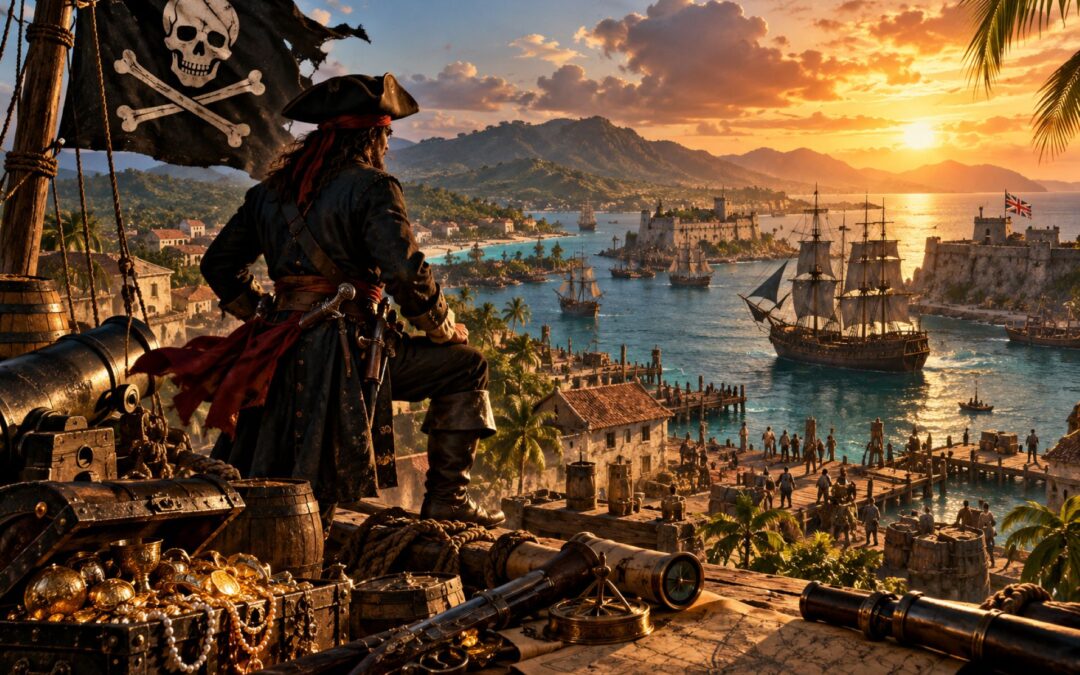
The pirates of the Caribbean occupy an unusual place in popular imagination. They are remembered as flamboyant adventurers sailing beneath skull-and-crossbones flags, hunting buried treasure, fighting with cutlasses, and living beyond the reach of kings and governments. Stories and films have turned them into symbols of freedom, rebellion, danger, and adventure. Yet the real history of Caribbean piracy was considerably more complicated than the legends suggest.
The most famous age of piracy emerged from a world of competing European empires, expanding colonial trade, religious conflict, and maritime warfare. Many of the men who eventually became pirates began as privateers, legally authorized to attack enemy ships on behalf of governments. Others were hunters, unemployed sailors, former naval servicemen, or people seeking to escape the harsh conditions of ordinary maritime employment.
Over roughly two centuries, these raiders established strongholds in places such as Tortuga, Port Royal, and Nassau. They developed their own systems of leadership, discipline, and wealth distribution, sometimes offering ordinary sailors a degree of participation rarely available aboard conventional ships. However, their communities also depended on robbery, intimidation, violence, and the exploitation of people caught in expanding colonial economies.
The history of the real pirates of the Caribbean is therefore not simply a story about criminals searching for treasure. It is also the story of how European empires encouraged maritime violence when it served their interests, tolerated it when it brought wealth, and eventually suppressed it when the costs became too great.
How Spain’s Caribbean Empire Created an Opportunity for Raiders
The origins of Caribbean piracy can be traced to the European colonization of the Americas beginning in the late fifteenth century. Following Christopher Columbus’s voyages, Spain established colonies across the Caribbean and expanded its possessions into Central and South America. The conquest of powerful Indigenous states, the exploitation of colonial labor, and the development of mining and plantation economies brought enormous quantities of wealth under Spanish control.
Gold and silver became especially important to Spain’s imperial finances. Valuable cargoes traveled from American ports across the Atlantic to Europe, while manufactured goods, settlers, military supplies, and enslaved people moved through interconnected colonial trading networks. Sugar, tobacco, hides, dyes, and other commodities gradually added to the economic importance of these territories.
To organize and protect this commerce, Spain developed a system of regular transatlantic fleets. Armed escorts accompanied valuable merchant vessels, and major ports became essential points in the movement of goods between the Americas and Europe. The development of Spanish treasure fleets and competition for colonial wealth also created opportunities for rival powers to disrupt Spanish trade and capture riches without conquering entire territories.
Spain’s growing power attracted opposition from France, England, and the Netherlands. These states wanted access to overseas resources and commercial opportunities, but Spain already controlled many of the most valuable territories and trading routes. Conflicts in Europe consequently extended into the Atlantic, where attacks on shipping and overseas settlements could damage an enemy’s finances while enriching the attackers.
Religious differences intensified these rivalries. The Protestant Reformation divided European Christianity, and political competition between Catholic Spain and Protestant powers such as England and the Dutch Republic frequently overlapped with religious hostility. France, despite remaining predominantly Catholic, also competed fiercely with Spain for strategic and dynastic reasons. The struggle for maritime influence was therefore shaped by political interests as well as religion.
One way European governments challenged Spanish wealth was through privateering. A privateer operated under official authorization, usually granted through a document known as a letter of marque, which permitted attacks on designated enemy vessels under specified conditions. The proceeds were divided according to the arrangements governing the expedition, with the state or its representatives potentially receiving a portion.
This distinguished privateering from piracy in legal terms. Pirates attacked ships without legitimate authorization, while privateers could claim that their violence formed part of an officially sanctioned conflict. In practice, however, the boundary was often uncertain because permissions had limitations, wars ended, and distant colonial authorities could interpret or enforce regulations inconsistently.
French maritime raiders were among the earliest Europeans to exploit Spain’s vulnerability in American waters. Figures such as François Le Clerc attacked Spanish shipping and settlements during the sixteenth century, demonstrating the profitability of raiding an empire whose possessions were widely dispersed.
English expeditions followed as hostility between England and Spain increased. Francis Drake became particularly famous for attacking Spanish possessions and shipping, including during his circumnavigation of the globe between 1577 and 1580. His activities helped enrich English interests while challenging Spain’s ability to protect its enormous overseas trading system.
These attacks were part of the wider emergence of England’s expanding overseas empire, which increasingly connected maritime commerce, colonization, privateering, and competition for territory.
Nevertheless, the early raiders faced practical limitations. Without reliable bases in the Caribbean, ships arriving from Europe had to operate across great distances before returning home with their prizes. Spain also adapted by strengthening its fleets, improving defenses, and protecting important shipping routes.
The targets were not limited to treasure ships. Coastal settlements and ports along the Spanish Main, including places such as Cartagena, Portobelo, and Panama, offered opportunities to seize stored goods, demand payments, destroy facilities, and interrupt commerce. These attacks became increasingly important as European competitors established more permanent footholds around the Caribbean.
The combination of immense colonial wealth, imperial competition, vulnerable settlements, and officially encouraged maritime violence created the conditions from which Caribbean piracy would develop. What began largely as an instrument of European warfare gradually became an independent occupation for communities of experienced and heavily armed seafarers.
From Hunters to Buccaneers: Tortuga and the Brethren of the Coast
During the early seventeenth century, Spain still claimed extensive territories throughout the Caribbean, but its authority was not equally strong everywhere. French, English, and Dutch settlers established themselves on islands and coastlines where Spanish occupation was limited or difficult to enforce. Some became involved in agriculture and trade, while others survived through hunting and the exploitation of local resources.
Around the 1620s, groups of predominantly French settlers lived along the northern and western parts of Hispaniola. They hunted wild cattle and pigs, preserving meat by smoking it over wooden frames. The technique was associated with the word boucan, and the hunters became known as boucaniers, from which the English word buccaneers developed.
The earliest buccaneers were therefore not necessarily pirates. They were hunters and frontier settlers whose livelihoods depended on access to animals, forests, trading partners, and suitable places to live. Their activities nevertheless brought them into conflict with Spanish colonial authorities, who regarded unauthorized foreign settlements as threats to Spanish control.
Spanish attempts to expel these communities pushed many of the settlers toward Tortuga, a small island lying off Hispaniola’s northern coast. Its location offered access to Caribbean shipping routes while providing a base that was more defensible than many exposed coastal settlements. French settlers arriving from other islands increased the population and strengthened the community’s maritime connections.
Over time, hunting alone could not support everyone’s ambitions or provide a reliable livelihood. Men familiar with weapons, boats, and the surrounding coast began attacking Spanish vessels and settlements. The transformation of Caribbean hunters into maritime buccaneers became an important development in the history of regional piracy.
Tortuga’s importance grew because it provided something the earlier European raiders had lacked: a convenient place to return, recover, obtain supplies, recruit companions, repair vessels, and dispose of captured goods. A successful expedition no longer required an immediate voyage back across the Atlantic. Its participants could remain in the Caribbean and prepare for another campaign.
The Spanish repeatedly attempted to destroy this growing threat. In 1640, the French adventurer and engineer François Levasseur took control of Tortuga and developed a formidable defensive position commonly known as Fort de la Roche. Its artillery and elevated location strengthened the settlement against attacks from the sea and helped preserve its usefulness as a buccaneer stronghold.
Although the fort made Tortuga more difficult to capture, Spanish forces continued to challenge the island. A major attack in 1654 forced the defenders to surrender, and the Spanish dismantled important fortifications to prevent their immediate reuse. Their success was not permanent, however, because buccaneers and settlers eventually returned.
By around 1660, French influence had become increasingly dominant on Tortuga, although its maritime community remained connected to raiders of several nationalities. New defenses, including a fort associated with the name Blondel, reflected the continuing importance of protecting the island. These changes also demonstrated how closely piracy and colonial politics had become intertwined.
Within this environment, many buccaneers identified themselves with a loosely organized community commonly called the Brethren of the Coast. They shared certain customs, interests, and patterns of cooperation, particularly in their opposition to Spanish wealth and authority. Yet they did not establish a permanently unified pirate government controlling every expedition.
Their organization was most visible aboard individual ships and during specific raids. Crews often agreed upon articles setting out expectations for conduct, the distribution of captured property, and the consequences of breaking established rules. Depending on the expedition, these agreements could specify who held authority, how disputes were resolved, and what compensation participants would receive.
Captains might be chosen or accepted by their crews, and their positions could depend on continuing support. This contrasted with the rigid hierarchies of many naval and merchant vessels, where ordinary sailors had limited influence over commanders. Successful leadership still required considerable practical authority, especially during combat, when hesitation and disagreement could threaten the entire crew.
Pirate articles also governed the distribution of plunder. Captains and certain officers generally received larger portions, while ordinary crew members received agreed shares. Specialists, including surgeons and carpenters, could be awarded additional compensation because their skills were difficult to replace and essential to an expedition’s survival.
Discipline was another important concern. Theft from companions, disobedience, desertion, and actions that endangered an expedition could bring penalties ranging from the loss of shares to physical punishment. Marooning, which involved abandoning a person in an isolated place with limited supplies, became one of the punishments associated with pirate culture, although practices differed between crews.
These rules were not evidence that pirate communities had achieved universal equality or a modern system of democratic government. Authority, rewards, and personal freedom remained unequal, and people captured during raids did not enjoy the protections negotiated by the pirates themselves. Nevertheless, the ability of some crews to negotiate leadership and compensation made buccaneering distinctive within the harsh maritime world of the seventeenth century.
Tortuga helped transform scattered hunters, privateers, and opportunistic raiders into an enduring maritime community. Its success demonstrated that piracy could flourish when experienced sailors possessed a defensible harbor, commercial connections, and colonial authorities willing or unable to tolerate their activities.
Port Royal, Henry Morgan, and the High Tide of Buccaneering
While Tortuga developed as an important French-associated buccaneer base, England established another powerful stronghold in the Caribbean. In 1655, English forces captured Jamaica from Spain during Oliver Cromwell’s campaign against Spanish possessions in the Americas. Although the English had initially attempted a larger assault on Hispaniola, their occupation of Jamaica provided a strategically valuable island that would remain under English control.
Jamaica’s southern harbor offered an excellent location for shipping, defense, and commerce. At its entrance stood Port Royal, which rapidly developed into a center for merchants, sailors, privateers, and buccaneers. Its importance was both military and economic because England needed ways to defend its new possession while disrupting Spanish activity nearby.
The colonial authorities recognized that experienced maritime raiders could serve these purposes. Buccaneers operating from Port Royal might attack Spanish ships and settlements while also discouraging hostile forces from approaching Jamaica. Governors consequently issued privateering commissions and maintained relationships with captains whose activities could benefit the colony.
Christopher Myngs was among the notable commanders associated with this period. He led expeditions against Spanish possessions and helped demonstrate the enormous rewards obtainable through large, coordinated buccaneer campaigns. His attack on Campeche in 1663 was particularly significant, bringing together a substantial force and exposing the vulnerability of important Spanish settlements.
One participant in this maritime world was Henry Morgan, who would become among the most famous figures in the history of Caribbean buccaneering. Morgan developed his reputation through attacks against Spanish interests and the ability to assemble men for ambitious expeditions. His career illustrated both the extraordinary opportunities available to successful raiders and the unstable legal boundaries surrounding their activities.
In 1668, Morgan led an attack on Portobelo, a fortified Spanish settlement on the Caribbean coast of present-day Panama. Portobelo was important because goods and precious metals moving across the Isthmus of Panama passed through the region before continuing toward Europe. Its defenses made it an intimidating target, but Morgan’s forces captured the town and extracted substantial wealth.
The following year, he conducted another major expedition against Spanish settlements around Lake Maracaibo, including Maracaibo and Gibraltar in present-day Venezuela. These operations demonstrated his ability to combine surprise attacks, aggressive tactics, and calculated risks. They also showed why coastal settlements could be more attractive targets than heavily escorted treasure fleets.
Morgan’s greatest expedition culminated in the attack on Panama in 1671. His forces moved across the Isthmus of Panama and defeated Spanish defenders before capturing and plundering the city on the Pacific coast. The operation was one of the most ambitious buccaneer campaigns of the period, requiring considerable organization and the movement of a large force through difficult territory.
The raid also caused a serious diplomatic problem. England and Spain had negotiated the Treaty of Madrid in 1670, seeking to regulate relations between their overseas possessions and reduce hostilities. Morgan’s attack became controversial because it occurred during a transition toward peace, although the extent to which he and colonial authorities understood the treaty’s implications at the time has been debated.
Morgan was recalled to England and faced scrutiny over the expedition. Yet his remarkable standing as a colonial commander eventually worked in his favor, and he was knighted in 1674. He also received an important position in Jamaica’s government, becoming involved in the very colonial system whose earlier policies had encouraged his raids.
His career revealed an extraordinary contradiction. A man who had acquired wealth and influence through attacks on Spanish possessions could be punished, celebrated, and ultimately incorporated into imperial authority, depending on the political circumstances. The distinction between useful privateer and troublesome pirate was shaped not only by actions at sea but also by decisions made in colonial capitals and European courts.
Morgan was not the only buccaneer to lead ambitious expeditions. In 1680, raiders including John Coxon, John Sawkins, and Bartholomew Sharp participated in a campaign commonly associated with the Pacific Adventure. Buccaneers crossed the Isthmus of Panama and operated against Spanish interests along the Pacific coast of the Americas.
The expedition evolved through changes of leadership and disagreements among its participants. Some returned across the isthmus, while others continued their voyages in the Pacific, with Sharp’s party eventually returning toward the Atlantic by sailing around Cape Horn. The campaign demonstrated how far buccaneering networks could extend beyond the Caribbean.
These expeditions contributed to Port Royal’s prosperity. Successful raiders returned with money, stolen goods, and valuable cargoes, supporting merchants, ship suppliers, taverns, lodging houses, and numerous other businesses. People who had never participated in a raid could still benefit economically from the circulation and expenditure of captured wealth.
Port Royal acquired a reputation for extravagant spending, gambling, drinking, prostitution, and conspicuous displays of wealth. Accounts of pirates exhausting fortunes in astonishingly short periods became part of the settlement’s legend. Although some descriptions were exaggerated by moral disapproval or colorful storytelling, the city certainly developed a reputation for commercial activity and pleasure.
Yet the historical settlement was more than a notorious pirate playground. It became a significant colonial trading center whose prosperity was connected to merchant shipping, plantation production, and the trafficking of enslaved Africans. Its defenses, urban development, and commercial connections reflected Jamaica’s growing importance to the English Atlantic economy.
The archaeological remains of seventeenth-century Port Royal preserve evidence of this broader colonial history, including the city that existed before one of the Caribbean’s most devastating natural disasters.
On June 7, 1692, a powerful earthquake struck Port Royal. The disaster caused widespread destruction, with extensive sections of the settlement collapsing or sinking beneath the water. Buildings, streets, and inhabitants were lost as the ground failed and the harbor environment changed dramatically.
The earthquake was subsequently interpreted by some observers as divine punishment for the city’s supposed wickedness. From a historical perspective, however, its significance lay in the destruction of a thriving port and the interruption of the commercial and social networks that had developed there. Efforts to rebuild followed, but Port Royal never fully recovered its former prominence.
The decline of its buccaneering role had already begun before the disaster. As England’s Caribbean colonies became more deeply involved in plantation agriculture, commercial shipping, and the slave trade, maintaining security became increasingly valuable. Raiding that had once helped defend Jamaica now threatened the stable maritime commerce upon which colonial prosperity depended.
Port Royal consequently evolved from a haven associated with privateers into a place where colonial authorities increasingly sought to restrain and prosecute pirates. Its transformation foreshadowed a larger shift taking place across the Caribbean: European governments were becoming less willing to tolerate armed seafarers whose activities they could no longer reliably control.
Why the Buccaneer Era Ended—and Piracy Moved Across Oceans
By the closing decades of the seventeenth century, the conditions that had supported Caribbean buccaneering were changing. The privateering system depended heavily on warfare, political authorization, and the willingness of colonial officials to accommodate raiders. As European powers negotiated peace agreements and sought more predictable commercial relationships, the legal opportunities for attacking Spanish possessions became more restricted.
The older multinational buccaneer communities also became less cohesive. English, French, and Dutch interests did not always remain aligned, particularly when their governments entered new conflicts or made peace with former enemies. Expeditions could fracture over leadership, the allocation of plunder, the choice of targets, or the risks of continuing a campaign.
Piracy also offered uncertain economic rewards. Although spectacular raids produced enormous fortunes for some participants, many voyages yielded little profit. Ships required maintenance, supplies, weapons, and manpower, while crews faced storms, disease, combat, imprisonment, and execution. The promise of great wealth could conceal long periods of hardship and financial disappointment.
Some buccaneers therefore abandoned raiding and pursued more stable occupations. They returned to Europe, entered colonial agriculture or timber production, joined merchant vessels, or accepted service in European navies. Experienced seafarers were valuable to governments and commercial enterprises that increasingly required skilled personnel to protect trade.
Others continued piracy but looked beyond the Caribbean for richer or less effectively defended targets. This contributed to the development of maritime raiding routes connecting the Atlantic and Indian Oceans, sometimes called the Pirate Round. Ships could travel around the Cape of Good Hope and enter waters used by European trading companies, merchants from the Middle East, and vessels operating within the Mughal Empire’s extensive commercial networks.
The Indian Ocean offered opportunities that differed from traditional Caribbean raiding. Its trade connected ports across Africa, Arabia, India, and Southeast Asia, carrying textiles, precious metals, spices, and numerous other valuable goods. Commercial vessels could be heavily armed, but successful attacks sometimes promised extraordinary rewards.
One of the most notorious pirates associated with these routes was Henry Every, also known as Henry Avery. After seizing a privateering vessel during a mutiny in 1694, Every commanded the Fancy and led an expedition into the Indian Ocean. His pirates attacked Mughal shipping in 1695, culminating in the capture of the Ganj-i-Sawai, a richly laden vessel carrying passengers and cargo connected to the pilgrimage trade.
The raid became famous for its immense plunder and for the atrocities committed against passengers and crew. It also created a major diplomatic crisis, threatening the commercial interests of the English East India Company in Mughal territory. The full history of Henry Every’s attack on the Mughal treasure ship illustrates how piracy had become an international problem extending far beyond Caribbean waters.
Every was subsequently associated with Nassau in the Bahamas, where he sought refuge while authorities were pursuing him and his companions. Accounts describe arrangements that allowed pirates to find temporary shelter and dispose of their wealth, including the bribery of colonial officials. His visit helped demonstrate the attractiveness of the Bahamas as a potential refuge for pirates returning from distant expeditions.
The movement toward Indian Ocean piracy did not mean Caribbean piracy had disappeared. Instead, the geography of maritime robbery was expanding and changing. Experienced sailors moved between oceans, and piracy followed shifting patterns of warfare, trade, enforcement, and commercial opportunity.
Meanwhile, developments in Europe were preparing to create another generation of unemployed privateers. The Caribbean’s next major pirate community would arise not from the hunting settlements of Hispaniola or the privateering economy of Jamaica, but from the weakened colonial administration of Nassau.
Nassau and the Rise of the Pirate Republic
At the beginning of the eighteenth century, Nassau was a small English colonial settlement on New Providence Island in the Bahamas. Its harbor was conveniently situated near important Atlantic and Caribbean shipping routes, while the surrounding islands offered numerous channels, shallows, and places where vessels could seek shelter. Effective imperial administration was difficult to maintain, and the colony remained vulnerable to attacks by rival European powers.
The War of the Spanish Succession, which began in 1701, intensified these difficulties. French and Spanish attacks disrupted the settlement, damaged its defenses, and encouraged inhabitants to leave. At the same time, wartime privateers found opportunities to operate from the Bahamas, taking advantage of its location near merchant shipping.
The war’s conclusion changed the economic position of these men. The major peace settlements of 1713 and 1714 reduced the legal opportunities available to privateers who had previously attacked enemy commerce. Sailors accustomed to capturing ships suddenly faced a world in which their former activities might expose them to prosecution.
Many had few attractive alternatives. Merchant ships offered employment, but wages could be low, work was dangerous, and discipline was often severe. Former naval sailors also faced uncertain prospects as wartime forces were reduced. Nassau offered a place where experienced seafarers could continue operating without immediate interference from an effective colonial government.
By the middle of the 1710s, pirates had become sufficiently numerous and powerful to dominate much of the settlement’s maritime activity. This period is commonly associated with the Pirate Republic of Nassau, although the phrase should not be understood as describing a formally established independent state with a constitution, regular elections, or universally recognized government institutions.
Instead, Nassau became a loosely organized community of pirate captains, crews, associates, merchants, and other inhabitants. Its influence arose primarily from the armed ships using the harbor and the weakness of ordinary colonial authority. Individual captains retained considerable independence, cooperating when expeditions offered mutual advantage and competing when their interests diverged.
Benjamin Hornigold and Henry Jennings were among the important figures associated with Nassau’s early pirate community. Hornigold had experience organizing raids and commanding crews, and he became connected to sailors who would achieve notoriety in their own right. Jennings was associated with attacks on Spanish interests, including opportunities created by the wrecking of a Spanish treasure fleet in 1715.
As piracy expanded, the harbor attracted other well-known captains. Charles Vane gained a reputation for defying authority and continuing piracy despite efforts to suppress it. Samuel Bellamy, remembered as Black Sam Bellamy, commanded a successful pirate crew before dying when his ship was wrecked in 1717.
Edward Teach, better known as Blackbeard, became perhaps the most famous pirate associated with this generation. His career took him from service within the maritime raiding world toward independent piracy. Blackbeard’s reputation depended not simply on the cargoes he captured but also on his deliberate cultivation of a terrifying appearance intended to intimidate opponents.
Stede Bonnet followed a very different path. Unlike many pirates whose careers began in harsh maritime employment, Bonnet was a relatively prosperous landowner from Barbados who entered piracy despite limited seafaring experience. His association with Blackbeard became one of the more unusual relationships of the period, demonstrating that pirate captains differed substantially in background and ability.
Other figures included John Rackham, generally known as Calico Jack, and the women pirates Anne Bonny and Mary Read. The surviving evidence concerning Bonny and Read comes from a combination of legal records and later accounts, making some details of their early lives uncertain. Their participation nonetheless challenges the assumption that every pirate crew consisted exclusively of men, even though women were exceptional rather than commonplace among these communities.
Several of these captains and their associates became identified with the Flying Gang, a name associated with the pirate network operating from Nassau during its most famous years. They were not necessarily members of one permanently unified organization, nor did they share a single commander throughout the period. Their significance lay in the connections between crews, ships, and a harbor that offered them temporary protection.
Pirates initially sometimes distinguished between potential targets according to nationality. Former English privateers might continue attacking French or Spanish vessels while avoiding ships belonging to their own country. Such restraint became increasingly difficult to maintain when lucrative British merchantmen crossed the same routes.
For sailors whose principal objective was personal profit, political loyalty could become an obstacle. Crews sometimes pressured captains to pursue valuable targets regardless of nationality, especially when passing up a vulnerable merchant vessel meant losing an immediate opportunity for plunder. This willingness to attack ships belonging to several European powers made independent pirates a threat to commerce generally rather than a useful weapon against one designated enemy.
Nassau’s attraction was not limited to Europeans seeking adventure. Its community included men who had served in navies or merchant vessels, people seeking to escape established forms of maritime discipline, and individuals whose choices were constrained by colonial systems of coercion. Black sailors and some formerly enslaved people participated in pirate crews, although their experiences and status varied considerably.
It would be misleading to describe Nassau as a society in which every inhabitant enjoyed equal freedom. Pirate captains possessed armed power, captured people could be subjected to exploitation, and relations between racial and social groups were shaped by the broader world of Atlantic slavery. Nevertheless, some pirates experienced considerably more autonomy and access to potential wealth than they had known in conventional employment.
For a short period, Nassau provided the combination of shelter, personnel, commercial contacts, and weak state authority that had allowed earlier strongholds such as Tortuga to flourish. But unlike buccaneers operating under commissions issued by colonial governors, its most notorious pirates increasingly threatened shipping belonging to Britain itself. Their independence made them economically dangerous to the very empire whose previous wars had helped create their profession.
What Life Under the Black Flag Was Really Like
The popular image of pirate life emphasizes freedom from authority, but the reality was shaped by the practical demands of operating a ship. A vessel depended on coordinated labor, navigation, maintenance, provisioning, and the ability to fight or escape when threatened. Even highly independent pirate crews needed rules because disorder could destroy their chances of survival.
Many pirate ships operated under agreed articles governing conduct and the distribution of rewards. These arrangements differed from crew to crew, but they frequently established expectations for obedience, compensation, conflict, and the handling of captured property. The existence of such agreements reflected the need to maintain cooperation among armed men whose principal incentive was the possibility of personal gain.
Some crews chose their captains and could remove them when they lost confidence in their leadership. A captain’s authority was often strongest during battle or pursuit, when rapid decisions were essential. Outside combat, significant influence might belong to the crew collectively or to another officer, particularly the quartermaster.
The quartermaster could represent the interests of ordinary crew members, supervise the allocation of provisions and plunder, and help enforce agreed rules. This arrangement limited a captain’s freedom to act without regard for the men serving under him. It also reduced the likelihood that disputes over money or supplies would immediately undermine an expedition.
Captured wealth was ordinarily divided according to predetermined shares. Captains and officers might receive larger portions, but ordinary sailors could expect a defined interest in the rewards of successful voyages. Some agreements provided compensation for injuries, recognizing that a crew member who lost a limb or suffered a disabling wound had sacrificed part of his future earning ability.
These practices contrasted with conditions aboard many contemporary merchant and naval ships. Ordinary sailors often endured physically exhausting labor, dangerous working environments, irregular pay, restricted movement, and harsh punishment. In naval service, discipline could be particularly severe, while merchant seamen might struggle to obtain promised wages from employers.
Piracy could appear attractive because it offered a greater personal stake in the proceeds of maritime commerce. A successful crew member might receive more from a single captured cargo than he could earn through an extended period of conventional service. The possibility of electing leaders and negotiating compensation also provided forms of participation unavailable in many ordinary maritime workplaces.
The attraction was nevertheless inseparable from extraordinary risks. Pirates could be killed during attacks, injured in accidents, lost at sea, or captured and prosecuted. Their livelihoods depended on taking property by force, and most could not expect dependable profits from every voyage.
Pirate articles also imposed discipline. Fighting among companions, stealing from the common stock, deserting during an expedition, and acting in ways that threatened collective safety could bring serious punishment. Some crews used fines, reductions in shares, whipping, or marooning, while particularly grave breaches could lead to death.
The existence of shipboard rules did not mean every pirate crew followed an identical code. Surviving accounts describe practices from different ships and periods, and some later writers presented pirate customs in exaggerated or romanticized forms. The most defensible conclusion is that many crews developed negotiated systems of authority and reward, not that piracy operated under one universal constitution.
The experience of captured ships reveals the limits of pirate freedom. Merchant sailors could face threats, confinement, assault, or forced recruitment, while passengers might be robbed of personal belongings and subjected to intimidation or torture. Some captains preferred surrender without resistance because it preserved valuable cargo and minimized casualties, but this calculated behavior did not prevent serious violence.
Pirates also operated within the wider Atlantic economy of slavery. The historical realities of Golden Age piracy complicate the idea that pirates represented an uncomplicated rejection of colonial exploitation. Pirate crews could include Black sailors who exercised agency and received shares, while other people of African descent were captured, sold, coerced, or kept in bondage.
The proportion of Black sailors within the pirate population is difficult to establish precisely. Surviving crew lists, trial records, and contemporary reports are incomplete, and the status of individuals was not always recorded consistently. Some historical interpretations emphasize the opportunities piracy offered people escaping slavery, while other research stresses the extent to which pirates participated in, rather than rejected, racial exploitation.
It is therefore inaccurate to assume that all pirates treated people equally regardless of ancestry. The freedoms available to participating crew members were not necessarily extended to prisoners, enslaved people, or people excluded from the crew’s decision-making. Even among pirates themselves, authority and reward were often unequal.
Women were another notable exception to the predominantly male world of piracy. Anne Bonny and Mary Read became famous partly because their presence aboard pirate vessels departed from common maritime expectations. Their reputations have been amplified by later stories, but the surviving legal record confirms their involvement in piracy and subsequent prosecution.
A pirate crew might consequently combine elements of cooperation and shared decision-making with behavior that was coercive and violent toward outsiders. The same men who insisted upon receiving fair portions of captured cargo could acquire that wealth through intimidation, robbery, and brutality.
Bartholomew Roberts, one of the most notorious pirates of the period, is associated in early pirate literature with a preference for the rewards and independence of piracy over the low wages and hard labor of legitimate employment. Whether the familiar words attributed to him reproduce his exact speech is uncertain. The sentiment nevertheless captures a recognizable motivation: for some sailors, the possibility of wealth and autonomy made even a dangerous and potentially short criminal career appear preferable to conventional service.
The distinctive feature of pirate organization was not that pirates invented fairness or consistently practiced equality. It was that some groups of maritime outlaws developed contractual arrangements that gave ordinary participants more direct influence over leadership and compensation than was customary in many other seafaring institutions.
Those arrangements deserve historical attention, but they cannot be separated from how pirate wealth was obtained. Understanding pirate life requires examining both the internal relationships that made crews functional and the violence through which they pursued their livelihoods.
How Britain Broke the Pirate Strongholds
By the late 1710s, Caribbean piracy had become a major concern for British colonial and commercial authorities. Independent pirates attacked merchant vessels regardless of their national allegiance, interrupted valuable shipping routes, and threatened the profitability of colonial trade. Their activities endangered not only merchants carrying manufactured goods and agricultural commodities but also the networks involved in the Atlantic slave trade.
This represented a significant change from earlier periods when privateers had been useful instruments of imperial competition. Britain now possessed expanding colonial markets and commercial interests that depended on the predictable movement of ships. Captains who had once helped disrupt Spanish trade could no longer be tolerated when they threatened British commerce as well.
The government initially attempted to encourage pirates to abandon their activities without requiring the capture of every individual crew. On September 5, 1717, George I issued a royal proclamation offering pardons to pirates who surrendered under specified conditions. The measure sought to separate those willing to return to lawful employment from pirates determined to continue attacking shipping.
The pardon was not an unrestricted guarantee of immunity for any future offense. It applied according to stated deadlines and conditions, making surrender a practical decision for men who could otherwise face prosecution and execution. A further proclamation in December 1718 extended the opportunity for some pirates to submit.
Pardons alone could not restore effective control over Nassau, where pirate crews had operated with limited interference for several years. Britain therefore appointed Woodes Rogers as royal governor of the Bahamas. Rogers was an experienced sailor and former privateer whose appointment reflected the government’s intention to reestablish authority in the islands.
He arrived at Nassau in July 1718, supported by armed vessels and a royal commission. His arrival confronted pirates with a choice between accepting the king’s pardon and continuing to resist the restoration of government. Some surrendered, while others refused to abandon their independence.
Charles Vane was among the captains determined to resist. When Rogers’s forces approached Nassau, Vane escaped rather than submit, leaving the new governor to consolidate control over the settlement. The episode demonstrated that pirates could evade immediate capture even when the government possessed superior institutional resources.
Nevertheless, Nassau’s position had changed fundamentally. The pirate community no longer enjoyed the same ability to use the harbor openly as a secure center for recruitment, provisioning, and the disposal of stolen cargoes. Rogers sought to restore fortifications, establish regular administration, and discourage the return of hostile vessels.
These efforts proved difficult because Nassau’s inhabitants were accustomed to weak government, and the settlement lacked reliable financial and labor resources. Rebuilding defenses and establishing effective administration required cooperation that Rogers could not always obtain easily. The restoration of royal authority under Woodes Rogers was therefore a complex undertaking involving private interests, colonial politics, military threats, and the practical difficulties of governing New Providence.
Former pirates also became useful to the authorities. Benjamin Hornigold, once associated with Nassau’s pirate community, accepted a pardon and participated in efforts to pursue other pirates. Such reversals were possible because the boundaries between authorized maritime service and criminal piracy had always depended partly on political allegiance and legal recognition.
The suppression campaign extended beyond Nassau. Colonial governors and naval commanders organized patrols, pursued wanted captains, seized ships, and prosecuted captured pirates. As enforcement increased, pirates faced growing difficulties finding places where they could repair their vessels, recruit crews, or spend their stolen wealth without attracting attention.
Blackbeard’s career came to a violent end in November 1718 when forces led by Lieutenant Robert Maynard confronted him near Ocracoke, off the coast of North Carolina. Blackbeard was killed during the fighting, and his death became one of the most famous episodes in the campaign against piracy. His reputation for intimidation had not protected him from determined armed pursuit.
Stede Bonnet was captured and executed in Charleston, South Carolina, in December 1718. His fate reflected the increasingly serious consequences facing former privateers and independent captains who continued operating outside the law.
John Rackham, known as Calico Jack, was captured and executed in Jamaica in 1720. Anne Bonny and Mary Read were also tried for piracy, but their executions were delayed after they claimed pregnancy. Read died in prison, while Bonny’s eventual fate remains uncertain.
Charles Vane, who had escaped Rogers at Nassau, was eventually captured and taken to Jamaica. He was executed at Gallows Point near Port Royal in 1721, a striking reversal for a region that had previously benefited from the wealth brought by privateers and buccaneers.
The struggle against piracy continued after these famous executions. Bartholomew Roberts, whose career ranged across the Atlantic and West African coast, was killed during an encounter with British naval forces in 1722. His death became another important marker in the decline of large-scale Atlantic piracy during the early eighteenth century.
Executions served both practical and symbolic purposes. They removed experienced captains while public hangings and the display of bodies warned other sailors about the consequences of piracy. The threat of severe punishment made offers of pardons and lawful employment more attractive.
Yet punishment alone did not bring the Golden Age to an end. The restoration of government in Nassau, naval patrols, improved enforcement, pressure on merchants who dealt with pirates, and changing employment opportunities collectively undermined the conditions that had sustained the pirate communities.
Piracy depended on more than armed ships and daring captains. It required favorable political circumstances, access to ports, markets for stolen goods, replacement personnel, and opportunities to attack vulnerable shipping. Once these advantages diminished, the survival of large and openly operating pirate groups became increasingly difficult.
By the middle of the 1720s, the organized Caribbean piracy associated with Nassau’s famous generation had been greatly reduced. Maritime robbery did not disappear, but the period in which large pirate communities could dominate major colonial harbors was drawing to a close.
The hunters had become the hunted, not because piracy suddenly ceased to be profitable everywhere, but because European states increasingly possessed both the incentive and the capacity to suppress it.
The Myths and Contradictions Behind the Pirate Legend
The historical pirates of the Caribbean remain familiar largely because their lives were transformed into legends. Popular literature, theater, illustrations, and later cinema created a recognizable pirate identity built around distinctive clothing, hidden treasure, frightening flags, unusual speech, and extravagant acts of violence. Some details had foundations in historical practice, while others were exaggerated or invented.
Pirate flags offer a useful example. Black flags decorated with skulls, skeletons, hourglasses, and other threatening images were associated with pirates during the Golden Age. Their purpose was often psychological, warning a potential victim that resistance might bring disastrous consequences.
However, pirates did not universally sail beneath one standardized Jolly Roger. Different captains used different designs, and the evidence for some famous flags attributed to particular individuals is uncertain. The modern skull-and-crossbones symbol represents a simplified version of a more varied historical tradition.
The familiar pirate accent is another product of cultural storytelling. Historical pirates came from different regions and linguistic backgrounds, and there is no reason to assume that they shared a single distinctive manner of speaking. The exaggerated sounds associated with fictional pirates owe much to theatrical performance and twentieth-century screen portrayals.
Walking the plank has similarly become a defining feature of fictional pirate cruelty. Although instances have been reported in the broader history of piracy, there is little convincing evidence that it was a regular punishment among the famous Caribbean pirates of the late seventeenth and early eighteenth centuries. Hanging, imprisonment, marooning, and violence during raids were much more firmly connected to their actual lives.
Buried treasure also occupies a greater place in adventure stories than in the documented operations of most pirates. Captured money and cargoes were generally valuable because they could be divided, sold, exchanged, or spent. Pirates typically wanted the economic rewards of their expeditions rather than the inconvenience and risk of concealing wealth for an uncertain future.
The famous image of the treasure map, complete with an X marking a secret location, therefore belongs more naturally to later adventure fiction than to the everyday functioning of pirate crews.
The construction of these legends began relatively early. A General History of the Pyrates, first published in 1724 under the name Captain Charles Johnson, became enormously influential in shaping subsequent accounts of the Golden Age. It preserved information about important pirates but also contained sensational material, uncertain anecdotes, and narratives whose reliability varies.
Later literary works transformed pirate history still further, making the outlaw sailor a figure who could represent danger, freedom, greed, mystery, or rebellion depending on the story being told. Fictional pirates inherited selected elements of the historical record while leaving behind much of the colonial violence and exploitation that had made their careers possible.
The most important misconception, however, is not about clothing, accents, or treasure maps. It concerns the meaning of pirate freedom.
Some pirate crews did negotiate rules, distribute shares, elect leaders, and provide compensation for injuries. These practices could be relatively participatory when compared with the conditions of many ordinary sailors. They are historically significant because they show that maritime workers sometimes created alternative arrangements outside conventional institutions.
But the benefits of these arrangements were concentrated among the participants who belonged to the crew. The people whose ships were attacked, whose possessions were seized, or whose freedom was destroyed did not necessarily share in that supposed equality.
Pirates could reject aspects of established authority while continuing to exploit the imperial trading networks around them. They could resent harsh maritime discipline yet impose terrifying violence on outsiders. They could claim freedom for themselves while participating in systems of enslavement and coercion.
Nor were they entirely separate from the states whose laws they violated. The history of privateering demonstrates that governments helped create generations of armed seafarers accustomed to taking wealth by force. Colonial governors sometimes welcomed these men when their actions harmed rival empires, and commercial settlements profited from the exchange of stolen goods.
When priorities changed, the same imperial structures that had tolerated or encouraged maritime raiding began treating it as an intolerable threat. The pirates’ independence became most dangerous when it interfered with the security of trade that colonial governments wanted to protect.
The historical legacy of Caribbean piracy therefore contains a genuine contradiction. Pirate communities sometimes developed unusual forms of cooperation and shared authority, but their economic foundations rested heavily on violence, unequal power, and the opportunities created by European colonial expansion.
Understanding that contradiction does not make pirate history less interesting. It makes the subject more revealing, exposing the complicated relationship between individual freedom, organized violence, maritime labor, commerce, and political authority.
The pirates of the Caribbean emerged because European empires created enormous flows of wealth that were difficult to defend and encouraged armed raids against their rivals. Buccaneer settlements such as Tortuga and Port Royal provided bases where maritime raiding could become an enduring occupation, while Nassau briefly allowed independent pirates to exercise substantial influence beyond effective colonial control.
Their decline followed another transformation. As imperial powers increasingly valued secure trade over opportunistic attacks on their competitors, the governments that had once benefited from privateering turned their resources toward suppressing piracy. Royal pardons, stronger administration, naval pursuit, and public executions gradually deprived pirate crews of the freedom to operate openly.
The real pirates were neither the carefree adventurers of popular fiction nor a unified community committed to universal liberty. They were sailors operating in a violent and unequal maritime world, sometimes creating strikingly participatory arrangements among themselves while exploiting people outside those arrangements.
Their most enduring historical significance lies in that combination of rebellion and dependence. Pirates challenged the authority of governments and shipowners, yet their opportunities were inseparable from the imperial rivalries, commercial systems, and human exploitation of their age. The legend celebrates life beyond society’s rules; the history shows how deeply that life was shaped by the society from which the pirates claimed to escape.
Last Updated on October 29, 2026 by Aseem Gupta