
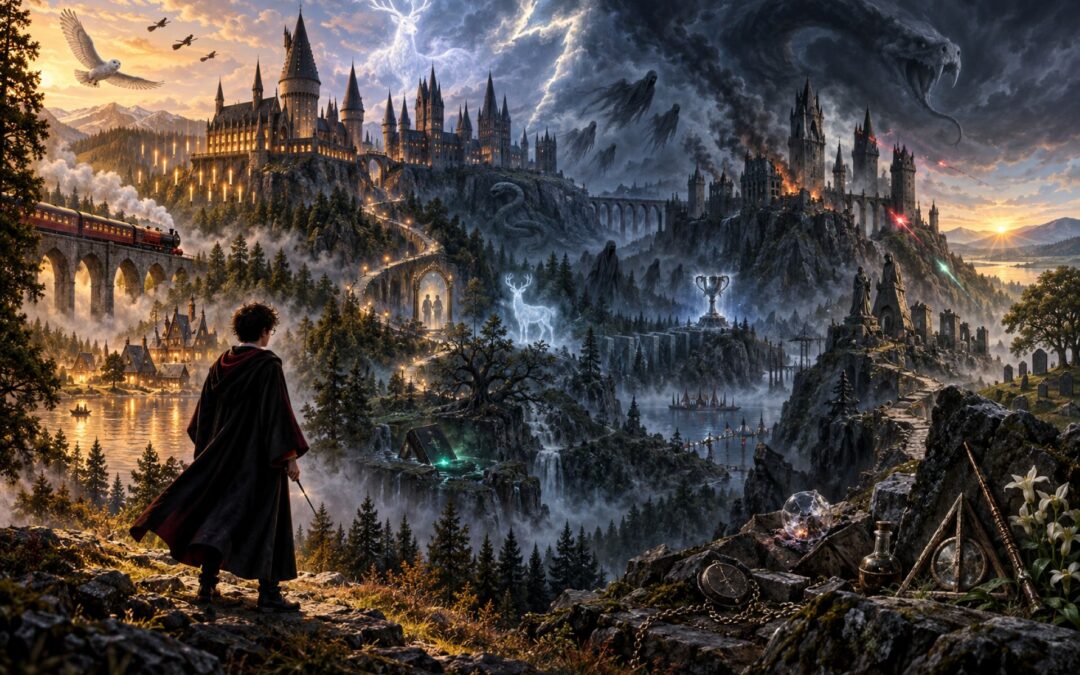
J.K. Rowling’s seven Harry Potter novels can be read as seven adventures, but their larger design becomes clearer when they are treated as one continuous story. What begins with an eleven-year-old boy discovering that he is a wizard gradually reveals itself as the unfinished history of a war: Harry’s parents were murdered by Lord Voldemort, Harry survived for reasons nobody fully understands, Voldemort survived in another sense, and almost everything Harry learns at Hogwarts eventually becomes part of understanding why the two of them are bound together.
The original sequence runs from Harry Potter and the Philosopher’s Stone through Harry Potter and the Deathly Hallows. Rowling’s official publication history confirms the seven-novel structure, while Bloomsbury’s series overview presents the books as connected stages of a single larger adventure. The first novels use the rhythm of the boarding-school story: Harry returns to Hogwarts each year, encounters a mystery, confronts danger, and goes home for the summer. Gradually that rhythm breaks down. The mysteries reveal pieces of the same historical conflict, Voldemort returns physically, the government collapses into denial and later dictatorship, Hogwarts becomes a battlefield, and Harry’s final education takes place outside school altogether.
The central contrast is not simply between a good wizard and an evil one. Harry and Tom Riddle are both orphans, both unusually powerful, both connected to Hogwarts, both capable of speaking Parseltongue, and both marked by childhoods in which ordinary family life was taken from them. Voldemort responds to vulnerability by trying to eliminate dependence, attachment, and death itself; Harry gradually learns that dependence, grief, friendship, mercy, and mortality are not weaknesses to be escaped. The final victory therefore depends less on Harry becoming more powerful than Voldemort than on Harry becoming the kind of person Voldemort cannot understand.
Spoiler warning: the discussion below covers the complete seven-book story, including every major death, revelation, the final battle, and the epilogue.

The Boy Who Lived Enters the Wizarding World
The opening movement of the series establishes almost every conflict that will matter later. Harry begins without knowledge of his parents, his magical identity, Voldemort, or the reason for his scar, while the wizarding world already treats him as a historical figure. His first two years at Hogwarts therefore concern more than discovering magic: they teach him that entering the world to which he belongs does not automatically tell him who he should become.
The mysteries of the Philosopher’s Stone and the Chamber of Secrets also plant mechanisms whose importance cannot yet be understood. Lily Potter’s sacrifice, the connection between Harry’s wand and Voldemort’s, Tom Riddle’s diary, Harry’s ability to speak to snakes, and the distinction between shared traits and chosen character will all return when the final conflict becomes intelligible.
From Privet Drive to the Philosopher’s Stone
The story begins after an apparently impossible event. Lord Voldemort, the dark wizard who has terrorised magical Britain, attacks James and Lily Potter at their home in Godric’s Hollow. He kills them but fails to kill their infant son. The curse intended for Harry rebounds, Voldemort loses his body, and Harry is left alive with a lightning-shaped scar.
Harry becomes famous throughout the magical community as the Boy Who Lived, yet he grows up knowing none of this. Albus Dumbledore leaves him with Lily’s sister Petunia Dursley, her husband Vernon, and their son Dudley because there is protective magic connected with Lily’s blood and because Harry needs somewhere outside the celebrity of the magical world. The arrangement keeps Harry physically protected but does not give him a loving childhood. The Dursleys resent him, hide the truth about his parents, make him sleep in a cupboard, indulge Dudley’s cruelty, and treat Harry’s unexplained magical incidents as evidence that something is wrong with him.
Approaching his eleventh birthday, Harry begins receiving letters addressed to him from Hogwarts School of Witchcraft and Wizardry. Vernon tries increasingly absurd measures to prevent Harry from reading them, eventually taking the family to an isolated hut. Hagrid arrives there at midnight and overturns Harry’s entire understanding of himself: Harry is a wizard, his parents were wizards, they were murdered by Voldemort rather than killed in a car crash, and the strange events of Harry’s childhood have been manifestations of magic.
Hagrid takes Harry into the hidden magical world through Diagon Alley. Harry discovers money left by his parents at Gringotts, encounters people who recognise his name, buys school supplies, and receives a wand from Ollivander. The wand contains a phoenix feather whose only other feather from the same bird lies inside Voldemort’s wand, creating a connection whose significance neither Harry nor the reader yet understands.
The magical world initially seems like an escape from everything Harry suffered with the Dursleys, but Rowling quickly complicates that fantasy. On the Hogwarts Express, Harry meets Ron Weasley, whose loving but financially strained family gives him what Harry lacks while Harry’s money and fame represent things Ron envies. He also meets Hermione Granger, an exceptionally prepared Muggle-born student whose intelligence is initially accompanied by poor social instincts, and Draco Malfoy, who confidently divides the wizarding world into families and people he considers worthy or inferior.
Draco offers Harry friendship on the assumption that status should determine association. Harry rejects him, partly because Draco reminds him of Dudley. This becomes one of the story’s earliest statements about identity: Harry has only just discovered his ancestry, fame, wealth, and abilities, yet he immediately confronts competing ideas about what those facts should mean.
At the Sorting Ceremony, Harry learns that the Sorting Hat sees qualities in him suited to Slytherin, the house associated in his imagination with Voldemort and now Draco. He asks not to be placed there and enters Gryffindor. The moment does not mean that circumstances or temperament can simply be wished away; instead, it introduces the recurring principle that possibilities do not determine moral identity until choices give them direction.
Harry’s first year combines ordinary school experiences with a growing mystery. He learns spells and potions, becomes Gryffindor’s Seeker, encounters ghosts and moving staircases, develops an antagonistic relationship with Professor Severus Snape, and accidentally discovers that an enormous three-headed dog named Fluffy is guarding a trapdoor. He and Ron initially find Hermione irritating, but the Halloween troll incident changes their relationship. When Hermione is trapped with the troll, the boys go back for her, and after they survive together she lies to protect them from punishment. The three children become friends because each has seen the others choose loyalty under pressure.
Harry’s first Quidditch match appears to confirm his suspicion that Snape is dangerous. Harry’s broom begins trying to throw him off while Snape seems to be muttering an incantation, and Hermione disrupts him. What Harry does not know is that Professor Quirrell is causing the problem and Snape is attempting to counter the curse. The misreading is characteristic of Rowling’s mystery construction: Snape’s genuine unpleasantness makes the false explanation psychologically convincing.
At Christmas, Harry receives the Invisibility Cloak that belonged to his father. Exploring Hogwarts under it, he discovers the Mirror of Erised, which shows the deepest desire of whoever looks into it. Harry sees the family he never knew surrounding him. The discovery is emotionally more powerful than most of the overt magic he has encountered because Hogwarts can give Harry friends, education, adventure, and belonging, but it cannot return James and Lily.
Harry repeatedly returns to the Mirror until Dumbledore intervenes. Dumbledore explains that people can waste their lives looking at what they desire rather than living in reality. That warning introduces the series’ larger treatment of death and loss: grief should not be denied, but attempts to make the dead substitute for the living can become another form of captivity.
Meanwhile, Harry, Ron, and Hermione identify the object beneath Fluffy as the Philosopher’s Stone associated with Nicolas Flamel. The Stone can produce wealth and extend life, making it an obvious target for someone trying to regain power. Hagrid’s inability to keep secrets helps the children realise that a stranger has learned how to get past Fluffy, and detention in the Forbidden Forest brings Harry face to face with a hooded figure drinking unicorn blood to sustain a damaged existence.
The figure is connected to Voldemort, who survived the destruction of his body in a diminished state. Harry concludes that the Stone is in immediate danger and believes Snape is trying to steal it. When Dumbledore is called away, Harry, Ron, and Hermione descend through the trapdoor themselves.
Their progress establishes the trio as a cooperative unit rather than three interchangeable sidekicks. Hermione recognises how to escape Devil’s Snare and later solves a logic problem involving potions. Harry’s skill on a broom allows him to capture a flying key. Ron commands the giant wizard-chess game and deliberately sacrifices his piece so Harry and Hermione can continue.
Harry eventually reaches the final chamber alone and discovers that he has misunderstood the central mystery. Quirrell, not Snape, has been trying to obtain the Stone. Voldemort has attached himself parasitically to Quirrell and is attempting to regain strength.
The Mirror of Erised becomes part of Dumbledore’s final protection. Harry can retrieve the Stone because he wants to find it without wanting to use it. Voldemort and Quirrell seek wealth, survival, or power; Harry’s objective is simply to prevent them from obtaining those things. When Quirrell tries to seize him, physical contact burns Quirrell because Lily’s voluntary death for Harry has left a protection Voldemort cannot bear.
Harry awakens in the hospital wing and learns that the Stone will be destroyed with Flamel’s agreement. Flamel therefore accepts eventual death rather than preserving himself indefinitely, creating the first major contrast between Voldemort’s terror of mortality and other characters’ willingness to accept it. For a much deeper treatment of this first stage of Harry’s story, the dedicated article on Harry Potter and the Philosopher’s Stone follows the novel independently.
Harry returns to Privet Drive at the end of the year, but the meaning of that return has changed. He is still an orphan and still required to live with the Dursleys, yet he no longer depends on them to tell him who he is. Hogwarts has not erased his childhood, but it has given him history, friendships, ability, and a place he now regards as home.
The Chamber of Secrets and the First Tom Riddle
Harry’s second year takes the secure home he thinks he has found and makes it frightening. Before he can return, a house-elf named Dobby appears at Privet Drive and warns that terrible events are planned for Hogwarts. Dobby sabotages Harry’s attempts to go back because he believes keeping Harry away is the only way to protect him.
When the Dursleys imprison Harry after Dobby causes a magical incident, Ron, Fred, and George Weasley rescue him in a flying car. Harry spends part of the summer at the Burrow, experiencing for the first time the everyday disorder of a loving family. The contrast with Privet Drive matters throughout the series: the Weasleys possess little money but create the kind of domestic belonging Harry values more than wealth.
In Diagon Alley, Harry encounters the celebrity author Gilderoy Lockhart, who will become the new Defence Against the Dark Arts teacher, and sees Lucius Malfoy clash with Arthur Weasley. During the confrontation, Lucius secretly slips an old diary into Ginny Weasley’s possessions. The apparently trivial act will become one of the most important retrospective details in the series.
Harry and Ron later miss the barrier to Platform Nine and Three-Quarters and fly the Weasley car to Hogwarts. Their spectacular arrival creates another year of rule-breaking, but the central threat emerges when Harry begins hearing a voice nobody else can hear. Soon Mrs Norris, Filch’s cat, is found Petrified near a message declaring that the Chamber of Secrets has been opened.
The legend says that Salazar Slytherin created a hidden chamber at Hogwarts and placed a monster inside it that his heir could use against students considered unworthy of magical education, particularly those born to Muggle parents. The attacks therefore transform blood prejudice from Draco Malfoy’s social arrogance into the organizing ideology of attempted murder.
Harry’s situation becomes worse when he reveals that he can speak Parseltongue during a duelling demonstration. The ability is strongly associated with Slytherin and Voldemort, and students begin suspecting that Harry himself may be the Heir of Slytherin. Harry is disturbed for a deeper reason: the Sorting Hat considered Slytherin for him, he shares a rare ability with Voldemort, and he does not yet know why.
Harry, Ron, and Hermione attempt to discover whether Draco is responsible by using Polyjuice Potion. Their plan establishes that Draco knows the ideology of the attacks but does not know who is carrying them out. The mystery therefore shifts away from the obvious Slytherin antagonist.
Harry eventually finds the diary that Lucius placed among Ginny’s things. It belonged to a Hogwarts student named Tom Riddle and can respond to Harry’s writing. Riddle shows Harry a preserved memory in which a younger Hagrid appears to have been responsible for opening the Chamber decades earlier.
The memory seems persuasive because it gives Harry exactly the kind of complete explanation he wants. Yet it is a curated version of history, designed by Riddle to conceal the real attacker. When Hagrid is later taken to Azkaban and Dumbledore is suspended from Hogwarts, the school appears to be losing the people most capable of protecting it.
Following Hagrid’s clue, Harry and Ron enter the Forbidden Forest and meet the enormous spider Aragog. He reveals that Hagrid’s creature was not responsible for the earlier death and that the real monster is something spiders instinctively fear. Hermione, before being Petrified herself, works out the answer: the creature moving through Hogwarts is a Basilisk, travelling through the pipes and killing through its gaze. The victims have survived only because none looked directly into its eyes.
The final crisis occurs when Ginny is taken into the Chamber. Lockhart, exposed as a fraud whose celebrated adventures were stolen from other people through memory charms, is forced by Harry and Ron to accompany them. His attempt to erase the boys’ memories backfires, leaving him incapacitated and separating Ron from Harry.
Harry enters the Chamber alone and discovers Ginny unconscious beside Tom Riddle. The Riddle speaking to him is not simply a memory but a preserved version of Voldemort’s younger self. His full name, Tom Marvolo Riddle, can be rearranged into the identity he created for himself: Lord Voldemort.
Ginny has been writing in the diary throughout the year. Riddle encouraged her to confide in him, gradually gained power through those confidences, possessed her, opened the Chamber through her, released the Basilisk, and forced her to commit acts she could barely remember. The apparent companion who listened sympathetically to a lonely eleven-year-old girl was feeding on her vulnerability.
Riddle is fascinated by Harry because he sees similarities between them. Both grew up outside the magical world, both discovered Hogwarts as a place where they possessed exceptional ability, both speak Parseltongue, and both are connected with Slytherin. Harry cannot yet explain why the similarities exist, but he rejects Riddle’s assumption that resemblance creates identity.
Fawkes, Dumbledore’s phoenix, arrives carrying the Sorting Hat. The bird blinds the Basilisk, and Harry pulls Godric Gryffindor’s sword from the Hat. He kills the Basilisk but is bitten by one of its venomous fangs. Fawkes’s tears heal him, and Harry uses the fang to stab the diary.
The diary is destroyed and Riddle disappears. Neither Harry nor Dumbledore yet uses the word “Horcrux,” but Harry has just destroyed one of the magical objects containing pieces of Voldemort’s soul. The series therefore introduces Voldemort’s solution to death four books before Harry understands what it is.
Back in Dumbledore’s office, Harry asks whether the similarities between himself and Voldemort mean that the Sorting Hat should have put him in Slytherin. Dumbledore identifies a more important distinction: Harry chose Gryffindor, whereas Voldemort repeatedly chose domination. Harry can wield the sword because his loyalties and actions matter more than his frightening similarities to his enemy.
Harry also realises that Lucius Malfoy deliberately planted the diary among Ginny’s belongings. He cannot prove the entire scheme, but he can exploit Lucius’s mistreatment of Dobby. By hiding a sock inside the returned diary, Harry tricks Lucius into giving Dobby clothing, freeing the house-elf.
The full Chamber of Secrets article examines the mystery separately, but within the complete series the novel performs an even more important function. It introduces Tom Riddle as a human being rather than a disembodied evil, gives Harry his first direct encounter with a Horcrux, and makes the question “What if I am like him?” central long before Harry learns why part of Voldemort is literally attached to him.
The Past Returns: Sirius Black, Peter Pettigrew, and Harry’s Parents
Harry’s third year initially appears less connected to Voldemort because Voldemort himself never becomes the immediate antagonist. In fact, Prisoner of Azkaban performs essential work for the larger story by dismantling Harry’s simplified history of his parents’ generation. The past is no longer a clean story in which James and Lily were good, Voldemort was evil, and everyone else can be classified according to which side they appeared to occupy.
Harry begins the year by losing control of his magic after Aunt Marge insults his parents. He leaves Privet Drive expecting severe punishment but instead discovers that the Ministry is unusually eager to keep him safe. Sirius Black, a convicted murderer and supposed Voldemort supporter, has escaped from Azkaban, and Harry gradually learns that Sirius was believed to have betrayed James and Lily to Voldemort.
The danger follows Harry to Hogwarts in the form of Dementors, the guards of Azkaban. Their presence affects him more severely than most students because when they approach, Harry relives fragments of his parents’ deaths. He hears Lily screaming as Voldemort comes for him, turning an event Harry has known only as historical information into something emotionally immediate.
Professor Remus Lupin, the new Defence Against the Dark Arts teacher, becomes one of the few adults who consistently treats Harry with patience and respect. Lupin teaches practical magic without humiliation and later helps Harry learn the Patronus Charm, which repels Dementors by drawing upon a powerful positive memory. Harry struggles because the worst part of the Dementors’ attack is also his only access to his parents’ voices; protecting himself means giving up a form of contact with the dead.
The story’s school mystery develops through the Marauder’s Map, which Fred and George give Harry. The map shows the people moving around Hogwarts and carries the names Moony, Wormtail, Padfoot, and Prongs, though Harry initially does not know who they are. Sirius appears to break into the school repeatedly, reinforcing the belief that he intends to kill Harry.
Harry’s anger becomes increasingly personal when he overhears that Sirius was James Potter’s closest friend, Harry’s godfather, and apparently the man entrusted with the Potters’ hiding place. The betrayal therefore seems worse than ordinary allegiance to Voldemort. Harry begins imagining revenge.
Several apparently secondary plots eventually converge. Hermione’s impossible schedule, Hagrid’s attempt to save Buckbeak from execution, Ron’s repeated conflict with Hermione over Crookshanks and Scabbers, and Lupin’s monthly illnesses all contain information the main characters do not yet understand. The story depends on their tendency to interpret each mystery separately.
The climax begins when Scabbers, Ron’s apparently ordinary rat, is discovered alive. Sirius drags Ron and the rat into the passage beneath the Whomping Willow, and Harry and Hermione follow. Harry reaches the Shrieking Shack believing he has finally cornered the man who betrayed his parents.
The explanation reverses almost everything Harry thinks he knows. Sirius did not betray James and Lily. The Potters originally intended Sirius to be their Secret-Keeper, but Sirius persuaded them to use Peter Pettigrew instead because nobody would suspect the weaker, less conspicuous man. Pettigrew then gave the information to Voldemort.
After the Potters died, Sirius confronted Pettigrew. Pettigrew murdered bystanders, severed his own finger, transformed into a rat, and allowed Sirius to be blamed for the killings. He then spent twelve years hiding as the Weasley family pet.
Lupin also reveals the identities behind the Marauder’s Map. Lupin was Moony, so called because he is a werewolf; Sirius was Padfoot, an Animagus who could become a large dog; Pettigrew was Wormtail, the rat; and James was Prongs, a stag. As teenagers, James, Sirius, and Pettigrew secretly learned Animagus transformations so they could accompany Lupin during his werewolf transformations.
The revelation restores Sirius to Harry but complicates the moral history of the group. Snape’s hatred of James and Sirius does not originate entirely in irrational bitterness; the Marauders bullied him, and Sirius once endangered his life by directing him toward a transformed Lupin. Snape arrives in the Shrieking Shack convinced that Sirius and Lupin are lying and unwilling to hear their explanation.
Sirius and Lupin want to kill Pettigrew. Harry stops them, not because he forgives Pettigrew, but because he believes James would not have wanted murder committed in his name. The decision appears to cost Harry immediately: Lupin transforms into a werewolf before Pettigrew can be formally handed over, and Pettigrew escapes.
That escape is one of the most important acts of cause and effect in the series. Pettigrew will return to Voldemort, help restore him to a body, and eventually hesitate when ordered to kill Harry because Harry once saved his life. Harry’s mercy therefore creates danger, but it is not meaningless simply because it fails to produce immediate justice.
Sirius is recaptured, and Dementors prepare to administer the Kiss. Harry sees a distant figure cast an extraordinarily powerful Patronus and initially believes James has somehow returned. Hermione then reveals that she has been using a Time-Turner throughout the year to attend overlapping classes.
Harry and Hermione travel back through the events they have already experienced, save Buckbeak, and position themselves to rescue Sirius. At the crucial moment, Harry realises that nobody else is coming. He was the figure across the lake. Knowing that he has already seen himself succeed, he casts the Patronus that saves his earlier self and Sirius.
The emotional movement is subtle but important. Harry begins the book hearing his dead father and mother whenever Dementors overwhelm him and ends it by recognising that he cannot wait for James to appear and rescue him. His father remains part of him, symbolised by the stag Patronus, but Harry must perform the action himself.
Sirius escapes on Buckbeak, but he cannot publicly clear his name, and Harry cannot go to live with him. Lupin resigns after Snape reveals his werewolf status. Pettigrew remains free. The ending therefore denies Harry the simple restoration he wants while giving him a truer understanding of his parents and their friends.
The dedicated article on Harry Potter and the Prisoner of Azkaban can examine that mystery on its own terms. Within the seven-book arc, its crucial achievement is to replace inherited moral categories with a harder lesson: loyalty can fail, apparently guilty people can be innocent, victims can also behave badly, admirable people can carry shameful histories, and mercy may matter even when its consequences cannot yet be seen.
Voldemort Returns and Childhood Ends
The fourth novel is the hinge on which the complete series turns. A contemporary New Yorker assessment recognised Goblet of Fire as a transitional volume in the seven-book design, and that transition is visible in almost every part of the story. The magical world becomes wider, more international, and more spectacular at precisely the moment when the political and moral dangers Harry has only partly understood become impossible to contain.
The book opens away from Harry and Hogwarts at the Riddle House in Little Hangleton. Frank Bryce, the elderly gardener, discovers that someone is using the abandoned house and overhears Peter Pettigrew speaking with a physically ruined Voldemort. Their conversation concerns a plan involving Harry and a person positioned inside Hogwarts. Voldemort discovers Frank listening and murders him.
Harry experiences part of the scene through a dream and wakes with his scar hurting. His scar has already connected him to Voldemort symbolically, but it is now beginning to function as a channel through which Harry experiences Voldemort’s presence and emotions. Unsure how seriously to interpret the warning, Harry writes to Sirius.
The wider magical world initially seems celebratory. Harry travels with the Weasleys to the Quidditch World Cup, where enormous crowds, international visitors, professional athletes, Ministry officials, and magical spectacle reveal that Hogwarts represents only a small portion of wizarding life. The celebration collapses when masked Death Eaters terrorise a Muggle family and the Dark Mark appears in the sky.
The event establishes that Voldemort’s ideology did not disappear when Voldemort lost his body. People who returned to respectable life after the first war can still participate in sadistic violence, while institutions struggle to identify responsibility. The apparent evidence points toward the house-elf Winky because she is found with Harry’s wand near the place where the Mark was cast.
Back at Hogwarts, the school announces the revival of the Triwizard Tournament. Beauxbatons and Durmstrang will visit, and one champion from each school will compete in three dangerous tasks. The age restriction and elaborate rules create an atmosphere of controlled danger: adults repeatedly insist that the tournament has been made safer.
The new Defence Against the Dark Arts teacher appears to reinforce that sense of seriousness. Alastor “Mad-Eye” Moody is a famous former Auror known for fighting Dark wizards. He demonstrates the three Unforgivable Curses—Imperius, Cruciatus, and Avada Kedavra—and teaches students with a practical directness missing from some of Harry’s previous instructors.
The irony is that Moody is not Moody. Barty Crouch Jr., a Death Eater believed dead, has imprisoned the real Moody and is impersonating him with Polyjuice Potion. He therefore spends the year teaching Harry skills, protecting his progress, and subtly manipulating events so Harry will survive long enough to be delivered to Voldemort.
The Goblet of Fire selects Fleur Delacour for Beauxbatons, Viktor Krum for Durmstrang, and Cedric Diggory for Hogwarts. Then it produces Harry’s name as a fourth champion. Harry is only fourteen and insists that he never entered.
The adults determine that the magical contract obliges him to compete. Fake Moody correctly suggests that someone could have Confunded the Goblet into thinking four schools were participating and entered Harry under a fourth school so he would be the only possible selection. The explanation is accurate because Crouch Jr. arranged exactly that manipulation.
Many students do not believe Harry’s denial. Hufflepuffs resent the fact that Cedric’s legitimate selection is being overshadowed, Slytherins mock Harry, and even Ron becomes convinced that Harry found a way to enter without telling him. The dispute reveals a recurring problem in Ron’s friendship with Harry: Harry experiences fame as intrusion and danger, while Ron sometimes sees only the attention and exceptionalism he lacks.
The first task involves dragons. Hagrid secretly shows Harry what the champions will face, and Harry warns Cedric because he knows the other schools probably have their own sources of information. Hermione helps Harry practise the Summoning Charm, and fake Moody steers him toward recognising that his flying ability is the skill he should exploit. Harry summons his Firebolt and uses agility rather than raw magical power to get past the Hungarian Horntail.
Ron finally understands that Harry would never voluntarily seek such danger, and the two reconcile. The tournament nevertheless keeps exposing the difference between the public story and the reality Harry experiences. Spectators see scores, rivalry, and spectacle; Harry increasingly sees a dangerous system whose rules have already been manipulated.
The Yule Ball shifts the immediate danger into adolescent embarrassment. Harry wants to attend with Cho Chang but discovers that Cedric has already asked her. Ron’s developing feelings for Hermione become visible when she attends with Viktor Krum, and he reacts with jealousy rather than admitting why he is upset.
The romantic subplot matters because the children are growing even while the war returns around them. Hermione is no longer simply the clever girl who provides information, Ron is beginning to confront desires he cannot articulate, and Harry’s attraction to Cho exists beside a danger neither of them understands fully.
The second task requires the champions to rescue people they care about from beneath the lake. Dobby ultimately provides Harry with gillyweed, allowing him to breathe underwater. Harry reaches Ron but becomes worried that Fleur’s younger sister Gabrielle will be left behind after Fleur fails to reach the hostages.
Harry does not understand that the hostages are magically protected and takes both Ron and Gabrielle to the surface. His decision is inefficient as competition strategy but consistent with the character the series has been building. Harry repeatedly refuses to treat someone else’s life as an acceptable cost merely because an authority or rule implies the risk is controlled.
The mystery around Barty Crouch Sr. meanwhile deepens. He appears near the Forbidden Forest confused and desperate to speak to Dumbledore, then disappears while Harry seeks help. The Pensieve later gives Harry glimpses of the trials following Voldemort’s first fall, including accusations against Igor Karkaroff and the conviction of Barty Crouch Jr.
The third task places the champions inside a magically constructed maze. Fake Moody eliminates obstacles and competitors from outside, ensuring Harry advances. Harry and Cedric eventually reach the Triwizard Cup together.
Neither will take it alone. Cedric believes Harry deserves it because Harry saved him, while Harry believes Cedric deserves it because Cedric would have reached it first under fair conditions. They decide on shared victory.
The Cup is a Portkey.
It transports them to the graveyard in Little Hangleton. Voldemort orders Pettigrew to kill Cedric, and Cedric dies almost immediately. The abruptness marks the point at which the school-adventure structure finally breaks: Cedric is not killed because he misunderstood a puzzle or chose a dangerous path. He is murdered because he happens to be present.
Pettigrew ties Harry to Tom Riddle Sr.’s grave and performs the ritual that gives Voldemort a new body. Bone from Voldemort’s father, Pettigrew’s severed hand, and Harry’s blood are combined. Voldemort deliberately insists on Harry’s blood because he believes taking the protection left by Lily into himself will allow him to touch Harry safely.
Voldemort summons the Death Eaters and humiliates those who abandoned him. His followers return largely because his power has returned. Their relationship with him therefore exposes the weakness inside his idea of loyalty: he inspires obedience through fear, hierarchy, and advantage rather than mutual attachment.
Voldemort gives Harry his wand and turns the murder scene into a theatrical duel. He wants to destroy the story of the Boy Who Lived before the followers who remember his failure. Instead, the twin cores of their wands create Priori Incantatem, forcing Voldemort’s wand to produce echoes of recent victims.
Cedric appears, followed by Frank Bryce, Bertha Jorkins, James, and Lily. These are not fully restored dead people, but their appearances give Harry enough support to break contact and escape with Cedric’s body. The dead continue to shape Harry’s life without becoming substitutes for the living.
Returning to Hogwarts does not restore safety. Fake Moody takes Harry away from the crowd, reveals too much, and is confronted by Dumbledore, Snape, and McGonagall. Under Veritaserum, Barty Crouch Jr. explains how his mother helped him escape Azkaban, how his father controlled him, how he returned to Voldemort, captured Moody, entered Harry into the Tournament, and manipulated the entire year.
The confession should provide extraordinary evidence that Voldemort has returned, but Minister for Magic Cornelius Fudge arrives with a Dementor that administers the Kiss to Crouch Jr. Fudge then refuses to accept Harry and Dumbledore’s account. The government’s problem is no longer ignorance alone: acknowledging Harry’s testimony would require admitting that Voldemort returned under the Ministry’s watch and that major systems of security failed.
Dumbledore begins reorganising resistance without the Ministry. He sends messages to old allies, gives Snape a dangerous assignment connected with his former Death Eater identity, and tells the school that Cedric was murdered by Voldemort rather than allowing his death to become a politically convenient accident.
The individual article on Harry Potter and the Goblet of Fire explores this transition in greater detail. Within the complete series, however, the book’s final chapter title—“The Beginning”—describes exactly what has happened. Harry has solved the year’s mystery, but solving the mystery no longer produces restoration. Voldemort has a body, Cedric is dead, the government chooses denial, and Harry’s childhood assumption that danger can be discovered and contained before summer has ended.
Denial, Resistance, and the Prophecy
If Goblet of Fire restores Voldemort, Order of the Phoenix asks what happens when the truth is politically inconvenient. Harry enters his fifth year carrying direct knowledge of Voldemort’s return, yet much of magical Britain is encouraged to treat him as unstable, attention-seeking, or manipulated by Dumbledore. The conflict therefore expands beyond defeating Voldemort to include the struggle over whether reality itself will be publicly acknowledged.
The summer begins with Dementors attacking Harry and Dudley in Little Whinging. Harry uses a Patronus to save them and is immediately threatened with expulsion for performing underage magic. The same government refusing to recognise Voldemort’s return treats Harry’s defensive action as an opportunity to discipline him.
Members of the Order of the Phoenix eventually escort Harry to Number Twelve, Grimmauld Place, Sirius Black’s inherited family home. There Harry discovers that Dumbledore has already reassembled the resistance organisation that fought Voldemort during the first war. The Order includes familiar adults such as Sirius, Lupin, the Weasleys, Moody, and Snape, as well as new figures including Nymphadora Tonks and Kingsley Shacklebolt.
Harry is furious that important information has been withheld from him. His anger is partly adolescent and partly justified: he has been isolated after witnessing Cedric’s murder while adults discuss a war centred increasingly on him. This becomes one of the book’s major emotional patterns. Adults repeatedly attempt to protect Harry through secrecy, while secrecy leaves him vulnerable to misunderstanding the fragments of information he does receive.
Grimmauld Place also reveals Sirius’s childhood environment. The Black family home is full of pure-blood ideology and family contempt, and Sirius’s relationship with the house-elf Kreacher reflects his own inability to separate the servant from the family he hates. Kreacher’s later role in Sirius’s death will make that contempt consequential.
Harry’s Ministry hearing becomes an early test of institutional hostility. Dumbledore successfully demonstrates that Harry used magic in response to Dementors, but the unusual effort devoted to prosecuting a teenager makes clear that the legal process has become entangled with political reputation. Fudge increasingly regards Dumbledore not as an ally warning him about Voldemort, but as a rival supposedly seeking power.
At Hogwarts, the Ministry appoints Dolores Umbridge as Defence Against the Dark Arts teacher. Her manner is superficially polite, but her teaching policy eliminates practical defence because the Ministry fears Dumbledore may be preparing students for political rebellion. The official curriculum therefore becomes a way to prevent students from acquiring skills they genuinely need.
Umbridge punishes Harry for insisting that Voldemort returned. Her detention forces him to write lines with a magical quill that cuts the words into the back of his hand. The cruelty is bureaucratic rather than openly chaotic: she frames torture as discipline and believes institutional authority legitimises what she does.
As Umbridge gains power through Educational Decrees, Hermione proposes that students learn practical defence from Harry. The group that becomes Dumbledore’s Army begins as a response to institutional failure. Harry does not initially see himself as a teacher, but the others remind him how much practical experience he already has.
Training the group changes Harry. He has spent years learning from older protectors, improvising in danger, and surviving events he did not choose. Now he becomes responsible for helping other people become capable of defending themselves. The DA also creates a community that includes characters such as Neville Longbottom, Luna Lovegood, and Ginny Weasley, all of whom will matter greatly in the final resistance.
Harry’s connection with Voldemort simultaneously becomes more dangerous. He dreams through the perspective of a snake attacking Arthur Weasley at the Ministry and wakes in time for the Order to save Arthur. The vision proves that Harry’s access to Voldemort’s mind can provide useful information, but it also raises the possibility that the connection works both ways.
A visit to St Mungo’s exposes Harry and his friends to injuries left by the first war. They encounter Neville with his parents, Alice and Frank Longbottom, who were tortured by Death Eaters until they lost their ability to live independently. Neville’s background transforms his earlier awkwardness: he has grown up carrying a family tragedy comparable in seriousness to Harry’s but without public fame.
Dumbledore asks Snape to teach Harry Occlumency so he can close his mind against Voldemort. The arrangement is disastrous partly because both participants bring unresolved hostility into the lessons. Snape wants Harry to control emotion and curiosity, while Harry sees Snape’s secrecy as another adult refusal to explain what matters.
The lessons collapse when Harry enters Snape’s Pensieve and sees a memory from Snape’s adolescence. James Potter and Sirius Black publicly humiliate Snape while Lily Evans intervenes on his behalf. Snape, furious and ashamed, uses a blood slur against Lily.
The scene shatters Harry’s idealised image of James. His father can be courageous, loyal, and loved while also having behaved cruelly. The series’ moral world has moved a long distance from Harry’s early tendency to classify adults according to whether they were kind or unkind to him.
Meanwhile, Hermione finds a way to counter the Ministry’s propaganda. Harry gives an interview about Voldemort’s return that Luna’s father publishes in The Quibbler. The account spreads through the school and magical community despite Umbridge’s attempt to ban it. Suppression makes the forbidden version more visible.
Dumbledore’s Army is eventually exposed. Dumbledore takes responsibility to protect the students and escapes rather than allow himself to be arrested. Umbridge becomes Headmistress, but formal control does not produce real legitimacy. Students, teachers, and even magical features of the school resist her.
The crisis comes when Harry experiences a vision of Sirius being tortured in the Department of Mysteries. Hermione correctly worries that Voldemort may be manipulating Harry, but Harry’s terror overwhelms caution. He attempts to verify Sirius’s location through the Floo network and encounters Kreacher, who tells him Sirius has gone.
Kreacher is lying in accordance with the opportunity created by Sirius’s mistreatment of him and the influence of the Malfoys. Harry therefore believes the vision. When attempts to contact the Order fail, he decides to go to the Ministry.
Ron, Hermione, Ginny, Neville, and Luna accompany him. Their presence matters because the series has moved beyond the original trio without diminishing it. The DA has produced other young people willing and able to act.
Inside the Department of Mysteries, Harry finds no tortured Sirius. Instead, the Death Eaters are waiting around a prophecy connected to Harry and Voldemort. Voldemort has manipulated Harry into retrieving it because only the people to whom a prophecy refers can remove it safely.
The confrontation becomes a battle. The students fight but are outmatched until members of the Order arrive. Sirius duels Bellatrix Lestrange and is struck by a spell that sends him through the mysterious Veil in the Death Chamber.
Harry cannot accept Sirius’s death immediately. Sirius represented the possibility of a family life tied directly to James and Lily, and his loss repeats the pattern of finding family only to have it taken away. Harry chases Bellatrix in rage and attempts the Cruciatus Curse, discovering that wanting someone punished is not the same as possessing the sustained sadistic intent required to torture effectively.
Dumbledore arrives and duels Voldemort in the Ministry atrium. Voldemort eventually possesses Harry in an attempt to force Dumbledore to kill them both, but Harry’s grief and attachment to Sirius become unbearable to Voldemort. The connection Voldemort thought gave him control exposes him instead to emotional experiences he avoids.
Fudge and other Ministry officials finally see Voldemort. Denial becomes impossible.
Afterward, Dumbledore tells Harry the truth he has deliberately withheld. Years earlier, Sybill Trelawney gave a prophecy concerning a child born as July ended whose parents had defied Voldemort. The prophecy suggested that this child could possess the power to defeat him and that the two would become locked in a conflict in which neither could live securely while the other survived.
There were two possible children: Harry and Neville. Voldemort chose Harry because he regarded the half-blood child as more like himself. By attacking Harry, killing his parents, and marking him with the scar, Voldemort helped create the enemy he feared.
The prophecy therefore does not operate as a simple mechanical destiny. Voldemort hears part of it, believes it, chooses to act, and thereby creates the circumstances that make it significant. Harry’s eventual choice to confront Voldemort will arise not because a prophecy magically removes all alternatives but because Voldemort has murdered people Harry loves and will continue harming others.
Dumbledore also admits that he avoided Harry throughout the year partly because he feared Voldemort might exploit their relationship. His attempt to protect Harry through distance contributed to Harry’s isolation and poor decisions. This is the beginning of the series’ increasingly serious interrogation of Dumbledore’s methods.
The complete article on Harry Potter and the Order of the Phoenix can treat the Ministry conflict as an individual novel. In the larger story, its function is to transform knowledge into responsibility. Harry now understands why Voldemort targeted him and why their conflict will not disappear. He also learns that recognising the truth does not automatically make institutions act on it, and that resistance may have to begin before authority gives permission.
Dumbledore’s Final Lessons and the Secret of the Horcruxes
By the sixth novel, Voldemort’s return is publicly accepted. Death Eater attacks affect magical and Muggle life, the Ministry operates under fear, and Hogwarts is protected by heightened security. Yet Half-Blood Prince is structured less as an action-heavy war novel than as an education in the enemy Harry must eventually defeat.
Dumbledore finally begins giving Harry sustained access to the information he withheld earlier. His lessons do not primarily teach spells. They reconstruct the life of Tom Riddle so Harry can understand what kind of person created Voldemort, why Voldemort fears death, and where he might have hidden the pieces of his soul.
The opening chapters show the conflict operating on several levels at once. The Muggle Prime Minister is informed that disasters in Britain are connected to Voldemort. Narcissa Malfoy, terrified for Draco, visits Snape with Bellatrix Lestrange and persuades him to make an Unbreakable Vow that he will protect Draco and complete Draco’s assigned mission if the boy cannot.
Harry knows none of this when Dumbledore retrieves him from Privet Drive. Dumbledore first takes Harry to help persuade Horace Slughorn to return to Hogwarts. Slughorn is a gifted Potions teacher who collects relationships with talented or influential students, valuing proximity to future success.
At school, Harry becomes convinced that Draco Malfoy is carrying out a mission for Voldemort. Ron and Hermione suspect Harry is letting years of rivalry distort his judgement, but this time Harry is essentially right. Draco has been tasked with killing Dumbledore, both as a punishment for Lucius Malfoy’s failures and as an almost impossible test intended to destroy Draco whether he succeeds or fails.
Harry also acquires an old Potions textbook filled with annotations by someone calling himself the Half-Blood Prince. The notes dramatically improve his performance and contain inventive spells not found in the printed text. Harry becomes attached to the mysterious Prince as a private teacher whose insights make difficult magic easier.
Dumbledore’s first memories take Harry backward into Voldemort’s ancestry. The Gaunt family, descendants of Salazar Slytherin, possess an obsession with pure blood but live in poverty, violence, and isolation. Merope Gaunt becomes attached to the wealthy Muggle Tom Riddle Sr. and eventually conceives a child with him.
The precise moral circumstances of their relationship are disturbing, but what matters for the larger arc is that Tom Riddle Jr. is born from a family history containing coercion, abandonment, class resentment, inherited pride, and obsession with ancestry. His origins do not excuse what he becomes. They show that Voldemort’s later ideology of pure-blood superiority is partly an act of self-invention by a half-blood man trying to erase and dominate the facts of his own birth.
Dumbledore next shows Harry his first meeting with the young Tom Riddle in a Muggle orphanage. Riddle already knows that unusual things happen around him and has used his abilities to frighten and control other children. He collects trophies from people he has harmed and reacts strongly to the discovery that he is different.
The contrast with Harry is deliberate. Both boys enter the magical world from unhappy childhood environments and discover that they possess rare abilities. Harry’s first instinct is astonishment that he belongs somewhere; Riddle’s is confirmation that he is exceptional and entitled to power over others.
Riddle becomes an extraordinarily accomplished Hogwarts student. He learns to charm teachers and conceal cruelty behind politeness. He opens the Chamber of Secrets, discovers his connection to Slytherin, creates the Voldemort identity, and becomes fascinated by objects connected to Hogwarts’s founders and magical history.
The crucial gap in Dumbledore’s evidence is a memory from Slughorn. The version Slughorn gave Dumbledore has clearly been altered because he is ashamed of what really happened. Harry is therefore tasked with persuading him to surrender the authentic memory.
While this investigation develops, Draco’s assassination attempts become increasingly dangerous. A cursed necklace almost kills Katie Bell, and poisoned mead nearly kills Ron. Draco is frightened, isolated, and failing, but his inability to execute the mission cleanly places other people in danger.
Harry uses house-elves to investigate him, assigning Dobby and Kreacher to follow Draco. Their reports help confirm that Draco is using the Room of Requirement for a secret project. Harry does not yet know that Draco is repairing a Vanishing Cabinet connected to the one at Borgin and Burkes, which will allow Death Eaters into Hogwarts.
The Half-Blood Prince’s book creates another complication. Harry finds a spell labelled Sectumsempra and eventually uses it on Draco without knowing what it does. The spell cuts Draco severely, and Snape arrives in time to heal him.
Harry is horrified. The incident does not make Harry equivalent to Voldemort, but it confronts him with a real flaw: curiosity and anger can make him reckless, especially when he trusts power he has not understood. He hides the Prince’s book rather than continuing to treat it as harmless assistance.
Harry finally obtains Slughorn’s real memory after drinking Felix Felicis and approaching him during a moment of unusual emotional openness following Aragog’s funeral. The memory reveals that teenage Riddle asked Slughorn about Horcruxes—objects containing fragments of a wizard’s soul created through murder.
Riddle did not merely ask how to make one. He was interested in whether the soul could be divided repeatedly, even suggesting seven pieces as a magically significant total. Slughorn explained enough for Riddle to continue his research and has spent decades ashamed that his vanity made him useful to Voldemort.
Dumbledore now explains his central theory. Voldemort created multiple Horcruxes and therefore survived when the killing curse rebounded from Harry because his soul remained anchored to the world. The diary Harry destroyed in the Chamber was one of them.
Dumbledore suspects Voldemort chose significant objects rather than random containers. The Gaunt ring has already been destroyed. The diary is gone. Other likely Horcruxes are connected with the founders of Hogwarts, Voldemort’s personal history, or objects he considered worthy of containing pieces of himself.
The mission of the final books becomes clear: Voldemort cannot truly be killed while the Horcruxes survive.
Harry also discovers that Snape was the person who overheard part of Trelawney’s prophecy and reported it to Voldemort. Voldemort then targeted the Potters, causing Lily’s death. Harry’s hatred of Snape intensifies because Snape now seems connected directly with the chain of events that killed his parents.
Dumbledore eventually takes Harry to a sea cave where he believes another Horcrux is hidden. The protections around it are deliberately cruel. Dumbledore must drink a potion that causes intense suffering, weakness, and terror, while Harry is forced to keep making him drink despite his pleas to stop.
Harry then fights Inferi and helps Dumbledore escape with a locket they believe is the Horcrux. Returning to Hogwarts, they discover the Dark Mark above the school. Dumbledore is already severely weakened.
On the Astronomy Tower, Draco disarms Dumbledore. This apparently small fact will become one of the decisive technical details of the series. Draco has reached the moment he has spent the year preparing for, but when Dumbledore is helpless before him, Draco cannot bring himself to murder him.
Dumbledore speaks to Draco calmly and offers protection for him and his family. Death Eaters arrive before Draco can decide what to do. Snape enters.
Dumbledore says Snape’s name.
Snape kills him.
The Death Eaters flee, and Harry pursues Snape in rage. Harry attempts spells from the Prince’s book against him, and Snape reveals the final irony: he is the Half-Blood Prince. The teacher Harry has hated and the anonymous teacher whose brilliance he admired are the same person.
After Dumbledore’s death, Harry discovers that the locket from the cave is a fake. A note signed “R.A.B.” says the real Horcrux was stolen and will be destroyed. The apparent triumph of the cave therefore produces another mystery.
At Dumbledore’s funeral, Harry decides he will not return to Hogwarts as an ordinary student. The school that structured the first six books can no longer contain what must happen next. Harry intends to find the remaining Horcruxes, and Ron and Hermione immediately commit themselves to going with him.
The individual Half-Blood Prince article provides a closer examination of Dumbledore’s memories and Draco’s mission. At series scale, the novel represents the final transfer of responsibility. Dumbledore has spent years deciding how much Harry should know and when he should know it. His death ends that arrangement. Harry now possesses an incomplete plan, several unresolved mysteries, and no mentor who can finish the work for him.
The Horcrux Hunt, the Deathly Hallows, and the Battle of Hogwarts
The final novel dismantles almost every structure that previously organised Harry’s life. Privet Drive can no longer protect him, Hogwarts is no longer available as a safe school, the Ministry falls to Voldemort, Dumbledore is dead, and the trio spends much of the story without reliable access to experienced adults. Harry’s last education is therefore a test of whether he understood what Dumbledore was trying to teach him rather than whether he can simply obey instructions.
The story begins inside Voldemort’s expanding regime. Death Eaters meet at Malfoy Manor, where Voldemort takes Lucius Malfoy’s wand in the hope that using a wand unrelated to Harry’s will overcome the twin-core problem. He murders Charity Burbage in front of his followers, while the Malfoys themselves increasingly resemble frightened prisoners inside their own home.
Harry prepares to leave Privet Drive permanently. The Dursleys must be moved for their own protection, and Harry’s childhood relationship with them ends without full reconciliation. Dudley, however, awkwardly expresses that he does not regard Harry as worthless, suggesting that even this hostile relationship changed over time.
The Order attempts to move Harry by creating multiple decoys using Polyjuice Potion. The escape becomes a battle. Mad-Eye Moody is killed, George Weasley loses an ear, and Hedwig dies. Voldemort attacks Harry with Lucius’s wand, but Harry’s wand acts in a way Harry cannot explain and destroys the borrowed wand.
The mystery of wand behaviour therefore joins the unfinished questions Harry inherited from Dumbledore. Voldemort believes the answer lies in defeating Harry’s wand, while Harry lacks enough information to interpret what happened.
At the Burrow, preparations for Bill and Fleur’s wedding coexist with plans for the Horcrux hunt. Dumbledore’s will gives Ron the Deluminator, Hermione a copy of The Tales of Beedle the Bard, and Harry the first Golden Snitch he ever caught. Harry is also meant to receive Gryffindor’s sword, but the Ministry refuses to hand it over.
The gifts are deliberately obscure. Dumbledore is still guiding the trio, but he is no longer present to explain his intentions. Harry increasingly resents that method, especially as he begins learning uncomfortable information about Dumbledore’s youth.
The wedding is interrupted by news that the Ministry has fallen. Voldemort’s followers gain control of the government, and Harry, Ron, and Hermione escape. The change is political rather than merely military: Voldemort does not need to sit openly in the Minister’s office because existing institutions can be captured and made to enforce his ideology.
The trio eventually establishes a base at Grimmauld Place, where the mystery of R.A.B. is solved. Regulus Arcturus Black, Sirius’s younger brother, joined the Death Eaters and later discovered enough about Voldemort’s immortality to turn against him. He took Kreacher to the Horcrux cave, replaced the real locket with a fake, and died trying to ensure the original could be destroyed.
Kreacher’s story transforms Harry’s understanding of both Regulus and Sirius’s house-elf. Sirius treated Kreacher largely as an embodiment of the family he hated, while Regulus eventually trusted the elf with an important mission. Harry begins treating Kreacher with greater respect, and the house-elf’s behaviour changes markedly in response.
The real locket has passed from Kreacher to Mundungus Fletcher and then to Dolores Umbridge. Harry, Ron, and Hermione infiltrate the Ministry, now operating a Muggle-Born Registration Commission that forces Muggle-born witches and wizards to “prove” how they supposedly stole magic.
The ideology Voldemort’s followers once expressed in private households and masked violence has become administrative law. Umbridge thrives under the new system because her authoritarianism never depended on personal loyalty to Voldemort; she simply benefits from institutions that allow prejudice and punishment to masquerade as procedure.
The trio steals the locket and escapes, but their secure access to Grimmauld Place is compromised. From then on, they live as fugitives in remote camps, carrying the Horcrux with them because they lack a reliable way to destroy it.
The locket affects their emotions, amplifying irritation, jealousy, hopelessness, and resentment. Ron is particularly vulnerable because he worries about his family, feels physically weak after injury, and fears that Harry and Hermione share a closeness that excludes him. When Harry admits he has no clear plan beyond what Dumbledore told them, the argument becomes explosive.
Ron leaves.
His departure is painful precisely because his earlier loyalty has been genuine. The series does not reduce the moment to “Ron was disloyal”; it exposes insecurities that have existed since the first book. He loves Harry and Hermione but sometimes experiences their abilities or relationship as evidence that he is less necessary.
Harry and Hermione continue without him. Their visit to Godric’s Hollow brings Harry physically close to his buried parents and to the ruined house where Voldemort tried to kill him. It also becomes a trap when Nagini is concealed inside the body of Bathilda Bagshot.
They escape, but Harry’s wand is broken. Losing it removes another source of continuity and leaves him increasingly dependent on partial explanations.
Rita Skeeter’s biography of Dumbledore becomes a parallel crisis. Harry learns that young Dumbledore became close to Gellert Grindelwald and once entertained grand political ideas about wizard dominance over Muggles “for the greater good.” He also learns more about Dumbledore’s sister Ariana and the family tragedy surrounding her death.
Harry feels betrayed because Dumbledore demanded trust while revealing very little about himself. Hermione urges him to recognise that people can change, but Harry’s uncertainty is real. The mentor who taught him to reject domination once imagined participating in it.
Ron eventually returns after using the Deluminator to locate Harry and Hermione. He finds Harry following a silver doe Patronus to a frozen pool containing Gryffindor’s sword. Harry dives for it, but the Horcrux locket tightens around his throat and nearly kills him.
Ron saves Harry and retrieves the sword. Harry then asks Ron to destroy the locket because Ron rescued him and because the object has exploited him most deeply. When opened, the Horcrux produces visions designed around Ron’s fears: his family preferring Harry, Hermione rejecting him, and Harry diminishing him.
Ron destroys it.
The victory is more than removal of another soul fragment. Ron defeats a version of his own insecurity after returning voluntarily to the people he feared did not need him.
Hermione remains furious at Ron for leaving, but the trio is restored. They then visit Xenophilius Lovegood to investigate a strange symbol Dumbledore included indirectly in Hermione’s copy of The Tales of Beedle the Bard. Xenophilius explains the legend of the Deathly Hallows.
“The Tale of the Three Brothers” describes three magical objects: the Elder Wand, supposedly unbeatable; the Resurrection Stone, capable of calling back the dead in a limited form; and an Invisibility Cloak that allows its owner to hide from Death. Someone who possesses all three is called the Master of Death.
Harry becomes obsessed with the possibility that the Hallows are real. His own Invisibility Cloak may be the Cloak from the story. The Resurrection Stone could explain Dumbledore’s interest in the Gaunt ring. The Elder Wand might offer a weapon powerful enough to defeat Voldemort.
The Hallows create the final great temptation in Harry’s education. Horcruxes require him to perform patient, dangerous work destroying Voldemort’s attempts to escape death. The Hallows appear to offer a faster route through superior power.
The trio is later captured and taken to Malfoy Manor. Bellatrix Lestrange becomes terrified when she sees Gryffindor’s sword because she believes the real sword should be stored inside her Gringotts vault. Her reaction gives Harry another clue: Voldemort may have hidden a Horcrux there.
Hermione is tortured while Ron and Harry are imprisoned below with Luna, Ollivander, Dean Thomas, and the goblin Griphook. Harry uses a fragment of the two-way mirror Sirius once gave him to call for help, and Dobby arrives.
Dobby rescues the prisoners, but Bellatrix throws a knife as they Disapparate. It strikes Dobby.
Harry buries him manually at Shell Cottage. The death creates a decisive change in Harry’s thinking. Voldemort is simultaneously seeking the Elder Wand, and Harry realises he might still be able to race him to it. Instead, he chooses to remain, mourn Dobby, question Ollivander about wand allegiance, and speak with Griphook about breaking into Gringotts.
For much of the book Harry has been pulled between Dumbledore’s mission and the possibility of gaining the Hallows. Dobby’s death clarifies his priorities. Harry stops chasing the fantasy of mastering death and returns to the work of dismantling Voldemort’s immortality.
Ollivander explains that wands possess forms of allegiance and may transfer loyalty when their owners are defeated. Harry has already taken Draco Malfoy’s wand at the Manor, though he does not yet grasp all the consequences.
The trio breaks into Bellatrix’s vault at Gringotts with Griphook’s assistance. Inside they find Helga Hufflepuff’s cup, one of the suspected Horcruxes. They escape on the back of a dragon, but Griphook takes Gryffindor’s sword.
Voldemort finally understands what they are doing. His panic gives Harry access to his thoughts, and Harry learns that another Horcrux is hidden at Hogwarts. He also sees Voldemort mentally reviewing the hiding places of the fragments, allowing Harry to identify the importance of Ravenclaw’s lost diadem.
The trio returns to Hogsmeade and is rescued by Aberforth Dumbledore, who provides a harsher account of Albus’s past. Aberforth accuses his brother of sacrificing other people to grand plans and suggests that Harry may simply be another person Dumbledore was willing to use.
The criticism matters because it is partly true. Dumbledore has manipulated Harry’s access to information and has known that the end of the Horcrux plan may require Harry’s death. Harry nevertheless chooses to continue, not because Dumbledore has been proved infallible, but because the mission itself is morally necessary.
Harry enters Hogwarts through a passage connected to the Room of Requirement and discovers that Neville, Ginny, Luna, and other students have been sustaining resistance under the Carrow regime. Hogwarts has become an occupied institution, yet Dumbledore’s Army survives underground.
Harry searches for Ravenclaw’s diadem while preparations for battle spread through the school. McGonagall confronts Snape, who flees rather than reveal the full truth of his position. Teachers animate Hogwarts’s defences, students are evacuated or allowed to remain depending on age and choice, and members of the Order arrive.
Ron and Hermione independently realise that Basilisk fangs from the Chamber of Secrets can destroy Horcruxes. They retrieve them, and Hermione destroys Hufflepuff’s cup. Their return to the Chamber connects the second novel directly to the final battle: the monster Harry killed at twelve leaves behind the weapon needed at seventeen.
Harry finds the diadem in the Room of Requirement. Draco Malfoy, Crabbe, and Goyle confront the trio, and Crabbe releases Fiendfyre he cannot control. The cursed fire destroys the diadem along with the room’s contents. Harry nevertheless risks himself to save Draco and Goyle rather than abandoning enemies to die.
The battle intensifies. Fred Weasley is killed. Lupin and Tonks die. Colin Creevey and many others fall. The school that once contained mock battles, house rivalries, exams, Quidditch, and detentions has become the site of actual war.
Voldemort meanwhile believes the Elder Wand belongs to Snape because Snape killed Dumbledore. He summons Snape to the Shrieking Shack and has Nagini kill him, assuming this will transfer the wand’s allegiance.
Harry reaches Snape before he dies. Snape gives Harry memories.
Those memories reconfigure the entire series. Snape knew Lily Evans as a child and loved her before Hogwarts. Their friendship deteriorated as Snape became attracted to people fascinated by the Dark Arts and pure-blood ideology. His use of a blood slur against Lily during the humiliation Harry witnessed became a breaking point.
Snape later joined the Death Eaters and overheard part of Trelawney’s prophecy. He reported it to Voldemort without knowing whom Voldemort would target. When he realised Lily was in danger, he begged Voldemort to spare her and went to Dumbledore for help.
Lily died anyway.
Snape then agreed to help Dumbledore protect Harry. His Patronus remained a doe, matching Lily’s, and it was Snape who sent the silver doe that led Harry to Gryffindor’s sword. He spent years serving as a spy, allowing almost everyone—including Harry—to believe the worst of him.
The memories do not transform Snape into a uniformly kind man. He bullied students, humiliated Neville, treated Hermione cruelly, and carried old resentments into the classroom. What changes is the interpretation of his allegiance. His courage and loyalty were real even though they coexisted with bitterness and cruelty.
The memories also reveal that Dumbledore’s death was planned. The curse Dumbledore acquired while destroying the Gaunt ring was already killing him. Snape’s act on the Astronomy Tower spared Draco from murder, maintained Snape’s position with Voldemort, and gave Dumbledore control over the circumstances of his death.
Then Harry sees the information Dumbledore never told him directly.
When Voldemort’s killing curse rebounded from baby Harry, Voldemort’s shattered soul was so unstable that a fragment attached itself to the only living thing nearby. Harry became an accidental Horcrux.
As long as that fragment remains, Voldemort cannot be fully destroyed.
Harry must allow Voldemort to kill him.
Harry leaves the castle without telling most of his friends what he is doing. He encounters Neville and asks him to kill Nagini if he gets the opportunity, ensuring that someone else understands the importance of the final known Horcrux. He does not give Neville the entire explanation.
Harry opens the Golden Snitch Dumbledore left him and finds the Resurrection Stone. He uses it not to restore the dead permanently but to summon James, Lily, Sirius, and Lupin as companions on his walk toward the Forbidden Forest.
The contrast with Voldemort is now complete. Voldemort has spent his life mutilating his soul to avoid death. Harry walks voluntarily toward death because doing so may save other people.
He allows Voldemort to cast Avada Kedavra.
Harry awakens in a strange, luminous version of King’s Cross and encounters Dumbledore. Nearby lies a damaged creature associated with the fragment of Voldemort’s soul that had been attached to Harry.
Dumbledore explains why events unfolded differently from what Voldemort expected. When Voldemort used Harry’s blood to rebuild his body, he took Lily’s protection into himself. As long as Voldemort lives, that protection provides a connection that helps tether Harry to life. Voldemort’s curse destroys the soul fragment he placed in Harry rather than making Harry’s death irrevocable.
The King’s Cross sequence also gives Harry a choice. He can continue onward into death or return to the battle. Accepting mortality has paradoxically given him more freedom than Voldemort’s attempts to escape it.
Harry returns without revealing that he is alive. Narcissa Malfoy is ordered to examine him. She asks Harry quietly whether Draco is alive, and when Harry tells her he is, she lies to Voldemort and declares Harry dead.
A mother’s concern for her child therefore defeats Voldemort’s demand for absolute loyalty at another crucial moment. Like Lily before her, Narcissa acts according to a relationship Voldemort undervalues.
Voldemort brings Harry’s apparently dead body to Hogwarts and announces victory. Neville refuses to submit and pulls Gryffindor’s sword from the Sorting Hat. When fighting resumes, he kills Nagini, destroying Voldemort’s last external Horcrux.
Harry eventually reveals himself and confronts Voldemort in the Great Hall. By this point, the final conflict is no longer a contest to see which wizard has accumulated more magical force. Voldemort has misunderstood the history of the Elder Wand.
Draco disarmed Dumbledore on the Astronomy Tower before Snape killed him. If defeating the previous master transfers allegiance, Draco rather than Snape became the Elder Wand’s master. Harry later defeated Draco at Malfoy Manor and took his wand.
The Elder Wand’s allegiance therefore belongs to Harry.
Harry explains this to Voldemort and urges him to feel remorse, offering even at the end the possibility that Voldemort could choose differently. Voldemort instead casts the Killing Curse while Harry uses Expelliarmus.
The Elder Wand will not kill its true master. Voldemort’s curse rebounds.
Tom Riddle dies.
The manner of his death completes the irony of his life. He spent decades trying to escape ordinary mortality by dividing his soul, turning himself into an almost mythic terror, and constructing magical protections around fragments of himself. Once those protections are gone, he dies as a mortal human being.
Harry chooses not to become a new ruler through possession of the Elder Wand. In the book, he intends to return it to Dumbledore’s tomb and allow its extraordinary power to end if Harry dies undefeated. The Cloak remains part of his ordinary life, while the Resurrection Stone is left behind in the forest.
The epilogue moves nineteen years forward. Harry and Ginny are married and have children. Ron and Hermione are married and have children. They bring the next generation to Platform Nine and Three-Quarters.
Harry’s son Albus Severus is frightened that he may be sorted into Slytherin. Harry tells him that one of the men for whom he is named was a Slytherin and one of the bravest people Harry knew, and that the Sorting Hat takes a person’s preference into account.
The reassurance quietly resolves a conflict that began when eleven-year-old Harry begged the Hat not to put him in Slytherin. Adult Harry no longer needs to treat the house as proof of moral corruption. He has learned too much about Snape, Regulus, Draco, Slughorn, and the complexity of choice to believe identity works so simply.
Harry’s scar has not hurt for nineteen years.
The full article on Harry Potter and the Deathly Hallows examines this final novel independently. Taken as the conclusion of one seven-book story, however, Deathly Hallows works by bringing together mechanisms that once appeared unrelated: the diary, Basilisk venom, Gryffindor’s sword, Pettigrew’s debt, Lily’s sacrifice, Harry’s blood, Snape’s Patronus, Dumbledore’s death, Draco’s disarming, wand allegiance, and Harry’s growing understanding of mortality all become components of the same final outcome.
Harry, Ron, Hermione, and the Characters Who Shape the War
The plot of Harry Potter depends on mysteries, hidden objects, magical rules, and long-range revelations, but its emotional continuity comes from characters whose relationships accumulate over seven books. Their importance cannot be reduced to whether they contribute directly to Voldemort’s defeat. The series works because the war matters personally before it matters abstractly: people are fighting for homes, families, friendships, identities, memories, and the freedom to decide what kind of lives they will live.
The major characters are also rarely useful as simple moral symbols. Harry can be brave and reckless, Ron loyal and jealous, Hermione brilliant and overconfident, Dumbledore wise and manipulative, Snape courageous and cruel, Sirius loving and irresponsible, Draco prejudiced and frightened. The later books become richer precisely because the neat categories of Harry’s childhood repeatedly fail.
Harry Potter
Harry begins as a child defined almost entirely by other people. The Dursleys tell him he is unwanted and abnormal, while the wizarding world tells him he is famous and historically important. Neither version is something Harry created. His development consists largely of learning which inherited identities deserve acceptance and which should be rejected.
His strongest quality is not exceptional magical genius. Harry is talented, especially in practical defence and flying, but Hermione is academically stronger, Dumbledore and Voldemort operate on another level of magical sophistication, and many victories require skills Harry does not possess. His defining strength is the speed with which he treats other people’s danger as morally relevant to him.
That tendency appears when he returns for Hermione during the troll incident, risks the second Triwizard task for Gabrielle, attempts to save Sirius, returns for Draco in the Room of Requirement, and finally walks into the forest to protect everyone fighting at Hogwarts. It can make Harry heroic, but it can also make him manipulable. Voldemort lures him to the Department of Mysteries precisely because Harry cannot calmly ignore the possibility that Sirius is being tortured.
Harry’s anger becomes increasingly important after Goblet of Fire. He is not a serenely virtuous hero moving through darkness untouched by trauma. Cedric’s murder, public disbelief, Dumbledore’s distance, Umbridge’s abuse, Sirius’s death, and repeated secrecy make him volatile. His growth requires learning to distinguish justified anger from useful action.
He also changes in his relationship to authority. At eleven, Dumbledore seems almost impossibly wise. By the seventh book, Harry knows Dumbledore concealed information, flirted with authoritarian ideology in youth, damaged his family through ambition, and prepared Harry for a sacrifice he could not straightforwardly explain. Harry continues the Horcrux mission after discovering these things because moral adulthood means judging the mission independently rather than needing the mentor to remain flawless.
Harry’s final movement concerns death. The Mirror of Erised tempts him with the dead family he wants back. Dementors give him fragments of Lily’s final moments. The Resurrection Stone could become another attempt to possess the dead, yet Harry uses it only when he has already chosen death for himself.
That distinction is central. Harry does not defeat grief; he learns to carry it without organising his life around undoing it. By the time he reaches the forest, he can walk beside representations of James, Lily, Sirius, and Lupin without believing they can remove his responsibility.
His relationship with Voldemort clarifies the same point. Their biographies contain remarkable similarities, but Harry refuses Voldemort’s fundamental conclusions. Harry experiences dependence and creates friendship; Voldemort experiences dependence and seeks invulnerability. Harry loses people and keeps loving; Voldemort treats love as a weakness. Harry fears death but eventually accepts it; Voldemort fears death so completely that the effort to escape it destroys his soul.
Ron Weasley and Hermione Granger
Ron and Hermione are not simply complementary assistants who supply Harry with whatever ability the plot requires. Their friendship with Harry creates the social world in which he becomes capable of resisting Voldemort, and both possess arcs that matter independently of his.
Ron begins with almost the opposite childhood problem from Harry. He has an abundance of family but worries that there is nothing distinctive about him inside it. Bill, Charlie, Percy, Fred, and George have all established identities before Ron arrives at Hogwarts, and his family’s lack of money makes him unusually sensitive to status.
Harry therefore becomes both Ron’s closest friend and a recurring trigger for insecurity. Harry is famous without wanting fame, wealthy without caring much about money, and repeatedly placed at the centre of extraordinary events. Ron sometimes sees the external benefits before understanding the emotional cost.
The Goblet of Fire conflict exposes that tension clearly. Ron temporarily believes Harry entered himself because the possibility fits an old insecurity: perhaps Harry gets another extraordinary experience while Ron remains the companion. The Horcrux later exploits the same fear more viciously by suggesting that Hermione prefers Harry and that Ron is unnecessary.
Ron’s growth is not the elimination of insecurity. It is learning that insecurity need not control his choices. He returns during the Horcrux hunt, rescues Harry from the frozen pool, and destroys the locket after facing an embodiment of his worst fears. The act works because the weakness has been acknowledged rather than magically removed.
Ron also possesses practical qualities easily overshadowed by Harry’s heroism and Hermione’s intelligence. He understands wizarding culture instinctively in ways Hermione and Harry cannot, thinks strategically, contributes humour that repeatedly releases pressure, and displays considerable courage when people he loves are threatened. His emotional maturation is uneven, particularly in romantic situations, but the unevenness makes his eventual commitment to Hermione more believable than a personality transformation would have been.
Hermione begins with a different insecurity. She knows a great deal but initially treats correct information as though it automatically produces correct social judgement. Her intelligence gives her confidence in rules, institutions, books, and preparation because knowledge has been the way she creates security in an unfamiliar magical world.
The troll incident begins loosening that certainty. Hermione learns that moral judgement sometimes requires breaking rules, while Harry and Ron learn that her knowledge is not merely irritating pedantry. Across the series she becomes increasingly willing to violate institutional rules when those institutions become unjust.
Her development is visible politically as well as practically. Hermione notices the treatment of house-elves before Harry or Ron seriously questions it and tries to organise around the issue. Her moral diagnosis is stronger than her method: she often assumes she understands what liberation should look like without listening enough to the people she wants to help.
That contradiction is characteristic of Hermione. She can be right in principle and overconfident in application. Her intelligence remains extraordinary, but the series repeatedly shows that knowledge must interact with empathy, context, and judgement.
During the final book, Hermione becomes the trio’s logistical foundation. She prepares supplies before they flee, protects her parents by altering their memories, creates concealment enchantments, researches the Hallows, performs dangerous deceptions, endures torture, and continues operating under enormous fear. Her competence is one reason the Horcrux mission survives Harry’s incomplete planning.
The trio succeeds because its members are not interchangeable. Harry supplies moral urgency and instinctive action, Hermione supplies research and preparation, and Ron provides cultural fluency, strategic insight, humour, and emotional grounding. Each can also become dangerous when isolated inside a strength: Harry’s courage becomes recklessness, Hermione’s intelligence becomes certainty, and Ron’s emotional sensitivity becomes insecurity.
Dumbledore and Snape
Dumbledore and Snape form the most complicated adult relationship surrounding Harry because both help protect him while withholding information and carrying responsibility for circumstances that placed him in danger. Their actions cannot be understood through the simple categories Harry uses as a child.
Dumbledore is genuinely one of the wisest and most powerful figures in the series. He understands magic deeply, recognises Voldemort’s limitations, protects people others dismiss, and repeatedly insists that love, choice, and mercy matter in ways Voldemort fails to comprehend. His strategic understanding of Horcruxes and Harry’s blood connection ultimately makes Voldemort’s defeat possible.
Yet Dumbledore also possesses a history that explains why he distrusts his own desire for power. As a young man, he formed an intense bond with Grindelwald and imagined a political order in which gifted wizards could dominate Muggles for a supposedly benevolent greater good. His sister Ariana died during the collapse of that relationship, and Dumbledore spent the rest of his life wary of positions that might tempt him to exercise too much authority.
That self-awareness does not make him incapable of manipulation. Dumbledore controls information around Harry constantly. Some secrecy protects Harry because a child cannot reasonably carry every burden at once, but other decisions postpone painful truths partly because Dumbledore himself finds them difficult to communicate.
The prophecy is withheld until Sirius dies. Harry’s status as an accidental Horcrux is never explained directly. Dumbledore arranges his own death with Snape without informing many people who will suffer from believing Snape murdered him in betrayal.
Aberforth’s criticism is therefore important. Dumbledore can become so focused on the larger plan that individual people become pieces within it. What prevents him from becoming the man he and Grindelwald once imagined is not that he never manipulates; it is that he recognises the moral danger of doing so and remains capable of love, guilt, and correction.
Snape’s contradictions are even sharper because his virtues are largely hidden while his cruelty is visible. As a teacher, he humiliates students, favours Slytherin, mocks weakness, and transfers his hatred of James onto Harry. Neville’s fear of him and Hermione’s repeated treatment are not inventions caused by misunderstanding.
At the same time, Snape repeatedly protects Harry. In the first book he counters Quirrell’s attempt to curse Harry’s broom. As the conflict deepens, he works as Dumbledore’s spy inside Voldemort’s organisation, knowing that discovery would mean death.
His love for Lily is the emotional origin of that commitment, but it should not be simplified into proof that all his actions are romantic or noble. Snape helped create the danger by joining the Death Eaters and reporting the prophecy. He initially asked Voldemort to spare Lily rather than showing equal concern for James and Harry.
What makes his later life morally significant is that remorse produces sustained action. Snape cannot undo what he did, but he spends years serving a cause that requires enormous personal risk and gives him little public honour.
The final memories also demonstrate that Dumbledore and Snape understand each other’s moral compromises. Dumbledore relies on Snape because Snape has already crossed lines, regretted them, and proven willing to live inside the consequences. Snape resents Dumbledore’s willingness to prepare Harry for death yet ultimately continues the plan.
Harry’s eventual ability to recognise Snape’s bravery without needing to pretend Snape was kind represents his own moral maturation. Adult Harry does not resolve the contradiction by turning Snape into a saint. He accepts that a person can behave cruelly in some relationships while acting with extraordinary courage in others.
Voldemort, Draco, and the Malfoys
Voldemort is frightening not because the series gives him unlimited complexity, but because the parts of human life he rejects are precisely the ones sustaining his enemies. His central psychological project is the elimination of vulnerability.
Tom Riddle’s childhood does not predetermine Voldemort. He grows up without parents, learns early that he is different, and discovers that he can frighten and control other children. Harry grows up in comparable isolation but responds very differently when he enters Hogwarts.
Riddle wants distinction before he wants belonging. He dislikes the ordinariness of his name, collects trophies, conceals his actions, and becomes fascinated with the idea that Slytherin ancestry makes him exceptional. Even his adoption of pure-blood ideology is an act of self-reconstruction by a half-blood wizard ashamed of his Muggle father.
His obsession with immortality extends the same psychology. Death is intolerable because it is the ultimate condition he cannot dominate. Horcruxes convert murder into an attempt to make the self invulnerable, but the method destroys the integrity of the self it is meant to preserve.
Voldemort also misunderstands loyalty. He can recognise fear, obedience, ambition, and utility, but genuine attachment repeatedly surprises him. Lily dies for Harry. Narcissa lies to Voldemort for Draco. Snape betrays Voldemort’s cause because of Lily. Harry’s friends keep fighting after Harry appears dead because their loyalty is not contingent on his visible power.
Draco begins much smaller than Voldemort, but his arc provides a useful picture of inherited ideology confronting reality. As a child, Draco repeats pure-blood assumptions with the confidence of someone whose family has taught him that privilege is natural. He enjoys association with Voldemort’s reputation when it functions as social dominance.
The sixth book forces him to experience the ideology as personal danger. Voldemort gives him an assassination mission partly to punish Lucius, turning Draco’s family status into a liability. Draco becomes frightened, isolated, and increasingly unable to maintain his earlier swagger.
His failure to kill Dumbledore matters because it reveals a limit. Draco is capable of prejudice, bullying, cowardice, and harmful actions, but when required to perform murder directly, he hesitates. The series does not turn that hesitation into complete moral redemption; it simply establishes that he has not become Voldemort.
Lucius and Narcissa display different aspects of the same decline. Lucius initially treats association with Voldemort as a route to influence while maintaining respectable status. After repeated failures, Voldemort humiliates him and turns Malfoy Manor into a headquarters.
Narcissa finally breaks from Voldemort’s interests for the simplest possible reason: she wants to reach her son. Her lie about Harry’s death demonstrates again that family attachment can override authoritarian loyalty. The Malfoys survive not because they achieve heroic redemption but because their commitment to one another ultimately becomes stronger than their commitment to Voldemort.
Sirius, Lupin, Ginny, Neville, and the Wider Chosen Family
Sirius is one of the most emotionally important adults in Harry’s life because he offers a direct connection to James and the possibility of a home outside both Privet Drive and Hogwarts. He loves Harry sincerely, yet Azkaban, family trauma, grief, and confinement leave him restless and reckless.
His relationship with Harry sometimes blurs Harry with James. Sirius wants to protect his godson but also longs for the companionship and adventure of the friend he lost. That makes his affection powerful without making him an ideal substitute parent.
Lupin provides a quieter form of mentorship. He is patient, competent, and unusually capable of recognising Harry’s fear without humiliating him. His werewolf status also reveals how prejudice can convert a manageable condition into economic and social exclusion.
Lupin’s great flaw is his tendency to withdraw when shame convinces him other people would be better without him. He attempts to abandon Tonks and their unborn child during Deathly Hallows, framing escape as participation in Harry’s mission. Harry angrily rejects that rationalisation, forcing Lupin to confront the difference between self-sacrifice and avoidance.
Ginny begins as a shy younger girl overwhelmed by Harry’s fame and becomes progressively more independent. Her possession by the diary gives her a traumatic history Harry sometimes overlooks, while her later confidence in Quidditch, friendships, resistance, and combat establishes an identity separate from being Harry’s eventual partner.
The romantic development between Harry and Ginny is comparatively compressed, particularly given her ultimate importance in Harry’s adult life. What works is the kind of relationship she represents. Ginny understands danger, refuses to treat Harry as a fragile celebrity, has her own social world, and can challenge him rather than simply admire him.
Neville Longbottom supplies one of the series’ strongest secondary arcs. He begins as a frightened, forgetful child whose greatest early act of courage is standing up to his friends. The revelation about his parents gives emotional context to his fear without making it disappear.
His growth becomes visible through Dumbledore’s Army. Practical training turns dormant ability into confidence, and by Deathly Hallows Neville helps sustain resistance inside Hogwarts under an openly authoritarian regime. His killing of Nagini is therefore not an unexpected heroic upgrade but the culmination of years in which courage becomes habitual.
Luna Lovegood provides a different kind of resilience. She is frequently mocked, socially isolated, and willing to believe improbable claims, yet she possesses unusual emotional perception. She understands Harry’s grief after Sirius dies because she has lost her own mother, and she offers companionship without demanding that he perform normality.
Hagrid functions as Harry’s first bridge into the magical world and remains one of the series’ clearest examples of unconditional affection. He is impulsive, careless with dangerous creatures, and often a security risk, but his loyalty never depends on Harry’s fame or success.
Molly and Arthur Weasley gradually become Harry’s parental figures. Arthur introduces curiosity and decency within an imperfect bureaucracy, while Molly’s care extends to Harry without pretending he is not endangered. Her battle with Bellatrix near the end makes explicit what has long been true: the Weasley family treats Harry’s conflict as their own because he has become family.
Fred and George keep humour alive inside increasingly dark circumstances, but their humour is not apolitical escapism. Their rebellion against Umbridge and later joke shop convert irreverence into resistance against authority that depends on fear.
Dobby and Kreacher complicate the magical world’s treatment of servitude. Dobby actively desires freedom and becomes fiercely loyal to Harry because Harry helps give him it. Kreacher initially appears hostile and contemptuous, but his later relationship with Harry shows how abuse, loyalty, history, and treatment shape behaviour.
The wider cast therefore reinforces the central idea that Harry’s greatest resource is not individual magical superiority. He survives because relationships distribute courage, knowledge, shelter, memory, labour, information, and sacrifice across a community.
How the Wizarding World Works—and Fails
The wizarding world is one of the series’ greatest imaginative achievements because it feels simultaneously extraordinary and everyday. Magic transforms transport, communication, sport, medicine, education, banking, law, domestic labour, and architecture, yet witches and wizards still create bureaucracies, prejudices, celebrity cultures, class divisions, bad newspapers, schools, prisons, and dysfunctional governments.
That familiarity is also where the world-building becomes most open to criticism. Institutions designed initially to support a children’s school adventure are later required to carry the political weight of a war narrative. Some withstand that expansion remarkably well; others begin to look inconsistent or implausible when examined as social systems rather than entertaining inventions.
Hogwarts, the Ministry, and Magical Institutions
Hogwarts is the emotional centre of the series because it is the first place Harry experiences as home. Its houses, feast hall, moving staircases, ghosts, portraits, grounds, classrooms, Quidditch matches, secret passages, and annual rituals create continuity even as each book introduces new danger.
The house system is especially important because it simplifies identity for children before the later story complicates that simplification. Gryffindor becomes associated with courage, Slytherin with ambition and dark-family traditions, Ravenclaw with intellect, and Hufflepuff with loyalty and fairness. Yet the series gradually shows that individuals cannot be reduced to those reputations.
Snape and Slughorn complicate Slytherin. Pettigrew complicates Gryffindor. Luna’s intelligence does not resemble Hermione’s, despite Ravenclaw’s reputation, and Cedric demonstrates that Hufflepuff’s qualities can be heroic rather than merely agreeable.
Hogwarts also embodies the series’ recurring tension between protection and danger. Dumbledore repeatedly calls it one of the safest places in the magical world, but children encounter deadly creatures, cursed objects, possessed teachers, secret chambers, illegal punishments, infiltrators, and eventually occupying forces inside it.
Part of this is genre necessity. A genuinely risk-averse school would prevent most of the novels from happening. The later books partly absorb that implausibility by showing that even powerful institutions depend heavily on the competence and morality of the adults running them.
The Ministry of Magic begins as background bureaucracy and gradually becomes one of the series’ most important institutions. Its failure under Fudge demonstrates how fear of political cost can become more dangerous than lack of information. Fudge does not need to support Voldemort ideologically; he merely needs to prefer reassurance to evidence.
Under Scrimgeour, the Ministry accepts the threat but still prioritises public confidence and symbolic unity. By Deathly Hallows, Death Eaters capture enough of the state to redirect existing administrative structures toward persecution.
That progression is effective because authoritarianism does not arrive only as masked villains breaking windows. It also arrives through hearings, registrations, educational decrees, propaganda, personnel changes, and procedures. Umbridge is frightening precisely because she does not require Voldemort’s theatrical violence to behave tyrannically.
Azkaban presents one of the world’s most troubling institutions. Dementors impose psychological torment on prisoners regardless of individual circumstances, and Sirius spends twelve years there without a proper process capable of discovering Pettigrew’s deception. The Ministry’s willingness to use Dementors and later lose control of them reveals a society that accepts cruelty when it is administratively convenient.
Gringotts introduces another power structure. Goblins control much of wizarding banking but possess a history of conflict with wizards, particularly around ownership conventions. The dispute over Gryffindor’s sword between Harry and Griphook exposes different definitions of property: humans think purchase transfers ownership permanently, while goblins may regard a goblin-made object as something human buyers merely possess during their lives.
The conflict is not explored deeply enough to become a fully developed political history, but it prevents magical Britain from appearing culturally uniform. Wizards may be dominant in government, yet other intelligent communities possess grievances that long predate Voldemort.
Blood Status, Species Hierarchy, and Power
Blood prejudice is the most explicit social hierarchy in the series. Pure-blood supremacists treat Muggle-born witches and wizards as illegitimate intruders despite the obvious fact that Muggle-born people can possess equal or greater magical ability.
The ideology therefore cannot survive through evidence of biological superiority. It survives through family identity, inherited status, social networks, fear, historical mythology, and repetition. The Malfoys embody its aristocratic form, while Voldemort transforms it into revolutionary authoritarian politics.
Voldemort’s own half-blood ancestry exposes the hypocrisy. His ideology is not an honest description of his origins but a weapon for constructing an identity in which the part of himself he despises can be erased.
The Ministry takeover demonstrates how prejudice changes once attached to state power. Muggle-born people are required to prove that they did not somehow steal magic, reversing the burden of evidence so the accusation becomes nearly impossible to answer. Bureaucracy manufactures guilt from identity.
The treatment of werewolves reveals another form of exclusion. Lupin is personally gentle and highly competent but faces employment discrimination because of his condition. Fenrir Greyback responds to exclusion very differently, embracing violence and attempting to create more werewolves.
The books never argue that prejudice alone causes every harmful action among marginalised groups, but they show how exclusion reduces opportunities for people such as Lupin and makes Voldemort’s promises attractive to others.
Giants are treated similarly as a group presumed violent and unintelligent. Hagrid’s ancestry becomes scandalous when Rita Skeeter reveals it, despite his years of work at Hogwarts. Madame Maxime’s reluctance to acknowledge giant ancestry shows how stigma encourages concealment.
House-elves create the most difficult ethical problem in the world-building. They are legally and socially bound to wizarding families, often punished or commanded against their own interests, and culturally conditioned to regard service as central to identity.
Dobby proves that a house-elf can desire freedom and wages. Winky demonstrates that liberation can be psychologically devastating when a person’s identity has been formed entirely inside servitude. Kreacher demonstrates that treatment and inherited loyalty matter profoundly.
Hermione correctly recognises the structural injustice, but the narrative sometimes turns her activism into comedy and allows resistance from house-elves themselves to weaken the urgency of the issue. The result is one of the series’ least resolved moral threads: the books identify inherited servitude as disturbing without developing a convincing transformation of the institution.
This limitation becomes more noticeable because the series handles blood prejudice with much greater moral clarity. Voldemort’s racial hierarchy is unambiguously evil, while house-elf servitude remains embedded in the restored postwar world.
Magic, Wands, Horcruxes, and the Hallows
Magic in Harry Potter works less like a rigorously quantified system than a narrative language with rules that become precise when the plot requires precision. Characters use spoken spells, potions, magical objects, enchanted creatures, transformations, and inherited abilities, while the limits of magic often emerge through particular situations rather than a universal theory.
The most important rules concern things magic cannot solve cleanly. Death cannot simply be reversed. Love cannot be manufactured as genuine attachment. A person cannot use unlimited magical power without moral consequences.
Wands are initially presented as personal tools that choose their users. The first book establishes Harry and Voldemort’s twin cores, while the fourth demonstrates the unusual result when those wands meet directly.
The final novel adds a more complicated rule: wand allegiance can change when a wizard is defeated. This is crucial to the Elder Wand plot. Draco disarms Dumbledore, Harry later defeats Draco, and the Elder Wand therefore recognises Harry rather than Voldemort.
The mechanism is ingenious because it makes the final victory depend on events Voldemort considers beneath his attention. He focuses on murder as the decisive form of defeat, while wand allegiance can change through disarming. His obsession with killing blinds him to other kinds of power relationships.
Horcruxes represent the opposite of ordinary wand relationships. Instead of creating connection between wizard and magical instrument, they convert objects into containers for mutilated selfhood. Murder fractures the soul, and Voldemort uses that fracture deliberately to protect himself from death.
The objects he chooses reveal his vanity. Rather than hiding his soul in entirely anonymous items, Voldemort seeks historically significant trophies associated with Hogwarts or his ancestry. The strategy therefore contains an emotional weakness: the man who wants to become untouchable also wants his immortality embedded in objects that affirm his exceptional identity.
The Deathly Hallows provide a different fantasy of mastering death. The Elder Wand promises victory over others, the Resurrection Stone promises access to those who have died, and the Cloak offers escape from danger.
Their deeper meaning depends on how they are used. Voldemort wants the Wand because domination seems like mastery. Harry becomes most worthy of the Hallows only when he stops trying to accumulate them as a solution to mortality.
The Cloak is the Hallow Harry uses most naturally because it does not ask him to dominate anyone. The Stone is useful when he no longer expects it to defeat death. The Wand becomes safest when he refuses to build his identity around possessing it.
The Major Themes of the Harry Potter Series
Harry Potter’s themes are effective because they are embedded in recurring narrative mechanisms rather than delivered only through philosophical speeches. Sorting, prophecy, blood status, Horcruxes, Dementors, the Mirror, the Hallows, wands, Patronuses, school houses, and magical institutions all become ways of exploring questions about identity, mortality, attachment, power, and moral choice.
The themes also deepen as Harry ages. The first book can express a principle simply enough for a child—choices matter more than abilities—while later books ask what that principle means when choices occur under trauma, prejudice, manipulation, fear, political repression, and inherited conflict.
Choice, Identity, and Destiny
The tension between identity and choice begins almost immediately. The Dursleys define Harry as abnormal, the magical world defines him as famous, Draco defines people through ancestry, and the Sorting Hat identifies capacities Harry associates with Slytherin.
Harry cannot choose the circumstances of his birth. He cannot choose to have living parents, to avoid fame, or to remove the scar linking him to Voldemort. What he can choose is what those circumstances become morally.
The Sorting Hat provides the earliest direct expression. Harry possesses qualities that could fit Slytherin, but he asks for another path. Dumbledore later tells him that this decision differentiates him from Voldemort more meaningfully than their shared abilities.
The prophecy makes the question harder because it seems to introduce destiny. Yet Voldemort’s response to the prophecy is what gives it force. He chooses Harry, attacks his family, marks him, and spends years trying to eliminate him.
Harry eventually chooses to fight Voldemort because living passively would mean allowing Voldemort to continue murdering and controlling others. Prophecy describes the shape of the conflict, but decisions create the conflict’s moral meaning.
Draco illustrates inherited identity from another angle. He begins by repeating his family’s ideology and appears destined to become another Death Eater. When the role becomes real rather than performative, he discovers limits to what he is willing to do.
Snape represents the possibility of changing allegiance after serious wrongdoing. His early choices help Voldemort, and later choices oppose him. The later service does not erase the earlier responsibility, but neither does the earlier responsibility render change meaningless.
The series therefore rejects both moral essentialism and easy absolution. People are shaped by history and temperament, but character remains something enacted repeatedly rather than revealed once.
Love, Sacrifice, and Mercy
Love is sometimes described so frequently in discussions of Harry Potter that it risks sounding sentimental. Within the story, however, love has practical, magical, political, and ethical consequences.
Lily’s sacrifice creates the protection that saves baby Harry and later prevents Quirrell from touching him safely. Voldemort understands the effect only as a magical obstacle to overcome. He never understands why Lily’s choice happened.
That limitation causes his later mistake. Voldemort believes using Harry’s blood will neutralise Lily’s protection by incorporating it into his own body. Instead, he helps preserve a connection that contributes to Harry’s ability to survive the Forest.
Harry consciously repeats the underlying principle when he goes to Voldemort without defending himself. His sacrifice provides protection for the people fighting at Hogwarts because he voluntarily offers himself to save them.
Love also matters without supernatural effects. Molly Weasley’s inclusion of Harry gives him family. Ron and Hermione repeatedly choose danger because leaving Harry alone would be easier. Sirius and Lupin provide connections to his parents. Dobby returns to rescue Harry because freedom created loyalty rather than compelled obedience.
Mercy works similarly. Harry refuses to let Sirius and Lupin kill Pettigrew. The decision allows Pettigrew to escape and help restore Voldemort, so the books do not pretend mercy always produces immediate good consequences.
Years later, Pettigrew hesitates when ordered to murder Harry because Harry once saved him. Voldemort’s magical hand interprets that hesitation as betrayal and kills Pettigrew. The debt therefore matters, though not in the simple way Harry might have hoped.
Dumbledore’s repeated emphasis on mercy comes from an understanding that killing changes the killer as well as the victim. Harry uses disarming spells so often partly because he does not want domination to become his default response.
The final confrontation preserves that principle. Harry tells Voldemort to try remorse rather than simply announcing his intention to kill him. Voldemort refuses the last moral possibility available.
Death, Grief, and the Desire for Immortality
Death may be the most important theme running through the seven novels. Scholarly discussion has similarly identified death, grief, and ways of responding to mortality as central concerns of the series. Harry begins as an orphan whose life has been defined by deaths he cannot remember, while Voldemort’s entire adult existence is organised around refusing to accept his own.
The Mirror of Erised gives Harry the first magical means of seeing the family he lost. The temptation is understandable precisely because the desire is legitimate. Dumbledore’s warning is not that Harry should stop missing his parents; it is that longing can consume the life still available.
Dementors turn grief into an attack. Harry repeatedly hears Lily’s final moments and initially resists giving them up because the voices are a connection to his parents. Learning the Patronus means finding a relationship to memory that protects life rather than repeatedly surrendering to trauma.
Ghosts establish early that magical survival after death is possible in limited ways, but they are not presented as complete solutions. Nearly Headless Nick eventually tells Harry that Sirius will not simply return as a ghost because becoming a ghost is itself connected to fear of going onward.
The deaths become progressively more painful as Harry forms deeper relationships. Cedric’s death is shocking because it is abrupt and unnecessary. Sirius’s death removes Harry’s imagined future family. Dumbledore’s death removes authority. Dobby’s death transforms Harry’s priorities. Fred, Lupin, Tonks, and others make the final victory inseparable from loss.
The Resurrection Stone appears to offer the fantasy Harry has carried since the Mirror. Yet the figures it calls back are not truly restored to ordinary life. Harry uses them while walking toward his own death, which reverses the temptation of the Mirror. Instead of abandoning life to remain with the dead, he receives comfort from the dead while fulfilling responsibility to the living.
Voldemort represents the opposite response. He cannot tolerate the idea that the self might cease. Horcruxes convert that fear into murder, fragmentation, and dependence on hidden objects.
His attempt to escape death therefore makes him less fully alive. He loses ordinary appearance, relationships, trust, and the integrity of his own soul in exchange for continued existence.
The title “Master of Death” ultimately changes meaning. Voldemort interprets mastery as defeating death through greater magical force. Harry achieves the deeper form of mastery by no longer allowing fear of death to determine what he will do.
Prejudice, Authoritarianism, and Resistance
The magical world initially appears to Harry as liberation from the narrow prejudice of the Dursleys. Over time he learns that magic has not eliminated hierarchy; it has simply produced different categories through which people can exclude one another.
Blood purity is the most obvious example. Muggle-born witches and wizards possess magic regardless of family history, so pure-blood supremacy requires ideology to contradict observable reality. Its social purpose is to preserve inherited status.
Voldemort’s movement radicalises prejudices that already exist rather than inventing them from nothing. Lucius Malfoy can express supremacist ideas while remaining influential in respectable institutions. The World Cup attackers can terrorise Muggles before Voldemort has formally returned.
Political denial then assists the threat. Fudge’s refusal to recognise Voldemort buys the Death Eaters time because responding honestly would damage confidence in the government. The Ministry uses the press and Hogwarts policy to discredit people presenting inconvenient information.
Umbridge represents authoritarianism without revolutionary drama. She believes in rules, hierarchy, punishment, conformity, and institutional control. She can therefore serve effectively under the pre-Voldemort Ministry and later prosper under the regime Voldemort captures.
Dumbledore’s Army demonstrates resistance beginning at the level of practical competence. The students do not start with a grand political programme; they begin because official education refuses to teach them how to defend themselves.
By Deathly Hallows, that network has become underground resistance inside Hogwarts. Neville and others keep organising even when Harry is absent. The development is important because it prevents the political story from becoming one exceptional hero rescuing a passive society.
The Order of the Phoenix represents adult resistance, but the books are realistic enough to show that resistance organisations also contain disagreements, secrecy, failures, and grief. Opposing Voldemort does not automatically make every decision correct.
The series is strongest politically when it shows how dangerous systems require more than openly evil leaders. They require prejudices people already accept, institutions more committed to self-protection than truth, citizens willing to ignore suffering, and procedures that can be redirected toward injustice.
Friendship, Family, and Coming of Age
Harry’s deepest emotional journey is from isolation toward belonging. He begins in a house where his presence is treated as a burden and eventually builds a network of relationships so extensive that Voldemort repeatedly miscalculates because he cannot understand why people remain loyal to one another.
The trio is the centre of that network. Harry, Ron, and Hermione fight, misunderstand one another, become jealous, keep secrets, and occasionally separate. The durability of the friendship matters because it survives conflict rather than because conflict never occurs.
The Weasleys expand Harry’s idea of family. Their home is crowded, financially strained, loud, and sometimes embarrassing to Ron. For Harry it represents abundance because affection is ordinary there rather than conditional.
Sirius offers family through the past, while Ginny ultimately offers family through the future. Lupin, Hagrid, Dumbledore, Molly, Arthur, and even figures such as McGonagall supply different forms of adult care without any one person replacing James and Lily.
Harry’s coming of age therefore does not involve becoming completely independent. Voldemort’s idea of adulthood would be self-sufficiency so complete that nobody could hurt or control him. Harry’s maturity involves choosing relationships while accepting that attachment makes grief possible.
The epilogue completes this movement. Harry does not become the exceptional orphan forever standing outside ordinary life. He becomes a parent bringing his child to the same platform where his own chosen family began.
Symbols and Motifs Across the Seven Books
Rowling’s most effective symbols are usually objects that matter to the plot before they accumulate interpretive meaning. The scar hurts, the Mirror displays images, wands cast spells, the sword destroys Horcruxes, and the Hallows possess concrete magical functions. Their symbolic force grows through repeated use rather than through separation from the story.
This makes them especially useful across a seven-book sequence. An object can mean one thing when Harry is eleven and another when he is seventeen because the reader’s knowledge has changed alongside his.
The Scar, the Mirror, the Patronus, and the Phoenix
Harry’s scar begins as the physical mark of Voldemort’s failed attack. To magical society it becomes proof of Harry’s historical identity as the Boy Who Lived, even though Harry cannot remember receiving it.
Later the scar becomes a channel of sensation and perception. Harry experiences Voldemort’s emotions, dreams, and eventually portions of his perspective. The connection is useful but dangerous because it makes the boundary between them psychologically unstable.
The final revelation transforms the scar again. Harry’s connection is not merely symbolic or neurological; Voldemort accidentally placed a fragment of his soul inside Harry. Once that fragment is destroyed, the scar loses its active function.
The Mirror of Erised represents desire without fulfilment. Its danger lies not in lying but in showing a truth about longing that can become more attractive than reality.
Harry’s relationship with the Mirror anticipates the Hallows. Both ask whether the desire to recover what has been lost will govern him. Academic analysis of the Mirror, choice, and Harry’s developing identity is useful precisely because the object reveals not simply what Harry wants, but how he learns to respond to wanting.
The Patronus transforms memory into protection. Harry’s stag connects him to James, while Snape’s doe connects him permanently to Lily. The magic is intensely personal because its form expresses something about the person producing it.
Harry’s most important Patronus moment occurs when he realises he himself produced the figure he mistook for James. Memory of his father becomes a source of strength without becoming a fantasy that his father will return to solve the problem.
Fawkes, the phoenix, introduces death and renewal in a form fundamentally different from Voldemort’s immortality. A phoenix dies and returns according to its nature rather than mutilating itself in terror of death. Fawkes’s tears heal, his song strengthens allies, and his loyalty appears when Harry demonstrates loyalty to Dumbledore.
Horcruxes and Hallows
Horcruxes and Hallows form the central symbolic opposition of the final story because both concern responses to death. Horcruxes preserve life through murder and division, while the Hallows appear to promise mastery through possession.
Voldemort’s Horcruxes reveal his obsession with identity. He does not scatter his soul randomly. He places fragments in objects linked to Slytherin, Hogwarts founders, personal trophies, and his own mythology.
Each destroyed Horcrux therefore dismantles both magical protection and Voldemort’s constructed self-image. The diary connects him to the brilliant schoolboy Tom Riddle, the ring to the Gaunts, the locket to Slytherin, the cup to Hufflepuff, and the diadem to Ravenclaw.
Harry is the accidental Horcrux Voldemort never intended. This is appropriate because Harry is the relationship Voldemort understands least. Voldemort tries to make Harry into an object of fear and accidentally makes him a vessel carrying part of Voldemort himself.
The Hallows offer subtler temptations. The Elder Wand promises superiority, the Stone promises access to the dead, and the Cloak promises concealment. Any of them can be interpreted selfishly.
Harry’s relationship with each reverses that temptation. He rejects domination through the Wand, does not use the Stone to keep the dead permanently beside him, and uses the Cloak chiefly to move through the world rather than rule it.
The “Master of Death” is therefore not simply the person who gathers three objects. Harry becomes master of death when possession of the objects stops being the point.
Hogwarts as Home
Hogwarts is more than the series’ principal setting. It represents the possibility of belonging without erasing difficulty.
Harry’s first sight of the school follows a childhood in which his home excluded him. Hogwarts gives him friends, competence, traditions, teachers, rivalry, secrets, and a community that expects him to participate.
That does not make it morally perfect. The school contains old prejudices, dangerous practices, incompetent teachers, structural favouritism, secret histories, and recurring security failures.
Its emotional importance comes from Harry’s willingness to belong despite learning these things. Maturity does not require discovering that the home was perfect all along. It requires moving from idealisation toward informed commitment.
The final battle at Hogwarts therefore matters symbolically as well as strategically. Voldemort attacks the place where Harry found identity, but the defenders are not protecting a building because it is flawless. They are protecting a community capable of being better than the hierarchy Voldemort wants to impose.
How Rowling Builds the Seven-Book Story
The series’ popularity depends heavily on accessibility. Rowling writes narrative prose that moves quickly, foregrounds curiosity, and explains a large imaginary world through Harry’s limited knowledge. Yet the completed sequence reveals a more elaborate structural method beneath that readability.
Her strongest construction technique is delayed significance. Details introduced as jokes, school objects, minor mysteries, or character peculiarities can reappear books later with much greater weight. This creates the pleasure of retrospective recognition: rereading changes the meaning of scenes because the reader now knows what the characters could not.
Point of View, Mystery, and Foreshadowing
Most of the series stays close to Harry’s perspective. The reader usually knows what Harry knows and misreads evidence when Harry misreads it. That limitation makes mystery possible without requiring a deliberately deceptive narrator.
Snape is the most sustained example. Harry’s dislike of him is justified by Snape’s behaviour, which makes incorrect conclusions about Snape’s larger allegiance plausible. The reader is not asked to discover that every negative judgement was false; instead, new information changes the scale on which Snape must be judged.
Scabbers works differently. The rat is present from the beginning as an almost comic feature of Ron’s life. Once revealed as Pettigrew, earlier behaviour becomes evidence that nobody knew how to interpret.
Tom Riddle’s diary performs another type of foreshadowing. In Chamber of Secrets, it appears to be a uniquely dangerous enchanted object. Only in Half-Blood Prince does Harry learn that it was a Horcrux, turning a completed second-year mystery into part of Voldemort’s immortality system.
The Vanishing Cabinet follows a similarly patient path. It appears in relatively minor scenes before Draco repairs its twin and uses it to allow Death Eaters into Hogwarts. The object’s history rewards memory without making understanding earlier books depend on anticipating its final use.
Rowling’s mysteries often rely on conspicuous false suspects. Snape appears guilty when Quirrell is responsible, Sirius appears murderous when Pettigrew is guilty, and Moody appears protective when Crouch Jr. is manipulating Harry. The method is sometimes formulaic, but it works because the false explanation usually exposes something true about the character being misread.
Long-range plotting is less seamless in other places. Horcrux mechanics become much more explicit late in the sequence, and wand allegiance carries enormous final importance despite receiving comparatively little emphasis earlier. The structure therefore combines genuine long-term planting with later-developed mechanisms that must be integrated rapidly.
Still, the amount of successful convergence is impressive. Lily’s sacrifice, Pettigrew’s debt, Snape’s history, Dumbledore’s damaged hand, the diary, the sword, Draco’s disarming, and Harry’s blood all eventually affect the ending rather than remaining isolated lore.
The School-Year Structure and Its Breakdown
The first books use an extremely durable annual rhythm. Harry suffers through summer, returns to Hogwarts, encounters new teachers and mysteries, progresses through school terms and holidays, faces a climax near the end of the year, and returns to the Dursleys.
The repetition provides comfort. Whatever happens, the reader understands the underlying calendar, and Hogwarts feels capable of absorbing disruption.
Goblet of Fire breaks that reassurance. The school year technically concludes, but the political crisis remains unresolved. Cedric cannot be restored, Voldemort remains alive, and the government refuses Dumbledore’s warning.
Order of the Phoenix then turns Hogwarts itself into contested territory. Ministry authority enters classrooms, the students form underground resistance, and Dumbledore is removed.
Half-Blood Prince destroys the old structure more decisively. Dumbledore dies, Hogwarts’s security is penetrated, and Harry decides not to return to ordinary schooling.
Deathly Hallows abandons the school-year format almost entirely until the story circles back to Hogwarts for the final battle. That return feels powerful because the institution has been absent as daily structure for much of the novel.
The formal development mirrors Harry’s maturation. Childhood provides repeated routines and adults who define the calendar. Adulthood begins when the familiar schedule disappears and Harry must decide what comes next.
Humour, Horror, and the Darkening Tone
Harry Potter does not progress from comedy to darkness by simply abandoning humour. Fred and George, Ron, Luna, school rivalries, magical accidents, absurd bureaucracy, ghosts, portraits, and ordinary adolescent awkwardness remain present even as the body count increases.
That coexistence is important because the later deaths occur inside a world readers have learned to experience as pleasurable. Hogwarts would have less emotional weight as a battlefield if it had always been grim.
The early books often allow grotesque danger to remain cartoonish. The Dursleys are exaggerated, school punishments are outrageous, magical creatures are frightening and funny, and Voldemort can remain partially abstract.
Cedric’s death changes the emotional contract. The violence is sudden and irreversible. Later torture, political persecution, deaths, and wartime displacement become increasingly difficult to absorb into the comic school-adventure mode.
Rowling generally manages the tonal transition by allowing humour to become a form of endurance rather than proof that nothing is seriously wrong. Fred and George’s rebellion under Umbridge is funny because authority is oppressive, not because oppression is unreal.
The expanding scale also creates pacing problems. The later books contain more subplots, exposition, political context, and mysteries than the compact early novels. Some readers will value that accumulation; others may prefer the economy of the first three.
The final novel has an especially difficult structural task. It must explain Dumbledore, Snape, the Hallows, Horcruxes, wand allegiance, Harry’s survival, and Voldemort’s defeat while completing multiple character arcs. The result is powerful but necessarily exposition-heavy near the end.
The Ending Explained: Why Harry Survives and Voldemort Dies
The ending can feel complicated because several different magical mechanisms operate at once. Horcruxes explain why Voldemort survived his first defeat; Lily’s sacrifice explains why Harry survived as a baby; Voldemort’s use of Harry’s blood changes the later protection; Harry’s accidental Horcrux status explains why he must face Voldemort; and wand allegiance explains why Voldemort loses the final duel.
The first step is Voldemort’s soul. Before attacking Harry as a baby, Voldemort had already created multiple Horcruxes through murder. When his Killing Curse rebounded, his body was destroyed, but the pieces of soul anchored elsewhere prevented ordinary death.
His soul had also become dangerously unstable through repeated fragmentation. When the curse rebounded from baby Harry, another fragment broke away and attached itself to Harry, the only living person nearby.
Harry therefore became an accidental Horcrux without Voldemort knowing it.
That connection explains several features developed across the series. Harry can speak Parseltongue, experiences Voldemort’s emotions and thoughts, and carries a relationship to Voldemort that extends beyond the scar’s symbolic meaning.
The Horcrux hunt destroys the pieces Voldemort intentionally created. The diary, ring, locket, cup, diadem, and eventually Nagini are eliminated. Harry remains the unintentional fragment.
Dumbledore realises this before his death. He also understands that telling Harry too early could make it impossible for Harry to live normally or reach the necessary choice freely. His solution is morally troubling because he prepares Harry for a path that appears to require Harry’s death.
Harry learns the truth only through Snape’s memories. He then walks voluntarily into the Forest and allows Voldemort to cast Avada Kedavra.
The curse destroys the fragment of Voldemort inside Harry.
Why does it not permanently kill Harry himself? The answer lies partly in what Voldemort did during his resurrection.
Lily’s sacrifice placed a protection in Harry’s blood. Voldemort believed that using Harry’s blood to rebuild his own body would overcome the barrier that once prevented him from touching Harry.
In one sense, he succeeds. He can physically touch Harry after the graveyard ritual.
In another sense, he makes a crucial mistake. By taking Harry’s blood into his regenerated body, Voldemort carries Lily’s protection within himself. Dumbledore later comes to believe this creates a continuing tether between Harry and life while Voldemort remains alive.
Harry therefore reaches the King’s Cross state rather than simply ceasing to exist. The damaged soul fragment attached to him has been destroyed, while Harry retains the possibility of returning.
King’s Cross should not be reduced to a literal railway station hidden inside magical cosmology. The scene functions as an intermediate experience in which Harry speaks with Dumbledore and is given a choice.
The conversation also completes Harry’s reassessment of Dumbledore. Dumbledore acknowledges his youthful attraction to power, the catastrophe surrounding Ariana, his weaknesses, and the limitations of the plan he created. Harry no longer needs an infallible mentor; he can understand a flawed one.
Harry chooses to return.
His voluntary surrender has another effect. By offering himself to save the defenders of Hogwarts, Harry creates protective magic analogous in principle to Lily’s sacrifice. Voldemort subsequently finds that his spells do not control the defenders as securely as expected.
Nagini still needs to die because she remains the final intentional Horcrux. Neville destroys her with Gryffindor’s sword, leaving Voldemort’s soul wholly contained within his mortal body.
The remaining problem is the Elder Wand.
Voldemort believes mastery of the Elder Wand passed from Dumbledore to Snape because Snape killed Dumbledore. He therefore kills Snape to gain that mastery.
The assumption is wrong because killing is not the only way to defeat a wand’s owner. Draco disarmed Dumbledore before Snape performed the planned killing.
Draco therefore became the Elder Wand’s master, even though he never possessed the wand physically or understood what had happened.
Later, Harry overpowered Draco at Malfoy Manor and took Draco’s ordinary wand. Wand allegiance can recognise defeat across the relationship between wizard and wand, so mastery of the Elder Wand passes to Harry.
Voldemort eventually wields a wand whose loyalty belongs to the person he is trying to kill.
This is thematically appropriate because Voldemort interprets power almost exclusively through possession and murder. He assumes that physically taking the wand and killing the previous apparent master must establish ownership.
Harry understands enough to recognise that power can depend on relationships and histories invisible to possession.
During the final duel, Voldemort casts Avada Kedavra and Harry casts Expelliarmus. The Elder Wand will not properly kill its true master. Voldemort’s curse rebounds, and because his Horcruxes are gone, there is no mechanism left to preserve him.
Voldemort dies.
The ending therefore does not reveal one secret spell more powerful than everything Voldemort knows. Harry wins because numerous earlier choices converge. Lily chose sacrifice. Voldemort chose Harry’s blood. Draco chose not to murder Dumbledore. Harry defeated Draco. Snape remained loyal to Dumbledore’s plan. Neville destroyed Nagini. Ron and Hermione helped destroy the other Horcruxes. Harry chose to surrender himself.
The difference between the two men is finally visible in the structure of their victories and failures. Voldemort tries to make himself dependent on nobody, but his survival depends on hidden objects, terrified followers, stolen knowledge, and misunderstood wand ownership. Harry openly depends on other people, and those relationships become the distributed system that defeats Voldemort.
The Hallows add the final philosophical layer. Voldemort seeks the Elder Wand because he thinks mastery of death means possessing unbeatable power. Harry possesses all three Hallows at different points, but his relationship with them changes.
He uses the Stone to accompany him toward death rather than avoid it. He uses the Cloak as part of ordinary life. He rejects the Wand as an instrument for permanent supremacy.
That is why Harry becomes the truer “Master of Death.” He does not conquer death. He stops allowing fear of it to dictate his moral choices.
Critical Review: How Well Does the Harry Potter Series Hold Up?
The Harry Potter series succeeds on several levels at once. It is accessible enough for young readers, intricate enough to reward rereading, emotionally cumulative enough to sustain attachment across seven large novels, and structurally ambitious enough that events from early childhood adventures can acquire new meaning during the final war.
Its weaknesses often emerge from the same expansion that produces its strengths. A world designed first for magical discovery and school mystery eventually has to function as a political society, legal system, economy, educational structure, and wartime state. Not every early invention survives that scrutiny equally well.
What the Series Does Exceptionally Well
The clearest achievement is long-range narrative payoff. Rowling repeatedly turns background information into later necessity without making the early books feel like obvious setup.
Scabbers can exist as Ron’s old pet before becoming Pettigrew. The diary can function as the villain of one school mystery before becoming evidence of Horcruxes. Gryffindor’s sword can kill a Basilisk before Basilisk venom makes the sword capable of destroying soul fragments.
This structure gives rereading unusual value. Once readers know the ending, scenes involving Snape, Dumbledore, Draco, Pettigrew, the diary, the Vanishing Cabinet, and Voldemort’s choice of Harry acquire different meanings.
Rowling is also exceptionally good at creating a world through accumulation of concrete details. Hogwarts feels memorable not because readers receive a systematic description of its architecture but because they repeatedly experience meals, corridors, passwords, staircases, lessons, feasts, sports, portraits, dormitories, punishments, common rooms, and seasonal rituals.
The school consequently becomes emotionally convincing even when its institutional safety is implausible. Readers know what it feels like to return there.
The principal characters benefit from the same accumulation. Ron and Hermione become important because readers spend years witnessing meals, arguments, homework, jealousy, jokes, danger, and reconciliation rather than receiving a summary of friendship. Sirius’s death hurts because Harry has imagined a future with him. Dobby’s death hurts because a comic figure from the second novel has become a freely acting person whose loyalty was earned rather than commanded.
The transition in tone is another major achievement. The early books can function as children’s fantasy mysteries, but the series does not remain frozen at the emotional level of eleven-year-old Harry.
Romance, grief, politics, trauma, moral ambiguity, institutional failure, and death become increasingly important as Harry ages. The world becomes darker without requiring the first novels to pretend they were always adult war fiction.
Thematically, the series develops several ideas with unusual consistency. Choice matters more than inherited status. Love creates forms of power Voldemort cannot understand. Attempts to escape death at any cost become spiritually destructive. Institutions can fail because respectable people prefer comfort to truth.
These ideas are rarely isolated from the plot. Voldemort’s philosophy of death becomes Horcruxes. Harry’s philosophy becomes the Forest. Blood prejudice becomes Ministry policy. Dumbledore’s distrust of power becomes his complicated relationship with authority.
The emotional architecture of the ending is particularly strong. Harry does not win by discovering he is secretly more powerful than Voldemort. He wins after discovering that a piece of Voldemort exists inside him and choosing to surrender the life he wants.
That choice allows the final battle to resolve both plot and character. The frightened orphan who once stared into a mirror wishing the dead could return becomes a young man capable of meeting the dead, accepting comfort from them, and still continuing toward his own death.
Contemporary critics of the final novel recognised the satisfaction produced by this convergence. A major Guardian review of Deathly Hallows noted both the pleasure of seeing old clues return and some of the structural strain involved in resolving such an enormous story. That combination remains a fair description of the completed series.
Where the Series Is Less Convincing
The most persistent structural weakness is institutional plausibility. Hogwarts needs to be dangerous enough for children to have adventures, but the number of catastrophic failures under adult supervision can make the supposed safety of the school difficult to accept literally.
This is less damaging in the early books because exaggerated danger belongs comfortably inside children’s fantasy. It becomes more noticeable once the narrative asks readers to take the Ministry, Hogwarts governance, criminal justice, and wartime politics seriously.
Azkaban is an extreme example. A society willing to expose prisoners continuously to Dementors has accepted an extraordinary form of psychological torture, yet the ethical implications receive relatively limited institutional examination after the prison becomes politically inconvenient.
The treatment of house-elves is a larger moral problem because the series itself draws attention to it. Hermione identifies servitude as unjust, Dobby demonstrates a desire for freedom, and Kreacher shows how treatment shapes loyalty.
Yet the postwar resolution does not seriously address the institution. Comedy surrounding Hermione’s activism sometimes shifts attention from her flawed methods to the suggestion that the oppressed population largely prefers its condition. The result is less convincing than the books’ treatment of blood prejudice because the moral diagnosis is never matched by systemic change.
Romantic development is also uneven. Ron and Hermione receive years of tension and gradual recognition, even if some of their conflict becomes repetitive. Harry and Ginny receive less space relative to the importance their marriage eventually has.
Ginny becomes confident, capable, funny, and independent, but much of that development occurs outside Harry’s direct attention. The relationship works conceptually because she fits the life Harry eventually wants, yet the emotional progression could have been developed more fully on the page.
Some secondary characters also disappear into the scale of the final war. Lupin and Tonks die offstage, and their deaths are partly designed to echo Harry’s own childhood loss by leaving Teddy Lupin orphaned. The thematic parallel is clear, but the characters might have deserved more final narrative attention.
The prose itself is functional rather than consistently remarkable at sentence level. Rowling’s greatest stylistic strengths lie in pace, comic timing, naming, dialogue, clues, atmosphere, and narrative control rather than lyrical language. Readers looking primarily for stylistic virtuosity may find the writing comparatively straightforward.
The later novels can also become overextended. As the cast expands and political context deepens, the compact mystery efficiency of the first books becomes harder to maintain. Order of the Phoenix in particular uses repetition deliberately to convey frustration, but some readers may feel Harry’s isolation and Umbridge’s oppression occupy more space than necessary.
The final book contains a related pacing issue. The prolonged period of hiding and searching is thematically useful because the trio must operate without school structure or Dumbledore’s immediate direction, yet the uncertainty can feel static compared with Hogwarts-centred plotting.
Several crucial explanations arrive very late. Wand allegiance becomes indispensable to Voldemort’s defeat but receives its clearest exposition only in Deathly Hallows. Dumbledore’s understanding of Harry’s blood protection also requires a dense explanation near the end.
This does not make the ending incoherent, but it does mean the final resolution depends partly on rules readers have had less time to internalise than the older elements of the story.
Snape’s conclusion presents another interpretive difficulty. “The Prince’s Tale” powerfully reveals his courage and allegiance, but some readings overcorrect by treating the revelation as proof that his earlier cruelty no longer matters.
The stronger interpretation preserves both truths. Snape was brave enough to deceive Voldemort for years and cruel enough to make vulnerable children afraid of him. The series becomes more interesting, not less, when those facts remain unresolved into a single moral label.
Dumbledore creates a similar problem. His plan succeeds, which can tempt readers to treat every manipulation as justified retrospectively. Yet Aberforth’s criticism and Dumbledore’s own admissions suggest that the story knows strategic correctness and moral innocence are not the same thing.
The epilogue will also divide readers. Its ordinary domesticity is thematically appropriate because Harry’s reward is not kingship, supreme magical office, or perpetual heroic adventure. He receives the family continuity Voldemort’s violence once denied him.
At the same time, its neat pairings and rapid glimpse of adult life can feel overly tidy after a series that spent so much time complicating childhood categories. Readers wanting a fuller account of how magical society changed after the war receive relatively little.
None of these limitations destroys the central achievement. They become visible because the story asks a children’s fantasy world to carry an enormous amount of emotional, political, and philosophical weight. It often succeeds better than its initial premises would lead one to expect.
Who Should Read It and Why It Still Matters
The series remains especially valuable for readers who enjoy narrative accumulation. Individual books provide mysteries and climaxes, but the greatest pleasure comes from seeing knowledge change over time.
A child can read the first book as a story about discovering magic and friendship. A later reader can recognise that the same book has already introduced mortality, prejudice, sacrificial protection, moral choice, false suspicion, and the limitations of power.
The books also remain unusually effective as transitional reading. Younger readers can grow with Harry from relatively compact school adventures into longer novels dealing with politics, trauma, death, sexuality in restrained adolescent form, moral ambiguity, and war.
Adult readers may find some early caricatures broad and some institutional logic fragile, but the series rewards returning to characters once viewed only through Harry’s childhood understanding. Dumbledore, Snape, Sirius, Lupin, Pettigrew, and even the Malfoys become more complicated precisely because the reader is asked to revise earlier judgements.
Readers seeking hard-system fantasy may find the magical rules inconsistent. Readers seeking literary prose as the primary attraction may find Rowling’s sentence-level style relatively conventional. Readers uncomfortable with unresolved elements such as house-elf servitude will have legitimate reasons to criticise the world’s moral restoration.
For readers interested in character-driven fantasy, mystery, coming of age, friendship, school stories, and long-form plot construction, however, the sequence remains unusually effective. Its strongest contribution is the fusion of those genres rather than innovation in only one.
The lasting emotional power comes from its understanding of childhood. Children inherit worlds they did not create: families, prejudices, wars, institutions, reputations, and unresolved histories. Growing up means discovering that adults did not necessarily understand or solve those things before passing them on.
Harry inherits Voldemort’s war, Dumbledore’s secrets, James and Sirius’s mistakes, Snape’s guilt, the Ministry’s failures, and a magical society structured by old prejudices. He cannot undo that inheritance.
He can decide what to continue.
That is why the epilogue matters despite its simplicity. The series begins with Harry as a baby carried away from the ruins of his parents’ home and placed in another household without understanding what has happened. It ends with Harry as a father accompanying his own child toward Hogwarts.
When Albus Severus worries about being placed in Slytherin, Harry does not pass on the fear that dominated his own Sorting. He tells the boy that a Slytherin can be brave and that his own preference matters. Harry’s understanding has become more flexible than the one he inherited.
The journey from the cupboard under the stairs to Platform Nine and Three-Quarters nineteen years later is therefore not ultimately a story about becoming the world’s greatest wizard. Harry never needs to become Dumbledore, and he does not defeat Voldemort by copying Voldemort’s pursuit of superior power.
He becomes someone capable of living after grief without denying grief, loving people despite the danger of losing them, accepting help without treating dependence as humiliation, questioning authority without rejecting responsibility, and facing mortality without making immortality the organising purpose of life.
Voldemort spends the entire series trying to become more than human because he regards ordinary human limits as intolerable. Harry’s victory lies in accepting those limits without allowing them to make him passive. He chooses friends, family, responsibility, mercy, resistance, and finally sacrifice while knowing that none can guarantee safety.
The seven books therefore form one coherent story because the question introduced at the beginning is the question resolved at the end. Harry begins surrounded by other people’s explanations of who he is: unwanted child, famous survivor, Gryffindor, potential Slytherin, chosen enemy, prophecy subject, Horcrux, symbol of resistance. His adulthood arrives when none of those descriptions is sufficient to control him.
The Boy Who Lived ultimately defeats Voldemort by becoming willing to die, but that paradox is only the final expression of something the series has been teaching him since his first year. Power matters. Ability matters. History matters. Circumstances matter. Yet none of them alone decides what a person becomes.
What matters most is what a person chooses to do with them.
Last Updated on September 10, 2026 by Aseem Gupta