
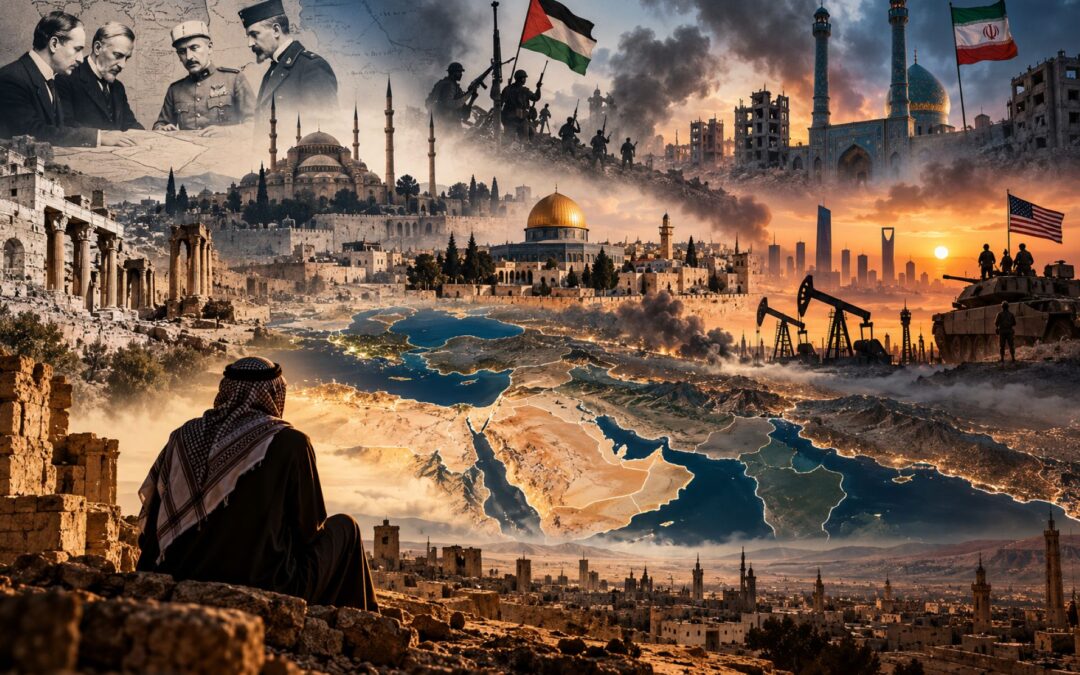
The Middle East is home to some of the world’s oldest civilizations, great religious traditions, historic trading centres, and enormous natural resources. Yet modern discussions of the region are frequently dominated by war. Israel and Palestine, Iran and Saudi Arabia, Syria, Iraq, Lebanon, Yemen, and the involvement of powers such as the United States and Russia form a complicated network of rivalries that can be difficult to understand.
The simplest explanations are also the most familiar. Some blame oil, others point to religious divisions between Sunni and Shia Muslims, while others trace everything to European imperialism or the creation of Israel. Each explanation captures something important, but none can account for the region’s conflicts on its own. Wars that appear connected today often began under different circumstances and developed according to different political interests.
Understanding why the Middle East has experienced so much conflict requires examining how those interests evolved. The collapse of the Ottoman Empire, contradictory European wartime commitments, competing national movements, Cold War interventions, revolutions, and struggles for regional influence created overlapping disputes. Later decisions did not simply repeat earlier conflicts; they changed the political landscape and produced new ones.
The result is not one continuous war with a single cause. It is a history in which territorial disputes, foreign intervention, demands for independence, ideological competition, and security fears have repeatedly reinforced one another.
The Ottoman Empire Falls—and Foreign Powers Move In
For centuries, much of the territory that now forms the modern Middle East belonged to the Ottoman Empire. At different points, Ottoman authority extended across Anatolia, the Levant, Mesopotamia, the Arabian Peninsula, southeastern Europe, and parts of North Africa. The empire governed populations speaking different languages and practising different religions, including Sunni and Shia Muslims, Christians, Jews, Arabs, Turks, Kurds, Armenians, and numerous other communities.
These populations did not share a single identity or political ambition. Some identified primarily with their religion, locality, dynasty, language, or community rather than the modern nations that would eventually emerge. Ottoman institutions, provincial administration, and negotiations with local elites helped maintain imperial authority, although relations between communities were neither uniformly peaceful nor continuously hostile.
By the nineteenth century, the empire faced mounting difficulties. European industrialisation had transformed military technology, transportation, and economic competition, while the Ottoman government struggled to reform its institutions and maintain control over distant territories. European powers repeatedly intervened in Ottoman affairs, sometimes claiming to protect religious minorities and sometimes pursuing unmistakably strategic or commercial interests.
Nationalism added another challenge. Movements demanding autonomy or independence spread through the Balkans and other imperial territories. The empire lost substantial European possessions during the nineteenth century and the Balkan Wars of 1912–13. Italy had also seized Ottoman Libya, while Britain and France had established control over important territories in North Africa.
The empire was weakening, but it was not simply waiting to disappear. Ottoman reformers attempted to strengthen central institutions, modernise the armed forces, and develop a more cohesive state. The Young Turk Revolution of 1908 was part of this struggle over the empire’s political future. Nevertheless, disagreements over centralisation, political representation, and nationalism continued to deepen tensions.
The outbreak of World War I and the Ottoman Empire’s eventual entry into the conflict transformed these problems into a struggle for survival. In late 1914, the Ottoman government entered the war alongside Germany and Austria-Hungary, bringing its territories into direct confrontation with Britain, France, Russia, and their allies.
For Britain, the Ottoman Empire’s position was especially important because of geography. The Suez Canal connected the Mediterranean and Red Seas, providing a much shorter maritime route between Europe and Asia. Control of Egypt and access through the canal were central to Britain’s communications, trade, and military connections with India and its wider empire.
These interests formed part of Britain’s broader system of imperial trade routes, strategic territories, and overseas influence. France likewise possessed longstanding commercial, religious, and political interests in the eastern Mediterranean, particularly in the territories corresponding to modern Lebanon and Syria.
Oil was becoming another strategic consideration. Commercially significant quantities had been discovered in Persia in 1908, and the growing use of petroleum in naval vessels, vehicles, and industrial machinery increased its military importance. Britain was particularly interested in securing reliable supplies, although the vast oil wealth later discovered across the Arabian Peninsula was not yet fully understood.
The First World War therefore brought together several overlapping ambitions. European governments wanted to defeat the Ottomans, secure strategic routes, protect commercial interests, and influence the political settlement that would follow. Arab nationalists and local leaders saw opportunities to challenge Ottoman authority, but their desired futures were not necessarily those envisioned by London or Paris.
The crucial question was what would replace Ottoman rule. Different parties were already making competing plans before the empire had been defeated.
Three Wartime Promises Reshape the Arab Middle East
Between 1915 and 1917, Britain participated in three arrangements that profoundly shaped the modern Middle East. Each arose from wartime calculations, but together they produced expectations that proved difficult to reconcile.
The first developed through correspondence between Sir Henry McMahon, Britain’s High Commissioner in Egypt, and Sharif Hussein bin Ali, the Hashemite ruler of Mecca. Hussein hoped to secure independence for a large Arab political entity in return for supporting the Allies against the Ottoman Empire.
In the Hussein–McMahon correspondence of 1915, Britain indicated support for Arab independence within certain boundaries, subject to exclusions and qualifications. The exact territory covered by these commitments became controversial, especially regarding Palestine. Arab leaders subsequently argued that Palestine had been included, while British officials maintained that the correspondence excluded it.
The disagreement was not a minor technicality. It concerned whether a territory inhabited predominantly by Palestinian Arabs had already been included in Britain’s promises of postwar independence. The correspondence did not produce a mutually agreed map capable of settling the question.
Hussein launched the Arab Revolt in June 1916. Supported by British money, supplies, advisers, and military operations, Arab forces attacked Ottoman positions and communications. The revolt contributed to the Allied campaigns, particularly around the Hejaz and later toward Syria, although its military significance varied considerably across the region.
While these negotiations were taking place, Britain and France were pursuing another arrangement.
The secret Sykes–Picot Agreement, concluded in May 1916, outlined how the two European powers intended to divide influence over substantial portions of the Ottoman Empire’s Arab territories. Named after British diplomat Mark Sykes and French diplomat François Georges-Picot, it provided for areas of direct control and areas of influence, with provision for an international arrangement concerning Palestine.
The historical map of the Sykes–Picot arrangements preserved by the Library of Congress illustrates the imperial spheres envisioned during these negotiations. France expected an influential position in the northern Levant, while Britain anticipated control or influence farther south and east, including strategically important approaches toward Mesopotamia and the Persian Gulf.
Russia was also involved in Allied discussions about Ottoman territory, with ambitions involving the Turkish Straits and parts of eastern Anatolia. The Russian Revolution and Russia’s withdrawal from the war subsequently disrupted those expectations.
Sykes–Picot is often portrayed as the moment European officials drew all the Middle East’s modern borders without considering its inhabitants. That interpretation captures the imperial arrogance of the arrangement but exaggerates its direct effect. The agreement was not implemented exactly as written, and today’s borders emerged through additional negotiations, military occupations, treaties, local resistance, and postwar settlements.
The third major commitment came in November 1917.
The Balfour Declaration, issued by British Foreign Secretary Arthur James Balfour and addressed to Lord Walter Rothschild for communication to the Zionist Federation, expressed British support for establishing a Jewish national home in Palestine. It also stipulated that the civil and religious rights of existing non-Jewish communities should not be prejudiced.
The distinction between a national home and an explicitly sovereign Jewish state mattered. The declaration did not formally promise immediate statehood, although Zionist leaders viewed it as an important political breakthrough toward their national aspirations.
The declaration also contained an important imbalance. It recognised Jewish national aspirations while describing Palestine’s Arab majority as non-Jewish communities whose civil and religious rights required protection. It did not expressly recognise their equivalent political or national rights.
Britain’s decision reflected several considerations. Zionist diplomacy had secured support among influential British policymakers, while some officials believed the declaration could advance Allied interests during the war. Others considered a friendly political presence in Palestine strategically useful near the Suez Canal.
These calculations should not be reduced to the idea that a wealthy Jewish family controlled British or American wartime policy. The United States entered World War I in April 1917, months before the Balfour Declaration was issued. Explaining the declaration requires examining British government strategy, Zionist advocacy, wartime diplomacy, and imperial competition rather than attributing it to a single individual or community.
The contradictions became increasingly consequential after the Ottoman defeat.
At the end of the war, Arab leaders hoped to establish independent governments across former Ottoman territories. Faisal, Hussein’s son, attempted to build an Arab government in Damascus, but French forces defeated his kingdom in 1920. Britain and France subsequently consolidated their positions under the League of Nations mandate system.
France received mandates for Syria and Lebanon. Britain acquired mandates for Iraq and Palestine, while Transjordan developed under separate British administration. The arrangements differed between territories, and local populations continued negotiating, resisting, or contesting the political structures imposed upon them.
The new governments were not simply artificial creations populated by people with no historical connections. Iraq, Syria, Lebanon, Palestine, and neighbouring territories contained longstanding communities, regional identities, economic networks, and local institutions. Nevertheless, the imperial settlement placed distinct populations within new political arrangements and often subordinated their aspirations to external priorities.
Kurdish communities, spread across several territories, did not obtain the independent state some nationalists sought. Arab political unity proved elusive, while European officials attempted to balance local elites, colonial interests, and their competing visions of regional stability.
Britain also faced resistance in Iraq and eventually supported a Hashemite monarchy there. Other arrangements developed in Transjordan and the Arabian Peninsula, where local dynasties, rivalries, and military campaigns shaped the emergence of modern states.
The Ottoman Empire’s collapse had created opportunities for independence, but the resulting order was neither wholly independent nor universally accepted. The sharpest contradiction would develop in Palestine, where two national movements increasingly regarded the same territory as essential to their futures.
Palestine, Partition, and the Wars That Followed
The Israeli–Palestinian conflict is often explained as an ancient religious feud. Religion gives the land extraordinary significance, particularly Jerusalem and its sacred places, but the modern conflict developed primarily through competing national movements, migration, political authority, and territorial claims.
Modern political Zionism emerged in nineteenth-century Europe, where Jewish communities faced discrimination, antisemitism, and periodic violence. Zionists argued that Jews constituted a people entitled to national self-determination, with the historic Jewish homeland in Palestine at the centre of their aspirations.
Jewish religious and historical connections to the land long predated modern Zionism. Jewish communities continued living in Palestine alongside Muslims and Christians, while Jewish immigration also increased during the late nineteenth and early twentieth centuries. However, the political movement for a modern Jewish national home was distinct from Jewish religious identity, and many Jews initially opposed Zionism or preferred other solutions to European antisemitism.
Palestinian Arabs, meanwhile, possessed longstanding family, cultural, economic, and political connections to the same land. Their national consciousness developed through broader Arab intellectual movements, opposition to Ottoman and later British rule, and increasing resistance to the prospect of losing political control over their homeland.
Under the British Mandate, the two movements confronted a political framework that could not easily satisfy both.
Jewish immigration increased, particularly as antisemitic persecution worsened in Europe. Zionist institutions developed agricultural settlements, political organisations, labour networks, and armed defensive groups, strengthening the foundations of a future state. Palestinian Arabs feared that demographic and landownership changes would eventually undermine their prospect of national independence.
Violence broke out at several points during the 1920s and 1930s. Clashes reflected disputes over immigration, land, political representation, religious sites, and British administration, with civilians from different communities suffering attacks.
The Arab Revolt of 1936–39 marked a particularly important escalation. Palestinian Arabs protested British rule and Jewish immigration, while armed groups attacked British installations and Jewish targets. Britain suppressed the revolt through extensive military operations, policing, arrests, and emergency measures.
The consequences were severe for Palestinian Arab political organisation. Many leaders were imprisoned, exiled, or weakened, leaving the community less institutionally prepared for the confrontation that followed.
British policy also became increasingly contradictory. In 1939, London issued a White Paper proposing restrictions on Jewish immigration and a future independent Palestine, alienating much of the Zionist movement just as European Jews faced catastrophic persecution.
The Holocaust fundamentally transformed the political and humanitarian circumstances. Nazi Germany and its collaborators murdered approximately six million European Jews, intensifying demands for a secure Jewish homeland and increasing international support for Jewish statehood. For many Holocaust survivors, Palestine represented a possible place of refuge after the destruction of their communities.
Palestinian Arabs, however, objected to being required to surrender political control over their homeland as a consequence of crimes committed primarily in Europe. Both national movements claimed legitimate rights, but their competing visions of sovereignty could not be reconciled within the existing political arrangement.
By 1947, Britain was increasingly unable or unwilling to resolve the dispute and referred the problem to the newly established United Nations.
The UN General Assembly recommended partitioning British Mandate Palestine into separate Arab and Jewish states, with Jerusalem placed under a special international arrangement. Jewish leaders accepted the proposal, although not without reservations about its boundaries. Arab leaders rejected it, arguing that the plan violated the political rights of the country’s Arab majority and allocated a disproportionately large territory to the proposed Jewish state.
The United Nations’ historical account of the Question of Palestine traces how this proposed partition, the subsequent wars, and the continuing dispute over national rights shaped the conflict.
Fighting began after the November 1947 partition recommendation, before Israel declared independence. Jewish and Palestinian Arab forces fought across towns, roads, and mixed communities as British withdrawal approached.
On May 14, 1948, David Ben-Gurion proclaimed the establishment of Israel. Armies from neighbouring Arab states entered the conflict shortly afterward, transforming the fighting into a broader interstate war.
Israel survived and secured substantially more territory than the UN partition plan had assigned to the proposed Jewish state. Jordan came to control the West Bank, including East Jerusalem, while Egypt administered the Gaza Strip. The Palestinian Arab state envisaged by the UN plan was never established.
For Israelis, the war became associated with independence, national survival, and the establishment of a sovereign Jewish state after centuries of persecution. For Palestinians, it became the Nakba, or catastrophe.
More than 700,000 Palestinians fled or were expelled from their homes during the fighting and its aftermath. Villages were depopulated or destroyed, families were separated, and refugees sought safety in the West Bank, Gaza, Jordan, Lebanon, Syria, and elsewhere.
The causes of displacement varied across locations, including direct expulsions, fear of violence, military operations, and the collapse of communities. The resulting refugee question became one of the conflict’s most enduring disputes, particularly regarding return, compensation, property, and recognition of historical responsibility.
The 1949 armistice agreements stopped major hostilities but did not resolve the competing national claims. Israel remained insecure in a region where several governments rejected its legitimacy, while Palestinians remained without an independent state.
Further wars changed the territorial situation.
In 1967, amid escalating regional tensions and military mobilisation, Israel launched attacks against Egyptian forces and fought Egypt, Jordan, and Syria in the Six-Day War. Israel captured the Sinai Peninsula, Gaza Strip, West Bank, East Jerusalem, and Golan Heights.
These territorial conquests fundamentally changed the conflict. Israel now controlled the West Bank and Gaza, territories central to Palestinian demands for statehood, along with other areas captured from neighbouring states. Israeli settlement activity in occupied territory subsequently became another major source of dispute.
In 1973, Egypt and Syria launched a coordinated attack in an effort to reverse territorial losses. Although Israel eventually recovered militarily, the war demonstrated that the post-1967 situation could not be treated as permanently settled.
Diplomacy produced important changes. Egypt signed a peace treaty with Israel in 1979 and recovered Sinai through the subsequent withdrawal of Israeli forces. Jordan signed its own peace treaty in 1994.
The Palestinian question proved more difficult. The Palestine Liberation Organization emerged as a central representative of Palestinian nationalism, while the First Intifada beginning in 1987 brought widespread resistance against Israeli occupation. The Oslo agreements of the 1990s established limited Palestinian self-government and mutual recognition between Israel and the PLO, but did not settle borders, refugees, Jerusalem, settlements, or final sovereignty.
Later violence, including the Second Intifada, deepened mistrust. Israel withdrew its permanent settlers and ground forces from Gaza in 2005, but disputes over borders, maritime access, airspace, and external control continued. After Hamas took control of Gaza in 2007, Israel imposed extensive restrictions on the territory, with Egypt also regulating access through its border.
Israel cited security threats, including attacks by armed Palestinian organisations, while Palestinians continued to demand freedom from occupation, meaningful sovereignty, and an end to restrictions and displacement.
The conflict therefore cannot be understood solely as hostility between Jews and Muslims. It involves competing national claims, security concerns, territorial control, international law, historical dispossession, and generations of unresolved political decisions.
It also became entangled with a wider struggle over the political future of the Arab world.
Arab Nationalism Meets the Cold War
The creation of Israel and the defeat of Arab armies in 1948 weakened the legitimacy of several established governments. Across the region, activists and military officers increasingly argued that monarchies and colonial-era political institutions had failed to secure national independence, economic development, and dignity.
One of the most influential figures to emerge from this period was Gamal Abdel Nasser.
In 1952, Egyptian military officers overthrew King Farouk, ending the monarchy’s effective rule. Nasser eventually became Egypt’s dominant leader and promoted a vision of Arab nationalism built around independence from foreign domination, political modernisation, and solidarity among Arab-speaking societies.
Nasser’s influence extended far beyond Egypt. He argued that Arab governments should resist Western interference and cooperate to overcome political fragmentation. His rhetoric attracted supporters across the region, although the degree to which different populations supported political unity varied considerably.
The Suez Crisis of 1956 turned him into an international symbol of anti-imperial resistance.
Nasser nationalised the Suez Canal Company, challenging a commercial and strategic arrangement long associated with British and French power. Britain and France regarded the move as a threat to their influence, while Israel viewed Egypt’s policies and regional military posture as serious security challenges.
The three countries secretly coordinated military action. Israel invaded Sinai in October 1956, and British and French forces subsequently intervened under the pretext of separating the combatants and protecting the canal.
The operation proved politically disastrous for Britain and France. The United States, under President Dwight Eisenhower, opposed their intervention and applied diplomatic and financial pressure, while the Soviet Union also condemned it. The invaders eventually withdrew.
As explained in the US State Department’s historical account of the Suez Crisis, the confrontation illustrated Britain’s and France’s declining ability to impose their will independently and the increasing influence of the Cold War superpowers.
Nasser emerged with greater prestige. Yet his ambition for a politically unified Arab world encountered significant obstacles. Egypt and Syria formed the United Arab Republic in 1958, but the arrangement collapsed in 1961 amid disagreements over political authority and centralisation.
Arab governments often shared ideological language while pursuing incompatible national interests. Monarchies feared revolutionary republican movements, military regimes disagreed over leadership, and disputes between neighbouring states persisted.
Meanwhile, the United States and Soviet Union competed for influence.
The Soviet Union developed military and political relationships with Egypt, Syria, and Iraq at different times, although these governments were not necessarily communist or unquestioningly obedient to Moscow. Washington supported important conservative governments, including Saudi Arabia and other Gulf monarchies, while its relationship with Israel grew progressively closer.
These alignments formed part of the larger history of Cold War competition and indirect conflicts between Washington and Moscow. Regional governments frequently accepted assistance from powerful patrons while retaining their own agendas, sometimes changing partners when circumstances shifted.
Egypt illustrates this flexibility. Nasser relied heavily on Soviet weapons and assistance, but his successor Anwar Sadat eventually expelled Soviet military advisers, reoriented Egyptian foreign policy, and pursued closer relations with the United States.
The defeat of Arab forces in 1967 damaged the prestige of pan-Arab nationalism, although it did not immediately eliminate the ideology. Sadat’s later peace with Israel further demonstrated that Arab states were increasingly making decisions according to their individual security and diplomatic interests.
Iran experienced another form of Cold War intervention.
In 1951, Prime Minister Mohammad Mossadegh became the leading figure in Iran’s effort to nationalise its oil industry, which had long operated under arrangements dominated by British interests. Nationalisation was an assertion of economic sovereignty, but it also produced a severe confrontation with Britain and disrupted Iranian oil exports.
British officials sought Mossadegh’s removal, while American policymakers became increasingly concerned about political instability and potential Soviet influence.
In August 1953, British and American intelligence operations helped overthrow Mossadegh’s government. A declassified CIA memorandum published by the US State Department documents the campaign to replace his government with one more closely aligned with Western interests under the Shah’s leadership.
Mohammad Reza Pahlavi had already been Iran’s monarch before the coup. The intervention strengthened his position and helped establish the authoritarian political order that subsequently governed Iran.
The oil arrangements that followed were also more complicated than a simple transfer of ownership to the United States. A 1954 settlement created an international consortium involving British, American, Dutch, and French oil interests, while Iran retained formal ownership through its national oil company. Foreign companies nevertheless continued exercising substantial operational influence.
For many Iranians, the coup became a powerful symbol of foreign interference and the denial of national self-determination. Its memory would remain politically important long after the Cold War calculations that helped produce it had changed.
Oil played a different role in the Gulf monarchies. Petroleum exports gave governments such as Saudi Arabia, Kuwait, Qatar, and the emerging Gulf states substantial financial resources, while their relationships with Western powers provided military assistance and security guarantees.
The 1973 Arab oil embargo demonstrated that petroleum could also be used as a diplomatic instrument. Arab oil producers attempted to pressure countries supporting Israel during the war, contributing to an international energy crisis and reinforcing the Middle East’s importance to the global economy.
By the 1970s, the region was shaped by competing nationalist governments, conservative monarchies, the unresolved Israeli–Palestinian conflict, foreign military relationships, and oil wealth. These rivalries were already complex when another major transformation began in Iran.
Iran’s 1979 Revolution Changes the Region’s Politics
The Iranian Revolution of 1979 transformed the political balance of the Middle East. It overthrew a monarchy closely associated with the United States and established an Islamic Republic whose leaders openly challenged American influence and the regional order supported by Washington.
Its significance becomes clearer when placed within the longer history of political Islam.
Islamism broadly describes movements seeking to give Islamic principles a defining role in political authority, law, and society. Such movements differ enormously in their interpretations, institutions, methods, and objectives. Some participate in electoral politics, others support authoritarian government, and some embrace revolutionary or militant activity.
Their development long predated the Iranian Revolution. Egypt’s Muslim Brotherhood, founded in 1928 by Hassan al-Banna, became one of the most influential organised movements advocating an Islamic framework for social and political reform. Other Islamic revivalist and political movements emerged through different intellectual and historical circumstances.
The decline of secular Arab nationalism helped create opportunities for some Islamist movements, but it did not originate them.
In Iran, the Shah’s government pursued rapid modernisation, industrial development, military expansion, and closer relationships with Western powers. These policies produced economic and social changes but also considerable resentment.
Critics objected to political repression, corruption, inequality, foreign dependence, and the concentration of power around the monarchy. The Shah’s security apparatus, particularly SAVAK, became associated with surveillance, imprisonment, and torture.
Opposition came from a broad coalition that included religious leaders, students, liberals, leftists, nationalists, and ordinary citizens. Ayatollah Ruhollah Khomeini emerged as a particularly influential figure through his denunciation of the Shah and his advocacy of an Islamic political order.
Mass protests and strikes destabilised the monarchy. The Shah left Iran in January 1979, Khomeini returned from exile in February, and the revolutionary movement dismantled the old regime.
The establishment of the Islamic Republic subsequently transformed the coalition’s aspirations into a political system dominated by religious institutions. Khomeini’s doctrine of clerical guardianship gave senior Islamic jurists extraordinary authority over the state, while many former revolutionary allies found themselves excluded or suppressed.
The seizure of the American embassy in Tehran later in 1979 deepened the rupture with Washington. The hostage crisis became a defining event in US–Iranian relations, reinforcing mutual hostility that continued for decades.
For the wider region, the revolution raised several fears.
Iran’s new leaders promoted revolutionary ideals and challenged monarchies that they regarded as dependent on Western power. Governments in Saudi Arabia and other Gulf states feared political agitation, particularly among communities that might sympathise with Iran’s religious or revolutionary message.
The religious dimension mattered because Iran is predominantly Shia Muslim, while Saudi Arabia’s monarchy claims a central position in the Sunni Muslim world through its custodianship of Islam’s holiest sites. However, describing the resulting rivalry as simply Sunni against Shia obscures its political foundations.
The distinction between religious and national identity is essential here. As the separate explanation of the difference between Arab and Muslim identities makes clear, being Arab is not equivalent to being Muslim. Iran is a predominantly Persian-speaking state, and its relationships with Arab governments are shaped by history, politics, geography, and security interests as well as religion.
Iranian political identity also reflects a long history extending well beyond the Islamic Republic, including the development of Shia state institutions under the Safavids and the struggle over foreign influence during the modern Pahlavi period. These continuities are important to understanding Iran’s transformation from the Persian empires to the revolutionary state.
The Gulf monarchies responded by strengthening security cooperation. Saudi Arabia, Kuwait, Bahrain, Qatar, Oman, and the United Arab Emirates established the Gulf Cooperation Council in 1981, partly reflecting concerns about regional instability and the effects of Iran’s revolution.
Their relations with the United States became increasingly important, although individual Gulf governments maintained different foreign policy priorities and relationships with Tehran.
The Iranian Revolution did not produce a unified regional division overnight. Instead, it introduced another powerful ideology and a government whose opposition to Western influence altered diplomatic calculations across the Middle East.
The next generation of wars would demonstrate how revolutionary politics, territorial ambitions, and foreign intervention could interact with devastating consequences.
Afghanistan, Iraq, and the Costs of Intervention
Two countries became central to the region’s changing security environment during the late twentieth century: Afghanistan and Iraq.
Afghanistan is geographically distinct from the Arab Middle East, but its wars deeply affected political movements, military networks, and foreign-policy decisions across the wider Islamic world.
In December 1979, Soviet forces entered Afghanistan to support a communist government struggling against armed opposition. Moscow feared losing a strategically important neighbouring ally, but the intervention became a prolonged and destructive war.
Afghan resistance included numerous mujahideen factions with different political, ethnic, religious, and local objectives. They were not a single organisation under unified leadership, nor did they all share the ideology of later transnational extremist movements.
The United States supported the Afghan resistance as part of its effort to weaken Soviet influence. Pakistan’s intelligence services played a major role in distributing assistance, while Saudi Arabia and other governments provided financial and political support. Weapons, funding, and training strengthened various Afghan factions, although assistance and influence were distributed unevenly.
The war inflicted immense suffering. Large numbers of civilians were killed or displaced, millions became refugees, and Afghanistan’s infrastructure and institutions were devastated. Soviet forces withdrew in 1989, but the departure of the occupying army did not create a stable political settlement.
The Afghan government eventually collapsed, rival mujahideen factions fought for power, and the country descended into another civil war.
The Taliban emerged in the 1990s from a different political and social environment shaped by war, refugee communities, religious education, and regional patronage. The movement gained control of much of Afghanistan and established its first government in 1996.
Al-Qaeda developed along a separate trajectory. Osama bin Laden and his associates built a transnational militant network from connections formed during the Afghan jihad, seeking to pursue violence against governments and countries they viewed as enemies.
It is misleading to claim that Washington directly created or financed Al-Qaeda simply because the United States supported Afghan resistance groups. American assistance strengthened the wider anti-Soviet war effort, but direct US funding of bin Laden is not established by the historical evidence.
Nevertheless, the broader consequences of foreign intervention were profound. Armed organisations, weapons, ideological networks, and years of institutional collapse helped create conditions in which extremist movements could develop.
Following Al-Qaeda’s September 11, 2001 attacks on the United States, Washington launched military operations in Afghanistan against the Taliban government, which had provided sanctuary to the organisation. The Taliban lost national power in 2001, but the war continued for another two decades before its return to Kabul in 2021.
Afghanistan demonstrated the difficulty of converting military intervention into durable political stability.
Iraq presented a different set of problems.
In September 1980, Iraqi President Saddam Hussein launched an invasion of Iran. He hoped to exploit the instability following Iran’s revolution, improve Iraq’s strategic position, and challenge Iranian influence, while longstanding territorial disputes added to the confrontation.
The Iran–Iraq War lasted until 1988 and caused enormous casualties and economic destruction. It included missile attacks on cities, attacks on oil infrastructure and shipping, and Iraq’s extensive use of chemical weapons.
Several Arab Gulf governments supported Iraq financially or politically because they feared the spread of Iran’s revolution. The United States also tilted toward Iraq during parts of the conflict, although American relations with both governments were complicated and Washington simultaneously engaged in covert dealings with Iran.
The war revealed how regional governments could temporarily cooperate with a country they otherwise distrusted in order to prevent a more threatening strategic outcome.
It also left Iraq heavily indebted and militarised.
In August 1990, Saddam invaded Kuwait, claiming grievances involving debt, oil production, and territorial disputes. The occupation threatened Gulf security and raised fears that Iraq might extend its control toward Saudi Arabia’s oil-producing regions.
The United States assembled an international coalition operating under United Nations Security Council authorisation. In 1991, coalition forces expelled Iraqi troops from Kuwait during the Gulf War.
The war greatly reinforced Washington’s military role in the Gulf. American forces and facilities became increasingly important to regional security arrangements, particularly in Saudi Arabia and neighbouring states.
That presence generated controversy. Some governments regarded American protection as essential, while Islamist militants such as bin Laden denounced the stationing of foreign forces near Islam’s holy cities. These grievances became part of Al-Qaeda’s broader ideological justification for violence, although they cannot alone explain the organisation’s development or actions.
Iraq remained under Saddam’s dictatorship throughout the 1990s, subject to sanctions, international inspections, and recurring confrontations with Western governments.
The next major turning point came in March 2003.
The United States, supported by Britain and other coalition partners, invaded Iraq and overthrew Saddam Hussein. The Bush administration presented Iraqi weapons of mass destruction and security concerns as central justifications, but the alleged active stockpiles were not found.
The invasion’s legality was widely challenged, particularly because it lacked a new, explicit Security Council authorisation for the use of force. Supporters defended the removal of Saddam’s repressive government, while critics argued that the war violated Iraqi sovereignty and produced consequences far beyond its stated objectives.
The destruction of the existing political order created a dangerous institutional vacuum. The disbanding of Iraq’s military and the exclusion of large numbers of former Baath Party members weakened state capacity while fuelling anger among segments of the population.
Armed insurgencies, sectarian attacks, militia activity, and competition among political factions followed. Sunni extremist networks expanded, Shia armed movements gained power, and Iran developed greater influence through relationships with Iraqi parties and militias.
Al-Qaeda’s Iraqi branch became a central participant in the violence. Its successors later contributed to the rise of the Islamic State, which seized substantial territory in Iraq and Syria in 2014 before losing its major territorial strongholds to local and international military campaigns.
The consequences were especially revealing for Washington. An invasion justified partly as a means of improving regional security helped produce instability that strengthened some of America’s adversaries, including Iran’s influence within Iraq.
Yet neither Afghanistan nor Iraq can be explained entirely through foreign intervention. Afghan political factions, Iraqi leaders, militias, neighbouring governments, and local communities all made decisions that affected the wars’ trajectories.
The central lesson is that removing an existing government or defeating an enemy does not resolve the deeper political disputes that determine what happens afterward. When institutions collapse and competing groups struggle for authority, intervention can create new conflicts that survive long after the original military campaign ends.
How Regional Rivalries Turn Local Wars Into Proxy Conflicts
By the early twenty-first century, the Middle East contained a dense network of alliances, armed organisations, foreign military relationships, and unresolved political disputes. Governments increasingly sought influence beyond their borders, often supporting local forces rather than confronting their rivals directly.
This pattern is commonly described as proxy warfare.
A proxy conflict occurs when outside powers support armed or political actors involved in another country’s struggle. Support can include weapons, money, intelligence, training, diplomatic assistance, or direct operational cooperation.
However, calling a group a proxy does not mean it obeys every instruction from its foreign backer. Local organisations often possess independent leadership, domestic constituencies, ideological commitments, and political objectives. Their interests may overlap with those of a sponsoring government without being identical.
Iran provides an important example.
Following the 1979 revolution, Iranian governments developed relationships with armed movements and political organisations across the region. These ties enabled Tehran to exert influence beyond its borders and, in some cases, threaten adversaries without relying solely on conventional interstate warfare.
Hezbollah emerged in Lebanon during the 1980s amid the Lebanese Civil War and Israel’s 1982 invasion. Iran played a major role in its development, but Hezbollah also became a Lebanese political and military organisation with its own constituency, institutions, and domestic interests.
Its relationship with Iran has involved ideological alignment, military assistance, and strategic cooperation, particularly in confronting Israel. Nevertheless, understanding Hezbollah requires examining Lebanese politics, Israel–Lebanon tensions, and the country’s confessional political system, not merely Iranian foreign policy.
In Iraq, Iran cultivated relationships with Shia political parties and armed groups, especially after Saddam’s removal. Some developed close security ties with Tehran, while others pursued more autonomous Iraqi agendas. Their influence became entangled with disputes over state authority, sectarian representation, and the presence of foreign troops.
Iran also developed relationships with Palestinian militant organisations, including Hamas and Palestinian Islamic Jihad.
Hamas is a Sunni Islamist Palestinian movement, demonstrating why Iran’s regional relationships cannot be understood as a simple Shia alliance. Tehran’s support reflects shared opposition to Israel and other strategic interests, even where religious doctrines and political priorities differ.
Yemen illustrates another complicated relationship.
The Houthi movement originated in northern Yemen through local religious, political, and social grievances. Its roots predate the present regional rivalry and include conflicts with the Yemeni government over authority, identity, and marginalisation.
After the Houthis seized the capital, Sanaa, in 2014, Yemen’s political crisis intensified. A Saudi-led coalition intervened militarily in 2015 in support of the internationally recognised government, fearing the emergence of a hostile armed movement along Saudi Arabia’s southern border.
Iran supplied assistance to the Houthis, although the movement maintained its own leadership and domestic objectives. The conflict developed into a devastating humanitarian catastrophe involving foreign military intervention, internal fragmentation, economic collapse, and prolonged displacement.
Treating Yemen solely as a Saudi–Iranian proxy war therefore overlooks the original Yemeni political crisis and the decisions of domestic factions.
Syria presented an even more complex confrontation.
In 2011, protests against President Bashar al-Assad’s authoritarian government were met with repression, helping transform political unrest into an armed conflict. Opposition forces fragmented, jihadist organisations gained territory, and foreign governments increasingly intervened.
Iran and Hezbollah supported Assad’s government, while Russia intervened militarily in 2015 to help preserve it. Turkey supported several opposition groups and pursued its own security objectives, particularly regarding Kurdish armed organisations near its southern border.
The United States supported forces fighting the Islamic State, including Kurdish-led formations. Gulf governments and other regional actors also supported different opposition movements at various points.
The result was not a simple conflict between two foreign sponsors. Syria became a battlefield where struggles over authoritarian rule, opposition politics, territorial control, Kurdish autonomy, jihadist movements, and regional security intersected.
Saudi–Iranian competition influenced these wars, but it was never the only force shaping them.
Saudi Arabia’s foreign policy has historically been influenced by concerns about Iranian power, domestic security, its religious position, and relationships with other Arab governments. Iran has sought to protect its political system, maintain regional influence, and establish deterrence against stronger conventional military adversaries.
Other governments have pursued their own calculations. Qatar has supported different political movements from Saudi Arabia, while the United Arab Emirates has developed distinct relationships and security priorities. Turkey’s interests in Syria and Iraq often revolve around Kurdish armed movements, border security, and regional influence.
Russia’s involvement has reflected its military relationships, strategic access, and desire to maintain international influence. The United States has sought to protect allies, counter militant organisations, preserve regional access, and prevent hostile powers from dominating strategically important areas.
These positions have changed over time. Governments that cooperate against one threat can disagree sharply over another.
The restoration of Saudi–Iranian diplomatic relations in March 2023 offered an important illustration. In a joint agreement announced by Saudi Arabia, Iran, and China, Riyadh and Tehran agreed to resume diplomatic relations and reaffirm commitments concerning sovereignty and non-interference.
The agreement did not erase years of rivalry or eliminate their competing interests. It demonstrated, however, that even longstanding antagonists may seek accommodation when the costs of confrontation become too high.
The region’s political landscape is therefore better understood as a shifting network than as two permanently opposed camps. States form relationships according to security interests, diplomatic opportunities, domestic politics, and changing regional circumstances.
The wars that followed October 2023 would expose both the strength and the fragility of these relationships.
From October 2023 to the Regional Crises of 2026
On October 7, 2023, Hamas-led Palestinian armed groups launched a large-scale attack into southern Israel. They attacked civilian communities and military positions, killed approximately 1,200 people, and took around 250 hostages into Gaza.
The deliberate killing of civilians and hostage-taking were grave violations of international humanitarian law. Israel responded with an extensive military campaign intended to destroy Hamas’s military capabilities and recover the hostages.
The resulting war produced catastrophic destruction and civilian suffering in Gaza. Large numbers of Palestinians were killed or injured, communities were displaced repeatedly, and essential infrastructure—including homes, hospitals, schools, water systems, and roads—suffered extensive damage.
International investigators and humanitarian organisations raised serious concerns about the conduct of hostilities, civilian protection, humanitarian access, forced displacement, and restrictions on essential supplies. The legality of particular military operations and the responsibilities of those involved became subjects of international investigation and litigation.
The conflict did not begin in October 2023. The attack occurred within the longer context of occupation, blockade, failed peace initiatives, Palestinian political division, and recurring wars between Israel and armed organisations in Gaza. Recognising that history is necessary to explain the conflict, but it does not justify attacks on civilians or excuse violations by any party.
The war also threatened a diplomatic transformation that had been taking place across parts of the Arab world.
In 2020, Israel established formal normalisation agreements with the United Arab Emirates and Bahrain under the Abraham Accords framework, with Morocco also advancing normalisation and Sudan entering a more complicated process. These agreements demonstrated that some Arab governments were willing to develop official relations with Israel without first securing a comprehensive resolution of the Palestinian question.
Economic cooperation, technology, investment, trade, security, and concerns about Iranian influence contributed to these calculations. For participating governments, relations with Israel offered potential strategic and commercial benefits.
Saudi Arabia was not an original signatory to the Abraham Accords, but discussions concerning possible Saudi–Israeli normalisation became increasingly prominent before October 2023.
Such a development would have carried considerable symbolic and strategic importance because of Saudi Arabia’s regional influence and its position in the Islamic world. It also raised questions about whether Palestinian national aspirations would retain their former centrality in Arab diplomacy.
Some analysts have argued that disrupting normalisation was among the strategic calculations behind Hamas’s attack. Iran also had reasons to oppose a regional diplomatic arrangement that might strengthen Israel and its partners. However, these interpretations should not be presented as conclusively established explanations of Hamas’s motives or as proof that Tehran directed the operation.
Hamas’s own political objectives, Palestinian circumstances, its relationship with other armed groups, and the decisions of its leadership must remain distinct from assumptions about external sponsorship.
The consequences spread beyond Gaza.
Along Israel’s northern border, Hezbollah and Israeli forces exchanged attacks, eventually escalating into a wider military confrontation involving Israeli operations in Lebanon. The fighting demonstrated how the Israel–Palestine conflict could interact with existing tensions between Israel, Hezbollah, and Iran.
Yemen’s Houthis also became involved in attacks connected to the Gaza war, including operations threatening commercial shipping in the Red Sea. These attacks affected a maritime route essential to international trade and prompted responses from Western governments.
The maritime dimension mattered because the Middle East is not strategically important only as a producer of oil. Routes through the Suez Canal, Red Sea, Bab el-Mandeb Strait, Persian Gulf, and Strait of Hormuz connect markets across Europe, Asia, and Africa. Military instability along these routes can disrupt shipping, raise transportation costs, and affect economies far beyond the immediate conflict zones.
Meanwhile, Syria underwent a dramatic political transformation.
In December 2024, a rebel offensive brought down Bashar al-Assad’s government, ending more than five decades of rule by the Assad family. Assad fled to Russia, while forces led by Hayat Tahrir al-Sham emerged at the centre of a new transitional government.
Ahmed al-Sharaa became Syria’s transitional president in January 2025. The collapse of the Assad government weakened an important regional ally of Iran and transformed the political relationships that had developed during the civil war.
Yet Assad’s removal did not resolve Syria’s underlying problems. The new authorities faced the enormous task of rebuilding state institutions, integrating armed factions, protecting minorities, managing territorial disputes, and establishing a political order accepted by different communities.
Kurdish autonomy remained particularly important. Kurdish-led forces had governed substantial areas of northeastern Syria during the civil war, while Turkey regarded elements of these armed formations as a threat because of their connections with Kurdish militancy across its border.
Fighting in early 2026 produced new agreements between Syrian transitional authorities and Kurdish-led forces, setting out arrangements for integrating territory and security institutions. Implementation remained politically sensitive, particularly regarding local representation, minority rights, and the distribution of authority.
As documented in the UK House of Commons Library’s September 2026 assessment of Syria’s political and security transition, the country had made significant changes to its institutional structure but continued facing disputes over Kurdish integration, representation, accountability, and minority protections.
Syria’s experience illustrated an important distinction between defeating a regime and establishing a stable state. The disappearance of one government can remove an old source of conflict while creating new struggles over who inherits its authority.
Gaza remained in a humanitarian crisis even after a ceasefire was announced in October 2025.
A ceasefire can reduce large-scale hostilities without settling the political causes of a war or guaranteeing civilian safety. The unresolved questions included Gaza’s governance, disarmament, reconstruction, Israeli security concerns, Palestinian political representation, and the broader future of Palestinian statehood.
By October 2026, the humanitarian consequences remained severe. In its Humanitarian Situation Report of October 22, 2026, the United Nations Office for the Coordination of Humanitarian Affairs described continuing casualties in Gaza, shortages of essential medicines, inadequate shelter, damaged infrastructure, and difficulties maintaining humanitarian assistance.
UNICEF reported that hundreds of children had been killed since the October 2025 ceasefire announcement, while restrictions and funding shortages continued to undermine relief operations. Humanitarian organisations warned that reduced food assistance and inadequate housing left families exposed to worsening conditions.
The West Bank also experienced serious instability. Israeli military operations, settler violence, restrictions on movement, demolitions, and continuing settlement-related disputes contributed to Palestinian insecurity and displacement.
These developments demonstrated that the Palestinian question could not be reduced to the status of fighting in Gaza. Questions concerning occupation, sovereignty, security, refugees, settlement activity, Jerusalem, and political rights remained unresolved.
The regional situation became even more dangerous in 2026 when confrontation involving Iran, Israel, and the United States escalated into direct warfare.
On February 28, 2026, American and Israeli strikes against Iran initiated a wider conflict. Iran retaliated against targets across the region and sought to exercise pressure around the Strait of Hormuz through threats and attacks affecting maritime traffic.
The confrontation differed from earlier periods in which Iran and its adversaries primarily operated through diplomatic pressure, covert activity, or allied armed organisations. Direct military exchanges raised the possibility that a regional struggle once largely conducted indirectly could develop into a more extensive interstate war.
The Strait of Hormuz was particularly important because a substantial share of internationally traded petroleum passes through it. Disruption threatened Gulf exporters, energy-importing countries, shipping businesses, and global economic stability.
Diplomatic efforts produced temporary pauses but did not immediately resolve the confrontation.
According to the Congressional Research Service’s September 18, 2026 assessment of the US–Iran conflict, the United States and Iran agreed to an April ceasefire and signed a memorandum of understanding in June intended to end hostilities and support further negotiations. That arrangement subsequently collapsed, and limited military exchanges had resumed by September.
The report described continuing risks involving Iranian retaliation, American military operations, Gulf security, sanctions, and the economic consequences of a prolonged confrontation.
These developments cannot be explained by the Israeli–Palestinian conflict alone, although the regional escalation interacted with its consequences. The Iranian nuclear question, military deterrence, Iranian regional influence, Israeli security policy, American commitments, and the security concerns of Gulf governments all contributed to the wider confrontation.
Nor did the conflict reveal a simple division between Arab governments on one side and Iran on the other. Gulf states faced difficult choices because Iranian power threatened some of their security interests while a prolonged war also endangered their infrastructure, economies, and political stability.
Countries such as Oman, Qatar, and Saudi Arabia had reasons to preserve diplomatic channels, even while maintaining relationships with Washington and pursuing different policies toward Tehran. The incentives to prevent escalation were therefore substantial, despite unresolved strategic disagreements.
The wars of the 2020s also challenged several assumptions inherited from the previous century.
Assad’s fall altered Iran’s regional network. Arab–Israeli normalisation demonstrated that some governments were willing to separate their diplomatic relationships from the unresolved Palestinian question, even as the Gaza war renewed public and political attention to Palestinian rights. Direct US–Iranian confrontation showed how indirect rivalry could escalate into open conflict.
At the same time, the region continued to display considerable diversity. Several Gulf states developed sophisticated economies, international investment relationships, and diplomatic initiatives. Others struggled with civil war, weakened institutions, displacement, and the consequences of repeated intervention.
These differences matter because describing the entire Middle East as a permanently unstable region obscures the varied political trajectories of its countries.
The modern Middle East is not a single battlefield governed by one historical grievance. It is a collection of states and societies whose conflicts have different origins but frequently become connected through alliances, geography, ideology, security arrangements, and economic interests.
That interconnectedness explains why a conflict in one country can rapidly affect several others. It does not mean every country shares the same political goals or that every future confrontation is inevitable.
The question of why the Middle East has experienced so much conflict therefore has no single answer.
European imperialism helped create political arrangements and territorial disputes that continue to matter. Competing national movements struggled over sovereignty, most consequentially in Palestine. Cold War intervention reinforced external military relationships and contributed to authoritarian rule and political instability. Revolutionary movements changed the ideological landscape, while governments and armed organisations pursued influence across national borders.
Oil made the region economically and strategically significant, but it did not create every conflict. Religion has shaped political identity and mobilisation, but disputes involving religious communities frequently concern territory, institutions, resources, and power as much as theology.
The most important distinction is between explaining historical conditions and denying the responsibility of those making decisions within them. Governments, movements, and outside powers inherited difficult circumstances, but their choices could escalate disputes, prolong wars, support negotiations, or create opportunities for peace.
Understanding the past does not make today’s conflicts inevitable. It reveals why they became interconnected, why some have proved so difficult to resolve, and why durable peace requires addressing the political grievances and security concerns that repeatedly turn local disputes into regional crises.
Last Updated on October 29, 2026 by Aseem Gupta