
Reading Time: 56 Minutes
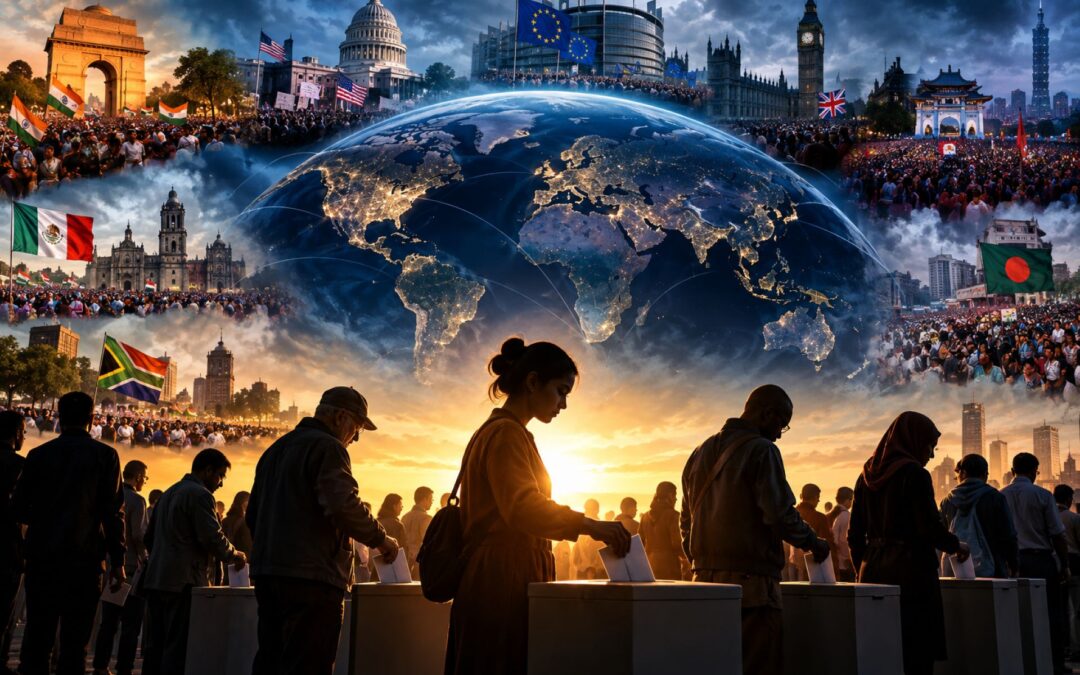
In 2024, much of the world went to the polls. From the world’s largest democracy to Pacific island nations with populations smaller than a typical city neighbourhood, voters chose presidents, parliaments and governments in an extraordinary concentration of elections. Some removed leaders who had dominated their countries for decades. Others strengthened political dynasties, returned controversial figures to power or participated in contests where the outcome was barely in doubt.
The scale was historic. According to International IDEA’s 2024 global election tracker, 74 national elections took place across 62 countries, alongside the European Parliament elections. Approximately 1.65 billion ballots were cast, although that figure includes people voting in multiple rounds or different elections. Never before had so many significant electoral decisions been concentrated into a single calendar year.
Yet this remarkable demonstration of political participation coincided with growing concerns about democracy itself. Elections continued in countries where opposition politicians faced imprisonment, journalists encountered censorship and electoral authorities operated under intense government pressure. In several states, voting reinforced the authority of leaders who had already weakened the institutions designed to constrain them.
Elsewhere, the opposite happened. Governments that had appeared politically untouchable suddenly lost parliamentary majorities or disappeared from power altogether. Britain ended 14 years of Conservative government, South Africa’s African National Congress lost its majority for the first time since apartheid, and Botswana experienced its first change of governing party since independence.
The results did not follow one ideological direction. Conservative governments fell in some countries, left-wing governments lost support in others, and authoritarian incumbents frequently secured overwhelming official victories. Inflation, corruption, national identity, migration, security and geopolitical rivalry shaped elections differently depending on the country.
This made 2024 more than a collection of electoral results. It became an unusually revealing examination of how political power changes hands, why voters lose confidence in their governments, and what separates the existence of elections from the practice of democracy.
Why 2024 Became the Biggest Election Year in History
The concentration of elections in 2024 was the result of political calendars converging across the world. Parliamentary terms expired in countries with very different political systems, presidential cycles reached their scheduled conclusions, and early elections were called after government crises. The United States, India, Indonesia, Mexico, Russia and numerous other countries happened to vote within the same twelve-month period.
The European Union added another dimension. Citizens across its member states elected representatives to the European Parliament, bringing hundreds of millions of people into a regional electoral exercise that influenced policies extending far beyond national borders. Countries ranging from Germany and France to Malta and Luxembourg participated in determining the composition of the European legislature.
Counting such an extraordinary year is less straightforward than it initially appears. Different organisations use different definitions of national elections, particularly when deciding whether to include legislative runoffs, presidential second rounds, elections with limited competition or voting in territories with disputed political status. Consequently, estimates published before the year began differed from those compiled after the elections had concluded.
International IDEA’s final assessment recorded 74 national elections in 62 countries. Its tracker reported approximately 1.65 billion ballots cast and an overall turnout rate of around 61% based on available registered-voter information. These numbers measure related but different things: ballots cast are not necessarily the same as individual voters, and registered voters are not the same as everyone legally eligible to vote.
India illustrates the importance of these distinctions. Its 2024 general election involved an electorate approaching one billion registered voters and required voting across seven phases. The enormous administrative operation was counted as one national parliamentary election, even though polling extended from April into June.
Other countries held several distinct national contests. Iran conducted parliamentary voting in March and May before holding an unexpected presidential election in June and July. France voted in the European elections and then held two rounds of legislative elections after President Emmanuel Macron dissolved parliament. Bulgaria conducted two parliamentary elections within five months because its political parties struggled to establish a durable government.
The diversity of political systems mattered just as much as the number of elections. Some countries held competitive contests in which governments could realistically be defeated. Others conducted elections under circumstances that heavily favoured incumbents, excluded serious challengers or made political alternation almost impossible.
A presidential landslide in Rwanda, for example, cannot be interpreted in the same way as an opposition victory in Botswana. Nor can an election conducted during a violent political crisis be evaluated solely by its official vote totals.
Turnout figures require similar caution. High participation may reflect public enthusiasm, social pressure, compulsory voting rules or intense political mobilisation. Low participation can indicate indifference, logistical difficulties, opposition boycotts or a belief that voting will not change the distribution of power.
What made 2024 historically revealing was therefore not simply the quantity of voting. It was the opportunity to observe, within one year, how dramatically elections could differ in their competitiveness, legitimacy and consequences.
January to March: Early Elections Expose the Divides
The opening three months established several themes that would recur throughout the year. Some elections reinforced entrenched political authority, while others showed that even relatively stable governments could be vulnerable to economic dissatisfaction and demands for change. Questions about national sovereignty, military influence and institutional fairness appeared alongside the familiar struggle between governments and opposition parties.
The contrast was particularly striking because electoral outcomes did not always predict subsequent political developments. Bangladesh began the year by returning a long-serving prime minister to power, only to witness her government’s collapse months later. Senegal, meanwhile, emerged from a serious constitutional controversy with an unexpected opposition victory.
January: Boycotts, Sovereignty and the Pacific
Bangladesh opened the year with parliamentary elections on 7 January. Prime Minister Sheikh Hasina’s Awami League secured another overwhelming victory, extending her uninterrupted tenure in office since 2009. The result initially appeared to confirm the extraordinary durability of a government that had dominated Bangladeshi politics for more than a decade.
However, the election’s legitimacy was heavily disputed. The Bangladesh Nationalist Party, the country’s principal opposition force, boycotted the contest after demanding that the vote be administered by a neutral caretaker government. Opposition figures accused Hasina’s administration of repression and electoral manipulation, while the government defended the process and rejected allegations that the result lacked legitimacy.
The absence of meaningful competition weakened the victory’s significance as a demonstration of public support. Economic pressures, concerns about political corruption and anger over employment opportunities continued beneath the surface. Those grievances would eventually contribute to a nationwide uprising, making Bangladesh one of the clearest examples of how an apparently decisive electoral victory could conceal severe political instability.
Two days later, Bhutan completed the second round of its National Assembly elections. Former prime minister Tshering Tobgay returned to power after his People’s Democratic Party defeated the Bhutan Tendrel Party. His comeback reflected dissatisfaction with economic conditions, including unemployment and the migration of young Bhutanese seeking opportunities abroad.
Bhutan’s election offered a very different political picture from Bangladesh’s. The Himalayan kingdom had transitioned from absolute monarchy to constitutional democracy only in 2008, yet voters had already demonstrated a willingness to replace governing parties. The central debate concerned economic performance and leadership rather than whether an opposition victory would be permitted.
On 13 January, Taiwan held one of the year’s most geopolitically consequential presidential elections. The island’s relationship with China dominated international attention, although domestic concerns about wages, housing and governance were also important to voters.
The Democratic Progressive Party’s Lai Ching-te, also known as William Lai, won the presidency with approximately 40% of the vote. His opponents were Hou Yu-ih of the Kuomintang, which generally favoured closer engagement with Beijing, and Ko Wen-je of the Taiwan People’s Party, which presented itself as an alternative to the established political rivalry.
Lai’s victory extended the DPP’s control of the presidency, but it did not deliver an unrestricted mandate. The party lost its majority in the Legislative Yuan, leaving the new president dependent on negotiations with opposition lawmakers. Taiwan’s electorate had therefore maintained one political direction in the presidency while limiting the governing party’s legislative authority.
The result demonstrated the difficulty of reducing Taiwan’s politics to a simple choice between independence and reunification. Many voters supported preserving Taiwan’s democratic system and existing autonomy while remaining concerned about the economic and military consequences of escalating tensions with China. Domestic dissatisfaction also played a significant role in the fragmented result.
The following day, Comoros held its presidential election. President Azali Assoumani, who had first seized power in a military coup in 1999, was declared the winner amid serious opposition allegations of electoral irregularities. The election became especially controversial because the initial announcement suggested turnout of approximately 16%, while later official figures revised participation upward to around 56%.
The conflicting figures, protests and opposition objections made Comoros an example of why preliminary election announcements require careful verification. Assoumani’s official victory did not settle the broader dispute about the fairness of political competition and the increasing concentration of authority under his leadership.
January concluded with parliamentary elections in Tuvalu, a Pacific island nation with a population of roughly 11,000. Tuvalu does not operate through a conventional party-based parliamentary system. Its elected representatives subsequently choose the prime minister, making the composition of its small legislature particularly important.
Feleti Teo emerged as prime minister in February and reaffirmed Tuvalu’s diplomatic relationship with Taiwan. The decision carried significance far beyond the country’s size because only a small number of states maintain formal diplomatic recognition of Taipei rather than Beijing.
Tuvalu also faced an extraordinary environmental challenge. Rising sea levels and increasingly damaging coastal conditions threatened communities whose physical territory, culture and sovereignty were closely connected. The country had begun developing digital representations of its islands and national heritage as part of its efforts to preserve its identity.
Practical geography shaped the electoral process itself. Difficult weather and transport conditions delayed the assembly of newly elected lawmakers, demonstrating that the logistics of democratic government can become unusually complex in remote island nations.
February: Strongmen, Security and Uneasy Mandates
El Salvador’s presidential election on 4 February produced one of the year’s most decisive official results in a competitive electoral setting. President Nayib Bukele secured nearly 85% of the vote, reflecting extraordinary public approval of his campaign against the country’s powerful criminal gangs.
Bukele’s administration had overseen a dramatic decline in reported homicides and the weakening of organisations such as MS-13 and Barrio 18. Many Salvadorans experienced improvements in everyday security after years in which gang violence, extortion and intimidation had controlled entire communities.
However, the campaign involved mass detentions, prolonged emergency powers and serious allegations of arbitrary imprisonment and violations of due process. Bukele’s reelection also followed a controversial constitutional interpretation that permitted him to seek another consecutive term despite longstanding restrictions.
The result exposed a difficult tension between democratic popularity and constitutional safeguards. A leader can possess overwhelming public support while simultaneously weakening protections intended to prevent abuses of state power. The deeper history of Bukele’s security crackdown and its human-rights costs demonstrates why the country’s electoral result cannot be understood from his approval rating alone.
Azerbaijan held its presidential election on 7 February. President Ilham Aliyev secured another overwhelming victory in a contest criticised by international observers for its restrictions on genuine competition and independent political activity.
The election followed Azerbaijan’s military recapture of Nagorno-Karabakh in September 2023, an operation that ended the region’s longstanding Armenian separatist administration and was followed by the flight of most of its ethnic Armenian population. Aliyev presented the restoration of Azerbaijani territorial control as a historic national achievement.
The military victory strengthened his political position, but it did not resolve concerns about press freedom, opposition activity and the concentration of power. Azerbaijan illustrated how nationalist achievements and control over political institutions could reinforce one another under an entrenched presidency.
Pakistan voted on 8 February amid an unusually turbulent political confrontation. Former prime minister Imran Khan was imprisoned, and his Pakistan Tehreek-e-Insaf party faced legal restrictions that prevented its candidates from contesting under the party’s familiar electoral symbol.
Despite these obstacles, PTI-backed independent candidates won more general seats than candidates from any other single political party. The result demonstrated that Khan retained substantial public support, even though his political organisation faced formidable institutional constraints.
Yet winning the largest group of directly contested seats was not equivalent to securing the parliamentary majority necessary to form a government. The Pakistan Muslim League-Nawaz and Pakistan People’s Party negotiated a coalition arrangement, allowing Shehbaz Sharif to return as prime minister.
The election revealed the complicated relationship between popular support, party organisation, coalition arithmetic and military influence in Pakistan. Allegations of electoral interference, restrictions on political competition and disputes over results deepened the country’s existing divisions.
Finland’s presidential runoff on 11 February occurred in a very different setting. Former prime minister Alexander Stubb narrowly defeated Pekka Haavisto with approximately 51.6% of the vote.
This was Finland’s first presidential election since joining NATO in April 2023, following Russia’s full-scale invasion of Ukraine. Security policy, the relationship with Russia and Finland’s integration into Western defence institutions were central to the campaign.
Both leading candidates broadly supported Finland’s new strategic direction, meaning the election concerned differences in leadership and foreign-policy approach rather than an existential dispute over NATO membership. Stubb’s victory reinforced the country’s commitment to European cooperation and collective defence.
Indonesia’s presidential election on 14 February brought former general Prabowo Subianto to power. Prabowo secured a first-round victory with nearly 59% of the vote, benefiting from the popularity of outgoing president Joko Widodo, widely known as Jokowi.
The relationship between the two political figures was strengthened by Prabowo’s choice of Jokowi’s son, Gibran Rakabuming Raka, as his running mate. For many voters, the ticket promised continuity in infrastructure investment, economic development and the policies associated with the preceding administration.
For critics, the result raised concerns about political dynasties, institutional checks and Prabowo’s controversial military past. Human-rights allegations associated with his earlier career remained politically significant, although he denied wrongdoing.
Prabowo’s victory showed that voters dissatisfied with traditional political rivalries could nevertheless choose continuity when an outgoing administration remained popular. An election year marked by several dramatic incumbent defeats also contained successful transfers of authority between political allies.
Belarus closed February with parliamentary elections conducted under President Alexander Lukashenko’s longstanding authoritarian system. Serious opposition forces had been excluded or suppressed following the mass protests triggered by the disputed 2020 presidential election.
The ballot offered no realistic opportunity for an opposition movement to displace the governing establishment. Constitutional changes had also strengthened the All-Belarusian People’s Assembly, further reshaping the institutional framework around Lukashenko’s rule.
Belarus demonstrated the limits of judging democracy by whether citizens periodically enter polling stations. Where opposition movements cannot organise freely and political competition is tightly controlled, elections primarily confirm an established distribution of power rather than place it genuinely at risk.
March: A Kremlin Landslide, a Senegalese Upset and Portugal’s Fracture
Portugal’s parliamentary election on 10 March followed the resignation of Socialist prime minister António Costa amid a political controversy and investigation. The centre-right Democratic Alliance, led by Luís Montenegro, narrowly emerged ahead of the Socialists, ending eight years of Socialist-led government.
The most striking development was the growth of Chega, the right-wing populist party. Its electoral gains challenged the political dominance historically exercised by Portugal’s mainstream centre-left and centre-right parties since the country’s democratic transition in 1974.
Montenegro chose not to form a government with Chega, leaving his administration dependent on difficult parliamentary negotiations. The election illustrated a pattern that would recur across Europe: even when mainstream parties retained substantial support, the fragmentation of the electorate made stable government formation increasingly complicated.
Russia’s presidential election, held from 15 to 17 March, offered a stark contrast. Vladimir Putin secured approximately 87% of the official vote, extending his rule for another six-year presidential term.
The outcome came in an environment of severely restricted political competition. Independent media faced extensive limitations, prominent critics had been imprisoned or driven abroad, and anti-war opposition figures were excluded from serious participation.
Alexei Navalny, Putin’s most prominent domestic political opponent, had died in an Arctic Russian penal colony on 16 February. His death intensified international scrutiny of the treatment of political opponents and the broader restrictions surrounding Russia’s political system.
Voting was also conducted in Russian-occupied parts of Ukraine, whose incorporation into Russia is not recognised internationally. The election therefore became part of Moscow’s wider attempt to assert territorial and political legitimacy during its war against Ukraine.
Putin’s victory demonstrated the difference between an official electoral mandate and meaningful political competition. The reported scale of public support could not be evaluated independently of the institutional environment in which opposition activity, media access and electoral administration operated.
Senegal’s presidential election on 24 March produced a dramatically different outcome. Bassirou Diomaye Faye, an opposition candidate who had recently been released from prison, won outright in the first round with approximately 54% of the vote.
His victory followed months of political turmoil. Outgoing president Macky Sall had attempted to postpone the election, provoking protests and a constitutional confrontation before the vote proceeded.
Faye was strongly supported by Ousmane Sonko, a prominent opposition politician whose own presidential candidacy had been blocked. Their political movement appealed to younger voters, critics of the established political elite and citizens demanding stronger accountability and economic reform.
The result represented a remarkable opposition breakthrough, achieved through an electoral process that ultimately permitted a transfer of power despite the preceding controversy. Faye became Senegal’s youngest elected president, carrying expectations of anti-corruption reforms, economic sovereignty and a different relationship with established political interests.
His immediate challenge was translating presidential authority into the parliamentary support necessary for reform. Senegal’s subsequent legislative election in November would become an important second stage in the political transition.
March also saw Iran hold the first round of parliamentary elections and voting for the Assembly of Experts. Turnout was reported at approximately 41%, reflecting substantial public disengagement amid economic hardship, political restrictions and the legacy of protests following Mahsa Amini’s death in 2022.
Iran’s electoral system allows limited competition among approved candidates, but the Guardian Council exercises extensive authority over who may stand for office. Reformist and moderate politicians faced significant barriers, leaving conservative factions in a strong position.
These March contests set the stage for an unexpected additional election later in the year. The death of President Ebrahim Raisi in May would force Iran to hold an early presidential election, creating another revealing test of public dissatisfaction within a tightly constrained political framework.
April to June: Established Majorities Begin to Fracture
The second quarter brought some of the year’s most consequential parliamentary elections. Governments that had maintained seemingly durable political dominance discovered that their support had weakened, while established coalitions fragmented under economic and social pressures. In other countries, elections provided an opportunity for leaders to consolidate authority through constitutional changes or overwhelmingly favourable parliamentary results.
The contrast was especially visible in South and East Asia, where India and South Korea produced setbacks for governing parties, while the Maldives delivered a decisive mandate to its president’s political organisation. Across Europe and Africa, voters confronted very different combinations of economic frustration, political identity and institutional trust.
April: Constitutional Power and Coalition Politics
Kuwait held parliamentary elections on 4 April, with opposition-oriented candidates securing a substantial share of the 50 elected seats. The result initially suggested another period of negotiation between the elected National Assembly and the country’s ruling monarchy.
However, Kuwait’s political system had long experienced disputes between parliament and the executive. On 10 May, Emir Sheikh Mishal Al-Ahmad Al-Jaber Al-Sabah dissolved parliament and suspended important constitutional provisions for a period that could extend up to four years.
The decision effectively overrode the normal functioning of the newly elected legislature. It demonstrated that an electoral result could be politically significant yet quickly neutralised by institutions possessing greater constitutional or practical authority.
Slovakia’s presidential runoff on 6 April strengthened the position of Prime Minister Robert Fico. Peter Pellegrini, an ally of Fico, defeated pro-Western former foreign minister Ivan Korčok after a campaign shaped partly by Slovakia’s position on the war in Ukraine.
The presidency is less powerful than the prime minister’s office, but the outcome mattered because the president can influence appointments and serve as an institutional counterweight. Pellegrini’s victory reduced the likelihood of significant friction between the presidency and Fico’s government.
The result also reflected divisions within Slovak society about relations with Russia, military assistance to Ukraine and the country’s political direction inside the European Union. It did not represent a complete reversal of Slovakia’s Western institutional commitments, but it strengthened a political leadership more sceptical of some established European positions.
South Korea’s parliamentary election on 10 April delivered a substantial defeat to President Yoon Suk Yeol’s conservative People Power Party. The opposition Democratic Party and its affiliated proportional-representation list secured 175 seats in the 300-member National Assembly.
The distinction between constituency and total seats is important. The Democratic Party itself won 161 constituency seats, while proportional seats awarded to its allied list brought the combined figure to 175. The opposition consequently maintained a powerful parliamentary position against the president.
Voter dissatisfaction reflected a combination of economic concerns, political confrontation and controversies involving the presidential administration. Yoon faced growing criticism over his leadership and allegations surrounding his wife’s acceptance of an expensive handbag.
The election exposed a divided political system in which the president and parliament represented opposing forces. That institutional conflict would become dramatically more dangerous in December when Yoon attempted to impose martial law.
Croatia held parliamentary elections on 17 April, allowing Prime Minister Andrej Plenković’s Croatian Democratic Union to remain in power. However, the party lost seats and required a coalition agreement with the right-wing Homeland Movement.
The result illustrated how an incumbent can retain control of government while becoming more dependent on ideological allies. Coalition formation introduced questions about nationalism, minority rights and the future direction of a country that remained firmly embedded in the European Union and NATO.
On the same day, the Solomon Islands elected a new parliament. Following coalition negotiations, Jeremiah Manele became prime minister in May.
Manele had played a prominent role in the Solomon Islands’ decision to switch diplomatic recognition from Taiwan to China in 2019. His emergence as prime minister suggested continuity in the country’s engagement with Beijing, including an emphasis on infrastructure and diplomatic cooperation.
The implications extended beyond domestic politics. The Solomon Islands’ security agreement with China in 2022 had already concerned Australia and the United States, which feared an expansion of Beijing’s strategic presence in the Pacific. A parliamentary election in a relatively small island country consequently became part of a much larger regional competition.
India began its general election on 19 April. Voting would continue through seven phases until 1 June, reflecting the logistical complexity of conducting a national election among hundreds of millions of registered voters.
Prime Minister Narendra Modi entered the contest seeking a third term after a decade in office. His Bharatiya Janata Party expected a strong mandate, supported by its organisational reach, Modi’s personal popularity and the political appeal of Hindu nationalism.
However, the election would ultimately reveal that the BJP’s dominance had important limitations. Economic inequality, unemployment, local political concerns and opposition alliances contributed to a result very different from the parliamentary landslide many had anticipated.
The Maldives held parliamentary elections on 21 April, producing a much stronger outcome for the governing political movement. President Mohamed Muizzu’s People’s National Congress secured a substantial majority in the 93-member parliament.
Muizzu had campaigned on reorienting the country’s foreign relationships, particularly by reducing aspects of its security dependence on India and strengthening engagement with China. His party’s parliamentary victory gave him considerably more freedom to pursue that approach.
Nevertheless, the Maldives remained economically and geographically connected to both countries. Its political direction demonstrated how smaller Indian Ocean states could use relations with competing regional powers to negotiate their strategic position, even as they remained vulnerable to tourism fluctuations, debt and environmental pressures.
Togo’s parliamentary election on 29 April strengthened the position of President Faure Gnassingbé and his ruling party. The Union for the Republic secured 108 of the 113 parliamentary seats amid opposition criticism of the country’s political framework.
The vote followed constitutional changes replacing the directly elected executive presidency with a system centred on a powerful president of the Council of Ministers. Critics argued that the restructuring would allow Gnassingbé to maintain authority while circumventing existing presidential term restrictions.
His family had dominated Togolese politics for decades, beginning with his father Gnassingbé Eyadéma. The parliamentary victory therefore became part of a broader institutional transformation that threatened to make political alternation even more difficult.
May: Democratic Breakthroughs and Entrenched Elites
Panama elected José Raúl Mulino president on 5 May. Mulino had entered the race as the replacement for former president Ricardo Martinelli, who was disqualified following a money-laundering conviction.
Martinelli remained an influential political figure despite his legal problems, having sought refuge in Nicaragua’s embassy in Panama City. Mulino’s victory demonstrated the continuing appeal of Martinelli’s political movement and its promise of economic competence.
The new president inherited formidable challenges. Reduced rainfall had disrupted Panama Canal operations, migration through the Darién Gap had become an international issue, and public anger over corruption and mining controversies had weakened confidence in the political establishment.
Chad’s presidential election on 6 May marked another stage in the country’s contested political transition. Mahamat Idriss Déby, who had assumed power following the death of his father, President Idriss Déby, in 2021, won with approximately 61% of the official vote.
His presidency had emerged from military-led transitional arrangements that were supposed to restore civilian constitutional government. Opposition figures challenged the fairness of the election, arguing that the political environment strongly favoured the incumbent.
The death of opposition leader Yaya Dillo during a confrontation with security forces in February intensified those concerns. Déby’s victory formalised his continued leadership but did little to resolve questions about the independence of political institutions or the country’s longstanding concentration of power.
North Macedonia held presidential and parliamentary elections on 8 May, producing a historic result. Gordana Siljanovska-Davkova became the country’s first female president after defeating incumbent Stevo Pendarovski.
Her victory coincided with a strong parliamentary performance by the nationalist VMRO-DPMNE party. Voter dissatisfaction had grown over corruption concerns and the slow progress of accession negotiations with the European Union.
North Macedonia’s political frustrations were closely connected to its difficult path toward European integration. Disputes over national identity, language and relations with neighbouring states had repeatedly delayed progress, creating space for parties promising a more assertive position.
Despite its nationalist rhetoric, the new political leadership broadly maintained North Macedonia’s Western institutional orientation. The election illustrated how voters could seek a stronger expression of national identity without necessarily rejecting NATO or eventual EU membership.
Iran completed parliamentary runoffs on 10 May, following the first round in March. The elections reinforced conservative dominance in the legislature, while the extremely low participation in the runoff highlighted the depth of public disengagement.
The results unfolded amid persistent economic problems, political restrictions and unresolved anger over the suppression of previous protest movements. For many Iranians, the limited range of permitted candidates raised questions about whether voting offered an effective mechanism for changing national policy.
The Dominican Republic reelected President Luis Abinader on 19 May. He won with approximately 57% of the vote, benefiting from support for his economic management and firm approach toward migration from neighbouring Haiti.
Abinader’s Modern Revolutionary Party also strengthened its position in Congress. His victory stood apart from the numerous incumbent defeats elsewhere, demonstrating that governments perceived as effective could retain substantial public support.
Nevertheless, the country continued to face challenges involving inequality, public services, economic opportunity and the humanitarian consequences of Haiti’s worsening crisis. His strong mandate did not remove the need to navigate those pressures.
Lithuania reelected President Gitanas Nausėda on 26 May with more than 74% of the runoff vote. The result reflected confidence in his leadership during a period of heightened security concerns following Russia’s invasion of Ukraine.
His opponent, Prime Minister Ingrida Šimonytė, shared much of his commitment to NATO and support for Ukraine. The election therefore revealed substantial continuity in Lithuania’s strategic orientation despite differences between the candidates.
Later in the year, parliamentary elections would replace the centre-right governing bloc with a Social Democratic-led coalition. The combination demonstrated that electoral change did not necessarily require a corresponding transformation of national security policy.
Madagascar held legislative elections on 29 May. President Andry Rajoelina’s political coalition was ultimately awarded a parliamentary majority, with 84 seats in the 163-member National Assembly.
Opposition figures raised concerns about irregularities and the fairness of the process. The disputed political environment reflected broader dissatisfaction with economic conditions, institutional credibility and restrictions on political activity.
South Africa’s election on the same day produced one of the year’s most historically significant outcomes. For the first time since the end of apartheid in 1994, the African National Congress failed to win an outright parliamentary majority.
The ANC received approximately 40% of the vote and secured 159 seats in the 400-member National Assembly. Its decline reflected years of public frustration over unemployment, corruption, failing infrastructure, electricity shortages and the limited economic opportunities available to millions of South Africans.
The result did not mean that voters rejected the democratic transition associated with Nelson Mandela. Rather, it demonstrated that the party historically identified with liberation could no longer rely on that legacy to overcome dissatisfaction with its governing performance.
President Cyril Ramaphosa remained in office through a Government of National Unity, which included the Democratic Alliance and several smaller parties. The arrangement forced political organisations with different ideological histories to cooperate on national priorities.
South Africa’s election demonstrated democratic accountability in an important sense: voters were able to weaken a party that had governed for three decades without overturning the constitutional system. Yet the difficult economic conditions behind the ANC’s electoral setback could not be resolved simply by changing the composition of parliament.
June: India, Mexico and Europe Choose Different Futures
India’s general election concluded on 1 June, with results announced on 4 June. Modi secured a third term as prime minister, becoming the first Indian leader since Jawaharlal Nehru to win three consecutive parliamentary election victories.
However, the parliamentary arithmetic transformed his position. The BJP won 240 of the 543 elected Lok Sabha seats, falling short of the 272 required for an outright majority.
Its National Democratic Alliance partners enabled Modi to remain in power, but the BJP was no longer able to govern independently. Regional parties and coalition allies acquired greater importance in a political system the BJP had dominated with single-party parliamentary majorities since 2014.
The opposition INDIA alliance also performed better than many forecasts anticipated. The Indian National Congress improved its parliamentary representation, while regional parties demonstrated that local political identities remained important despite the BJP’s national strength.
The result was neither an outright rejection of Modi nor an uncomplicated endorsement of his existing governing approach. Voters returned him to office while weakening his party’s ability to exercise parliamentary authority without negotiation.
The election also illustrated the continuing significance of India’s democratic institutions and political contradictions. Electoral competition had constrained a powerful incumbent, even as debates over minority rights, political finance, press freedom and institutional independence remained unresolved.
Iceland elected Halla Tómasdóttir president on 1 June. A businesswoman with a campaign emphasising unity and public trust, she won approximately 34% of the vote in a multiparty contest.
The presidency is largely ceremonial, but the election mattered as an expression of public confidence in an institution expected to represent national continuity. Iceland would later experience a more consequential parliamentary shift after the governing coalition collapsed.
Mexico held its presidential election on 2 June, producing a historic victory for Claudia Sheinbaum. She became the country’s first woman president and the first president of Jewish background, winning almost 60% of the vote.
Sheinbaum represented Morena, the political movement established by outgoing president Andrés Manuel López Obrador. Her victory demonstrated the continued popularity of the governing party’s social programmes and political identity, rather than the anti-incumbent backlash occurring elsewhere.
Morena and its allies also achieved major legislative success, strengthening their ability to pursue institutional reforms. Supporters viewed the result as an endorsement of policies intended to address inequality and expand the role of government in economic and social development.
Critics raised concerns about the concentration of political power and the independence of institutions that could be affected by constitutional changes. The election also took place amid serious political violence, with organised crime exerting influence over local contests and numerous candidates or politically connected individuals killed during the electoral period.
Mexico therefore combined a historic expansion of political representation with continuing challenges involving security, institutional autonomy and the relationship between elected governments and criminal organisations.
From 6 to 9 June, European Union citizens voted for the 720-member European Parliament. The results revealed gains for several nationalist and right-wing populist parties, particularly in France and Germany.
However, the outcome did not amount to the collapse of the European political centre. The European People’s Party remained the largest political group, and pro-European parties retained significant collective strength, as shown by the official European Parliament results.
In France, Marine Le Pen’s National Rally achieved a decisive victory over President Emmanuel Macron’s political alliance in the European election. Macron responded by dissolving the National Assembly and calling snap parliamentary elections, turning a European-level setback into a domestic political gamble.
In Germany, Alternative for Germany made significant gains while Chancellor Olaf Scholz’s governing coalition suffered a poor result. The vote revealed growing public dissatisfaction and increased support for parties critical of immigration and established European political arrangements.
The European election demonstrated a wider fragmentation of political loyalties. Voters remained concerned about migration, living costs, security, climate policy and the distribution of authority between national governments and EU institutions.
Belgium held federal and regional elections on 9 June, revealing deep divisions between its Dutch-speaking and French-speaking political communities. The New Flemish Alliance remained an important force in Flanders, while liberal and other parties gained ground in French-speaking areas.
Prime Minister Alexander De Croo announced his resignation after his party’s poor performance. Belgium’s complex party system and linguistic divisions made forming a new governing coalition difficult, continuing the country’s longstanding pattern of extended coalition negotiations.
Bulgaria also voted on 9 June, conducting its sixth parliamentary election since 2021. GERB-SDS emerged as the largest electoral grouping, but the fragmented result failed to produce an immediate stable government.
Repeated elections had become a defining feature of Bulgaria’s political crisis. Corruption concerns, tensions between established parties and reformist movements, and disputes over the country’s political direction had made coalition-building exceptionally difficult.
Low participation reflected widespread frustration with repeated contests that appeared unable to create durable leadership. Bulgaria would return to the polls in October, extending a political cycle in which elections occurred frequently without resolving the country’s governing difficulties.
San Marino held elections for its Grand and General Council, the parliament of the small republic surrounded by Italy. The principal issues included economic management, fiscal reform and the country’s relationship with the European Union.
Although San Marino is not an EU member, its economic position is closely connected to neighbouring European markets and institutions. Its election showed that European integration could shape domestic political debate even in countries outside the Union.
Mongolia voted on 28 June under a revised parliamentary system that expanded the legislature from 76 to 126 seats. The ruling Mongolian People’s Party lost its previous supermajority but retained enough seats to remain the largest force.
The opposition Democratic Party made gains, reflecting dissatisfaction with corruption, economic inequality and the distribution of benefits from Mongolia’s extensive mineral resources. Nevertheless, the ruling party’s continued strength demonstrated that voter frustration did not inevitably produce an opposition takeover.
Mauritania concluded the month’s national elections on 29 June. President Mohamed Ould Ghazouani won a second term with approximately 56% of the vote, while opposition candidates challenged aspects of the process.
Mauritania’s political system operated amid persistent economic inequality and regional security concerns. The election preserved continuity under Ghazouani while leaving unresolved questions about the competitiveness of political institutions and whether economic progress would be broadly shared.
France also held the first round of its snap legislative election on 30 June. The result indicated a highly fragmented electorate and intensified uncertainty over whether Macron’s decision to dissolve parliament would strengthen his position or further weaken his governing authority.
By the end of June, the year’s electoral pattern was becoming increasingly difficult to describe through a single political trend. India and South Africa had weakened dominant governing parties, Mexico had overwhelmingly endorsed the incumbent political movement, and Europe’s established party systems were becoming more fragmented. The following months would add political uprisings and disputed transitions to an already complicated picture.
July to September: Landslides, Uprisings and Geopolitical Choices
The third quarter demonstrated how elections could produce fundamentally different kinds of political change. Britain removed a governing party after fourteen years, Iran unexpectedly elected a reform-minded president, and France entered a period of parliamentary fragmentation. Meanwhile, Venezuela’s disputed presidential election and Bangladesh’s uprising showed that the struggle over political authority could extend far beyond the ballot box.
These events also highlighted the difference between electoral victory and effective governing power. Winning an election could provide a mandate, but constitutional institutions, coalition arithmetic, military influence and public protest often determined what that mandate could actually accomplish.
July: Britain’s Turn, Iran’s Reformist and Contested Votes
The United Kingdom held its general election on 4 July, ending fourteen years of Conservative government. Keir Starmer’s Labour Party won 411 seats in the House of Commons, securing a commanding parliamentary majority.
The victory was extraordinary in its distribution of seats, but less overwhelming in terms of popular support. Labour received approximately 33.7% of the vote, benefiting from Britain’s first-past-the-post electoral system and the fragmentation of the Conservative vote.
The Conservatives suffered one of the worst defeats in their history after years marked by Brexit disputes, political scandals, leadership changes and economic instability. Boris Johnson’s resignation, Liz Truss’s short-lived premiership and Rishi Sunak’s inability to restore public confidence had all contributed to the governing party’s weakened position.
Starmer campaigned primarily on stability, economic competence and the restoration of public services. His relatively cautious approach appealed to voters seeking an end to political turbulence rather than a sweeping ideological transformation.
However, the election did not provide an uncomplicated mandate for every aspect of Labour’s programme. The relatively modest popular-vote share and low overall turnout suggested substantial disengagement and dissatisfaction across the electorate.
The government inherited major challenges involving weak productivity, housing shortages, public-service pressures, fiscal constraints and the long economic consequences of Brexit. Understanding the economic problems behind Britain’s political dissatisfaction explains why removing an unpopular government was easier than resolving the conditions that had damaged its legitimacy.
Iran held a presidential runoff on 5 July after President Ebrahim Raisi died in a helicopter crash in May. The unexpected election created an opportunity for reformist candidate Masoud Pezeshkian, a physician and former health minister.
Pezeshkian defeated conservative candidate Saeed Jalili with approximately 54% of the runoff vote. He campaigned on improving economic management, easing certain social restrictions and seeking greater engagement with the international community.
His victory was significant because reformist political forces had struggled to maintain influence within Iran’s governing system. Turnout increased between the first presidential round and the runoff, suggesting that some voters regarded the choice as meaningful despite widespread political disillusionment.
Nevertheless, Iran’s president operates within a system in which ultimate authority rests with the supreme leader and powerful unelected institutions. The Guardian Council controls candidate eligibility, while major questions of national security and foreign policy remain subject to constraints beyond the presidency.
Pezeshkian’s victory therefore represented an opening within the existing political order rather than a transfer of sovereign authority to a freely elected executive. Whether reforms could be implemented depended on institutions that were not themselves transformed by the presidential result.
France completed its snap legislative election on 7 July, producing a fragmented National Assembly. The left-wing New Popular Front alliance emerged as the largest parliamentary grouping, while Macron’s centrist alliance lost ground and the far-right National Rally and its allies remained a major force.
No bloc secured an absolute majority. The result frustrated expectations of a straightforward National Rally breakthrough but left France without the stable parliamentary majority required for easy governing.
The electoral system played an important role. Cooperation and candidate withdrawals between rounds helped prevent some three-way contests from splitting opposition votes in ways that would benefit the far right.
The outcome revealed several distinct public attitudes rather than one national preference. Some voters rejected Macron’s leadership, others opposed the National Rally, and many supported left-wing alternatives offering a different economic programme.
France’s difficulties were therefore institutional as well as ideological. Its semi-presidential political system now had to operate under parliamentary conditions that made passing legislation and forming stable governments unusually challenging.
Rwanda held presidential elections on 15 July, with President Paul Kagame winning approximately 99% of the official vote. Kagame had governed the country since 2000 and remained strongly associated with Rwanda’s reconstruction following the 1994 genocide.
Supporters credited his administration with restoring stability, improving public services and overseeing economic development. Critics pointed to severe restrictions on opposition activity, political dissent and press freedom.
The overwhelming result could not be separated from the limited opportunities available for genuine political competition. Kagame’s continued dominance highlighted the challenge of evaluating elections in states where institutions and political freedoms are heavily controlled by the incumbent leadership.
Syria also held parliamentary elections on 15 July under President Bashar al-Assad. The ruling Ba’ath Party and allied organisations secured an overwhelming majority in a political system that offered little possibility of replacing the government through elections.
Years of civil war, displacement and territorial fragmentation had already undermined the meaningful participation of large parts of the Syrian population. The election largely confirmed the existing regime’s political structure rather than producing a new national mandate.
Yet the appearance of continuity proved misleading. Within five months, Assad’s government would collapse after a rapid rebel offensive, demonstrating that an authoritarian electoral victory offered little assurance of regime durability.
Venezuela’s presidential election on 28 July became one of the year’s most disputed contests. Electoral authorities declared President Nicolás Maduro the winner with just over 51% of the vote, but the opposition challenged the result and presented detailed polling-station records supporting its candidate, Edmundo González Urrutia.
González had entered the race after prominent opposition leader María Corina Machado was barred from running. The opposition accused the government of suppressing political competition and manipulating the electoral process, while Maduro’s administration rejected those accusations.
The refusal to publish a complete, independently verifiable breakdown of polling-station results severely undermined confidence in the official announcement. International observers and several foreign governments questioned the legitimacy of the result, while protests erupted across Venezuela.
Authorities responded with arrests and repression. The dispute unfolded against the background of a prolonged economic catastrophe, severe restrictions on political freedom and a mass exodus of Venezuelans seeking security and opportunity elsewhere.
Venezuela demonstrated that holding an election did not necessarily provide a peaceful mechanism for resolving competing claims to political authority. Without trustworthy institutions, transparent results and meaningful protection for opposition participation, a ballot could deepen an existing political crisis rather than settle it.
August: Kiribati and Bangladesh’s Sudden Reversal
August contained relatively few national elections, but it became one of the year’s most politically dramatic months because of Bangladesh. The country that had begun 2024 with a decisive government victory witnessed the collapse of that government without another national election.
The crisis grew out of protests over public-sector employment quotas. A controversial arrangement concerning jobs reserved for descendants of veterans of Bangladesh’s 1971 independence war became the immediate focus of student mobilisation.
Critics argued that the quota system reinforced political privilege and reduced opportunities for young people competing in an economy where secure employment was highly valued. The protests soon expanded beyond recruitment policy into a broader confrontation over government authority, corruption and repression.
As demonstrations spread, the response of security forces intensified public anger. Hundreds of people were killed during the unrest, and the confrontation escalated into a nationwide movement challenging Hasina’s continued leadership.
On 5 August, Sheikh Hasina resigned and fled to India, bringing her uninterrupted fifteen-year premiership to an abrupt end. The extraordinary reversal showed that the political dominance expressed in January’s parliamentary result had not translated into durable public legitimacy.
Nobel Peace Prize laureate Muhammad Yunus became chief adviser to an interim administration on 8 August. His appointment followed negotiations during a period of political upheaval rather than a conventional parliamentary transfer of power.
The new authorities faced the difficult task of restoring order, responding to demands for accountability and establishing conditions for another election. Although an election in 2025 was initially anticipated, Bangladesh did not hold its subsequent general election until February 2026.
The events also demonstrated how youth mobilisation could alter a political system that appeared resistant to ordinary electoral competition. Bangladesh’s uprising formed part of a wider pattern of youth-led political upheavals in South Asia, although each country’s grievances, institutions and political outcomes were different.
Kiribati held parliamentary elections in August, initiating another electoral process with international implications disproportionate to the country’s small population. The Pacific island state had transferred diplomatic recognition from Taiwan to China in 2019 under President Taneti Maamau.
That decision had become central to the country’s international relationships. Competition over diplomatic recognition, infrastructure investment and strategic influence created pressure on governments whose immediate priorities also included education, healthcare and economic opportunities.
Kiribati’s vulnerability to rising sea levels added another dimension. As with Tuvalu, the consequences of climate change threatened livelihoods, coastlines and the long-term security of communities.
The parliamentary results established the political setting for October’s presidential election. Kiribati demonstrated how the concerns of small island states combined highly local practical questions with global environmental and geopolitical forces.
September: Sri Lanka’s Rejection of the Old Order
Algeria held its presidential election on 7 September, returning President Abdelmadjid Tebboune for another term. The electoral process became controversial even among candidates participating in it.
Initial official figures indicated an extraordinarily large victory, but inconsistencies and objections led to revisions. The final confirmed result gave Tebboune approximately 84% of the vote.
His campaign and opposition challengers alike questioned aspects of the election administration. The dispute illustrated how procedural credibility could become a problem even when the incumbent’s victory itself was not seriously threatened.
Algeria’s politics remained shaped by the country’s powerful military establishment, the influence of longstanding political networks and public dissatisfaction over economic opportunities. Its substantial oil and gas resources provided national revenue, but did not eliminate frustrations concerning unemployment, political representation and institutional accountability.
Jordan held parliamentary elections on 10 September. The Islamic Action Front, associated with the Muslim Brotherhood, substantially increased its representation and secured 31 seats.
The party benefited from public anger over Israel’s war in Gaza and widespread solidarity with Palestinians. Jordan has a large population of Palestinian origin, making developments in the Palestinian territories particularly important to its domestic politics.
Nevertheless, the political system remained dominated by forces loyal to the monarchy. The distribution of parliamentary representation and the king’s extensive executive authority limited the implications of the opposition’s gains.
Turnout was relatively low, at approximately 32%. The combination of opposition advances and limited institutional power demonstrated how elections could register public discontent without fundamentally changing who controlled government policy.
Sri Lanka’s presidential election on 21 September produced a more decisive political transformation. Anura Kumara Dissanayake, leader of the left-wing National People’s Power coalition and associated with the Janatha Vimukthi Peramuna, defeated candidates connected to the established political order.
Dissanayake’s success followed the devastating economic crisis of 2022. Sri Lanka had experienced shortages of fuel, food and medicine, severe financial instability and mass protests that drove President Gotabaya Rajapaksa from office.
The crisis damaged confidence in political families and parties that had dominated the country for decades. Dissanayake presented himself as an anti-corruption reformer promising accountability, institutional change and a different relationship between government and ordinary citizens.
He did not win an outright majority of first-preference votes. His victory was confirmed through Sri Lanka’s preferential voting process, a reminder that electoral mechanisms can matter significantly when public support is divided among several candidates.
The result carried enormous expectations. Sri Lanka still faced heavy debt obligations, difficult negotiations with international creditors and the challenge of rebuilding an economy damaged by policy failures and external shocks.
The new leadership also had to navigate relations with India and China, both of which maintained substantial economic and strategic interests in the country. The election demonstrated that a dramatic political mandate could create an opportunity for change without removing the constraints inherited by the new government.
The Czech Republic held Senate elections during September, revealing another aspect of Europe’s changing political landscape. Andrej Babiš’s populist ANO movement made gains, winning eight of the 27 seats being contested.
The result reflected dissatisfaction with the government of Prime Minister Petr Fiala and reinforced the continuing appeal of political forces critical of the traditional establishment. However, the parliamentary balance and the limited number of Senate seats contested prevented the vote from producing an immediate national change of government.
Austria’s parliamentary election on 29 September delivered a historic victory for the far-right Freedom Party. Led by Herbert Kickl, the party secured approximately 29% of the vote, becoming the largest party in the National Council.
Its campaign emphasised immigration restrictions, national sovereignty and opposition to aspects of established European policy. Economic dissatisfaction and concerns about living costs also contributed to its appeal.
Yet winning the largest number of votes did not guarantee the right to govern. Other major parties were reluctant to cooperate with the Freedom Party, creating uncertainty over whether a viable coalition could be formed.
Austria illustrated a crucial distinction between electoral success and governing authority. A party could become the largest parliamentary force while still facing political isolation if it lacked the alliances necessary to command a majority.
October to December: The Different Faces of Political Change
The final quarter brought the year’s most concentrated sequence of contested transitions, peaceful changes of government and extraordinary institutional crises. Some incumbents lost power after decades of dominance, while others maintained control through disputed elections or systems designed to restrict meaningful competition. The United States also elected Donald Trump to a second presidency, a development with consequences far beyond American domestic politics.
By December, the idea that 2024 represented one coherent political movement had become impossible to sustain. The year ended with both peaceful democratic transfers and severe political confrontations over whether elections could be trusted.
October: Repression, Disputed Results and Botswana’s Transition
Tunisia held its presidential election on 6 October, returning President Kais Saied with approximately 91% of the official vote. Turnout was only about 28.8%, highlighting widespread political disengagement.
Tunisia had once appeared to be the most promising democratic transition associated with the Arab Spring. The uprising of 2011 removed President Zine El Abidine Ben Ali and introduced a period of competitive elections and political pluralism.
Saied’s presidency dramatically altered that trajectory. He had suspended and subsequently dissolved parliament, consolidated executive authority and introduced constitutional changes that weakened institutional checks.
Opposition politicians faced arrests and restrictions, while the presidential election took place under circumstances that sharply limited competition. The result demonstrated that democratic gains achieved through a popular uprising could erode when political authority became increasingly concentrated.
Mozambique held presidential and legislative elections on 9 October. The ruling Frelimo party, which had governed since independence, claimed another victory, with Daniel Chapo declared president-elect.
The official presidential result was subsequently revised by the Constitutional Council to approximately 65% for Chapo. Opposition candidate Venâncio Mondlane rejected the outcome, alleging widespread electoral fraud and presenting himself as the legitimate winner.
Protests escalated across the country, followed by violent confrontations and a heavy security response. The killings of an opposition lawyer and party official intensified fears about political repression.
Mozambique’s crisis exposed the dangers of elections conducted without sufficient public confidence in electoral administration or dispute-resolution institutions. Instead of resolving political competition, the announcement of results triggered a confrontation that threatened national stability.
Georgia’s parliamentary election on 26 October became another major international controversy. The ruling Georgian Dream party was declared the winner, but opposition movements and international observers raised concerns about intimidation, electoral irregularities and the broader political environment.
Georgia occupied a politically sensitive position between Russia and the European Union. Georgian Dream formally maintained support for European integration, but critics accused its leadership of moving toward Moscow through increasingly restrictive policies.
President Salome Zourabichvili challenged the election’s legitimacy, while opposition groups organised demonstrations. The political crisis deepened in November when the government announced that it would not pursue opening EU accession negotiations before 2028.
The decision intensified public anger among Georgians who regarded European integration as central to their country’s future. In December, Georgian Dream’s parliamentary majority supported the indirect election of Mikheil Kavelashvili as president, a process rejected by the opposition.
Georgia demonstrated how elections could become part of a broader struggle over a country’s international alignment and constitutional legitimacy. The dispute concerned not simply which party governed, but whether the political system would remain open to meaningful opposition and closer integration with European institutions.
Japan held parliamentary elections on 27 October, producing a serious setback for Prime Minister Shigeru Ishiba’s Liberal Democratic Party. The LDP and its coalition partner Komeito lost their combined majority in the House of Representatives.
Japan’s political system had been dominated by the LDP for most of the period since the 1950s. However, corruption scandals, rising living costs and dissatisfaction with governing-party politics weakened its electoral position.
The opposition Constitutional Democratic Party made substantial gains, leaving Ishiba dependent on parliamentary negotiations. Japan entered an unfamiliar period of minority government at a time when economic and security pressures required sustained political leadership.
Uruguay also held presidential and legislative elections on 27 October. The presidential contest proceeded to a runoff between Yamandú Orsi of the centre-left Broad Front and Álvaro Delgado of the governing centre-right National Party.
Uruguay’s politics differed considerably from the confrontational environments seen elsewhere in Latin America. Its democratic institutions, political parties and electoral processes enjoyed comparatively high public confidence.
Orsi would eventually win the presidential runoff on 24 November. His victory represented a peaceful return of the centre-left rather than a rejection of the country’s constitutional system or a dramatic break with established democratic practices.
Uzbekistan held parliamentary elections on 27 October under President Shavkat Mirziyoyev’s political system. Although the government had introduced economic reforms and revised electoral arrangements, meaningful opposition remained tightly restricted.
The parties allowed to compete broadly supported the existing political establishment. The election therefore did little to challenge the underlying concentration of authority, despite the outward appearance of multiparty parliamentary politics.
Bulgaria returned to the polls on 27 October after its June election failed to produce a stable government. GERB-SDS again emerged as the leading electoral force, but the result preserved significant political fragmentation.
The repeated contests illustrated the limitations of electoral participation when parties could not build durable governing agreements. Bulgarian voters were repeatedly asked to choose representatives without receiving the political stability that elections were supposed to produce.
Lithuania completed its parliamentary election on 27 October, with the Social Democrats emerging as the leading force. The result marked a change from the previous centre-right administration, although the country’s strategic commitment to NATO and support for Ukraine remained broadly shared across the main political parties.
Kiribati completed its presidential election on 25 October, returning Taneti Maamau to office. The result maintained the country’s diplomatic relationship with China, reinforcing the political direction established after the switch from Taiwan in 2019.
Botswana’s election on 30 October produced one of the clearest examples of democratic renewal during the year. The Botswana Democratic Party, which had governed continuously since independence in 1966, suffered a historic defeat.
The opposition Umbrella for Democratic Change coalition won a parliamentary majority, and its leader Duma Boko became president. The governing party’s collapse reflected dissatisfaction over unemployment, economic inequality and the country’s dependence on diamond production.
Outgoing president Mokgweetsi Masisi conceded defeat and accepted the transfer of power. Botswana consequently demonstrated something that numerous other political systems struggled to achieve: an entrenched governing party could lose an election and surrender authority peacefully.
The result was important precisely because the election was not followed by an institutional crisis. Botswana showed that political longevity did not have to become permanent political entitlement, and that a democratic system could replace its governing establishment without collapsing.
November: Trump Returns as Other Governments Fall
Moldova held its presidential runoff on 3 November, with pro-European president Maia Sandu winning a second term. Her victory followed a closely contested campaign marked by disputes over alleged foreign interference and the country’s geopolitical direction.
Moldova occupied a sensitive position between the European Union and Russia, with the unresolved conflict involving the separatist region of Transnistria adding further complexity. Sandu advocated closer integration with European institutions, while opponents criticised aspects of her government’s economic and political performance.
A narrowly approved referendum on the country’s European integration path had preceded the presidential runoff in October. Diaspora voters played an important role in both contests, demonstrating how citizens living abroad could influence the strategic direction of their home country.
Sandu’s victory strengthened Moldova’s European orientation, but it did not eliminate the divisions within the electorate. Economic pressures, institutional mistrust and competing attitudes toward Russia continued to shape domestic politics.
Palau held presidential elections on 5 November. President Surangel Whipps Jr. defeated former president Tommy Remengesau Jr., his brother-in-law, in a contest combining local economic concerns with international strategic implications.
The small Pacific nation maintained diplomatic recognition of Taiwan and a close relationship with the United States. Its location gave it importance within the wider competition over security and influence in the Pacific.
Whipps’s reelection suggested continuity in those relationships. Yet voters also faced practical concerns about living costs, public services and the economic opportunities available in a small island country.
The United States held its presidential election on the same day, producing the year’s most internationally consequential political comeback. Donald Trump defeated Vice President Kamala Harris, winning both the Electoral College and the national popular vote.
The contest followed an extraordinary campaign. President Joe Biden had initially sought reelection, but concerns about his age and performance intensified after a poorly received debate in June.
Biden withdrew from the race in July, and Harris became the Democratic presidential candidate. Her campaign attempted to unite voters concerned about Trump’s return while presenting a continuation of some Biden administration priorities and a different political style.
Trump’s campaign had also been transformed by extraordinary events. He survived an assassination attempt at a rally in Pennsylvania in July and was the target of another apparent attempt in Florida in September.
His campaign emphasised immigration restrictions, economic nationalism, criticism of the Biden administration’s handling of inflation and promises to change American foreign policy. Trump also retained intense support from voters who believed the political establishment had failed to address their economic and cultural concerns.
His victory was decisive in electoral terms, with 312 Electoral College votes against Harris’s 226. Republicans also gained control of the Senate and retained a narrow majority in the House of Representatives, giving Trump’s incoming administration substantial legislative advantages.
However, the result should not be interpreted as a mandate for every proposed policy or as proof that all American voters shared the same political priorities. The election brought together concerns about living costs, immigration, cultural identity, government competence and the relative appeal of the two candidates.
Trump’s return carried international consequences because the United States remained central to global security and economic institutions. His positions on NATO, Ukraine, China, tariffs and immigration signalled a potentially substantial change in Washington’s relationship with allies and trading partners.
The election also demonstrated the political consequences of a governing party’s loss of public confidence. Harris inherited the difficulties associated with an unpopular incumbent administration while facing a Republican candidate whose personal appeal remained strong despite extensive legal and political controversy.
Mauritius voted on 10 November and delivered an overwhelming defeat to the incumbent government. The opposition Alliance du Changement, led by former prime minister Navin Ramgoolam, won an overwhelming parliamentary majority.
Outgoing prime minister Pravind Jugnauth’s coalition suffered a devastating setback amid public dissatisfaction and controversies involving alleged surveillance and political misconduct. The scale of the defeat reflected the electorate’s willingness to replace an established governing leadership.
Ramgoolam’s return illustrated another pattern of the year: opposition victories did not always bring unfamiliar figures into office. Voters sometimes sought change by restoring leaders who had previously governed, hoping that experience would provide stability after a period of public mistrust.
Senegal held parliamentary elections on 17 November after President Bassirou Diomaye Faye dissolved the National Assembly. His political movement, PASTEF, secured a commanding majority.
The result completed an important stage of the political transformation that began with Faye’s presidential victory in March. He now possessed the parliamentary support necessary to pursue much of his reform agenda.
Nevertheless, the concentration of political authority also created expectations of measurable results. Economic reform, youth employment and institutional accountability remained difficult challenges, and the governing movement would be judged by its ability to deliver improvements rather than simply by the scale of its electoral success.
Uruguay’s presidential runoff on 24 November confirmed Yamandú Orsi’s victory. The result returned the Broad Front to government after a term under the centre-right administration of Luis Lacalle Pou.
The transition proceeded peacefully, reinforcing Uruguay’s reputation for relatively strong democratic institutions. Its election showed that alternation between established political blocs could remain routine even during a year marked by intense polarisation elsewhere.
Namibia held presidential and parliamentary elections on 27 November. Netumbo Nandi-Ndaitwah, the candidate of the ruling SWAPO party, won approximately 57% of the presidential vote and became the country’s first woman president-elect.
Her eventual inauguration would take place in March 2025. The 2024 result was nevertheless historic for a country whose government had been led by SWAPO since independence in 1990.
The election was controversial because of technical and logistical difficulties, including ballot shortages and extended voting arrangements. Opposition figures challenged the process and alleged electoral malpractice.
The dispute demonstrated the importance of election administration even in countries with established political institutions. Technical failures can damage public confidence when they occur in a highly competitive political environment, particularly if candidates believe the problems affect participation unevenly.
Ireland held a general election on 29 November, with Fianna Fáil emerging as the largest party and Fine Gael also retaining substantial representation. Sinn Féin remained a major opposition force but did not achieve the breakthrough required to displace the established governing parties.
Irish politics had been changing for years as housing affordability, healthcare pressures and immigration became increasingly important electoral issues. Sinn Féin’s growth had challenged the longstanding dominance of Fianna Fáil and Fine Gael, two parties rooted in the political divisions following Irish independence.
Yet the election showed that dissatisfaction did not always translate into an opposition victory. The established parties retained sufficient combined parliamentary strength to pursue another governing arrangement, although coalition negotiations remained necessary.
Iceland completed its snap parliamentary election on 30 November after the previous coalition collapsed. The Social Democratic Alliance emerged as the largest party, ending the Independence Party’s longstanding position as the dominant force in the legislature.
The outcome reflected dissatisfaction with economic conditions and the governing coalition’s performance. However, Iceland’s multiparty system required negotiations before a new administration could take office.
Romania’s political crisis also escalated during November. In the first round of its presidential election on 24 November, far-right candidate Călin Georgescu unexpectedly emerged as the leading contender after a campaign that attracted intense attention for its online mobilisation.
His result shocked Romania’s political establishment and raised questions about social-media campaigning, political finance and alleged foreign interference. The dispute would become even more serious in December, when the Constitutional Court annulled the presidential election process.
December: Romania, Ghana and the Aftermath of Syria’s Election
Romania entered December amid growing uncertainty over the legitimacy of its presidential contest. Intelligence assessments and allegations concerning foreign interference, online campaigning and electoral irregularities intensified scrutiny of the first-round result.
On 6 December, the Constitutional Court annulled the presidential election process. The decision was extraordinary because it overturned a national vote and required the presidential election to be held again.
Supporters of the annulment argued that the integrity of the electoral process had been compromised. Critics questioned the evidence, transparency and constitutional implications of invalidating a vote after citizens had already participated.
The controversy exposed a fundamental democratic dilemma. States have a responsibility to protect elections from manipulation and unlawful interference, but judicial intervention that cancels an election must itself meet exceptionally demanding standards of evidence, legality and public accountability.
Romania had also held parliamentary elections on 1 December. The Social Democratic Party emerged as the largest force, while the right-wing Alliance for the Union of Romanians made significant gains.
The results revealed substantial public dissatisfaction with established political parties. They also showed that Romania’s political divisions extended beyond a single presidential candidate or disputed online campaign.
The presidential election was eventually rerun in May 2025, but the annulment itself remained one of the defining electoral controversies of 2024. It demonstrated how disputes about electoral integrity could become disputes about the legitimacy of the institutions responsible for protecting democracy.
Ghana’s presidential election on 7 December produced a more peaceful and decisive transition. Former president John Dramani Mahama defeated Vice President Mahamudu Bawumia, returning to power after losing reelection in 2016.
Mahama’s National Democratic Congress benefited from public frustration over inflation, economic instability and the government’s handling of Ghana’s debt crisis. The country had experienced a sovereign-debt default and entered a multibillion-dollar assistance programme with the International Monetary Fund.
Bawumia conceded defeat, allowing the transfer of power to proceed without a prolonged legitimacy dispute. Ghana once again demonstrated the importance of opposition parties being able to win elections and governing parties accepting the result.
However, Mahama inherited severe economic challenges. Restoring financial stability, controlling inflation and addressing public dissatisfaction would require difficult decisions rather than merely a change in leadership.
Ghana’s political experience contrasted sharply with countries where electoral defeat triggered repression or institutional confrontation. Its democratic strength was visible not because political disagreements had disappeared, but because those disagreements could be resolved through an accepted electoral process.
Syria experienced a different kind of political transformation on 8 December. Armed opposition forces entered Damascus after a rapid military offensive, bringing Bashar al-Assad’s government to an end.
Assad fled to Russia, ending a family dynasty that had ruled Syria for more than half a century. The collapse occurred only months after parliamentary elections had overwhelmingly favoured his ruling political establishment.
The contrast was extraordinary. An electoral system that appeared to confirm the regime’s authority had offered little meaningful indication of its underlying vulnerability.
The rebel movement led by Hayat Tahrir al-Sham became central to the emerging political transition, with Ahmed al-Sharaa assuming a leading role. Syria’s future remained highly uncertain, particularly given the legacy of civil war, sectarian divisions, displacement and competing foreign interests.
The collapse should not be mistaken for the immediate establishment of democracy. Removing an authoritarian government and constructing an accountable political system are separate achievements, and the second can prove substantially more difficult than the first.
South Korea also entered an extraordinary constitutional crisis. On 3 December, President Yoon Suk Yeol declared martial law, accusing opposition forces of obstructing government and engaging in activities threatening national security.
The move provoked immediate resistance. Members of the National Assembly gathered and voted against the declaration, while protesters mobilised to defend the constitutional order.
Yoon withdrew the measure within hours, but the political consequences were severe. On 14 December, the National Assembly impeached him, suspending his presidential powers while the Constitutional Court considered the case.
The crisis was directly connected to the divided political environment revealed in April’s parliamentary election. The opposition’s legislative strength had constrained Yoon’s presidency, but his attempted use of emergency authority transformed ordinary political confrontation into a fundamental test of constitutional government.
South Korea’s response also demonstrated the resilience of institutions capable of resisting an executive attempt to override democratic procedures. Parliament, citizens and other constitutional actors played decisive roles in preventing the martial-law declaration from becoming a lasting suspension of civilian political authority.
Iceland concluded its own political transition far more peacefully. On 21 December, Kristrún Frostadóttir became prime minister after the Social Democratic Alliance negotiated a coalition with other parties.
The formation of a new government resolved the uncertainty following November’s parliamentary election. It provided another example of how coalition politics could produce orderly political change, even when an election did not deliver a majority to any single party.
By the end of December, the global election year had produced almost every conceivable political outcome. Some governments had fallen through elections, others through public uprisings or military developments, and several had consolidated authority through contests that remained deeply disputed.
The most important task was now to understand what these very different results collectively revealed.
Why Incumbents Lost Ground—and Why Not Everyone Did
One of the most widely discussed patterns of 2024 was the difficulty faced by governing parties. In Britain, South Africa, Botswana, Mauritius and several other countries, voters weakened or removed political establishments that had previously appeared secure. In India, Japan and France, major governing forces retained influence but lost parliamentary strength.
The common explanation was dissatisfaction with political performance. Inflation, weak wage growth, unemployment, public-service problems and deteriorating living standards had eroded confidence in governments across different political systems.
The economic disruptions following the COVID-19 pandemic were particularly important. Supply-chain problems, energy-price shocks and broader inflation reduced household purchasing power in many countries. Even when national economic indicators improved, voters often continued to experience high prices, expensive housing and limited financial security.
The political consequences were understandable. Citizens frequently judge governments through the conditions of everyday life rather than through macroeconomic statistics. A government might point to economic growth while households continued struggling with food prices, employment uncertainty or rising housing costs.
However, this explanation cannot account for every election. Taiwan’s campaign involved profound security concerns, Jordan’s parliamentary result was influenced by the war in Gaza, and several Pacific island elections were shaped partly by diplomatic competition between China and Taiwan.
Nor did inflation necessarily help parties of one ideological orientation. Economic dissatisfaction could benefit conservatives, social democrats, nationalists, populists or entirely new political movements, depending on which party had previously governed and which alternative appeared credible.
Pew Research Center’s analysis of global elections in 2024 found widespread negative views of national economic conditions and substantial dissatisfaction with the functioning of democracy. Across 34 surveyed countries, a median of 64% of adults regarded their national economic conditions negatively, while a median of 54% across 31 countries expressed dissatisfaction with how democracy worked.
These findings help explain why electoral volatility occurred across such different political environments. They do not establish that every voter rejected an incumbent for the same reason, nor do they prove that dissatisfaction inevitably resulted in government defeat.
That qualification is essential because the popular account of 2024 as a universal anti-incumbent revolt exaggerates what actually occurred. International IDEA’s election assessment recorded party turnover in 22 elections, equivalent to approximately 34% of the elections covered by that measure.
That is a consequential level of change, but it is not an opposition victory in the vast majority of elections. Numerous incumbents remained in office, and several secured substantial public mandates.
Mexico’s Claudia Sheinbaum won decisively while promising continuity with the outgoing administration. El Salvador’s Nayib Bukele received overwhelming support after dramatic improvements in reported security conditions. Indonesia’s Prabowo Subianto benefited from his association with a popular outgoing president.
Lithuania’s Gitanas Nausėda, the Dominican Republic’s Luis Abinader and Mauritania’s Mohamed Ould Ghazouani were also reelected. Their results demonstrated that voters did not automatically reject incumbents simply because economic and political conditions were unsettled.
Some ruling parties survived despite losing seats. India’s BJP, Japan’s LDP and South Africa’s ANC all experienced electoral setbacks without immediately surrendering every instrument of national political authority. Coalition arrangements and parliamentary negotiation created outcomes more complicated than straightforward victory or defeat.
Other incumbents maintained power in political environments where opposition activity was severely restricted. Russia, Rwanda, Azerbaijan and Belarus could not reasonably be used as evidence that voters freely preferred continuity under conditions comparable with those in competitive democracies.
This distinction is central to Thomas Carothers’s assessment of the global year of elections. The results did not demonstrate one universal ideological swing, a uniform rejection of incumbents or an uncomplicated verdict on the future of democracy.
Instead, they revealed different political responses to different failures and expectations. In some countries, voters demanded better economic management. In others, security, identity, geopolitical alignment or distrust of institutions took precedence.
The rise of populist parties was another significant development, particularly in Europe. Austria’s Freedom Party, France’s National Rally and Germany’s Alternative for Germany achieved important results by challenging established political movements on immigration, national identity and government performance.
Yet their successes did not amount to the disappearance of conventional politics. The European People’s Party remained the largest group in the European Parliament, and the ability of populist parties to enter government depended on national electoral systems and coalition relationships.
Similarly, the left performed strongly in some countries. Britain’s Labour Party won a large parliamentary majority, Sri Lanka elected a left-wing reformist president, and Uruguay returned a centre-left political movement to power.
The broader pattern was therefore one of political contestation rather than a single ideological revolution. Established parties were increasingly vulnerable when voters believed they had failed to deliver acceptable results, but the direction of electoral change depended on the alternatives available and the institutions through which votes were translated into authority.
The most important political consequence may have been the weakening of assumptions about permanent electoral dominance. Parties associated with national liberation, economic success or long periods of political stability discovered that their historical achievements did not guarantee future support.
Botswana and South Africa demonstrated this especially clearly. In both countries, parties associated with independence or liberation lost substantial ground because voters evaluated their contemporary governing records rather than treating historical legitimacy as permanent entitlement.
At the same time, elections revealed the durability of political systems capable of accommodating change without collapsing. Uruguay, Ghana and Senegal showed that intense competition could produce legitimate transitions when electoral institutions and governing actors accepted the possibility of defeat.
The lesson was not that voters always wanted change. It was that many voters had become less willing to accept poor performance merely because a governing party had previously earned their loyalty.
What 2024 Revealed About the Survival of Democracy
The extraordinary number of elections held in 2024 created an apparent contradiction. More people participated in national political processes than during almost any comparable period, yet international assessments continued to identify serious problems in the quality of democratic governance.
The contradiction becomes easier to understand when elections are treated as one component of democracy rather than as its complete definition. Voting is essential to representative government, but meaningful political choice also requires institutions capable of protecting competition, rights and accountability.
A country can organise technically efficient elections while restricting the media, excluding serious political challengers or using state resources to maintain the governing party’s advantage. In such circumstances, the existence of ballots does not guarantee that voters possess a realistic opportunity to change the government.
The distinction was especially visible in authoritarian political systems. Russia, Belarus, Rwanda and Azerbaijan conducted elections that returned established leaders with overwhelming official support. However, opposition restrictions and unequal political conditions made those results fundamentally different from competitive victories elsewhere.
In other cases, elections took place amid serious disputes over whether the announced result accurately represented the votes cast. Venezuela and Mozambique illustrated how inadequate transparency, contested electoral administration and repression could transform a national vote into a legitimacy crisis.
Romania introduced a different institutional dilemma. Its Constitutional Court annulled the presidential election after concerns about alleged interference and electoral irregularities. The decision raised difficult questions about how democracies should protect electoral integrity without undermining public confidence in the legitimacy of voting itself.
The challenge is not solved by choosing between unrestricted elections and unlimited judicial intervention. Electoral systems require safeguards against manipulation, but those safeguards must themselves operate through transparent procedures, defensible evidence and institutions whose authority is subject to the rule of law.
Political violence added another threat. Mexico’s electoral environment was marked by killings connected to local political contests, while Mozambique’s disputed result triggered deadly confrontation. Where candidates or voters face intimidation, the formal right to participate may offer less protection than the law appears to promise.
The ability of opposition parties to organise is equally important. An election cannot establish meaningful accountability if political challengers are routinely imprisoned, excluded through arbitrary procedures or prevented from communicating with the electorate.
Media freedom also shapes whether voting represents informed political choice. Citizens need access to competing information about economic performance, corruption, government decisions and political alternatives.
New digital technologies complicate that requirement. Online platforms can expand political participation and allow opposition movements to organise outside traditional media structures. They can also enable coordinated manipulation, disinformation and the rapid amplification of misleading political claims.
The Romanian election controversy demonstrated how disputes about online influence could become central to questions of electoral legitimacy. However, attributing a particular election result solely to social-media interference requires evidence beyond the mere presence of aggressive digital campaigning.
Political finance presents another challenge. Governing parties may benefit from access to public resources, while wealthy donors, opaque campaign funding or unequal media exposure can distort competition without eliminating elections altogether.
International IDEA’s review of the 2024 election super-cycle emphasised the importance of electoral integrity, trustworthy information and the institutions responsible for administering democratic competition. The extraordinary scale of voting made these issues more visible, not less important.
The organisation’s subsequent Global State of Democracy 2025 report found that 94 countries recorded a deterioration in at least one measured aspect of democratic performance in 2024 compared with 2019. This finding concerned a multiyear comparison of democratic conditions, not a claim that 94 democracies collapsed during the election year.
It nevertheless highlighted a serious problem. Elections can continue even as institutional safeguards weaken, making democratic deterioration gradual rather than immediately obvious.
Tunisia provided a particularly striking example. The country’s post-2011 transition had once represented the possibility of democratic development following the Arab Spring. By 2024, concentrated executive power, opposition restrictions and extremely low electoral participation had significantly weakened that achievement.
Georgia’s crisis also demonstrated how institutional questions could become intertwined with geopolitical identity. Citizens were not simply debating a parliamentary majority; they were confronting competing visions of their country’s constitutional future and international alignment.
Yet 2024 also offered substantial evidence of democratic resilience. Botswana removed a party that had governed for nearly sixty years, and its outgoing president accepted defeat. Ghana transferred power peacefully between political rivals, while Senegal emerged from a constitutional controversy with an opposition victory.
South Africa’s experience was similarly significant. The ANC’s loss of its majority showed that even a party closely identified with the creation of the democratic state could be weakened through the ballot box.
These outcomes mattered because democracy does not require governments to lose every election. It requires them to be capable of losing when voters withdraw their support, and for the political system to respect the consequences.
Peaceful alternation provides evidence that political authority belongs to institutions and citizens rather than permanently to individual leaders or parties. A governing party that treats electoral defeat as legitimate helps preserve the system that may later allow it to return to office.
However, the mere presence of an opposition victory does not guarantee long-term democratic health. New governments may inherit weak institutions, serious economic problems or political incentives that encourage them to concentrate power once they take office.
Sri Lanka’s political transition illustrated this challenge. Dissanayake’s victory created expectations of reform, but his administration still had to address difficult economic constraints and demonstrate that its promises of accountability would translate into durable institutional changes.
Bangladesh showed an even more fundamental distinction. Mass mobilisation removed a government that ordinary electoral competition had failed to displace, but the fall of a leader did not automatically create a stable democratic system. Establishing credible elections and accountable institutions remained a separate political task.
Syria represented a still more profound example. Assad’s collapse ended one form of authoritarian rule, but the absence of that government did not guarantee an inclusive, representative or peaceful replacement.
The contrast between these countries illustrates why political change and democratic progress must be evaluated separately. A government can fall without democracy improving, just as a governing party can remain in office while democratic institutions continue operating effectively.
The quality of a democracy also depends on what happens between elections. Legislatures must be capable of scrutinising governments, courts must apply laws without improper political interference, journalists must be free to investigate public affairs, and citizens must retain the ability to protest and organise.
South Korea’s December martial-law crisis provided a powerful demonstration of these principles. President Yoon attempted to invoke extraordinary powers, but lawmakers and citizens resisted, and the constitutional system imposed immediate limits on his actions.
The episode did not show that South Korean democracy was immune to crisis. It showed that institutions and public mobilisation could prevent a severe executive challenge from becoming a permanent suspension of democratic government.
The lesson extends to countries with less dramatic political confrontations. Parliamentary opposition, judicial independence, investigative reporting and civil-society organisations may appear less important during periods of political stability, but their value becomes visible when governments attempt to exceed their authority.
Democratic resilience therefore cannot be measured solely through turnout, margins of victory or the frequency of elections. It depends on whether political competition remains genuine and whether elected leaders accept limits on their authority.
The international environment also complicates democratic development. Russia’s war against Ukraine, competition between China and Taiwan, tensions over European integration and wider struggles for regional influence all shaped domestic political decisions during 2024.
Smaller countries were particularly exposed to these pressures. Tuvalu, Kiribati, Palau, the Solomon Islands and the Maldives made electoral decisions within political environments affected by economic dependence, diplomatic recognition and strategic competition among larger powers.
Yet it would be misleading to portray their voters as merely responding to foreign governments. Local concerns about employment, public services, climate change and economic opportunity remained important, even when international observers focused on geopolitical alignments.
That distinction reinforces the broader lesson of the year. Elections are national political events embedded in specific histories, institutions and social conditions, even when their consequences reach across borders.
The global election year therefore revealed neither the inevitable collapse of democracy nor its universal triumph. It showed that democracy remained capable of producing meaningful political change while facing significant pressures from authoritarianism, institutional weakness, economic dissatisfaction and political polarisation.
Some governments demonstrated that electoral defeat could be accepted as an ordinary part of political life. Others demonstrated how elections could be used to reinforce established authority while limiting the freedoms that make genuine competition possible.
The difference was not the presence or absence of voting. It was whether citizens possessed meaningful opportunities to influence political authority, challenge their leaders and hold governments accountable after the results were announced.
The elections of 2024 changed governments, weakened political establishments, preserved powerful incumbents and exposed deep institutional vulnerabilities. They also demonstrated that voters across very different societies were willing to use the political opportunities available to them, whether to demand change, defend continuity or express dissatisfaction.
The most enduring lesson lies in the distinction between an election as an event and democracy as a continuing system of government. A country may conduct an enormous electoral exercise and still fail to protect political competition, while another may experience fierce political disagreement and remain democratic because its institutions permit legitimate alternation.
The historic importance of 2024 was not simply that an extraordinary number of ballots were cast. It was that those ballots revealed how differently political power operates around the world—and why the future of democracy depends not only on the right to vote, but on whether voting can genuinely hold power accountable.
Last Updated on October 30, 2026 by Aseem Gupta