
Reading Time: 25 Minutes
In the 1960s, an American anthropologist studying hunter-gatherers in the Kalahari returned with observations that challenged one of civilisation’s favourite assumptions. The people he studied were not spending every waking hour in a desperate search for food. They knew how to feed themselves in a difficult environment, shared what they obtained, and organised their lives without the wealth and political hierarchies that much of the modern world considers indispensable.
The anthropologist, Richard B. Lee, was studying Ju/’hoansi communities, one of several peoples commonly grouped under the name San. His findings helped inspire a provocative idea: perhaps the original affluent society was not one with enormous possessions, but one in which people’s needs could be met without endless work. Yet that memorable phrase captures only one part of a far more complicated story.
The San are foragers, artists, traders and political actors whose histories reach beyond stereotypes of people untouched by modernity. They have also endured dispossession, exploitative labour, military recruitment and long struggles over ancestral land.
Who Are the San People?
The name San refers to a variety of Indigenous communities in southern Africa, especially Botswana, Namibia and South Africa, with related populations and histories extending across neighbouring countries. They are not one tribe with a single language, government or uniform culture. The Ju/’hoansi of northeastern Namibia and northwestern Botswana, the Naro, the G|ui and G||ana, the Hai||om and many others have histories, identities and practices that overlap without being interchangeable.
Even the familiar labels come with difficult histories. European settlers often called hunter-gathering communities “Bushmen,” a name some people now embrace and others reject. San is widely used in scholarship and advocacy but also originated as a term applied by outsiders. When discussing a particular community, its own name is usually more informative than either umbrella label. The Khoikhoi, meanwhile, were historically associated especially with pastoralism, although economic practices and identities changed through time. Combining Khoi and San into Khoisan has sometimes obscured rather than clarified those distinctions.
Languages provide a particularly striking example of the diversity hidden by the umbrella terms. Some San languages have elaborate systems of click consonants, represented in linguistic transcription by symbols such as ǀ, ǁ, ǃ and ǂ. Clicks are ordinary meaningful speech sounds, not gestures or curiosities. Southern African click-using languages belong to distinct families, including Kx’a, Tuu and Khoe-Kwadi; the term “Khoisan” does not establish that all these languages descend from one demonstrable common ancestor. Languages such as Xhosa and Zulu also use clicks, reflecting long histories of contact and borrowing. Scholarly discussions of the classification of Khoisan languages show why linguistic resemblance should not be mistaken for a single ethnic identity.
Genetics has added another dimension to the story. Some lineages among southern African populations diverged from lineages ancestral to many other living humans exceptionally far back in the history of Homo sapiens. A 2026 genomic study of Khoe-San populations reported a deep divergence associated with sampled San populations of roughly 115,000 years and showed considerable variation among populations often grouped together. Such findings matter for understanding human ancestry, but they do not mean today’s San are an unchanged people who have lived in exactly the same way for 115,000 years. All living human populations have histories of migration, mixture, cultural change and adaptation; none is a surviving fossil of humanity’s beginnings.
Nor was the Kalahari a single unchanging homeland throughout those millennia. The region includes sandy woodland, savannah and dry country with widely varying rainfall. It stretches principally through Botswana and Namibia into South Africa, but its different areas offer very different opportunities for survival. People have moved within it, into it and out of it as ecological and political conditions changed. Understanding the San begins not with an imaginary isolated desert tribe, but with many communities making lives in an interconnected and demanding landscape.
Surviving the Kalahari: Plants, Poison and Tracking
A visitor unfamiliar with the Kalahari might see dry grasses, scattered trees, patches of sand and few obvious sources of food. Someone raised with local ecological knowledge sees a different landscape: underground plants worth digging up, seasonal nuts and fruits, insects and animals, subtle signs of recent rain, and places where water might still be available. Survival does not simply require endurance. It requires remembering where resources appear, how they change through the year and what work is necessary to make them usable.
Among the Ju/’hoansi whom Lee studied, gathering was central rather than supplementary. Women commonly collected plant foods while men more often undertook large-game hunting, although the boundaries of work were never quite as absolute as a short description suggests. Mongongo nuts became a famous example because they supplied substantial nourishment and could be stored, while roots, berries, other nuts and various plant foods broadened the diet. Gathering also required knowledge of toxicity, ripeness and preparation: some useful plants were difficult to identify, some needed processing, and others could be dangerous. Routes between food sources and water also mattered.
Lee’s fieldwork in the 1960s was conducted during severe regional drought. In his well-known dietary calculations, the people in the camps he studied obtained an estimated average of around 2,140 calories and 93 grams of protein per person per day, despite conditions outsiders often assumed would produce starvation. These were findings about particular people at a particular time, calculated with particular methods—not proof that food was always abundant or that all San communities escaped hunger. Their significance lay in revealing how much a skilled subsistence system could achieve under circumstances apparently hostile to human life.
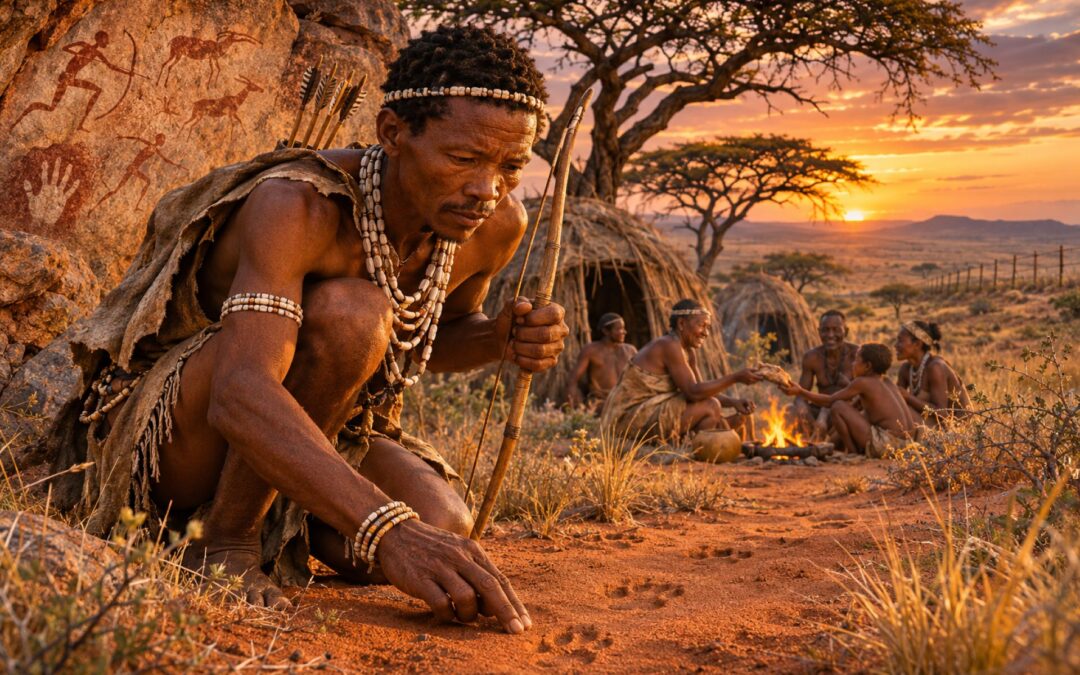
Hunting added meat, fat and valuable opportunities for collective sharing. Animals such as kudu, wildebeest and other antelope were far larger than the light bows and arrows used by some San hunters might suggest they could bring down. Yet the technology was designed for a particular method rather than for dramatic force. In some traditions, a small poisoned arrowhead could lodge in an animal while parts of the shaft fell away. A hunter then tracked the wounded animal, sometimes for hours. The process demanded stamina, judgement and luck; a hit never guaranteed success.
The poison itself was the product of detailed biological knowledge. Research on beetle and plant arrow poisons among Ju|’hoan and Hai||om hunters documents notable differences between communities. Some Ju/’hoansi used substances obtained from the larvae of leaf beetles, including Diamphidia, collected from cocoons associated with particular host plants. Some Hai||om hunters used preparations from toxic plants instead. People learned to locate suitable materials and make and handle them within established hunting traditions; the exact substances, tools and procedures varied, and their dangers were taken seriously. Such practices should be understood as ethnographic knowledge, not as a universal recipe shared by every San group.
The archaeological depth of this technological tradition is remarkable, although continuity must not be overstated. Among the finds at South Africa’s Border Cave was an approximately 24,000-year-old wooden implement bearing chemical traces associated with toxic castor-bean material. The Border Cave study interpreted it as a poison applicator comparable to tools documented among later hunter-gatherers. The site also yielded ornaments and other organic artefacts that illuminate complex ancient material culture. These finds do not establish that a modern San identity has existed unchanged since their manufacture; they do show that sophisticated hunting equipment and symbolic practices have a long history in southern Africa.
Poison was only part of a successful hunt. Following an animal across dry ground demands the ability to notice slight differences in soil impressions, scuffed stones, displaced leaves, bent grass or dung. Experienced trackers can sometimes distinguish individuals within a herd, estimate an animal’s condition from its movements, and judge whether tracks are fresh enough to pursue. A footprint may reveal direction, but following a trail also means continually revising an explanation of where an animal is likely to go next: toward shade, grazing, water or a place where it might slow down. This is an active form of reasoning, not a magical ability to read every movement with certainty.
The same attention to footprints could extend to social life. People familiar with the camp and its surroundings might recognise who had passed along a path, visited a neighbouring household or left early in the morning. Tracking was thus a way of interpreting changes that could separate finding food from returning empty-handed.
The Society That Kept Everyone Equal
Bringing home a large animal did not mean the successful hunter could keep the entire reward. Meat circulated through a community according to social expectations and relationships, often reaching households far beyond the hunter’s immediate family. That mattered because success at hunting is uneven: one person might return with plenty, while several others had an unproductive week. Sharing distributed both nourishment and risk. It also created obligations and recognitions that linked families across time.
In the camps described by Lee and other ethnographers, influence could not simply be turned into unquestioned authority. Skilled hunters might enjoy respect, experienced elders might be persuasive, and some people could speak more effectively than others. But there were also powerful social habits for keeping anyone from acting as though success entitled them to rule. Decisions about moving camp, relations with neighbours or access to resources involved negotiation; outright command was harder to sustain when people could resist, criticise or leave. Egalitarianism here describes a continuing social effort, not a place where power or conflict had disappeared.
Few stories illustrate that effort better than Lee’s account of Christmas in the Kalahari. After years of collecting information about the !Kung, as they were often called in the ethnography of the period, Lee wanted to thank the people who had worked with him. He decided to purchase a large ox for a Christmas feast. He chose a remarkably large animal, enough, he believed, to feed the families expected.
The reaction was baffling. Instead of gratitude, Lee heard that his ox was a miserable choice. People complained that it was too old, too thin and barely worth preparing. One visitor wondered how such a disappointing animal could feed everyone; others made the criticism sharper. Lee checked the animal, defended his purchase and worried that the feast would end in quarrelling over inadequate portions. Even people he hoped would give him an impartial assessment seemed to confirm the bad news.
When the animal was finally slaughtered, the supposedly pathetic ox proved to be full of fat and meat. The people working on it laughed and continued joking about its worthlessness. The feast went on, with enough food to share and celebrate. Lee realised that the weeks of mockery had not been an honest assessment of the animal. Nor had the entire episode been a simple prank for amusement. It was a lesson in the etiquette of generosity and the dangers of pride.
Lee later asked why a hunter who had brought food to others should be treated this way. His informants explained the convention sometimes called insulting the meat. A successful hunter was not meant to announce that he had killed something magnificent and expect admiration. He might understate his achievement, while others would mock the animal as too small or bony even when it was excellent. Beneath the teasing lay a serious idea: a person praised too extravagantly for providing meat might come to see everyone else as dependent inferiors. The insults worked to cool the hunter’s pride and keep generosity from becoming a claim to domination.
Lee eventually understood that the lesson applied to him as well. His stores of supplies, ability to distribute gifts and position as an outside researcher gave him unusual power. By offering a magnificent ox, he imagined himself performing an exceptional act of generosity. For his hosts, sharing meat was something people did for one another routinely. Their teasing reminded him that an impressive gift did not place its giver above the community or erase the inequalities created by other interactions.
These practices complicate easy descriptions of San gender relations as either perfectly equal or rigidly patriarchal. In many ethnographically documented communities, women’s gathering was fundamental to the food supply, and women could have substantial influence in domestic decisions, partnerships and the choice of where to live. Separation and divorce were possible, sometimes with less institutional obstruction than in societies where marriage was controlled by formal legal or religious authorities. Yet women also performed essential care work, and conflict, coercion and violence were not absent. A serious account of relative equality must include who did which kinds of work, whose preferences prevailed in a dispute, and how individual experiences differed.
Nor can the Christmas ox story be treated as a law followed identically by every San community. It records a particular social world and a specific exchange between an anthropologist and the people he was studying. Its wider significance is that equality can also be sustained through expectations about success, sharing and treatment of neighbours.
Friendship, Gift-Giving and the Art of the San
An apparently modest gift can do important work in a society where households move, food supplies fluctuate and social relationships extend beyond one camp. Among Ju/’hoansi communities, anthropologists documented exchange partnerships known as hxaro. People gave one another ornaments, tools and other possessions, often receiving something in return much later. The delay was part of the point. The exchange affirmed that a relationship would continue beyond the moment when an object changed hands.
A decorated item might travel from one settlement to another, become part of a different household’s possessions and eventually be reciprocated through another gift. These networks maintained distant friendships and could offer hospitality in difficult times. An exchange partner elsewhere might be someone to visit when water or food was scarce at home. Hxaro was not a cash transaction aimed at immediate equivalence, nor was it generosity without social meaning. It combined personal affection, reputation, reciprocity and the practical value of belonging to a wider network.
Such networks also challenge the assumption that mobility requires weak attachments. Families and small groups could gather during favourable seasons, renew relationships, exchange news, arrange visits and participate in shared activities. The social geography of the Kalahari was larger than the camp visible at any one moment. In Polly Wiessner’s long-term study of hunting and hxaro exchange, meat sharing and wider exchange relationships appear as part of a complex system in which cooperation, personal standing and long-term obligations were intertwined.
Ornaments were among the objects that could carry those relationships. Beads made from ostrich eggshell were fashioned, polished and assembled into jewellery, their appearance shaped by choices of material, size, pattern and arrangement. As possessions that could be worn, admired, given away and remembered, such objects joined artistry to social life. Tools and other practical items could also circulate as gifts; their usefulness did not make them any less meaningful.
San artistic traditions extend far beyond jewellery. Rock paintings and engravings across southern Africa depict animals, human figures and scenes whose interpretation often requires sensitivity to local ritual traditions rather than straightforward assumptions that every image documents an ordinary hunt. In northwestern Botswana, Tsodilo contains more than 4,500 recorded paintings concentrated within a relatively small area, alongside an archaeological record of extraordinarily long human activity. The hills are also culturally and spiritually significant to communities living nearby. It would be simplistic to attribute every image to the same people across thousands of years, but equally mistaken to dismiss this landscape as empty wilderness.
Music, dancing, storytelling and healing practices have also contributed to the cultural lives of different San communities. In some settings, communal dancing and trance-related healing bring people together and give ritual form to relationships, tension and care. Contemporary artists work with painting, photography, performance and other materials as well as inherited techniques. Art can change while remaining culturally meaningful.
The Original Affluent Society: A Different Meaning of Wealth
For centuries, a familiar narrative portrayed hunter-gatherer existence as a state of unending labour interrupted by hunger. Without farms, granaries, factories or markets, how could anyone possess enough to enjoy leisure? Lee’s Kalahari observations challenged this assumption precisely because the surrounding landscape looked, to outsiders, so unpromising. If people in a comparatively dry region could obtain adequate food without working continuously at subsistence, perhaps the definition of poverty needed closer examination.
In the camps Lee observed, adults spent roughly twelve to nineteen hours a week on the work he counted as obtaining food. His classic paper, What Hunters Do for a Living, helped overturn the assumption that gathering was marginal to survival; plants often supplied most daily nutrition while hunting yielded highly valued but less predictable returns. The figures were provocative, and they remain historically important. But the most quoted number came from a restricted definition of work. It did not include all the effort required to raise children, maintain shelter, collect and process materials, prepare food or support other members of the group.
When domestic labour and care were considered, total work estimates rose considerably. Comparisons with a modern forty-hour employment week also become misleading if they count housework for one society but not the other, or treat all hunter-gatherers as though they lived under the same conditions. Seasonal variation, resource access, household composition and changes caused by dispossession can alter workload substantially. Lee’s finding should therefore be neither dismissed as meaningless nor repeated as proof that every San adult has always enjoyed a nineteen-hour week.
The anthropologist Marshall Sahlins turned such research into an influential argument he called the original affluent society. Affluence, he suggested, could be achieved in two different ways. People might satisfy their wants by producing more and acquiring greater resources, or they might want comparatively little and have sufficient means to satisfy those wants. Under the second definition, people with few stored possessions need not experience their lives as perpetual deprivation. The argument challenged the habit of equating wealth with the accumulated quantity of goods.
That idea has a surprising connection to a British economist writing decades earlier. In his 1930 essay Economic Possibilities for Our Grandchildren, John Maynard Keynes imagined technological progress making it possible to meet material needs with a working week of around fifteen hours. He anticipated a future in which rising productivity would leave people facing the unfamiliar problem of how to use their leisure well. His prediction was not simply that inventions would make people rich. It was that the struggle to secure life’s necessities might stop dominating their time.
Technology did make vast increases in production possible. Yet societies have also used productivity gains to create new goods, expand expectations, build increasingly elaborate services and generate forms of work unimaginable in Keynes’s world. Higher output can reduce scarcity while also encouraging new definitions of what counts as enough. None of that means modern life is only an unnecessary accumulation of possessions: medicines, reliable water systems, safer childbirth, electricity and communication have transformed human welfare. The San comparison asks a narrower, more uncomfortable question about which wants are worth pursuing and which forms of labour are required to sustain them.
The attractive picture of a leisurely, cooperative community also needs historical limits. Anthropologists did not discover a population outside history. San groups traded, worked for others, adopted new technologies, faced pressure from neighbouring states and adapted to colonial economies. Some people experienced coercion and poverty long before they became subjects of modern ethnography. Moreover, a particular foraging system depended on access to substantial land and resources; it could not be transplanted unchanged into a dense modern city. The idea challenges assumptions rather than offering a universal blueprint for happiness.
Did Agriculture Really Make Life Better?
Agriculture transformed the world by allowing people to cultivate plants and manage animals in ways that could sustain much larger populations. Yet its rise was neither a sudden universal decision nor a simple transition from misery to comfort. Foragers in different parts of the world had long experimented with managing plants, storing food and occupying settlements for extended periods. The development of farming involved numerous regional pathways, often extending over many generations, and people frequently combined cultivation with hunting, gathering and fishing.
Farming demanded work of a different kind. Fields had to be cleared or prepared, crops planted, weeds managed, harvests protected and food stored. Animals needed feeding and care; irrigation, where used, required maintenance and cooperation. Because people invested effort in particular plots and facilities, remaining in one place could become more attractive—or more necessary. Stored crops supported specialists, rulers and institutions, but storage also created something identifiable that could be seized, taxed or controlled by those with power.
The historian and political scientist James C. Scott, notably in Against the Grain, argues that early grain-based states depended on circumstances making both agricultural produce and the people cultivating it easier to monitor and appropriate. Fixed fields, visible harvests and concentrated populations could serve administrators and armies as well as farmers. The rise of cities, accounting systems and political hierarchy therefore cannot be understood only as a voluntary exchange of independence for convenience. Yet Scott’s account is an interpretation of particular historical processes, not evidence that every farming society was inherently oppressive or that people everywhere were forced into agriculture at swordpoint.
There were measurable costs to some early agricultural transitions. Archaeologists studying human remains in particular regions have found signs of nutritional stress and changing disease burdens associated with narrower diets and denser settlements. Close contact among humans and domestic animals could create opportunities for some pathogens to circulate, while contaminated water and accumulated waste posed additional risks. But it would be inaccurate to claim that nearly every infectious disease appeared only because cities existed, or that all foragers were safe from epidemics and famine. Disease histories are varied, and the effects of agriculture differed by time and place.
Nor did early farmers conquer every hunter-gatherer society they encountered. Farming spread through migration, exchange, intermarriage and sometimes violent displacement. In Europe and elsewhere, genetic and archaeological evidence points to complicated mixtures of these processes. Some communities continued to forage long after farmers arrived, and many incorporated selected new practices without abandoning their former livelihood altogether. For a fuller account of the wider transformation, the history of human civilisation provides the long chronological setting.
The San experience makes this debate unusually concrete. Their traditional foraging systems depended on movement across landscapes that supported animals, edible plants and reciprocal relationships. As farming, pastoralism and state authority expanded, those landscapes became subject to new claims of ownership and control. Agriculture was not simply a disastrous mistake; it helped support billions of people and extraordinary technical achievement. The more relevant question is what can be lost when a growing society assumes its way of organising land, labour and wealth must displace everyone else’s.
Trade, Conquest and the Destruction of San Independence
Long before European occupation, southern Africa was a region of movement, negotiation and exchange. Communities associated with hunting and gathering interacted with pastoralists and farmers through trade, marriage, service, conflict and the sharing of knowledge. Bantu-speaking populations gradually expanded into different parts of the region over many centuries, carrying agricultural practices and languages, but their encounters with existing populations were not one uniform military campaign. Some groups mixed, some traded, and some experienced displacement or new forms of dependence. The Kalahari’s environmental conditions could limit intensive cultivation in some areas, but they did not build a wall between foragers and the rest of Africa.
Indeed, the idea of entirely isolated San hunters is contradicted by evidence of wider commerce. Animal skins, ivory, ostrich products, ornaments and other goods could move along routes linking communities across considerable distances. Copper offers a particularly vivid example. Nineteenth-century observers recorded San people moving copper ore for exchange with other groups, challenging European assumptions that those labelled hunters and gatherers could not participate in specialised trade. Some communities also kept livestock or worked within mixed economic systems. Their history is not a choice between pure independence and sudden modern contact, but a series of changing relationships in which people could gain opportunities while also losing control over their labour and land.
European colonial settlement intensified that process dramatically. In 1652 the Dutch East India Company established a settlement at the Cape, initially intended to service ships travelling around southern Africa. Expanding farms and stock-raising soon encroached upon land used by Khoikhoi pastoralists and San communities. Livestock ownership, water access and grazing territory became sources of conflict, while colonial firearms, horses and organised commandos increasingly reshaped the balance of power. Disease, forced labour and the destruction of existing economies further undermined Indigenous communities, although their experiences differed across the region.
On the expanding frontier, settlers and colonial authorities often treated San resistance as criminal raiding rather than resistance to dispossession. When communities took livestock or defended access to resources, they faced punitive expeditions in which men, women and children could be killed, captured or forced into dependency. This did not mean Indigenous people ceased resisting. They used local terrain, mobility and weapons—including poisoned arrows in some encounters—to evade or contest armed outsiders. But sustained pressure reduced the territory on which independent ways of life could be maintained.
The scale and character of this violence have become a major subject of scholarship. A chapter on the settler genocides of San peoples in southern Africa traces patterns of killing and eliminationist settler violence over a prolonged period. Not all Khoisan inhabitants were wiped out by 1806. The population categories were diverse, survivors remained, and cultural continuities persisted. Nevertheless, repeated massacres, enslavement, coercive labour systems and land seizure devastated many communities and radically restricted their independence.
The later scramble for African territory brought another powerful set of colonial institutions. Germany proclaimed a protectorate in what became German South West Africa in 1884, beginning a period of colonial conquest, settler expansion and labour exploitation in present-day Namibia. The genocidal wars against the Herero and Nama in the early twentieth century are among the most notorious episodes of German colonial rule. San communities were also subjected to violent persecution, dispossession and coercion, though the histories and scales of violence against these different populations should not be collapsed into one event.
Labour demand mattered as much as land hunger. Farms, mines and colonial enterprises wanted workers who could be compelled to accept unequal conditions. San people who had once moved between hunting grounds and exchange partners increasingly found themselves living under employers, officials and landowners who controlled access to resources. Accounts from the period describe the pursuit and recruitment of Indigenous workers, sometimes involving coercion and the separation of families. Particular newspaper reports and memoranda need verification before their exact wording can be repeated, but the broader pattern of forced and heavily constrained labour is clear from the historical record.
Germany lost South West Africa during the First World War, and South Africa subsequently administered the territory under an international mandate before maintaining its control in defiance of growing international opposition. Political regimes changed, but many San families continued to face restricted access to land, employers’ power, discrimination and limited economic choices. In Botswana, too, colonial and postcolonial systems altered where people could live, hunt or obtain water. By the mid-twentieth century, substantial numbers of San were wage labourers, farm workers or residents of settlements rather than people relying exclusively on foraging.
This was not the inevitable end of a prehistoric lifestyle. It was the consequence of political choices about who could occupy land, own animals, trade freely and determine the conditions of work. The skills of hunting and tracking survived, but increasingly they were valued by institutions that offered little protection to the communities from which those skills came. In one of the darkest ironies of modern San history, that knowledge would soon become a military asset.
The San in the South African Border War
During the second half of the twentieth century, southern Africa became a major arena of anti-colonial conflict and Cold War competition. The South West Africa People’s Organization, or SWAPO, challenged South African rule over the territory that would become Namibia. South Africa’s apartheid government attempted to maintain control, while the conflict became entangled with wars and political struggles in neighbouring Angola. Soviet and Cuban involvement on one side and Western support for South Africa at different stages gave the confrontation an international dimension beyond local independence politics.
San communities entered this conflict under very different circumstances. Some people volunteered for military service, attracted by wages and resources unavailable elsewhere. Others were recruited amid insecurity, displacement, coercive structures and relationships with military authorities they could not easily refuse. It is misleading to speak of “the San army” as if all San peoples had made one collective political decision. Distinct groups were drawn into different formations, and individual families could experience military service as opportunity, danger or both.
The South African Defence Force valued knowledge of tracks, movement and local environments. Men with experience identifying footprints, reading disturbed vegetation and travelling through difficult terrain could perform reconnaissance and tracking tasks that conventional soldiers found demanding. The army’s use of San trackers became part of the mythology of the Border War, but their employment was tied to real military institutions and operations rather than a simple continuation of ancestral hunting. Training, modern weapons, command hierarchies and the political aims of their employers fundamentally changed how those skills were used.
Recruitment began earlier. Research on the militarisation of the !Xun and Khwe shows that men from these communities were recruited by Portuguese security forces in Angola during the 1960s, before later service connected to South African units such as 31 Battalion. Elsewhere, units associated with the South African military drew on San men living in Namibia, including communities around Nyae Nyae. Different recruitment histories must be distinguished rather than combined into a single story of all San men being turned into soldiers simultaneously.
For people around Tsumkwe and Nyae Nyae, a military presence could also reorder ordinary life. Wages and supplies changed household economies, while armed installations, recruitment and security restrictions affected movement and relationships with surrounding communities. Some families became deeply dependent on military incomes. Recruitment might bring immediate financial stability without giving them lasting political power over their territory. Military wages did not guarantee lasting protection.
That change arrived with the collapse of South African control and Namibia’s independence on 21 March 1990. As military structures withdrew or transformed, some San veterans lost their income and status and faced difficult decisions about where to live. Members of the !Xun and Khwe communities linked to South African formations were among those relocated to South Africa, including Schmidtsdrift, before later settlement at Platfontein. Other families remained in Namibia and confronted different challenges. The end of a war that promised freedom to the new nation did not automatically reverse the marginalisation of everyone who had been drawn into it.
There is a painful contrast between the admiration military officers expressed for San tracking skills and the insecurity experienced by many of the people who possessed them. A technique that had once helped secure food, navigate a landscape and sustain family relationships could now be used to locate enemies. The transformation is not evidence that San societies were naturally warlike; it reveals how a powerful state can appropriate Indigenous knowledge while leaving questions of land, livelihood and political belonging unresolved.
The San Today: Land Rights, Conservation and Survival
The image of the San as a handful of hunters living beyond the reach of history is especially misleading in the present. Contemporary San communities include wage workers, farmers, craft producers, guides, activists, teachers, students and people seeking opportunities in towns as well as rural areas. Hunting and gathering remain important in cultural knowledge and, in some places, livelihood, but they are rarely the sole means of support. Poverty, unequal access to education and health services, insecure land rights and discrimination continue to affect many communities. These conditions should not be confused with the voluntary simplicity imagined in theories of ancient affluence.
The Central Kalahari Game Reserve in Botswana illustrates how access to land became a modern political struggle. Established during the colonial period, the reserve encompassed areas long inhabited and used by Indigenous communities. In the late twentieth century the Botswana government began relocating residents to settlements outside its boundaries, with major removals taking place during the late 1990s and in 2002. Officials defended the policy with arguments concerning service provision, development and wildlife management. Residents and advocates challenged the removals as violations of rights, identity and attachment to ancestral land.
The dispute was more complicated than a straightforward conflict between conservation and people who wanted to hunt. For families who had lived in or used the reserve, land was connected to ancestors, burial places, knowledge of water and food, and networks of relationships. Moving to a settlement might offer access to some services while also ending opportunities for independent subsistence and disrupting familiar social arrangements. Critics argued that relocation increased dependency and exposed people to unemployment and social hardship. The discovery of diamonds in and around the reserve intensified public suspicion, but the claim that mining alone explains every government decision cannot be established simply by noting that mineral resources existed.
Residents took their case to court. In Sesana and Others v Attorney General, the Botswana High Court delivered a landmark judgment on 13 December 2006 concerning the removals and the applicants’ rights in the reserve. The decision gave significant legal recognition to those challenging their loss of residence. It was not, however, a universal settlement of every San community’s land claims, nor did it instantly restore all the practical conditions needed to live in the reserve. Implementation, access and the interpretation of different rights remained contested.
Water became an especially revealing issue. Living in a dry environment is possible only when people can reach usable sources of water or obtain it through reliable arrangements. After a further dispute, Botswana’s Court of Appeal ruled in January 2011 that applicants could use an existing borehole and sink new ones; the court also criticised the treatment they had received. Legal victories therefore unfolded in stages, each dealing with a concrete barrier to remaining on the land. Residence rights mattered less without usable water.
Campaigners also tried to make the dispute visible internationally. The advocacy organisation First People of the Kalahari and supporters drew attention to the relationship between the global diamond trade and Indigenous land claims. One appeal was reported as addressing hip-hop celebrities, including Snoop Dogg, and challenging those who celebrated diamond jewellery to consider the people living in diamond-producing regions. The appeal’s precise wording should not be treated as independently verified here, and celebrity involvement was not the engine of the court judgment. The episode nevertheless illustrates an inventive political strategy: linking a remote land dispute to a consumer symbol recognised around the world.
Across the border in Namibia, a different set of initiatives has sought to give communities greater authority over natural resources. Nyae Nyae was among the country’s first registered communal conservancies in 1998. Under Namibia’s conservancy framework, recognised communities can organise wildlife management, elect committees and develop economic activities within the law. Conservancy institutions can bring income from tourism and regulated wildlife use, create employment and support efforts to monitor poaching. They also provide an organisational basis through which residents can argue for a greater voice in decisions about their surroundings.
Nyae Nyae demonstrates both the possibilities and the limits of that approach. The landscape remains important to Ju/’hoansi communities whose livelihoods may combine resource use, employment, crafts, tourism and assistance from other institutions. Visitors and filmmakers interested in local culture can create revenue, although the value of an activity depends on who controls it and how benefits are distributed. Conservation programmes may protect wildlife while communities still struggle with limited infrastructure, changing economic opportunities and disputes over land use. Being recognised as a conservancy is not the same as possessing undisputed control over ancestral territory.
Those tensions are central to 2026 research on customary land rights in Nyae Nyae. Its authors describe ongoing efforts by the Ju/’hoansi and their traditional authority to address incursions by outside pastoralists and develop an ancestral land claim. The research places conservation and development within the larger question of legal authority over land used by communities across generations. It is a reminder that wildlife numbers, tourist income and cultural exhibitions cannot by themselves resolve the political foundations of insecurity.
Modern San advocacy does not ask the rest of the world to believe that every person should return to a life of hunting and gathering. Different individuals want different combinations of education, jobs, cultural continuity, mobility and access to ancestral places. What they share is a claim to participate in defining those choices rather than having them imposed by settlers, soldiers, conservation officials or distant governments. Their story remains unfinished because sovereignty, dignity and survival are practical questions, negotiated through laws, institutions and everyday decisions.
The traditional knowledge that impressed anthropologists was never simply a collection of clever techniques for obtaining food. It belonged to living relationships among people, animals, plants and places. When those relationships are disrupted by land loss, the damage cannot be measured only in income or calories. Regaining authority means shaping a future, not preserving a picturesque past.
The San experience ultimately complicates the familiar idea that civilisation advances along one inevitable road from hunting to farming, from villages to cities, and from modest wants to greater consumption. Agricultural and industrial societies have created remarkable forms of security and possibility, but they have also concentrated power and made others pay for their expansion. San communities have demonstrated sophisticated ways of sharing risk, limiting personal arrogance and understanding difficult environments; they have also experienced scarcity, conflict and far-reaching historical change.
Their history does not offer a simple verdict that one way of life is better than all others. It asks what counts as a good life, who gets to decide, and whether greater production always means greater freedom. A society’s achievements deserve to be measured not only by what it can accumulate, but also by the dignity and choices available to the people living within it.
Last Updated on November 7, 2026 by Aseem Gupta