
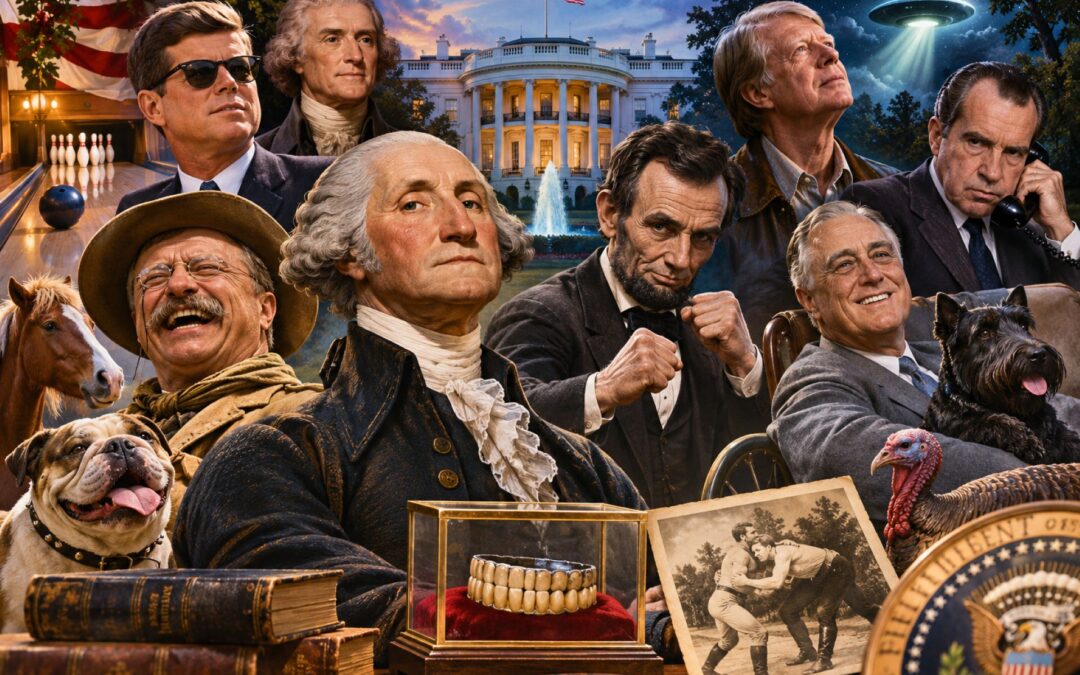
Reading Time: 28 Minutes
The presidency is built around an almost superhuman job description. Its occupant must make decisions about wars, economies, constitutional disputes and the future of a country. Yet the people who have held that office have also worried about bad teeth, collected trousers, named their pets unusual things, played poker, raced horses and occasionally embarrassed themselves in front of the entire world. One even continued giving a campaign speech after being shot.
Those stories offer a different view of American history. Some reveal an unexpected talent or a lifelong habit; others expose the private circumstances behind a public image. A few are genuinely consequential, particularly when personal relationships and presidential authority collide. And some of the most entertaining tales have survived precisely because they are easier to repeat than to verify.
There have been 47 numbered presidencies but only 45 individual presidents, because Grover Cleveland and Donald Trump each served two nonconsecutive terms. From George Washington to the modern White House, their unusual experiences form a surprisingly revealing history of the people behind the office. The trick is knowing when a wonderful story is also a true one.
The Founding Presidents: Strange Habits and Hidden Histories
George Washington looked imposing in the portraits commissioned during his lifetime. What those images rarely communicate is how much pain he endured because of his teeth. He began losing them long before becoming president, despite repeated treatments, and had only one natural tooth left when he took office in 1789. By the time he was a public symbol of national stability, eating and speaking could be deeply uncomfortable private struggles.
His dentures were not made of wood, despite a remarkably persistent American legend. Different sets involved carved ivory, including hippopotamus ivory, human teeth, animal teeth and metal components. Springs helped hold some dentures in place, but also put pressure on his jaws. Mount Vernon’s account of Washington’s dental problems shows why his facial appearance sometimes changed between portraits. Claims that every set contained the same materials, or that his expression can be explained entirely by his dentures, go beyond the evidence.
Washington enslaved people at Mount Vernon, and records show that he purchased teeth from enslaved individuals, although historians cannot conclusively connect those purchases to particular surviving dentures. Behind a famous presidential myth lies a reminder of the unequal world that made such transactions possible. His dental suffering was real; so was the human cost surrounding aspects of his treatment.
John Adams, the second president, left a comparatively cheerful curiosity in White House pet history. Two dogs associated with his family are commonly listed as Juno and Satan. Juno sounds like an appropriately classical name for a Founding Father; Satan is rather harder to explain. The striking contrast makes the pair irresistible to collectors of presidential trivia, but no reliable account establishes what inspired the darker name or how the animal behaved.
Adams was not alone in keeping animals close. For Adams’s family, the executive mansion was also a home, and household life followed them into it.
Thomas Jefferson’s most consequential private story cannot be treated as charming trivia. He had a long relationship with Sally Hemings, a woman he enslaved at Monticello, who was also the half-sister of his deceased wife, Martha. Historical documentation, family testimony and DNA findings support the conclusion that Jefferson fathered Hemings’s six children. Four survived to adulthood. The evidence and its limitations are examined in Monticello’s account of Jefferson and Sally Hemings.
The imbalance of power is central to understanding that history. Hemings had no legal freedom to leave the relationship on equal terms, and Jefferson did not publicly acknowledge the children. Two were permitted to leave Monticello, while the two younger surviving sons were freed under his will; Sally herself was not formally emancipated by Jefferson’s will but later lived in a condition of informal freedom. The author of the Declaration of Independence lived with contradictions that cannot be resolved by calling the relationship a secret romance. Hemings and her children also had lives and choices of their own, which deserve attention beyond their connection to him.
James Madison presented an almost opposite kind of surprise. At approximately five feet four inches tall and of slight build, he is generally regarded as the shortest American president. Accounts placing his weight around a hundred pounds emphasize how physically unimposing he appeared beside the other prominent men of his generation. His nickname, or the later popular shorthand of “Little Jemmy,” captured a contrast that contemporary observers could hardly miss.
Yet Madison was central to the Constitutional Convention, helped make the case for ratification in the Federalist Papers, shaped the Bill of Rights and helped organize the Democratic-Republican Party with Jefferson. His achievement was intellectual and organizational, not physical. Few presidential contrasts are more instructive than the gap between the diminutive figure described by observers and the enormous constitutional legacy associated with his name.
James Monroe’s unusual distinction reaches well beyond the United States. Liberia’s capital, Monrovia, bears his name. The settlement developed out of a colonization project organized by the American Colonization Society, which supported moving free Black Americans to West Africa. Monroe aided that project, and the settlement was named Monrovia in his honour in 1824, not 1822 as some retellings suggest.
The State Department’s history of Liberia places the name in a more complicated setting. The project reflected American disputes over slavery and racial coexistence, and the acquisition of land involved coercion and resistance from local African communities. Many free Black Americans and abolitionists opposed colonization. Monroe’s name survives on a modern capital, but the story behind that honour is inseparable from the racial politics of the early republic.
From John Quincy Adams to John Tyler: Duels, Legends and Family Records
John Quincy Adams, Monroe’s successor, developed a reputation for rising early and swimming in the Potomac River. In an era when river bathing was common and privacy meant something different, reports of the president entering the water without a bathing suit were not especially improbable. Adams’s own writings make clear his enthusiasm for swimming, even when friends worried about the risks. The surprising part was not simply the absence of clothing but the president’s willingness to venture into a dangerous river.
A more theatrical version has journalist Anne Royall sitting on his clothes until he agreed to answer her questions. In this famous story, Adams must grant an interview before he can leave the water. It is perfect historical comedy, with a powerful man defeated by an enterprising reporter, but the documentary foundation is weak. The episode is best understood as presidential folklore attached to a genuine swimming habit, rather than a confirmed account of the first interview with a naked president.
Andrew Jackson offered far less peaceful outdoor entertainment. Before becoming president, he was embroiled in repeated feuds and confrontations, with an especially fierce sensitivity to insults directed at his wife, Rachel. Popular histories sometimes credit him with more than a hundred duels. That figure is not securely documented, and disputes, threats and formal duels should not be counted as the same thing.
One confrontation is beyond serious doubt. In 1806, Jackson fought Charles Dickinson after a dispute involving racing debts and insults to Rachel. Dickinson shot first and wounded Jackson. Jackson then fired and killed his opponent, carrying the effects of the injury for years. The episode illuminates a culture in which elite men could use violence to defend reputation, even when the result was fatal. It also reveals why Jackson’s combative temperament was already famous before he entered national politics.
Martin Van Buren’s strange contribution is linguistic rather than violent. His hometown was Kinderhook, New York, and his supporters used “Old Kinderhook” as a nickname during the 1840 campaign. The initials OK became a political slogan, visible on banners and in the activities of enthusiastic supporters. That connection is sometimes presented as the origin of one of the world’s most familiar expressions.
The real history is better. In 1839, before Van Buren’s reelection campaign, the letters “O.K.” appeared in print as a playful abbreviation for “oll korrect,” a deliberate misspelling of “all correct.” The nickname Old Kinderhook gave an existing expression a spectacular opportunity to spread. Van Buren did not invent the word, but his supporters helped make it part of everyday American language. It was an unusually lasting contribution for a candidate who lost that election.
William Henry Harrison, the man who defeated Van Buren, became president for only 31 days. He took office on 4 March 1841 and died on 4 April. The traditional story blames pneumonia supposedly brought on by delivering a lengthy inaugural address in cold weather. Modern medical interpretations have questioned that explanation, with some researchers suggesting an intestinal infection connected to unsanitary conditions around Washington. Neither a precise diagnosis nor contaminated White House drinking water as the definitive cause can be established retrospectively.
A less credible tale gives Harrison an exotic pet goat that wandered White House grounds and headbutted a cabinet member. The incident has the flavour of a nineteenth-century political cartoon, but good primary evidence is missing. There is no reason to discard the genuine oddity of Harrison’s brief presidency in favour of a colourful animal story that cannot be properly substantiated. Thirty-one days in office is remarkable enough.
John Tyler, who succeeded Harrison, holds a numerical record that is much better documented: he fathered 15 children, more than any other American president. He had eight children with his first wife, Letitia, and seven with his second wife, Julia. His youngest child was born in 1860, when Tyler was about seventy. For a man born in 1790, this produced a family chronology that already stretched across extraordinary changes in American life.
The generational distances became stranger still. Tyler’s son Lyon Gardiner Tyler fathered children late in his own life, allowing two of the president’s grandsons to survive into the twenty-first century. Harrison Ruffin Tyler, the last surviving grandson, died in May 2025. Thus a grandson of someone born during George Washington’s first presidency lived in the age of smartphones, artificial intelligence and commercial spaceflight. It sounds like a genealogical mistake, but the explanation is simply two generations of unusually late fatherhood.
Polk to Buchanan: Overwork, Animals, Fires and Personal Mysteries
James K. Polk entered the White House with unusually specific ambitions. He pledged to serve only one term and left office after completing it, having overseen major territorial expansion and the Mexican-American War. He maintained a demanding working routine and was remembered for his intense attention to administration, correspondence and appointments. His image as a tireless president has sometimes inspired stories of almost uninterrupted twelve- or sixteen-hour working days, although no universal daily schedule can be proved.
Polk survived retirement for only 103 days. Leaving office in March 1849, he died that June, probably of cholera, after travelling in a period when the disease was widespread. Exhaustion may have affected his health, but attributing his death simply to overwork mistakes a dramatic moral lesson for a medical conclusion.
Zachary Taylor, Polk’s successor, brought a soldier’s background and a beloved horse into presidential memory. Old Whitey had accompanied him during his military career and became a public attraction when Taylor was celebrated as a hero of the Mexican-American War. Visitors reportedly sought hairs from the horse’s tail as souvenirs, a nineteenth-century equivalent of taking home a celebrity’s autograph. Some retellings say the tail was plucked nearly bare and that caretakers had to protect the animal from overeager admirers.
Exactly how bald the tail became is difficult to establish, but the broader story captures the popularity of a war hero’s horse. Taylor himself died in July 1850 after a sudden gastrointestinal illness, traditionally associated with cherries, iced milk and other food consumed during Fourth of July celebrations. The precise cause remains debated. Old Whitey’s reported appearance in the funeral procession gave the horse one final place in a story of presidential celebrity and abrupt loss.
Millard Fillmore inherited the presidency and eventually acquired a peculiar reputation as the man who brought the bathtub to the White House. Unfortunately for collectors of quirky firsts, that tale comes from a famous bathtub hoax by journalist H. L. Mencken, who published a satirical history in 1917. The joke escaped its original context and entered popular accounts as fact. Fillmore’s administration is a useful reminder that a good joke can outlive the public’s memory of who made it.
Fillmore had a genuine interest in books. He and Abigail Fillmore supported the establishment of a White House library, and the president was present during the disastrous Library of Congress fire in December 1851. Accounts describe him joining the effort to fight the blaze and save books. Whether every detail of the later bucket-brigade narratives is precise matters less than the contrast: his real enthusiasm for reading has received less popular attention than a plumbing invention he never made.
Franklin Pierce is often introduced as the only sitting president ever arrested. According to a circulating story, his carriage struck an elderly woman in Washington in 1853, after which an officer arrested him for reckless driving before the matter was quietly dropped. It is the sort of tale that seems designed for modern traffic-law comparisons, especially when paired with Grant’s much better-attested speeding episode.
But historians have not produced a convincing contemporary arrest record, police documentation or correspondence confirming Pierce’s supposed collision. That absence does not demonstrate that every part of the story is impossible, but it does make the confident title of “only arrested president” unjustified. A responsible telling distinguishes a persistent legend from something that can be established about his presidency. Speculation about a governmental cover-up adds nothing without evidence.
James Buchanan, the only president who never married, occupied a different kind of historical mystery. He shared an unusually close personal and political connection with Senator William Rufus King of Alabama. They lived together for years in Washington, and surviving correspondence contains affectionate language. Political contemporaries also mocked their intimacy, using gendered insults that reveal more about nineteenth-century attitudes than about what either man privately believed.
The relationship has generated longstanding speculation about Buchanan’s sexuality. Historians can examine the language, living arrangements and social setting, but cannot assign a definitive modern identity or prove a sexual relationship from the surviving evidence. Marriage patterns, friendship conventions and queer history all deserve careful treatment. What is certain is that Buchanan’s bachelorhood set him apart from every other president, while his connection with King remained important enough to attract notice during their lifetimes.
Lincoln to Arthur: Wrestling, Tailoring, Speeding and Intellectual Talent
Abraham Lincoln’s distinctive physical talent was not merely his height. Before he entered national politics, the tall, long-limbed young man earned a formidable reputation as a wrestler in frontier Illinois. Wrestling was both recreation and a public test of strength, and success could establish a newcomer’s standing in a community. Lincoln’s unusual reach and determination made him an imposing competitor, despite the awkward appearance caricaturists later loved to exaggerate.
A famous story places him against Jack Armstrong, associated with a rough local group called the Clary’s Grove Boys. Accounts vary about the exact result, with some describing a drawn contest and others an increasingly heated confrontation. The important episode is that the two men emerged with mutual respect and later connections, rather than remaining permanent enemies. The familiar claim that Lincoln won 299 of exactly 300 matches is too precise for the surviving evidence.
In 1992, Lincoln was honoured by the National Wrestling Hall of Fame, recognition of a sporting reputation formed long before he faced the Civil War. Wrestling helped him build confidence, friendships and a recognisable public identity in the places where his political career began.
Andrew Johnson, Lincoln’s successor, possessed a markedly different practical skill. Born into poverty and apprenticed as a tailor, he learned to cut and sew clothing before becoming a politician. He continued taking pride in the craft even as he rose through local and national office. Stories claim that he personally made an inaugural suit, although the precise details of such accounts are harder to document than his professional training.
Johnson’s beginnings were socially unusual for a president of his time: a man with little formal schooling who entered politics through manual work and public speaking. Yet the familiar story of a self-made tailor should not obscure his presidency’s failures during Reconstruction, particularly his opposition to efforts to secure equal political rights for formerly enslaved Americans. A modest background did not guarantee generous views of freedom or citizenship.
Ulysses S. Grant had a taste for fast horses that periodically collided with the ordinary rules of Washington streets. Contemporary images and later recollections portray a president who enjoyed driving horses at speed and was not always attentive to the risks posed to pedestrians. The best-known incident concerns police officer William West, who said he stopped Grant after complaints about reckless racing in the capital.
In a 1908 recollection preserved by the National Park Service, West described warning Grant and, after a subsequent offence in 1872, taking him to the police station, where the president posted twenty dollars in collateral. The account also involves several other drivers. It is stronger evidence than a free-floating internet anecdote, though it is still a recollection published decades later. It does not establish that Grant was the only president ever to receive a traffic-related citation.
The deeper appeal is the question of whether a president was subject to the same street-level rules as everyone else. West’s story insists that public office did not erase the danger created by reckless driving. Grant’s willingness, in the retelling, to accept the officer’s action makes the encounter as interesting as the image of a president enthusiastically racing through Washington.
Rutherford B. Hayes witnessed a different revolution in transportation and communication. During his administration, a telephone arrived at the White House, bringing Alexander Graham Bell’s recent invention into a residence accustomed to letters, messengers and telegraphy. The White House line is often said to have had the telephone number 1. With few people equipped to call, the device was initially much less useful than it would become.
A quotation sometimes attributed to Hayes has him wondering who would ever want such an invention. There is little dependable evidence that he said it. His story is still an excellent measure of technological change: an instrument that was little more than a novelty for a president became an ordinary expectation of life in the United States.
James A. Garfield is remembered for his assassination, but his intellectual life supplies a more cheerful distinction. A gifted teacher and scholar, he knew classical languages and remained interested in mathematics while pursuing politics. In 1876, as a member of Congress, he published an original proof of the Pythagorean theorem using a trapezoid. Few American presidents can claim a mathematical contribution so easily demonstrated on paper.
Another popular claim says Garfield could simultaneously write Greek with one hand and Latin with the other. He was certainly praised for his language skills, and stories about his ambidexterity circulated widely, but the dramatic simultaneous-writing performance is less firmly established than his published proof. Garfield’s scholarly curiosity was remarkable whether or not he ever performed that feat.
Chester A. Arthur, who succeeded Garfield, developed the nickname “Elegant Arthur” through his clothes, facial hair and love of fashionable presentation. His taste for tailored garments and carefully arranged appearances made him a target for political cartoons. Popular accounts claim that he owned more than eighty pairs of trousers and changed outfits multiple times a day. Those exact numbers are difficult to verify, but his reputation as a conspicuously well-dressed president is not in serious doubt.
Arthur’s presidency also included support for civil service reform, complicating the notion that he was interested only in his wardrobe. His carefully managed appearance became the unusual personal fact that overshadowed more substantial decisions.
Cleveland to Theodore Roosevelt: Gallows, Heirlooms and Bullets
Grover Cleveland is the only president who also personally carried out executions while serving as sheriff. In Erie County, New York, during the 1870s, he performed the hanging of two condemned men rather than assigning both duties to a subordinate. Accounts suggest that he believed responsibility should not simply be pushed onto someone else. That may describe his view of the office, but it does not make the executions wholesome or erase the violence involved.
Political opponents later revived the incidents to portray him as unnervingly comfortable with the gallows. Cleveland’s life offers a particularly stark example of how a quality celebrated as firmness in one setting can appear troubling in another. He remains doubly unusual because his terms were nonconsecutive, making him the twenty-second and twenty-fourth president without becoming two different people.
Benjamin Harrison came between those two terms and brought his own rare family connection to the White House. He was the grandson of William Henry Harrison, the president whose term lasted only a month. They remain the only grandfather and grandson who both served as American president. The relationship created an obvious historical comparison, though Benjamin had a vastly longer opportunity to govern.
Domestic stories make the connection more tangible. Accounts say Benjamin encountered or reused White House household objects and china associated with his grandfather, a reminder that the institution preserves traces of earlier residents. The claim that the same dinner plates had simply been waiting for him for forty-eight years is best treated cautiously unless a specific inventory supports it.
William McKinley had an attachment to red carnations, which he wore frequently and treated as lucky flowers. In popular retellings, he removed one from his lapel, gave it to a young admirer, and was shot moments later. The scene became an irresistible symbol of fate after the assassination attempt against him in Buffalo on 6 September 1901. He died eight days later, and the story of the flower acquired the character of an omen.
The timing of the supposed gift is not established well enough to present it as a proven final gesture. What is clear is that the carnation became linked to his public memory. Ohio adopted the scarlet carnation as its state flower in 1904 in tribute to McKinley. The flower’s journey from personal preference to public commemoration is more revealing than the convenient claim that one missing blossom caused his luck to run out.
Theodore Roosevelt supplied one of the most astonishing fully documented episodes in presidential history. On 14 October 1912, while campaigning in Milwaukee, he was shot at close range by John Schrank. Roosevelt had already served as president and was running again as the Progressive Party candidate. The bullet struck his chest, but first passed through an eyeglass case and a thick folded copy of his prepared speech, which helped reduce its force.
Roosevelt’s experience as a hunter and outdoorsman shaped his reaction. He believed that because he was not coughing blood, the wound might not have penetrated a lung. Rather than go straight to medical care, he proceeded to the auditorium. He showed his bloodstained shirt and damaged manuscript and told the audience he had been shot. That extraordinary announcement was followed not by a quick farewell, but by a political speech that continued for well over an hour.
The Theodore Roosevelt Presidential Library’s account places the episode in the volatile election campaign of 1912. Roosevelt was eventually treated, and doctors decided that removing the bullet was more dangerous than leaving it in place. He lost the election to Woodrow Wilson, but the speech became a defining part of his larger-than-life reputation. Unlike the invented feats attached to some presidents, this incident needs very little dramatic improvement.
Taft to Hoover: White House Eccentricities and Unusual Power
William Howard Taft became a frequent subject of jokes about his weight, particularly the claim that he became trapped in a White House bathtub and needed help getting out. That story lacks credible contemporary evidence. It has nevertheless proved exceptionally durable because its punchline is simple and because Taft was a large man in an era less accustomed to discussing the practical consequences of obesity with sensitivity.
There was, however, a genuinely unusual bathtub. Taft used an oversized fixture designed to accommodate his substantial frame, and images and accounts of its exceptional dimensions helped fuel the legend. The often repeated claim that four men could fit inside it is a way of dramatizing its size, not proof of a presidential rescue operation. His later service as chief justice of the United States was historically more important, but public memory has often reduced this uniquely accomplished lawyer and politician to a bathroom joke.
Woodrow Wilson’s most consequential domestic drama began in October 1919, when he suffered a severe stroke. The president was physically incapacitated and politically weakened at a moment when the United States was debating the Treaty of Versailles and participation in the League of Nations. His wife Edith took an increasingly important role in controlling who reached him and which papers or issues were presented for his attention.
For the remainder of his presidency, she operated as an extraordinarily powerful gatekeeper. Cabinet members, visitors and advisers could not assume direct access to Wilson. As the Miller Center’s account of Edith Wilson explains, she later described her role as stewardship rather than independent decision-making, but historians continue to debate how much power the arrangement gave her in practice. The public did not receive a clear account of the president’s condition, and the constitutional system had no straightforward modern procedure for handling prolonged incapacity.
Calling Edith America’s first female president is a provocative shorthand, not a legal description. She did not take the oath or acquire the constitutional powers of the office in her own name. Yet the distinction between formally holding power and controlling information reaching the person who holds it became unusually blurred. Her story is one of the strongest reminders that presidential private life can become a matter of national governance.
Warren G. Harding belonged to a more convivial world of White House socializing. His friends and political associates gathered for card games, drinks and conversation, despite the restrictions of Prohibition. Such evenings helped create the image of a president whose informality could drift into carelessness. A particularly entertaining story alleges that he wagered and lost a valuable collection of White House china during a poker game.
The china tale appears repeatedly, but firm documentation of the supposed bet is elusive. It should not be treated as evidence of a specific loss unless a contemporaneous record can be identified. Harding’s administration did confront documented corruption, most famously the Teapot Dome scandal involving federal oil reserves. The president died in office in 1923 before those revelations fully unfolded. His reputation requires no fictional dinnerware disaster to explain why historians have examined his circle so critically.
Calvin Coolidge, Harding’s successor, was known for reserve, economy of words and an improbably lively collection of household animals. In 1926, the Coolidge family received a live raccoon reportedly intended for the Thanksgiving table. They chose not to eat her. Instead, the animal was named Rebecca and became a White House pet, eventually appearing in photographs and being taken outdoors with a leash.
The phrase “presidential pardon” is sometimes attached to Rebecca, borrowing from the modern Thanksgiving turkey ritual. But treating the raccoon’s adoption as an official constitutional act would miss the joke. The interest of the story lies in the contrast between the taciturn president’s image and a household sufficiently eccentric to welcome a raccoon among its animals. Rebecca was reportedly troublesome, as raccoons tend to be, and eventually proved unsuitable for ordinary domestic life.
Herbert Hoover and his wife Lou Henry Hoover shared a different unexpected habit. Both had spent time in China early in their marriage, and both learned some Mandarin. Accounts say they sometimes used the language for private conversations, particularly when they did not want others nearby to understand. Few presidential couples could casually switch to Chinese as a way of preserving domestic privacy in Washington.
More sensational accounts depict Hoover as so determined not to encounter servants that White House employees were warned by bells and ordered to disappear from hallways. The details vary across tellings and require more care than a straightforward assertion that staff routinely hid against walls. The larger historical point is secure: presidents and their families had different expectations about service, formality and privacy, and Hoover’s household became associated with unusually strict arrangements. The Mandarin conversations, meanwhile, reflected genuine international experience rather than an invented party trick.
Franklin Roosevelt to Nixon: Superstitions, Private Lives and Presidential Behaviour
Franklin D. Roosevelt led the United States through the Great Depression and most of the Second World War, but he was reportedly uneasy about the number thirteen. Accounts describe his reluctance to dine with exactly thirteen people and his sensitivity to certain dates. This is often labeled triskaidekaphobia, the fear of thirteen, although it is not possible to determine from public anecdotes whether he experienced a clinical phobia or simply followed a personal superstition.
Some later stories claim that Roosevelt never travelled on the thirteenth or avoided every Friday the thirteenth. Such universal rules are harder to establish than particular preferences at dinners or gatherings. The underlying contrast remains delightful: a man who confronted economic catastrophe and global war could still be influenced by a number associated with bad luck. Great responsibility did not necessarily eliminate everyday irrational habits.
Harry S. Truman’s unusual fact is hidden in plain sight. His middle initial, S, does not abbreviate one full middle name. It honours both his grandfathers, Anderson Shipp Truman and Solomon Young, allowing the family to acknowledge both surnames and namesakes without choosing one as the president’s middle name. The letter is therefore his complete middle name rather than a mysterious missing word.
The punctuation has generated its own small controversy. Truman often used a period after the S, and official styles frequently write “Harry S. Truman,” even though some grammatical arguments suggest no abbreviation means no period is required. It is a trivial dispute beside his decision to use atomic bombs or his role in the early Cold War, yet it may be the most commonly asked question about the spelling of a president’s name.
Dwight D. Eisenhower grew up with strong religious influences that encouraged humility, discipline and, within parts of his family’s tradition, pacifist ideals. His mother associated with the Bible Student movement, whose later history intersects with that of Jehovah’s Witnesses. The family background was complicated, and it would be an oversimplification to say everyone in his household uniformly rejected military service. Nevertheless, the contrast with Eisenhower’s eventual career is striking.
He became supreme commander of Allied forces in Europe during the Second World War and oversaw the Normandy invasion, one of history’s most consequential military operations. His professional life required organizing immense destructive power, even as his public statements often displayed caution about the human costs of war. The man who later warned of the military-industrial complex had spent decades understanding military institutions from the inside. That tension reveals more than a simplistic story of a pacifist boy turning into a general.
John F. Kennedy’s glamorous public image coexisted with a private life marked by extramarital relationships. Accounts involving actresses, socialites and White House staff accumulated after his death, though they are not all equally substantiated. Mimi Alford, who worked as a young White House intern, later described a sexual relationship with Kennedy. Her account is different in evidentiary status from speculation built around famous photographs or whispered rumours.
Marilyn Monroe’s breathy performance of “Happy Birthday” for Kennedy at Madison Square Garden in May 1962 became an unforgettable piece of political theatre. It does not, by itself, prove that the two had an affair. Allegations involving Ellen Rometsch, a woman linked in press stories to espionage concerns, are even more difficult to reduce to simple certainties. The White House’s carefully produced family image, particularly Jackie Kennedy’s public role, helps explain why the difference between image and private behaviour has fascinated biographers for decades.
Lyndon B. Johnson was famous for ignoring conventional personal boundaries. He could pressure politicians from inches away, continue arguments through long encounters and conduct business in settings that other presidents would have regarded as private. Staff and biographers have described conversations that continued while he used the toilet, apparently with little concern for the discomfort of those required to remain nearby.
Johnson’s conduct was not merely a peculiar bathroom habit. It fitted a broader style of domination, persuasion and relentless personal involvement that became known as the Johnson Treatment. He could make another person’s physical and psychological space feel entirely his own. That intensity contributed to his extraordinary effectiveness in steering major civil rights legislation through Congress, even as it could leave colleagues and employees exhausted or embarrassed. The eccentricity was connected to a recognizable political method.
Richard Nixon’s White House recreation also became surprisingly personal. A keen bowler, he enjoyed the sport as a way of relaxing away from public scrutiny. Although bowling lanes had been installed elsewhere in the White House complex for Harry Truman decades earlier, a private one-lane alley was constructed at the White House during Nixon’s administration in 1973, not immediately upon his arrival in 1969.
Nixon could bowl in formal clothes and was reputed to have recorded scores above two hundred. There is something disarming about the picture of one of America’s most intensely scrutinized politicians practising his technique in a secluded alley. The solitude is also revealing. Nixon struggled with distrust and isolation as the Watergate scandal gathered force, and bowling offered a controlled environment in a presidency increasingly beset by uncontrollable events.
Ford to Biden: UFOs, Hollywood, Sports and Personal Tragedy
Gerald Ford reached the country’s highest office by a path no other American president has followed. He was never elected by the nation as either vice president or president. When Spiro Agnew resigned in 1973, Richard Nixon nominated Ford to replace him under the Twenty-Fifth Amendment, and Congress confirmed the appointment. Less than a year later, Nixon resigned during Watergate and Ford automatically became president.
There was nothing unconstitutional about this succession. The unusual part is that the ordinary electoral route had been bypassed twice through established constitutional procedures. Yet his story illustrates how carefully designed succession rules can place a familiar legislative figure in the Oval Office without a national presidential campaign or victory.
Jimmy Carter entered presidential folklore through a strange light he saw in the Georgia sky. In 1969, years before entering the White House, he observed an unidentified aerial phenomenon near Leary, Georgia. He later submitted a report describing the event, including its unusual light and apparent movement. The National Archives preserves the story of Carter’s UFO report, which he filed in the early 1970s while serving as governor.
A UFO is simply an unidentified flying object, not proof of a spacecraft from another planet. Carter did not establish that he had seen aliens, and later interpretations of the sighting have remained inconclusive. During the 1976 presidential campaign, he expressed interest in greater openness about government UFO information, though national-security considerations limited what followed.
Ronald Reagan reached politics through an entertainment career that seemed unlikely preparation for Cold War diplomacy. Before becoming governor of California, he appeared in dozens of films, worked in radio and served as a public spokesman. But another early occupation supplied an even less obvious boast: lifeguarding on the Rock River in Dixon, Illinois.
Reagan claimed that he rescued seventy-seven people from drowning during several summers as a young lifeguard. He reportedly kept a tally of rescues, cutting notches into a piece of wood as a record of his work. The figure comes largely from his own reminiscences and should be attributed accordingly; it is not the same kind of independently audited statistic as an election result. Whether every rescue happened exactly as recalled, the story helps explain the physical confidence and taste for dramatic anecdotes that remained part of his public identity.
George H. W. Bush had a taste for adventure that outlasted his presidency. A Navy pilot during the Second World War, he had experienced the danger of being shot down over the Pacific. Decades later, he deliberately returned to the sky for recreational parachute jumps, marking birthdays including his seventy-fifth, eightieth, eighty-fifth and ninetieth.
Bush also produced one of the most awkward moments in modern presidential diplomacy. During a state dinner in Japan in January 1992, he became ill and vomited on Prime Minister Kiichi Miyazawa before collapsing briefly. The incident was attributed to illness, not a calculated insult or a problem with Japanese hospitality. It became an international media spectacle and entered Japanese popular slang through expressions playing on Bush’s name. A president accustomed to controlling delicate international encounters had been defeated by his own stomach.
Bill Clinton’s most notorious private episode became a constitutional crisis. His relationship with Monica Lewinsky, a young White House intern, began in the mid-1990s and later emerged during investigations involving the president. Clinton publicly denied having a sexual relationship with her, and the controversy expanded into questions about false testimony and obstruction of justice. The House of Representatives impeached him in 1998, although the Senate acquitted him in 1999.
Reducing the affair to titillating gossip overlooks the imbalance between a president and a junior employee and the damage inflicted by the scandal’s intensely public treatment. It also obscures the distinction between private misconduct and the constitutional allegations that led to impeachment. Clinton’s story demonstrates that the line between personal conduct and public responsibility can vanish remarkably quickly when the person involved occupies the presidency.
George W. Bush faced an unusually literal attack on his dignity during a December 2008 press conference in Baghdad. Iraqi journalist Muntadhar al-Zaidi suddenly threw one shoe at the president, then another, in a gesture of contempt connected to anger over the Iraq War. Bush ducked both shoes and was unharmed. The incident was captured on video, turning a moment of political protest into a global spectacle.
Bush’s quick reactions and subsequent joke about the size of the footwear received nearly as much attention as the protester’s message. In many cultures, striking or threatening someone with a shoe carries an especially insulting meaning. The encounter compressed years of conflict into a few seconds of extraordinary television.
Barack Obama brought another kind of athletic enthusiasm into the White House. He played basketball regularly and had an existing outdoor tennis court adapted so that it could also accommodate basketball. Pickup games became part of his recreational life and, occasionally, of the political atmosphere surrounding his administration.
His sporting connections included professional players, and stars such as LeBron James and Kobe Bryant participated in White House events or visits. But their mere presence does not establish that Obama played a one-on-one game against each of them. The widely repeated image of a president casually defeating NBA legends belongs closer to celebrity storytelling than documented athletic record. What is clear is that basketball was not a staged interest invented for cameras; it was a serious personal recreation that accompanied him throughout his political ascent.
Donald Trump’s unexpected appearance in sports entertainment came well before his return to the White House. He had long maintained a relationship with professional wrestling promoter Vince McMahon, and Trump properties hosted WrestleMania events in Atlantic City. In 2007, during WrestleMania 23’s “Battle of the Billionaires,” Trump and McMahon backed opposing wrestlers, with the losing side required to undergo a public head-shaving humiliation.
Trump became physically involved in the staged entertainment, and McMahon ultimately had his head shaved. The segment displayed Trump’s comfort with spectacle, branding and the boundary between scripted conflict and public persona. The WWE inducted him into its Hall of Fame in 2013. He subsequently became the forty-fifth president, served from 2017 to 2021, and returned in January 2025 as the forty-seventh. His two nonconsecutive terms echo Cleveland’s earlier distinction while giving the presidential numbering its latest apparent puzzle.
Joe Biden’s defining personal story began not with an eccentric pastime but with a family catastrophe. Shortly after his election to the Senate in November 1972, a car accident killed his wife, Neilia, and their infant daughter, Naomi. His sons Beau and Hunter were seriously injured and hospitalized. Biden considered the demands of his new career against the immediate responsibility of caring for his surviving children.
When his Senate term began in January 1973, he took the oath at the hospital in Wilmington, Delaware, where his sons were recovering. The US Senate’s account of the hospital ceremony records how Secretary of the Senate Francis Valeo travelled there to administer it. Biden later became known for commuting between Delaware and Washington, an arrangement closely connected to his commitment to raising his family.
His political career spanned decades as senator, vice president and, from 2021 to 2025, president. Further family losses, including Beau Biden’s death from cancer in 2015, became part of the way he spoke about grief and public service. The hospital oath is sometimes presented as a tidy story of triumphant perseverance, but the more important fact is its human difficulty. For a new senator, the responsibilities of national office began in a room where his children were still recovering from the accident that had shattered their family.
Presidents are remembered through grand decisions, but their smaller stories often survive because they make the office seem human. Washington’s teeth, Garfield’s mathematics, Coolidge’s raccoon and Nixon’s bowling alley each reveal a personality behind the official portrait. Other stories, including Jefferson and Hemings or Edith Wilson’s control of access to an incapacitated president, show how private circumstances could carry profound public consequences.
Just as revealing are the legends: Adams’s stolen clothes, Fillmore’s bathtub, Pierce’s arrest and the countless perfectly phrased remarks that nobody can securely trace. Americans have always enjoyed making presidents into larger-than-life characters, sometimes through admiration and sometimes through ridicule. Looking carefully at the evidence does not make their stories less entertaining. It makes the genuine surprises easier to appreciate, and reminds us that history is usually more interesting than the myth.
Last Updated on November 25, 2026 by Aseem Gupta