
Reading Time: 26 Minutes
On 4 March 1869, Ulysses S. Grant became president of the United States. One conspicuous person was missing from his inauguration: the man he was replacing. Andrew Johnson remained at the White House rather than watch Grant take the oath. Their disagreement was not merely a matter of bruised egos. It reflected a struggle over the meaning of freedom and citizenship after the Civil War.
Presidential inaugurations are meant to demonstrate that political power belongs to an office, not to the individual occupying it. Yet the people involved are rarely immune to pride, resentment, ideological conviction or the desire to settle scores. Some presidents have refused to attend their successors’ ceremonies. Others have spent years attacking former friends, undermining rivals or questioning their competence and legitimacy.
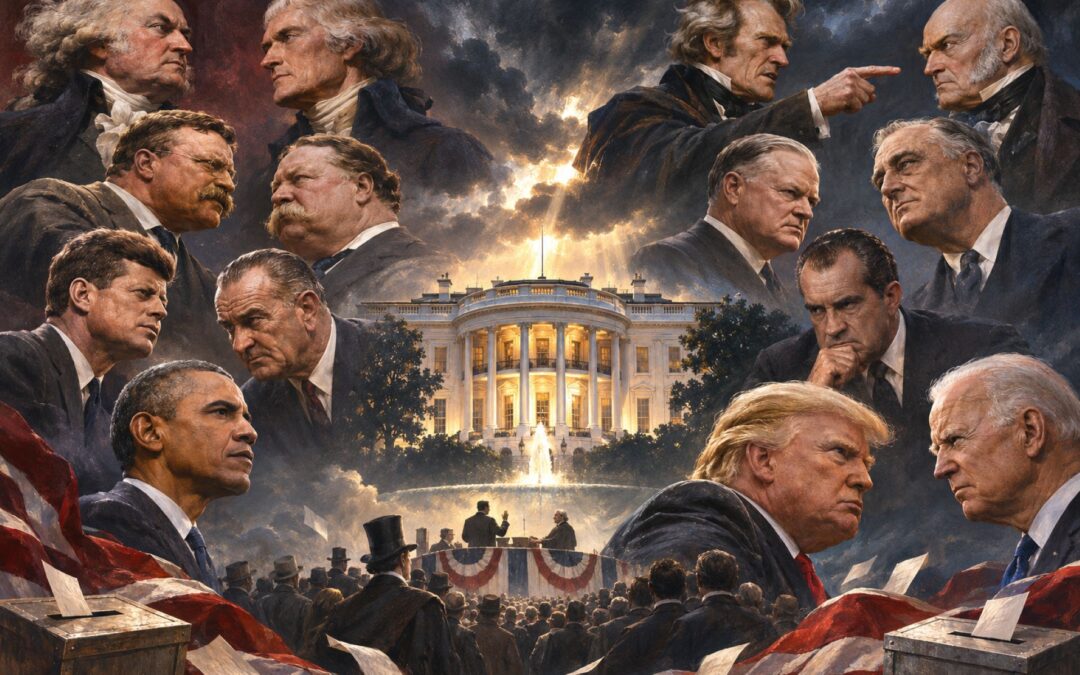
The history of the United States contains plenty of these confrontations. They range from bitter election campaigns in the early republic to disputes over Reconstruction, economic collapse, war and democratic transitions. But the stories are not all equivalent. Some were genuinely personal feuds; others were political partnerships strained by hard choices, or ordinary disagreements later embellished into tales of hatred. The interesting question is not simply which presidents disliked one another. It is when that dislike actually changed history.
Adams and Jefferson: When Founding Fathers Became Political Enemies
John Adams and Thomas Jefferson helped establish the United States before becoming opponents in one of its earliest and ugliest political contests. Adams was a leading advocate of independence, while Jefferson drafted the Declaration of Independence. Their personalities differed sharply: Adams could be combative and suspicious, whereas Jefferson often preferred to make his arguments indirectly. They nevertheless respected one another and served the new country during its struggle for recognition abroad.
In the 1780s, their diplomatic assignments brought them together in Europe. Adams represented American interests in Britain; Jefferson served in France. They discussed government, history and political philosophy, and their families developed a warm relationship. Their correspondence from this period reveals a friendship built on shared revolutionary experiences rather than identical opinions.
The disagreements sharpened under George Washington. Adams and Jefferson came to embody competing visions of the republic. The Federalists, with whom Adams was associated, favoured a stronger national government and worried about the destabilising effects of popular passions. Jefferson’s emerging Republican opposition feared concentrated federal power and admired the principles, if not every development, of the French Revolution. Foreign-policy disputes and partisan newspapers magnified these differences.
The electoral system turned those tensions into an awkward governing arrangement in 1796. Adams won the presidency, while Jefferson finished second in the electoral vote and became vice president under the original constitutional rules. It was an arrangement the Constitution permitted but partisan politics made increasingly difficult: the president’s most formidable opponent was also his constitutional deputy.
Relations deteriorated as Adams signed the Alien and Sedition Acts in 1798. The measures increased federal power over noncitizens and punished certain criticism of the government. Jefferson regarded them as dangerous encroachments on civil liberties and supported organised opposition. Adams, meanwhile, believed his opponents were conspiring to destroy his administration. Political disagreement had become a contest over the character of the republic itself.
The election of 1800 brought the hostility into the open. A notorious newspaper attack described Adams in grotesque, gendered language. Although the insult is often attributed directly to Jefferson, Monticello identifies the attribution as misleading: it originated with journalist James Callender, whom Jefferson had supported financially. Federalist attacks on Jefferson could be equally vicious, portraying him as morally unfit and hostile to religion.
Jefferson ultimately won after the House of Representatives resolved an electoral tie between him and Aaron Burr. Adams left Washington before Jefferson’s inauguration on 4 March 1801. The departure symbolised their estrangement, although the reasons for his early exit cannot be reduced confidently to a single personal slight.
The remarkable ending came decades later. Mutual friend Benjamin Rush encouraged renewed contact, and the two former presidents resumed writing to each other in 1812. Their letters ranged from politics and faith to memory, ageing and the meaning of the revolution. Both died on 4 July 1826, exactly fifty years after the adoption of the Declaration of Independence. A rivalry that had helped define America’s first party conflict ended in a friendship restored through conversation.
John Quincy Adams and Andrew Jackson: The Election That Created Enemies
A generation later, another Adams became embroiled in an election that convinced millions of Americans the political system had been manipulated. John Quincy Adams, John Adams’s son and an experienced diplomat, faced Andrew Jackson, a military hero whose appeal rested partly on his image as a man outside the Washington establishment. The 1824 contest also included William H. Crawford and Henry Clay, reflecting the fragmentation of the once-dominant Democratic-Republican Party.
Jackson won more popular and electoral votes than any other candidate, although voting for presidential electors was not yet universal across the states. Crucially, he did not win a majority of electoral votes. Under the Twelfth Amendment, the choice therefore passed to the House of Representatives, which would decide among the leading eligible candidates. As Speaker of the House, Clay wielded substantial influence despite being excluded from the final selection himself.
Clay supported Adams. The House duly elected Adams in February 1825, and the new president appointed Clay secretary of state. Jackson’s supporters cried foul. They alleged a “corrupt bargain” in which Clay had exchanged his influence for a prestigious cabinet post. That allegation became a devastating political weapon, although the appointments and the sequence of events do not themselves establish that a secret deal occurred. Clay also had genuine policy reasons to prefer Adams over Jackson.
Jackson regarded the outcome as a betrayal of the voters who had supported him. His allies spent the next four years portraying the Adams administration as an illegitimate product of elite bargaining. The dispute helped turn a contested presidential selection into the organising grievance of a new political movement. Jackson’s supporters developed electoral networks and party machinery that would become central to the Democratic Party.
The 1828 rematch was exceptionally cruel. Adams’s supporters drew attention to Jackson’s military executions and violent reputation. They circulated attacks on his marriage to Rachel, whose earlier divorce had not been legally completed when she and Jackson first married. The charge of bigamy was technically rooted in a painful legal complication but deployed as a weapon against a woman who was not standing for office. Jackson’s supporters retaliated with lurid accusations about Adams, including a discredited story suggesting that he had arranged women for the Russian emperor during his diplomatic service.
Jackson defeated Adams decisively. Rachel died in December 1828 before her husband entered the White House. Jackson was devastated and held his political enemies morally responsible for the suffering inflicted on her. It would be irresponsible, however, to assert that campaign attacks medically caused her death. The distinction between Jackson’s personal conviction and demonstrable causation matters.
Adams did not attend Jackson’s inauguration in March 1829, recalling his father’s departure before Jefferson took office. Jackson’s inaugural reception then drew an enormous crowd of supporters to the White House. Accounts of the disorder became part of the mythology of the new democratic age: enthusiastic citizens entering spaces traditionally associated with a narrow governing elite.
The conflict had consequences beyond two men’s reputations. It accelerated the breakup of the old party alignment and the rise of a new competitive political system, though that transformation also depended on changes in suffrage, organisation and sectional interests. Personal hostility and institutional development were intertwined, not interchangeable.
Andrew Johnson and Ulysses S. Grant: Reconstruction Turns Personal
When Abraham Lincoln was assassinated in April 1865, Vice President Andrew Johnson inherited a country whose armies had defeated the Confederacy but whose political future remained unresolved. What would happen to formerly enslaved people? How quickly should the Southern states regain representation? Could the federal government prevent former Confederate elites from restoring their power through different means?
Johnson, a Southern Unionist who had opposed secession, favoured rapid restoration of Southern governments and offered generous pardons to many former Confederates. His policies gave white Southern leaders room to enact restrictive Black Codes and resist the rights of freedpeople. Congressional Republicans increasingly insisted that emancipation required federal enforcement of citizenship and equal protection. The resulting dispute was a struggle over the consequences of the American Civil War, not merely an argument over administrative procedure.
Ulysses S. Grant was the Union’s most celebrated general. Initially, he had reasons to cooperate with Johnson, his civilian commander-in-chief. But he became increasingly concerned about the president’s course and drew closer to congressional Republicans. Grant’s enormous popularity also made him a potential successor, adding a political dimension to their disagreements.
The confrontation crystallised around Secretary of War Edwin Stanton, who supported congressional Reconstruction. Congress had passed the Tenure of Office Act in 1867, restricting the president’s capacity to remove certain officials without Senate consent. Johnson suspended Stanton and placed Grant temporarily in charge of the War Department during a Senate recess. Grant accepted the temporary assignment, but when the Senate refused to approve Stanton’s removal, Grant relinquished the position.
Johnson believed Grant had promised to remain in office and force a court test of the law. Grant disputed that account. Their published correspondence displayed a remarkable breakdown between president and general: Johnson accused Grant of bad faith, while Grant defended his conduct and denied the version of events presented by the White House. What might otherwise have been an internal administrative quarrel became a national argument about constitutional authority and personal honour.
Johnson subsequently removed Stanton again and tried to appoint another replacement. The House of Representatives voted to impeach him in February 1868. The Senate’s account of Johnson’s impeachment places the Stanton controversy within his repeated clashes with Congress over Reconstruction. Johnson survived removal from office by one vote in the Senate, but his authority was badly damaged.
Grant won the 1868 presidential election on a platform aligned more closely with congressional Reconstruction. The bitterness between the two men carried into inauguration day on 4 March 1869. Grant would not share the traditional carriage ride with Johnson, and Johnson did not attend the ceremony. The absent president became an enduring symbol of a fractured transfer of power.
Grant’s administration later enforced Reconstruction legislation and used federal authority against the Ku Klux Klan. These efforts had serious limitations, and Reconstruction’s achievements eventually faced devastating reversals, but Grant’s policies represented a meaningful contrast with Johnson’s. Their feud mattered because competing personal and constitutional loyalties intersected with the rights and safety of millions of newly freed Americans.
Roosevelt and Taft: The Friendship That Split the Republican Party
Theodore Roosevelt and William Howard Taft began as political allies and genuine friends. Roosevelt had become president after William McKinley’s assassination in 1901 and built a reputation for vigorous executive leadership, conservation and confronting powerful corporations. Taft, an experienced administrator who had governed the Philippines and served as secretary of war, seemed a dependable successor.
After winning election in his own right in 1904, Roosevelt announced that he would not seek another term. He backed Taft in 1908 and expected him to continue much of his reform agenda. Taft won comfortably. Yet the two men had different temperaments and conceptions of presidential power. Roosevelt valued public mobilisation and executive initiative; Taft, a lawyer and eventual Supreme Court chief justice, preferred legal processes and institutional restraint.
The disagreement was not simply that Taft abandoned reform. His administration pursued major antitrust cases and other regulatory measures, sometimes more aggressively through the courts than Roosevelt had. But Taft also aligned with conservative Republican leaders on important disputes, including tariff policy, and dismissed conservationist Gifford Pinchot after a confrontation involving Interior Secretary Richard Ballinger. To Roosevelt and progressive Republicans, these choices suggested that Taft had sided with forces they had struggled to contain.
Their correspondence cooled and criticism grew public. Roosevelt increasingly portrayed Taft as weak and politically inept. Taft felt that the former president had become unfair and disloyal, particularly when Roosevelt attacked policies that had emerged from complicated compromises. Political language turned personal; both men used biting descriptions of the other, and the dispute was amplified by newspapers eager for a sensational clash.
In 1912 Roosevelt challenged the sitting president for the Republican nomination. He performed strongly in many preferential primaries, but Taft controlled enough delegates, including through disputed convention decisions, to secure renomination. Roosevelt’s supporters cried foul. Rather than accept defeat, Roosevelt launched the Progressive Party, popularly known as the Bull Moose Party, and campaigned as its presidential candidate.
The split proved disastrous for the Republican ticket. Democratic nominee Woodrow Wilson won an overwhelming majority of electoral votes, though not a majority of the popular vote. Roosevelt finished second nationally, ahead of Taft, and carried more states. Taft won just Vermont and Utah. The 1912 Republican division demonstrated how a dispute between a president and his predecessor could fracture an established party and alter a national election.
It is tempting to claim that Roosevelt single-handedly handed Wilson the presidency. The split certainly helped Wilson, but the votes for Roosevelt and Taft cannot simply be added together as though every voter would have supported the same unified Republican candidate. The deeper consequence was the public exposure of divisions over economic power, executive leadership and the future of progressive reform. Roosevelt and Taft eventually moved toward reconciliation, but the political damage of 1912 could not be undone.
Hoover and FDR: A Presidential Feud During the Great Depression
Herbert Hoover and Franklin D. Roosevelt did not begin as enemies. Both had reputations for energetic public service, and Roosevelt had once viewed Hoover favourably enough to suggest him as a possible Democratic presidential candidate in 1920. The relationship deteriorated as the Great Depression transformed the political landscape and made their differing ideas about government intervention central to the 1932 election.
Hoover had entered the White House in 1929 with considerable administrative experience. The stock market crash, waves of bank failures, collapsing production and soaring unemployment devastated confidence in his presidency. His administration was not entirely inactive: it supported public works, created the Reconstruction Finance Corporation and pursued measures intended to stabilise financial institutions. Yet Hoover resisted some forms of direct federal relief and came to symbolise a government unable to meet the scale of suffering.
Roosevelt, governor of New York, offered a more flexible and optimistic alternative. His promise of a New Deal was more a direction of travel than a fully specified policy blueprint, but it conveyed urgency and experimentation. Hoover saw Roosevelt as dangerously inconsistent, and the campaign featured caustic descriptions from both men. Their disputes involved genuine ideological differences, but they also reflected Hoover’s frustration that the public had rejected his record and Roosevelt’s conviction that he needed freedom to chart another course.
Roosevelt won the November election decisively. Under the constitutional timetable then in force, he would not assume office until 4 March 1933. That four-month interval was dangerous. Banking panics intensified, gold reserves came under pressure, and some states imposed restrictions on withdrawals. The country had voted for a new approach, but the defeated president still held formal responsibility for the government.
Hoover repeatedly tried to secure public commitments from Roosevelt, particularly over financial stability, gold and budget policy. Roosevelt resisted being bound to the outgoing administration’s programme before taking office. He feared that accepting Hoover’s terms could compromise his ability to deliver the changes voters expected. Hoover interpreted this refusal as irresponsible political calculation during a national emergency.
The correspondence and manoeuvring revealed an awkward constitutional problem: the incoming president possessed electoral legitimacy but no executive authority, while the outgoing president retained legal power without a renewed mandate. Hoover’s requests were not necessarily neutral proposals, and Roosevelt’s silence was not necessarily indifference. Historians still debate how much a more cooperative transition could have eased the crisis.
The two men rode together to the Capitol on inauguration day in an atmosphere remembered for its frostiness. The Hoover Presidential Library’s account of their relationship describes a transition that replaced earlier cordiality with lasting bitterness. Roosevelt entered office, declared a national bank holiday and began an emergency programme that reshaped federal economic policy.
The feud should not be treated as proof that either man deliberately caused the banking panic. Longstanding structural weaknesses, monetary failures, deflation and the collapse of confidence predated their final dispute. But their inability to agree during a period of exceptional vulnerability showed how a personal and political transition could become part of a larger institutional crisis.
Truman’s Feuds with Eisenhower and Nixon: The Politics of Loyalty
Harry Truman admired Dwight D. Eisenhower long before the two became adversaries. As a wartime commander, Eisenhower had demonstrated an ability to coordinate enormous military operations and work with competing personalities. Truman, who became president in 1945, respected the general’s reputation and at times encouraged the idea of an Eisenhower presidential candidacy. In the late 1940s, their relationship was friendly enough that Truman presented Eisenhower with a Distinguished Service Medal.
The personal break came as Eisenhower entered partisan politics in 1952. He sought the Republican nomination while Truman supported the Democratic candidate, Adlai Stevenson. Campaign disagreements were inevitable, but one particular episode made the breach more painful: the treatment of General George C. Marshall. Marshall had been Army chief of staff during the Second World War and secretary of state under Truman, lending his name to the plan for European recovery. Truman considered him a man of exceptional integrity.
Senator Joseph McCarthy and other anti-communist critics attacked Marshall with allegations that he had assisted communist interests. The charges were part of a wider climate of suspicion in which political disagreements could be recast as disloyalty. Eisenhower had been a colleague and admirer of Marshall, yet while campaigning in Wisconsin, he removed language defending the general from a speech. Advisers worried that challenging McCarthy in his home state would cost valuable votes.
Truman interpreted the omission as a failure of courage. In his view, a military leader who owed so much to Marshall should not have allowed electoral calculation to override personal loyalty. Eisenhower saw Truman’s subsequent campaign attacks as unfair and increasingly bitter. The tension made their relationship an example of how political competition can transform old professional respect into something close to personal contempt.
The transition after Eisenhower’s victory was uncomfortable. Truman invited him to a customary pre-inauguration meeting at the White House; Eisenhower declined the social invitation and arrived for the ceremonial journey without the warmth Truman expected. Both men maintained the formal transfer of office, but the contrast between public ritual and private displeasure was unmistakable. The Korean War made an orderly handover especially consequential, although claims that their feud directly delayed particular military decisions require more evidence than mere descriptions of their frosty behaviour.
Their relationship softened in later years. As the National Archives’ account of the Eisenhower–Truman thaw shows, efforts to restore cordiality eventually bore fruit. The two never needed to agree about the 1952 election to recover a measure of mutual respect. Their story resembles Adams and Jefferson’s in that political estrangement did not prove permanent.
Truman’s dislike of Richard Nixon was more durable. Nixon had risen to national prominence through aggressive anti-communist investigations and accusations against political opponents. As a congressman and later a senator, he helped define a political style that Truman considered opportunistic and destructive. Nixon criticised the Truman administration over communist expansion, especially the victory of Mao Zedong’s forces in China in 1949 and American policy in Asia.
Truman responded with unusually harsh language. In interviews and private comments that later became public, he called Nixon a liar and expressed contempt for his methods. The ferocity is striking because Nixon was not Truman’s direct opponent in a presidential election: the antagonism centred on the kind of political conduct Truman believed Nixon represented. Nixon, for his part, saw Truman as an emblem of Democratic foreign-policy failures.
There is an important chronological limit to this story. Truman died on 26 December 1972. The Watergate break-in had already occurred, but Nixon’s resignation did not take place until August 1974. Truman could not have watched the completed scandal vindicate his judgment. His criticisms belong to the political era he lived through, not to a fictional reaction after his death.
Kennedy and Johnson: Rivals Inside the Same White House
John F. Kennedy’s decision to select Lyndon B. Johnson as his running mate in 1960 was as much an exercise in political arithmetic as a gesture of friendship. Kennedy was a young Massachusetts senator from a wealthy, well-connected family. Johnson, the powerful Senate majority leader from Texas, brought extensive legislative experience, Southern political relationships and a far more abrasive style. They could help one another electorally even while making each other uncomfortable.
Johnson had sought the Democratic presidential nomination himself and entered the vice presidency from a position of immense influence in the Senate. The change was personally difficult. Vice presidents possessed relatively little independent authority, and Kennedy surrounded himself with younger advisers who tended to share his family’s social background and habits. Johnson was accustomed to commanding committees, bargaining over legislation and cultivating personal obligations. He suddenly found himself outside many of the administration’s most consequential conversations.
The deepest hostility often lay between Johnson and Kennedy’s younger brother Robert, the attorney general. Robert Kennedy distrusted Johnson and regarded him as crude and unprincipled. Johnson resented Robert’s influence over the president and the way some Kennedy associates treated him. The reciprocal contempt became an open secret in Washington. That rivalry should not be confused with proof that John Kennedy himself hated his vice president to the same degree; JFK’s relationship with Johnson was more strategic and complicated.
After Kennedy was assassinated in Dallas on 22 November 1963, Johnson inherited both the presidency and the unfinished legislative programme. He used his intimate knowledge of Congress to secure passage of major laws, including the Civil Rights Act of 1964 and Voting Rights Act of 1965. His political skills had been formidable before Kennedy’s death, and his presidency gave him the opportunity to exercise them directly.
Johnson sometimes contrasted his legislative achievements with what he considered Kennedy’s less effective handling of Capitol Hill. Those boasts reflected genuine differences in experience, but they also served Johnson’s desire to escape the perception that he was merely completing someone else’s presidency. Kennedy loyalists, meanwhile, continued to influence the public memory of the administration. Their competing claims about credit added another layer to the old resentments.
In 1967 Johnson signed a federal anti-nepotism provision restricting the appointment of close relatives to federal positions. The measure has frequently been linked to the fact that President Kennedy had appointed his own brother attorney general, and to Johnson’s personal antagonism toward Robert Kennedy. That political context is significant, but it does not conclusively establish a single motive for the law. It addressed a broader institutional question: should presidents be allowed to install family members in powerful government jobs?
This was a rivalry shaped by class, region, personality and ambition, yet its most consequential outcomes were institutional. Kennedy needed Johnson’s political reach; Johnson needed a route to the national stage; and once president, Johnson pursued legislative goals that transformed American life. Their partnership was uncomfortable, but reducing it to an unbroken story of mutual hatred would obscure what each achieved.
Johnson and Nixon: The Vietnam Peace Talks Controversy
Some presidential rivalries involve bruised friendships. Others raise questions about whether electoral ambition interfered with matters of war and peace. Lyndon Johnson’s hostility toward Richard Nixon reached its peak during the final months of the 1968 presidential campaign, as the United States tried to find a route out of the Vietnam War.
By 1968 the war had become politically ruinous for Johnson. Hundreds of thousands of American troops were deployed, casualties were mounting, and the Tet Offensive had severely damaged confidence in official assurances of progress. Johnson announced in March that he would not seek reelection and intensified efforts to begin serious peace negotiations. His administration was communicating with North Vietnam while attempting to keep the South Vietnamese government involved in the diplomatic process.
Nixon, the Republican candidate, faced Democratic nominee Hubert Humphrey, Johnson’s vice president. A breakthrough before election day might have helped Humphrey. That possibility created an obvious incentive for Nixon’s campaign to discourage expectations of a rapid settlement. The key historical controversy concerns contacts between Republican intermediaries and South Vietnamese officials, particularly through Anna Chennault, a politically connected fundraiser with access to South Vietnam’s ambassador in Washington.
Contemporary intelligence and later-released presidential recordings indicate that American officials detected communications urging South Vietnam to resist participation in the proposed talks or expect more favourable treatment after a Nixon victory. Johnson regarded the contacts as an extraordinary interference with his administration’s foreign policy. In conversations captured on White House recordings, he used the word treason to describe what he believed was happening.
The LBJ Presidential Library’s material on the Chennault Affair is valuable because it moves the episode beyond hearsay. Records document the administration’s suspicions, intelligence reporting and discussions among senior officials. But historians continue to debate exactly what Nixon knew and directed at each stage, how his intermediaries operated, and the role of South Vietnam’s own calculations. The South Vietnamese leadership was not simply a passive instrument of American campaign politics; it had reasons of its own to distrust proposed terms and Washington’s willingness to compromise.
Johnson faced a terrible political and institutional dilemma. Publicly exposing the operation might have affected the election, but doing so would have involved revealing sensitive intelligence collection and methods. He also worried about placing secret surveillance information into a partisan campaign. The administration did not make its full evidence public before the vote. Johnson instead pursued his diplomatic effort while privately expressing fury at what he believed Nixon’s side had done.
Nixon narrowly won the election. South Vietnam’s refusal to join the anticipated talks contributed to the failure of the immediate diplomatic opening, and the war continued for years. It is reasonable to treat the affair as a serious ethical and historical controversy. It is not reasonable to claim with certainty that, without these contacts, peace would have been signed immediately or that a calculable number of later deaths resulted from Nixon’s intervention. North Vietnam, South Vietnam, Washington and the conflict on the ground all presented obstacles to an agreement.
This distinction does not make Johnson’s reaction trivial. A presidential candidate’s campaign had been accused of influencing another government’s response to active negotiations led by the sitting president. Whether one accepts the harshest interpretation of Nixon’s conduct or a more qualified one, the episode shows how the struggle for presidential power can reach beyond campaign rhetoric into foreign policy itself. That is why the Johnson–Nixon dispute remains among the most consequential rivalries in modern American history.
Carter and Reagan: A Cold Transition Amid an International Crisis
Jimmy Carter and Ronald Reagan were political opposites in ways that extended beyond party labels. Carter, a former Georgia governor, approached the presidency with a reputation for moral seriousness and close attention to administrative detail. Reagan, a former California governor and accomplished communicator, often preferred to express a broad principle and leave technical questions to advisers. Their contrasting styles were particularly visible during the 1980 election.
Carter entered the campaign beset by inflation, economic uncertainty, energy problems and the seizure of Americans at the US embassy in Tehran. The hostages had been held since November 1979, making their captivity an ongoing national ordeal. Reagan presented himself as the candidate who could restore confidence and make government appear less anxious and overburdened. He defeated Carter decisively.
The transition carried understandable strains. Accounts from participants describe differences in preparation and priorities, with Carter more focused on detailed briefings and Reagan less inclined to work through every issue in the same manner. Those differences sometimes caused irritation, but they are not strong evidence of the kind of lasting personal feud seen between Johnson and Grant or Roosevelt and Taft.
A popular story alleges that Nancy Reagan demanded early access to the White House or its guest accommodation so that the incoming family could redecorate, and that the Carters indignantly refused. Versions of this story circulated during the transition, but its details have been contested. Treating it as a settled example of the Reagans’ arrogance would give a political rumour more weight than the evidence warrants.
The most extraordinary moment came on 20 January 1981. As Reagan took the presidential oath, the Americans held in Iran were about to become free after 444 days of captivity. Their actual departure occurred during the inauguration-day transition, following prolonged negotiations conducted by the Carter administration. The timing made it seem to many observers that Reagan had accomplished in moments what Carter had failed to do for more than a year. That impression ignored the difficult negotiations and agreements already reached before Reagan took office.
Carter’s defeat and the hostage release formed a painful personal juxtaposition, but the event did not mean Reagan had magically resolved the crisis through his presence alone. Carter later participated in efforts to secure the release of the hostages and remained deeply associated with the negotiations. This episode belongs in a history of presidential tensions because it shows how competing public images can shape a transition, even without a fully developed personal vendetta between the men involved.
Obama and Trump: From Birtherism to Political Polarisation
Barack Obama and Donald Trump became antagonists before Trump held public office. During Obama’s presidency, Trump promoted the false claim that Obama had not been born in the United States and was therefore ineligible to be president. The conspiracy persisted despite the public availability of Obama’s birth records and Hawaii’s confirmation of his birth there. It was not an ordinary policy disagreement: it challenged the legitimacy of the first Black president through an allegation without factual foundation.
Obama answered the campaign of insinuation with humour as well as official documentation. In April 2011 the White House released his long-form birth certificate. Days later, at the White House Correspondents’ Dinner, Obama mocked Trump’s fascination with the subject, including a joke that presented a scene from The Lion King as his birth video. Trump was in the audience. The exchange became part of political folklore, and later commentators suggested that the humiliation propelled Trump toward the presidency. That psychological explanation is impossible to prove. Trump had considered presidential politics before the dinner, and his eventual candidacy had multiple causes.
The animosity continued after Trump announced his 2016 campaign and won the election. His presidency brought substantial efforts to reverse Obama’s policies. Republicans tried unsuccessfully to repeal the Affordable Care Act in its entirety, while Trump signed legislation eliminating the federal individual-mandate tax penalty. He withdrew the United States from the Iran nuclear agreement and initiated withdrawal from the Paris climate agreement. These were policy decisions with political constituencies behind them, not merely personal revenge, although Trump frequently framed his leadership in opposition to Obama’s record.
Trump also made an unsupported accusation that Obama had ordered surveillance of his campaign. Disputes over investigations into Russian interference, intelligence practices and Trump’s own conduct became central to their public attacks. Obama, who initially observed some restraint toward his successor, grew more openly critical as Trump’s administration unfolded. During the COVID-19 pandemic and the 2020 campaign, he challenged Trump’s response to the emergency and warned about the direction of American democracy.
Symbolic clashes mattered because they conveyed how deeply the two presidents represented opposing political identities. Trump did not host Obama’s official White House portrait unveiling during his first term; the portrait was eventually unveiled under President Biden in 2022. What had usually been a bipartisan ritual of recognition became another marker of political estrangement. Yet neither man held a monopoly on defining that symbolism. For supporters, the disagreement concerned competing ideas about government, culture and national leadership.
An unexpected scene complicated the story. At Jimmy Carter’s state funeral in January 2025, Obama and Trump sat beside one another and appeared to converse amiably. The encounter did not erase their differences or imply a private reconciliation. It demonstrated something simpler: public adversaries can interact with courtesy, even after years of acrimonious politics. The rivalry was real, but its occasional moments of civility caution against treating every encounter as evidence of unbroken personal hatred.
Trump and Biden: Election Denial and the Transfer of Power
Donald Trump’s rivalry with Joe Biden moved beyond personal insults into a struggle over the validity of an election and the obligations of an outgoing president. In 2020 Biden challenged Trump’s bid for reelection amid the COVID-19 pandemic, an economic downturn and intense disputes about public health and race. Trump repeatedly called Biden “Sleepy Joe” and attacked his competence, while Biden criticised Trump’s leadership, character and handling of the pandemic. Both used sharply personal language, but the constitutional stakes became most visible after the votes were counted.
Biden won the national popular vote by more than seven million votes and secured 306 electoral votes to Trump’s 232. Trump refused to acknowledge defeat, alleging widespread fraud. His campaign and allies filed numerous legal challenges, but courts repeatedly rejected or dismissed attempts to overturn the outcome. Election administrators from both parties affirmed the integrity of the results, and recounts did not change the winner. The existence of partisan dispute did not make the factual outcome uncertain.
The refusal to concede also disrupted the transition process. Formal recognition by the General Services Administration was delayed, restricting the incoming team’s access to some resources and contacts during a national health emergency. Eventually the transition proceeded, but the delay highlighted the extent to which ordinary administrative cooperation depends on the outgoing president’s willingness to accept the electoral process. The presidency has immense formal authority, yet many of its handover customs rely on voluntary institutional restraint.
On 6 January 2021, as Congress met to certify the electoral votes, a mob of Trump supporters attacked the US Capitol. The violence interrupted the congressional session and endangered lawmakers, police and staff. Trump had promoted false claims about the election and urged supporters to assemble in Washington. The relationship between his actions and the attack became the subject of investigations, legal proceedings and continuing public debate. What is not in dispute is that Congress ultimately certified Biden’s victory and that the assault was a grave attack on the constitutional transfer of power.
Trump chose not to attend Biden’s inauguration on 20 January 2021. Instead, he left Washington that morning. His absence recalled earlier presidential no-shows, but the circumstances differed. John Adams, John Quincy Adams and Andrew Johnson had also missed successors’ inaugurations; the history of presidential inauguration absences places Trump’s decision within that longer tradition. Yet the refusal to accept a certified result, coupled with the events of January 6, made the 2021 transition distinctive in American political life.
Biden repeatedly presented Trump and his political movement as a threat to democratic institutions. Trump continued to contest the legitimacy of the 2020 result and pursued a return to office. Their rivalry remained a defining feature of American politics through the 2024 election, even after Biden withdrew from the race and Vice President Kamala Harris became the Democratic nominee. Trump defeated Harris, securing a second, nonconsecutive presidential term.
The transition in January 2025 provided a striking contrast. Biden welcomed Trump to the White House and attended his inauguration on 20 January, following the ceremony that Trump had refused to attend four years earlier. This was not proof that the two men had resolved their personal or political differences. It was proof that a president can uphold the ceremonial transfer of power while remaining profoundly opposed to the successor’s programme. Where the 2021 handover illustrated institutional strain, the 2025 ceremony illustrated the value of maintaining a constitutional tradition despite conflict.
Obama and Biden: Political Partners with Private Tensions
Not every strained relationship between presidents begins as a contest for office. Barack Obama and Joe Biden spent eight years as president and vice president, developing a working partnership that became central to their public images. Obama had selected Biden in 2008 partly for his foreign-policy experience, congressional relationships and ability to connect with voters beyond Obama’s natural political base. Biden offered experience and a different temperament; Obama offered the larger political platform.
Their partnership included genuine affection and many policy disagreements. Biden often spoke more impulsively than Obama and sometimes complicated the administration’s messaging. In 2012 Biden publicly expressed support for same-sex marriage before Obama announced his own position, creating a moment of political difficulty that also accelerated an important public discussion. Such disagreements did not mean the partnership was fraudulent. Successful administrations often contain differences between people who share broad objectives but have competing instincts.
After leaving office, Biden considered running for president in 2020. Reports suggested Obama had doubts about whether his former vice president should enter a demanding campaign and whether he could defeat Trump. Obama did not immediately endorse Biden during the crowded Democratic primary, a decision that frustrated some Biden supporters. Yet former presidents commonly avoid choosing sides while their party’s nomination remains unsettled. Obama endorsed Biden in April 2020 after Biden emerged as the presumptive nominee, and campaigned for him in the general election.
The relationship faced another test during Biden’s 2024 reelection effort. Biden, already the oldest sitting president in American history, struggled to quiet concerns about his age and ability to campaign effectively. After his widely criticised debate performance against Trump in June, prominent Democrats privately and publicly debated whether he should remain the nominee. Reporting indicated that Obama shared concerns about Biden’s prospects, even as he was careful about how he expressed them.
Biden announced on 21 July 2024 that he would end his reelection campaign. Obama praised his service, while the Democratic Party moved toward Harris as its candidate. Later accounts depicted a mixture of strategic disagreement, loyalty, disappointment and concern. Some reported remarks attributed to Obama are impossible to authenticate confidently and should not become the organising evidence for a supposed secret feud.
Obama and Biden illustrate an important distinction often lost in political storytelling: friends and allies can distrust one another’s judgment on a particular decision without becoming enemies. Their disagreements reflected the burden of party leadership and the difficulty of balancing personal loyalty against electoral responsibility. Unlike the bitter breaks between Roosevelt and Taft or the constitutional confrontation surrounding Trump and Biden, this was primarily a dispute within an enduring political alliance.
Presidential rivalries are compelling because they reveal people behind institutions. Adams could feel betrayed by Jefferson and later recover their friendship. Jackson could turn a disputed election into a political movement. Roosevelt could challenge a successor he had once championed. Johnson could see the stakes of Reconstruction in his battles with Grant, while another Johnson could fear electoral interference during an unfinished war.
The consequences, however, were never determined by personality alone. Political parties, laws, economic conditions, public movements and constitutional rules shaped what these presidents could do. A grudge might deepen a crisis or sharpen a contest, but it did not create every crisis it touched. The distinction between documented conflict and dramatic folklore is essential to understanding the past.
The strongest presidential tradition is not that leaders must like one another. It is that they must recognise the limits of their personal power, accept lawful outcomes and keep public responsibilities separate from private resentments. American history shows how difficult that has sometimes been—and why it matters when presidents manage to do it anyway.
Last Updated on November 25, 2026 by Aseem Gupta