
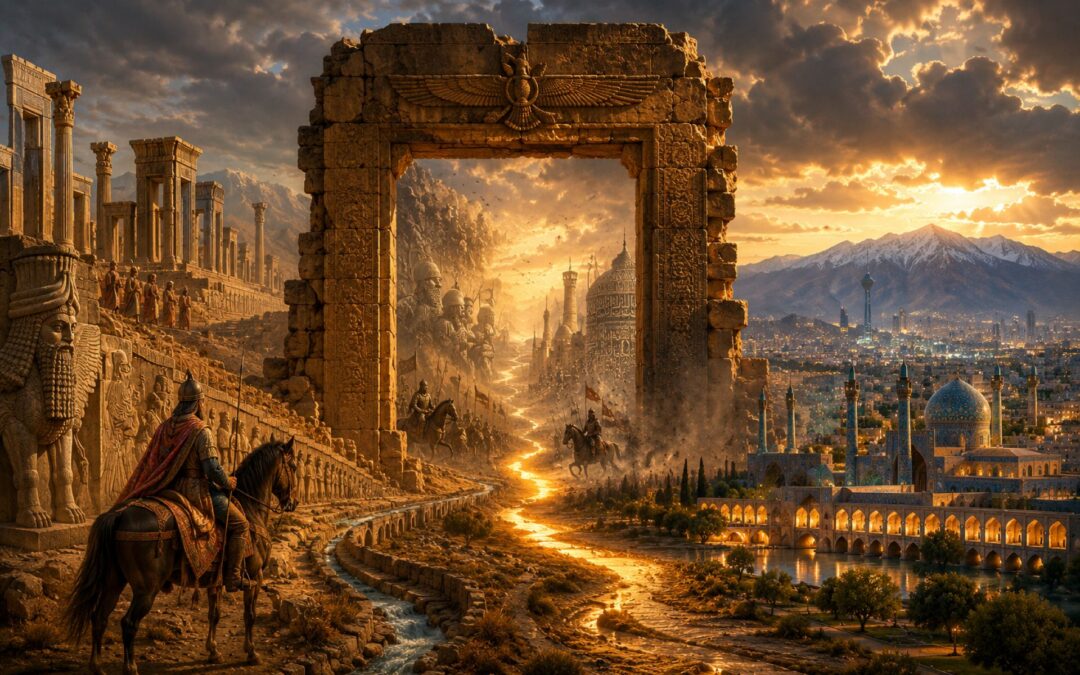
Persia has fallen many times.
Its capitals have been captured, its dynasties overthrown, its cities burned, its territories divided and its religions transformed. Assyrians, Macedonians, Arabs, Turks and Mongols all conquered parts of the Iranian world. Russia and Britain later reduced its sovereignty without formally colonising it. In the twentieth century, monarchy gave way to revolution, and an aggressively modernising state became an Islamic republic.
Yet Persia did not disappear.
That is the central puzzle of Iranian history. The Achaemenid, Parthian, Sasanian, Safavid, Qajar and Pahlavi states were not one continuous empire. They differed profoundly in language, religion, political structure and territorial reach. Modern Iran is not simply the Achaemenid Empire under another name.
What persisted was something broader: a civilizational centre rooted in the Iranian plateau, sustained by durable cities, administrative traditions, trade routes, literary memory and an unusual capacity to absorb foreign rulers without remaining culturally subordinate to them.
The names themselves reveal part of the complexity. “Persia” derives from Persis, the Greek form of Parsa, the southwestern region associated with the ancient Persians. “Iran” comes from a much older indigenous conception of the land of the Iranian peoples. European governments had long known the country as Persia when, in 1935, Reza Shah’s government requested the wider diplomatic use of Iran. Neither name is entirely wrong, but they carry different associations.
Iran is the modern state. Persia is often used for its premodern empires and cultural traditions. The Persianate world extends further still, encompassing societies from Anatolia to India and Central Asia that adopted Persian language, literature, government and court culture even when they were ruled by non-Persian dynasties.
Across all three meanings runs the same historical tension. Iran stood at the meeting point of Mesopotamia, Central Asia, India, the Caucasus and the Mediterranean. That location made it wealthy, connected and strategically indispensable. It also exposed it to repeated invasion.
Persian civilization survived not by resisting all outside influence, but by continually transforming it.
Before Persia: Elam and the Iranian Plateau
Long before the rise of the Persians, the Iranian plateau already contained agricultural communities, trade routes, cities and political traditions stretching back thousands of years.
The region’s geography shaped everything that followed. Western Iran rises sharply from the Mesopotamian plain into the Zagros Mountains. The interior contains high plateaus, deserts, isolated valleys and scattered areas of cultivable land. To the north lie the Caucasus and the Caspian region. To the east, routes lead toward Central Asia, Afghanistan and the Indian subcontinent. To the south, the Persian Gulf opens into the Indian Ocean.
This was not an easy environment in which to build a densely populated river civilization like those of Egypt or southern Mesopotamia. Water was limited and unevenly distributed. Communities often depended on local rainfall, mountain streams, pastoralism and carefully managed irrigation.
But the plateau was not isolated. Its valleys and mountain passes connected several of the ancient world’s great cultural zones.
Some of the earliest known farming settlements in western Iran appeared during the Neolithic period. Communities cultivated grains and legumes, kept animals and gradually established more permanent villages. By the fifth millennium BCE, Susa had emerged in the southwest as one of the region’s most enduring urban centres.
Susa would remain important under Elamite, Achaemenid, Seleucid, Parthian and Sasanian rule. Few places better illustrate the continuity beneath Persia’s changing dynasties. Capitals moved and ruling languages changed, but the same strategic centres repeatedly returned to political prominence.
The earliest major civilization associated with southwestern Iran was Elam. It should not be imagined as one unified nation existing unchanged for thousands of years. As the history of Elam shows, the name covers a succession of related but changing kingdoms, cities and political coalitions that developed through constant interaction with Mesopotamia.
Elamite rulers competed with Sumerian, Akkadian, Babylonian and Assyrian states. At times, Mesopotamian armies invaded Elam and seized its cities. At other times, Elamite kings marched west and interfered in Babylonian politics. The frontier between the Iranian highlands and the Mesopotamian plain was therefore not a simple boundary between two sealed civilizations. It was a zone of war, migration, diplomacy and exchange.
Elam’s political centres included Susa in the lowlands and Anshan further east. Its people used several writing systems over time. Proto-Elamite, one of the earliest, remains undeciphered, while later Elamite texts written in cuneiform can be read with considerably greater confidence. The language was neither Semitic nor Indo-European and eventually disappeared, but it survived for centuries within later Persian administration.
Elamite society traded far beyond its immediate neighbours. Materials and objects moved between Iran, Mesopotamia, the Persian Gulf, Central Asia and the Indus region. Stone, metals, timber and agricultural goods passed through networks that would later become part of far larger transcontinental systems.
The precise relationship between Elamite culture and later Persian civilization is difficult to define. It would be misleading to draw a straight line from Elamite religion, social organisation or art to every later Iranian institution. Yet the early Persians did not enter an empty landscape. They inherited cities, scribal traditions, routes, political centres and local populations whose influence did not vanish when rulers changed.
From around the second millennium BCE, Iranian-speaking peoples gradually entered and spread across the plateau. They formed part of the wider Indo-Iranian branch of Indo-European-speaking populations whose movements transformed much of Eurasia.
This was not a single invasion that instantly replaced the existing inhabitants. Migration, settlement, conflict and cultural mixing occurred over many centuries. Groups later known as Medes, Persians and Parthians established themselves in different regions while interacting with older communities.
By the first millennium BCE, Iranian-speaking peoples had become politically dominant across much of the plateau. Yet Elamite remained important in administration, particularly in the southwest. The future Persian Empire would therefore emerge from cultural combination rather than simple ethnic replacement.
This pattern would recur throughout Iranian history. New rulers arrived, but they rarely began from nothing.
Cyrus the Great and the Birth of the Persian Empire
Before the Persians built their empire, the Medes had become one of the principal Iranian powers of western Asia.
The details of Median political organisation remain debated. Greek accounts, especially those associated with Herodotus, describe a sequence of Median kings who united the tribes and established a centralised empire. Modern historians are more cautious. The Medes certainly formed a powerful political coalition and played a major role in the destruction of the Assyrian Empire, but the size and administrative unity of their state are uncertain.
In 612 BCE, Median and Babylonian forces captured Nineveh, helping bring down the empire that had dominated much of the Near East through military power and systematic terror. The collapse of Assyria created space for new states.
Among the Medes’ subordinate peoples were the Persians of southwestern Iran. Their ruling house, later called the Achaemenid dynasty, was associated with the region of Parsa. During the middle of the sixth century BCE, Cyrus II rebelled against the Median king Astyages.
Later stories embroidered the rebellion with prophecies, hidden royal identities and court intrigue. The historical outline is simpler. Cyrus defeated Astyages around 550 BCE, absorbed the Median realm and gained control of a political network extending far beyond his original homeland.
His victory did not merely replace Median officials with Persians. Cyrus incorporated Median elites, military traditions and royal practices into the new state. This willingness to preserve useful institutions would become one of the strengths of Persian imperial rule.
Cyrus next turned west. He defeated Croesus, king of Lydia, and brought much of Anatolia under his authority. Persian commanders then subdued Greek cities along the Aegean coast. To the east, Cyrus expanded into territories connected with Central Asia, although the chronology and exact boundaries of these campaigns remain uncertain.
His most famous conquest came in 539 BCE, when Persian forces entered Babylon.
Babylon was one of the greatest cities in the ancient world and the centre of a kingdom that controlled Mesopotamia and parts of the Levant. Cyrus did not present himself to its inhabitants as a foreign destroyer. He adopted the traditional language of Mesopotamian kingship, claimed to have restored proper religious order and worked through existing institutions.
The Cyrus Cylinder, created after the conquest, records this political programme in the form of a Babylonian royal inscription. It describes Cyrus as a legitimate king favoured by the god Marduk and presents his rule as a restoration after the alleged failures of the previous king, Nabonidus.
In modern times, the cylinder has often been called the first declaration of human rights. That description is anachronistic. Cyrus did not proclaim universal individual liberties in the modern sense. He was an imperial conqueror speaking through established traditions of royal legitimacy.
Yet the inscription still matters. It reflects a method of government that relied less on cultural destruction than on accommodation. Local temples were restored, displaced cult images were returned and communities deported by earlier rulers were permitted to rebuild their institutions.
The biblical tradition remembered Cyrus with exceptional favour because his policies allowed Judean exiles and their descendants to return to Jerusalem and restore the Temple. He became one of the rare foreign monarchs treated as an instrument of divine purpose.
This reputation should not turn Cyrus into an idealised modern liberal. Persian imperial rule remained autocratic, hierarchical and capable of severe violence. Rebellions could be crushed, populations deported and tribute imposed.
What distinguished Cyrus was not an absence of coercion, but a sophisticated understanding of how to rule a diverse empire. He did not require every conquered society to become Persian. Instead, he sought loyalty, taxation and political order while preserving many local elites, religious practices and administrative structures.
The resulting state became the foundation of the Achaemenid dynasty, the first Persian Empire and the largest territorial empire the world had yet seen.
Its lands eventually stretched from Central Asia and the Indus region to Egypt, Anatolia and the Aegean. It contained dozens of peoples, languages, legal traditions and religious systems.
No ruler could govern such a space by issuing commands from one capital alone. Cyrus created the political framework, but the imperial system reached its mature form under successors who transformed conquest into administration.
Cyrus died while campaigning in Central Asia, probably in 530 BCE. His tomb still stands at Pasargadae, modest in comparison with the monumental architecture later associated with Persian kingship.
His most enduring achievement was not a single battle or decree. It was the creation of an imperial model flexible enough to connect profoundly different societies without demanding their complete cultural uniformity.
Darius, Xerxes, and the Achaemenid System
Cyrus’s son Cambyses II extended Persian power into Egypt. His death, however, produced a succession crisis that threatened to fragment the empire.
Darius I emerged victorious in 522 BCE, but his accession was contested. Rebellions broke out across several provinces, and Darius spent the early part of his reign defeating rival claimants and reasserting central authority.
Once secure, he reorganised the empire on a scale that made Achaemenid rule more systematic than it had been under Cyrus.
The empire was divided into provinces conventionally called satrapies, governed by satraps who collected revenue, administered justice and maintained order. The system was never perfectly uniform. Some regions preserved local kings, temple authorities or hereditary elites, while others were more directly supervised.
This flexibility was practical. Egypt, Babylonia, Lydia and Central Asian territories possessed different economic and political traditions. Persian power was strongest when it used those systems rather than trying to abolish them.
At the same time, Darius worked to prevent provincial governors from becoming independent rulers. Military command, financial administration and royal inspection could be divided among different officials. Messengers and inspectors linked provincial courts to the king. Members of the royal family and Persian aristocracy circulated through this network, creating ties between the centre and regional elites.
Darius also regularised taxation and promoted imperial coinage. The gold daric and silver siglos facilitated state payments and long-distance exchange, though many local economies continued using their own currencies and systems of tribute.
The empire did not operate through one imposed language. Old Persian appeared in royal inscriptions, but Aramaic became especially important for communication across large distances. Elamite remained prominent at the imperial centre, while Babylonian, Egyptian, Greek and other languages continued in their respective regions.
This multilingual bureaucracy illustrates the deeper logic of Achaemenid government. Persian identity stood at the top of the political hierarchy, but imperial administration depended on cultural plurality.
Roads and communications tied the system together. The most famous route connected Susa with Sardis in western Anatolia. Relay stations supplied official couriers with fresh horses and provisions, allowing royal orders and reports to move far faster than ordinary travellers.
This was not a modern postal system open equally to the entire population, nor was every element invented by one king. The Persians expanded, linked and standardised older regional networks into an imperial communications system capable of governing enormous distances.
The empire also invested in the control of water and movement. Canals, wells, roads and irrigation supported armies, agriculture and trade. Qanats—gently sloping underground channels that carried water from aquifers to settlements and fields—became one of the most important technologies used across the Iranian world.
Qanats were not a uniquely Persian invention attributable to a single ruler, but Persian states helped spread and maintain them. Their underground construction reduced evaporation and protected water supplies in dry environments. They turned difficult landscapes into productive zones and allowed communities to survive far from permanent rivers.
Achaemenid kings ruled from several centres. Susa remained an administrative capital. Babylon retained immense economic and symbolic importance. Ecbatana served as another royal centre. Darius also began constructing Persepolis, whose terraces, palaces and reliefs expressed the empire’s political vision.
The delegations carved into the stairways of Persepolis do not depict conquered peoples as a mass of defeated captives. They appear in distinctive clothing, carrying regional gifts or tribute toward the king. The imagery communicated hierarchy, but also ordered diversity. The empire’s strength was represented through the participation of many peoples under one royal authority.
Religion under the Achaemenids is harder to reconstruct than later tradition sometimes suggests. Persian royal inscriptions invoke Ahura Mazda, the supreme deity associated with Zoroastrian tradition. Yet the exact date of Zoroaster and the development of early Zoroastrianism remain uncertain.
It is therefore risky to describe the Achaemenid Empire as a fully organised Zoroastrian state. Its rulers honoured Ahura Mazda while governing subjects who worshipped many gods. Persian policy frequently supported local cults when they reinforced political order.
The empire’s social structure was equally complex. Evidence from administrative tablets at Persepolis shows women receiving rations, supervising workforces and managing economic resources. Some elite women controlled estates and travelled independently.
These records challenge older assumptions that women were entirely absent from Persian economic life. They do not establish universal gender equality, but they reveal a society in which women—particularly within the royal and administrative economy—could hold significant responsibilities.
The Achaemenid Empire is often remembered in the West primarily through its wars with the Greek city-states. Those wars mattered, but they formed only one part of a much larger imperial history.
Persian expansion into the Aegean brought it into conflict with Greek communities on the Anatolian coast. After the Ionian Revolt, Darius sent forces into the Greek mainland. A Persian expedition was defeated at Marathon in 490 BCE.
The loss was important, but it was not a mortal blow to the empire. By Persian standards, Greece was a distant and relatively poor frontier. The empire’s most valuable centres lay in Egypt, Mesopotamia, Anatolia, Iran and Central Asia.
Darius died before launching another major campaign. His son Xerxes organised a much larger invasion in 480 BCE. Persian forces crossed into Greece, defeated resistance at Thermopylae and occupied an evacuated Athens.
The Persian fleet was then defeated at Salamis. Xerxes withdrew much of his force, and the army remaining in Greece was defeated at Plataea the following year.
Greek survival had enormous consequences for Greek history and later Western memory. It did not end Persian power. The Achaemenid Empire remained the dominant state in western Asia for another century and frequently influenced Greek affairs through diplomacy, subsidies and alliances.
Indeed, Greek cities continued fighting one another far more often than they united against Persia. Achaemenid wealth enabled Persian kings to intervene strategically without permanently occupying the mainland.
The empire’s resilience came from more than military size. It connected regional economies, maintained political order across vast distances and allowed local identities to continue beneath Persian sovereignty.
It was not a peaceful federation. Imperial power depended on taxation, hierarchy and the threat of force. Rebellions in Egypt and Babylonia could be punished harshly. Court politics sometimes became violent, and succession struggles weakened royal authority.
Yet the system proved remarkably durable. Cyrus had created an empire. Darius created many of the institutions that allowed it to function as an empire rather than a temporary accumulation of conquests.
For nearly two centuries, the Achaemenids governed the most extensive political system the ancient world had known. When it finally collapsed, it did so with astonishing speed.
That collapse would long be explained as the inevitable defeat of a decadent Asian empire by a dynamic Greek conqueror. The truth was far more complicated.
Alexander’s Conquest and the Hellenistic Transformation
The Macedonian conquest of Persia began before Alexander crossed into Asia.
His father, Philip II, had transformed Macedonia into the strongest military power in the Greek world. He reorganised the army, developed the long Macedonian pike formation and combined infantry, cavalry and siege warfare more effectively than most contemporary states.
After defeating an alliance of Greek cities, Philip planned an invasion of the Persian Empire. He was assassinated in 336 BCE before the expedition began.
Alexander inherited the throne at twenty. He quickly eliminated rivals, crushed rebellions and destroyed Thebes after it attempted to regain its independence. The destruction sent a clear message: resistance would be punished severely.
In 334 BCE, Alexander crossed into Anatolia with a relatively small but experienced army. He defeated Persian forces at the Granicus River and took control of much of western Asia Minor.
The decisive confrontation with Darius III came at Issus in 333 BCE. The narrow terrain limited the Persian army’s ability to exploit its numbers. Alexander led a direct cavalry attack toward the Persian centre, and Darius withdrew when his position became dangerous.
Greek and Roman accounts later transformed the retreat into proof of personal cowardice. These narratives were written within traditions that celebrated Alexander and often caricatured Persian kingship. Darius’s withdrawal may have contributed to the army’s collapse, but it should not be treated as the simple explanation for the fate of an empire.
After Issus, Alexander moved south through the Levant. Tyre resisted for months before falling in 332 BCE. The city’s defenders suffered massacre and enslavement. Gaza met a similarly brutal fate.
Egypt surrendered with far less resistance. Alexander adopted the role of pharaoh and founded Alexandria, which would become one of the Mediterranean world’s most important commercial and intellectual centres.
Darius attempted to negotiate, offering territory and a marriage alliance. Alexander refused. He was no longer seeking merely to punish Persia or liberate Greek cities. He intended to replace Darius as ruler of the entire empire.
The final major battle took place at Gaugamela in 331 BCE. Darius selected open ground that should have favoured his larger army and chariots. Alexander nevertheless manoeuvred his forces with exceptional discipline, created a gap in the Persian line and drove toward the royal position.
Darius again withdrew. Once the king left the field, the political cohesion of the army collapsed.
Alexander entered Babylon and Susa, gaining access to enormous treasuries. He then moved into the Persian heartland and captured Persepolis. The royal palaces were looted, and part of the complex was burned.
Ancient accounts disagreed over whether the fire was a calculated act of revenge for Xerxes’s destruction in Greece or the result of drunken impulse. Whatever the immediate cause, the burning carried immense symbolic weight. The ceremonial centre of Achaemenid kingship had been destroyed by a Macedonian conqueror claiming the Persian throne.
Darius fled east, seeking to raise new forces. He was eventually seized and killed by members of his own entourage. Alexander pursued and punished those responsible, presenting himself as the avenger and legitimate successor of the fallen king.
The conquest should not be reduced to a contest between one genius and one coward. Modern reassessments of the empire’s fall emphasise a combination of Macedonian operational excellence, Persian command failures, the political consequences of repeated defeats and Alexander’s ability to preserve momentum across vast distances.
The Achaemenid Empire was not necessarily in terminal decline before the invasion. It could still mobilise large armies, collect immense revenue and command loyalty across much of its territory. There was no universal uprising of oppressed subjects waiting to welcome Alexander.
But the empire’s structure placed enormous symbolic and political importance on the king. Once Darius lost two major battles and could no longer protect the imperial centres, loyalty began to fragment. Alexander’s reputation for rewarding surrender and destroying stubborn resistance sharpened the choice faced by provincial elites.
His victory was therefore military, psychological and political at once.
Alexander did not seek to govern Persia as a purely Macedonian possession. He retained much of the existing provincial system, appointed Persian officials and gradually adopted elements of Achaemenid court ceremony.
He married Roxana, a noblewoman from Central Asia, and later married Stateira, a daughter of Darius. At Susa, he arranged marriages between Macedonian officers and women from Persian aristocratic families. He recruited Iranian troops and trained them in Macedonian methods.
These policies generated tension among his veterans. Some believed their king had become too Persian. Alexander, meanwhile, needed to persuade Iranian elites that he was not merely a foreign raider but a legitimate emperor.
His approach combined adaptation with autocracy. He admired aspects of Persian kingship while remaining capable of extreme violence. His empire did not reconcile its different ruling groups before his sudden death in Babylon in 323 BCE.
Alexander left no mature adult heir and no stable succession system. His generals divided the empire and fought one another for decades.
The Iranian territories eventually came under the Seleucid dynasty, founded by Seleucus I. Greek and Macedonian settlers established cities, and Greek became a major language of administration, commerce and elite culture. In Central Asia, the Greco-Bactrian kingdoms developed distinctive societies blending Hellenistic, Iranian and Indian influences.
Hellenistic rule changed Iran, but it did not erase it. Most rural communities continued speaking local languages, worshipping local gods and organising life through older social structures. Greek influence was strongest in cities, armies, royal courts and elite culture.
The conquerors had replaced the Achaemenid dynasty. They had not eliminated the Iranian world beneath it.
Within little more than a century, Iranian power began to re-emerge from the northeastern frontier.
Parthia and the Return of Iranian Power
The Parthians arose from the region between northeastern Iran and Central Asia, where settled agricultural societies met the mobile cultures of the Eurasian steppe.
During the third century BCE, the Parni, an Iranian-speaking group associated with the wider Dahae confederation, entered the Seleucid province of Parthia. Under Arsaces and his successors, they established a dynasty that would rule much of Iran and Mesopotamia for nearly five centuries.
The early Parthian kingdom was relatively small. Its transformation into a major empire occurred under rulers such as Mithridates I, who expanded westward into Media and Mesopotamia during the second century BCE.
The Parthians did not attempt to abolish every element of the Hellenistic world. Greek remained important in coinage and administration, particularly during the dynasty’s early period. Greek cities continued to function, and Parthian art combined Iranian, Mesopotamian and Hellenistic traditions.
Over time, however, Iranian forms of kingship and identity became more prominent. The Arsacid rulers adopted titles that connected them with older imperial traditions while governing through a political structure less centralised than that of the Achaemenids.
Power was shared uneasily between the king and great aristocratic families. Local rulers, cities and noble houses retained substantial autonomy. This arrangement could weaken central control during succession struggles, but it also allowed regional elites to remain invested in the survival of the empire.
Parthia was not a constitutional monarchy, and its nobles did not govern through a stable parliamentary system. Kings could be overthrown, and aristocratic families could influence succession, but political conflict still produced intrigue and civil war.
The military power of the Parthians rested heavily on cavalry. Light horse archers could move rapidly, harass enemies and retreat without becoming easy targets. Heavily armoured cavalry, later known as cataphracts, delivered powerful charges.
The “Parthian shot”—turning in the saddle to fire backwards while apparently retreating—became a symbol of their style of warfare. It exploited the mobility and archery traditions of the steppe while adapting them to imperial defence.
Rome encountered the effectiveness of this system in 53 BCE, when the Roman commander Marcus Licinius Crassus invaded Mesopotamia. At Carrhae, Parthian horse archers surrounded and exhausted the Roman army while camel trains replenished their arrows. Armoured cavalry attacked whenever the Roman formation weakened.
Crassus was killed during the failed campaign. Later stories claimed that molten gold was poured into his mouth as punishment for greed, but this belongs to the moralising traditions that grew around his death rather than secure historical fact.
Carrhae revealed that Roman military superiority had limits. Rome could conquer Mediterranean kingdoms and defeat Hellenistic armies, but the Iranian plateau presented a different strategic challenge.
Parthia possessed enormous depth. Even when Roman forces captured western cities, holding territory east of Mesopotamia required long supply lines and continuous campaigning. The Parthians could retreat, regroup and exploit the distance between Roman armies and their bases.
For centuries, Rome and Parthia competed over Armenia, northern Mesopotamia and the routes connecting the Mediterranean to Central Asia. Neither side permanently destroyed the other.
The Parthian Empire also occupied a crucial position within long-distance trade. Goods, diplomatic missions and artistic influences moved across its territories between the Roman world, Central Asia, India and China.
Parthian rulers benefited from this exchange but did not control every stage of what later historians called the Silk Road. Trade moved through many overlapping networks, intermediaries and political zones.
Religious life was similarly diverse. Iranian deities coexisted with Greek, Mesopotamian, Jewish and local traditions. The worship of Mithra remained important in Iranian contexts, but Roman Mithraism should not be treated as a straightforward export of one Persian religion. The Roman cult developed within a different social and symbolic environment and combined several influences.
By the early third century CE, internal rivalries and repeated wars with Rome weakened Arsacid authority. In the southwest, a local ruler named Ardashir challenged the Parthian king Artabanus IV.
Ardashir’s victory in 224 CE ended Arsacid rule and inaugurated a new dynasty. The Sasanians would retain some Parthian institutions, but they claimed to restore a more centralised and explicitly Iranian imperial order.
The Sasanian Revival and the Last Pre-Islamic Empire
The Sasanian dynasty emerged from Persis, the same southwestern region associated with the ancient Achaemenids.
Its founder, Ardashir I, defeated the last Parthian king and presented his rise as more than a change of ruling family. The new dynasty cultivated an image of Iranian restoration.
Sasanian rulers looked back toward ancient traditions of universal kingship, though their precise knowledge of Achaemenid history was limited. They called themselves kings of kings of Iran and, at times, of Iran and non-Iran. Rock reliefs, royal inscriptions, monumental architecture and court ceremony placed the monarchy at the centre of an ordered world.
The empire was generally more centralised than its Parthian predecessor, although powerful noble families remained essential. Provincial government, taxation and military organisation were reworked over time, especially under major reforming rulers.
Zoroastrianism acquired a more formal relationship with the state. Priests, fire temples and religious law became important components of Sasanian authority. Yet neither belief nor policy remained uniform throughout the empire.
Christians, Jews, Buddhists, Manichaeans and followers of local traditions all lived under Sasanian rule. Their treatment varied by period and political context. Christians might face suspicion during wars with Christian Rome, then gain greater security when rulers sought to distinguish local churches from the Roman state.
Jewish communities flourished in Mesopotamia, where scholarly centres contributed to the composition and interpretation of the Babylonian Talmud. The empire was therefore both a major Zoroastrian state and a setting in which several religious traditions developed.
The prophet Mani appeared in the third century and claimed to complete the revelations associated with figures including Zoroaster, Buddha and Jesus. Manichaeism spread rapidly across the Roman world, Iran, Central Asia and eventually China.
Its universal claims alarmed established religious authorities. Mani was executed under Sasanian rule, and his followers later faced persecution from several governments. The religion eventually disappeared as an organised global community, but its ideas influenced later debates about light, darkness, matter, spirit and salvation.
The Sasanians became Rome’s most formidable eastern rival. Early rulers invaded Roman territories, captured cities and contested Armenia and Mesopotamia. Shapur I achieved one of the dynasty’s greatest triumphs when the Roman emperor Valerian was captured in 260 CE.
Later wars produced alternating victories. Roman and Byzantine armies occasionally penetrated deep into Sasanian territory, while Persian armies repeatedly threatened Syria, Anatolia and the Caucasus.
This rivalry lasted for more than four centuries. It was military, ideological and economic. Both empires claimed universal legitimacy, competed for frontier kingdoms and sought control over trade routes.
Yet they also influenced one another. Diplomatic practices, luxury goods, military technology, artistic motifs and ideas of sacred kingship moved across the frontier even during periods of war.
The Sasanians maintained extensive connections with India, Central Asia and China. Persian merchants participated in trade across the Indian Ocean and along land routes through Central Asia. Silk, spices, metals, textiles and precious objects moved through networks that tied western Asia to the wider Eurasian economy.
Sasanian art and architecture had an influence far beyond the empire’s political borders. Domed halls, monumental arches, royal hunting imagery, textiles and courtly motifs were later adopted and transformed within Islamic societies.
The Sasanian Empire represented one of the peaks of pre-Islamic Iranian political and cultural power. Its influence would survive long after its ruling dynasty disappeared.
Its final century, however, brought increasingly destructive conflict.
In the early seventh century, the Sasanian king Khosrow II launched a major war against the Byzantine Empire. Persian armies captured Syria, Palestine and Egypt and advanced deep into Anatolia. For a time, the Sasanians appeared close to destroying their great rival.
The Byzantine emperor Heraclius then reorganised his forces and launched counteroffensives into Sasanian territory. By 628, the Persian political elite had turned against Khosrow. He was overthrown and killed.
The war ended without a stable victor. Both empires recovered most of their previous territories, but their states had been badly damaged. Years of mobilisation had disrupted taxation, agriculture and local authority. Plague had struck the region. Military commanders and aristocratic factions competed for power.
The Sasanian succession collapsed into chaos. Several rulers occupied the throne within a few years, some surviving only months. The monarchy’s legitimacy weakened precisely when the empire required coordinated defence.
Arab Muslim forces entered this fractured landscape after the death of Muhammad. The first attacks did not automatically destroy the empire. Persian forces resisted, and the outcome was not inevitable.
But defeat at al-Qadisiyyah opened Mesopotamia to further conquest. The Sasanian capital at Ctesiphon fell. Another major Persian defeat at Nahavand in the 640s broke the empire’s capacity for coordinated resistance.
Yazdegerd III fled east, attempting to raise new armies before being killed in 651.
The Sasanian state had vanished. The cultural systems it had developed had not.
The Arab Conquest and Persia’s Reinvention of Islam
The Arab conquest was one of the deepest ruptures in Iranian history.
A dynasty that had ruled for more than four centuries disappeared. Zoroastrian kingship lost the state that had supported it. Arabic-speaking Muslim armies established control over Mesopotamia and the Iranian plateau. New taxes, political authorities and religious institutions reshaped society.
Yet military conquest and cultural transformation did not occur at the same speed.
Iran did not become uniformly Muslim immediately after the fall of the Sasanians. Conversion unfolded gradually and unevenly across several centuries. Zoroastrian communities remained important in many regions. Christians, Jews and other religious groups also continued under Muslim rule.
Non-Muslims generally paid the jizya, a tax associated with protected status, though its administration varied. Political and social incentives encouraged conversion, and discrimination could be severe. Warfare, local coercion and the destruction or appropriation of institutions occurred in different places.
But the idea that the conquerors instantly forced the entire population to accept Islam does not fit the long chronology of religious change. Islamization was a prolonged process involving taxation, patronage, marriage, migration, urbanisation, political advantage, sincere religious conviction and the formation of new communities.
Early Muslim rule also changed the position of Iranian elites. Some families lost land or authority, while others entered the new administration. The conquerors needed people who understood taxation, record-keeping and provincial government. Elements of Sasanian bureaucratic practice survived because they remained useful.
Under the Umayyad Caliphate, political power was concentrated within an Arab imperial elite. Non-Arab converts sometimes faced unequal treatment even after becoming Muslim. This created resentment among Persian and other non-Arab populations.
Eastern Iran became a major base for the revolutionary movement that overthrew the Umayyads in the eighth century. The Abbasids came to power with substantial support from Khurasan, a region extending across northeastern Iran and parts of Central Asia.
The new dynasty built Baghdad near the old centres of Mesopotamian imperial life. Abbasid government drew upon Arab, Persian, late antique and Islamic traditions. Persian administrators and court customs became increasingly influential.
This was not simply a restoration of the Sasanian Empire under Muslim rulers. The caliphate remained an Islamic political order whose sacred language was Arabic. Yet Persian political experience helped shape the way that order governed.
Translation, scholarship and commerce flourished in Baghdad and other cities. Greek philosophical and scientific works were translated and debated. Indian mathematics and astronomy entered Arabic intellectual life. Persian, Syriac-speaking Christian, Jewish and other scholars participated in this wider exchange.
What later came to be called the Islamic Golden Age was not the achievement of one ethnicity. It emerged from the interaction of many intellectual traditions under institutions supported by Muslim courts and urban economies.
Persian participation was nevertheless profound. Iranian scholars contributed to medicine, mathematics, astronomy, philosophy, literature, geography and theology. Persian administrative ideas influenced court ceremony and political advice literature.
Most consequentially, the Persian language returned as a major written language.
Middle Persian had survived the conquest, but Arabic became dominant in religion, high scholarship and imperial administration. From roughly the ninth century onward, New Persian emerged in Arabic script, enriched with a large Arabic vocabulary but retaining its Iranian grammatical structure.
Courts in eastern Iran patronised poets and writers. Persian became a language of literature, history, government and refined culture.
The revival was not a rejection of Islam. New Persian literature developed inside an Islamic world. Its writers drew from Iranian legends, Quranic traditions, Arabic learning and the experiences of new Persian-speaking societies.
This process enabled the reconstruction of Iranian identity under Islamic rule. Pre-Islamic kings and heroes re-entered cultural memory through literature rather than political restoration.
The most powerful example was Ferdowsi’s Shahnameh, completed around the beginning of the eleventh century. Drawing upon older Iranian traditions, it narrated the legendary and historical past of Iran from creation to the Arab conquest.
The poem preserved an Iranian historical imagination while existing within the Persian-Islamic world. It allowed readers to admire pre-Islamic kings, mourn the fall of the Sasanians and remain part of an Islamic civilization.
Persian literature soon travelled beyond Iran. Rulers in Central Asia, Afghanistan, India and Anatolia adopted Persian as a language of court and administration. Many of those dynasties were Turkic in origin, but their political culture became Persianate.
The conquerors had changed Persia’s religion and political order. Persia, in turn, changed the civilization of Islam.
That mutual transformation helps explain why the Arab conquest did not produce cultural disappearance. Iranian identity ceased to depend upon a Zoroastrian monarchy. It found new carriers in language, literature, bureaucracy, scholarship and historical memory.
Turks, Mongols, and the Persianate World
From the tenth century onward, many of the dynasties ruling Iran were not ethnically Persian. Several originated among Turkic military groups from Central Asia.
This did not bring an end to Persian influence. It expanded the geographical reach of Persianate culture.
The weakening of direct Abbasid authority allowed regional dynasties to emerge. The Samanids, based in Central Asia and northeastern Iran, played a decisive role in the revival of Persian literature. The Buyids, an Iranian dynasty, entered Baghdad in 945 and reduced the Abbasid caliph to a largely symbolic position.
In the eleventh century, the Seljuk Turks built a vast empire across Iran, Iraq and Anatolia. They entered Baghdad in 1055 and presented themselves as protectors of the Sunni caliphate.
Seljuk military power was Turkic, but much of the machinery of government was Persian. Viziers, scribes, judges, tax officials and scholars operated through administrative traditions rooted in Iran and the wider Islamic world.
Persian became the language of courtly prestige across many Seljuk territories. Architecture, poetry, historical writing and political theory flourished under rulers whose ancestors had entered the region as steppe warriors.
This was the Persianate pattern: a ruler did not need to be Persian or govern from Iran to participate in a cultural system shaped by Persian language, literature, etiquette and administration.
The system was adaptable because it did not require ethnic uniformity. Turkic military elites could retain their origins while presenting themselves through Persian court culture. Islamic legitimacy, Turkic military power and Persian administration existed within the same political order.
Iran therefore remained culturally influential even when it lacked a single independent empire.
The Mongol invasions threatened this continuity more severely than most previous conquests.
In the early thirteenth century, the armies of Genghis Khan entered Central Asia and northeastern Iran. Cities that resisted could be destroyed, their populations killed or enslaved and their irrigation systems damaged.
The scale of violence was immense. Urban centres that had supported trade, scholarship and agriculture were devastated. Regions already vulnerable to environmental pressure suffered long-term decline.
In 1258, Hulagu, a grandson of Genghis Khan, captured Baghdad and ended the Abbasid caliphate’s political existence there. The destruction of the city became a symbol of the end of an era, though intellectual and commercial life continued elsewhere.
Iran came under the Ilkhanate, one of the successor states created by the division of the Mongol Empire. At first, the Mongol elite stood outside the Islamic and Persian traditions of the populations they governed.
That separation did not last.
The Ilkhans needed revenue, stable agriculture and experienced administrators. Persian bureaucrats entered their service. Cities and trade networks were restored where political conditions permitted. Mongol rulers gradually adopted local institutions, and several converted to Islam.
The Mongol conquest of Iran therefore produced both catastrophic destruction and a later phase of cultural adaptation. The second development does not erase the first.
Ilkhanid courts patronised historians, scientists, architects and artists. Persian became central to official and literary life. Mongol imperial connections also enabled movement across Eurasia, linking Iran more directly with China and other regions.
The conquerors were not simply “Persianized” in the sense of abandoning all Mongol identity. They created a new political culture from Mongol, Islamic and Persian elements.
The fourteenth century brought further disaster. The Black Death spread through the region, killing large numbers of people and disrupting already fragile communities.
Later in the century, Timur built another empire through campaigns of extraordinary violence. Cities that resisted faced massacre and enslavement. Precise death totals cannot be established, and the largest estimates are unreliable, but the destruction across Iran, Central Asia, India, the Caucasus and the Middle East was enormous.
Timur was also a major patron of architecture, scholarship and the arts. His descendants presided over a brilliant court culture centred especially on cities such as Samarkand and Herat.
There is no contradiction in recognising both realities. Conquerors could destroy populations and support magnificent art. Cultural patronage did not redeem mass violence.
The Timurid world further expanded Persianate culture. Persian literature, painting, architecture and historical writing reached new levels of sophistication. Turkic language and identity also flourished, producing a multilingual elite culture rather than a simple replacement of one tradition by another.
After Timurid authority weakened, western Iran and the Caucasus were contested by Turkoman confederations, especially the Qara Qoyunlu and Aq Qoyunlu. Political unity remained elusive.
Yet beneath dynastic fragmentation, Persian language, bureaucracy and historical memory continued to connect much of the region.
By the end of the fifteenth century, a religious order from northwestern Iran began turning that cultural continuity into a new political project.
The Safavids and the Making of Modern Iran
The Safavids began as a Sufi religious order centred at Ardabil. Over generations, the order acquired a militant following among Turkoman tribal groups known as the Qizilbash.
Its young leader Ismail captured Tabriz in 1501 and proclaimed himself shah. Within a decade, his forces had conquered most of Iran.
The new state did more than replace one dynasty with another. It restored political unity to the Iranian plateau after centuries of fragmentation and gave that unity a distinctive confessional identity.
Ismail declared Twelver Shiism the official religion of his realm.
At the beginning of Safavid rule, much of Iran’s population was Sunni, while religious life also included various Shiite, Sufi and local traditions. The transformation of Iran into the centre of Twelver Shiism was therefore not an automatic expression of an existing national consensus.
It was a state-building project.
Safavid rulers sponsored Shiite institutions, brought scholars from Arabic-speaking regions, supported shrines and integrated new rituals into public life. Sunni legal and religious structures were displaced. Conversion occurred through preaching, education, patronage, administrative pressure and coercion.
The process unfolded unevenly, but its long-term result was decisive. Shiism created a strong distinction between Safavid Iran and its Sunni neighbours, especially the Ottoman Empire.
The Safavid dynasty helped establish several features of political identity associated with modern Iran: a territorial state centred on the plateau, a monarchy using the title shah and a dominant commitment to Twelver Shiism.
The Safavid-Ottoman rivalry was geopolitical as well as religious. Both empires competed over Mesopotamia, eastern Anatolia and the Caucasus. Each sought control of trade routes, frontier fortresses and strategic populations.
The Battle of Chaldiran in 1514 exposed the military limitations of the early Safavid state. Ottoman firearms and disciplined infantry defeated the Qizilbash cavalry. Ismail retained his throne, but the aura of invincibility surrounding him was broken.
Later rulers attempted to reduce dependence on tribal military elites. The greatest reforms occurred under Shah Abbas I, who came to power in 1588.
Abbas reorganised the army, expanded the use of firearms and developed forces directly dependent on the crown. He also drew upon converted or recruited populations from the Caucasus, creating new military and administrative groups that balanced Qizilbash power.
European adventurers and diplomats participated in this world, but Safavid reform was not simply the importation of a British military model. It emerged from Iran’s own political needs and from wider changes in gunpowder warfare.
Abbas recovered territory from the Ottomans and strengthened control over the Persian Gulf. With English naval assistance, Safavid forces expelled the Portuguese from Hormuz in 1622.
He moved the capital to Isfahan and transformed it into one of the great cities of the early modern world. Mosques, palaces, gardens, bridges, bazaars and public squares expressed the wealth and confidence of the state.
Isfahan was not only a Persian or Muslim city. Armenians forcibly relocated from the Caucasus became important merchants in the suburb of New Julfa, connecting Iran with commercial networks stretching toward India, Russia and Europe.
Persian silk, carpets and luxury goods circulated widely. Dutch and English trading companies negotiated with the Safavid court. Iran stood within a global commercial system even as European maritime powers gained increasing influence over oceanic trade.
Safavid society was hierarchical and unequal. Government appointments could reward ability, but patronage, family connections, military background and access to court remained crucial. It should not be described as uniformly meritocratic.
Nor should the empire’s later difficulties be reduced to a broad claim that Islamic civilization had ceased to innovate. Safavid decline resulted from specific problems: weak rulers, court factionalism, fiscal pressure, military stagnation, declining control over frontier regions and the difficulty of maintaining institutions built around a powerful monarch.
In 1722, Afghan forces captured Isfahan and brought effective Safavid rule to an end. Russia and the Ottoman Empire occupied parts of Iranian territory.
The crisis produced another cycle of collapse and reconstruction. Nader, a brilliant military commander, defeated Iran’s enemies, restored much of its territory and eventually made himself shah.
Nader invaded India in 1739 and sacked Delhi, carrying away immense wealth. His campaigns briefly recreated a formidable Iranian empire, but continuous war and increasing brutality alienated his subjects and commanders.
After his assassination in 1747, Iran again fragmented.
The eighteenth century showed both the strength and weakness of Iranian political continuity. The territorial idea of Iran survived. Rebuilding a stable state capable of defending it proved much harder.
Qajar Iran and the Age of European Pressure
The Qajar dynasty emerged from the struggles that followed the deaths of Nader Shah and the later Zand ruler Karim Khan.
Agha Mohammad Khan defeated his rivals and reunified much of Iran during the late eighteenth century. In 1796, he was crowned shah, establishing the Qajar dynasty.
The new state inherited an old problem under radically changed conditions. Iran still occupied the strategic space between Central Asia, the Caucasus, Mesopotamia and India, but it now faced expanding European empires equipped with industrialising economies, modern armies and increasingly sophisticated bureaucracies.
Russia advanced south into the Caucasus. Britain, ruling India, viewed Iran through the security of its Asian empire.
Two wars with Russia during the early nineteenth century ended disastrously for the Qajars. Iran lost extensive territories in the Caucasus, including areas corresponding to modern Georgia, Armenia, Azerbaijan and parts of Dagestan.
The defeats revealed more than military inferiority. The Qajar state struggled to collect revenue, train and supply a modern army or impose consistent authority across its provinces. Attempts at reform faced resistance from court factions, local elites and limited finances.
Britain and Russia increasingly treated Iran as a zone of strategic competition. Neither formally colonised the country, but both exercised influence through loans, commercial concessions, military pressure and political alliances.
Iranian rulers tried to preserve autonomy by balancing one power against the other. This strategy sometimes created room for manoeuvre, but it could also deepen dependence.
Foreign concessions became a major source of anger. The monarchy granted overseas interests rights over resources, trade and infrastructure in exchange for immediate revenue. To many Iranians, these arrangements appeared to transfer national wealth to foreigners while enriching a narrow court.
The Tobacco Concession of 1890 produced one of the first great nationwide protests of modern Iranian history. Merchants, clerics and ordinary consumers joined a boycott that forced the shah to cancel the arrangement.
The movement demonstrated the political strength of networks connecting religious authorities, bazaars and urban communities. These same groups would later participate in the Constitutional Revolution.
Oil intensified the struggle over sovereignty. In 1901, the Qajar government granted William Knox D’Arcy a concession to search for petroleum across much of the country. Oil was discovered in commercial quantities in 1908.
The resulting industry became strategically vital to Britain, particularly after the Royal Navy shifted toward oil-powered ships. Iran possessed the resource, but a British-controlled company dominated its production and profits.
Political dissatisfaction had already erupted into the Constitutional Revolution. Protesters demanded limits on royal authority, legal reform and the creation of a representative assembly.
In 1906, the shah accepted a constitution and the establishment of the Majles, Iran’s parliament. The Iranian Constitutional Revolution brought together merchants, clerics, intellectuals, guilds and reformers, though they did not agree on every objective.
Some sought accountable government and equality before law. Others wanted to defend Islamic institutions against arbitrary monarchy and foreign domination. Still others hoped that constitutional government would enable economic and military modernisation.
The revolution did not produce immediate stability. Mohammad Ali Shah attempted to destroy the constitutional movement and ordered the parliament bombarded in 1908. Constitutional forces eventually removed him, but foreign pressure and internal divisions continued.
In 1907, Britain and Russia divided Iran into spheres of influence, with a neutral zone between them. The agreement demonstrated how little regard the great powers had for Iranian sovereignty.
The crisis worsened during World War I. Although Iran declared neutrality, Russian, Ottoman and British forces operated across its territory. Local communities endured occupation, disruption, famine and political violence while the central government struggled to exercise authority.
The Russian Revolution removed one imperial power but introduced the new Soviet state. Britain attempted to secure its own position through political and military influence.
In 1921, Reza Khan, an officer in the Persian Cossack Brigade, participated in a coup that brought a new government to Tehran. British officials saw advantages in the rise of a strong anti-Bolshevik authority, but Reza Khan was not simply a foreign appointee. His ascent also depended on Iranian military forces, political alliances and the widespread desire for order after years of fragmentation.
He became minister of war, then prime minister. In 1925, the Majles ended Qajar rule and placed him on the throne as Reza Shah Pahlavi.
The constitutional monarchy survived in form. In practice, Iran entered a new era of authoritarian centralisation.
The Pahlavis, Oil, and the 1979 Revolution
Reza Shah sought to construct a powerful central state capable of resisting foreign interference and overcoming the fragmentation associated with the Qajar period.
He built roads, expanded the army, strengthened government control over the provinces and reduced the autonomy of tribal groups. New schools, courts and administrative institutions promoted a more standardised national identity.
His government encouraged secular law, restricted clerical influence in some areas and adopted European styles of dress. Women’s education expanded, and compulsory unveiling became one of the regime’s most controversial policies.
These reforms were presented as national modernisation. They were also imposed through coercion.
Tribal communities were forcibly settled, political opponents were suppressed and newspapers controlled. The state’s authority expanded faster than meaningful constitutional accountability.
Reza Shah’s nationalism drew heavily upon pre-Islamic Iranian history. Ancient kingship, archaeological heritage and the Persian language became symbols of a modern national state. In 1935, his government requested that foreign governments use “Iran” more widely in official communication.
The monarchy’s attempt to assert independence encountered the realities of the Second World War.
Iran declared neutrality, but Britain and the Soviet Union distrusted Reza Shah’s ties with Germany and considered Iranian territory essential for strategic supply and oil. In 1941, British and Soviet forces launched the Allied invasion of Iran during World War II.
Reza Shah was forced to abdicate in favour of his son, Mohammad Reza Pahlavi. Iran became a crucial supply route through which Allied equipment moved to the Soviet Union.
The occupation weakened the central state but also opened political space. Parties, newspapers, labour movements and parliamentary factions became more active during the 1940s.
The most important dispute centred on oil.
The Anglo-Iranian Oil Company controlled the industry under arrangements widely regarded in Iran as exploitative. The company was immensely profitable, while Iranian workers endured poor conditions and the state received a limited share of the revenue.
Mohammad Mossadegh emerged as the leading advocate of oil nationalisation and parliamentary sovereignty. In 1951, the Majles nationalised the oil industry, and Mossadegh became prime minister.
Britain responded with an embargo, legal pressure and efforts to isolate Iran. Negotiations failed as both sides disputed compensation, control and sovereignty.
The crisis also became a struggle over power inside Iran. Mossadegh sought to strengthen elected government against royal authority. The shah and his supporters feared that the prime minister was weakening the monarchy. Conservatives, clerics, nationalists, military officers, bazaar interests and the communist Tudeh Party manoeuvred within a rapidly polarising political environment.
Mossadegh briefly resigned during a confrontation with the shah in 1952 but returned after widespread demonstrations. By 1953, Britain and the United States had decided to support his removal.
Declassified American records concerning Operation TPAJAX document the covert campaign involving propaganda, political manipulation, military contacts and support for forces opposed to the prime minister.
An initial attempt failed, and the shah fled the country. Days later, pro-shah military units and street forces overthrew Mossadegh’s government.
The coup cannot be understood solely as a foreign operation imposed upon passive Iranians. Iranian political actors played essential roles. Yet British and American intervention was decisive in planning, financing and supporting the effort.
Mossadegh was arrested, and royal authority expanded dramatically after his removal. A new oil consortium gave Iran a larger share of revenue but restored substantial control to foreign companies.
The 1953 coup became one of the defining memories of modern Iranian politics. It associated the monarchy with foreign intervention and weakened faith in the possibility of peaceful constitutional reform.
During the 1960s and 1970s, Mohammad Reza Shah pursued rapid economic and social transformation. The White Revolution redistributed some land, expanded education, promoted industrialisation and extended voting rights to women.
Oil income financed infrastructure, urban development and one of the region’s most powerful militaries. Millions moved from villages to cities. A new middle class emerged, and consumer culture expanded.
The transformation was real, but deeply uneven.
Land reform disrupted older rural structures without always creating viable farms. Rapid urbanisation produced housing pressure and social dislocation. Oil wealth intensified corruption and dependence on the state. Economic growth brought inflation and visible inequality.
Political participation narrowed even as society became more educated and complex. The intelligence service SAVAK monitored, imprisoned and tortured opponents. Independent parties were marginalised, and the monarchy eventually attempted to organise political life through a single state party.
Religious opposition grew as clerics condemned authoritarianism, foreign influence and aspects of secular reform. Ayatollah Ruhollah Khomeini, exiled after confronting the Shah in the 1960s, became the most influential religious critic of the regime.
But the opposition was broader than the clergy. Liberals wanted constitutional government. Nationalists invoked Mossadegh. Marxists and guerrilla organisations opposed imperialism and class inequality. Students, intellectuals, merchants, workers and religious networks all contributed to the crisis.
The Shah’s close relationship with the United States further damaged his legitimacy. Many Iranians regarded the monarchy as dependent on the same foreign power that had helped overthrow Mossadegh.
By the late 1970s, economic disruption, political repression and public anger converged. Demonstrations expanded as state violence produced funerals, new protests and further confrontation.
The Shah attempted concessions, dismissed officials and promised reform, but his authority had eroded. He left Iran in January 1979. Khomeini returned from exile the following month.
The revolution was not born with one universally agreed programme. It was a coalition united by opposition to the monarchy.
After victory, that coalition fractured. Khomeini and his allies built institutions based on the principle of clerical guardianship. Liberals were marginalised, leftist organisations were suppressed and many former allies of the revolution were imprisoned, executed or driven into exile.
The monarchy had fallen. The political crisis that culminated in the 1979 Revolution produced not the parliamentary system many revolutionaries expected, but an Islamic Republic combining elections with institutions dominated by religious authority.
The Islamic Republic and Why Persian Civilization Endured
The Islamic Republic represented both a rejection of the Pahlavi monarchy and another transformation of the Iranian state.
Its founders opposed royal nationalism, Western political influence and secular authoritarianism. They established a system in which elected institutions existed alongside clerical bodies capable of supervising candidates, legislation and major questions of state power.
The supreme leader became the most powerful authority. The president, parliament and local governments retained electoral legitimacy but operated within constitutional limits enforced by institutions such as the Guardian Council.
The new state faced an immediate crisis with the seizure of the American embassy in Tehran in 1979. The hostage crisis destroyed prospects for a rapid reconciliation with the United States and strengthened revolutionary factions that portrayed political opposition as collaboration with foreign enemies.
In 1980, Saddam Hussein’s Iraq invaded Iran, expecting the revolutionary government to be weak and divided.
The invasion instead mobilised Iranian society. The war lasted eight years and caused enormous destruction on both sides. Iran’s new leaders used the conflict to consolidate institutions, suppress dissent and create a powerful culture of martyrdom and national resistance.
The Iran–Iraq War also revealed the interaction between Islamic revolutionary ideology and older forms of Iranian national identity. The state presented the conflict through Shiite symbolism, but it was also defending the territory and sovereignty of Iran.
That combination remained central after the war.
The Islamic Republic sought influence beyond its borders through relationships with political and armed movements in Iraq, Lebanon, Syria, Yemen and the Palestinian territories. These policies emerged from revolutionary ideology, security concerns and the desire to prevent hostile powers from surrounding Iran.
They also operated within a much older geographical reality. Iranian states had long competed for influence in Mesopotamia, the Caucasus, Central Asia and the eastern Mediterranean. Modern strategy is not the restoration of an ancient empire, but it takes place across many of the same contested spaces.
Iran’s relationship with the United States remained hostile. Sanctions, disputes over the nuclear programme, regional conflicts and mutual security fears shaped the country’s economy and foreign policy.
The government increasingly cultivated ties with Russia, China and Eurasian institutions. Iran became a full member of the Shanghai Cooperation Organisation in 2023, formalised in the organisation’s announcement of Iran’s admission.
It also joined the expanded BRICS grouping from 2024.
These alignments do not eliminate Iran’s economic difficulties or diplomatic isolation from many Western states. Nor do they recreate the political reach of ancient Persia. They show that Iran continues to position itself as an independent centre of power connecting the Middle East with Central and South Asia.
The state governing Iran today differs profoundly from every empire that preceded it. It is Islamic rather than Zoroastrian, republican rather than monarchical and shaped by modern nationalism, mass politics, oil, industrialisation and the international state system.
Yet its survival still draws upon historical resources older than the republic.
Iran possesses a strong territorial consciousness. Its inhabitants have lived through revolution and ideological conflict without losing the idea of Iran as a distinct political community.
Persian remains the central language of state and culture, carrying a literary tradition that links the present with medieval and pre-Islamic memory. Religious identity has changed, but Iranian Shiism developed institutions and rituals deeply connected with the country’s particular history.
The administrative centre has repeatedly rebuilt itself after invasion and collapse. Foreign rulers who governed Iran often depended on Iranian officials, cities, revenue systems and cultural prestige. Even when political sovereignty disappeared, those structures preserved the possibility of revival.
Geography contributed to this endurance but did not guarantee it. Mountains and deserts made conquest difficult, yet Iran was conquered repeatedly. Its position along trade and military routes exposed it to danger as much as it generated wealth.
The more important advantage was adaptability.
The Persians incorporated Median and Elamite institutions. Alexander adopted Persian kingship. Parthians combined steppe warfare with Hellenistic and Iranian traditions. Sasanians transformed older royal ideas into a centralised imperial state.
After the Arab conquest, Persian identity survived through Islam rather than outside it. Turkic and Mongol rulers used Persian administrators and patronised Persian literature. The Safavids rebuilt Iran around a new Shiite identity. Constitutionalists combined Iranian sovereignty with modern representative politics. The Pahlavis fused ancient symbolism with authoritarian modernisation. The Islamic Republic joined religious government with the institutions of a modern state.
None of these transformations was peaceful or complete. Continuity should not be confused with cultural purity.
Iranian civilization contains Elamite, Persian, Median, Greek, Arab, Turkic, Mongol, Islamic, Caucasian, Central Asian and European influences. Its history is not the story of an unchanged people resisting contamination from outsiders.
It is the story of a society repeatedly reorganising foreign and inherited elements into new forms of Iranian life.
That is why the fall of a Persian dynasty rarely meant the disappearance of Persia. Political defeat could destroy armies, courts and capitals. It could not easily erase the networks of language, memory, administration and culture through which Iran understood itself.
The Achaemenid Empire vanished. The Sasanians vanished. The caliphates, Seljuks, Mongols, Safavids, Qajars and Pahlavis all vanished.
Persian civilization survived because it never depended entirely upon any one of them.
Its deepest continuity was not an unbroken empire, religion or ruling family. It was the capacity to preserve a recognisable Iranian centre while changing almost everything required to keep that centre alive.
Conquerors repeatedly transformed Persia.
Ruling Persia repeatedly transformed the conquerors.
Last Updated on July 23, 2026 by Aseem Gupta