
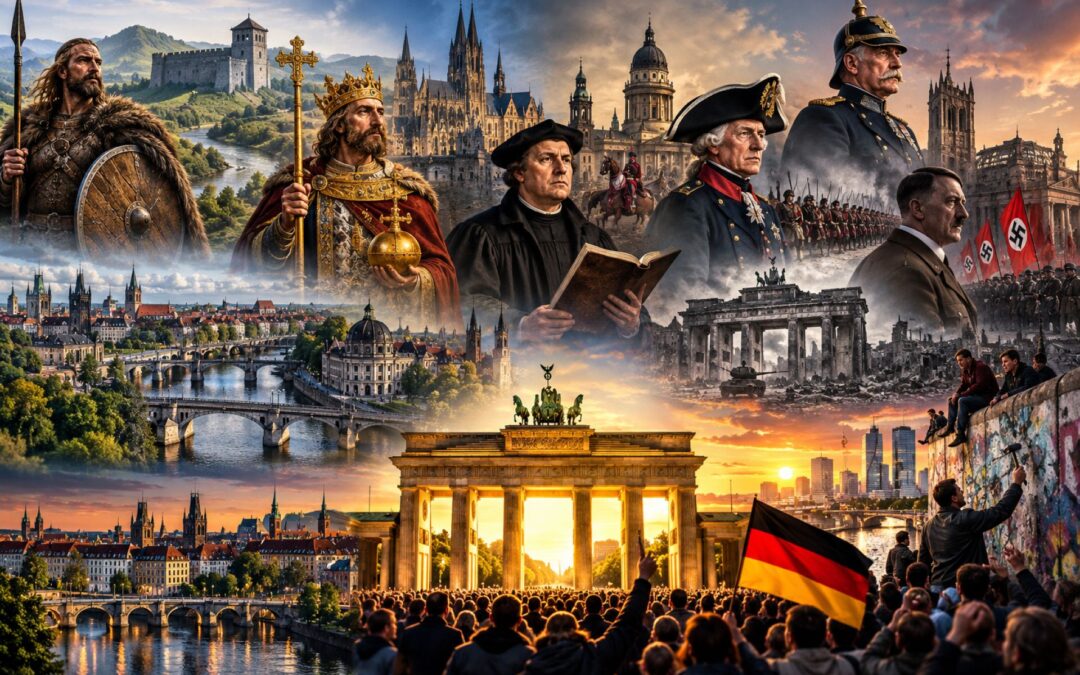
Germany is one of Europe’s most influential countries, but for much of its history, there was no single country called Germany. The territories that eventually formed the modern German state were once inhabited by different peoples, divided among competing kingdoms, governed by emperors with limited authority, and repeatedly transformed by religious conflict, foreign invasion, and political revolution.
For centuries, the German-speaking world was culturally connected but politically fragmented. Its rulers competed for land and influence, its cities developed powerful commercial networks, and its intellectual and artistic traditions flourished without a unified national government. When Germany finally became a nation-state in 1871, it rapidly emerged as an industrial and military powerhouse whose influence would reshape the balance of power across Europe.
Yet unification was only one turning point in a much longer and more turbulent history. Within seventy-five years, Germany experienced two world wars, the collapse of its monarchy, the destruction of its first parliamentary democracy, Nazi dictatorship, the Holocaust, and military defeat. The country was subsequently divided between rival political systems before reunifying peacefully in 1990.
Understanding the history of Germany means following these extraordinary transformations and the forces that connected them. It is the story of how a fragmented collection of territories became a powerful empire, how that empire gave way to catastrophe, and how the modern German state emerged from the consequences of its past.
Before Germany: Ancient Peoples and the Roman Frontier
Long before Germany existed as a recognizable political entity, the lands between the North Sea, the Baltic, and the Alps were inhabited by communities whose histories stretched back thousands of years. Evidence of prehistoric human occupation reaches into the Paleolithic period, while the retreat of the great ice sheets created changing landscapes in which hunter-gatherer populations established settlements, followed seasonal resources, and gradually developed increasingly complex societies.
During the sixth millennium BCE, agriculture began spreading across much of central Europe. Neolithic farming communities cultivated crops, raised domesticated animals, constructed permanent settlements, and transformed the surrounding landscape. Over subsequent millennia, Bronze Age and Iron Age societies developed extensive networks of trade, exchange, and cultural interaction, establishing foundations for the more recognizable populations encountered by ancient Greek and Roman observers.
By the later Iron Age, Celtic-speaking communities occupied substantial parts of central and southern Europe, including territories within present-day Germany. Their societies developed fortified settlements, sophisticated metalworking traditions, and commercial connections extending across the continent. The La Tène cultural tradition, associated with much of Celtic Iron Age Europe, was particularly influential in regions surrounding the upper Rhine and Danube.
Farther north, communities speaking languages ancestral to the Germanic language family developed across northern central Europe and southern Scandinavia. These populations were diverse, and their identities cannot be reduced to one common tribe or a single migration from Scandinavia. Language, archaeological culture, political allegiance, and ancestry did not always correspond neatly, making it misleading to treat the ancient Germanic peoples as an early German nation.
The most important external influence on the region came from Rome. As the Roman Republic expanded northward, it encountered Celtic and Germanic-speaking communities whose territories lay beyond its established political control. Julius Caesar’s campaigns in Gaul during the first century BCE brought Roman armies into sustained contact with Germanic groups along the Rhine, and his military expeditions across the river helped establish the Roman conception of Germania as a region beyond the imperial frontier.
Rome’s ambitions extended beyond simply defending the Rhine. Under Emperor Augustus, Roman commanders attempted to incorporate territories farther east into the empire’s provincial system. These expeditions involved military conquest, alliances with local leaders, administrative expansion, and efforts to transform a region whose political structures differed considerably from those of the Mediterranean world.
The most famous reversal came in AD 9, when a coalition of Germanic warriors led by Arminius, a Cheruscan leader who had received Roman military training, ambushed three Roman legions commanded by Publius Quinctilius Varus. The destruction of these forces in the Battle of the Teutoburg Forest was one of the most devastating defeats suffered by the early Roman Empire. It exposed the vulnerability of Roman armies operating in unfamiliar terrain against opponents who understood their tactics and movements.
The defeat did not immediately end Roman military activity east of the Rhine. Germanicus led further campaigns into the region between AD 14 and 16, and Roman power continued to shape politics along the frontier. Nevertheless, the empire ultimately abandoned sustained attempts to organize most of the territory between the Rhine and Elbe into permanently governed provinces, although Roman-controlled lands extended beyond the Rhine in the southwest.
The Rhine and Danube subsequently became central geographical features of the Roman frontier, reinforced in some regions by roads, watchtowers, forts, and defensive works known collectively as the Limes Germanicus. Roman settlements such as Cologne, Mainz, and Regensburg developed into important urban centres, while trade and military service created enduring connections between Roman provincial society and communities beyond imperial control.
Germanic warriors served in Roman auxiliary forces, merchants exchanged agricultural produce and other goods for Roman manufactured products, and cultural influences crossed the frontier in both directions. Yet the societies outside Roman territory generally retained decentralized political structures organized around kinship, local communities, agricultural production, and warrior leadership. Their religious traditions also differed from Roman Christianity, although the precise beliefs and practices varied considerably among groups and changed over time.
These encounters form part of the wider story of migration, cultural exchange, and political development in early European history. The Roman frontier was not a simple boundary between two completely separate civilizations, but a changing zone of interaction, competition, and exchange whose consequences outlasted the empire itself.
From the Franks to East Francia: The Beginnings of a Kingdom
Beginning in the late fourth century, political upheavals across Eurasia intensified population movements and warfare throughout Europe. The westward expansion of the Huns placed pressure on various communities, while the weakening authority of the Roman Empire created opportunities for military leaders and migrating populations to establish themselves within imperial territory.
This period is conventionally known as the Migration Period, although it was not a single coordinated movement of entire peoples. Germanic-speaking groups, Roman provincial populations, military federations, and other communities moved, fought, intermarried, and reorganized themselves under changing circumstances. Some entered the empire through negotiated settlements, while others established control through military confrontation.
The resulting transformations were profound. Visigothic forces sacked Rome in 410, the Vandals established a kingdom in North Africa, and the Angles, Saxons, and other settlers contributed to the formation of new societies in Britain. Meanwhile, the Burgundians and Franks established powerful kingdoms in former Roman territories, combining elements of Germanic leadership with surviving Roman administrative and religious traditions.
The Western Roman Empire conventionally reached its political endpoint in 476, when the Germanic military leader Odoacer deposed Romulus Augustulus in Italy. However, Roman institutions and cultural traditions did not disappear overnight. Christian bishops, landholding elites, legal practices, urban communities, and administrative arrangements continued to influence the successor kingdoms that emerged across western Europe.
Among these kingdoms, the Frankish realm became particularly important for the future German and French states. Under Clovis I, who ruled around the turn of the sixth century, the Franks consolidated power over large parts of Gaul. His conversion to Catholic Christianity strengthened relations with influential religious institutions and helped integrate Frankish kingship into the social structures inherited from Roman rule.
The Frankish kingdom eventually developed under the Merovingian and Carolingian dynasties. Its rulers extended their authority across territories that now form parts of France, Germany, Belgium, the Netherlands, Switzerland, and Italy. At the same time, Slavic-speaking populations established themselves across much of central and eastern Europe, including regions east of the Elbe, creating a complex cultural and political frontier that would remain significant throughout the Middle Ages.
The most celebrated Carolingian ruler was Charlemagne, who became king of the Franks in 768. Through military campaigns and political alliances, he expanded his dominion across much of western and central Europe. His conquests included prolonged wars against the Saxons, whose resistance was met with brutal repression and forced Christianization, revealing the coercive foundations of his imperial expansion.
Charlemagne also subdued the Lombard kingdom in northern Italy and strengthened his relationship with the papacy. On Christmas Day in 800, Pope Leo III crowned him emperor in Rome, symbolically reviving the imperial title in western Europe. Although Charlemagne’s empire was not Germany, it established political, religious, and institutional traditions that would profoundly influence the development of the German-speaking lands.
Aachen became one of Charlemagne’s principal centres of government, where his court supported religious scholarship, education, administrative reforms, and cultural patronage. His efforts to govern an enormous territory depended on personal loyalty, regional officials, ecclesiastical institutions, and repeated royal intervention rather than the mechanisms of a modern centralized state.
The empire proved difficult to hold together after Charlemagne’s death in 814. Disputes among his descendants eventually led to the Treaty of Verdun in 843, which divided the Carolingian realm into three major political territories. The eastern portion, ruled by Louis the German, became known as East Francia and contained substantial parts of the lands that would later develop into Germany.
East Francia was not yet a nation-state. It was a kingdom containing several powerful duchies, including Saxony, Bavaria, Franconia, and Swabia, whose rulers maintained considerable local authority. Nevertheless, its political development created institutions and territorial relationships that increasingly distinguished it from the western Frankish kingdom.
In 919, leading nobles selected Henry the Fowler, Duke of Saxony, as king of East Francia. His reign strengthened the position of the Saxon dynasty, while his son Otto I extended royal authority through military success, alliances with the church, and intervention in Italian politics.
Otto’s victory over Magyar forces at the Battle of Lechfeld in 955 helped secure his prestige and reduced the threat of devastating raids into central Europe. In 962, he was crowned emperor by Pope John XII, connecting eastern Frankish kingship to the revived western imperial tradition.
The development of the medieval German kingdom and its imperial institutions marked an important turning point. Yet the political order emerging under Henry and Otto was still based on dynastic authority, aristocratic power, and Christian legitimacy rather than the concept of a unified German nation.
The Holy Roman Empire: Shared Culture, Divided Rule
The Holy Roman Empire became the dominant political framework for much of central Europe during the Middle Ages. Its rulers claimed to continue the universal Christian imperial tradition associated with Rome and Charlemagne, but their authority rested on a complicated relationship between kingship, aristocratic privilege, ecclesiastical institutions, and territorial power.
Unlike a modern nation-state, the empire did not possess a single centralized government exercising uniform control over every territory. It incorporated duchies, counties, bishoprics, principalities, kingdoms, and free imperial cities, many of which possessed significant rights of self-government. The political boundaries of the empire also extended beyond the German-speaking world, making it inappropriate to equate the institution directly with Germany.
The emperor’s position depended heavily on securing cooperation from regional rulers. Royal authority could be strengthened through personal relationships, control over important estates, military force, and appointments within the church. However, successive rulers found that attempts to consolidate power frequently provoked resistance from nobles determined to protect their established privileges.
One of the defining disputes concerned the relationship between imperial and papal authority. Medieval rulers had long exercised considerable influence over the appointment of bishops and abbots, partly because senior ecclesiastics controlled important territories and resources. During the eleventh century, reforming popes challenged this practice, producing the Investiture Controversy.
The conflict between Emperor Henry IV and Pope Gregory VII became particularly famous when Henry travelled to Canossa in 1077 seeking reconciliation after his excommunication. Although the dispute continued beyond this episode, it exposed the limits of imperial power and the increasingly independent political position of the papacy. The Concordat of Worms in 1122 eventually established a compromise over ecclesiastical appointments without eliminating the underlying competition between secular and religious authority.
The Hohenstaufen dynasty later attempted to strengthen imperial prestige and influence. Frederick I Barbarossa, who became king in 1152 and emperor in 1155, pursued ambitious policies in Germany and Italy, seeking to defend imperial rights against powerful princes and Italian city-states. His grandson Frederick II ruled a diverse collection of territories, but his conflicts with the papacy and regional powers demonstrated the difficulties of sustaining centralized imperial authority.
Over time, territorial rulers strengthened their influence within the empire. They collected revenues, administered justice, maintained armed forces, negotiated alliances, and developed increasingly distinct political institutions. Imperial government continued to function, but much of everyday political authority remained in the hands of regional dynasties and corporate bodies.
A major constitutional milestone came in 1356, when Emperor Charles IV issued the Golden Bull. This settlement formalized the role of seven prince-electors in choosing the King of the Romans, who would normally become emperor. The electors included the archbishops of Mainz, Trier, and Cologne, along with the secular rulers of Bohemia, the Palatinate, Saxony, and Brandenburg.
The Golden Bull reduced uncertainty surrounding royal elections and reinforced the privileged position of the principal electors. At the same time, it reflected the decentralized character of the empire by recognizing that the selection of its supreme ruler depended on negotiations among powerful territorial interests.
Political fragmentation did not prevent economic and cultural development. German cities expanded as trade, manufacturing, commerce, and specialized crafts became increasingly important. Merchants and artisans formed guilds, municipalities negotiated privileges, and some urban communities secured substantial independence from local territorial rulers.
The Hanseatic League became one of the most significant commercial networks in northern Europe. Centred on cities such as Lübeck and Hamburg, it connected merchants and trading settlements around the Baltic and North Seas. Its influence rested on commercial cooperation, negotiated privileges, and collective action rather than the authority of a unified German government.
Other cities developed as centres of scholarship, religious life, and artistic production. Gothic cathedrals transformed urban landscapes, while institutions such as the University of Heidelberg, founded in 1386, contributed to the growth of learning. Religious houses, merchant families, princely courts, and municipalities all participated in the cultural development of the German lands.
The medieval period also witnessed extensive movement of German-speaking settlers into central and eastern Europe. Known broadly as Ostsiedlung, this eastward settlement involved farmers, merchants, craftsmen, and religious communities moving into territories now located in countries such as Poland, the Czech Republic, and Slovakia. Some settlers arrived at the invitation of local rulers, while others participated in processes of political expansion that altered existing communities and relationships over land.
The Teutonic Order established a powerful territorial state along the Baltic following campaigns against pagan populations, particularly in Prussia. Its expansion involved warfare, conquest, settlement, and Christianization, although the broader movement of German-speaking populations into eastern Europe cannot be reduced to the actions of the order alone.
These medieval developments formed an early chapter in the much wider history of German-speaking communities beyond Germany’s present borders. Many later diaspora populations emerged from subsequent migrations, but the medieval settlement of eastern Europe helps explain why German language and cultural traditions became established across territories that would eventually belong to other states.
The empire also endured devastating crises. The Black Death reached central Europe during the fourteenth century, causing severe demographic losses and social disruption. Conflicts over taxation, landholding, religious authority, and urban privileges further complicated the political landscape.
Nevertheless, the Holy Roman Empire survived these challenges because it was not simply a failed attempt at centralization. Its institutions provided a framework within which diverse rulers and communities could negotiate authority, settle disputes, and maintain political relationships without surrendering their autonomy.
By the end of the fifteenth century, the German lands possessed important linguistic, commercial, and cultural connections, but political unity remained elusive. This combination of shared identity and decentralized government would shape the next major transformation in German history.
Luther, Religious Division, and the Thirty Years’ War
The sixteenth century opened with attempts to strengthen the administration of the Holy Roman Empire. Emperor Maximilian I supported reforms involving imperial courts, regional administrative arrangements, and mechanisms for maintaining public peace. These changes improved certain aspects of imperial government but did not turn the empire into a centralized monarchy.
The most consequential development of the period came from religion rather than administrative reform. In 1517, Martin Luther, a monk and professor of theology at the University of Wittenberg, circulated his Ninety-Five Theses criticizing the sale of indulgences and other practices associated with the Catholic Church. Although Luther initially sought theological reform, his arguments quickly challenged fundamental questions of religious authority.
The spread of Luther’s ideas was greatly accelerated by printing. Johannes Gutenberg’s development of movable-type printing in Mainz during the mid-fifteenth century had transformed the production and distribution of written material in Europe. Pamphlets, sermons, translations, and polemical writings allowed religious controversies to reach audiences far beyond universities and ecclesiastical institutions.
Luther challenged the authority of the pope, emphasized the importance of scripture, and developed theological arguments concerning salvation and religious practice. His translation of the Bible into German also influenced the development of written German, although regional linguistic differences remained substantial.
The Reformation soon acquired major political implications. Some princes supported Protestant reform from religious conviction, while others recognized opportunities to strengthen their independence from imperial and ecclesiastical authorities. Control over church lands, clerical appointments, religious institutions, and taxation became closely connected to struggles over political power.
Religious transformation also intersected with wider social tensions. During the German Peasants’ War of 1524–1525, rural communities challenged feudal obligations, taxation, and established authority, sometimes drawing upon religious language to justify their demands. The uprisings were violently suppressed, and Luther himself rejected the rebellion, demonstrating that religious reform did not necessarily imply support for social or political equality.
Emperor Charles V attempted to defend Catholic unity within the empire. His victory over Protestant forces in the Schmalkaldic War in 1547 temporarily strengthened his position, but it did not restore religious uniformity. Protestant princes remained politically influential, and the empire lacked the capacity to impose a single religious settlement across its territories.
The Peace of Augsburg in 1555 recognized the right of imperial rulers to determine whether their territories would officially follow Catholicism or Lutheranism. This arrangement offered a practical compromise after decades of conflict, but it did not establish modern freedom of religion. Subjects often faced restrictions depending on the confession chosen by their rulers, and the agreement did not initially extend equal recognition to every form of Protestantism.
Religious and political tensions continued into the seventeenth century. The immediate crisis that triggered the Thirty Years’ War began in Bohemia in 1618, when Protestant nobles resisted the authority of the Catholic Habsburg monarchy. What began as a conflict within the Habsburg lands expanded into an international struggle involving the Holy Roman Empire, Spain, Sweden, Denmark, France, and other European powers.
Religion was an important cause, but the war cannot be understood as an exclusively theological confrontation. Dynastic ambitions, territorial rivalries, strategic interests, and the balance of power increasingly shaped the decisions of the participating states. Catholic France eventually opposed the Catholic Habsburgs, illustrating how political calculations could outweigh confessional solidarity.
For the inhabitants of the German lands, the consequences were catastrophic. Armies repeatedly crossed the countryside, requisitioning food, destroying settlements, and spreading disease. Agriculture and trade suffered severe disruption, while famine, epidemic illness, forced migration, and military violence caused enormous demographic losses.
The scale of destruction varied considerably between regions. Some territories suffered repeated devastation and catastrophic population decline, while others experienced less severe disruption or periods of recovery. Historians continue to debate the precise mortality figures, but the conflict remains among the most destructive episodes in German history.
The fighting eventually ended with the Peace of Westphalia in 1648. The agreements restructured aspects of imperial politics, confirmed important territorial and confessional arrangements, and extended formal recognition to Calvinism alongside Catholicism and Lutheranism. They also reinforced the considerable rights of imperial estates within the existing constitutional order.
As the Deutsches Historisches Museum’s treatment of the Reformation and Thirty Years’ War demonstrates, this era transformed the relationship between religious allegiance, territorial government, and political authority.
Westphalia did not abolish the Holy Roman Empire or instantly create the modern system of sovereign nation-states. Imperial institutions continued to operate, and emperors retained meaningful political roles. Nevertheless, the settlement confirmed that the German lands would remain divided among numerous rulers whose interests could not easily be subordinated to a single central authority.
The destruction of the war also shaped later political development. Rebuilding devastated territories required stronger fiscal administration, greater military organization, and more active intervention by regional governments. In the following centuries, some German states would develop powerful administrative and military institutions, while others remained comparatively small and vulnerable.
Among these emerging powers, two would eventually dominate the struggle over Germany’s political future: Austria and Prussia.
Austria and Prussia: The Rival Powers of German Europe
By the late seventeenth century, the German-speaking world remained divided among numerous principalities, duchies, kingdoms, ecclesiastical territories, and free cities. Yet political power was becoming increasingly concentrated in a smaller number of ambitious dynastic states. The most important were Habsburg Austria and Brandenburg-Prussia, whose rivalry would ultimately determine the form of German unification.
The Habsburg dynasty had provided many Holy Roman emperors and possessed substantial hereditary territories extending beyond the German-speaking lands. Its dominions included Austria, Bohemia, Hungary, and other regions inhabited by diverse linguistic, religious, and ethnic communities. Vienna became a major centre of imperial administration, aristocratic society, diplomacy, and cultural patronage.
Habsburg power rested on a combination of dynastic inheritance, territorial administration, military resources, and relationships with local elites. Although the dynasty enjoyed great prestige within the Holy Roman Empire, its rulers also had to govern a multinational collection of territories whose political interests did not always align with those of the German principalities.
Farther north, Brandenburg-Prussia developed into a formidable competitor. The Hohenzollern dynasty controlled Brandenburg, an electorate within the Holy Roman Empire, and the Duchy of Prussia, which lay outside the empire’s original political framework. The two territories were geographically separated, making their administration and defence unusually challenging.
During the seventeenth century, Frederick William, known as the Great Elector, strengthened the state’s military and administrative institutions. He developed more reliable methods of taxation, expanded the standing army, and reduced some of the constraints imposed by regional estates. These changes did not eliminate aristocratic privilege, but they increased the monarchy’s ability to mobilize resources and pursue coordinated policies.
In 1701, Frederick III of Brandenburg assumed the title King in Prussia, ruling as Frederick I. The new royal title enhanced the prestige of the Hohenzollern dynasty and reflected the growing international importance of its territories. Over the following decades, Prussia acquired a reputation for administrative discipline, military organization, and close connections between landholding elites and the state.
The most famous Prussian monarch of the eighteenth century was Frederick II, commonly known as Frederick the Great. After becoming king in 1740, he launched a campaign to seize Silesia from the Habsburg monarchy, beginning a series of conflicts that dramatically altered the European balance of power.
The Silesian Wars established Prussia as Austria’s principal German rival. During the Seven Years’ War of 1756–1763, Frederick faced an imposing coalition that included Austria, France, Russia, and other powers. Prussia survived through military performance, diplomatic circumstances, assistance from allies, and changes within the opposing coalition.
The peace settlement of 1763 confirmed Prussia’s possession of Silesia and established it as a European great power. It did not, however, produce the near-doubling of territory sometimes attributed to that conflict. Prussia’s subsequent expansion, including gains during the partitions of Poland, belonged to a broader process extending across several decades.
Frederick also cultivated an image as an enlightened monarch, supporting aspects of religious tolerance, legal reform, education, and intellectual culture. Nevertheless, his government remained an authoritarian monarchy in which the army, royal administration, and privileged social elites exercised enormous influence.
The eighteenth century was also a period of remarkable cultural achievement across the German-speaking world. Philosophers such as Gottfried Wilhelm Leibniz and Immanuel Kant contributed to fundamental debates about reason, knowledge, ethics, and political authority. Writers including Johann Wolfgang von Goethe and Friedrich Schiller became central figures in German literature, while composers such as Johann Sebastian Bach helped establish influential musical traditions.
These cultural developments strengthened intellectual connections across politically divided territories. Shared literary languages, university networks, publishing industries, and philosophical debates contributed to the emergence of broader ideas about German culture and identity.
Yet cultural identity did not automatically produce political unity. Austria and Prussia represented competing models of dynastic power, while smaller German states guarded their independence. Their rivalry increasingly posed a fundamental question: if the German lands were ever united, would that union include Austria, or would it be organized around Prussian leadership?
The answer would emerge through the revolutionary upheavals of the nineteenth century and the military conflicts that followed.
Napoleon, Nationalism, and the Revolutions of 1848
The French Revolution of 1789 challenged the political foundations of Europe’s established monarchies. Its language of liberty, citizenship, popular sovereignty, and equality inspired reformers across the continent, including intellectuals and activists within the German states. At the same time, conservative rulers feared that revolutionary ideas threatened dynastic authority, aristocratic privilege, and the existing social order.
Austria and Prussia joined other European powers in confronting revolutionary France. War began in 1792, but French armies eventually moved beyond defending the revolution and began reshaping the political map of Europe. The rise of Napoleon Bonaparte transformed these conflicts into a prolonged struggle for military and political supremacy.
Napoleon’s victories proved especially consequential for the German lands. After defeating Austria and later Prussia, he dismantled important elements of the existing imperial order, reorganized territories, and promoted the creation of larger dependent states. The number of small political entities declined dramatically as secularization, territorial consolidation, and French intervention altered the structure of central Europe.
In 1806, Napoleon established the Confederation of the Rhine, bringing numerous western and southern German states into a political arrangement aligned with France. Their withdrawal from the Holy Roman Empire undermined the institution’s remaining foundations. On 6 August 1806, Emperor Francis II renounced the imperial title, formally ending the Holy Roman Empire after centuries of existence.
The empire’s dissolution marked an enormous historical rupture. An institution that had long organized the political relationships of central Europe disappeared, while many German rulers now owed their position to French power. Napoleon also introduced or encouraged legal, administrative, and social reforms in territories under his influence, although these changes varied across different states.
For Prussia, defeat at the battles of Jena and Auerstedt in 1806 exposed the inadequacy of its existing military system. Reformers subsequently attempted to modernize the army, administration, education, and aspects of social organization. These changes strengthened the state and contributed to a wider political environment in which reform and nationalism became increasingly connected.
French domination also provoked resistance. German intellectuals and political activists began arguing more forcefully that people sharing cultural and linguistic connections should possess greater collective independence. Nevertheless, the emerging nationalist movement contained different political visions, ranging from liberal constitutionalism to conservative monarchy and more exclusionary forms of national identity.
Napoleon’s disastrous invasion of Russia in 1812 weakened French military power. In 1813, coalition forces defeated him at the Battle of Leipzig, often called the Battle of the Nations, ending his dominance over much of Germany. The subsequent Allied campaigns eventually forced Napoleon’s abdication, although his brief return in 1815 required a final victory at Waterloo.
The wider Napoleonic Wars and their transformation of European politics created the conditions for a new diplomatic settlement. At the Congress of Vienna in 1814–1815, the victorious powers attempted to restore political stability while accommodating some of the territorial changes produced by the preceding decades.
The settlement established the German Confederation, a loose association of thirty-nine sovereign states that included Austria and Prussia. Its central institution, the Federal Assembly at Frankfurt, provided a forum for coordination but did not constitute a national parliament or an executive government capable of imposing unified policies across Germany.
The confederation was intended primarily to preserve stability and maintain the territorial order. Conservative rulers viewed revolutionary nationalism and constitutional liberalism as threats, while reformers increasingly criticized censorship, political restrictions, and the absence of national representation.
Economic changes gradually weakened some of the barriers between the German states. Industrialization expanded manufacturing, mining, transportation, and commercial activity, especially in regions such as the Rhineland and Saxony. Railways connected previously distant markets, while growing cities created new concentrations of workers, businesses, and intellectual activity.
The establishment of the Zollverein in 1834 represented another important development. This customs union, led by Prussia and excluding Austria, reduced trade barriers among participating German states. Although it was an economic institution rather than a national government, it created stronger commercial connections and increased Prussia’s influence within the German-speaking world.
Political dissatisfaction reached a turning point in 1848, when revolutionary movements spread across Europe. In German territories, demonstrators demanded constitutional government, civil liberties, representative institutions, and national unity. Uprisings and public pressure forced several rulers to make concessions, allowing reformers to pursue the possibility of a unified German state.
In May 1848, representatives assembled at St Paul’s Church in Frankfurt to create a constitutional framework for Germany. The National Assembly debated fundamental rights, parliamentary representation, the nature of executive authority, and the territorial boundaries of a proposed German nation. One of its most difficult questions was whether Austria should form part of the new state.
The assembly eventually adopted a constitution favouring a smaller German nation-state that excluded the Austrian Empire and offered a hereditary imperial crown to Frederick William IV of Prussia. However, the king rejected the crown in 1849, refusing to accept sovereignty conferred by a revolutionary parliament.
The collapse of the Frankfurt Parliament demonstrated the continued strength of conservative monarchy and the military power of Austria and Prussia. Yet the revolution was not historically meaningless. As the German Bundestag’s account of the Frankfurt National Assembly shows, its constitutional debates and catalogue of fundamental rights established an enduring political legacy.
The failure of 1848 revealed that national unification would not necessarily arrive through liberal parliamentary negotiation. During the following two decades, Prussian political and military leaders would pursue a different route, using diplomacy and warfare to achieve a union dominated by their own monarchy.
Bismarck’s Wars and the Unification of Germany
Following the revolutions of 1848, the movement for German unity entered a new phase. Liberal nationalists continued to advocate constitutional government, but conservative elites increasingly recognized that political unification might strengthen the power of an existing monarchy rather than replace the old dynastic order.
Prussia was particularly well positioned to take advantage of this possibility. Its industrial economy was expanding, its transport networks were improving, and its military institutions were undergoing significant modernization. The customs union had already increased economic cooperation among German states, creating connections that a future political union could build upon.
The central political figure in this transformation was Otto von Bismarck, who became Prussian minister-president in 1862. Bismarck was a conservative monarchist who sought to preserve the authority of the Prussian crown while enhancing the state’s position in European affairs. He understood that German nationalism could be used to support Prussian leadership, even if many nationalists originally hoped for a more parliamentary political system.
Bismarck’s approach depended on diplomacy, strategic calculation, military power, and an ability to exploit divisions among potential opponents. He did not invent German nationalism, nor did unification depend solely on his personal decisions. However, his policies helped determine the sequence of conflicts through which Prussia overcame its rivals and reorganized the German political order.
The first decisive conflict came in 1864, when Prussia and Austria fought Denmark over Schleswig and Holstein. The war followed disputes concerning the constitutional and dynastic status of the duchies, whose populations included German-speaking and Danish-speaking communities. The combined Prussian and Austrian forces defeated Denmark, which surrendered control over the territories.
The settlement created new disagreements between the victorious powers. Prussia and Austria administered the duchies under separate arrangements, and Bismarck used the resulting tensions to prepare for a confrontation with Austria. The dispute provided an immediate issue around which a much larger struggle for leadership in Germany could develop.
In 1866, Prussia went to war against Austria and its German allies. The conflict, known as the Austro-Prussian War or Seven Weeks’ War, culminated in the decisive Battle of Königgrätz, also called Sadowa. Prussian forces defeated the Austrian army, demonstrating the effectiveness of their military organization, railway mobilization, and operational planning.
Bismarck avoided imposing excessively humiliating terms on Austria, recognizing that long-term European stability would benefit from preventing permanent hostility between the two powers. Nevertheless, the political consequences were decisive. The existing German Confederation was dissolved, and Austria was excluded from the new political organization emerging under Prussian leadership.
In 1867, Prussia established the North German Confederation, which united the northern German states under a federal constitution. The Prussian king served as its president, while Bismarck became federal chancellor. The confederation possessed common institutions, a federal parliament, and coordinated military and foreign policies, making it far more integrated than the earlier German Confederation.
The southern German states, including Bavaria, Württemberg, Baden, and the southern portion of Hesse, remained outside the new federation. Many inhabitants valued their regional independence, and their rulers feared subordination to Prussia. Nevertheless, military agreements connected these states to Prussia in the event of external conflict.
The opportunity for further unification emerged through deteriorating relations with France. Napoleon III’s government feared that Prussian expansion threatened France’s position in continental Europe. A diplomatic dispute over the possible succession of a Hohenzollern candidate to the Spanish throne intensified tensions, and Bismarck’s editing and publication of the Ems Dispatch helped inflame public opinion.
On 19 July 1870, France declared war on Prussia. Bismarck’s diplomacy and the threat of a foreign opponent helped bring the southern German states into the conflict alongside Prussia. The resulting Franco-Prussian War became the decisive final stage of German unification.
German forces mobilized effectively and won a series of victories over the French armies. At the Battle of Sedan in September 1870, Napoleon III was captured along with a large French force. Although the French Empire collapsed, the newly proclaimed French Republic continued resisting, and German armies eventually besieged Paris.
The military victory allowed Bismarck and the German princes to negotiate the creation of a unified empire. On 18 January 1871, King Wilhelm I of Prussia was proclaimed German Emperor in the Hall of Mirrors at the Palace of Versailles.
The location was symbolically significant. German unity was proclaimed inside a French royal palace while the war was still underway, demonstrating both the success of Prussian military leadership and the humiliation imposed upon France.
The German Empire brought together the North German Confederation and the southern German states under a federal monarchy dominated by Prussia. Austria remained outside the new state, resolving the long-standing contest over whether German unification would include the Habsburg monarchy.
The subsequent peace settlement transferred Alsace and part of Lorraine to Germany and imposed a substantial indemnity upon France. These provisions deepened French resentment and created tensions that would influence European diplomacy for decades.
German unification represented an extraordinary political achievement, but its circumstances also established significant limitations. The new state had been created through a combination of nationalism, economic integration, dynastic negotiation, and military victory rather than through the triumph of the liberal constitutional movement of 1848.
Germany had finally become a nation-state, but its government remained deeply connected to monarchical authority and Prussian political traditions. The tension between rapid national development and restricted democratic power would become one of the defining features of the new empire.
The German Empire: Industry, Colonialism, and Rivalry
The German Empire established in 1871 rapidly became one of the most powerful states in Europe. Its large population, expanding industrial economy, developed educational institutions, and substantial natural resources provided the foundations for extraordinary growth. Within a few decades, Germany stood alongside Britain and the United States as one of the world’s leading industrial powers.
Industrial development transformed German society. Coalfields in the Ruhr and other regions supplied expanding factories, while steel production supported railways, machinery, construction, and armaments. Chemical and electrical industries became particularly important, with German firms developing strong international reputations for technological innovation and industrial organization.
Urbanization accompanied industrialization. Cities such as Berlin, Hamburg, Essen, and Leipzig expanded as people moved from rural communities in search of employment. Railways connected markets and manufacturing centres, while new businesses, banks, technical institutions, and research organizations strengthened the country’s productive capacity.
Scientific and intellectual achievement developed alongside economic expansion. German universities attracted scholars and students from across Europe, while contributions to physics, chemistry, engineering, medicine, philosophy, and music helped establish the country’s international cultural reputation. Figures such as Max Planck and Albert Einstein emerged from an intellectual environment supported by strong educational and scientific institutions, although their individual careers crossed national boundaries and political systems.
Despite these accomplishments, the empire’s political structure contained significant contradictions. Germany was a federal monarchy whose constitution provided for a Reichstag elected by universal adult male suffrage, an unusually broad electoral franchise for its time. Yet the emperor appointed the chancellor, the government was not responsible to the Reichstag in the manner of a parliamentary democracy, and substantial power remained with the monarchy and state governments.
Prussia’s dominance reinforced these tensions. Its king was also the German emperor, its territory and population gave it enormous weight within the federation, and its political institutions retained important aristocratic and military influences. The imperial government therefore combined modern economic and administrative capacities with constitutional arrangements that restricted parliamentary control over executive authority.
Bismarck remained chancellor during the empire’s early decades and pursued policies intended to strengthen national unity while limiting challenges to the existing political order. His Kulturkampf involved attempts to restrict the political and institutional influence of the Catholic Church, reflecting fears that Catholic loyalties might compete with allegiance to the new empire. These policies provoked resistance and were eventually modified.
Bismarck also confronted the growing socialist movement. Industrialization had created a rapidly expanding urban working class whose demands included better wages, improved working conditions, political representation, and social protection. The government attempted to suppress socialist political activity while introducing reforms designed to reduce the movement’s appeal.
Germany consequently became a pioneer in modern social insurance. Legislation introduced health insurance in 1883, accident insurance in 1884, and old-age and disability insurance in 1889. These measures did not create a comprehensive welfare state by contemporary standards, but they represented important innovations in the relationship between government, employment, and social security.
In foreign policy, Bismarck generally sought to preserve the European settlement created by German unification. He understood that Germany’s central geographical position and sudden emergence as a great power could alarm its neighbours. His diplomatic strategy therefore aimed to prevent hostile coalitions, maintain workable relations with Russia and Austria-Hungary, and isolate France.
The alliance system he constructed was complicated and sometimes fragile. The Dual Alliance with Austria-Hungary in 1879 developed into the Triple Alliance with Italy in 1882, while separate arrangements attempted to manage relations with Russia. These agreements reflected Germany’s efforts to protect its position without provoking a war that might threaten the empire’s achievements.
Yet the empire also pursued expansion beyond Europe. Beginning in 1884 under Bismarck, Germany acquired colonial territories in Africa and the Pacific, including German South West Africa, German East Africa, Cameroon, Togoland, and islands in the Pacific. Although Bismarck had initially been cautious about colonial commitments, commercial pressures, international competition, and domestic politics contributed to a change in policy.
German colonial rule involved coercion, racial inequality, land dispossession, forced labour, and violent repression. Its most notorious example occurred in German South West Africa, where German forces conducted a campaign of extermination against the Herero and Nama between 1904 and 1908. The genocide remains a central part of Germany’s colonial history and challenges any account of the empire that concentrates only on industrial achievement and diplomatic prestige.
The imperial leadership changed significantly in 1888. Wilhelm I died, and his successor Frederick III ruled for only ninety-nine days before dying of illness. The throne then passed to Wilhelm II, whose ambitions and political temperament differed markedly from those of his grandfather and the aging Bismarck.
In 1890, Wilhelm II dismissed Bismarck and increasingly asserted his own influence over imperial policy. His government adopted a more ambitious international strategy commonly associated with Weltpolitik, seeking greater global prestige, colonial influence, and naval power. The expansion of the German navy brought the empire into sharper competition with Britain, whose security and international position depended heavily on maritime supremacy.
Germany’s growing power also influenced relations with France and Russia. French resentment following the loss of Alsace-Lorraine persisted, while the deterioration of German-Russian relations contributed to the development of a Franco-Russian alliance. Britain subsequently moved closer to France and Russia, creating an international environment characterized by competing diplomatic alignments and growing strategic suspicion.
By the early twentieth century, Europe had become increasingly unstable. Arms races, nationalist movements, imperial rivalries, military planning, and diplomatic crises intensified fears that a future conflict might involve several great powers simultaneously. Germany occupied a central position within this system, possessing enormous economic and military strength but also facing growing anxiety about its security.
The empire that Bismarck had helped create through carefully managed conflicts now existed within an international order that its leaders found increasingly difficult to control. In 1914, a crisis originating in the Balkans would expose the dangers of this system and begin a war whose consequences would destroy the German monarchy itself.
World War I and the End of the Kaiserreich
On 28 June 1914, Archduke Franz Ferdinand, heir to the Austro-Hungarian throne, was assassinated in Sarajevo by Gavrilo Princip, a Bosnian Serb nationalist. The assassination triggered a diplomatic crisis between Austria-Hungary and Serbia, but it did not make a continent-wide war inevitable. The escalation depended on decisions taken by political and military leaders during the following weeks.
Germany offered strong support to Austria-Hungary, its principal continental ally, while Russia moved toward supporting Serbia. French commitments to Russia, British concerns about the European balance of power, and competing mobilization plans intensified the crisis. The belief that military action had to begin before opponents gained an advantage made diplomatic compromise increasingly difficult.
When war began, German military planners hoped to defeat France rapidly before concentrating their efforts against Russia. German armies advanced through neutral Belgium into northern France, bringing Britain into the conflict and producing widespread international condemnation. However, the German offensive was halted at the First Battle of the Marne in September 1914, preventing the quick victory anticipated by military leaders.
The Western Front developed into a vast system of trenches, fortified positions, artillery batteries, and defensive obstacles. Repeated offensives caused enormous casualties without producing decisive breakthroughs. Battles such as Verdun and the Somme illustrated the destructive power of industrial warfare, in which modern weapons could kill soldiers on an unprecedented scale while leaving the front line largely unchanged.
Germany initially achieved important victories against Russia on the Eastern Front, including the Battle of Tannenberg in 1914. Nevertheless, fighting across multiple theatres placed tremendous pressure on German manpower, industry, agriculture, and transportation. As the conflict expanded, military operations became increasingly dependent on the mobilization of entire societies.
Britain’s naval blockade restricted access to essential imports and contributed to serious shortages within Germany. The civilian population suffered from declining food supplies, inflation, harsh working conditions, and the diversion of economic resources toward military production. Political disagreement intensified as the enormous costs of war became increasingly apparent.
Germany’s unrestricted submarine warfare helped bring the United States into the conflict in 1917. Meanwhile, the Russian Revolution and Russia’s subsequent withdrawal from the war appeared to offer Germany an opportunity to concentrate its forces in the west. German commanders launched major offensives during the spring of 1918, hoping to secure victory before American troops could decisively strengthen the Allied armies.
The offensives initially achieved significant territorial gains but failed to break the Allied position. German forces suffered severe losses, supplies became increasingly difficult to maintain, and Allied counterattacks gradually forced the army backward. By the autumn of 1918, German military leaders recognized that the war could no longer be won.
Domestic unrest accelerated the collapse of the imperial system. Sailors mutinied at Kiel, workers and soldiers established councils in several cities, and demands for political reform spread across the country. On 9 November 1918, Wilhelm II abdicated, bringing the monarchy to an end as republican government was proclaimed in Berlin.
Two days later, an armistice took effect on 11 November, ending the fighting on the Western Front. After more than four years of the First World War and its enormous human and political consequences, Germany faced military defeat, economic exhaustion, political upheaval, and the loss of its imperial government.
The collapse of the Kaiserreich represented more than the removal of one monarch. It destroyed the political order established in 1871 and created an uncertain struggle over how Germany should be governed. For the first time, the country would attempt to establish a parliamentary democracy at the national level, but the circumstances of its birth were exceptionally difficult.
The Weimar Republic and the Collapse of Democracy
The German republic established after the First World War inherited a country deeply divided by defeat, political upheaval, and economic hardship. Its leaders had to construct new democratic institutions while negotiating peace terms, managing revolutionary movements, and confronting conservative forces that remained influential within the military, judiciary, bureaucracy, and business community.
In 1919, a National Assembly meeting in Weimar adopted a democratic constitution that established a federal republic with an elected parliament, a president, and extensive civil rights. The new political system represented a major departure from the imperial monarchy, providing a framework for representative government and broader democratic participation.
Yet the republic’s legitimacy was challenged almost immediately. Many Germans associated the new government with military defeat and the armistice, even though the imperial leadership and military commanders had already recognized the impossibility of victory. Right-wing nationalists promoted the false claim that Germany’s army had been betrayed by civilian politicians and domestic opponents rather than defeated militarily.
The Treaty of Versailles, signed in June 1919, further intensified resentment. Germany lost territory to neighbouring states, surrendered its overseas colonies, accepted restrictions on its armed forces, and became responsible for substantial reparations. Article 231 assigned responsibility for war-related losses and damage to Germany and its allies as part of the treaty’s legal framework, but its wording was widely interpreted in Germany as a humiliating declaration of war guilt.
The political effects were considerable. Opponents of the republic portrayed democratic leaders as responsible for national humiliation, while many citizens questioned whether the new government could protect German interests. Nevertheless, the treaty alone did not determine Germany’s subsequent development, and the republic retained opportunities to establish greater political stability.
The early years were marked by political violence and attempted coups. The Spartacist uprising of 1919 exposed divisions within the left, while the Kapp Putsch of 1920 demonstrated the danger posed by right-wing opponents of parliamentary government. Armed paramilitary groups, political assassinations, and conflicts over revolutionary demands contributed to an atmosphere of uncertainty.
Economic problems became particularly severe in 1923. Germany’s financial difficulties, the occupation of the Ruhr by French and Belgian forces, and the government’s response to the resulting crisis contributed to catastrophic hyperinflation. The collapse of the currency destroyed savings, disrupted commerce, and undermined confidence in public institutions.
During the same year, Adolf Hitler and the National Socialist German Workers’ Party attempted to seize power in Bavaria through the failed Beer Hall Putsch. Hitler was imprisoned, but the episode helped transform him into a recognizable figure within the radical nationalist movement. His subsequent political strategy increasingly emphasized gaining authority through legal institutions while undermining democracy from within.
Germany experienced a period of relative stabilization during the middle and later 1920s. Currency reform, international financial arrangements, and diplomatic initiatives reduced some immediate pressures. Under Gustav Stresemann and other political leaders, Germany pursued reconciliation with European neighbours and re-entered important international institutions.
The Weimar years also witnessed considerable cultural and intellectual achievement. Berlin became associated with experimental theatre, cinema, architecture, journalism, literature, and artistic innovation. The Bauhaus movement contributed to new approaches to design and architecture, while intellectuals debated modernity, democracy, social change, and the relationship between culture and politics.
Yet the political settlement remained fragile. Coalition governments depended on negotiations among parties with competing social interests and ideological commitments, while significant parts of the conservative establishment remained hostile to parliamentary democracy. The constitution also granted the president emergency powers that could be used to govern without normal legislative processes under certain circumstances.
The Great Depression of 1929 transformed these vulnerabilities into a severe national crisis. Germany was particularly exposed to international financial disruption because its recovery depended partly on foreign lending and investment. As economic activity contracted, unemployment rose dramatically, businesses failed, and public confidence in parliamentary government weakened.
The Nazis exploited this atmosphere of despair and political polarization. Their propaganda promised economic revival, national strength, repudiation of Versailles, and resistance to communism, while directing hatred toward Jews and other groups portrayed as enemies of the nation. Hitler’s movement combined mass rallies, modern political messaging, street-level intimidation, and appeals to voters disillusioned with established parties.
Nazi electoral support grew rapidly, but the party never secured an outright majority in a free national election. Its rise was facilitated by the fragmentation of parliamentary politics and by conservative elites who believed they could use Hitler’s popularity while controlling his ambitions.
On 30 January 1933, President Paul von Hindenburg appointed Hitler chancellor. The decision was made within the constitutional framework of the republic, but it placed an openly anti-democratic leader in control of the government. The Nazis then moved quickly to destroy the institutions that had enabled their ascent.
Weimar’s collapse illustrates how economic catastrophe, political extremism, institutional weaknesses, and decisions by powerful elites can interact to undermine democracy. Its failure was not inevitable from 1919, but by 1933 the forces defending parliamentary government had become too weak and divided to prevent dictatorship.
Nazi Dictatorship, the Holocaust, and World War II
Hitler’s appointment as chancellor marked the beginning of the most destructive period in German history. The Nazi government rapidly dismantled democratic institutions, suppressed political opposition, and transformed the state around a dictatorship defined by aggressive nationalism, militarism, antisemitism, and a racial ideology that claimed to divide humanity into hierarchies of supposedly superior and inferior peoples.
The Reichstag Fire in February 1933 provided an opportunity for emergency measures that suspended important civil liberties. The Enabling Act, passed in March under conditions of intimidation and repression, allowed Hitler’s government to enact legislation without normal parliamentary approval. Communist and Social Democratic organizations were suppressed, trade unions were dismantled, and independent political activity became increasingly dangerous.
During the following months, the Nazis brought state governments, public institutions, cultural organizations, professional associations, and much of civil society under their control. Political opponents were arrested, intimidated, driven into exile, or imprisoned in concentration camps. The Gestapo, SS, and other institutions became central instruments of surveillance, persecution, and terror.
In 1934, Hitler ordered the murder of perceived rivals and other opponents during the purge commonly known as the Night of the Long Knives. Following Hindenburg’s death later that year, Hitler combined the offices of president and chancellor, consolidating his position as Führer. The military’s personal oath of loyalty to Hitler reinforced the regime’s dependence on authority centred around one leader.
Nazi rule also transformed public life through propaganda, censorship, youth organizations, and education. Joseph Goebbels’s propaganda apparatus attempted to shape how Germans understood politics, national identity, culture, and the regime’s achievements. Public enthusiasm, opportunism, conformity, fear, and resistance existed alongside one another, demonstrating that German society’s relationship with the dictatorship was complex rather than uniform.
Antisemitism was not an incidental feature of Nazi ideology. It occupied a central position in Hitler’s worldview and the regime’s effort to construct a racially defined national community. Jews were progressively excluded from public employment, professional life, economic activity, education, and other aspects of society through a growing body of discriminatory legislation.
The Nuremberg Laws of 1935 deprived German Jews of full citizenship rights and prohibited marriages and sexual relationships between Jews and people classified as possessing German or related blood. These laws converted racial ideology into formal state policy, institutionalizing discrimination and helping prepare the ground for increasingly violent persecution.
During the nationwide anti-Jewish violence of November 1938, commonly known as Kristallnacht, synagogues were burned, businesses were destroyed, Jewish people were assaulted and murdered, and thousands of Jewish men were imprisoned in concentration camps. The violence demonstrated the regime’s willingness to move from legal exclusion and economic dispossession toward organized terror.
The Nazi dictatorship persecuted many other groups as well. Roma and Sinti communities faced racial discrimination, imprisonment, deportation, and mass murder. People with disabilities were targeted through forced sterilization and organized killing programmes, while political opponents, Jehovah’s Witnesses, gay men, and others suffered repression according to different ideological and institutional policies.
At the same time, Hitler pursued an increasingly aggressive foreign policy intended to overturn the European settlement established after World War I. Germany rearmed in violation of treaty restrictions, reintroduced conscription, and remilitarized the Rhineland in 1936. These actions challenged the ability and willingness of Britain and France to enforce the postwar order.
In March 1938, Nazi Germany annexed Austria in the Anschluss. Later that year, the Munich Agreement enabled Germany to acquire the Sudetenland from Czechoslovakia after Britain and France accepted territorial concessions in an attempt to prevent war. In March 1939, Germany occupied the Czech lands, demonstrating that Hitler’s ambitions extended beyond the incorporation of German-speaking populations.
The policy of appeasement followed by Britain and France reflected several considerations, including memories of the First World War, domestic political pressures, military concerns, and hopes that territorial concessions might satisfy Hitler’s demands. However, repeated concessions failed to prevent further aggression.
In August 1939, Nazi Germany and the Soviet Union signed the Molotov–Ribbentrop Pact. Its secret protocols outlined spheres of influence in parts of eastern Europe and facilitated the coming invasion and partition of Poland. On 1 September 1939, German forces invaded Poland, beginning the European phase of the Second World War.
Britain and France declared war on Germany two days later. German armies rapidly defeated Poland in cooperation with the Soviet Union’s subsequent invasion from the east, and in 1940 Germany conquered Denmark, Norway, the Netherlands, Belgium, Luxembourg, and France. These victories gave Nazi Germany control over much of continental Europe.
Britain continued fighting after France’s defeat, resisting German air attacks during the Battle of Britain and enduring sustained bombing. Germany also became involved in military campaigns in the Balkans and North Africa, while its occupation policies across Europe imposed harsh conditions upon civilian populations.
On 22 June 1941, Hitler launched Operation Barbarossa, the invasion of the Soviet Union. The campaign was conceived not simply as a conventional military conquest but as an ideological and racial war aimed at destroying Soviet power, acquiring territory, and transforming the demographic structure of eastern Europe.
German forces initially advanced rapidly, capturing enormous territories and inflicting devastating losses upon Soviet armies. However, the invasion exposed Germany to the logistical difficulties of operating across vast distances against an opponent capable of mobilizing substantial manpower and industrial resources. Soviet resistance, winter conditions, overstretched supply systems, and strategic decisions progressively weakened the German offensive.
The invasion also intensified the regime’s campaign of mass murder. German occupation authorities, SS units, police formations, military institutions, and collaborators participated in the systematic persecution and killing of Jewish communities and other targeted populations across occupied Europe.
The Holocaust emerged through an escalating process of exclusion, dispossession, forced confinement, deportation, mass shootings, and industrialized killing. In occupied eastern Europe, mobile killing units known as Einsatzgruppen murdered Jewish men, women, and children, often with assistance from other German units and local collaborators.
Jewish populations were forced into ghettos under appalling conditions, where overcrowding, starvation, disease, and violence caused immense suffering. As Nazi policy developed toward the systematic murder of European Jews, deportation networks transported victims to concentration camps and killing centres, including Auschwitz-Birkenau, Treblinka, Sobibor, Belzec, and Chelmno.
The Wannsee Conference of January 1942 coordinated administrative aspects of the regime’s genocidal policy among senior officials. It did not mark the beginning of Nazi mass murder, which was already underway, but it illustrates how government institutions and bureaucratic structures participated in the implementation of genocide.
Approximately six million European Jews were murdered in the Holocaust. The regime also carried out mass killings of Roma and Sinti, people with disabilities, Soviet prisoners of war, Polish civilians, and other targeted groups, although the methods, ideological categories, and circumstances of persecution differed.
The United States Holocaust Memorial Museum’s account of the Holocaust documents the systematic nature of this persecution and the central role of Nazi institutions. Understanding the genocide is indispensable to understanding Nazi Germany, because it was not merely a consequence of the war but a fundamental expression of the regime’s ideological objectives.
Meanwhile, Germany’s military position was deteriorating. The entry of the United States into the war in December 1941 dramatically expanded the resources available to the Allied coalition. Germany and its partners now faced opponents whose combined industrial capacity, manpower, and geographical advantages increasingly exceeded their own.
The Battle of Stalingrad became a major turning point. German forces advancing toward the city in 1942 became trapped by Soviet counteroffensives, and the surviving German army surrendered in February 1943. The defeat inflicted enormous military and psychological damage upon the regime, while demonstrating that Germany could no longer assume strategic initiative on the Eastern Front.
Allied victories in North Africa and the invasion of Italy placed additional pressure on Axis forces. Strategic bombing increasingly struck German industrial centres and cities, causing extensive destruction and civilian casualties. In June 1944, Allied forces landed in Normandy, establishing a major front in western Europe and beginning the liberation of German-occupied territories.
German resistance continued despite mounting defeats. A group of German officers and civilians attempted to assassinate Hitler in July 1944, but the plot failed and the regime carried out severe reprisals. Although resistance existed within Germany, it remained fragmented, while the dictatorship continued mobilizing resources and enforcing obedience until the final months of the war.
By early 1945, Allied armies were advancing into Germany from the east and west. Cities had suffered enormous destruction, the economy was collapsing, and millions of civilians faced displacement, shortages, and the consequences of years of total war. Soviet forces eventually encircled Berlin, while Hitler remained in the city before dying by suicide on 30 April.
German forces surrendered unconditionally in May 1945, with the surrender taking effect on 8 May in most of Europe. The defeat ended twelve years of Nazi rule and almost six years of devastating war in Europe.
The broader Second World War and the destruction it brought across continents fundamentally altered the international order. For Germany, the consequences were especially profound: its dictatorship had been destroyed, its cities and institutions were shattered, millions were dead or displaced, and the victorious powers assumed control over its remaining territory.
The country that had emerged as a unified empire in 1871 now faced occupation, territorial losses, the responsibility of confronting Nazi crimes, and an uncertain political future. Its recovery would take place within the very different international circumstances of the emerging Cold War.
Occupation, Two German States, and the Berlin Wall
Germany’s defeat in 1945 left the country under the authority of the four principal Allied powers: the United States, the Soviet Union, Britain, and France. Their governments divided Germany into occupation zones and similarly partitioned Berlin, even though the city lay deep within the Soviet-controlled zone.
The Allies initially shared broad objectives, including disarmament, demilitarization, denazification, and the removal of institutions associated with Nazi dictatorship. However, disagreements soon emerged over reparations, political reconstruction, economic recovery, and the long-term future of Germany.
The immediate humanitarian challenges were enormous. Millions of Germans had been killed during the war, and cities such as Berlin, Dresden, Hamburg, and Cologne had suffered extensive damage. Food shortages, housing destruction, broken transportation networks, and industrial disruption created severe difficulties for civilians attempting to rebuild their lives.
Population movements further complicated recovery. German communities from territories transferred to Poland and the Soviet Union, as well as German-speaking minorities elsewhere in central and eastern Europe, experienced flight, forced migration, and expulsion. Millions of refugees and expellees arrived in occupied Germany, placing additional pressure on scarce housing and public services.
The occupation authorities also confronted the question of how to deal with Nazi crimes and political responsibility. The Nuremberg Trials prosecuted leading figures of the Nazi regime for major international crimes, establishing important precedents in international criminal law. Denazification programmes attempted to remove Nazi influence from public institutions, although their implementation varied and frequently encountered practical and political limitations.
As relations between the Soviet Union and Western powers deteriorated, Germany became a central point of confrontation. The Western Allies increasingly favoured economic reconstruction and political institutions based on parliamentary democracy, while the Soviet authorities established a political system dominated by communists and reorganized economic structures according to Soviet priorities.
These disagreements were particularly visible in Berlin. In 1948, the introduction of a new currency in the western occupation zones contributed to a confrontation with the Soviet Union, which blocked land routes to West Berlin. Britain and the United States responded with the Berlin Airlift, supplying the city’s western sectors by air until the blockade ended in 1949.
The crisis demonstrated that Germany’s division was becoming increasingly permanent. In May 1949, the western occupation zones formed the Federal Republic of Germany, commonly called West Germany, with Bonn serving as its provisional seat of government. Its constitution, known as the Basic Law, established a federal parliamentary democracy designed to prevent the concentration of power associated with Germany’s recent dictatorship.
In October 1949, the Soviet zone became the German Democratic Republic, or East Germany. Despite its official name, the GDR developed into a one-party dictatorship dominated by the Socialist Unity Party. The Soviet Union remained central to its security and political survival, while state institutions exercised extensive control over political and social life.
The two German states followed increasingly different economic paths. West Germany adopted a social market economy combining private enterprise, market competition, social insurance, and public regulation. Reconstruction was supported by domestic reforms, industrial expertise, international trade, American assistance, and changing economic circumstances.
During the 1950s, West Germany experienced rapid economic growth often described as the Wirtschaftswunder, or economic miracle. Industrial production expanded, exports increased, living standards improved, and businesses recruited workers from abroad to meet labour demand. The recovery helped restore confidence in the Federal Republic and established it as one of western Europe’s leading economies.
Under Chancellor Konrad Adenauer, West Germany pursued political integration with western Europe and the United States. It became a member of NATO in 1955 and participated in the institutions that eventually developed into the European Union. These commitments reflected both economic interests and a deliberate attempt to anchor German democracy within a wider international order.
East Germany developed a centrally planned economy based on state ownership and government direction of production. Its authorities expanded education, employment opportunities for women, and certain forms of social provision, but the system also suffered from shortages, limited consumer choice, political interference, and restrictions on personal freedom.
The regime’s coercive institutions played a major role in maintaining power. The Ministry for State Security, widely known as the Stasi, developed extensive surveillance networks involving officials and informants. Political dissent could lead to intimidation, imprisonment, restrictions on employment, and other forms of repression.
Popular dissatisfaction occasionally erupted into open resistance. In June 1953, protests beginning among East German workers spread into a wider uprising against government policies and political conditions. Soviet military intervention and East German security forces suppressed the movement, demonstrating the regime’s dependence on external support.
The formation of the Warsaw Pact in 1955 formalized East Germany’s military alignment with the Soviet bloc. Germany had become one of the clearest geographical expressions of the Cold War confrontation between the Soviet Union and the Western powers, with two rival political systems occupying the territory of a previously unified nation.
The division was especially visible in Berlin. West Berlin remained politically and economically connected to West Germany but was geographically surrounded by East German territory. Its existence provided an unusual point of contact between the two systems, and large numbers of East Germans used Berlin as a route to escape to the West.
This migration created serious problems for the East German government, particularly because many emigrants were young or possessed valuable professional skills. On 13 August 1961, East German authorities began sealing the border between East and West Berlin, eventually constructing the elaborate system of walls, barriers, watchtowers, patrol roads, and security installations known as the Berlin Wall.
The Wall became an enduring symbol of divided Germany. Families were separated, travel was severely restricted, and people attempting unauthorized crossings risked arrest or death. Its construction also represented a tacit acknowledgment that the GDR could not prevent emigration without physically restricting its population.
Relations between the two German states nevertheless evolved over time. During the late 1960s and 1970s, West German Chancellor Willy Brandt pursued Ostpolitik, a policy intended to improve relations with eastern European states and acknowledge political realities while maintaining the possibility of future German unity.
Agreements between the two German states reduced some tensions and facilitated limited practical cooperation. However, their political systems remained fundamentally different, and the division of Germany continued to reflect the wider structure of the Cold War.
By the 1980s, East Germany faced growing economic difficulties and dissatisfaction among citizens frustrated by political repression, restricted travel, and shortages. Although the government appeared stable, its survival depended on structures increasingly vulnerable to changes within the Soviet Union and across eastern Europe.
The country that had been divided after the catastrophe of Nazi rule was approaching another decisive transformation. This time, the collapse of an authoritarian system would begin not with foreign conquest but with peaceful protest and the weakening of the political structures that had sustained it.
The Fall of the Wall, Reunification, and Modern Germany
During the second half of the 1980s, Soviet leader Mikhail Gorbachev introduced reforms intended to address the Soviet Union’s economic and political difficulties. His policies of glasnost and perestroika encouraged greater openness and restructuring, while changes in Soviet foreign policy reduced Moscow’s willingness to maintain eastern European governments through military intervention.
These developments profoundly affected East Germany. Its leadership initially resisted meaningful reform, but the government’s ability to control its population was weakening. Citizens increasingly demanded political freedom, opportunities to travel, and an end to the repression associated with the ruling Socialist Unity Party.
During 1989, demonstrations expanded across the German Democratic Republic. Leipzig became particularly important because of its Monday demonstrations, which brought growing numbers of citizens into public spaces to demand change. Religious institutions, civic organizations, reform groups, and ordinary citizens participated in the wider movement.
The East German government also faced an emigration crisis. Changes in neighbouring countries, especially Hungary’s opening of routes toward Austria, enabled increasing numbers of East Germans to leave. The departure of citizens and the scale of domestic protests exposed the regime’s declining authority.
By autumn 1989, the political situation had become increasingly difficult to control. Erich Honecker, East Germany’s long-serving leader, was removed from power, but attempts by his successors to preserve the system through limited concessions failed to restore public confidence.
On 9 November 1989, East German official Günter Schabowski announced changes to travel regulations during a televised press conference. His confused explanation suggested that the new arrangements would take effect immediately, prompting thousands of East Berliners to gather at border crossings demanding passage to the West.
The border guards eventually opened the checkpoints, allowing crowds to cross freely. East and West Berliners celebrated together, climbing onto the Wall and dismantling portions of the barrier that had divided their city for nearly three decades. The images became among the most recognizable symbols of the collapse of communist rule in eastern Europe.
The fall of the Berlin Wall was historically decisive, but political reunification required further negotiation. East Germany remained a separate state, while the future of the two German governments raised important questions concerning international security, constitutional arrangements, economic integration, and the rights of the occupying powers.
In March 1990, East Germany held its first free parliamentary elections. The result gave democratic legitimacy to a government committed to pursuing German unity, and the People’s Chamber became central to the negotiations that followed.
As the German Bundestag’s history of the freely elected People’s Chamber explains, the institution was transformed from a parliament subordinate to communist party leadership into a democratic body responsible for decisions that would determine the country’s future.
The governments of East and West Germany negotiated monetary and economic integration, while international diplomacy addressed the security implications of reunification. The Two Plus Four negotiations brought together the two German states and the four victorious Allied powers from World War II: the United States, the Soviet Union, Britain, and France.
The resulting treaty, signed in September 1990, established the external conditions for German unity and the termination of the remaining Four Power rights and responsibilities. It addressed questions of borders, sovereignty, military arrangements, and Germany’s international position, helping ensure that reunification would occur within a stable European framework.
On 3 October 1990, the five re-established eastern German states acceded to the Federal Republic of Germany. The German Democratic Republic ceased to exist as a separate state, and the Federal Republic’s constitutional framework was extended to the enlarged country.
Reunification therefore did not involve the creation of an entirely new state from two equal constitutional systems. It occurred through the integration of East German territories into the existing Federal Republic, preserving the Basic Law and the parliamentary institutions that had developed in West Germany since 1949.
Berlin regained its position as the capital of a unified Germany. In 1991, the Bundestag voted to move the principal seat of parliament and government from Bonn to Berlin, although the transition took several years. The decision symbolized the restoration of national political unity while preserving the constitutional system established after the Second World War.
The economic consequences of reunification were enormous. East German industries had operated within a centrally planned system and often struggled to compete under market conditions. Privatization, restructuring, factory closures, and unemployment caused severe disruption in many eastern regions, even as substantial public investment improved infrastructure and living conditions.
The effects were uneven and lasted for decades. Some cities and industries adapted successfully, while other communities experienced population decline, persistent economic disadvantages, and frustration over the pace of change. Differences in wealth, employment opportunities, political attitudes, and social experience continued to distinguish parts of eastern and western Germany long after formal reunification.
The challenge was not simply to rebuild infrastructure or reorganize businesses. Generations of Germans had lived under different political institutions, educational systems, labour arrangements, media environments, and understandings of citizenship. Reunification brought those experiences together within one state, but it could not immediately erase the historical differences created by four decades of separation.
At the international level, reunified Germany became increasingly influential within Europe. Its economic strength, population, and central geographical location gave it a major role in shaping European integration. Germany participated in the development of the European Union and adopted the euro, deepening its economic and political connections with neighbouring countries.
The transformation of German foreign policy was equally significant. The aggressive ambitions associated with imperial and Nazi Germany were replaced by a political approach placing considerable emphasis on European cooperation, international institutions, economic interdependence, and the avoidance of unilateral military action. These priorities did not eliminate political disagreements, but they fundamentally altered Germany’s position within Europe.
Germany’s relationship with its past also became a central feature of its national identity. Public memorials, education, historical research, museums, legal proceedings, and political debate contributed to an ongoing effort to confront the crimes of Nazism and the Holocaust. This process of historical reckoning developed unevenly and involved prolonged controversy, but it became an important element of the Federal Republic’s democratic culture.
The country’s postwar constitution also reflected lessons drawn from earlier political failures. Federalism, judicial review, protections for fundamental rights, and limits on executive authority were designed to make authoritarian consolidation more difficult. The Federal Constitutional Court became an influential institution in interpreting and protecting the Basic Law.
Germany’s contemporary importance rests heavily on its industrial economy. The country developed internationally competitive industries in automotive manufacturing, mechanical engineering, chemicals, precision equipment, and other specialized sectors. Its export-oriented businesses became deeply integrated into global supply chains, while vocational education and technical expertise helped sustain industrial production.
However, the economic model that supported decades of prosperity has also created vulnerabilities. Dependence on international export markets exposed German businesses to global competition and changing demand, while reliance on imported energy became particularly problematic following Russia’s full-scale invasion of Ukraine in 2022. Demographic ageing, infrastructure needs, bureaucratic complexity, and technological transition have added further challenges.
These issues have contributed to Germany’s modern economic difficulties and debates over the future of its industrial model. They illustrate that the country’s economic position, despite its enormous strengths, cannot be separated from changes in international politics, technological competition, domestic institutions, and demographic conditions.
The reunified state has also faced difficult debates concerning immigration, national identity, regional inequality, European integration, and the political consequences of economic uncertainty. These disputes reflect the challenges of governing a large and diverse democracy rather than the existence of a single settled national consensus.
What distinguishes modern Germany from much of its earlier history is the institutional framework through which these disagreements are contested. The country remains a federal parliamentary democracy, with political authority exercised through constitutional institutions, competitive elections, regional governments, an independent judiciary, and participation in wider European structures.
That outcome was neither inevitable nor easily achieved. Germany’s transition from divided medieval territories to an empire, from dictatorship to occupation, and from Cold War division to peaceful reunification involved repeated changes in political authority, national identity, and international relationships.
The reunification of 1990 did not remove every problem created by the country’s history, but it completed a transformation that would have seemed extraordinary only a generation earlier. A nation once divided by an armed border became a single democratic state whose central political institutions were explicitly shaped by the determination to avoid the authoritarianism and destructive nationalism of its past.
Germany’s history demonstrates that political unity and national identity are not fixed conditions. They emerge through institutions, conflicts, economic relationships, cultural exchange, and decisions made under changing historical circumstances.
For centuries, the German-speaking world possessed strong cultural connections without a unified government. The empire created in 1871 achieved political unity and remarkable industrial power, but its subsequent history exposed the dangers of militarism, dictatorship, racial persecution, and aggressive expansion. The catastrophe of World War II then destroyed the Nazi regime and divided Germany between competing international systems.
The modern Federal Republic emerged through reconstruction, constitutional democracy, European cooperation, and ultimately the peaceful reunification of 1990. Its institutions reflect lessons drawn from Germany’s extraordinary achievements and devastating failures, while its continuing challenges show that historical transformation never produces a permanently settled political order.
The history of Germany is therefore not simply the story of a fragmented people eventually becoming one nation. It is the history of how different forms of political unity were created, challenged, destroyed, and rebuilt—and how the meaning of being Germany changed with them.
Last Updated on October 31, 2026 by Aseem Gupta