
Reading Time: 21 Minutes
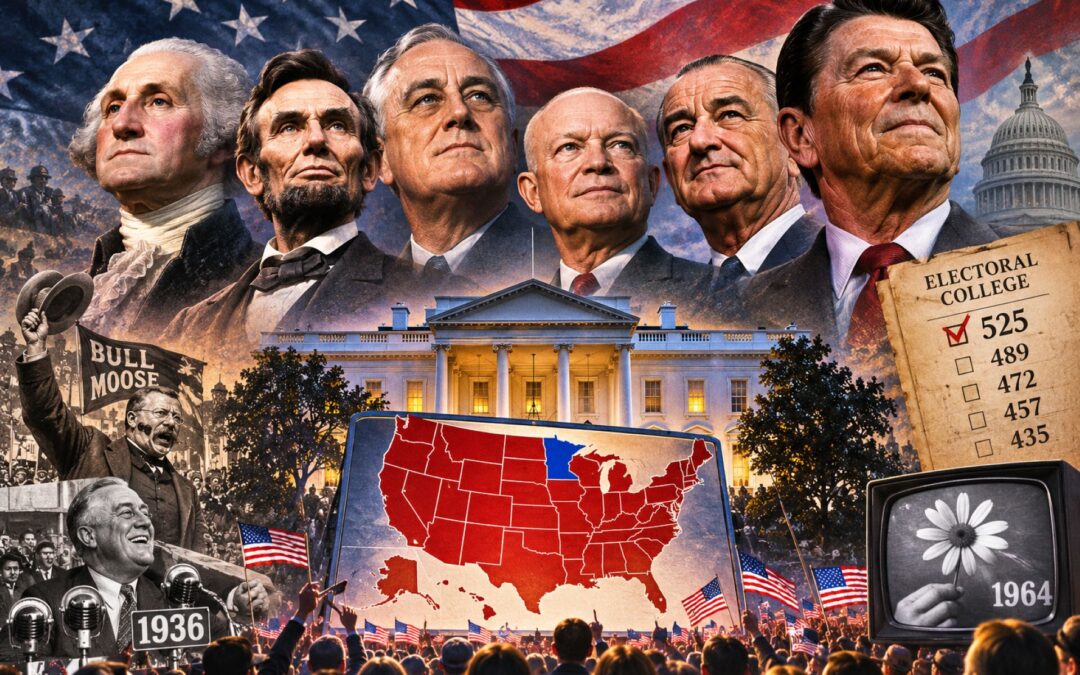
On 6 November 1984, Ronald Reagan came within one state of sweeping the United States presidential election. He won 49 states and 525 electoral votes, the largest electoral total any candidate has ever received. His opponent, Walter Mondale, carried only his home state of Minnesota and the District of Columbia.
Nearly two centuries earlier, George Washington had achieved something Reagan could not: unanimous election to the presidency, twice. But Washington’s 69 electoral votes in 1789 and Reagan’s 525 in 1984 belonged to vastly different political systems and electorates.
Between those victories were campaigns transformed by war, economic collapse, bitter party divisions and unexpected personal tragedies. Several apparent political triumphs were followed by scandal, assassination or resignation. America’s biggest election landslides are therefore more than a record of who won the most votes: they reveal why a country can rally behind a leader, and how quickly that apparent certainty can disappear.
What Makes an American Presidential Election a Landslide?
There is no official threshold for a presidential landslide. The label usually describes an election whose outcome is overwhelmingly one-sided, but the size of a victory depends on what is being measured. A candidate can dominate the Electoral College without winning an equally overwhelming share of the popular vote.
The president is chosen through electors allocated to the states, with each state’s total reflecting its representation in Congress. Except in Maine and Nebraska, the candidate winning a state’s popular vote generally receives all its electoral votes. The District of Columbia has participated since the 1964 election. Those rules can magnify a fairly modest nationwide lead into an imposing electoral map.
The National Archives’ historical Electoral College results reveal several possible records: a unanimous result, the highest percentage of available electoral votes, the largest absolute electoral total, the most states won, or the greatest popular-vote margin. These records are not interchangeable. A victory based on 42 percent of the popular vote may still look like a landslide when competing parties split the opposition.
Comparisons across centuries require special care. Washington’s electors originally cast two votes without distinguishing president from vice president; the Twelfth Amendment changed that procedure. Early states also differed over whether voters or legislatures chose electors, while the franchise excluded women and many other Americans. Slavery, racial restrictions, property requirements and later voting barriers profoundly shaped who could participate.
The expansion from thirteen original states to fifty states, along with changes in the number of electors, also makes raw totals deceptive. Washington’s unanimity and Reagan’s record of 525 votes are both extraordinary, but for different reasons. To understand the strongest victories, the political circumstances matter at least as much as the arithmetic.
Washington, Jefferson and Monroe: Near-Perfect Electoral Victories
When the new republic chose its first president in 1788–1789, George Washington stood in a category of his own. His leadership of the Continental Army had made him the most widely respected national figure, and his role in the Constitutional Convention reassured Americans uncertain about the new federal government. He had hoped to remain at Mount Vernon rather than return to public life, but his reputation made him the obvious choice.
All 69 participating electors gave Washington one of their two presidential votes. John Adams received the second-highest total and became vice president. Washington was not elected through a modern popular-vote contest between organized national party tickets; in some states, ordinary voters had no direct role in choosing electors at all.
In 1792, Washington won every participating elector’s vote again, this time 132 out of 132. Disagreements between the emerging Federalist and Democratic-Republican camps were intensifying, particularly over the powers of the central government, yet neither camp fielded a serious alternative to Washington himself. No subsequent president has replicated his complete unanimity.
By 1800, however, party competition exposed an unforeseen weakness in the original Constitution. Democratic-Republicans intended Thomas Jefferson for president and Aaron Burr for vice president, but both received 73 electoral votes. Under the existing rules, electors had not formally assigned one vote to each office, so the House of Representatives had to decide which man would lead the country.
The House remained deadlocked for 35 ballots. Jefferson finally prevailed on the 36th, following a crisis that illustrated how badly the electoral machinery fitted the emerging party system. The Twelfth Amendment, ratified in 1804, required separate electoral votes for president and vice president, the arrangement used today.
Burr’s later downfall supplied one of the strangest episodes surrounding a landslide. After losing his standing among Democratic-Republicans, he sought the governorship of New York in 1804. Alexander Hamilton opposed him, aggravating an old rivalry. On 11 July, Burr, still the sitting vice president, shot Hamilton in a duel in New Jersey; Hamilton died the following day.
Murder indictments followed in New York and New Jersey, but Burr returned to Washington to carry out his official duties. Early in 1805 he presided over the Senate’s impeachment trial of Supreme Court Justice Samuel Chase, and observers praised his procedural conduct despite the scandal surrounding him. The bizarre contrast between constitutional responsibility and private violence captured the disorderly nature of the young republic’s political culture.
Jefferson, meanwhile, defeated Federalist Charles Cotesworth Pinckney by 162 electoral votes to 14 in 1804. His popularity had been strengthened by the Louisiana Purchase, while the Federalists struggled to present a united challenge. It was not unanimity, but it was an emphatic display of one party’s growing strength.
James Monroe came even closer to Washington’s record in 1820. The Federalist Party had largely collapsed as a national electoral force during the so-called Era of Good Feelings, leaving Monroe without meaningful organized opposition for reelection. Of the 232 electors who actually cast presidential votes, 231 supported him.
The lone exception was William Plumer of New Hampshire, who voted for John Quincy Adams, although Adams had not campaigned for the office. A popular story claims Plumer wanted Washington to remain the only unanimously elected president. Historians have questioned that explanation; support for Adams or dissatisfaction with Monroe offers other possibilities. Whatever his motive, a single elector prevented a second president from matching Washington’s perfect electoral record.
Pierce, Lincoln and Grant: Landslides in the Shadow of Tragedy
Franklin Pierce was hardly the obvious presidential favorite in 1852. A former senator from New Hampshire, he emerged as the Democratic nominee only after the party’s better-known contenders failed to secure enough convention support. His opponent, Whig candidate Winfield Scott, had a national reputation as a military hero but struggled to unite his party over slavery and other sectional issues.
Pierce won 254 electoral votes to Scott’s 42, carrying 27 of the 31 states. The result looked like a sweeping personal mandate, even though the underlying sectional conflicts remained unresolved. The Whig Party’s weakness helped deliver Pierce a victory much larger than his popular-vote margin.
Before he could take office, an unimaginable tragedy struck his family. On 6 January 1853, Pierce, his wife Jane and their eleven-year-old son Benjamin were traveling by train near Andover, Massachusetts. Their carriage derailed and tumbled down an embankment. Pierce and Jane survived, but Benjamin, their only surviving child, was killed in front of them.
The loss devastated the couple. Jane had already endured the deaths of their other two sons and reportedly interpreted the accident through the lens of her husband’s political ambitions. Pierce entered the White House amid profound grief, and his presidency would eventually become associated with the worsening confrontation over slavery, especially the Kansas–Nebraska Act. His landslide did little to bring national stability or personal happiness.
Twelve years later, Abraham Lincoln faced a very different crisis: he feared he could not win reelection while the Civil War continued. Union casualties were enormous, military progress had stalled, and opposition to the war had become politically potent. In August 1864, Lincoln expected voters might choose a different president.
On 23 August, he wrote what became known as the blind memorandum, predicting that his administration would probably be defeated. He sealed the document and asked cabinet members to sign its reverse without reading the contents. His stated concern was that, if he lost, he would need to cooperate with his successor to preserve the Union before inauguration.
The Democratic candidate was George B. McClellan, the former Union general whom Lincoln had removed from command. McClellan personally supported continuing the war to restore the Union, but his party’s platform called for seeking an immediate cessation of hostilities and negotiations. That contradiction made the Democratic position difficult to explain to voters and soldiers alike.
Then the military picture changed. On 2 September 1864, Union forces under William Tecumseh Sherman captured Atlanta, providing a powerful sign that victory might be achievable. Other Union successes further strengthened public confidence. Lincoln’s campaign emphasized that changing national leadership in the middle of a war could jeopardize the effort, echoing his famous warning about swapping horses while crossing a stream.
Several states enabled soldiers to vote in the field, and soldiers’ ballots favored Lincoln strongly. The broader campaign and the military turning points of the Civil War reinforced one another. Lincoln won 212 electoral votes to McClellan’s 21, carrying every participating state except Kentucky, Delaware and New Jersey.
The triumph was painfully short-lived. Lincoln was inaugurated for his second term on 4 March 1865, and just six weeks later, on 14 April, he was shot at Ford’s Theatre. He died the next morning, leaving the Union’s impending victory and the future of emancipation in the hands of his successors.
Ulysses S. Grant, the general most closely associated with Union victory, secured his own second-term landslide in 1872. His opponent was Horace Greeley, the influential newspaper editor nominated by Liberal Republicans and supported by Democrats seeking to remove Grant. Greeley’s reform coalition criticized corruption in Grant’s administration but was an uneasy alliance from the beginning.
Grant won approximately 56 percent of the popular vote and 286 electoral votes. Greeley carried only a small group of states, and his defeat was compounded by an extraordinary sequence of personal losses. His wife Mary had died on 30 October, shortly before the election. Greeley himself died on 29 November, after the popular vote but before the electors met.
Under the electoral rules, Greeley’s pledged electors could no longer vote for a living candidate who had led their ticket. They scattered their support among several other figures. The official 1872 electoral record notes that Congress rejected three electoral votes cast for Greeley after his death.
Grant’s victory remained decisive, but the opposition’s post-election disintegration made the formal result unusually complicated. His second term would confront economic depression and scandals, reminding Americans that even a victorious Civil War commander could not govern by electoral reputation alone.
Roosevelt, Taft and Wilson: How a Split Party Produced a Landslide
In 1912, an election that should have favored the incumbent Republican president instead produced one of America’s most lopsided Electoral College results. William Howard Taft had entered the White House in 1909 with the backing of his predecessor, Theodore Roosevelt. Yet their political friendship deteriorated as Roosevelt grew convinced that Taft had abandoned the progressive reform agenda.
Roosevelt challenged Taft for the Republican nomination. When the party selected Taft, Roosevelt and his supporters organized the Progressive Party, popularly known as the Bull Moose Party. The break divided Republican voters into competing camps while Democrat Woodrow Wilson prepared to benefit from their dispute.
Roosevelt’s campaign became even more remarkable on 14 October 1912. In Milwaukee, a would-be assassin, John Schrank, shot him in the chest shortly before a scheduled speech. The bullet passed through a metal eyeglass case and a thickly folded manuscript of his speech, reducing its force, before lodging in his body.
Roosevelt refused to abandon the event. After checking his condition, he addressed the audience for well over an hour, explaining that he had been shot but intended to continue. The bullet-damaged pages of his campaign speech remain an extraordinary physical reminder of that day. Doctors later judged that removing the bullet would be riskier than leaving it in place.
His resilience did not reunite the Republicans. Wilson received about 42 percent of the popular vote but won 435 electoral votes. Roosevelt finished second with 88 electoral votes, while the sitting president, Taft, received only eight, from Utah and Vermont. Socialist Eugene V. Debs also attracted a substantial minority of voters, further demonstrating the fractured political environment.
The result also exposed the limits of treating a landslide map as a mandate for one ideology. Progressives supported candidates in different parties, and disagreed over the role of government and the methods of reform. Wilson would pursue important banking and antitrust changes, but the election itself did not establish a single, unified national vision.
Wilson’s victory was a landslide on the Electoral College map, not a demonstration that nearly everyone favored him. Roosevelt and Taft together received considerably more votes than Wilson. The election illustrated how a divided opposition can allow a candidate with minority popular support to dominate under winner-take-all rules. It also left behind one of the most enduring presidential rivalries of the twentieth century.
Harding, Hoover and FDR: From Normalcy to Depression
After World War I, Americans were exhausted by international conflict, political repression and the disruptions of an influenza pandemic. President Woodrow Wilson had suffered a severe stroke, and the debate over joining the League of Nations had intensified disagreements about America’s international role. In 1920, Republican Warren G. Harding offered voters a simple promise: a return to “normalcy.”
Harding was not a particularly dynamic campaigner. Instead, he conducted much of his campaign from the front porch of his home in Marion, Ohio, receiving delegations and delivering carefully managed speeches. His understated approach contrasted with the turmoil of the preceding years and made political stability seem like an attractive proposition.
The election was also a milestone in American democracy. Ratified in August 1920, the Nineteenth Amendment prohibited denying the vote on the basis of sex, making this the first presidential election after nationwide constitutional protection for women’s suffrage. Many women, particularly Black women in the South, still faced racial and administrative barriers that the amendment did not remove.
Harding defeated Democrat James M. Cox by roughly 60 percent to 34 percent of the popular vote. The margin of about 26 percentage points remains the largest in a contested presidential election measured by the modern national popular vote. Harding also took 404 electoral votes to Cox’s 127. The Democratic vice-presidential nominee was a relatively young Franklin D. Roosevelt, whose own political future was far from certain.
The administration did not get the opportunity to deliver lasting normality. Corruption controversies, including the Teapot Dome affair, damaged Harding’s reputation. On 2 August 1923, he died while traveling in San Francisco, and Vice President Calvin Coolidge succeeded him. The president who had promised a quieter national life left office through an unexpected death rather than a planned political transition.
The next celebrated Republican landslide came in 1928, when Herbert Hoover appeared to represent national competence and prosperity. Hoover had built a reputation as an engineer, humanitarian relief organizer and capable secretary of commerce. His Democratic opponent, New York Governor Al Smith, became the first Roman Catholic nominated for president by a major American political party.
Smith’s religion became an ugly campaign issue. Anti-Catholic prejudice fueled unfounded claims that he would place the interests of the pope above the Constitution. Cultural divisions over Prohibition and urban immigration also worked against him, particularly in communities that had long supported Democrats. Hoover won 444 electoral votes to Smith’s 87, carrying 40 of the 48 states.
The result appeared to validate the Republican stewardship of the booming 1920s economy. Yet the prosperity rested on serious weaknesses, including financial speculation, uneven income distribution and fragile banking arrangements. Only months after Hoover took office, the stock market crashed in October 1929, and the economy began a prolonged collapse.
The Great Depression did not arise from the stock market crash alone. Bank failures, falling demand, collapsing prices and policy mistakes deepened the downturn. Unemployment approached one-quarter of the workforce by 1933, while farms, factories and households struggled under burdens that Hoover’s administration could not adequately relieve.
By the 1932 election, Hoover had become associated in the public mind with economic catastrophe. Franklin D. Roosevelt, now governor of New York, won the Democratic nomination and broke with convention by flying to Chicago to accept it in person. He promised the American people a “new deal,” using the phrase to describe a more active federal response to the crisis.
Roosevelt defeated Hoover by 472 electoral votes to 59, carrying 42 states and reducing Hoover’s electoral map to just six. A president who had won overwhelmingly four years earlier was now defeated almost as decisively. The dramatic reversal showed how quickly voters could abandon a seemingly dominant party when its claims of competence no longer matched daily experience.
Once in office, Roosevelt moved rapidly to stabilize banks and establish New Deal programs addressing unemployment, relief, financial reform and economic recovery. Not every policy succeeded, and the extent to which the New Deal ended the Depression remains debated. What was unmistakable was Roosevelt’s capacity to restore enough political confidence to make the Democrats dominant in the next election.
In 1936, Roosevelt faced Republican Alf Landon, governor of Kansas. The popular magazine Literary Digest conducted a vast postal poll, sending out roughly ten million questionnaires and receiving about 2.4 million responses. Its projection suggested Landon would win, with roughly 57 percent of the two-party vote and 370 electoral votes.
The apparent precision was misleading. Its lists disproportionately reached people who owned automobiles or had telephones, groups more likely to be affluent at a time of economic distress. Moreover, people who chose to respond did not necessarily resemble the electorate as a whole. An enormous sample could not compensate for a fundamentally unrepresentative selection and response process.
The Literary Digest polling failure became a famous warning against confusing quantity of data with quality of evidence. George Gallup’s much smaller but more carefully constructed survey anticipated Roosevelt’s victory far more accurately. Election night exposed the magazine’s forecast as spectacularly mistaken.
Roosevelt won 523 electoral votes to Landon’s eight. Landon carried only Maine and Vermont, states whose earlier voting habits had once been celebrated as indicators of national results. Roosevelt’s 1936 victory was the closest anyone had come to Washington’s unanimous sweep since Monroe in 1820. The candidate who had been on the losing Democratic ticket in 1920 had become the dominant national politician of his generation.
Yet even that extraordinary mandate did not erase economic uncertainty. A renewed recession in 1937–1938, disputes over Roosevelt’s proposal to expand the Supreme Court and resistance to some New Deal measures revealed the limitations of electoral power. Roosevelt had won the election almost everywhere, but he could not eliminate disagreements over how America should be governed.
The Forgotten Landslides of Roosevelt and Eisenhower
The 1936 victory is Roosevelt’s most visually dramatic electoral map, but it was not his final commanding win. In 1940, he sought an unprecedented third term while Europe was engulfed in war. Republican Wendell Willkie challenged his domestic record and argued against excessive concentration of power, although both candidates recognized the danger posed by Nazi Germany.
Roosevelt won 449 electoral votes to Willkie’s 82. His success suggested that many Americans preferred continuity during an international emergency, even as they remained divided about direct involvement in the conflict. When the United States entered World War II after Pearl Harbor in December 1941, Roosevelt became the country’s wartime commander in chief.
In 1944, with Allied forces fighting across Europe and the Pacific, Roosevelt won a fourth term against Republican Thomas E. Dewey. The margin was smaller than in his earlier landslides but still decisive: 432 electoral votes to 99. Voters had endorsed continuity again, although Roosevelt’s health was deteriorating. He died on 12 April 1945, less than three months after his fourth inauguration, and Harry Truman inherited the presidency during the war’s final months.
The next great beneficiary of military prestige was Dwight D. Eisenhower, the former supreme Allied commander in Europe. After two decades of Democratic occupancy of the White House, he defeated Adlai Stevenson in 1952 by 442 electoral votes to 89. Eisenhower combined personal popularity with public fatigue over the Korean War and worries about corruption and Cold War insecurity.
Four years later, Eisenhower repeated his victory, winning 457 electoral votes, while Stevenson received 73 and one faithless elector voted for another candidate. Eisenhower carried 41 states in 1956. His appeal crossed some traditional party boundaries, particularly among voters who valued steadiness and his military record more than partisan loyalty.
Together, Roosevelt and Eisenhower demonstrate that not every landslide emerged from a divided opposition or a dramatic scandal. Wartime leadership, public trust and the perceived competence of an incumbent could also produce repeated victories. Their elections belong in any serious comparison of America’s largest presidential triumphs, even when a list built around unusual anecdotes overlooks them.
Johnson and Nixon: Sweeping Wins, Political Unraveling
The election of 1964 took place less than a year after the assassination of President John F. Kennedy. Lyndon B. Johnson had inherited the presidency amid national grief and uncertainty, then sought a full term of his own. His Republican opponent, Arizona Senator Barry Goldwater, advocated a more uncompromising form of conservatism and opposed important aspects of Johnson’s liberal domestic agenda.
Johnson portrayed the contest as a choice between responsible leadership and dangerous risk. One of the most consequential campaign advertisements was Daisy, which showed a young girl picking petals from a flower before a countdown and imagery evoking nuclear annihilation. It aired as a paid political advertisement only once, but subsequent news coverage gave it an audience far beyond its original broadcast.
The advertisement did not explicitly name Goldwater, but its message was unmistakable: voters were being asked to consider whether his approach might endanger the country. Goldwater’s own rhetoric on nuclear weapons and his opposition to the Civil Rights Act of 1964 made him vulnerable to a campaign stressing extremism, although supporters viewed him as a principled defender of limited government.
Johnson won 61.1 percent of the popular vote and 486 electoral votes to Goldwater’s 52, carrying 44 states and the District of Columbia. Goldwater won Arizona and five states in the Deep South, revealing an important regional realignment beneath the national landslide. Some voters were moving toward Republican conservatism even as Johnson dominated the immediate contest.
Johnson interpreted his victory as support for an ambitious domestic program. His Great Society initiatives included Medicare, Medicaid, antipoverty measures and landmark voting-rights legislation. Yet his presidency became increasingly consumed by the Vietnam War, with rising American casualties and divisions over the government’s conduct of the conflict.
By March 1968, Johnson was so politically weakened that he announced he would not seek another term. His televised address on 31 March ended with a declaration that he would neither seek nor accept his party’s nomination. Less than four years had passed between one of the greatest electoral victories in American history and his decision to leave the presidential race.
Goldwater’s defeat also had a surprising consequence. Shortly before the 1964 election, an actor and former Democrat named Ronald Reagan delivered a televised speech supporting Goldwater, remembered as A Time for Choosing. The speech made Reagan a national figure among conservatives and helped establish the political movement that would eventually carry him to the White House.
Eight years after Johnson’s victory, Republican Richard Nixon produced a landslide of his own. His Democratic challenger, South Dakota Senator George McGovern, opposed the Vietnam War and represented the party’s increasingly assertive liberal wing. The Democratic campaign suffered from disorganization, internal tensions and a damaging dispute over McGovern’s original running mate, Thomas Eagleton.
Eagleton’s history of treatment for mental illness became public after his selection. After initially supporting him, McGovern asked Eagleton to withdraw, and the vice-presidential nominee left the ticket just eighteen days after being announced. Sargent Shriver replaced him, but the episode undermined perceptions of the campaign’s judgment and stability.
On election day in 1972, Nixon won 49 states and 520 electoral votes. McGovern carried only Massachusetts and the District of Columbia, totaling 17 electoral votes. One elector pledged to Nixon in Virginia, Roger MacBride, broke with his ticket and voted for the Libertarian candidates John Hospers and Tonie Nathan instead.
That single faithless vote entered electoral history: Nathan became the first woman to receive an electoral vote for vice president. It was a tiny anomaly within an overwhelming Republican victory, but it illustrates how the Electoral College can produce outcomes not visible in a simple state-by-state map.
The event that would destroy Nixon’s presidency had already occurred. On 17 June 1972, five men were arrested after breaking into Democratic National Committee offices in the Watergate complex in Washington, D.C. The subsequent investigation uncovered obstruction of justice, abuses of power and efforts to conceal the administration’s connection to the affair.
As evidence accumulated, Nixon’s seemingly secure mandate disintegrated. On 9 August 1974, he became the first United States president to resign. The man who had carried 49 states less than two years earlier had lost the support necessary to remain in office. An election landslide had offered no protection against the constitutional and political consequences of misconduct.
Reagan: The Record 525-Vote Victory
Ronald Reagan’s political ascent was already remarkable before his record-breaking reelection. A former Hollywood actor, labor leader and governor of California, he had moved from the Democratic Party to become one of the Republican Party’s most persuasive conservative voices. By 1980, inflation, economic stagnation, an energy crisis and the Iran hostage crisis had damaged confidence in President Jimmy Carter.
Reagan presented himself as an optimistic alternative, promising economic renewal, a stronger national defense and a less intrusive federal government. His skill as a communicator helped him reach voters beyond the Republican base. In the 1980 election, he defeated Carter by 489 electoral votes to 49, although independent candidate John Anderson complicated the popular-vote contest.
Carter conceded on election night while voting was still under way in parts of the western United States, drawing criticism over the announcement’s possible effect on turnout. Colorful accounts later circulated about Reagan receiving Carter’s concession telephone call while wrapped in a towel after a shower, but that detail is better treated as an anecdote than as an established part of the electoral record.
Reagan’s first term included a severe recession, high unemployment and controversy over his economic policies. As the recovery gathered pace, however, falling inflation and improving economic indicators strengthened his reelection prospects. The country was also debating the Soviet Union, nuclear weapons and Reagan’s willingness to confront communist power.
His Democratic opponent in 1984 was Walter Mondale, Carter’s former vice president. Mondale challenged the administration on deficits, social spending and the implications of conservative economic policies. He selected Representative Geraldine Ferraro as his running mate, making her the first woman nominated for vice president by a major American political party.
At the Democratic convention, Mondale had also argued bluntly that federal deficits would ultimately require higher taxes. He insisted that Reagan would raise taxes too, but that only he was prepared to admit it. The statement demonstrated candor, yet it gave Republicans an obvious contrast between their confident economic message and a challenger warning voters about the costs ahead.
Reagan was 73, older than any incumbent president who had previously sought reelection. A shaky performance in his first debate with Mondale intensified doubts about his age and mental sharpness. Those concerns gave Mondale an opening, but Reagan defused much of the controversy during their second debate on 21 October.
Asked whether age should count against him, Reagan responded that he would not exploit his opponent’s “youth and inexperience” for political purposes. The line drew laughter from the audience and from Mondale himself. Its effectiveness lay in turning a serious vulnerability into a moment of humor and command, restoring confidence among viewers who had questioned Reagan’s performance.
The result on 6 November was historic. Reagan carried 49 states and 525 of 538 electoral votes, winning roughly 59 percent of the popular vote. Mondale won Minnesota by just 3,761 votes, a microscopic margin out of more than two million cast there, and received its ten electoral votes. The District of Columbia contributed his remaining three.
The Reagan Presidential Library’s account of the 1984 campaign records an electoral total no winning candidate has surpassed. Reagan did not match Washington’s unanimity, but he came within one state of a sweep. The contrast is striking because Washington faced no comparable national two-party contest, whereas Reagan defeated an established major-party opponent.
Reagan’s second term nevertheless exposed familiar limits to political power. The Iran–Contra affair revealed secret arms dealings involving Iran and the diversion of funds associated with Nicaraguan Contra rebels, generating investigations and controversy over executive accountability. Reagan’s public standing suffered, although his approval ratings recovered before he left office in January 1989.
His vice president, George H. W. Bush, secured another substantial Republican victory in 1988, receiving 426 electoral votes against Democrat Michael Dukakis. But Bush’s result fell short of Reagan’s record, and the Republican dominance of the 1980s proved no more permanent than earlier electoral eras. The same voters who granted a party an extraordinary victory could change course when circumstances changed.
What Landslides Actually Tell Us About a Presidency
The largest American election victories do not all have the same explanation. Washington’s unanimous elections rested on his unusual standing above emerging party competition. Jefferson and Monroe benefited from the weakness of Federalist opposition. Wilson exploited a split Republican Party, while Hoover and Franklin Roosevelt won enormous mandates at opposite ends of a disastrous economic transformation.
Military leadership and perceived competence mattered for Lincoln, Roosevelt and Eisenhower. Johnson benefited from incumbency, national mourning and anxiety about his opponent, while Reagan combined a recovering economy with strong communication skills and an effective conservative coalition. A decisive result may reflect enthusiasm for the winner, rejection of the loser, or both simultaneously.
The Electoral College also changes what a landslide looks like. Wilson’s 435 electoral votes in 1912 concealed the fact that most voters supported someone else. Reagan’s 525 votes reflected genuinely broad support, yet even his 1984 popular-vote share was far lower than his proportion of electoral votes. Harding’s popular-vote margin and Washington’s unanimity belong to different statistical categories altogether.
Nor should landslides be mistaken for permanent ideological endorsements. Johnson’s victory preceded widespread disillusionment over Vietnam. Nixon’s decisive reelection did not prevent Watergate from ending his presidency. Pierce entered office after a triumph but could neither escape personal bereavement nor halt the slide toward sectional conflict. Even exceptionally popular presidents continued to face Congress, courts, changing public priorities and events beyond their control.
The most useful lesson is not that some presidents were universally beloved or that voters always make consistent judgments. It is that electoral victories are snapshots of particular moments: the alternatives available, the rules of competition and the fears or hopes voters bring to the ballot box. The map that appears overwhelmingly settled on election night can conceal divisions that will shape the country for decades.
Washington’s unanimous victories and Reagan’s record 525 electoral votes remain landmarks in American political history. But the stories between them show why the number of votes a president wins is not a reliable measure of what the presidency will become. Elections decide who receives power. History judges how that power is used, and sometimes overturns the apparent verdict of election night with startling speed.
Last Updated on November 25, 2026 by Aseem Gupta