
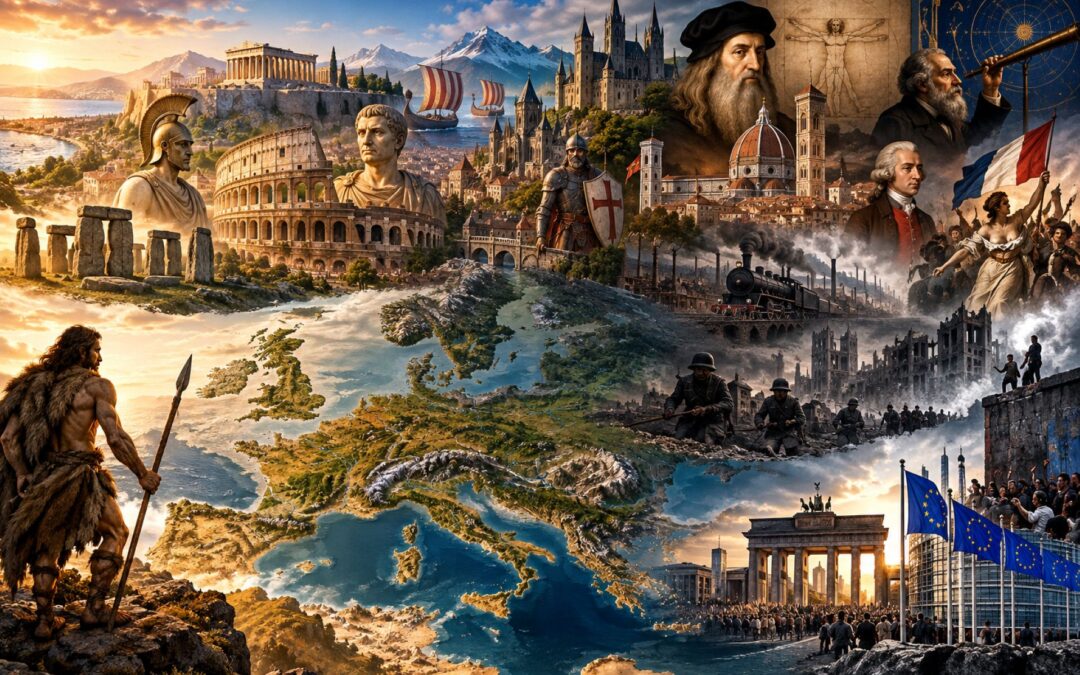
Europe’s history began long before the continent had recognizable borders, nations, or even a common identity. The people who first inhabited its forests, plains, mountains, and coastlines could not have imagined the kingdoms, empires, industrial cities, and political institutions that would eventually emerge from the societies they established. The familiar map of modern Europe is the result of thousands of years of migrations, conquests, cultural exchanges, religious transformations, revolutions, and wars.
Few regions have exerted such extensive influence over global history. Ancient Greek philosophy, Roman law, Christianity, the Renaissance, the Scientific Revolution, industrialization, colonial expansion, and the development of modern political institutions all contributed to Europe’s historical importance. Yet these developments did not arise in isolation. European societies repeatedly borrowed ideas, technologies, crops, beliefs, and institutions from peoples beyond their borders, while their own expansion transformed societies across the world, often through conquest and exploitation.
Nor was Europe’s development a continuous march toward prosperity or enlightenment. The same continent that produced influential ideas about liberty and equality also witnessed religious persecution, slavery, imperial domination, fascism, and two devastating world wars. Periods of intellectual achievement and economic growth frequently coexisted with profound inequalities and destructive political rivalries.
Europe was never one civilization moving in a single direction. The Mediterranean, Atlantic coast, Baltic region, Balkan Peninsula, and eastern European plains developed different political and cultural traditions, even as trade, migration, religion, and warfare connected them. Understanding the history of Europe therefore requires following these overlapping histories and examining how their interaction created the continent that exists today.
From Ice Age Europe to the First Farming Communities
The earliest chapters of European history were written by human populations that lived long before agriculture, cities, or recorded language. Human ancestors reached parts of Europe hundreds of thousands of years ago, while Neanderthals occupied substantial areas of the continent before the arrival and expansion of modern humans. Homo sapiens began establishing themselves in Europe roughly 45,000 years ago, although migration routes, settlement patterns, and encounters with other human populations varied considerably.
These early communities lived through environmental conditions that were dramatically different from those of modern Europe. During the last Ice Age, enormous ice sheets covered much of northern Europe, while glaciers extended through mountain ranges farther south. Areas beyond the ice were frequently cold, dry landscapes supporting animals such as mammoths, reindeer, wild horses, and bison. Human populations adapted through hunting, gathering, seasonal mobility, sophisticated tools, and knowledge of local environments.
Archaeological discoveries reveal that these societies were far more complex than the term primitive might suggest. They manufactured stone blades, bone implements, ornaments, and specialized hunting equipment. Cave paintings at Lascaux in France and Altamira in Spain demonstrate remarkable artistic traditions, although the beliefs and purposes behind particular images remain uncertain. Such discoveries show that symbolic expression, technical skill, and social cooperation were established features of European life long before the first civilizations.
The climate began changing substantially toward the end of the last Ice Age. As temperatures generally increased after approximately 12,000 years ago, ice sheets retreated, vegetation shifted, and populations occupied regions that had previously been inaccessible or difficult to inhabit. Forests spread through many areas, while rising sea levels transformed coastlines and separated Britain from continental Europe. Human communities adapted their diets, tools, and settlement patterns to these changing environments.
An even more consequential transformation followed with the spread of agriculture. Farming had developed earlier in parts of Southwest Asia, including regions of the Fertile Crescent and Anatolia. Beginning in the seventh millennium BCE, agricultural practices spread into southeastern Europe and gradually across much of the continent, through combinations of population movement, cultural exchange, and local adoption. Communities increasingly cultivated crops such as wheat and barley, raised domesticated animals, and established settlements occupied for extended periods.
Agriculture transformed social relationships because productive land, livestock, stored food, and permanent buildings became increasingly important resources. Larger settlements could support more specialized activities, while the accumulation and inheritance of property created new possibilities for social differentiation. However, farming did not immediately replace hunting and gathering everywhere. Different communities combined subsistence strategies for centuries, and parts of northern and northeastern Europe adopted agriculture considerably later than the Mediterranean and Balkans.
The emergence of settled societies also encouraged new forms of monumental construction and collective ritual. Megalithic monuments appeared across parts of Atlantic and northern Europe, including stone circles, chambered tombs, and ceremonial landscapes. Stonehenge, whose construction involved multiple phases beginning in the late Neolithic, illustrates the organizational capabilities of communities able to coordinate labor, transport materials, and maintain traditions over generations. The precise religious and social meanings of many such monuments remain subjects of archaeological debate.
Technological change accompanied these developments. Copper objects appeared in parts of southeastern Europe during the fifth millennium BCE, followed by wider experimentation with metallurgy and eventually bronze production. Meanwhile, population movements introduced new ancestry and contributed to profound changes in European societies. Ancient DNA evidence of steppe migration demonstrates substantial movements into Europe during the third millennium BCE, associated with populations from the Pontic-Caspian steppe and frequently discussed in relation to the spread of Indo-European languages.
These movements were not a single invasion that instantly replaced Europe’s inhabitants or cultures. Their scale, chronology, and consequences differed by region, while the relationship between genetic ancestry and spoken language cannot be established from DNA alone. Nevertheless, the eventual spread of Indo-European language families helped shape the linguistic foundations of much of Europe, including the ancestors of Greek, Latin, Celtic, Germanic, and Slavic languages. Europe’s prehistoric population was already the product of repeated migration and cultural interaction, a pattern that would continue throughout its recorded history.
The Bronze Age and Europe’s First Literate Civilizations
By the third millennium BCE, bronze technology and increasingly extensive trading networks were changing societies across Europe. Bronze, commonly produced through combinations of copper and tin, offered advantages for manufacturing many weapons, tools, and prestige objects. Its production also encouraged exchange across considerable distances because the necessary materials were not distributed evenly. Communities able to control resources, trade routes, and specialized craftsmanship could accumulate wealth and political influence.
The most elaborate early European palace societies emerged around the Aegean Sea, where geographical proximity encouraged interaction with established civilizations in Egypt and the Near East. On Crete, the Minoan civilization developed major palace complexes, particularly during the second millennium BCE. Sites such as Knossos reveal sophisticated architecture, storage facilities, administrative practices, fresco painting, and maritime connections. Minoan communities used writing systems, including Linear A, which remains undeciphered, and participated in an interconnected eastern Mediterranean world.
On the Greek mainland, the Mycenaean civilization developed powerful palace-centered kingdoms from approximately the seventeenth and sixteenth centuries BCE. Their fortified centers included Mycenae, Tiryns, and Pylos, where administrative records written in Linear B preserve the earliest known written form of Greek. These kingdoms organized agricultural production, specialized manufacturing, military resources, and exchanges with neighboring societies. Their political traditions later provided material for Greek legendary narratives, although the surviving stories of the Trojan War cannot be treated as straightforward contemporary history.
The Aegean world depended on networks connecting Greece, Anatolia, Cyprus, Egypt, and the Levant. Merchants and diplomatic intermediaries exchanged metals, pottery, textiles, luxury goods, and artistic techniques, while rulers competed through military alliances and conflicts. Such connections encouraged prosperity but also exposed complex societies to disruptions beyond their immediate territories. A shortage of essential resources or the collapse of a trading partner could undermine institutions that depended on regular exchange.
Around 1200 BCE, much of the eastern Mediterranean experienced a prolonged crisis. Several palace systems collapsed, settlements were destroyed or abandoned, and long-distance political and economic networks were reorganized. Possible explanations include warfare, internal conflict, environmental pressures, migration, and systemic instability, but historians do not regard one cause as sufficient to explain every regional collapse. Mycenaean palace administration disappeared, and Linear B ceased to be used, leaving later Greek communities without the same bureaucratic writing tradition.
The upheaval did not produce a uniform collapse throughout Europe. Societies in central Europe, the Italian Peninsula, Scandinavia, and the Atlantic region followed their own historical trajectories, while Aegean populations continued to develop new communities and cultural practices. Ironworking gradually became more important during subsequent centuries, but its adoption was uneven rather than the result of a sudden universal technological revolution. Out of these changes, new political institutions and cultural traditions would eventually emerge, especially in Greece and Italy.
Ancient Greece, Persia, and Alexander’s Hellenistic World
The centuries after the Mycenaean palace collapse transformed the Greek-speaking world. During the early first millennium BCE, communities gradually developed into independent city-states known as poleis, each possessing its own institutions, territory, social hierarchy, and political traditions. Settlements such as Athens, Sparta, Corinth, and Thebes became important centers of regional power. Although Greek communities shared elements of language, religious practice, and mythology, political unity remained exceptional.
Contacts with Phoenician traders and other Mediterranean peoples helped reshape Greek commerce and intellectual life. The Greeks adapted an alphabetic writing system derived from Phoenician traditions, introducing important changes that contributed to the development of the Greek alphabet. Written records became increasingly significant for law, poetry, administration, and public communication. Homeric epic traditions, religious festivals, athletic competitions, and artistic achievements helped create a recognizable Greek cultural world despite continuing political rivalry.
Between the eighth and sixth centuries BCE, Greek settlers founded communities around the Mediterranean and Black Sea. These settlements connected Greek-speaking populations with societies in southern Italy, Sicily, Anatolia, the Black Sea region, and North Africa. They facilitated trade in agricultural products, metals, pottery, and other goods while spreading and adapting cultural practices. Greek expansion was not always peaceful, and relations with established local populations ranged from cooperation and intermarriage to displacement and armed conflict.
Different Greek city-states developed contrasting systems of government. Sparta became associated with a militarized citizen society supported by the labor of a large subordinated population known as helots. Athens gradually developed institutions of direct citizen participation, particularly through reforms associated with Solon, Cleisthenes, and later democratic leaders. Eligible male citizens could participate in political assemblies and public decisions, but women, enslaved people, and resident foreigners were excluded from citizenship. Ancient Athenian democracy was therefore innovative without representing political equality in the modern sense.
Greek political development unfolded alongside the expansion of the Persian Empire. During the sixth century BCE, the Achaemenid rulers established control over an enormous territory extending from western Asia toward the Mediterranean and beyond. Persian authority over Greek-speaking communities in Anatolia contributed to conflicts with independent Greek states. The Greek victories at Marathon in 490 BCE, Salamis in 480 BCE, and Plataea in 479 BCE became defining events, although the Persian Empire remained a major power rather than collapsing after these defeats.
The fifth century BCE also saw an extraordinary concentration of philosophical, artistic, and intellectual activity. In Athens, figures such as Socrates, Plato, playwrights including Sophocles and Euripides, and historians such as Thucydides explored questions about justice, political authority, human conduct, and the interpretation of events. Architectural projects, including the Parthenon, expressed the power and cultural ambitions of the Athenian state. These achievements later became influential far beyond Greece, although they developed within a society sustained partly by imperial tribute, inequality, and enslaved labor.
Greek cultural achievement did not prevent destructive internal competition. Athens and Sparta became the principal rivals in the Peloponnesian War, fought from 431 to 404 BCE, which damaged communities throughout the Greek world. Sparta emerged victorious, but its dominance was contested, and further conflicts prevented the establishment of durable political unity. The resulting balance of power created opportunities for Macedon, a kingdom to the north whose rulers developed increasingly effective military and diplomatic institutions.
Philip II of Macedon established supremacy over much of mainland Greece after his victory at Chaeronea in 338 BCE. His son Alexander inherited this political and military foundation and launched a campaign against the Persian Empire in 334 BCE. Within approximately a decade, Alexander conquered the Persian imperial heartland, took control of Egypt, and advanced into northwestern parts of the Indian subcontinent. His death in Babylon in 323 BCE left an empire too vast and contested to remain united under one ruler.
Alexander’s successors divided his territories into competing kingdoms, but the cultural consequences of his conquests endured. The Hellenistic world brought Greek-speaking elites and institutions into closer contact with Egyptian, Persian, Mesopotamian, and other traditions. Cities such as Alexandria became centers of scholarship, commerce, and cultural exchange. The ancient Greek legacy was thus shaped not only by developments within Europe but also by centuries of interaction with civilizations across the eastern Mediterranean and western Asia.
Rome: From Republic to Empire and Christian Civilization
While Greek city-states competed for influence, Rome developed from a settlement in central Italy into the dominant power of the Mediterranean world. Roman tradition dated the city’s founding to 753 BCE and attributed it to Romulus, but its actual origins involved the gradual development of communities along the Tiber River. Early Roman society was influenced by neighboring Italic peoples, Etruscan political and artistic traditions, and commercial contact with Greek settlements in southern Italy.
According to traditional Roman chronology, the monarchy ended in 509 BCE and was replaced by a republic. Republican government distributed authority among elected magistrates, aristocratic institutions such as the Senate, and citizen assemblies. These institutions did not create modern representative democracy, since wealthy families exercised disproportionate influence and large parts of the population lacked political equality. Nevertheless, Rome developed enduring practices of public office, legal procedure, political competition, and civic identity.
Roman expansion across the Italian Peninsula combined military conquest with alliances, negotiated privileges, colonization, and varying degrees of incorporation into Roman institutions. The Republic developed an exceptional ability to mobilize military resources and recover from severe defeats. Its increasing influence brought it into conflict with Carthage, the powerful North African state that dominated important western Mediterranean trading networks. The First Punic War, fought from 264 to 241 BCE, established Rome as a major naval power and gave it control over Sicily.
Two subsequent Punic Wars culminated in the destruction of Carthage in 146 BCE, while Roman campaigns also extended its authority into Greece, Iberia, and other Mediterranean territories. By the first century BCE, Rome controlled a vast network of provinces inhabited by peoples with different languages, religions, and political traditions. Expansion generated wealth for military commanders and aristocratic families, but it also intensified competition over land, citizenship, provincial administration, and the political rewards of conquest. Enslaved labor became integral to significant parts of Roman economic and social life.
The institutions of the Republic struggled under these pressures. Political disputes increasingly escalated into violence, and ambitious commanders developed personal loyalties among soldiers whose military service could determine their livelihoods. Julius Caesar’s rise and assassination revealed the depth of the crisis but did not restore the old political order. Following another period of civil conflict, Octavian consolidated power and received the title Augustus in 27 BCE, establishing the imperial system conventionally associated with the beginning of the Roman Empire.
Imperial Rome brought much of southern and western Europe into a single political structure. Its territory also extended across North Africa and the Middle East, making it a Mediterranean empire rather than simply a European state. Under emperors such as Trajan, whose reign marked a high point of territorial expansion, Roman authority encompassed diverse communities connected through roads, ports, military installations, taxation, law, and commercial exchange. Cities including Londinium, Lutetia, and Colonia Agrippinensis developed as important regional centers within these networks.
The first two centuries of imperial rule are often associated with the Pax Romana, a period of comparative internal stability that supported commerce and urban development across much of the empire. Roman engineering produced extensive road systems, bridges, aqueducts, harbors, and public buildings. Latin became a major administrative and cultural language in western provinces, while Greek remained widely influential in the eastern Mediterranean. Roman law, citizenship, military organization, and political administration would leave lasting marks on later European institutions.
Roman society was nevertheless characterized by sharp inequalities. Political privileges, legal status, wealth, gender, and enslavement shaped individual opportunities, while provincial populations experienced imperial government in different ways. Conquest and taxation could impose severe burdens, and the empire’s borders remained subject to recurring warfare. Intellectual and artistic achievements flourished alongside these contradictions, producing influential works by writers and thinkers such as Virgil, Seneca, Tacitus, and Marcus Aurelius.
From the third century CE, imperial authority faced increasingly serious challenges. Civil wars, competing military commanders, financial pressures, epidemics, and external conflicts exposed weaknesses in a political system dependent on military success and orderly succession. Emperors including Diocletian introduced administrative reforms intended to stabilize government and improve imperial coordination. These measures preserved the empire for generations, even as its political organization changed substantially.
One of the most consequential transformations concerned religion. Christianity emerged in Roman Judea during the first century CE and spread through networks of cities, households, merchants, and religious communities. Christians periodically faced persecution, but the religion continued to expand. The agreement traditionally known as the Edict of Milan in 313, associated with Constantine and Licinius, affirmed religious toleration and ended the official persecution of Christians within their territories. Constantine’s patronage subsequently increased Christianity’s influence, while legislation under Theodosius I in 380 gave Nicene Christianity a privileged and official position within the imperial state.
Christianity would eventually become a central institution in European political and cultural life. However, its rise did not eliminate the empire’s existing divisions or guarantee political survival. The Roman state continued to change under the pressure of internal competition and movements across its frontiers, producing different outcomes in its western and eastern territories.
The Fall of Western Rome and the Transformation of Europe
The collapse of Western Roman imperial authority was not a single catastrophe that immediately erased Roman civilization. During the fourth and fifth centuries, the western provinces experienced military conflicts, economic and administrative pressures, political fragmentation, and the settlement of peoples previously living beyond imperial frontiers. Roman institutions weakened unevenly, while local elites, religious authorities, and military leaders adapted to changing circumstances.
Groups conventionally described by Roman writers as barbarians included Goths, Franks, Vandals, Burgundians, Saxons, and numerous others. They were not members of one unified civilization, and their relationships with Rome ranged from warfare to trade, military service, diplomatic alliance, and settlement within imperial territory. Movements of the Huns and other populations contributed to changing patterns of migration and conflict. Roman governments sometimes invited or negotiated the settlement of foreign groups, but competition over territory, resources, and authority could produce destructive wars.
The Visigothic sack of Rome in 410 had enormous symbolic significance because the city represented centuries of imperial dominance. Yet the western empire continued to exist afterward, even as it lost the ability to control important provinces. Vandals established a powerful kingdom in North Africa, Frankish rulers expanded their influence in Gaul, and various Germanic groups developed political authority in parts of Britain and the Iberian Peninsula. In 476, the Germanic military leader Odoacer deposed Romulus Augustulus, the last emperor conventionally recognized as ruling the western imperial court in Italy.
The year 476 is therefore a useful historical marker, but it did not end Roman society or usher the whole continent into ignorance. Western successor kingdoms retained elements of Roman administration, law, landholding, urban life, and religious organization. Latin continued to evolve into regional languages, while Christian institutions preserved and transformed written traditions. Some towns declined or lost economic connections, but others remained significant, and conditions varied greatly among regions.
In Gaul, the Franks developed one of the most durable successor kingdoms. Their ruler Clovis, traditionally associated with baptism around the end of the fifth century, helped strengthen the relationship between Frankish monarchy and Catholic Christianity. This alliance became important because religious institutions could provide literacy, administrative experience, social networks, and ideological legitimacy. Monasteries and bishoprics played substantial roles in preserving written culture, organizing charitable activity, and spreading Christianity beyond former Roman territories.
The Eastern Roman Empire followed a different trajectory. Centered on Constantinople, it retained a powerful imperial government, complex administration, substantial urban wealth, and extensive traditions of Greek and Roman learning. Its inhabitants continued to identify themselves as Romans, although historians commonly use the later term Byzantine Empire to distinguish its medieval history. Eastern Roman rulers preserved imperial ambitions and frequently contested control of territories in Italy, the Balkans, Anatolia, and the Mediterranean.
The seventh century transformed this eastern world through the emergence and rapid expansion of Islam. Muslim armies conquered major territories previously controlled by the Eastern Roman and Sasanian empires, including Syria, Egypt, and other parts of the eastern Mediterranean. During the early eighth century, Muslim forces crossed into the Iberian Peninsula and defeated the Visigothic kingdom. Much of Iberia subsequently became part of Al-Andalus, a politically and culturally influential region in which Muslim, Christian, and Jewish communities interacted under changing conditions of cooperation, hierarchy, and conflict.
Frankish resistance to Muslim expeditions into regions north of the Pyrenees included Charles Martel’s victory near Tours and Poitiers in 732. The battle became prominent in later European historical narratives, although it did not single-handedly determine the religious future of the continent. Islamic political authority remained established in Iberia for centuries, while Mediterranean trade and intellectual exchange continued across religious boundaries. Medieval Europe consequently emerged from several interacting traditions: Latin Christianity in much of the west, Eastern Christianity in the Byzantine world and neighboring regions, and Islamic societies in parts of the Mediterranean.
Charlemagne, Vikings, and the Rise of Medieval Kingdoms
By the eighth century, the Frankish kingdom had become one of the strongest political powers in western Europe. The Carolingian dynasty expanded its authority through military conquest, alliances with religious institutions, and efforts to strengthen royal administration. Charlemagne, who became king in 768, extended Frankish control across substantial parts of present-day France, Germany, northern Italy, and neighboring regions. His campaigns also involved coercion and forced conversion, particularly during prolonged warfare against the Saxons.
On Christmas Day in 800, Pope Leo III crowned Charlemagne emperor in Rome. The ceremony symbolized an attempt to revive western imperial authority, but it also created tensions over relations between secular monarchy, the papacy, and the existing Eastern Roman emperor. Charlemagne promoted religious reform, education, manuscript production, and administrative coordination, contributing to a cultural revival often called the Carolingian Renaissance. These initiatives depended on networks of bishops, monasteries, and aristocratic officials rather than a modern centralized bureaucracy.
The empire proved difficult to maintain after Charlemagne’s death in 814. Dynastic disputes culminated in the Treaty of Verdun in 843, which divided the Carolingian realm among his grandsons. The resulting political territories were not yet modern France or Germany, but their development contributed to the historical formation of those later states. Regional rulers, aristocratic families, and religious institutions increasingly shaped political authority, reinforcing the fragmented landscape of medieval Europe.
Meanwhile, Scandinavian societies were becoming powerful participants in European trade, warfare, and migration. The conventional beginning of the Viking Age is associated with the attack on Lindisfarne in 793, although contacts between Scandinavia and other European regions were much older. Norse ships combined maritime mobility with the ability to navigate shallow waterways, enabling expeditions across northern seas and far into river systems. Monasteries and coastal settlements were vulnerable targets, but raiding represented only one aspect of Scandinavian expansion.
The Viking expansion across Europe also involved merchants, craftsmen, settlers, political leaders, and explorers. Scandinavian groups established communities in the British Isles, influenced political developments in Ireland and England, and settled in northern France, where the region of Normandy eventually emerged. Norse voyages extended to Iceland, Greenland, and the North American coast. These activities connected northern Europe with commercial and cultural networks extending across the North Atlantic.
Eastern routes were equally significant. Scandinavian traders and warriors, often associated with the Varangians, traveled through the Baltic and along river systems connecting the northern forests with the Black Sea and Byzantine territories. Their interactions with Slavic, Finnic, and other populations contributed to the development of political communities associated with the Rus. Kyivan Rus emerged during the ninth and tenth centuries as an important medieval polity whose history forms part of the heritage of several modern eastern European peoples. It should not be treated as the straightforward national origin of any one modern state.
Other movements transformed central Europe. Magyar groups entered the Carpathian Basin during the late ninth century and conducted military expeditions across neighboring territories. Their defeat by Otto I at Lechfeld in 955 weakened the pattern of large-scale westward raiding, while the consolidation of the Hungarian kingdom contributed to the formation of a more durable regional political order. Christianity became central to royal institutions in Hungary around the turn of the millennium, as it did in several Scandinavian kingdoms.
By approximately 1000 CE, Europe contained an increasingly recognizable landscape of Christian kingdoms, regional principalities, and expanding trade networks. These societies remained politically fragmented, but religious institutions, dynastic relationships, commerce, and shared cultural practices created connections across large distances. The following centuries would bring agricultural expansion, growing towns, more elaborate governments, and a powerful revival of intellectual and economic activity.
Feudal Society, the Crusades, and Medieval Growth
Between approximately 1000 and 1300, much of Europe experienced significant agricultural and demographic growth. Improvements in farming techniques, the use of heavier plows in suitable soils, changing systems of crop rotation, and the expansion of cultivated land helped increase production in many regions. Relatively favorable climatic conditions contributed to these developments, although local experiences differed considerably. Larger populations supported the growth of villages, markets, towns, and increasingly specialized forms of labor.
Most Europeans nevertheless remained dependent on agriculture. Landownership, customary obligations, and relationships between powerful families and rural communities shaped access to resources and political protection. Historians often describe these arrangements through the concept of feudalism, in which rulers and nobles distributed rights over land or income in exchange for military service and loyalty. However, medieval Europe did not possess one universal feudal system, and relationships between rulers, aristocrats, peasants, and landholders differed across regions and centuries.
Many peasants lived under manorial arrangements involving rents, labor services, customary rights, and obligations to local lords. Some were legally unfree, while others possessed greater independence or access to communal resources. Noble families accumulated power through landed estates, military capabilities, marriage alliances, and relationships with monarchs. Political authority was frequently overlapping rather than clearly divided among the centralized institutions familiar in modern states.
Religious institutions formed another major source of authority. Churches and monasteries owned land, collected revenues, operated schools, administered charitable services, and influenced political legitimacy. The papacy claimed spiritual leadership over Latin Christianity and increasingly asserted its authority in disputes with secular rulers. Medieval religious life also shaped calendars, architecture, education, social customs, and the ways communities understood suffering, morality, and salvation.
Economic developments created opportunities beyond the countryside. Merchants expanded trading networks across northern Europe, the Mediterranean, and inland commercial routes, while towns acquired varying degrees of self-government. Italian cities such as Venice, Genoa, and Florence developed important commercial and financial institutions. In northern Europe, urban trading networks helped connect ports and markets around the Baltic and North Seas. Money changing, credit arrangements, merchant associations, and banking practices became increasingly important to commerce.
This period also witnessed remarkable cultural and intellectual development. Gothic cathedrals transformed the skylines of cities such as Paris, Chartres, and Canterbury, reflecting both religious commitments and the organizational capabilities of urban communities. Universities emerged in places including Bologna, Paris, Oxford, Cambridge, and Salamanca. Scholars studied theology, law, medicine, philosophy, and the liberal arts, drawing on Christian traditions alongside works transmitted through Byzantine, Islamic, and other intellectual networks.
The authority of the Church also contributed to military campaigns framed as religious obligations. In 1095, Pope Urban II called for an expedition that became the First Crusade. European armies eventually captured Jerusalem in 1099, establishing Latin Christian states in the eastern Mediterranean. The medieval Crusades continued in different forms for centuries, involving not only campaigns in the Levant but also conflicts in Iberia, the Baltic region, and territories whose populations were considered religious or political enemies of the papacy. The Fourth Crusade’s conquest of Constantinople in 1204 demonstrated that crusading warfare could also devastate Christian societies.
Across Iberia, Christian kingdoms gradually expanded at the expense of Muslim-ruled territories through the long process conventionally known as the Reconquista. The political and religious history of the peninsula involved shifting alliances as well as warfare, and relationships were not always divided neatly along confessional lines. Elsewhere, Christian military orders campaigned against pagan communities around the Baltic, while the Mongol expansion of the thirteenth century brought enormous disruption to eastern Europe. Mongol forces conquered or subordinated numerous Rus principalities and devastated parts of Poland and Hungary, creating enduring political consequences.
Medieval growth was therefore accompanied by conquest, coercion, political rivalry, and economic inequality. Yet the expansion of towns, commerce, learning, and administrative institutions created foundations for subsequent European transformations. By around 1300, many European societies possessed more extensive commercial networks and increasingly sophisticated political structures than they had three centuries earlier. This period of growth would soon encounter a series of crises that profoundly altered the continent.
The Black Death and the Crisis of the Late Middle Ages
The early fourteenth century exposed the vulnerability of Europe’s expanding medieval societies. Agricultural production depended heavily on environmental conditions, while growing populations placed pressure on land and resources in some regions. The Great Famine of 1315–1317 devastated substantial parts of northern and western Europe after repeated harvest failures. Hunger, malnutrition, livestock disease, and economic disruption weakened communities already struggling with the uncertainties of agricultural life.
An even greater catastrophe arrived in the middle of the century. Beginning in 1347, the Black Death spread rapidly through European ports, commercial networks, and inland settlements. The pandemic was caused by the bacterium Yersinia pestis, transmitted through ecological and human processes that included infected fleas and possibly other routes depending on local conditions. Its origins and early transmission history remain subjects of historical and scientific research, but its consequences across Europe are unmistakable.
The mortality was extraordinary, although precise estimates vary by region and available evidence. Some communities lost a substantial proportion of their inhabitants within a few years, while others experienced lower immediate mortality or repeated subsequent outbreaks. Urban centers could be particularly vulnerable because of population density and commercial connections. The plague also devastated societies beyond Europe, making the pandemic part of a wider Afro-Eurasian history rather than an exclusively European disaster.
People struggled to explain the catastrophe through the medical and religious frameworks available to them. Some interpreted the disease as divine punishment, while others proposed environmental causes or sought protection through religious practices. Fear also produced persecution, including attacks on Jewish communities falsely accused of spreading the plague. These accusations reflected existing prejudice and political vulnerabilities rather than any genuine explanation of the disease.
The demographic collapse transformed economic relationships. With fewer workers available in many regions, surviving laborers could sometimes demand higher wages or more favorable terms from landholders. Landowners and governments attempted to preserve established obligations, including through laws limiting wages and mobility. The resulting conflicts contributed to changing labor arrangements, but their consequences differed sharply between regions. In parts of western Europe, some peasants gained greater freedom over time, while forms of coercive dependence persisted or intensified elsewhere.
Social tensions contributed to revolts that revealed the instability of established authority. England’s Peasants’ Revolt of 1381 emerged from taxation, labor restrictions, and broader resentment of political and economic inequality. Uprisings also occurred in France and other regions, although their immediate causes varied. Most were suppressed, but they demonstrated that medieval social relationships were being contested in increasingly visible ways.
Warfare compounded these difficulties. The Hundred Years’ War, fought intermittently between England and France from 1337 to 1453, caused extensive devastation, particularly in French territories. Armies and armed bands disrupted agriculture, trade, and local life, while taxation increased the burdens imposed on populations. The development and more extensive use of infantry formations, projectile weapons, and gunpowder artillery gradually altered military practices, although armored cavalry and fortifications remained important for generations.
The late medieval crisis did not destroy Europe’s capacity for cultural or political development. Some cities remained commercially influential, rulers introduced administrative reforms, and changing economic relationships created opportunities for new groups. The social and institutional transformations of the fourteenth and fifteenth centuries developed alongside an intellectual movement that had already begun in parts of Italy. Together, these changes would help reshape European understandings of learning, authority, artistic achievement, and political life.
The Renaissance, Reformation, and Europe’s Religious Wars
The Renaissance is commonly described as a rebirth of classical learning and artistic achievement, but it did not arise suddenly from the fall of Constantinople in 1453. Its roots extended into the economic and cultural development of Italian cities during the preceding centuries. The fourteenth-century development of Italian humanism demonstrates that scholars and patrons had already begun recovering, studying, and adapting classical traditions well before the Ottoman conquest of the Byzantine capital.
Italian cities provided favorable conditions for this transformation. Florence, Venice, Genoa, and other commercial centers accumulated wealth through trade, banking, manufacturing, and maritime activity. Powerful families, civic governments, and religious institutions financed artists, architects, writers, and scholars. Patronage enabled ambitious cultural projects, although artistic production was also shaped by political competition, religious priorities, and the interests of wealthy sponsors.
Humanist scholars sought to recover and understand classical Greek and Latin texts through careful study of language, history, and rhetoric. Their work did not necessarily reject Christianity, since many humanists remained deeply religious. Instead, they developed new ways of engaging with ancient authors and questions concerning education, politics, ethics, and human experience. Contacts with Byzantine scholars and the transmission of texts through Islamic intellectual traditions contributed to this expanding body of learning.
Renaissance art reflected both technical experimentation and changing intellectual interests. Filippo Brunelleschi’s architectural innovations and work associated with linear perspective influenced the representation of space. Artists including Leonardo da Vinci, Michelangelo, and Raphael explored anatomy, proportion, movement, religious symbolism, and classical themes. Their works emerged within specific institutional and political environments, making the Renaissance as much a product of urban society and patronage as individual genius.
The development of printing with movable metal type in Europe during the fifteenth century greatly increased the potential circulation of written materials. Johannes Gutenberg’s innovations in Mainz combined printing techniques with systems suited to producing books on a larger scale than manuscript copying. Printing did not immediately make everyone literate or eliminate traditional forms of communication, but it transformed the economics of textual reproduction. Scholars, religious reformers, governments, merchants, and readers increasingly participated in expanding networks of printed information.
These developments helped spread Renaissance ideas beyond Italy. Scholars in northern Europe adapted humanist methods to religious study, education, and debates over political authority. Artists in the Low Countries and German territories developed distinctive approaches to realism, portraiture, engraving, and religious subjects. The Renaissance was therefore not simply an Italian movement copied elsewhere; it became a collection of regional intellectual and artistic transformations connected through European institutions and exchange.
Religious criticism increasingly challenged the authority and practices of the Roman Catholic Church. Concerns over ecclesiastical wealth, clerical misconduct, indulgences, and relations between the papacy and secular rulers had existed for generations. In 1517, Martin Luther circulated arguments against the sale of indulgences and other practices, contributing to a movement that became the Protestant Reformation. The printing press helped distribute his writings, while support from sympathetic rulers and communities enabled reform movements to survive institutional opposition.
Protestant Christianity developed into several traditions rather than one unified alternative to Catholicism. Lutheran, Reformed, Anglican, Anabaptist, and other movements differed in theology, political relationships, religious practice, and understandings of church authority. The Catholic Church responded through internal reform, new religious orders, theological clarification, and measures intended to defend established doctrine. The Council of Trent, meeting intermittently from 1545 to 1563, played an important role in defining Catholic responses to the Reformation.
The division of western Christianity transformed European politics because religious allegiance became closely connected with dynastic legitimacy, territorial government, and collective identity. In France, conflicts between Catholics and Huguenots produced prolonged civil wars and devastating episodes of violence, including the St. Bartholomew’s Day massacre in 1572. In the Low Countries, revolt against Spanish Habsburg rule combined political resistance with religious conflict and eventually contributed to the emergence of the Dutch Republic.
The Thirty Years’ War, beginning in 1618, demonstrated the destructive potential of these overlapping rivalries. It began within the Holy Roman Empire but expanded into a wider European struggle involving dynastic ambition, territorial competition, political survival, and religion. Large areas of central Europe experienced military devastation, famine, epidemics, and population decline. The Peace of Westphalia in 1648 helped settle important aspects of the conflict, but it did not immediately produce the modern sovereign-state system in its completed form.
The Renaissance and Reformation transformed Europe without establishing intellectual or religious uniformity. Classical scholarship, printing, religious reform, and political competition made new ideas available while creating fresh sources of conflict. By the seventeenth century, Europe had become a continent of increasingly differentiated religious communities and rival states. At the same time, its maritime powers were extending their influence across oceans, beginning another transformation whose consequences would be felt globally.
Europe’s Overseas Empires and the Atlantic World
European maritime expansion developed from a combination of commercial ambition, political rivalry, religious objectives, navigational experience, and access to technologies and knowledge accumulated across several civilizations. Mediterranean trade had long connected European merchants with African and Asian markets, but routes controlled by competing states encouraged some rulers and merchants to seek alternatives. Portuguese expeditions along the African coast gradually expanded European knowledge of Atlantic navigation and created new opportunities for trade and conquest.
During the fifteenth century, Portuguese sailors established routes and commercial positions along the western African coast. Bartolomeu Dias rounded the southern tip of Africa in 1488, and Vasco da Gama reached India by sea in 1498. These voyages connected Portuguese commercial networks more directly with the Indian Ocean, where sophisticated trading systems had already existed for centuries. Portuguese power relied heavily on fortified ports, naval force, negotiated relationships, and attempts to control strategically valuable trade routes.
Spain’s overseas expansion followed a different but equally consequential trajectory. In 1492, Christopher Columbus crossed the Atlantic under Spanish sponsorship and reached islands in the Caribbean. His voyage did not represent the discovery of an uninhabited continent, since the Americas contained diverse societies with long histories, complex agricultural systems, cities, commercial networks, and political institutions. Norse voyagers had also reached parts of North America centuries earlier. Columbus’s expeditions mattered because they initiated sustained European colonial contact and expansion across the Atlantic.
Spanish conquests transformed much of the Americas during the sixteenth century. Military campaigns against the Aztec and Inca empires combined with local alliances, political conflict, epidemic disease, and colonial institutions to produce the destruction or subordination of numerous indigenous political systems. European colonizers acquired enormous territories and established systems designed to extract labor, agricultural products, and mineral wealth. Silver from American mines became especially significant to international commerce, connecting European economies with markets across the Atlantic and Pacific.
Other European powers entered the colonial competition. The Dutch Republic developed maritime commercial networks and chartered companies that operated across Asia, Africa, and the Americas. England and France established colonial settlements, trading stations, plantation economies, and overseas military positions. Chartered companies such as the Dutch East India Company and English East India Company combined private investment with privileges granted by governments, sometimes exercising extensive political and military authority.
The expansion of European overseas empires contributed to an unprecedented increase in sustained exchanges among continents. Crops originating in the Americas, including potatoes, maize, and tomatoes, gradually became important to diets in Europe and elsewhere. Animals, diseases, agricultural techniques, technologies, and commercial goods moved through new networks. The resulting Columbian Exchange altered environments, populations, economic relationships, and patterns of consumption across the world.
These transformations were inseparable from violence and exploitation. Colonial settlement frequently involved indigenous dispossession, forced labor, coercive religious policies, and the destruction or reshaping of established communities. Competition for land and resources produced conflicts both within colonial societies and among European powers. Indigenous populations were not passive participants; they resisted conquest, negotiated alliances, adapted institutions, and sometimes exploited rivalries among colonizing states.
The transatlantic slave trade became one of the most destructive dimensions of European imperial expansion. European merchants and colonial systems participated in networks that forcibly transported millions of enslaved Africans to the Americas. According to historical estimates compiled by SlaveVoyages, approximately 12.5 million captive Africans embarked on transatlantic voyages between 1501 and 1866, and a smaller number survived the passage. Enslaved labor supported plantation economies producing sugar, tobacco, coffee, cotton, and other commodities consumed in European and international markets.
Commercial profits, colonial taxation, maritime trade, and financial investment contributed to the development of European economic power, although scholars continue to debate the relative importance of particular colonial activities to industrialization and long-term growth. The economic consequences also varied among European societies. Some merchants, governments, and investors benefited enormously, while much of the population remained poor and colonial wealth did not translate automatically into widespread prosperity.
European imperial expansion was therefore a contradictory historical process. It intensified global connections and helped create increasingly integrated commercial systems, but it did so through political domination, enslavement, warfare, and the unequal distribution of power. Europe’s growing influence over distant territories would shape its international ambitions for centuries, while the resulting colonial relationships would eventually contribute to struggles over independence, sovereignty, and global inequality.
Science, Enlightenment, Revolution, and Napoleon
Between the sixteenth and eighteenth centuries, European intellectual life underwent transformations that changed how people investigated nature, political authority, and the organization of society. The Scientific Revolution did not suddenly replace centuries of superstition with rational thought. Medieval European scholars had already developed sophisticated intellectual traditions, drawing on ancient Greek works, Islamic scholarship, university teaching, and observation. However, new combinations of mathematics, experimentation, instruments, and systematic investigation increasingly challenged established explanations.
Nicolaus Copernicus argued for a model of the cosmos in which Earth moved around the Sun, raising fundamental questions about inherited astronomical assumptions. Johannes Kepler developed mathematical descriptions of planetary motion, while Galileo Galilei used telescopic observations and physical investigation to challenge prevailing ideas. Their work was accompanied by controversy because astronomical theories intersected with established philosophy, scriptural interpretation, and institutional authority. Scientific change involved competing explanations and gradual acceptance rather than one decisive intellectual victory.
Other researchers transformed understandings of the physical world and the human body. William Harvey’s work on blood circulation challenged important aspects of traditional medical thought. Robert Boyle contributed to experimental approaches to chemistry and the behavior of gases. Isaac Newton’s mathematical formulation of motion and universal gravitation offered an extraordinarily influential framework for explaining physical phenomena. Scientific societies, journals, universities, and correspondence networks increasingly connected researchers across political boundaries.
These developments contributed to a broader intellectual movement associated with the Enlightenment. Thinkers such as John Locke, Montesquieu, Voltaire, Jean-Jacques Rousseau, and others debated the nature of political legitimacy, religious toleration, individual rights, government, and human reason. They did not agree on every question, and their ideas emerged from different political and social contexts. Nevertheless, Enlightenment arguments helped challenge the assumption that hereditary authority and established institutions should remain beyond criticism.
The spread of printed books, newspapers, pamphlets, and periodicals expanded opportunities for public debate among literate populations. Coffeehouses, salons, reading societies, and intellectual associations became important spaces for exchanging ideas, although access was shaped by wealth, education, gender, and social standing. Some monarchs adopted administrative reforms influenced by Enlightenment thinking while maintaining extensive personal authority. Others resisted demands for limits on government or broader political participation.
The American Revolution demonstrated how disputes over representation, taxation, and imperial authority could develop into a struggle for independence. The Declaration of Independence in 1776 gave influential expression to claims about equality, rights, and the legitimacy of government. Yet the resulting republic continued to contain profound inequalities, including slavery and the exclusion of large populations from political rights. The American example nevertheless influenced political debates across the Atlantic.
In France, financial crisis, social inequality, aristocratic privilege, and dissatisfaction with royal authority contributed to revolutionary upheaval in 1789. The French Revolution challenged the foundations of the Bourbon monarchy and transformed the relationship between political sovereignty and citizenship. The National Assembly abolished important feudal privileges, revolutionary leaders proclaimed rights and national sovereignty, and the monarchy was eventually abolished. The execution of Louis XVI in January 1793 symbolized the destruction of the old political order.
The revolution also exposed tensions between political ideals and the use of state power. War against neighboring monarchies, internal rebellion, factional conflict, and fears of counterrevolution contributed to the radicalization of revolutionary government. The Reign of Terror involved extraordinary emergency powers, political persecution, and executions justified by their advocates as necessary to defend the republic. Revolutionary France demonstrated both the extraordinary reach of ideas about political equality and the dangers of concentrating coercive authority in the name of those ideals.
Out of this unstable environment emerged Napoleon Bonaparte. A successful military commander during the Revolutionary Wars, Napoleon took power in the coup of 1799 and crowned himself emperor in 1804. His government introduced administrative, legal, and institutional reforms, including the Civil Code, while restricting political opposition and expanding personal authority. Through military victory and diplomacy, he established direct or indirect control over much of continental Europe.
The Napoleonic Wars transformed European politics by dismantling or reorganizing older states, spreading some revolutionary institutions, provoking resistance, and intensifying new forms of nationalism. Napoleon’s military successes did not create a stable continental order, because his expanding empire generated increasingly severe strategic and political demands. British resistance, warfare in Iberia, the disastrous invasion of Russia in 1812, and growing international coalitions progressively undermined his power.
Napoleon’s final defeat at Waterloo in June 1815 ended the Hundred Days and opened the way for a settlement dominated by the victorious European powers. The Congress of Vienna sought to restore stability through territorial arrangements, dynastic legitimacy, and a balance of power intended to prevent another prolonged continental war. Yet the revolutionary and Napoleonic periods had transformed political expectations in ways that could not be reversed simply by restoring monarchies. National sovereignty, citizenship, constitutional rights, and popular political participation would remain powerful forces throughout the nineteenth century.
Industrialization, Nationalism, and the Age of Imperialism
The Industrial Revolution began transforming Britain during the second half of the eighteenth century before spreading unevenly across Europe. Its significance extended far beyond the appearance of factories or steam engines. Industrialization changed how goods were produced, where people lived, how labor was organized, how states mobilized resources, and how economic power was distributed. It gradually created societies whose productive capabilities differed enormously from those of earlier agricultural economies.
Britain possessed several conditions favorable to early industrial growth, including accessible coal deposits, commercial and financial institutions, transport networks, technical experimentation, and connections to overseas markets. Textile manufacturing became a major center of mechanization, while developments in steam power and iron production expanded productive capacity. Industrial change did not occur through one invention or one coordinated plan. Improvements accumulated across industries, with technological experiments interacting with capital investment, labor markets, and commercial demand.
Factories changed the organization of work by bringing larger numbers of laborers together under increasingly regulated schedules and production systems. Mechanized manufacturing expanded output, but working conditions could be exhausting and dangerous. Industrial workers frequently faced low wages, insecure employment, hazardous machinery, and crowded housing. Women and children participated extensively in industrial labor, while their opportunities and legal protections varied according to occupation, region, and historical period.
Rapid urban growth created additional pressures. Industrial towns expanded faster than housing, sanitation, and public administration could initially accommodate. Overcrowding, polluted water, industrial smoke, and infectious disease shaped everyday life for substantial populations. At the same time, industrial expansion supported new occupations, commercial institutions, consumer markets, and opportunities for social mobility. The benefits and burdens of economic growth were distributed unevenly, contributing to conflicts over wages, working conditions, and political representation.
Transportation experienced a similarly profound transformation. Railways already had earlier industrial uses, but the development of steam-powered public rail transport accelerated commercial and social change. The Stockton and Darlington Railway opened in 1825, while the Liverpool and Manchester Railway, opened in 1830, became an important milestone in intercity passenger and freight transport. During subsequent decades, railway networks spread across Europe, linking mines, manufacturing centers, ports, towns, and national markets. Steamships and later communications technologies further reduced the practical barriers imposed by distance.
Industrialization also reshaped political thought. Karl Marx and Friedrich Engels criticized capitalist economic relationships, arguing that the concentration of productive property and the dependence of workers on wages produced structural exploitation. Socialist movements developed different proposals for economic organization and political reform, ranging from revolutionary transformation to parliamentary action. Trade unions, cooperative organizations, and emerging labor parties challenged employers and governments over wages, working hours, social welfare, and political rights.
Nationalism became another increasingly influential force. The French Revolutionary and Napoleonic periods had helped spread ideas associating political legitimacy with a people or nation, but nationalist movements differed in their objectives and methods. Some sought independence from multinational empires, while others advocated the political unification of territories sharing aspects of language or culture. Revolutionary uprisings across Europe in 1848 exposed demands for constitutional government, national self-determination, and social reform, although many immediate revolutionary efforts were suppressed.
Italian unification demonstrated how nationalism could combine with diplomacy, popular mobilization, and warfare. The Kingdom of Italy was proclaimed in 1861, but the process of incorporating territories continued afterward, with Rome becoming part of the kingdom in 1870. German unification followed a different path under Prussian leadership, particularly through the policies and wars associated with Otto von Bismarck. The German Empire was proclaimed in 1871 following Prussia’s victory over France. These developments transformed Europe’s balance of power by creating powerful new states in the continent’s center.
The political transformation of Europe coincided with renewed overseas imperial expansion. By the late nineteenth century, industrial European powers possessed military, transport, and communications capabilities that helped them project force across enormous distances. Britain’s empire expanded and consolidated its control over India and other territories, while France extended its holdings in Africa and Asia. Belgium, Germany, Italy, Portugal, Spain, and other states participated in colonial competition, although the scale and methods of their expansion differed.
The partition of Africa during the late nineteenth century imposed colonial boundaries and political authorities across much of the continent with limited regard for existing societies and institutions. European powers pursued resources, markets, strategic routes, prestige, and political influence, often using military conquest and coercive administration. In Asia, colonial control and unequal treaties altered established political and commercial relationships. Imperial competition brought European states into closer contact with the wider world while intensifying rivalries among themselves.
By the early twentieth century, Europe had become both a center of extraordinary industrial power and a politically unstable collection of competing states. Germany’s rapid industrial and military development challenged established balances of influence, while British and French leaders worried about changing strategic circumstances. The Austro-Hungarian, Russian, and Ottoman empires confronted nationalist movements and disputes over territories inhabited by diverse populations. Military planning, alliance commitments, colonial rivalry, and nationalism combined to create a dangerous international environment in which a regional crisis could escalate into something far larger.
World War I and the Destruction of the Old European Order
Europe’s political tensions reached a breaking point in June 1914, when Archduke Franz Ferdinand, heir to the Austro-Hungarian throne, was assassinated in Sarajevo by Gavrilo Princip, a Bosnian Serb nationalist. The assassination created an immediate diplomatic crisis, but it did not make a continental war inevitable. Political leaders still made decisions about ultimatums, military mobilization, alliance commitments, and negotiations. The failure of diplomacy during the July Crisis transformed a confrontation between Austria-Hungary and Serbia into an expanding international war.
The First World War began in an atmosphere shaped by competing great-power ambitions and fears about national security. Germany supported Austria-Hungary, while Russia mobilized in support of Serbia and its broader regional interests. France and Britain became involved as the conflict escalated, and Germany’s invasion of Belgium contributed directly to Britain’s entry. Existing alliances intensified the crisis, but military assumptions, political choices, and the perceived risks of delay were equally important.
German planners hoped to achieve a rapid victory in the west before concentrating their forces against Russia. Their offensive advanced through Belgium and northern France but failed to produce the decisive outcome they expected. On the Western Front, armies established extensive defensive systems, and trench warfare became associated with prolonged bombardment, repeated offensives, and immense casualties for limited territorial gains. Battles such as Verdun and the Somme demonstrated the destructive capabilities of modern armies.
The Eastern Front experienced more extensive movement, but its military campaigns were also exceptionally costly. Fighting involved Russia, Germany, Austria-Hungary, and neighboring territories, while the Ottoman Empire’s entry expanded the conflict further. European imperial possessions and global trading networks ensured that the war also reached Africa, the Middle East, Asia, and the world’s oceans. The First World War was therefore a global conflict whose principal European fronts formed only part of a much larger struggle.
Industrial technology made warfare increasingly destructive. Machine guns, heavy artillery, submarines, aircraft, chemical weapons, and eventually tanks transformed battlefield operations, but technological innovation rarely provided immediate solutions to entrenched military problems. Governments mobilized workers, factories, transportation systems, agricultural production, and financial resources on an extraordinary scale. Civilian populations endured shortages, displacement, censorship, political restrictions, and bombardment, making the distinction between battlefield and home front increasingly difficult to maintain.
Russia’s wartime crises contributed to revolutionary upheaval in 1917. The Romanov monarchy collapsed, a provisional government struggled to maintain authority, and the Bolsheviks eventually seized power under Lenin’s leadership. The Russian Revolution and subsequent civil conflicts transformed eastern European politics and contributed to the establishment of a communist state. Russia’s withdrawal from the war changed the strategic situation, but Germany’s final offensives in 1918 failed to secure victory before Allied forces regained the initiative.
The armistice of 11 November 1918 ended major fighting on the Western Front, although violence and political instability continued elsewhere. Germany, Austria-Hungary, Russia, and the Ottoman Empire experienced the collapse or transformation of long-established political orders. The peace settlements created or reconstituted states, altered borders, assigned reparations, and established new international arrangements. The Treaty of Versailles became especially controversial because its terms and political interpretations shaped grievances that subsequent movements would exploit.
The war devastated Europe’s demographic, economic, and psychological foundations. Millions of military personnel and civilians died, enormous resources were consumed, and established assumptions about imperial stability and technological progress were undermined. Political revolutions, nationalist struggles, and disagreements over borders continued after the fighting. Rather than establishing an uncontested peace, the First World War produced a fragile international order whose weaknesses would become increasingly visible during the following decades.
Depression, Dictatorship, World War II, and the Holocaust
Europe emerged from the First World War with new political boundaries but unresolved social and economic tensions. Some countries adopted or extended parliamentary institutions, while others struggled with revolutionary movements, military influence, ethnic disputes, and unstable governments. The 1920s brought periods of economic recovery, cultural experimentation, and expanded political participation, including important gains in women’s voting rights. However, prosperity was uneven, and several states remained vulnerable to financial shocks and political extremism.
Italy experienced one of the earliest major authoritarian transformations. Benito Mussolini’s Fascist movement exploited fears of socialism, nationalist resentment, political instability, and the perceived weakness of parliamentary government. Mussolini became prime minister in 1922 and gradually dismantled democratic institutions, establishing a dictatorship that glorified national unity, militarism, obedience, and the authority of the state. His government pursued aggressive foreign policies and sought to expand Italy’s imperial influence.
The Soviet Union followed a different ideological and institutional path. After Lenin’s death, Joseph Stalin consolidated power through political maneuvering, repression, and the elimination of rivals. His government launched forced collectivization and rapid industrialization, transforming the economy while inflicting immense human suffering. State violence, deportations, famine, imprisonment, and political terror became central features of Stalinist rule. Soviet achievements in industrial production therefore developed alongside coercive policies that devastated millions of lives.
The Great Depression further undermined European political stability after the financial crisis that began in 1929. International trade contracted, unemployment increased sharply, and banking failures exposed the fragility of economies dependent on credit and foreign investment. Governments struggled to respond, while many citizens became disillusioned with political parties that seemed unable to protect their livelihoods. Economic hardship did not automatically produce dictatorship, but it strengthened extremist movements in societies where democratic institutions were already vulnerable.
In Germany, Adolf Hitler and the National Socialist German Workers’ Party exploited resentment over the First World War, economic distress, antisemitism, nationalist grievances, and fears of communism. Hitler was appointed chancellor in January 1933 and rapidly destroyed democratic opposition through political violence, emergency powers, and institutional manipulation. The Nazi regime transformed Germany into a one-party dictatorship organized around racial ideology, aggressive nationalism, and personal loyalty to Hitler. Its persecution of Jews escalated through discriminatory legislation, exclusion, imprisonment, expropriation, and organized violence.
Nazi Germany sought to overturn the European territorial settlement and establish a much larger empire through conquest. Hitler rearmed Germany, remilitarized the Rhineland, annexed Austria, and dismantled Czechoslovakia through a combination of threats and agreements. Britain and France pursued policies of appeasement partly because leaders hoped to avoid another catastrophic war, although their decisions reflected differing strategic assumptions and domestic pressures. These concessions did not prevent further German aggression.
On 1 September 1939, Germany invaded Poland. Britain and France declared war two days later, beginning the European phase of the Second World War. German forces defeated Poland with the Soviet Union occupying its eastern territories under the arrangements of the Nazi-Soviet pact. Germany subsequently conquered or occupied much of western and central Europe, while Britain continued resisting after France’s defeat in 1940. The war expanded enormously when Hitler invaded the Soviet Union in June 1941 and Japan attacked the United States at Pearl Harbor later that year.
Nazi occupation brought systematic persecution, forced labor, deportation, political repression, and mass murder. The Holocaust was the deliberate, state-sponsored genocide of European Jews carried out by Nazi Germany and its collaborators. Approximately six million Jews were murdered through mass shootings, ghettos, extermination camps, forced labor, starvation, and other methods of persecution and killing. The United States Holocaust Memorial Museum’s documentation establishes both the scale of this genocide and its place within the wider history of Nazi persecution.
The Nazi regime and its collaborators also murdered millions of people from other targeted groups, including Roma and Sinti, disabled people, Soviet prisoners of war, Polish and other civilians, and political opponents. These crimes differed in their ideological foundations, institutional methods, and historical classifications, and they should not be collapsed into one undifferentiated death toll. The Holocaust remains distinctive as the systematic attempt to annihilate Europe’s Jewish population, while the broader Nazi system of mass murder reveals the destructive reach of racial dictatorship and imperial warfare.
The conflict forced European populations into difficult and often dangerous circumstances. Resistance movements organized intelligence operations, sabotage, underground publications, escapes, and armed struggle, while collaborationist institutions and individuals supported occupying regimes for different ideological, political, or personal reasons. Many civilians concentrated on survival amid hunger, bombardment, forced displacement, and the breakdown of normal institutions. Their experiences differed widely across occupied territories and changed as the war progressed.
The balance of the war shifted through a combination of Allied industrial production, military adaptation, economic resources, strategic decisions, and the enormous sacrifices of combatants and civilians. Soviet resistance and victories, particularly at Stalingrad and Kursk, inflicted devastating losses on Germany. Allied campaigns in North Africa and Italy weakened Axis positions, while the Normandy landings in June 1944 opened another major western front. Soviet and Western Allied armies advanced toward Germany as its military position deteriorated.
Germany surrendered unconditionally in May 1945 after the collapse of Nazi rule and Hitler’s suicide. The war continued in Asia and the Pacific until Japan’s surrender later that year, confirming the worldwide scale of the conflict. Europe had suffered catastrophic destruction, including the murder of entire communities, the devastation of cities, immense civilian displacement, and the collapse of multiple authoritarian regimes.
The two world wars fundamentally changed Europe’s position in the international system. The continent’s former great powers emerged economically weakened and militarily exhausted, while the United States and Soviet Union became dominant global powers. The destruction also encouraged new efforts to prevent another European war through international institutions, economic cooperation, and security arrangements. However, these initiatives developed within a continent that was rapidly being divided into opposing ideological and military blocs.
The Cold War, Decolonization, and European Integration
The defeat of Nazi Germany did not produce a unified European political order. During the years after 1945, relations between the United States and the Soviet Union deteriorated over Germany’s future, political systems in eastern Europe, security arrangements, and competing visions of international order. Europe became a central arena of the Cold War, an extended confrontation involving ideological rivalry, military alliances, intelligence operations, economic competition, and the threat of nuclear warfare.
Western European governments sought reconstruction through domestic reforms, international trade, and assistance from the United States. The Marshall Plan provided substantial American economic support to participating European countries, encouraging recovery and cooperation while strengthening the Western alliance. Democratic institutions were reestablished or consolidated in countries such as France, Italy, and West Germany, although political circumstances differed across the region. The creation of NATO in 1949 established a collective defense alliance linking North American and European members.
Eastern Europe came under Soviet political influence through communist governments, security institutions, and economic arrangements supported by Moscow. Countries including Poland, Hungary, Romania, Bulgaria, Czechoslovakia, and East Germany experienced different forms of one-party rule and Soviet involvement. The Warsaw Pact, established in 1955, formalized a military alliance among the Soviet Union and its eastern European partners. Soviet leaders presented their regional system as necessary for security and socialist development, while critics emphasized political repression, constrained sovereignty, and the suppression of opposition.
Germany became one of the most visible symbols of Europe’s division. The country was divided into western and eastern states in 1949, while Berlin remained a focal point of diplomatic confrontation. The construction of the Berlin Wall in 1961 physically restricted movement between East and West Berlin and came to symbolize the wider division of Europe. Soviet interventions in Hungary in 1956 and Czechoslovakia in 1968 demonstrated the limits of political reform within the eastern bloc.
Western Europe experienced substantial economic growth during much of the postwar period. Industrial recovery, investment, productivity improvements, welfare policies, and rising consumer demand helped increase living standards in numerous countries. Public healthcare systems, education, housing programs, and social insurance arrangements expanded in different forms. Nevertheless, prosperity was uneven, labor disputes persisted, and economic shocks during the 1970s exposed vulnerabilities in the postwar growth model.
The experience of repeated European warfare encouraged leaders to pursue closer economic integration. France, West Germany, Italy, Belgium, the Netherlands, and Luxembourg began building institutions intended to bind economically important sectors and reduce the likelihood of another major conflict. The European Coal and Steel Community was established by a treaty signed in 1951 that entered into force in 1952. The Treaty of Rome, signed in 1957 and effective from 1958, created the European Economic Community, which sought to develop a common market and deepen cooperation.
The postwar foundations of European integration reflected practical economic interests as well as the political desire to prevent renewed conflict. European integration proceeded unevenly, with members disagreeing about sovereignty, economic regulation, agricultural policy, and the appropriate powers of shared institutions. Its achievements did not eliminate national governments, nor did all European countries participate. Nevertheless, it represented an unusually ambitious attempt to organize relations among states through permanent institutions rather than recurring military competition.
European political change also involved the end of overseas empires. After 1945, independence movements challenged European colonial rule across Asia, Africa, the Caribbean, and other regions. Britain, France, the Netherlands, Belgium, Portugal, and other powers relinquished territories through processes that ranged from negotiated transition to prolonged armed conflict. Decolonization reflected the political mobilization and sacrifices of colonized peoples, changing international norms, imperial exhaustion, and shifting global power relationships.
The end of colonial rule transformed Europe itself. Migration from former colonies brought new populations, languages, religious traditions, and cultural influences into European societies. These communities contributed to economic reconstruction and social change while frequently encountering discrimination, unequal opportunities, and debates over citizenship and identity. Europe’s relationship with its colonial past became an enduring feature of contemporary political and cultural life.
Southern Europe experienced its own democratic transitions. Authoritarian regimes fell in Portugal and Greece in 1974, while Spain began its transition toward democracy following Francisco Franco’s death in 1975. These changes expanded the region’s democratic institutions and eventually supported closer participation in European integration. Meanwhile, eastern European economies faced growing difficulties involving productivity, shortages, debt, and the rigidity of political administration.
During the 1980s, Soviet leader Mikhail Gorbachev introduced reforms associated with glasnost and perestroika, seeking to address the Soviet system’s political and economic problems. His government also reduced its willingness to use force to maintain communist rule in eastern Europe. Reform movements and popular protests gained strength, and one communist government after another lost power during 1989. The opening of the Berlin Wall on 9 November 1989 became the defining symbol of these transformations.
German reunification followed in 1990, while the Soviet Union dissolved in December 1991. The Cold War division of Europe had ended without direct full-scale war between the two superpowers, but its conclusion did not remove every political or security problem. Former communist states faced difficult transitions, while the status of borders, military alliances, economic institutions, and national identities remained contested. Europe entered the post-Cold War period with new possibilities for cooperation and new uncertainties about its political future.
Europe After the Cold War: Integration, Crisis, and Renewed Conflict
The end of the Cold War created expectations that Europe’s political divisions might gradually diminish. Former communist countries introduced multiparty systems, developed new economic institutions, and pursued different paths toward market-oriented economies. Some experienced rapid growth and expanding political freedoms, while others endured severe economic contraction, unemployment, inequality, institutional weakness, and political instability. The consequences depended on domestic conditions, reform policies, international support, and the legacies of communist government.
European integration accelerated during the 1990s. The Maastricht Treaty established the European Union in 1993, creating a framework for cooperation that extended beyond the earlier economic community. European institutions developed common policies in several areas while retaining a complicated division of responsibilities with member states. The euro was introduced for noncash transactions in 1999, and euro banknotes and coins entered circulation in participating countries in 2002. Monetary integration created important economic opportunities but also raised difficult questions about national fiscal policies and shared financial responsibilities.
The European Union expanded to include several countries that had previously belonged to the communist bloc or existed within the Soviet sphere of influence. The major enlargement of 2004 admitted ten countries, including Poland, Hungary, the Czech Republic, Slovakia, Slovenia, and the three Baltic states. Further accessions extended EU membership into southeastern Europe. NATO also expanded eastward, although its membership, institutional purposes, and geographical coverage remained distinct from those of the EU.
Political transformation did not occur peacefully everywhere. The breakup of Yugoslavia during the 1990s produced wars involving competing nationalist claims, ethnic persecution, forced displacement, and atrocities against civilians. The genocide at Srebrenica in 1995 became one of the most horrifying episodes of postwar European history. Conflicts in Bosnia and Kosovo demonstrated that the end of communist rule could coincide with violent struggles over territory, identity, and state sovereignty. International diplomacy, intervention, and peacekeeping helped bring several conflicts to an end, but their political legacies endured.
The global financial crisis of 2008 exposed important weaknesses in Europe’s economic arrangements. Banking instability, declining output, public debt, and financial uncertainty affected member states differently, while countries using the euro faced particular challenges because they shared monetary policy without possessing fully unified fiscal institutions. Greece became the most prominent example of the sovereign debt crisis, requiring international assistance and experiencing years of severe austerity, unemployment, and social hardship. The crisis generated intense debates about economic solidarity, national responsibility, democratic accountability, and the future of European integration.
Migration and asylum became increasingly prominent political issues during the following decade. Conflicts, persecution, economic insecurity, and other pressures brought people toward Europe through multiple routes, while European governments disagreed over border management, refugee protection, responsibility sharing, and integration. The sharp rise in asylum arrivals during 2015 intensified these disagreements. Migration also intersected with longer-running debates about Europe’s colonial legacies, population change, labor markets, national identity, and the treatment of minorities.
These pressures contributed to changing political alignments. Populist and nationalist parties gained influence in several countries, often criticizing European institutions, established political elites, immigration policies, and aspects of economic globalization. Their objectives and ideologies varied considerably, and they could not be understood as one unified movement. Disagreements over integration demonstrated that European cooperation depended on continuing political consent rather than an inevitable process of consolidation.
Britain’s decision to leave the European Union illustrated this uncertainty particularly clearly. In the referendum of 23 June 2016, a majority of participating voters supported withdrawal. The political and legal process continued for several years before the United Kingdom formally left the EU on 31 January 2020. Brexit reflected debates about sovereignty, democratic accountability, immigration, economic relationships, and Britain’s place in Europe. Its consequences also showed that membership in a European institution and belonging geographically or historically to Europe were different questions.
Europe’s security environment underwent another profound transformation when Russia launched its full-scale invasion of Ukraine on 24 February 2022. The invasion followed years of conflict beginning in 2014, including Russia’s annexation of Crimea and fighting in eastern Ukraine. It challenged established principles concerning territorial sovereignty and the use of force, produced extensive destruction and displacement, and forced European governments to reconsider defense spending, energy security, military cooperation, and their relationships with Russia. The war also generated responses involving sanctions, military assistance, humanitarian support, and diplomacy.
The conflict exposed the limits of assumptions that economic interdependence and international institutions could permanently remove the possibility of major European warfare. European states responded in different ways according to their strategic circumstances, political priorities, and existing commitments. NATO’s security role became more prominent, while the European Union undertook additional measures addressing economic pressure, energy disruption, and support for Ukraine. Europe’s political institutions remained important, but they could not eliminate the underlying conflicts over borders, security, and political authority.
By 2026, Europe remained one of the world’s most economically developed and institutionally interconnected regions, yet it continued to face significant internal and external challenges. Economic inequality, demographic change, migration, energy transitions, technological competition, strategic dependence, and political polarization influenced public debate across the continent. The European Union united many states under common institutions, but the continent extended far beyond its membership, encompassing countries with different alliances, political systems, and historical experiences.
These tensions were not evidence that Europe’s history had simply returned to an earlier age. Modern European societies possessed institutions, technologies, rights frameworks, and economic relationships that differed fundamentally from those of earlier centuries. Nevertheless, familiar historical questions persisted: how political communities could protect their independence, how rival states might cooperate, how prosperity should be distributed, and how different populations could live together without suppressing their distinct identities.
Europe’s present was therefore neither the completion of an inevitable journey toward unity nor a simple repetition of its violent past. It was the result of historical achievements and unresolved contradictions that had developed over thousands of years.
The history of Europe reveals a continent repeatedly transformed through encounters among different peoples, political systems, and intellectual traditions. Prehistoric migrations helped shape its populations and languages; ancient Mediterranean civilizations established influential institutions; medieval societies developed new kingdoms and commercial networks; and Renaissance scholarship, religious reform, scientific investigation, and political revolution changed understandings of knowledge and authority.
Industrialization and overseas expansion gave European powers extraordinary global influence, but that power was accompanied by domination, exploitation, and increasingly destructive competition. The two world wars shattered Europe’s established political order and encouraged new forms of cooperation, while the Cold War divided the continent before the collapse of communist regimes reopened possibilities for integration.
No single empire, religion, language, nation, or political institution has ever defined all of Europe. Its history has been shaped by differences that sometimes encouraged innovation and exchange and at other times produced persecution, conquest, and war. The continent’s most enduring characteristic may be the continuous interaction between these competing forces.
Understanding Europe means recognizing that its borders and institutions are historical creations rather than permanent arrangements. The continent that exists today was built through countless decisions about authority, identity, resources, knowledge, and coexistence. Those decisions remain unfinished, and the future of Europe will continue to depend on how its societies navigate the relationship between their shared history and their different political aspirations.
Last Updated on October 31, 2026 by Aseem Gupta